The Confusion Between the Terms Antique and Vintage
Among clock collectors and owners of older items, there’s considerable confusion surrounding the correct use of the terms “antique” and “vintage.” These terms are often used interchangeably, and more often than not, incorrectly. According to U.S. law, an “antique” refers to items that are over 100 years old.
Webster’s American dictionary describes an antique as “a work of art, piece of furniture, or decorative object that comes from an earlier period, typically at least a century ago”. Wikipedia supports this view, applying the term “antique” to objects 100 years or older. In short, most sources define “antique” as items that have crossed the 100-year mark.

What Does “Vintage” Mean?
The word “vintage,” according to eBay, applies to items that are less than 100 years old but more than 30 years old. However, in everyday conversation, the term often describes anything that is not new, appears worn, or simply looks old—sometimes without any understanding of its actual age or origin. This casual misuse has caused “vintage” to become as overused as “antique.”

Auctions and Marketing Buzzwords
In online auctions, the word “vintage” has become more commonplace. Sellers who know little about the items they are offering frequently label them as “vintage” or “rare,” hoping to appeal to potential buyers. Items that were once considered rare—like the 30-hour Ogee clock—have become much more common with the rise of the internet, where thousands are now available for sale, causing prices to plummet.
Nowadays, a truly rare clock is often one that has significant provenance or is a one-of-a-kind piece.
The Misuse of “Collectible”
“Collectible” is another marketing term that, like “vintage,” has been overused. It suggests that the item is desirable and belongs in your collection, often inflating its perceived value. But just because something is called “collectible” doesn’t always mean it’s valuable.
Jewelry: A Special Category
When it comes to jewelry, anything over 20 years old is frequently classified as vintage. You might also come across terms like “near vintage” or “true vintage,” though there’s no clear definition for these phrases. These terms can be arbitrary, with sellers often assigning their own meaning to them.
Thoughts on Age and Value
Age alone does not guarantee value because the worth of an item is influenced by a combination of rarity, demand, condition, and historical significance. Many clocks that are simply “old” may lack these additional qualities. For instance, mass-produced clocks from past decades may have little value if they were made in abundance (again, the 30-hour Ogee clock) and do not have distinguishing features, craftsmanship, or historical connections.
Also, if an item has deteriorated beyond repair or lacks appeal to collectors, it may not hold much worth despite its age.
Value is often shaped by the significance people assign to it, whether due to its aesthetic, cultural, or nostalgic relevance. Without those added dimensions, something might just be old rather than genuinely valuable.
Case in Point: Dating a Particular Arthur Pequegnat Clock
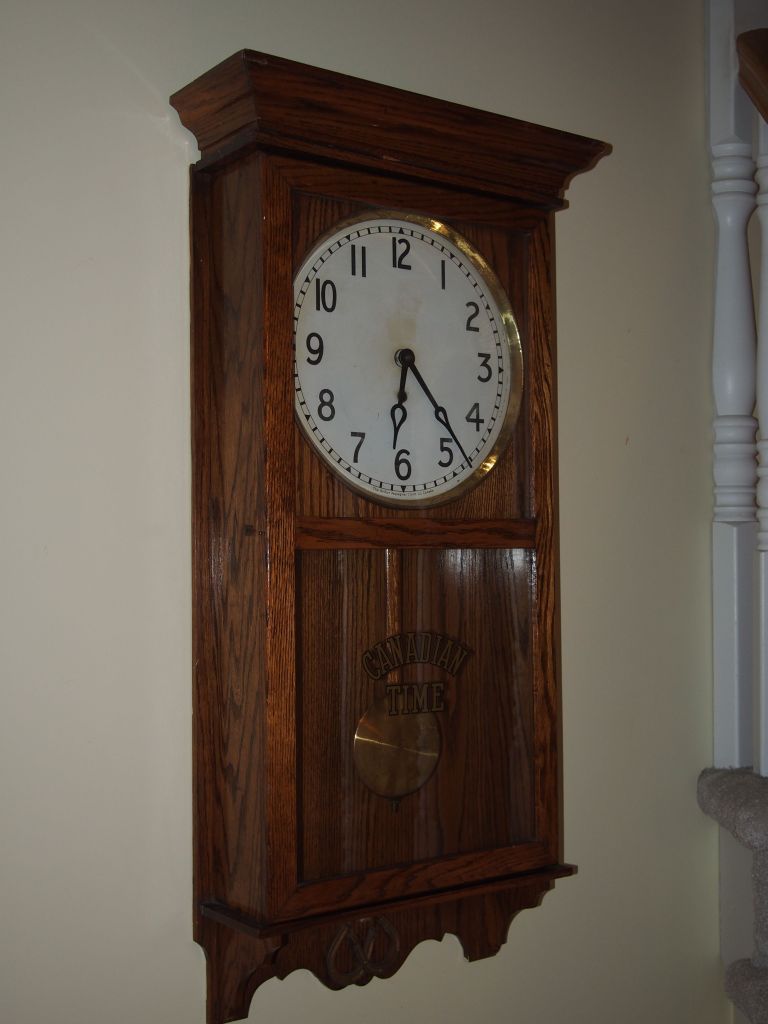
In my collection, I have an Arthur Pequegnat Canadian Time clock that is undoubtedly old, but I cannot pinpoint its exact year of manufacture. The company produced the Canadian Time model between 1917 and 1941, but the movement and case design do not provide a definitive clue to narrow down its age any further.
While I can’t pinpoint the exact year, the clock was manufactured between 1917 and 1941. As we are now in 2024, even the latest possible date for its production (1941, the year of the company’s demise) puts the clock at 83 years old, edging closer to the 100-year threshold that defines an antique. If the clock were produced in the earlier part of that range, it would already be over 100 years old, meeting the criteria for being considered an antique.
Classifying the Canadian Time clock as an antique also acknowledges its historical and cultural value. The clock embodies the craftsmanship and design aesthetics of early 20th-century clocks, capturing a snapshot of that era’s manufacturing techniques and style. This designation also reflects its quality and the ongoing appeal it holds for collectors and historians alike.
If I were to sell it I would classify it as an antique.
What Truly Matters
Whether your clock is antique, vintage, or collectible, the most important thing is that you enjoy it. Ultimately, a clock’s true value lies in the stories it tells, the memories it holds, and the joy it brings to its owner—qualities that transcend any label or age.
Discover more from Antique and Vintage Mechanical Clocks
Subscribe to get the latest posts sent to your email.
 Antique and Vintage Mechanical Clocks
Thanks, another gre
LikeLike
My 148 year old antique Hamilton time only Octagon short drop lives again.
sadly I can’t load a pic
LikeLike
Good news. You might have sent me a photo, I’ll check.
LikeLike
Struggling now with this Meiji clock. I tore it down but my photos of the chime arms didn’t show the orientation of the one arm. The count wheel arm is not an issue it’s the other one. I’m not even sure yet what it does but I think it’s triggered by the main motion works arbor.
Get Outlook for iOShttps://aka.ms/o0ukef
LikeLike
I would have to see a photo or two. Email me at ronjoiner@antiquevintageclock.com
LikeLike