
I recently had the opportunity to expand my collection with more Canadian-made clocks, including a 30-hour Ogee clock produced by the Canada Clock Co. at their Hamilton plant between 1880 and 1884.
Canadian clock companies have historically struggled to survive due to fierce competition from American manufacturers. Companies like Westclox in Peterborough survived largely due to their connections with U.S. parent companies, while smaller firms like Pequegnat persevered independently for as long as possible until the market and materials eventually declined.
Clockmaking in Whitby & Hamilton, Ontario
From 1872 to 1884, a group of Canadian clockmakers sought to compete with American companies by producing locally-made clocks designed for the Canadian market.
The Canada Clock Co. (Whitby, Ontario), the Hamilton Clock Co. (Hamilton, Ontario), and the Canada Clock Company (Hamilton, Ontario) faced significant challenges in the 19th century during a 12-year span as they sought to establish Canada’s presence in the clock-making industry.
The Canada Clock Co. was founded in Whitby, Ontario, in 1872, but its operations ceased after just four years, largely due to a catastrophic factory fire.
In 1876, key figures from the failed company, including manager John Collins, relocated to Hamilton to form the Hamilton Clock Co. Despite this renewed effort, the company folded after four years, halting production in 1880.
Later that year, another attempt was made to revive the industry with the creation of a new Canada Clock Co., reusing the old name and operating out of the former Hamilton Clock Co. factory. Unfortunately, success remained elusive, and the company declared bankruptcy in 1884, marking the end of a dozen turbulent years of clock production in the Canadian market.
Movements were made in Canada though they were essentially copies of American movements, most notably those manufactured by the Waterbury Clock Company. Case styles were also “borrowed” from Waterbury, Ansonia, and New Haven. Made in Canada, yes, original designs, no!
30-hour Ogee Clocks
Fortunately, many clocks from the three companies have survived to this day and occasionally they show up on online auction sites and other for-sale sites.
I have one other Ogee clock from this group of companies, one from the Hamilton Clock Company. It is exactly the same dimensions as a typical American Ogee of that time and mirrors the clock’s dimensions described in this article.
The brass movement of the Hamilton clock is a 30-hour time and strike and weight driven. Of particular interest is the use of an etched tablet that resembles a silk screen technique.

I have four other 30-hour Ogee clocks, two from Chauncey Jerome, a George H. Clark, and a Waterbury. All share the same dimensions as my two Canadian-made clocks.
Why were they so popular?
They were popular in the 19th century for a number of reasons. Most households did not need clocks with extended run times, and daily winding became a routine part of life, so the 30-hour duration was not seen as a disadvantage.
They were more affordable to produce and purchase, making them accessible to a broader audience. The weight-driven mechanism was simple, reliable, and required little maintenance. Unlike steel springs, which were expensive to manufacture in the early days, the weights were cheap to produce, further reducing costs.
Finally, the Ogee clock’s distinctive double-curved molding often made with exotic veneers was visually appealing and complemented the furniture styles of the period.
Canada Clock Company Ogee
My latest Ogee was made between 1880 and 1884 at the Canada Clock Co. factory in Hamilton, Ontario.

This clock has several intriguing features. First, it is the only one in my Ogee collection that includes an alarm function. Before the widespread availability of affordable alarm clocks or reliable pocket watches, many people relied on their household clock to wake them up in the morning. This was especially helpful in agrarian societies, where waking up early was essential for tending to livestock or starting farm work.

Second, the glass tablet showcases a unique cherub figure that differs from any designs I have encountered on similar clocks from the three companies. Unfortunately, the cherub has partially faded over time.
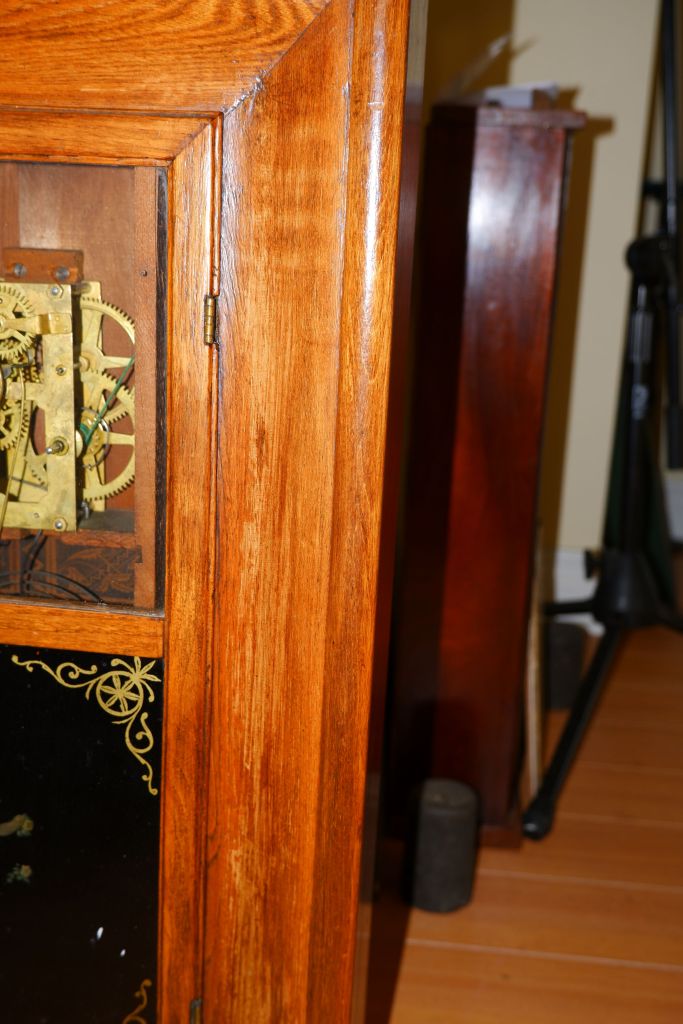
Third, the clock features an imitation wood-grained finish that I have not encountered on other Ogee clocks. Genuine exotic or high-quality wood, such as mahogany or rosewood, was expensive. By using cheaper, locally available wood like pine or basswood and applying a faux wood grain finish, clockmakers could mimic the look of luxurious woods at a fraction of the cost.

While most of the “grain” is still intact, some of it has worn away in the Ogee section on the right side. Although it requires cleaning, I must be careful to preserve the “grain.”
Fourth and final, it is one of the few Ogee clocks I have encountered that still has the dust blocks for the pulleys intact. There are two, one on each side located on the top of the case. These are frequently lost at some point in the clock’s life.

The label is mostly intact missing the bottom left-hand corner section. A clock’s label includes the name of the manufacturer. This helps identify where the clock was made and by whom, which is essential for authentication. This is particularly important when there is no maker’s stamp on the movement.
Servicing and Cleaning
This might turn into a winter project since I have several clocks waiting for servicing. However, I’d like to focus on the case first to preserve the faux grain. The plan is to give it a light cleaning and apply a coat or two of traditional shellac to help protect the finish.
I noticed that the hammer lever (strike-side) got stuck when I briefly ran the clock. It’s probably just a small adjustment, but I’ll need to disassemble the movement regardless. While I’m at it, I will also take care of any wear issues.
Discover more from Antique and Vintage Mechanical Clocks
Subscribe to get the latest posts sent to your email.
 Antique and Vintage Mechanical Clocks
Anyone else pick up on the irony? A typical 19th century work day easily run sixteen hours plus for both of a hard working couple, (eg. 5am-9pm). Yet found time out of their busy day to wind a 30 hour clock. A Eight Day clock must have seemed luxurious. Ironic. In spite of todays time saving devices, many of us simply “don’t have the time” to have a 30 hour clock in regular service.
LikeLike
Nicely put, Marty.
LikeLike
The dial appears to be a Waterbury one due to the corner decorations. The same could be said for the movement. I’d have to see a closer image to compare if they’re identical or not. The use of the nuts for the pillars tells me it’s after 1870s. I have no idea if they were importing American movements and parts and simply reselling them in their own cases with their own labels (this was not uncommon, and the US movement makers may even have supplied unmarked movements for this).
LikeLike
I am always suspicious of the dials on these clocks and never sure if they are original. However as they copied Waterbury movements it makes sense they would source dials from them as well. Still, a nice clock for the price.
LikeLike
Wonderful site glad I found it while looking for information about a New England Clock , Conn. This clock has a time only movement made in Germany. The arm attached to the pallet moves free to one side only, and it stops at 12 on the way back and will not go beyond, and the pendulum will swing on the hanger but soon stops. It seems the pallet is stopped by the escapement wheel at 12 and can’t move any further. Is this normal?
Thanks for any observation.
LikeLike
Can you send me some photos. Please send to ronjoiner@antiquevintageclock.com
LikeLike