
Accepting the schoolhouse clock as a restoration project, I was prepared for the inevitable wear and tear it had endured over time. Despite its condition, I wondered what it would look like if the case was rejuvenated.
Decisions, decisions.

My collection of wall clocks includes several schoolhouse models and I am continually impressed by their resilience despite their age.
These clocks, renowned for their durability, keep time reliably, even in well-worn condition.
While many of these clocks spent their lives in school rooms, some ended up in commercial establishments and offices, often neglected until they stopped working. I’ve seen clocks with bushing holes so enlarged it’s a wonder they still ran.
This particular clock, manufactured by New Haven, boasts a classic design with a twelve-inch Roman Numeral dial and a distinctive short drop style. Its standout feature is the reverse painted glass on the access door, allowing the decorative pendulum bob to be seen in motion.
The softwood case is veneered in Rosewood veneer accents. The clock’s case must have been quite elegant at one time, but now it is showing much wear and tear.
Is it even worth fixing? However, let’s look at the movement.
The movement
I am impressed by the size and construction of the movement. The plate measures 5 inches tall and 3 inches wide, but it extends to 5 1/2 inches wide when including the main wheel and the third wheel. It is one of the larger time-only movements I have seen in an antique clock. Two wood blocks secure the movement to the case.

It has been challenging to determine the date of manufacture of the movement, even though the trademark design should provide some clues. Despite searching through antique clock forums, the best match I found was an identical movement in a Cambria wall clock, which had no trademark but featured pins instead of nuts to hold the plates together.
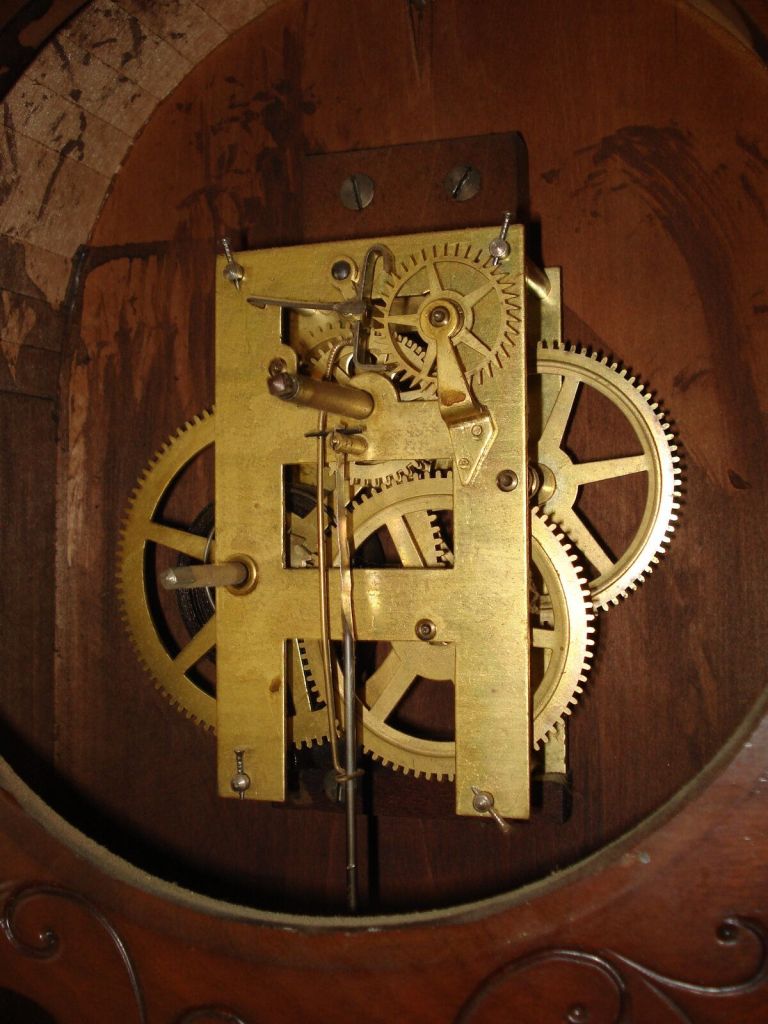
According to this site New Haven began using this trademark style in 1890.

Although it looks clean, my plan is to take it apart and assess what needs to be done. Join me in my next article as I guide you through servicing the movement.
Discover more from Antique and Vintage Mechanical Clocks
Subscribe to get the latest posts sent to your email.
 Antique and Vintage Mechanical Clocks
You must be logged in to post a comment.