
American clocks with double dials, often referred to as “double dial” or “two-dial” clocks, were common in the 19th century.
There are two categories of double-dial clocks but first, let’s talk about the calendar clock. These clocks typically have one dial for the time and another for the calendar. The reason for this design was to provide both timekeeping and a calendar function in a single device.

By integrating both time and calendar functions into a single clock, manufacturers provided a practical solution for the needs of households and businesses.
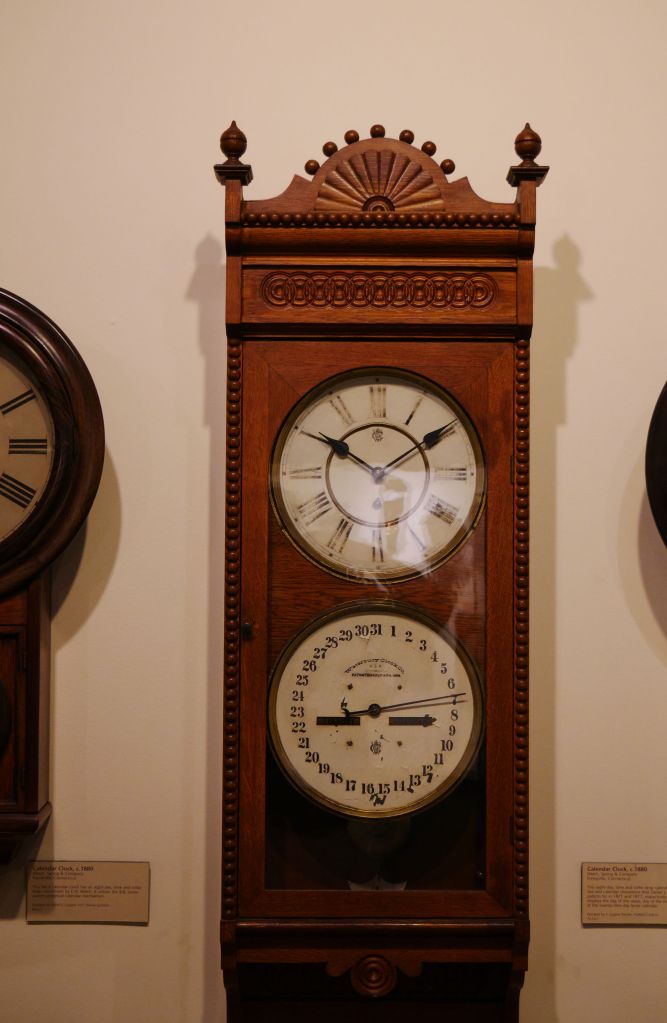
Moreover, before the widespread adoption of standardized timekeeping systems, local time could vary significantly from one place to another. Having a clock that displayed both local time and the date helped people coordinate activities and synchronize their schedules more effectively.
Fashion (Southern Calendar Clock Co.) and Ithaca were well-known makers of quality shelf and wall calendar clocks. Seth Thomas was a significant producer of office calendar clocks.

Less common are double-dial clocks that exhibit two separate times. A typical two-dial clock of this type would display railroad time and local time or railroad time and city time.

When the two major US railway companies adopted Standard Time in 1883 the Seth Thomas Company began the manufacture of 8-day weight-driven clocks with two time dials. The clocks would come with an upper and lower plaque depicting local time and railroad time. Some clocks were production clocks while others like the #17 were special order clocks.
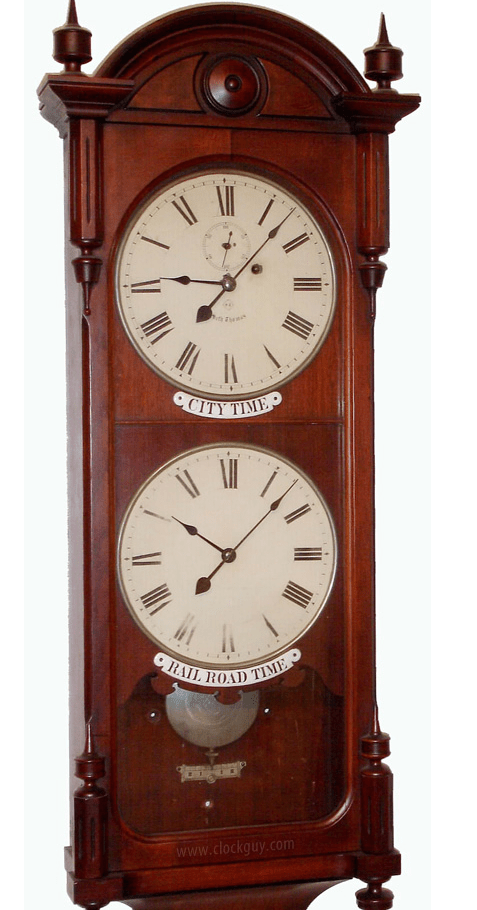
Both dials are run by one movement with a connecting drive shaft between the upper and lower units. Once the upper movement is set up, the lower unit will display the relative difference. Moving the hands on the upper unit moves the hands on the lower unit accordingly.
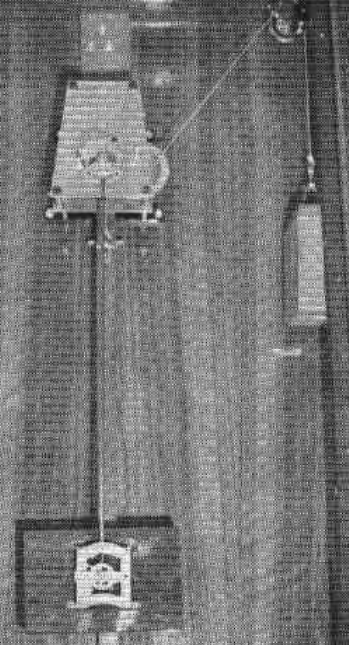
Examples of the more prevalent #6 can be readily found, whereas the specialized #17 is exceptionally rare. Regardless, acquiring either double-time model would entail a significant investment of thousands of dollars.
Discover more from Antique and Vintage Mechanical Clocks
Subscribe to get the latest posts sent to your email.
 Antique and Vintage Mechanical Clocks
Please explain the difference between railroad time and city time. Thank you for posting the beautiful time piece photographs.
LikeLike
City time referred to the local time observed within a particular city or town. While railroad time (or standard time) provided a standardized reference for train schedules and communication between different regions, cities often retained their own local time for everyday activities and social purposes. Years ago, while traveling through Thunder Bay, Ontario, my wife and I stopped at a small town for supper, assuming the restaurant would be open. However, to our surprise, it was closed. We later learned that the area did not adhere to the local time zone, aligning itself instead with a neighboring town in a different time zone for commercial purposes.
LikeLike
Hey I’m new here. I saw your post with the Canadian Par Aro clock you saw in Ladysmith. Im one town away from ladysmith and I picked it up. It runs good but the body is extremely cheaply built. Might strip it for the movement or sell it. unless you want it i could sell it to you since you collect Canadian clocks.
LikeLike
Yes, my focus is on Canadian-made clocks or those with a Canadian connection. What steered me away from the Par Aro clock was the price. A little too high for what it was worth. As I recall the movements are Japanese and not the highest of quality. The cases also lack the finishing and quality of comparable clocks from the US and Canada. If you would to gift it to me I would accept it but in the meantime I will be on the lookout for one locally.
LikeLike
Very interesting blog. Are the lower dials always driven by the upper dial’s mainspring? If so, were they still 8 day wind clocks? Thanks!
LikeLike
There is one movement. The lower calendar is connected by a rod or rods which actuates a smaller geared mechanism to turn a cylindrical calendar. A simpler design for an analogue dial calendar connects the top movement to the bottom by means of rod running from the movement and attached to a rachet that advances the calendar one click (representing a day) at a time. See the photo at the top of this page link. https://mb.nawcc.org/threads/national-clock-company-new-haven-calendar-clock.201186/
And yes, most were eight day. Pretty ingenious for the time.
LikeLike