
During the winter months, I teach part-time in a justice program at our local community college. The other day, I had a former student visit this blog and she commented on her admiration for one of my clocks, specifically a time and strike crystal regulator by Ansonia.
Thanks, Cate for allowing me the opportunity to profile this clock once again!

First a history of how I acquired the clock and what I know about it. While exploring an antique shop in Bloomfield, Ontario, my wife came across an intriguing find – an antique glass-cased brass time-and-strike American-made clock with an open Brocot escapement, manufactured by Ansonia.
This particular clock, featured in the 1905 Ansonia catalog under the name “Prism,” was priced at $29.00, a substantial sum for its time. It was the simplest design in the crystal regulator line and the lowest-priced model.
Collectors in the clock world frequently have discussions regarding the proper name for these clocks. Are they four-glass clocks or crystal regulators?

A “four-glass clock” is a broader term referring to clocks with glass panels on all four sides, while a “crystal regulator” is a more specific subtype of mantel clock known for its transparent glass panels and often associated with high-quality craftsmanship. The primary differences lie in the design, purpose, and origin. The term “crystal regulator” is used specifically for American clocks that fall under the broader category of four-glass clocks, distinguished by transparent panels on all sides. Conversely, a French-made clock with a similar appearance is generally referred to simply as a four-glass clock.
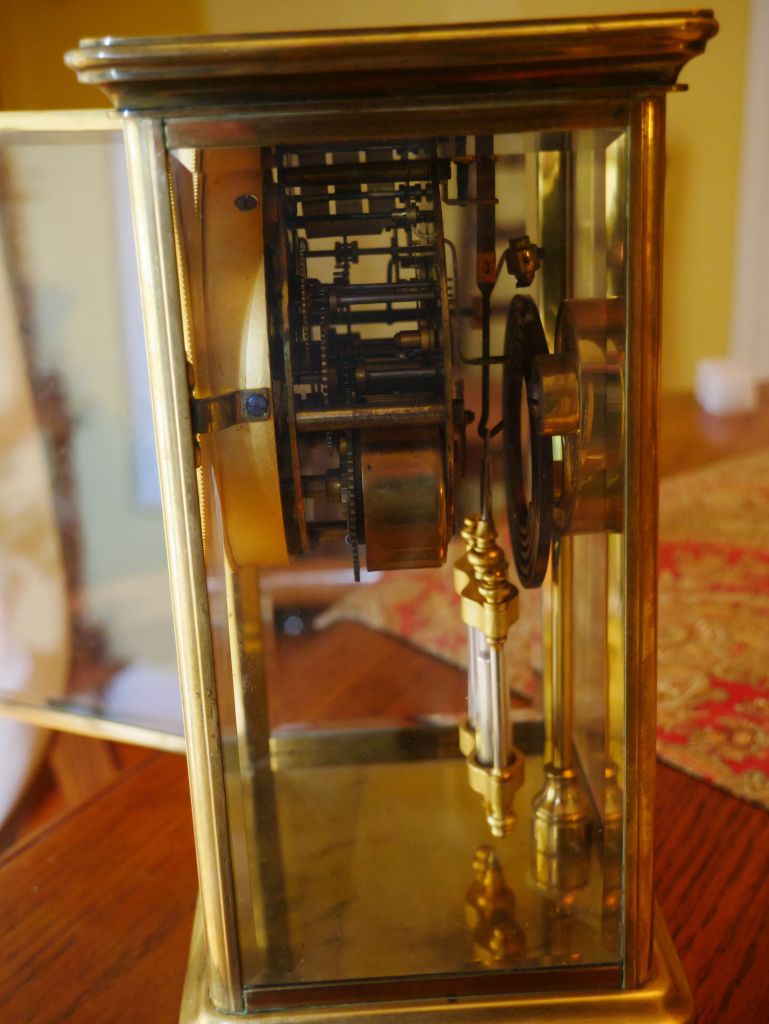
While both types typically feature Brocot escapements, there’s a notable distinction in the pendulum design. Many four-glass French clocks incorporated mercury-filled pendulum vials, whereas American crystal regulators utilized nickel slugs within transparent vials.
American Crystal Regulators were essentially replicas of French regulators, boasting similar design elements such as a stylistic gong block, visible Brocot escapements, round movement plates, and beveled glass panels. However, they were an economical alternative to the French clock.
French regulators, crafted by high-profile makers like Japy, Marti, Vincenti, and Mougin, were highly esteemed and often included mercury pendulums. In the American market, Ansonia and Seth Thomas were prominent manufacturers of such clocks. They were not built to the higher standards of a French clock and were priced accordingly. Nonetheless, American Crystal Regulators have become sought-after by clock collectors.
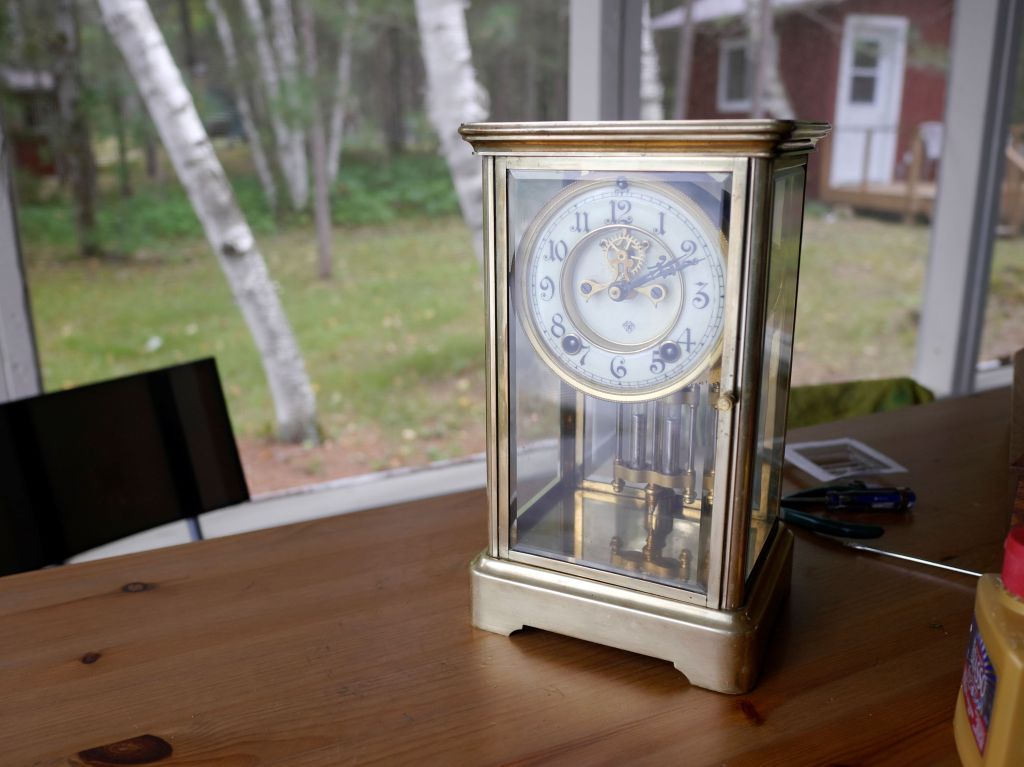
The four glass panels of this clock are in very good shape, with only a small corner chip on one panel, which I discovered a few days after purchasing the clock. Fortunately, the chip is not visible from the front. The glass was likely damaged during a servicing session.
Overall, the clock is in good condition for its age and was made somewhere between 1905 and 1910. The brass, though tarnished, cleaned up nicely with the use of a cleaner. The brass was also lacquered to maintain its shine and protect it from deterioration.

Upon acquiring the clock, it was not in running order, and my initial evaluation suggested that all it might require was a thorough cleaning and some bushing work. There was certainly a small amount of wear and the movement required 5 bushings, all on the front plate.
After disassembling, cleaning, and addressing wear, it ran without issue. Now, it’s one of several clocks that run weekly.
I would have to say it is one of the more unique clocks in my collection.
Discover more from Antique and Vintage Mechanical Clocks
Subscribe to get the latest posts sent to your email.
 Antique and Vintage Mechanical Clocks
You must be logged in to post a comment.