
In this post, I describe an unusual issue when relocating my mini Vienna Regulator clock. Out of all my clocks, this one tends to be the most sensitive when I move it to a different location in my home. I’ve previously shared my experiences with this clock because it’s not the first time I’ve encountered issues.

Exploring a brief history of Vienna Regulators provides insight into why this clock is a significant milestone in horological evolution.
The Vienna Regulator clock, also known as the Vienna wall clock, is a type of precision pendulum clock that originated in Vienna, Austria.
The style and craftsmanship of Vienna Regulator clocks are often associated with exceptional quality and precision.
The development of the Vienna Regulator clock was influenced by several factors. One of the key factors was the rising demand for accurate timekeeping during the Industrial Revolution. Vienna, as a center of craftsmanship and technological innovation, played a vital role in meeting this demand.
Vienna regulators are distinctive and typically have a slender wooden case, which houses the pendulum and the clock mechanism. This design allowed for a longer pendulum, resulting in greater accuracy. The movement was typically attached to a frame on the backboard of the case by a keyhole design which allowed the movement to be lifted and removed from the case for servicing. The pendulum was often enclosed in a glass door or window, allowing the movement to be admired from the front and side panels while protecting it from dust.
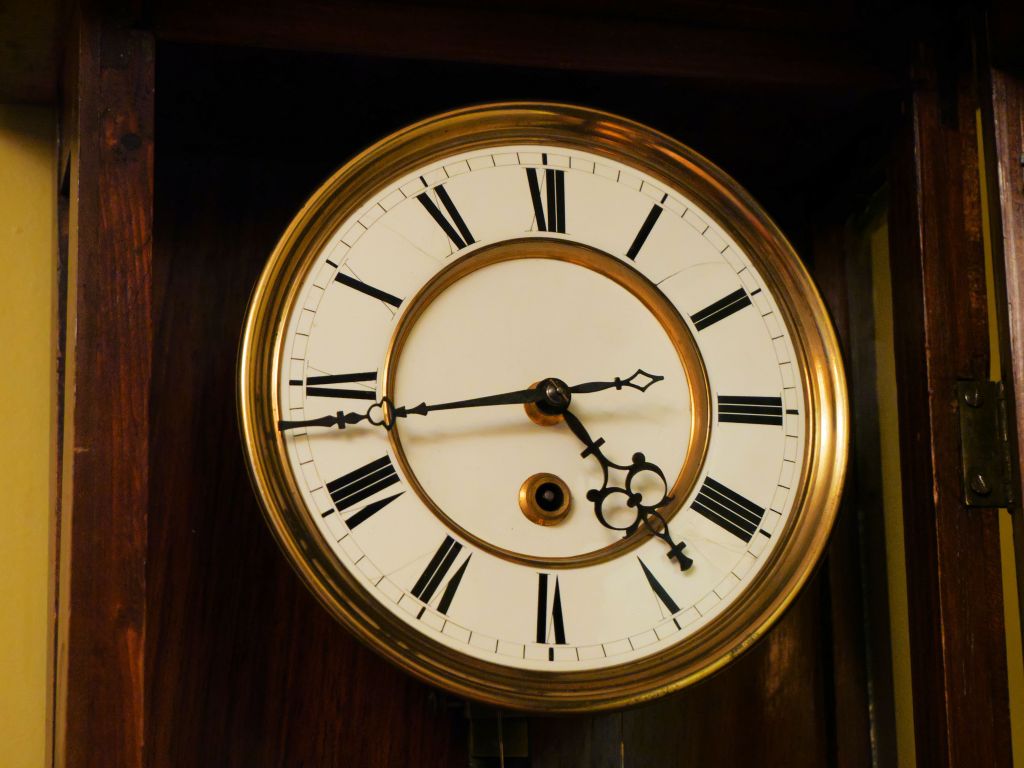
The cases, made of various types of wood such as walnut, oak, or mahogany, were often finely crafted with decorative inlays, carvings, or veneers. The clocks featured a white enamel or porcelain dial, usually adorned with Roman numerals and ornate hands.
The movement of the Vienna Regulator clock was powered by weights suspended on cables or cords. The weights (up to three) were typically wound up once a week, providing the necessary power for the clock to run accurately. While the majority of these clocks were designed to operate as 8-day runners, some were specifically engineered to run for 30 days and longer.
During the 19th century, the Vienna Regulator clock underwent several design changes. The earlier models, known as “Vienna Regulators of the Biedermeier period,” were characterized by a simpler and more classical style. Later models, influenced by the emerging Victorian and Rococo revival styles, featured more elaborate ornamentation and decorative elements.
While the popularity of the Vienna Regulator clock declined in the early 20th century with the advent of more modern clocks, it remains valued by collectors and enthusiasts today.
It’s also worth noting that the term “Vienna Regulator” typically denotes a clock style commonly manufactured in Germany and Austria from approximately 1804 to the end of the 19th century, even if it wasn’t necessarily crafted in Vienna.
But let’s go on.
What is making this clock stop?
During an unusually cold winter day, a substantial plumbing problem caused significant leakage from a ceiling pipe in our family room. To address the damage, we had to replace the pipes and patch the ceiling. During the repairs, we decided to refresh the room’s decor, taking the opportunity to make a few changes. As part of the update, we moved our Vienna Regulator clock from upstairs to the family room to showcase its elegance.
After running flawlessly for a few days, the clock stopped. I checked the clock’s beat, adjusted it, and confirmed its proper vertical orientation. This resulted in the clock running for a few hours before encountering another stoppage.
Suspecting a tangled cable issue which could cause a loss of power to the movement, I took the movement out of its case and carefully rewound the cable onto its take-up reel but this did not resolve the issue.
Could the problem be related to wear? I removed the movement from its case and disassembled it, inspecting for any signs of wear including bent arbors, or damaged or worn teeth. However, I found no such issues. In fact, the movement looked very clean, and the oil in the pivots appeared to be in excellent condition.

After reinstalling the movement into its case and reattaching the weight and pendulum, I noticed a slight wobble in the pendulum, that was not visible from afar.
Out comes the movement which consisted of removing the weight and unhooking it from the frame posts. Upon reexamining the movement, everything appeared to be in proper order. In most clock movements the suspension spring is physically attached to the movement. In clocks of this type, the pendulum rod is attached by the suspension spring to the backboard frame, and there could be a tendency to overlook inspecting the suspension spring as the cause of the stoppage.
This time, the problem was identified as a slightly kinked suspension spring. Lacking a spare, instead of replacing it, I removed the pendulum assembly from its case and used the shaft section of a small screwdriver to smooth out the kink. A temporary fix, to be sure, till I source the correct spring for this clock.
Some clocks can be temperamental and a clock that works fine in one location may not work in another. However, it would appear that moving the clock from one location to another caused a deformity in the suspension spring. So, the fault was mine.

My other Vienna Regulator keeps ticking without a hitch, unlike this clock which tends to act up when moved. It’s running fine now and will stay at its new location which is back upstairs.
Discover more from Antique and Vintage Mechanical Clocks
Subscribe to get the latest posts sent to your email.
 Antique and Vintage Mechanical Clocks
Whew! That was a thorny problem to solve. Good work, Ron.
LikeLike
Thanks.
Ron
LikeLike
Nice write-up. We experienced the same issue when my wife inherited her mother’s 1870 Vienna Regulator and we moved it to our house. Once we perfectly aligned it, vertically, it started working. The clock is super sensitive to movement. It’s a beautiful classic (8-day wind) timepiece although its missing some finials.
LikeLike
Thanks. I have another less finicky Vienna that has worked perfectly since I bought it 6 years ago.
Ron
LikeLike