
Dropping in Facebook Marketplace from time to time is interesting because there’s always the possibility that an unknowing seller might list an antique clock without realizing its true value. Occasionally, I strike gold, however, the majority of listings mainly feature commonplace antique clocks, alongside an overwhelming abundance of quartz-driven ones.

On any typical day, it’s a common occurrence for me to find more than half a dozen 31-day clocks available for sale.
What is a 31-day clock
A 31-day clock is a type of mechanical clock that runs for about a month before it needs to be wound up again. It has a pendulum that swings back and forth to regulate the time. The name 31-day clock comes from the fact that it can operate for 31 days without stopping, but some clocks may run for a few days more or less depending on their level of wear.
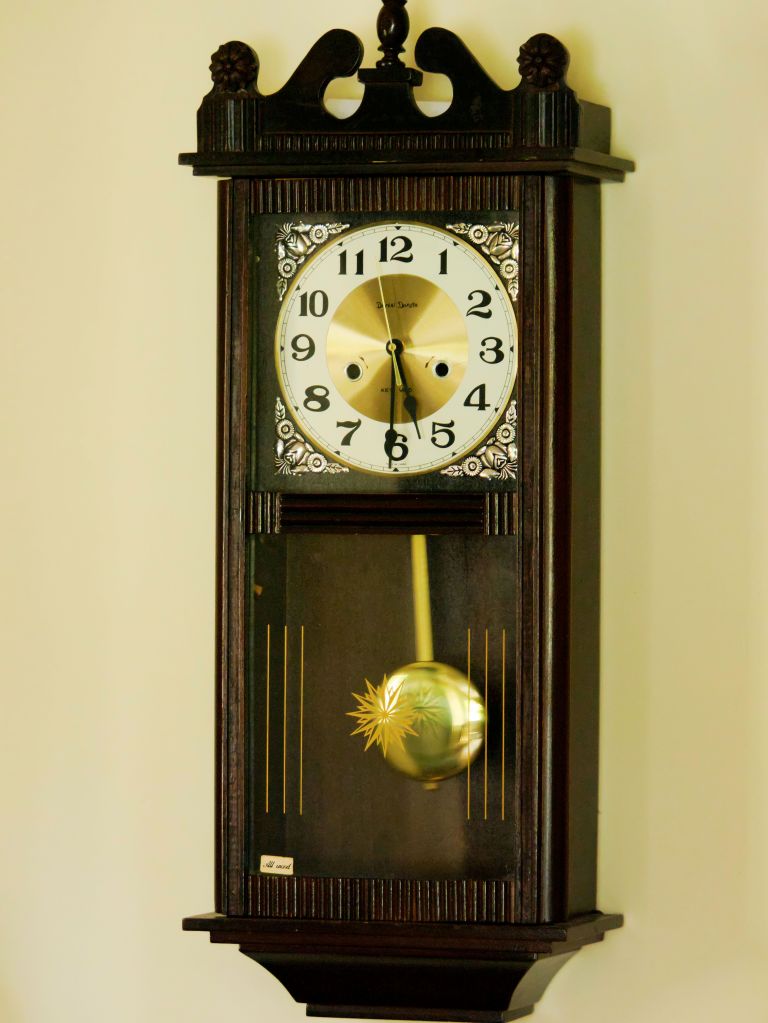
A significant number of these clocks are designed as spring-driven time-and-strike models, meaning they strike every half-hour announcing the time on the hour.
Most 31-day clocks originate from China or Korea, with trade names such as Citizen (not to be confused with the watch company), Daniel Dakota, Alaron, Olympia, Sabre, Beacon, and well, the list goes on. Directional arrows near the winding arbours typically give away the origin of the clock, with a common association being Chinese or Korean manufacture.

Acquiring a vintage 31-day wall clock manufactured in China or Korea will not set you back very much. These clocks were and still are widely available since they were produced in massive quantities during the 1960s through to the 1980s. It is a safe bet that a vast majority, around 99%, have never seen the inside of a clock repair shop. Their inexpensive movements appear remarkably resilient, enduring for long periods and finally meeting an unceremonious end in the trash or, popping up on online for-sale sites such as Facebook Marketplace.
Clockmakers typically prefer to avoid servicing these clocks and may encourage you to swap out the mechanical movement for a quartz one if the clock is not functioning. This is primarily due to the powerful and potentially hazardous mainsprings in 31-day clocks, which make working on them a risky task. Secondly, these clocks have such low value that any maintenance, even basic oiling, will cost many times more than the clock is actually worth. Thirdly, replacement parts are impossible to find and any repairs necessitate salvaging components from similar movements. Indeed, converting them to quartz movements is not such a bad idea.
The Distinction Between 31-day and 30-day clock
31-day clocks should not be confused with antique 30-day clocks, such as those produced over a century ago by companies like Seth Thomas, Welch, Waterbury, and makers of 30-day Vienna Regulators.

The latter boasted sturdy movements with deadbeat escapements, large cases, and dials, and a significant number were powered by weights. These clocks were more accurate than the average domestic clock of the time and were often found in public places such as post offices, libraries, business offices, retail establishments, and factories. Unlike 31-day clocks, collectors find these clocks desirable.
If you are fortunate enough to come across a 31-day clock at a remarkably low price, it’s important to temper expectations regarding its resale value. Despite being budget-friendly acquisitions, these clocks typically don’t appreciate significantly in value, and it’s wise to view them more as charming additions to your collection rather than lucrative investments.
Discover more from Antique and Vintage Mechanical Clocks
Subscribe to get the latest posts sent to your email.
 Antique and Vintage Mechanical Clocks
I enjoy reading and learning about clocks from your page. I have one of the German wall clocks that you wrote about. I am fortunate to have a clock shop less than a mile away and from which the clock came.
LikeLike
Thank you.
LikeLike