
I first wrote about this clock in April 2023 after having won it at auction. With so many other projects on the go, I can finally allocate time to focus on servicing this captivating German time and strike mantel clock.

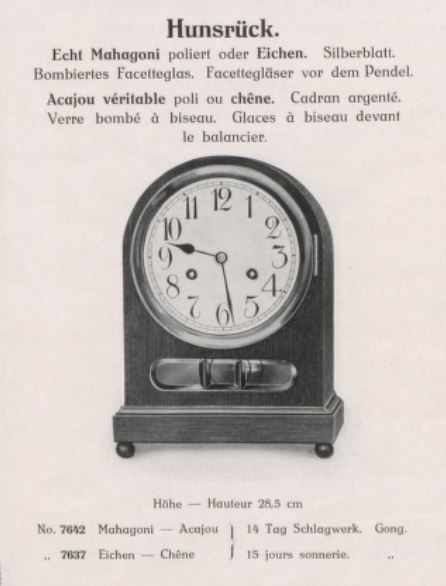
The 1915 Junghans catalog identifies the clock as the Hunsruck, named after a mountain range in Germany, and provides its specifications as 28.5 cm in height with a mahogany or oak case construction, a 14-day run time, and a silvered dial. This clock is the mahogany cased model.
The movement is a time-and-strike design that was a hallmark feature of numerous Junghans mantel clocks during that period. I have one other Junghans mantel clock with an identical 151 movement.

The Junghans trademark is boldly showcased on the gong block and inscribed on the back of the movement. On the back plate, it is stamped B13 which denotes the movement as having been manufactured in the latter part of 1913.
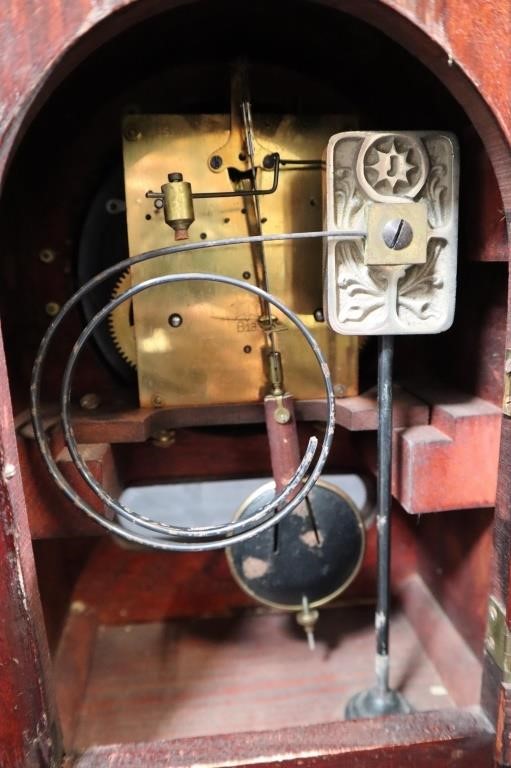
Removing the movement from the case is relatively straightforward. The movement, which rests on a wooden support board is held in place by two rather large 1 1/8 inch wood screws. After taking the movement out of the case, two brass thumbscrews are removed to release the seat board.
Assessment
Upon my initial assessment, it appears that the movement is in decent condition, overall. However, there is a noticeable accumulation of dirty oil in the majority of pivot holes, indicating a thorough cleaning is necessary.

Upon closer inspection, elongated pivot holes in three locations tell me that new bushings need to be installed: specifically, on the third wheel time side, back plate, and both the front and back plates of the star wheel. The star wheel runs off the count wheel and it is the star points that activate the hammer for the strike.
I use toothpicks to carefully clean out the pivot holes before immersing the plates in the ultrasonic cleaner as part of my standard practice. With a soft cloth, I clean and inspect the pivots on each wheel using a fingernail across the pivot to check for ridges and imperfections. I then check the integrity of the pins in each of the lantern pinions. Once satisfied that the inspection is complete the next step is cleaning the parts in my ultrasonic cleaner.
I will pause here and resume next week with the continuation of servicing the Junghans type 151 clock movement, including details about the necessary bushing work. Additionally, I will provide insights into the case’s condition. Stay tuned for the conclusion!
Discover more from Antique and Vintage Mechanical Clocks
Subscribe to get the latest posts sent to your email.
 Antique and Vintage Mechanical Clocks
I don’t like the ads at all. Can I switch them off? Otherwise useable information for aspiring clock restorers.
LikeLike
I’m glad you find the information valuable. The revenue generated from ads covers the costs associated with maintaining my blog, including domain registration, custom email, and server storage. However, feel free to enable the adblocker in Chrome, and I believe other browsers also offer similar options.
LikeLiked by 1 person
Thanks for the information re ads. Regarding the Junghans make, I had a few interesting ones, in the sense to see and then correct what so-called clockmakers do to those mechanisms. I have a few photos, but not in all the detail you give. I will put these eventually onto my site.
Best regards, Thomas
LikeLike
Thanks. Looking forward to seeing those photos.
Ron
LikeLike