
Recently, I acquired a gallery clock in exchange for another clock. I favour wall clocks over other types due to their convenient wall placement, eliminating the need for a shelf or mantel. Additionally, they tend to draw more attention compared to other clock varieties.
The clock I traded, a rare Canadian cottage clock, held significant value, but overall, I am content with the exchange.

Gallery clocks are often called pub clocks, canteen clocks, or office clocks.
Gallery clocks are often found in public galleries and exhibition spaces, where they serve both functional and decorative purposes. They are usually placed on prominent walls and are designed to be easily visible to visitors. These clocks can vary in style, ranging from antique designs with Roman numerals to more modern and contemporary styles with sleek, minimalist features.
This time-only gallery-style clock made by the Gilbert Company of USA is nondescript and quite ordinary looking. There is nothing special or distinctive about it.
The casing of the clock is relatively light in weight and based on the wood’s coloration, it seems to be made of cherry wood. A previous owner meticulously refinished the case, and while the result is impressive, it appears almost too flawless.
The clock has a 12″ Arabic dial and is 16 1/2″ across with spade hour hand and minute hand with a heavy brass dial bezel. The dial is constructed from paper and lacks a metal backing, clearly indicating a cost-saving measure.
A 12-inch dial is considered the standard size for a gallery clock and a 12-inch dial would have been the maximum size for a domestic environment. I own a smaller 10″ gallery clock, crafted in England, equipped with a conventional spring-driven movement, specifically designed for placement in a compact office setting. Larger 14″ and 16″-inch” gallery clocks on the other hand would have been found in public areas, factories, and post offices.
At first glance, it’s easy to mistake this conventional spring-driven pendulum clock for a fusee clock. Upon closer inspection, however, its features set it apart from the traditional fusee clock, revealing its true identity as an ordinary mass-produced spring-driven time-only American-made clock.

The winding arbour sits just below the central cannon, and above the centre cannon, you’ll find the Gilbert trademark. Interestingly, the winding arbour is positioned in the same location as that of a typical fusee gallery clock.
This specific movement is present in other Gilbert time-only clocks and is almost identical to the one used in the Gilbert Admiral calendar clock.

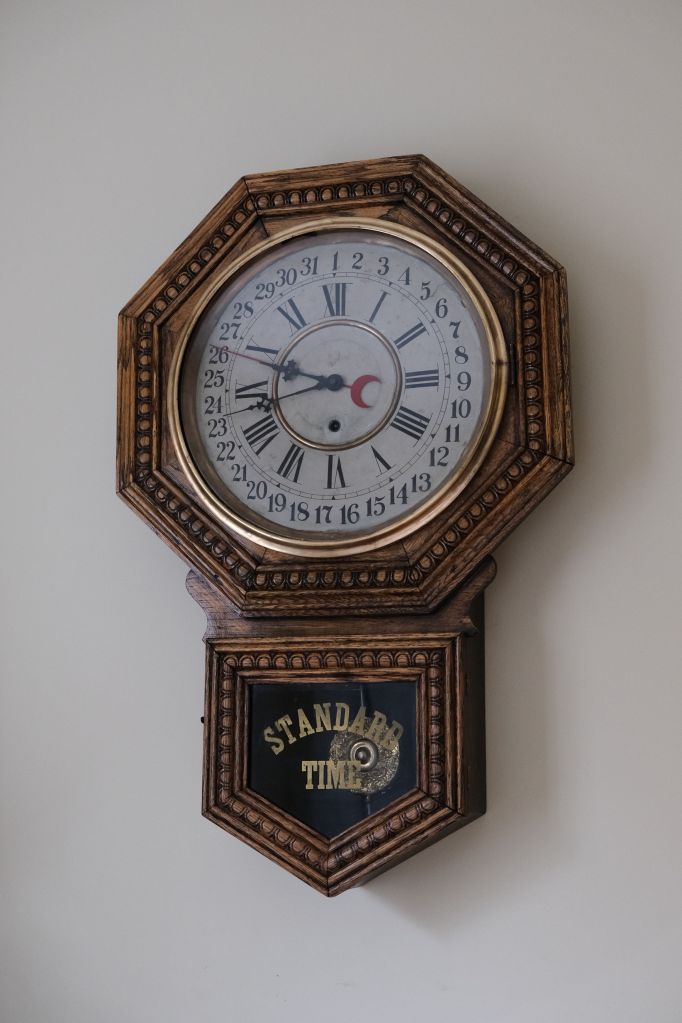
A trap door on the bottom provides access to the pendulum. When the clock is hung on the wall, attaching the pendulum to the pendulum rod is nearly impossible. I discovered that laying the clock on its back, attaching the pendulum bob to the hook, and then carefully mounting the clock on the wall is a slightly easier method.
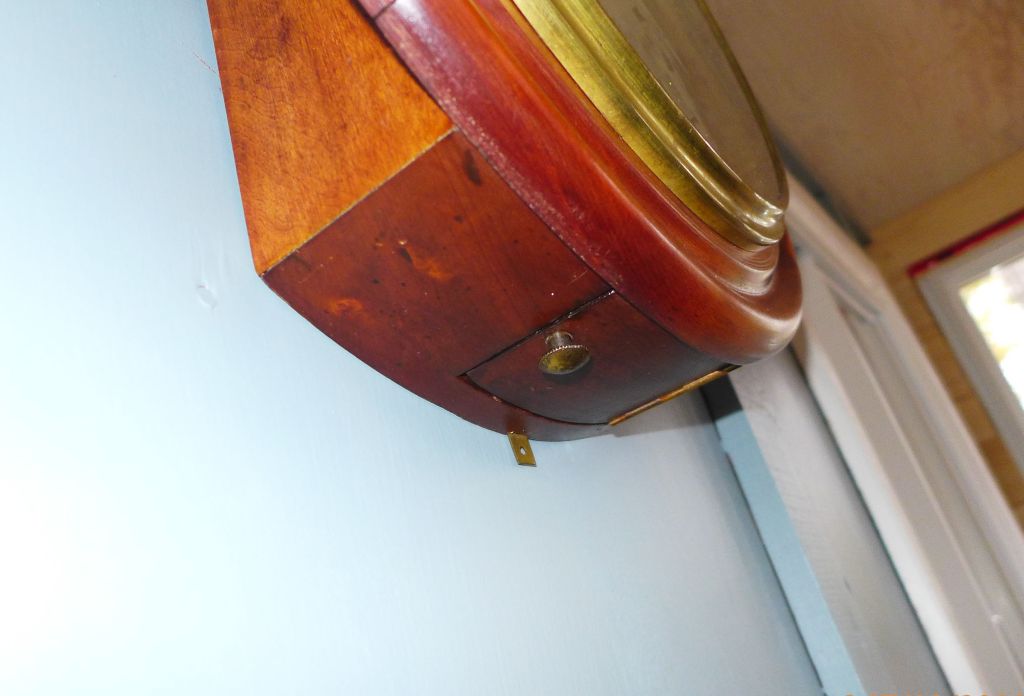
The previous owner found the clock in Virginia and brought it to Canada. The clock was lacking its original glass, but a replacement was included as part of the exchange deal. In addition, the clock was completely serviced, one bushing hole was found to be enlarged and a new bushing was installed.
Two other gallery clocks
The two other gallery clocks in my collection are a clock with a 10″ dial made by a British maker, Empire, and a 12-inch (dial) fusee clock, maker unknown but likely British.
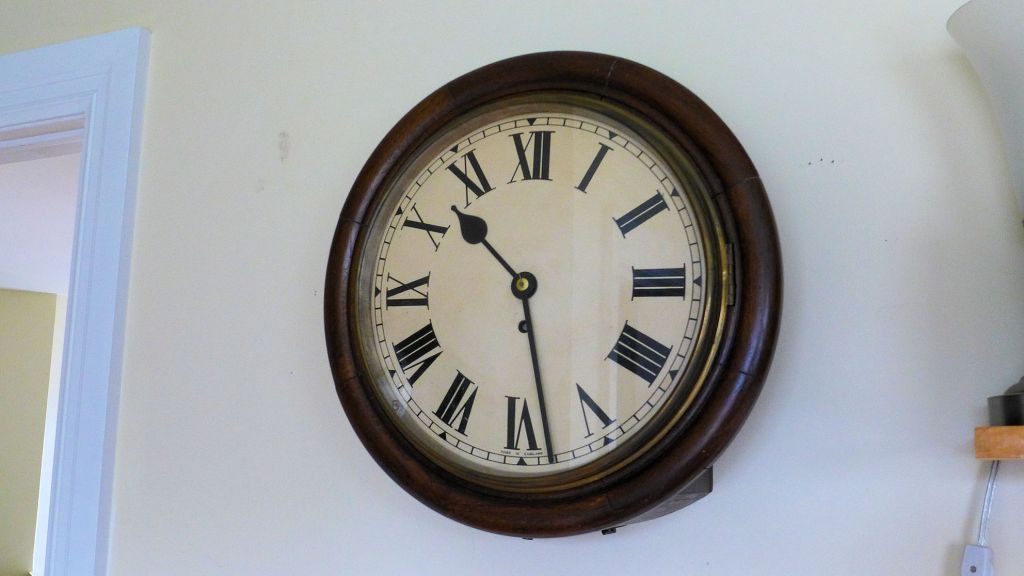
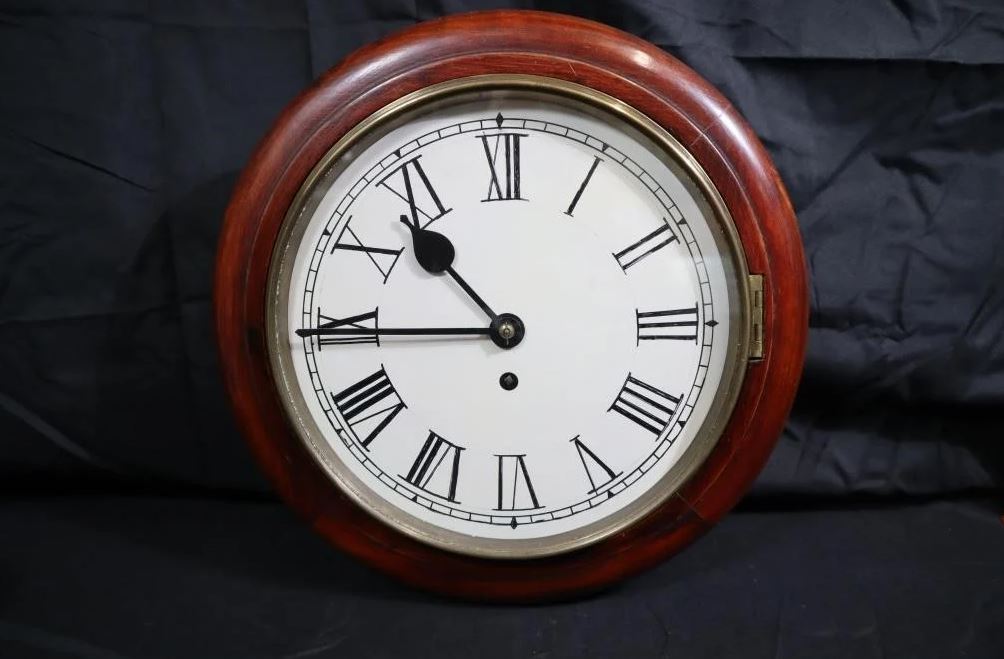
Given that the Gilbert clock underwent a thorough servicing and the missing glass was replaced, my only task remained to find a suitable spot to display it.
Discover more from Antique and Vintage Mechanical Clocks
Subscribe to get the latest posts sent to your email.
 Antique and Vintage Mechanical Clocks
You must be logged in to post a comment.