
During its prime, the Seth Thomas company produced exquisite clocks, and in my view, clocks from the 1870s stand out as the pinnacle of their craftsmanship. This particular clock embodies the design aesthetics of its era, lending it a timeless and enduring appeal.
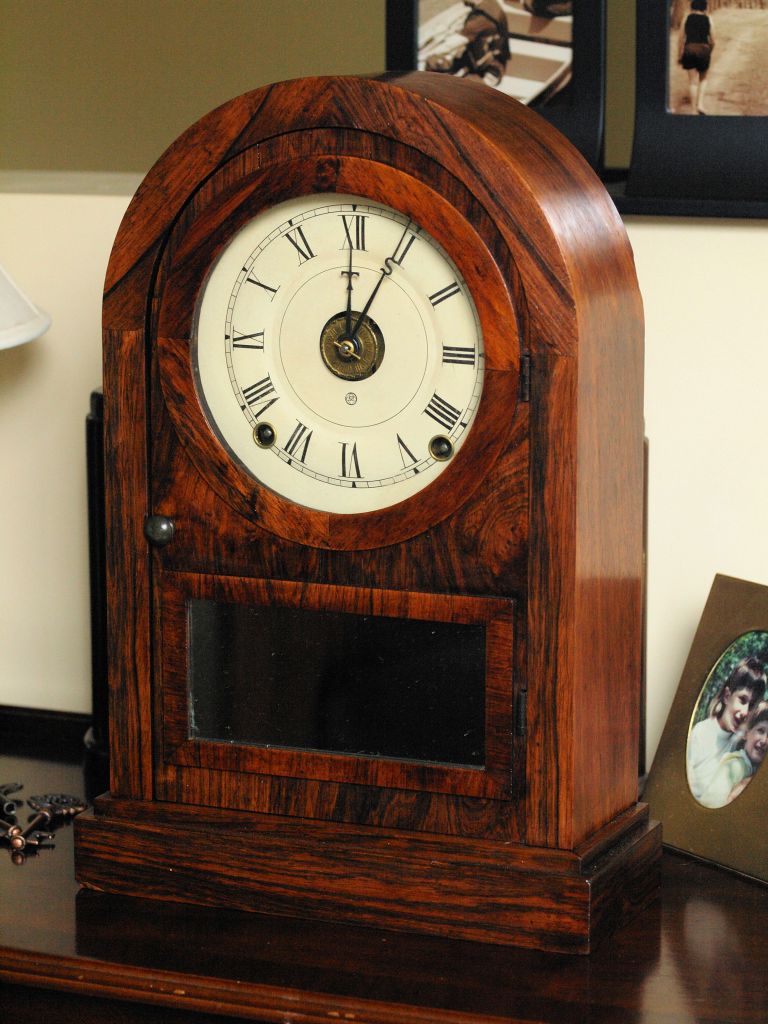
The clock boasts a sizable round top design, measuring 15 inches in height, 10 inches in width at the base, and 4 inches in depth. Encased in a visually appealing Rosewood veneer, and it features a mirrored rectangular lower tablet. Some variants have clear glass, but the original design likely incorporated mirrored glass.
The wood grain is exceptionally bold and eye-catching. A missing sliver of veneer between the 9 and 12 o’clock positions on the bezel, which was absent when I acquired the clock in 2019 at an NAWCC clock convention in the United States, has been faithfully restored.
The clock’s distinctive charm is amplified by its unique stylized hands, adorned with an “S” on the minute hand and a “T” on the hour hand. The clock dial seems too well-preserved to be original although the replacement (?) dial displays the Seth Thomas trademark just below the centre cannon.
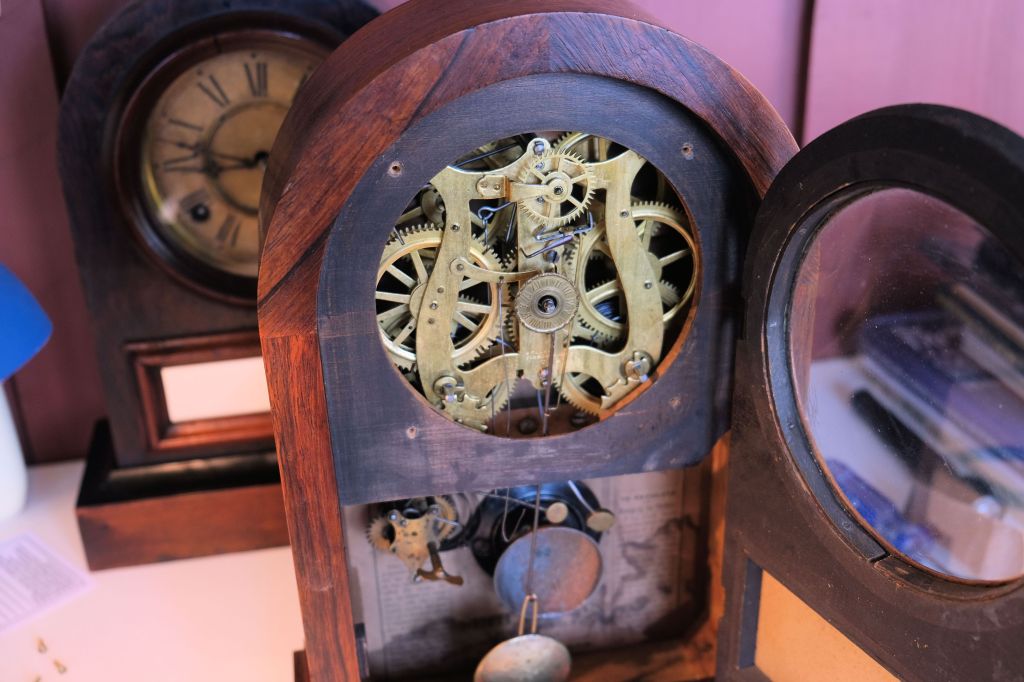
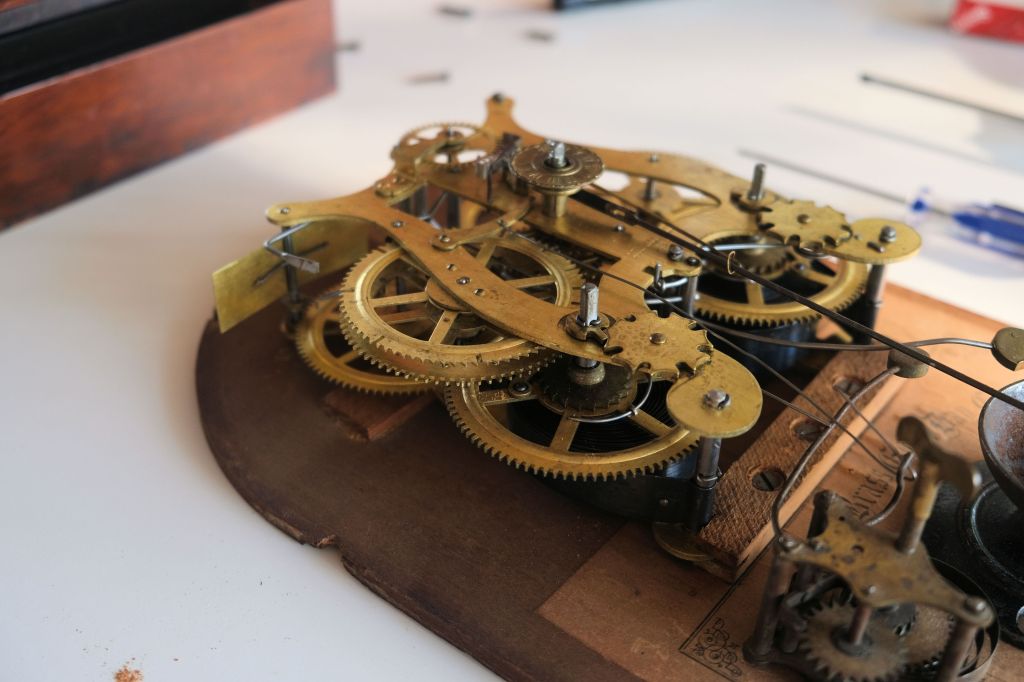
What truly sets this clock apart is its elegant lyre 8-day time and strike spring-driven movement, accompanied by a bell gong with an alarm function. This movement, seemingly stuffed into the case, reveals its intricate workings when the dial mount is removed. The remarkable engineering of the movement is a testament to its adaptability, enabling it to be mounted in a wide variety of clock cases. Nevertheless, as mentioned, it is a tight fit.
The movement proudly bears the die-stamped inscription “S. Thomas, Plymouth Conn.” and is equipped with Geneva stops (or stop-works) for enhanced timekeeping accuracy, a feature often absent in many antique clocks of that period.
Unlike many contemporary clocks, the movement plates are held together with taper pins, reflecting a common practice of the era. The alarm mechanism, situated just below and to the left of the movement is wound by the small end of a double side key. There is an alarm adjustment wheel on the centre cannon with a cam that activates the alarm and once set runs the alarm spring down till the alarm stops which necessitates rewinding each night. The alarm emits a piercing shrill as it strikes the iron bell gong. As the average household had just one clock the sound of the alarm was designed to resonate throughout the entire home.
The movement is mounted on the back of the case using wooden blocks at the top and bottom. To access the movement, the rear panel must be unscrewed, revealing the internal workings.
Inside the case, a well-preserved label declares, ”Spring Brass Eight Day Clocks”, “Made and Sold by Seth Thomas, Thomaston, Connecticut”. While slightly weathered in the lower right corner due to minor water staining, the label predominantly remains intact, adding good context to this attractive shelf clock.
After being stored away for 2 years, I recently dusted off the clock and applied a layer of Minwax finishing paste wax. The plan is to display the clock prominently in my home once again.
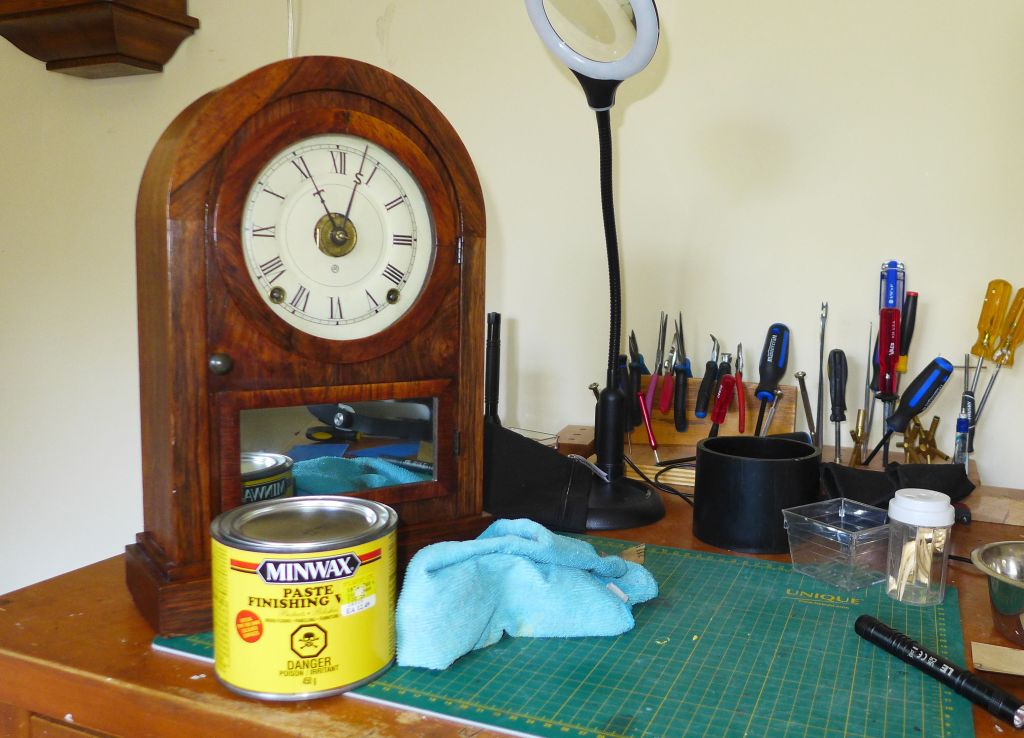
Undoubtedly, this simple time and strike clock with alarm stands out as one of the most captivating pieces in my collection, embodying the artistry and ingenuity of Seth Thomas clocks from the latter part of the 19th century.
Discover more from Antique and Vintage Mechanical Clocks
Subscribe to get the latest posts sent to your email.
 Antique and Vintage Mechanical Clocks
<
div dir=”ltr”>Love the “S” and “T”
LikeLike