
In this post, I describe an unusual issue when relocating my mini Vienna Regulator clock. But first some background information on Vienna Regulators.
The Vienna Regulator clock, also known as the Vienna wall clock, is a type of precision pendulum clock that originated in Vienna, Austria, in the late 18th century.

The development of the Vienna Regulator clock was influenced by several factors. One of the key factors was the rising demand for accurate timekeeping during the Industrial Revolution. Vienna, as a center of craftsmanship and technological innovation, played a vital role in meeting this demand.
They typically had a slender wooden case, which housed the pendulum and the clock mechanism. This design allowed for a longer pendulum, resulting in greater accuracy. The pendulum was often enclosed in a glass door or window, allowing the movement to be admired from the side panels while protecting it from dust.
The cases, made of various types of wood such as walnut, oak, or mahogany, were often finely crafted with decorative inlays, carvings, or veneers. The clocks featured a white enamel or porcelain dial, usually adorned with Roman numerals and ornate hands.

The movement of the Vienna Regulator clock was powered by weights suspended on cables or cords. The weights (up to three) were typically wound up once a week, providing the necessary power for the clock to run accurately.
During the 19th century, the Vienna Regulator clock underwent several design changes. The earlier models, known as “Vienna Regulators of the Biedermeier period,” were characterized by a simpler and more classical style. Later models, influenced by the emerging Victorian and Rococo revival styles, featured more elaborate ornamentation and decorative elements.
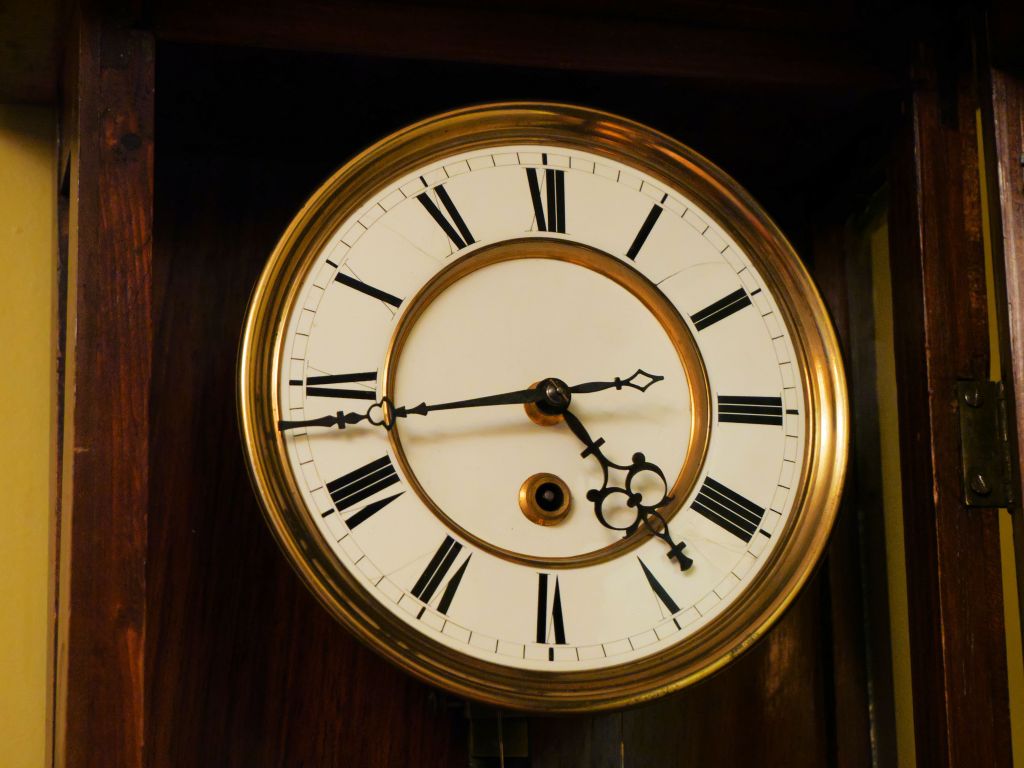
The style and craftsmanship of Vienna Regulator clocks are often associated with exceptional quality and precision.
While the popularity of the Vienna Regulator clock declined in the early 20th century with the advent of more modern timekeeping devices, it remains highly valued by collectors and enthusiasts today.
The issue
During an unseasonably warm winter, we unexpectedly experienced a sudden drop in temperature, causing a significant plumbing issue that led to a major leak of the pipes in the ceiling of our family room on the first floor of our two-story home. The extent of the damage necessitated replacing the pipes and removing and replacing the gyprock ceiling. While the repairs were underway, we took the opportunity to revamp the room’s decor and make a few changes, including relocating some clocks to that area.
Some clocks can be temperamental and a clock that works fine in one location may not work at all in another. Such was the case of a miniature Vienna Regulator that once moved from an upstairs bedroom refused to run in the family room.
Suspecting a tangled cable issue the result of which would rob power to the movement, I took the movement out of its case and carefully rewound the cable onto its take-up reel. No change.
Could it be a wear issue? I proceeded to carefully remove the movement from its case and meticulously disassembled it, thoroughly inspecting for any signs of bent arbors, or damaged or worn teeth. However, to my surprise, I found no such issues. In fact, the movement was remarkably well-preserved, and the oil in the pivots appeared to be in excellent condition.
After carefully reinstalling the movement into its case and reattaching the weight and pendulum, I observed an interesting issue. I noticed that the bottom of the case protruded farther out than the top, indicating that the wall was not perfectly vertical. Suspecting a connection between this misalignment and the movement’s inability to run, I decided to investigate further.

I adjusted the stabilizers, one on each side, stepping them back slightly, and to my surprise, I discovered the root cause. The escapement pallets, responsible for regulating the movement, were not engaging with the escape wheel correctly. This misalignment was likely the reason for the movement’s previous failure to function properly. It also made me realize that the wall where the clock was previously located was not vertically level.

While achieving horizontal leveling is undoubtedly crucial, it is important that vertical leveling can make a significant difference when it comes to the functionality of a clock. In fact, proper vertical alignment can be the determining factor between a clock that runs smoothly and one that fails to operate at all.
At the end of the day the exercise was worthwhile as it allowed me the clean the movement, reoil the pivots, and polish the brass pendulum and weight.
Discover more from Antique and Vintage Mechanical Clocks
Subscribe to get the latest posts sent to your email.
 Antique and Vintage Mechanical Clocks
You must be logged in to post a comment.