
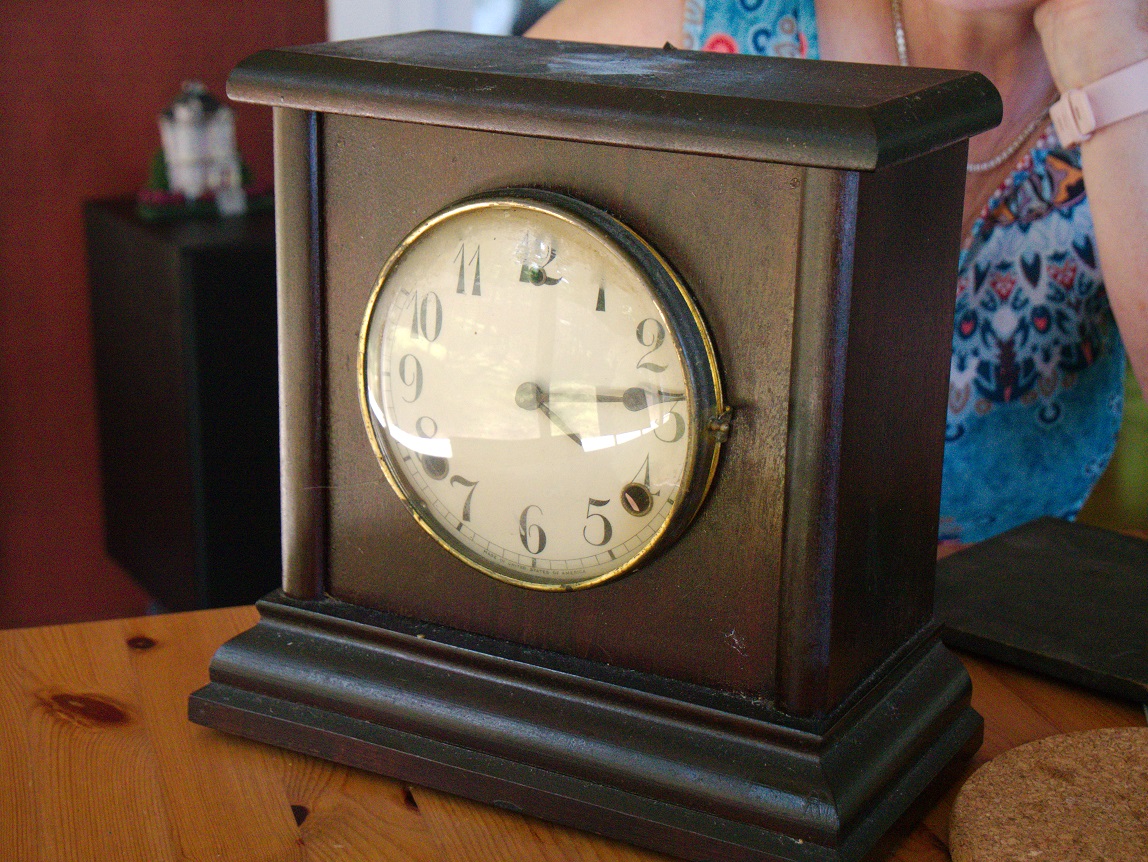
I am always on the lookout for clocks to add to my collection, and one of the places where bargains can often be found is Facebook Marketplace. While browsing the listings, we came across an intriguing clock from a small village in Quebec. It was my wife who pointed it out, thinking it would make an interesting addition to our collection.
From our summer cottage in Quebec, we made the short trip—about half an hour—to a nearby town to see the clock. We learned it had spent its entire life in this quaint village. Due to the pandemic, we arranged the purchase in an unusual way: the agreed-upon amount was sent to the seller via eTransfer, and they left the clock in a recycling bin outside their home for us to pick up. The entire transaction took place without any in-person contact, making it one of the more unique methods I’ve used to acquire a clock.

The clock was wrapped in a plastic bag with a note attached that said, “Thank you.” As we drove away, I wondered if a clock purchased sight unseen would be what we expected.

It is a very simple clock, but we were pleasantly surprised by its condition—it has clearly had a good life. This clock is an excellent example of a nondescript mantel clock that could be found in thousands of homes across Canada and the USA during the 1920s. Companies like Seth Thomas, Sessions, and others produced similar styles to appeal to those who could not afford the more elaborate, feature-rich upper-range mantel clocks offered by most manufacturers of the time.
The clock had been listed on Facebook Marketplace for $40 but had no takers for over three months. When the price was reduced, we decided to buy it.
It was described as a non-running clock, but the key, pendulum bob, and all parts of the movement were intact. The only flaw is the hour hand—the spade end has been snapped off. While the clock is nothing extraordinary, once cleaned up and put in running order, it should look presentable and run well for years to come.
Normally, I avoid American mantel clocks from the 1920s and ’30s, as I’ve owned several in the past. However, I found myself drawn to this clock, largely because it appeared to be untouched and well-preserved. I expect some wear consistent with its age, but at first glance, it looks promising.
This clock was made by Gilbert, a well-regarded American clock manufacturer with a long history of producing clocks from 1841 to 1957.
The clock features no exotic veneers, appliqués, fancy trim pieces, or finials—just a plain, two-column, square-shaped, tinted mahogany lacquer hardwood case measuring 10 inches high, 5 ½ inches deep, and 10 ½ inches wide at the base. The enameled 5-inch dial with spade hands displays Arabic numerals. At the top of the dial, within the number 12, is a regulating arbor for adjusting the clock’s speed.
There is no identifying stamp on the rear plate, and the seller was unaware of the maker. However, once the movement was removed from the case, the markings became visible. The front plate bears the Gilbert trademark—a capital “G” within a diamond—along with “Wm Gilbert Clock Co., Winsted, Conn.” stamped on the right. At the lower center is the number 17, indicating the year (1917) when the movement was designed. The movement features steel plates with brass bushing inserts, which is not surprising given the brass shortages during the First World War (1914–1918), prompting manufacturers to use steel for clock plates.

The case has an austere 1920s look. The movement date of 1917 suggests Gilbert might have used the same movement for a number of years following the war. The entire case, especially the molded base is free of gouges, dents, and other calamities associated with the rough handling and careless storage of old clocks. The case was cleaned with Murphy’s soap revealing a beautiful mahogany finish underneath layers of dirt.
If the movement is complete, I can usually get the clock running within a few minutes with a few adjustments here and there. However, despite oiling the movement, checking the gap in the crutch loop, releasing the tension on the mainsprings, and adjusting the beat, the clock would stop after just a few seconds. It wasn’t until I removed the suspension spring that I discovered a kink, which was enough to prevent the clock from running. The suspension spring will be replaced during servicing, but after I smoothed out the kink, the clock began to run. The strike side required no adjustments and works well.
While oiling and basic adjustments like these are no substitute for proper cleaning, they help me identify the issues I’m dealing with. Minor wear will be addressed by installing a few bushings. For now, the clock is running as well as can be expected.
Judging from cobwebs within and around the movement, a couple of dead houseflies plus dirt and grime on the movement itself, I doubt this clock has been running for many years though it likely gave years of reliable service before it stopped.
The previous owner says the clock has been in the family for a long time. It had been his grandmother’s clock passed on to his mother. It was dusted and cared for but, “she got tired of dusting it”, he said and it ended up stored in a barn for the last number of years.
I don’t mind dusting it!
Discover more from Antique and Vintage Mechanical Clocks
Subscribe to get the latest posts sent to your email.
 Antique and Vintage Mechanical Clocks
Good catch ,Ron. There are collectors who focus on one style or type . Perhaps go further to specialize into a subset of it. Others enjoy a find if it speaks to us. Sounds as this relatively humble clock fits the bill for you second category..
LikeLiked by 1 person
Not a style I choose that often these days but I was intrigued by the condition of the clock. The movement is in surprisingly good shape. Thanks, Marty.
LikeLiked by 1 person