
This is a Smiths Enfield Art Deco-style clock that reflects the clean lines and geometric design of the 1930s. It needs a few adjustments to ensure smooth operation before being listed for sale. Perfect for collectors or anyone who appreciates vintage clocks of this era.

The Smiths Clock Co. became Smiths Enfield in 1949 and the Smiths Enfield name first appeared in catalogs from 1950 onward. This oak-cased time and strike shelf clock was made somewhere between 1949 and 1955, vintage, but not antique. More information on this company can be found here. The latter part of the 1970s saw the decline of this and many other companies who fought hard to compete with inexpensive clock offerings from the Far East.
The clock keeps good time, but there’s an issue with the strike side. While the strike has a pleasant sound, it operates erratically. This may be an adjustment issue that will require removing the movement from the case for further inspection.
Once out of its case, I ran the strike side going through each hour observing the action of the levers and the snail. The setup is conventional but there is no rat tail per se on this movement just a pin or striker point midway along the rack arm. The rack pin was hitting the sloping edge of the plateau part of the snail, and the pin was not connecting with the flat section of the snail.
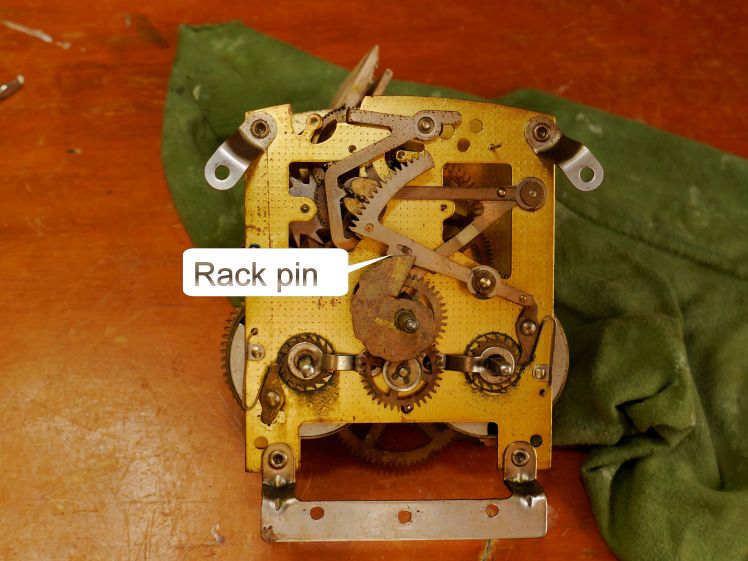
The Adjustment
To make the adjustment, I removed the clip and washer to release the snail. I advanced the snail to the one o’clock position and removed the snail and reinserted it so that it was placed approximately where the rack pin hits midway along the plateau of the snail. This will permit the snail to fall at the midpoint throughout the 12-hour cycle. On the test stand, I monitored the strike sequence.
Determining the sweet spot in similar movements that have a rack and snail arrangement will take some experimentation.
As expected, I found that when advancing the strike, the paddle was catching on one of the points of the star wheel. This could either stall the strike train or cause an extra strike on the hour.
Although it is a simple adjustment the mainsprings must be let down and the plates pulled apart enough to relocate the paddle arbour so that the paddle is positioned between two tips of the star wheel. In the process of manipulating the levers, one or two other wheels may pop out. After repositioning all the wheels, secure one corner of the plate with a screw and proceed with testing the strike-side action.
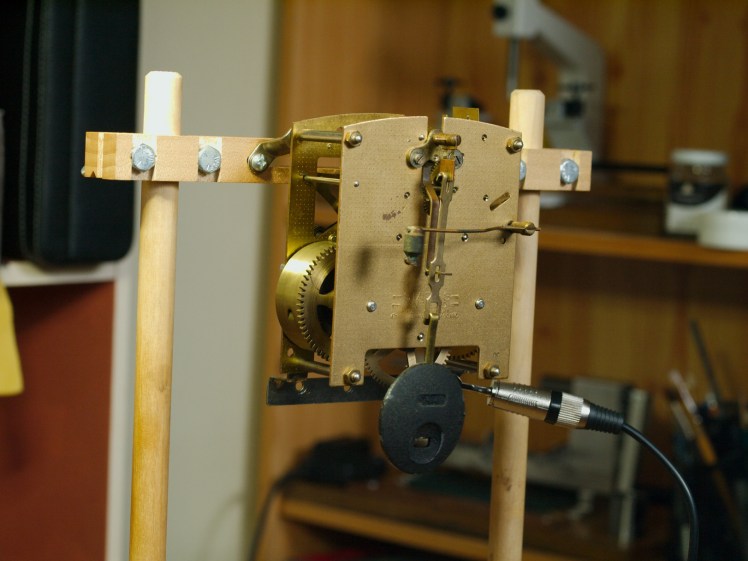
The clock had clearly been out of sorts for quite some time. Now that everything is properly adjusted and functioning as it should, it can be confidently sold without the dreaded disclaimer, “might need some adjustment.”
Discover more from Antique and Vintage Mechanical Clocks
Subscribe to get the latest posts sent to your email.
 Antique and Vintage Mechanical Clocks
You must be logged in to post a comment.