
Over the years, I’ve accumulated a small collection of tools and supplies that I use when maintaining and repairing antique clocks. Many readers of this blog have asked what oils, cleaning materials, and horology tools are most useful for working on mechanical clocks.
This page brings together the basic clock repair tools that I personally use or recommend for hobbyists and collectors. Whether you are learning about antique clock maintenance or simply want to keep your clocks running properly, having the right tools can make the work much easier and more enjoyable.
The list below includes the essential items used in clock servicing, from lubricants and cleaning supplies to magnifiers and specialized horology tools. I will update this page from time to time as I discover additional tools that may be helpful to fellow clock enthusiasts.
I have included links to some of the tools and suppliers that I personally use. At present, these are not affiliate links, and I do not receive any compensation from them. This may change in the future, but for now, the links are provided purely as a resource for fellow clock enthusiasts.
Clock Oils and Lubricants
- Clock oil – a high-quality synthetic or natural oil designed specifically for clock movements. Use Keystone or other specially formulated clock oil; some repairers have had good success with synthetic oil.
- Mainspring oil – used for lubricating mainsprings during servicing. Keystone mainspring oil is specially designed for mainsprings.
- Small precision oiler – allows very small drops of oil to be applied accurately. Refillable ones are preferred; stiff plastic ones tend to crack over time.
- Dip oiler with oil cup; a traditional method of oiling movements.
Cleaning Supplies
- Clock cleaning solution – used to remove old oil and dirt from clock parts. I use DEOX-007, a concentrated degreaser and brightener. It is a mild alkali in a water base. It is biodegradable and is excellent for Ultrasonic cleaners
- Soft cleaning brushes – useful for gently removing debris from gears and plates.
- Toothpicks and cotton swabs are available at any craft, hobby, or dollar store.
- Metal polishing; call it old-fashioned, but I use Brasso exclusively.
Basic Clock Repair Tools
- Magnifier headset; helpful for inspecting pivots, bushings, and gear teeth. Carson makes a good headset that has a small LED light and interchangeable lenses; a loupe is also recommended.
- Clock repair screwdriver set – small precision screwdrivers for clock movements.
- Lint‑free cloths – for drying and polishing clock components.
- Tweezers – many types, useful for handling small components. Try to source tweezers designed for clock and watch work rather than relying on dollar store versions; I use a #2, a medium size for general work, and an NN, which has a thicker, stronger tip.
- Small plastic parts trays (various sizes) help keep screws and parts organized during repair; available at craft, hobby, or dollar stores.
- Pivot locator; 8-inch with knurled handle; great for coaxing pivots into place; a must-have for avoiding broken/bent pivots.
- Assorted quality slotted screwdrivers; Klein Tools
- Smooth nose and serrated pliers of good quality; Klein Tools
- Mainspring clamps; Set of four round wire mainspring clamps holds mainsprings during disassembly. 1-3/8″, 1-7/8″, 2-3/8″ and 3″ diameters.
- Hobby desk lamp with brightness control.
- Movement holder: a 5-inch diameter, 4-inch high piece of PVC pipe will do.
- Cutting and smoothing broaches; enlarge, shape, and polish bushing holes
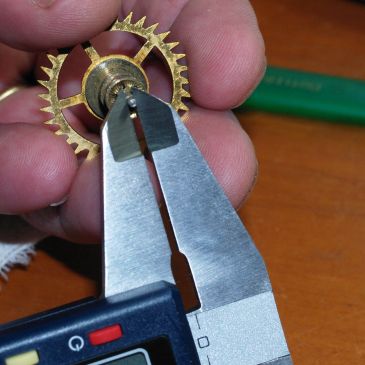
- Electronic Micrometer for measuring pivot diameters
Specialized Horology Tools
- Mainspring winder – makes removing and reinstalling mainsprings safer and easier; there are others, but the Ollie Baker style mainspring winder handles springs of any size, both hole end and loop end. The set includes nine steel mainspring sleeves, clamps, and instructions. (Requires letdown chucks)
- Mainspring let down set; used to wind clocks, as a key gauge, or to release mainsprings. Set includes a plastic handle and 3 chucks in sizes: #5-6, #7-8, and #10-12, which cover most American and European clocks
- Bushing tool – used to repair worn pivot holes in clock plates. Buy new or used. If used, ensure that good, sharp cutters come with the purchase. I have been using a Burgeon bushing set successfully for several years. You will also require a set of common bushings, Bergeon for their machine, and KWM bushings for the KWM bushing machine
- Metal lathe, Taig or Sherline; there are several uses for a lathe, including fashioning new pivots, but probably the most common use is as a pivot polisher.
- Various clock stands; I use a Gene’s movement test stand to test clock movement. It is well-built, adjustable, and simple to use. It is one of the best test stands I have ever used. I also use a metal stand with two screw clamps with a cast-iron base.
- Ultrasonic cleaner; I use an L&R Q140, 3.2 litre with heater and drain (no basket included), not too big, not too small, dependable, reliable, and made in the USA. Buy a Cambridge Time accessory basket, which is significantly less expensive than the one provided by L&R.
Recommended Horology Books
- Introductory books on clock repair and servicing. Recommended are Steven G. Conover’s repair manuals, including Striking Clock Repair Guide, Clock Repair Basics, Clock Repair Skills, to name a few in the series. Laurie Penman, Philip E. Balcomb and Eric Smith are other recommended authors who provide instructional guides. For 400-day clock repair, the Horolovar manual is highly recommended.
- Reference books on identifying antique clocks; Tran Duy Ly covers most American manufacturers and some French and German makers.
- Books covering the history of clockmaking. Look for Kennth D. Roberts, Eli Terry and The Connecticut Shelf Clock. Other authors are Simon Fleet, Eric Smith, and Brooks Palmer.
Trusted Clock Parts Suppliers
- TimeSavers – one of the largest U.S. suppliers of clock parts and tools.
- Perrin Supply – Canadian supplier of watch and clock parts
- Merritt’s Antiques – a well-known clock repair supply company. As of March 23, I am experiencing occasional difficulties accessing the site.
- Ronell Clock Supplies; not a supplier I use often, but they are worth an online visit.
- Meadows and Passmore; Parts for European, British, and French clocks
Final Thoughts
Having the right tools makes working on antique clocks much easier and more enjoyable. Many of these tools will last for years and are worthwhile investments for anyone interested in maintaining or restoring mechanical clocks.
Some tools, however, are quite expensive, and if they are only used occasionally, they may not be worth the cost. For that reason, it often makes sense to build your tool collection slowly, purchasing tools as the need arises rather than all at once.
Do not overlook the used market, as there are often good bargains to be found. That said, it is important to do your research before buying. There is little point in purchasing a used Bergeon bushing machine if it does not come with the accessories, which on their own can cost as much as $600.
If I have missed any tools that you find useful, I would be pleased to hear your suggestions.
Related links
- Gene’s movement test stand is an inexpensive testing stand for most movements.
- More advanced tools for the budget-minded and for those willing to invest a little more
- A smoothing broach completes the bushing process; Smoothing broaches offer several advantages. Firstly, these broaches are designed to finish the holes in the clock plates, ensuring proper fitment of the bushings.
- What does bushing a clock mean? If a clock movement is not serviced (cleaned and oiled) routinely, there will be wear in the plates of the movement where the pivots come through. These must be dealt with.
- How to safely remove a clock movement from its case; you’re new to clock repair or restoration, one of the first hands-on steps you’ll encounter is removing the movement from its case. This process needs to be done with care to avoid damaging delicate components.
- Compact tools to use in clock repair; Some of these tools you will no doubt find more useful than others.
- The role of macro-photography in clock repair; A camera can be your best friend.
- Can I repair my clock with common household tools?; While it is possible to repair an antique clock with common tools, there are limitations to what can be achieved. That’s the short answer.
 Antique and Vintage Mechanical Clocks
You must be logged in to post a comment.