For years, my wife and I have been on the hunt for an elusive Arthur Pequegnat Hall clock, a prized possession among Canadian collectors. Recently, I stumbled upon what seemed like the jackpot—a seemingly authentic piece advertised for a mere $100. However, as I explored the deal further, doubts crept in, casting a shadow over my potential bargain.
Join me on this intriguing journey as we uncover the secrets of a clock that may not be what it initially appeared to be.

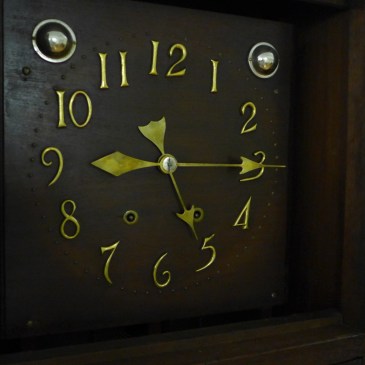
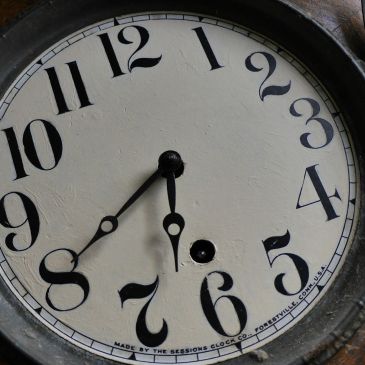
The clock is closely reminiscent of Pequegnat’s craftsmanship. It was a tempting find but a closer inspection raised eyebrows. The clock hands seemed out of place (for a Pequegnat), and the overall workmanship did not quite match the renowned Pequegnat build quality. Could this have been a misstep in our quest, or was there more to this story?
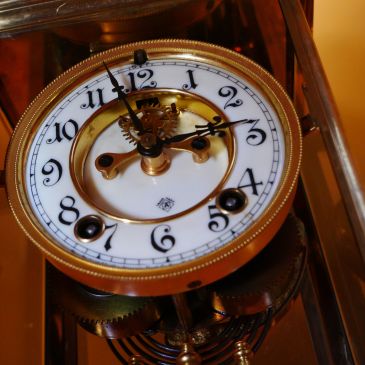
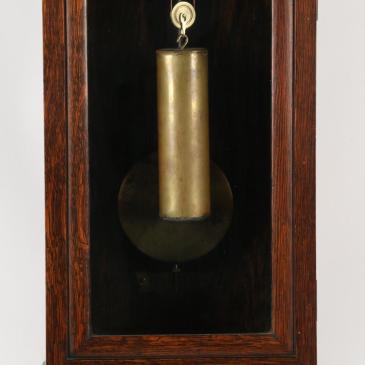
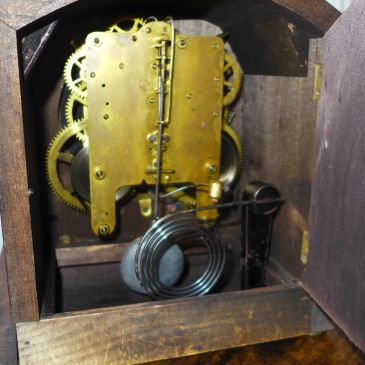
Undeterred I made an over-the-phone offer of $90 and embarked on a 90-minute journey to claim what could be a gem in disguise. The seller warned of a non-functioning clock but sweetened the deal by mentioning that it had weights—only to reveal later that the weights were, in fact, fake. On top of that, a spring-driven New Haven mechanical movement lay beneath the surface.

The weight cans were empty shells, and the decent-quality ladder chains with acorn pull ends were crudely strung to mimic a weight-driven movement.

Further investigation unveiled a raised platform supporting the movement, yet no traces of a seat board that usually accompanies weight-driven mechanisms. The clock’s peculiarities extended to a tied cord on the strike lever, adding to the mystery. As questions piled up, it became clear that this clock’s origins were far from conventional.

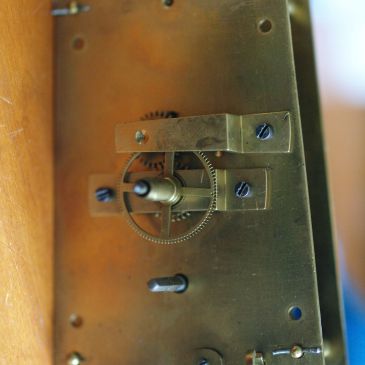
The movement is stamped 27. This could be a date stamp but it is more likely the length of the pendulum in inches. The movement plates are pinned rather than held with screws or nuts suggesting an older square-aperture type New Haven movement. Judging from the build of the movement I would say that it is earlier than 1927. The heavy, solid wood case which comes apart in three sections is certainly just as old.
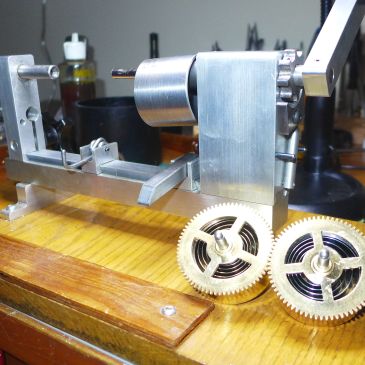
I removed the movement from its case and mounted it on a test stand. The movement runs at 72 bpm, not quite the 60 bpm one would typically expect from a hall clock and the slower beat rate explains the long pendulum rod.
The only plausible explanation was clear: I had purchased a kit clock, where an independently crafted case had been paired with a New Haven movement, dial face, hands, accessory weight cans, and ladder chains with acorn pull ends. It was likely a more cost-effective means of acquiring a tall case clock back in the day.

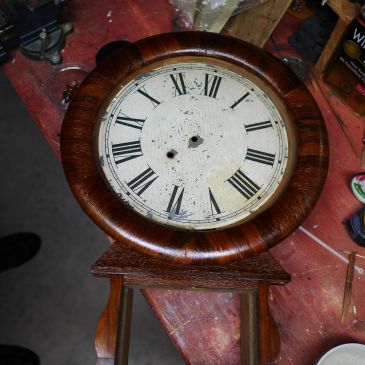
Despite the oddities, I had, after all, secured the clock at a reasonable price. Now, armed with the knowledge of its peculiarities, I am content with it. Servicing the movement and restoring the case have been completed and after having stood in my work area for a couple of years it was time to move it to its permanent location.
And it looks pretty good! The combination of the separately crafted case with the New Haven movement, dial face, hands, and the accessory weight cans and ladder chains with pull ends came together quite well, offering an appealing and budget-friendly tall case clock.
The lesson in all of this is that in the world of clock collecting, sometimes unexpected discoveries and not value and authenticity are the ones that leave a lasting impression.


You must be logged in to post a comment.