
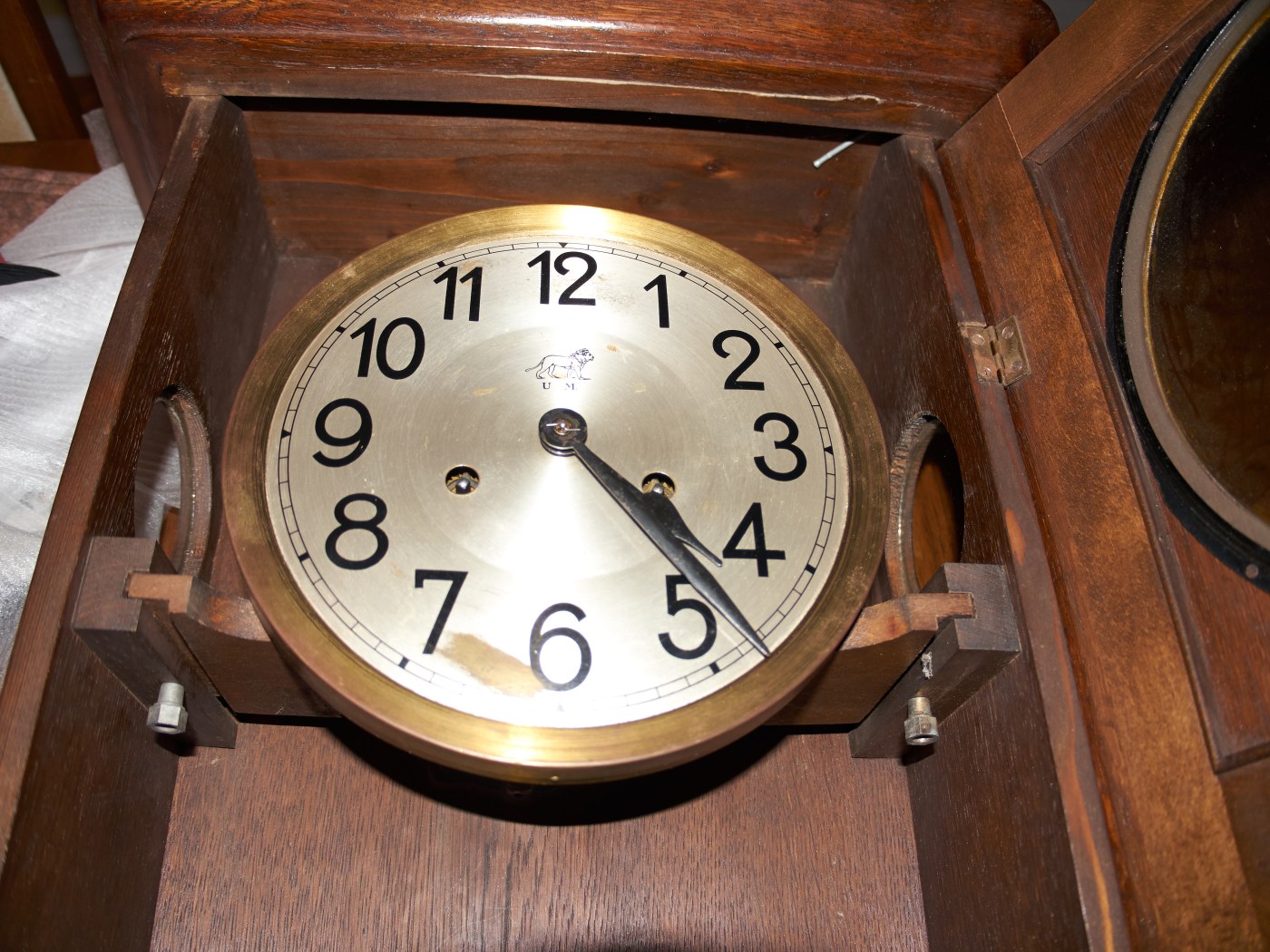
U. M. Müller clocks were once a familiar name in households across Europe, yet today the brand is not as widely recognized among collectors as some of the larger German makers. That is a bit surprising, because the company produced clocks that could easily stand beside the finest German manufacturers of the early twentieth century.
One area where U. M. Müller truly excelled was with their box clocks. At a time when tastes were shifting away from the tall and highly ornate Vienna regulators, these clocks offered something different—cleaner lines, practical design, and a price that appealed to the growing middle class. By the 1930s, the sleek German box clock had largely replaced the Vienna regulator in many homes, quietly marking the end of an era.
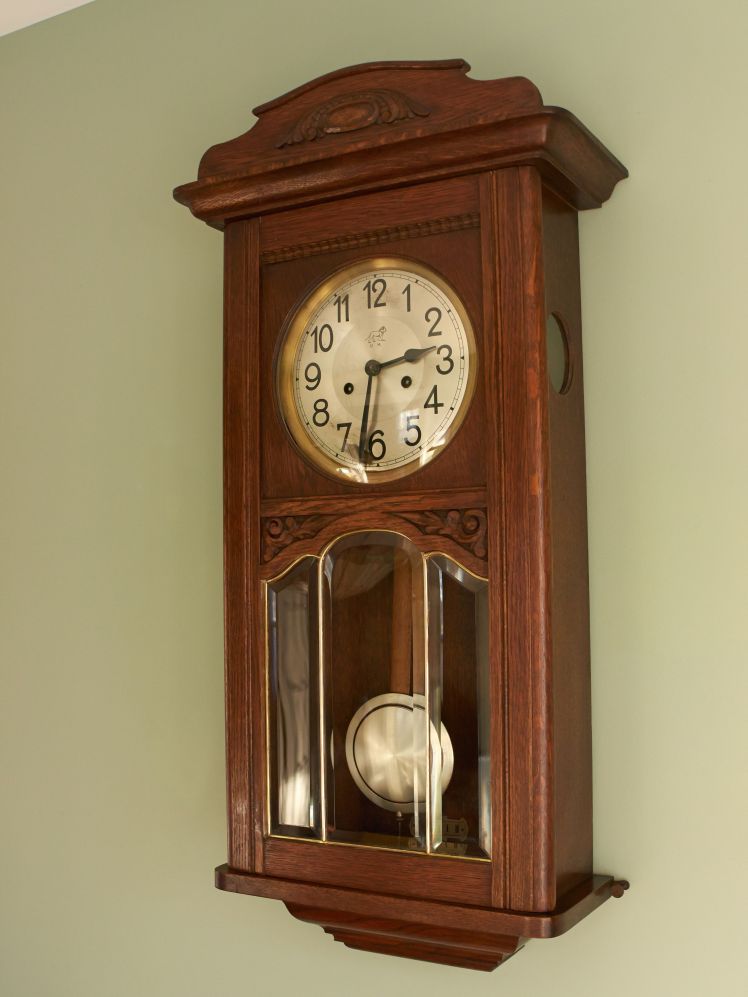
This particular U. M. Müller is a striking example of that transition. The oak case has a stately presence, highlighted by delicate carved inlays on the door, brass strip framing, and a fixed wooden crown. A brass bezel frames the metal dial, which carries classic spade and spear hands. The beveled glass, also set in brass, adds a refined touch. On the back, wall stabilizers ensure the clock hangs securely—another reminder that this was a clock designed not only to look good, but to perform reliably day after day.
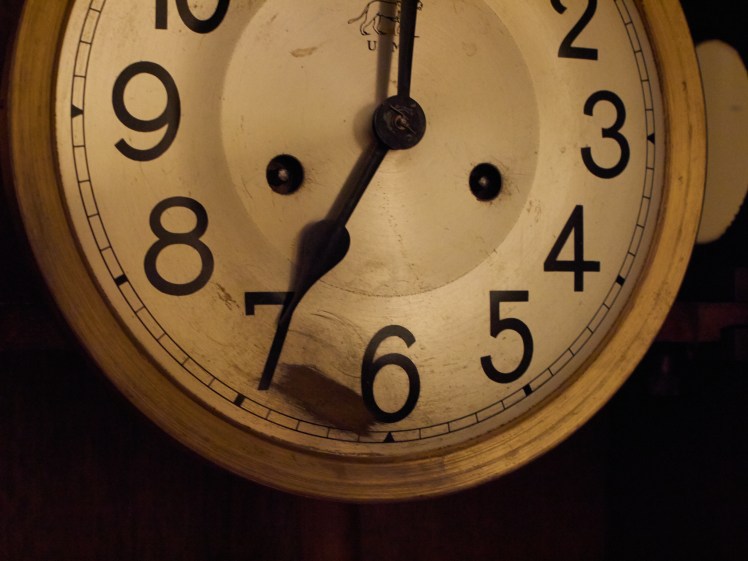
The case itself has aged beautifully over the decades, with no noticeable scratches or blemishes. The dial, however, tells a different story. Its surface bears the marks of long service, including an abrasion between the numbers 6 and 7 where the paint has worn through to the bare metal. While it is not something that can really be repaired, it does give the clock a bit of honest character—evidence of the many years it faithfully kept time on someone’s wall.
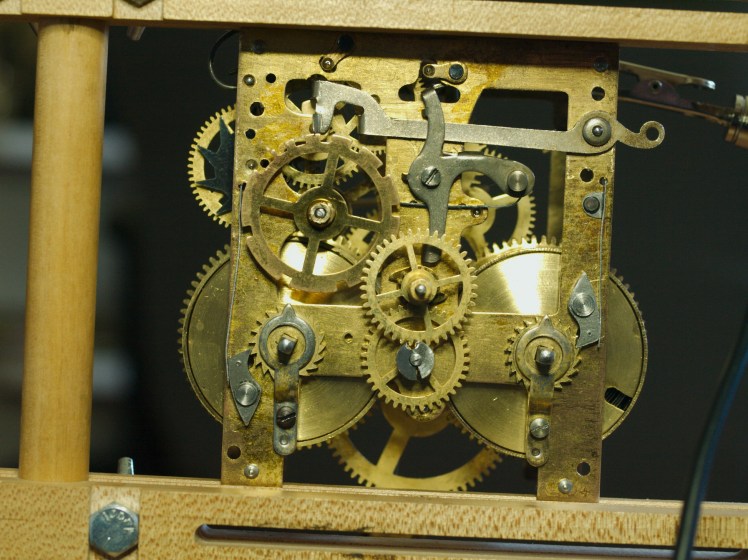
Inside is a classic count wheel time-and-strike movement that strikes on a coiled gong. The strike is bold and full on the half-hour and the hour, but never harsh or overpowering. Like most spring-driven clocks, one should not expect chronometer precision, but this example runs just as these clocks were meant to—steady, dependable, and capable of keeping “regular” time across its full eight-day cycle.
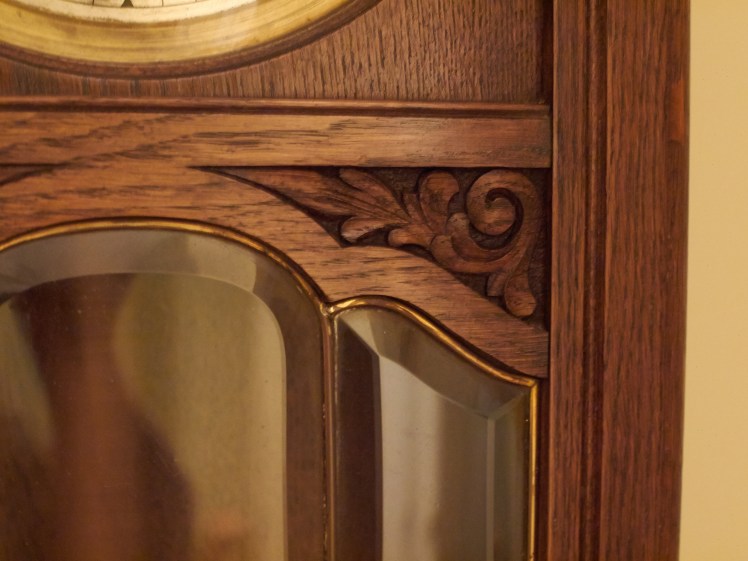
After a careful cleaning and waxing, the oak case shows what it must have looked like when new, more than ninety years ago.
Collectors sometimes date U. M. Müller clocks using the small lion trademark on the dial. A raised tail generally indicates a clock made before 1930, while a lowered tail—like the one on this example—places it in the mid to late 1930s.
According to Schmid’s Lexikon, the company’s history dates back to 1867 in Mühlheim, Germany. Ownership changed hands several times over the years, including a period under R. Schnekenburger around 1880. The company operated as R. Schnekenburger GmbH a.d. Donau before facing financial difficulties, and acquired by Gebrüder Müller in 1923. The firm developed a reputation for building solid, handsome clocks that were both reliable and affordable. Müller clocks were competitive with other German makers such as Junghans, Kienzle, and Gustav Becker, though often at a slightly lower price point aimed at the middle-class market.
In the end, this U. M. Müller is a fine reminder of a moment when clock design was changing. As the grand Vienna regulators slowly disappeared from the walls of European homes, clocks like this stepped in to take their place—simpler, practical, and built for everyday life. Nearly a century later, it still does exactly what it was meant to do: quietly mark the passing of time while adding a bit of character to any room.
Related Articles
- UM Müller box clock | servicing the movement: I bought this clock in 2013, and while it has been very reliable and running daily, like all things mechanical, it requires attention from time to time.
- UM Muller box clock; not a household name in its time, yet U. M. Müller produced clocks that could stand proudly beside the finest German makers of the early 20th century.
- German Box clocks: a journey into clockmaking history: the popularity of Vienna Regulator clocks began to wane towards the early part of the 20th century. The more modern and less ornate design of the box clock appealed to changing tastes and preferences after World War I.
Discover more from Antique and Vintage Mechanical Clocks
Subscribe to get the latest posts sent to your email.
 Antique and Vintage Mechanical Clocks
Very interesting..beautiful clock…have a gre
LikeLike