
Tick-Talk Tuesday is a special time when I respond to readers’ letters and comments about clock issues, challenges, and recommendations for specific clocks. When the comments and questions are especially complex, I consult with fellow clock enthusiasts within my circle to ensure I offer the most precise and helpful answers possible.
David P writes
I am inquiring if there is any chance you could offer me an opinion of who the maker maybe of the below clock. I am exploring purchasing the clock and just trying to learn more about it. I am not looking for an appraisal or value, just trying to determine the maker. Thank you in advance for any help you can provide.
Respectfully,
David P.
My Reply
Hi, and thanks for your email, David P. What do you know, and what have you been told about the clock? (Unfortunately, I received no further details about the clock from David)

My initial impression was that it might be an English or Scottish tall case clock. This style was widely produced in both England and Scotland from the early 19th century up until around 1900. American clockmakers of the period were strongly influenced by these British designs.

However, upon further examination, it appears to have all the features of an early 1800s to 1825 American clock, including the plain, understated case, the design of the columns and capitals, the top fretwork, the brass finials, and the arched dial with a moon phase and calendar window.
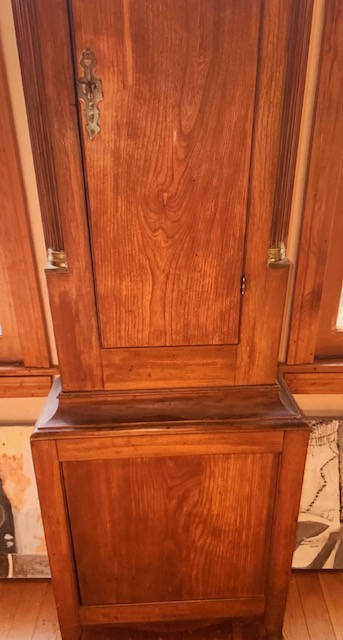
These clocks are difficult to identify unless there are markings on the clock case or dial face. A painted name is typically on the dial, usually below the center arbour, often including the maker’s town or city. On painted dials, the name may be faint or worn off due to age.
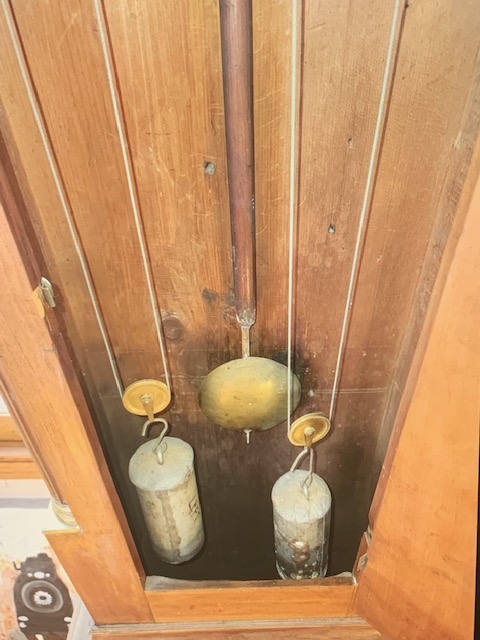
There may be a name or trademark on the backplate or front plate of the movement but I have found that to be less common with many clocks having generic “English-style” bell strike movements. Even less common is a signature found inside the case door or on the backboard. Sometimes, paper labels were pasted inside the case though extremely rare.

Some makers at the time were Simon Willard (Roxbury, MA) – Famous for tall case clocks and his patent timepiece (“banjo” clock). He used finely made 8-day brass movements.
Others were Elnathan Taber, Aaron Willard, from the Willard family.
Daniel Munroe, Lemuel Curtis were top-tier Massachusetts makers, David Rittenhouse (Philadelphia) was renowned for his precision movements and astronomical clocks. John Wood, Benjamin Chandlee, and others in Pennsylvania and Maryland made complex 8-day brass movements.
That said, determining the maker of a clock can be particularly challenging when there is no visible trademark, label, or inscription. However, experienced collectors and horologists often look for clues in the construction of the case and the design characteristics of the movement. Certain features—such as the shape or the style of the hands and pendulum, the design of the dial face—may point to specific regions or even individual makers. That said, without definitive markings, any attribution remains speculative and requires careful comparison with known examples from the period.
In short, I cannot identify the clock—more research is needed. I would add that if it were made by an eminent American clockmaker, such as Simon Willard, it would have been identified as such by now.
The bottom line is that it looks impressive, it appears to be intact, and if you like it and it falls within your budget, it would be a nice acquisition.
Ron
Discover more from Antique and Vintage Mechanical Clocks
Subscribe to get the latest posts sent to your email.
 Antique and Vintage Mechanical Clocks