
We are quite accustomed to the accuracy of quartz clocks which lose or gain mere milli-seconds per week. Contrast that with an era when folks were content to accept that their mechanical clock would be a minute fast or slow through the week, and it was a common practice to make small adjustments over the run cycle of a clock.
Clocks generally fall into four categories: quartz, electro-mechanical, electric, and mechanical. In this discussion, we’ll focus on mechanical clocks—whether antique or vintage—as we explore the common reasons why a clock may run slow.
Our discussion on why a clock runs slow should be grounded in a few practical realities. A typical American spring-driven clock, even when properly serviced, may gain or lose a couple of minutes per week—this is considered normal. In contrast, weight-driven mechanical clocks that vary by only a few seconds per week are regarded as highly accurate, with astronomical regulator clocks being among the most precise of all.
That said, how many mechanical devices do you know run perfectly (relatively speaking) after 120 years?
A clock runs slowly for a variety of reasons.
Let’s consider several factors and examine each in detail.
- Environmental factors
- The pendulum is too low or too high
- The pendulum is the incorrect weight
- Incorrect suspension spring length
- The suspension spring is not attached correctly
- Lack of lubrication
- Gummed-up lubrication (over-oiled)
- Balance Wheel Requires an Adjustment
- A weak mainspring
- Changes or Alterations During Servicing
- Clock cycle time variance
- Slipping, Binding and Rubbing
Environmental Factors
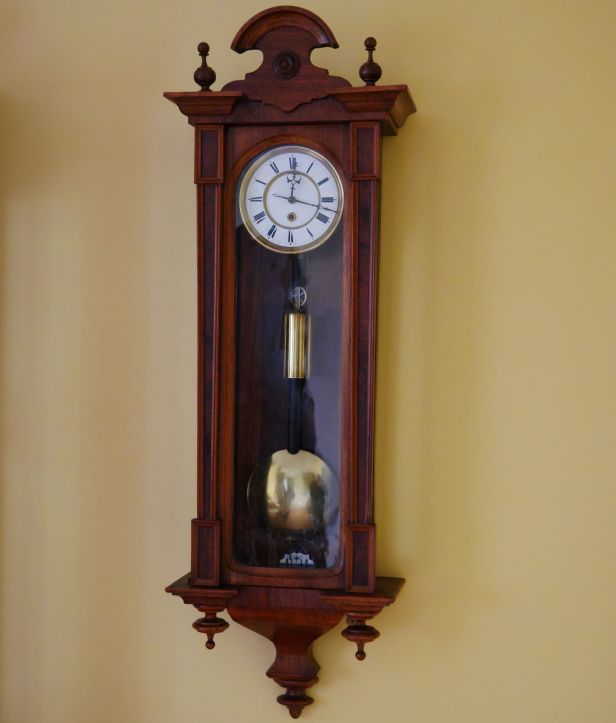
Mechanical clocks are subject to a number of environmental factors that may cause them to gain or lose speed over the course of a year. These factors include heat, cold, and humidity. Increasing the ambient temperature of a clock will slow it down from the expansion and lengthening of the pendulum unless the pendulum is a compensating type using Mercury or dissimilar metal rods. Denser air also causes the pendulum to move more slowly.

Moving a clock from sea level to a higher elevation will affect the speed of the clock.
It is common to make seasonal speed adjustments on a clock that does not have a compensating pendulum.
Pendulum Too Low or Too High
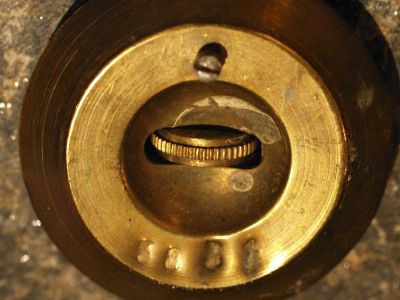
The lower the pendulum bob, the slower the clock will run. Many pendulum clocks can be adjusted either by a set screw at the bottom of the pendulum or by an inset screw on the pendulum.
In the absence of an adjustment on the pendulum, there is a regulator on the clock face. Use the small end of a double-sided key and insert it into the dial face of the clock to speed up or slow down the clock.
Shortening the pendulum will speed up the clock. Anything that increases the length of the pendulum will reduce the rate of the pendulum and result in a clock that will run slower.

Pendulum is the Incorrect Weight
If the pendulum is too heavy, it causes the centre of gravity to be too low, consequently, the clock will run slower. Having the correct weight pendulum for your clock ensures smooth running.
Incorrect Suspension Spring Length
Often, when a clock is repaired by a person who has limited knowledge of the effect a replacement spring will have on the running of a clock they will occasionally install an incorrect length or thickness of suspension spring. Choose the suspension spring that is correct for your clock.

Suspension Spring Not Attached Correctly, or Bent or Twisted Spring
The suspension spring is located at the top of the pendulum rod and serves as the flexible part that allows the pendulum to swing. It connects the top post to the pendulum leader. If it is not installed securely, the pendulum may not swing at all or could wobble, which robs the movement of its energy.
If the spring is bent or twisted, the imperfection will also drain its energy. This imperfection reduces the efficiency of energy transfer to the pendulum, causing it to lose amplitude and making the clock run slow or stop altogether.
Lack of Lubrication
Pivot holes that have dried up mean that there is no lubricating barrier between the pivots and their bearing holes, although the movement may otherwise be very clean.
Small drops of clock oil applied to the dry pivot holes will ensure the clock runs well and will have a long life. Without oil, the steel pivots will wear the brass pivot holes, resulting in wheels that will not mesh properly, eventually stopping the clock.
An approved clock oil must be used, although I have heard that synthetic oil works well too.
Note: a small drop of oil in each bushing hole is all that is required. As they say, Less Is More!
Gummed-up Lubrication
Clock oil loses its viscosity over time. Aging oils also lose their adhesive properties. Oil becomes oxidized, and oxidized oil forms varnish-like residues or gums that can clog pivots and bushings, increasing friction.
When a clock runs slowly, the first instinct is to apply more oil. Old blackened or greenish oil in the pivot holes is a sure sign the clock has been over-oiled or the oil has degraded. The addition of fresh oil produces an almost immediate improvement in the running of the clock, but it will not be long-lasting. In a short time, the clock will begin to run slowly again as the new oil mixes with the dirt and grime in the old oil. When this occurs, the oil becomes an abrasive paste, resulting in exacerbated wear.
The only solution is servicing, which includes disassembly, cleaning of the movement, addressing wear issues, reassembly, and testing.
Balance Wheel Requires an Adjustment
Balance wheels can be adjusted to speed up or slow down a clock.
Regulation of the escapement is done by sliding the two small weights attached to the center of the balance wheel inward to make the clock run faster, and outward to slow it down.
To adjust, simply hold the wheel and push the small adjustment “finger.” Moving the finger to the right will speed up the clock, and moving it to the left will slow it down. Each movement of one dot typically changes the rate by about 10 seconds per day.
The movement usually has a directional indicator guide near the balance wheel, with an “S” for slow and an “F” for fast.

A Weak Mainspring
Often, the mainspring you will find in your antique clock is the original one(s). The steel used at the time the clock was made was generally of higher quality than the steel used today, with some exceptions. By their very nature, mainsprings become weak over time.
Weak mainsprings are called “set” mainsprings. If “set”, your clock will not run a full cycle, 8 days for eight-day clocks, a full 30 hours for one-day clocks, or whatever the designed cycle. When a spring-driven clock is brought in for a professional repair, the mainsprings are often replaced.
Most properly serviced clocks with their original mainsprings will complete their full cycle, even if the springs are not as powerful as they once were, because cleaning reduces resistance throughout the gear train.
If your clock requires a mainspring replacement, a correctly sized, quality American- or German-made mainspring should provide years of reliable service.
Changes or Alterations During Servicing
Changing or altering the mechanism, such as replacing a gear with an incorrect tooth count, may speed up or slow down a clock. Although movement parts may appear to be similar, manufacturers often made small changes, resulting in parts that may not be interchangeable with the exact movement over the years.
Clock Cycle Time Variance
American spring-driven eight-day clocks typically run slightly faster at the beginning of their cycle because they provide most of their power early on, then run more slowly throughout the week as the mainspring unwinds. A spring-driven clock that is one or two minutes fast at the start of the week may often be a minute or two slow by the end of its cycle. This is considered normal, and no adjustment is necessary.
Occasionally, you will see Geneva Works or stop works on a clock movement. These mechanical additions are designed to compensate for the variance of spring power by utilizing the mechanism to limit the mainspring’s unwinding, ensuring a consistent amount of power is delivered throughout the clock’s running cycle. I have also seen enough of these clocks with the Geneva stops removed. Why? Often, the repairer did not understand how to set them!
The power on a weight-driven clock, on the other hand, is constant, and the loss or gain in time at the beginning of the cycle will be the same at the end, assuming no wear issues are slowing it down.
Slipping, Binding, and Rubbing
If your clock is losing many minutes per day, something in the mechanism is slipping or binding. If your clock is losing minutes per day after all adjustments are made, it is likely that bushing wear or some other worn component, including a weak mainspring, is causing the problem.
Clock repairers often use a term called end shake. End shake allows freedom of lateral movement for each of the wheels between the movement plates. If the plates are tight and there is no end shake, too much resistance will slow a clock. It is why clock repairers always check for sufficient end-shake when servicing the wheels/gears on a movement.
If a wall clock is not mounted correctly, the pendulum might rub against the case. Make sure the clock is not only level and in beat but also properly aligned vertically against the wall. If a clock is not aligned vertically, the pendulum may not swing evenly, causing it to rub against not only the clock case but other parts as well. This uneven motion puts extra stress on a distorted suspension spring.
Final Thoughts
Your situation may be unique, and if it is not covered by this article, I recommend consulting a clock repair expert. If you have little experience and choose to work on an antique or vintage clock yourself, the mistakes you make could be irreversible. For beginners, there are many reputable books and online forums dedicated to clock repair that can provide guidance before attempting any work.
There is also a certain element of risk working with mechanical clocks, as the power contained in the mainsprings may cause serious injury if not handled properly. Always take proper precautions when handling mainsprings or winding mechanisms. If you are unsure or unfamiliar with safe procedures, it’s best to seek assistance from a professional clockmaker to avoid injury and damage to the clock. That said, the safest clocks to work on for beginners are weight-driven ogee clocks or time-only, spring-driven clocks.
Knowing why your clock runs slowly is the first step in diagnosing the problem. Addressing the issue is the next step. Beyond that, periodic maintenance and servicing with quality parts is the key to a long life for your clock.
Discover more from Antique and Vintage Mechanical Clocks
Subscribe to get the latest posts sent to your email.
 Antique and Vintage Mechanical Clocks