
A German-made Mauthe time-and-strike wall clock, likely from the late 1940s, was gifted to my father-in-law—a physician in a small Nova Scotia town—by a grateful secretary, likely in the mid-to-late 1960s. It hung in the family home until 1997 when it was packed away during a move and eventually passed to the user’s brother-in-law. The clock was never displayed again and remained in storage for decades.
Recently, I was asked to restore it. My wife recalls the clock from childhood, confirming its presence in the home for many years. A service sticker inside the door, from “Time Center” in Amherst, Nova Scotia, suggests it was professionally serviced sometime between 1974 and 1996, most likely in the 1980s.
Now, after years of neglect, the clock is due for a full movement cleaning and cosmetic case touch-up.
I’ll cover the case restoration in this article. Surprisingly little must be done to the case, although it is dull with age and has a few minor scratches.
A word about Clock Cases
I’m firmly opposed to stripping and refinishing clock cases for two key reasons. First, it destroys the original patina—a quality many collectors value and appreciate in antique clocks. Second, the finishing techniques used when these clocks were made are nearly impossible to replicate today. As a result, refinishing often produces a sanitized look that lacks the character and authenticity of the original.
Instead, I will begin by cleaning the case and attempting to minimize the nicks and scratches that have accumulated over time through normal use, using a light coat.
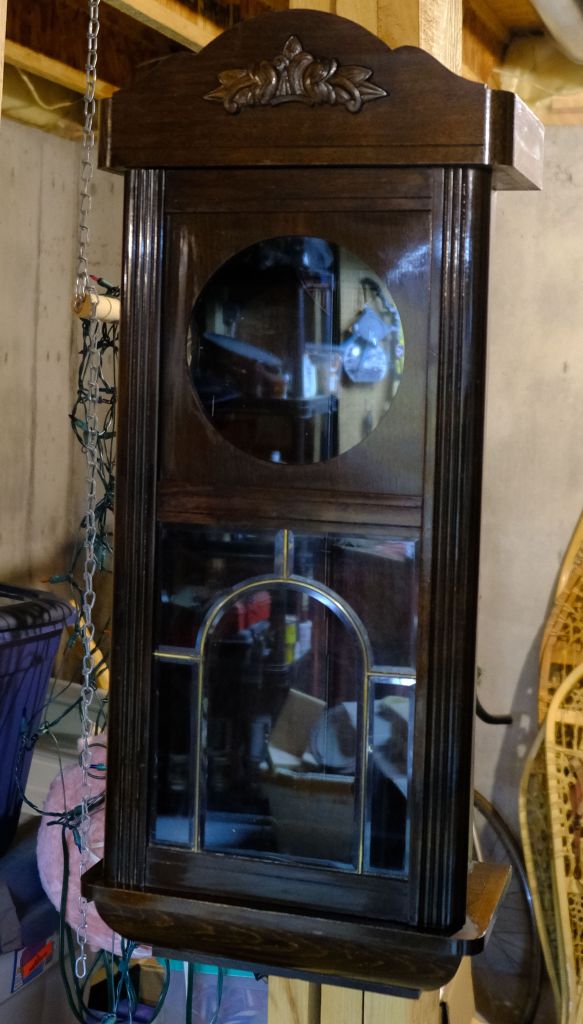
The Case
The clock case was cleaned and given two light coats of Minwax wipe-on poly, with a light sanding between applications. For the final polish, 2500-grit sandpaper was used to achieve a smooth finish.
The poly finish helped conceal minor scratches, though some faint marks remain visible upon close inspection.
The glass was thoroughly cleaned, and the brass strips on the door were polished using Brasso.
The spun brass bezel was also polished with Brasso. While there is some minor wear visible on the dial face, I chose to leave it untouched, aside from a gentle cleaning with soap and water, as it is not particularly noticeable from a normal viewing distance.

While I was working on the case, the movement was undergoing testing. It’s now at the end of the first testing phase, and the next step is to reinstall it into the case and continue with testing.

The movement dial is attached to the movement using four pins, one at each corner. Once the dial is in place, the hands are installed—first the hour hand, followed by the minute hand.
Once the dial is mounted on the movement and attached to the seat board, the assembly can be slid into the channels in the case and screwed into place. Under the seat board are two thumbscrews used to secure the movement.
The main challenge was positioning the strike hammers so they rest about 1/8″ from the strike rods. This involved some trial and error, requiring the movement to be removed several times for fine adjustments. The hammer rods are somewhat pliable and can be carefully bent into the correct position.
Finally
This well-traveled Mauthe clock has finally returned to active duty, proudly ticking away once more after decades in storage. With both the case and movement restored, it now stands as a meaningful family heirloom and a fine example of mid-century German craftsmanship.
Discover more from Antique and Vintage Mechanical Clocks
Subscribe to get the latest posts sent to your email.
 Antique and Vintage Mechanical Clocks
neat! Scientists Create First Synthetic Human Embryo 2025 charming
LikeLike