
Many years ago, my father-in-law received a gift from his secretary. As a physician in a small town in Nova Scotia, it was once common practice to accept small tokens of appreciation from fellow employees. The gift was a German-made Mauthe time-and-strike wall clock, often referred to today as a “box clock” and made sometime in the late 1940s.
It hung on the wall in my in-laws’ home until 1997, when they moved to a smaller house in the same town to downsize. The clock was packed away and never rehung in their new home. Instead, my brother-in-law took it to his home, about three hours away, presumably intending to display it. However, it remained in storage and was never hung.

Recently, he asked if I could service the movement and restore the clock, and I gladly agreed.
My wife remembers the clock from her childhood, recalling it from when she was a young girl. This suggests it was gifted in the mid-to-late 1960s. Her father proudly hung the clock in the family home, and I remember his weekly ritual of winding it.
It was evidently serviced at least once. Inside the clock’s door, there is a sticker from a clockmaker in Amherst, identifying the repairer as Time Center, 5 Westminster Ave, Amherst. However, an online search yielded no information about this business. The sticker includes a Canadian postal code, which indicates that the clock was serviced after 1974, when postal codes were introduced in Nova Scotia. This means the servicing took place sometime between 1974 and 1996, though I cannot pinpoint the exact year. It likely would have been serviced in the 1980s.

After many years stored, it is long overdue for a cleaning. The plan is to service the movement and touch up a tired case.
Servicing the Movement
Before taking the clock apart, I wanted to see if it still worked. I removed the movement, oiled the pivots, and then placed the movement back into the case. I hung the clock on the wall in my office, wound it, attached the pendulum, and gave it a push. To my surprise, it ran for a while—despite having been in storage for years. Running the clock also reassured me that I likely wouldn’t encounter any significant mechanical issues.

However, the only way to confirm any wear for certain would be to disassemble the movement, which I proceeded to do.
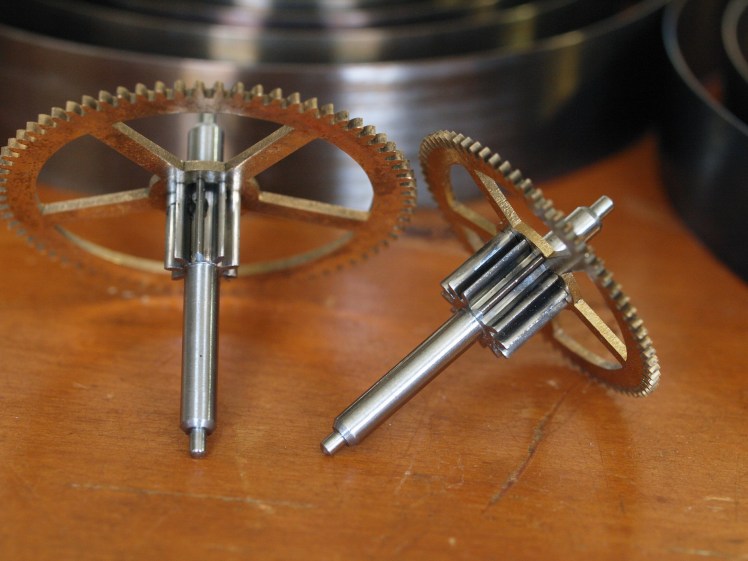
I disassembled the movement, put all the parts in an ultrasonic cleaner, dried the parts after the cleaning, pegged the pivot holes, polished the pivots, and now checked for wear. I generally assemble the trains separately with the strike side first, since often it is the greater source of wear. I then move to the time side.
The movement looked to be in very good condition overall, though I noticed some wear in six of the pivot holes. The most worn appeared to be the third wheel on the backplate (or star wheel), and the second wheel on the time side backplate. In the end, I installed only two bushings—those pivot holes were in the worst condition.
This is a family clock, and I doubt it will see daily use; it’s more likely to serve as a decorative piece. If I were doing this as a professional repair, I would have addressed all signs of wear, which in this case might have meant installing up to six bushings.

I’m also donating my time to this project, so if the clock stops after a couple of years, I’d have no problem servicing it again.
The mainsprings were serviced by removing them from their barrels, thoroughly cleaning them, and then applying fresh oil. The barrels and their caps were also cleaned to remove any residual oil and were placed in the ultrasonic cleaner for a deep clean.

Reassembly
Transitioning from a typical American antique clock movement to a German one is a significant step, primarily because you’re dealing with much smaller pivots, which greatly increases the risk of bending or breaking them. Those who have replaced pivots before know how challenging the process can be—and that it requires specialized equipment, such as a metal lathe. This is a case where it’s essential to resist the urge to force the pivots into their respective holes and instead exercise a great deal of patience.
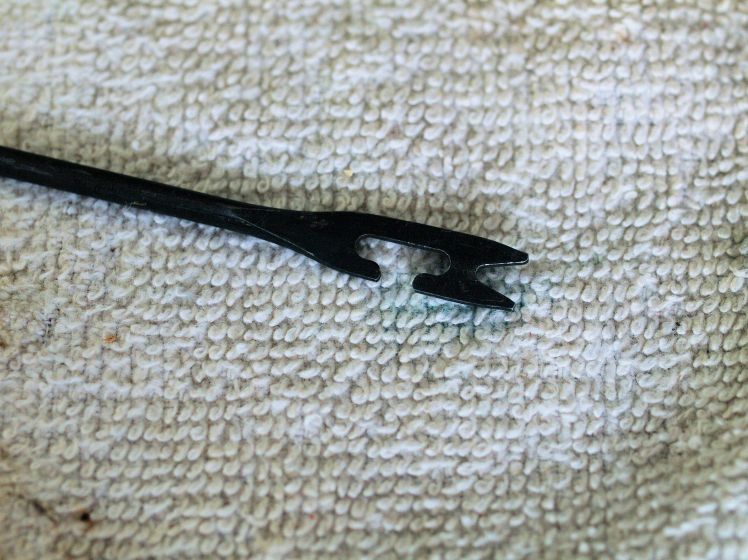
A pivot locator is an essential tool that every clock repair person should have in their toolbox.
Assembling the movement begins with inserting the mainspring barrels onto the backplate. The third wheel on the time side is positioned between the barrels, which means the barrels go in first, then the third wheel and the three-wing retaining spring on the top are then secured in place. After that, all the other gears and put in place.
Once everything is where it should be, the front plate is positioned and secured in place by the two movement nuts on the barrel end, which helps prevent the plates from separating while aligning the pivots up the trains into their respective holes. On the strike side, I generally leave the fly and stop wheel out until the very last moment.
The escapement is worked in through the opening on the front plate after the movement is assembled and the two screws for the suspension spring bridge secure the escapement in place. Once they are in place, it is time to work on the front plate by installing the levers, the rack, and the snail.
This movement has four strike hammers. It produces its distinctive bim-bam sound by having one hammer strike the outermost rod, while the other three simultaneously strike the remaining rods. The arrangement involves a paddle and “L” rod system (one hammer on the paddle and three on the “L” rod), and both must be positioned between two points of the star wheel.
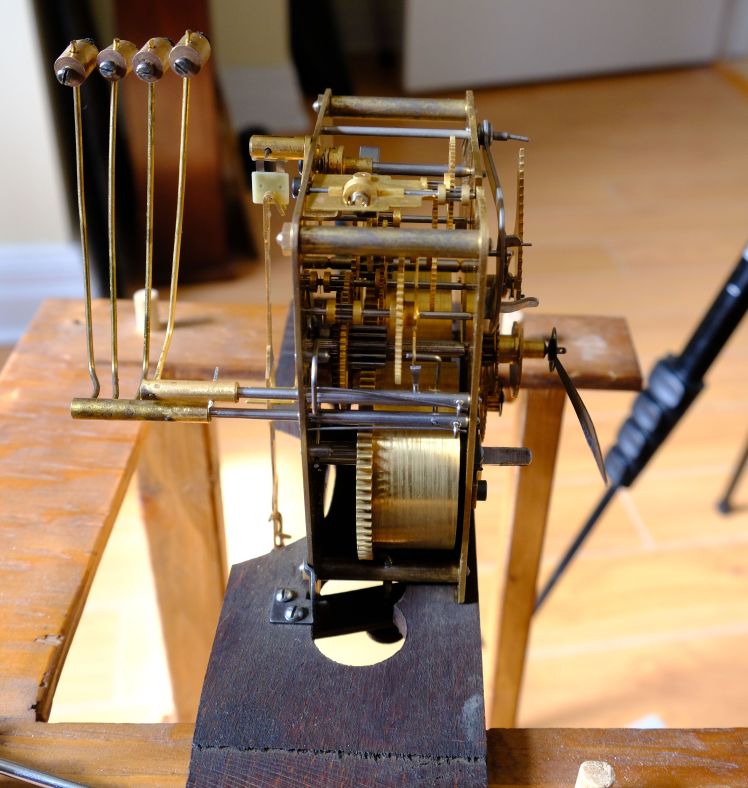
If not, one or the other may get caught on a star point and stop the strike. Sometimes, I’m successful on the first try; otherwise, I must open the plates and reposition the star wheel. In this case, I got it right the first time.
The only other adjustment to be mindful of is ensuring that the pin on the warning wheel—the uppermost gear on the strike side—is positioned roughly at the 12 o’clock mark. This ensures that the wheel spins enough to properly set up the warning.
Testing
I take a cautious step-by-step approach during the testing phase. I wind the time side first, observe the movement and the action of the escapement, and make any necessary adjustments to ensure that once the movement is level, the escapement is in beat. I then run it for 24 hours.
Once I’m satisfied that the time side will run reliably, I shift my focus to the strike side. I check the movement, ensure there aren’t any obvious obstructions, wind the strike side mainspring, and observe its action, taking care to note the position of the lever on the snail to ensure that all 12 hours strike properly. I did have to make one small correction. I adjusted the snail by removing it, repositioning it one cog to the left, and reinserting it to ensure it aligned properly with the flat sections.
I typically test for about 2 weeks or 2 eight-day cycles before I reinstall it into the case. Once in the case, I resumed testing for another two cycles.
Summary
I’ll cover the case restoration in a separate article. Notably, surprisingly little must be done to the case, although it is dull with age and has a few minor scratches.
This project is particularly rewarding because it’s a family clock. It has been in the family for nearly 60 years and was a source of pride for my father-in-law. Were he still with us, I’m sure he’d be pleased to know that it’s being carefully restored to its original condition.
Discover more from Antique and Vintage Mechanical Clocks
Subscribe to get the latest posts sent to your email.
 Antique and Vintage Mechanical Clocks
I
LikeLike
Thank you. I value everything you publish very much. Peter
LikeLike
Thank you for those kind words.
LikeLike
Hi,
I have read your stories about old clocks with great interest. My interest in these pendulum clocks only arose recently, when my mother’s antique clock, which had been an heirloom in the family for years, passed into my possession. It is a Mauthe clock in a very similar style to the Mauthe “Horse Crown” wall clock you have written on your blog. The turned door jambs of my clock seem to be exactly the same kind of.
I have tried to find out the year of manufacture of my clock from European sources. In the German archives I found a patent book, according to which my clock was also manufactured, D.R.P 55006. From another source I found out that Mauthe had purchased the right to manufacture clocks according to the patent in question in 1895. Too bad I didn’t write down that source information.
There is also evidence that logo no.3 was introduced in 1901 or 1902. Mauthe also applied for a new clock patent in 13.6.1899 for ”Einstellung auf die minute”. I understand it so that the pendulum makes 120 beats / minute when my clock beats 116 times. The patent received in 25.4.1900. The question arises whether the company continued to manufacture the old patent 55006 in parallel with the new patent, or were these watches manufactured under the 55006 patent number manufactured before 1900?
Thanks for your interesting stories!
Best regards
Sakari Saksa
LikeLike
Thanks for your response to my article. The D.R.P. 55006 patent refers to a specific part of the movement. The patent was registered in May 1890 or 1891 for Heinrich Kielmann in Ruhrort, a borough in Duisburg. It pertained solely to the pendulum suspension arrangement, and Mauthe was an extensive user of the Kielmann patent. The patent was used by other manufacturers as Kielmann allowed it to be widely adopted. My horse crown Mauthe, made in 1899, features the Kielmann suspension. Mine also has 116bpm and I am not aware of the later change to 120bpm and I am curious as to why they would. Mauthe may have changed the suspension arrangement at some point, but if they did, I do not know when. If I come up with new information I will let you know.
LikeLiked by 1 person
Dear Ron,
Been meaning to write to you for a while just had to get to a long weekend. Love your emails.
This clock my grandfather bought in the early 1930âs when he first came to Canada. We had it till about 2010 or so since it was not working properly as my Mom put it. She took it to a clock repair place and was told it could not be fixed not sure what the problem was but my Dad and grandfather always dealt with it and they were now out of the picture.
Since my Mom was told it could not be repaired nothing serious happened to it but regardless she gave it to the clock maker who thanked her so he could at least savage the parts. I knew nothing about this at the time. Dad always dealt with anything about the clock. We as family could not touch that clock only Dad did the maintenance. Well my Mom passed almost 3 years ago and boy I miss that clock. It was part of the kitchen on our family farm for decades. I will send a picture of it from the 70âs.
I was at a contents sale a year ago and lo and behold a clock exactly the same as ours was there. It even had the exact chime sound. I bought and it worked but when I got it home it got a bit rattled. So I ended taking a couple days clock repair course with a clockmaker who said it was in excellent shape and we just got it going very quickly. He said if anyone says that the clock cannot be repaired they just donât know how to do it. Even if a part is missing you just make a part. These old clocks will last forever if taken care of. I wished we had known about him as the person my Mom went to obviously did not have the knowledge. When I saw your picture it brings back so many memories and the chime fills my home withâ¦well it just makes my home complete. Even though it is not the original one we had it is an exact duplicate and perhaps in a little better shape not by much though.
Thank you for your love of clocks as I am becoming a fan.
PS my Dad on the farm placed it in the kitchen mounted in the corner with a yellow curtain below. The 1st/2nd pic is me with the one from the contents sale. The other 2 pics are Dad getting a haircut but with the clock in the back and Christmas. Both had the maple leaf and exact same chime, I was told sometimes there is a high sounding chime but the one I got was exactly the same sound. So thrilled.
PSS any info. on the clock if you have any historical info. would be greatly appreciated thanks again so much Ron.
LikeLiked by 1 person