
I recently added two more Pequegnat clocks to my collection: the Dandy model and the Hamilton Tall, the latter of which I will be profiling in this article. I now have a total of 12 Arthur Pequegnat clocks in my possession.

For those unfamiliar with the Pequegnat name, the Arthur Pequegnat Clock Company is arguably the most iconic antique clockmaker in Canada. No Canadian antique clock collection would be complete without a Pequegnat piece.
The Arthur Pequegnat Clock Company
The Pequegnat Clock Company was a Canadian clock manufacturer that operated from 1904 to 1941. It was founded by Arthur Pequegnat, a Swiss immigrant who brought his family to Canada in search of a new beginning.
Pequegnat, a skilled clockmaker and entrepreneur, saw an opportunity to establish his own clock company in Kitchener, Ontario (then known as Berlin). However, the story of the Pequegnat clocks begins even before 1904.
In 1897, Arthur expanded his Berlin jewelry shop to include bicycle manufacturing. By 1904, with declining demand for bicycles, he shifted focus to clockmaking, using his Berlin Bicycle Manufacturing plant to produce clock movements. The company’s motto, “Buy Canadian – Pequegnat clocks are better than foreign-made ones,” resonated with Canadian consumers.

Initially, Pequegnat sourced wooden clock cases from local furniture makers, but eventually, the company began producing its own cases. The Pequegnat Clock Company became known for high-quality, reliable clocks, offering a wide range of designs, including wall clocks, mantel clocks, and hall clocks.
The Hamilton Tall
Cashing in on Canada’s identity as a nation, Pequegnat saw the value in naming clocks after Canadian cities, cities such as Stratford, London, Toronto, Moncton, Montreal, and, of course, Hamilton. This marketing strategy undoubtedly struck a tone with buyers.
Interestingly, there are two models named Hamilton, which collectors differentiate as the “Tall” model and the “Wide” model (or shorter and taller by some). Among the two, the Tall model is considered more desirable by collectors.
Another model, which could have been a variant of the Hamilton but instead named St. Thomas, shares an identical case. However, it has a mission-style dial, which, in my opinion, complements the case more effectively. In the photo below, the St. Thomas is shown in the bottom left corner.
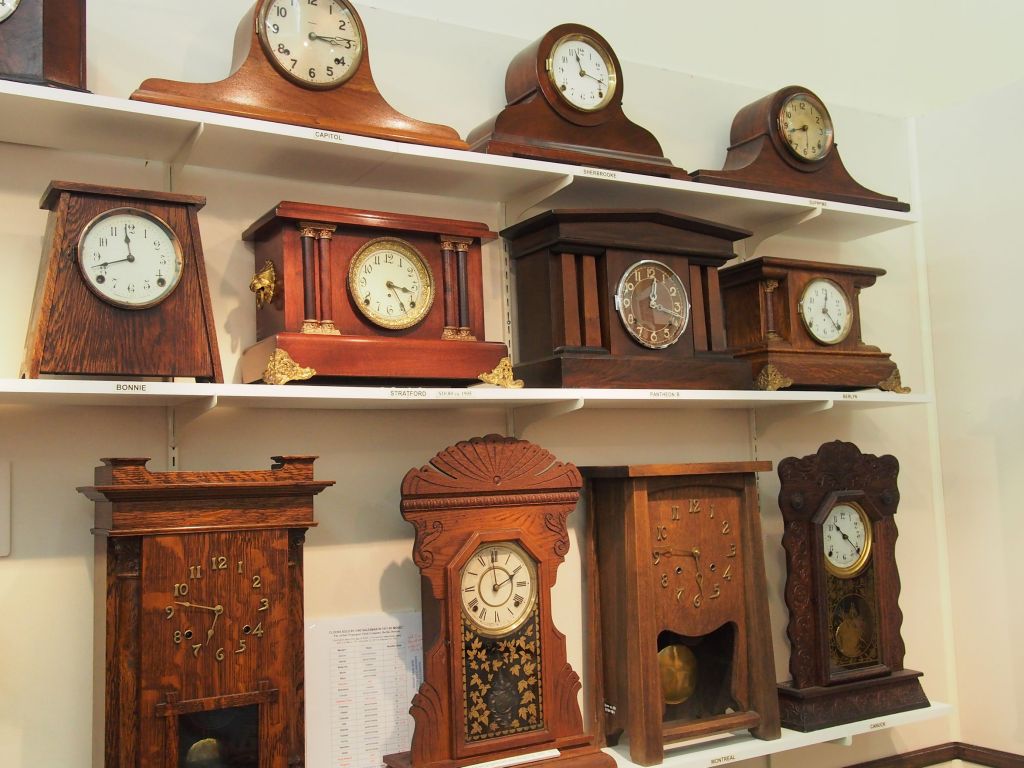
Berlin, Ontario, was renamed Kitchener in 1916, due to anti-German sentiment during World War I. This change provides a useful reference when dating Pequegnat clocks, as labels, movements, or dials marked “Berlin” indicate the clock was made in 1916 or earlier, while those marked “Kitchener” were produced after 1916. However, many Pequegnat models were produced over an extended period, making it challenging to pinpoint exact manufacturing dates for specific clocks.
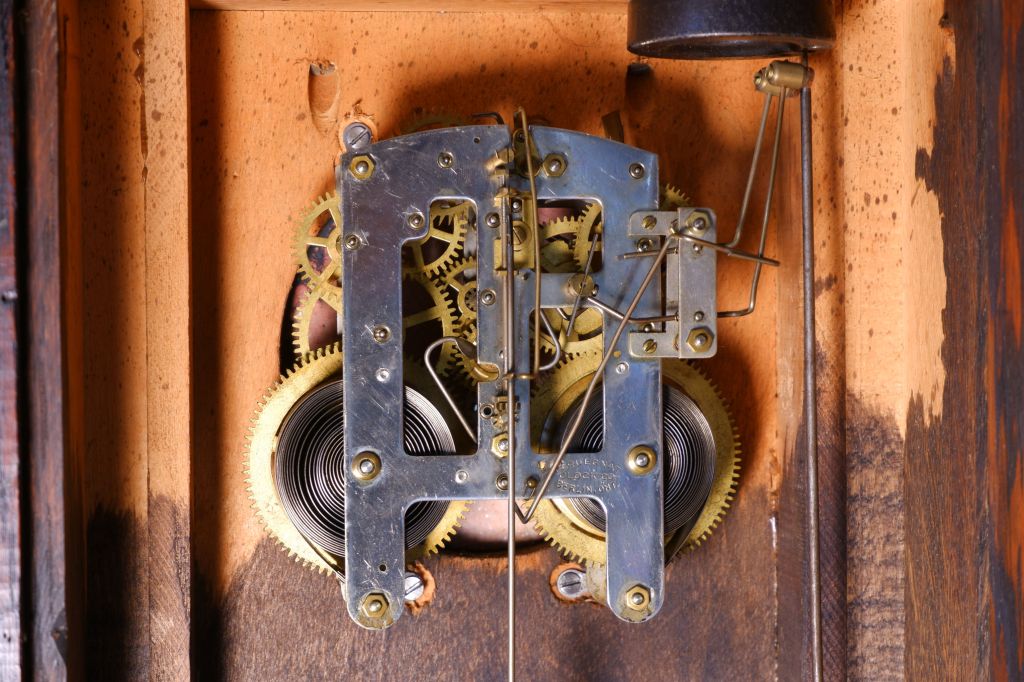
A common characteristic of Pequegnat movements is the nickel-plated front and back plates. Nickel-plated movements had a more polished, attractive finish, further appealing to customers.
The Pequegnat Clock Company initially used steel plates for their clock movements but later transitioned to brass plates, with the shift occurring around 1907-1908 (though this date is unconfirmed). Steel plates were more susceptible to rust and corrosion, whereas brass offered greater resistance to corrosion and was easier to machine, making it a more suitable material for clockmaking. Despite this transition, Pequegnat continued to nickel-plate the movements to further protect against wear and enhance the perceived quality of the clocks.
The heavy brass-sheathed pendulum bob is visible through a glass panel on the front of the case.
Two Issues
Two factors keep this clock from being in perfect condition. First, a keen eye will notice that it has two strike hammers but only one rod gong. At some point, the second rod broke off. Tuned rods, considered an upgrade in a Pequegnat clock, contribute to a rich and vibrant sound. I have not investigated the movement closely but it appears that the half-hour strike is meant to strike the rod that is missing.
I spoke with the previous owner, who had the clock for several years, and he mentioned that it was already in that condition when he acquired it. He had been in the process of sourcing a new gong block and rod, but due to personal issues, he was forced to sell off his collection before completing the repair.

The second is the lack of a label. Labels often contain artwork, company logos, or slogans, adding to the clock’s aesthetic and historical charm. A clock with an intact, legible label is often considered more desirable and can command a higher price than one without.
That said, the case is in very good condition, and despite minor imperfections—such as one or two nicks and a slightly dented lower left front corner—it has held up remarkably well for a 110-year-old clock.
Case Construction and Condition
The case is made of quarter-sawn oak and stained dark oak. Quarter-sawn oak is not a type of oak but is created by cutting the wood logs at a specific angle—perpendicular to the growth rings. Quarter-sawn oak is more stable and less prone to warping, splitting, or twisting over time compared to flat-sawn wood. This makes it an ideal material for long-lasting clock cases.
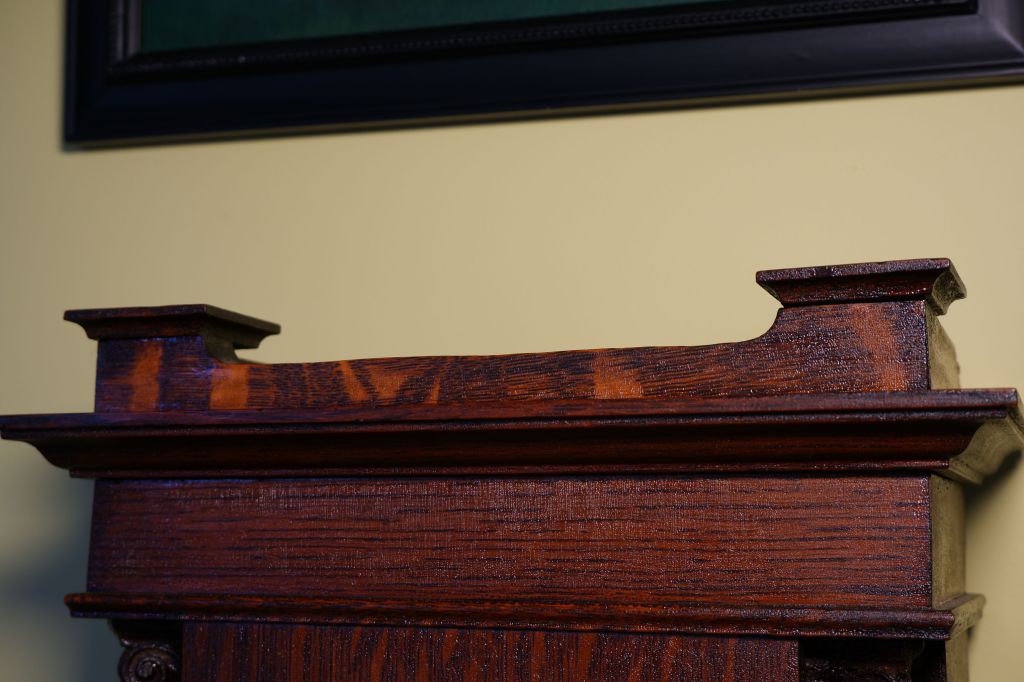
The enemy of a clock case—moisture—is effectively mitigated by using quarter-sawn oak.
Most importantly, quarter-sawn oak enhances the grain in any clock case. The dark stain has a rich, elegant appearance, but it requires cleaning and polishing to restore it to its original condition.

For reasons unknown to this writer the company chose not to stain the entire interior of the case. It is not just this clock but other Hamiltons I have seen online.

The clock was available with two types of dials: a plain spun-brass dial and a piecrust dial. This particular clock features a simpler, more understated dial. The dial itself appears to be enamel-coated, distinguishing it from the painted dials typically found on their less expensive models. All Hamiltons had spade hands.
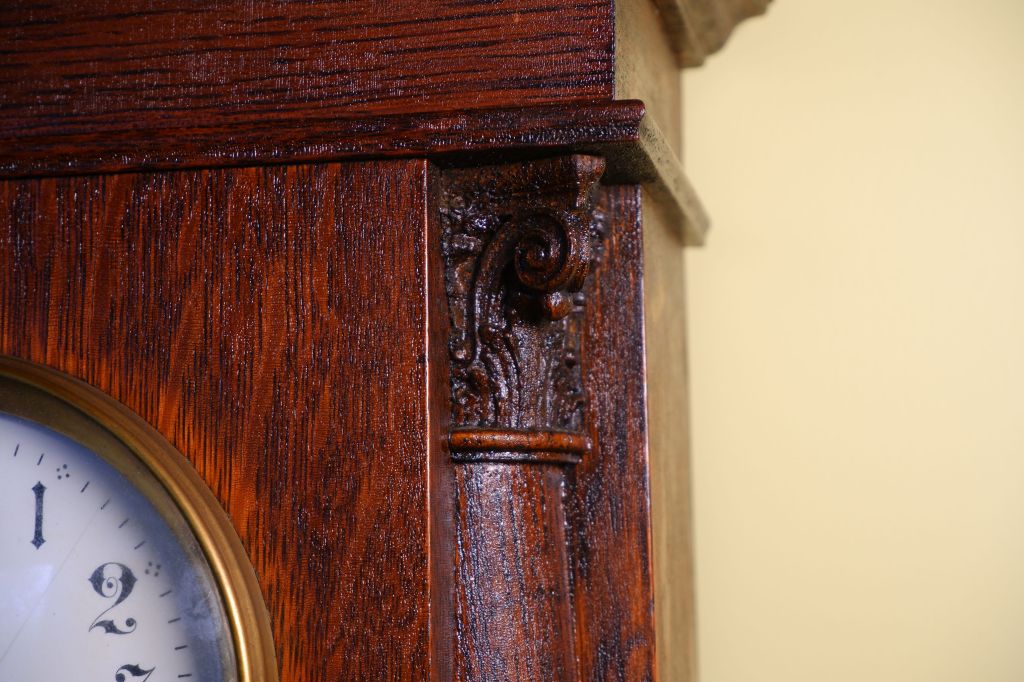
A notable feature is the two flanking quarter columns adorned with wood-carved capitals.
A Prestigious Clock for the Times
Arthur Pequegnat manufactured a range of clocks for the general public, but for those who could afford it, more ornate and visually appealing options were available. These luxurious designs conveyed a sense of status and sophistication, making them highly attractive parlour clocks.

Two challenges
In the coming weeks, I will be exploring options for the missing rod gong. Should I look for a replacement gong block and rods, or should I consider finding a second rod?
The second challenge is the case. The case appears to be in good condition and is definitely not a candidate for refinishing; however, a light sanding and waxing might be all it needs to give it a refreshed look.
The previous owner did not service the movement, so it will require cleaning. In the meantime, it runs well, keeps accurate time, and strikes—though only on one gong—on the hour.
Discover more from Antique and Vintage Mechanical Clocks
Subscribe to get the latest posts sent to your email.
 Antique and Vintage Mechanical Clocks
Nice write up. Myself, I only have one pequegnat ….. it’s the ward model. Still in working order, though , I don’t run it anymore.
Sent from my iPhone
>
LikeLike
Thanks. The Ward is a nice little clock. Reminds me of a Sessions clock from the same period.
LikeLike