
Tick-Talk Tuesday is a special time when I respond to readers’ letters and comments about clock issues, challenges, and recommendations for specific clocks. When the comments and questions are especially complex, I consult with fellow clock enthusiasts within my circle to ensure I offer the most precise and helpful answers possible.
RK writes:
I am working on an almost identical clock movement as the one shown on your website above. It was made by Frederick Mauthe. I have restored the movement, inserted many bushings, etc., and during testing have realized that the movement is gaining an hour a day. I don’t think the pendulum is original and I suppose I am on a quest for a replacement.
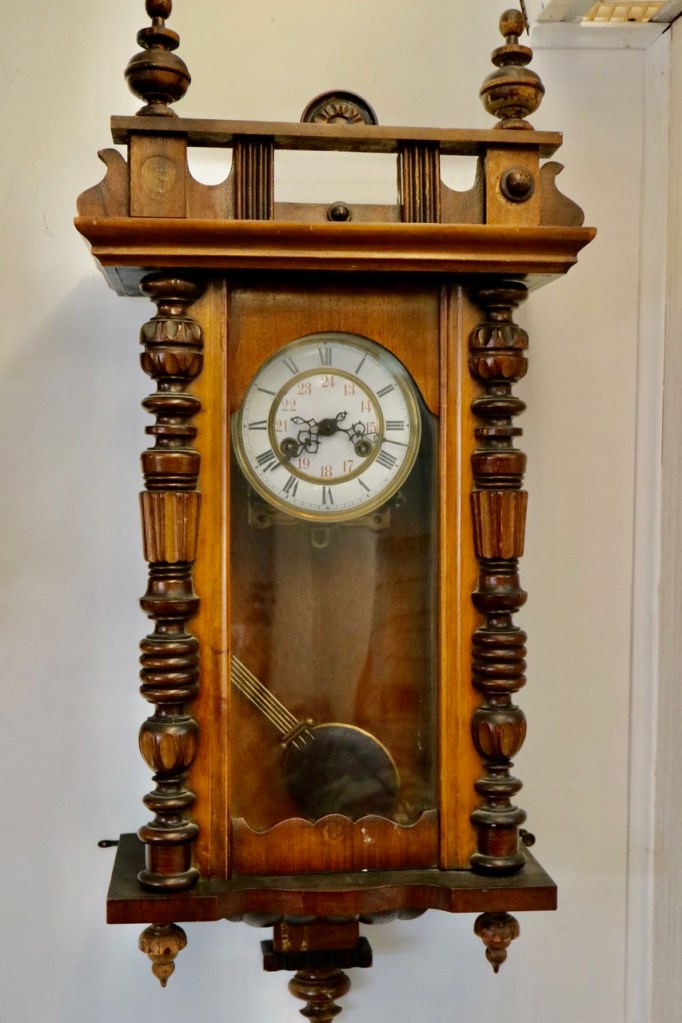
Here is the case. The finial has been re-glued and altered at the top, and that is another story. Here is the current pendulum: it weighs 0.139 kilos; the distance from the top hook to the bottom of nut under the pendulum is 220 mm. The diameter of the bob 100 mm. I believe this is too light and too short, but there is no more room in the case.

Do you know what the correct dimensions are for the original pendulum? (Weight and length)
This movement is now working so well and it would be a pity not to be to use it just because I cannot find a replacement pendulum.

Thanks for your time.
RK
My reply:
Hi and thanks for your email, RK. On the back of the movement, on the lower left of the last photo, are two numbers. 34 refers to the measurement in centimeters from the top of the suspension spring post to the bottom of the pendulum regulating nut. The second number refers to the beats per minute. Measure the pendulum you have and compare it to the first number.
Regarding the pendulum’s bob weight, I won’t have access to the clock until mid-September. However, I can get the measurements you need at that time if they’re still required.
Discover more from Antique and Vintage Mechanical Clocks
Subscribe to get the latest posts sent to your email.
 Antique and Vintage Mechanical Clocks
Ron, now that I have understood how to identify the length of the pendulum, I realized that the threaded rod that holds the adjusting nuts had been broken in earlier times. It was too short thereby causing it to run too fast. I have now ordered a new 4-40 12inch length of threaded rod to replace the old one. The problem is solved. Thanks for your help, Ron. RK.
LikeLike
I am happy that I could help.
LikeLike
Hello again Ron.
first off congratulations for being recognized as #9 by chat GPT.
On the topic of a Mauthe movement I have a couple questions:
I’ve read and watched the instructions posted on the NAWCC forum a hundred times to no avail.
Thanks in advance
Bill
LikeLike
The correct pronunciation is closer to “Mow-tuh,” with a soft “tuh” sound at the end. It’s a German name, so the “th” is not pronounced like in English. Having said that, I try not to correct if mispronounced.
This can indeed be a tricky process, and it’s understandable that you’re having difficulty, especially with the relationship between the S cam, gathering pallet, and warning wheel pin. While it sounds like you’ve already gone through various instructions, I’ll suggest a typical approach:
Start by setting the S cam on the minute arbor so that it releases the strike train just before the hour or half-hour. The cam’s shape should allow the strike train to start running as the pin lifts off the cam’s highest point.
The pin on the gathering pallet (bean cam) must be timed so that it catches the last rack tooth as the train completes its strike sequence. You want to make sure that the rack is fully gathered before the train locks.
The warning wheel pin should engage the hook and stop the train just before the gathering pallet pin hits the stop point. This ensures that the train is ready to release when the S cam allows it to do so.
LikeLiked by 1 person
thanks Ron. I’ll be back at the bench later this afternoon.
LikeLike
I hope things go well.
LikeLike