
One clock that holds a special meaning and one that I would like to add to my collection someday is the Arthur Pequegnat Regulator #1, a single-weight eight-day clock. This clock is truly a rare find, though the prices I’ve encountered thus far are a bit steep for my budget.

The Arthur Pequegnat Story
The Arthur Pequegnat clock company was a formidable contender to American wall clock manufacturers. While their wall clocks often mirrored American models, some of their designs boasted a unique touch. The company favoured the heartwood of quarter-sawn white oak for their cases, showcasing the stunning visual appeal of this choice of wood.
The story of the Arthur Pequegnat clock company is one marked by distinction. Born in Switzerland in 1851, watchmaker Arthur Pequegnat immigrated to Berlin, Ontario, Canada, in 1874 with a substantial entourage of 18 family members. Initially establishing himself as a jeweler and watch repairman in the late 1870s, Arthur and his brother Paul operated a successful shop in Berlin, Ontario, by the mid-1880s. After a decade, the brothers pursued independent ventures, each managing prosperous jewelry shops in Southern Ontario.
In 1897, Arthur expanded his Berlin Jewelry shop to include bicycle manufacturing. However, as the demand for bicycles waned by 1904, he shifted focus back to the clock industry, manufacturing his clock movements at his Berlin Bicycle Manufacturing plant. Initially, wooden clock cases were sourced from local furniture makers, but over time, Arthur began crafting his own cases.
Despite Arthur’s passing in 1927, the company, guided by family members, persevered until 1941. The scarcity of brass during the war effort led to the company’s closure. The factory, where these exceptional timepieces were crafted, never produced another clock and was eventually demolished in 1964. Today, Kitchener pays tribute to this great clock manufacturer with a commemorative plaque.
The renaming of Berlin to Kitchener in 1916, amid World War I anti-German sentiments, serves as a helpful dating marker for Pequegnat clocks. Movements or dials marked “Berlin” indicate a clock dating to 1916 or earlier, while those marked “Kitchener” are from 1916 or later. Due to the long production life of many clocks, precise dating of Arthur Pequegnat clocks remains challenging.
For a fascinating journey into the world of Arthur Pequegnat clocks, The Canadian Clock Museum stands as a treasury, boasting the most extensive museum collection of Arthur Pequegnat clocks in Canada. Additionally, the Macdonald Museum in Middleton, Nova Scotia, offers a modest yet noteworthy collection of Pequegnat clocks—a worthwhile stop for those journeying through the Canadian province of Nova Scotia.
The Regulator #1
The Regulator #1 is frequently likened to the Seth Thomas Regulator #2. While the Seth Thomas counterpart found widespread use in offices and rail stations across America, the Arthur Pequegnat Regulator #1, though less prolific, met the demands of many businesses in Canada.
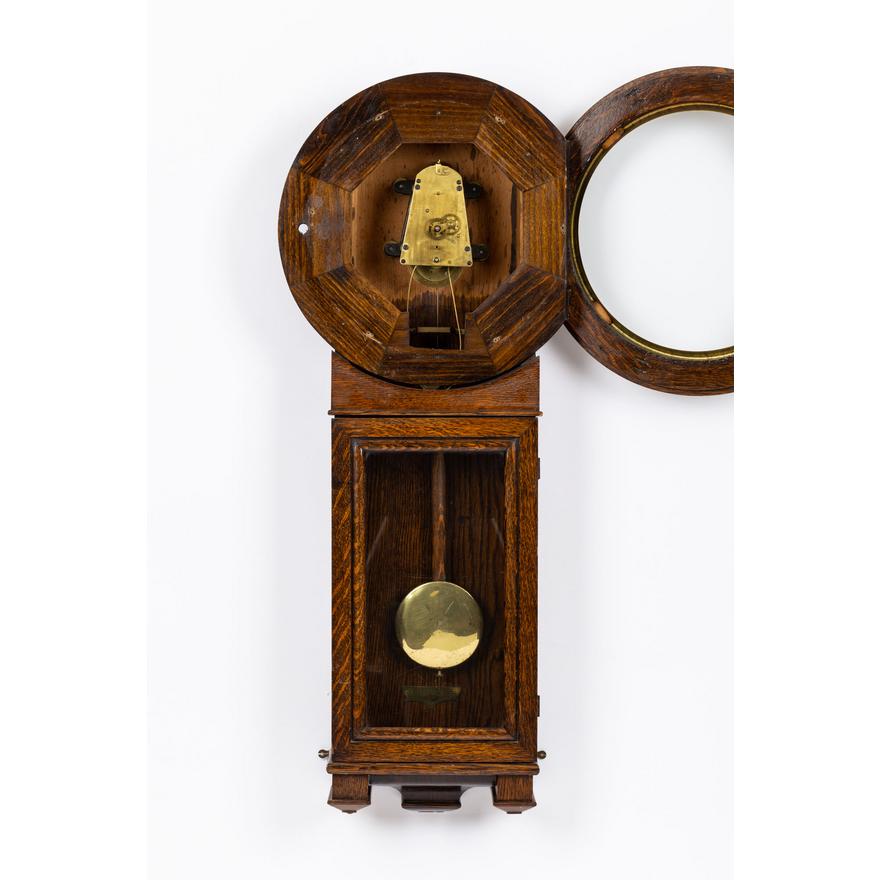
Although sought after by collectors the Regulator #1 has interesting technical quirks according to Canadian clockmaker John Plewes, author of Repariring & Restoring Pendulum Clocks. Plewes cites three design issues with the clock. Two are minor quibbles but the third involves the weight. Despite its similarity to the Seth Thomas Regulator #2, it requires a heavier weight (1/2 lb more) to drive it reliably. A lighter weight such as the one found on the ST#2 causes the clock to stop after a short period particularly when the minute hand is rising. The hands are simply too heavy for the clock as they influence the force applied to the train.
Plewes, therefore, takes issue with Arthur Pequegnat’s claim that the #1 is the “finest office clock made”.

Regardless, the clock is highly sought after among Canadian collectors, and commands a premium, often doubling the price of similarly styled clocks from well-known American counterparts such as the Seth Thomas Regulator #2.
Ah, some day!
Discover more from Antique and Vintage Mechanical Clocks
Subscribe to get the latest posts sent to your email.
 Antique and Vintage Mechanical Clocks
Morning, Ron…
Wishing you and your family a happy New Year, and thanks again for these interesting weekly articles. So well written and illustrated!
LikeLike
Thank you.
LikeLike