
You’ve acquired a clock that was running smoothly when you first laid eyes on it, but upon bringing it home and setting it up, it has suddenly fallen silent. A fundamental aspect of ensuring the proper functioning of mechanical clocks is to have a clock that is in beat.
Let’s delve into the concept of “beat.”
To start, ensure your clock rests on a level surface. Now, take a moment to listen closely to the tick and tock of your clock, attempting to minimize background noise and distraction. Placing a pencil or ruler near the ear with the other end touching the clock’s plate will amplify the sound.
A clock is considered “in beat” when its ticks and tocks are evenly spaced, creating a rhythmic, even cadence of tick…tock…tick…tock. Conversely, a clock is “out of beat” when these sounds are uneven, manifesting as ticktock… or tocktick…. Put another way, there should be an equal amount of time between each tick and tock. When a clock loses its beat, it may either cease running altogether or operate briefly before coming to a halt. It is important to emphasize that a clock’s regular beat is crucial for its proper functionality.
Correcting a clock’s beat can be achieved through two methods. The first involves gently tilting the clock sideways, back and forth, while listening for the beat to even out. Once you’ve achieved an even beat, prop the clock to maintain that tilt. However, while this method restores the clock’s beat, it may not maintain an aesthetically pleasing appearance.
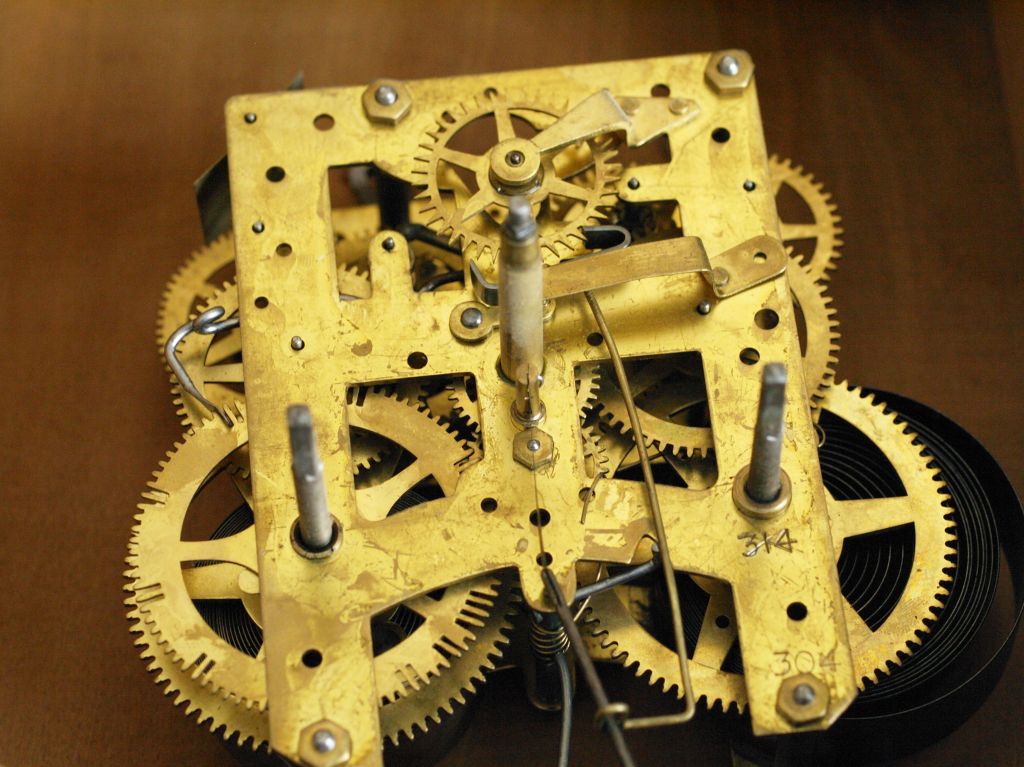
The second method entails adjusting the crutch, the rod extending down from the pallets that rock back and forth on the escape wheel. The pendulum rod passes through either a crutch loop or a forked foot at the end of the crutch, as indicated in the accompanying photo. It’s essential to ensure that the pendulum rod sits in the middle of the crutch loop without being too tight or too loose. The crutch is attached to the pendulum leader, which, in turn, connects to a post with a suspension spring.

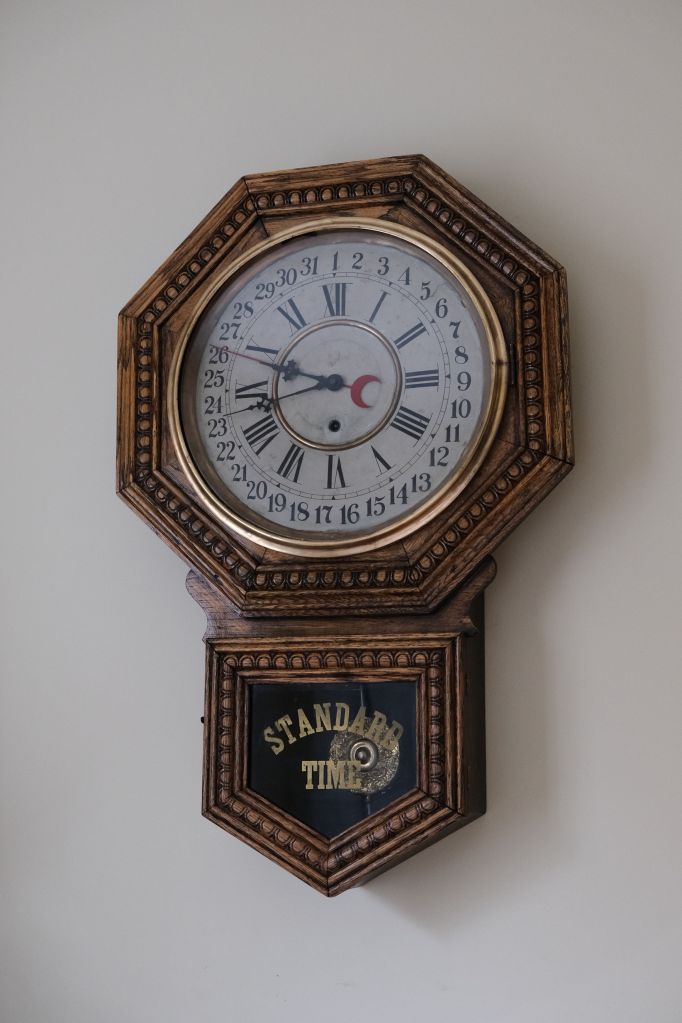
For mantel clocks, the process is relatively straightforward, as they typically feature rear access doors that allow easy crutch adjustments. However, wall clocks require a bit more effort. To access the crutch on a wall clock, you’ll need to remove the hands (the minute hand is released with a screw or pin, while the hour hand is simply pulled off) and the dial face, which is attached with screws. Minor adjustments to a wall clock’s beat can also be made by slightly tilting the clock off-level, but the tilt may or may not be noticeable.
The crutch adjustment process can vary depending on the crutch’s design. If your clock’s crutch is a simple rod or wire, you can adjust it by gently bending it left or right until you achieve a steady tick-tock rhythm. The brass rod is usually pliable enough to allow for re-adjustments if necessary. Listen carefully to the beat as you make these adjustments, stopping when you attain a consistent and even tick-tock pattern.
If the crutch connects to the pallets with a friction joint, the adjustment involves holding the pallets steady with one hand while shifting (pushing) the crutch slightly to the left or right on the friction joint. The adjustment here may be subtle, requiring slight movements in either direction.
The good news is that you need to undertake this procedure only once. Whether your clock is a wall clock, mantel clock, time and strike, time-only, or time, strike, and chime, the principles remain identical.
There’s no need to seek professional assistance for this task; it’s a do-it-yourself procedure that’s remarkably straightforward.
However, if the clock is moved to a new location, you may have to repeat the above procedure.
There’s something undeniably soothing about the rhythmic ticking of a mechanical clock in a room, especially when it’s in perfect beat.
Discover more from Antique and Vintage Mechanical Clocks
Subscribe to get the latest posts sent to your email.
 Antique and Vintage Mechanical Clocks
Hi, Dennis here. I wondered if you could tell me what kind of figural was attached to this clock. I think that you might know or maybe know someone that has this info. It is a cast brass with solid plates on all four sides. Seth Thomas with a perfect porcelain dial. Time and strike. Am getting it ready for assembly. So just have back plate of movement and picture of this beautiful case. it is 12.75 high and 9.75 wide. would appreciate any info. I really enjoy your Blog Thank you  Dennis
LikeLike
Thanks for your kind words, Dennis. Send me a photo (or photos) of your clock at ronjoiner@antiquevintageclock.com so that I can give you some ideas on how to address the missing figural.
Ron
LikeLike