
This unnamed fusee clock was acquired from a friend this past summer and after a few months, I am finally able to hang it on the wall. Unfortunately, after having been involved in the extensive cleanup following the devastating hurricane Fiona here in Nova Scotia, there was little time for clock repair. But, now that the dust has settled it’s time to get back to clock collecting and repair.
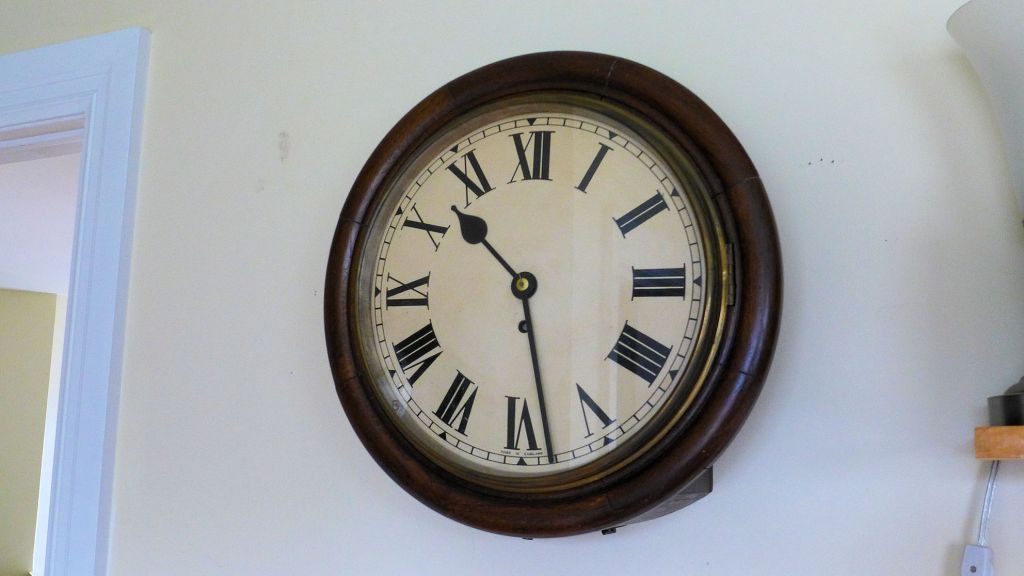
It is the first fusee clock in my collection. I have waited a while but this is an excellent acquisition.
This time-only gallery-style clock with a fusee movement is non-descript and quite ordinary and there is nothing special or distinctive about it. It has a 12″ dial and is 15 1/2″ across with a spade hour hand and spear minute hand with a heavy brass dial bezel.
A 12-inch dial is considered the standard size for a gallery clock and a 12-inch dial would have been the maximum size for a domestic environment. Larger 14″ and 16″-inch” gallery clocks would have been found in public areas, factories, and post offices.
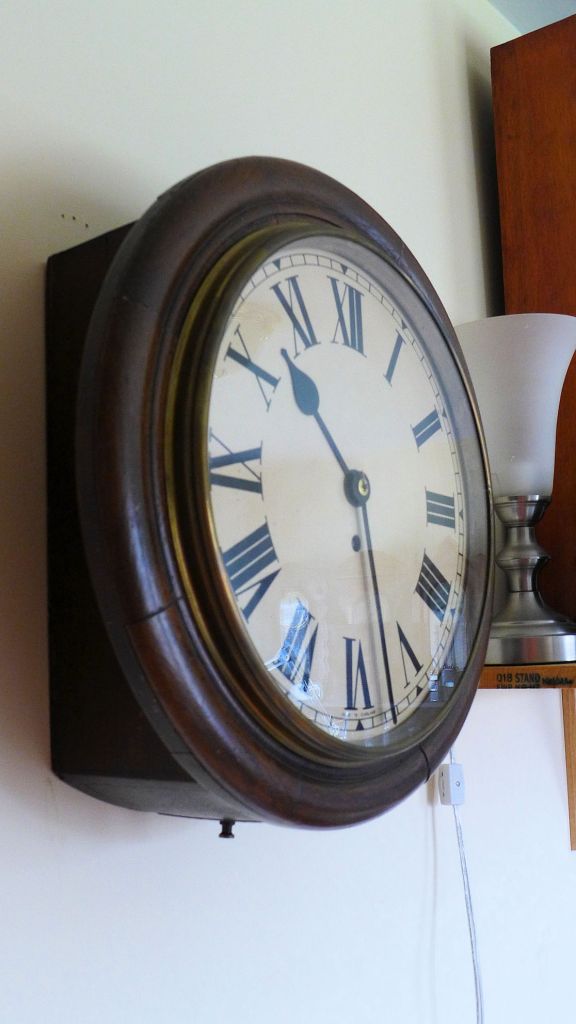
I am not an expert when it comes to identifying wood types but I would say a solid mahogany bezel surround with veneers on the rear access box.
Although fairly heavy it is designed to be quickly removed from the wall by pulling out 4 wooden pegs (two on each side of the back box), very handy for periodic inspection/maintenance. The pendulum leader literally hangs on a notch on top of the escapement bridge so, disconnecting by means of opening up a side door on the right and reaching in is pretty simple.
It has a conventional anchor escapement, a robust bridge, and a sturdy crutch. The plates are held together with screws but pinned to the back of the dial.
There is a trademark on the movement which I cannot identify. Perhaps a reader might identify this English company. I can make out T, an S, an O, and something else. Atson, AT & Son or something with a “z”?
I posted the question on a popular antique clock forum site and expected a response but got nothing.

Is it an antique (over 100 years old)? Perhaps, but it could be as late as the 1920s. The plates are thick, the gears are machine cut, cut pinions throughout, a hefty pendulum bob, thick but plain movement pillars, and a generally robust feel all around. It was certainly designed for longevity and reliability. The screwed pillars are a good sign that it was made after 1900.
This fusee has a cable drive. It is unknown whether it originally had a chain as most did many years ago or if it was converted to cable as many were when taken in for servicing. Chains are difficult to source and wire/cable is much more cost-effective.
An advantage of a brass cable is that if it should snap there would be less collateral damage than a chain flailing all over the place. When a chain releases very suddenly the potential for taking out gear teeth and other parts is much higher.

Fusee advantages
Constant torque and in theory, more accurate timekeeping are its chief advantages. It works like this. As the spring begins to uncoil the cable is on the smallest diameter of the fusee. The pull on the spring drum becomes less as the diameter of the fusee increases. The diameter of the fusee becomes larger giving greater leverage.
The larger radius at the fusee compensates for the weaker force of the spring, keeping the drive torque constant which is why fusee clocks are better timekeepers than conventional spring clocks.
Accuracy cannot be compared to a quartz clock today but keeping time within a minute or two a week in an industrial/office/domestic setting was perfectly acceptable in an age when the exact time was unimportant.

The plan
I am not going to tackle this project just yet but fortunately, it has seen servicing. I can identify at least three newer bushings. There does not appear to be significant play in the movement which is always a good sign so, there should not be a problem if the servicing is delayed for a while.
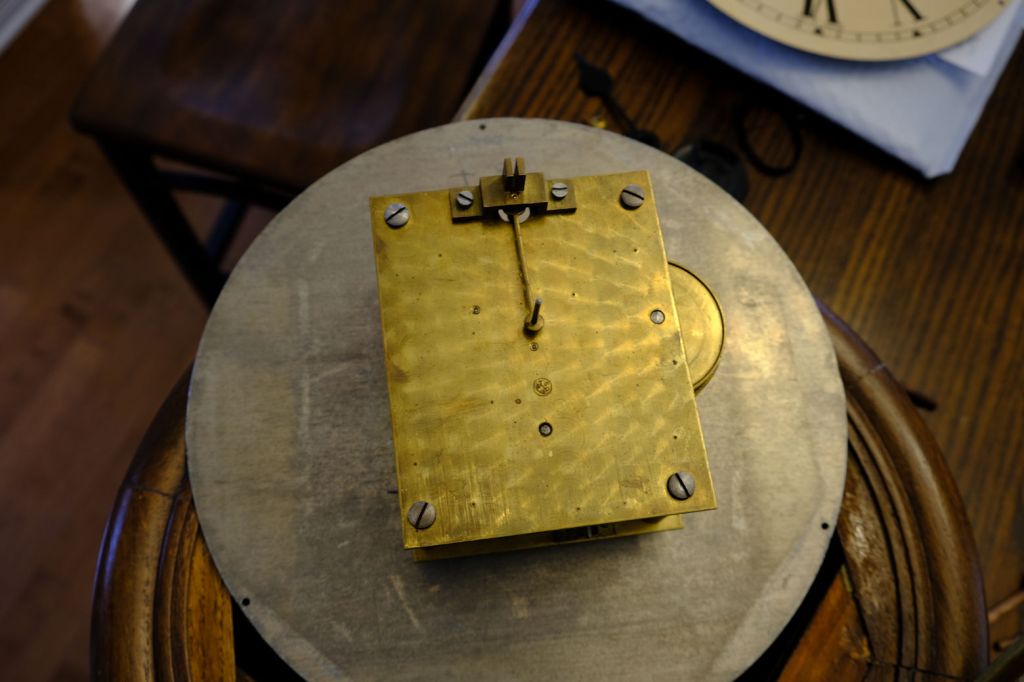
The movement is not particularly dirty so, I oiled the movement, mounted it on the wall, attached the pendulum, and put it in beat.
Taking the movement apart and addressing any wear issues does not concern me but I must learn more about how to set the preload on the mainspring, which has its own winding arbour (not accessible through the dial) before I dive deeper into servicing this movement.
The clock came without a key and I had to order one, a very large #11 key.
In the meantime, the clock is happily ticking away on my office wall.
Discover more from Antique and Vintage Mechanical Clocks
Subscribe to get the latest posts sent to your email.
 Antique and Vintage Mechanical Clocks
Hello,
I just thought I best comment as I have just acquired the same, or at least, a very similar clock. I’m not a collector and I came across this clock by chance at an antiques dealer here in the UK. I have been looking for a n clock since moving into our Edwardian house a few years ago. I am very happy to have one at last.
My clock is not in such a good condition as yours seems to be. Someone has previously done some very clumsy ‘repair work’ to the clock face. Looks like they have tried to cover up rust spots or similar which has left glossy paint marks here and there. I might to some research and see if there is a way to amend that later on.
As this is my first and only pendulum clock, it’s been a learning curve trying to hang it correctly and balance the beat. It seems to be running very well before it stops suddenly. The record so far is 8 hours before it stopped. Could this still be due to the balance of the clock? I will keep reading up on these clocks so I can get it right.
I can tell you that the mark on the back of the movement says, TSOL1. The seller didn’t know anything about it’s origin and I haven’t been able to find out anything about it either. Someone in the shop did have a guess that the movement itself was from Germany as it was cheaper back in the day.
Thanks for posting this article, it was really fun to see another ‘mystery clock’ out there.
Have a nice day.
Camilla
LikeLike
Hi and thanks for your comments. If you said that it runs for a few minutes and stop, yes, I would say that the clock is not in beat. There should be an even tick and tock when the clock is running. Here is an article I wrote describing how to set the beat. https://antiquevintageclock.com/2023/09/15/a-guide-to-adjusting-your-clocks-beat/
Have you turned the winding arbour till it winds no further? It may only be receiving partial power
However, if it runs for 8 hours it leads me to believe either it is slightly out of beat or there is a power issue that could be the result of a weak mainspring or quite possibly a bent part such as a gear arbour. Regardless of the situation, disassembling it is essential to pinpoint the root cause of its poor performance.
Also check out this article on dial inpainting.
Regards,
Ron
LikeLike