
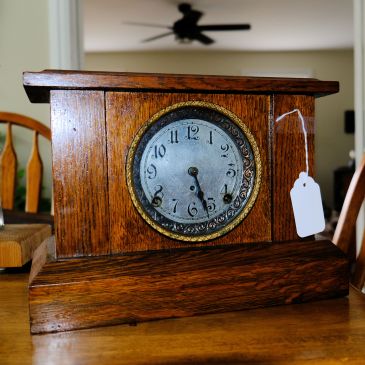
The newest addition to my collection of Pequegant clocks is the Jewel. That marks a total of nine Pequegnat clocks in my modest collection. I was not actively seeking a new clock. In fact, I haven’t purchased one in months, and mantel clocks weren’t even on my radar.

I bought the Simcoe (above) in 2018 from a shop in Victoria, British Columbia (Canada) and I think, at the time, I paid close to $200 for it. I located the Jewel in an antique shop about 20 minutes from where I live. I recognized it almost instantly, even though it was placed on a shelf nearly out of my reach.
The Jewel’s price was significantly lower so, why pass it up?

The two clocks boast strikingly similar case designs. In fact, the dimensions of the quarter-sawn oak case are identical, although the Simcoe model is slightly taller due to its corner feet and wider due to the addition of lion-head handles on each side. Both contain the same 8-day time and strike movement.

Made in Canada before 1916, this clock has an 8-day, spring-driven time and strike movement with signature Pequegnat nickel-plated plates. Initially, I thought there might be brass bushing inserts on steel plates. However, upon passing a magnet over the plates, I discovered that the plating was not on steel but on brass. Plating over brass may not be the most practical solution, but aesthetically, it offers a pleasing appearance.
Although the movement bears the stamp “The Arthur Pequenat Clock Co., Berlin, Canada” there is no maker’s name typically found on the lower section of the dial face, a peculiarity I’ll delve into shortly.

Both “Berlin” Simcoe and Jewel models feature pie-crust dials, setting them apart from later clocks with plain brass bezels.
Why are they called “Berlin” clocks? In 1916, the town of Berlin, Ontario faced considerable backlash due to the ongoing war in Europe, with its name being associated with the enemy of the time. These wartime tensions prompted the town to undergo a name change to Kitchener, Ontario. While Pequegant clocks lack a specific date stamp, the town’s name change serves as a useful reference point for dating these clocks. The company had a relatively short lifespan, being founded in 1903 and ceasing production in 1941.

The case is in excellent condition but I was drawn to the dial immediately. Something is certainly amiss. At first, I suspected the dial had been replaced, but upon closer examination, I realized that a previous owner had scraped off the paint from the dial, leaving the numbers intact. It’s not unexpected. With time, the paint on these dials tends to degrade, and it’s likely that it had deteriorated to such an extent that the decision was made to remove it altogether.
Should I overlook this issue and simply accept it as is, or address it by repainting the dial?

The most interesting aspect of this clock is the price. Although antique clock prices have been depressed in the last several years, Canadian-made Pequegnat clocks seem to hold their value quite well. A quick perusal of auction sites reveals that realized prices for the Jewel hover between $100 and $250 with the Berlin-made clocks commanding a higher price.
While the movement, unfortunately, does not run, based on my experience with other Pequegnat clocks in my collection, I suspect it may be gummed up with dirt and could potentially require a bushing or two to have it run as it should.
A worthwhile acquisition at an excellent price point.

You must be logged in to post a comment.