
Over the years, as my clock collection has evolved and my interest in Canadian horology has deepened, I’ve found myself crossing paths with a wide range of clocks from around the world. One group that continues to spark curiosity—and conversation—is the Chinese-made mechanical wall clocks that became so common in North America during the 1960s and 1970s.
These clocks are sometimes overlooked in collector circles, but I think they deserve a second look—not just for what they are, but for what they represent.
A Familiar Look with European Roots
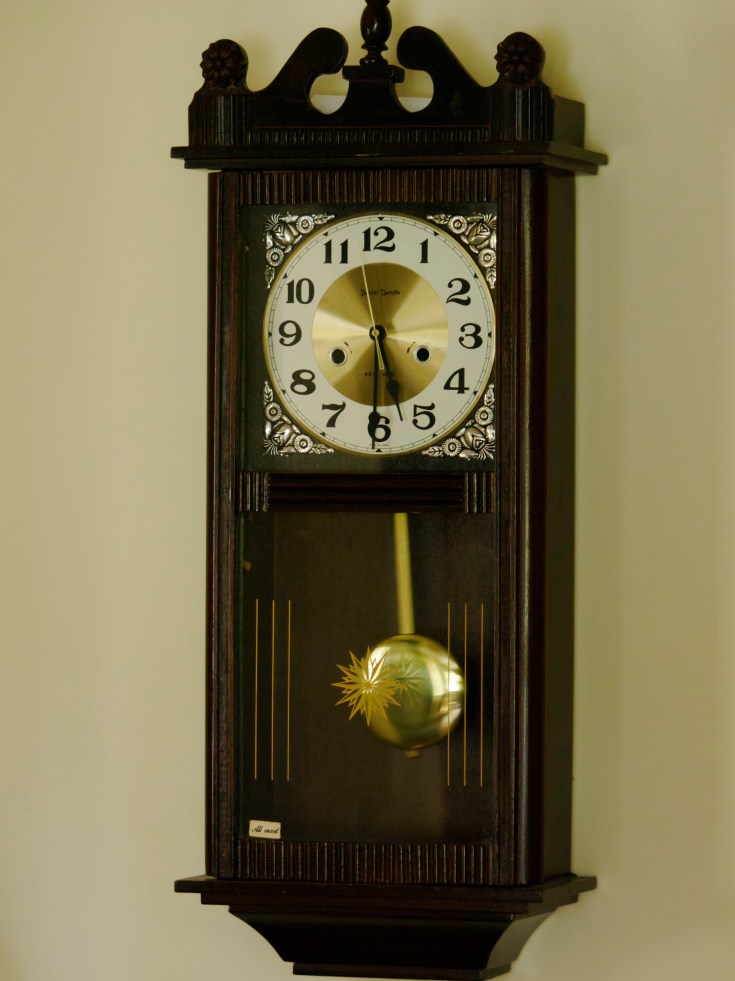
If you’ve spent any time browsing antique shops or estate sales, you’ve likely seen them: wooden wall cases with a glass door, a visible pendulum, and a brass-toned dial with Roman numerals.
Many were time-and-strike, typically 31-day movements, and designed to echo the look of traditional European box clocks.
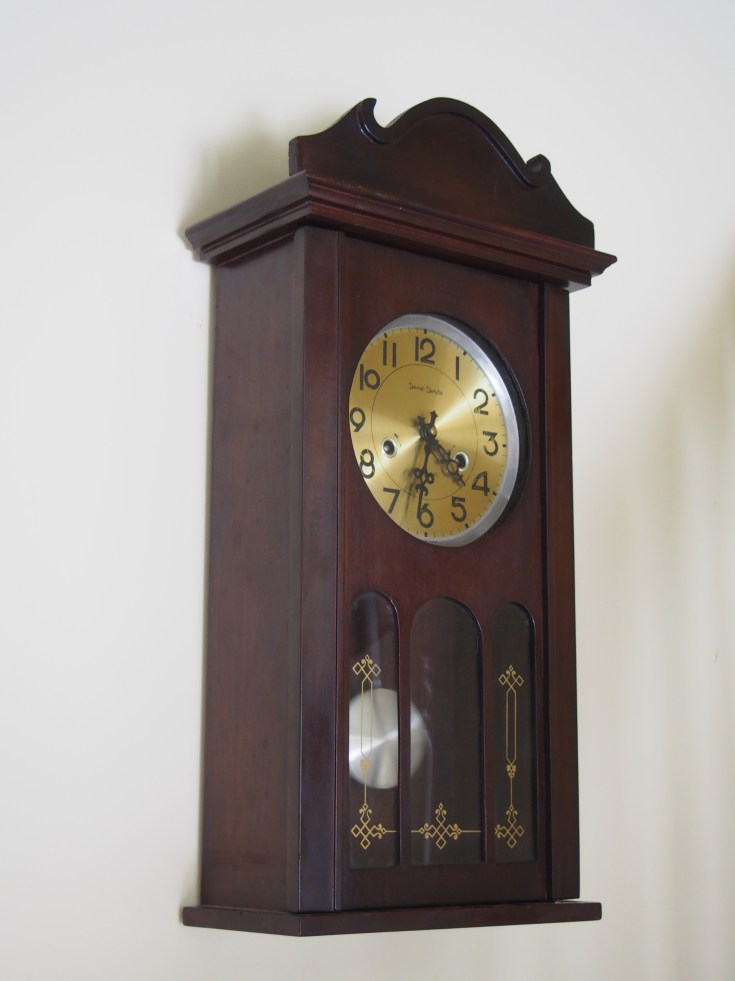
One seemingly universal feature was the winding arrows just above the winding points on the clock face. A simple instruction for reminding the owner of which direction to wind the clock.
The resemblance to the European clock was no accident. During the mid-20th century, China was actively developing its manufacturing base, and clockmaking became one of the industries where established European designs—particularly German—served as inspiration.
The goal wasn’t to reinvent the form, but to produce reliable, attractive clocks that could be exported to a growing international market.
Seizing an Opportunity
These clocks arrived in North America at just the right moment. The 1960s and 70s were decades when traditional décor still held strong appeal, and a wall clock was more than a timekeeper—it was part of the room.
Chinese-made clocks fit comfortably into that setting, offering a familiar look at a price point that made them accessible to many households. For some families, this may well have been their first mechanical clock—something to wind, listen to, and live with day to day.
There’s a certain charm in that, and I suspect many of these clocks quietly marked the rhythm of family life for years.
A Distinctly Western name
One of the more intriguing aspects of these clocks is the variety of brand names they carry, often sounding distinctly Western. Names like Daniel Dakota, Linden, Citizen, Kassel, Ergo, Camelot, or Tempus Fugit show up regularly, and while they appear to suggest a manufacturer, they were typically importer or distributor brands.

At the time, using a Western-sounding name helped make the clocks feel familiar to buyers, while today it adds an extra layer of interest for collectors trying to trace their origins.
The model was straightforward: a North American import company would source clocks from a Chinese factory, apply its own branding, and sell them through furniture stores, catalogues, or retail outlets. This wasn’t unusual then, and it certainly isn’t unusual now.
Stepping up on the Global Stage
It’s fair to say these clocks were not built to the same standard as their German or earlier North American counterparts. Differences in finishing, materials, and long-term durability are often noted, and that’s part of the honest assessment. But context matters.
These clocks were never intended to be heirloom-grade pieces. They were designed to be functional, affordable, and widely available—and in that role, they succeeded. The fact that many are still ticking today is, in its own way, a testament to their durability and purpose.
What I find most compelling about these clocks is the broader story they tell. China has a long and fascinating relationship with mechanical timekeeping, going back centuries, and by the 1960s and 70s, the country was stepping onto the global stage as a manufacturing force.
These clocks represent part of that early export story, a period when production scaled up, and goods began flowing outward to homes around the world.
In that sense, they mark a transition—from regional craftsmanship to global manufacturing—and they sit at an interesting crossroads in horological history.
A Word from the Workbench
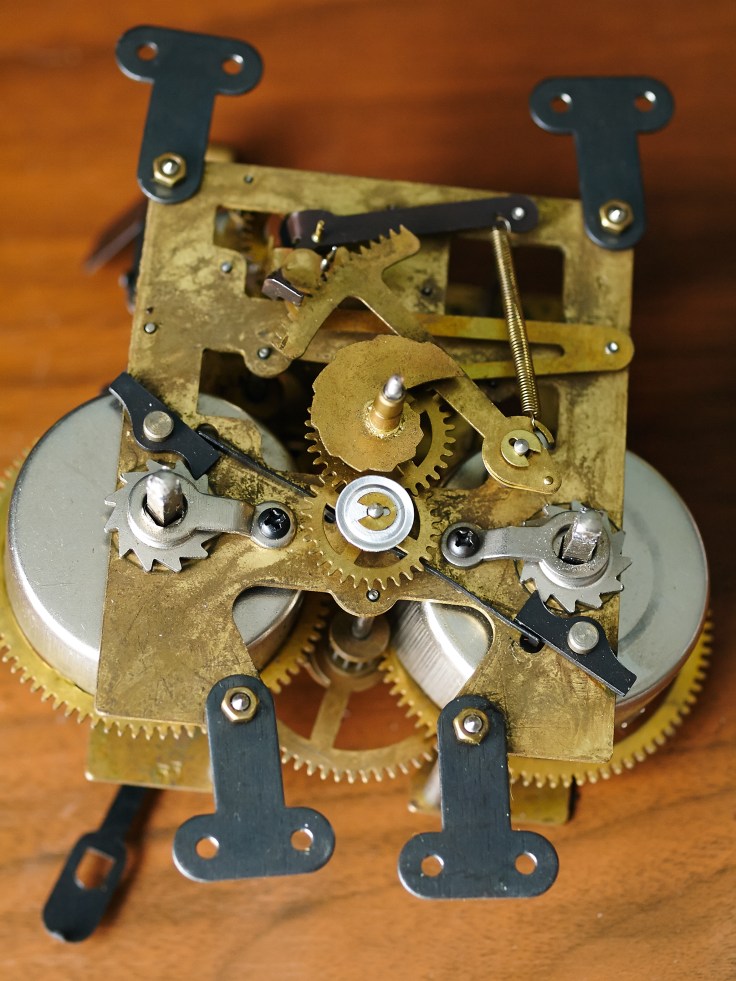
It is doubtful that these Chinese-made clocks were ever designed with long-term repairability in mind. The original design philosophy appears to have emphasized low manufacturing cost and mass production rather than ease of servicing. At the time, the industry largely viewed these clocks as inexpensive consumer products rather than heirlooms. When a clock stopped functioning, many owners were expected to replace it rather than invest in repairs.
This approach is reflected in the construction of many of these movements. Components were often assembled quickly, replacement parts were unavailable, and disassembly for servicing is difficult compared to traditional mechanical clocks. While skilled hobbyists and clockmakers can often repair them, repairability was likely a secondary consideration to affordability and convenience.
In spite of the design philosophy, many of these clocks have lasted a surprisingly long time.
That said, a caution concerning repair.
A number of these movements were built as 31-day clocks, which meant they required very large, very powerful mainsprings to keep them running for that length of time. Those springs can store a surprising amount of energy, and they demand respect when being handled.
On top of that, the overall quality of the parts was not on par with German or earlier North American-made clocks, which can make servicing more challenging.
Perhaps the biggest hurdle today is parts availability—quite simply, replacement parts are not easy to source, and if something breaks, there’s no clock parts supplier to turn to. So, are they serviceable? Yes, in many cases they are, but care must be taken, especially with those strong mainsprings, and one has to accept that if a component is damaged beyond repair, replacement is often not an option.
Many of these clocks were later converted into ones with quartz movements.
The Reality of a 31-Day Run
One other practical note with many of these 31-day clocks is timekeeping over the full run. In theory, they’re designed to run a full month on a single winding, but in practice, even a very small gain or loss each day tends to add up. Timekeeping was never their strongest suit.
A clock that’s right on time at the beginning of the month can easily find itself several minutes off by the end of it. For that reason, many owners find it more satisfying to treat them as a weekly-wind clock—winding them on the same day each week. It keeps the clock running in a more stable portion of the mainspring’s power curve and makes it much easier to keep accurate time over the long haul.
A Well-deserved place in Horology
One final note. It’s sometimes suggested that China simply adopted or copied mechanical clockmaking from Europe, but the historical record tells a very different story.
During the Tang Dynasty, a remarkable figure named Yi Xing, working alongside the engineer Liang Lingzan, developed a water-powered astronomical clock regulated by an early escapement mechanism around AD 725. That concept of controlled, step-by-step motion lies at the very heart of mechanical timekeeping.
So rather than being late to the story, China was, in fact, exploring some of the fundamental principles of clockmaking centuries before mechanical clocks appeared in Europe.
Final thoughts
While my own focus remains largely on Canadian-made clocks, I’ve come to appreciate the role these Chinese clocks played in homes across North America. They may not be the centrepieces of a collection, but they are honest, practical, and historically significant.
More importantly, they brought the experience of mechanical timekeeping into countless homes, and that’s something worth recognizing. If you happen to have one on your wall—or tucked away on a shelf—it might be worth taking another look. Wind it up, listen closely, and consider the journey it took to get there. As always, the story behind the clock is often just as interesting as the clock itself.
Related Articles
This article serves as a counterpoint that argues Chinese-made clocks were designed to be inexpensive and largely disposable.
Discover more from Antique and Vintage Mechanical Clocks
Subscribe to get the latest posts sent to your email.
 Antique and Vintage Mechanical Clocks