
Not long ago, my wife and I were attending a medical appointment in Springhill, Nova Scotia. While we were in the area, we decided that a side trip to Parrsboro fit the bill, as the town was less than a half-hour drive away. It was a leisurely, sunny fall day as we drove through the hills and lakes of northern Nova Scotia, and we were eager to see the sights of Parrsboro, situated on the Minas Basin, which is connected to the world-famous Bay of Fundy. Parrsboro is one of the oldest settled areas of Canada. It is known for its maritime heritage and its wondrous geological formations.
Once in town, we stopped for a coffee, did a bit of shopping, and thought, since we were here, why not check out The Parrsboro Mansion Inn?

There was a very specific reason for our visit to the inn— in 2018, I had purchased a clock that originally came from this house. Today, it’s a family-run business, but many years ago, it was a private home. We stopped and talked to the present owner, who kindly provided us with a history of the house and some photos.
I tried to imagine where in the house the clock would be hung—perhaps in the living room or the parlour. “You wouldn’t consider gifting us the clock,” the owner said. “Let me think about it,” I replied.
Now, let’s go back in time.
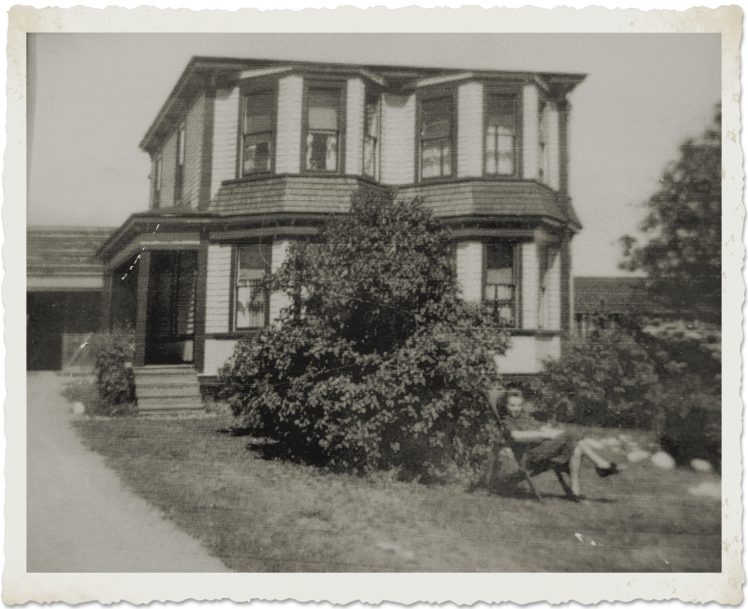
In 1873, Henry Davison operated a blacksmith shop on this land near the roadside, not too far from the town centre. In 1898, Joseph Jeffers purchased the eight-acre property and built a spacious home for his family.
The Jeffers family retained ownership until 1930, when it was sold to Hilbert Lank. Hilbert died in 1972, but the family stayed on for a number of years. To everyone in the Parrsboro community, it is still known as the Lank House, even though the Lank family sold it to its present owners some years ago.
Back in 2018, when I bought the clock, the seller explained that the clock was brought over from Europe when her husband’s family moved to Canada in the 1890s and had been in the family ever since. I assume that when I bought the clock, the house had already been sold and the family was in the process of liquidating its contents.

The clock is a stylish German-made Friedrich Mauthe time-and-strike wall clock that reflects the period. Judging from the design of the trademark, I determined that it was made in the late 1890s—consistent with the information provided by the seller.
The clock case was not without its issues — it was missing two finials and some case pieces, but the biggest challenge was the finish, which was heavily “alligorated”. This is a term that describes a finish that has tiny, irregularly shaped cracks and ridges that appear on the surfaces. Extensive exposure to heat and sunlight causes the finish to soften, attract dirt and dust, dry out, and contract, leaving behind a rough, textured finish.
The clock had clearly been stored for a long time, and it had suffered as a result. I was loath to strip down the case, but it was necessary.

In keeping with its history, we now call it the Lank Clock.

From a chance online listing to a deep dive into Parrsboro’s history, this clock has connected me to a story spanning more than a century. Restoring it is not just about repairing a case and servicing a movement—it’s about preserving a piece of time, heritage, and memory. Every tick now carries the echoes of Lank House, and it will continue to tell its story for generations to come.
Discover more from Antique and Vintage Mechanical Clocks
Subscribe to get the latest posts sent to your email.
 Antique and Vintage Mechanical Clocks
Gre
LikeLike
Thank you.
LikeLike
Wh
LikeLike
Love your stories Ron ….love love love. Never saw a Mauthe Wall clock like the one in your story.
Marie
LikeLike
Thanks so much. It might look different because It is quite possible the clock had a horse ornament on top of the flat area of the crown at one time. I am doing some research currently to determine if that is the case.
LikeLike