Dating an Antique or Vintage Clock – Part II

Honestly, an entire book could be devoted to the topic of dating clocks. Some time ago, I published an article titled “How to Date an Antique or Vintage Clock – Part I,” in which I used specific examples from my own collection.

I’d like to explore this topic further, and this post will discuss additional methods for dating an antique or vintage mechanical clock. While there is no one definitive method for dating an antique or vintage clock, there are often clear clues in some cases and more subtle hints in others that can help pinpoint when a clock was made.

Occasionally, the exact month and year are displayed somewhere on the case, and in other instances, the clock by way of serial numbers, date stamps on the movement, style of hands, spandrels, dial design, case design, and so on, establishes the date to within a certain period.

After 1896 foreign clocks (Europe, England) were mandated to have the country of origin on the case, usually on the dial. Any clock made after that date will have the country of origin.

Duration of manufacture

A bit of research into the history of a clockmaker can help you narrow down the timeframe for dating your clock. For instance, the E.N. Welch Clock Company, an American manufacturer, produced clocks until 1903, when it was acquired by the Sessions Clock Company, which continued making clocks until 1970. The E.N. Welch Clock Company made clocks for a 50-year period until its acquisition by Sessions in 1903.

By 1903 German-based clock manufacturer Junghans was the largest clock maker in the world and continued in its quest to bring more companies into the fold. Gustav Becker, founded in the 1860s, and Hamburg American Clock Company, founded in 1883 were absorbed by Junghans in the late 1920s. Although those companies were folded into Junghans in 1926 the Gustav Becker name lived on for another 9 years.

Gustav Becker regulator C.1907, Braunau factory

Clocks with Steel vs Brass plates vs Woodworks movements

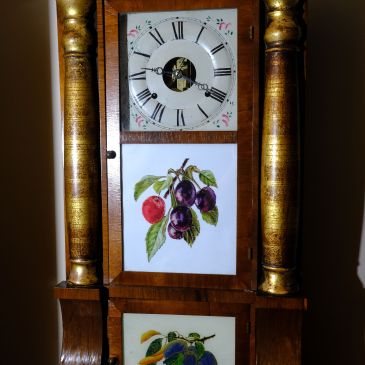
Smaller shelf clocks with 1-day (30-hour) wooden movements were produced in fairly large quantities from around 1810 to 1845, after which most clockmakers changed over to brass movements. Wood dials were also popular during this period.

Daniel Pratt woodworks movement with dial removed C.1832-38

By 1860 iron weights were being replaced by springs as the power source, and smaller clocks, many of them 8-day, were becoming increasingly popular. Early American spring-driven clocks used brass springs (late 1830s) until steel became cost-effective.

This information is important for dating a clock because it highlights key transitions in clockmaking technology and design, which can help pinpoint the era in which a clock was made. For example, the use of wooden movements and wood dials can indicate a clock was produced between 1810 and 1845. The shift from iron weights to springs by 1860 helps us understand why spring-driven clocks became popular, which is crucial for narrowing the period of manufacture. Additionally, the switch from brass springs to steel in the early 1840s can provide a more precise date range for early spring-driven clocks.

Understanding these technological changes allows you to make more informed judgments about a clock’s age based on its features.

Brass mainsprings for Manross clock
Brass mainsprings from a Manross steeple clock C.1837

During periods when brass was in short supply such as the World Wars (WWI and WWII), makers often made steel plate movements with brass bushing inserts. However, some companies such as Arthur Pequegnat used either steel plates or brass-plated steel plates throughout their operating years (1902 to 1941).

Steel plates on a Pequegnat time and strike clock

Other clock companies switched to steel as a cost-cutting measure when brass prices were high, not necessarily during wartime.

Screws and nails, chime rods, coiled gongs

In older clocks, nails, and screws were made of iron and hand-forged, with screw heads being slotted. Hand-forged nails can be found in clock cases dating from the earliest examples up to the mid-19th century, after which machined screws and nails started to replace them.

An ogee clock, like this example made by George H. Clark in 1865, was constructed with hand-forged nails.

George H Clark 30-hour Ogee shelf clock

Robertson and Phillips head screws were introduced in the first part of the twentieth century. Since the Robertson head was invented in 1906 and Phillips screw heads only began to be widely used in the 1930s screws of these types found in older antique clocks are later additions.

Since these screw types were introduced in the early 20th century, their use in a clock that dates from an earlier period suggests that the screws were likely replaced or added during a later restoration or repair. Recognizing these screws helps refine the clock’s dating and can provide insight into its history and any modifications it may have undergone.

The first rod gong, a single striking rod, dates back to patent designation DRGM 108469, granted to Johann Obergfell on December 23rd, 1899. The introduction of the rod gong, as opposed to earlier bell or strike systems, represents a key development in the evolution of mechanical clocks, especially in terms of sound quality and the technology used.

Understanding when this innovation occurred can help date a clock more accurately, particularly those with rod gongs, as it indicates they were likely made after 1899. Rod gongs are typically made from a copper or nickel alloy and are press-fitted into a block.

Coiled gong - a replacement?
Thick coiled gong

There are two types of coils: the thick coils, which spiral only a few times and produce a deep, rich tone, and the thinner coils, which spiral many times and often have a higher-pitched, tin-like sound. Thick coils were used well before the mid-1800s. These coils are typically mounted onto a fitting, which is then attached to an iron block. Smaller, thicker coils became more common towards the end of the 19th century.

On the American front, thin wire coils were very common. Some examples had the coil mounted to a dome-shaped base which was said to improve the tone considerately.

Commemorative plaques

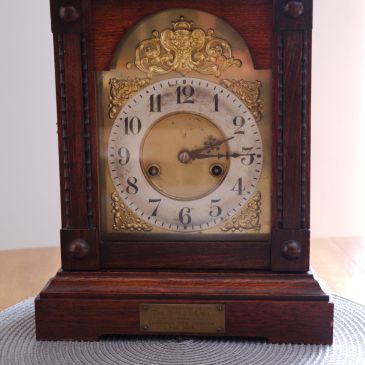
Commemorative plaques which display dates are often a good indicator of the age of a clock. However, the clock may have been on a seller’s shelf for years before the date on the plaque. This nevertheless places the clock within a certain range of dates. This photo shows a plaque on a HAC (Hamburg American Clock Co.) time and strike shelf clock.

HAC shelf clock with the date 1926 on a plaque

Type of escapement

Recoil (anchor), half deadbeat, Graham deadbeat, pinwheel, Brocot types are found in older antique clocks while, hairspring, floating balance, lever type escapements are found in newer vintage (less than 100 years old) clocks.

For example, floating balance movements began appearing in mechanical clocks in the early 1950s. The floating balance will tolerate being out of level, unlike pendulum clocks which must be on a level surface, an attractive marketing feature.

This is important because the type of escapement mechanism used in a clock can provide key insights into its age and technological development. Older clocks with recoil (anchor), half deadbeat, Graham deadbeat, pinwheel, or Brocot escapements reflect the horological practices of earlier periods, while newer clocks featuring hairspring, floating balance, or lever type escapements indicate a more modern design, typically found in clocks less than 70 years old.

For example, the introduction of the floating balance in the 1950s was a signifcant advance because it allows for clocks that are less sensitive to being off-level, a feature that made them more convenient for consumers. Recognizing these mechanisms helps in accurately dating a clock and understanding the technological shifts over time.

Sspriral spring for floating balance escapement
floating balance escapement C. 1950

Style of case

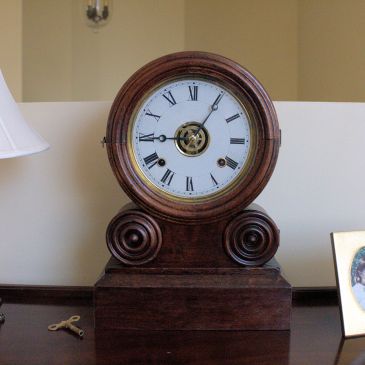
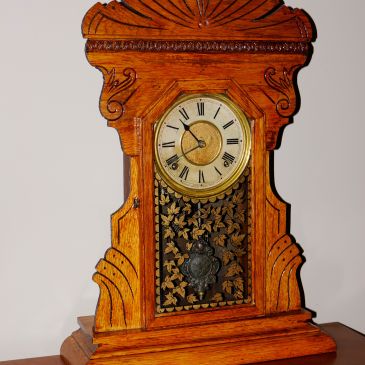
The style of the case, such as ogee, box clock, steeple, cottage, or gingerbread, can help date the clock to a specific period.

The style of a clock case can offer valuable clues about its age, as different case styles were popular during specific periods in history. Here’s a breakdown of some common clock case styles and their associated timeframes:

  1. Ogee Clocks: These clocks, named for the distinctive curved, “S”-shaped design of their cases, were popular from the early 19th century, especially between 1825 and 1850 but continued to be made into the 1880s. They typically have a simple, symmetrical shape, often with a painted or paper dial, and were mostly made with wooden movements in the early years.
  2. Box Clocks: This style features a simple, rectangular or square case, often with a hinged door or glass front. Box clocks were common in the early to mid-19th century (1920s to 1940s), with their plain, functional design making them relatively inexpensive to produce.
  3. Steeple Clocks: Steeple clocks are characterized by their pointed, “steeple” shape at the top of the case. This design became particularly popular from the 1840s through the 1870s. Steeple clocks were typically more decorative and were often used in homes and churches, with some having more ornate carvings or decorative elements.
  4. Cottage Clocks: Cottage clocks, with their simple and rustic designs, emerged in the mid-19th century, around the 1840s and 1850s. Often smaller in size, these inexpensive clocks were popular in rural homes. They are sometimes characterized by a more casual, handcrafted appearance, with wooden cases and floral or geometric motifs.
  5. Gingerbread Clocks: This style, which features intricate carvings and decorative elements like scalloped edges, ornate moldings, and small, detailed pieces, gained popularity in the mid- to late-19th century (around 1860 to 1880). Gingerbread clocks are often associated with the Victorian era and were typically mass-produced.

The case style is a strong indicator of the clock’s approximate age because clockmakers and manufacturers often adapted their designs to reflect contemporary tastes. By identifying the specific features of a clock’s case—such as the materials used, shape, and any distinctive decorative elements—you can narrow down the period in which it was made, which can then aid in dating the clock more precisely.

Rare Ingraham Huron found on a local online for-sale site
E Ingraham Huron C.1878

Knowing the period when a case was made provides a reliable indicator of the clock’s age. Although there are earlier patent dates stamped on the movement of this E. Ingraham Huron time and strike 8-day shelf clock, this style of case was made for only 2 years, 1878 to 1880.

Date stamps on movements or cases & searchable databases

Some makers stamp date their movements or display the date elsewhere on the clock case. The Gilbert Clock Company often date-stamped their movements. Sessions put dates on the door labels.

Some makers such as Junghans stamp a date code on their movements. For example, B19 stamped on the back plate of a Junghans movement refers to a movement made in the latter half of 1919.

Serial numbers stamped on movements can be compared to a database to determine the exact year the clock was made. The Ridgeway clock company used 4-digit codes. For example, serial number 4981 refers to a Ridgeway clock made in 1981.

Gustav Becker clocks were made in both Silesia and Braunau factories, both of which produced clocks but each had a unique serial number convention. The serial number on a Gustav Becker clock will give the exact year of production assuming you know where it was made, Silesia or Braunau.

An online databases such as ClockHistory.com provides invaluable information on companies and models made by them, the years the clock company was in business, and how long the company was in operation.

Searchable databases like Mikrolisk, the horological trademark index help date a clock by comparing a trademark. Some companies revise or restyle their trademarks over the years allowing one to date a clock within a certain period.

At Antique-horology.org keywords or text can be used to search trademarks and identify years they were used.

Scottish tall case clock
Scottish tall case clock C.1848

The date 1848 is attributed to the clock above. I arrived at this date because it was made by William McLachlan of Newton Stewart, Scotland. According to an English clock database, Mr. McLachlan was a clock assembler and ran a clock-making business in Newton Stewart until his death in 1848. While the clock could have been assembled as early as 10 years prior, 1848 serves as a conservative estimate.

Other miscellaneous indicators

Plywood began to be used in clock cases starting in 1905. One of the clocks in my collection, a Junghans bracket clock, made around 1913, features a plywood back access door.

Seth Thomas made clocks in marble cases for a short time, from 1887 to about 1895. They also made clocks in iron cases finished in black enamel, from 1892 to about 1895.

Adamantine clocks were most popular through to 1915. Seth Thomas is best known for their “Adamantine” black mantel clocks, which were made starting in 1882. Adamantine is a celluloid veneer, glued to the wood case. Adamantine veneer was made in black and white, and in coloured patterns such as wood grain, onyx, and marble.

Seth Thomas Adamantine clock circa 1911

Final thoughts

My goal for this two-part article was to provide a broad, generalized overview. Each of the sub-topics mentioned above could be explored in much greater detail, and I hope this serves as a useful reference for some of you. I welcome any corrections to the dates, and if there’s anything I’ve missed or other information that should have been included, please feel free to leave a comment.

As I’ve outlined, there are many ways to date a clock—some methods are quite obvious, while others are more subtle and require a bit of research to pinpoint.

For some collectors and clock fans, dating a clock is crucial, as it adds historical context and value to the piece. For others, however, it may not be as important, especially if the clock serves primarily as a decorative item rather than a functional or collectible piece. In such cases, the aesthetic appeal might take precedence over its exact age.

Are inexpensive carriage clocks worth fixing? Schatz and Sohne

Schatz and Sohne, the maker of this attractive 8-day carriage clock may not have considered the fact one day their carriage clocks would require servicing. Did they make a throw-away clock? We’ll see.

Many were sold and gifted to family, friends, and business associates. Over the years they have either been tossed out, found their way to antique shops/flea markets, or sat on a shelf never to run again. They are pretty, however!

Schatz and Sohne carriage clock

Were they meant to be repaired and are they fixable? Perhaps.

Just about any clock can be fixed. However, the cost of a professional service would be far more than it is worth but may be justified for sentimental reasons. In the case of this clock a professional service would be out of the question.

I paid $40 for this clock. The seller said that it runs for 4 days and stops. He was quite correct. I wound it fully each time and over the course of a few weeks, it promptly stopped at about the 4-day point. I appreciate the seller’s honesty.

The loss of power that is consistent in this clock’s cycle tells me that there is serious wear at some point in the train. Some might immediately assume that the mainspring is weak but in my experience mainsprings are generally much more powerful than required.

So, let’s see what we have.

Rear showing winding key

Disassembly

A rubber band or two comes in quite handy when employed to hold the four glass sections in place while taking the clock apart. Next, unscrew the key and pull out the small knob used to change the time. Four screws hold the base to the glass sides and top of the clock.

Carriage clocks such as this example are more decorative than functional but are they worth fixing?

The first step in removal is to pull out the works from the base, then, pull off the hour and minute hands which are both friction fit. Next, the dial face and front section are removed by means of two screws that hold it in place. The base is removed from the movement, again, two screws hold it in place.

The movement showing the escape wheel

Once the movement is removed it becomes apparent that three plates are required for the gear train. The design is not far removed from a conventional time-only clock except for the upside-down configuration with an inverted escapement. The third plate is effectively used as mounting points for the dial, the mainspring barrel, and the escape wheel arbour.

Side view of the movement showing the three plates

Six screws hold the plates together. Once the rear plate is removed, the wheels are revealed.

The wheels are very small and the pivots are tiny and easily bent. Though I was careful, I can imagine anyone using brute force to bring the plates together upon re-assembly could easily risk bending or breaking a pivot. Therefore, extra caution is highly recommended.

Some wheels removed

As for wear, everything looked very good except for the second wheel bushing hole which was badly worn, not surprising since the second wheel accepts the full force of the main wheel. Thin brass plates also exacerbate wear.

I believe I “might” have found the cause of the power issue. The bushing hole shown below is elongated enough to cause problems transmitting power up the train.

Elongated pivot hole

That one was the worst by a large margin. All the other pivot holes had acceptable wear and did not require new bushings.

All parts were cleaned in the ultrasonic, the pivots were polished and pivot holes pegged out.

Now for bushing work

I have installed hundreds of bushings on clocks and this one was a real challenge. The pivot on the second wheel is 1.27 mm. The Bergeon bushing I chose has a 2mm diameter. Anything larger would have required removing too much brass making the new bushing potentially loose and unstable. As it stands there is a slight bulging of the brass plate where the bushing is installed.

Because the inside diameter of the bushing was .95mm a considerable amount of broaching out was required to enable it to fit the 1.27mm pivot. The result is a thin sidewall but sufficient to do the job. Using a pivot cutter I reduced the height of the bushing for a nice clean fit.

Just one bushing but a tough one.

New bushing for the second wheel

Reassembly

Reassembly went without issue though I had to refer to the photos I took during disassembly to determine when all those darned washers had to go. Photographing each step in the process always pays dividends in the long run.

Pivot locator

A pivot locator comes in very handy when putting it all together. Using the locator, the pivots are gently convinced to find their respective holes.

Once the escape wheel hairspring peg is pushed back into its post it is time to give the escape wheel a little spin and test the movement prior to returning it to its case.

And the final results

After disassembly, cleaning, addressing a serious wear issue, and testing, the final result is…….yep, it runs 4 days and stops.

I may remove the mainspring from its barrel (not something I did this time) and give it a good cleaning but I think that is it.

Will I go further and perhaps replace a weak mainspring? No! I am not going to put more money into a clock which, at the end of the day, is nothing more than a decoration. It is just not worth it.

Pretty to look at though!

Dating an antique or vintage clock – Part I

There is no single method of dating an antique or vintage clock but there are some strong clues in some cases and subtle inferences in others that help determine when a clock was manufactured. Occasionally, the exact month and year is displayed somewhere on the case, and in other instances the clock by way of serial numbers, date stamps on the movement, style of hands, spandrels, dial design, case design, and so on, establishes the date to within a certain period.

This is by no means an exhaustive reference but my thoughts on how to date a clock. I will therefore rely on various examples in my collection.

This is the first part of a two-part article. In the second part, I will explore additional clues for determining a clock’s age.

Elisha Manross steeple clock

This Elisha Manross clock is an attractive steeple design. Steeple clocks were made in the thousands from the early 1830s to the end of the century. A steeple clock is a type of mantel or shelf clock characterized by its pointed, spire-like top, which resembles the steeple of a church. These clocks were particularly popular in the mid-19th century and were produced by various American and Canadian clockmakers, including Seth Thomas, Chauncey Jerome, and others.

Elisha Manross steeple clock

Elisha Manross was an important pioneer of the Connecticut clock and lived from 1792 to 1856 and he was the maker of the steeple clock pictured above. A distinctive feature of this particular clock is brass mainsprings.

Brass mainsprings for Manross clock
Brass mainsprings, Manross clock

From 1836 to 1850 brass mainsprings were used in clocks because steel was considered very expensive. It was not until 1847 that the tempered steel mainspring developed for everyday clocks was introduced and with it, the brass mainspring faded into clock history.

This provides an important clue when dating this clock, that it was made before 1850. The second clue is the label located inside the case. Elihu Gere, the printer was in business at 10 State Street Hartford Conn. The printer’s name and address are located on the bottom of the label And this tells us that the printer was at this location until 1847. Armed with these pieces of information one can date the clock from about 1845 to 1847.

Daniel Pratt Jr reverse ogee columns with splat top

Next, is a Daniel Pratt Jr. shelf clock. A distinctive feature of this clock is that it has a woodworks movement. A woodworks movement is a type of clock mechanism/movement made predominantly from wood rather than metal. These movements were commonly produced in the early 19th century, particularly in the United States, during a time when wood was more affordable and readily available than brass or steel. Woodworks movements were very common before 1840 and were considered the first mass-produced clocks.

Daniel Pratt Jr.

Daniel Pratt (1797-1871), Jr., clock-maker, banker, town clerk, and legislator, lived in the town of Reading, Massachusetts, in the 1800s. Pratt did not contribute much to clock-making and was widely regarded as an entrepreneur rather than an innovator.

This particular Daniel Pratt Jr. reverse Ogee shelf clock was made in Reading, Massachusetts, c. 1832-38, within that six-year period. It has a splat-top mahogany case with half reverse Ogee moldings flanking the door, painted wooden Roman numeral dial, mirrored lower tablet, and wood dial face. The mirrored tablet was considered a luxury at the time.

Woodworks movement

McLachlan tall case clock

It is a classic Scottish design from the mid-1800s. The removable bonnet is 23 inches at its widest point, the waist is 15 3/4 inches wide and the base is 20 inches wide. The bonnet has tapered columns on either side. The dial access door which covers the entire bonnet swings to the right. The solid wood access door on the waist measures 9 X 24.

McLachlan Scottish Clock

The well-preserved sheet iron white dial has painted spandrels, each one depicting an ewe with a lamb and a painted arch top showing a man resting on a rock with two working horses directly behind.

English Bell strike movement

The robust movement is made in the Guild style and movements contained in these clocks are commonly called “English bell strikes” with anchor escapements.

McLachlan was not a clock-maker in the true sense of the word but rather an assembler, bringing the dial, clock case, and movement together to assemble into a tall case clock for a particular customer. Signatures on a clock dial may or may not refer to someone other than the clock-maker. 19th-century retailers and distributors often put their own names on clocks in an attempt to ‘brand’ their products. The actual movement may have been made by someone else likely in Birmingham England. 19th-century clock cases were almost always made separately from the movement and are rarely signed.

The name Wm McLachlan, of Newton and Stewart, is inscribed on the dial. In his book, Clock-makers & Watchmakers of Scotland 1453 to 1900 David Whyte lists McLachlan, William, clock & watchmaker in Newton-Stewart, Wigtownshire as a business advertised for sale on 25 May 1852. McLachlan either retired or passed away before the sale date. Newton-Stewart is a former burgh town in the historical county of Wigtownshire in Dumfries and Galloway, southwest Scotland.

This clock was therefore made between 1848 and 1852. The painted dial which originated in or around 1810, the style of the hands, the style of spandrels, the shape of the arched dial, and the shape of the case are other clues that it was made within that period.

Sessions Beveled #2 tambour style mantel clock

This Sessions tambour style clock represents a very popular style of clock sold in the 1920s and 1930s in the USA.

Sessions Beveled #2

It is a fairly attractive mantel clock featuring a toned mahogany finish with faux inlay below the dial face. Faux inlay was an affordable way to enhance a clock’s decorative details and a common feature of clocks of this type in the 1920s.

Label on the inside of the access door

Sometimes, the exact date of manufacture can be pinpointed down to the year and month, making dating straightforward. In this instance, the clock was produced in September 1927.

Arthur Pequegnat kitchen clock

Dating a clock can sometimes be challenging, and unfortunately, this particular clock is difficult to date with precision.

Arthur Pequegnat kichen clock
Arthur Pequegnat kitchen clock

In Canada, the Arthur Pequegnat Clock Company produced clocks from 1903 to 1941. Before the First World War, the company operated in Berlin, Canada. During the war, the city’s name was changed to Kitchener in 1917 due to anti-German sentiment at the time. This small piece of information helps to approximate the date of a Pequegnat clock.

Below the six on the dial is the inscription “The Arthur Pequegnat Clock Co. Berlin, Canada,” but neither the case nor the movement provides any clues to narrow the date beyond the period between 1904 and 1917.

I hope the examples I’ve shared provide some helpful insights into dating a clock. This is the first part of a two-part article; in the second part, I will discuss additional clues for determining a clock’s age.

Having a professional service your clock

Is it worth the time and expense to have a clock professionally serviced?

That is the question of the day.

I receive many letters from people who ask whether a clock handed down to them is worth repairing/preserving. It is not an easy question to answer. Shared history and stories connected with the clock can be passed down from generation to generation and it is fond memories that keep it alive and consequently, there is a desire to have a clock in running condition. Sometimes it is better to do nothing and simply remember the stories associated with the clock.

If the decision is made to do something, the first consideration is whether or not the cost of preserving or restoring the clock is worth it. If the clock has deep sentimental value, the cost of repair cannot be compared to its resale value.

In the early days of clock collecting, I sent out clocks to be serviced and happily absorbed the cost. I knew then that some clocks cost more to repair than they are worth but I wanted to preserve some and have them operate daily, so, professional repairs were necessary.

Junghans clock in pieces
Junghans clock before restoration

A case in point

In January 2017 I bought a box of old clock parts (above photo). I was determined to make my German-made circa 1895 Junghans Crispi wall clock into what it is today. It was my first huge restoration challenge. It was a steep learning curve for me but in the end, I was pretty happy with the results.

During the course of restoration, I attempted to repair the movement, which hadn’t run in over a hundred years and made some rookie errors. I had no other course of action than to bring it to a professional in order to correct my mistakes. At the end of the day, the total cost was $475 for the initial purchase plus the servicing.

Last year, after 4 years of reliable running the clock developed an errant strike which required investigation and disassembly (and a good cleaning while I was at it) but I would not blame that on the professional repair. Perhaps it is the nature of that particular Junghans movement requiring the odd adjustment every now and then.

Junghans Crispi wall clock

In the years since then, I have acquired the skills and necessary equipment to perform my own repairs.

Twenty-three of the clocks in my collection are daily runners, all serviced from time to time by myself over the years. I am not a professionally trained clock-maker and some procedures are clearly beyond my capabilities, things such as teeth replacement and repair and fashioning new parts from stock brass. 95% of repairs I can comfortably handle on my own.

Rare Ingraham Huron found on a local online for-sale site
Rare E Ingraham Huron professionally repaired

Should you bring your clock to a professional? This is a decision you will have to make after weighing all factors. Know that by relying on a professional you can be assured that years of knowledge and experience go into the repair of your precious clock which becomes part of the cost.

Reputable repairers have the correct equipment to tackle just about any repair, offer a warranty period, and will correct any problems that arise after servicing, often without an additional fee.

Clocks are machines and machines do not last forever, parts will wear and from time to time they, like any machine, require attention. If, after some years, the clock that you had professionally repaired stops, I would have no hesitation suggesting that you return to the same repairer for servicing unless, of course, you had a negative experience.

Delft clock by Forestville – Let’s take it apart and see what we have

Delft Clock from Forestville

This clock was bought at auction in Ottawa, Ontario, and hung on the wall of the kitchen at our cottage in Quebec for 4 years. The clock was imported from Germany and sold by the Forestville Clock Co. of Toronto, Canada.

It was never a great timekeeper probably because it had never been properly cleaned. I brought it home to Nova Scotia to give it the attention in now deserves.

The word Delft is not a model name but refers to the design and composition of the dial face and surround. According to one source, Delft is “tin-glazed Dutch earthenware with blue and white or polychrome decoration”. Delft also refers to a place in the Netherlands, famous for the manufacture of pottery.

Delft clocks typically had a nondescript Dutch scene as one would expect but since this is not a delft clock by strict definition, it is, instead produced in a German factory (made in Germany stamped on the back) in the Delft style.

Mother and child

Many of these clocks were produced and were quite popular as kitchen clocks in Canada in the 1950s and 1960s perhaps a salute to Canada’s close association with Holland during the war years. There is a number stamped on the back (1054) which may refer to its year of make, 1954.

This clock is only required to run two months a year so, I am not concerned about future wear but a cleaning now will keep the clock running for several more years

Although this clock is from the Forestville Clock Co. other manufacturers produced similar styles. Most if not all of the movements are German-made and called, appropriately enough, “plate clock” movements.

A common Dutch scene

It is a small and simple time-only movement with a hairspring balance similar to what might be found on an alarm clock movement.

With tin dust cover removed

Some Delft clocks are pendulum driven and must be level on the wall to operate correctly whereas a hairspring escapement is more tolerant of placement.

Movement removed showing the mainspring

The mainspring may appear tiny by mechanical clock standards but it is as powerful as it needs to be in a movement this small and designed to run for 8 days.

Disassembly and cleaning

The front plate is affixed to a tin plate and the two cannot be separated unless the rivets are broken. This is a serious issue if bushing work is required on the front plate. To expose the bushing holes one must break the rivets with no guarantee that the tin plate and movement plate would be successfully pressed back together again.

There is some wear in the pivot holes but not enough to warrant concern at this point in time. There is also some pivot hole wear in the back plate but, again, not enough to require bushing work.

Back plate and mainspring removed

At some future point bushing work will have to be done and that would be a challenge for two reasons. One, the back-plate is difficult to access (as described above) and two, any bushings installed would be very tiny. I don’t have anything that small and they would have to be hand made. The designers may not have had servicing in mind when they made the clock and sadly, we are witnessing the beginnings of the throw-away generation.

All the parts, including the mainspring, are cleaned in the ultrasonic, dried thoroughly, inspected and pivots polished. Just a good cleaning and oiling this time around.

Since I decided not to do any bushing work, the movement was put back together. The wheels are installed plus the pallets leaving the escape wheel the last to position. There is an adjustment screw on the bottom plate for the escape wheel which can be Loosened allowing the escape wheel to be installed separately.

On the test stand

Feeding a very minuscule hairspring into its post is always a little tricky and quite often it takes several attempts. Manipulating small clock parts can be frustrating if you are used to working on American clocks with large wheels and pivots.

It is on the test stand and I will run it for about two weeks. If everything is satisfactory the remaining parts will be attached and the clock will be stored until the summer.

This clock is only required to run two months a year so, I am not concerned about future wear but a cleaning now will keep the clock running for several more years.

Dating a Hamburg Amerikanische Uhrenfabrik (HAU) shelf clock

During the Christmas season, we split our time between Calgary, Alberta, and Ottawa, Ontario to see our 2 daughters. While in Calgary my wife spotted an interesting item on an Ottawa Facebook Marketplace, an English time and strike clock.

HAU shelf clock

She showed me the photo and I said, “that does not look like any English clock I am familiar with. The style is definitely German”. There is a commemorative plaque on the front base section which references an English church so, I am assuming the seller thought it was English.

When we picked it up from his home outside Ottawa I was surprised to learn that the seller is a clock collector and had no idea the clock he was selling was German. Occasionally I sell clocks to manage my collection and when advertising one for sale I make it a point to know the maker.

But, no matter, it was in very good condition and in working order.

The movement showing the single strike rod and pendulum bob

The maker is HAU or HAC. The familiar cross arrows trademark of the maker is stamped on the movement, in the middle of the backplate.

HAC was formed in Germany in 1873 by Paul Landenberger and Phillipp Lang and was originally called Landenberger & Lang Uhrenfabrik. The company changed its name to Hamburg Amerikanische Uhrenfabrik (HAU)/Hamburg American Clock Company (HAC) in 1883. The famous crossed-arrows

Crossed arrows trademark

became their trademark in 1892. In 1926 the company went into a cooperative with Junghans and in 1930 they finally merged with Junghans.

The date on the plaque says 1926. However, HAC/HAU clocks are difficult to date prior to Junghans acquisition of HAC/HAU in 1930. Once Junghans and HAC began their collaboration in 1926 some of the movements were date coded.

Plaques are a good but not foolproof method of dating a clock. A clock purchased as a gift in 1926 could very well have been sitting on the retailer’s shelf for two or more years.

Catalogs are another good but hardly foolproof method of dating a clock. A catalog confirms that a model was made in a particular year, but that same model was probably offered 5 years +/- from the year of the catalog.

I will probably not determine a more reliable date for my new clock than circa 1926. The movement, compared to an earlier model (below), also has many cutouts and additional holes that indicate that it was a late production model and confirms that is closer to the 1926 date.

HAC clock movement
Solid plates of an early HAC clock movement CA. 1895

The clock runs for a while and stops. It is in need of a service but I expected to clean it as many of these old clocks have rarely seen the inside of a clockmakers’ shop.

Fleet Time replacement movement needed – calling all clock parts collectors

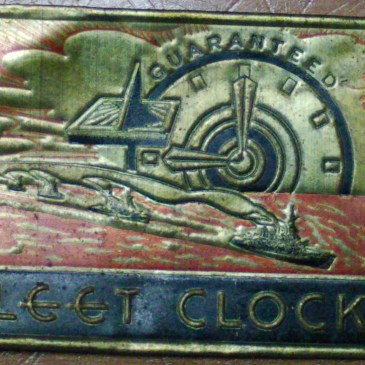
This Fleet Time mantel clock is a generic mantel clock with a walnut finish, flat front, a slightly domed top, and step-side features. Simple but attractive. Fleet assembled clocks sourced from German parts in the Montreal area for 4 years prior to WWII.

While the case looks great after refinishing, I was oh so close to having a fully functioning clock when disaster struck.

This is a call-out for anyone who can sell me or donate a replacement movement or otherwise direct me to where I can locate one. I am in need of a mainspring barrel and second wheel on the time side. As much as possible I would like it to be exactly the style of movement that came with the clock.

Fleet Time case
Fleet Time case, refinished

My clock passion is collecting clocks made or assembled in Canada and I would love to see this clock in working order

Fleet second time wheel
Fleet second wheel, a bent leaf cannot be unbent

Here is my story

The movement looked to be in reasonably good condition but needed a good cleaning.

Fleet time barrel
Fleet time barrel
Fleet time movement
Fleet time movement

The mainsprings can be removed without disassembling the movement, handy for such things as replacing a broken mainspring.

The movement was completely serviced with several new bushings installed. The mainsprings were removed, cleaned, and returned to their barrels.

Through the testing phase, the mainsprings were partially wound. Once I was satisfied that the movement was running well I installed it back into its case. I then wound the strike side fully and then wound the time side. Just as I was feeling resistance, CLUNK, and then the arbour turned freely.

Hoping it was only a broken mainspring I was not prepared for what I discovered when I opened up the movement. There were three broken/bent teeth on the mainspring barrel, a broken mainspring, and a damaged leaf pinion on the second wheel.

Broken mainspring

When a mainspring breaks at the teeth end of the barrel it tries to unwind but the loose end provides sufficient resistance, that is, a slower release of the energy, and is less likely to cause major damage. A broken mainspring results. A break at the winding arbour end or close to it as in this case results in the sudden release of energy and the result is damage not only to the mainspring but clock parts up the train; this is known as collateral damage.

A clock colleague advised me that although the barrel teeth and leaf pinion can be fixed it is usually not cost-effective because the process is so time-consuming. His solution is to collect movements that are used as donors for times such as this.

The plan, at this point, is to source a donor movement and harvest parts for what I hope would result in a successful repair.

So, here I am asking if anyone has a spare movement they can part with.

My clock passion is collecting clocks made or assembled in Canada and I would love to see this clock in working order.

Best clock acquisition of 2021

The time has come to determine the best clock acquisition of the past year. As a clock hobbyist, I have had little difficulty locating interesting clocks over the years, and despite the seemingly never-ending pandemic, I have scored a few in 2021 though the past year has been leaner than most.

In the early days of collecting, simple time and strike vintage mantel clocks were my principal focus so that I could take them apart, repair them if necessary, and generally advance my learning. Many of those clocks have been either sold or gifted. For the past three years, I have shifted my focus toward collecting interesting clocks, rare clocks, or clocks that have a special provenance that even includes the odd mantel clock.

My wife is my best clock finder. Our discussions often go something like this; “did you see that wall clock on Facebook?”. “Let me see. Yeah, it looks good, what do you think? Make an offer?” and off we go. Sometimes I will accept the offer from the seller without negotiating because I feel it is a fair price and other times there is some wheeling and dealing prior to firming the sale.

At the end of the post, you will have an opportunity to vote on what you think is the best in 2021.

In no particular order, here are my finds for 2021.

Sawin banjo clock

This is a garage sale find and even though it was purchased in the spring of 2021 it is still a work in progress. The clock is over 180 years old and in pretty decent shape.

Sawin weight driven banjo clock

It is a weight-driven banjo but it has no markings. An educated guess is that it was made by John Sawin of Boston or one of his associates on or close to 1840. I have completed minor veneer work on the case and have replaced the broken glass dial. The movement has been serviced but I am now looking at clock parts supply sources to replace a badly bent suspension spring. I want to avoid paying an outrageous price for the complete assembly; suspension spring, leader and spike.

Gilbert mantel or Shawville clock

I call this the Shawville clock because it spent most of its life in Shawville, Quebec (Canada).

It was a family clock for many years and following a death in the family, all possessions were either sold off or given away, a very common practice today. It has a time-and-strike Gilbert movement in a mahogany tinted case that has led a kind life since its manufacture in 1917. It is simple and unadorned and that’s what I love about it. I serviced the movement, cleaned the case, replaced a broken hour hand and now it is on prominent display in our home.

Gilbert time and strike

New Haven tall-case clock

An interesting $90 acquisition is this New Haven tall-case clock with a secret. Wow, a tall-case clock for $90, you say. Despite the look of a weight-driven clock, it is, in fact, a spring-driven clock. I was unaware of this until I walked through the door of the seller. I bought it anyway.

New Haven tall case clock

The weight cans are empty shells and they are simply there for show. The movement is quite large, eight-day, of course, and looks to be very robust. Despite my best efforts to determine if it was originally weight driven it had to have been spring-driven from the start, in other words, no evidence of a seat board or any additional holes for mounting the movement to the case. This appears to be an early “kit clock”, i.e. movement, dial face, hands, pendulum, “weights”, and ladder chains bought from the New Haven Clock Company and fitted to a pre-made case.

The case was very dark from years of accumulated dirt and grime and vigorous scrubbing revealed a wonderful red oak finish.

Waterbury Wren mantel clock

Ansonia Syria

Another clock with a secret is actually a disappointment. I found it in an antique store and it reminded me of an Ansonia Syria I had worked on for a friend last year, so, I was drawn to it.

Waterbury Wren mantel clock

It has a Waterbury case and what I thought was a Waterbury movement, but no.

It is missing the brass bezel and glass which is easily replaced but what is most disappointing is the mismatched movement, a Seth Thomas time and strike, which obviously replaced the original movement presumably because it was worn out. The movement is well-made and runs well but at the end of the day, the clock is destined to be sold.

Schatz Schatz carriage clock

This is a Schatz carriage clock made by August Schatz and Sohne of Germany. Thousands of these were sold and given as gifts through the 60s and 70s. It has an interesting lower visible escapement and an exposed movement.

Schatz carriage clock

Although it is working and keeping time it runs for about 4 days and stops. A cleaning is called for (on my list). It has a wind-up key in the back much like a typical alarm clock. It says West Germany on the dial and made, I would say, in the 1970s. August Schatz and Sohne closed in 1985, a victim of slow sales and a shift to quartz clocks by other makers.

Chauncey Jerome ogee clock

This clock is original in many ways, with a nearly flawless case made of mahogany veneer over softwood, moon hands, a wood dial, and a movement that matches when the case was made. Even the pendulum bob looks original. It was missing the suspension spring and rod and a wooden movement block, all easily sourced.

Chauncey Jerome 30-hour ogee clock

It cleaned up nicely and was a good candidate for a fresh coat of traditionally prepared shellac. I have three other 30-hour ogee clocks and this one is the most original of the bunch.

E. Ingraham Grecian shelf clock

This is a very nice shelf clock from an estate auction. It is an Ingraham Grecian clock with an alarm feature. If you have ever used the alarm on an old antique clock your first impulse is to throw it through a window, it is so loud and it goes on and on till the spring winds down.

Ingraham Grecian
Ingraham Grecian 8-day shelf clock

It came with incorrect hands and I had the darnedest time sourcing them but searching various suppliers in Canada and the US paid off. The case has been cleaned and the movement serviced including the infuriating alarm.

Fleet Time Co. mantel clock

An inexpensive clock that had huge potential but left me frustrated. Fleet Time Co. of Montreal had a short life of 4 years before the Second World war when they lost their source of German movements.

Fleet Time case
Fleet Time clock

I stripped the case and re-glued some sections, applied a walnut stain and I was very pleased with the final result. I serviced the movement, wound the time side completely, and BAM, kerplunk! the sound of a mainspring exploding. Sometimes you can get away with just replacing a mainspring and other times, like this, it took out the barrel teeth and a leaf pinon on the second wheel. I placed it in a plastic bag and it is now on a shelf in the basement awaiting donor parts.

Hamburg American Clock Company. (HAC) mantel clock

This German-made mantel clock has an interesting 14-day movement, an early production type from HAC. HAC is short for the Hamburg American Clock Company, a German company which had a long history up to the time it was absorbed by Junghans in the late 1920s. This clock was made in or around 1895.

HAC mantel clock
HAC 14-day mantel clock

It was another estate sale find. The case is nondescript and nothing special, but quite elegant.

So…..

Tell me what you think and I will reveal what I believe is my best acquisition this year in the next post. Let’s see if we agree.

Would you buy a “Cucuko” clock?

I frequently cruise the online for-sale sites for interesting clocks and I could not help but chuckle at this one.

Would you buy a Cucuko clock?

Online ad

If you are going to sell a cute Black Forest clock take a little time to find out how to spell the darn word. It is not choochoo or cucko, or CooCoo, or Coockoo, or Cucuko, it’s Cuckoo!

The word is Cuckoo and the Cuckoo is actually a bird found commonly in Europe. That little birdie that comes through the top hatch door the hour and half-hour on so-called clocks is a Cuckoo, plain and simple and they are a real thing.

Dave's cuckoo clock
Dave’s cuckoo clock

I don’t know how many times I have seen the word misspelled. How much more would a seller know about the clock if they can’t even spell the name correctly?

The name is not the only thing to snicker at, look at the price.

I got mine for free. I call it Dave’s clock, the name of the previous owner. It is a lot nicer than the one offered for sale and I’d sell it for a whole lot less than $300…… if I sold it!

Kienzle time and strike movement servicing

I have just one other Kienzle clock in my collection and it is a rather unusual one, the World Time desk clock from the 1940s. I do not come across Kienzle clocks very often. They are no lessor quality than most German clocks, I just don’t see many around this region.

Kienzle World Time clock

The latest is a German styled round top box clock. It was a an auction buy. I knew it was German at the time but did not know the maker. After a little research I discovered that it is made by Kienzle Uhren.

Kienzle Uhren GmbH is a well-respected German clock company that has a long history.

The company was founded in Schwenningen in southern Germany, in the Black Forest, by Johannes Schlenker, in 1822. In 1883, Jakob Kienzle became part of the family by marriage, and took control of the company, becoming its sole owner in 1897.

Jacob revolutionized production by mass-producing individual components and then assembling them. This modern manufacturing approach led to a massive expansion, and by 1939, Kienzle had over 3,500 employees and was making about 5 million wall-clocks and table clocks per year.

The company continued on through the years, changing hands a few times and gradually shifted production to wristwatches. It continues in business to this day as a watch maker.

The movement

In many respects it is a typical well-engineered German movement from the 1930s. The movement is compact in design and anyone who has worked on German movements will feel right at home. It has a 43 cm pendulum length and runs at 104 beats per minute as per the stamping on the back plate.

Kienzle movement, back showing pendulum leader and strike hammers
Front plate showing rack and snail mechanism

Unfortunately, the spring barrels cannot be removed separately, the movement must be completely taken apart to replace the mainsprings if they break.

The 4 hammer strike assembly can be taken apart separately. One advantage is that once the plates are back together the strike paddle can be easily positioned on the star wheel. The strike has a repeater function which is handy.

With top plate off and showing the placement of the wheels

All parts are hand-cleaned before putting them in the ultrasonic cleaner. Taking excess oil and grime off the movement prior to cleaning ensures a longer life for the cleaning solution. When the solution gets dirty enough I discard it.

The movement has a combination of leaf and lantern pinions, leaf pinions on the second wheels and lantern pinions up both trains. I expect the ultrasonic will do a great job cleaning the lantern pinions.

Taking the mainsprings out of their barrels

The mainsprings must be taken out to be cleaned and the barrels cleaned in the ultrasonic. The springs are quite powerful and mainspring troubles account for many problems with German clocks.

When the mainspring breaks movement damage can result. Teeth are torn form the barrel and the first leaf/lantern pinion is destroyed or the second arbor is bent. I have had movements go both ways from severe damage to simply a broken mainspring (which is easily replaced).

Cleaning of springs and barrels is therefore essential not only to ensure they are free from old oil and dirt but to inspect them for cracks, breaks, and tears. These mainsprings appear to be in very good condition.

Parts are sorted into containers

I typically preheat the Polychem Deox 007 solution and run parts for 20 to 30 minutes in the ultrasonic, switching off the heat midway through the cycle. I dry all the parts by hand and for the lantern pinions and some parts that seem to hide water, I use a hairdryer to ensure that everything is free of any potential rust build-up.

The mainsprings, which are cleaned of old oil are done separately in the ultrasonic cleaner.

All parts except mainsprings are placed in the ultrasonic cleaner

The next step is putting the re-oiled mainsprings back into their barrels and for that a spring winder is a must. Polishing the pivots come after that.

Olie Baker spring winder. Cleaning the strike side mainspring

Bushing work

This movement might have been cleaned at one point in its life based on pivot scratches on the inside of the plates and worn screws on the back cock but it has never been bushed. When I tested the wheels in the movement I found the time side ran relatively freely while the strike side seemed stiff and sluggish. So, the movement is worn but the wear would be no more than typical for its age.

Following my first assessment I have determined that the movement requires as many as 10 bushings, 6 on the backplate and 4 on the front or, 5 on the strike side, and 5 on the time side. As expected there is more wear lower in the trains.

On the front plate are:

  • The second wheel time side, third and fourth wheel on the time side and the verge.

On the rear plate are:

  • Second wheel on the time side, second and third wheel on the strike side, third and fourth wheel on the strike side and the verge.

I always like to start with the most difficult, the pivot hole on the back cock which supports the suspension spring, crutch and pendulum.

In total 12 bushings were required, including the escape wheel. The escape wheel was pretty sloppy both front and back, and better to do those while the movement is apart. 12 is probably the most I have installed in a German clock in quite a long time.

Reassembly and testing

I generally perform a power test prior to the final assembly of the verge, rack and snail, and all outside pieces. It is a good check against my bushing work and if anything is tight or stiff I can address it without taking everything apart. Everything looked good at that point.

Both trains are moving and being tested before the other parts go on

However, with verge installed, pendulum leader, crutch and pendulum, the movement consistently stopped after a few minutes. I took it apart and discovered that the 4th wheel on the time side was moving stiffly. As that wheel had a new bushing installed all it took was reaming out the pivot hole to free it up. Now the movement is running well.

Testing the Kienzle movement on a makeshift test stand
Testing the Kienzle movement on a makeshift test stand, beat amplifier is attached

Onward to the strike side and attaching the levers, snail and rack. The levers, rack and snail and gears are attached and finally the strike hammers are installed. The strike hammer posts must be bolted in from the inside of the back plate, something to remember when reassembling the movement.

When I got the clock only one strike hammer functioned but with all hammers repositioned all 4 strike hammers are doing their job and producing a melodic bim-bam strike.

The case does not require much attention other than a cleaning with soap and water.

There is absolutely nothing on the movement, gong block or case that tells me who the maker is though I now know it is definitely a Kienzle.

Pursuing a clock on an online auction

I have a growing collection of clocks with upwards of 85 in my collection. My focus is on clocks made in Canada that are entirely manufactured in this country or companies such as Fleet and Forestville, that assembled clocks with foreign/domestic cases and movements. In addition, I have many other clocks that were made in France, Briton, Germany, Austria and so on.

In terms of style, my particular interest is wall clocks. Within my collection, I have 21 wall clocks, the oldest around 1870, and the newest is from the 1930s.

I would like to add one more to my collection but it is sitting in an auction house awaiting my bid. This post will describe my experience bidding on a clock at an online auction. Did I win the clock? Read on and the answer will be revealed at the end of the post.

During pandemic times it is probably safer purchasing a clock online. There remains a risk however. Unknowns are the condition of the case, who the maker is, the state of the movement and what time and money it will take to service it. At this point I only have photos to go on. This is an estate auction and the auction house is located 1 1/2 hours drive from my home.

The clock appears to be a vintage oak-cased German time and strike from about the 1930s. I am guessing Mauthe as the maker since there is no indication from the auction information as to who made the clock. Many German makes have the company name or logo on the dial face; there is nothing on this one. Nevertheless, It looks like a good prospect and I will chance it.

Box clocks were all the fashion in the 1920s and 1930s but those with round tops were less common. Many German tall case or hall clocks of that era had round tops so it is unusual to see a round top on a wall clock. Nevertheless, it is a very attractive clock with simple lines in the Art Deco style.

The three tall panes of beveled glass look good. There appears to be a scratch or a crack on the right hand section of the door about halfway up, but nothing is showing on the inside of the door in that area.

There are no pictures of the movement but one can see the movement seat board thumb screws and the winding arbours in the next shot. The rod gong is visible behind the pendulum rod and it looks like a rod lock at the midway point.

The item description does not say it is running and it does not come with a key. The pendulum is crooked on the auction photo which might mean the connecting hook is broken or it is hooked incorrectly.

This is an online auction called a “Lockdown Live Auction” that, as of this writing, closes in one day.

I have a good feeling about winning this item for four reasons.

  1. One, it is the only clock offered which means that clock collectors will not be drawn to this auction,
  2. There is no reserve bid, the opening bid is $5.00 A reserve is off-putting because auction houses that seldom have clocks for offer, price them higher than they are worth,
  3. There has been no pre-bidding yet and,
  4. It is offered without a key which means that it may or may not be running and might or might not need adjustment or repair. The casual collector might avoid this one.

The auction house allows all bidders to set up a “watch list” and I will be monitoring the bids on this item until the item hits the “auction floor” tomorrow.

A Google search reveals that this style of clock is uncommon but I found one that sold at auction for $100. It was described as an unknown German wall clock.

What would I bid? I am going no higher than $75 but winning it for less would be nice. The final price includes a buyers premium of 15%, 15% sales tax and shipping.

The next day

At 10:30 AM there have been a couple of pre-bids and the clock is now at $12.50. I held off bidding until 8 minutes before it came up for sale at 8:00 PM. At the 8 minute-to point the bidding was $22.50. I placed a “high bid” of $60 which means paying only a small amount more than the next highest bid. Not wanting to get caught up in last second bidding, I walked away from the computer. I was prepared to let it go if I lost the bid.

I returned later to discover that I had won the item for $52.50. With buyers premium, tax, and delivery the final cost is $73.43.

Who is the maker?

The clock arrived. There is no trademark name on the dial face, and nothing on the outside of the case to identify the maker.

The movement sits on a seat board, typical of most German clocks. I released two thumbscrews at the bottom of the seat board and slid the movement out for further inspection. There is no maker’s mark on either the movement or the iron block of the 4-rod gong.

These two shots are the front and back of the rack and snail time and strike movement.

There are two numbers on the bottom right of the rear plate, 43 (length of pendulum rod) and 104, (beats per minute). Using those two numbers and the search terms “German”, “wall clock” and “round top” I conducted a search on the internet and found a matching clock. I compared the design of the plates on mine with the clock I found and it is a Kienzle from the early 1930s or late 1920s.

Who is Kienzle?

Kienzle is a well-respected German clock company that has a long history.

The company was founded in Schwenningen in southern Germany, in the Black Forest, by Johannes Schlenker, in 1822. In 1883, Jakob Kienzle became part of the family by marriage, and took control of the company, becoming its sole owner in 1897.

He revolutionized production by mass-producing individual components and then assembling them. This modern manufacturing approach led to a massive expansion, and by 1939, Kienzle had over 3,500 employees and was making about 5 million wall-clocks and table clocks per year.

The company continued on through the years, changing hands a couple of times and gradually shifted production to wristwatches. It still exits today.

The most distinctive feature of this clock is the 4-rod bim-bam strike. Probably the nicest sound of any striking clock that I have.

I wound both sides and it runs well but the movement is dirty and requires a servicing. Stay tuned for that.

Finial replacement on a Junghans wall clock

In January 2017 I took a chance, plunked down $75 and bought a project clock which consisted of a box of clock parts.

Junghans clock in pieces
Junghans clock in pieces (notice bottom finial)

I took it home, stared at the box for a while trying to figure out what to do and how far I would get with this project. I itemized the parts, arranging them on the case as best I could and put together a plan. At least I had something to go on when someone sent me the actual catalog image of the clock.

The clock is called the Crispi by Junghans, Ca. 1899. Junghans is a reputable German clock-maker that made all styles of clocks for over 100 years in Germany and continues in the watch business to this day.

There are subtle differences between my clock and the clock in the catalog but to the untrained eye it looks much the same.

What I did not change at the time was the bottom centre finial. Most who are familiar with clock case design would agree that the bottom centre finial is actually one of the top crown finials and was re-positioned in a previous repair. I left it as-is as I went about restoring the rest of the clock.

After completing a number of other clock projects during the Pandemic as well as addressing an errant strike issue with this clock, I decided it was time to replace the finial with something more in keeping with the original design.

Here is the clock (next photo) when I finished with the case. That bottom centre finial always bothered me but, as I said, I let it be.

This is a clock that I took to a professional clockmaker to have repaired in the days when I did not have the skills to service a clock.

It worked well for about two years or more and then the strike side became very erratic. It would either strike incorrectly on the half hour or strike until the mainspring wound down. I cannot blame the repairer as these movements can be finicky to work on but my knowledge of clock repair has improved such that I can better diagnose and repair most clock issues today.

The problem was twofold. One, the paddle was not quite in the correct position in the deep slot of the count wheel at the end of the strike and the strike paddle ended the strike sequence by hanging off one of the star points of the strike wheel.

It took several attempts through trial and error but eventually I was victorious and the movement now strikes correctly.

Crispi clock back from the horologist
Top finial placed on the bottom by a past repairer

Now, let’s get back to the case. As you can see the clock had been returned to its former glory and is quite faithful to the original except for that bottom finial.

I chose a flat back unfinished 2 1/2″ by 2 3/4″ hardwood finial that is available from most clock parts suppliers. I matched the stain to the case and applied three coats of shellac. Using a drill press I made a hole to accommodate a piece of dowel in the base and finial to secure it to the lower base section. I applied yellow carpenters glue to secure it and here is the result. The cost to rectify it was minimal.

The shape, size and style is now appropriately suited to the case.

The seller had the clock in his family for many years, perhaps as long as the clock is old. Anyway, he would not budge from the $75 but he asked me to send a photo of the clock when it was completed. I did, and received no acknowledgement. I don’t think he ever thought it would look quite like this.

Fleet Time mantel clock – Mainspring damage

The Fleet Time Co. was a short-lived Canadian clock company that operated between the years 1936 and 1940 producing a range of two and three-train mantel clocks with movements sourced from Germany. All clocks had pendulums and were spring-driven. According to the Canadian Clock Museum in Deep River, Ontario, the company was listed as an importer of clocks and watches. The locations were 440 McGill and then 303 St. Paul West, Montreal (Canada).

The Second World War took a heavy toll on this company as the source of movements dried up and so the future prospects of this small company.  Why they did not source movements from France and Germany like the Forestville Clock Co. of Toronto and others during the war years and beyond is anyone’s guess. Perhaps the margins were slim or alternate suppliers could not be found. That and the increasingly popular electric clock doomed the company.

Wood cases were made in Canada for some models while other cabinets were imported from Germany.

Of the two Fleet clocks in my collection one is this two-train clock with an unknown German movement and the other a Westminster chime mantel clock with a German Gufa movement. For more on the Gufa clock go here.

This clock is in much the same condition as my first Fleet clock, dents, gouges and scratches everywhere. Unfortunately, the tinted lacquer finishes on these old clocks do not survive well over time. It is one reason they attract little attention and sell for almost nothing despite having movements that are relatively strong runners.

Fleet Time clock
Fleet Time time and strike mantel clock, broken glass

It is a plain, generic mantel clock with a walnut finish, flat front, a slightly domed top, and step-side features on outboard feet. The dial is heavily tarnished and the glass bezel that should be soldered to the chapter ring has detached. These bezels often go missing. At least it came with the clock.

Fleet time movement
Fleet time movement

The clock strikes on 3-rods producing a bim-bam sound, just loud enough so as not to be too intrusive.

The location of the star striking wheel on the movement is somewhat unusual. Commonly found between the plates, the star wheel is on the outside of the rear plate.

Fleet time barrel
Damaged Fleet Time barrel

As I have said in a previous article the barrel and second wheel on the time side were damaged during servicing. I don’t know who the maker is and I would appreciate any information to aid me in my search for a donor movement. The case has been reconditioned, with the addition of a dial and bezel from an old Blackforest Clock Co. clock.

Fleet Time case
Fleet Time case ready for repaired or replaced movement

It is a nice piece of Canadian horological history that I would like to see running.

Tick Talk Tuesday #35 – this clock is a blast

Tick-Talk Tuesday is about the letters and comments I have received from you, the reader, concerning your clock, issues you might have had, challenges you face or a clock you would like me to profile or my responses to your questions with advice on your particular clock concern. For those comments and questions that stump even me, I consult within my clock circles for the best possible answer

LG writes,

“Dear Mr.Ron:

I came across this vintage mini clock by Sonoo-Ron in a leather pouch. I cannot find anything about it and thought this must be very unique and if interest to you?  If you are not interested, but know something about it, would love to know more!

Sender’s photo

Thank-you so very much!

Regards, LG”

Sender’s photo

My reply,

“I must confess that I have never heard of the name which I believe is Sonochron. What I found interesting is that the clocks were used by bomb-makers in Europe.

The electro-mechanical travel alarm clock from the 70s is from the Schwarzwälder Müller-Schlenker watch factory in Schwenningen.

The alarm clock is the following size: 70 mm length, 33 mm height and 25 mm depth.

The clockwork is mechanical, the alarm electrical. Due to its construction, it was very popular with a left-wing extremist terrorist group, the “Revolutionary Cells” (RZ). The possibility of separating the clockwork and buzzer means that the alarm clock can be converted into a time fuse for bombs. It was used in the RZ bombings. In 1985, the Federal Criminal Police Office had the remaining stock of Sonochron alarm clocks marked in order to track down future attackers. They could only be bought in selected shops that were equipped with video surveillance by the police. This action sparked a heated debate about state interference with personal rights, because all buyers were monitored. The alarm clock was a hot topic of conversation.

Source: https://www.deutsches-uhrenmuseum.de/en/museum/items-of-the-month/item-of-the-month-september-2015.html

Sender’s photo

Thank you, but my interest lies with wholly mechanical clocks.”

LG wrote back:

“Thank-you so very much!  🤗

Amazing information!👏

So very wonderful of you to provide. Wow!!

Warmest Regards, LG

Fleet Time mantel clock with Gufa movement – servicing the movement

Fleet clock with a new finish

About a year ago I picked up two clocks. I had my eye on one, an Arthur Pequegnat Canuck shelf clock, and the other was “thrown in” as part of the deal. We completed the transaction on the Pequegnat clock and the seller asked me if I wouldn’t mind looking at a mantel clock stored on a shelf in his garage. He said, “for $10 more you can have this”. I did not know the make at the time but for $10, why not! It was in sad condition as you can see in the next photo.

Fleet clock with a worn finish

A tin plate affixed on the back of the clock told me what it was made by the Fleet Time Company of Montreal (Canada).

Many of these clocks were sold at department stores across Canada during the pre-war (WWII) era. However, this little-known Canadian clock company had a brief life span. Between 1936 and 1940 the company produced a range of two and three-train mantel clocks with movements sourced from Germany but were forced to end their operations when the war began.

Fleet label
Fleet Time Co. label

The Second World War took a heavy toll on this company as the source of movements dried up and so did the company’s fortunes.

Wood cases were made in Canada for some models while other cabinets were imported from Germany.

Servicing the movement

I had completed work on the case a few months ago and now it is time to service the movement.

3 train Fleet movement by Gufa

The clock has a Gufa Westminster chime movement. Gufa is the Guetenbacher Uhrenfabrik, located in Gütenbach, Germany. They manufactured 400-day clocks, cuckoo-clocks and later they became the “Jahresuhrenfabrik” (August Schatz & Sons in Triberg, Germany). Gufa is not a name horologists come across very often in North American. There is a chime gear patent date number ending in 34 which likely refers to the year 1934 indicating manufacture between 1935 and 1939. It is a solid, well-built movement.

Assessment of the movement

I had replaced the time mainspring shortly after I bought the clock but I knew that I would eventually have the movement on the workbench. As is typical of German clocks of this period in that the mainspring barrels can be removed without dismantling the movement, so, replacing the time mainspring was an easy fix.

The clock was running, though not well. On the fourth or fifth day, the chimes (and strike) would stop though the time train would soldier on a few days more. Wear issues on the strike and chime train had to be addressed.

I disassembled the movement, put the parts into the ultrasonic cleaner, and discovered afterwards that the plates had been lacquered. With the ultrasonic heat setting on, the lacquer stripped off but not uniformly. As it is a $10 clock I am not concerned about aesthetics.

Fleet wheels
Fleet movement wheels tied together according to location

To eliminate the chance that I would mix up the wheels for the 3 trains, I tied each set together. Once out of the ultrasonic cleaner I untied them and placed them in their respective trays. Westminster chime movements have similar-looking gears in the three trains and it is best to separate them to avoid frustration during re-assembly.

After inspecting the movement I determined that new bushings were required on the second wheels plus the motion works arbour. Three of the second wheels on the backplate, one bushing for the strike side second wheel front plate, and one for the motion works for a total of 5 new bushings; not bad for a 3-train movement. These are the typical wear points on three-train movements as the second wheels handle the greatest load.

Bushing work

Once the pivot holes were pegged out and the wheels rechecked in their locations, the bushing begins. Aside from the second wheels, most other pivot holes were in good shape. I don’t often use bushings with an outside diameter of 4.50mm but this movement required 4 in total. All bushings had to be reamed out with a cutting broach followed by a smoothing broach. All wheels were test fit with the plates together and things looked good.

Reassembly

Next is reassembly. With so many wheels it is a bit trickier than a two-train movement but it is important to work slowly and carefully to avoid a bent pivot. Once the wheels are positioned, test each train to check that everything is in place. After the nuts are tightened, the remaining parts such as the locking plate, chime locking lever, warning lever, rack snail, mainspring barrels and so on are installed/attached.

Testing

Of all movements, three trains are the most difficult to set up correctly. Although all three trains spin independently they are interconnected by levers. In order for everything to function in unison, careful attention must be paid to the job of each lever, what it does and how it performs its function every 15 minutes.

Gufa movement
Gufa movement, front plate showing rack, snail, levers, and so on

Everything went fairly smoothly. Both the strike side and chime side go into warning as they should, the locking plate stops the chime at each quarter-hour including the hour, which is a good sign the locking hook on the chime train is in the correct position.

Gufa movement
Gufa movement on the test stand

The chime strike lever is, however, sticking on the strike warning pin. Without taking the movement apart I used 1600 grit memory paper to smooth the hook end surface where it meets the strike warning wheel pin. The polishing allowed it to function a little better but continued testing revealed that that solution did not work. I finally had to remove the chime strike lever and polish the hook. the polishing was successful.

The next issue is the strike paddle which is ending the strike sequence hanging off one of the star points. The plates on the strike side must be opened up and the paddle repositioned. For safety reasons and to preserve the mechanism should things go awry, the power is let down on all mainsprings. Adjustments such as these come with the territory as nothing should be expected to work perfectly the first time.

Gufa movement
Gufa movement, the upper wheel is the main chime wheel

After the aforementioned adjustments are made, next is the chime sequence and that means loosening the set screw for the main chime wheel and rotating the drum till the quarter strike is at the 1-2-3-4, the beginning of the sequence.

Once the adjustments have been made it is back to the test stand.

Okay, my strike paddle adjustment did not work but in the meantime, the testing of the movement proceeded and everything looks very good at this point. I will give it a few days and return to re-adjusting that paddle.

Everything is working now.

I’ll be honest, 3 train movements are not my favorite type to work on for 4 reasons. One, they often need major work only after a few years. Secondly, it is often not enough to install new bushings for worn pivot holes lower in the trains but to address other worn holes up the trains, as well. Thirdly, they are labour intensive and finally, except for modern movements, parts are almost impossible to find.

In many cases, certainly as far as a modern Hermle is concerned, it is often more cost-effective to simply replace the movement rather than repair it.

Tick Talk Tuesday #34 – what is a HHSN clock?

Tick-Talk Tuesday is about the letters and comments I have received from you, the reader, concerning your clock, issues you might have had, challenges you face, a clock you would like me to profile, my advice on your particular clock concern or a general clock question. For those comments and questions that stump even me, I consult within my clock circles for the best possible answer

CL writes:

“Hi Ron, 

I was hoping you could help me identify a clock I purchased at an estate sale this weekend for $10. The back of the wall pendulum clock has a intact paper label with a full size standing Ostrich and the letters H H S N. Stamped on the workings is 45/100 and 27583 It is a 4 chime clock. 

That is all of the identifying marks. 

Any information you have would be helpful. 

I did find one post on a site called Worth Point about a clock that had HHS N (Hermann Heinrich Straussj of Nurenberg)

STORAGE AUCTION FIND IN UNIT I WON IN AUCTION! If you search journeymagazine on eBay’s Discussion boards under Watches, Clocks & Timepieces I asked about this antique clock movement with the initials HHS N – and got 2 responses. First is a link that shows HHS N is a very rare clock movement that was part of the historical clock & watch exhibition in Nuremberg 1905 (Below)The 2nd is a link to a Mauthe that had HHS N clock movement in it.A VERY RARE CLOCK MOVEMENT FOR THE COLLECTOR OUT THERE!NOTE: I don’t have a key + I don’t know clock movements, so I don’t know if it works – Ask Any Questions or for more Photos – SOLD AS IS!FROM LINK GIVEN ME ON DISCUSSION BOARD: H.H.S.N. was a mark for the firm of Herm.[ann] Heinr.[ich] Strau [ =ss], of N rnberg. The only information in Abeler’s _Meister der Uhrmacherkunst_, the standard ref. for clockmakers in the German speaking tradions, is “erw. Hist. Uhrenauustell., N rnberg 1905.” In other words, they were mentioned in some connection with the historical clock & watch exhibition in N that year (in celebration of the 400th anniversary of the invention of the pocket watch (so they said) by Peter Henlein aka Petrus Hele. There were lots of firms represented, new and old clocks exhbited, etc. There’s a dozen or so small-print pages on this exhibition in several issues of the 1905 _ 

Thanks for your time.”

My reply:

“Hi CL

Thank you for coming to my blog.

This is a German “box” clock style from the late 1920s. The letters HHSN stand for Hermann-Heinrich Strauss, Nürnberg. Strauss in German means Ostrich. This company were clock dealers who are thought to have used Mauthe movements (and others) in their clocks. They went out of business in the late 1920s. Your clock could have been made by almost any of the big German firms at the time, Mauthe, Kienzle, Junghans etc. The movement looks like a Mauthe and that makes perfect sense.  45 refers to the length in centimetres of the pendulum (17.7 inches) while the number 100 refers to the beats per minute. 27583 is a production number and the first two digits are likely the year the clock was made.

4 -rods mean the movement will produce a very nice bim-bam strike if the hammers are aligned correctly on each of the strike rods.

It is a clock worth preserving and a steal for the price you paid.

Hope this helps

Ron”

CL replies:

“Ron,

Thank you for this knowledge!  I appreciate the quick reply.  I look forward to getting it cleaned and hung on our wall.”

HAC mantel clock – refreshing the case

Servicing the movement is complete. Next is the case.

For those unfamiliar with the HAC acronym, it stands for Hamburg American Clock Company, a well-known German company that was acquired by Junghans in the late 1920s. I have a number of German clocks including Junghans, Mauthe, Hermle, Jauch, Gufa, and Gustav Becker but this is the first HAC clock in my collection. This clock dates to somewhere between 1900 and 1908.

Here is the auction photo of the clock.

Bracket clock
HAC mantel clock (reproduced with permission)

As you can see there is some wear as expected from a 100+-year-old clock. The dial is especially grimy.

I focused on the dial first, managing to remove most of the grime while retaining its patina. Plus I touched up the numbers and chapter ring. There were numerous scratch marks on the dial surround and I did my best to clean it up and make it more presentable but it is what it is. Check out this article for more information on cleaning the dial.

HAC clock is attractive but the dial needs a lot of work
HAC clock is attractive but the dial required a lot of work

Stripping a case is always the last resort in my view. There is visible wear on the bottom corners, the lower part of the columns, and column capitals but not enough to justify removing the finish.

I cleaned the case with Murphy’s soap, applied 2 coats of shellac using 4X0 steel wool between coats followed by a coat of Minwax finishing wax.

HAC mantel clock
HAC mantel clock

Better but not perfect but perfect was never my goal. Now, where to put it?

HAC/HAU movement servicing

The arrangement of the gears should be familiar to anyone working on German clocks made in the first quarter of the twentieth century

Bought on an online estate auction site earlier this year, servicing the movement is the subject of this post. Once the movement is serviced, the next step is to address dirt and grime on the case and see what I can do to improve the look of the dial although I am not very hopeful that I can do much to improve it.

For those unfamiliar with the HAC acronym, it stands for Hamburg American Clock Company, a well known German company acquired by Junghans in the late 1920s. It is otherwise known as Hamburg Amerikanische Uhrenfabrik or HAU. Kind of a strange name for a German clock company but that is how the original investors wanted it named.

I have a number of German clocks including familiar makers such as Junghans, Mauthe, Hermle, Jauch, Gufa, and Gustav Becker but this is the first HAC clock in my collection.

HAC clock
HAC clock circa 1900-1910

Assessment of the movement

It is a typical 14-day German time and count-wheel strike circa 1900 to 1910. It is a robust and almost industrial looking movement and perhaps made early in this series of movements. It could be the type #21 although I can find nothing to confirm it.

The arrangement of the gears should be familiar to anyone working on German clocks made in the first quarter of the twentieth century. This movement has slightly thicker plates, no cutouts, and no extraneous holes and looks sturdy.

HAC clock movement
HAC clock movement, dirty and very tarnished

It has been worked on in the past, the strike side mainspring having been replaced at some point in the clock’s life. The time side has the HAC cross arrows stamped on the mainspring and appears to be original.

HAC clock movement
HAC clock movement, no cutouts

It doesn’t look as though there were issues at the time when the mainspring was replaced, no punch marks around the pivot holes or new bushings, for example, but there are wear issues now and that is to be expected in a 100+ year old clock movement.

In total the movement required 9 bushings, 6 on the strike side and 3 on the time side; 4 on the backplate, and 5 on the front plate. A couple of pivot holes are questionable and exhibit some wear and out of an abundance of caution I bushed them and why not while I have the movement apart. As expected there is more wear on the lower parts of the trains.

The bushing work went as expected. Some of the pivots are quite small and required 2.50mm OD bushings which I don’t often use but have plenty of them in my supply.

Ultrasonic cleaning did not do much to brighten up the brass plates, but to me aesthetics is unimportant. My goal, as always, is simply to have a properly serviced movement that runs well.

Assembly and testing

The movement was assembled and oiled. Both the strike and the time side are running well. There were no particular problems setting up the strike side other than a couple of attempts setting up warning before I got it right.

HAC movement
HAC movement on the test stand

It continued to run well during the next couple of weeks.

It is a 14-day movement but I find with these German movements that winding them once per week ensures more accurate timekeeping.

Tick Talk Tuesday #31 – nobody wants the family clock

Tick-Talk Tuesday is about the letters and comments I have received from you, the reader, concerning your clock, issues you might have had, challenges you face or a clock you would like me to profile or my responses to your questions with advice on your particular clock concern. For those comments and questions that stump even me, I consult within my clock circles for the best possible answer

MM writes, “Attached are photos of a clock my mom has. She is downsizing and does not have room for this clock. The key is there and the best I can tell the clock works and chimes. Nobody in the family has an interest. Can you suggest what she can do with this clock.

Jauch wall clock, the style is known as a "box" clock
Jauch wall clock

Jauch, the maker of your clocks, was a German clock manufacturer that made fine German clocks for the masses. Other German makers made higher end clocks but many people bought Jauch clocks for their homes because the price fit within their budget. Jauch sold popular styles of clocks over a number of years but finally folded in the mid 1970s.

Westminster chime clocks can be easily sold online. I would suggest Facebook Marketplace where she could sell locally and would be able to get something in the $125 range.

She could also gift it to a friend or acquaintance.”

Jauch clock face
Dial showing three winding arbours, a chiming clock

MM evidently reconsidered and decided to keep the clock. MM replied “I’ve decided to keep the clock myself. Are there any precautions needed before movement. Do I have to secure or remove the pendulum, etc.?”

My reply, “Unhook the pendulum. You may want to wrap the pendulum in paper or tissue and place it back in the case unhooked for transport. Make sure the key is inside the case and ensure the door clasp is secure.”

“Thank you for all your help”, MM replied.

Authors’ note

It is a shame that many fine clocks are thrown away or discarded in some fashion. The generation of folks who cherished old clocks are dying off and the newer generation either sees them as irrelevant or they don’t fit the decor. People are now living longer and pass off their possessions to “children” who are already retired and have enough “stuff” of their own.

Family heirlooms are lost forever.

Clocks are the mechanical wonders of a lost era. How many machines do you know work perfectly after 100 years?

Hamburg American Clock Co. – shelf clock, first look

This clock was an estate auction buy in early 2021. Since my wife and I were unable to bid in person we placed an online bid. So many estate auction houses are taking this very route that the days of people packing an auction house and bidding feverishly may be behind us. It was described as an unknown clock but I’d seen enough photos online to know that I had likely won a Hamburg American Clock Co. shelf clock. And, for a small shipping fee the clock was delivered to us a few days later by courier.

HAC was a well-known German company that was founded in 1883 and made clocks for a number of years before they were acquired by Gebr Junghans Uhrenfabrik or Junghans for short, in the late 1920s. I have a number of German clocks but this is the first HAC clock in my collection.

Bracket clock
Bracket clock, auction photo (with permission)

When I opened the box I inspected the clock for damage (there was none) and proceeded to look for the familiar cross arrows trademark on the backplate of the movement. I could see how it would have been easily missed by the auction house since the trademark was “hidden” behind the pendulum leader. Many HAC clocks have a trademark on the gong block, this one does not.

HAC trademark
HAC trademark

The case is a little tired and worn, especially the dial, but there is nothing amiss, no parts missing. The movement works but I am not sure what to do with a very tired looking dial face.

I pulled the movement out of the case to examine it more closely, inspect for any immediate issues, and proceeded to photograph it from different angles.

HAC clock
HAC clock, tired but working

HAC clock movement
HAC clock movement, backplate

HAC clock movement
HAC clock movement, front plate

Like other German movements, it is robust, well-engineered and has a certain industrialized look, even crude in some respects. The front and backplates are solid indicating that it was probably an early version of this movement. There are no “extra” holes in the plates that are often found in many other German movements, holes that are made for various functions for other styles of cases. Compared this to the #36 movement (below right) from HAC. At 8.7 cms by 10.9 cms this one is almost the exact size.

HAC clock movement
HAC #36 clock movement

The plates are almost 2 mm thick, suggesting a well engineered movement.

Movements on German mantel and shelf clocks from other manufacturers are typically bolted to a seat-board. On this clock, brackets on all 4 corners attach the movement to the inside front panel which is very American!

Numbers in the top left corner of the backplate,164, 42, and 130 tell the beats per minute, the number of escape wheel teeth, and pendulum length.

I am anxious to take the movement apart and look at ways to revitalize the case and dial.

This is an excellent winter project.

Auction clock bought on a whim

Although I have sold a few clocks locally in the past year to trim down my collection, I am always on the lookout for new acquisitions. One in, one out, has become the rule.

I am a frequent follower of online for-sale and estate auction sites and look for unique clocks like this E. Ingraham Grecian shelf clock (right) which I bought in early January 2021.

Ingraham Grecian
Ingraham Grecian shelf clock C.1871

There are two noteworthy estate auction houses in Nova Scotia, but only one offering premium items. As for what I term is “the better auction house”, art and Canadiana are their specialties but occasionally clocks are added to the auction offerings.

In February 2021 I took a chance on a second clock from the same auction house. Since one clock was offered I knew that the auction would not attract collectors. If there are several clocks offered for auction, I find that collectors are attracted and that tends to drive up the bidding.

Bracket clock
Bracket clock, photo used with permission Harris and Sons

The description of the clock according to the auction house is as follows:

Antique walnut bracket style mantel clock with polished brass outer
dial. In running order but probably could use a clean, with mellow
tone chime. Brass movement. No makers marks. Measures 14
inches tall by 10 1/4 wide and 5 3/4 inches deep.

So a “pig in a poke” as we would say locally. An unknown maker in a fairly attractive case. “Could use a clean” is a euphemism for “might have some issues”. From the auction photos, the case looks tired and the state of the movement is unknown, but, I am up for the challenge.

Bracket clock
Bracket clock, photo used with permission Harris and Sons

The dial looks intriguing. It could be one piece with a silvered chapter ring or spandrels added over the brass which is more likely. As of this writing, it remains at the auction house awaiting shipment.

The movement is certain to be German. However, it might have been made by any number of companies, Junghans, Mauthe, HAC but I am thinking it is HAC, the Hamburg American Clock Co. and made in the early part of the 20th century. I do not have any other HACs in my collection, so, this would be the first.

I suspect a well-built movement with solid plates front and back.

Bracket clock
Bracket clock, photo used with permission Harris and Sons

The reserve bid of $75 is what I paid. I am not a fan of reserve bids but at least I did not pay more than that. Of course, tax and the auction house buyer’s premium are always added to the final invoice.

I think I will be pleased with the purchase.

Variables that affect antique and vintage clock prices?


Arthur Pequegnat Simcoe
Canadian made Arthur Pequegnat Simcoe mantel clock, circa 1916, $300 (in Canada)

There are many types and styles of clocks and dozens of manufacturers. If you are a collector you know exactly what you are looking for and have a good idea of its approximate value. If you are not an “expert”, selecting an antique clock can be a daunting task. But this article is not about helping you find that special clock. It is about the variables that affect clock prices in 2021.

Mantel clocks on display in a museum

Over the years I have learned the value of many antique and vintage clocks. When I come across an interesting clock on an online for sale site or in an antique store I have several questions in mind. Is there anything special about it? When was it made? Is it rare? Is it historically significant? Is the price too high or too low and why? How much work must I put into it if it clearly needs TLC and will the seller accept a lower price? That said, I am prepared to walk away at any point.

For example, E. Ingraham clocks are common and can be had for very little money but the more desirable Ingrahams of the 1860s and 70s are those that Elias Ingraham had a hand in designing. The Ingraham Grecian is an attractive example of a clock that was designed in a period of American clock manufacturing where dappearance and uniqueness mattered.

E. Ingraham Grecian shelf clock C. 1870

Condition is important. One look at the case will tell me how well it was cared for. In my experience, it is pretty rare to find a clock that has been professionally serviced and many where a previous owner applied their limited skills to get it running. However, if you have the skills to service the movement and are handy at restoration, there are certainly bargains to be found.

If acquiring antique and vintage clocks is something you enjoy but have no knowledge of clock repair, the cost of servicing must be factored into the price particularly if you want it to run reliably.

Let’s assume that you are looking for an authentic antique or vintage clock that has not been altered in any way save for minor cosmetic touch-ups. What factors influence the price you pay for a clock today?

one-weight Vienna wall clock
Miniature one-weight Vienna regulator wall clock, unsigned, circa 1870, in the $400 range

Here is a list of factors I would consider in making your next purchase and why you would pay more for some clocks and less for others.

Variables that affect clock prices today

  • Wall clocks generally command higher prices than mantel clocks, the exceptions are Asian wall clocks and the like that have little value.
  • Most mantel clocks less than 100 years old have little value.
  • Clocks that come from a prominent collection that are well cared for and in excellent condition are more desirable.
  • Demand in your local area affects price; Canadian-made clocks are sought after in Canada whereas the same clocks are almost worthless in the US.
  • Weight-driven clocks are more desirable than spring-driven clocks. The exception is the modern weight-driven grandfather clock whose value has plummeted in recent years.
  • Condition is key, a clock in excellent condition is worth more than one in poor condition or with parts missing.
  • Running clocks are worth (generally) more than non-running clocks.
  • A recently serviced clock is worth more than one that has either not been serviced in a long time or never serviced.
  • The same clock may be worth more than others that are the same or similar if it has special provenance i.e. a well-documented tall case clock that came from Grover Cleveland’s home.
  • A clock with a replacement movement is termed a marriage by collectors. Marriages are worth far less than an authentic clock but acceptable by some collectors.
  • Any clock that has had its mechanical movement replaced with a quartz one is worthless.
  • One of the largest factors in a clock’s value is the manufacturer. Many from Sessions Clock Co. are rather ordinary and relatively inexpensive but some Seth Thomas Sonora Chime clocks, for example, have good value.
  • Age does not always equate to a higher price. A clock that is 170 years old is not necessarily worth more than one that is 50 years old.
  • Mechanism type; double and triple fusee clocks and pinwheel regulators are worth more than open-spring-driven mantel clocks or modern tall-case weight-driven clocks.
  • Some clockmakers are more desirable than others; generally speaking a German-made Winterhalder and Hofmeier mantel clock is worth more than a similar American-made Gilbert mantel clock. Assuming both are in the same condition, an unsigned four-glass French clock has a greater value than a branded American crystal regulator.

Scottish tall case clock
Scottish tall case clock, circa 1848 for under $300

The Law of Supply and demand and the 30-hour ogee

The law of supply and demand is the theory that explains the interaction between the sellers of a resource and the buyers for that same resource. Generally, as price increases, people are willing to supply more and demand less and vice versa when the price falls. At the end of the day, the clock market is very unpredictable. Clocks on eBay that go for $400 one month are $100 the next.

An interesting example is a 30-hour ogee clock. Prior to the popularity of online auction sites 30-hour ogee clocks (below) were commanding prices in the hundreds of dollars. Antique stores had them in the $250-400 range and when the internet came along supply increased and prices dropped.

George H. Clark 30 hour Ogee
George H. Clark 30 hour Ogee, circa 1860

I have paid low prices for some of my clocks but higher for what I call special clocks that are not necessarily rare but are made with some level of precision or unique in design.

Seth Thomas Regulator #2
Seth Thomas Regulator #2, circa 1925, $800-1000 range

Closing thoughts

In commercial transactions, the principle that the buyer purchases at his own risk in the absence of an express warranty is termed Caveat Emptor, or let the buyer beware. In the clock world, buyers have little or no recourse if those goods turn out to be defective, misrepresented, or broken. The best of luck trying to get your money back if you are a successful bidder on an online auction site and your package arrives in pieces.

Selecting and purchasing an authentic antique mechanical clock can be a daunting task but it can also be a very rewarding experience.

Junghans Crispi wall clock and strike woes

Crispi clock back from the horologist
Antique Junghans Crispi wall clock

During the winter of 2017, I restored an antique Junghans Crispi time and strike wall clock, circa 1898.

It came to me as a box of parts. I sensed the seller fully intended to complete the project but never got around to it but at least he reconstructed the case. I saw a challenge in that collection of dusty and dirty parts.

Much of the clock is original; the movement, the pendulum, dial, hands, coil gong, and movement bracket, the bottom base and top section of the case, crown, backboard, vertical columns, and most of the decorative trim. I added glass, smaller trim features, upper finials, and their bases.

Replaced some 40 years ago is the box frame and the front section that supports the right and left columns. Parts of the clock were evidently destroyed beyond repair and the remainder salvaged for later restoration which was never completed.

Junghans clock in pieces
How the clock came to me

While much of the “newer pieces” are hidden, the previous owner took care to replicate woodworking techniques of the period aside from the use of Roberston screws on the back panel.

That aside, the movement was very dirty and had not been running for many years. Perhaps it last worked just before the Halifax Explosion of 1917. The previous owner informed me that the clock was in the family home in north-end Halifax (Nova Scotia, Canada) and the clock took a significant hit from that fateful blast on December 6th.

Very dirty movement
Very dirty movement, right out of the case

After completing work on the case, I set about working on the movement. During the course of disassembling/reassembling the movement, I not only broke the strike paddle but a retention spring as well. Back then (2017), my skills were not advanced enough to repair it so I had it professionally serviced.

Junghans movement
Junghans movement, broken strike paddle

Three months later I picked up the clock and hung it on my dining room wall. It ran perfectly for over two and a half years. Some months ago the strike became erratic. It would strike incorrectly, not at all, or incessantly till the mainspring ran down.

I had a number of other clock projects on the go so I kept the time side going and left it on the wall until December 2020.

Disassembly and Inspection

Once I took the movement apart I found a slightly bent strike side cam wheel arbor. There were no other bent pivots or worn pivot holes and everything else looked good. Back in 2017 during its stay in a clock shop it had had extensive bushing work done, 6 on the front plate and 6 on the rear plate. There was a small amount of dirty oil around the pivots and after 2 plus years that is to be expected.

During the course of manipulating the plates, I snapped the paddle arbor retention spring, again! This time I was able to repair it.

Junghans movement spring repair
Junghans movement spring repair upper center, Threadlocker Red at the base of the spring

There was enough of the spring to reuse. The wire is thin (0.5mm), very brittle and it does not take much pressure to break it. Using a micro drill with a 0.5mm HHS bit I drilled out the existing hole in the plate, reinstalled the spring, and applied Threadlocker Red to bond the spring to the plate.

Electric micro drill

Re-assembly

I cleaned the parts in the ultrasonic, pegged the pivot holes, polished the pivots, and re-assembled the movement.

Junghans movement work
Junghans movement work ready for the rear plate

I took a couple of attempts to line up everything on the strike side; paddle in the deep slot, cam lever in the low part of the cam, and strike paddle aligned between the points on the star wheel while ensuring that the stop wheel pin was in the 12 o’clock (approximately) position. If you have worked on German count-wheel strike movements, all this should sound familiar.

One is tempted to bend a lever or two to correct the strike side behave but in my experience, unless someone has messed with a lever in the past, it is best to leave them alone.

Junghans clock
Junghans movement on the test stand

And now for testing. After several days the movement is running well and the strike side is finally behaving itself. Since there is nothing amiss I will chalk this up to a strike side design that causes it to “wander” over time or that slightly bent cam wheel arbor. One or two cycles on the test stand should be sufficient before returning it to its case.

While it was on the test stand I decided to research this clock. I visited the Junghans archive catalogue site and discovered a few new-to-me details. The clock was available in the 1898 catalog as I suspected.

Four Junghans wall clocks in 1898 catalog; the Cripi second from left

The clock case is described as “old oak” with burnished brass trimmings. The Crispi, as it was called, was designated #1758 and was available with a white or ivory-colored celluloid dial or a white or ivory-colored 5 3/4 inch enamel dial (this clock). The length is forty and a third inches (103 cm) and it is a 14-day strike. Given the description of the length, in inches, the clock was likely marketed for the United Kingdom and Italy as you can see by the above catalog entry.

Overall, a successful servicing and if it “wanders” again, a simple disassembly, reassembly, and re-adjustment at some point in the future should put it right. Let’s hope that is more than two years away this time.

Solar time and strike mantel clock by Eatons – first look

In the 1960s, T. Eaton & Co., one of Canada’s most iconic department stores, offered a variety of home goods to suit the tastes of the era. Among their diverse range of products was a charming collection of clocks, including the small but striking mantel clock that continues to capture the attention of collectors today. Its distinctive style and craftsmanship represented a unique intersection of mass-market appeal and decorative elegance.

In this article, we take a closer look at this somewhat ordinary-looking clock, exploring its design, history, and place within the broader context of mid-century Canadian home décor.

Solar mantel clock
Solar mantel clock

A changing economic and retail environment in the late 1990s, along with mismanagement, culminated in the chain’s dissolution in 1999. As a young child, I remember pouring through the Eatons “Christmas Wish Book” trying to decide on that perfect gift….for me!

Eatons catalog
1975 Eaton’s catalogue, page 184, clocks (Online image: Fair Use; for information purposes only)

Eaton’s catalogue, as well as department stores spread across Canada, sold a variety of clocks including this mantel clock with a German-made Hermle movement under their house brand, Solar. Many of the Solar clocks sold from the 1950s through to the 1980s survive in Canadian homes to this day more as decorations rather than functional pieces.

This particular example is a time and strike mantel clock featuring a 6″ dial and a dark walnut case. Priced at approximately $50 or $60 when it was first sold, it measures around 13″ wide, 7″ high, and 4″ deep. Its compact size makes it an ideal choice for homes where space is limited, fitting comfortably in nearly any room without overwhelming the space.

Equipped with a Type 141 German movement from Hermle, this clock features a recoil escapement, an 11cm pendulum, and operates at a rate of 200.8 beats per minute. It strikes on the half-hour with a bell, though its chime isn’t particularly melodious. As a testament to its design and durability, the type 141 is still being produced by Hermle GmbH & Co. KG today.

It also came with instructions and a product card from Eatons.

Solar Hermle movement
Solar with type 141 Hermle movement (trademark FHS)

When I purchased the clock, it wasn’t running, and I hoped that a thorough cleaning would restore its function. The scratches and gouges on the backplate of the movement suggest that it has been serviced before. However, I won’t know the full extent of any previous repairs until I remove the movement from its case for a closer inspection. My main concern is the possibility of plated pivots, which were a common issue with Hermle clocks from the late 1970s to the late 1980s. Fortunately, I have a strong feeling that this clock predates that troublesome period.

The case, on the other hand, is in near-perfect condition.

It will be serviced and put up for sale. I am not normally in the business of selling clocks but will sell the odd one locally to trim my collection and cover clock supplies.

Look for an upcoming blog article on the servicing of the Hermle movement.

Junghans bracket clock – a small detail makes a big difference

A small change makes a big difference on a Junghans mantel clock from 1911. Let me explain.

Back in September 2020, I bought a German-made Junghans bracket style clock. It is 14 inches high by 10 inches wide by 6 inches deep, mahogany veneered, attractive brass accents, and a carrying handle on a curved domed top.

Junghans clock
Junghans bracket clock

I just love the way it looks.

Junghans bracket clock handle

What about those chrome feet

The clock is original in almost every way; the quality time and strike movement is original to the clock, the spiral gong is correct; latches, bezels, and so on look good and work perfectly but for some strange reason it has replacement chrome feet and they bug the heck out of me.

Why should a small detail mar the classic lines of this clock!

Junghans bracket clock
Junghans bracket clock, chrome foot

After searching various online auction sites, I discovered that the original corner feet would have looked like the ones in the below photographs. I can only surmise that many years ago one fell off, got lost and the repairer simply found what would work and tossed the other three feet out.

Junghans bracket clock online
Clock feet (Online photo, Fair Use: used informatively for the public good)

Bracket clock feet
Clock feet (Online photo, Fair Use: used informatively for the public good)

So, where to find corner feet. There are a number of suppliers worldwide but my usual go-to supplier here in Canada, Perrins who are otherwise excellent, has a very limited selection of clock case corner feet and not in the style or size I was looking for.

US suppliers similarly have a limited supply as bracket clocks are not as popular there as overseas. England is the logical place to look since it is the land of the bracket clock.

Interestingly, the term bracket clock first appeared in 19th century England and is commonly referred to as a spring-driven pendulum table clock with a carrying handle (and often with subsidiary dials) so that it could be moved from room to room in the owner’s home. Of course, true bracket clocks had a strike silencer so as not to disturb the owner’s beauty sleep.

Using the search term “brass bracket feet” I searched the two largest suppliers in England, Cousins and Meadows and Passmore.

I found exactly what I was looking for at Cousins UK. Cousins calls the part a ridged carriage clock corner foot made of polished brass, sourced from Spain or India. They come in three sizes and for this clock, I chose the smallest one.

It took two weeks from the order date to arrival on my doorstep. I am very impressed!

Bracket clock feet Cousins
Bracket clock feet from CousinsUK (Online photo, Fair Use: used informatively for the public good)

The feet are made of brass and look to be of decent quality.

Installation was simple. Rather than risk splitting the base so near to the edge I pre-drilled the holes. Using a mini electric drill I first marked the holes with each foot in place and drilled a deep enough hole.

Two slotted brass screws are required per foot. As I screwed one screw of each foot I checked for correct orientation and made a small adjustment as necessary.

Perfect!


Corner foot for Junghans bracket clock
Corner foot for Junghans bracket clock, the screw holes are pre-drilled

Corner foot for Junghans bracket clock
Left front corner foot

The feet are very sturdy and look exactly what the manufacturer would have used at the time.

Junghans Corner feet finished
Junghans bracket clock with new corner feet

Compare this last photo with the first to see the difference the new feet make on this clock.

This is an example of a subtle but important change that is very inexpensive (less than $24) and I am sure you will agree that it makes a dramatic difference.

Junghans Sydney
Junghans Sydney

While I was working on this clock I visited the Junghans site and discovered a 1912 Catalogue which informs me that this clock was called the Sydney.

It was available in fumed oak or mahogany, 14 1/2 inches tall “with brass handle, inlaid polished brass designs, polished brass feet, and plain silver dial”. Both finishes were available with an 8 day or 14-day movement. The quarter strike 8-day clock had 2 gongs while the 14-day movement had 1 gong.

This then is a 14-day movement with a mahogany case and is referred to as model 7020. Judging by the name and the style, this clock was made for the English market.

It seems my research concerning the new polished brass feet paid off very nicely.

Website Powered by WordPress.com.

Up ↑