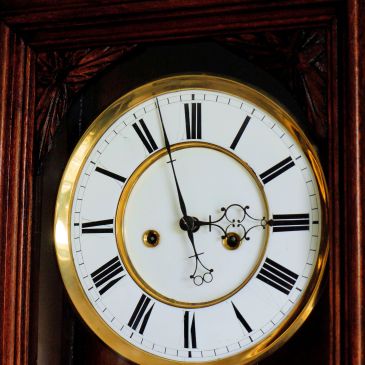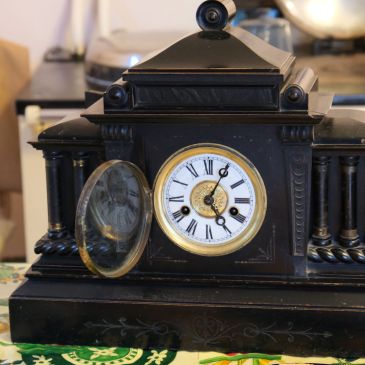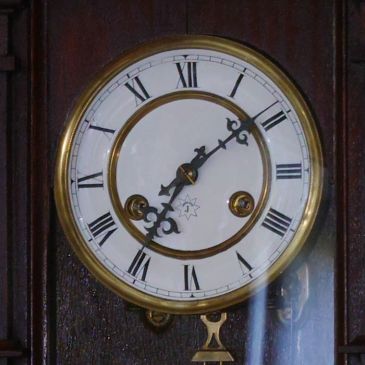
Junghans bracket clock – cleaning a silvered dial and brass accents

Lately, I have been working on a stately bracket clock by Junghans from the latter part of 1911. I love the look of this clock though some would say it is quite plain.

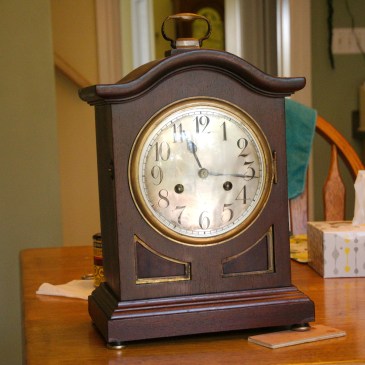
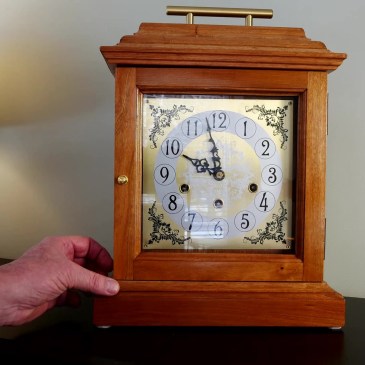
Junghans mantel clock on display on the day it was bought

The Regency style veneered mahogany case of this time and strike bracket clock is in reasonably good condition save for a small piece of veneer missing on the right side of the base and replacement chrome feet which look decidedly out of place.

I had completed servicing the movement a while back but also planned to address both the case and the dial as part of the rejuvenation of this clock.

After a thorough cleaning (and scrubbing) with Murphy’s soap, I freshened up the case followed by three coats of shellac.

The top of the clock looked good after a cleaning

Cleaning the dial

Silvered dials present a somewhat more challenging problem than zinc painted or paper dials. The silvering is very thin and can be rubbed off easily through over-aggressive cleaning resulting in a damaged finish so, it pays to be cautious.

Here is a prime example of a German U.M. Muller wall clock dial where someone used a strong cleaner resulting in a serious blemish. The dial must be completely restored. I have no plan to fix it.

U M Muller clock dial
U M Muller clock dial, damage between the numbers 6 and 7

Of course, there is the option of leaving this dial as-is but why not attempt a cleaning. As this is a non-porous dial, dirt is surfaced based.

Junghans clock dial
Junghans clock dial and the extent of the dirt and grime

From my research, many methods of dirt removal seemed dubious and any kind of chemical on a silvered dial is plain wrong. I chose to use mild (diluted) liquid soap and Q-tips to lift off the grime. While it took dozens of Q-Tips dipped in soapy water and gentle scrubbing in the direction of the spun dial most of the dirt was removed and none of the silvering was damaged. It is difficult to see any improvement as one proceeds so, it pays to be patient. After a couple of hour’s work of gentle rubbing, this is the end result.

Junghans clock dial after cleaning

While not perfect it is much improved. The aged look remains, with a patina that most would consider acceptable. Following the cleaning, where there was missing paint on the numerals, they were filled in with black acrylic paint. No further restoration is necessary.

Junghans clock project is finished
Junghans clock project is almost finished but for the lower brass features

Brass features

Next are brass features above the base section. Q-tips (many of them) and Brasso (Simichrome works well too) are perfect for bringing up the shine. Following the polishing, everything is wiped clean with soap and water and the inset panels are given a fresh coat of shellac.

The carrying handle on top was also cleaned with Brasso.

Junghans Corner feet finished
Junghans Cbracket style clock

Dial work and case cleaning are options when bringing any clock back to life but it boils down to personal choice. Some choose to leave things as they are to retain the original patina but I am in the camp that a little cleaning goes a long way. Cleaning takes time and patience, however. You may not see the results immediately but work carefully and you will be amply rewarded.

You may have noticed that the feet are different in the last photo but I will save that story for another day.

Junghans bracket clock – servicing the movement

Junghans bracket style clock, tilted to adjust the beat

I posted the first look at this clock a while back.

The Regency style veneered mahogany case of this Junghans time and strike bracket clock is in reasonably good shape save for a small piece of veneer missing on the front right corner and replacement chrome feet which look decidedly out of place.

The movement ran briefly after I got it home but after a short while refused to run despite adjustments. The seller says he had had the clock for two years and never had it running so I was sure it needed a good cleaning. In any event, my plan was to service the movement.

The movement is has a maker’s mark with B11 just below it. This refers to the approximate date of manufacture, the latter part of 1911.

Removing the movement

To remove the movement remove the hands, first the minute and then the hour hand. Open the rear access door to release two thumbscrews screws underneath the movement seat board. Move the gong assembly aside (or take it out completely by releasing a screw on the bottom of the case) and remove the works.

Junghans time and strike movement, B11 is under the Junghans trademark

Assessing the movement

This is a well-made movement. Early Junghans movements were robust and strong runners. I have heard stories of Junghans clocks from this era running well despite being very worn. Junghans’s movements are a cut above Mauthe, Hermle, HAC, and other mass-produced German clocks made during this period, in my view. The movement exudes quality with solid front and back plates though lantern pinions are favoured over cut pinions.

The movement has been serviced at least once, so far as I can determine. There is an “S” mark on the strike side barrel cap, helpful when returning the barrels to their correct location. I did not measure the mainsprings but the strike side spring is notably longer than the time side. There are two possible reasons, one that the strike side mainspring was replaced at some point in the clock’s life, or two, there is more load on the strike side requiring a stronger spring.

Junghans movement top view, strike side

The mainsprings are in good condition and there is plenty of power though there is more oil than necessary within the barrels. After assessing the movement I could see that there had been no significant repairs in the past. The crutch has been bent in several places in an attempt to adjust the beat but otherwise, everything looks reasonably good for the age of the clock.

Junghans movement, plate removed

Disassembly

Separating the plates was more difficult than it should have been. I had to remove all four pillars (secured by screws on both ends) to determine what was sticking. I discovered that the motion works centre arbour pivot was “stuck” in the backplate. By “stuck” I mean that although the wheel was moving freely the end of the pivot had been flattened. Why I don’t know. Had the pivot been punched in an attempt to enlarge it, had someone hammered the pivot end for whatever reason, had the pivot been replaced or it is possible that the plates had never been separated and that is how it came from the factory? Once the pivot was pried from the plate I rounded the end with a file and it now fits perfectly.

Junghans B11 movement
I use a screwdriver to point out any washer I find on a movement

All parts were cleaned in the ultrasonic cleaner which removed a considerable amount of accumulated grime. As always the ultrasonic cleaner does a great job with lantern pinions and the lantern pinions, on all 6 wheels, are in excellent condition.

There has been no bushing work done on the movement. The only punch mark I observed was just below the escape wheel outside the plate where an attempt was made to close the hole.

To bush or not to bush

After cleaning the movement, pegging the holes, and polishing the pivots the next step is deciding whether or not to bush the movement.

I could see that some bushings may be required, 4 on the backplate where there is more load on the wheels and 2 on the front plate for a total of 6, 2 on the strike side, and 4 on the time side but I will make a final decision once I have checked the entire movement further.

I installed all the wheels and checked for pivot movement within their respective pivot holes. The wear was not excessive. However, after much thought, I decided there is enough lateral movement of the pivots in their holes to affect its running. Besides, I wanted to place the clock in a prominent area of the house and by addressing wear issues now the clock would run well for some time without another servicing.

Seven bushings were installed, 3 on the time side, and 4 on the strike side. The largest one, which I did not include in my initial assessment, was a 4.5mm (OD) bushing for the count wheel.

Junghans front plate count wheel bushing
Junghans front plate new count wheel bushing

Re-assembly and testing

Once all the pivot work is complete and the holes pegged out again it is time for re-assembly. Setting up the strike side of the count wheel strike means ensuring that the warning pin is sitting just off the locking lever (12 o’clock position), the drop lever is sitting on the flat section of the cam wheel, and the count lever is in one of the deep slots of the count wheel.

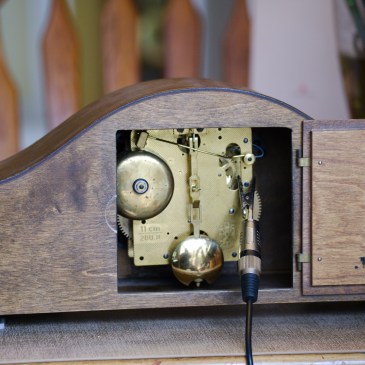
Testing the Junghans movement; beat amplifier attached

Only this time it was not all roses. The strike train consistently missed the half-hour strike because the count lever would drop in the middle part, not the beginning of the deep slot, occasionally missing the half-hour strike. Plus, the count lever did not completely rest on the cam. I cannot remember spending as much time correcting the strike side on a German movement as I did on this one. On one occasion I had everything together to discover that the paddle was hanging off one of the points of the star wheel. Having too much load at the beginning of the strike either will stop the strike or add one more strike to the indicated hour.

I must have taken the movement apart 5 times, and of course, each time I reassembled the movement I was wary of damaging those tiny pivots. Eventually, everything worked out. Sometimes when working with German countwheel strikes everything falls into place the first time. Not so much this time.

While on the workbench, I replaced the old tired suspension spring with a new one.

Junghans clock dial
Junghans clock dial numbers have been retouched

So, after a long-overdue cleaning and a few new bushings, the movement is oiled and is on the test stand. After several small adjustments to the beat, it is now running and striking as it should.

Now to see how we can address a grimy silvered dial. Join me in a couple of weeks as I take you through cleaning the dial face.

Junghans bracket clock – first look

Junghans mantel clock on display

I found this German mantel clock on a local online buy and sell site. The seller had two clocks, one, a generic German-made Westminster chime and this, a Junghans bracket-style clock. I knew right away that this was the better deal. It appeared to be a higher quality clock compared to the other one. I offered a slightly lower price and the seller quickly accepted. He said he never had it running in the two years he owned it and added, “I got to get rid of it, I’m moving”.

Junghans bracket clock handle

During my search to find the model name or number I came across one listed on eBay at the time of writing and two others while browsing similar auction sites. None had the model name or number but prices are all over the map, ranging from $50 to $300. I still do not know the model name or number.

Although it has a carrying handle on the domed top and would be termed a bracket clock, let’s just call it a rather plain-looking mantel clock with a handle. When I envision a classic bracket clock I picture a clock with verge escapement, subsidiary dials over a signed dial housed in a gaudy case. Let’s call this a poor relation.

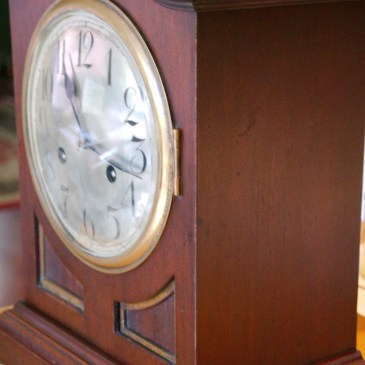
Junghans clock side view, not cleaned yet

The Regency style veneered mahogany case is in reasonably good condition save for a small piece of veneer missing on the bottom side front and replacement chrome feet which look decidedly out of place. It has not been cleaned in ages and scrubbing with soap and water removed a considerable amount of built-up dirt revealing a very attractive case.

The silvered dial shows some aging consistent with wear and caused when advancing the hands many times combined with the simple act of winding the movement arbors. The hands are original judging from other clocks like it. I may touch up the numbers and the hands in addition to giving the dial a cleaning to spruce things up a bit but we’ll see when I look at it further.

The dial catch, back access catch, and hinges work well. These often break from constant use.

Judging from scratch marks on the backplate, the movement has been worked on in the past. I won’t know the extent or quality of past servicing until I take the movement out of its case and examine it more closely. The movement has a maker’s stamp with B11 just below the mark. This refers to the approximate date of manufacture, the latter part of 1911.

Junghans time and strike movement

When I brought it home the clock ran briefly, stopped, and failed to proceed. It will need a thorough servicing and a few adjustments to get it running again.

Forestville mantel clock servicing – not fun when things go wrong! Part II

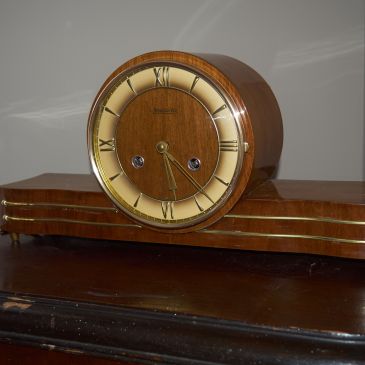
The face of Forestville bim-bam clock

Back in October (2020), I wrote about the challenges of working on this mantel clock by Forestville.

Recap so far

It is a nondescript Art Deco-style German mantel clock made in the 1960s sold under the Forestville name, a Toronto-based company that assembled clocks up to the 1970s.

The rack and snail movement is relatively simple to work on with all the adjustments, save for the stop wheel, on the outside of the plates. The mainspring barrels can be removed separately for servicing, typical of movements of the period.

An arrow pointing to the centre wheel

The hairspring escapement is something I did not attempt to clean. They can be finicky to work on and if the movement has been running beforehand, like this one, there is no pressing need to mess with it. Three screws detach it from the movement.

The bane of clockmakers – the broken pivot

When working with German and French movements particularly one must always be very careful of the small pivots. Normally when I work on this type of clock I am very aware of how easy it is to bend or break the tiny pivots and this clock was no exception. After taking apart the movement and reinstalling the gears to determine bushing wear I noticed the front plate center wheel pivot had come off.

Thinking I was careful guiding each pivot in place with a pivot locator I either applied too much pressure closing the plates or it was hanging on like a tread. Regardless, it broke. Compared to a pair of tweezers it is very small.

Broken pivot compared to a pair of tweezers

My experience with pivot repair is limited. I don’t come across broken pivots very often. Compared to an American clock that has much larger pivots these are tiny, perhaps 0.5mm or so. Although I have bushings that fit I do not have pivot wire that size and had to make do with a piece from my assortment of 0.85mm to 1.10mm wire. Not pretty but functional.

First, using a centring bit followed by a high-speed bit on my Taig metal lathe, I drilled 5mm into the shaft, enough to securely anchor the pivot wire. Once the wire was inserted, I applied high-strength Permatex Threadlocker Red to secure the wire in place.

A centring bit is essential when drilling a starting hole in an arbour.

After the 24 hour curing period for the adhesive, I installed a bushing in the front plate and put the gears back together to check the action of the new pivot. It is working okay. I will reserve judgment on the repair until the other bushings are installed.

There is more wear on the time side that at least 3 new bushings are required, two on the front plate and one on the back.

Out of an abundance of caution, I installed an additional 2 bushings. In total are T2, T3, T4, rear plate, and T4, T5, front plate. All bushings are on the time side which tells me that the strike side did not see much action, typical for many mechanical clocks since some folks find the noise of the strike bothersome.

2 new bushings on the front plate, new pivot in the centre of the photo (untrimmed)
3 new bushings on the rear plate using a Bergeon Bushing Machine

Servicing the mainspring barrels was more frustrating than I anticipated. Both mainsprings refused to catch on their hooks when I attempted to install them back into their barrels. The mainspring opening must be precisely on center to catch. Lesson learned; after a few tries, I successfully got them hooked back into the barrels.

Re-assembly

The new pivot was trimmed to fit and given a final polish prior to installation. Now to put it all together and see if the work has paid off.

I was especially careful putting everything back together and very mindful of how easy it is to snap off one of the delicate pivots. All went well. On the test stand, I ran the strike side through its sequence; it is going into warning and striking on the half-hour as it should. Now for the time side.

Repairing a broken pivot. Left on the lathe overnight to cure the adhesive and keep the pivot straight.

At first, the escape wheel would stop after a minute or so but after oiling the pivots including those on the hairspring (minus the jewelled ones, of course) it runs well.

Testing the Forestville movement on a non-standard stand

I will continue with the test of the movement but so far, after two 8-day running cycles, things are looking very good. The next step is to re-install the strike hammers and other moving parts and return the movement to its case.

Forestville mantel clock servicing – not fun when things go wrong! Part I

Forestville mantel clock

This post is about a mantel clock made by the Forestville Clock Company of Canada and some challenges servicing the movement.

In 2013 we were on a visit to the Thousand Islands and stopped at an antique store in Gananoque, Ontario. As my wife and I were strolling through the store and she noticed this mantel clock made by the Forestville Clock Company of Toronto. Somewhat plain in style it seemed to be in great shape and it was exactly what we were looking for at the time.

History of the Blackforest Clock Co. and Forestville Clock Co. of Toronto

The Blackforest Clock Company of Toronto, Ontario was founded by Leopold and Sara Stossel in 1928.  Both clock movements and complete clocks were imported from Germany and sold through department and jewelry stores across Canada. Their son Ed Stossel started working part-time with his parents’ company in the 1930s and later became a full-time employee in the late 1940s.

Some assembly work was carried out in their Wellington Street East factory. Initially imported mantel clock and grandfather clock movements were installed in cases made in Kitchener (home of the Arthur Pequegnat Clock Company), but later the complete mantel clocks were imported from Germany. This arrangement was interrupted by the Second World War, which also led to a name change to the Forestville Clock Company in 1941.  During the war years, the company imported its clock movements from England, the United States, and France. However, starting in the mid-1950s German factories again became the source of most Forestville clocks, with Mauthe being a major supplier.

The Forestville Clock Company was very successful during the middle decades of the twentieth century. Its grandfather clock cases and some of the wall clock cases were made in Canada. Ed Stossel retired in 1979 and unfortunately, the company survived just a few more years without his leadership.

Most Blackforest and Forestville mantel clocks still have their paper labels tacked inside the back door. This one does not.

My Forestville mantel clock

This clock movement and case are imported from Germany in the 1960s. There is a serial number on the backplate but no database exists online to date this clock. I am thinking that the  movement is made by Mauthe

The pivots and bushings appear to be in good condition at first inspection. The clock keeps good time and there is a simple speed adjustment on the hairspring escapement to regulate the clock. This mantel clock is handsome, has good lines and reflects the style of the period.

Servicing the movement

After 7 years I have put off servicing the movement far too long. The rack and snail movement is relatively simple to work on with all the adjustment wheels, save the warning pin, on the outside. The mainspring barrels can be removed separately for servicing, common for movements of the 60s,

The hairspring escapement is something I will not attempt to clean. They can be finicky to work on and if the movement has been running beforehand, like this one, there is no pressing need to fool with it. It is well protected by a plastic shroud. Three screws unhook it from the movement.

While there is some wear on the time side I see at least 3 new bushings required, two on the front plate and one on the back.

Hairspring escapement

When working with German and French movements one must always be very careful of the delicate pivots. Normally when I work on these clocks I am aware of how easy it is to bend or break a pivot and this clock was no exception. However, I had the movement apart and was reinstalling the gears to determine bushing wear and went about repositioning the center gear when I noticed its centre cannon front plate pivot had sheared off.

Arrow indicates center wheel with broken pivot (strike barrel removed)

I was not even aware that I was putting undue pressure on the pivot as I was carefully guiding each pivot in place with a pivot locator. However, either I applied too much pressure or it was ready to go because I broke a pivot. To give a sense of how small it is, here it is beside a pair of tweezers.

Broken pivot

My experience with pivot repair is very limited. This is not like a broken or worn pivot on an American clock which is less challenging to repair because they are simply much bigger. This pivot is small, perhaps 0.5mm or so. Although I have bushings that size I do not have pivot wire that small and had to make do with a piece from my assortment of 0.85mm to 1.10mm wire.

Repairing a broken pivot, pivot wire is glued in place and left on the lathe overnight

I centred the arbour with a centring bit and then using a high-speed bit, drilled to about 4 or 5mm into the shaft, enough to anchor the pivot wire. Once the wire was inserted, I used high-strength Permatex Thread Locker Red to secure the wire which takes 24 hours to cure. The next day I installed a bushing in the front plate and put the gears back together to check the action of the new pivot. It is working okay. I was not convinced the repair would work but I will reserve judgment until the other 3 bushings on the time side are installed.

Can’t wait to find out if the repairs are successful? It’s a long wait but on November 25th, I will present the results.

Horolovar guide and how to determine the correct suspension spring for a 400-day clock

A 400-day clock, also known as a torsion clock, is a type of mechanical clock designed to run for about a year (400 days) on a single winding. It features a unique suspension system, where a rotating pendulum or torsion spring controls the movement. The clock’s long-running time is achieved through a very slow, consistent release of energy from the mainspring, and the mechanism is typically enclosed in a glass dome for display. Though not particularly accurate, they are fascinating to watch.

Years ago, my daughter gave me a Horolovar guide as a Christmas gift. Any horologist who works on many 400-day clocks will agree that the Horolovar guide is an indispensable manual when working with 400-day clocks.

It’s not a manual you’ll reach for often, but when working on 400-day clocks—often called anniversary clocks—it becomes absolutely essential.

Horolovar 400 Day Clock Repair Guide

The guide was last published in June 1991, and I believe little has changed since then. However, while writing this, I did some research and discovered that Haller Uhrenfabrik GmbH still produces mechanical anniversary clocks. Haller Uhrenfabrik GmbH is a German clock manufacturer based in Simonswald in the Black Forest, known especially for anniversary clocks, table clocks, and decorative mechanical timepieces. Founded in 1874, it combines traditional clockmaking.

Using the Manual

My daughter was in the midst of moving across the country when she unknowingly overlooked the locking mechanism on the 400-day clock she had received as a gift a few years ago. Upon unpacking it, she found that the suspension spring had snapped. While a snapped suspension spring can’t be reused, it can be easily replaced.

400-day clocks require very specific suspension springs, ones specially designed for each of the many dozens of manufacturers in the past 100 years. Install a suspension spring with an incorrect thickness and length, and you are asking for trouble. The correct spring for the make and model of the clock will ensure a smooth-running anniversary clock that will operate for many years.

On the positive side, these clocks run so slowly at 8 beats per minute that it is rare to have worn pivots and bushing holes.

Horolovar templates
Horolovar templates

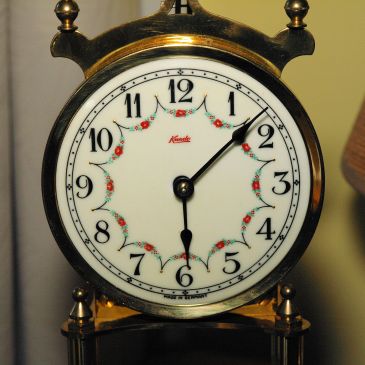
Back to the clock in question. It is a Kundo anniversary clock made in the 1950s. According to the Horolovar guide, it is model 1371. Model 1371 tells me that the thickness of the suspension spring is .081 mm or .0032″. I’ve worked on similar models before and had some leftover Horolovar suspension springs of that size.

Kundo 400-day clock, made in West Germany

This is essentially a one-hour job. There are two blocks, one at the top and one at the bottom. Carefully unscrew the blocks, ensuring the spring doesn’t become bent during the process (the small screws can be tricky to loosen). Once the blocks are removed, insert the suspension spring and tighten the screws. After securing the blocks, the manual will indicate where to attach the suspension fork.

suspension spring installed on a Kern
Suspension spring installed on a Kern 400-day clock

Install the assembly onto the clock by attaching the top block with a screw that threads into the mounting hole, and hooking the bottom block onto the pendulum—but your work is not yet finished.

Now comes adjusting the beat and regulating the clock. There is a bracket above the suspension spring assembly that can be turned slightly (it is a friction fit) in either direction to correct the beat. I set the beat by ear and eye. There is a beat setting tool that can be purchased from a clock supplier if you plan to work on a lot of these clocks. In any event, a beat amplifier is an absolute must.

Most 400-day clocks run at 8 beats per minute. Mine runs slightly faster at 9 beats per minute, but this can be adjusted using the dial-type speed regulator at the top of the four weights. While a clock running a bit fast might seem negligible, over the course of a year, it can accumulate into a significant difference of minutes or even hours. As anyone familiar with these clocks will attest, they are not known for their precision in keeping time.

Can you install a new suspension spring without the Horolovar guide? Yes, but you’ll need to research the correct suspension spring thickness for that specific model and use the old assembly as a template.

In the end, 400-day clocks are deceptively simple machines that demand careful attention to detail. Replacing a suspension spring may only take an hour, but selecting the correct one, installing it properly, and setting the beat requires patience and a bit of experience. The Horolovar guide brings all of this together, turning what could be trial and error into a straightforward process. It may not be a book you use often, but when you need it, there’s really no substitute.

Related Articles

Uhrenfabrik Mühlheim, Müller & Co box clock – servicing the movement

It is time to service this very fine German box clock by U. M. Muller. I have been stalling for too long. I am a little leery because the last time I worked on one of these the strike tension spring broke (my fault) so I made a promise to be more careful this time.

I bought this clock in 2013 and while it has been very reliable and running daily, like all things mechanical it requires attention from time to time.

A little background.

German “box clocks” effectively spelled the end of the Vienna regulator period because they were cheaper to produce, had simpler lines and appealed to the middle class consumer of the 1930s.

U M Muller box clock

According to Schmid’s Lexikon, the original founders of this company in Mühlheim started in 1867. It was acquired by R. Schnekenburger around 1880, then by Gebrüder Müller around 1896 when it became Uhrenfabrik Mühlheim vormals R. Schnekenburger. In 1900 it assumed the name Uhrenfabrik Mühlheim, Müller & Co. or UM Muller.

This U. M. Muller box clock features wood carved inlays on the door, metal dial, wall stabilizers, brass bezel trim, spade and spear hands, beveled glass framed in brass and a fixed wood carved crown. The case reflects excellent quality.

Logos are helpful in dating a clock. U. M. Muller clocks can be dated by the lion logo on the clock face. If the lion’s tail is up it is pre-1930. On this clock the tail is down which puts it is in the mid to late 1930s.

Back of movement

Okay, enough of background; let’s get on to servicing the movement which is the subject of this post.

U M Muller movement, front plate

It is a count wheel strike which is not unusual but to be honest I was a little surprised and expected a rack and snail movement for a 1930s clock.

The movement has been opened at least once, perhaps more. I could not see any obvious signs of repairs, so, perhaps a cleaning or an adjustment was all it required. It was very oily and I suspect it was sprayed with some sort of solvent. Despite the “wet” condition of the movement it is actually in very good condition.

I had two issues with disassembly. One, I could not pull the count wheel off its arbour despite my best efforts, so on it stayed. I simply worked around it. It made for an interesting installation of the cam wheel bushing. Secondly, the strike lifting lever spring snapped when I disassembled the clock. See, this is what I feared!

I salvaged what was left of the spring, which is essentially a stiff, straight wire that hooks onto the strike arbour, but had to drill a new hole in the plate adjacent to the old one to secure the spring. The remaining spring happened to be just long enough to do the job.

Spring repair for U M Muller movement, solder used to secure the spring in place

The movement was disassembled and parts placed in an ultrasonic cleaner. After drying all pivots were polished.

Mainsprings

The powerful mainsprings are a weak point in German clocks of this era. Usually when they break they take a few things with them. It is called collateral damage and manifests itself in broken wheel teeth, bent wheels, arbours and so on. As the mainsprings were in top shape with plenty of power, no splits or cracks, they were cleaned and reinstalled in their barrels.

Bushing work

The movement required 3 bushings, the escape wheel front and back and one on the cam wheel, strike side. It was actually not as worn as I expected and likely could have gone on further without stopping but the bushing work and overall servicing including a good cleaning will certainly extend the life of this clock.

The three 2mm diameter bushings required for the plates are some of the smaller ones in my supply. Not a huge problem but they are so small that one snapped out of my tweezers when I grabbed it from the container. It is on the floor….somewhere!

Wheels are in place and ready for the top plate

Otherwise, the bushing work went well.

Testing

the movement was assembled and while the time side ran well the strike side was out of adjustment. With count-wheel strikes it generally takes a couples of attempts to get it right but I think I have only one adjustment to make, relocating the stop wheel so that the stop pin is in the 12 o’clock position. I will leave it and test the time side for now.

Next day

This is the day when things go horribly wrong.

I let the mainsprings down and opened the plates to relocate the stop wheel. In my haste to reassemble the movement I bent one of the pivots on the governor. I knew it right away because when I had the plates back together the train would not turn and the fly was “stuck” in one spot. Out came the wheels and once I attached the fly arbour to the chuck of my lathe and gave it a few spins I could see how much it was bent. It was not bent by much, but any amount will stop the train. I straightened it as best I could and it looked pretty good. The pivots are tiny and care must be exercised when moving the wheels around when assembling the plates. It is a hard lesson for all clockmakers.

The lion’s tail is downward

Of course, while straightening the fly arbour the tiny fly retention spring, which is a small wire, flew into the room somewhere. I had to fashion a new fly spring from 19 gauge wire. What else could go wrong! Thankfully nothing else did.

This should have been a relatively easy movement to work on. Instead I seemed to have encountered one problem after another but with each problem I arrived at a solution. Despite my issues this is a well made German movement and really nice to work on.

All is well, the movement is running and striking as it should.

Selling an antique mechanical clock – preparation and advertising – how to

How to sell an antique mechanical clock

If you are a collector like myself there will come a point when there are just too many clocks and not enough walls and mantels. I manage my collection in two ways, some clocks are gifted while others are sold. I am not in the business of selling clocks but occasionally I will sell a few to trim my collection.

The objective is to recoup my initial investment and any time I put into a particular clock plus, make room for new acquisitions.

Juba Schatz time and strike sold in 2018

I hope you find these tips useful when preparing to sell your clock.

What does “antique” mean: The general standard for considering something as an antique is that it must be least 100 years old. Based on this definition a clock made on or before 1920 is an antique. Anything under 100 years but more than 30 years is vintage and anything 30 years or less is considered collectible. However, you will find sellers using the word antique when clearly, the article is vintage. And some consider anything that is old to be an antique.

Vintage Mauthe Westminster chime sold in 2019

Value: Research auction prices to get a feel for the value of similar clocks that are offered for sale and the price realized. There will be a range of prices and something in the middle of the range is a good guide. Know that a clock is only worth as much as someone will pay. If you price your clock too high you will know it soon enough.

Rare and desirable clocks, as well as clocks with an interesting provenance, will command higher prices.

Clocks vary in price according to the geographic location where they are sold. Generally, clocks that are made in the same location as the clock is sold will command higher prices.

Preparing the clock for sale: A clock in running condition will be worth more than one that is not. A professionally serviced clock in excellent running order will command a higher price. A clock case cleaned of grime will present better than a dirty one. Missing hands or dial glass will adversely affect the price. Items such as these can be replaced and parts are available from clock suppliers but it becomes an extra cost for the buyer and for many it is a deal-breaker.

Disclosure: Honesty is key. Tell the prospective buyer as much as possible about the clock. A clock that is a marriage, a case with a similar but replacement movement, should be stated as such. Replacement glass, newer dial, replacement crowns and finials, case repairs or full case restoration should also be disclosed. If the clock is running and was recently serviced by a competent repair person, state it. If the clock is running but the movement needs to be cleaned, state it. If it is not running describe why and what issues it might have (poor previous repairs, missing parts etc.). If you do not know, state it. Describe excessive wear, damage or missing pieces such as crowns, finials and trim pieces.

If your clock is rare, indicate why it is rare and how your research supports your description.

Jauch wall clock
Jauch wall clock may look antique but it was made in the 1970s

Where to advertise: There is any number of ways to sell a clock. Facebook for-sale sites, local online for-sale sites, eBay, flea markets, consignment shops and auction houses are popular places to sell a clock. Setting up an account for most online sites is a pre-requisite but there is usually no cost.

Photographing your clock: Few cell phones are capable of capturing a detailed image of a clock but for many, it will have to do. Out of focus photos are a no-no, however.

Several images from different angles as well as a photo of the inside of the clock case are much more helpful than one photo. During the daylight, place the clock near a window and position yourself between the window and the clock to take a series of photos in natural light. If there is damage or wear take closeup photos of those areas.

A dedicated camera with artificial light will produce superior results.

Determining the age of a clock by the movement from a Gilbert mantel clock is easy. It is stamped on the plate (1925)

Collectors are interested in certain makes. Along with your description state the maker and the approximate age. If you do not know, a picture of the makers mark on the dial or the movement will assist prospective buyers.

Description of your clock: Crafting an ad is an art in itself. You must be concise and accurate and not overly wordy. There is a balance between too little and too much information. More information means fewer inquiries from prospective buyers. Too much information with technical terms will turn off prospective buyers.

State the clock’s maker if known, the model if possible, the year it was made, the type, (time-only, time and strike, chiming clock), the style of clock (mantel, wall, shelf, parlour, Ogee, tall-case etc.). as well as any interesting features, for example, a steeple clock with an alarm function or a clock with a second’s hand.

There is no need to provide a reason for selling but sometimes it helps the ad.

Junghans Crispi time and strike wall clock
Junghans Crispi German time and strike wall clock, circa 1899

Example of a poor ad for Mauthe clock pictured below

Antique chiming clock, comes with key

Example of a good ad 

Scaling down my collection. Antique German time and strike clock made by Friedrich Mauthe, circa 1899. Original glass, mild restoration including new upper centre finial, repainted hands, new wall stabilizers and new arch piece. Cleaned and serviced in 2019. Runs well, key supplied.

Mauthe wall clock

And finally

Know your terms: If you are selling a mantel clock, the word is mantel, not “mantle”. A clock with two winding points (and there are exceptions) are generally called striking clocks, that strike not “chime” on the hour and half hour. A chiming clock generally has a quarter-hour musical tone such as Westminster or Whittington and often has three winding points (again there are exceptions). There is no such thing as a Tempus Fugit clock. Tempest fugit means “time flies”. A grandfather clock is a tall-case clock 6 feet or higher, not a wall clock. Gingerbreads and parlour clocks are different but both are often called kitchen clocks.

Though certainly not a definitive guide to selling, I hope I have provided some pointers and ideas when you decide to sell your antique mechanical clock.

What defines a successful clock day?

What defines a successful clock day? When everything goes according to plan, I’d say.

I ordered a number of parts from a clock supplier that finally arrived recently. Among the supplies was a good quality pivot oiler, a mainspring for the time side of a mantel clock, a set of better quality broaches and movement parts for my English bell strike.

I have a number of oilers but they are cheap and dispense far too much oil. A high quaility German made oiler is the right choice.

The broaches are made by Grobet and they are of excellent quality. The inexpensive broaches that I bought when I began my journey into clock repair will be put aside.

Success #1

In the fall of 2019 I picked up a clock made by the Fleet Time Company a short-lived Montreal-based company that lasted 4 years before World War II.

Fleet clock without the movement

The case had to be refinished but when I finally returned the movement to its case I discovered a broken time side mainspring. Some movements are designed such that the mainspring barrels can be removed without dis-assembly. I removed the barrel to take measurements for the replacement mainspring. Using needle-nosed pliers I pulled the mainspring out, measured the width, thickness, length and ordered one from my supplier. I had to put this project aside until the mainspring arrived.

Using my Ollie Baker spring winder I coiled the spring into a retention collar and inserted it into the spring barrel and once inside the barrel, it was capped and returned to the movement.

Broken time side mainspring, not reusable

It is finally nice to hear it chime.

Success #2

I recently serviced an Arthur Pequegnat Canuck time and strike kitchen clock. After installing 5 bushings and reassembling the movement I was not able to make the strike side run correctly. Today, I pulled the plates apart slightly to make an adjustment to re-locate the stop wheel.

The movement just before servicing

That was enough to allow the movement to go into warning. The clock is happily ticking and striking.

Success #3

I recently serviced a Waterbury York time and strike parlour clock. The strike side did not work when I bought it. I took the movement apart, cleaned it, installed several bushings and installed two missing helper springs. The movement ran well on the test stand but not when I returned it to its case.

In the case with the dial attached and the clock stopped. Today, I discovered that the crutch, a later replacement, is rubbing against the back of the dial, but just to be sure, I removed the dial and the clock ran without a problem. The solution; push the crutch loop further back into the movement.

Thoughts

These might seems like small victories but I’ll take them when they come. In the clock world some days are filled with challenges and frustrations but there are days like today where everything seems to go perfectly and that makes up for everything.

The schoolhouse clock – how it got its name

Older readers growing up in the rural areas of Canada and American have fond memories of the one-room schoolhouse clock located in the front or rear of the classroom. Just how did the schoolhouse clock get its name?

As the teacher instructed the students to work quietly on their own students would look up furtively at the clock anticipating the next recess. Students learned about time, how it regimented the day, how it seemed to move slowly and yet so quickly. Can you imagine the privileged child selected to wind the clock once per week.

Killarney, Ireland pub. The drop fusee wall clock is to the right

With a swinging pendulum visible from a distance, the clock can easily be seen running. The open-door bottom access sash allowed for restarting and adjusting the rate. The vast majority were American clocks though Canada produced its fair share of schoolhouse clocks. Time-only movements were very popular because they had fewer moving parts, noiseless except for the ticking sound, were simpler to maintain and would run well for years even if very worn.

The schoolhouse clock came to be known as a particular style of clock found in school settings. If a particular style was ordered by a school authority manufacturers might have informally described them as clocks for schools or “school clocks”. In any event, the term, “schoolhouse clock” has become part of the lexicon of the clock collector.

Today, the distinctive schoolhouse clock is known as a drop octagon by clock collectors.

Most schoolhouse clocks are 8-day running, constructed of oak, have a brass dial bezel, bottom glazed access sash, 9 or 12-inch dial with the majority being time-only. A time-only clock provides less distraction in the classroom environment than those clocks making a striking sound.

None of the labels on my clocks have the word “schoolhouse” written on them. They are either described as a “drop octagon” or have a specific model name

In some clock circles it is said that schoolhouse clocks are a derivative of the English drop dial fusee clock such as the one seen in an Irish pub in Killarney (above photo).

None of the labels on my clocks have the word “schoolhouse” written on them. They are either described as a “drop octagon” or have a specific model name.

Here are a few schoolhouse clocks from my collection. Enjoy!

Sessions Drop Octagon
Sessions Drop Octagon from a school in Springhill, Nova Scotia (Canada)

Gilbert Admiral with 31-day calendar function, Colchester County, Nova Scotia

Ansonia clock project is complete
Ansonia schoolhouse clock, Berwick, Nova Scotia

Jauch wall clock
German-made Jauch wall clock, 1970s era

“Special edition” clocks inspired by the classic schoolhouse wall clock are still sold today though you will find a quartz movement inside

Brandon II by Arthur Pequegnat, Great Village, Nova Scotia

Waterbury short drop wall clock, Halifax, Nova Scotia

Trio of clocks
A trio of clocks representing 3 time zones, From the left, a Waterbury, New Haven and Sessions

“Special edition” clocks inspired by the classic schoolhouse wall clock are still sold today though you will find a quartz movement inside.

The classroom was not only place for the schoolhouse clock. Many found their way into homes across Canada and the US. My grandparents had a Waterbury time and strike schoolhouse clock in their kitchen that I remember well as a young boy (the preview clock for this post).

Schoolhouse clocks evoke fond memories for the older generation today and fortunately many have been preserved for generations to come.

Is this a German box clock?

In light of current world events the antiquevintageclock.com family wish to convey our sympathy and condolences to those effected by Covid 19

A different looking box clock

Is this a German box clock? It certainly appears to be a typical time and strike German box clock with the addition of finials. I discovered it behind a bar at a resort in Varadero, Cuba before Covid19 scared us all into our homes.

I have two box clocks in my collection, one is this Mauthe clock from the 1930s but most box clocks I have seen are relatively plain-looking and unadorned. Finding one with finials is a bit unusual.

German "box" clock by Mauthe
German “box” clock by Mauthe

It might have been made by a number of German companies, Mauthe, Kienzle, Gustav Becker, or HAC but definitely German. I cannot see any markings on the dial or anywhere that might tell me what it might be. But those finials. Were they added later on? Who knows.

I am always on the lookout for interesting clocks during my travels and hopefully, in the months to come, my wife and I can resume our travelling once the current world health crisis subsides.

Plate clock movement – simple but finicky

In light of current world events the antiquevintageclock.com family wish to convey our sympathy and condolences to those effected by Covid 19

German-made time-only plate clock movement

Small shelf clocks of the 1930s from BlackForest Clock Co. of Toronto shared a simple German-made time-only movement across the line. The movement has tiny wheels and pivots plus a clever twisting pendulum rate adjuster.

Continue reading “Plate clock movement – simple but finicky”

Fleet Time Company of Montreal – Westminster chime mantel clock

In light of current world events the antiquevintageclock.com family wish to convey our sympathy and condolences to those effected by Covid 19

Here we have a nondescript mantel clock from the Fleet time Company of Montreal. This little known Canadian clock company had a short life between the years 1936 and 1940 producing a range of two and three-train mantel clocks with movements sourced from Germany. All clocks had pendulums and were spring-driven. According to business records, the company was listed as an importer of clocks and watches. The locations were 440 McGill and then 303 St. Paul West, Montreal (Canada).

The Second World War took a heavy toll on this company as the source of movements dried up and so the future prospects of this small company (information obtained from the Canadian Clock Museum, Deep River Ontario). One wonders why they did not diversify and source movements from France and Germany like the Forestville Clock Co. of Toronto during the war years.

Wood cases were made in Canada for some models while other cabinets were imported from Germany.

Gufa chime movement

This clock has a Gufa movement and one can assume most of their 3-train clocks had this movement although some movements are marked “Foreign”. Gufa is the Guetenbacher Uhrenfabrik, located in Gütenbach, Germany. They manufactured 400-day clocks and cuckoo-clocks and later they became the “Jahresuhrenfabrik” (August Schatz & Sons in Triberg, Germany).

Battered company plate, simply says “Fleet Clocks”

Close-up of foil plaque

The movement does not work because the time side mainspring is broken. The case is in bad shape and I am not sure how I will proceed but it is beyond simply cleaning, touching up and polishing. At this point, the only option is stripping. I am always reluctant to strip the finish from an old clock unless it is the only option. In any event, the case will be a late spring (2020) project.

The case needs a lot of work

This is another Canadian clock added to my clock collection although the fact that it was assembled and sold on Canadian soil is its only real qualification.

10 weight driven clocks in my collection

I am a big fan of weight driven clocks and will add them to my collection when time, opportunity and finances allow.

There are generally 2 categories of motive power for mechanical clocks. The energy required to run a clock is provided either by a spring or a weight. Most of my collection is spring-driven but 10 clocks are driven by weights and they represent the broad period from 1835 to 1996.

here are some interesting facts about my ten weight driven clocks:

  • Eight are American,
  • Two are Austro-German,
  • Three are Ogee style,
  • Five are thirty-hour or one-day,
  • Two are column style
  • One is woodworks, and
  • Three have deadbeat escapements with maintaining power

Rather than describe each one I will let the photos (with captions) speak for themselves.

Continue reading “10 weight driven clocks in my collection”

Blackforest clocks – I must be a sucker for these things

Your first thought might be the Blackforest region of Germany and there is, indeed, a close relationship to that region to a small clock company that operated many years ago in Toronto, Ontario (Canada).

Blackforest is (or was) a well-known Canadian clock company. The Blackforest Clock Company of Toronto, Ontario was founded by Leopold and Sara Stossel in 1928. Both clock movements and complete clocks were imported from Germany and sold through department and jewelry stores across Canada.

Blackforest shelf clock from 1937, the year of the Royal Tour

Their son Ed Stossel started working part time with his parents’ company in the 1930s, and later became a full-time employee in the late 1940s.

My first Blackforest shelf clock

Some assembly work was carried out in their Wellington Street East factory (Toronto). Initially, imported mantel clock and grandfather clock movements were installed in cases made in Kitchener, but later the complete mantel clocks were imported from Germany.

It is a one train time-only movement with tiny wheels and a unique twisting pendulum rate adjustment

The arrangement with suppliers was interrupted by the Second World War, which also led to a name change to the Forestville Clock Company in 1941. During the war years this company imported its clock movements from England, the United States, and even France. However, beginning in the 1950s German factories again became the source of movements, with Mauthe being a major supplier. Sadly, the company did not survive much past the late 1970s.

Continue reading “Blackforest clocks – I must be a sucker for these things”

Tick Talk Tuesday #23 – Forestville clock with electromechanical movement

Tick-Talk Tuesday is about the letters and comments I have received from you, the reader, concerning your clock, issues you might have had, challenges you face or a clock you would like me to profile. I offer my responses to your questions with advice on your particular clock concern. For those comments and questions that stump even me, I consult within my clock circles for the best possible answer

Not the most attractive clock in the world but a curiosity nonetheless. It is a mechanical clock but it is not wound in the conventional manner.

Continue reading “Tick Talk Tuesday #23 – Forestville clock with electromechanical movement”

Aunt Theresa’s mantel clock

Hamburg American Clock Company time and strike

My wife’s aunt lives in a quaint home near a small town in the south of Ireland. During our recent visit to Ireland we were invited to her home, had tea and cake and had a long talk about family history.

While there I was asked to take a look at the family clock which had not been running for a number of years. Aunt Theresa and her husband (now deceased) received the clock from his brother, an amateur antique collector, many years ago.

HAC’s are good quality movements with well-made cases

The clock is an attractive and somewhat large 6-column Victorian-style 14-day time and strike mantel clock with Roman Numeral dial made by the Hamburg American Clock Company. It is model #1902 probably made on or about that date. Hamburg American clocks are known for good quality movements with well-made cases.

I will take a look at it, I said, but without my tools, there is not much I could do. I wound both arbours and determined that the mainsprings had plenty of power. I gave the pendulum a push and immediately observed that there was power going to the escapement but there was an uneven tick-tock, so, the clock was out of beat. I propped up one side of the clock sufficiently to find the correct beat and it not only ran but dutifully struck on the half-hour. It works!

In the clock case was a note.

A note found inside the case

The note said,

Tried getting the clock to go on 22nd Sept ’92- worked at pendulum for a long time. I think the clock was too tightly wound. On morning of 23rd Sept, started pendulum again and it’s going since. The clock has not chimed yet. 6th Oct 92 gave the clock a small wind up as it had stopped

I admire aunt Theresa’s tenacity but the clock refused to run after the second winding way back in 1992, 27 years ago.

Time and strike movement with coiled gong

Here is what I discovered about the Hamburg American Clock Company.

In 1875, Paul Landenberger together with his partner, Philipp Lang, founded the Landenberger & Lang clock factory and although he had taken some know-how with him from Junghans (a noted German clockmaker), the company was bankrupt by 1882/1883. It was converted to a stockholding firm and with new investors, the company was re-named Hamburg-Amerikanische Uhrenfabrik (Hamburg-American clock factory).

The name might suggest that they had American made movements but that is far from the case. Hamburg is in the name because that is where the investors came from and “Amerikanische” referred to the movements which were made according to the “new” American mass-production methods.

Among clocks circles, the company is simply known as HAC.

Nice label with model number above

The familiar crossed arrows trademark mark found on the coiled gong was registered in 1891. The “Lux” trademark, which this clock does not have, was added in 1905 so, it places this clock between those years. Model #1902 might even suggest the year it was made. Junghans eventually gained influence over the company and by 1930 was able to take over HAC completely.

The good news is that the clock runs and that there is nothing fundamentally wrong with it but after all these years it needs a good servicing and that means disassembly and cleaning by a qualified clock repair person.

Trash to Treasure – when clock restoration is the only option

I was on a Facebook clock collector page recently and I was intrigued by the work someone had done on a clock that was surely destined for the garbage bin. The transformation was given an apt phrase, “Trash to Treasure” and so I thought I would write about my own experiences resurrecting old clocks.

Preserving the original patina is always the principle goal and I do as much as I can to keep things as they are. However, when the finish has been adversely affected by environmental damage, heat, cold, humidity over the course of many years, as in a couple of examples below, the only course of action is refinishing.

There are times when the only course of action is complete restoration

My grandfather’s clock – partial restoration
Continue reading “Trash to Treasure – when clock restoration is the only option”

Junghans wall clock – Sometimes a small thing can be a pain in the, well, you know

The problem; a run-on strike. The solution; remove the movement, poke around looking for the cause, find it almost immediately and apply a quick fix.

The story

My winter (2017) project was an antique German Junghans Crispi time and strike spring driven wall clock made in the style of a Vienna Regulator. It was manufactured in Schwenningen, Germany in 1899. It came to me as a box of parts. I put hours of work into this project so a malfunctioning movement was a bit of a disappointment.

When I originally  disassembled the movement for servicing I made two errors. In my attempt to correct a bent star wheel paddle, I managed to snap it off.

Strike paddle

However, I also managed to snap off the paddle wheel arbor spring which is essentially a thin steel wire which maintains paddle tension during the strike. At the time I did not have the right tools to repair the break. Hmm! After a professional servicing, all is right.

Return spring that had become loose after two years (first photos taken of the movement)

Fast forward to 2019

Now, two years later the strike side decided to malfunction. It was striking incessantly. I decided to check out the problem. I took the movement out of the case, removed the clock face and immediately noticed that the strike tension wire had wiggled out of the arbor so that nothing prevented the paddle from stopping, hence the run-on strike. As I mentioned this was one of the repairs made on the clock when it was professionally serviced.

The solution is Loctite. Some purists will scoff but I believe there is place for modern materials in clock repair so long as the repair is functional and discreet. I positioned the spring correctly and applied Loctite where the wire runs into the paddle arbour and allowed it to dry for 24 hours.

After the repair the clock is striking as it should. However, it took me a couple of days to find the correct beat. For some reason this clock must be absolutely level to function correctly. If it is off by just a smidgen it will not run. Anyway, everything is fine now.

Interpreting the numbers on an antique German clock movement

On many German antique pendulum-driven clocks, including those made by manufacturers like Mauthe, you’ll often find various numbers stamped or engraved on the back plate of the movement. These numbers serve different purposes and provide valuable information about the clock’s origin, design, and specifications.

In this article, we will explore some of these numbers and explain their purposes.

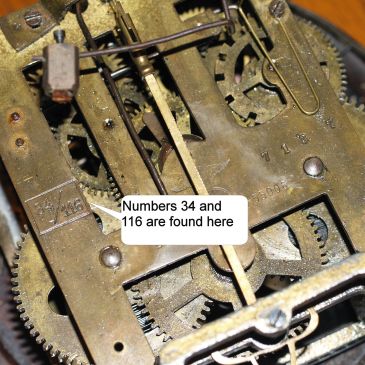
In the lower portion of the backplate of the movement in question, there are a series of numbers. Some of these numbers have a clear explanation while others are somewhat of a mystery. For example, one number, the beats per minute number, helps a clockmaker regulate the movement during servicing.

Let’s begin with the number 34. The number 34 refers to the measurement in centimeters from the top of the suspension spring post to the bottom of the pendulum regulating nut.

Nomenclature of a German pendulum assembly

The 34 cm measurement includes the following: the top of the suspension spring post, the suspension spring, the pendulum hanger, and the pendulum rod and bob. Within this total length, the suspension spring measures 2 centimeters. The pendulum rod, from the hook to the bottom, measures 26.5 centimeters

The number 116, located next to the number 34 on the movement, refers to beats per minute (BPM). Clock train tables typically express the timing of a movement in beats per hour (BPH). A movement running at 116 beats per minute will have 6,960 beats per hour. This information is invaluable for a clockmaker when regulating a movement during servicing.

Heinrich Kielmann patented hanger

On the movement pictured above is a peculiar number that does not relate to the running of the trains themselves.

The number 55006 is a patent number, issued to Heinrich Kielmann (Ruhrort/Rhein) in 1890 or 1891. The patent concerned the hanging of the pendulum. Kielmann not only manufactured loose movements for other makers but also allowed them to produce their own movements using his patented pendulum hanging system. This is why movements from various manufacturers may bear this patent number.

You might also come across another number.

The number 7137 is a mystery

In the example above, the number 7137 could indicate a production number or a coded method of expressing the date, known only to the manufacturer. Occasionally, numbers may be reversed, as seen in earlier Junghans clocks, or they could represent a production number, where 7137 might correspond to the specific number of this clock within the range of movements produced that year. Without access to the database of Mauthe clocks, the last number remains a mystery.

Should you receive a movement without a pendulum rod, or a bob, these measurements can be invaluable for sourcing replacement parts. Knowing the precise length of the pendulum, the type of suspension spring, and the size of the movement can help you find or fabricate compatible components, ensuring the clock can be properly restored to working condition.

Alternatively, understanding these numbers will undoubtedly deepen your knowledge of clock collecting and repair.

Schatz W3 – Installing an 8-rod chime block in a custom made clock case

Some time ago I bought this movement without a case.

Having a movement without a case is like a car engine without the body

I discovered this Aug Schatz & Sohne W3 (circa 1960) movement at a local antique store for under CAN$20. My wife said, “You should buy that, maybe you can make a case for it”. “Hmm”, I thought; that would be above my pay grade. The movement looked interesting and it was not expensive so, why not! But, having a movement without a case is like a car engine without the body but I was confident that one day I would have the solution.

This is a type W3 movement. “W3” refers to three chime tones, St Micheal, Whittington and Westminster.

Rear plate
Rear plate of the W3 movement showing chime selector and chime/strike hammers

I put out a plea and two people contacted me to say they had a case that would fit. One lived in Australia and the cost of shipping the case was too high. Another corresponded twice but I sensed he realized that his case would not fit. So, I put the movement away. On a positive note it runs well.

Schatz and Sohne W3 movement installed in a custom case

The pursuit of a custom made case

In the spring of 2018 my son’s girlfriend suggested that her grandfather could build the case. He loves doing this kind of work, she said. Although skeptical at first, I accepted her offer. Though a skilled craftsman her grandfather is over 90 years of age but spends as much time as he can in his woodworking shop in rural Virginia. He agreed to do the work. I sent the measurements to him but he preferred to have the movement in hand so it was sent to Virginia. He was able to use the movement as a guide in constructing the case. The clock was returned to me in December 2018 and it looked absolutely perfect.

Now to the installation of the chime block

The dimensions of the case allowed ample room to place a chime block. The block and rods are 7 1/2 inches long but even so there was not much room to spare on one end. The 8-rod chime block is from a Canadian clock supplier and is designed for a Hermle triple chime movement. There are not a lot of 8-rod chime blocks available through suppliers and given that I had little choice I had to assume that it would work for my clock and it does!

This video describes the placement of the chime block and some experimentation to achieve the optimum sound.

The tapered sections of the rods are an inch long and the hammers must be positioned to strike the wide point of the rods for best results. The oak base was trimmed to fit, allowing for about an eighth of an inch between the rods and the hammers. To close the distance to the rods the hammer wires are bent and centered on the rods. As they are brittle, chime rods should never be bent!

Chime block and oak piece forming the base

Once I was satisfied that the chime block was correctly positioned the block was secured. First I screwed the chime block to the hardwood base with 4 brass slotted screws. And finally, I secured the chime block through the base using two 1 1/4 inch slotted screws through pre-drilled holes.

I gave the case one more coat of shellac before putting it on display.

I am impressed with the outcome. Not all movements have such a happy ending.

A new & exciting direction in clock collecting & repair

I have been collecting clocks for over 8 years. In that time I have enjoyed my hobby immensely and I am constantly on the lookout for new and interesting acquisitions. It is more like a daily passion.

However, I now realize that as my collection steadily grows I have more than I need or want. I cherish some of my clocks and intend to keep them for years; my Arthur Pequegnats, selected Seth Thomas clocks, clocks made by the Hamilton Clock Co. and the Canada Clock Co., my Vienna regulators and some of my German wall clocks. I don’t mind parting with other clocks now or in the foreseeable future. Some I will miss and others I will not.

A house can only hold so many clocks

My daughter correctly pointed out that I should adopt a one clock comes in another goes out approach. “One-in, one-out”, she says and it makes perfect sense.

A house can only hold so many clocks. In my small office which is 10X12 I have a total of 15 clocks, 10 of which are running daily and the remainder in various states of repair. Outside my office, at any given time, there are 26 clocks in a number of rooms around the house. I am not one of those persons on YouTube who feel the need to cover their walls with clocks. I prefer to display them in a natural way, as an integral part of the decor of my home. The number is not all that important but I am trying to keep it manageable.

Kienzle clock on display with Ingraham Huron
Kienzle World Time clock and Ingraham Huron balloon style shelf clock

I have decided that now is the time to sell some of my clocks. My objective is not to make money but to recover the cost of the original purchase plus my labour on each clock that I sell. These are the clocks that have left my collection recently.

I am making more critical choices when adding pieces to my collection
Mauthe Westminster chime mantel clock, circa 1950
Juba Schatz Bim-Bam mantel clock, circa 1948
Four spandrels surrounding the chapter ring
Hermle Westminster chime with moon phase circa 1985

I have also gifted eight clocks over the last 3 years and most have been mantel clocks. Antique and vintage clocks make wonderful gifts to friends and family. It is cool to see them displayed and running in their homes when I visit though I know darn well that they are wound just hours before my arrival.

On a clock forum site recently someone said’ “How many clocks do you need”. The answer, “Just one more”

As my knowledge of the clock world grows and my experience repairing and restoring them expands I am making more critical choices when adding pieces to my collection. However, those critical choices often translate into spending more money. For example, recent acquisitions have been a Seth Thomas Regulator #2 and an Arthur Pequegnat Moncton, both wall clocks.

Seth Thomas Regulator #2, time-only, weight driven clock Circa 1922
Arthur Pequegnat Moncton, double spring time only clock, Circa 1930

I believe my new approach is a natural progression and perhaps I have been subconsciously heading down that path for a year or more. Unless a clock has an interesting provenance, is rare, uncommon, unique and/or is a challenge to restore I will now shy away from most of the garden variety clocks one sees on online for-sale sites and yes, I still have a few of those.

On a clock forum site recently someone said’ “How many clocks do you need”. The answer, “Just one more”.

I knew during the course of collecting antique and vintage clocks combined with increased knowledge/experience that my hobby would evolve and continuing my horological journey in a slightly different way is about time,

In clock restoration circles small details can make a big difference

Small details added during clock restoration projects can change the appearance of clock in a positive way. In this article I will describe how adding a piece (actually two), that should have there in the first place, will make all the difference.

During the fall (2018) I spent a considerable amount of time restoring a Vienna styled time and strike German made FMS Mauthe spring driven wall clock. Restoration involved completely stripping and refinishing the case and fully servicing the movement. My wife commented that the transformation was dramatic and of course, I graciously accepted the compliment.

For some reason many wall clocks are missing their side stabilizers

Before

And….

After

Restoration included adding an arched door insert above the dial and a new centre top finial. Otherwise, the clock was complete except for one small item, the 2 wall stabilizers. Why would they be missing? A thumbscrew might go astray during a servicing and rather than find a replacement it is too easy to take both off and discard them.

Clock case stabilizers

Many wall clocks are missing their side stabilizers. Check the rear backboard of a wall clock without stabilizers. You might find two small holes on either side of the case near the bottom indicating it once had wall stabilizers. Otherwise if you do not find those holes, the clock was never meant to have them.

Once the beat is set, level the clock on the wall and set the stabilizers by screwing each one into the wall. The stabilizers will compensate for any wall vibrations and the movement of the case during the weekly winding.

Right side stabilizer

Some stabilizers are unique to brands such as Ansonia and Gustav Becker. This, however, does not mean that they are limited to these movements, they are interchangeable. The stabilizers you see here are advertised as Vienna stabilizers.

Left and right stabilizers are barely seen but preform an important function

All clock suppliers carry stabilizers. I ordered a pair and simply re-used the screw holes on either side on the backboard to attach the stabilizers.

Are they absolutely necessary? No! Can a clock run without them. Yes! Yet, it is an often overlooked detail that might make all the difference.

Antique and vintage wall clock collection

It has taken me 6 years to assemble my collection of antique and vintage clocks. Although I have many clocks, wall clocks are my particular favorites. Check out my collection of antique and vintage wall clocks in this YouTube video I made in January 2019.

Feel free to comment.

FMS Mauthe “Horse Crown” wall clock – servicing the movement

Most refer to the name “Horse Crown” when describing this clock and it is easy to see why. Many would also consider it a Vienna Regulator style of clock. I have been putting off servicing this movement for a while and a long time has passed since it was properly serviced. So, let’s get started. First, some background.

Mauthe “Horse Crown”

The clcok was complete save for a missing bottom centre finial. I installed a new one shorty after I bought the clock

Clocks such as these are  often missing not only a  finial or two but the crown and other parts so this clock is in good condition.

Replacement middle finial

Year it was made and a history of the company

From my research, the trademark on the front plate tells me that the movement was made between 1895 and 1914 though the exact year of manufacture is unknown. Mauthe trademarks are very distinctive and from the trademark design, one can place the clock within a specific period of time. Unfortunately, the production number on the movement is a mystery as there is no known database for Mauthe clocks.

Trademark, production number, length of the pendulum (34cm), BPM (116) & patent number

Mauthe clocks have had a long and illustrious German history. In 1844 Friedrich Mauthe and his wife Marie founded the company in Schwenningen to produce watch parts. They were very successful through the years and diversified in several areas but after 1946 following the production of wrist watches the company gradually fell into decline.

This clock reminds me of what Forest Gump once said, “life is like a box of chocolates, you never know what you are going to get”

Now let’s open it up

The clock hung on my living room wall for three years. When I bought it I knew that it would eventually require servicing but there were so many other projects on the go, it could wait. The clock ran for several months at a stretch and there were months that the clock did not run at all. So, now that other projects have been completed the time is right for a thorough servicing.

Mauthe wall clock with new bottom centre finial

Forest Gump once said, “life is like a box of chocolates, you never know what you are going to get”. When inspecting any antique clock movement for the first time I have learned to expect just about anything.

As I move through any project my intent is not necessarily to correct mistakes of the past since they are an important part of the clock’s history but to ensure that past repairs do not cause me grief in the future. If it is a crude but functional and sturdy repair, I will generally leave it alone. I have learned that past repairs are part of the history of the clock.

When I took the movement out of the case I discovered something quite interesting. The dial is not original. Yes, it is a Mauthe dial but not for this clock. Two brass strips are fastened to each side of the front plate to accommodate a replacement dial. The added holes drilled into the side braces tell me that it once has a slightly smaller dial.

I am sure that those of you who are collectors have experienced the dilemma of identity

I am sure that those of you who are collectors have experienced the dilemma of identity. When I bought my first Vienna Regulator I began to realize that many parts were replaced over the years and it made me wonder what is original and what is not. It as an unwinnable argument and I have learned to accept the notion that it may not matter to me or to a casual observer who would not think of questioning whether a clock and its parts are original.

Two extensions, soldered to the sides to accommodate a replacement movement

But, let’s move on. A repair was made to the strike hammer which appears to have broken off at one point. Again, a rough but solid repair.

Hammer repair, you can see a pool of oil on the pivot to the left

The clock was coated in oil which was dripping down the plates. However, in terms of its general condition, there is surprisingly little wear. Perhaps the liberal application of oil had a hand in preserving the movement but I suspect that it did not run much over its life.

Mainspring servicing using the Olie Baker spring winder

The mainsprings are enclosed in barrels. I opened up the spring barrels to service the mainsprings. The mainsprings are in good shape with no evidence of rust. They cleaned up nicely. Broken mainsprings in German clocks can be problematic. Severe damage can result in missing mainspring barrel teeth and broken lantern pinions when the mainsprings let go, a challenge for any clock-maker.

Top plate removed

Strike side levers, escapement

The movement was disassembled and the parts were cleaned in my L&R ultrasonic cleaner. The springs and barrels were cleaned separately. All parts were washed in warm water and dried. Finally, the pivots were inspected and polished. Although this movement has a count wheel between the plates with levers much like an American time and strike there are no annoying helper springs to frustrate the re-assembly process.

After lubricating the mainsprings with Keystone Mainspring Lubricant, I put the movement together without the levers to check end-shake, meshing and the condition of the pivot holes. Two lantern pinions had some flat-spot wear but not enough to warrant replacement. Two pivot holes are slightly enlarged on the third and fourth wheel strike side but not so bad that they need immediate attention. If I were in the business of repairing clocks for a living I would bush those two and repair the lantern pinions.

Parts are cleaned & positioned, ready for the front plate

To reassemble the movement I secured the bottom front plate nuts to the back plate and then positioned the pivots into their holes working upwards. Once the pivots are in place on the strike side I attach the third nut loosely and continue guiding the pivots and the two lever assemblies in place. Unlike American movement which have larger pivots, care must be taken not to force the relatively small pivots into their holes.

Much like an American time and strike movement, the cam lever must be in the deep part of the cam while at the same time the count hook is in the deep slot on the count wheel. I made a note of the position of the stop wheel beforehand and in so doing managed to correctly position it on my first attempt.

I generally run a movement for an hour or so without lubricant to determine if everything is functioning properly. No point in oiling the movement repeatedly if it has the be dis-assembled to correct an issue. Once I am satisfied that the movement is running as it should, I apply oil to the pivot holes.

Having the movement out gave me an opportunity to clean up the case, paint the gong mount and movement rail and give the entire case two coats of shellac (traditional 1 lb cut). The movement is now reinstalled in the case.

With respect to my comments concerning the pivot holes and lantern pinions, putting the movement on a shorter 2-year cycle will enable me to monitor wear.

Website Powered by WordPress.com.

Up ↑