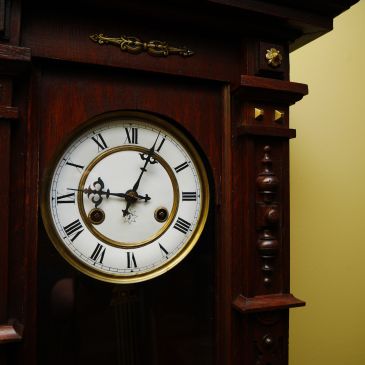
My Schatz W3 movement finally has a brand new custom built clock case

What do you do when you find a movement without a case? Hope that one comes along? Make one?

I discovered an Aug Schatz & Sohne W3 movement at a local antique store for under CAN$20. My wife said, “You should buy that, maybe you can make a case for it”. “Hmm”, I thought; that would be above my pay grade.

W3 refers to three chimes, St Micheal, Whittington and Westminster. It looked interesting and it was not expensive so, why not! Having a movement without a case is like a car engine without the body. Maybe a case will come along someday, I thought.

Back in August of 2017 I appealed to my readers asking, “If you have a spare case that would fit this movement and it is lying around in your shop I’d be very happy to take it off your hands.”

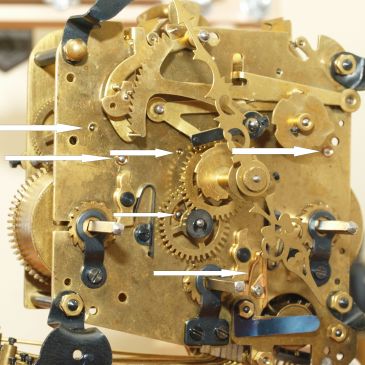
Front plate
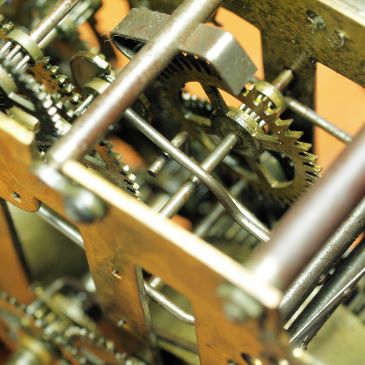
Triple chime Schatz movement

Aug. Schatz & Sohne are better known for 400-day clocks (including the 1000-day clock) and ships clocks. They are not typically known for shelf or mantel clocks but it is not too difficult to find them at antique stores and online auction and for-sale sites. The company is well regarded by German clock-makers.

Having a movement without a case is like a car engine without the body

This movement has a lever escapement though earlier versions of the W3 were pendulum driven. This particular escapement has 2 jewels; after came escapements with 7 and later still, 11 jewels.

2 jewelled escapement. Has escapement been serviced as well?

The front and back plates are thick and solid. Cut leaf pinions throughout suggest a robust movement design. There are eight chiming hammers and the chime drum can be switched to one of 4 positions; silent, St Micheal, Whittington and Westminster.

The movement is clean and in good shape though it has been serviced at least once in its life. I counted 13 new bushings and a newer click spring.

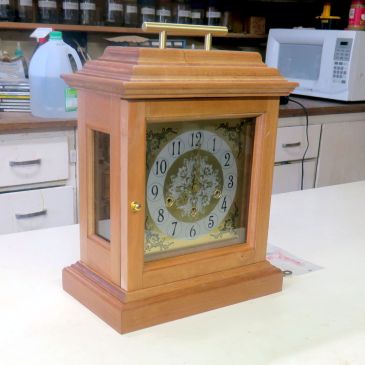
I now have a brand new custom built case

Having a movement without a case is like a having a car engine without the body.

Earlier this year my son’s girlfriend suggested that her grandfather could build the case. She said he loves doing this kind of work. Although skeptical at first, I considered her offer. Her grandfather is over 90 years of age but is a skilled craftsman and he continues to work in his woodworking shop in rural Virginia when he is able. She asked him and he agreed. I sent the measurements to him. Better if I brought the movement to him, her grandfather suggested. I gave the movement to her and she brought it to Virginia while on a visit. He was now able to use the movement as a guide to constructing the case.

We corresponded back and forth through email. I gave him complete latitude concerning the design of the case though he sought my approval during certain stages of construction. After a few months, the clock began to take shape. Below is a photo of the completed case taken in his rural Virginia shop.

The harsh lighting of the shop does not do the clock justice

The glass side panels give it an old world look. The hands are original but are lost in the detail of the new dial. I have since painted them a darker colour.

There is ample room for the chime block which I must supply. The chime block is bolted through the base of the case. The chime block is positioned as close to the chiming rods as possible and if the distance has to be closed the chime hammers are bent towards the rods allowing an eighth of an inch or so of space. It is a relatively simple procedure. As they are brittle, chime rods should never be bent!

The chime block will be mounted under the chime hammers

The clock finally arrives at Christmas time (2018)

My son brought the clock back from Virginia in a carry-on suitcase just after Christmas. He took special care not to damage it in any way.

Schatz W3 bracket clock

The detail and craftsmanship are impressive and reflects hours of meticulous work.

The detail work on the case is amazing
Image from H&W Perrin Co. Ltd

I put the final touches on the clock by painting the hands black, attaching four protective felt pads under the base and giving the case two coats of shellac (traditional 1 lb cut) to achieve an antique finish. With the chime block installed the project will be complete.

After writing the maker and expressing how pleased I was of the outcome, he replied;

“I’m glad you like the case and glad that a simple fix got it running. Painting the hands black was an excellent idea, for I worried that reading time would be difficult. I hope you are able to send me a video of clock with chimes.

Best wishes”

The chime block has arrived and is a perfect fit for the case. The installation and final adjustments should be interesting so, check back later.

Sometimes working on clocks can be a pain – literally!

Mauthe Horse Crown

I had just completed servicing this German Mauthe time and strike wall clock and everything seemed to be going well. It was keeping good time,striking on the half hour as it should and maintaining a consistent an 8-day cycle.

During my regular Saturday clock winding ritual, I decided to begin with this clock. I inserted the key into the strike side arbour, began to turn the arbour and “bang” went the mainspring. The winding key almost took my thumb off.

I think I am going to lose that nail

Ignoring the excruciating pain I just had to investigate the problem. I took the movement out of the case and took the dial off. Of course, I feared the worst. A sound like that is never good. The barrel seemed undamaged, the teeth were intact, no bent arbours and there did not appear to be any collateral breakage.

Aha!, there it is, a loose click spring. The click released when there was not enough tension on the click to hold it firmly to the ratchet wheel.

My fault entirely. When I dis-assembled the movement I bent the click springs out of the way and did not recheck the spring’s tension. When I re-assembled the movement the click on the strike side was evidently loose but it looked tight enough. I wondered why the strike side ratchet sounded “tinny” but I thought nothing of it. Now I know.

Clicks on Mauthe movement

I increased the tension of the click spring. To be on the safe side I checked and tightened the time side one as well. Both sides now have that reassuring click-click sound. As you can see in the above photo It is not the best click spring design.

A reminder to anyone working on clocks that potential (or stored) energy in the form of powerful mainsprings can be dangerous. All is well, lesson learned. But my poor thumb!

Mauthe (FMS) wall clock restoration – Part III – the case

This is Part III, the last of a three-part series on restoring this beautiful German FMS Mauthe wall clock. Part I can be found here. Part two can be found here.

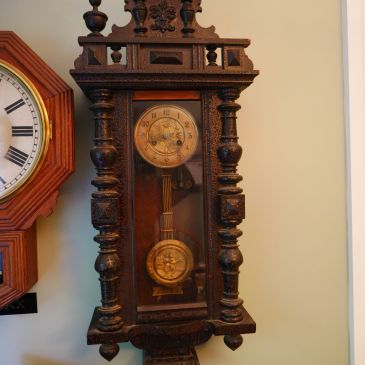
This antique Victorian style German time and strike FMS Mauthe wall clock was purchased from a family living in Truro Nova Scotia that once resided in the town of Parrsboro over 100 years ago.

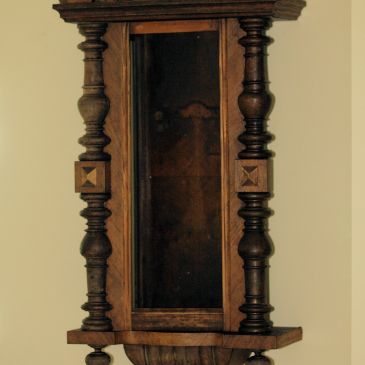
I have covered movement servicing in a previous article and now for case restoration. The case is part walnut veneer with softwood turns, frame and backboard, likely pine or poplar. All original wood surfaces were stained or lacquered to resemble walnut.

Time and a harsh environment have not been kind to this once majestic clock as the finish was in very poor condition. Stripping the case was my only option.

Mauthe crown, missing right finial
Base of clock

Stripping and staining were quite straightforward but time-consuming. After rubbing with steel wool I applied stain called Special Walnut, a light stain by Minwax which had the effect of enriching the grains even further. After the case was sanded I then applied 5 coats of shellac making the shellac in the traditional way with flakes and alcohol. I found a 1 lb cut ideal for this project.

The finish was probably the worst aligorating I have seen
Turned door column
Refinished corner section

As mentioned in a previous post, the movement was cleaned and two bushings were installed on the time side and one on the strike side. It was mounted in its case and has completed a successful testing period.

Although I was pleased with my work on the top door crosspiece, I could not find one clock online with a crosspiece similar to it from that period. Back to the drawing board!

Ogee style crosspiece on top of the front access door, stained to match case (later removed)

An Internet search for clocks of that style and period revealed that every clock had an arched top trim piece much like this Junghans Crispi wall clock from 1899.

Junghans Crispi wall clock
Junghans Crispi wall clock, restored in 2017

Making the arched top

Walnut veneer is preferred but I had to make do with oak plywood. Oak has a more pronounced grain but the end result looks good. Using a router I cut 3/16 inch oak veneered plywood into 2 curved pieces. Making a turn on a router is not as easy as it looks and it took me several attempts to get it right. After the 2 sections were cut (left, right and joining in the middle) I applied a darker walnut stain to match the case. I then covered the pieces with several coats of shellac then glued the two sections onto the top door frame.

The arched trim piece is an improvement and more in keeping with the design of the clock at that time.

Arched trim

The top finial was purchased from a supplier and stained to match the two lower finials.

The top final is new and stained to match the other two

Unfortunately, there is not much I can do about the darkened celluloid dial. Celluloid dials are almost impossible to clean. Replacement is an option but it would look out of place.

Celluloid dial with brass centre piece

The clock is now finished. The last step is regulating the movement.

The following is a breakdown of the costs & work completed:

Costs:

  • Purchase price $100
  • Amber shellac flakes, alcohol, brushes, containers – $75 (this cost will be spread over future projects)
  • Razor scraper for glass cleaning, $5
  • Finial $3
  • Furniture stripper $10
  • Suspension spring $4
  • 3/16 inch plywood $12.95
  • Corner doweling for the crown (left side) $6

TOTAL: $212.95

Traditional shellac is the only way to go

Work done:

  • Case stripped down to bare wood with furniture stripper, all surfaces except side frames
  • Sanded case
  • 1 coat of Minwax “Special” walnut stain which is lighter than dark walnut
  • 5 coats of shellac, 1 lb cut, rubbed with fine steel wool between coats.
  • Crosspiece for top of door fashioned from kitchen cabinet moulding, stained to match case, shellacked (later removed)
  • Arched top door insert made from 3/16″ oak veneered plywood, stained and shellacked
  • Adler gong and rails, cleaned & repainted
  • Beat plate cleaned and made flat, as flat as possible without damaging it!
  • Centre pan of dial face cleaned
  • Hands painted with flat black acrylic metal paint (2 coats)
  • New top centre “curtain rod” finial from Lee Valley, stained and shellacked, hole drilled for support post
  • Crown support rail constructed of softwood
  • Movement disassembled & cleaned in ultrasonic. Unable to remove the spring barrels. 3 bushings installed
  • Glass removed, scraped of shellac residue, cleaned and reinstalled. The residue told me that the case had been shellacked at least once in the past
The finished product

A satisfying project that resulted in the transformation of a clock that had been ignored for too long. its underlying beauty can finally be appreciated. Would I do things differently in the future? For the most part, no but there are some minor things I would approach in a different way. Case restoration is a learning process and each new project presents an interesting and unique challenge.

The clock has now been returned to its former glory and will now occupy a prominent location in my home.

Mauthe (FMS) wall clock restoration – Part II – servicing the movement
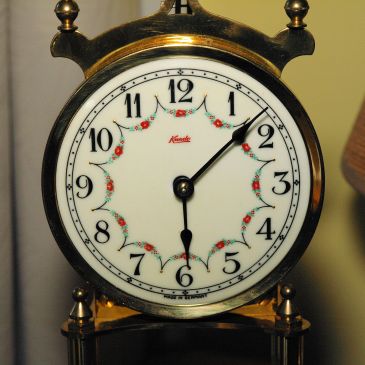
This is Part II of a three part series on restoring this beautiful German FMS Mauthe (Friedrich Mauthe Schwenningen) wall clock. Part I can be found here. Part III, in a week or so, will cover case repairs and refinishing.

This attractive antique Victorian style German FMS Mauthe wall clock was purchased locally from a family that once lived in the town of Parrsboro. Nova Scotia over 100 years ago.

Why would someone solder the minute hand to the arbour

In this post I will discuss servicing of the time and strike movement.

As I began taking off the dial I noticed that the minute hand had been soldered to the arbour. Not only that, it was in backwards. A taper pin should secure the minute hand, not solder. Using a butane torch I freed the hand. Once the hands are off, removing the dial requires pulling 4 pins from the support posts. Following that, the bottom rail, which is secured by two machine screws, is removed. Now to work on the movement.

Very dirty movement, in need for a good cleaning

Before we do that, let’s look at the numbers on the back plate. 105 is the number of beats per minute, 42 is the length of the pendulum rod in centimeters. The number 55006 is a patent number which was issued to Heinrich Kielmann (Ruhrort/Rhein) in 1890/1 and concerned the method of hanging the pendulum. The number 20934 refers to a production run but I have no idea what date is assigned to that number. The Adler gong has the FMS eagle on the block and from my research the eagle was placed on gongs going forward in 1898. Therefore, the clock is from about 1898 – 1905.

Coiled gong and gong block by Adler

The movement has not been serviced in some time. Expecting to see a significant amount of wear, I was pleased to discover the movement in generally good condition.

The pallets had little or no wear and the escape wheel likewise looked good. The pivots had very little wear and polished up nicely. There were 4 pivot holes that needed some degree of attention. I decided that two on the strike side were not so bad that they could wait but two others were quite worn, the centre wheel, front and the motion works wheel just above it. This is expected as these wheels carry most of the load from the mainsprings.

2 of 3 Bushings were installed for these pivots
The count wheel strike and motion works
After a 30 minute cleaning cycle the solution was quite dirty, in fact so dirty that I disposed of the solution

I take plenty of photos as an aid in helping me relocate the movement parts on reassembly. Sometimes the wheels on the strike and time side look similar. In the case of this movement there was no confusing which side the wheels should go.

I disassembled the movement and placed the parts in my ultrasonic cleaner. After a 30 minute cycle the solution was very dirty, in fact so dirty that I disposed of the solution (it is biodegradable). Reassembly was straightforward as most of the adjustments to the strike side occur outside the plates, unlike a typical American time and strike movement where there a myriad of levers and helper springs that seem to pop out when you you are trying your best to get everything set up between the plates.

As a side note, Mauthe did make time and strike movement with the count wheel located between the plates and with conventional wire levers.

The only critical adjustment is the stop wheel which has to be in the correct position otherwise the strike will not function correctly. Trial and error is needed to get this right but I set it correctly on the first attempt.

Stop pin on the strike train; positioning the stop pin upon reassembly is critical

Unfortunately, I do not have a test stand tall enough for this movement and the case was used to test the movement. The movement slides in and out on a set of rails making it relatively easy to make the necessary adjustments.

Cleaned, reassembled and installed in the case for testing.

One issue, a broken suspension spring. Could have been my handling of the movement or it was already broken. Nevertheless, my order from the supplier arrived and the spring has been replaced. Most clockmakers would agree that it is a good practice to replace the suspension spring as they weaken with age.

During testing the strike side was sluggish and would not engage from time to time. I attributed this to an enlarged pivot hole on the star wheel, back plate one of the two I noticed earlier. The new bushing was a very small #7 Bergeon at 0.80 mm (inside dimension) with very little margin for error. With the new bushing (a total of 3 for the movement) the strike side was still sluggish. After taking the movement apart again I found a slightly bent arbour on the second wheel of the strike side which I fdiscovered when I attached it to my lathe. Using a hollowed punch tool I straightened it out.

Broken suspension spring

The reassembled movement was oiled and mounted in the clock case. The recoil escapement is adjustable and a slight tweaking of the verge corrected the beat. After a few frustrating adjustments exacerbated by a bent arbour, the movement is running well after servicing.

Next, I will cover case refinishing for this fine old clock.

NOTE: After completing this project I designed and built an extension for my movement test stand to allow me to work on movements with long pendulums such as this one.

Mauthe (FMS) wall clock restoration – Part I – assessment and first steps

This is Part I of a three part series on restoring this beautiful 1900s Mauthe wall clock.

This Victorian style German wall clock was purchased locally from a family that once lived in the town of Parrsboro over 100 years ago. I found the clock on a local online for-sale site. It looked interesting but there was no price listed. I contacted the seller but they were asking considerably more than I was willing to pay. I explained the work that had to be done to the case, servicing of the movement and the fact that had it been in better condition they would easily receive more for the clock. I concluded the phone conversation with my top offer for the clock. They contacted me 4 days later and met my price.

Celluloid dial with brass centre pan
Open containers of Kerosene usually indicate that the owner thought the vapor would lubricate his clock. Closed containers indicate that he believed that a more controlled method of applying it would be needed

It is a (FMS) Mauthe time and strike wall clock with an Adler gong. I have been assured by the seller that the clock is original in every way and using the serial number and trademark I have determined that it was made between 1890 and 1910, consistent with information I was provided. The eagle emblem on the Adler gong suggests that it was made after 1898.

The seller said the movement was maintained regularly. For years a small thimble of liquid was placed inside the clock to keep it lubricated though she could not recall what the liquid was. I said that this was a wide practice in the old days of keeping a clock movement lubricated, a folk remedy that might work but was not ideal. In fact, from about 1850 to 1920 roads were dirt, dust was everywhere, and people depended on their clocks. They routinely took the dial off and swabbed the movement out with kerosene. They often used a little brush, made with a few chicken feathers. Kerosene (paraffin) was available everywhere and, if used often, was probably an excellent way to rinse away the dust and at the same time oil the movement for a while. A little cup, a thimble or a  greasy medicine bottle of kerosene was placed inside the clock case to maintain lubrication. Open containers of Kerosene indicate that the owner thought the vapor would slowly evaporate and lubricate his clock. Closed containers indicate that he believed that a more controlled method of applying it would be needed.

What to do about the case

The finish is alligorated. Alligorated finishes are those that have encountered heat damage and are characterized by a finish (shellac or lacquer) that softens and pools into globules collecting dirt as it re-hardens.

For this project I essentially have three options,

  • Leave the case as-is,
  • Attempt to dissolve the alligorating using a solution (see ingredients below) or
  • Strip the case down to the bare wood.

I eliminated the first option. The case is very unsightly.

On to option number 2. I first attempted to dissolve the alligorated finish using a mixture of turpentine, kerosene and white vinegar combined with #0000 steel wool and while I was able to soften the globules the surrounding area lightened considerably. The net effect was a blotchy finish.

While taking the glass panels out I noticed a residue of shellac on the edges of the glass panels, so, I was dealing not only with the original finish but whatever had been applied over the original finish.

On to the last option, stripping the case

To remove the finish I used EZ Strip, a non-caustic and Eco-friendly product. Though it was non-caustic I wore gloves and ensured that my workspace had good air flow. EZ Strip is jelly-like and relatively easy to work with. After allowing it to sit on the finish for 20-30 minutes it is ready to strip. Despite the ease of application it required rubbing and scrubbing to take off the original finish to the bare wood.

This is the finish when I received the clock

This is the crown before stripping,

The crown

And after.

The finish is removed from the crown

As the case is missing a trim piece on the upper part of the door I fashioned a piece from some cabinet trim. A new slotted wooden stabilizer that secures the crown to the case was constructed of softwood. This you cannot see but it ensures that the crown stays securely on the top of the case. Also missing is a corner piece on the left side of the upper crown. Cove moulding works well. I purchased a finial from Lee Valley and it worked well for this project.

Removing the old finish had an immediate effect. The grain of the walnut veneer that had been hidden all these years was finally exposed.

Case is stripped, awaiting sanding, stain and final finish

For the final finish I will use shellac prepared in the traditional way. This is my first experience with shellac flakes and it is best to begin with a light consistency called a 1 lb cut. This is approximately a 1:8 ratio of shellac to alcohol. Therefore, 1 oz (28g) of shellac is dissolved in 8 fl oz (236ml) of denatured alcohol. I plan to use a French polish technique and apply the shellac and a broad artists brush to coat the turned sections.

Why is it frustrating asking for advice on social media?

I posted my case restoration project on a popular online clock site. I was seeking advice on working with shellac and while I received good advice the discussion quickly morphed into a debate about whether or not it is ethical to strip a case. There was significant division. Those on one side said they would do very little but clean it up or take the objectionable dirt off the finish while the other side posited that if presented with a situation where the finish was so poor that you could not appreciate the beauty of the veneers, a stripping is an acceptable alternative. Although both arguments have merit some of the posters were somewhat indignant and considered it a heresy to do anything at all to a clock case. There will always be both sides of the argument and I respect that.

See servicing of the movement and the final finishing of the case in Parts II and III, in the weeks to come.

Perspective on Horological (clock) Development

Need a quick primer on developments and inventions in horology. You have come to the right place.

18th Century shelf clock Porto, Portugal

Though by no means a definitive guide the following are some important dates in the history of the clock as gathered through a number of sources. The difficultly in affixing some dates with precision results from discrepancies among sources.

Horological developments during the centuries before the mechanical clock are left out altogether. Water (Clepsydra) and sun clocks of the middle ages and astronomical clocks of ancient China deserve special mention but are the subject of a separate discourse and are not included here.

Important dates in Horological Development

  • CA. 1300 – First mechanical verge clock, Europe
  • 1364 – Astronomical clock conceived by Giovanni de Dondi, Italy
  • 1386 – Tower (turret) clock Salisbury Cathedral, England
Salisbury cathedral clock, photo by Dr. Meghan Joiner
  • CA. 1400 – Fusee invented by Jacobs, Czechoslovakia
  • CA. 1450 – Table clock with spring and fusee, Phillip the Good of Burgundy, France
  • CA. 1500 – Mainspring invented, Germany
  • CA. 1510 – Watch invented by Peter Henlein, Germany
  • CA. 1560 – Spring driven portable clock, Germany
  • CA. 1570 – Oldest known clock with a second hand, Orpheus clock, Germany
  • 1637 – Galileo, swinging temple lamp, pendulum control conceived, Italy
  • CA. 1650 – First tower clock appears in Colonies, America
  • 1656 – Pendulum clock devised by Huygens, Holland
  • 1657 – Verge and foliot gives way to pendulum control, Huygens, Holland
  • 1658 – Long-case prototype made by Fromanteel adapted from lantern clock, England
  • 1660 – Balance wheel conceived by Hooke, England
  • CA. 1675 – Richard Towneley invents the dead-beat escapement, England
  • 1675 – Balance wheel with spiral spring invented by Huygens, Holland
  • CA. 1675 – Recoil escapement and crutch invented by Hooke in collaboration with Clement, England
  • 1676 – Rack striking developed by Barlow, England
  • 1680 – 1700 – famous horologists of this era were Arnold, Earnshaw, East, Graham, Knibb, Compion and Windmills of England; Berthoud, Breguet and LeRoy of France
  • 1701 – St Sulpice seminary tower clock (imported from France), Montreal, Canada
  • 1713 – Harrison invents marine chronometer, England
  • CA. 1715 – Break-arch dial introduced
  • 1715 – Graham perfects deadbeat escapement, regarded as the “father” of the dead-beat escapement
  • 1717 – First tower clock of America, Benjamin Bagnall, Boston
  • 1726 – Mercurial pendulum invented (temperature compensating pendulum), Graham, England
  • 1726 – Wall clock by Thomas Bennett, 8 day brass, weight driven, America
  • 1736 – Harrison’s marine chronometer tested at sea (accurately ascertaining longitude), England
  • 1770 – White dials appear in English longcase clocks
  • 1776 – Independent seconds train invented for watch, Pouzait, Switzerland
  • 1790 – Vienna regulator style case emerges in Austria
  • 1790 – American woodworks clocks begin to be appear
  • 1802 – Willard patents his banjo clock, America
  • 1806 – Terry introduces Pillar and Scroll clock, America
  • 1809 – Martin Cheney leaves America to set up a clock-making shop in Montreal, Canada
  • 1810 – Carriage clock (Pendule De Voyage) introduced by Breguet of France
  • 1818 – Heman Clark makes wrought brass movement for Pillar and Scroll case, America
  • 1825 – Rolled brass production begins in America
  • 1837 – Noble Jerome 30-hour brass movement patent approved, America
  • 1840 – American brass movements in mass production
  • 1842 – American brass movement clocks exported to England by Chauncey Jerome
  • 1845 – Wood-works movement production ends, America
  • 1850 – Westminster tower clock designed by Lord Grimthorpe and made by Dent, England
  • CA. 1850 – Brocot (pin-wheel) escapement and pendulum suspension introduced, France
  • CA. 1850 – American mass production of watches begins
  • 1860 – Junghans (Germany) sent to America to study American mass production techniques
  • 1870 – Decline in English long-case clocks
  • 1874 – Mass production of mantel and wall clocks begin in Whitby, Canada,
  • 1900 – American clock production is at its height; makers are Ansonia, Ingraham, Gilbert, Howard, New Haven, Seth Thomas, Waterbury, and Welch
  • 1904 – Arthur Pequegnat begins clock production in Berlin, Canada
  • 1906 – Eureka electric clock introduced, America
  • CA. 1910 – Torsion pendulum clock (400-day) introduced, Germany
  • 1920-40 – Decline in American mechanical clock production
  • 1941 – Arthur Pequegnat ceases production, Canada
  • CA. 1960-70 – End of mass produced mechanical clocks, America (though cheaper Japanese, Korean & Chinese mechanical clocks flood North America)
  • Present day – Some movement and clockmakers remain; Howard Miller (Ridgeway), Keininger, Hermle, Chelsea, Jaeger LaCoultre among others

The clock is one of mans greatest achievements. The development of instruments to tell time is the unwavering toil of brilliant minds from many disciplines who, over 800 years, worked tirelessly to create, innovate and improve methods for telling the time.

Horology is not only the study of time but the synergy of art, joinery, fashion, design, décor, physics, engineering, metallurgy and mathematics. Indeed, the study of the mechanical clock is a microcosm of our society.

Time rules life – like it or not.

Tick-Talk Tuesday #17 – Can you tell me something about my Mauthe wall clock

Tick-Talk Tuesday is about the letters and comments I have received from you, the reader, concerning your clock, issues you might have had, questions about its origin, challenges you face or a clock you would like me to profile and my responses to your questions with advice on your particular clock concern. For those comments and questions that stump even me, I consult within my clock circles for the best possible answer.
Mauthe time and strike box clock

RC writes,

“I was looking online for information on the exact Mauthe Box clock you have.  I am going through my late fathers estate & trying to find out what it’s worth. It belong to my great uncle and passed onto my dad. Every since I was a little boy I can remember this clock being at my great uncles home.

Any information you could give me would be greatly appreciated. I have attached a picture of the clock.”

This is my box clock.

Box clock
Mauthe time and strike Box clock

My reply,

“You have a time and strike box clock. These have excellent movements and should run for years. A servicing would be due, however.

It might have the 3-rod “Divina gong” which, according to the standard German reference, Hans-Heinrich Schmid’s (2005) Lexikon der Deutschen Uhrenindustrie 1850-1980, is a Mauthe trade-name registered in 1912. It would have a pleasant two-tone, bim-bam sound. Unmarked box clocks like mine were likely sold as a Solar house brand by Eatons. Your is marked and was likely bought from a jeweler.

Thousands of German “box clocks” were made in the first third of the 20th century. The box clock replaced the classic “Vienna Regulator” after the First World War and reflected a minimalist approach to clock design. Most were made in Germany. I would date your to about the 1930s.

The following is excerpted from one my blog posts.

Mauthe clocks have had a long and illustrious history in Germany.  In 1844 Friedrich Mauthe and his wife Marie founded the company in Schwenningen to produce watch parts. At the end of the 1860s Mauthe began to produce their own wall clocks (and movements). The Mauthe sons Christian (1845-1909) and James (1847-1915) took over in 1876. In 1886 Mauthe began manufacturing its own springs. Around 1900, alarm clocks, pendulum wall clocks, grandfather clocks, office clocks and so called “Buffet Uhren” or “Buffet clocks” were offered. In 1904 the 3rd generation took over (Eugene Schreiber (1877-1939) – son of Christian Mauthe, Dr. Fritz Mauthe (1875-1951) – son of Jacob and Mauthe Alfred (1879-1911) – son of Jacob Mauthe to build on the base of the company.

In 1925 Mauthe announced a new trademark. It shows a right-looking eagle with outstretched wings, holding in its talons a three-part round plate with the letters F, M and S.
In the  1930s the company at its peak produced about 45.000 clocks per week.  About 60% were produced for export markets such as England. In the Mid-30s Mauthe started to manufacture their first wrist watches and some were supplied to the German Army (“Wehrmacht”). From 1946 on Mauthe re-started with the production of wrist watches. Shortly after that the company eventually fell into decline.

As to value, Mauthe wall clocks are currently in the $200 and $500 range depending on condition. A serviced clock would fetch more.

I would clean it up, service it and proudly display it.”


What is this clock thing for? #2 – the strike rod lock

If you ever need to transport a German box clock or a similar style wall clock there are several steps you must take before you remove it from the wall.

German "box" clock by Mauthe
German “box” clock by Mauthe, sold under the Solar or Forestville name in Canada

One of these procedures is to secure the strike rods. The gong or strike rods are screwed into the gong block. If allowed to move during transport there is a risk that the rod(s) will break. Although they are strong and withstand years of striking they are also brittle and can easily snap. Clock-makers have several solutions for securing the rods. This is one of them. Yours may be similar.

Gong block
The gong block

On some clocks, you may find a fork-like device that turns to secure the rods.

Strike rod stabilzer
Strike rod stabilizer

By turning it clockwise the three gong rods will fit into the forks as shown in the next photo.

Rod Stabilizer
The pendulum is removed and rods are now locked in place

Once the rods are secured in place and you have removed the pendulum rod and bob as well as secure the access door, you can now safely remove your clock from the wall.

Kundo 400 day oval anniversary clock – let’s get this thing working!

Of the five anniversary clocks in my collection, none have cost me more than $30. It’s unfortunate because these clocks are truly fascinating devices. They are well-crafted, delicate, and ornamental, driven by spring mechanisms. While many thousands were produced, their abundance is reflected in their low value today. My focus is on collecting the older mechanical models, the last of which were manufactured over 35 years ago, and steer clear of the battery-operated anniversary clocks still being sold.

Among clock repair enthusiasts (horologists), opinions on anniversary clocks vary—some enjoy working on them, while others struggle to develop an affinity for them. I fall firmly into the former group, finding these clocks both intriguing and enjoyable to work on.

Kundo 400 day torsion clock

Gustav Becker, Haller, and Schatz 400-day clocks are certainly more desirable, better made, and fetch higher prices. While I don’t have any of these makes in my collection, I am always on the lookout for more desirable and collectible models.

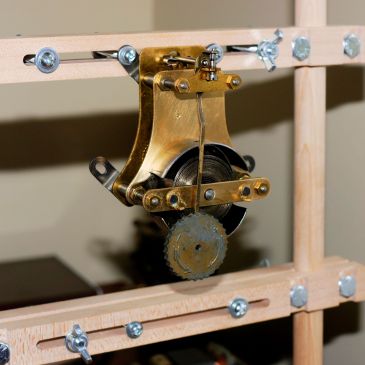
Movement before cleaning
Movement prior to cleaning and showing verdigris on the spring barrel

I picked this up for $5 at a local antique store. When buying one of these clocks, regardless of the price, it’s crucial to check that all parts are present, as sourcing a missing part can be nearly impossible unless you purchase an identical clock for parts. Often, the only issue is a broken suspension spring.

Fortunately, this Kundo clock was complete and in generally good condition. However, the suspension spring had clearly been snapped off due to improper transport. Many people either forget about or are unaware that these clocks feature highly effective pendulum locking mechanisms.

These are called torsion clocks because there is a weighted disk or wheel, often a decorative wheel with 3 or 4 chrome or brass balls on ornate spokes, suspended by a thin wire or ribbon called a torsion spring (otherwise known as a suspension spring). The torsion pendulum rotates about the vertical axis of the wire, twisting it, instead of swinging like an ordinary pendulum.

These clocks operate very slowly—in the case of this Kundo Junior, just 10 beats per minute compared to 100 beats per minute or more for a typical pendulum mantel clock. Due to the slow movement of the gears, wear is minimal, and it’s quite common to find these clocks with a broken suspension spring as their only issue.

Front plate removed
Front plate removed

The movement was disassembled and cleaned in an ultrasonic cleaner. The mainspring was removed from the barrel, cleaned, and serviced. Otherwise, there was minimal wear to the pivot holes. In fact, I have never needed to install a bushing in an anniversary clock because their slow operation results in very little friction.

The old spring was very twisted

Now, it’s time to install the new suspension spring. The suspension spring is a very thin piece of steel running down the back of the clock, designed to twist back and forth while suspending the pendulum balls. It’s crucial not to kink or bend it, as a bent or crimped spring is the most common reason these clocks fail to function properly.

You can purchase pre-assembled suspension springs in kit form—springs already fitted with blocks and a fork—but I’ve found it far more cost-effective to buy the springs separately and re-use the blocks and fork. To ensure accuracy, I consulted my Horolovar manual (I eventually purchased one) to find the exact template—Kundo 5E, in this case. I then unscrew the blocks and fork to install the new spring. Here is an example of a suspension spring from a Kern 400-day clock.

suspension spring installed on a Kern
A new suspension spring was installed on a Kern

Installing the suspension spring requires a little patience. While it is a delicate process, it’s relatively easy to do. It’s best to work on a flat surface. There are screws on both the top and bottom blocks that must be loosened before the new spring can be inserted. The bottom block was a bit stubborn, and a jeweler’s screwdriver is essential—you don’t want to strip those tiny screws.

Use the template in the Horolovar manual as your guide. For the Kern clock mentioned earlier, I had to rely on some guesswork while waiting for the manual to arrive, but once it did, I was able to confirm the measurements. After positioning the blocks, attach the fork and secure it with screws.

Install the bottom block first. Attach the spring block to the 4 pendulum balls with the pin then lock the pendulum balls in place using the locking lever. Some 400-day clocks use a simpler bottom block solution that simply hooks the block into place. Because this one uses a pin it is a bit more frustrating. After the bottom block is secured and locked in place install the top block to the top mount by first slipping the fork over the verge post. In the case of this Kundo it is a small side screw that secures the top block to the mount (saddle?).

I then attached the dial face and the hands then gave the pendulum a gentle 360-degree spin. Not surprisingly the clock failed to maintain its spin. An adjustment was required.

Looking at the top of the clock, you’ll see a screw that can be loosened to adjust the fork in one direction or another. Be very careful not to kink the suspension spring when loosening this screw. Loosen it gently, just enough to allow movement, and make small, incremental adjustments when setting the beat. While you can buy a beat adjustment tool for 400-day clocks, with a bit of trial and error—observing the verge’s action and fine-tuning the beat setter—you’ll eventually find the correct beat. You’ll know it’s “in beat” when the time between the tick and tock is the same. At that point, the clock should run smoothly. Since the ticking is so quiet, it helps to turn off any background noise in the room while making adjustments. I have several loud-ticking clocks in my office, and I stop them to assist with the process.

If you work on enough torsion clocks, a Timetrax or similar beat amplifier will make the task much easier.

The clock has been running for several weeks and is in the process of being regulated. Above the pendulum balls in a regulating adjustment dial. You will see a “+” and a “-“.  Adjusting towards the plus side speeds up the clock and the minus slows it down. I recommend minute turns for either adjustment.

There’s some debate about whether or not to oil these clocks, given the slow movement of the gears. While polishing the pivots to reduce friction can certainly be beneficial, I believe a bit of pivot oil is never a bad idea.

As I mentioned earlier, I’m part of the group that enjoys working on 400-day clocks, appreciating their delicate mechanisms and the satisfaction that comes with restoring them to working condition.

Blackforest shelf clock (Canadian made) gives me grief but decides to run again

Blackforest shelf clock

The clock is a 1937 Blackforest Royal Tour commemorative edition shelf clock with an 8-day time-only “plate” clock movement. Plate clock movements are so-called because they were typically used on kitchen clocks with Dutch Delft plates such as this one in the next photo.

Delft Clock from Forestville
Delft Plate Clock from Forestville

The movement is likely German and could have been made by a number of companies. There are no stamps or markings on the movement to give any indication of the maker. Canadian companies such as the Blackforest Clock Company of Toronto (the Forestville Clock Company after the war) imported German movements before the Second World War and installed them in Canadian made cases.

Grimy movement prior to cleaning

This clock had been happily running for about a year and then last week it suddenly stopped after a winding. I nudged the pendulum in an effort to make it go, checked to see if it was in beat and level but no luck. I nudged the pendulum a few more times, left it for a day or so, tried it again and still no luck. I was at the point of disassembling the movement to investigate the problem. Two days later I wound it tight and gave the pendulum a push and it sprang to life. I think I know what happened.

I thought I did a good job of servicing the movement including the mainspring over a year ago but apparently not well enough. You may have heard the expression, “you overwound the clock so that’s why it stopped”. There is a grain of truth in the expression because if you wind the spring till it winds no further the mainspring is at it tightest. If there are dirt, grime and rust on the mainspring the mainspring will actually cease in place, hence the clock stops. I believe this is what occurred in this case. Although it is running now it will need to be properly cleaned. In the meantime, I will let it run and see if it completes its full 8-day cycle.

Clocks we saw while on a visit to Spain and Portugal

In the early spring, my wife and I travelled to Portugal and Spain. We attended our daughter’s destination wedding in Sintra, Portugal and we decided to expand our stay, visit Spain and see the sights in Barcelona and Montserrat. Spain has always been on our bucket list and it did not disappoint.

Being a clock enthusiast I did a little research beforehand to find out if there were any clock museums along our travel route. Alas, we travelled to places that were very distant from the well know clock museums. Clocks in Europe were made in specific regions and that is where you will find clock museums. Here are a few clocks that I found in various places in Spain (Barcelona) and Portugal. I will let the photos tell the story.

Tall case clock in a cathedral
Tall case clock in a Barcelona cathedral

Little card on the side simply said "High box clock, school clock"
Little card on the side simply said “High box clock, school clock”, Barcelona

Marriage of movement and case found in a shop in Porto.
A marriage of movement and case found in a shop in Sintra, Portugal

Town clock in downtown Sintra, Portugal

Very ornate clock in poor condition, Pena Palace, Sintra, Portugal
A very ornate clock in poor condition, Pena Palace, Sintra, Portugal

Pena Palace, Sintra, Portugal

Tivoli Hotel, downtown Sintra. Unknown tall-case clock

The most ornate clcok is this working example at the Porto basilica
The most ornate clock I found is this working example at the Porto basilica

Unknown mantel clock, Tivoli Hotel, Sintra, Portugal

Unknown gallery clock. I could not find an opening on this clock. No arbor holes on the clock face.
Unknown gallery clock. I could not find an opening on this clock. No arbour holes on the clock face. Found on an estate in Sintra, Portugal

Flea market clock. Time and strike English or German clock, 1960s
Flea market clock. Time and strike English or German clock, the 1960s

Flea market clock. Time and strike French clock with matching candelabra

Used goods store, time and strike wall clock, possibly French

I was not specifically looking for these clocks but as we visited churches, museums, shops and public places I photographed any I discovered in our travels.

Tick Talk Tuesday #13 – Mauthe wall clock circa 1960s

Tick-Talk Tuesday is about the letters and comments I have received from you, the reader, concerning your clock, issues you might have had, challenges you face or a clock you would like me to profile and my responses to your questions with advice on your particular clock concern. For those comments and questions that stump even me, I consult within my clock circles for the best possible answer.

Modern Mauthe wall clock circa 1970S

DK writes, “I just received this clock.  I’m hoping you can help me identify it and maybe help me to fix it. I’d like to see if I can repair it if possible. Hope to hear from you.”

I write back, “Can you send a photo of your Mauthe clock with the door closed?”

An attractive wall clock by Mauthe

DK, “I seemed to have fixed it so it is working, however the Lewis girl at the bottom of the pendulum I turn it to increase a time or decrease the time how does it go or work?”

Me, “Your Mauthe clock is from the 1960s. It is a time and strike and should run reliably for years. To adjust the rate, turn the thumbscrew at the bottom of the pendulum clockwise to speed the clock up or counterclockwise to slow it down.”

DK, “Thanks Rockin Ronnie. Does this clock have any value?”

Me, “Not especially. Depends on the market but perhaps upwards of 100US in top condition.”

DK, “Thanks Ron I kind of figured as much. Have yourself a good day and thank you for everything!”

Note: In 1970, Mauthe struggled for survival, and in 1975 the company was in receivership and forced to close in 1976.

My Forestville mantel clock looks like yours

Forestville mantel clock
My Forestville mantel clock

Tick-Talk Tuesday is about the letters and comments I have received from you, the reader, concerning your clocks, issues you might have had and challenges you face and my responses to your questions with advice on your  particular clock concern(s). For those comments and questions that stump even me, I consult within my clock circles for the best possible response to your question

AM writes, “I am writing in hopes you can help me figure out how to safely set and wind my clock !

It looks pretty much identical to this one of yours I found online. Exactly same roman numerals. Forestville name in gold appliqué at top. GERMANY appliqué near the VI at bottom. Two key holes. Wing shaped box. Mine has darker brown wood glossy, and only one gold trim line. Same little feet. It has a silver colour key. I tentatively tried winding the left side clockwise, and it wound, but seemed tight. So I only wound it twice.  Scared to try the left side. Please let me know if you would – what each wind is for, and whether to go clockwise or counterclockwise. Thanks in advance for any clues you can give me.”

Roman numerals, Forestville name

Over winding a clock is a myth

My response, “Hi, These Forestville clocks have German movements. The movements are quite robust and will last for years. The left side is the strike side and the right side is the time side. You should be able to wind each side as tight as possible. Over winding a clock is a myth. If the clock does not run after you have wound each arbour to the limit, the springs are rusty and have seized the clock. However you should be able to safely wind each side several turns. The strike side will not function unless the time side is wound fully. You can get a feel for how the clock is wound. These clocks wind clockwise and the strike side might be a little tighter than the time side, I know mine is. The clock sounds like an old wristwatch because it has a hairspring or a floating balance wheel escapement not the usual pendulum ( I gather yours is the same). Anyway, do not be afraid of your clock. Wind it and enjoy it.

AM writes back and says, “Hello and thank-you for your reply. I took the plunge and wound each side about 4-5 X. No ticking as yet !  It must be seized at you said…Not sure what to do now cuz we live in the XXXXXXX and I doubt a clock expert nearby (within 300 km). Prince George is 3 hr drive west, and Grande Prairie Alberta 2.5 hr east. Will start asking around for sure. It is quite funky and reminds me of my Aunty Jane… so I will use as décor for the interim.”

My reply, “Open the access door. Locate the escapement at the top of the movement. If it is exposed give the wheel a little push. If it is in a plastic enclosure, tap on the plastic a few times. That might be enough to free the escapement. If it runs you have power through the clock. If it does not your power issue might be elsewhere i.e. seized springs, bent wheels etc. Unfortunately a repair would be far more than the clock is worth but that is a decision you will have to make.”

Hairspring escapement in my clock

AM managed to get the clock working but it will not strike despite plenty of whirring.

Balance wheel or floating balance escapement

Closer look at the floating balance escapement

AM says, “Well now I’m thinking maybe I can fix the chime myself ?  Particularly with your help.  So this one last attempt will show you how it sounds.  I also need to know:

  1. During the weekly wind, if I just do not wind the chime… will it stop the click and whirr without affecting the clock time?
  2. Here’s what I see at the back during non-chime time – one hammer is a ‘two in one’, and it was up, but the one at the back was down touching the rod.  So I tried lifting it, and realized that the little black metal stopper that holds the ‘two’ works well, but the front stopper wouldn’t hold the back hammer.  I gently bent that front black stopper (horrors? !) so it will hold it up. But still no chime.
  3. Then I decided to take a wee video of the strike during chime time.  At 11:00 that morning, this is what happened in the back of the clock:
  4. It seems to me by the length of whirring, that the chime is out of whack in that sense also.  Not sure tho how much whirr = one chime.”

I took a look at the video and the strike rods are way too high above the rods.

My reply, “There are three hammers. Your clock is not a chiming clock – it is a striking clock. A chiming clock makes a musical sound and typically the musical sound is the Westminster chime on the quarter hour. You have what is called a striking “Bim-bam” clock. The rear hammer hits first followed by the two front hammers to make that bim-bam sound. The hammers should be just above the strike rods. Yours are too high to strike the rods therefore you are not getting the sound of the strike. Lower the rods by slightly bending them past the rods to the side and bend them so that they are just barely above the rods leaving a gap of about 1/8 inch. They should now work as designed. I can only surmise that someone in the past bent the rods upwards to quiet the clock.”

AMs Forestville clock
AMs Forestville clock, a very attractive Art Deco clock

AM replies, “Ok!  Well that makes sense, and even the bending of the hammers.  I can hear and see my Uncle Bill … first swearing, then getting in there and bending those hammers!  He was dear soul really. Thanks for all your help”.

Mauthe mantel or “buffet” clock – can you tell me more about the maker?

Mauthe Westminster chime mantel clock
Mauthe Westminster chime mantel clock similar to LL’s clock

Tick-Talk Tuesday is about the letters and comments I have received from you, the reader, concerning your clocks, issues you might have had and challenges you face and my responses to your questions with advice on your  particular clock concern(s). For those comments and questions that stump even me, I consult within my clock circles for the best possible response to your question

LL writes, “I just had my Mauthe 3-train Tambour mantel clock cleaned and repaired. This is the first I’ve heard it chime in decades! I know my brother bought in England in the eighties but that is all I know about it. Can you tell me any more about the maker?”

Mauthe would have called your mantel clock a “buffet clock”.

Mauthe clocks have an interesting history. In 1844 Friedrich Mauthe and his wife Marie founded a company in Schwenningen, Germany to produce watch parts. At the end of the 1860’s Mauthe began to produce their own wall clocks (and movements). Some have been produced by home-work by so called “Gewerblern”, others have been produced in a more “industrial” way.

The Mauthe sons Christian (1845-1909) and James (1847-1915) took over in 1876. In 1886 Mauthe began manufacturing its own spring mechanism.

Around 1900, alarm clocks, pendulum wall clocks, grandfather clocks, office clocks and so called “Buffet Uhren” “Buffet clocks” were offered. The number of employees at that time went up to about 1,100 people. In 1904 the 3rd generation took over (Eugene Schreiber (1877-1939) – son of Christian Mauthe, Dr. Fritz Mauthe (1875-1951) – son of Jacob and Mauthe Alfred (1879-1911) – son of Jacob Mauthe.

In 1925 Mauthe announced a new trademark. It shows a right-looking eagle with outstretched wings, holding in its talons a three-part round plate with the letters F, M and S. My Mauthe mantel clock is unmarked. Early in 1930 the company produced about 45.000 clocks per week (with 2000 employees). About 60% were produced for export markets, England for example was one of those export markets.

Mauthe mantel clock sitting atop a Stromberg Carlson console radio

In the mid-1930’s Mauthe started to manufacture their first wrist watches, some were even supplied to the German Army (“Wehrmacht”).

From 1946 on Mauthe re-started with the production of wrist watches. Though largely successful during the post war years, sales began to decline and the company eventually declared bankruptcy closing in 1976.

These precision German movements keep very good time and are certainly worth keeping and repairing. Enjoy yours now that it chimes.

Mercedes clock – not made by the car folks

Mercedes makes a great car. Do they make clocks? No! Is this Mercedes novelty timepiece a great clock? Read on.

Attractive Porcelain clock
Attractive ceramic clock with time-only movement

This very attractive 30-hour Mercedes ceramic mechanical shelf clock of the Baroque Meissen style (debatable) from the 1970s is more of a novelty item than a clock.

It is a time-only alarm clock movement made by Gebrüder Hauser and marketed under several names one of which is Mercedes. Ceramic clocks on eBay or any other auction sites will reveal the Mercedes name as well as other retail names on similar-looking clocks. For example here is a similarly styled Alana clock. Same casting sans gold detailing.

The Alana, similar to Mercedes but without the gold coloured accents
The Alana, similar to Mercedes but without the gold-colored accents

This Mercedes novelty clock is in excellent condition with no chips, cracks or any sign of wear. But is it worth anything? Not a lot.

History of the company

The Gebrüder Hauser clock factory (Die Uhrenfabrik Gebrüder Hauser) was founded in 1923 by Otto and Josef Hauser in Weigheim, Germany. Josef Hauser resigned in 1926 and moved on to form his own company. The company name Gebrüder Hauser then received an additional owner, Otto Hauser. Aside from alarm clocks, clocks with pendulums and chess clock works were produced.

Winder and time set screw on rear of the clock
Spring winder, time set screw and speed lever on rear of the clock

In 1951, the son, Eduard Hauser joined the company. From 1955 onward small affordable alarm clocks and chess clockworks were manufactured. In 1965 Norbert Hauser joined the company and the company name was changed to KG.

The Gebrüder Hauser KG clock factory in Weigheim was eventually closed on 31 July 1998.

Are they common?

There are a number of variants of this clock, mechanical, electrical, and quartz. The mechanical version will command higher prices and is more desirable. Unfortunately, they are throwaway clocks and the cost of servicing would be far more than they are worth.

Nevertheless, it makes for an attractive mantelpiece and as a gift, it is likely the recipient will not keep it wound.

Halifax Explosion – December 6, 1917

Halifax (Nova Scotia, Canada) was devastated on 6 December 1917 when two ships collided in the city’s harbour.

Taken from the Dartmouth side

Results of the deadly blast

Today marks the 100th anniversary of the Halifax Explosion.

On Dec. 6, 1917, the Belgian relief ship Imo rammed into the French munitions vessel Mont-Blanc, which was carrying TNT through the narrowest part of Halifax harbour. A fire on board the French ship ignited her cargo, causing a devastating explosion. The Mont-Blanc exploded at 9:04:35 a.m., sending out a shock wave in all directions, followed by a tsunami that washed violently over the Halifax and Dartmouth shores. More than 2.5 square km of Richmond were totally levelled, either by the blast, the tsunami, or the structure fires caused when buildings collapsed inward on lanterns, stoves and furnaces.

Two thousand people were killed in the Halifax Explosion and another 9,000 were injured. The explosion is the worst man-made disaster in Canadian history.

Seconds later a Junghans Crispi wall clock fell off a wall in a house on Princess court, North End Halifax. The following is the story of that clock.

I bought the remains of the clock from a gentleman in Halifax who related the story of how this clock was passed down to him through his wife’s family. It was important to him that someone who had a love and an appreciation of old clocks should continue with the restoration after he had rebuilt the frame some 30 years ago.

Thus began the six month journey of restoring the clock to its former glory. During the restoration I was able to obtain an old catalog image (supplied by a member of NAWCC) to guide me through the rebuilding process. Some of the smaller trim pieces were missing and because they are impossible to locate they had to be either purchased from a clock supply house or handcrafted.

Junghans clock in pieces
How the clock came to me

Four Junghans clocks, the Cripi is second from the left

Junghans Crispi wall clock

It is now a wonderful tribute to that terrible tragedy on December 6, 1917.

Kundo 400 day clock and why I love anniversary clocks – Part II

I have never paid more that 30CDN for one but I see these clocks selling on EBay and other online for-sale sites at twice and three times what I typically pay

This a is Part II of a two part series on repairing a 400 day clock. Part I can be found here.

Attractive dial face
Attractive dial face, free of cracks and blemishes

I have four anniversary clocks (otherwise known as torsion clocks). I have never paid more that 30CDN for one but I see these clocks selling on EBay and other online for-sale sites at twice and three times what I typically pay. In fact, I saw one on EBay this morning (Oct 3, 2017) for 119US plus 39US shipping. The description is amusing:

When I tested it, I spun the balls about a full turn and it continued to spin back and forth for several minutes. From my understanding these things are supposed to go for a whole day without being spun again. I think it might need to be cleaned for it to do that.
The string still looks good; the cover is cracked a little where it connects to the clock but isn’t falling off.

Numerous dents, the pendulum locking guard is there for a reason!
Numerous dents, the pendulum locking guard is there for a reason! Not using it results in a snapped suspension spring and dents

The Horolovar suspension spring arrived today and now to install it in on the movement. 400 day clocks are easy to disassemble/clean and re-assemble but getting it to work correctly can be frustrating. Setting the beat can be a challenge.

To perform servicing on a 400 day clock you must have the Horolovar 400 day Repair Guide as a reference. The guide takes the guesswork out completely.

The old spring was snapped off just above the bottom block and unfortunately it was not re-usable

Horolovar 400 Day Clock Repair Guide

Horolovar templates
Horolovar templates

I received my guide as a Christmas gift last year. For my first Kundo miniature (bought and serviced in 2015) I did not have the guide and after a lot of guessing and cursing I managed to get the suspension spring installed correctly but it was more luck than skill.

Unfortunately, I required a new suspension spring for this clock. The old spring was snapped off just above the bottom block and not re-usable.

The guide tells me that this 400 clock is a Kundo Standard 53 that uses a .0032″ or .o81mm Horolovar spring. If you do not have the time to assemble suspension units, Horolovar will gladly sell you completely assembled units but you pay much more. In Section 10 of the guide there are templates for a number of clocks. Having a template at hand allows one to follow a pattern when screwing the fork and the upper and lower blocks to the suspension wire. This clock was template 3A.

The screws on the suspension assembly are very small and it pays to have good quality precision screwdrivers. It was not all joy, however. All went well until I got to the bottom block. The bottom block was seized and it took an extra effort to release the two block screws. However, once I overcame that little issue the completed assembly looked exactly like the template. The spring is longer than necessary and must be trimmed to fit. Now to install it on the movement.

Arrow indicates insertion point for top block

The suspension spring assembly slipped into the top and bottom easily. There is a threaded thumbscrew on the top base that slips into the top block (arrow in photo above). The bottom block has two hanger pins that the pendulum rests on. Next is the back spring cover and the locking guard. The locking guard is an earlier design and looks a somewhat flimsy but should work.

Once installed on the movement it is time to test the beat. The beat should be 8 beats per minute.

Next few days

There is nothing fancy about the beat adjustment. The top block fits into a friction fit base that is moved left or right to find the best beat. Moving the base allows one to position the fork that rocks the pallets back and forth so that the beat can be set.

As of this writing the clock has been running for 48 hours but there is a slight variance in the over-swing on each side after the click (I use toothpicks to check the over-swing – see photo below) which means that while the clock is running and keeping reasonable time the clock is very, very slightly out-of-beat. Minute changes in the next few days will address that.

I rotated the speed adjustment dial just above the pendulum several times as the clock was losing 10 minutes per day and am now discovering that a previous owner or a child perhaps gave that dial a few spins to see what would happen. Setting the time is a slow process and it will take a week or more to set the time correctly.

Using toothpicks to set the beat by observing the position of the over-swing

Working on anniversary clocks is always very satisfying for me and this is why I love them:

  • Anniversary clocks are time-only with few gears,
  • Relatively inexpensive to buy (though some Schatz and Gustav Beckers are less common, more desirable and more expensive),
  • Very quiet (this is a clock to have if a ticking clock drives you crazy),
  • Easy to dis-assemble/clean and re-assemble,
  • Operate so slowly that there is seldom any pivot wear and therefore, easy to service,
  • A great conversation piece,
  • They run for 400 days or more on a single wind though do not depend on them for accuracy.

Final note: this clock will be gifted to my daughter in Victoria who has always been fascinated with anniversary clocks.


Crazy Clock Ads – anniversary clocks – you decide, sadly illiterate or cleverly deliberate

400 Dayz, Heirloom Aniversry Clocks

Yoo may chooz clock 3 for ohnly 135$ or 2 for ohnly $185 or 3 for ohnly 235$ or all for jist 350$. Theze 400-day Clocs are in ecselent condishn and reecwire NOH electrisitee and thus NOH batreez, , jist wiinding wunts each year, for constant, dependable time-keeping, noh mater how oftn thu hydro wahz off. Doo note that this kind uv cloc haz at leest a 250 yeerz, air-loom liif-span and sellz for hundredz uv dollarz noo; thu numbr-3 cloc wahz $495 noo; thu numbr-2 wahz $695 and thu fanseer, numbr-1 wahz $795, back when quarts clocs wer beeing introdoosd. I don’t recahl thee exact aje uv them but I can ashoor yoo that thay ahl hav been in mii pohzseshn for les than fiftee yearz, and nun hav any vizible signz uv wear in thair gearz, becuz uv thoze geerz mooving a fraction uv an inch ohnlee 4-timez eech minit, insted uv 60 timez az iz comon with ahl uthr kindz. Ahl-soh, ahl 3 uv theez are thu real thing, NOT thu =FAKE= kind that require batereez and ohnly APEAR too bee authentic, with an electric motor driving thu pendulum and a quartz movement that’s noh mohr reliable than any uthr batery-driven clock. Yoo’re welcum too make uh vyooiing apt. for any time uv any day, sunday throo thurzday.

The clock described in the ad are similar to these in my collection. The prices he or she is quoting are much too high.

Kundo miniature
Kundo miniature

Kern 400 day clock
Kern 400 day clock

Is the seller cleverly deliberate or sadly illiterate? You decide!


Kundo 400 day clock and why I love anniversary clocks | Part I

The 400-day anniversary clock, also known as long-duration clocks, is a fascinating category of clock known for its ability to run continuously for a full year without needing to be wound. These clocks, often featuring intricate designs and beautifully crafted mechanisms, were first introduced in the late 19th century and have since become a beloved collectible.

Kundo standard size 400 day clock

In this article, we’ll explore the history, mechanics, and appeal of these interesting clocks. This is a two-part series. The first part describes my most recent purchase, a 400-day Kundo anniversary clock. Part II involves the installation of the suspension spring, cleaning, testing, and post adjustments.

400-day clocks are known for their inaccuracy, although they are undeniably beautiful and fascinating to observe. A minute lost each day adds up over the course of a year, potentially totaling many minutes—or even hours—by the end. Despite this, I still find great joy in owning and appreciating them.

A brief history

400 day clocks have been with us since about 1900. There were torsion clocks produced before 1900 but in limited numbers from about 1894 onward but the real push was after 1900. The Kundo model you see here was made in the late 1950s or early 1960s, probably the peak and subsequent decline of the anniversary clock era.

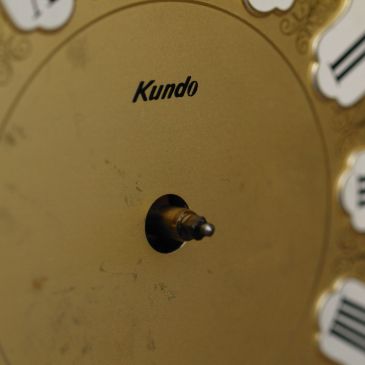
Dial face Kundo Clock

Once quartz clocks were introduced mechanical versions declined precipitously. Kundo is one of many companies making anniversary clocks in the 1950s and 60s. Kundo is a combined form of Kieninger and Obergfell. The company exists to this day as Kieninger, a subsidiary of Howard Miller which is part of a larger company.

This particular clock is a good example of a typical anniversary clock of the period. There are signs of wear as one might expect, dents on the base where an unrestrained pendulum did its damage and a snapped suspension spring but all the parts are there, complete with its dome.

Dents from weights bouncing around during transit

The clock was purchased at a local antique store. It is not in running condition. These clocks typically sell for around $50 to $100 or more on online marketplaces. Domes are often chipped or missing entirely. The glass dome on this one is free of chips.

I have ordered a Horolovar spring  (.0032″) and will report on the installation, cleaning, and testing of this 400-day clock. Look for the second part of this series.

The Cuckoo clock – A brief history

This weeks profile is about the cuckoo clock. I do not have one in my collection but I am always open to new additions. I  know almost nothing about them so I have to rely on knowledgeable people like Megan to fill in the blanks. Earlier this summer (2017) I received an email from Megan. Megan runs a site that specializes in Cuckoo clock products for sale. She asked me to profile her site and I said I would be happy to do so.

“I came across your clock blog and have really been enjoying it. I myself run a Black Forest cuckoo clock blog and I have an article about the history of the cuckoo clock that I think your audience might find useful. I have posted it below and should you find it useful, I would love to have it featured on your blog. If you want to check out my site, visit www.designedintime.com

Perhaps one of the greatest contributions to the Black Forest’s fame is the cuckoo clock. While it is easy to appreciate their charismatic beauty and charm, few realize how deeply rooted these clocks are in Black Forest history. It has been a long journey that has involved several hundred years and thousands of people in one small town.

The story of these incredible clocks starts several hundred years ago in Germany’s royal family. The first description of a cuckoo clock was in 1629 and made by a German nobleman, Philipp Hainhofer. He described a curious little clock that belonged to Prince Elector August von Sachsen. It was said to contain a bird that resembled a cuckoo and it was therefore called a cuckoo clock. Though these clocks were very primitive they did not make any noise.

Enter Franz Anton Ketterer! Ketterer was a clock maker from the Black Forest and is often credited with the invention of the cuckoo clock. It was one day in the 1730s, after pondering the mechanism of a church organ’s bellows that he was inspired to recreate the mechanism inside a clock that contained a cuckoo bird. Thus, the first cuckoo-calling mechanism was born.

Word spread of these fascinating little clocks and it wasn’t long before the cuckoo clock was on the rise in the Black Forest. Most of the villagers in the Black Forest were farmers, but as the eldest sons of the family often inherited the farm, it left the others with a need for supplemental income. Cuckoo clock making was, therefore, a wonderful opportunity for villagers to support their families. During the deep snowy winters, the villagers would toil away at their clock making skills and when the snow melted in the spring they would take their clocks to display in the town. These people, the early cuckoo clock makers from the Black Forest were given the name “Häuslers”.

At the time, hourglasses were the most commonly used timekeepers and the clocks became not only a much more accurate replacement but were also much more artistic. Germany, always a leader in the arts, once again did not disappoint. It wasn’t long before the villagers would have contests to see who could make the most unique and artistic cuckoo clock. People far and wide caught wind of these incredible timekeepers and it wasn’t long before there was an international demand for cuckoo clocks.

Therefore, in 1850, the Duke of Baden founded a clock-making school that offered classes in standard subjects such as math and writing, but also advanced clock-making.

As clock-making flourished a grand contest was offered by Robert Gerwig, the director of a Clock-making School in Furtwangen. It was open to any clockmakers who would compete for the best contemporary clock design. The winner would be funded to complete their design and the winning design was created by Friedrich Eisenlohr. Eisenlohr was an architect whose then-current project was building a new railway through the Black Forest and it was no surprise that the winning design was a cuckoo clock. This clock, however, resembled the rail houses and the design soon became a popular idea that would take over the early designs of the shield clocks. The box and roof style of the rail house design was the precursor to the modern day chalet clock that we see all over the world. Ironically though, there was only one difference between Eisenlohr’s design and the final product. This change would be that Eisenlohr’s design included a cuckoo, however, when the design was put into action, there was not sufficient funding to complete the cuckoo mechanism. Despite this, other Black Forest clockmakers soon figured how to merge both the cuckoo mechanism and the rail house design. Therefore Eisenlohr is still credited with the modern style.

Today, the Black Forest cuckoo clock is a world renowned treasure that has made the small, but beautiful Black Forest villages famous. It comes in a variety of sizes and styles including chalet and carved. While a true Black Forest cuckoo clock is mechanically operated, there are also battery operated clocks called quartz clocks. These can be made in the Black Forest and are often more affordable as they are not authentic like mechanically operated cuckoo clocks.

While visiting the Black Forest I strongly recommend stopping by some of the world-renowned clock makers, such as Hones, Rombach and Haas and Schneider. There are also a number of museums that contain some of the original shield and rail road clocks that are definitely worth checking out. Perhaps my favorite is the German Clock Museum in Furtenwagon as they contain some of the oldest cuckoo clock histories to date.

Next time you see a cuckoo clock, you can appreciate not only the skilled craftsmanship but also the hundreds of years of history that stand behind it!

Photos reproduced with permission. For more information on cuckoo clocks, visit Designed in Time, www.designedintime.com


A tale of two similar but very different carriage clocks

At first I thought they were identical

While at an antique store in Kazabazua, Quebec my wife made an offer on one of these two carriage clocks. The other clock was found at an antique barn just outside of Campbell’s Bay, Quebec, literally an hour’s drive apart and about a week between the two purchases.

I was surprised to find two seemingly identical clocks not far from each other. At first I thought they were identical.

 Italian made versus German made carriage clock
German versus Italian made carriage clocks

The one immediate difference is readily apparent. The dial on the left has Arabic numerals whereas the one on the right has Roman Numerals. They have similar dimensions but if you look closely the bases are not the same height. Both are alarm clocks. Both have a “second” hand at the top and a set-time indicator at the bottom section of the dial. Both have seemingly identical carriage style cases made of very similar materials. Both I believe, are 30 hour clocks. There is an access panel on the back of each clock for winding and adjusting. However, that is where their similarities end.

Musical alarm on the left and bell strike on the right

Musical versus bell strike

I would estimate that they were both made sometime after the First War

The one on the right is made by Junghans or Kienzle, both German clock companies with long and illustrious histories. I tried comparing the plate design and dimensions to a database found here and the closest I could find was Kienzle. However, it is also very similar to Junghans “Joker” style clocks that I have seen for sale on EBay. At one time (around 1905) Junghans had a branch in Venice (Italy) likely a delivery depot for clocks made in Germany. But it is also possible that some assembly may have been done there hence, no definitive markings. I would estimate that they were both made sometime after the First War.

Side views
Side views

Back access panels
Back access panels

The one on the right is made by an Italian maker, Fratelli Borletti. Fratelli Borletti was the only clock factory in Italy prior to WWI and produced only alarm clocks. Fratelli Borletti was later renamed “Veglia Borletti” and produced many car instruments for Fiat, Lancia, Daimler and so on. Today, Veglia Borletti belongs to Magneti Marelli.

The Junghans or Kienzle clock is a musical alarm clock while the Fratelli Borletti clock has a bell type alarm with a striker, though the striker on this particular clock is missing.

One (the musical alarm clock) is working and remarkably clean, the other needs a lot of work. Two very unusual clocks found not far from each other.

Visit to the National Association of Watch and Clock Collectors museum

Clock tower, NAWCC Museum

We were making our way to Missouri after beginning our journey in Maine in early May (2017). We only had one very important stop along the way because for the past 5 years I have always wanted to see the NAWCC clock museum in Columbia, Pennsylvania. Ever since I seriously wrapped my head around clock collecting and repair my dream was to visit this museum. Getting there was no problem but Interstate traffic is truly a disaster! Unfortunately, we budgeted too little time for a thorough tour in the hour and a half we had but we saw as much as we could in that short time.

Waiting in a hot parking lot for the museum to open was not much fun. Couldn’t you just open the front doors a little earlier than 10:00am? To kill time we walked around the town of Columbia. It might be neat and tidy place and one of the “top twenty small towns to visit in America”, so the sign says, but like all small towns in America the decline is evident in the number of vacant storefronts and absence of activity in the streets.

A sign in Columbia Penn.
Sign in Columbia Penn.

We finally got into the museum. We (my wife and I) were the first in and being a NAWCC member my wife and I got in free. During our time there we saw only one other couple. So, not a terribly busy time but there are likely peak periods in the summer.

I was wondering how I would describe my visit to the National Association of Watch and Clock Collectors Museum in Columbia Pennsylvania on that day in May. It was wonderful and more than I had imagined. There is simply not enough time to see everything and take it all in. The museum is very well laid out and there are displays to please everyone.

Vienna Regulator with Grande Sonnerie movement

For me the highlight has to be Engels Monument Clock (see Youtube video below). There was only ourselves and one other couple at the time so we were happy that the staff were able to put on a real show for us. The staffer walked us through the history of the clock and followed with a fascinating demonstration. AS he did so I imagined what it must have like to attend a local fair and see this wonderful clock in action. The clock was exhibited around the country for 74 years and last displayed in 1951 at the Ohio State Fall.

There is an emphasis on American clocks as you would expect but there are excellent examples of French, German, English and Japanese clocks. There is a broad selection of tall case clocks all the way back to the 1700s  The history of time was very interesting as are the interactive displays which I am sure would please any children visiting the museum.

In a later article I will post more photos.

Whether you are an avid collector or merely have a casual interest in clocks this is great place to visit.


Aug Schatz & Sohne W3 – help me find a case for this fine movement

W3 refers to the 3 chimes, St Micheal, Whittington and Westminster

This W3 Aug Schatz & Sohne movement is local antique store find for under CAN$20 though it came without a case and chime rods. W3 refers to the three chimes, St Micheal, Whittington and Westminster. The Whittington chime is my favorite.

Aug. Schatz, a German company, are known today for two types of clocks: the Schatz 400-day clock (including the 1000-day clock) and the ships clocks. They are not typically known for shelf or mantel clocks.

The movement has a platform escapement though earlier versions of the W3 came with a pendulum. I believe that this platform escapement has 2 jewels. Later platform escapement had up to 7 jewels. The front and back plates are solid. It has higher quality leaf pinions rather than lantern pinions and there are 8 chiming hammers, three for the hourly strike.

Rear plate
Rear plate

It has been worked on before, perhaps more than once, but it seems to be clean and in very good shape. There are at least 13 new bushings and a newer click spring.

Arrows show new bushings and a newer click spring
Arrows show new bushings and a newer click spring (bottom arrow)

Aug Schatz and Sohne trademark
Aug Schatz and Sohne German trademark showing W3 stamp

I oiled the movement and I wound all three arbors and it has been running happily for a week now, going through its quarter hour chime sequence flawlessly and hammer striking on the hour as it should. Well, at least the hammers moved.

Platform escapement
Platform escapement, jeweled or not

If you have a spare case lying around in your shop I’d be very happy to take it off your hands

If you have a spare case that would fit this movement lying around in your shop I’d be very happy to take it off your hands. It would have been a mantel, shelf or bracket styled clock. If a mantel clock it might look similar to this Juba Schatz bim-bam clock.

Juba Schatz time and strike clock

Having a movement without a case is like have a car engine without the body. If you have or know someone with a case that will fit this fine movement please drop me a line.

Tick Talk Tuesday #11 – clocks of Cuba

Tick-Talk Tuesday is about the letters and comments I have received from you, the reader, concerning your clocks, issues you might have had and challenges you face and my responses to your questions with advice on your  particular clock concern(s) and of course, general comments. For those comments and questions that stump even me, I consult within my clock circles for the best possible answer.

On my trip to Cuba in March of 2016 I happen to capture a number of interesting clocks. The two pictured below prompted a comment from JC.

wall clock
Wm Gilbert clock found in a restarant

Floor clock
Malaprade Floor clock

The first two clocks are the most interesting to me. The Gilbert looks fairly standard (often called a “Store Regulator”) but I think it’s been painted black. Normally these are in oak cases, occasionally (but rarely) in walnut. The colour would have matched the interior back.

The second clock looks like a fine and expensive Jeweler’s Pinwheel Regulator. I’m wondering if you’re wrong about it being spring driven. These are normally always weight driven. The weight normally hangs behind the pendulum. Is it possible you didn’t see the weight? The movements from these are almost always Swiss made (near the Jura region of France), with pinwheel escapements. They are VERY EXPENSIVE clocks. The movement alone would fetch around 1000$. I have no idea what that circle is on the dial. I’ve seen some with inlaid marble dials, but most have enameled dials like this one. Cases can range from plain to extremely elaborate, and from 5 feet to 9-10 feet.

The name and place on the dial is the retailer where the clock was sold. It is never the manufacturer (this is typical on all French and some Swiss clocks of this type/vintage – the same is true of Comtoise clocks and French mantle clocks).

The rest of the clocks (with the exception of the 2 figure 8 wall clocks) seem to be imported German clocks from 1930 and later. These include both tall clocks and all the 400 day clocks shown. The figure 8 clocks are either American or Asian made copies (likely from Japan) from the early 1900s.

Jauch Drop Octagon – one problem I cannot address…..yet!

Jauch wall clock
Jauch German drop octagon wall clock

We often cruise the HiBid sites. While they may be wholly Canadian I am sure there are similar sites in the US. HiBid are a hosting service for antique online auction companies and from time to time clocks come up on estate sales.

One day in early February 2017 we were on a Nova Scotia HiBid auction site and noticed a Jauch drop octagon with a PL42 movement. I made what I thought was a reasonably good bid. We had errands to run that day so I just left the bid, got home later and realized and surprised that I had won. It was a good purchase. After running for several weeks I opened the case up and discovered its hidden secret.

Time only movement
Time-only Jauch movement

The clock easily runs a full 8-day cycle but it gains about 5-7 minutes at the beginning of the cycle and loses the same at the end of the cycle. A dramatic difference! A properly functioning clock is designed to run at an acceptable rate of + or- 1 minute per week but this depends on adequate power to the escapement with very little fluctuation in that power.

Scored pivots and worn barrel arbor holes are real issues for this movement. The pivots are small, a light touch with a buff stick and a minimal polish along with pegging and round broaching the holes should be the first steps in reviving this clock. Bushing work is also quite possible. The barrels are another matter. If worn, they require bushing. The cap is too thin to bush without making a thin flange or leaving the bush a bit proud and peening both sides. The barrel is narrow and it is said that they really get the wobbles when worn.

This is an inexpensive German movement but finely made and well engineered. An overhaul should result in a good long run.

I took the movement apart and discovered two things. One, it needs at least 3, perhaps 4 bushings and secondly, there is a significant gap in the barrel cap as seen in the photo below.

Barell showing a very wide gap
Barrel cap showing a wide gap caused by wear around the arbour, weak point of this movement

Front plate is removed
Front plate is removed showing going train

The real issue for me is the barrel cap. I can attempt to bush the cap but the bushing would likely not hold unless it is peened. The gap is causing an unbalance in power transmitted through the gears as a result of the wear. The soft brass barrel cap is definitely a weakness of this movement. The result is the erratic running described above and a wobble in the pendulum. I contacted a gentleman in Arizona who would be prepared to correct the wear by installing two new bushings on the gear side and cap of the barrel. The cost is 1 1/2 times the value of the clock so I have decided against that option. It is just not worth it!

1 Day Later

I installed 3 bushings. The front side of the escape wheel arbour, the front side of the second wheel and the minute shaft. I re-assembled the movement, oiled it, adjusted the pallets, reinstalled the worn barrel and have put the movement back into its case. It is now running and in the next week or two I will see what effect new bushings will have on the running of the clock. My hope is a marginal improvement given the worn barrel.

A barrel repair will have to wait until I have the proper tools.


Website Powered by WordPress.com.

Up ↑