Mauthe box clock – Sold by Eatons under the Solar name or a Forestville?

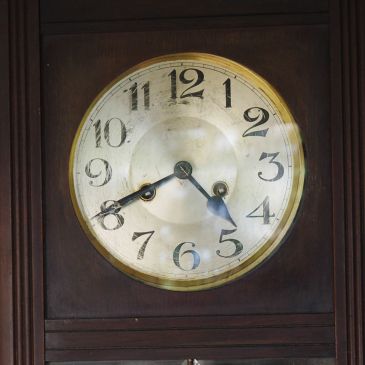
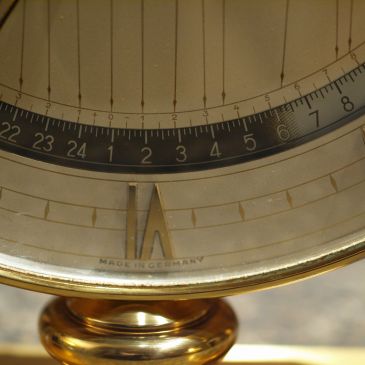
German box clocks are quite common. Prices for these clocks are all over the map, some ask hundreds of dollars but they can be had for very little money like this Mauthe box clock I picked up in a flea market outside Peterborough Ontario. The hands were faded and the case was in rough shape but I knew it was a good deal.

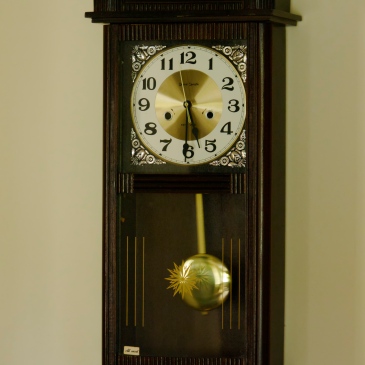
Mauthe box clock
Mauthe box clock, as found

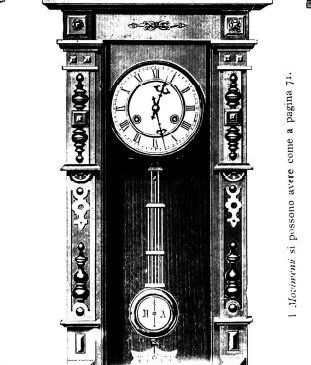
Thousands of German “box clocks” were made in the first third of the 20th century and even to the middle of the century. The box clock replaced the classic “Vienna Regulator” after the First World War and reflected a minimalist approach to clock design. Most, if not all, were made in Germany. Despite the absence of markings, I have no doubt that this clock was made in Germany by Mauthe.

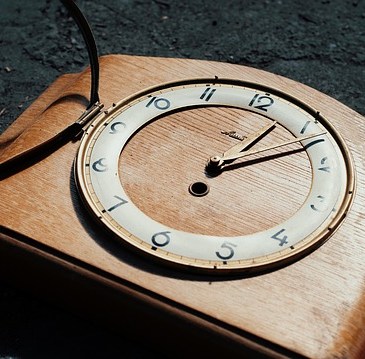
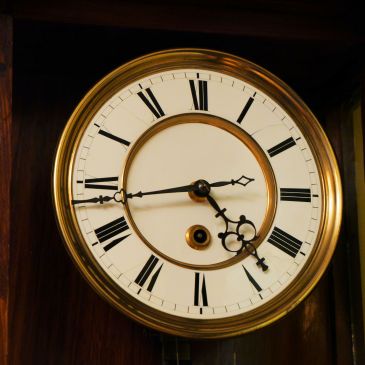
This vintage clock is 29 inches long by 13 inches wide and 7 inches deep. It has a 7-inch silvered Arabic dial with a spade hour hand and speared minute hand. The lower section of the case door has 5 beveled glass panels (middle one is arched) with brass connecting strips. There are two fluted columns that frame either side of the door and circular glazed viewing panels on each side. The movement is mounted and secured by thumbscrews on a seat board. The clock case is in fair to good condition with no gouges, deep scratches or missing pieces. Refinishing at some point in its life combined with environment factors has resulted in a darker walnut shade. The case is made of cheaper pine rather than the more expensive oak found in higher end box clocks.

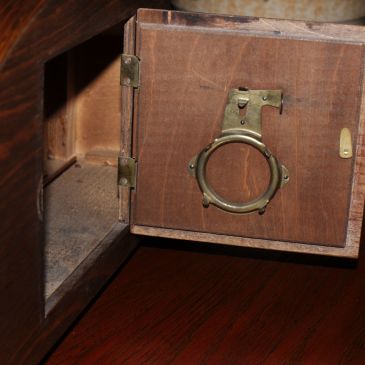
The door has its original glass, catches, hinges and swings very easily. There are no case stabilizers (stand-offs) which I found curious given the height and weight of the clock. It has a rod gong twist locking feature about one third up from the longest rod to secure the rods during transport. Rods are brittle and can easily snap off if unsecured when moving the clock.

Rod twist lock
Rod twist lock to secure the rods during transport

I would comfortably date the clock to the 1930s

The dial face has been “messed with” in some fashion. I suspect someone tried to clean the face with an abrasive cleaner as there are scratches on the numerals. The numbers were touched up with flat black acrylic metal paint. Evidence that it was distributed by a Canadian clock company is a maple leaf applique on the crown.

Maple leaf applique and Divina gong

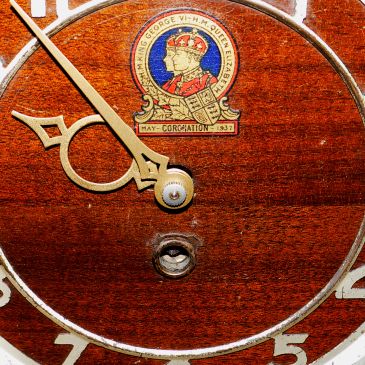
The five-point maple leaf is a common symbol for Canada. There are two possibilities. It might have been sold by the Forestville Clock Company of Toronto or Eaton’s department store under the Solar (Soler?) brand name. I would date the clock to the 1930s.

The price was right so I bought it

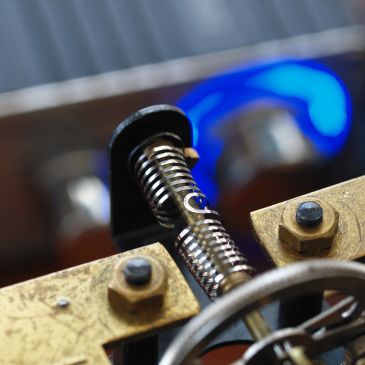
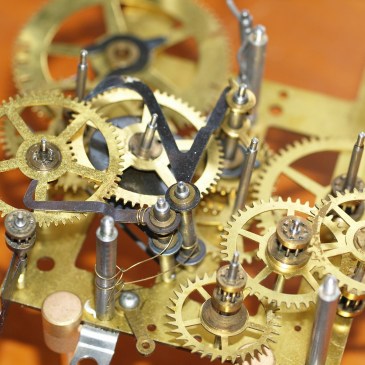
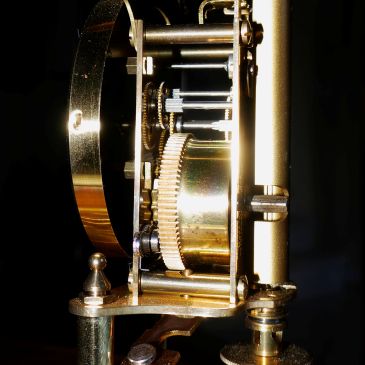
The rack and snail, time and strike, spring powered movement with recoil escapement has no markings but for the numbers 42 (pendulum length in cm) and 105 (beats per minute), the letters C,A, with numbers, 79/9 engraved in the lower right of the front plate, presumably a clock-makers mark for servicing in September of 1979 and a serial number, 25226. The back plate is solid brass while the front plate is open. It also has a repeater function on the strike side.

Mauthe movement front plate

This is an antique mall find and the seller left a note saying that the clock required servicing (code for not running). While on the wall in the store the clock ran for a few seconds and then stopped. So, yes, it needs servicing. The price was right so I bought it.

Mauthe movement back plate

I took the movement out of its case, inspected it and found it very clean. I looked for any obvious signs of wear or damage such as bent arbors or broken teeth and found nothing. The pivots holes were dry though absent of the tale-tell signs of thick black or green oil indicating wear. The mainsprings were wound tight as I would have expected. I oiled the movement, ran it outside the case for a few hours, returned it to its case, re-positioned the 3 strike hammers for the rod gongs and it ran strong, striking as it should on the hour and half hour.

The 3-rod “Divina gong” was, according to the standard German reference, Hans-Heinrich Schmid’s (2005) Lexikon der Deutschen Uhrenindustrie 1850-1980, a Mauthe trade-name registered in 1912. I compared the movement to similar Mauthe movements online and but for minor details it is the same. The case design is plain and free of decoration and is quite unremarkable save for the aforementioned beveled glass panels.

Divina rod gong
Divina rod gong, patented by Mauthe in 1912

I refreshed the case by first giving it a good cleaning with Murphy’s Soap. The cleaning revealed some light and dark patches so I opted to give the case a light coat of walnut stain followed by Poly Wipe Satin clear coat.

Box clock after case refresh
Box clock after case cleaning and refresh

There is not much I could do with the unsightly black smudges on the dial without lifting the silvering so I left that untouched but it still retains that vintage look.

Repainted numerals
Repainted numerals and hands

There were a number of unsightly black marks on the pendulum bob that I cleaned up using Brasso. Brasso was also used to clean up the brass bezel. The beveled glass and the brass strips were cleaned as well.

The Divina rod gong bim-bam strike has an especially pleasing resonance that echos through the house.

For a 50CDN investment the result after a refresh, is remarkable. It shows very well and it is a welcome addition to my growing clock collection.

Tick-Talk Tuesday #7 – SP’s thoughts on dating a Kienzle Weltzeituhr clock

Hitler's clock
Kienzle Weltzeituhr clock presented to Adolf Hitler in 1939

Tick-Talk Tuesday is about the letters and comments I have received from you, the reader, concerning your clocks, issues you might have had and challenges you face and my responses to your questions with advice on your  particular clock concern(s). For those comments and questions that stump even me, I consult within my clock circles for the best possible answer.

On display in an antique store in Quebec Canada

Weltzeituhr is German for “World clock”.

The first Kienzle World Time clock was presented to Adolf Hitler on his 50th birthday in 1939 by the government of Würthemberg. The classical design with the world map in the “Mercator” style (cylindrical map projection presented by Gerardus Mercator in 1569) and the moving narrow scale with the time in the denoted cities came from the Heinrich Johannes Möller hired at age 27 and Kienzle’s principle designer from 1931 til about 1970.

The original clock had a bulky “foot” or base (first photo) and was decorated with swastika patterns on the edge. After the war, the decoration was necessarily altered, the base became smaller but the general layout of the dial was preserved through all permutations of the clock, from the early mechanical versions to the electro-mechanical versions and finally the quartz movements in the 80s. A unique feature of this clock is that it shows Germany to be the centre of the world.

Time sequencer
24 hour time sequencer

SP writes, “One way to narrow down date of one of these clocks is to look at the names of the cities. For example, mine has Jakarta, Indonesia as ‘Batavia’ which was the name given by the Dutch who ruled until the Japanese took over in WWII. The name was officially changed Dec. 27, 1949.”

Side view of World Time Clock showing substantial brass surround

Your clock says ‘Germany’ and has ‘Djakarta’. It could have been made between 1942 and 1949

SP wrote further, “I got to thinking and I suspect that further sleuthing may be in order. If you go to the Wikipedia article on ‘Batavia’, you’ll see that the name was changed when the Japanese took over in 1942. It also says that the name change from ‘Batavia’ to ‘Djakarta’ was ‘internationally recognized’ on Dec. 27, 1949 so that there was a seven year period when it was called ‘Djakarta’ by part of the world and ‘Batavia’ by another (Keep in mind that the Germans, allies with Japan, would have been partial to seeing things the Japanese way). Then, at the ‘West Germany’ Wikipedia, I see that ‘West Germany’ was declared on May 23, 1949. Your clock says ‘Germany’ and has ‘Djakarta’. It could have been made between 1942 and 1949 if the names on the dial were determined by Kienzle in strict conformity with official names. Of course, whether or not they were strict in that way would be hard to pin down but it seems to me that an earlier date for your clock’s manufacture seems just as plausible as a later one. It does seem to me, however, that, if it was made in 1950 or later, it would very likely say ‘West Germany’ given the 7-month lead time and the earth-shaking importance of the name change at the time.

Is it a clock or a work of art? Both it would seem

I replied that the clock was likely not produced during the war years when many German plants turned their attention to the war effort. My clock was either made in 1942 or close to 1949.

Kienzle World Time clock
Kienzle World Time clock, circa 1942-49

SP wrote back some time later and shared this with me, “I was also thinking that the war years are unlikely for the same reason. I was just doing a little exercise in marking rough parameters. Another rough parameter: mine has no country of origin as in ‘Made in Germany’ or ‘Made in West Germany’ — perhaps an indicator that it was made for the domestic market. I came here originally to learn how to calibrate the ‘world time zone’ scale. Then I took the clock to my local clock maker to have it serviced and he explained that, on my model at least, you have to take the back cover off and manipulate the metal disk inside with your finger. I see that some clocks, including yours, have a little button or knob on the back half-way down from the center knob that controls the hands and I assume that it controls the time zone scale. Anyway, if you are a visitor to this site looking for the same information, now you have my report.”

Winding crank
Winding crank

On my clock the tiny knob controls both the hands and the zone scale. As I rotate the knob the zone advances incrementally.

I am certainly on the lookout for more Art Deco styled Heinrich Johannes Möller clocks to add to my collection and when I come across another I will be sure to write about it.

Thank you, SP, for sharing your knowledge and experiences concerning this wonderful clock.

So, it seems that my Kienzle was made between 1942 and 1949.

Is it a clock or a work of art? The latter I would submit. Thanks to Heinrich Johannes Möller and his ability to turn a timepiece into a true work of art.

Dugena mantel clock revisited

In a precious article I wrote about my frustrations getting this clock to run reliably. No matter what adjustments I made it ran poorly.

“You’ve got to be very careful if you don’t know where you are going, because you might not get there”, Yogi Berra

This time and strike movement (Hermle?) has been out of its case and lying in drawer for the past year or so. When I met the seller in a parking lot some time ago as I handed him $20 for this Dugena mantel clock he climbed into his car he said, “I hope you don’t expect much for $20; it’s not perfect”. Well, it’s not perfect.

It was keeping poor time, losing an hour or so a day but I thought, what a great clock to practice on and practice I did.

Oiling the movement had no effect. Issues? A weak spiral spring, a worn jewel on the floating balance, a power issue associated with a weak mainspring or perhaps pivot wear. I disassembled the movement several times and serviced the mainsprings. I had an issue re-hooking the strike side mainspring and so, discouraged, I put it aside.

Dugena time and strike German made mantel clock

Dugena – is it a clock company?

Dugena was a German retail clock name only, a marketing name, not a maker of movements or cases. Dugena was a registered cooperative society, a “Genossenschaft”, that bought clocks from other makers to sell them under their own brand. A brand name for a retail chain more or less.

Dugena floating balance
The clock runs slow, this bent spiral spring does not help

Floating balance clocks are much more accurate and above all, they do not have have the disadvantage of the pendulum; these clocks work even when the case is at an oblique angle

A great invention – the floating balance

The floating balance movement in this clock could have been made by anyone; Urgos, Jauch or Hermle perhaps. Hermle is likely since it was one of the leading companies using the floating balance escapement. The floating balance was invented in the 1930s but it took till 1941 for the patent application to be registered. It took another 10 years after that for the patent to be granted slowed by the war years and the challenges of industry recovery following the Second World War.

The floating balance was a great invention. Floating balance clocks are generally more accurate and above all, they do not have have the main disadvantage of the pendulum; they will work even when the clock case is at an oblique angle.

Time and strike movement, maker unknown

Back to the the clock

Months passed. I took the movement out, looked at the strike side barrel a second time, popped the barrel cap off and using pliers gave the inner part of the mainspring a turn and it hooked onto the catch. Success at last. The mainspring barrels can be removed without dis-assembly of the movement, so, in it went. Despite my minor triumph with the strike-side mainspring, straightening the spiral spring and adjusting the balance wheel to its fastest set point, the clock ran only marginally better. The only consolation is that although it runs 5 minutes slower per day it runs a full eight day cycle.

Despite the minor disappointment it has been a productive learning experience but I am inclined to put it aside as I have other projects on the go. Every time I think about the issues I am having with this clock it always comes back to the balance wheel.

Some day the solution will pop into my head.


Is my clock in beat?

You bought a clock. It ran when you first saw it but you bring it home, display it in that very spot you imagined and now it won’t run. 99% of the time this is caused by a clock not being in beat. All mechanical clocks must be set in beat before they will run properly.

Sessions time and strike

I make no attempt to explore the idiosyncrasies of various designs of clock movements. Much of the following information can be found at the forum site of the National Association of Watch and Clock Collectors, NAWCC . At this site there are additional tips on adjusting the beat of 400 day clocks, weight driven Vienna style clocks and so on.

When a clock is out of beat, it will either not run at all, or it will run for a short time and then stop

What does the term “beat” mean?

Make sure your clock is on a level surface. Listen to the tick and the tock of your clock. Try to minimize the sounds in the room you are in so that you can listen closely to it’s rhythm. It is in beat when its ticks and tocks are even….tick…tock…tick…tock…, and is out of beat when they are uneven, either, ticktock…. or tocktick…… Put another way, there will be an equal amount of time between the ticks and the tocks. When a clock is out of beat, it will either not run at all, or it will run for a short time and then stop. It is worth repeating that a clock’s beat must be regular to work properly.

Gilbert calendar clock, the Admiral

There are two ways to put a clock in beat. The first is to tilt the clock sideways, one way or the other, and listen for the beat to even out. When the beat is even, prop the clock to stay tilted that way. Now it will run in beat but it will obviously not look good.

The second way is to adjust the crutch to one side or the other, until the beat is even. The crutch is the rod that extends down from the pallets which rock back and forth on the escape wheel. The pendulum rod passes through either a loop (called a crutch loop) or a forked foot at the end of the crutch as indicated in the photo below. Incidentally, that rod needs to be in the middle of the crutch loop and can’t be tight inside the loop nor too loose. The crutch is attached to the pendulum leader which is then attached to a post with a suspension spring.

Mantel clocks have rear access doors that allow you to adjust the crutch, however for wall clocks you will have to remove the hands (the minute hand is released by a screw or a pin, the hour hand simply pulls off) and the dial face, also attached by screws that come off to reveal the movement. However,minor adjustments to the beat of a wall clock can be preformed by simply moving the clock off-level. It may not be noticeable if the clock is not quite level.

There is no need to take the movement out of its case to perform this procedure.

OLYMPUS DIGITAL CAMERA
American New Haven time and strike movement taken out of its case

If the crutch is a simple rod or wire as in the photo, it is adjusted by bending it to one side or the other (left or right). The brass rod is quite pliable allowing you to re-adjust if necessary. Listen to the beat as you make the adjustments and when you have a steady tick-tock the clock is in beat.

There us nothing as pleasant or soothing as the sound of a ticking mechanical clock in a room.

If it attaches to the pallets with a friction joint, it is adjusted by holding the pallets still with one hand, and shifting (pushing) the crutch right or left on the friction joint. The adjustment may be very slight in either direction.

plate-clock-movement_6-labels
Time only German movement for a Blackforest shelf clock

You need only to do this once. Whether your clock is a wall clock, a mantel clock, time and strike, time-only or time, strike and chime, the principles are exactly the same. There is no need to take your clock to a professional to have it “fixed”. This is definitely a do-it-yourself procedure. It’s that simple!

There is nothing as pleasant or soothing as the sound of the rhythmic ticking of a mechanical clock in a room especially if it is in beat.

Kienzle World Time Clock (Weltzeituhr) – more about this fascinating clock

Occasionally, I receive private email from readers.

One reader asked why I dated the clock to 1950

I received a couple such emails regarding my Kienzle World Time clock and it prompted me to dig a little deeper into the origin of this unique clock.

The clock is substantial, measuring 13 and 3/4″ high, 10″ wide  2 and 1/2″ deep. It is certainly a singular work of elegance, style and a genuine stand-out in any room.

Kienzle World Time clock
Vintage single train Kienzle World Time desk clock

One reader asked why I dated the clock to 1950.

I referred the reader to this article. The article suggested that the mechanical version of the World Time was introduced the late thirties. It had a healthy production run and there were several variations. Mine was “Made in Germany” (West Germany was created in 1949) and might have been manufactured on or before 1949 which would not have prevented it from selling in the 50s. For most of the ones advertised on Ebay, 1950 appears to be the most commonly cited year of manufacture though there are no specific markings regarding date of manufacture on my clock.

It was designed in 1939 and at least one clock was made that year

However, here is some additional information which suggests that although it was designed in 1939 at least one clock was made that year though it did not go into full production until much later.

Hitler's clock
Hitler’s clock

A birthday present for an infamous leader of Germany

The first Kienzle World Time clock was presented to Adolf Hitler on his 50th birthday in 1939 by the government of Würthemberg. The classical design with the world map in the “Mercator” (cylindrical map projection) style and the moving narrow scale with the time in the denoted cities came from the, at that time, Heinrich Johannes Möller, a famous designer who was working for Kienzle from 1931 onward til 1970. Möller was hired at age 27 and became Kienzle’s principle designer. The original clock had a bulky “foot” or base and was decorated with swastika patterns on the edge.  After the war, the decoration was altered, the base became smaller but the general layout of the dial was preserved through all permutations of the clock, from the early mechanical versions to the electro-mechanical version and finally the quartz movements in the 80s. A curious feature of the clock is that it shows Germany to be the centre of the world.

Time sequencer
Kienzle 24 hour time sequencer
Back of Kienzle clock
Back of Kienzle clock showing winder and speed adjustment

The World Time clock turned out to be a long standing model and was available to purchase up until the 1996 Kienzle bankruptcy. During the period that the World Time Clock was introduced (1939) Kienzle had more than 6500 employees and a production rate of 5 million clocks.

Through the later 50s and 60s Kienzle clocks lost their stylistic prominence and followed then current (international) stylistic influences but Heinrich Johannes Möller was a significant influence not only on the design of Kienzle clocks but in the clock world in general.

Why a Vienna Regulator clock is not a regulator

This article will explore the notion that a Vienna Regulator clock is not a true regulator. I realize that any discussion of regulator clocks produces a wide variety of conflicting opinions, nevertheless, here is my take subject of the Vienna Regulator and why it is not a true regulator.

The word “regulator” is  loosely defined but according to this definition it is a master clock, usually of great accuracy, against which other clocks are checked. Respected collectors like Derek Roberts tend to stay away from defining a regulator clock and instead refer to them as precision pendulum clocks. In this article I will present three examples for the reader to consider.

Every clock that has the word regulator on it is not a regulator

Every clock that has the word regulator on it is not a regulator. Think about it. Why would a clock manufacturer put the word “regulator ” on a clock? It is simply a marketing ploy. The term “regulator” is one that connotes accuracy but in the frantic world of clock marketing it is a word that sells plenty of clocks.

If it was expressly designed as a precision pendulum clock it can be called a regulator

Definition of a regulator

It is not difficult to define a “regulator” by its mechanical characteristics. Regulator clocks were invented in the late 18th century as a quest for greater timekeeping accuracy. If the clock was designed as a precision pendulum clock it can be called a regulator. The principle features of a regulator clock are:

  • Quality weight driven device,
  • With maintaining power,
  • A heavy pendulum (not necessarily mercury),
  • Generally eight-day movement, though some are more than 8 days,
  • Has some form of temperature control compensation,
  • Has a seconds dial,
  • Is 60 beats per minute,
  • Has one gear train
  • Features a deadbeat or pinwheel escapement and
  • Is expressly engineered to keep accurate time.

Complicated features like calendars and strike trains are omitted in the quest for accuracy. Regulators were (are) capable of extreme accuracy for a mechanical clock.

Does the addition of a strike train take a clock out of the regulator category? In theory, yes. The strike train takes some of the accuracy out of the clock, as the time train produces more friction when lifting the strike levers. If we accept the definition of a regulator as an extremely accurate clock to be used as a time standard, you will not find a strike train on these clocks.

Here are three examples

Example number 1. Arthur Pequegnat Regulator #1, A Handsome Clock, fitted with a Movement which is un-excelled”, Beautiful Finish on both Movement and Case, (Arthur Pequegnat advertisement)

The Arthur Pequegnat Regulator #1 clock is often compared to the Seth Thomas Regulator #2 as a precision regulator. Many Regulator #1 clocks found their way into offices and rail stations all across Canada. The Regulator #1 is the best timekeeper made by The Pequegnat Clock Company of Kitchener Ontario (Canada). The company states this in it’s advertising: “A Handsome Clock, fitted with a Movement which is un-excelled“, Beautiful Finish on both Movement and Case” and “The Finest Office Clock Made”!  They are weight driven, time-only, at 80 beats per minute, had a deadbeat escapement, with heavy pendulum, eight day movement with a brass weight hung on an iron bracket, maintaining power, a seconds dial and were designed to keep accurate time. It was a reasonably accurate clock used as a time standard.

However, some would argue that at 80 beats per minute it would not be considered a true regulator.

Arthur Pequegnat Regulator #1 wall clock
Is this Arthur Pequegnat Regulator #1 a regulator?

Example number 2. Mauthe “Horse Crown” time and strike spring driven wall clock.

The clock you see in the photo below is typically advertised on online for-sale sites as a “Vienna Regulator”. It is an attractively designed 1890s spring driven, time and strike clock made by Frederick Mauthe. Those individuals who sell these clocks have no hesitation in calling them Regulators. Let’s apply the definition above.

  • Is this a precision regulator?
  • A spring driven movement disqualifies it immediately.
  • Is it not capable of extreme accuracy.
  • It is 116 beats per minute
  • Was it conceived and designed as a precision clock? No!
RS Finial added (3)
Is this Mauthe horse crown wall clock a Vienna Regulator?

Example number 3. Miniature one-weight Vienna Regulator

This is an Austro-Hungarian era time-only weight driven clock made in the early 1870s. Many would accept this as a Vienna Regulator and would have no hesitation advertising it as such. It has a deadbeat escapement, it has one weight, is a time-only movement, has a heavy pendulum, with an eight day running time and has maintaining power.

one-weight Vienna wall clock
Is this one-weight miniature Vienna wall clock a regulator?

Let’s apply the definition above.

  • Is this a regulator? No!
  • There is no seconds dial, and, is
  • 80 beats per minute
  • Is it capable of extreme accuracy. No!
  • Was it specifically designed as a precision clock? No!

Granted, it is capable of some accuracy but it is not a reference timepiece. However, there is little doubt that some post office and rail clocks in the Vienna style such as this Wilhelm Bauer post office wall clock (below) were considered “regulators” in their day when common folk set their watches and clocks by them.

Wilhelm Bauer post office clock
Is this Wilhelm Bauer post office clock a regulator?

The Vienna Regulator clock and its characteristics

The Vienna Regulator is a particular style of clock made in Germania or the Austrian empire. They are characterized by finely crafted (ornate at times) cases with accurate movements. While they were capable of keeping good time, they were not designed as a precision instrument and were not capable of extreme accuracy. They have some but not all the characteristics of a regulator but they are not a true regulator. While the Vienna Regulator may not be true regulator it reflected not only the style and craftsmanship of the period they were made but the quest for accuracy. No one can argue that the best workmanship and attention to detail were put into the many clocks that were produced during what some might call the pinnacle of clock design and engineering.

As much as they are called regulators the three examples presented above are not true regulators. Regulators were (are) capable of extreme accuracy for a mechanical clock and nothing I have in my collection remotely qualifies as a regulator.

However, in the world of clock collecting and repair it is perfectly acceptable to continue referring to them as regulators since they are generally accepted as such. The word regulator has become part of the lexicon of collectors even if they do not strictly fall within the definition of a true regulator clock.

German “schoolhouse clock” by Gebruder Jauch?

The Germans would not have called them schoolhouse clocks, rather, short drop octagon wall clocks. The term “schoolhouse clock” is typically an American description.

The stylistic features of the Jauch reminds me of my Canadian made Arthur Pequegnat Brandon II wall clock

Jauch wall clock
Jauch wall clock

We often cruise the HiBid sites. I am not sure if they are wholly Canadian but may be in the US as well. HiBid are a hosting service for antique online auction companies and from time to time clocks come up on estate sales on various sites. One day in the past week (early February 2017) we were on a Nova Scotia HiBid auction site and noticed a Jauch drop octagon with a PL42 movement and I made what I thought was a reasonably small bid. We had errands to run that day so I just left the bid, got home later and realized that I had won. It was a good purchase.

The stylistic elements of the Jauch reminds me of my Canadian made Arthur Pequegnat Brandon II wall clock pictured here.

AP repaired_3
Brandon II by the Arthur Pequegnat Company of Kitchener Ontario, Canada

I picked the clock up yesterday (mid February 2017). There is very little wrong with it. I took the movement out of it’s case, inspected it, noticed that it was not very dirty, gave it some oil, and put it on the wall and it ran like a charm. Since it is not in dire need of disassembly and cleaning I decided to leave that for another day.

It has some unusual features. The case is solid oak, no veneers and surprisingly heavy for a clock made in 1976. The finish is light oak. The case measures 15 inches wide by 23 inches long, 5 1/4 inches deep. The movement is a time only, typical spring driven recoil escapement stamped PL42, is heavy and is well constructed with quality gearing. The date of manufacture for the movement is September, 1976. The dial bezel is hinged at the top and the spade hands are what you would typically find on this style of clock. The dial is paper on tin. The pendulum has a large and heavy nut on the back of the bob that may not be original to the clock and I am inclined to think it is a replacement. The bob can be seen through a glazed lower access panel. The previous owner made a crude “adjustment” to the case to accommodate the pendulum swing (last photo). One of two wall stabilizer screws can be seen in the fourth photo below. There is a missing top section access panel on the back of the clock that I may or may not replace.

Solid oak construction
Well made solid oak construction
Movement showing escapement
Pendulum and adjustment nut
Jauch pendulum adjustment

The clock is a Gebruder Jauch wall clock. Gebruder Jauch was a clock company from Schwenningen, Deisslingen, Germany. The Gebruder Jauch company manufactured hall, wall, and mantel clocks. They made movements for the trade, both spring and weight driven. In the late 1970’s the company fell victim to curtailed exports and the last recorded year of operation was 1978. The year they began is unclear but 1912 seems to be the consensus. Otherwise, I could find very little on this clock company. Perhaps someone can enlighten me.

Halifax Explosion and the Junghans Crispi clock – Part 3.5 – Postscript

My current project is an antique German Junghans time and strike spring driven wall clock made in the style of a Vienna Regulator. It was made in Schwenningen, Germany. It came to me as a box of parts. To some a box of clock parts and pieces is discouraging but to me it is a challenge.

This is Part 3.5 of a now three point five part series on my newly acquired Junghans Crispi wall clock. 

This is Part III and a half of a series on my newly acquired Junghans Crispi wall clock. In Part I described the circumstances by which I came across this clock and it’s incredible story as a survivor of the Halifax Explosion on Dec 6, 1917. In Part II I walk the reader through the servicing of the time and strike movement. In Part III I talk about the challenges of restoring the case.

I felt compelled to write Part 3.5 of the series showing the work I completed on the crown and the additional case work. I wasn’t sure how far I would go in restoring the case but the top finials are so essential to the final look of the clock that I decided to add these important elements.

The original finials might have been a little taller and wider much like the bottom centre finial

I bought three 3 and 3/4 inch finials from Timesavers. A wood lathe would have been ideal if I had one. I tried to imagine how the original finials looked and took a chance on what I felt were the most ornate without being too ostentatious. I believe they do it justice and complete the clock. The original finials might have been a little taller and wider much like the bottom centre finial but Timesavers has a rather limited selection. If I come across something closer in design in the future I can simply pull these out since they are not glued in place.

Support post for middle finial

As you can see above, I have clamped the final bases to the crown and test fit the three top finials which had just been given their first coat of stain. The support post is made of oak and anchors the crown to the case. It will eventually be screwed in place. The post not only attaches the crown to the top of the case but also supports the middle finial base (next photo).

Test fitting the top finial

The lion’s head on the crown has also been nailed in place using its existing holes.

Buttons and decorative nails

The case has an unusual number of decorative nails and buttons. Fortunately most of these decorative trim items came with the clock. Everything you see in the photo above is original save for the upper two floral brass buttons. Years of grime and dirt has been removed from the original decorative buttons, nails and pins.

Crown in place with all three finials
Crown in place with all three new finials

The clock reflected the Victorian era (1837 to 1901) of showy complicated designs with an emphasis placed on bright and brassy surface decoration

The crown is in position although for the moment it is merely sitting in place. I have added two new decorative nails to the finial bases. Although they are not exactly in the style of the other decorative nails, they are in keeping with the period look of the clock. The two brass buttons on either side of the movement support bracket (above photo) are replacements. The buttons, nails and trim pieces on the top part of the case, are original and cleaned up nicely.

Full view of case
Full view of case

This is a full view of the case with all decorative nails, buttons and trim pieces attached. Below the movement support bracket and on the side columns are two half moon wood pieces (one round decorative pressed wood applique cut in half) that replicate the original detail.

The clock is very garish; some might even call it gaudy. Other clocks I have from this period (1899) are not as pretentious as this one. This look may not be everyone’s cup of tea, but it appeals to me. I am sure that it will always be an interesting conversation given its fascinating history. Overall, I would say that the clock accurately reflects the Victorian era (1837 to 1901) with showy complicated designs and an emphasis placed on bright and brassy surface decoration.

final look
Final look with crown attached and movement installed

The above photo shows the case with movement, pendulum, face, brass bezel and hands attached. At this point the clock is about 90% complete. The final steps in this project are securing the door to the frame with hinges purchased from a supplier, attaching the door catches, installing “new” glass, applying a protective top coat finish using Minwax semi gloss wipe-on poly and finding a way to replicate a wood trim insert piece on the left column just above the rectangular brass decorative piece.

Arrow indicating missing trim piece

The clock came without the glass and it obviously must be replaced. I managed to find an old glass window in my area with sufficient “waviness” to replicate the glass at the time. I will have the glass cut and installed by a repair shop locally.

In the final analysis is this a restoration, repair or a replication?

Much of the clock is original; the movement, the pendulum, coil gong and movement bracket as are the bottom base and top part of the case and the crown, the back board, the vertical columns and most of the decorative trim. What has been replaced is the box frame and the front piece that supports the right and left columns. The previous owner used contemporary materials and techniques to reconstruct the frame and front piece. Although not authentic, I have no real objection because much of what he has done is unseen. I have added or will have added some decorative trim pieces, new glass, 3 new finials, hinges and catches, finial bases, used yellow carpenter’s glue where absolutely necessary,  stained the case and will remove the rust on the coil gong.

In the final analysis is this a restoration, repair or a replication? Perhaps all three. However, to the casual observer it is an attractive albeit brash, lovingly restored antique Junghans Crispi wall clock that fell off a wall, in Halifax, Nova Scotia on that fateful day, December 6, 1917.

I hope you enjoyed the series and if you have any comments, ideas or suggestions do not hesitate to leave me a message.


Hilarious and other interesting clock ads

I scour the online for-sale sites frequently and I am always amused by some of the clock ads that folks write. I wish I could post some pictures, some of the clocks are truly pathetic but copyright law prevents me from doing so but at least present the unique descriptions. None of the spelling errors are mine by the way.

Here we go:

“I have an old antique wined up clock works great runs real waits”

An ad for a Chinese wall clock similar to this Daniel Dakota

Converted quartz Daniel Dakota

“Original Carillon 1960-70 antique 31-day winding clock perfect condition. Elegant design with brass hands and pendulum. Comes with original key. Selling to people with taste $300”

No this clock does not look good!

“I made this clock myself, looks pretty good I think. $10.00”

An ad for what looks like a bracket clock:

“red color wood, in nice shape, not working, needs guts”

Not sure I’d take a chance on this one.

“Great look needs clock looked at and bulb. If I get to fixing it it will be more”

This ebony Adamantine Seth Thomas similar to this Sessions better be made of gold.

$1750.00 Good Investment, Great Gift, Excellent Condition, 8 Day, Chimes on the hour, bell on half hour, very accurate. I have owned this clock for 9 years with no problems. Circa 1890. This range of Adamantine Clocks, are known to collectors as “Black Mantel Clocks”

Session Raven time and strike mantel clock

Ad from Value-Village. I thought one could always get great deals there but not any more. And for $600 wouldn’t you want to know the maker of the clock?

“Foreign Granddaughter’s clock, Art Deco – Solid Oak -8 day, quarterly chime , Slight damage to dial and hinge, Dimensions: 55″H x 9,5″@ x 9.5″ D , Price: was $899.00 Now: $599.00!”

And another stellar Value Village ad. Are they serious at Value Village? It looks exactly like this Forestville time and strike that I own:

“Forestville German Art Deco Clock , Wood, Westminster Chimes (quarterly), Key wind in good working condition. Ca 1920. Has some damage at top of Dial. Key, Dimensions: 22″W X 5″H Price: was $499.00 NOW $349.00!”

Forestville time and strike mantel clock

More ads

“royal adult on carriage clock; never used by bulova”

“Coo Coo Clock in excellant condition!”

“Beautiful antique crank clock. Still works great”

“Clock antique, brand new. Made out of wood, heavy and durable. Japan movement powered by one AA battery. Beautiful, antique, decorative. High 9 inch, wide 7 inch.
I live Dufferin x Finch $60”

“Antique Citizen wall clock in working condition. Comes with key. Made in Korea. Asking $125 or make my an offer!”

Chinese or Koren clock perhaps. These quite often sell for less that $50. I might consider a Korean or Japanese clock but I would never pay $150 for a Chinese one. I wonder what might happen if I offered less, would they threaten me!

“Vintage Beacon regulator 31 day keywind wall clock. They don’t make em like this anymore! Solid wood (not veneers) The movements keep excellent time. This clock is over 50 years old and works like new! We do not know the exact age as father in law brought it to Canada from Germany in the early 50s. Its in mint condition and works like new. Seriously nice sounding chimes Dimensions: 28in h x 16in w (at round face) x 6in deep Key included Serious enquiries only please.  Price is NOT NEGOTIABLE! This means asking price of $150.00 is my final price.”

And others.

I have this clock but don’t have time to use it. Works fine.

Misfits clock works great from smoke free home

Jack Daniel’s promotional advertising wooden wall clock, would look great session room, rex room. Clock works $75 obo


Halifax Explosion and the Junghans Crispi clock – Part II – servicing the movement

Movement on test stand prior to cleaning

This is an antique German Junghans time and strike spring driven clock made in the style of a Vienna Regulator. It came to me as a box of parts. To some a box of clock parts and pieces is discouraging but to me it is a challenge.

Part II of a three part series on my newly acquired Junghans Crispi wall clock.

This is Part II of a three part series on my newly acquired Junghans Crispi wall clock. In Part I described the circumstances by which I came across this clock and it’s incredible story as a survivor of the Halifax Explosion of Dec 6, 1917.

This is a German count-wheel strike typically found in the lower lines of Mauthe, HAC and similar clocks. It is an open plate “bread and butter” movement, not of the highest of quality but well built and reliable. The count wheel is located to the rear between the plates and the mainsprings are enclosed in open barrels. There are no helper springs to worry about and all of the wheels are located in the centre and the upper side of the movement.

As you can see in the next two photos the movement was very dirty and I accepted the risk of running it for a day to see what issues might arise. I gave the pivots holes plenty of oil to mitigate any additional wear. What I found was a sticky hammer assembly that would malfunction intermittently which I attributed to dirt and grime buildup, otherwise the movement ran very well after not having run for 100 years. Imagine all that kinetic energy stored in the springs since 1917.

The movement is relatively easy to re-assemble but I had to install the lower centre wheel, the spring barrels and the centre cannon together with the top plate and then slide the gears in between the plates. Fortunately this process is not as difficult as it sounds but very different than laying the top plate right over the gears as you would in an American movement.

Very dirty movement
Very dirty movement
Mainspring barrel
Mainspring barrel with years of dirt showing

 I gave the pivots holes plenty of oil in the testing phase to mitigate any additional wear

Plates cleaned up well
All the wheels between the plates

I found everything within acceptable limits and decided that bushing work was not required

The accumulated grime of 100+ years came off following the ultrasonic cleaning. In fact I have never seen the ultrasonic solution so dirty. The plates cleaned up very well and I gave them an additional polishing with Brasso. After the parts came out of the ultrasonic I tested the movement for any evidence of excessive play and found everything within acceptable limits and decided that bushing work was not required. The pivot holes were pegged and the pivots were polished.

Springs were inspected and cleaned
Springs were inspected, cleaned and oiled

There were no cracks or unusual issues with the mainsprings though I found it curious that they were very clean with no rust. There was also very little lubricant remaining. The springs are somewhat tired as you might expect but I think there is enough power remaining for a full cycle so I decided not to replace them at this point. I applied Keystone mainspring oil to the springs once I returned them to their barrels.

With the movement back together, it is time to adjust the strike side. The strike wheels must be set up correctly with respect to each other ensuring that the third (hammer lifting star wheel) and fourth wheels (the strike cam) align with he count wheel. The warning pin on the last wheel (which actually protrudes from the plate) has to be high enough for sufficient rotation. In order to count the strikes properly this relationship must be right. Unfortunately, I can never get this correct the first time.

The servicing of the movement is not without headaches, however.

The servicing of the movement is not without headaches, however. I bent a pivot on the warning wheel which I managed to successfully straighten out. The hammer arbor paddle was barely touching the star wheel and while trying to adjust it, I accidentally snapped it off along with the retaining spring. Although the clock will go though the strike sequence the gong will obviously not sound. I don’t have the tools to put in a new paddle so I will have to get that attended to somehow. I managed to correctly adjust the strike side but the clock mysteriously stops after about an hour or so. Something is definitely amiss and more investigation is required.

I have had more success with the case restoration that you will read about in Part III. In the meantime I have to constantly remind myself that this movement has not been running in 100 years!


Halifax Explosion and the Junghans Crispi clock – Part I – the plan

rs-junghans_1

This is what happens when you get a clock in a box. Call it a collection of parts, pieces and dust. This is an antique German Junghans time and strike spring driven clock made in the style of a Vienna Regulator. There is no serial number on the movement, dating the clock to 1899 or earlier (in 1900 Junghans began to number their movements). To some a box of clock pieces is discouraging but to me it is a challenge.

Where to start?
Where to start?

It was advertised on a local online for-sale site as a clock that fell off a wall during the Halifax Explosion and I thought, well, that’s an intriguing story! As most Canadians know, the Halifax Explosion was a significant event in Canada 100 years ago.

On the morning of 6 December 1917 the SS Mont Blanc a French cargo ship laden with high explosives and Benzol collided with the Norwegian vessel SS Imo in the Narrows, a strait connecting the upper Halifax harbour to Bedford Basin. A fire on board the French ship ignited her cargo, causing a large explosion that devastated the Richmond District of Halifax. Approximately 2,000 people were killed by blast, debris, fires and collapsed buildings, and an estimated 9,000 others were injured.

The result was the largest human-made explosion prior to the detonation of the first atomic bombs in 1945. Nearly all structures within an 800-metre (2,600 ft) radius, including the entire community of Richmond, were obliterated. This clock is a witness to that day. In 1918, Halifax sent a Christmas tree to the City of Boston in thanks and remembrance for the help that the Boston Red Cross and the Massachusetts Public Safety Committee provided immediately after the disaster. That tradition carries through to this day.

The case is cleaned up
The case is cleaned up and we are visualizing where the parts go

It appears that the parts have literally sat in a box for the past 100 years.

The blast not only shattered the glass panels but heavily damaged the box frame. It appears that most of the parts have literally sat in a box for the past 100 years. I cannot imagine when the movement last worked, probably ticking its last on that fateful morning in December. Since the box frame was damaged beyond repair following the explosion, the seller, an amateur woodworker, built a new frame made of softwood and oak veneers some 30 years ago. You can see the lighter coloured pieces in the photo below that were never stained and finished. He admits that he knows nothing about clocks and eventually lost interest in the project. I am impressed with his skills since the work on the frame looks solid and well constructed.

Top centre final is missing as well as two other finials

The top centre final is missing, two other finials and some small trim pieces

Why was he letting it go? He said there had been a change in his life and it was time to move on. When I asked him about the history of the clock he said that his wife’s grandparents lived on Princess Place in North End Halifax. Princess Place is further south of the main area of devastation so houses in that area would have sustained heavy structural damage. The clock was blown off the wall by the blast wave. The clock remained in the family all these years, the seller having received it from his wife’s aunt.

I took it home stared at the box for a while trying to decided whether or not I made the right decision. I then set to determine what steps I should take to restore this fine clock. I poked through the box to see what was there and began to itemize the parts, arranging them on the case as best I could and proceeded to clean the case and determine the next steps. I was fortunate to have had someone send me the actual catalog image of the clock which you can see below.

The clock is called the Crispi by Yunghans. Yunghans is a reputable German clock-maker and continues in the watch business to this day. This is what the clock should look like and it will be a excellent guide for restoration. There will be obviously be some subtle differences between my clock and the clock in the catalog when the project is completed but to the casual eye it will look exactly the same.

The Crispi in the 1902 Yunghans catalog
The Crispi model in the 1902 Junghans catalog
Junghans trademark
Junghans trademark
Time and strike movement
Time and count-wheel strike movement

I have ordered the following parts from Timesavers; 3 new finials in the style that best fits the clock, 2 door hinges, 2 door latches and some trim pieces. I will have to build the bases for the finials from scratch. The lower section of an oak spindle will do just fine. There are other trim items that are missing but I will strategically arrange the remaining trim pieces as best I can.

Oak stairway spindle

The best news is that the movement is complete and in working order. The movement ran for a day on a test stand before I stopped it. It needs a very thorough cleaning which will be the next step in this project.

In Part II I will describe cleaning the movement and any issues that may arise as a result of disassembly.

In Part III I will explain the procedures involved in the case restoration once the remaining parts arrive.

An exciting little project indeed!

Stubborn little plate clock movement

I prefer time-only clocks above anything else. They are simple to work on and because they are less complex they tend to be more accurate, relatively speaking. Most are easy to service but this little guy has me stumped.

Thousands of these relatively small German movements were made and some found their way into small shelf clocks like the ones I will be talking about in this article.

RS Blackforest mantel clock (64)
Time-only movement, German

Let’s not confuse these inexpensive clocks with better known and highly regarded Black Forest clocks of Germany

I acquired a couple of Blackforest shelf clocks about a year ago. Let’s not confuse these inexpensive clocks with better known and highly regarded Black Forest clocks of Germany. The clocks I will be discussing here were made by the Blackforest Clock Co. of Canada in the 1930s. Later on, during the war years (1941) the company felt compelled to change it’s name to the Forestville Clock Company of Canada. They sourced their movements from England during the war years and Germany prior to (and after) World War II. They are German time-only “plate-clock” movements. They are called plate clock movements because they were made to be placed behind decorative plates, commonly called delft porcelain wall clocks designed primarily for the kitchen. Many delft clocks had time-only movements just like the ones in these shelf clocks.

RS Refinished case (7)
King George VI Commemorative visit 1937
RS together but not working (2)
Blackforest Shelf (mantel) clock circa 1935

They are easy to find. Antique stores, junk shops, and thrift stores all have them. They are very cheap, usually quite stressed having spent most of their lives in basements, attics and garages and probably the last clock to leave the store shelf. They are always passed over for the “better” clocks. I buy them because they are cheap and relatively easy to bring back to life. The pictures you see here are clock cases that have been significantly refreshed. Here’s a before shot.

rs-blackforest-mantel-clock-48
This is one very homely clock

 Those who are familiar with time-only movements know they are relatively simple to work on

Since the mainspring in one clock snapped in two places I have combined the best parts of each one in an attempt to have a working movement for the most attractive looking clock which for me is the 1937 commemorative edition King George VI clock. I might just throw in a quartz movement for the other clock unless I find another plate clock movement. For those who are familiar with time-only movements they are relatively simple to work on. You might call them fun and a good challenge for those new to clock repair. The gears are small and the pivots are tiny but they are easy to dissemble and put back together. No helper springs and levers to worry about. Here are some shots of the movement.

RS shelf clock number 2 (2)
Movement inside the case
rs-plate-clock-movement
Parts of two movements are combined to make a working one, back plate is off
rs-plate-clock-movement_5
All shined up and on the test stand
rs-plate-clock-movement_6
Showing unique one piece pallet, verge and pendulum assembly
OLYMPUS DIGITAL CAMERA
All in one pallets, verge and pendulum rod and bob.

I have been testing the movement with mixed results. I installed one bushing on T3 after which the movement ran better. It is in beat and will run but not for as long as I would like. Why can’t this little guy run a full eight days? The best it can do is 4 days. Perhaps a mainspring issue; too weak to give me a full eight day cycle? A pity because I truly wanted to have this thing running strong and reliably. Being a glutton for punishment I have another plate clock coming in the mail. I am not absolutely sure if it has the same movement but I am willing to bet that it does since it is another Forestville, this time a true delft clock.

These often neglected clocks are great fun to work on. Total outlay for all three clocks – $55. Not bad!

Is my clock worth fixing?

It is a question many clock owners face when confronted with a nonfunctional antique or vintage clock. Whether it’s a handed-down family heirloom, a vintage find from a flea market, or a sentimental gift, deciding whether to invest in repairs can feel daunting. Beyond its monetary value, a clock’s worth often lies in its history, craftsmanship, or the memories it holds. In this article, we’ll explore key factors to consider—such as the clock’s condition, sentimental significance, and potential repair costs—to help you determine whether restoring your clock is the right choice for you.

1) Sentimental value:

An antique clock passed down through generations often carries more than just the weight of its years; it holds the stories, traditions, and memories of a family or a special person. Such a clock may be destined to continue its legacy with future generations.

Similarly, a clock might hold personal significance as a cherished anniversary present, a thoughtful retirement gift, or a token of friendship. In these cases, the emotional value far outweighs its replacement value, making the clock truly “one of a kind” and irreplaceable. Repairing a clock with this kind of sentimental importance is unquestionably worthwhile. When entrusted to a trusted, professionally certified repair person (horologist), the restoration ensures its continued presence in your life, regardless of its resale value.

For instance, my 114-year-old Gustav Becker two-weight Vienna Regulator, a retirement gift from my wife, holds immense sentimental value. Initially purchased as a project clock on eBay, it required substantial investment to function correctly. Today, it looks stunning and runs beautifully, but repairing it wasn’t about the cost; it was about preserving something irreplaceable. In such cases, the expense of repair becomes less of an investment and more of a necessary operating cost to keep a beloved treasure alive.

Gustav Becker two weight regulator
Gustav Becker two weight regulator, a retirement gift from my dear wife

I own a Ridgeway grandfather clock that I plan to pass down to my children. It holds deep sentimental value, reminding me of a clock my wife and I nearly purchased over 30 years ago. At the time, we decided not to proceed with the deal but made a promise that we would one day own a grandfather clock like it. That promise was fulfilled in 2012 when we found a Ridgeway Hamilton Country grandfather clock, made in 1996 and in pristine condition. If and when it eventually requires repair, the cost may equal its market value, but to me, the repair would be well worth it. Its sentimental significance far outweighs any monetary considerations.

RS Ridgeway clock_2
Ridgeway Hamilton Country Westminster chime tall clock

2) A decorative item: The second type of clock is one with no emotional value—purely a decorative piece that no longer works. Perhaps it was a flea market find you got running for a time, but now it has stopped. In this case, you have two options: let it sit as a decorative item or repair it. When considering repairs, the replacement value of the clock should play a key role in your decision. If the repair costs exceed the cost of replacing the clock, it may make more sense to simply replace it.

However, if you have the tools and skills to repair it yourself, weigh the cost of new parts against your time and effort. For quality clocks, even a full overhaul of the movement may cost less than the clock’s actual value. With common antique clocks, such as American mantel or wall clocks, repair costs often approach or even exceed their market value. For rare or unusual clocks, however, repairs are typically more economical relative to their value, making the investment worthwhile.

3) Collector value: The third category includes clocks with collector value.

If a clock has been purchased as an “investment,” for resale, or simply as part of a collection, the repair costs should not exceed its overall value. For high-grade clocks requiring repair, especially if parts are unavailable, it’s important to carefully consider whether repairing it is worthwhile. When selling a clock, remember that buyers almost always prefer one in working condition, and as original as possible, so minimal repairs may enhance its appeal and value.

For example, I recently acquired a miniature Vienna Regulator. Not only is it in good working order, but it is also in exceptional condition—an impressive feat for a clock that is 145 years old.

one-weight Vienna wall clock
One-weight Vienna miniature wall clock, circa 1870

For collectors, determining a clock’s value can be challenging, especially with the significant fluctuations in clock prices in recent years. However, certain types of clocks, such as high-quality French bracket clocks, English lantern clocks, carriage clocks, and jeweler’s regulators, have managed to retain their value. Clocks that are unique, exquisitely crafted, low-production, or one-of-a-kind are typically far more valuable than common, mass-produced examples.

4) Quick re-sale: The final category includes clocks purchased for quick resale.

Many individuals buy and sell antique and vintage clocks purely for profit, often through online marketplaces or specialized sales. When acquiring a clock with the intent to resell, it’s important to factor in both the time and cost of repairs or parts needed to make it marketable. Since buyers almost always prefer a functioning clock, a fully serviced clock is not only more desirable but can also command a higher price than one left unserviced.

OLYMPUS DIGITAL CAMERA

This Ingersoll-Waterbury mantel clock (photo above) was purchased at a flea market for a very reasonable price and has since been fully serviced. If I were to sell it, I would need to recover the initial purchase price along with the cost of my time and supplies.

It’s worth noting that many clocks sold on online marketplaces are marketed to unsuspecting buyers. Sellers often claim the clock is in “excellent running condition” while adding a caveat that it “may require adjustment after shipping.” If you’re involved in buying and selling, keep in mind that buyers are often looking for a bargain. Additionally, you may not always achieve the price you believe your clock is worth, so pricing realistically is essential.

Final thoughts

There are many reasons why people acquire antique and vintage clocks. Deciding whether they are worth keeping or repairing ultimately depends on your purpose—whether it’s for profit, sentimental value, or a passion for collecting, as it is for me. Each clock has its own story and value, and understanding your connection to it will guide your decision.

Antiquing on a Sunday afternoon

Carriage clock with Jeweler's inscription
Carriage clock with Jeweler’s inscription

Sadly the number of antique shops in Nova Scotia is dwindling. We were antiquing in the city of Halifax (Nova Scotia, Canada) this past spring and one of the store owners remarked that there used to be dozens of antique shops in the city, now only a few remain. There are still a few antique shops left in the rural areas and one of our favorites is located in Great Village, Nova Scotia. We decided on a little drive to Great village on a sunny fall Sunday. We were not disappointed in the variety of clocks we discovered. Although I saw all the following clocks during our day of antiquing I bought only one, the Kern “diamond face” 400 day clock (see photo below).

rs-great-village-antiques_3
Window display

Unknown French clock

I want to give readers a sense of what is out there if you are collector like myself  or you are new to collecting. Now is an excellent time to buy. There are certainly deals to be found and plenty of clocks in the shops. My personal experience is that the antique stores are great places to buy clocks but it can be bit of a gamble. For example, the Kern 400 day clock was advertised for a very fair price complete with glass dome. I asked the store owner if they knew anything about clocks and they said “no, nothing at all”. Sometimes that is a very good answer! The tag on the clock said “as is”. The owner evidently thought the pendulum balls were seized. Prior to the purchase I discovered, that they were, in fact, in their locked position. I got the clock home, unlocked it, gave a little push and it has been running for the past week.

Stamps for sale
Stamps for sale

You can get a “steal” of a deal, a clunker or something in between in an antique shop. In this same shop two years ago I bought an Arthur Pequegnat Brandon wall clock for under $200. The case is in excellent shape as is the dial but the movement, though barely running, required servicing. Even though I had to put a little more money into the clock I still consider it a great deal!

Having some knowledge of clock models, styles and types in particular is an advantage. Or, perhaps you might have a good sense that what you are looking at is a good deal. In the case of the Kern 400 day clock I inspected it beforehand and found that it was not only complete but in excellent condition. The $58 Garrard time and strike (photo below) might be a good deal but if it is missing the pendulum you are going to have to search long and hard for a replacement or buy one which adds to the cost. You might ask yourself, what else is missing and how much more money would I have to put into it? The Garrard was missing the front glass and I could not figure out how it was attached so I passed on it. Those are some of the factors to consider when you see something at an attractive price.

A doomed Ogee
A doomed Ogee

In the case of the carriage clock (first photo) the seller wants $120 but the day I was there they were offering a 20% discount which works out to $96. There is a jewelers inscription on the front which says Ryrie Bros. Toronto. Ryrie Bros was a jeweler in Toronto and was incorporated in 1905 with James Ryrie as president and W.M. Birks as vice president. In 1924 the firm changed it’s name to Ryrie Birks and finally in 1933 became Birks. As any Canadian knows Birks (Maison Birk) is one of the premier jewelers in this country. One could comfortably date this clock at between 1905 and 1924. Although the tag says that it is French it is likely American. It might be desirable however there are two bothersome issues that I could see right away with this carriage clock. One, the left side beveled glass panel has a chip in the lower back corner and two, there are noticeable hairline cracks in the upper two corners of the face. The tag said it was in working order. $96 may not be a bad price when you consider that comparable clocks fetch upwards of $130 or more + shipping on Ebay. If it is still there before Christmas I might take a second look.

Unknown "marble" desk clock
Unknown “marble” desk clock

This unknown “marble” desk clock was very interesting and quite heavy. It had an alarm clock style movement with a key wind and an adjustment for the time, and what appears to be brass bird (duck?) on it’s right side.

Kern diamond face 400 day clock

As I mentioned I bought this Kern 400 day “diamond face” clock. It is in excellent condition; unlocked the pendulum, oiled the movement, gave it a gentle push of the pendulum and now running very well.

Could be Session, Ingraham, Ansonia
Could be Sessions, Ingraham, Ansonia

In decent shape, 1873 it said on the label, but the seller wanted too much, $450 if I recall. The seller claims it is running, according the tag. Is it a Sessions, Ingraham, Ansonia or …..?

Sessions shelf clock
Sessions shelf clock in oak case

This clock looked to be in decent shape, the strike side appeared to be working properly. The case is oak but when I picked it up to examine it more closely, the construction, fit and finish had a cheap feel. There was a card inside describing a servicing performed in 1994. $68 – a little high, I thought but there may not be a lot wrong with it.

20161120_1451511416

I like this clock but know very little about crystal regulators. What I do know is that most American companies made them, from simple brass and glass cases to elaborate cases with cast and gilt ornaments. Equivalent French examples seem to be more valuable than American ones. They can be highly expensive. Generally, the more elaborate the case, the more expensive the clock, even though the simple cases could easily be considered more tasteful. I remember seeing a very ornate one on Antique Roadshow which was valued at $8000. Condition is very important with these clocks, including the condition of the beveled glass, dials, and original finish (generally gilt) on the case ornaments. Is the pendulum supposed to be filled with anything? Mercury? These cylinders looked empty. The seller claims the clock is running and wants $365. A fair price? I don’t know. It needs a thorough cleaning though.

Garrard mantel clock

This English Garrard clock had a well constructed case and appeared to have a well-made, robust movement but was missing its front glass. I have been to this particular shop several times and nobody seems to be interested in the clock though the price has not changed.

rs-great-village-antiques_6
Seth Thomas made by Talley Industries

I noticed a Seth Thomas mantel clock in a dark corner. This particular example is one that I would not recommend to anyone unless you are a fan of Talley Industries. It is a Seth Thomas Westminster chime mantel clock made by Talley Industries, Peterborough, Ontario in the early seventies with what appears to be an imported West German Hermle movement. This clock was cheaply constructed (corners were chipped), likely has the dreaded plated pivot problem and has absolutely no collector value. Those in the clock collecting world familiar with Seth Thomas know that it was a reputable clock maker for many years and produced many fine clocks but the Talley Industries era must have been a very dark period for the company!

rs-great-village-antiques_8
A unique clock design

I hope this blog article gives the reader some ideas when it comes to antique shop clock shopping. It certainly pays to do your research. Although I love browsing the shops I do not limit my shopping to them. I acquire many of my clocks from a variety of sources including Ebay, Kijiji, and word of mouth but I like browsing through antique shops because there are always other interesting items that catch the eye.

One weight Vienna Regulator miniature

My quest for a one-weight Vienna Regulator ended this past week and I am now in possession of a miniature rather than a traditional antique Vienna wall clock. Here are first impressions back in 2016.

Top showing face and crown detail
Top showing face, hands and crown detail

This attractive unmarked Vienna Regulator one-weight (time-only) clock is 34 inches long 4.75 inches deep and 11 inches at it’s widest point and 8.5 inches at the waist. There are no markings on the movement. My research tells me that very few Austrian clocks have markings on the back plates. There are indications that the lines and style suggest Austro-Hungary, about 1870. The maker, however is unknown.

I believe that this clock is a transitional clock that forms the link between the simplicity of the earlier styles and the extravagance of the latter.  Where the earlier pieces rarely have columns on the side of the door, the transitional clocks have either broken columns (tops and bottoms of columns with hanging finials) or slender, elegant columns.  In comparison, the hallmarks of the Alt Deutsch clocks were full, and typically fluted columns with Corinthian pediments and rectangular panels at the base. The four-posted keyhole mounts were common throughout the transitional period. Most dials are two-piece porcelain with spun-brass bezels.

Transitional Vienna Regulators typically have wooden pendulum rods and brass bobs with zinc backs. The cases were typically made with walnut, cherry and other fruit wood veneers. There are not as many ebonized or faux (false-grained) finishes in the transitional style cases.

one-weight Vienna wall clock

Grain in two directions

This is a high quality clock housed in a beautiful walnut wood veneered case. The case is in excellent condition save for a few scratches near the door catch from the small brass hook moving back and forth and two small pieces of veneer missing on the uppermost right side that are not visible when looking at the clock head on.

The case is adorned with an attractive crown that is part of the clock unlike similar clocks that have removable toppers. Two finials finish the top. The finals do not appear to be original but are consistent with the style and age of the clock. The twin pillared tapered columns on either side start at the top and narrow towards the bottom of the case, an unusual feature and evidence of skilled craftsmanship. Curiously the left corner rectangular column piece is slightly longer than the right piece. The case is correctly finished on the bottom with a middle and corner finials. On the sides are two brass screws (or standoffs) for leveling adjustment.

rs-miniature-vr_24
One of two standoffs

Bottom finial is notched

Top finial might have been larger originally
Top finials originally might have been larger

Inside the case is a porcelain beat scale and large pendulum. All of the glass is original and in good shape. The interior glass clips used to secure the glass to the inside of the frame appear to be a later addition. The front glass which shows characteristic waviness and small imperfections are consistent with the age of the clock.

Bottom showing beat plate and finial detail
Bottom showing beat plate and finial detail, notice waviness of glass

rs-miniature-vr_8
Bottom finials

The simplicity of the time-only movement is what makes them last so long and remain easy to maintain. The four-posted key-hole mount is typical of a Germanic or Austrian clock.  The Graham deadbeat escapement assures accurate timekeeping.

rs-miniature-vr_39
Four-posted key-hole mount

rs-miniature-vr_43
Side view of movement showing deadbeat escapement and gear train

Escapement
Escapement

Escapement closeup
Escapement closeup

Case showing mounting bracket
Case showing mounting bracket and suspension spring slot

Back board
Back board

The brass weight is hung from a brass pulley by mean of catgut cable. The dial is a two piece porcelain with inner and outer brass bezels surrounded by roman numerals with bold but delicately styled hands. The winding arbour is framed in brass. There is some crazing on the dial consistent with aging.

rs-miniature-vr_45
Slight crazing on the porcelain dial

The original clock key is a winding type with wooden handle.

vr-prospect-7
Winding crank

There are stylistic elements that suggest that the clock is Germanic or Austrian such as the elaborate clock hands, the tapered pillars, and integrated crown. So, is this clock a Germanic, Austrian or Austro-Hungarian regulator? I am very pleased with my purchase and I believe that I bought a quality clock that, according to my research, was made in or about 1870. If you know the answer or can point me in the right direction I can be one step closer to solving this mystery.

Juba Schatz bim-bam mantel clock

In the clock world Germany is well known for well engineered, precision clocks. Juba Schatz is not a name one comes across often but it has solid roots in the German clock making industry.

Juba bim-bam mantel clock

This a an antique shop find of a clock that dates from the mid to late 1940s. Its design is understated, and reflects the minimalist lines of style common during the post war period.

This clock is in excellent condition and has some intriguing features; first, a circular disk that one rotates on the crutch to put the clock in beat to compensate for a surface that is not level; second, 4 strike rods, 1 for the first strike of the bim-bam and 3 for the second; third, a storage cradle on the back door for the pendulum bob just below the key holder and fourth, a very effective and robust two-piece steel strike lock, a aid in transporting the clock. The original operating instructions in English and German were included.

Juba instructions
Juba clock  instructions

Bim-bam clocks are not unique. Many companies made bim-bam clocks. They appealed to the masses due to the distinctive strike. The mechanical strike mechanism is made up of two and sometimes up to four finely tuned copper rods (as in this clock) mounted to a cast iron block.

At one time clocks with unique tonal sounds were called Normandy chimes. Instead of one strike on the hour and half hour, there were two.  It was a musical dual tone, instead of a single, (often harsh sounding) single hourly or half hour strike. The  American Gilbert Clock Company made several mantel clocks in the 1920s that had what Gilbert termed a “Normandy Chime”. Gilbert explicitly called this the “Normandy Chime”, which was supposed to have been patterned off the old bells of Normandy, The Normandy chime is the precursor to the bim-bam.

Information on this clock company is scarce. Several YouTube videos demonstrate a chiming or a striking Juba clock but contain no description or history of the company.

Juba movement showing pendulum and strike hammers
Juba movement showing pendulum, strike hammers and circular level compensation disk

Pendulum cradle and key holder

The formal company name is  Jahresuhren-Fabrik August Schatz und Söhne gmbh. I discovered that the company was formed in 1881 and ceased production in 1981. It was started by August Schatz who was born in 1854 and died in 1927. Family members took over the company after his death.

Schatz are best known for anniversary and mariner clocks but made cottage clocks, bracket clocks, mantel clocks, kitchen clocks and watches as well.

I will continue my search for more information about this important German maker.

A Pig in a Poke

“A pig in a poke” is an old expression but it still has relevance in the clock world today. What does it mean? It means something that is bought or accepted without knowing its value or seeing it first. Or, another way of putting it, a deal that is foolishly accepted without being examined first. If you have been to a live auction you might have experienced winning a bid on that seemingly expensive hall table, for example, only to find it was made in Indonesia.

My own personal example. I bought an antique wall clock (100+ years old) on EBay a year ago and from the write-up it looked great. I was eager to see it. When it arrived I began to notice a few things right away and little details later on despite the description that it was “all original”. The glass on all three sides was said to be original, clearly it was not. The clock hands were off of an Ogee clock and poorly attached, The movement was made during the same period the clock was made however the pendulum sits very low in the case leading me to believe that it (the movement) may not be original. The rod gong was probably added later. Normally the gong is in back of the pendulum. There are two different styles of weights though the differences are almost imperceptible. I could go on but the point is this: do not trust any seller absolutely in your online dealings. Luckily for me the clock works and shows well.

Gustav Becker two weight regulator
Gustav Becker two weight “Vienna Regulator”

Typically sellers will describe just about everything they feel the buyer needs to know but leave out essential details. This is called omission. It means that something in the description is deliberately left out for whatever reason. Is it unethical? Perhaps. However, sellers do not have an obligation to tell you everything about an item you are interested in since there are no disclosure laws in online dealing. That is why it is important to ask questions, lots of questions prior to any purchase.

The other day I followed postings on Facebook regarding a clock purchase. The person was quite proud of the fact that he had an attractive Art Deco clock coming in the mail. He provided only one photo of the clock showing its face and base. The style was similar to this clock.

Kienzle World Time clock

It was the only photo provided by the seller and with good reason. It was advertised as an 8-day clock because that is what it said on the clock face. It arrived several days later. This individual thought he was getting a mechanical clock but discovered when it arrived that the original movement had been taken out and replaced with a cheap quartz movement. Naturally he was dismayed. Caveat Emptor some would say but in this case the seller could have been more forthright. However, let me reiterate, the time to ask key questions is before the purchase.

The other day, again on Facebook, a fellow had bought a German box clock very similar to this one from my collection. When it arrived he proudly showed off his new acquisition.

after a good cleaning (4)
U M Muller German “box clock”, time and strike

The clock was keeping great time though the pendulum was very high up in the box and could barely be seen through the front glazing. It looked very odd. When he presented a photo of the inside of the clock it was clear that the seat board was handmade and it was obvious that the movement was originally mounted within a much smaller case.

Some weeks ago I was looking for banjo clock and I saw a couple on a local for-sale site. One was very intriguing. The only photo was of the outside of the clock; nothing showing the movement. I thought if it is weight driven it would be an excellent deal. I contacted the seller by email and  I asked if it were weight driven and he said he thought so but he also mentioned that it came with a winding key for the spring. Thanks I said.

Let the buyer beware. If you buy something you take responsibility to make sure it is what you intended to buy. Ask enough questions so that you are absolutely satisfied you know what you are getting otherwise you may be getting a pig in a poke.

Let me know if you have had similar experiences.

Kienzle World Time clock – a second look

Kienzle World Time clock

I put a quick article together on my newly acquired modern Art Deco brass Kienzle World desk clock in August and with only one photo in my post I really did not do this fine looking timepiece any justice. I hope the following  photos will show that this clock really impresses. As I mentioned in my last post regarding this clock, this is one of many clocks conceived by renounced German designer Heinrich Moeller. Moeller, who was trained as a cabinet maker, began working with Kienzle as chief designer in 1931 and through to about 1970.

On display
On display with Ingraham Huron

This vintage clock is from the period 1950 to 1960 judging from the many offerings on EBay. I noticed that this style is occasionally advertised as a 1960s clock but judging from others I have seen I am fairly confident that this is from 1950 give or take a year. This style seems to be the most desirable of the series. Later ones had quartz movements and were in less demand, judging from the lower prices. The weight is very substantial and it measures 13 and 3/4″H X 10″W X,  2 and 1/2″D.

Back of Kienzle clock
Back showing winding key, speed adjustment access port and time adjustment knob
OLYMPUS DIGITAL CAMERA
Brass bezel

This clock is in excellent condition with minimal wear and tarnish. In fact, observe the front and side views for an appreciation of the pristine condition of this clock.  The case was grimy as one might expect and a little polish brought up the finish very nicely.

Quite often small parts are missing in clocks such as this, for example, the time adjustment knob or the cover for the speed control needle. In this case  everything is completely intact. It is in very good working order and will run for a full 8 days.

Brass base
Decorative brass base

Will I service it? I am not sure. According to comments on the NAWCC message board some members have not had much luck working with this clock. Given that it seems to have had minimal wear and tear it may not have had a lot of use over the years so it might be wise to leave well enough alone, for now. I would like to oil it, however!

Winding crank
Winding crank
Time sequencer
Aperture for the 24-hour day and night indication

I am very pleased with this acquisition. The clock is certainly a singular work of elegance, magnificence, style and a stand-out in any room.

Inns and B&Bs – why don’t the clocks work?

Have you ever stayed at an inn or B&B? If you have you might have noticed those that have some sort of historical significance with furniture dating back a 100 years or more, have the odd antique or vintage clock. However, it frustrates me to no end to see them not running.

In the summer of 2014 my wife and I stayed at a beautiful century-old inn in Ganonoque, Ontario, Canada. There were at least 8 clocks in various locations within the inn. They were quite nice and appeared to be in good shape but none were running. A shame! Perhaps there are a number of reasons; clock(s) need(s) servicing / does not run, broken for whatever reason, laziness; staff cannot be bothered to keep them running, unsure how they work or fear of breaking the clock if staff attempt to wind or regulate it (them). I did not inquire.

I’m going to tell you about a pleasant exception we found on our travels. My wife and I were in Bar Harbor, Maine, USA in early June (2016) and I am delighted to say that I discovered that at the Bar Harbor Inn which is, I might add, a beautiful and stately inn prominently located on the village harbor(!), antique and vintage clocks inside the front room of the inn that were actually running.

RS June 2016 (23)
Bar Harbor Inn, Bar Harbor, Maine

I was so amazed that I stopped to examine the clocks without touching them, of course, and while doing so was approached by an elderly gentleman who identified himself as the bell captain. At the time (pun unintended) I was looking at what might be a German Mauthe long case round top, time and strike clock (please tell me if you know otherwise). He mentioned that it was brought over at the end of the Second World War by an American serviceman. Despite working at the inn for over 30 years and maintaining the clock on a weekly basis, he could not tell me the maker. He was no doubt enamored with the clock and obviously not concerned who made it.

RS June 2016 (128)
Possibly Mauthe tall case

He showed me another clock, a Seth Thomas time and strike which for some strange reason he was not permitted to wind or even touch for that matter. That duty was obviously left to a specially designated person since the clock must have had some particular relevance. Now, it doesn’t take much to wind a clock but some familiarity with how these old clocks work certainly goes a long way to preserving them.

RS June 2016 (129)
American Seth Thomas time and strike tambour style shelf clock

If you are, like myself, a clock person, the next time you are in an inn or B&B praise the owner / staff if the antique and vintage clocks are running or politely question why they are not. They deserve to be running.

Searching for a donor movement pays off

Last summer (2015) I bought a Blackforest time-only shelf clock for $10 at a small antique store in Kazabazua, Quebec which you see pictured below. To be fair it did not look like this when I bought it. It was quite beaten up and a case refresh was sorely needed which included stripping and re-staining.

RS together but not working (2)
Blackforest shelf clock #1

It’s a relatively simple 8-day time-only movement commonly known as a “plate clock” movement. To avoid any confusion let me say this shelf clock is Canadian made by the Blackforest Clock Company of Toronto (known as the Forestville Clock Company after the second war). The movement is likely German; the clock was made in the mid 1930’s when Canadian companies imported German movements for a variety of mantel and long case clocks.

Despite my best efforts I could not get Blackforest shelf clock #1 to run reliably. It would typically run 5-10 minutes and stop. The movement had a couple of bad teeth on the escape wheel; not an easy fix and I assume the source of the stoppage. I decided that I would wait until I found a donor movement to scavenge any parts I needed so I put #1 aside.

I scoured the net looking for an identical movement. I found one from a clock parts company in Ontario but sadly the company, despite having an online presence, was no longer in business. My numerous emails were not answered. I was getting a little discouraged until February 2016 when my wife and I were making our regular pilgrimage to a popular antique store in Great Village, Nova Scotia. I came upon Blackforest shelf clock #2, a clock not much different from the one I found in 2015 but more importantly it had an identical movement. I particularly like this one because it commemorates King George VI and Queen Elizabeth’s Royal Visit in 1939 (the coronation was in May 1937) making this vintage clock almost 78 years old.

RS shelf clock number 2 (12)
Royal Visit to Canada1937

RS Refinished case (7)
Blackforest shelf clock #2 circa 1938-39

No problem I thought. Between the two of them I should get one clock running reliably. I paid $20.00 for the newer one with a total of $30.00 for two clocks; a minimal outlay for the total project.

Blackforest shelf clock #2 ran for a while but I could not get it to run much past two days without it stopping. The sudden stop seemed like a power issue or perhaps it was just plain gummed up and dirty. A thorough cleaning was one solution to the stoppage. This was also a good opportunity to decide which clock was worth salvaging. In the end the newer one won out. However, two parts had to come from the older movement, the pendulum bob (the newer one had a cracked bob) and the spring / click / ratchet assembly which I will now discuss further.

Blackforest shelf clock #2 had a partially stripped ratchet (see photo with white arrow) which I thought was rather unusual; not very surprising since brass is a very soft metal and does not stand up to much abuse, a product of rough treatment in the past I suspect. While winding it I could feel the click slipping on the ratchet and feared that it would let go if I was not careful enough. This critical issue could have led to a unpleasant outcome at some point in the future so I determined that it was only prudent to replace the spring / click / ratchet assembly.

RS Blackforest mantel clock (63)
White arrow is pointing to a stripped ratchet

Pendulum
Pendulum assembly with rotating bob adjustment

Spring barrel
Open spring barrel, ratchet and click assembly

clock gears
Gears assembled on the front plate

The two replacement parts fit perfectly. Now for a thorough cleaning. All the parts were put into an ultrasonic cleaner, dried, inspected and polished. The pivots were inspected and polished. The pivot holes which were in very good condition were pegged out and once re-assembled the movement was oiled and briefly tested. As any clock enthusiast who has had experience with time-only movements, they are certainly the easiest to work on.

The final step is the long-term testing phase to see how it runs on a full wind.

Postscript: five days later there is no stoppage. It will take a little longer to regulate the clock but so far so good.

Blackforest shelf clock #2 now has a replacement spring, click and ratchet as well as a new pendulum bob. Does it make it original? Considering that it has parts from a clock that was likely made at the same time it is original enough as far as I am concerned.

The 400 day anniversary clock

My wife and I were at a little antique shop just outside Truro, Nova Scotia on a typical Sunday drive. I found a lovely Black Forest time-only shelf clock that was reasonably priced and bought it because it had a simple plate movement I was looking for. My wife on the other hand wandered through the same antique store and noticed a Kundo anniversary clock. Kundo was a well known German clock make and is otherwise known as Kieninger & Obergfell. Although we were not really in the market for an anniversary clock the price was right.

I noted at the time that it was not functioning but all it took when I got it home was a winding to get it running again and two weeks to regulate the time. Compared to those I have seen on EBay this one is in excellent condition and cleaned up well. The photos were taken prior to cleaning.

RS Kundo
Kundo anniversary clock

A 400 day anniversary clock is otherwise known as a torsion pendulum clock. The torsion clock is a mechanical clock which keeps time with a mechanism called a torsion pendulum. This is a weighted disk or wheel, often a decorative wheel with 3 or 4 chrome balls on ornate spokes, suspended by a thin wire or ribbon called a torsion spring (also known as suspension spring).

RS Kundo detail (2)
Without glass dome

The torsion pendulum rotates about the vertical axis of the wire, twisting it, instead of swinging like an ordinary pendulum. The force of the twisting torsion spring reverses the direction of rotation, so the torsion pendulum oscillates slowly, clockwise and counterclockwise. The rotation is generally 270 to 360 degrees and takes about 7-9 seconds. Mine has a little bit of over-swing which is not problematic.

The clock’s gears apply a pulse of torque (provided by a winding spring) to the top of the torsion spring with each rotation to keep the wheel going. Because they are running so slowly and require little energy, they are capable of running for long periods but are not as accurate as weight driven or other spring driven clocks due to the fact that they are subject to temperature and humidity changes and the long run periods between windings augment any inaccuracy. Mine runs within 2-3 minutes a month and most would consider that to be acceptable.

RS Kundo detail (3)
Movement and pendulum with speed adjustment dial on top of 4 spokes

An adjustment allows the balls to move in and out of its axis thereby controlling the rate of the clock. The closer the balls are to the centre of the axis the faster they will spin and further from the axis results in a slower rotation. Torsion clocks were popular gifts because they would run a year between windings thus marking an important occasion or anniversary.

Torsion clocks are usually delicate, ornamental, spring wound shelf clocks which typically stand between 9 and 12 inches in height. The polished clock mechanism is usually exposed under a plastic or glass case or dome (need not be, however), to allow one to watch the torsion pendulum turn.

RS Kundo detail (1)
Movement showing spring barrel

This particular torsion clock was made in the 1970s. Shortly thereafter production of torsion clocks began to decline. There was a minor resurgence of electronically switched electro-mechanical (battery) torsion clocks but otherwise the age of the torsion clock was coming to an end.

Torsion clocks have a long history which I will explore in a future article.

The shelf clock – what is it, exactly?

What is a shelf clock? If you have a number of clocks as I do it can be quite confusing to describe each specific type to the average person but it is really quite simple. Let me explain how you can identify the clock you might be looking at. The term shelf clock is a broad category but I believe it can be classified in the following ways.

Some 180 years ago the first shelf clocks were OG (Ogee) clocks. These were the first mass-produced American clocks, were inexpensive, and were made up to about the late 1870s. They represented the early years of American clock-making and the transition from more expensively produced wood movements to cheaper brass movement clocks. OG clocks are so named because of the double-curved molding on the front of the clock. The curved molding was designed to hide the weights. Many of these clocks were weight driven with 30-hour or 8-day movements and had mirrored or painted tablets. OG clocks were usually 25 inches in height and 15 inches wide and had hardwood veneers covering a softwood frame. They were surprisingly accurate and reliable.

Clocks
Spring-driven and weight driven 30 hour OG (Ogee) clocks, made by the Canada Clock Company, circa 1872-76 (Canadian Clock Museum)

Later, more stylish clocks could be found. These are called Column clocks because they would either have a half-column or full column on the left and right or even stacked half or full columns such as the one pictured below. Moldings on the top and bottom would be brought together by columns on each side of the clock with mirrored or painted tablets. Column clocks were almost exclusively weight driven with 30-hour or 8-day movements.

Column clock
Stacked Column clock, circa 1870 (Canadian Clock Museum)

At around 1840 Steeple clocks were introduced. They had a peaked centre section bordered by columns topped with finials and a peaked sash with a decorated (often hand-painted) lower tablet. They were spring driven with 8-day movements. Steeple clocks are very distinctive, stood about 15 inches high with veneered hardwood over softwood, often with reverse-painted scenes and are made by a number of well-known companies.

RS on display
Arthur Pequegnat Maple Leaf “fan top” Kitchen clock, circa 1905

Kitchen clocks (Gingerbread) were simple or ornate with carved or steam-pressed patterns made by quick-saws and heavy steel presses, stood 22-24 inches in height and about 15 inches wide, and had a decorated sash which could be a very simple design as you see here or a much fancier reverse-painted glass scene. These inexpensive, visually pleasing timepieces sat in the kitchens of lower and middle-class homes and were produced by the thousands. They were so named because of their likeness to the design of gingerbread houses at the time (early 1900s). They are usually made of oak, walnut or even walnut trimmings on oak with a metal clock face and many had a simple alarm mechanism. The Gingerbread clock you see here is the Maple Leaf “fan top” by Arthur Pequegnat. The Maple Leaf came in 4 unique styles all characterized by the maple leaf decal on the glass door.

Some kitchen clocks had beautifully carved features and figurines such as this stunning clock made by the Hamilton Clock Company (Canada), though a clock such as this might be found elsewhere in the home and considered a parlor clock.

RS City of Hamilton Canada Clock Co
City of Hamilton, made by the Hamilton Clock Company, circa 1880 (Canadian Clock Museum)

When spring-driven clocks were introduced the Parlor clocks like this Hamilton Clock Company model became popular. They tended to be narrower than column clocks because they had spring-driven movements. These clocks mirrored the furniture styles of the time. This one reflected the Victorian era with its bold figurines, carved finials, elaborate patterns etched into its wooden frame, and the hand-painted floral design of the sash.

RS 45-175
Seth Thomas round top cottage clock, circa 1930

Cottage clocks are less than 15 inches high and typically 8 inches wide are small, simple in design, and take up very little space. Many have basic alarm mechanisms but have one feature that distinguishes them from other pendulum clocks. They have a clip or a clasp that secures the pendulum rod for travel. The “round top” you see here was sold by Henry Birks and Sons an upscale Canadian jeweler. Others had “beehive” tops, flat tops, or octagon tops.

Pendulum rod clip
Pendulum rod clip for Seth Thomas round top

Smaller clocks are often referred to as desk clocks. They are usually mainspring driven with a flat dial. This Kundo 400-day anniversary German clock is an example of a desk clock but it might also be described more specifically as a torsion clock. This one stands less than ten inches tall and has a glass dome, a weighted wheel with 4 balls suspended by a ribbon called a torsion spring, and an exposed movement. It was typically given as a wedding gift.

RS Kundo
Kundo 400 day anniversary clock, circa 1970

Finally, the mantel clock.

Mantel clocks can be ornate, larger, and the centerpiece in a room. This particular clock, a Mauthe pendulum mantel clock offers a precision-built sophisticated German Westminster chime movement in a relatively non-descript but attractive and well-built cabinet that is simple yet elegant.

RS Mauthe mantle clock (30)
Mauthe time. strike and chime, circa 1970

ASIDE: Is it mantel or mantle? I have always considered a mantle as something you wear, a garment or a part of the earth’s crust. A mantel on the other hand is a shelf above, say, a fireplace. I see this word interchanged so often when clocks are advertised or described that either word is universally accepted. I prefer the word “mantel”.

RS April 12th
Ingraham Huron shelf clock, circa 1878

Mantel clocks were inexpensive to make, occupied very little space, and were part decoration and part practical timepieces. Mantel clocks were made with brass, wood, porcelain, slate, Bakelite, and metal though for the most part they were designed to be lightweight (slate clocks and cast iron clocks would be the exception), simple in basic design, and very practical. Mantel clocks have lasted so long, over two centuries, because they are dependable, versatile, and work so well in many domestic situations.

The categories of shelf clocks also include carriage clocks and lantern clocks. One of the first clocks whose movement and external structure was made predominantly from brass instead of iron or wood was the lantern clock. Although the shape of the clock looks somewhat like a lantern, the derivation of the name probably stems from the French word “laiton”, meaning brass. The earliest lantern clocks had striking mechanisms; later in the 17th-century alarms were sometimes added. Some lantern clocks had pendulums and could be hung on the wall.

Carriage clocks were spring-driven clocks developed in 19th century France and are made of plain or gilt brass. They are often no more than 8 inches tall, designed to be portable, and are characterized by a rectangular shape, glass or porcelain panels, and a carrying handle on the top. If you have a Breguet carriage clock as part of your collection you are very lucky indeed!

This is by no means an exhaustive description of the types of shelf clocks. There are others such as swinging clocks, tambour clocks, pillar and scroll, and so on. Whether you are shopping for a clock as a gift or adding one to your collection or even describing what you have seen to a friend, it is important to understand the distinctions between one type and another.

A curious little Blackforest shelf clock

RS shelf clock number 2 (6)
Black Forest Clock Company of Toronto, clock in as found condition

Shelf clocks such as the one pictured have always been hard to find though I did stumble upon this one very recently (April 2016) at an antique store in Great Village, Nova Scotia. Why, because of their cheap construction and inexpensive movements, not many of these clocks have survived over the years.

This one might have had a special meaning to someone at one time because it is a memento of the King George VI coronation of 1937 which nicely dates the clock. He became King George VI of England in December 1936 following the death of his father George V and the abdication of his brother. He had been a heavy smoker and in 1951 had his left lung removed then died suddenly in the winter of 1952. Elizabeth became queen later that year.

RS Refinished case (6)
Black Forest shelf clock after case restoration

RS Refinished case (7)
Another view of refinished case

This Blackforest shelf clock is only slightly larger than the first Blackforest clock I picked up last summer (2015) and like the other, is time-only.

RS shelf clock number 2 (4)
Company plate on rear of clock

The time-only movement is very simple in design. The pendulum rod, bob and pallets are one piece.

Pendulum
One piece pendulum assembly

To adjust the beat rate you either rotate the bob left for slower rate or right to make the clock run faster or slower. Outside the back plate sits the mainspring which is housed in an open barrel and there are 5 gear wheels plus the escape wheel between two solid plates. This is an identical movement as found in my other Blackforest shelf clock  but unlike this clock it was in very poor condition. The movement is German and could have been made by a number of companies at the time; Keinzle, Mauthe, Hermle or Junghans. There are no stamps or markings on this so-called “plate” movement to give any indication of the maker. Typically many Canadian companies such as the Blackforest Clock Company of Toronto (the Forestville Clock Company after the war) imported German movements before the Second World War and installed them in Canadian made cases.

RS shelf clock number 2 (2)
Plate clock movement

RS shelf clock number 2 (12)
Commemorative Edition – 1937 Coronation of King George VI

To refinish the case I cleaned it thoroughly using Murphy’s Soap, applied three coats of dark walnut stain taking care to wipe the stain with a cotton cloth 5-10 minutes after each application. My intent was to fill in the scratches and abrasions rather than radically alter the colour. I then rubbed the cabinet with 0000 steel wool between coats and applied two top coats of clear polyurethane satin finish. I cleaned the numerals but decided against repainting rather preserving the original patina, though I applied Brasso to bring back the finish on the key wind bushing. In the end the case is a little darker but likely closer to its original finish.

shelf clock number 2 (10)
Original winding key

I haven’t quite figured this out yet but I think the winding key has a “bottle opener” design to allow the pendulum to be locked during travel. Ideas?

This clock would make a great addition to a any bedroom. It is small enough for a dresser or even a side table, quiet enough (for a mechanical clock) and is still attractive in design after all these years. Heck, you can even wind the clock in the 6 o’clock position.

Ridgeway Grandfather Clock

Should every clock collector have a Grandfather (tall case or long case) clock? No, but it was something I had always wanted.

RS Ridgeway clock_2
Ridgeway tall case clock

In 2012 I was perusing a local for-sale site and came upon this particular Ridgeway grandfather clock. The ad said that the clock was in excellent condition. When I called the seller and asked what he meant by “excellent” he said, “You have to see it to believe it”. He was right. The brass was bright and shiny and the only indication of its age (1996) is slight tarnishing of the column capitals.

Unfortunately, this type of clock takes a real hit on the used market. The smaller homes that many folks prefer today simply means there there is no room for a clock this size.

Clock face showing moon dial
Clock face showing moon dial and raised Arabic numerals

The clock has a graceful, regal look. It stands 83 inches tall, has a scalloped bonnet crown, functional blue moon dial with constellation, 5-rod Westminster chime with shut-off, stately columns with brass base and caps, raised Arabic numerals, oak solids and veneers, brass lyre pendulum with 10 5/8 polished bob and access panels on each side. It was made by the Pulsaski Furniture Company. The Pulaski company struggled financially in later years and was eventually bought out by the Howard Miller Clock Company in 2004. Howard Miller continues to offer the Ridgeway line.

clock face
Moon phase with constellation

And it came with the original cabinet key.

key
Original Ridgeway cabinet key

The seller advertised that it had a quality Keininger movement. Later ones did; this has a Hermle movement. In the 1990s the German clock company Hermle was the principle supplier.

clock movement
Hermle movement

In this case the ubiquitous 451-033, with 114 cm pendulum and 60 bps.

grandfather clock
Sussex model

The clock is very similar to the Sussex model as shown in this advertising brochure.

I have also seen the clock referred to as the Hamilton Country model. Nonetheless, it is impossible to verify since very little information about the original company exists to this day.

clock pendulum
Lyre pendulum with brass bob

The clock runs very well and to within a minute a week. When it fails it is more cost effective to replace the movement rather than bring someone in to repair it. I will simply swap the movement out with an identical one since Hermle continues to make this movement to this day.

Perhaps my only grandfather clock for now.

Clocks of Cuba

During two vacation trips to Cuba in the last 4 months I managed to locate a few clocks in my travels. Though some clocks were very intriguing none that I saw save for the tower clocks were in working condition. Nonetheless it made me wonder about their provenance in a land that time seemingly forgot.

At Christmas time my family and I traveled to Trinidad of Cuba. We stayed overnight at Los Helechos Hotel in Topes de Collantes which is located about a half an hour bus ride from Trinidad of Cuba. The next day we spend our time exploring the wonders of Trinidad of Cuba.

I saw some interesting clocks in a couple of restaurants. The first is a Wm L. Gilbert time and strike wall clock with calendar dial from Winsted Conn., USA. It looked like a reasonably well preserved dark walnut regulator clock with an 8-day brass movement with pressed features dating to about the 1900s.

wall clock
Wm L. Gilbert clock found in a restaurant

The next is unknown to me. It is a Spanish clock. Whether or not Malaprade is the maker was difficult to determine as I could find no information on the internet. However, it is clear that this spring wound time-only clock with second hand feature was made in Barcelona. I would date it to pre-1930. It is a relatively short clock and might have been originally designed as a wall mounted clock as it stands less than 5 feet tall. I am not sure what the area around and below the keyhole represents. I cannot make out any sort of design if there is one.

Floor clock
Malaprade Floor or wall clock

Next is a floor clock. Again the maker is unknown. I do not see any winding arbors on the dial face and can only assume that it is weight driven (the weight was not attached) and that the weight (or weights) were pulled up by chain to reset the clock likely once every 8 days. This clock was clearly in meed of restoration as were most of the clocks that I saw.

Floor clock
Floor clock of unknown maker

In March we stayed at the Paradisus Rio de Oro in Holguin province located on Playa Esmeraldo near Guardelavaca. The resort is set on a beach next to Bahía de Naranjo Natural Park. In it are a number of interesting clocks.

Lobby clocks
Time only lobby clocks

There were a total of 4 of these lobby clocks which were originally intended to display time zones for the guests. They are time-only and the cases appeared to be in good shape but I do not think they have been running for quite a while. My thought is that there is nobody at the resort tasked with the responsibility of maintaining these and other fine clocks.

face of clock
Face of unknown floor clock, second hand is missing

RS Tall case clock (2)
Unknown floor clock

This clock actually works though it needs servicing. It is located in an ante-chamber adjacent to a Mediterranean themed restaurant. I opened the front door of the clock and found the rod gong impeding the pendulum. Once I dislodged the gong the clock happily began to function and it was in beat, surprisingly. Although it had two weights there were three winding arbors and I would be curious to see the internal workings of that movement. Inside the door was an official seal from the Ministerio de Cultura.

400 day clock
400 day clock

This 400 day clock was made in Germany. There were no other markings that I could determine. It could be a Kundo Kieninger & Obergfell dating to about the 1940s or so but that is just a guess. It needs a thorough servicing and clearly it has been neglected for some time.

Carriage style clock
Carriage or wall mounted clock

This is another an anniversary mantel clock but it appears to have a wall mounting bracket on the rear. Not sure why as these clocks are not meant for wall mounting. Again, an unknown maker but possibly German and in very poor condition. The front glass looks like it can be lifted up for adjustment purposes.

clock
Clock in a peasants home

While hiking through El Cubana National Forest we came across a small dwelling and we were able to briefly tour inside. In it I found an old quartz clock dating from the 1980s or earlier.

Tower clock
Tower clock at Peublo La Estrella tourist village

Tower clock
Tower clock in Holguin

The first tower clock is located in a tourist village in Cayo Santa Maria called Peublo la Estralla while the next is in a downtown principle square in the city of Holguin. The Olvera clock is a modern electric clock and I am assuming that the tower clock in Holguin might also be electric.

I am told that my next stop in Cuba (another time) should be the Paladar Decameron restaurant in Havana, a fixture in the paladar scene that’s located in the leafy residential district of Vedado. The restaurant is said to said have an old world charm with a collection of various collectibles including antique clocks of all shapes and sizes.

Cuba is a fascinating country and certainly worth exploring time and time again.

Website Powered by WordPress.com.

Up ↑