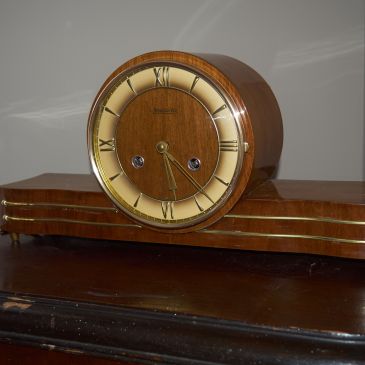

Girod movement in Canadian made case

Mantel clock
Mantel clock

This fairly non-descript mantel clock is a puzzler. It has a nicely constructed case with curved wood relief features and a westminster chime, hence the three winding arbors. It is in very good condition and required a simple de-greasing of the cabinet to bring it back to it’s former glory.

The clock was presumably made after the war years, perhaps the late 1940s and has a pendulum movement. Most mantel clocks beginning in the 1950s had balance wheel escapements so I am putting this in the late 1940s perhaps even the early 1950s. This particular mantel clock has a French Girod westminster chime movement.

Girod was a clock maker based in the Morbier-Jura region of France and produced clocks from the 1930’s into the 1960’s. The firm of Girod was founded in 1865 by brothers Leon and Auguste Girod. The clocks were made almost exclusively in the Art Deco style. This clock has Art Deco features particularly the formation of the dial numerals but I would not say it was sold as a Girod clock.

RS Girod mantel clock (8)
Dial face

Girod clocks (both mantel and tall case) often came with Westminster chimes, and often a second chime named Cloche de Jura, using the same notes as the Westminster chime. A handful of clocks were built with Ave Maria de Lourdes, and  St. Etienne chimes. This clock is westminster chime only; no double chime feature unfortunately. Girod cases usually featured carved walnut appliques and were very ornate, almost garish. Mine is very plain and as I said non-descript.

So, what is it? Well, from my research I have discovered that despite the fact that the clock movement is stamped Girod, it might be a German Kienzle movement. Girod movements had the distinctive feature of split plates, this one has solid one-piece plates. Again my research reveals that as a result of the post-war German reparation effort, Kienzle clock movements were brought from Germany into the Girod factory in France, assembled and stamped as a Girod movements for, it is my guess, export to Canada and other countries.

Another clue. The case has a stamp on the back. It is a little faded but it says, “Quality Cabinet Made in Canada”. There are three letters in the middle that I cannot make out. PHS or FHS perhaps?

RS Girod mantel clock (11)
Upside down stamp on back

There is no trademark on the dial face which would normally indicate the retail seller or manufacturer but my guess is that it was likely sold as a Forestville mantle clock (the Forestville Clock Company was based in Toronto). The logo (??) punched into the hour hand makes me wonder though.

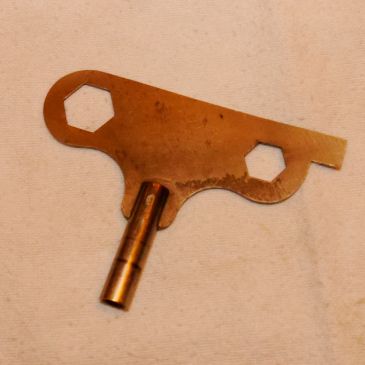
Look at the key. Why two wrench punch-outs and a screw driver end?

RS Girod mantel clock (1)
Key with screwdriver and wrench punch-outs
RS Girod mantel clock (4)
Girod movement showing chime rods and unusual pendulum

The above shot shows the movement. It has five strike hammers, 4 of which carry the Westminster chime and three hammers for the on-the-hour strike. The strike feature is quite loud. The rods appear to be differing lengths of copper and the pendulum has a relief of the Eiffel Tower that you can just make out. There is also a lever on the upper front of the movement which serves as a repeater. The movement appears to be very sturdily built and reflects German (??) quality.

Again my best guess is the Forestville Clock Company of Toronto but if you have other information or if you know more about the history of Girod clocks please drop a line.

Forestville mantel clock

If you’re expecting a post about clocks from the Black Forest region of Germany, I apologize for the mix-up. This article is actually focused on the Forestville Clock Company of Canada.

Forestville clocks were assembled in Canada with foreign movements in local and foreign-made cases through the late 1920s to the mid-1970s. Forestville mantel clock

This particular Forestville mantel clock is not particularly special but it comes with a story.

In 2013, during a visit to the Thousand Islands, my wife and I stopped by an antique store in Gananoque, Ontario. While browsing, I was drawn to a clock that caught my attention. I was somewhat familiar with the Forestville name, as the Forestville Clock Company of Toronto had assembled thousands of these clocks. The price tag on the back was $175, which seemed a bit high to me. We stayed overnight in the area and decided to return to the store the next day. When we did, a different clerk was on duty. Although I knew the price listed, I asked him what the clock was priced at, just out of curiosity. Without checking, he replied, “It’s $75,” and I bought it. Afterward, he noticed the price tag on the back and said, “You got a good deal.” I think he learned something that day.

History of the Blackforest Clock Company of Toronto

The Blackforest Clock Company of Toronto, Ontario was founded by Leopold and Sara Stossel in 1928.  Both clock movements and complete clocks were imported from Germany and sold through department and jewelry stores across Canada. Their son Ed Stossel started working part-time with his parents’ company in the 1930s and later became a full-time employee in the late 1940s.

Some assembly work was carried out in their Wellington Street East factory. Initially, imported mantel clocks and grandfather clock movements were installed in cases made in Kitchener, but later the complete mantel clocks were imported from Germany. This arrangement was interrupted by the Second World War, which also led to a name change to the Forestville Clock Company in 1941. During the war years, this company imported its clock movements from England, the United States, and even France. However, starting in the mid-1950s German factories again became the source of most Forestville clocks, with Mauthe being a major supplier. (source: The Canadian Clock museum)

The Forestville Clock Company was very successful during the middle decades of the twentieth century. Ed Stossel retired in 1979 and unfortunately, the company survived just a few more years under new leadership.

Dial of clock
closeup of the dial

Both the movement and case were imported from Germany probably in the late 1960s or the early 1970s and the style reflects that period. There is a serial number on the backplate but it is not much help in dating the exact year the clock was made.

Movement of clock
Movement showing evidence of over-oiling

As clock manufacturers were searching for efficiencies, lever escapements replaced floating balances and pendulums in the 1960s and 1970s. I much prefer a pendulum clock but clocks such as this have the advantage of operating on surfaces that are not level.

Balance wheel and hairspring escapement
Lever escapement with speed regulator

This is a closeup of the strike lever mechanism.

inside of mechanical clock
Lever mechanism for strike
strike mechanism
Lifting mechanism for strike function

The three strike rods give the clock a “bim-bam” sound on the half-hour. Not unique but disctinctive.

This mantel clock is a handsome piece with great lines and makes a wonderful addition to my growing collection of antique and vintage clocks. However, it is quite dirty and will need a thorough cleaning. I’ll save that task for another post.

A detail can make all the difference

on display (3)
Horse Crown Mauthe wall clock on display

I acquired this beautiful Mauthe Horse Crown Vienna style wall clock in the fall. I inspected it carefully enough before the purchase but it was not until I got it home that I discovered a finial or perhaps a trim piece missing from the base area on the bottom.

OLYMPUS DIGITAL CAMERA
Missing trim or finial

Once hung the clock did not look as balanced as it should. It did not look quite right and there was clear evidence of a piece missing when I inspected the bottom more closely.

I went to the usual clock parts sites to look for a finial or piece that would best fit the design of this turn of the century wall clock. There were a number of choices but I decided to get the base piece finial you see here. It is flat on one side and comes without a peg. It complements the style of the clock without making it look awkward and I think I struck the right balance. It may not be exactly like the original but it looks good enough to fool the casual observer or even an expert.

The trim piece came unfinished. I determined that the clock had an original walnut finish so proceeded to apply enough coats of stain on the trim piece to match the rest of the clock.

Here is the result.

RS Finial added (1)
Trim piece added to base of clock

Here is a shot of the clock from a couple of meters away. You can see that it is more “balanced” than before. it might even be period-correct judging from what I have seen on other Vienna style clocks.

RS Finial added (3)
A small detail makes a difference

72.9703-300
From Perrin Canada

This cost me $6.70 for the trim piece / finial I purchased from Perrin Canada, $4.99 for the dark walnut stain and $.79 for a length of 5/16 dowel. This small detail makes a huge difference.

Let me know what you think.

Mauthe Horse Crown Century-old Wall Clock

Another wall clock has joined my collection, so let’s take a closer look at what I’ve acquired and whether it was worth the price I paid.

Time and strike movement, 116 BPM

The clock was advertised locally in the Truro, Nova Scotia area. The seller knew little about it beyond its provenance, but what he did share was an interesting, albeit brief, story.

In the early 1980s, his wife brought the clock over from Holland, where it had been in her family for several generations. Sadly, his wife passed away three years ago. Had she been alive, I’m sure I would have learned much more about the clock’s history. The seller was understandably hesitant to part with it, as it served as a happy reminder of his past life. However, he was entering a new phase of his life with a new partner, which meant letting go of furniture and other possessions. Like him, I also view life as a series of phases. The clock was priced at $100, firm and non-negotiable.

This two-train (time and strike) spring-wound clock could be described as being in the style of a Vienna Regulator. As expected, the movement is quite dirty—a common issue for clocks like this that have often never been serviced. However, there are signs that adjustments were made at some point, evidenced by marks on several screws in the movement.

The clock is largely intact, except for a missing finial at the center of the bottom base. Why this particular part? According to the seller, the clock was brought over in a suitcase, and to make it fit, the bottom finial was snapped off and lost forever.

OLYMPUS DIGITAL CAMERA
Movement showing FMS Mauthe trademark

The clock is over 100 years old, with my research indicating it was made between 1895 and 1914, though the exact year of manufacture remains uncertain. The trademark—a Friedrich Mauthe of Schwenningen (FMS) emblem featuring three spokes with an eagle on top—is distinctive, as Mauthe trademarks are known to reflect the specific period during which the clock was produced.

Despite some benign neglect, the case is in good condition, and everything appears to be original, including the winding key.

OLYMPUS DIGITAL CAMERA
The crown

The crown fits into a slot at the top of the clock and can be easily removed if the clock needs to be relocated. The crown is made of wood, while the horse appears to be crafted from a casting material of some kind.

OLYMPUS DIGITAL CAMERA
The face

The dial is made of celluloid and has darkened with age. Inside the dial surround, there is a leaf-like emblem, a common design feature from this period.

OLYMPUS DIGITAL CAMERA
The base and bottom finials

The base is fairly plain, though the bottom center finial is missing. I plan to replace it.

OLYMPUS DIGITAL CAMERA
The coil gong

The coil gong and block with attached movement rails are characteristic of the period.

History of FMS Mauthe

Mauthe clocks have a long and distinguished history in Germany. In 1844, Friedrich Mauthe and his wife Marie founded the company in Schwenningen to produce watch parts. By the late 1860s, Mauthe began manufacturing its own wall clocks and movements. In 1876, Friedrich’s sons Christian (1845-1909) and James (1847-1915) took over the company. In 1886, Mauthe began producing its own springs. Around 1900, the company expanded its offerings to include alarm clocks, pendulum wall clocks, grandfather clocks, office clocks, and the so-called “Buffet Uhren” or “Buffet clocks.” In 1904, the third generation took charge: Eugene Schreiber (1877-1939), son of Christian Mauthe; Dr. Fritz Mauthe (1875-1951), son of Jacob Mauthe; and Alfred Mauthe (1879-1911), son of Jacob Mauthe, helped build upon the foundation of the company.

In 1925, Mauthe introduced a new trademark featuring a right-facing eagle with outstretched wings, clutching a three-part round plate inscribed with the letters F, M, and S. By the 1930s, the company was producing around 45,000 clocks per week, with approximately 60% destined for export markets like England. In the mid-1930s, Mauthe began manufacturing its first wristwatches, some of which were supplied to the German Army (“Wehrmacht”). After 1946, Mauthe resumed wristwatch production, but the company eventually entered a period of decline.

Was it worth $100? I would say yes, but it’s on the higher end of what I would typically pay for a clock like this.

Now, it’s time to clean the clock, install a new bottom middle finial, and add it to the queue for servicing.

U M Muller Box Clock

Probably not a household name in its time, yet U. M. Müller produced clocks that could stand proudly beside the finest German makers of the early 20th century. Their box clocks, in particular, became strong competitors, capturing a market that was shifting away from the ornate Vienna regulator toward something more modern, practical, and affordable. By the 1930s, the sleek German box clock—with its simpler lines and middle-class appeal—had all but closed the Vienna regulator era.

This particular U. M. Müller is a striking example. The oak case features delicate carved inlays on the door, brass strip framing, and a fixed wood crown, giving it a stately presence. The brass bezel surrounds a metal dial with spade and spear hands, while beveled glass framed in brass completes the look. Wall stabilizers ensure a secure mount, reminding us that this was a clock built not just for beauty, but for reliability.

after a good cleaning (4)
All original German box clock

The case itself has aged beautifully, with no noticeable scratches or blemishes. The dial, however, tells a different story—its surface bears marks and abrasions, including one between the 6 and 7 where the paint is worn through to bare metal. It is not repairable, but it does speak to the long life and service this clock has seen.

U M Muller clock (9)
Incorrect use of a cleaning agent

Inside, the movement is a classic rack-and-snail time and strike. The clock chimes on a coiled gong—bold at the half hour, more resonant on the hour, but never harsh. As with most spring-driven movements, one should not expect chronometer precision. Still, this example proves steady and reliable, keeping “regular” time across its full 8-day cycle.

U M Muller clock (2)
Inlay carvings meets brass strip framing

After a careful cleaning and waxing, the case now shows hints of what it must have looked like when new—over 90 years ago.

U M Muller clock (4)
2 screws are loosened to remove the movement

Collectors often date U. M. Müller clocks by the lion trademark on the dial. A raised tail indicates pre-1930 manufacture; a lowered tail, as on this example, places it in the mid to late 1930s.

after a good cleaning (1)
An attractive addition to our kitchen

According to Schmid’s Lexikon, the company’s roots trace back to 1867 in Mühlheim. After passing through several hands—including R. Schnekenburger around 1880 and later Gebrüder Müller—the brand built a legacy of solid, handsome clocks that still charm collectors today.

Blackforest shelf / kitchen / cottage clock

RS together but not working (2)
Finished case

This is a Blackforest shelf or kitchen clock made before the Second Word War. Blackforest is a Canadian clock company.  The Blackforest Clock Company of Toronto, Ontario was founded by Leopold and Sara Stossel in 1928.  Both clock movements and complete clocks were imported from Germany and sold through department and jewelry stores across Canada.  Their son Ed Stossel started working part time with his parents’ company in the 1930s, and later became a full-time employee in the late 1940s.

Some assembly work was carried out in their Wellington Street East factory.  Initially, imported mantel clock and grandfather clock movements were installed in cases made in Kitchener, but later the complete mantel clocks were imported from Germany.  This arrangement was interrupted by the Second World War, which also led to a name change to the Forestville Clock Company in 1941.  During the war years this company imported its clock movements from England, the United States, and even France.  However, starting in the mid nineteen fifties German factories again became the source of most Forestville clocks, with Mauthe being a major supplier. The company did not survive much past the late 1970s.

I found this in a antique shop in Kazabazua Quebec and it was in sad shape. This particular clock would have been the least expensive in the Blackforest catalog. I had an opportunity to go through the Blackforest catalog during my visit to the Canadian Clock Museum in Deep River this past summer and could not find a listing. I have no idea of the model name or number as there is no label on the clock. The only feature it shares with other Blackforest mantel clocks is the metal bezel, numerals and hands. Otherwise it is a one train time-only movement with a minimum number of gears and a unique twisting pendulum adjustment. The movement is as simple as it gets so it is easy to work on.

The photo shows the movement out of the clock and as you can see, it is quite dirty. I am in the midst of dis-assembly, cleaning (in my new Ultrasonic cleaner) and oiling. My initial observation is that the pivot holes, pivots and lantern gears are in good shape and the mainspring seems strong. Not a lot of wear for a 75+ year old clock.

RS Blackforest mantel clock (66)
Single train time-only movement

The next photos show the condition of the case when I bought it and the second is the first phase of stripping. You will notice that I did not disturb the decal; it would have been impossible to find a replacement. It was in terrible condition, likely sitting in a attic or garage for quite a few years. The spring was wound very tight and I am assuming at this point that dirt and grime caused it to cease. Although I paid $15 for it at the time it seemed too much after I got it home. Nonetheless, I went to work on it and if I can get it to function it might be worth more than I paid for it. As far as restoring this clock I used a latex dark walnut wood satin and a polyurethane top coat, not what would have been done at the time which likely would have been a dark lacquer finish. This method will be more durable. The first photo shows the case is in a restored condition and as you can seeing it is a striking little clock.

RS Blackforest mantel clock (48)
RS Blackforest mantel clock (77)

Mauthe Mantel Clock – called a buffet clock by the marketing folks at Mauthe

Mauthe mantel clocks are widely available in various shapes and sizes, often appearing on online marketplaces, at garage sales, flea markets, and in antique shops. However, not all are well-preserved, with many showing signs of age and neglect. This particular round-top mantel clock stands out for its excellent condition, especially considering its age.

RS Mauthe mantle clock (30)
Mauthe buffet clock

While this is commonly called a mantel or shelf clock, in Mauthe marketing parlance it is referred to it as a “buffet clock”. In the mid-20th century, clocks of this style were often designed to sit on buffets, sideboards, or credenzas in dining rooms. This placement allowed the clock to serve both a decorative and practical purpose that complemented the room’s furnishings. The term “buffet clock” reflects its association with this specific setting, distinguishing it from mantel or shelf clocks, which were typically placed in living areas or on fireplaces.

This 3-train Westminster chime pendulum clock features a 5-rod gong block and plays a quarter-hour musical tone. I discovered it at an antique shop in Great Village, Nova Scotia (Canada) some time ago. The movement is unmarked, lacking a trademark, but bears the number 50089 on the bottom right of the rear plate. There is no doubt that the movement is original to the case.

RS Mauthe mantle clock (29)
Back of the clock showing the 3-train movement
RS Mauthe mantle clock (28)
Mauthe clock and Stromberg Carlson console radio

Mauthe – The Company

Mauthe clocks were produced in Germany by a company with a long and distinguished history, manufacturing thousands of wall, mantel, office, and hall clocks. Founded in 1844 by Friedrich Mauthe and his wife, Marie, in Schwenningen, Germany, the company initially focused on producing watch parts. By the late 1860s, Mauthe began making its own wall clocks and movements, some produced through the “Gewerblern” method, a form of cottage industry, while others were made in a more industrial, factory-based approach.

In 1876, the Mauthe sons, Christian and James, took over the business. A decade later, in 1886, Mauthe started manufacturing its own spring mechanisms.

By around 1900, Mauthe offered a range of clocks, including alarm clocks, pendulum wall clocks, grandfather clocks, office clocks, and “Buffet Uhren” (Buffet clocks). At this time, the company employed around 1,100 people. The third generation of the Mauthe family took control in 1904, with Eugene Schreiber, Christian Mauthe’s son, Dr. Fritz Mauthe, Jacob Mauthe’s son, and Alfred Mauthe, Jacob’s other son, joining the leadership.

In 1925, Mauthe introduced a new trademark featuring an eagle with outstretched wings, clutching a three-part round plate marked with the letters F, M, and S. By 1930, the company was producing approximately 45,000 clocks per week, with over 2,000 employees. Around 60% of their production was for export, with England being the primary market.

In the mid-1930s, Mauthe began manufacturing wristwatches, some of which were supplied to the German Army (Wehrmacht). After a brief pause during the war years, Mauthe resumed production in 1946, focusing on wristwatches. The company continued operations through the 1950s, 1960s, and 1970s, but ultimately declared bankruptcy and closed in 1976.

RS Mauthe mantle clock (11)
Clock face showing three arbour points

This clock runs a complete 8-day cycle and produces a very pleasant sound. The case features a simple yet attractive design, is in excellent condition, and the movement is clean, having been recently serviced.

This Mauthe buffet clock is a fine example of the company’s craftsmanship, combining reliable timekeeping with a pleasing chime. Its well-preserved condition and recent servicing make it a standout piece for any clock collector.

Website Powered by WordPress.com.

Up ↑