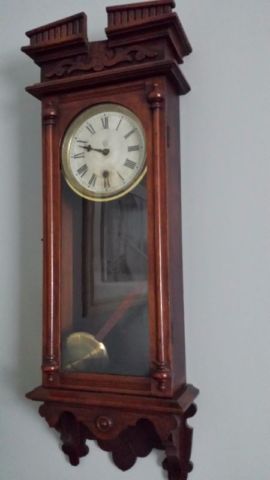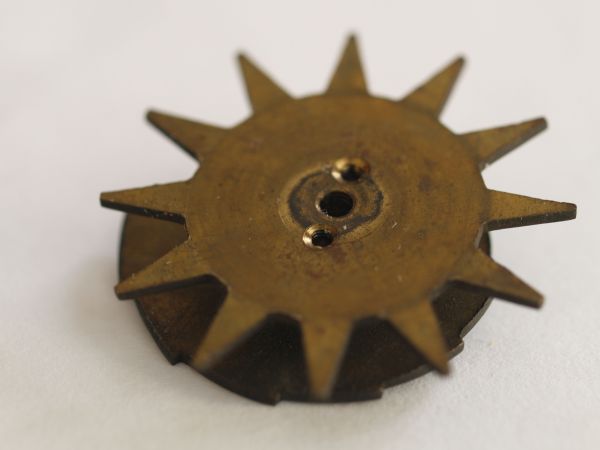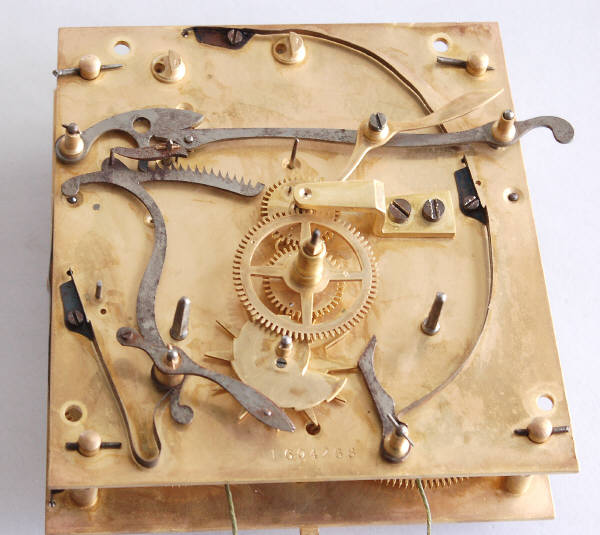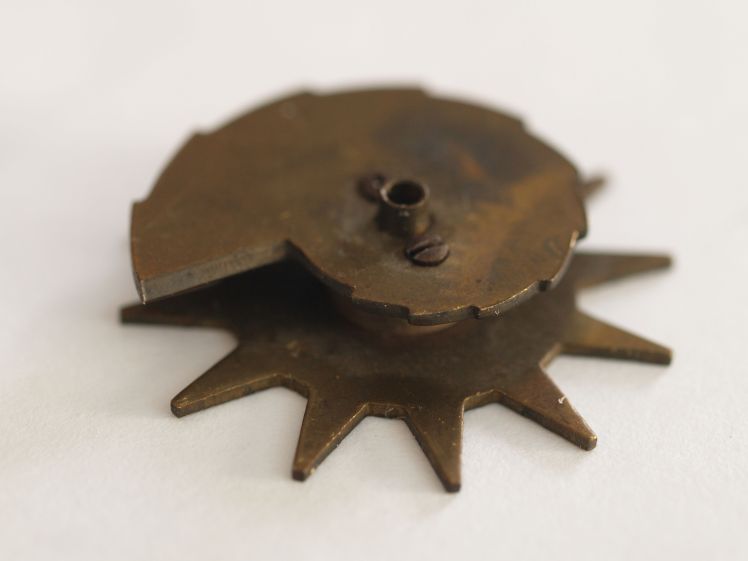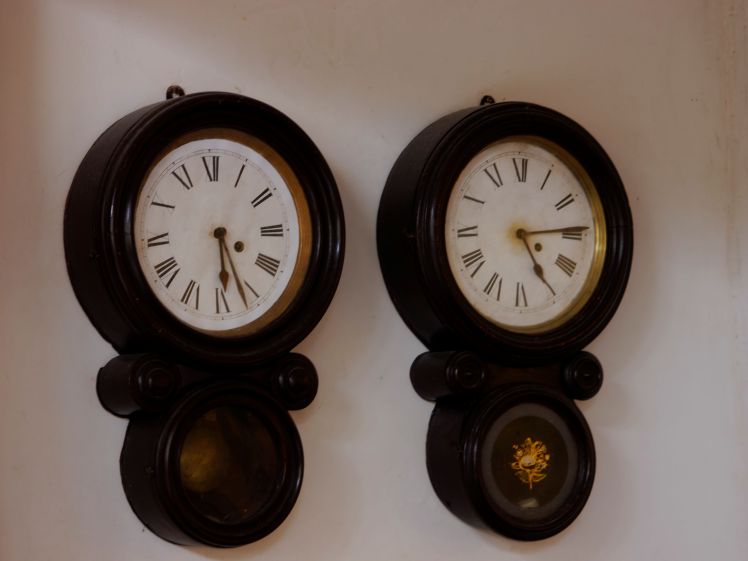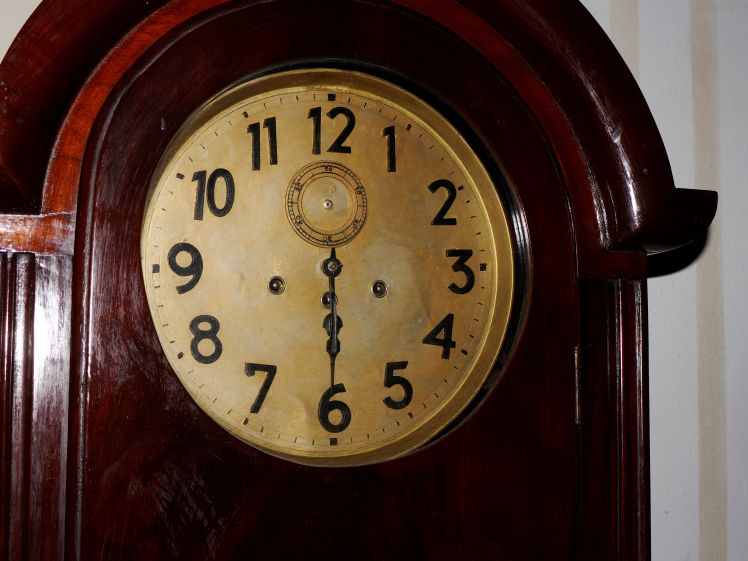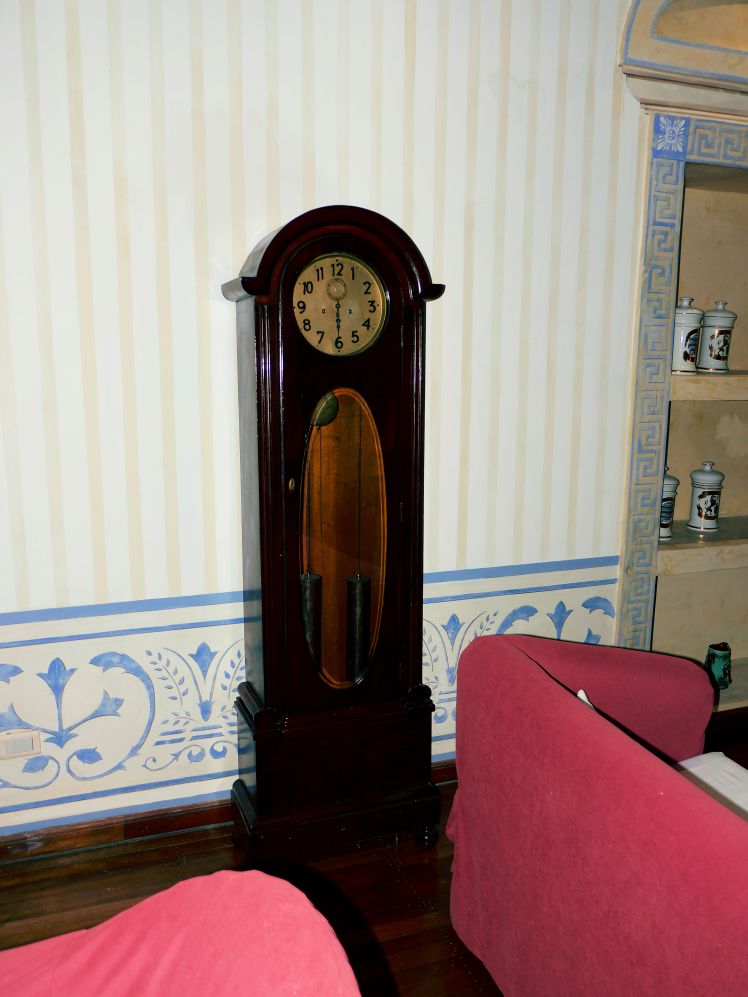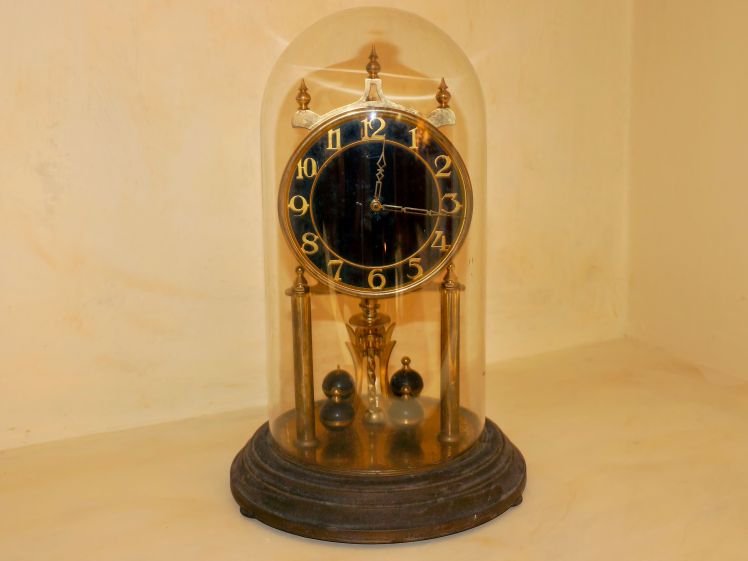
Is my clock worth fixing?

It is a question many clock owners face when confronted with a nonfunctional antique or vintage clock. Whether it’s a handed-down family heirloom, a vintage find from a flea market, or a sentimental gift, deciding whether to invest in repairs can feel daunting. Beyond its monetary value, a clock’s worth often lies in its history, craftsmanship, or the memories it holds. In this article, we’ll explore key factors to consider—such as the clock’s condition, sentimental significance, and potential repair costs—to help you determine whether restoring your clock is the right choice for you.

1) Sentimental value:

An antique clock passed down through generations often carries more than just the weight of its years; it holds the stories, traditions, and memories of a family or a special person. Such a clock may be destined to continue its legacy with future generations.

Similarly, a clock might hold personal significance as a cherished anniversary present, a thoughtful retirement gift, or a token of friendship. In these cases, the emotional value far outweighs its replacement value, making the clock truly “one of a kind” and irreplaceable. Repairing a clock with this kind of sentimental importance is unquestionably worthwhile. When entrusted to a trusted, professionally certified repair person (horologist), the restoration ensures its continued presence in your life, regardless of its resale value.

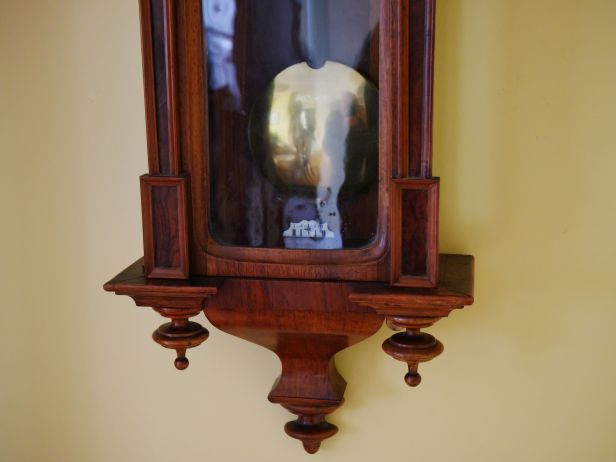
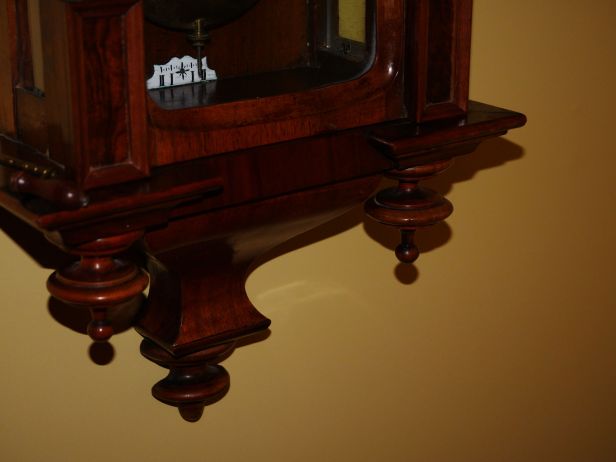
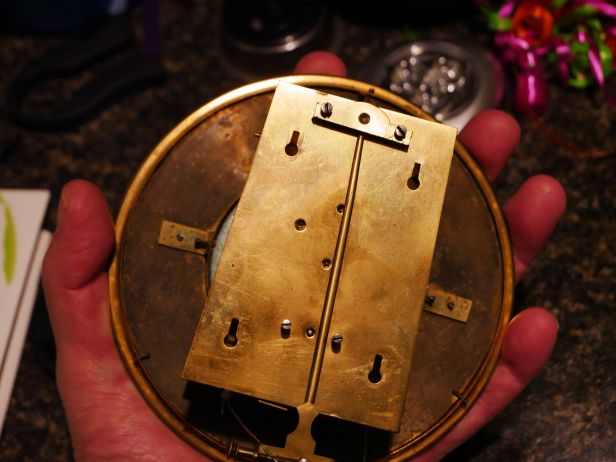
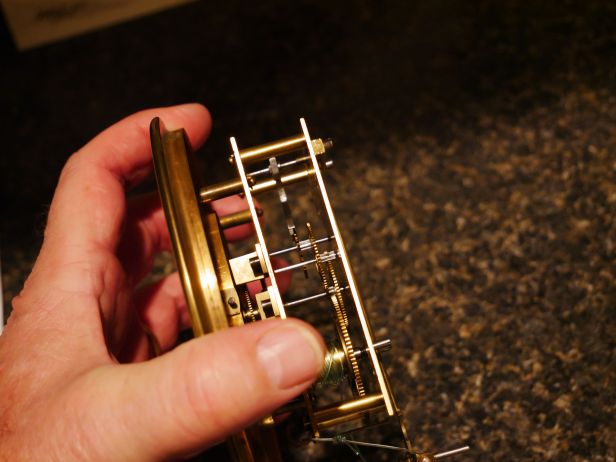
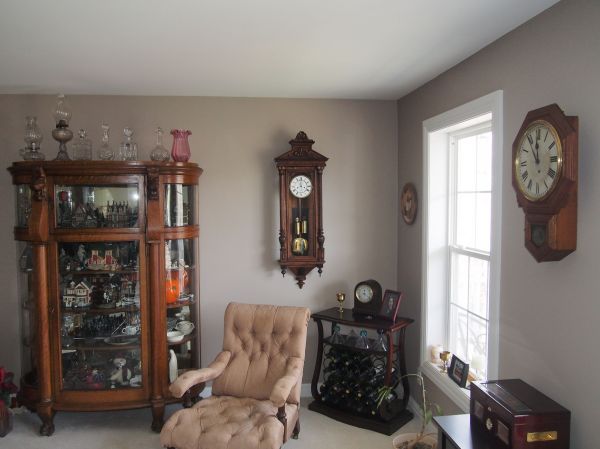
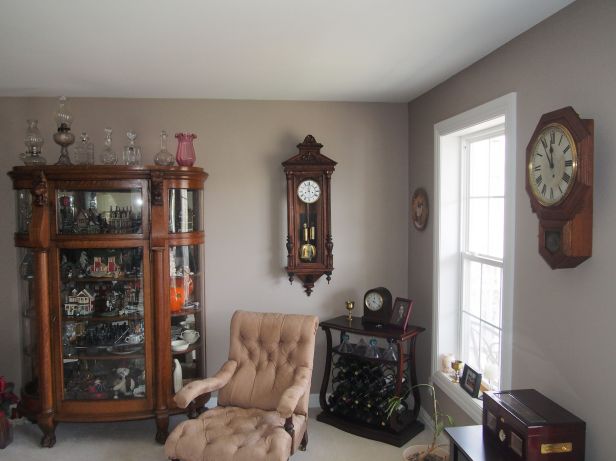
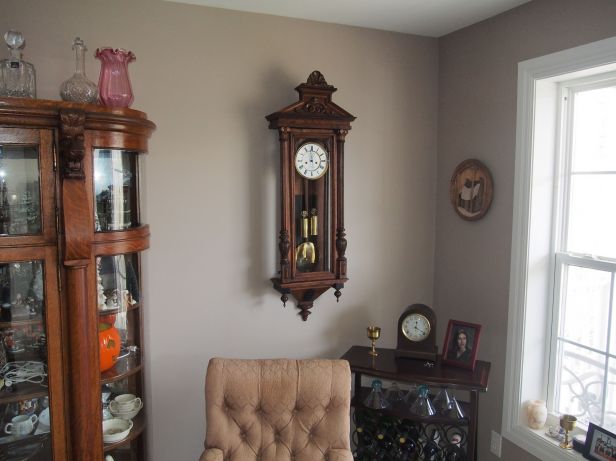
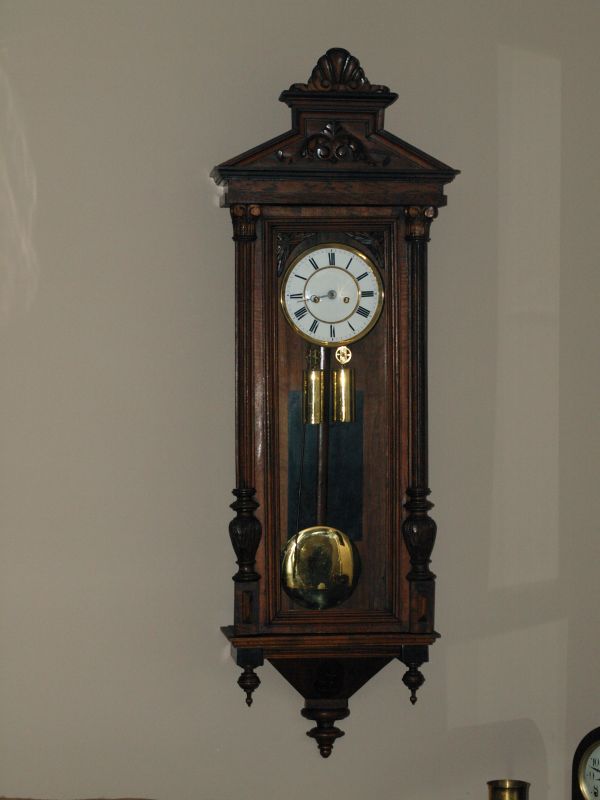
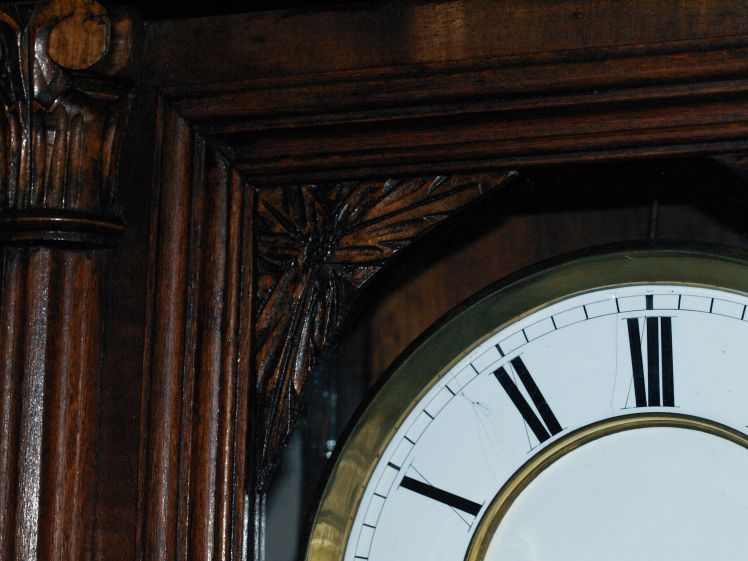
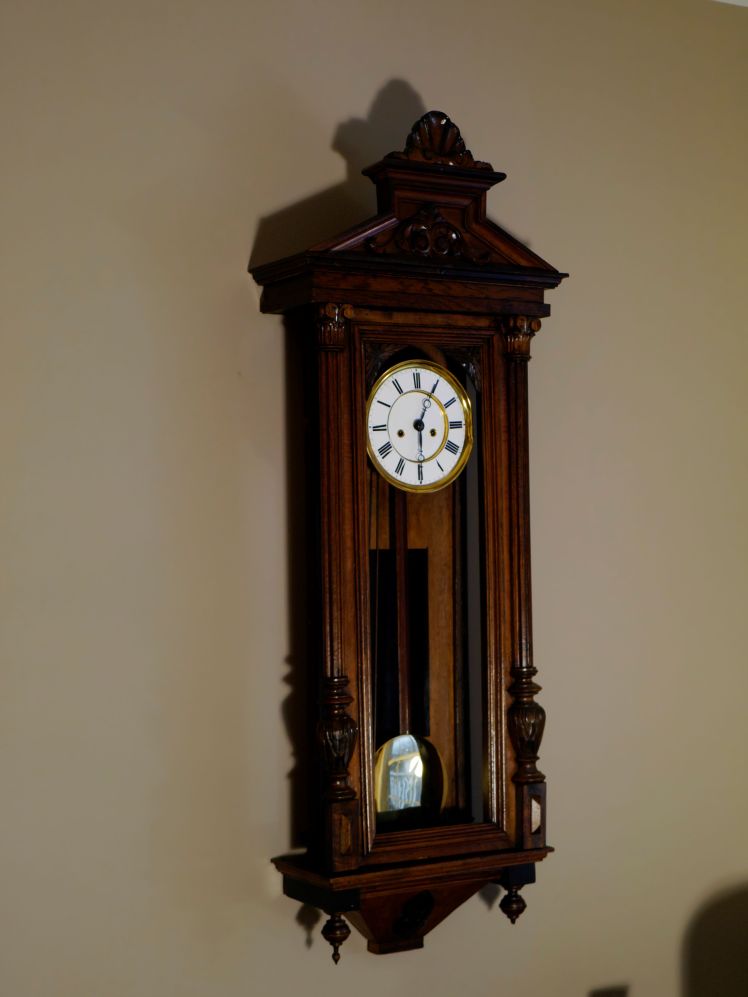
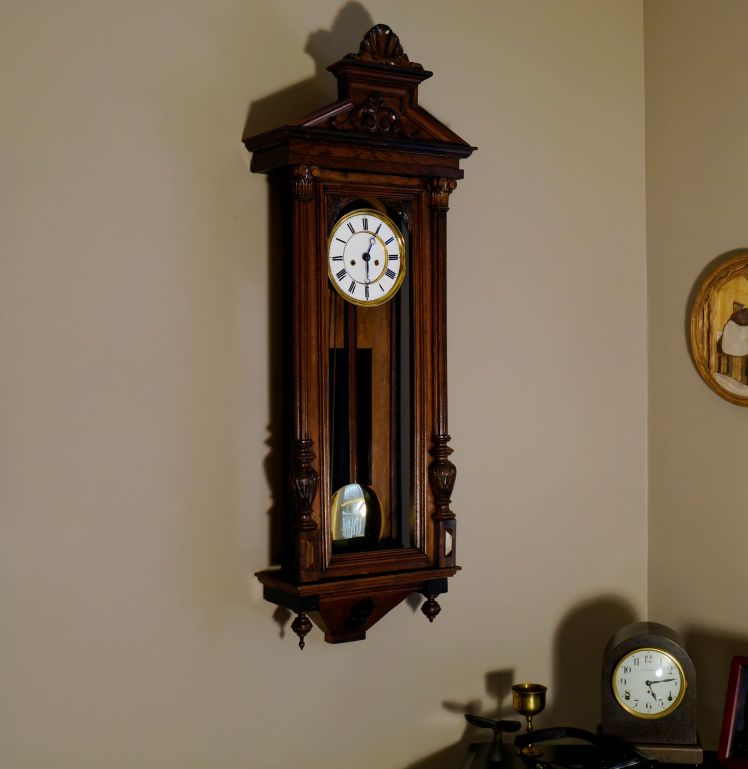
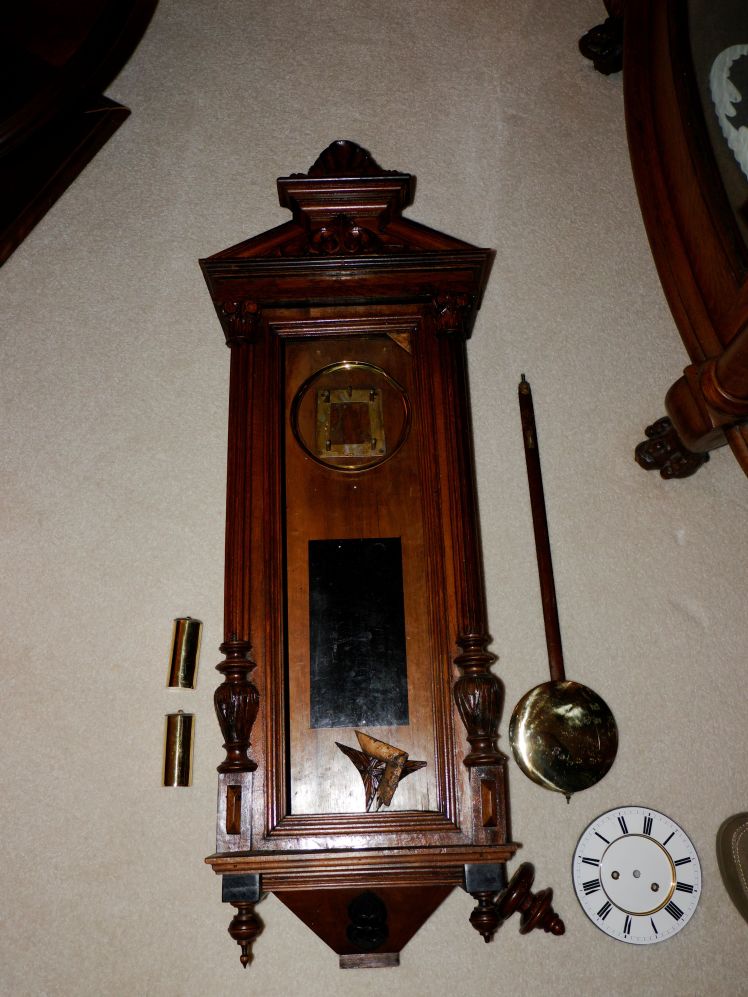
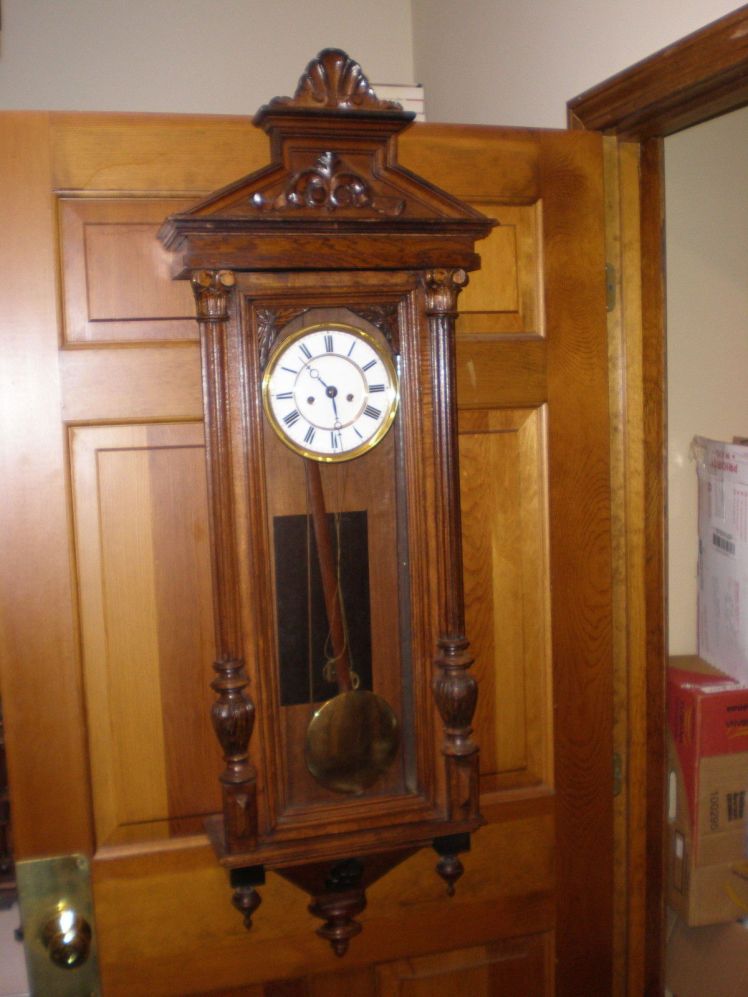
For instance, my 114-year-old Gustav Becker two-weight Vienna Regulator, a retirement gift from my wife, holds immense sentimental value. Initially purchased as a project clock on eBay, it required substantial investment to function correctly. Today, it looks stunning and runs beautifully, but repairing it wasn’t about the cost; it was about preserving something irreplaceable. In such cases, the expense of repair becomes less of an investment and more of a necessary operating cost to keep a beloved treasure alive.
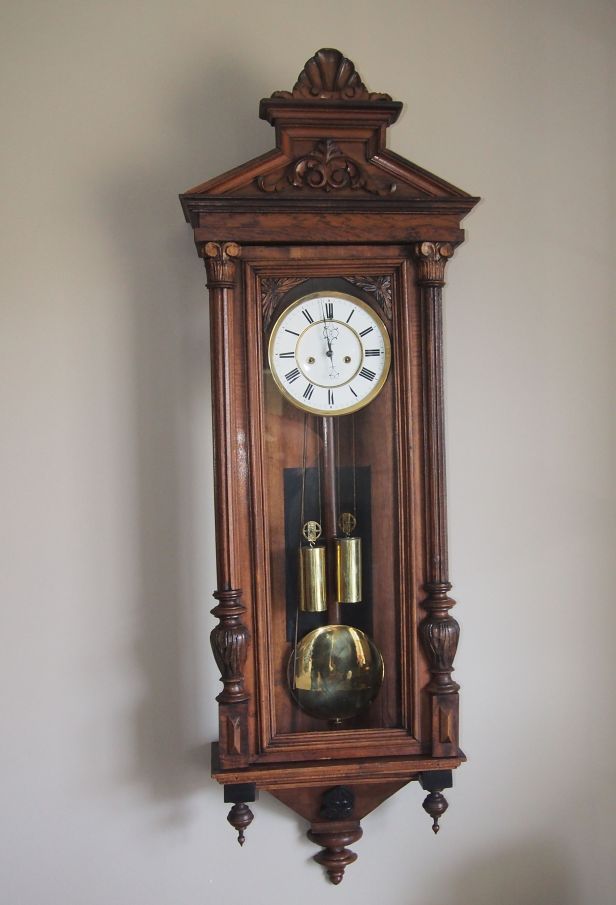
Gustav Becker two weight regulator
Gustav Becker two weight regulator, a retirement gift from my dear wife

I own a Ridgeway grandfather clock that I plan to pass down to my children. It holds deep sentimental value, reminding me of a clock my wife and I nearly purchased over 30 years ago. At the time, we decided not to proceed with the deal but made a promise that we would one day own a grandfather clock like it. That promise was fulfilled in 2012 when we found a Ridgeway Hamilton Country grandfather clock, made in 1996 and in pristine condition. If and when it eventually requires repair, the cost may equal its market value, but to me, the repair would be well worth it. Its sentimental significance far outweighs any monetary considerations.
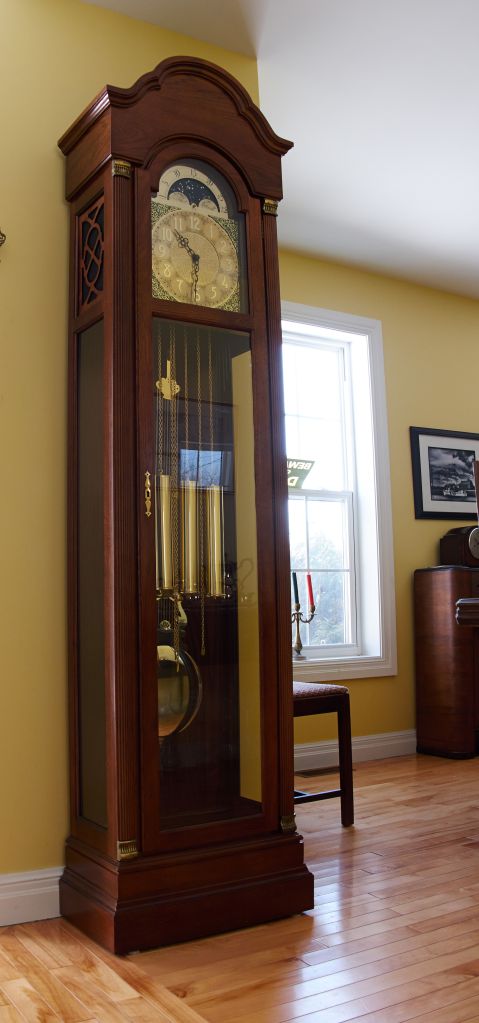
RS Ridgeway clock_2
Ridgeway Hamilton Country Westminster chime tall clock

2) A decorative item: The second type of clock is one with no emotional value—purely a decorative piece that no longer works. Perhaps it was a flea market find you got running for a time, but now it has stopped. In this case, you have two options: let it sit as a decorative item or repair it. When considering repairs, the replacement value of the clock should play a key role in your decision. If the repair costs exceed the cost of replacing the clock, it may make more sense to simply replace it.

However, if you have the tools and skills to repair it yourself, weigh the cost of new parts against your time and effort. For quality clocks, even a full overhaul of the movement may cost less than the clock’s actual value. With common antique clocks, such as American mantel or wall clocks, repair costs often approach or even exceed their market value. For rare or unusual clocks, however, repairs are typically more economical relative to their value, making the investment worthwhile.

3) Collector value: The third category includes clocks with collector value.

If a clock has been purchased as an “investment,” for resale, or simply as part of a collection, the repair costs should not exceed its overall value. For high-grade clocks requiring repair, especially if parts are unavailable, it’s important to carefully consider whether repairing it is worthwhile. When selling a clock, remember that buyers almost always prefer one in working condition, and as original as possible, so minimal repairs may enhance its appeal and value.

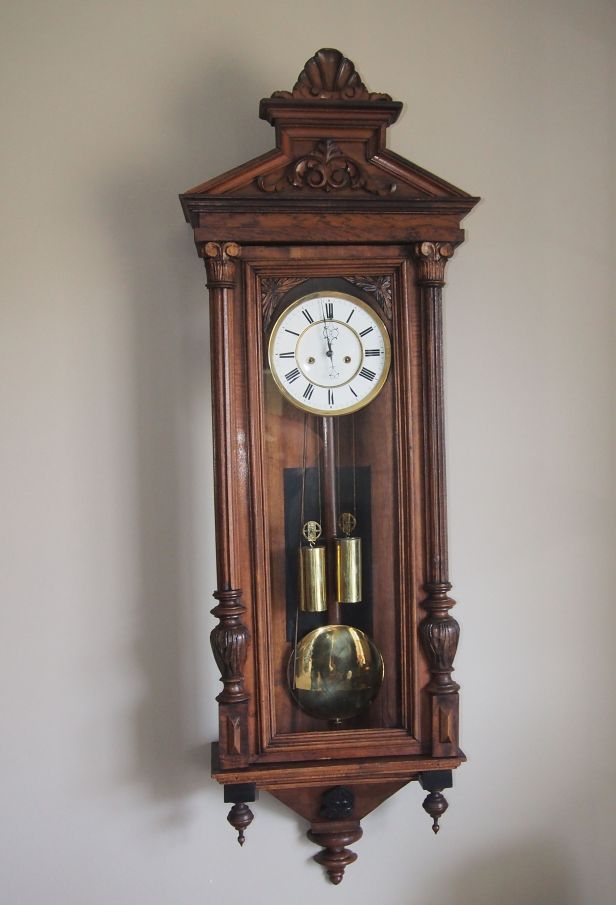
For example, I recently acquired a miniature Vienna Regulator. Not only is it in good working order, but it is also in exceptional condition—an impressive feat for a clock that is 145 years old.
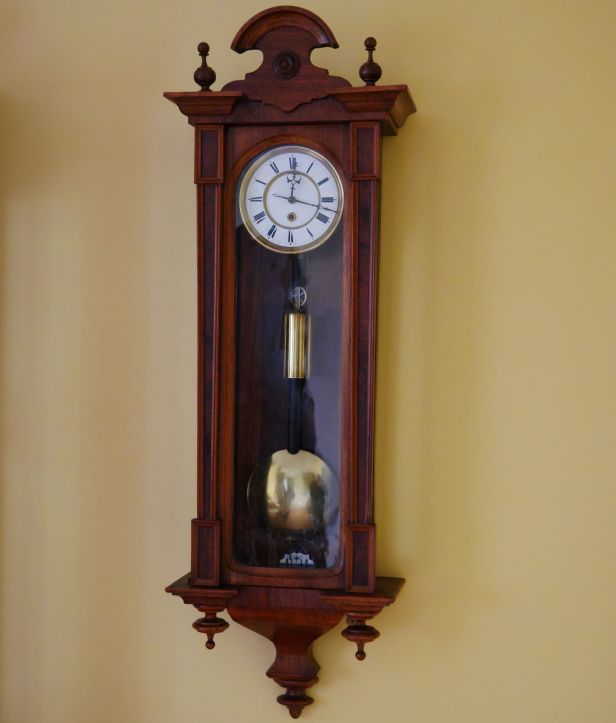
one-weight Vienna wall clock
One-weight Vienna miniature wall clock, circa 1870

For collectors, determining a clock’s value can be challenging, especially with the significant fluctuations in clock prices in recent years. However, certain types of clocks, such as high-quality French bracket clocks, English lantern clocks, carriage clocks, and jeweler’s regulators, have managed to retain their value. Clocks that are unique, exquisitely crafted, low-production, or one-of-a-kind are typically far more valuable than common, mass-produced examples.

4) Quick re-sale: The final category includes clocks purchased for quick resale.

Many individuals buy and sell antique and vintage clocks purely for profit, often through online marketplaces or specialized sales. When acquiring a clock with the intent to resell, it’s important to factor in both the time and cost of repairs or parts needed to make it marketable. Since buyers almost always prefer a functioning clock, a fully serviced clock is not only more desirable but can also command a higher price than one left unserviced.
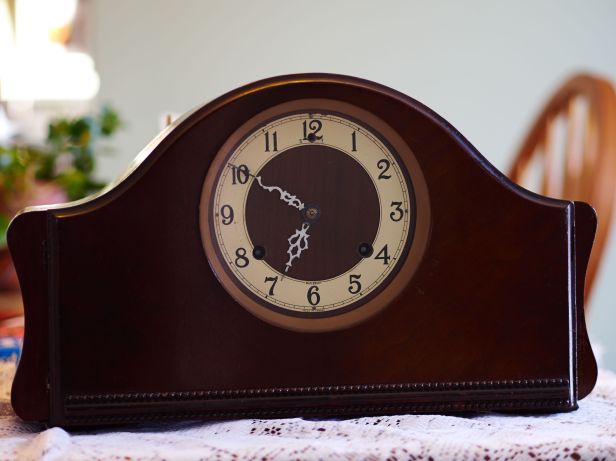
OLYMPUS DIGITAL CAMERA

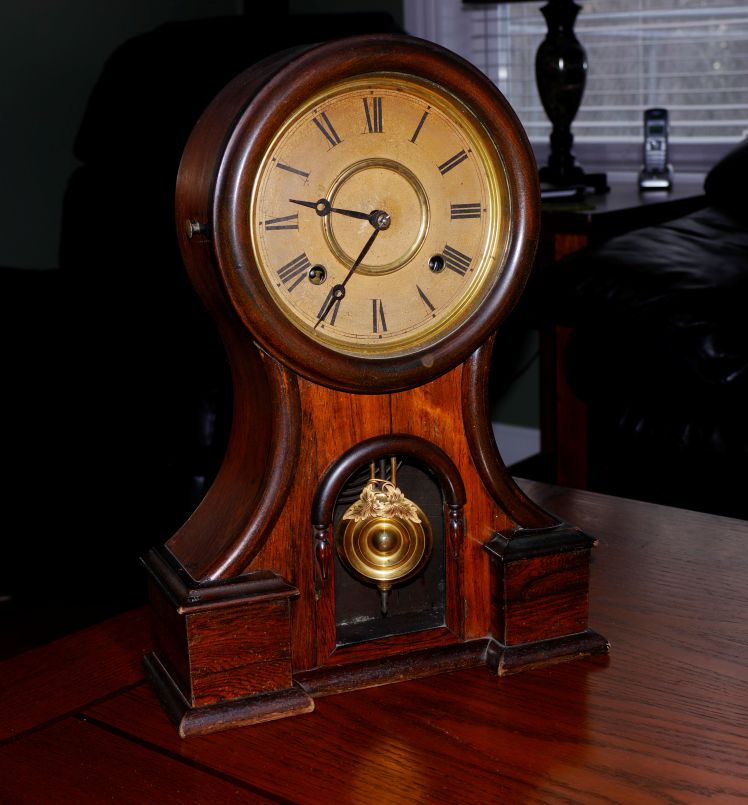
This Ingersoll-Waterbury mantel clock (photo above) was purchased at a flea market for a very reasonable price and has since been fully serviced. If I were to sell it, I would need to recover the initial purchase price along with the cost of my time and supplies.

It’s worth noting that many clocks sold on online marketplaces are marketed to unsuspecting buyers. Sellers often claim the clock is in “excellent running condition” while adding a caveat that it “may require adjustment after shipping.” If you’re involved in buying and selling, keep in mind that buyers are often looking for a bargain. Additionally, you may not always achieve the price you believe your clock is worth, so pricing realistically is essential.

Final thoughts

There are many reasons why people acquire antique and vintage clocks. Deciding whether they are worth keeping or repairing ultimately depends on your purpose—whether it’s for profit, sentimental value, or a passion for collecting, as it is for me. Each clock has its own story and value, and understanding your connection to it will guide your decision.
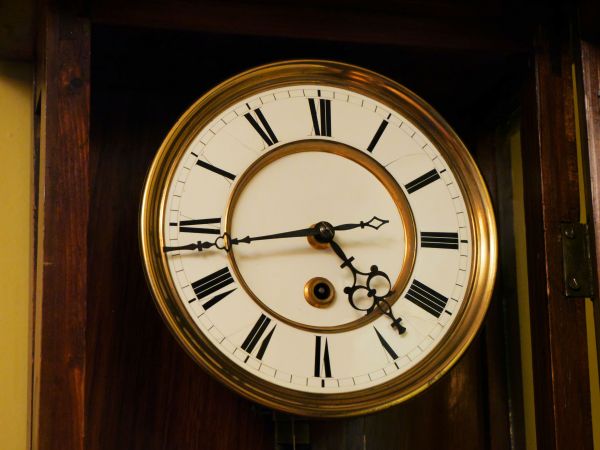
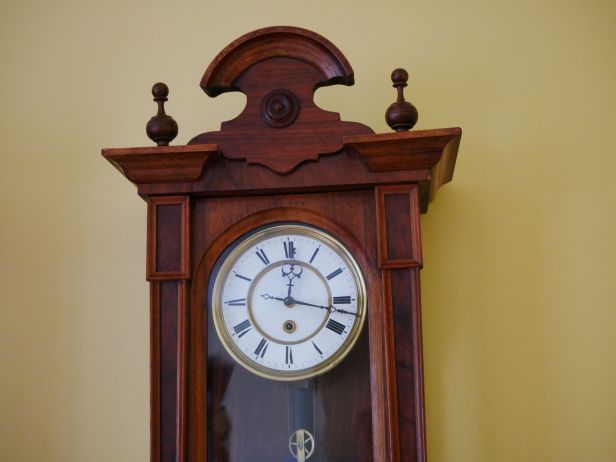
One weight Vienna Regulator miniature

My quest for a one-weight Vienna Regulator ended this past week and I am now in possession of a miniature rather than a traditional antique Vienna wall clock. Here are first impressions back in 2016.

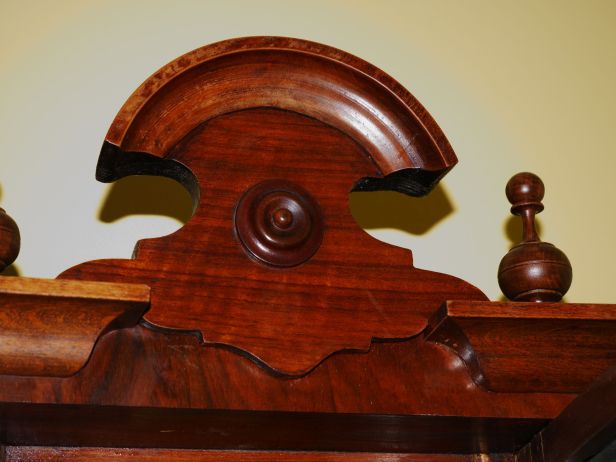
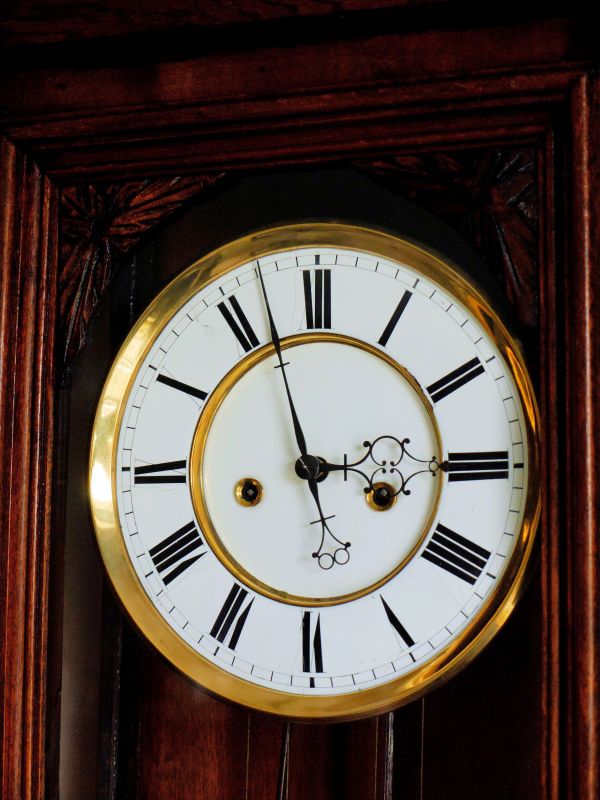
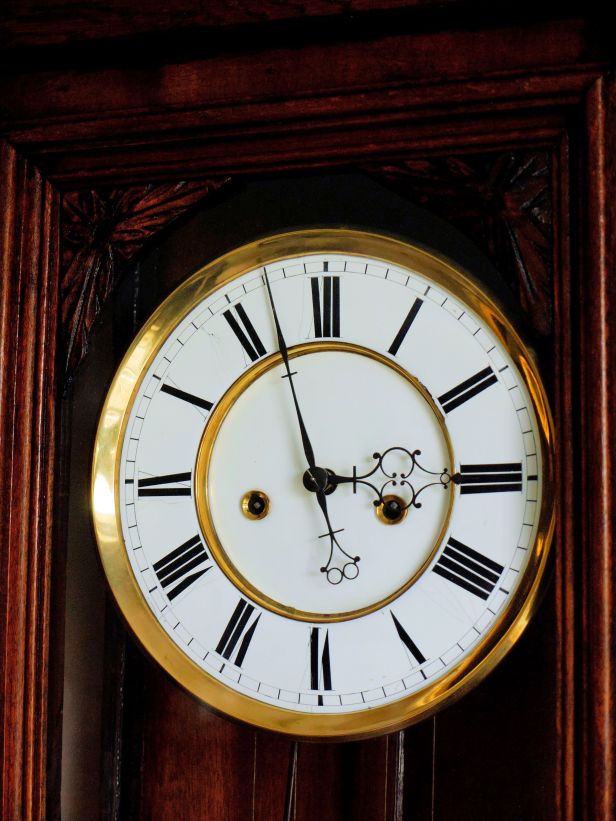
Top showing face and crown detail
Top showing face, hands and crown detail

This attractive unmarked Vienna Regulator one-weight (time-only) clock is 34 inches long 4.75 inches deep and 11 inches at it’s widest point and 8.5 inches at the waist. There are no markings on the movement. My research tells me that very few Austrian clocks have markings on the back plates. There are indications that the lines and style suggest Austro-Hungary, about 1870. The maker, however is unknown.

I believe that this clock is a transitional clock that forms the link between the simplicity of the earlier styles and the extravagance of the latter.  Where the earlier pieces rarely have columns on the side of the door, the transitional clocks have either broken columns (tops and bottoms of columns with hanging finials) or slender, elegant columns.  In comparison, the hallmarks of the Alt Deutsch clocks were full, and typically fluted columns with Corinthian pediments and rectangular panels at the base. The four-posted keyhole mounts were common throughout the transitional period. Most dials are two-piece porcelain with spun-brass bezels.

Transitional Vienna Regulators typically have wooden pendulum rods and brass bobs with zinc backs. The cases were typically made with walnut, cherry and other fruit wood veneers. There are not as many ebonized or faux (false-grained) finishes in the transitional style cases.

one-weight Vienna wall clock

Grain in two directions

This is a high quality clock housed in a beautiful walnut wood veneered case. The case is in excellent condition save for a few scratches near the door catch from the small brass hook moving back and forth and two small pieces of veneer missing on the uppermost right side that are not visible when looking at the clock head on.

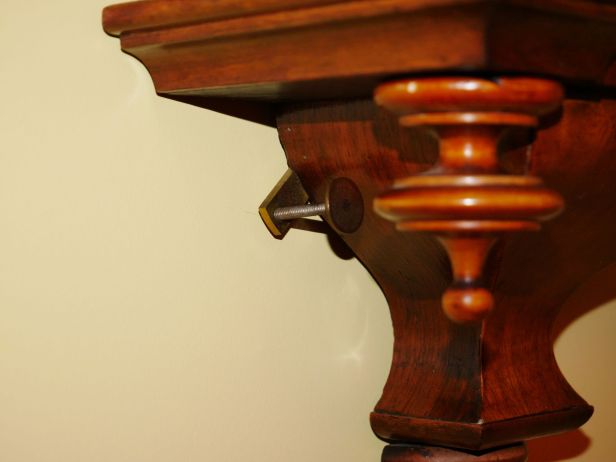
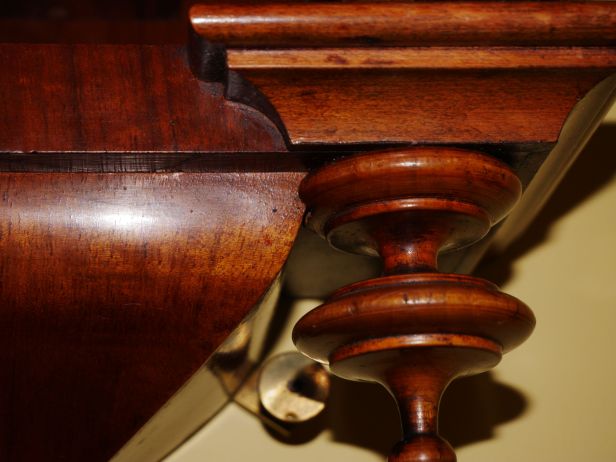
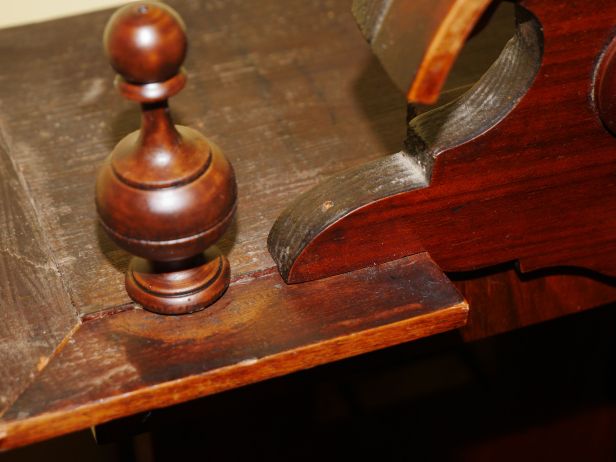
The case is adorned with an attractive crown that is part of the clock unlike similar clocks that have removable toppers. Two finials finish the top. The finals do not appear to be original but are consistent with the style and age of the clock. The twin pillared tapered columns on either side start at the top and narrow towards the bottom of the case, an unusual feature and evidence of skilled craftsmanship. Curiously the left corner rectangular column piece is slightly longer than the right piece. The case is correctly finished on the bottom with a middle and corner finials. On the sides are two brass screws (or standoffs) for leveling adjustment.

rs-miniature-vr_24
One of two standoffs

Bottom finial is notched

Top finial might have been larger originally
Top finials originally might have been larger

Inside the case is a porcelain beat scale and large pendulum. All of the glass is original and in good shape. The interior glass clips used to secure the glass to the inside of the frame appear to be a later addition. The front glass which shows characteristic waviness and small imperfections are consistent with the age of the clock.

Bottom showing beat plate and finial detail
Bottom showing beat plate and finial detail, notice waviness of glass

rs-miniature-vr_8
Bottom finials

The simplicity of the time-only movement is what makes them last so long and remain easy to maintain. The four-posted key-hole mount is typical of a Germanic or Austrian clock.  The Graham deadbeat escapement assures accurate timekeeping.

rs-miniature-vr_39
Four-posted key-hole mount

rs-miniature-vr_43
Side view of movement showing deadbeat escapement and gear train

Escapement
Escapement

Escapement closeup
Escapement closeup

Case showing mounting bracket
Case showing mounting bracket and suspension spring slot

Back board
Back board

The brass weight is hung from a brass pulley by mean of catgut cable. The dial is a two piece porcelain with inner and outer brass bezels surrounded by roman numerals with bold but delicately styled hands. The winding arbour is framed in brass. There is some crazing on the dial consistent with aging.

rs-miniature-vr_45
Slight crazing on the porcelain dial

The original clock key is a winding type with wooden handle.

vr-prospect-7
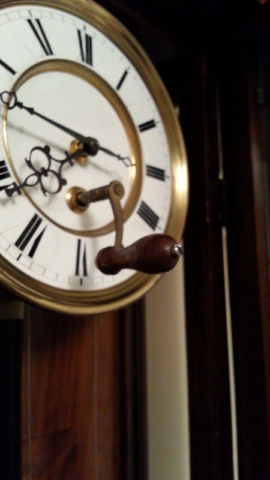
Winding crank

There are stylistic elements that suggest that the clock is Germanic or Austrian such as the elaborate clock hands, the tapered pillars, and integrated crown. So, is this clock a Germanic, Austrian or Austro-Hungarian regulator? I am very pleased with my purchase and I believe that I bought a quality clock that, according to my research, was made in or about 1870. If you know the answer or can point me in the right direction I can be one step closer to solving this mystery.

New glass and bezel for Waterbury Arion

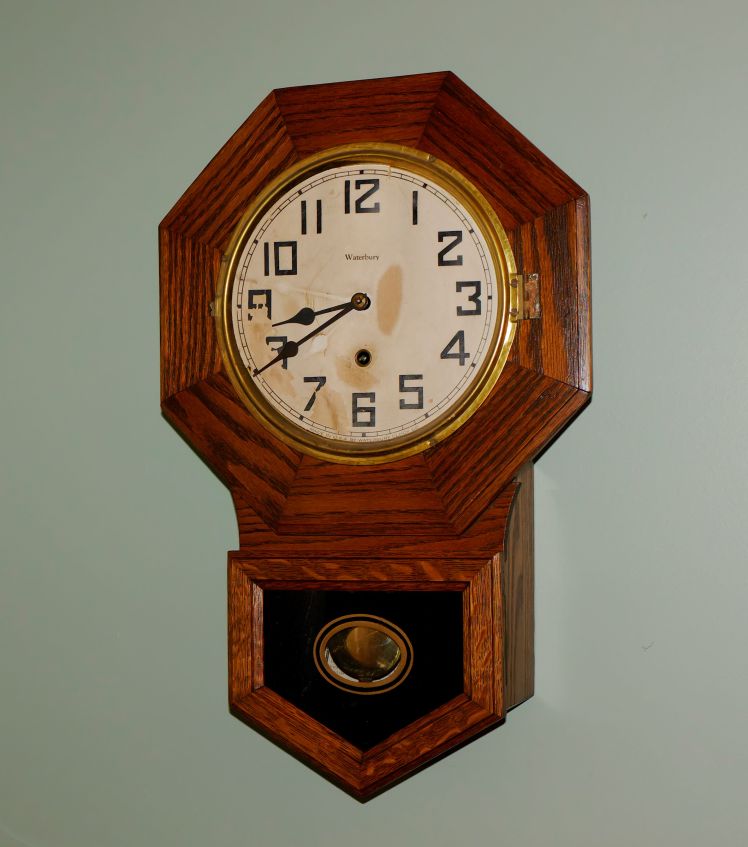
I am not sure where you would have found a Waterbury Arion. It is really too small for a schoolhouse clock or an office clock unless it was a tiny office. Nevertheless, enough of them were made since they are fairly common.

rs_1080437
Waterbury Arion octagon short drop without glass and bezel surround

I bought this time-only clock from an older gentleman in Halifax, Nova Scotia.. When he advertised it on a local online for-sale site the photo was so poor that I did not notice that it was missing a bezel and glass so when I arrived at his home we negotiated a slightly lower price.

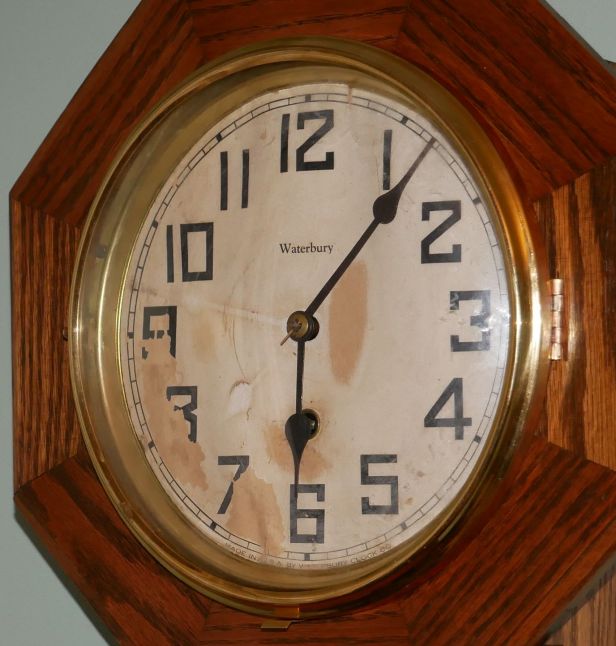
The oak cabinet is in very good condition as is the reverse painted glass sash. On the other hand, the paper dial is not in great shape but I have decided to leave well enough alone. I think it adds character to the clock. It is a strong runner and keeps very good time. Since it is only 19 inches tall it will fit just about anywhere in a home. A year has gone by and I like the clock so much that I felt it was worth putting on a glass dial and brass bezel.

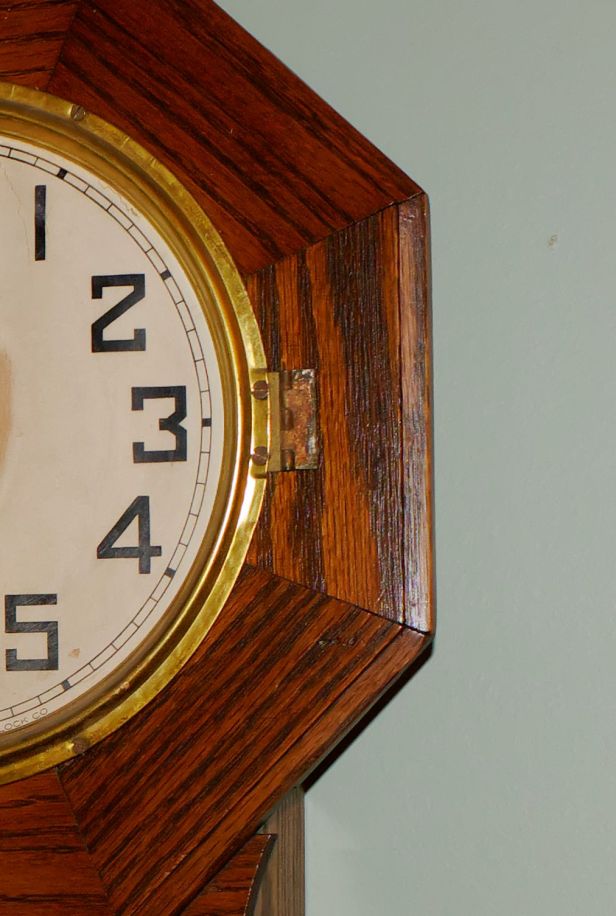
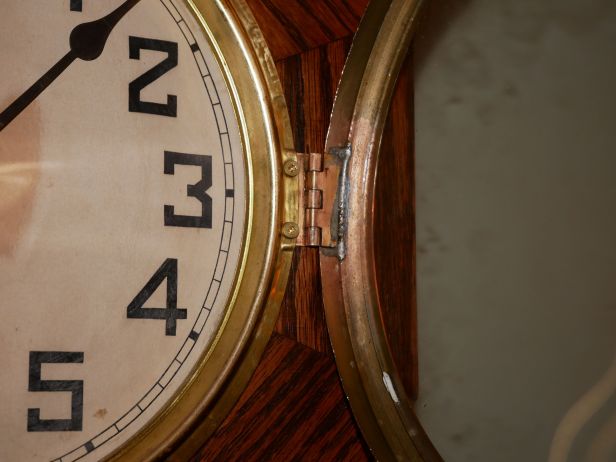
I measured the clock face and ordered a new bezel and glass. Not having done this before, I thought the glass and bezel would come as one complete assembly or if not complete, a simple way of attaching the glass. What came were 4 brass clips, a hinge without screw holes, the brass bezel, convex glass sized to fit and a 1 1/2 inch long brass tab. Not what I expected!

rs-waterbury-octogon-short-drop-9
Original hinge prior to sanding and cleaning

I did not see the need to replace the original hinge as it is in very good condition. I learned that soldering will only hold if the parts to be soldered are cleaned/sanded beforehand and petroleum-based plumber’s flux paste is used, plus I chose to use a propane torch rather than a soldering iron to get as much heat to the parts as I could. Capillary action is required to make the solder flow so there must be sufficient heat.

Although I need more practice soldering I achieved a strong bond. At hand were Robertson screws to secure the hinge to the case which will be replaced with slotted screws at a later date.

rs-bezel-and-glass-on-a-waterbury-_4
New bezel installed with old hinge

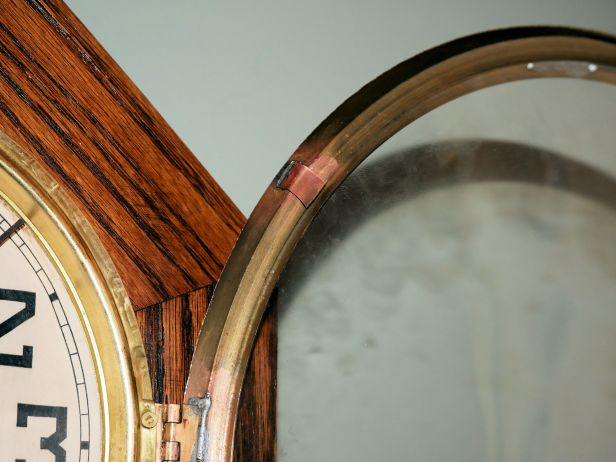
Next was getting the glass into the bezel. Here is one of the clips that I soldered into place. There are 4 of them and each one was a minor frustration. If the solder bond is strong enough the clips can be safely bent and I was able to bend these with ease.

rs-bezel-and-glass-on-a-waterbury-_3
Bezel showing a clip soldered into place

The high heat of a torch will discolour the brass. Too much heat and the outside of the brass will also be discoloured. Must be beginners luck, the outside of the bezel is fine.

When pushing the tabs down to anchor the glass I put a small chip in the glass which is not otherwsie noticeable. I did not want to put an anchor slot in the left side of the bezel which is what the 1 1/2 inch tab is for so I decided to trim it and use it as a bottom support for the bezel assembly, just under the number “6”. Not ideal but very functional.

rs-2bezel-and-glass-on-a-waterbury-_1
You can just see the support tab under the 6

In the process I also cleaned up the brass around the dial pan to match the new bezel/glass surround. Despite minor frustrations and the need to stop and think as I went along the project is now complete and the clock looks much more better.

rs-bezel-and-glass-on-a-waterbury-_1
Completed bezel project.

A great little project and I learned more about soldering along the way.

Now to repaint the numerals.

Mystery clock – if you know the maker, let me know

If you know the maker, let me know or direct me to where I can find out.

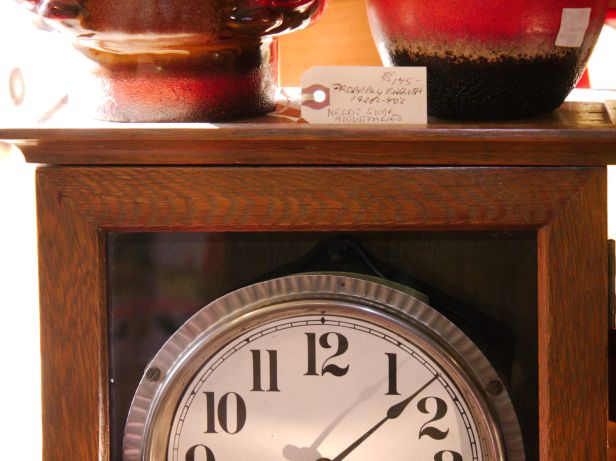
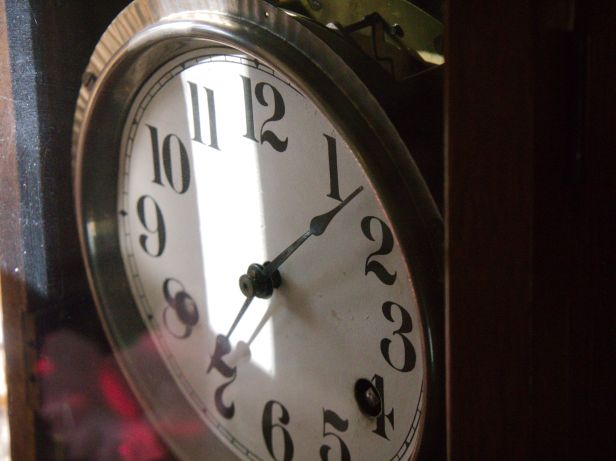
I was in an antique shop in a small village in the Annapolis Valley, Nova Scotia lately and came across this unusual box-type wall clock. I glanced at the back of the clock and noticed that the wall anchor hook had been detached suggesting that a past owner determined that it was to be a shelf clock. What else did the previous owner(s) do to alter this clock, I wondered?

The clock measures about 24 inches tall (60 cm), about 14-15 inches wide (40 cm) and about 6 inches (15 cm) deep. The dial is about 10 inches (25 cm) in diameter. The tag on the top of the clock says, “$145 – probably English, 1920s to 1940s, needs some adjustments”. The shop owner could not say whether it would run or not.

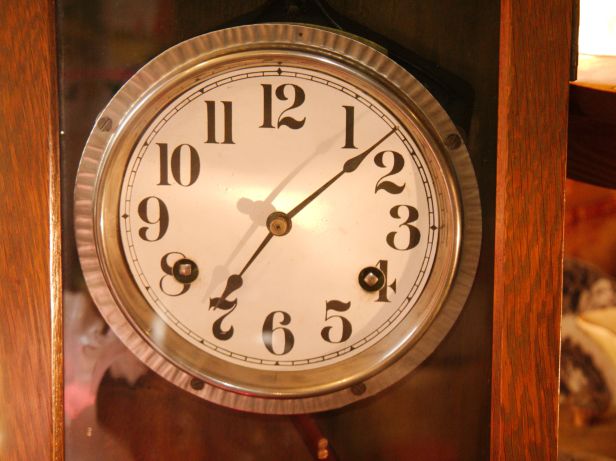
At first glance it appears to be a conventional clock but there are a few features which I find very intriguing. I discussed the clock with the owner of the antique shop and she said that it is a railway clock which I doubt for two reasons, one, the clock dial face is too small to be seen at a distance and two, it appears to be a time and strike clock given the two winding arbors. Railway clocks usually have dials that are 12 inches (30 cm) in diameter or more and normally do not strike. Striking clocks would not be heard amid the cacophony of a typical train station.

Now, it is quite conceivable that it is not a strike clock at all but a time-only clock that has two winding arbors. Double spring clocks were not uncommon during that period and if so, it would probably make this a 15 day (or more) clock similar to this double-spring Seth Thomas railway clock pictured here. That could be the case in this instance.

Double sporing 15 day Seth Thomas
Double spring 15 day American Seth Thomas

The spade hands look original as does the clock dial pan, oak case and oak rod with what appears to be a spun brass pendulum. What appears to be missing is an oak piece (or other wood I assume) that surrounds the dial pan and hides the four dial pan mounting screws. The dial face might be a little newer. The hands are attached by a nut which would put it in the period the tag suggests.

Mystery clock
Mystery clock

rs-annapolis-royal-oct-16-2nd-set_12_1-3

The winding arbors are exceptionally large and would require an unconventional key. I should have put something beside the arbors to show just how large they actually are. While the owner of the shop had a number of clock keys she did not have one to fit this particular clock.

Very large winding arbors
The clock has very large winding arbors

The bezel should have a cover for the screws
The bezel should have a surround to hide the screws

The next feature I noticed is that the clock appears to have a Graham dead-beat escapement or something very similar though I could only see the top part of the escapement. The Graham deadbeat escapement has been the escapement of choice in almost all finer pendulum clocks.  It might also be another type of escapement but it is impossible to say without a closer examination. Normally one would associate a recoil escapement with a cheaper spring driven clock but accuracy must have been a priority in this case.

rs-annapolis-royal-oct-16-2nd-set_12_1-1
Beat scale

It is indeed a mystery. I would love to see what the original clock looks like. The price is not unreasonable but I wonder what else is missing besides the bezel surround and the wall anchor hook.

If you can point me in a direction, leave a reply.

A Pig in a Poke

“A pig in a poke” is an old expression but it still has relevance in the clock world today. What does it mean? It means something that is bought or accepted without knowing its value or seeing it first. Or, another way of putting it, a deal that is foolishly accepted without being examined first. If you have been to a live auction you might have experienced winning a bid on that seemingly expensive hall table, for example, only to find it was made in Indonesia.

My own personal example. I bought an antique wall clock (100+ years old) on EBay a year ago and from the write-up it looked great. I was eager to see it. When it arrived I began to notice a few things right away and little details later on despite the description that it was “all original”. The glass on all three sides was said to be original, clearly it was not. The clock hands were off of an Ogee clock and poorly attached, The movement was made during the same period the clock was made however the pendulum sits very low in the case leading me to believe that it (the movement) may not be original. The rod gong was probably added later. Normally the gong is in back of the pendulum. There are two different styles of weights though the differences are almost imperceptible. I could go on but the point is this: do not trust any seller absolutely in your online dealings. Luckily for me the clock works and shows well.

Gustav Becker two weight regulator
Gustav Becker two weight “Vienna Regulator”

Typically sellers will describe just about everything they feel the buyer needs to know but leave out essential details. This is called omission. It means that something in the description is deliberately left out for whatever reason. Is it unethical? Perhaps. However, sellers do not have an obligation to tell you everything about an item you are interested in since there are no disclosure laws in online dealing. That is why it is important to ask questions, lots of questions prior to any purchase.

The other day I followed postings on Facebook regarding a clock purchase. The person was quite proud of the fact that he had an attractive Art Deco clock coming in the mail. He provided only one photo of the clock showing its face and base. The style was similar to this clock.

Kienzle World Time clock

It was the only photo provided by the seller and with good reason. It was advertised as an 8-day clock because that is what it said on the clock face. It arrived several days later. This individual thought he was getting a mechanical clock but discovered when it arrived that the original movement had been taken out and replaced with a cheap quartz movement. Naturally he was dismayed. Caveat Emptor some would say but in this case the seller could have been more forthright. However, let me reiterate, the time to ask key questions is before the purchase.

The other day, again on Facebook, a fellow had bought a German box clock very similar to this one from my collection. When it arrived he proudly showed off his new acquisition.

after a good cleaning (4)
U M Muller German “box clock”, time and strike

The clock was keeping great time though the pendulum was very high up in the box and could barely be seen through the front glazing. It looked very odd. When he presented a photo of the inside of the clock it was clear that the seat board was handmade and it was obvious that the movement was originally mounted within a much smaller case.

Some weeks ago I was looking for banjo clock and I saw a couple on a local for-sale site. One was very intriguing. The only photo was of the outside of the clock; nothing showing the movement. I thought if it is weight driven it would be an excellent deal. I contacted the seller by email and  I asked if it were weight driven and he said he thought so but he also mentioned that it came with a winding key for the spring. Thanks I said.

Let the buyer beware. If you buy something you take responsibility to make sure it is what you intended to buy. Ask enough questions so that you are absolutely satisfied you know what you are getting otherwise you may be getting a pig in a poke.

Let me know if you have had similar experiences.

Clocks in their natural surroundings

I noticed this topic in a well frequented clock forum site and it prompted me to write this article.

Many clock collectors realize that presentation is everything. I have about 25 clocks on display in my home and in each case I try as much as possible to situate the clock so that it catches the eye, enhances the room and stimulates conversation from friends and family.

I try not to place more than one clock in one particular location. However, I also recognize that some collectors wish to display their entire collection by having multiple clocks in one particular spot. If this is your choice, it makes perfect sense to group your clocks into types. They may be according to maker, style, type, vintage / age, or country of origin. For example, a collection might have wall clocks in one area or room, shelf clocks in another area or room, European clocks in one area, North American clocks in another and so on. I have observed that some presentations are very well thought out with a distinct theme running through while I have seen other collections that are haphazard and confusing. It takes a little care and attention when arranging your collection.

Some collectors place limits on how many clocks are displayed at one time and how many are actually running at one time. Most of the clocks I have on display are running continually but I tend to allow some clocks to stop for a “break”. Occasionally I will change the location of some clocks for a little variety keeping in mind that some are quite sensitive to being moved.

Let me show you some examples of my arrangements. You can see just three clocks in the following photo. There are in fact 7 clocks in this room but since it is a fairly large room the clocks can be nicely spread out. The most prominent is a 2-weight Gustav Becker circa 1902 which I have written about in several posts. It is 51 inches in height and certainly commands the room. At the bottom centre is a Seth Thomas time and strike round-top cottage clock made in the 1930`s and to the right is an Ansonia time-only short drop octagon, circa 1895.

clocks in a living room
Clocks in a front room

If you prefer your collection confined to one room rather than spreading the clocks throughout the house, that is certainly another option. While some prefer to consolidate their collection in one area of the house others, like myself, prefer to have clocks in almost every room. It is a matter of choice and of course, what your partner can tolerate.

RS Ridgeway clock_2
Ridgeway tall case clock

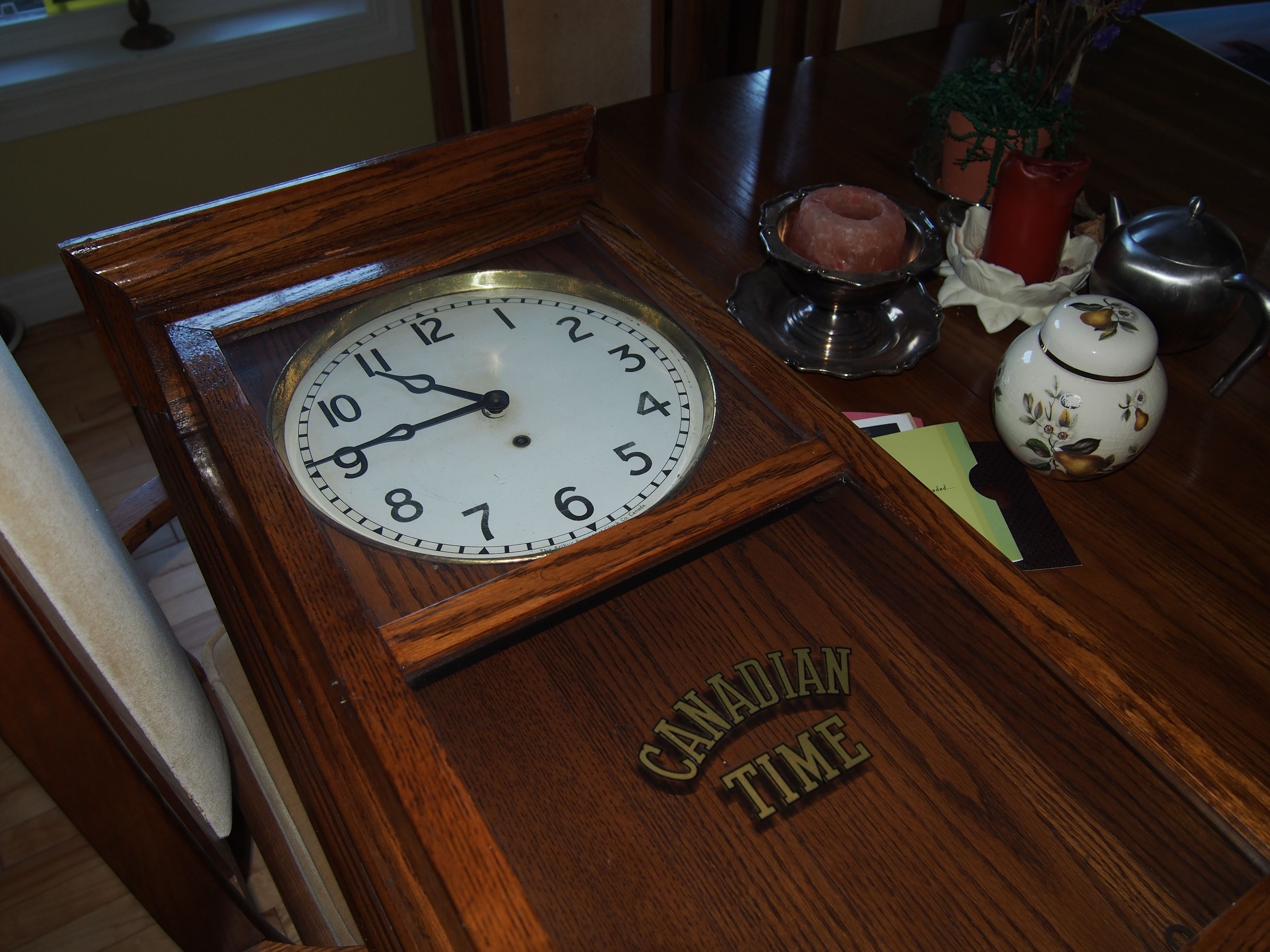
In another example my Ridgeway tall case (or grandfather clock) is one of two clocks in an entrance hallway. Unfortunately, this tall case clock is the only one I have room for. If I find another, this one would have to go. The other clock in the entrance hallway is an Arthur Pequegnat Canadian Time wall clock seen here.

RS Pequegnat
Arthur Pequegnat Canadian Time clock

RS AP repaired_5
Arthur Pequegnat Brandon schoolhouse clock

This schoolhouse clock is on the second floor of my home. We have a very simple rule; no striking clocks on the second floor for obvious reasons. The sound of a striking clock tends to keep some folks awake.

This U.M. Muller time and strike wall clock is our go-to kitchen clock.

RS Kitchen clock
U M Muller wall clock

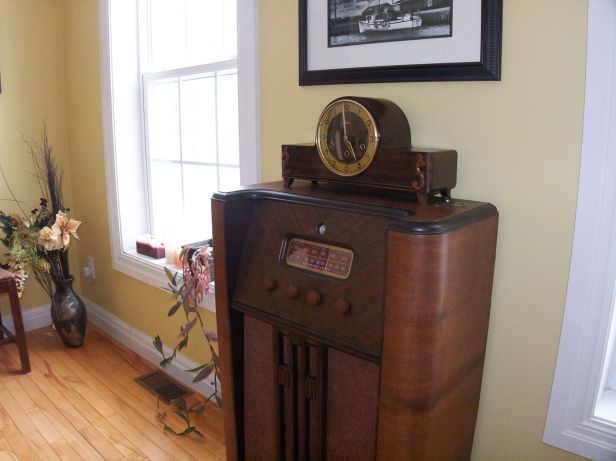
And finally here is a Mauthe Westminster chime mantel clock appropriately placed on top of a 1947 Stromberg Carlson console radio in our dining room.

RS Mauthe mantle clock (28)
Mauthe mantel clock

It does not take much to carefully place clocks in the home but it does require some amount of thoughtfulness, care and attention. Let me know what you think about arranging your collection.

Clock collectors understand the importance of presentation when displaying their collection. While it’s generally recommended to avoid placing multiple clocks in one location, some collectors choose to showcase their entire collection together. In such cases, grouping the clocks based on maker, style, type, vintage/age, or country of origin can create a cohesive and visually appealing arrangement. Thoughtful and well-planned presentations with a distinct theme running through them tend to be more successful than haphazard and confusing displays.

It’s common for collectors to set limits on the number of clocks displayed and running at any given time. Some clocks may be allowed to stop for a “break” while others continue to run continuously. Occasionally changing the location of clocks can add variety, but it’s important to consider the sensitivity of certain clocks to being moved.

For example, in one photo, there are three prominently displayed clocks in a large room, including a 2-weight Gustav Becker clock from 1902, a Seth Thomas round-top cottage clock, and an Ansonia short drop octagon clock. The arrangement allows the clocks to command attention without overcrowding the space.

Another option is to confine the collection to one room, while others prefer to have clocks distributed throughout the house. The choice depends on personal preference and the tolerance of one’s partner.

In an entrance hallway, the Ridgeway tall case clock shares space with an Arthur Pequegnat Canadian Time wall clock. The limitations of the hallway restrict the number of clocks displayed.

A schoolhouse clock is placed on the second floor, following the rule of avoiding striking clocks in upper-level rooms to prevent disturbing sleep.

The kitchen features a U.M. Muller time and strike wall clock, which serves as a reliable timepiece for the household.

Lastly, a Mauthe Westminster chime mantel clock sits atop a 1947 Stromberg Carlson console radio in the dining room, adding a touch of elegance to the space.

Arranging a clock collection requires thoughtful consideration, care, and attention. It’s essential to find a balance between showcasing the clocks and maintaining a visually pleasing and harmonious environment. Each placement decision contributes to the overall aesthetic and impact of the collection within the home.

How many marriages have you performed?

I do not mean marriage in the traditional sense. In the clock world a marriage is defined as a bringing together of parts to make a complete functioning clock. Among clock circles it is generally accepted that if a clock has significant parts from another source, such as a movement, pendulum, weights, put into a different though correct case it is considered a marriage.

GB 2 weight
Gustav Becker 2-weight regulator

If it has a large number of parts from a variety of sources, even parts not original to the period or correct to the clock it might be considered something else. See my previous post for a discussion on Frankenclocks.

I am in a bit of a quandary.

I have written a number of blog posts concerning a Gustav Becker two-weight regulator clock that I bought in February. I am fascinated by what I have learned about this clock but the journey has been both enlightening and frustrating as I attempt to get it to run reliably.

I purchased it as a project clock and knew that I would have to source parts that were missing from the movement which the seller disclosed at the time of sale. I decided to buy another GB movement. About a month after I bought the clock my search on EBay bore fruit. The movement I found (from Poland!) was a Braunau movement which is the same factory but newer by 16 years (1902 versus 1918). It was an excellent fit for my clock project since up to 90% of the parts are interchangeable and the price was very reasonable.

RS Hands from Poland (3)
Clock face with replacement VR hands

My intent was to part out the 1918 movement to supply the 1902 movement with the parts I needed such as two springs, a snail / star wheel, hammer assembly and gathering pallet. While I took what I could from the 1918 movement to get the original movement running I had mixed success. It ran well for a while and then it would stop and lock up for no apparent reason. It stopped several times. Each time I took it apart, inspected the parts I thought might be problematic but found nothing amiss. After I dis-assembled, cleaned and oiled the movement each time I had it out, I returned the movement to it’s case and the clock would run for a while, a couple of weeks, a couple of days, hours perhaps before it would just stop abruptly. I am sure that if I investigated further I would find a slightly bent pivot, worn pinion or problematic gear tooth somewhere. Now for plan B.

Weights for clock
Weights for Regulator clock

I thought, well I do have the 1918 movement, why not switch them and see what happens. I returned all the parts such as star wheel / snail, springs, hammer assembly etc. from the 1902 movement to the 1918 movement and hoped that the 1918 movement once installed in the case would run and run well. I was initially concerned that the newer movement, a P27 requiring what I thought was a longer pendulum would not fit the case case but it seems to be sized perfectly. It is a mystery to me how pendulums are measured. The movement has now been in the case for the last fourteen days and it is not only running well but keeping excellent time.

The question remains, should I leave the 1918 movement in the case since it is now running well? Although it is the “correct” movement though not the original one, could the clock now be considered a “marriage”? The answer is, yes!

If I were to sell the clock I would disclose that the movement is not original to the case which would certainly affect its overall value. I could make the deal more attractive by providing the original movement as part of the sale considering that it is repairable, if I sold it!  These situations occur quite often in the world of EBay et al when the clock seller chooses not to give too much detail in their description of the item when they know some parts are not original. Furthermore, from a buyers perspective there is no guarantee that the clock they are looking at is 100% original.

GB clock
Gustav Becker clock occupying a prominent location in the living room

This is my first marriage. Would I do it again? If faced with similar circumstances in the future I would probably do the same thing but it has also taught me to be cautious with any potential clock purchase by asking key questions prior to any decision.
Of  course this clock is not for sale. I think the clock looks outstanding on my living room wall.

Let me know if you have you performed any marriages or if you think it is an ethical practice?

It was my mother’s clock

I hear this so often when I am purchasing clocks for my collection. Time and time again (pun not intended) I walk into someone’s home with the intent to purchase an antique clock and I am greeted by the same words more often than not, “It was my mother’s clock” or a variation, “My grandmother had this clock” or “My wife loved this clock”.

Some time ago (April 2016) my wife and I took a trip to the Bridgewater which is located about two hours from our home in Nova Scotia, Canada. I knocked on the door walked into a modest home and spoke with the seller who explained that the clock he was about to say goodbye to had been in his family for over 70 years, perhaps longer. When I was “so high”, he motioned with his hand, “I remember this clock in my grandmother’s home”. Although I did not ask him why he was selling it I could not understand his motivation for parting with this “family” clock.

Mothers and grandmothers seem to be the keepers of the the flame, the maternal spirit of sentimentality. No doubt the clocks were originally purchased by the “man of the house” because it was the man’s station to life to make important decisions for the home though the person who invested emotionally in the acquisition was the wife. Has this changed?

RS Ingraham Huron1
Ingraham Huron

Another example. We traveled to Halifax, Nova Scotia to see a grandfather clock. Now, I have always wanted a grandfather clock. Twenty five years ago my wife and I put a deposit on a beautiful grandfather clock with the hope that it would one day be proudly displayed in our home and our homes to come. Life got in the way, the money was required for a deposit on a new home so we canceled the order. That has always been a deep regret. Fast forward to three years ago. That grandfather clock that I always wanted was staring me in the face when I saw it on a for-sale site. The price was very reasonable. On the phone I asked the seller. “What condition is in in?” and he replied, “You have to see it to believe it”. We visited the seller who explained that the clock was his mothers. He was sorry to see it go but it and several other beautiful clocks just had to go to make room for the “next phase of my life”, whatever he intended that to be. It was in truly exceptional condition so we bought it. I often wonder what he must have told his mother or if he had any regrets when we walked out the door.

RS Ridgeway clock_2
Ridgeway tall case clock circa 1996

We were in the Annapolis valley (about 3 hours from our home) checking out an Ansonia Short drop schoolhouse wall clock in the fall of 2015 and settled on a price with the seller on the phone. When we arrived the seller explained that the clock had been in the family for a number of years. His mother had passed on and they were in the process of managing her estate. I asked him if he knew anything about the clock. The seller was in his late fifties and said,”I remember it hanging on the wall of my mother’s home when I was a kid, but I never actually saw it running”. “She loved it and she brought it especially to Nova Scotia from a school in Ontario”. We bought it.

RS April 16
Ansonia Short drop schoolhouse clock

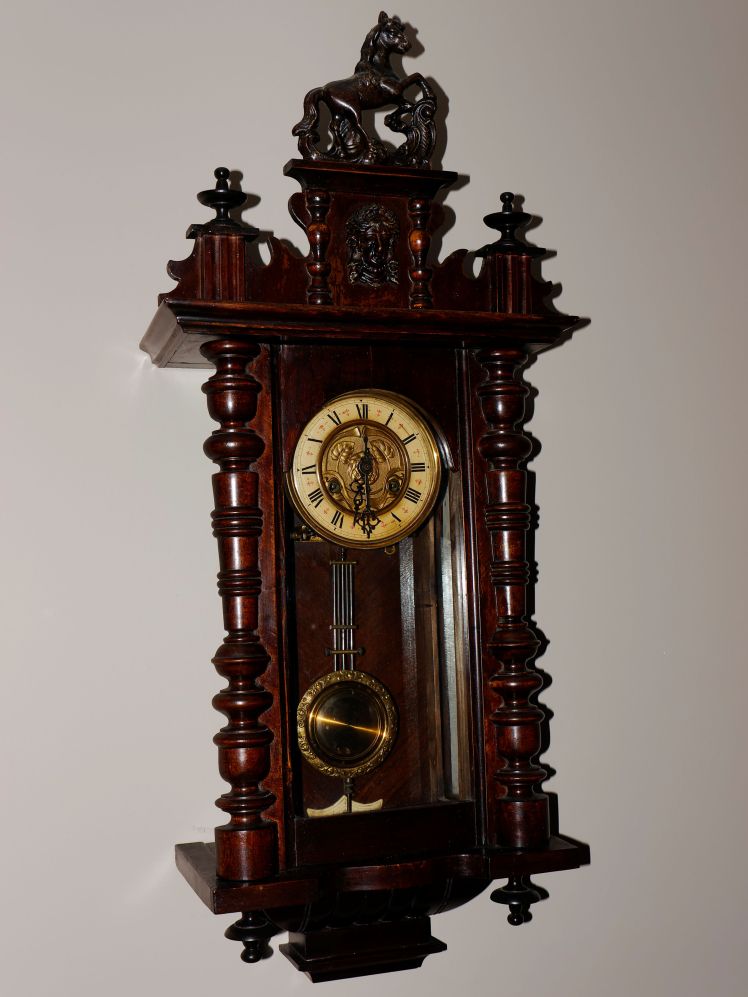
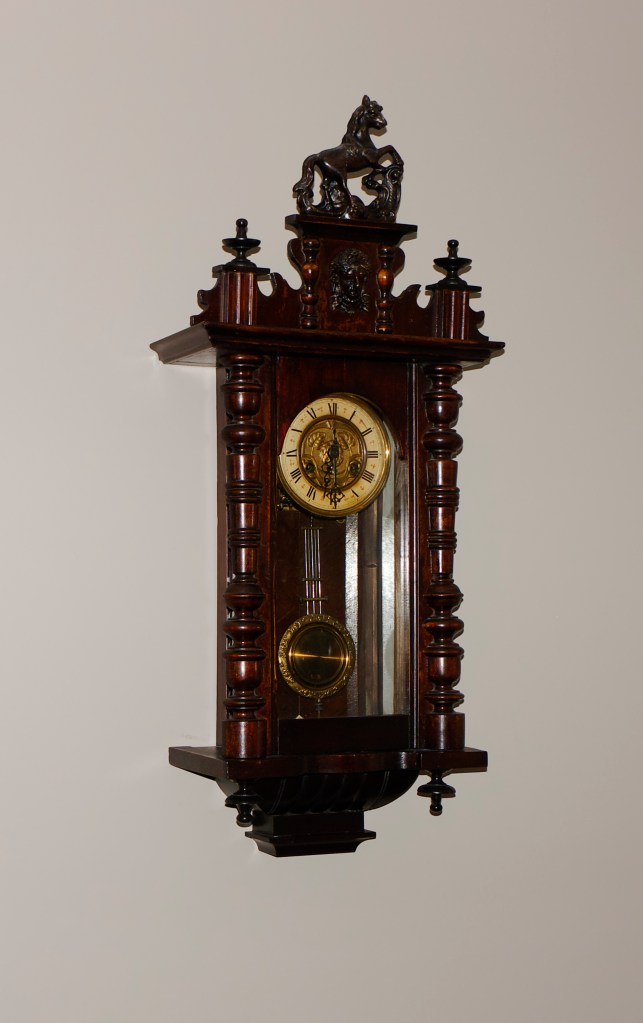
We saw an ad on a local for sale site. It was for a spring driven Mauthe wall clock with a horse crown (top piece) made in about 1895. An elderly couple was in the process of down-sizing and made the decision to divest themselves of some of their keepsakes, his mostly it seemed. He was obviously in a new relationship and explained that his wife had passed away some three years ago and she always loved the Mauthe clock which she considered a family heirloom but it as well as other keepsakes had to go.

RS Mauthe
Mauthe clock with middle finial missing

He told the story about how she had brought it and a number of other items in a suitcase from the Netherlands in the 1980s. The bottom middle final was missing because I suspect that it simply did not fit in the suitcase and somehow got lost over the years. It was the only thing amiss with the clock. It must have been hard for him to see the clock go but he seemed heartened to see that it was going to a good home.

We were on our way to Tantallon (near Halifax, Nova Scotia) to look at a small wall clock, a Waterbury Arion short drop schoolhouse / office clock. The gentleman we spoke to on the phone said that he wanted to reduce his collection of clocks. We arrived and I was quite surprised at the size of this particular clock. It is really quite diminutive with a dial of less than 8 inches and 19 inches from top to bottom. It was missing the glass and bezel but the oak case was in excellent condition. The dial face was in poor condition with barely readable numerals from 6 to 10, however, the price was right. I then asked, “Where did you get this clock”. He replied,”I didn’t; my wife bought it from a fellow in Debert”. “She buys them and I fix them”, he said. I looked around the house and there were some truly beautiful clocks of all types and they were all well cared for and each one was purchased by his wife and cared for by him. A truly symbiotic relationship!

RS_1080437
Waterbury Arion short drop wall clock

In my journeys throughout Nova Scotia and elsewhere in Canada I have been amazed at how many clocks were collected and cherished by women. In many cases the clocks are in excellent condition, a tribute to those who cared for them, the Mothers.


Is Your Clock a FrankenClock? Key Insights for Collectors

This article is about a curious term that you might have heard concerning clocks and clock collecting. The term is FrankenClock. Let me explain.

Have you ever bought a clock and as much as you hoped that every mechanical part, finial and piece of trim is original and you later found out through experience, research or knowledge that it is not, how then do you feel about your purchase? Obviously you might feel disappointed, even cheated. So if a clock has parts that are not original what would it be called? Some would call it a FrankenClock.

RS GB April 8
Gustav Becker 2 weight Vienna Regulator

Let me explain further. Here is my Vienna regulator clock as it is today. It shows well, keeps excellent time after a replaced movement, a thorough cleaning, oiling and case repairs. It is original? Well, mostly. As I said in a previous post this clock was sold as a “project” clock and the seller made no pretense that everything was absolutely original and that is fair game. Here is a summary of what I have discovered so far.

Clock glass panels

Let’s begin with the side and front glass panels which I believed were original when I recieved the clock. The glass was broken during shipment and had to be replaced. In fact, the case was broken is several parts, but that is another story. Although I thought I was replacing the original glass I found out that the broken glass was likely not original to the case. When I brought the case into a glass installer I was asked two simple questions. Why is the side glass thicker than the front glass and why are finishing nails used to anchor the glass? Good points. So, just how many times was the glass replaced on this clock?

GB weights
GB weights

Weights

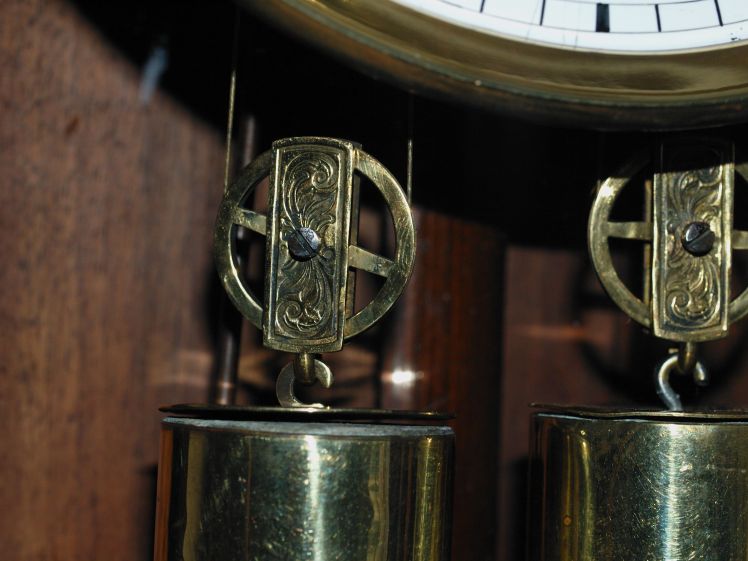
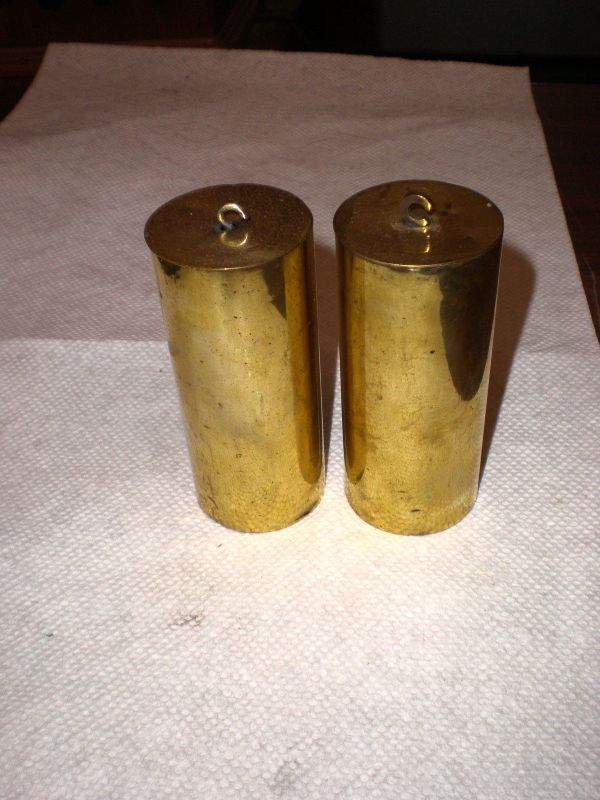
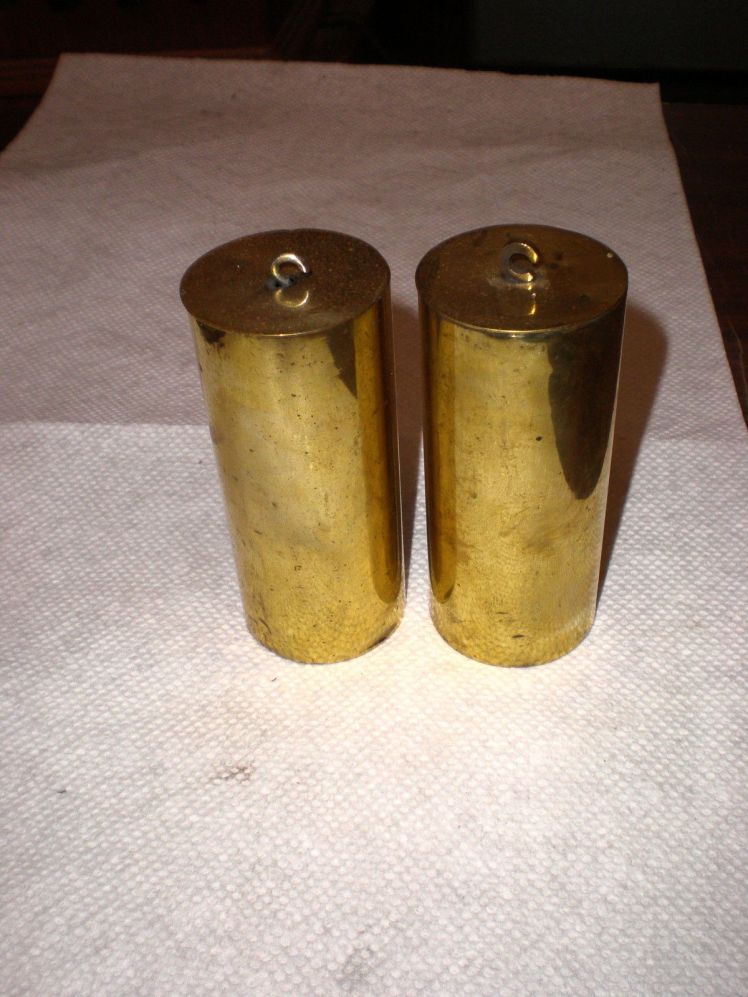
The weights at first glance looked identical but closer inspection reveals that one weight has a slightly different hook design than the other. I doubt the factory would have provided dissimilar weights.

The movement

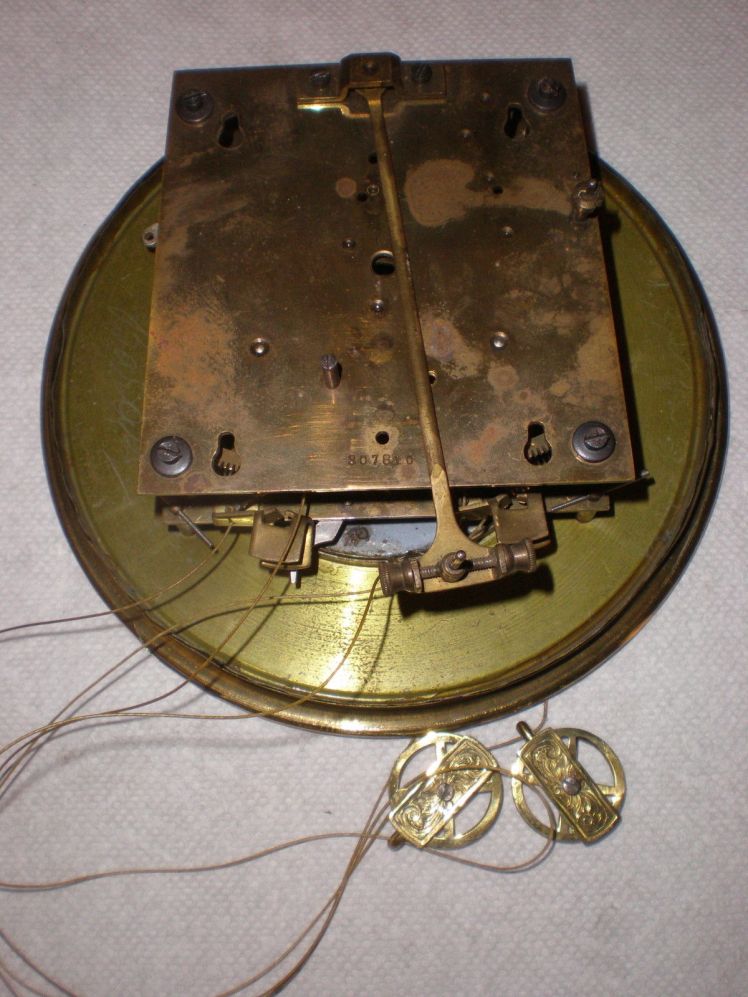
The movement appears to be a match for the case and it is appropriate to the period but is it original? The movement had parts missing which the seller kindly disclosed when the clock was advertised for sale. Parts missing were the star wheel/snail and the strike hammer and rod. The gathering pallet for the rack was bent and therefore could not advance the rack. In any event the strike side did not function at all. Thus began my search for a donor movement.

I was specifically searching for a Gustav Becker “Braunau” factory movement to provide the correct parts for my clock. The donor movement came from Poland. From the serial number on the donor movement I was able to determine that it was made 16 years after the movement that came with the clock. Minor differences were expected. The plates were thinner, the lever springs were a different design, the minute arbour shaft was slightly thicker and the star wheel/snail, gathering pallet and hammer/rod and were not a good fit for my old movement. A disappointment, the parts were not interchangeable. Out went the old movement and in went the new movement.

NOTE: I kept the old movement and if I sell the clock in the future I will disclose that change and others.

On to other issues

The spun brass dial bezel is a replacement though correct for the period.

trim piece
Upper left side trim piece

There are a couple of trim pieces that I suspect were probably added later on though when, I do not know.

Bottom finial
Bottom centre finial

The bottom centre finial appears to be a replacement though probably correct for the period. The bottom finial has wormwood holes but the clock case itself does not have one bit of worm damage.

Sowing hour hand on clock dial
showing hour hand on dial
Minute hand
Minute hand missing it’s centre bushing

The clock did not have Vienna regulator hands. They are Ogee clock hands. I searched the supply houses in Canada, the US and Britain and was surprised at the limited selection of Vienna regulator hands. The photo below shows replacement hands with the correct measurements. The hands are also from Poland. There must be quite a successful business in Poland parting out clocks and selling the pieces. The hands have not arrived yet.

Clock hands Vienna Regulator
Vienna clock hands

i later discovered that they are not the correct hands but they look good and they will do for now.

Are there other parts of the clock that are not original? Yes, but it does not change how I feel about this clock. It has provided me with an excellent learning experience and it allows me to view future purchases with a much more critical eye.

Caveat Emptor

There are many examples of FrankenClocks and you may even have one or two in your collection. There is a popular expression that I always find appropriate in these cases. It is Caveat Emptor (let the buyer beware), the principle that the buyer alone is responsible for checking the quality and suitability of goods before a purchase is made. Reputable auction houses will disclose repairs and replacement or questionable parts on a clock but do not depend on what the seller says on most popular online auction sites. It’s a jungle out there!

The ethics of buying used clocks – one that got away

wall clock
Waterbury Halifax – One that got away

I am writing about an experience I had on a local for-sale site today and wonder if others have had the same happen to them. I found this Waterbury Halifax time-only wall clock for sale at a reasonable price.

It had issues. It was not running and the top centre finial was missing. I was assured by the prospective seller that they had the  finial but that the spring was “broken”. The seller was not clear whether they meant the suspension spring or the main spring. A suspension spring replacement is an easy fix, the mainspring is a little more difficult. Since it only has one spring it was obvious that if either spring were “broken” the clock was not running. I was prepared to accept that since I can make the necessary repairs. Still, the price was reasonable.

We exchanged emails for a day or so. I asked questions about it’s condition and if there were any other issues and they responded appropriately all the while courting me as the buyer. Finally, I agreed to look at the clock with the intention of buying it and we arranged a time and a place for the exchange. It was a cash deal so a trip to the bank was necessary beforehand.

We set the time between 2 and 4 pm. At around 11:20 am I received an email which stated.

“Morning . The clock has been sold as of a few minutes ago. Thank you for your interest, have a great day.”

I replied, “Not very ethical”, and left it at that.

I believe I am correct. It is clear that the seller received a better offer though I have no way of knowing.

What would you have done if you were the seller?


Gustav Becker March 2016 update part 2

As I mentioned in a previous post my Gustav Becker two weight regulator arrived with some issues. I was aware beforehand that there would be some problems as it was advertised as a ‘project” clock and that is what it has become, but not in an entirely negative way. It is all good learning.

Clock movement
New movement from Poland

My donor GB clock movement arrived from Poland this week. As mentioned previously the original movement came without a star wheel/snail (not disclosed by the seller), a hammer assembly and a couple of non-operational parts which necessitated the acquisition of another movement. The gathering pallet which I originally thought was bent on the original movement has a piece broken off as I discovered when I compared it with the newer movement.

At a glance the two movements look identical but I am learning that there are key differences between the movement made in 1902 and the donor movement, made in 1918. The “newer” movement has thinner plates. The centre arbor is thicker on the new movement but the star wheel/snail is an exact fit. The escape wheel is slightly smaller. The fan on the new movement created an obstruction when I tried to install it on the old movement so out it came and replaced by the old fan. I was also able to transfer the gathering pallet as well. This time it works correctly as it advances the rack. The escape wheel is smaller on the new movement and I gather that the pendulum for the newer movement is a little shorter i.e faster rate. I am also able to salvage the hammer and hammer rod on the replacement movement though I have not attached it as yet. It would need some adjustment.

Clock part
New star wheel

clock part
Broken gathering pallet

During the testing phase the clock is running without its dial face and hands. I am checking and calibrating the hour and half hour strike while observing the action of the strike side specifically the advance of the star and snail. All seems to be working as it should. The time and strike weights are also descending at the same rate so I am assuming that the clock is going through its correct cycle on the hour and half hour.

More testing in the next few days after which I will install the hammer assembly, the face and hands and string new cable for the weights.

Clocks of Cuba

During two vacation trips to Cuba in the last 4 months I managed to locate a few clocks in my travels. Though some clocks were very intriguing none that I saw save for the tower clocks were in working condition. Nonetheless it made me wonder about their provenance in a land that time seemingly forgot.

At Christmas time my family and I traveled to Trinidad of Cuba. We stayed overnight at Los Helechos Hotel in Topes de Collantes which is located about a half an hour bus ride from Trinidad of Cuba. The next day we spend our time exploring the wonders of Trinidad of Cuba.

I saw some interesting clocks in a couple of restaurants. The first is a Wm L. Gilbert time and strike wall clock with calendar dial from Winsted Conn., USA. It looked like a reasonably well preserved dark walnut regulator clock with an 8-day brass movement with pressed features dating to about the 1900s.

wall clock
Wm L. Gilbert clock found in a restaurant

The next is unknown to me. It is a Spanish clock. Whether or not Malaprade is the maker was difficult to determine as I could find no information on the internet. However, it is clear that this spring wound time-only clock with second hand feature was made in Barcelona. I would date it to pre-1930. It is a relatively short clock and might have been originally designed as a wall mounted clock as it stands less than 5 feet tall. I am not sure what the area around and below the keyhole represents. I cannot make out any sort of design if there is one.

Floor clock
Malaprade Floor or wall clock

Next is a floor clock. Again the maker is unknown. I do not see any winding arbors on the dial face and can only assume that it is weight driven (the weight was not attached) and that the weight (or weights) were pulled up by chain to reset the clock likely once every 8 days. This clock was clearly in meed of restoration as were most of the clocks that I saw.

Floor clock
Floor clock of unknown maker

In March we stayed at the Paradisus Rio de Oro in Holguin province located on Playa Esmeraldo near Guardelavaca. The resort is set on a beach next to Bahía de Naranjo Natural Park. In it are a number of interesting clocks.

Lobby clocks
Time only lobby clocks

There were a total of 4 of these lobby clocks which were originally intended to display time zones for the guests. They are time-only and the cases appeared to be in good shape but I do not think they have been running for quite a while. My thought is that there is nobody at the resort tasked with the responsibility of maintaining these and other fine clocks.

face of clock
Face of unknown floor clock, second hand is missing

RS Tall case clock (2)
Unknown floor clock

This clock actually works though it needs servicing. It is located in an ante-chamber adjacent to a Mediterranean themed restaurant. I opened the front door of the clock and found the rod gong impeding the pendulum. Once I dislodged the gong the clock happily began to function and it was in beat, surprisingly. Although it had two weights there were three winding arbors and I would be curious to see the internal workings of that movement. Inside the door was an official seal from the Ministerio de Cultura.

400 day clock
400 day clock

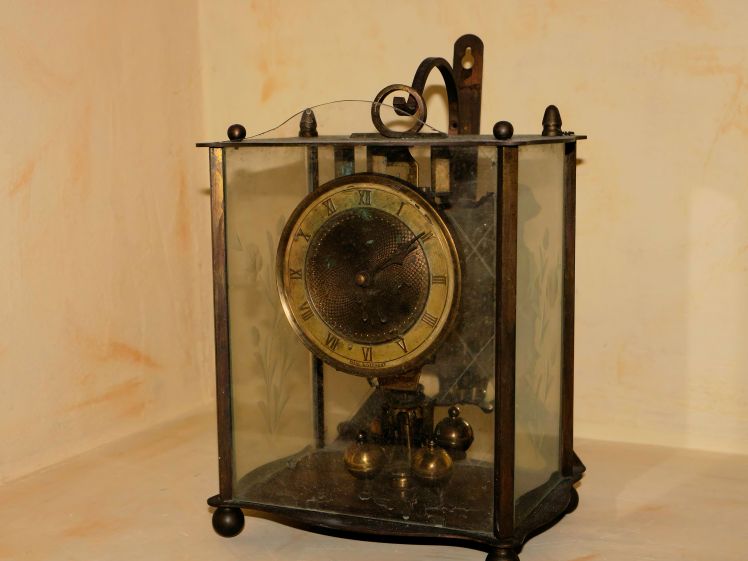
This 400 day clock was made in Germany. There were no other markings that I could determine. It could be a Kundo Kieninger & Obergfell dating to about the 1940s or so but that is just a guess. It needs a thorough servicing and clearly it has been neglected for some time.

Carriage style clock
Carriage or wall mounted clock

This is another an anniversary mantel clock but it appears to have a wall mounting bracket on the rear. Not sure why as these clocks are not meant for wall mounting. Again, an unknown maker but possibly German and in very poor condition. The front glass looks like it can be lifted up for adjustment purposes.

clock
Clock in a peasants home

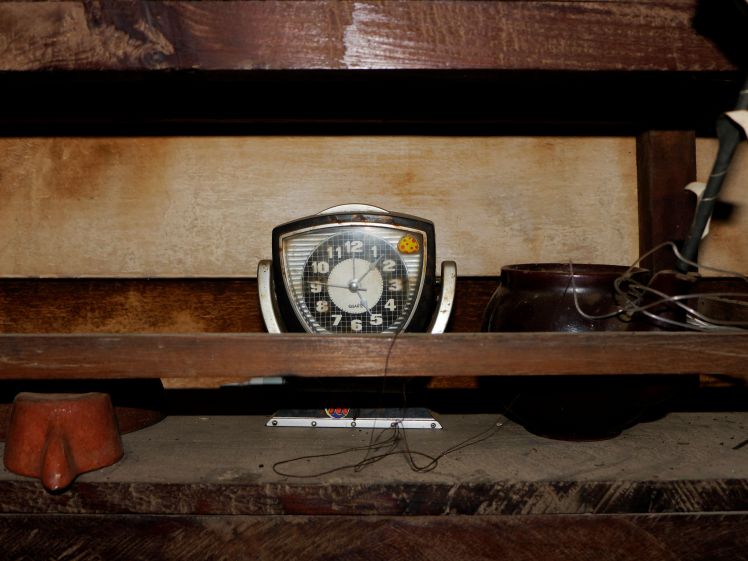
While hiking through El Cubana National Forest we came across a small dwelling and we were able to briefly tour inside. In it I found an old quartz clock dating from the 1980s or earlier.

Tower clock
Tower clock at Peublo La Estrella tourist village

Tower clock
Tower clock in Holguin

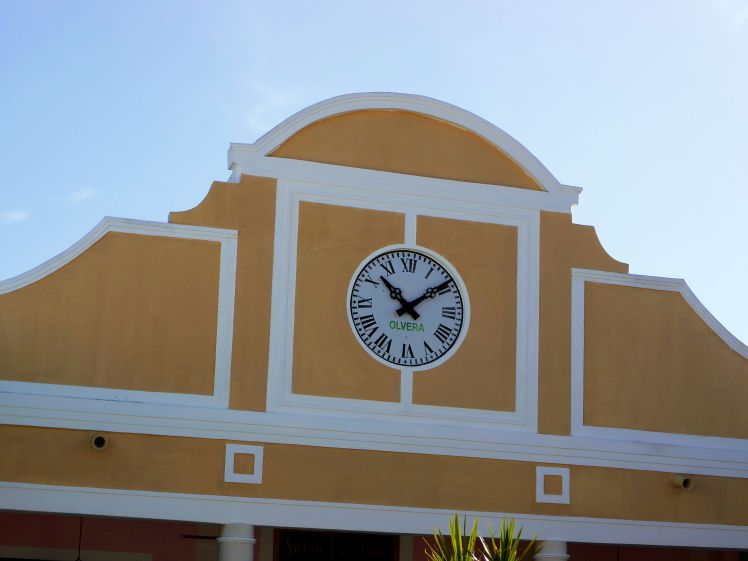
The first tower clock is located in a tourist village in Cayo Santa Maria called Peublo la Estralla while the next is in a downtown principle square in the city of Holguin. The Olvera clock is a modern electric clock and I am assuming that the tower clock in Holguin might also be electric.

I am told that my next stop in Cuba (another time) should be the Paladar Decameron restaurant in Havana, a fixture in the paladar scene that’s located in the leafy residential district of Vedado. The restaurant is said to said have an old world charm with a collection of various collectibles including antique clocks of all shapes and sizes.

Cuba is a fascinating country and certainly worth exploring time and time again.

Gustav Becker update

OLYMPUS DIGITAL CAMERA
GB movement before dis-assembly

I got a lead through a email a few days ago on a Braunau movement that was up for sale on EBay and I am happy to say that I purchased it today. It should arrive by post in the next few days.

My plan is to either take the parts out of the replacement movement or use it if it is in better condition. My inclination is to keep the movement that came with the clock rather than create a “Franken-clock”.  It is preferable to keep the clock as true to the original as possible.

However, I am sure that over the years many clocks have benefited from replacement parts and after 114 years clocks such as this probably had repairs that might have included the odd part replaced. On my movement there have been 4 new bushings installed and one lever post repaired. Who knows what other parts might have been added over the years. The top plate is the only real indication I have that the clock was made in late 1902 and the clock case certainly fits that period.

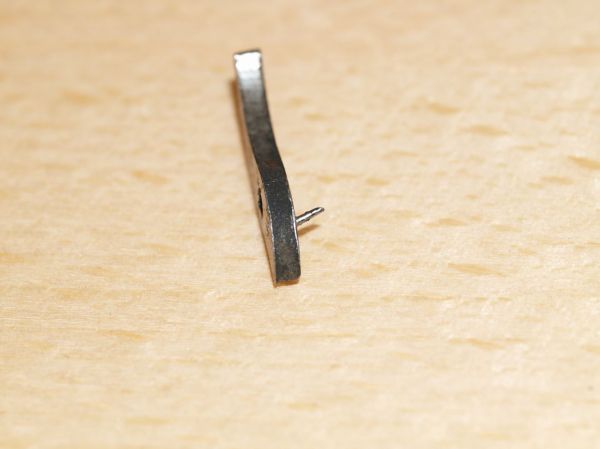
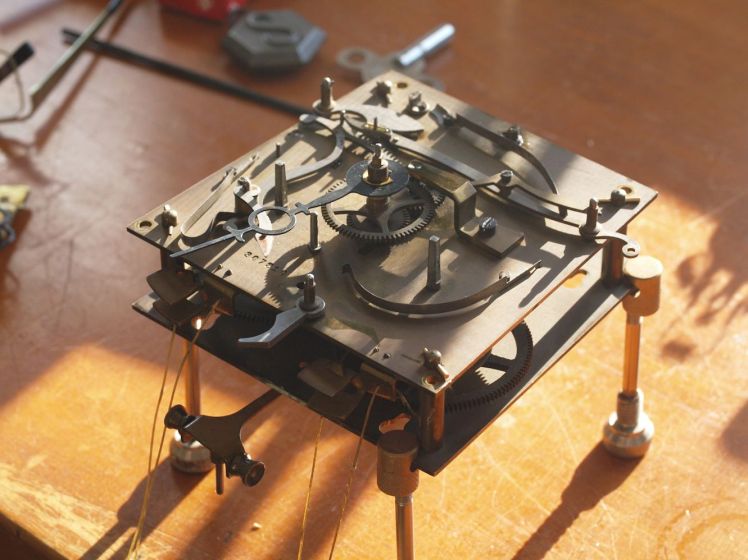
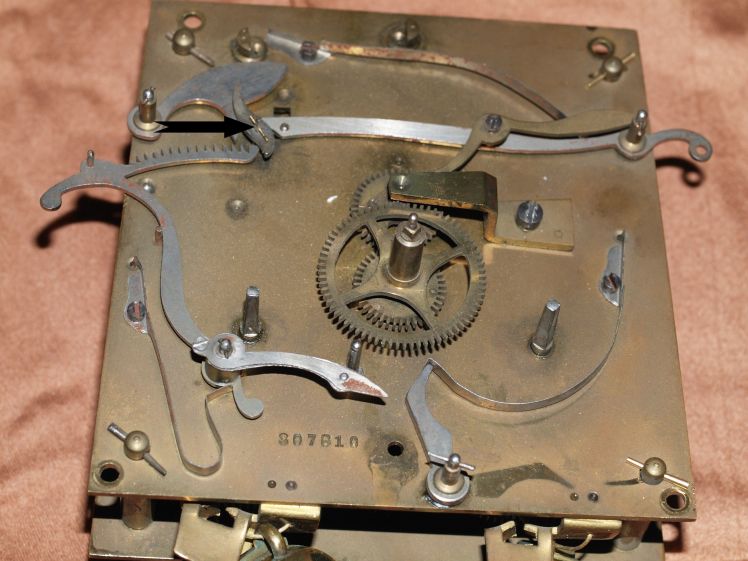
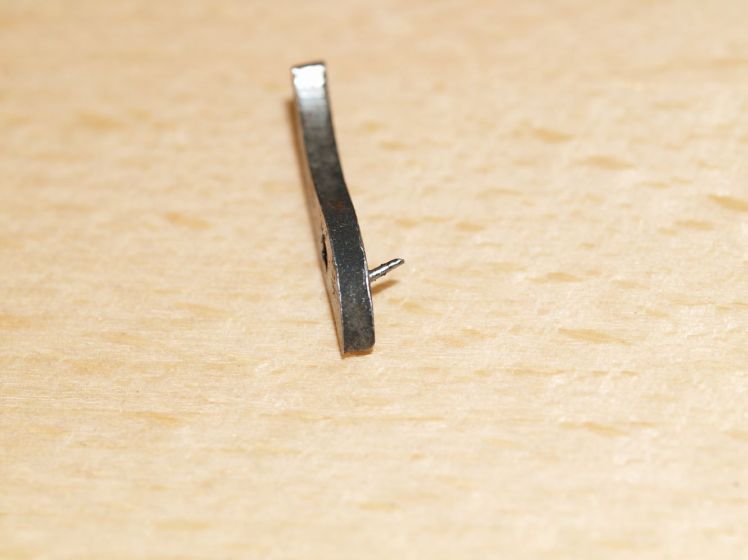
This movement has one other issue that I can see. There is a lever with a pin that rotates and advances the rack. It is the gathering pallet. In the photo below you can see the pallet, indicated by the black arrow. In the photo that follows you will see that the pin that is attached to the pallet is bent. The bent pin does not allow the pallet to advance the rack. Hence the strike train does not work. So, it must be unbent or replaced.

clock movement
Black arrow showing the location of the pin

bent lever pin
Bent pin on lever

The risk is snapping the pin off if I make an attempt to straighten it. I will wait to see if the replacement movement has a pallet that is in better condition and if so, a straight swap.

clock movement
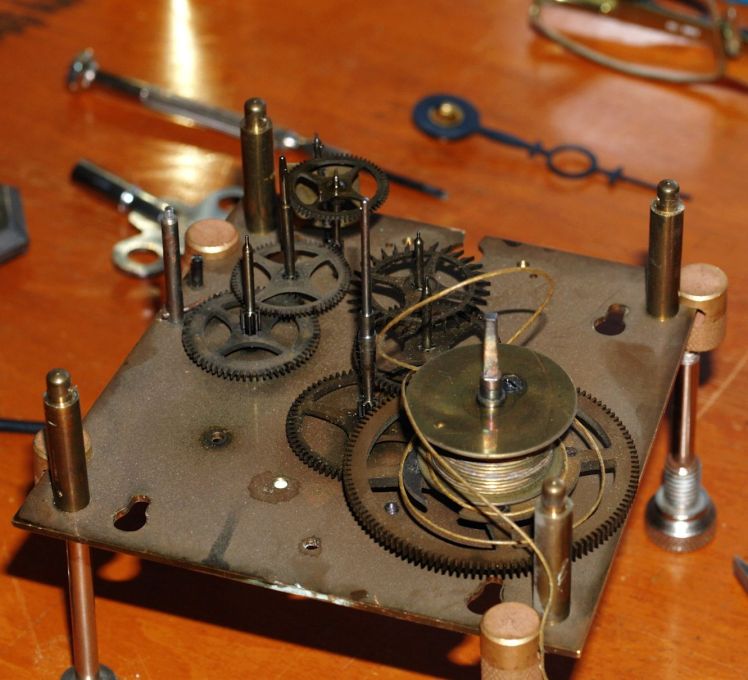
Movement is nearly dis-assembled

The last photo shows the movement almost apart and prior to cleaning and polishing.

This Gustav Becker came to me as a project clock and I am determined to get it running.  In the meantime I have installed the time side gears to check the time train and the clock is running and keeping proper time. Obviously it does not strike but in time that will be rectified.


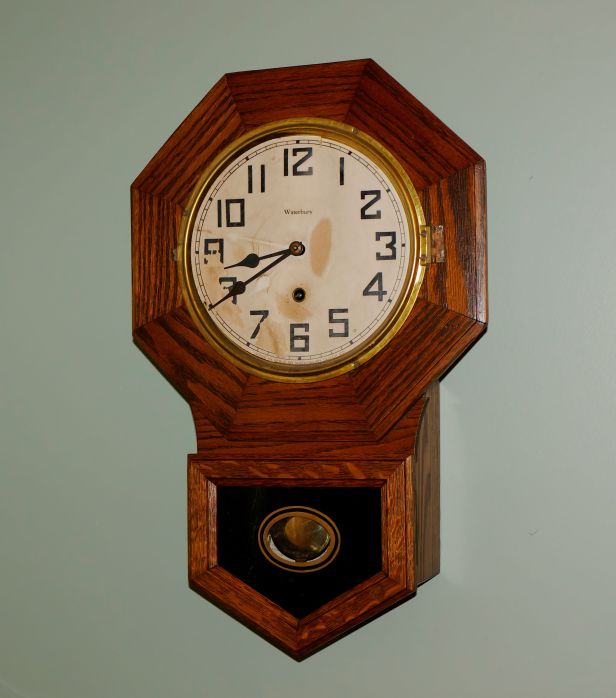
Waterbury “Arion” Small Octagon Short Drop wall clock

RS_1080437
Waterbury Arion wall clock

A diminutive size, this clock was made around 1930 just a couple of years before the Waterbury Clock Company was placed in receivership. It is a solid oak case measuring 19 inches long by 12 inches wide, with a paper dial marked Waterbury, a black and gold pendulum aperture, and 8-day time-only movement. The bottom of the dial says, ” Made in the USA by Waterbury Clock Company”, Connecticut.

While the clock is a strong runner there are obvious issues concerning the paper dial and the lack of a brass bezel. The dial plate does not have to be changed out but the clock is in need of a brass bezel, hinge and convex glass. Although the style might be slightly different on a replacement bezel, it is clearly required to complete the look. I have decided to retain the paper dial as an exact replacement is impossible or so I have found so far in my research. Half of the paper dial has become unglued from the dial pan. Two-sided tape in three locations was the fix. I may touch up the numbers 7, 8, and 9. We`ll see.

RS Waterbury Octogon short drop (10)
Pendulum bob

The Waterbury Clock Company was incorporated in the city of Waterbury, Connecticut, on March 5, 1857. Up until the Great Depression Waterbury had been quite prosperous. But like so many companies, most of the profits lined the pockets of its Directors instead of being reinvested in new equipment and updated facilities thus hastening its rapid decline. In 1932 the company was bought and re-organized under the name Ingersoll-Waterbury.and in later years the company morphed into the Timex Corporation. If you peruse the Timex site today you will see a line of Timex watches called the Waterbury collection. Timex is certainly acknowledging a link to its past.

RS Waterbury Octogon short drop (8)
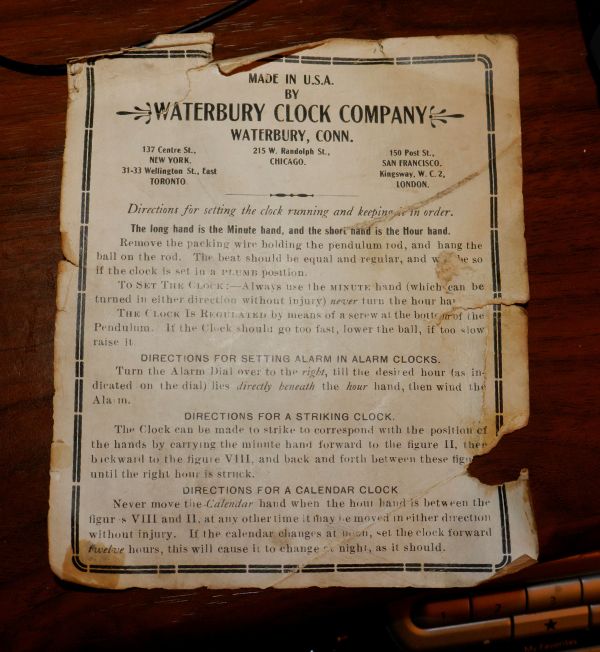
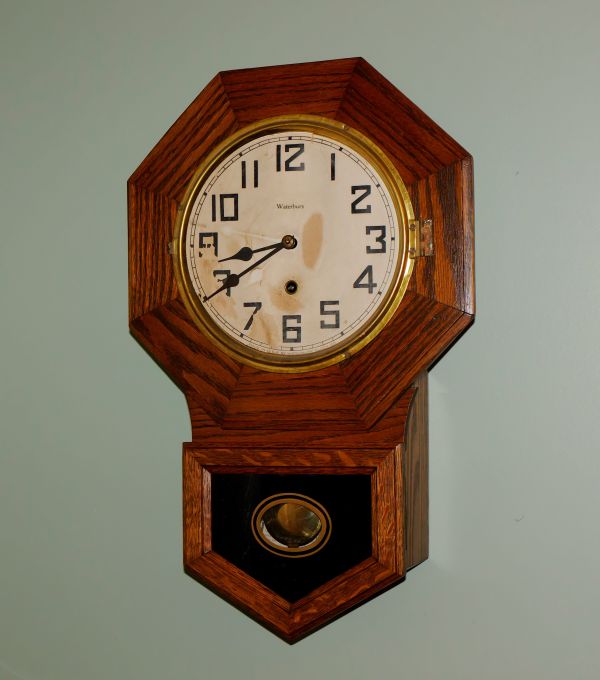
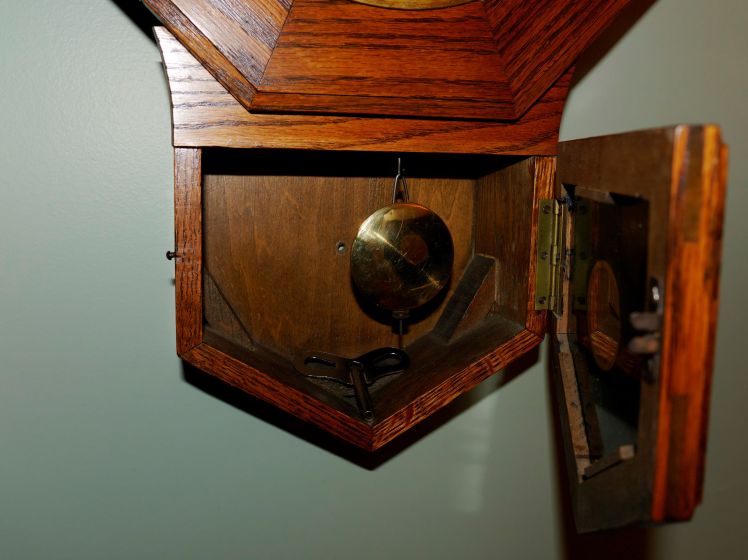
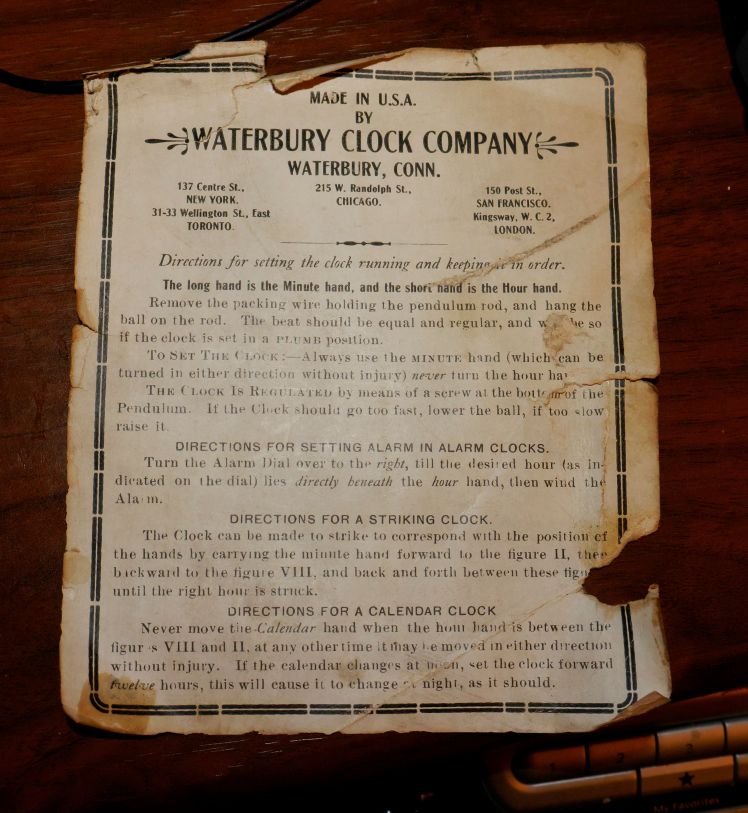
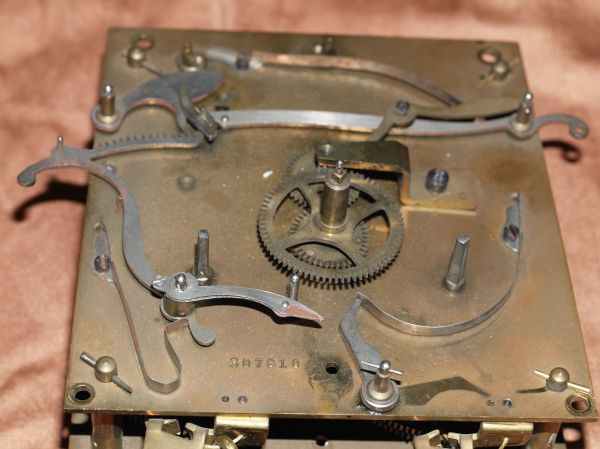
Instructions for the clock

The instructions came with the clock and I smiled when I read them.  “The long hand is the minute hand and the short hand is the hour hand”.

A inexpensive acquisition and only a few dollars to add glass and a bezel to complete the clock.


Request for assistance – attention Gustav Becker afficionados

RSa GB movement in no weights (1)
Gustav Becker with Braunau movement

As you know from reading my last post concerning this fine timepiece I am appealing to anyone who knows anything about these particular clocks to assist me in finding a critical part for the strike side. The part is called the “star wheel / snail”. Without it the strike side will not function. The time side will happily run without it.

The photo that follows is a movement with the star wheel intact (my apologies, it is a grab from EBay). Look closely towards the bottom just off centre you will see a wheel shaped like a star with a snail type assembly on top, hence the name. That is the one I am missing. Why it was taken off my clock movement is a mystery to me but it is what it is. A couple of guesses; someone did not want the clock to strike for whatever reason or two, it was a donor clock for another.

If you look closely in the next photo towards the bottom centre it shows my clock without the star wheel. Both of these are Braunau movements.

gb2
Showing the star wheel and snail which are one piece


OLYMPUS DIGITAL CAMERA
My clock showing missing star wheel and snail


Gustav Becker clocks of that era were essentially made in two factories, the Frieberg Works and the later Braunau Works.  My clock is from the Braunau factory. The star wheel must be from a Braunau clock as the design of that wheel was slightly different than ones from Silesia clocks.

If you know of a source or you happen to have one lying around (LOL) please email me.

Oh, and one more thing. If you happen to know the size suspension spring I need that would be great.  I am missing that too.

advertized on EBay (6)
Pendulum rod near suspension spring mount. The strike rod is just to the left

There is no prize for assisting me but if you do I will give you digital hug!

Thanks for reading my blog.

Gustav Becker Vienna Regulator Braunau factory circa 1902

RS GB movement in no weights (5)
Gustav Becker Vienna Regulator

This is a Gustav Becker 2 weight “Vienna Regulator” made at the Braunau factory in 1902. The serial number is a confirmed match for the numbered series built during that period. The clock was made in the Gustav Becker Braunau works in Bohemia (now Broumov, Czech Repulic), in mid-1902. The Braunau operation started up in February 1888 and would have been producing clocks up until 1925. Bohemia is a province in the Habsburg Austrian Empire hence the reference to clocks during that period referred to as Vienna Regulator style. The definition of a Vienna Regulator is a debatable point and I will leave that up to the reader to decide.

Some notable features are the inverted keyhole movement mount, rod gong and a wood pendulum rod with brass covered zinc. There are intricately carved trim pieces, certainly a common feature of the craftsmanship found in higher end clocks of that period. The clock is 51 inches tall and is a commanding presence on any wall and certainly a great addition to our living room.

What is missing in the photo are the two weights which at this point are not attached; the condition of the cables are suspect. Replacement cables are on the list. There is also a small part of the right bottom finial which has to be reattached (glued).

The bottom middle finial is also not attached. The bottom middle finial is in the freezer right now because I noticed that it was the only part of the clock with woodworm holes. I inspected the finial carefully, banged it on white paper and not a bit of dust or dead insects. This is a good sign and one indication that the worms and their larvae have been long gone but as an extra precaution a few days in the freezer won’t hurt and once it gets to -30C here in Nova Scotia a little time outside won’t do any harm either. I am not at the point where I will introduce it to chemicals as my best guess is that the problem insects have simply left their mark and have since departed. There is no indication of any worm holes on the clock itself which leads me to believe that the bottom middle finial may not be original. Chemical eradication appears to be the only course of action it seems as freezing does nothing.

RS the case (5)
some pieces had to be reattached

At the moment this clock is not working. The clock needs a very good cleaning and possible bushing work. I have not opened it up yet to investigate further but my first inspection of the moment is that it has not seen maintenance in some time. This will be one of my first steps.

This is a good project and from time to time I will detail my progress on this fine European clock.

Gustav Becker 2-weight regulator wall clock

3Clock Cake1 [3086218]
This takes the cake
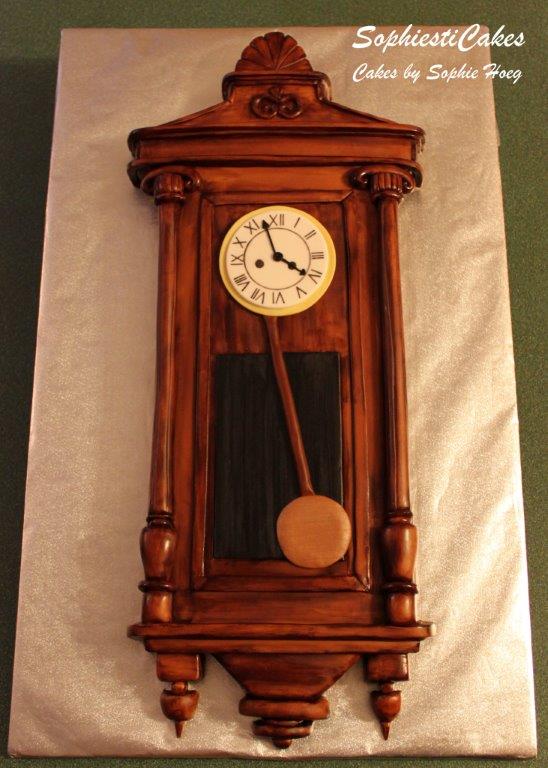
My wife bought me a Gustav Becker 2-weight regulator at a popular auction site and while I haven’t received it just yet she had to show me what it looked like in a most unusual way.  She thought that a photo would not do so she had someone make a cake from the auction site photo so that I could enjoy it before it came. That someone has a cake making business and as you can see she is very talented. It was awful hard to cut into it though.

The Gustav Becker clock which should be here in the next few days was advertised as a “project” clock so I am not expecting a perfect clock. According to the seller the strike hammer is missing although the crown, movement, weights, base, dial and pendulum are said to be original. We’ll see what else is missing when it arrives.

You can see the real clock in the following images.

$_57
Seller’s photo of Gustav Becker wall clock

$_57e
Regulator weights

$_57a
Movement and cables

Clock collectors usually pride themselves in having at least one Gustav Becker (GB) clock in their collection with earlier clocks commanding high prices. Indeed, Gustav Becker is one of the better known clock companies of the mid 1800s to 1930. In 1850 Gustav Becker opened workshops in Freiburg and Silesia, Germany.  At first, Becker struggled with untrained help, but won the “Medaille d’Or” for design at the 1852 Silesia Trade Exposition. Becker incorporated that first medal and his initials, G.B., into his trademark and into many components of his clocks, from movement, mounts to wall standoffs to beat-plates and pulleys.

Once he received the award he was able to attract skilled craftsmen to his various workshops. Until 1880 most Becker clocks were weight driven regulators but spring driven clocks followed.

Becker clocks are not too difficult to identify. Serial numbers on the clocks identify the year of manufacture. The cases of these clocks reflect the ornate furniture trends of the day and range from very simple to elaborately constructed. The casework is extraordinarily well done and often incorporates hand carving. Germany has never lacked for skilled carvers and the talent of the region’s artisans is evidenced in the Becker clock cases.

In 1926 the brand as well as the later acquisitions of Lenzkirch and Thomas Haller were absorbed by Junghans. Junghans continued to produce clocks under the Gustav Becker name until the early 1930s. While GB clocks are relatively easy to identify by their serial numbers, one way to identify a GB under the Junghans name is the serial number which was restarted at 0001 after the take over.

Does frustration await me? We`ll see. I will be posting updates on this fine timepiece as I progress through the restoration process.

A detail can make all the difference

on display (3)
Horse Crown Mauthe wall clock on display

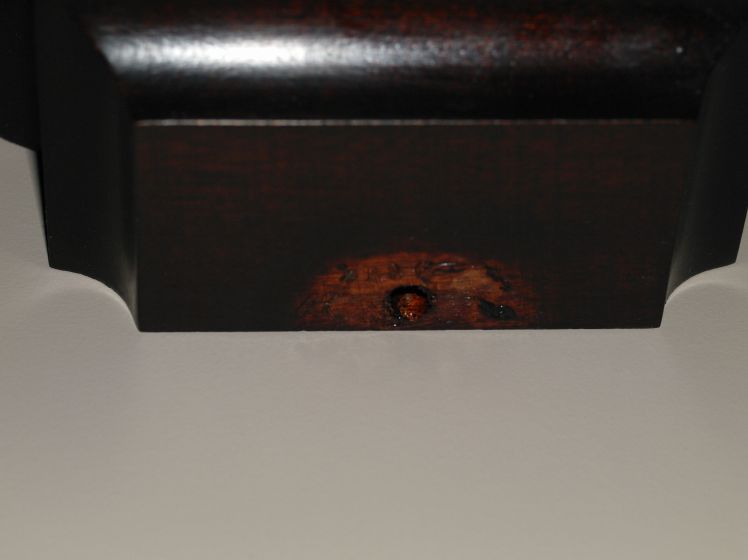
I acquired this beautiful Mauthe Horse Crown Vienna style wall clock in the fall. I inspected it carefully enough before the purchase but it was not until I got it home that I discovered a finial or perhaps a trim piece missing from the base area on the bottom.

OLYMPUS DIGITAL CAMERA
Missing trim or finial

Once hung the clock did not look as balanced as it should. It did not look quite right and there was clear evidence of a piece missing when I inspected the bottom more closely.

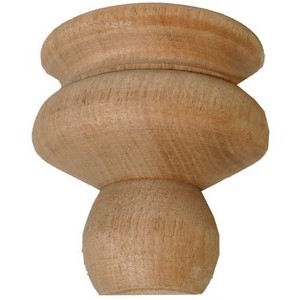
I went to the usual clock parts sites to look for a finial or piece that would best fit the design of this turn of the century wall clock. There were a number of choices but I decided to get the base piece finial you see here. It is flat on one side and comes without a peg. It complements the style of the clock without making it look awkward and I think I struck the right balance. It may not be exactly like the original but it looks good enough to fool the casual observer or even an expert.

The trim piece came unfinished. I determined that the clock had an original walnut finish so proceeded to apply enough coats of stain on the trim piece to match the rest of the clock.

Here is the result.

RS Finial added (1)
Trim piece added to base of clock

Here is a shot of the clock from a couple of meters away. You can see that it is more “balanced” than before. it might even be period-correct judging from what I have seen on other Vienna style clocks.

RS Finial added (3)
A small detail makes a difference

72.9703-300
From Perrin Canada

This cost me $6.70 for the trim piece / finial I purchased from Perrin Canada, $4.99 for the dark walnut stain and $.79 for a length of 5/16 dowel. This small detail makes a huge difference.

Let me know what you think.

Clock Repair Tools

RS Brandon
Arthur Pequegnat Brandon time only wall clock

It is time to buy the tools I need for clock repair. I already have a number of basic tools to get me started; pliers, letdown chucks, screwdrivers, etc.

However, my first significant tool is an Ollie Baker Mainspring Winder which arrived from the USA today. It is pictured below. The Ollie Baker comes with an assortment of collars for every size of mainspring.

Olie Baker spring winder

The spring winder will enable me to inspect, clean, and re-install barreled or open springs on all the clocks I will be servicing. My first impression is that it is a robust and well-machined tool that will give years of service. Indeed, one of the most important tools for clock repair enthusiasts is the spring-winder.

I also ordered bushing kit #5488 from Perrins today which will enable me to have the bushings I need in order to use the Bergeon Bushing Machine that I will purchase later on this year.

The Bergeon Bushing tool is “Swiss made” and exudes quality. In every clock, due to considerable wear, the plates have to be bushed from time to time. This tool allows the bushing of plates of various sizes. The kit includes driving punches, centering bit, stakes, and reamers.  I can bush by hand which some folks do by using appropriate reamers and files but I know that a bushing machine is a must-have. The first photo shows a clock movement that I had professionally bushed. It required 5 bushings in all in addition to cleaning and oiling and it runs very well.

With these tools, I can progress more seriously into this most interesting hobby.

Mauthe Horse Crown Century-old Wall Clock

Another wall clock has joined my collection, so let’s take a closer look at what I’ve acquired and whether it was worth the price I paid.

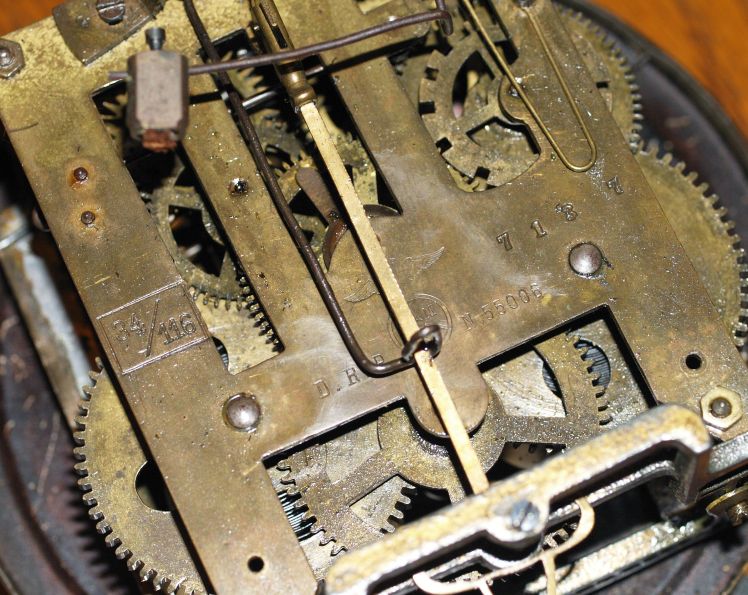
Time and strike movement, 116 BPM

The clock was advertised locally in the Truro, Nova Scotia area. The seller knew little about it beyond its provenance, but what he did share was an interesting, albeit brief, story.

In the early 1980s, his wife brought the clock over from Holland, where it had been in her family for several generations. Sadly, his wife passed away three years ago. Had she been alive, I’m sure I would have learned much more about the clock’s history. The seller was understandably hesitant to part with it, as it served as a happy reminder of his past life. However, he was entering a new phase of his life with a new partner, which meant letting go of furniture and other possessions. Like him, I also view life as a series of phases. The clock was priced at $100, firm and non-negotiable.

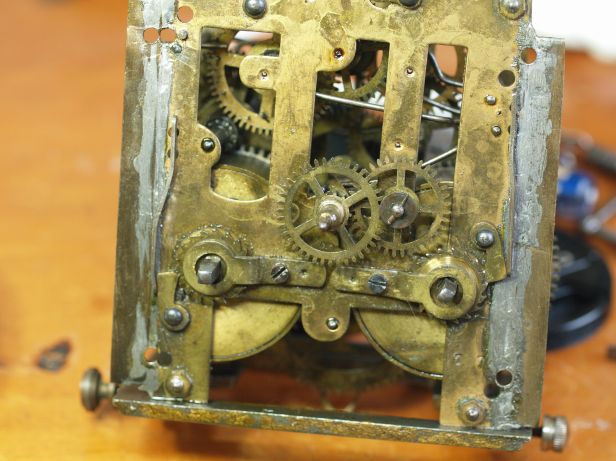
This two-train (time and strike) spring-wound clock could be described as being in the style of a Vienna Regulator. As expected, the movement is quite dirty—a common issue for clocks like this that have often never been serviced. However, there are signs that adjustments were made at some point, evidenced by marks on several screws in the movement.

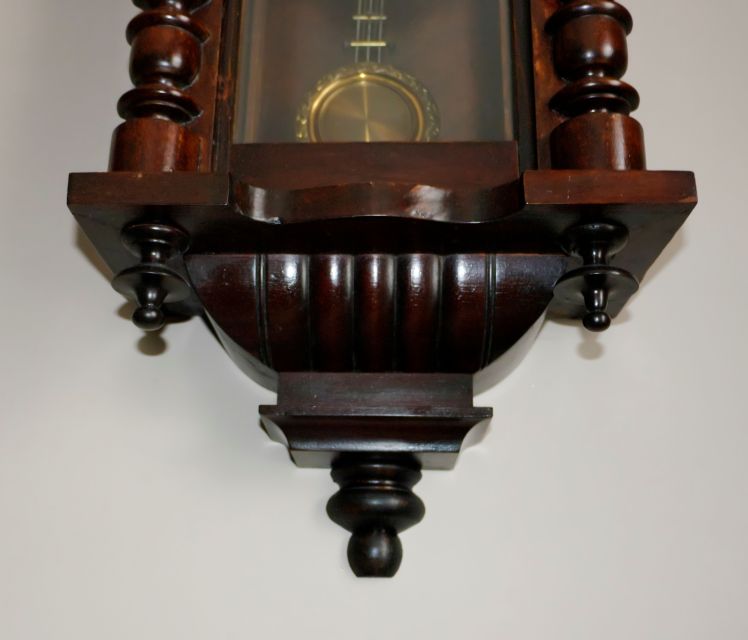
The clock is largely intact, except for a missing finial at the center of the bottom base. Why this particular part? According to the seller, the clock was brought over in a suitcase, and to make it fit, the bottom finial was snapped off and lost forever.

OLYMPUS DIGITAL CAMERA
Movement showing FMS Mauthe trademark

The clock is over 100 years old, with my research indicating it was made between 1895 and 1914, though the exact year of manufacture remains uncertain. The trademark—a Friedrich Mauthe of Schwenningen (FMS) emblem featuring three spokes with an eagle on top—is distinctive, as Mauthe trademarks are known to reflect the specific period during which the clock was produced.

Despite some benign neglect, the case is in good condition, and everything appears to be original, including the winding key.

OLYMPUS DIGITAL CAMERA
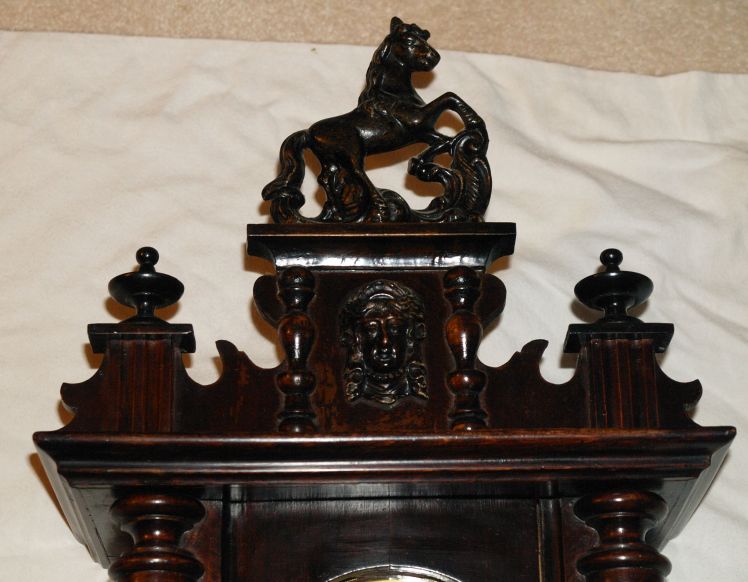
The crown

The crown fits into a slot at the top of the clock and can be easily removed if the clock needs to be relocated. The crown is made of wood, while the horse appears to be crafted from a casting material of some kind.

OLYMPUS DIGITAL CAMERA
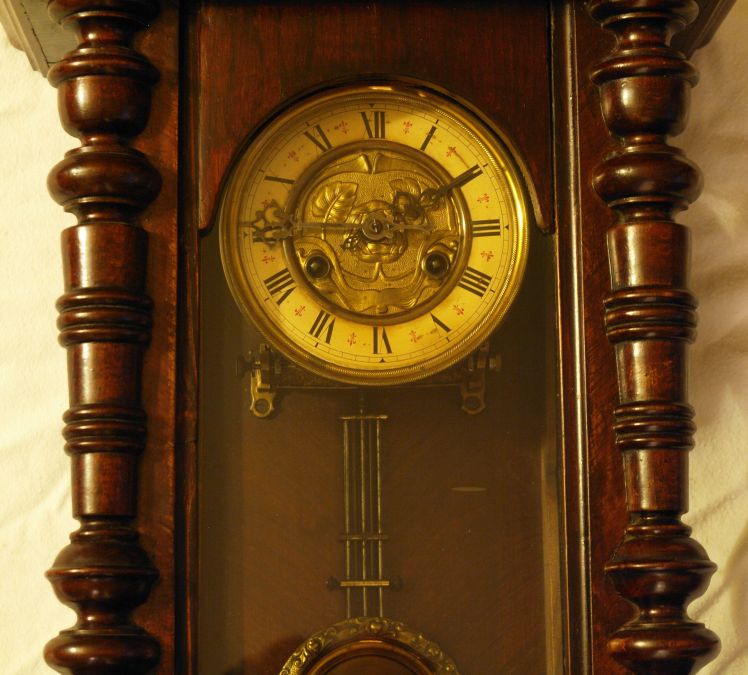
The face

The dial is made of celluloid and has darkened with age. Inside the dial surround, there is a leaf-like emblem, a common design feature from this period.

OLYMPUS DIGITAL CAMERA
The base and bottom finials

The base is fairly plain, though the bottom center finial is missing. I plan to replace it.

OLYMPUS DIGITAL CAMERA
The coil gong

The coil gong and block with attached movement rails are characteristic of the period.

History of FMS Mauthe

Mauthe clocks have a long and distinguished history in Germany. In 1844, Friedrich Mauthe and his wife Marie founded the company in Schwenningen to produce watch parts. By the late 1860s, Mauthe began manufacturing its own wall clocks and movements. In 1876, Friedrich’s sons Christian (1845-1909) and James (1847-1915) took over the company. In 1886, Mauthe began producing its own springs. Around 1900, the company expanded its offerings to include alarm clocks, pendulum wall clocks, grandfather clocks, office clocks, and the so-called “Buffet Uhren” or “Buffet clocks.” In 1904, the third generation took charge: Eugene Schreiber (1877-1939), son of Christian Mauthe; Dr. Fritz Mauthe (1875-1951), son of Jacob Mauthe; and Alfred Mauthe (1879-1911), son of Jacob Mauthe, helped build upon the foundation of the company.

In 1925, Mauthe introduced a new trademark featuring a right-facing eagle with outstretched wings, clutching a three-part round plate inscribed with the letters F, M, and S. By the 1930s, the company was producing around 45,000 clocks per week, with approximately 60% destined for export markets like England. In the mid-1930s, Mauthe began manufacturing its first wristwatches, some of which were supplied to the German Army (“Wehrmacht”). After 1946, Mauthe resumed wristwatch production, but the company eventually entered a period of decline.

Was it worth $100? I would say yes, but it’s on the higher end of what I would typically pay for a clock like this.

Now, it’s time to clean the clock, install a new bottom middle finial, and add it to the queue for servicing.

Ansonia Octagonal Short drop “schoolhouse” clock

Ansonia Schoolhouse ClockClock
Ansonia Schoolhouse Clock

I have been thinking of expanding my collection of wall clocks lately after acquiring a good sampling of mantle and shelf clocks.

I picked up this clock not far from where I live. It is an Ansonia octagonal short drop commonly known as a schoolhouse clock. I am putting the date of manufacture at around the turn of the 20th century though I cannot quite pin down the year. The number 12 is stamped on the movement which could refer to the year “1912”, or even the month of a year. The letters “TT” are also on the movement. This is my first Ansonia clock.

The gentleman I bought it from told me that this clock has been in his family for over 50 years and “I never saw it running”, he says. He was in the process of liquidating his mother’s estate and was loath to give it up as it had been a favorite of hers. He also said that it came out of a schoolhouse in Ontario, Canada; where, he did not know. The case is in great shape though there are other minor issues. One, the face has had some paint applied around the minute / hour pipe presumably to hide stains incurred from years of oily fingers winding and adjusting the clock.

OLYMPUS DIGITAL CAMERA
Paint applied to the clock face

You can just barely make out the Ansonia trademark. The second issue is a missing bushing for the hour hand.

OLYMPUS DIGITAL CAMERA
Missing bushing for 4 inch hour hand

The bushing inserts into the hour hand hole to friction fit with the hour pipe / cannon. I suspect that the clock was not running was for this very reason. Someone thought the clock was broken. It is an easy fix and requires buying or fashioning a new bushing.

Curiously, there were pieces of rotted elastic band on the pendulum rod just below the suspension spring. I have no clue why. You can still see a bit of it in this photo.

OLYMPUS DIGITAL CAMERA
Time only Ansonia movement

Otherwise except for a little adjusting (bending of the crutch to get the beat right} the clock works well and has been ticking away for a day now. There is very little wear on the clock and no obvious bushing issues that I can see although I will have to take the movement out of its case for a further inspection and a thorough cleaning to determine what if anything needs fixing.

Much has been written about the Ansonia clock company. The company history can be found here. The Ansonia Clock Company went into receivership just before the stock market crashed in 1929, a foretelling of things to come, perhaps. The machinery and dies were sold to a Russian Company. A sad end to a glorious American company.

Postscript: I took the movement out of it’s case and found that the clock does indeed need 2-3 new bushings. The wear is not terrible and the clock runs fairly well but bushing work is in order. Once the new hour and minute hands arrive I will clean the movement, re-assemble the clock and display it until my bushing machine comes in the new year.

Nov 10th; new hands arrive in the mail. The hour hand has the required bushing and was an easy friction fit. Now looks and runs as it should.

U M Muller Box Clock

Probably not a household name in its time, yet U. M. Müller produced clocks that could stand proudly beside the finest German makers of the early 20th century. Their box clocks, in particular, became strong competitors, capturing a market that was shifting away from the ornate Vienna regulator toward something more modern, practical, and affordable. By the 1930s, the sleek German box clock—with its simpler lines and middle-class appeal—had all but closed the Vienna regulator era.

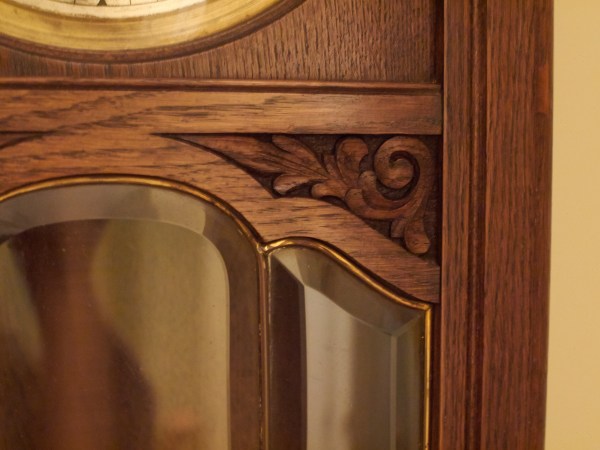
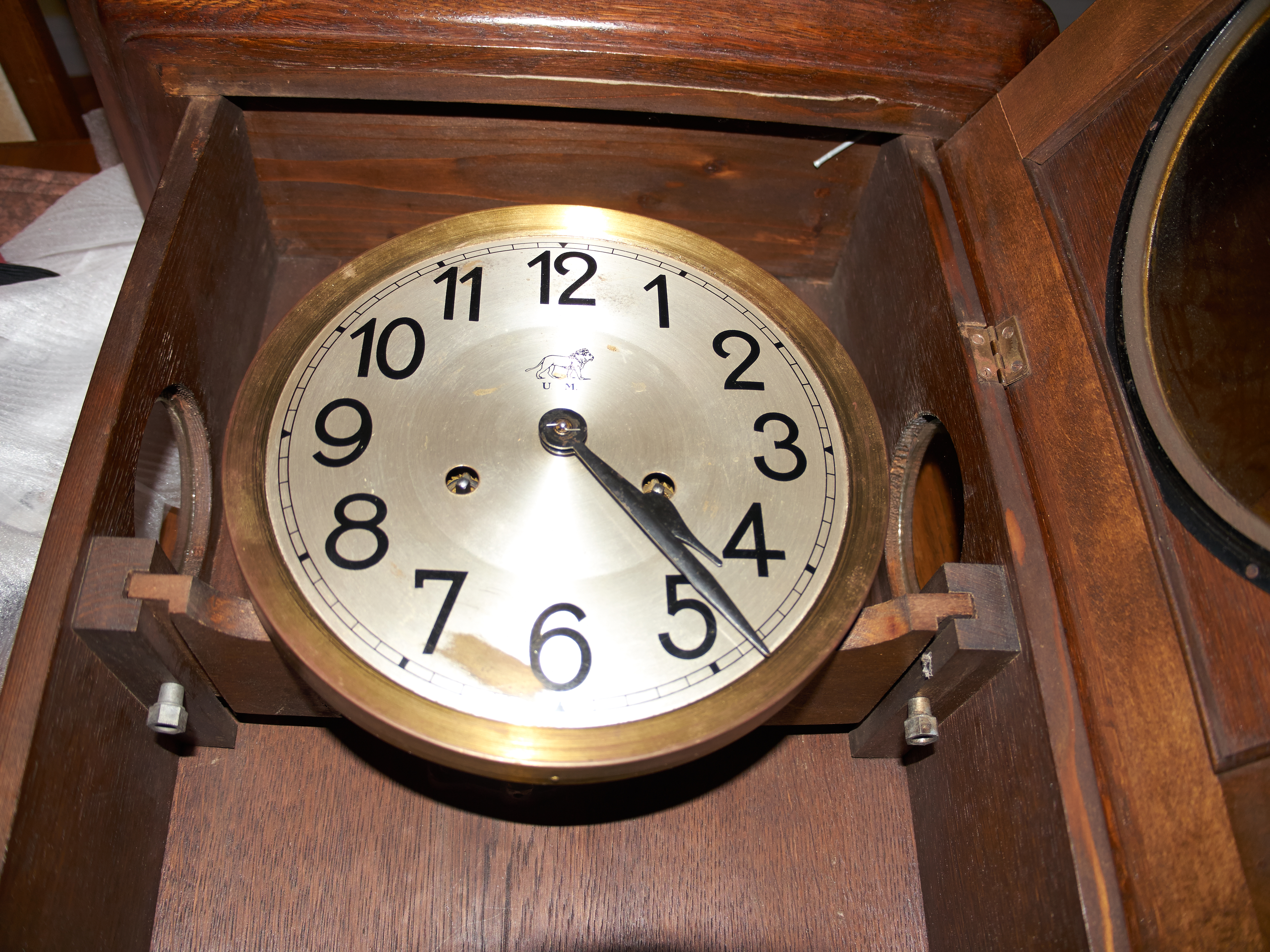
This particular U. M. Müller is a striking example. The oak case features delicate carved inlays on the door, brass strip framing, and a fixed wood crown, giving it a stately presence. The brass bezel surrounds a metal dial with spade and spear hands, while beveled glass framed in brass completes the look. Wall stabilizers ensure a secure mount, reminding us that this was a clock built not just for beauty, but for reliability.

after a good cleaning (4)
All original German box clock

The case itself has aged beautifully, with no noticeable scratches or blemishes. The dial, however, tells a different story—its surface bears marks and abrasions, including one between the 6 and 7 where the paint is worn through to bare metal. It is not repairable, but it does speak to the long life and service this clock has seen.

U M Muller clock (9)
Incorrect use of a cleaning agent

Inside, the movement is a classic rack-and-snail time and strike. The clock chimes on a coiled gong—bold at the half hour, more resonant on the hour, but never harsh. As with most spring-driven movements, one should not expect chronometer precision. Still, this example proves steady and reliable, keeping “regular” time across its full 8-day cycle.
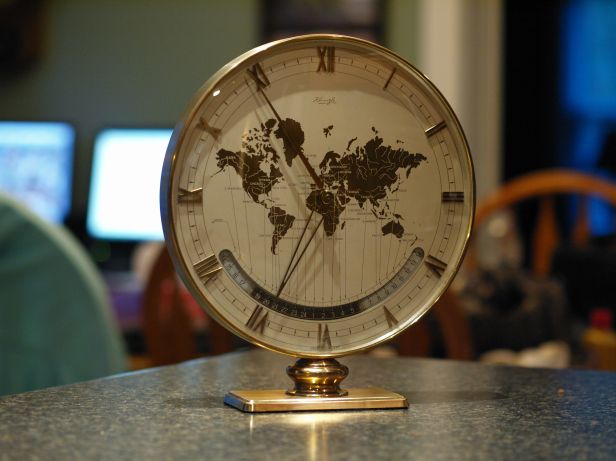
U M Muller clock (2)
Inlay carvings meets brass strip framing

After a careful cleaning and waxing, the case now shows hints of what it must have looked like when new—over 90 years ago.

U M Muller clock (4)
2 screws are loosened to remove the movement

Collectors often date U. M. Müller clocks by the lion trademark on the dial. A raised tail indicates pre-1930 manufacture; a lowered tail, as on this example, places it in the mid to late 1930s.

after a good cleaning (1)
An attractive addition to our kitchen

According to Schmid’s Lexikon, the company’s roots trace back to 1867 in Mühlheim. After passing through several hands—including R. Schnekenburger around 1880 and later Gebrüder Müller—the brand built a legacy of solid, handsome clocks that still charm collectors today.

Daniel Dakota wall clock

No serious collector would admit that they have a Daniel Dakota wall clock in their collection. I have two!

The clcok that started my collection, a humble Chinese clock that still ticks today.

One was converted to quartz. The other was gifted to a family member. Are they attractive clocks? The functional styling is borrowed from American and German box clocks; they are not what one would consider a beautiful clock.

One Daniel Dakota clock was given to me. I took it to a local clock repair person. I will not say he was a competent clock-maker because he was not at all interested in repairing this clock or any other clock for that matter. His method of maintaining a profitable business consisted of replacing every mechanical movement with a quartz one. However, with my blessing he pulled out the movement because it was “broken” and installed a quartz movement. I found out later that a very little work was needed to make this mechanical movement run again.

A previous owner attempted to wind the clock in the wrong direction using a pair of pliers and popped the mainspring out. Though a simple to fix I now have a working movement with no case.

The case was in sad shape. Not surprising since clocks such as this one were never taken care of properly. I removed tacky plastic trim, added two rosettes, re-stained damaged sections of the case and cleaned the glass.

The quartz movement is a Westminster / Whittington chime with auto night shut off. Although many quartz movements can be found around the $10 range this was well over $100. Although there not marking on the movement I believe this one was made by Sieko. Quartz movements can be pricey when you factor in 2 chime tones, a pendulum, auto shut off and so on.

Daniel Dakota movement

My other Daniel Dakota is in the midst of a good cleaning and undergoing some slight adjustments. It is missing a bottom trim piece but I doubt that it will ever be replaced. The bottom piece was likely taken off so that it could sit on a shelf.

Daniel Dakota wall clock, one of Tempus Fugits more popular models
Daniel Dakota missing bottom trim piece

Daniel Dakota movement dis-assembled and parts spread out

Chinese movements are not made to the same tolerances as a fine German or American movements. The plates are thin, there are plastic parts (though not on this movement) and no supplier has replacement parts. They have an amazing ability to last almost forever and the manufacturer knew that they would never be serviced. A throw-away mechanical clock in the Chinese tradition of mass marketing. However, you can breathe new life into these movements with a thorough servicing.

Although Daniel Dakota is a successful marketing brand name, you will not find a company site anywhere online. There are many suppliers associated with the name and no single factory where they are produced. Daniel Dakota clocks are sold by many a variety of retailers across North America and they are regarded as a low cost, low quality utilitarian clock for the average home.

The next time you hear someone criticize Daniel Dakota clocks remind them that although they are very inexpensive or can be picked up for almost nothing they will run for many years with very little care.

Arthur Pequegnat Canadian Time wall clock

The Canadian Time clock was produced by the Arthur Pequegnat Clock Company, which holds a special place in Canadian horological history. Founded in 1904, the company became the longest-lasting Canadian-based clock manufacturer, operating until 1941. Pequegnat clocks are known for their solid craftsmanship and distinctive designs, contributing significantly to the Canadian clock-making industry during the early 20th century.

Arthur Pequegnat, originally from Switzerland, brought his expertise in clockmaking to Canada, where he established a reputation for high-quality clocks. The company manufactured a wide range of clocks, from wall clocks to mantel clocks, many of which are now highly prized by collectors for their durability and unique aesthetic. Despite the challenges of competing with larger international clock manufacturers, Pequegnat’s attention to detail and commitment to quality ensured the company’s success for several decades.

Today, Pequegnat clocks are considered a piece of Canadian history, and the company’s legacy endures through the ongoing interest of collectors and enthusiasts, like myself, who appreciate the skill and craftsmanship of these antique clocks.

Pequegnat wall clock
Canadian Time clock by Arthur Pequegnat

This particular clock was made after 1916 in Kitchener, Ontario, Canada. Clocks made before 1917 were marked “Berlin” on the dial face. The town was known as Berlin from 1854 until 1912 and became the City of Berlin from 1912 until 1916. Due to the negative association with Germany during the First World War, the decision was made to change the name to Kitchener midway through the war. Today, Kitchener serves as the seat of the Regional Municipality of Waterloo, Ontario.

OLYMPUS DIGITAL CAMERA
Label affixed to back of clock

Unfortunately, the exact year my clock was manufactured is unknown as Pequegnat did not date-stamp their movements, but the Canadian Time series was produced up until 1941. By that year, the demand for brass from World War II armament makers, a crucial material for clock movements, forced the Arthur Pequegnat company to halt production. If the clock was made as late as 1941, it would be 72 years old.

OLYMPUS DIGITAL CAMERA
Checking on condition of the clock

This clock features Arabic numerals, which was less common since most were ordered with Roman numerals. As a railway clock, the use of Arabic numbers would have made it easier to read for the general public in a train station. The manufacturer allowed customers to choose between Arabic or Roman numerals when ordering. Additionally, buyers could also opt for a version of this clock with time, strike, and calendar functions.

OLYMPUS DIGITAL CAMERA
The Crossed horseshoes were likely added by a previous owner

The crossed horseshoes on the base of a clock are often associated with good luck and protection. In many cultures, horseshoes are considered symbols of good fortune, particularly when they are displayed with the open end facing upward, which is thought to catch and hold luck. I have not seen another Canadian Time clock with crossed horseshoes.

OLYMPUS DIGITAL CAMERA
On prominent display in my home

I’m hoping to track down a photo of the clock from its time at the Pictou, Nova Scotia train station before it was decommissioned in the early 1990s, as that could really help narrow down the clock’s manufacturing date.

The clock itself is quite large, measuring 37 inches high, 5 inches deep, and 15 inches wide. It’s made of quarter-sawn oak, which results in boards with annual rings mostly perpendicular to the face, providing greater stability and minimizing warping.

The Canadian Time clock is a reliable timepiece, showcasing the quality and craftsmanship that went into its creation.

Arthur Pequegnat Regulator #1

One of the clocks that I would like to add to my collection is the Arthur Pequegnat Regulator #1, single weight 8-day time only clock. A rare clock indeed and prices of the few I have seen are on the high side. Too rich for me at his time.

The company distinguished itself as a competitor for some of the better American wall clocks such as those made by Seth Thomas. Their wall clocks often looked like models made by Seth Thomas but some of their designs were unique. For their wooden cases, they favored the heart wood of quarter-sawn white oak that showed off beautiful ray flecks.

The regulator #1 is often compared to the Seth Thomas Regulator #2. Thousands of Seth Thomas Regulator #2s found their way into offices and rail stations all across America. The Arthur Pequegnat Regulator #1, though not as prolific, served the needs of many businesses in Canada. The clock is highly collectible in Canada and will command twice the price of similarly styled clocks by well-known American counterparts.

This photo of the Regulator #1 was taken at the Canadian Clock Museum in Deep River Ontario in 2013.

The Arthur Pequegnat clock company had an illustrious albeit short life. Watchmaker Arthur Pequegnat was born in Switzerland in 1851. Arthur immigrated to Berlin, Ontario Canada in 1874 with his wife, parents, brothers and sisters; a grand total of 18 family members.

By the late 1870’s Arthur was operating a jewelry store and watch repair in Southern Ontario. By the middle 1880’s Arthur and his brother Paul were operating a shop in Berlin, Ontario. After about ten years the brothers went their own way, both operating successful jewelry shops in Southern Ontario.

In 1897 Arthur expanded his Berlin Jewelry shop to include the manufacture of Bicycles. However, By 1904, with the decrease in the demand for Bicycles, Arthur began to re-focus on the clock industry, by manufacturing his own clock movements at his Berlin Bicycle Manufacturing plant. At first the wooden clock cases were made by local Furniture Makers, however in time he manufactured his own clock cases.

Berlin, Ontario was re-named Kitchener Ontario in 1916, due to anti-German backlash during WW I. The date becomes a useful tool when determining the age of Pequegnat clocks, Movements or Dials marked “Berlin” date the clock to 1916 or earlier and those marked “Kitchener” are 1916 or later. Since many clocks had a long production life it is difficult to date any Arthur Pequegnat clock with precision.
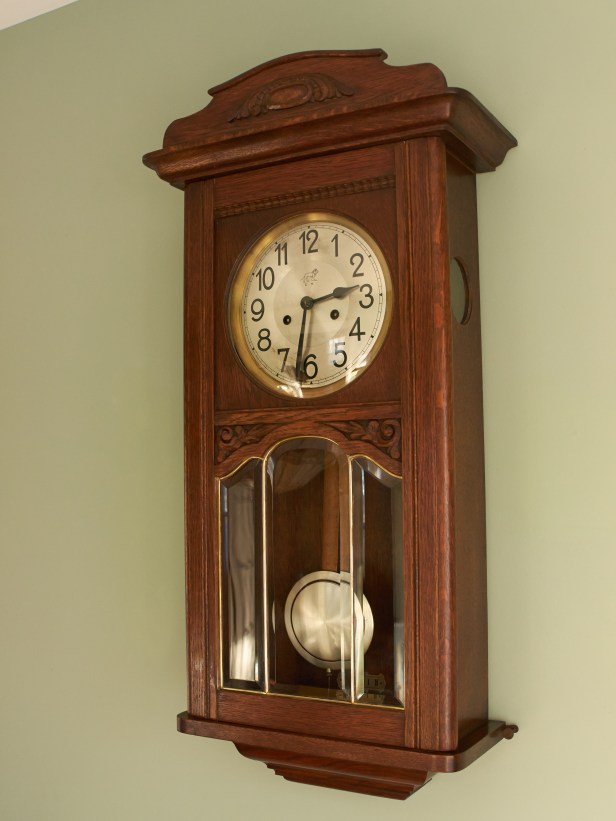
Regulator #1, hanging in the Macdonald Museum in Middleton, Nova Scotia, Canada

Arthur died in 1927, however, with family members in control, the company continued to operate until 1941. The war effort meant that brass became difficult to obtain and the company shut its doors. The factory never produced another clock, and was demolished in 1964. All that remains in Kitchener today is a plaque commemorating this great clock manufacturer.
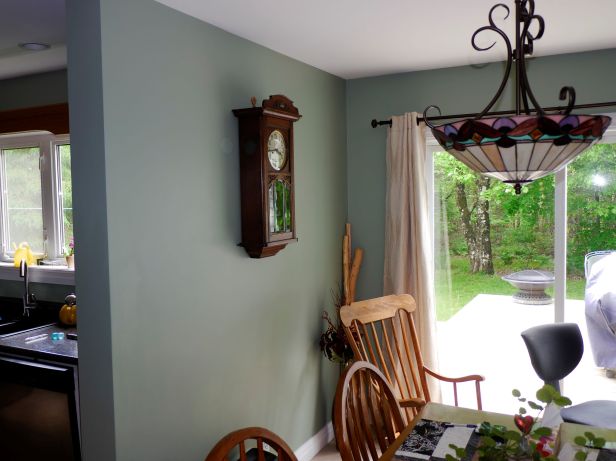
MacDonald Museum main exhibit area

The Canadian Clock museum contains the largest collection of Arthur Pequegnat clocks in Canada and it is certainly worth a visit. The Macdonald Museum in Middleton, Nova Scotia has a modest collection of Pequegnat and is worth visiting if you are traveling through the province of Nova Scotia.

Website Powered by WordPress.com.

Up ↑