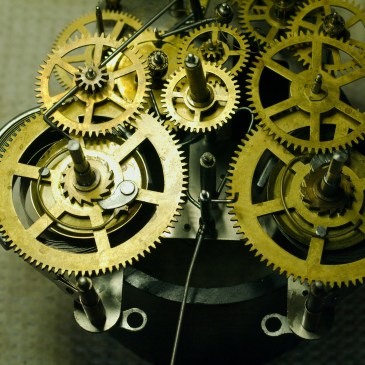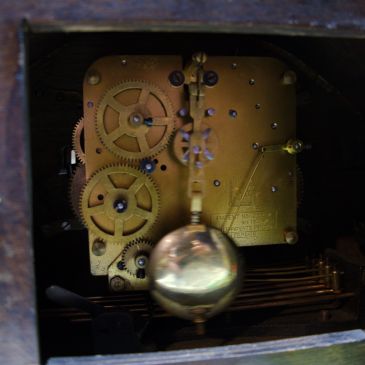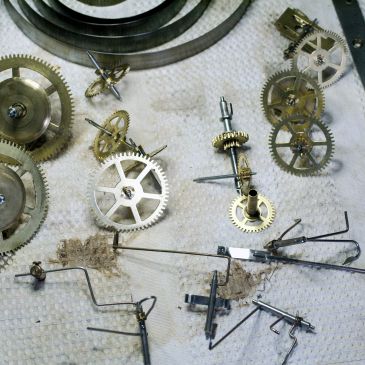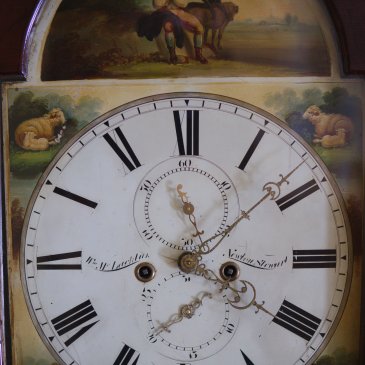
Selling an antique mechanical clock – preparation and advertising – how to

How to sell an antique mechanical clock

If you are a collector like myself there will come a point when there are just too many clocks and not enough walls and mantels. I manage my collection in two ways, some clocks are gifted while others are sold. I am not in the business of selling clocks but occasionally I will sell a few to trim my collection.

The objective is to recoup my initial investment and any time I put into a particular clock plus, make room for new acquisitions.

Juba Schatz time and strike sold in 2018

I hope you find these tips useful when preparing to sell your clock.

What does “antique” mean: The general standard for considering something as an antique is that it must be least 100 years old. Based on this definition a clock made on or before 1920 is an antique. Anything under 100 years but more than 30 years is vintage and anything 30 years or less is considered collectible. However, you will find sellers using the word antique when clearly, the article is vintage. And some consider anything that is old to be an antique.

Vintage Mauthe Westminster chime sold in 2019

Value: Research auction prices to get a feel for the value of similar clocks that are offered for sale and the price realized. There will be a range of prices and something in the middle of the range is a good guide. Know that a clock is only worth as much as someone will pay. If you price your clock too high you will know it soon enough.

Rare and desirable clocks, as well as clocks with an interesting provenance, will command higher prices.

Clocks vary in price according to the geographic location where they are sold. Generally, clocks that are made in the same location as the clock is sold will command higher prices.

Preparing the clock for sale: A clock in running condition will be worth more than one that is not. A professionally serviced clock in excellent running order will command a higher price. A clock case cleaned of grime will present better than a dirty one. Missing hands or dial glass will adversely affect the price. Items such as these can be replaced and parts are available from clock suppliers but it becomes an extra cost for the buyer and for many it is a deal-breaker.

Disclosure: Honesty is key. Tell the prospective buyer as much as possible about the clock. A clock that is a marriage, a case with a similar but replacement movement, should be stated as such. Replacement glass, newer dial, replacement crowns and finials, case repairs or full case restoration should also be disclosed. If the clock is running and was recently serviced by a competent repair person, state it. If the clock is running but the movement needs to be cleaned, state it. If it is not running describe why and what issues it might have (poor previous repairs, missing parts etc.). If you do not know, state it. Describe excessive wear, damage or missing pieces such as crowns, finials and trim pieces.

If your clock is rare, indicate why it is rare and how your research supports your description.

Jauch wall clock
Jauch wall clock may look antique but it was made in the 1970s

Where to advertise: There is any number of ways to sell a clock. Facebook for-sale sites, local online for-sale sites, eBay, flea markets, consignment shops and auction houses are popular places to sell a clock. Setting up an account for most online sites is a pre-requisite but there is usually no cost.

Photographing your clock: Few cell phones are capable of capturing a detailed image of a clock but for many, it will have to do. Out of focus photos are a no-no, however.

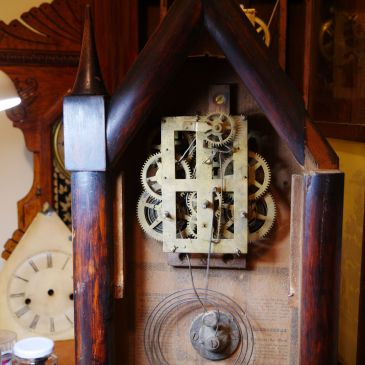
Several images from different angles as well as a photo of the inside of the clock case are much more helpful than one photo. During the daylight, place the clock near a window and position yourself between the window and the clock to take a series of photos in natural light. If there is damage or wear take closeup photos of those areas.

A dedicated camera with artificial light will produce superior results.

Determining the age of a clock by the movement from a Gilbert mantel clock is easy. It is stamped on the plate (1925)

Collectors are interested in certain makes. Along with your description state the maker and the approximate age. If you do not know, a picture of the makers mark on the dial or the movement will assist prospective buyers.

Description of your clock: Crafting an ad is an art in itself. You must be concise and accurate and not overly wordy. There is a balance between too little and too much information. More information means fewer inquiries from prospective buyers. Too much information with technical terms will turn off prospective buyers.

State the clock’s maker if known, the model if possible, the year it was made, the type, (time-only, time and strike, chiming clock), the style of clock (mantel, wall, shelf, parlour, Ogee, tall-case etc.). as well as any interesting features, for example, a steeple clock with an alarm function or a clock with a second’s hand.

There is no need to provide a reason for selling but sometimes it helps the ad.

Junghans Crispi time and strike wall clock
Junghans Crispi German time and strike wall clock, circa 1899

Example of a poor ad for Mauthe clock pictured below

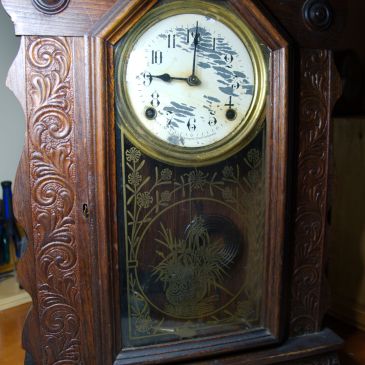
Antique chiming clock, comes with key

Example of a good ad 

Scaling down my collection. Antique German time and strike clock made by Friedrich Mauthe, circa 1899. Original glass, mild restoration including new upper centre finial, repainted hands, new wall stabilizers and new arch piece. Cleaned and serviced in 2019. Runs well, key supplied.

Mauthe wall clock

And finally

Know your terms: If you are selling a mantel clock, the word is mantel, not “mantle”. A clock with two winding points (and there are exceptions) are generally called striking clocks, that strike not “chime” on the hour and half hour. A chiming clock generally has a quarter-hour musical tone such as Westminster or Whittington and often has three winding points (again there are exceptions). There is no such thing as a Tempus Fugit clock. Tempest fugit means “time flies”. A grandfather clock is a tall-case clock 6 feet or higher, not a wall clock. Gingerbreads and parlour clocks are different but both are often called kitchen clocks.

Though certainly not a definitive guide to selling, I hope I have provided some pointers and ideas when you decide to sell your antique mechanical clock.

What is this clock thing for? #5 – the mainspring clamp

The only way you can safely disassemble a clock with an open mainspring is by using mainspring restraining clamps. 4 piece sets, which will accommodate various mainsprings sizes are available from all clock suppliers.

Wind the mainsprings tightly enough so that you can work the clamps around the springs. Move the rachet click aside and allow the let-down key to release the mainspring slowly into the clamp.

Mainspring contained in a clamp
Mainspring  restrained within in a clamp

With the mainspring safely clamped you can proceed with cleaning and servicing a clock movement.

A soft steel wire becomes a clamp

When a clamp may not fit or you do not have clamps, a soft steel wire will suffice.

This clamp on a time side mainspring

Round and flat mainspring clamps are available from suppliers. The above shows a flat clamp on a mainspring

Olie Baker spring winder
Applying a round mainspring clamp while using an Olie Baker spring winder

If you can afford it, a spring winder is one of several essential tools of a clockmaker.

Removing lever with helper spring
Assembling a movement with a mainspring restrained in a clamp

Safety is paramount when working with a clock.  If you are going to buy just one set, I would purchase flat clamps. They are easier to maneuver around the mainspring than a round clamp. Mainsprings are not to be fooled with. They are very powerful and all that power can cause damage not only to clock components but to your limbs as well.

Interesting clock repairs, some good, some not so good

While I admire the ingenuity and creativity of clock repairpersons many years ago some of the repairs are downright scary and dangerous. I say clock repairpersons because may were back yard mechanics with minimal clock skills that were paid to “just get his thing running”.

In this article, I will describe some of the strange repairs in clocks I have worked on over the years.

Let’s start with this interesting wheel repair.

Tooth repair on a 30-hour time and strike

I would call this a passable tooth repair. It is functional but it could have been dressed properly and filed down to improve its appearance. I left it as-is.

Continue reading “Interesting clock repairs, some good, some not so good”

English bell strike servicing Part I – the assessment

In February 2020 my wife was perusing an online auction house looking for interesting bargains and noticed a 170-year-old Scottish tall case offered for bidding.

Over the past couple of years we had talked about acquiring an antique tall case clock but those we liked were either well beyond our reach or required extensive repairs so, here was a unique opportunity.

Though we had only auction photos to go by, the clock looked intriguing and was very much what we had in mind. We began our bidding low and managed to win the bid with a decent and acceptable (to us) price.

Tall case clocks have dropped dramatically in price over the past few years; nobody wants them and they do not fit the modern minimalist lifestyle of the young today. Besides, where would you put it?

Tucked into the corner of the auction house

The clock was not without issues nor did I expect it to be problem-free. The case required some structural work and the overall finish was dull and lifeless.

This article concerns my initial impressions and assessment of the movement prior to cleaning and dis-assembly.

Movement as found

What was I up against in terms of servicing the movement? What kind of issues would I find and did I have the skills to address those issues?

My preliminary assessment involved setting up the movement, connecting the weights, and performing some tests. After putting the clock in beat I managed to have it running for about a day.

while the time side ran well the strike side was another matter. Attaching the weight to the strike side produced a run-on strike until the power was depleted. Hmm, something serious or simply a minor adjustment?

Back of clock showing the crutch, bell, and hammer

While I have worked on dozens of English, German and American time and strike movements, this was my first attempt at an English bell strike. They are relatively easy to dis-assemble and re-assemble but are notorious for being temperamental. The greatest challenge is not the cleaning of the components or the reassembly, it is achieving long term reliability as a dozen parts threaten to hang up, split, or fall apart. Wear combined with scars from old repairs challenge any clockmaker.

First impressions

It is a very heavy movement with 3mm plates and large well-engineered components. These movements were designed to run reliably for years but 170 years and a history of cumulative repairs leaves one with a movement that can fail in many unexpected ways.

Looking at the escapement from above

Problem areas/issues

  • Enlarged pivot holes: I am reluctant to bush every pivot hole but upon inspection at least 3 bushings are required and possibly a fourth.
  • Repaired rack tail: The rack tail takes quite a beating. Once the rack is released during the strike sequence it drops with a bang on the snail. Years of banging ultimately results in a damaged and often repaired tail. The fix on this movement is ugly but the question is, is it robust enough to continue doing its job?
  • Homemade rack tail spring: Made from copper wire; there is too much tension causing the rack tail to strike the snail with too much force. A new rack spring has been ordered. In the meantime, I am using a thinner spring wire.
  • Worn gathering pallet: Assess and determine functionality.
  • Loose clicks: Loose clicks are a common issue with English bell strike clocks. The clicks on this movement are loose though the strike side is a little tighter than the time side. Both are functional. Should they be replaced or will they continue to function reliably as-is?
  • Loose crutch The crutch rod connecting to the escape wheel arbour has been adjusted too many times. It is loose and must be addressed.
  • Stiff Suspension spring: The suspension spring is the incorrect thickness and fashioned from a piece of a metal ruler! There is little amplitude. A new suspension spring assembly, pendulum rod, spike and hex nut have been ordered.
  • Bent rack: If it is soft steel it can be bent back to its original position. If it is hardened steel it could break if I tried to bend it.
  • Loose bell connection: Bell has been removed many times and the thread for the bell rod end where it connects to the cast iron bell, is stripped.
  • Missing seconds hand: Ordered
  • Calendar hand not connected: The movement has no calendar function. The face has a calendar hand and while the movement has no calendar wheel the movement is period correct. Was the movement replaced early in the clock’s life or was the clock originally built and assembled without a calendar function? That will remain one of the clock’s mysteries.
  • The cables are brass and they look old: I will make decision whether or not they should be replaced.
Side view showing the main wheel and the time train

And this ends part I. In the next part, dis-assembly and re-assembling the movement will be covered so, stay with me as we explore this movement further in Part II.

Fleet Time company of Montreal – case refinishing and 2 surprises

While refreshing the case of this relatively nondescript mantel clock assembled by a short-lived Canadain clock company I ran into two interesting surprises.

Here is a garden-variety vintage Westminster chime mantel clock from the Fleet Time Company of Montreal (Canada). Many of these clocks were sold at department stores across Canada during the pre-war (WWII) era. However, this little known Canadian clock company had a brief life. Between 1936 and 1940 the company produced a range of two and three-train mantel clocks with movements sourced from Germany but were forced to end their operations.

The Second World War took a heavy toll on this company as the source of movements dried up and so did the company’s fortunes.

Wood cases were made in Canada for some models while other cabinets were imported from Germany.

This particular clock has a Gufa Westminster chime movement and I assume most of their 3-train clocks had a similar if not the very same movement. Gufa is the Guetenbacher Uhrenfabrik, located in Gütenbach, Germany. They manufactured 400-day clocks, cuckoo-clocks and later they became the “Jahresuhrenfabrik” (August Schatz & Sons in Triberg, Germany).

Rather than advertise the maker, many Fleet Time clocks simply had the word “Foreign” stamped on the movements.

This is a clock that could easily have been thrown in the garbage and I am fairly sure that is where it was headed. While I was in the city of Halifax (Nova Scotia, Canada) to pick up an Arthur Pequegnat Canuk kitchen clock the seller took me into his garage, pointed to a clock sitting on a shelf, and said. “for $10 more you can have this one”. “Why not”, I said!

Refinishing the case

I thought I would tackle the case first. While the front of the clock looks okay, the finish on the side sections were down to the bare wood plus scratches on top really detracted from the general appearance of the clock. It was a real mess. On top of that, the left side shoulder section was completely detached and had to be re-glued. Hot hide glue was used for this repair.

The finish was badly worn on both sides

Surprise #1

Rather than reproduce the dark lacquer finish I chose to sand the case down to the bare wood to see what lay beneath. To my surprise, I discovered a nicely grained, and beautifully textured grain. Enhancing the veneer with a light walnut stain is the way I chose to go because I did not want to go as dark as the original finish. Special Walnut, which has a light tone is perfect for the case and if I did not like it I could apply a darker walnut stain over it later.

Choosing the right stain; part of the case is still drying off from a wipe down with a damp cloth

The special walnut is very pleasing to the eye.

Special walnut stain

And the top of the clock.

Top of clock

After two coats of stain (above), here is the result.

After two coats of stain and two coats of shellac

The Special Walnut stain produced a very pleasing result. I applied one more coat of shellac, let it dry, and topped it off with Minwax Polishing Wax to produce a satin finish. Not the finish that came from the factory but it wlooks good.

Surprise #2

After cleaning the chapter ring, polishing the chrome bezel I was ready to return the movement to its case but what I should have done was test the movement beforehand.

When I received the clock I confirmed that the strike and chime functioned as they should and I assumed the time side was fine.

Broken mainspring which is not reparable

I inserted the winding key into the centre arbour and found no resistance. Hmm!

On these movements the barrels can be pulled out without disassembling the movement which certainly simplifies repairs. I pulled out the barrel, popped the back cap off, and discovered a broken mainspring. Using needle-nose pliers and heavy gloves, I pulled the mainspring out with for closer examination. No part of this mainspring is reusable and a new one must be ordered.

Occasionally when a mainspring breaks it takes a few other components with it like broken teeth, broken leaf pinions or bent arbours referred to as collateral damage. I inspected the gear teeth, pinions and arbours on the time train, gave the wheels a few spins and found everything moved smoothly, so, no damage this time. The broken mainspring is the only issue keeping this vintage mantel clock from striking and chiming again.

Mainsprings care easily sourced from a clock supplier. I waited until I built up a list of supplies for other projects then submitted the order online. German and American mainsprings are best and avoid those made anywhere else particularly India.

The movement was placed in a plastic bag along with nuts, hands, screws etc. and stored safely away until the mainspring arrived.

Two weeks later

Two weeks later, out come all the parts from storage.

Using my Olie Baker spring winder and mainspring retention collar I installed the mainspring into its barrel.

Fitting the barrel back into the movement involves moving the strike rods out of the way which is a bit of a pain, then, the barrel slides into a channel on the plate. The movement was returned to its case and the hands attached.

Fleet Time Westminster chime

The strike hammers were re-positioned for the best possible sound and my guess is that the clock is running and chiming for the first time in many years. As of this writing, it has completed a number of 8-day cycles. And to top it off, it looks great!

Let’s see, $10 for the clock $19.50 for the mainspring and less than a few dollars for stain, glue, etc. A satisfying project combined with a piece of Canadian clock history.

A 1847 Elisha Manross steeple clock with rare brass mainsprings

Among American clocks, the name Elisha Manross does not immediately come to mind unlike well-known clockmakers such as Seth Thomas, New Haven or Waterbury. However, Elisha Manross (1792-1856) was an important pioneer of the Connecticut clock.

Brass mainsprings are very rare. It is possible for a clockmaker to go through their entire career without seeing brass mainsprings. Why? Because brass was used for a very short period as a mainspring in clocks. From 1836 to 1850 brass mainsprings were used because steel was considered very expensive. It was not until 1847 that the tempered steel mainspring developed for everyday clocks was introduced and with it, the brass mainspring faded into clock history.

Tempered brass mainspring, American Clock and Watch Museum, Bristol Connecticut, June 2019

Quite often 30-hour time and strike Gothic Steeple clocks such as this one by Elisha Manross (Ca. 1847) have steel mainsprings because the original brass mainsprings broke and were replaced. That the mainsprings in this clock are original and still in excellent condition tells me that this clock did not have a particularly hard life.

Elisha Manross 30 hour movement
Elisha Manross 30 hour movement, as found

My plan is to preserve the brass mainsprings. Some might be tempted to replace them with steel ones. My interest is in preserving the brass mainsprings in this clock because they represents a very important part of the history of American clocks and should be back in the movement where they belong.

Continue reading “A 1847 Elisha Manross steeple clock with rare brass mainsprings”

Service intervals for antique and vintage mechanical clocks?

It is not uncommon for a mechanical clock to run 25, 30 years or more with nothing more done to it other than the occasional oiling.

How often should a mechanical clock be serviced? It is not as simple an answer as it seems.

In this post, I will discuss what it means to service a mechanical clock and explore some of the factors that influence how long a clock’s movement will last and how to prolong its life. Those factors will help you decide the best service interval for your antique or vintage clock.

Elisha Manross 30 hour movement
A very dirty 30-hour movement from the 1850s

If your clock does not work, cleaning it is the first step in determining the problem. Cleaning is just another word for servicing and the term “servicing” in the realm of professional clock repair implies a complete disassembly of the movement.

Though a common practice in the past, dunking a movement in a solvent and hoping for the best is not a substitute for servicing. Servicing a clock means that it is taken apart, inspected, assessed, cleaned, wear issues noted and damage due to abuse or failed parts is addressed.

What to look for

Normally clocks in my collection are inspected on a 3-4 year cycle. I will open them up and check the condition of the movement and if dry, re-oil. If I notice a particular clock stops occasionally and I find need to investigate, I will service it simply as a prudent measure. Clocks that stop occasionally are sending a clear message they require servicing.

If I notice that I am not getting full power during the clock’s designed running cycle I will investigate. For example, if a clock consistently stops at day 4 or 5 of its eight-day cycle this tells me that the movement might be very dirty or that there are worn parts causing the clock to stop prematurely.

I generally take the movement out of the case for inspection. As I inspect the movement I look for green or black residue around the pivots which indicate a more serious problem. It is at that point that dirt and other contaminants are mixing with the clock oil and producing an abrasive paste. This paste plays havoc with bushing holes and pivots.

The movement must be inspected closely and at a minimum, disassembled and cleaned. Once disassembled I will inspect parts for wear and determine if the wear should be addressed immediately or at some point in the future.

one-weight Vienna wall clock
Miniature one-weight Vienna wall clock stopped and after a cleaning runs much better

Let’s look at some factors that affect wear on a movement.

The clock’s environment

The local environment is the greatest factor affecting the life of a mechanical clock. In today’s homes, humidity and temperature can be controlled very effectively. However, there are always occasions in the year when the windows are open causing humidity to rise in a home. A clock may run faster or slower if there are changes in the home’s humidity as wood and metal expand and contract. Constant temperature and humidity in the home environment will definitely improve a clock’s performance.

Older homes with poor insulation have environments that are more difficult to control especially in kitchen areas where clocks are exposed to higher humidity and particulates from cooking. Clocks in homes with a wood heat stove tend to attract dust (though most modern wood stoves are well sealed) and the presence of pets will shorten the lifespan of clock pivots.

Dog and cat hair in suspension will get into the workings of a mechanical clock by wrapping around the pivots. Eventually, it is the reason the clock requires servicing.

I use an Excel spreadsheet and record any changes I make to a clock in my collection

The amount of dirt and dust (and animal hair) entering the movement is determined by how well the clock case is sealed. There is a very good reason why you should have an access door on the back of your mantel clock and if it is missing it should be replaced. Movements in high quality, well-sealed cases will run many years with minimum maintenance.

U M Muller box clock, and example of high-quality case construction

What are the signs that something is amiss

Spring driven time and strike clocks typically exhibit more wear on strike side pivots due to the hourly striking action. Yet clocks, especially American time and strike ones, will tolerate pivot wear and still run reasonably well if very worn.

It is very common to install many new bushings on an American clock. But sometimes I come across a movement where one side is much more worn than the other. I recently worked on a movement that required six bushings on the time side but none on the strike side. Evidently, a previous owner was bothered by the noise and the strike side was rarely wound.

With chiming clocks, the chime train is first to respond to additional friction caused by dried oils and dirt. The additional complexity of the chime side means that more parts are subject to wear. The chime will eventually slow down then stop altogether.

Fleet Time Westminster chime mantel clock circa the 1940s

If your weight-driven clock stops before its designed cycle, check for twisted cables around the winding drum and ensure that it is correctly in beat. Otherwise, a weight-driven clock does not tolerate pivot wear well and will need to be taken apart to investigate for that and other possible issues.

Sits without running

What happens when a mechanical clock sits without running? Time and environment are the biggest enemy – not operation. The only deterioration on an unused clockwork would be the oil as the oil will thicken and break down over time. Many clockmakers claim that synthetic oil is less prone to breaking down, something to consider for your prized mechanical clock if you do not plan to run it regularly.

Parts that are not moving for extended periods of time tend to fuse, and rust builds up faster particularly in high humidity environments. All mechanical things age better when running occasionally and so my advice is to let parts move from time to time. Run your valued mantel clock at least once per month to give it the exercise it needs.

This Schatz triple chime clock is “exercised” once per month

The environment in my home is controlled, the temperature is constant, the humidity is low and we do not have pets much like a museum environment. Having said that, I continue to schedule a health check on my clocks as a preventative measure.

I use an Excel spreadsheet to track and record any changes I make to a clock including information on service intervals and issues regarding the servicing of each clock in my collection. I want my clocks to last and some I would like to pass on to my children.

Restoring an 1850s Scottish tall clock case – Part II

Restoring the case of an 1850s period Scottish tall case clock with an English bell strike is the subject of this blog. This is Part II of a two-part series. Check out Part I here.

While the case was made in Scotland, the movement, dial and weights are all from Birmingham, England made at or before 1850. The clock was in fair condition when I bought it from an estate auction early in 2020, though I knew almost immediately that structural repairs and cosmetic fixes were necessary. My work was cut out for me.

It is rare to find a clock from this period that has not been subject to minor or even major repairs/changes over the years, some acceptable, others questionable

In Part I, I addressed age cracks, a cracked backboard and attaching a backboard to the waist section. In this, Part II, I will continue with installing new door pins, fashioning a missing right rear foot, cleaning the case and overall case refinishing.

New door pins

Both upper and lower door pins were missing. I considered what I would use as pins. Wood screws could work.

I cut the heads off two 3/4 inch steel wood screws and threaded each screw into the existing holes at the top and bottom of the frame. They are more than strong enough to hold the bonnet access door and appear authentic.

I learned that the poured cement on my basement floor is not level. It took me a 1/2 hour of crawling on the basement floor to find a perfectly level area

Continue reading “Restoring an 1850s Scottish tall clock case – Part II”

Restoring an 1850s Scottish tall clock case – Part I

This is my first experience with a tall case clock from the 1850s and my first venture into English bell strike movement servicing.

Let me explain. Although the case was made in Scotland, the movement, dial and weights are all from Birmingham, England made at or before 1850. The clock was in fair condition when I bought it from an estate auction early in 2020, though I knew almost immediately that structural repairs and cosmetic fixes were necessary.

In this Part I, I will address case age cracks, a cracked backboard and attaching the backboard to the waist.

In Part II, I will continue with new door pins, replacing a missing right rear foot, cleaning the case, overall finishing & attending to various trim pieces.

Although modern adhesives were used for the main structural repairs, some trim pieces were attached using traditional hot hide glue

The first question is how to address present structural issues. Should I utilize materials and techniques that would have been available at the time or select a modern method that would ensure that the part(s) will continue to provide strength, rigidity and service for many years to come? I used both approaches and my apologies to the purists.

As found, standing in a corner of the auction hall

Continue reading “Restoring an 1850s Scottish tall clock case – Part I”

My antique and vintage clock wish list

Putting together a list of all the clocks I desire really appeals to me. The more I research the antique and vintage clock world the more discerning I have become as a collector.

Most clock collectors evolve as their tastes change and after collecting for more than 10 years I have changed my thinking on clocks I collect. I have also been focusing my collection on specific styles (wall clocks are preferred over mantel clocks) and makes of clocks (Arthur Pequegnat, for example).

A good portion of my wall and mantel clocks were acquired years ago when I was less discriminating as a collector (and some need to go) but in the past couple of years, I have been focusing on exceptional clocks that have historic significance and generally those made before 1900 in an age where better quality clocks were manufactured.

This is my current list including those clocks (indicated) I have acquired:

  • Arthur Pequegnat Regulator #1 wall clock 
  • Arthur Pequegnat Moncton, time-only, double spring 15-day movement ACQUIRED – summer 2018
  • Seth Thomas regulator #2 ACQUIRED – summer 2018
  • English 8-day Fusee gallery clock
  • Ithaca, double dial calendar clock
  • Antique tall case clock, McLachlan clock – ACQUIRED – winter 2020
  • Banjo timepiece, weight driven
  • English lantern clock
  • Jeweller’s regulator with pinwheel escapement
  • Martin Cheney wall or tall case clock
  • English bracket clock
  • American crystal regulatorACQUIRED – summer 2018
  • Vedette wall clock – ACQUIRED June 2019
  • Vienna Regulator (mini) wall clock – one weight ACQUIRED – Fall 2016

The latest is a tall case clock from Newton Stewart, Scotland, circa 1850. My son-in-law has a Scottish tall case clock that is even older than this one. It was brought over by his family in the early 1800s. I have always admired that clock and wished that one day I could add a similar one to my collection. Luckily I was able to pick one up at auction in February of 2020.

Photo of McLachlan clock at an auction house

And, the search goes on for others on my list.

Tick Talk Tuesday #25 – broken suspension spring on Vedette clock

Tick-Talk Tuesday is about the letters and comments I have received from you, the reader, concerning your clock, issues you might have had, challenges you face or a clock you would like me to profile and my responses to your questions with advice on your particular clock concern. For those comments and questions that stump even me, I consult within my clock circles for the best possible answer

WE writes:

“I have the same Vedette Westminster chime box clock as the one I saw on your site. I am in need of the spring for the pendulum. Do you know where I can buy one? Thanks”

WE is referring to this clock, a 1930s vintage box clock made by Vedette of France.

Vedette Westminster chime box clock

My reply.

“Hi, WE,

If you are in the US, the biggest supplier is Timesavers. Another supplier is Merritt’s. In Canada, the main supplier is Perrin, located in Toronto.

The part you are looking for is called the “suspension spring”. If you have a broken one you will have to measure the total length, the length of the blocks and length of the steel band or bands between the blocks.

Broken suspension spring

Suspension spring mounted on the post

If the suspension spring is missing altogether, I can provide you with measurements to aid in your search. Let me know.

Ron”

Waterbury York parlour clock – a fresh approach to addressing a non-functioning strike side

Back in December 2019, I wrote about the challenges of adjusting the strike side of this attractive parlour clock, a Waterbury York, circa 1900. Despite many attempts the strike side refused to work. Though I was close to a solution but I did not realize it at the time. I put it aside to think about it.

Attempt #2. Will I be successful? Read on.

A shot of the clock the day I brought it home.

The time side functioned perfectly but the strike side did not run at all when I first brought the clock home. Typically a good cleaning or a simple lever adjustment is all that is required though once I opened the movement up I saw it true colours. I detailed these surprises in my December post.

Continue reading “Waterbury York parlour clock – a fresh approach to addressing a non-functioning strike side”

Search for my past clock articles using keywords

In light of current world events the antiquevintageclock.com family wish to convey our sympathy and condolences to those effected by Covid 19

I receive letters from all over the world asking my advice on a number of clock issues such as how a particular component of a mechanical clock should work, a clock repair challenge, how to address a particular repair or more basic things such as how to find a winding key that fits, how to wind a clock or set a clock in beat.

As comedian Dean Martin once said, “Keep those cards and letters coming”

In the past 4 years, I have authored over 400 articles that have covered a number of areas such as clock history, clock repair challenges and general clock articles but rather than direct questioners to use the search box (Search for clock articles using keywords), located to the right on the main page, I simply answer the question. It usually prompts a dialogue with more questions.

Veneering a cornice on a Seth Thomas shelf clock

Please drop me a line concerning your clock issue or give the search box a try; you might find what you need. One keyword should help in your search.

In-painting a clock dial

As American comedian and actor Dean Martin once said, “Keep those cards and letters coming”.

Session Electric clock model 3W – refinishing the case

In light of current world events the antiquevintageclock.com family wish to convey our sympathy and condolences to those effected by Covid 19

The only exception to my collection of mechanical clocks is this vintage Sessions electric auto-start table clock, model 3W, made by the Sessions Clock Co. Forestville, Connecticut in 1934 and sold throughout Canada (Canadian Standards Approval sticker on the back).

I wrote about this clock at the beginning of this year (2020) and have time to focus on the case.

Sessions 3W electric table clock
Sessions 3W electric table or shelf clock

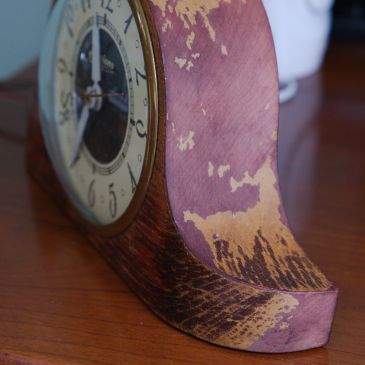
From the front, it doesn’t look too bad but the side view reveals much of the finish has worn off over the years

On the back, it states that it consumes 2.5 watts of electricity. I suppose the manufacturer could not call it model 2.5. it was a very affordable clock in its day and available almost anywhere.

At 4 1/2 inches tall and 8 1/4 inches wide it would fit on any countertop, bookcase, desk or bedside table though it does not have an alarm. It is time-only with an Arabic dial and a sweep second hand. Having a sweep second-hand means that at a glance you can see that the clock is running. There is only one control in the rear, a spring-loaded push-and-twist-in knob to adjust the time.

Continue reading “Session Electric clock model 3W – refinishing the case”

Fleet Time Company of Montreal – Westminster chime mantel clock

In light of current world events the antiquevintageclock.com family wish to convey our sympathy and condolences to those effected by Covid 19

Here we have a nondescript mantel clock from the Fleet time Company of Montreal. This little known Canadian clock company had a short life between the years 1936 and 1940 producing a range of two and three-train mantel clocks with movements sourced from Germany. All clocks had pendulums and were spring-driven. According to business records, the company was listed as an importer of clocks and watches. The locations were 440 McGill and then 303 St. Paul West, Montreal (Canada).

The Second World War took a heavy toll on this company as the source of movements dried up and so the future prospects of this small company (information obtained from the Canadian Clock Museum, Deep River Ontario). One wonders why they did not diversify and source movements from France and Germany like the Forestville Clock Co. of Toronto during the war years.

Wood cases were made in Canada for some models while other cabinets were imported from Germany.

Gufa chime movement

This clock has a Gufa movement and one can assume most of their 3-train clocks had this movement although some movements are marked “Foreign”. Gufa is the Guetenbacher Uhrenfabrik, located in Gütenbach, Germany. They manufactured 400-day clocks and cuckoo-clocks and later they became the “Jahresuhrenfabrik” (August Schatz & Sons in Triberg, Germany).

Battered company plate, simply says “Fleet Clocks”

Close-up of foil plaque

The movement does not work because the time side mainspring is broken. The case is in bad shape and I am not sure how I will proceed but it is beyond simply cleaning, touching up and polishing. At this point, the only option is stripping. I am always reluctant to strip the finish from an old clock unless it is the only option. In any event, the case will be a late spring (2020) project.

The case needs a lot of work

This is another Canadian clock added to my clock collection although the fact that it was assembled and sold on Canadian soil is its only real qualification.

Arthur Pequegnat Canuck gingerbread clock first look

Hi readers, in light of current world events the antiquevintageclock.com family wish to convey our sympathy and condolences to those effected by Covid 19

I have a total of eight Arthur Pequegnat clocks in my collection. The newest, an Arthur Pequegnat Canuck is not exactly my favorite though it is not unattractive for a gingerbread clock. The company made a range of kitchen clocks but I have seen very few in the true gingerbread style, such as this one.

The clock runs well though it will certainly need servicing

Few are offered on online for-sale sites so it is quite possible that not many of them have survived over the years. Collectors would often pass them up as most other Pequegnat clocks are considered more desirable and valuable.

Label located under the base of the clock

Continue reading “Arthur Pequegnat Canuck gingerbread clock first look”

Dating an antique Gothic Steeple Manross clock

Hi readers, in light of current world events the antiquevintageclock.com family wish to convey our sympathy and condolences to those effected by Covid 19

Dating a clock can be a challenge and often an estimate within a range of dates is the best that can be accomplished. Dating some clocks can be relatively easy as in the case of this Sessions Beveled Number 2 tambour style time and strike. Inside the back access door, it is stamped Sept 1927, the date of manufacture.

Further research about the clockmaker, the movement design and the label will reveal a date within a narrow range

Inside access door of Sessions tambour clock

Sessions Beveled No. 2

This Gilbert time and strike movement has a die-stamped year but the month of manufacture is unknown. Other markings in the case might narrow it down.

Toothpicks reminding of the location of the bell lever
Gilbert movement made in 1906

Research concerning the maker, the clock design, the model name or number and the label may reveal the exact date or something within a narrow range of years. Books on the identification of American clocks such as those by Tran Duy Ly can be very helpful.

Let’s look at this Elisha Manross Gothic Steeple clock.

Elisha Manross (1792-1856) was an important pioneer of the Connecticut clock and made a variety of clock styles, one of which is the gothic steeple pictured below.

Elisha Manross Gothic Steeple clock. Hands are incorrect; it would have had spade hour and spear minute hands

Although Elisha Manross had been active in Bristol clock-making since 1812 and earlier he shows in the Bristol tax records as making clocks from 1842-1851. His business was dissolved in 1854 and the factory was purchased in 1855 by E.N. Welch.

Manross made two steeple clocks. One is 20″ high and 10″ wide, the other is 19 1/2 inches high by 9 1/2 inches wide. The larger case would have made for other labels but the smaller size such as this one was manufactured in the Manross factory.

Elisha Manross 30 hour movement
A very dirty Elisha Manross 30 hour movement, just out of the case

This 30-hour clock by Elisha Manross has some distinctive features that help in its dating. Let’s narrow down the date by looking at the design of the movement and case. Three features make this clock interesting. One, it has very rare brass mainsprings; two, the count-wheel is located in the middle on the backplate and three, the veneer on the front columns and door is in a vertical orientation.

Brass mainsprings

Brass mainsprings were invented, patented and first used in 1836 by Joseph Shaylor Ives. Brass was cheaper and more accessible than steel in the mid-1830s and 1840s. Silas B. Terry developed steel springs for clock use in the Bristol area circa 1847, and as steel improved and became cheaper, brass springs quickly disappeared.

In the history of the American clockmaking, brass mainsprings had a very short life, between 1836 and 1850. The brass mainsprings on this movement have survived for a very long time and most clocks of this age have had replacement steel mainsprings.

Count-wheel

Many American time and strike movements have the count wheel located on the left side of the front plate just above the mainspring (or winding arbour for a weight-driven clock). Placing the count wheel in the rear of this movement adds complexity to the lever arrangement. Also absent is a strike-side cam wheel typically found on later American time and strike movements.

Manross backplate showing location of count-wheel

Veneer and vertical orientation

Exotic woods were used to cover the pine case. Elisha Manross clocks were either clad in Rosewood veneer or Mahogany. Manross clocks were produced with the Mahogany veneer in a vertical orientation, such as this clock, and Rosewood veneer in a horizontal orientation. American clockmakers did not normally orient the veneer in this manner.

Left front column

Dating this clock – let’s see what the data tells us

Records also show that steeple cases were made by Manross between 1847 and 1853. The label on the clock is in remarkable condition for a 168-year-old clock and is extremely helpful in dating this clock. On the back of the door, the left side of the upper tablet is the inscription 8/43, not once but twice. Is this the date the case was made? The door is clearly original to the case since it has the same vertical orientation as the veneer.

Records also show the sale of 705 cases (unknown as to type) to “E. Manross” during the months July-November, 1843. It is very possible the case was constructed in 1843, stored until later when the movements were placed in the case and readied for sale.

The date of August 1843 is inconsistent with the label, located on the inside backboard, which was printed by Elihu Geer at his shop on 10 State Street, Hartford Conn on or about 1850. The label was likely added to the case just prior to the sale of the clock.

We can conclude that the clock was made no earlier than 1843 and no later than 1850 and we can safely date this clock within a 5-7 year period.

Dating aside, it is truly remarkable that a mechanical device that is 173 years old is still operating to this day.

NOTE: The principal source of this blog article is the October 1993 NAWCC bulletin.

Disassembling an antique tall case clock

The disassembly of an antique tall case clock need not be a daunting task. When I bought this clock at auction at the beginning of 2020 I put into practice some of the things I had learned when transporting a Ridgeway grandfather clock in 2013. My advice is to work slowly and methodically but think about what you are doing at each step of the process.

Why disassemble? A move across town, across the country, or even redecorating are three of many reasons. Even if you wish to move the clock from one area of your home to another disassembly is required. Yes, moving it a few inches requires disassembly.

Scottish tall case clock from the 1850s

An antique tall case clock, such as this weight-driven Scottish tall case clock from the 1850s with an English brass bell strike, can be easily disassembled by one person. In this blog, I will walk you through the steps required to safely disassemble an antique tall case clock.

Similar American tall case clocks from the same period are disassembled in the same manner.

Continue reading “Disassembling an antique tall case clock”

What is this clock thing for? #5 – the pivot locator

I want to talk about one of the most useful tools in clock repair, the pivot locator.

As an avid horology enthusiast for the past 9 years, I have been steadily building my knowledge of clock repair and with it a selection of essential clock tools.

Continue reading “What is this clock thing for? #5 – the pivot locator”

Day light savings time – time to see it end

When people living in the Yukon Territory, Canada switch their clocks forward to Daylight Saving Time Sunday March 8th, it will be for the last time. The government announced March 4th, that the territory will keep the time change permanent, after hearing an overwhelming majority of residents said they would rather remain an hour ahead than switch back in November.

Continue reading “Day light savings time – time to see it end”

Re-organizing my office/shop

My clock hobby has evolved to the point that I am constantly looking for ways to increase efficiency and adapt space to suit my needs. What began as an upstairs bedroom has become my office/shop for the past 6 years.

The acquisition of new tools and equipment means more space and, of course, more room for clocks.

This is how my office looked in 2014.

Continue reading “Re-organizing my office/shop”

Seth Thomas round top in for servicing-Part II

8-day Lyre movement in its case

In this, Part II of my Seth Thomas time and strike shelf clock servicing I discuss bushing work, cleaning, final assembly and testing.

Seth Thomas round top shelf clock, days after it was purchased

In Part I, my observations (and preliminary repairs) concerning my Seth Thomas round top shelf clock were as follows.

Continue reading “Seth Thomas round top in for servicing-Part II”

Pendulum bob weight – should it make a difference?

Welch movement on test stand
E. N. Welch movement on test stand

I was working on a E. N. Welch (ca. 1875) mantel clock movement in the late fall of 2019, giving it a thorough cleaning during which I installed 6 bushings.

Continue reading “Pendulum bob weight – should it make a difference?”

Odd marriage and an amusing explanation of the maker

Interesting marriage

This clock was advertised on a local online for-sale site. It is a Vienna Regulator-styled wall clock that is an obvious marriage. The ornate dial certainly does not belong to this style of case, the pendulum is unusually short and it is missing its bottom finials.

By way of comparison, this is how a movement should look like in a similar case.

Mauthe Vienna style wall clock

It annoys me when I see things like this and I have little sympathy for people who fall for this kind of deception. Do your research!

Tempus Fugit means “time flies”

What is most amusing is the description which says “There is a name on it I believe it says JEMLAUS FUOITE. I did try to take a picture of the name.” It actually says Tempus Fugit or Time Flies but I had to laugh.

Pub clocks of Ireland

During our recent trip to the southern part of Ireland including the capital city of Dublin, I expected to see antique mechanical clocks in some of the pubs and I was not disappointed.  I tried to visit as many pubs as possible to search for clocks, of course, and while there I sampled the local ales and lagers though no Irish visit is complete without a pint or two of Guinness stout.

Continue reading “Pub clocks of Ireland”

Website Powered by WordPress.com.

Up ↑