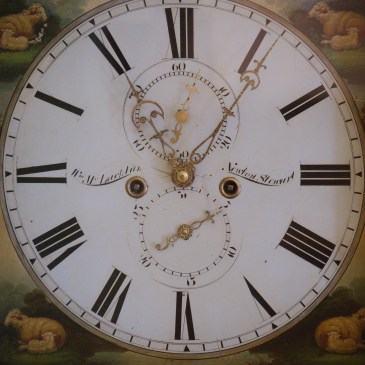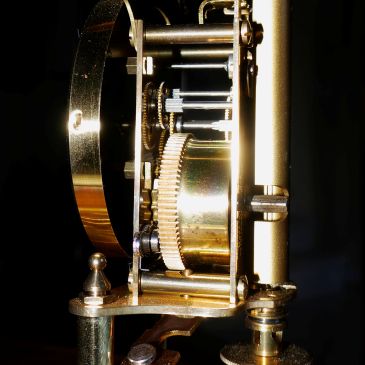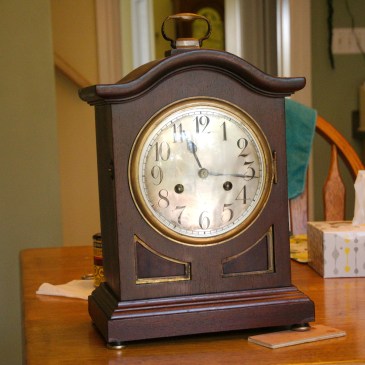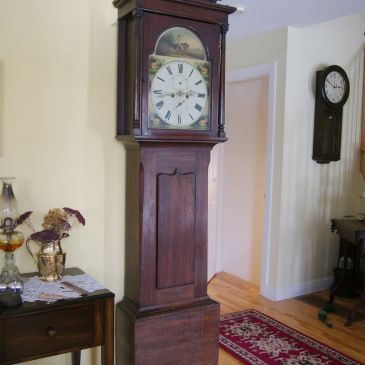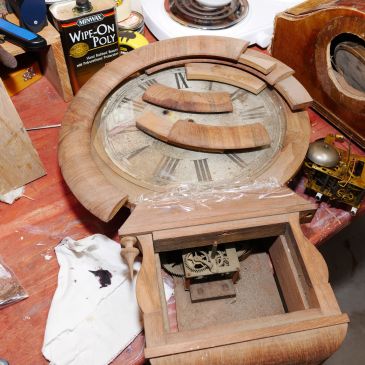

Okay so, you want to sell your clock but for $2500 shouldn’t the photo be better than this? And Sheffield is spelt wrong!

Okay so, you want to sell your clock but for $2500 shouldn’t the photo be better than this? And Sheffield is spelt wrong!
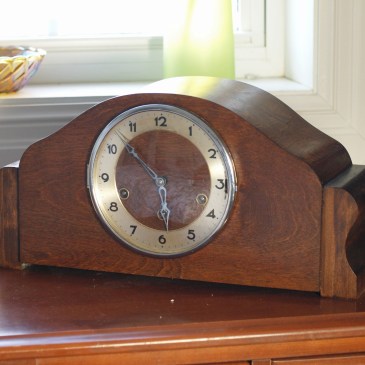
In the 1960s, T. Eaton & Co., one of Canada’s most iconic department stores, offered a variety of home goods to suit the tastes of the era. Among their diverse range of products was a charming collection of clocks, including the small but striking mantel clock that continues to capture the attention of collectors today. Its distinctive style and craftsmanship represented a unique intersection of mass-market appeal and decorative elegance.
In this article, we take a closer look at this somewhat ordinary-looking clock, exploring its design, history, and place within the broader context of mid-century Canadian home décor.

A changing economic and retail environment in the late 1990s, along with mismanagement, culminated in the chain’s dissolution in 1999. As a young child, I remember pouring through the Eatons “Christmas Wish Book” trying to decide on that perfect gift….for me!

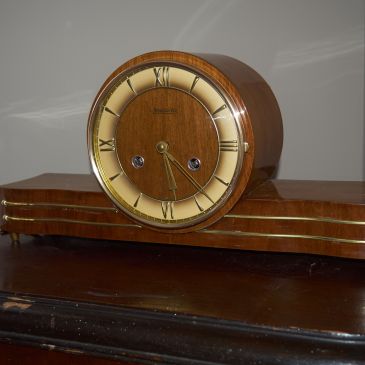
Eaton’s catalogue, as well as department stores spread across Canada, sold a variety of clocks including this mantel clock with a German-made Hermle movement under their house brand, Solar. Many of the Solar clocks sold from the 1950s through to the 1980s survive in Canadian homes to this day more as decorations rather than functional pieces.
This particular example is a time and strike mantel clock featuring a 6″ dial and a dark walnut case. Priced at approximately $50 or $60 when it was first sold, it measures around 13″ wide, 7″ high, and 4″ deep. Its compact size makes it an ideal choice for homes where space is limited, fitting comfortably in nearly any room without overwhelming the space.
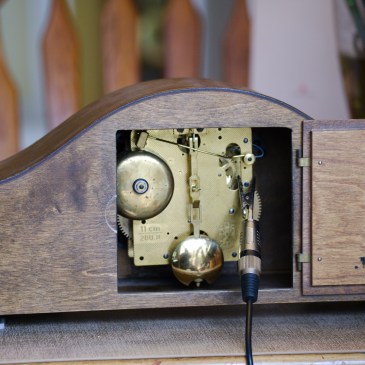
Equipped with a Type 141 German movement from Hermle, this clock features a recoil escapement, an 11cm pendulum, and operates at a rate of 200.8 beats per minute. It strikes on the half-hour with a bell, though its chime isn’t particularly melodious. As a testament to its design and durability, the type 141 is still being produced by Hermle GmbH & Co. KG today.
It also came with instructions and a product card from Eatons.

When I purchased the clock, it wasn’t running, and I hoped that a thorough cleaning would restore its function. The scratches and gouges on the backplate of the movement suggest that it has been serviced before. However, I won’t know the full extent of any previous repairs until I remove the movement from its case for a closer inspection. My main concern is the possibility of plated pivots, which were a common issue with Hermle clocks from the late 1970s to the late 1980s. Fortunately, I have a strong feeling that this clock predates that troublesome period.
The case, on the other hand, is in near-perfect condition.
It will be serviced and put up for sale. I am not normally in the business of selling clocks but will sell the odd one locally to trim my collection and cover clock supplies.
Look for an upcoming blog article on the servicing of the Hermle movement.
Do you ever run into those situations working with clock movements when one little thing is so annoying? I recently serviced one of my box clocks, a Mauthe with a bim-bam strike. Everything went according to plan except for one small issue; the strike side was misbehaving. I’ll explain a little later but first something about the clock.

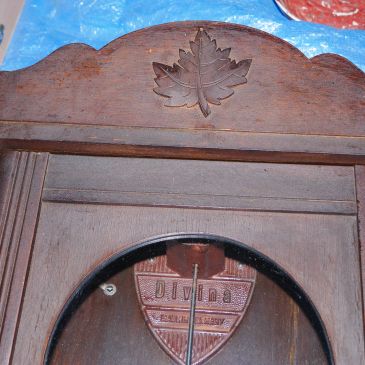
Nowhere on this clock German “box” clock by Mauthe does it have the Mauthe trademark or name, not on the clock face or any markings on the movement. However, an excellent clue is the two-rod gong, which was made by Divina, a subsidiary of Mauthe.

The clock was likely sold under the Forestville or Solar name in department stores across Canada in the 1940s. There is an applique of a maple leaf on the crown so, I would like to think it was made for the Canadian market. These are very good movements, are designed for long life and the sound of the gong is impressive.
So, what’s the problem?
The movement was taken out, cleaned, and one bushing installed. The movement is in very good overall condition despite having last seen a servicing in 1979 according to a date scratched on the front plate.

Putting these German movements back together is not that difficult but one always must be mindful of the small pivots and the risk of bending or breaking one. How do I know that? Well, I might have bent or broken one or two along my journey through clock repair but not on this movement.

Two critical adjustments prior to assembling the plates are the placement of both the stop or warning wheel and the star wheel.

The stop or warning wheel requires about half a rotation to arrest the train during the warning phase by means of a stop pin. During dis-assembly I made a note of the location pin, at approximately the 12 o’clock position which saved time and frustration and it worked just fine once assembled.
What I missed was the correct positioning of the star wheel relative to the two hammer arbours. Because there are two actuators and two paddles, they must be placed between two star points on the wheel. Otherwise, one of the paddles will become hung up on a star point at the end of the strike.
For example, during the end of the strike, you might hear the bim part of the “bim-bam” strike and the bam part at the beginning of the next strike. Of course, there is always the risk that the hung up paddle will stop the train entirely.
It is a simple adjustment but the mainsprings must be let down for safety reasons and the plates pulled apart enough to relocate the paddle lever arbours so that both paddles are between the star points. In the process of repositioning the levers, one or two other wheels may or may not pop out. Once all the wheels are relocated, screw down the corner of the plate and test the strike side action.
After the adjustment, the strike side ran as it should. It is a little thing but pretty annoying especially when it is discovered after the movement is put together.
In clock repair, fine-tune adjustments are part of the experience.
What is my best clock find of 2020?
2020 was a very trying year for us all and I suppose that applies to clock collectors generally when it comes to acquisitions. Despite the pandemic, I managed to purchase a few clocks though obviously, not as many as in other years.
The contenders for the year are clocks from Solar, Junghans, Sessions, Arthur Pequegnat, and Fleet, leading up to the big winner of the year, a Scottish tall case clock.
Solar
First on the list is an attractive German-made Solar time and strike mantel clock, sold by the Eatons Department store chain in Canada during the 1960s and 70s.

It has a Hermle type 141 movement and strikes the half-hour on a bell. It was a non-working clock when I bought it for $20 but it was simple enough to service and now runs like a charm. I will likely sell it locally for a few dollars more.
Junghans bracket clock
For $40 I could not possibly go wrong with this bracket clock even though it was a non-working clock and need some serious TLC. I serviced the movement, refreshed the case, polished the brass, added new feet and the clock now occupies a prominent location in my family room.

Sessions 3W electric clock
The diminutive Sessions desk clock has a Synchron motor (60 cycles per second) and the only repair is to replace the plug. I like the simplicity and style. It has some issues consistent with an 87-year-old electric clock but it is in pretty good shape for its age.

Arthur Pequegnat
Next is an Arthur Pequegnat Canuck time and strike gingerbread or kitchen clock as it is otherwise known. This was another inexpensive find, $50 on an online for-sale site, and for $10 more, another clock completed the deal.

I spent a considerable amount of time on this clock, refreshing the case, inpainting the dial, and refurbishing the movement. I was very satisfied with the results and this clock will join my collection of 7 other Arthur Pequegnat clocks. A nice find for a very good price.
Fleet Time Company
Next is a Fleet Westminster chime mantel clock from the late 1930s, made by the Fleet Time Company of Montreal. Fleet assembled clocks for 4 short years before World War II sourcing movements from Germany with locally made cases. It is the $10 clock that was combined with the deal above.


I refurbished the case and replaced the time side mainspring but did nothing to the movement except re-oil it. The case was completely stripped down to the bare wood followed by the application of a medium oak stain and a clear satin topcoat. This is a lovely mantel clock with a rich Westminster chime and I will probably keep this one in my collection since it was assembled in Montreal and represents a small but important piece of Canadian horological history.
McLachlan tall case clock
Finally, let’s come to my prize for the year, bought at a live auction in February 2020, a Scottish tall case clock assembled by William McLachlan of Newton, Steward in 1848. Completely restored were the dial, movement, and the case, which required extensive structural repairs.

With an English bell strike movement, tall, stately mahogany case, beautiful hand-painted dial and heavy 13 lb weights, this clock has a commanding presence in my home. If you have ever heard the sound of an antique bell strike clock you will understand that is it as loud as it is because it was designed to echo through a stately Scottish manor. It is a conversation piece and those who have seen it marvel at its condition and age.
Despite a difficult year, I was pleased with my purchases. I am confident that 2021 will be a better year for me as a clock collector and a better year for us all.
Ringing in the New Year is for reminiscing, reliving, looking back, and looking forward.

However, I’ll be brutally honest; let’s hope that 2021 is a better year. Indeed, 2020 will be a year that will live in infamy. It was tough but most of us got through it. However, the Antiquevintageclock.com family wish to convey our sympathy and condolences to those deeply affected by Covid 19.
At last, a New Year begins!
As champagne corks pop, glasses are raised and fireworks explode into the sky, it is important to recognize the special symbolism this holiday brings with it. Amid promises of new beginnings and fresh starts comes a time of reflection and resolutions that more often than not tend to be short-lived.

Be SMART!
Whether your goals consist of just getting out more, or renewing your relationships with loved ones, it can make all the difference when hopes are transformed into words and deeds. Be good to yourself and be good to others.
Perhaps you have made resolutions that are not necessarily clock-related and if so, avoid disappointment by making them SMART;

For those of you who are clock lovers, where will your horological journey take you this year? Will it be finding that special clock, finally servicing mom’s prized mantel clock, buying that unique clock repair tool, or reading that special clock book?
May the New Year bring you prosperity and happiness. Happy New Year everyone!
A small change makes a big difference on a Junghans mantel clock from 1911. Let me explain.
Back in September 2020, I bought a German-made Junghans bracket style clock. It is 14 inches high by 10 inches wide by 6 inches deep, mahogany veneered, attractive brass accents, and a carrying handle on a curved domed top.

I just love the way it looks.

What about those chrome feet
The clock is original in almost every way; the quality time and strike movement is original to the clock, the spiral gong is correct; latches, bezels, and so on look good and work perfectly but for some strange reason it has replacement chrome feet and they bug the heck out of me.
Why should a small detail mar the classic lines of this clock!

After searching various online auction sites, I discovered that the original corner feet would have looked like the ones in the below photographs. I can only surmise that many years ago one fell off, got lost and the repairer simply found what would work and tossed the other three feet out.


So, where to find corner feet. There are a number of suppliers worldwide but my usual go-to supplier here in Canada, Perrins who are otherwise excellent, has a very limited selection of clock case corner feet and not in the style or size I was looking for.
US suppliers similarly have a limited supply as bracket clocks are not as popular there as overseas. England is the logical place to look since it is the land of the bracket clock.
Interestingly, the term bracket clock first appeared in 19th century England and is commonly referred to as a spring-driven pendulum table clock with a carrying handle (and often with subsidiary dials) so that it could be moved from room to room in the owner’s home. Of course, true bracket clocks had a strike silencer so as not to disturb the owner’s beauty sleep.
Using the search term “brass bracket feet” I searched the two largest suppliers in England, Cousins and Meadows and Passmore.
I found exactly what I was looking for at Cousins UK. Cousins calls the part a ridged carriage clock corner foot made of polished brass, sourced from Spain or India. They come in three sizes and for this clock, I chose the smallest one.
It took two weeks from the order date to arrival on my doorstep. I am very impressed!

The feet are made of brass and look to be of decent quality.
Installation was simple. Rather than risk splitting the base so near to the edge I pre-drilled the holes. Using a mini electric drill I first marked the holes with each foot in place and drilled a deep enough hole.
Two slotted brass screws are required per foot. As I screwed one screw of each foot I checked for correct orientation and made a small adjustment as necessary.
Perfect!


The feet are very sturdy and look exactly what the manufacturer would have used at the time.

Compare this last photo with the first to see the difference the new feet make on this clock.
This is an example of a subtle but important change that is very inexpensive (less than $24) and I am sure you will agree that it makes a dramatic difference.

While I was working on this clock I visited the Junghans site and discovered a 1912 Catalogue which informs me that this clock was called the Sydney.
It was available in fumed oak or mahogany, 14 1/2 inches tall “with brass handle, inlaid polished brass designs, polished brass feet, and plain silver dial”. Both finishes were available with an 8 day or 14-day movement. The quarter strike 8-day clock had 2 gongs while the 14-day movement had 1 gong.
This then is a 14-day movement with a mahogany case and is referred to as model 7020. Judging by the name and the style, this clock was made for the English market.
It seems my research concerning the new polished brass feet paid off very nicely.

This year especially has taught us to be very thankful for family, friends, and relationships. Although we will all be celebrating Christmas in a very different way in 2020, minus the get-togethers with family and friends, we must still be thankful for what we have by extending best wishes in a virtual way.

It is my wish that the New Year brings respite and relief for us all but that doesn’t mean we should not count our blessings now.
During this festive season of giving, let us take time to slow down and appreciate the simpler things in life, the love we have for each other. May this wonderful time of the year touch your heart in a special way.
If there is a clock under the tree consider it a timely gift to remind you of days gone by and of happy memories when families got together to celebrate love and togetherness.

Wishing you much happiness not just today, but throughout the New Year.
Tick-Talk Tuesday is about the letters and comments I have received from you, the reader, concerning your clock, issues you might have had, challenges you face or a clock you would like me to profile or my responses to your questions with advice on your particular clock concern. For those comments and questions that stump even me, I consult within my clock circles for the best possible answer

TD says,
“Hi Ron, I’m TD. I purchased a Gilbert Clock from an antique store in xxxxxxx, Wis. It’s a Gilbert Tambour style mantel clock model 2041. It’s marked “Normandy Chime 2041.” The question I have is what is the keyhole under number 12 for? The clock sat in the store for a long time, that is till it found ME. I have a thing for old clocks. I feel they’re a living thing and it’s a shame if they’re not ticking away as long as they’re able to. Just like Us!”


My response,
Hi TD,
I have a Gilbert tambour 2038 with Normandy Chime which is similar in some ways. Look at the key that came with your clock. It should be doubled ended one like this one.
The small end fits into an arbor just below the “12”. This is for regulating the speed of your clock. You might see an “S” and an ”F” above the 12. Turning the key clockwise speeds up the clock and counterclockwise slows it down. If you have only a single-ended key, it is the wrong type for your clock although it will wind it up.
I also have a thing for old clocks. Be careful it is addictive.
Hope this helps.”
Whoops! Should have been published on Tuesday. My wife caught the error this morning.

I posted the first look at this clock a while back.
The Regency style veneered mahogany case of this Junghans time and strike bracket clock is in reasonably good shape save for a small piece of veneer missing on the front right corner and replacement chrome feet which look decidedly out of place.
The movement ran briefly after I got it home but after a short while refused to run despite adjustments. The seller says he had had the clock for two years and never had it running so I was sure it needed a good cleaning. In any event, my plan was to service the movement.
The movement is has a maker’s mark with B11 just below it. This refers to the approximate date of manufacture, the latter part of 1911.
Removing the movement
To remove the movement remove the hands, first the minute and then the hour hand. Open the rear access door to release two thumbscrews screws underneath the movement seat board. Move the gong assembly aside (or take it out completely by releasing a screw on the bottom of the case) and remove the works.

Assessing the movement
This is a well-made movement. Early Junghans movements were robust and strong runners. I have heard stories of Junghans clocks from this era running well despite being very worn. Junghans’s movements are a cut above Mauthe, Hermle, HAC, and other mass-produced German clocks made during this period, in my view. The movement exudes quality with solid front and back plates though lantern pinions are favoured over cut pinions.
The movement has been serviced at least once, so far as I can determine. There is an “S” mark on the strike side barrel cap, helpful when returning the barrels to their correct location. I did not measure the mainsprings but the strike side spring is notably longer than the time side. There are two possible reasons, one that the strike side mainspring was replaced at some point in the clock’s life, or two, there is more load on the strike side requiring a stronger spring.

The mainsprings are in good condition and there is plenty of power though there is more oil than necessary within the barrels. After assessing the movement I could see that there had been no significant repairs in the past. The crutch has been bent in several places in an attempt to adjust the beat but otherwise, everything looks reasonably good for the age of the clock.

Disassembly
Separating the plates was more difficult than it should have been. I had to remove all four pillars (secured by screws on both ends) to determine what was sticking. I discovered that the motion works centre arbour pivot was “stuck” in the backplate. By “stuck” I mean that although the wheel was moving freely the end of the pivot had been flattened. Why I don’t know. Had the pivot been punched in an attempt to enlarge it, had someone hammered the pivot end for whatever reason, had the pivot been replaced or it is possible that the plates had never been separated and that is how it came from the factory? Once the pivot was pried from the plate I rounded the end with a file and it now fits perfectly.

All parts were cleaned in the ultrasonic cleaner which removed a considerable amount of accumulated grime. As always the ultrasonic cleaner does a great job with lantern pinions and the lantern pinions, on all 6 wheels, are in excellent condition.
There has been no bushing work done on the movement. The only punch mark I observed was just below the escape wheel outside the plate where an attempt was made to close the hole.
To bush or not to bush
After cleaning the movement, pegging the holes, and polishing the pivots the next step is deciding whether or not to bush the movement.
I could see that some bushings may be required, 4 on the backplate where there is more load on the wheels and 2 on the front plate for a total of 6, 2 on the strike side, and 4 on the time side but I will make a final decision once I have checked the entire movement further.
I installed all the wheels and checked for pivot movement within their respective pivot holes. The wear was not excessive. However, after much thought, I decided there is enough lateral movement of the pivots in their holes to affect its running. Besides, I wanted to place the clock in a prominent area of the house and by addressing wear issues now the clock would run well for some time without another servicing.
Seven bushings were installed, 3 on the time side, and 4 on the strike side. The largest one, which I did not include in my initial assessment, was a 4.5mm (OD) bushing for the count wheel.

Re-assembly and testing
Once all the pivot work is complete and the holes pegged out again it is time for re-assembly. Setting up the strike side of the count wheel strike means ensuring that the warning pin is sitting just off the locking lever (12 o’clock position), the drop lever is sitting on the flat section of the cam wheel, and the count lever is in one of the deep slots of the count wheel.

Only this time it was not all roses. The strike train consistently missed the half-hour strike because the count lever would drop in the middle part, not the beginning of the deep slot, occasionally missing the half-hour strike. Plus, the count lever did not completely rest on the cam. I cannot remember spending as much time correcting the strike side on a German movement as I did on this one. On one occasion I had everything together to discover that the paddle was hanging off one of the points of the star wheel. Having too much load at the beginning of the strike either will stop the strike or add one more strike to the indicated hour.
I must have taken the movement apart 5 times, and of course, each time I reassembled the movement I was wary of damaging those tiny pivots. Eventually, everything worked out. Sometimes when working with German countwheel strikes everything falls into place the first time. Not so much this time.
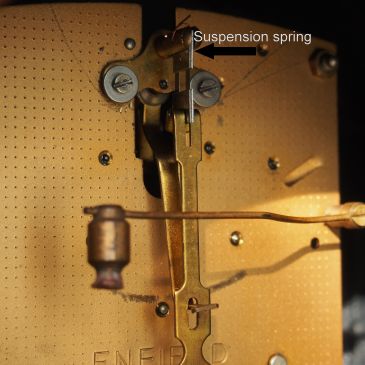
While on the workbench, I replaced the old tired suspension spring with a new one.

So, after a long-overdue cleaning and a few new bushings, the movement is oiled and is on the test stand. After several small adjustments to the beat, it is now running and striking as it should.
Now to see how we can address a grimy silvered dial. Join me in a couple of weeks as I take you through cleaning the dial face.
Let me start by saying that opinions on torsion clocks are divided—some people have great success with them, while others absolutely loathe them. Despite their seemingly simple design, they can cause endless frustration, which is why many clock repairers tend to avoid them. Fortunately, I seem to be one of the lucky ones.

I gifted this clock to my daughter three years ago. She chose it for its intriguing visible movement and the convenience of running an entire year without winding. Recently, she moved across the country, and during the relocation, the clock “broke.” “Can you fix it, Dad?” she asked. “Leave it with me,” I replied.
400-day clocks, also known as torsion clocks, have been around for over a century. They were first produced in limited numbers in the mid-1890s, but their popularity surged after 1900. Between then and the 1980s, thousands were manufactured, becoming a favorite choice for wedding and retirement gifts—hence the nickname “anniversary clock.”
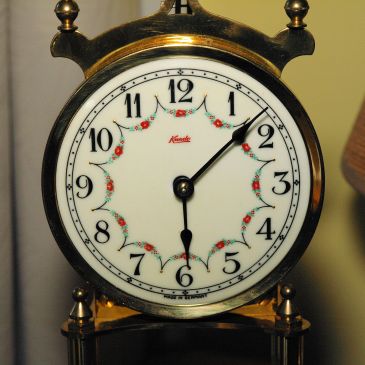
The Kundo model featured here dates back to the late 1950s or 1960s, during the height of production. However, with the advent of quartz clocks, mechanical versions quickly fell out of favor.
Kundo is a well-known name in the world of anniversary clocks. The name is a combination of Kieninger and Obergfell, a highly respected German company. Today, the company continues as Kieninger, operating as a subsidiary of Howard Miller USA.

To service a 400-day clock, I highly recommend using the Horolovar 400-Day Repair Guide as a reference. Can you repair a 400-day clock without it? Yes, but the Horolovar guide eliminates almost all the guesswork.
This particular 400-day clock is a Kundo Standard 53, which requires a .0032″ (0.081mm) Horolovar spring. If you don’t have the time or tools to assemble the suspension units yourself, Horolovar (or most clock suppliers) offers fully assembled units. However, these come at a significantly higher cost.
Section 10 of the Horolovar guide includes templates for various clocks. These templates provide precise patterns for positioning the fork and attaching the upper and lower blocks to the suspension wire, ensuring proper assembly.

The screws on the suspension assembly are very small, so using a high-quality precision screwdriver is essential to avoid damaging them. The suspension spring is longer than needed and will require trimming to fit. Once the spring is securely attached to the fork and blocks, it’s ready to be reinstalled onto the movement.

The suspension spring assembly hooks onto the top cock and bottom weights or balls. A threaded thumbscrew on the top base slips into the top block. The bottom block has two pins to which the pendulum hangs. Next are the back spring cover and the locking guard.
Torsion clocks have pendulum locking systems that must be engaged even when the clock is moved just a few feet. Often, the result of an unlocked clock is a broken suspension spring. The locking guard on this clock is an earlier design and looks pretty flimsy in my view but it should work.
Once the spring assembly is installed on the movement it is time to test the beat. The beat should be 8 beats per minute and there should be ample overswing in both directions. A 270-degree rotation is healthy enough.
What makes the 400-day anniversary clock a great addition to a collection?
They are:
What makes them less ideal:
Since I had previously serviced this clock, I was able to loosen the tiny screws on the blocks and fork with ease. Sometimes they can be tight and difficult to remove, but on this occasion, everything went smoothly. As of this writing, the clock has been running well for several weeks.
While it’s currently running slightly fast, small adjustments to the regulating dial will slow it down. However, there’s a limit to how much you can adjust, and it’s not a clock I would rely on for precise timekeeping.

A cuckoo clock will happily run and strike without bellows but it is the bellows that create the unique sound.
When a cuckoo clock requires servicing the bellows should be inspected and if they are in poor condition they should be replaced. The constant, every hour and half-hour strike of the clock combined with the actuation of the bellows causes leaks at the creases as these are the highest wear points.
So, how does one repair the bellows?

Carefully take the old bellows tubes out with a hobby knife. On some cuckoo clocks, you may have screws that hold the bellows in place. Once they are out resist the temptation to rip them off the wood columns as the bellows themselves can be used as a template for your new bellows.


Here are the basic steps
Make a tracing of the bellows opening on paper. Scape away all the old covering and old glue with an Exacto knife or similar. Using TYVEK, cut a piece of material approximately 2 inches by 7 inches. On the fixed end of the two bellows pieces glue a new hinge with a strip of TYVEK.

Using the template you made earlier and with the bellows open wrap the TYVEK around the bellows. After you are satisfied that it will fit, apply Seal-All or a carpenter’s yellow glue to all outside edges. The sides will have a V-shape. Press the TYVEK to the sides and ends of the bellows for about 2-3 minutes until the glue sets. Trim any excess TYVEK.

Wait for about two hours until the glue is dry. Using a popsicle stick or similar, start by gently making the creases pushing inward as you go. Press the bellows together and clamp (or rubber band) for 24 hours. The TYVEK needs to be formed so that it knows which way to fold when the bellows are actuated.
When done reinstall the bellows back into the clock case, connect the actuators, and re-attach the back cover.
If you hear a “Cuck” but no “Koo” you’ve done something wrong. Once you’ve done a few of these you will get it right every time.
Enjoy the unique sound of your cuckoo clock.

I found this German mantel clock on a local online buy and sell site. The seller had two clocks, one, a generic German-made Westminster chime and this, a Junghans bracket-style clock. I knew right away that this was the better deal. It appeared to be a higher quality clock compared to the other one. I offered a slightly lower price and the seller quickly accepted. He said he never had it running in the two years he owned it and added, “I got to get rid of it, I’m moving”.

During my search to find the model name or number I came across one listed on eBay at the time of writing and two others while browsing similar auction sites. None had the model name or number but prices are all over the map, ranging from $50 to $300. I still do not know the model name or number.
Although it has a carrying handle on the domed top and would be termed a bracket clock, let’s just call it a rather plain-looking mantel clock with a handle. When I envision a classic bracket clock I picture a clock with verge escapement, subsidiary dials over a signed dial housed in a gaudy case. Let’s call this a poor relation.

The Regency style veneered mahogany case is in reasonably good condition save for a small piece of veneer missing on the bottom side front and replacement chrome feet which look decidedly out of place. It has not been cleaned in ages and scrubbing with soap and water removed a considerable amount of built-up dirt revealing a very attractive case.
The silvered dial shows some aging consistent with wear and caused when advancing the hands many times combined with the simple act of winding the movement arbors. The hands are original judging from other clocks like it. I may touch up the numbers and the hands in addition to giving the dial a cleaning to spruce things up a bit but we’ll see when I look at it further.
The dial catch, back access catch, and hinges work well. These often break from constant use.
Judging from scratch marks on the backplate, the movement has been worked on in the past. I won’t know the extent or quality of past servicing until I take the movement out of its case and examine it more closely. The movement has a maker’s stamp with B11 just below the mark. This refers to the approximate date of manufacture, the latter part of 1911.

When I brought it home the clock ran briefly, stopped, and failed to proceed. It will need a thorough servicing and a few adjustments to get it running again.

How do you get those wonderful macro shots, a reader asked.


Photography easily becomes part of almost any hobby and in my view, a camera is essential for clock repair. Describing a process on paper is one thing but it cannot replace a well-crafted video or a series of detailed still images. A picture is worth a thousand words.
Having the right tool is also important. For optimum results, I suggest a dedicated camera with a good macro lens. Why? You can take wonderful pictures with a cell phone but cell-phones are very limiting because they have difficulty isolating the foreground from the background and have a hard time producing decent macro images.
I have a number of cameras, two Pansonics, a Fuji, and an Olympus E330. While the first three cameras are either new or relatively new the last, an Olympus E-330, made 14 years ago, is my go-to camera for macro work.

At 7.5 mp it has more than enough megapixels and reducing the file for blog work makes for a particularly small but detailed file when server space is limited (as on a blog). I use artificial light on occasion but for the most part, rely on natural light from a west-facing window in my workspace. When artificial light is required, I rely on a continuous studio light and rarely use the on-camera flash.

Paired with an Olympus 50mm F2 macro lens it is excellent for those very close clock shots and allows me to isolate my subject while maintaining a pleasing background blur.

After almost 15 years it works every day and I can still purchase CF memory cards and even aftermarket BLM-1 batteries. Simply put, I will use it until it goes to photography heaven.

The E330s best feature is its ability to activate a switch from automatic to manual focus mode and lock on an extremely close subject such as the above and below photos.

Some clock repairers record everything on paper and to each their own, but for me, there is no substitute for a digital image. During any clock repair job, I will take dozens of photos from every conceivable angle. If I have difficulty reassembling the movement or am puzzled as to where a particular wheel, lever, washer, or spring should be positioned, my photos are my best reference. In addition, I catalog my images so that I can refer to them, days, weeks, or months later if need be.
My advice is simple, buy a good new or used camera with a dedicated macro lens for clock repair. It does not have to be the latest, greatest, and the most expensive but decent enough to give you good quality results. You will thank me.

Back in October (2020), I wrote about the challenges of working on this mantel clock by Forestville.
Recap so far
It is a nondescript Art Deco-style German mantel clock made in the 1960s sold under the Forestville name, a Toronto-based company that assembled clocks up to the 1970s.
The rack and snail movement is relatively simple to work on with all the adjustments, save for the stop wheel, on the outside of the plates. The mainspring barrels can be removed separately for servicing, typical of movements of the period.

The hairspring escapement is something I did not attempt to clean. They can be finicky to work on and if the movement has been running beforehand, like this one, there is no pressing need to mess with it. Three screws detach it from the movement.
The bane of clockmakers – the broken pivot
When working with German and French movements particularly one must always be very careful of the small pivots. Normally when I work on this type of clock I am very aware of how easy it is to bend or break the tiny pivots and this clock was no exception. After taking apart the movement and reinstalling the gears to determine bushing wear I noticed the front plate center wheel pivot had come off.
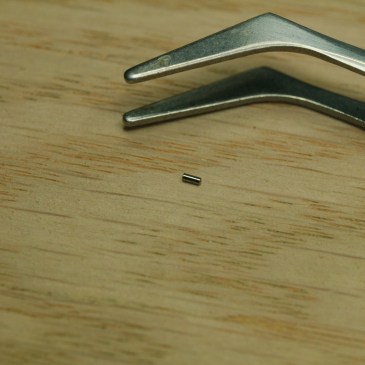
Thinking I was careful guiding each pivot in place with a pivot locator I either applied too much pressure closing the plates or it was hanging on like a tread. Regardless, it broke. Compared to a pair of tweezers it is very small.

My experience with pivot repair is limited. I don’t come across broken pivots very often. Compared to an American clock that has much larger pivots these are tiny, perhaps 0.5mm or so. Although I have bushings that fit I do not have pivot wire that size and had to make do with a piece from my assortment of 0.85mm to 1.10mm wire. Not pretty but functional.
First, using a centring bit followed by a high-speed bit on my Taig metal lathe, I drilled 5mm into the shaft, enough to securely anchor the pivot wire. Once the wire was inserted, I applied high-strength Permatex Threadlocker Red to secure the wire in place.

After the 24 hour curing period for the adhesive, I installed a bushing in the front plate and put the gears back together to check the action of the new pivot. It is working okay. I will reserve judgment on the repair until the other bushings are installed.
There is more wear on the time side that at least 3 new bushings are required, two on the front plate and one on the back.
Out of an abundance of caution, I installed an additional 2 bushings. In total are T2, T3, T4, rear plate, and T4, T5, front plate. All bushings are on the time side which tells me that the strike side did not see much action, typical for many mechanical clocks since some folks find the noise of the strike bothersome.


Servicing the mainspring barrels was more frustrating than I anticipated. Both mainsprings refused to catch on their hooks when I attempted to install them back into their barrels. The mainspring opening must be precisely on center to catch. Lesson learned; after a few tries, I successfully got them hooked back into the barrels.
Re-assembly
The new pivot was trimmed to fit and given a final polish prior to installation. Now to put it all together and see if the work has paid off.
I was especially careful putting everything back together and very mindful of how easy it is to snap off one of the delicate pivots. All went well. On the test stand, I ran the strike side through its sequence; it is going into warning and striking on the half-hour as it should. Now for the time side.

At first, the escape wheel would stop after a minute or so but after oiling the pivots including those on the hairspring (minus the jewelled ones, of course) it runs well.

I will continue with the test of the movement but so far, after two 8-day running cycles, things are looking very good. The next step is to re-install the strike hammers and other moving parts and return the movement to its case.
It is that time of the year when you begin searching for that unique gift. Of course, there are a multitude of choices but have you considered a mechanical clock as a gift? Let me provide you with a few tips.

Mechanical clocks harken back to the old days when life was simpler; no mobile telephones, no internet, and no streaming TV. Ah, those were the days!
Okay, so you are reasonably sure that a mechanical clock would be appreciated by the receiver. What to buy? There are a plethora of choices out there and certainly, clocks that would fit every budget from the simple and cheap American kitchen clock to a rare 19th century Boulle figural French mantel clock. Let me attempt to narrow your choices, not with a specific clock but a buying strategy.
Mechanical clocks appeal to those who enjoy the sound, the strike of a clock, or those who merely appreciate it as part of their decor. These factors will influence your choice as a gift.
Here are two examples of clocks I have gifted to my family. My son and his partner have a German Schatz W3 bracket clock in a custom case. It is in excellent mechanical in running condition but it stays quiet on their shelf. Nevertheless, it is the centrepiece for their fireplace mantel.

My daughter has a Sessions Raven 8-day mantel clock which sits atop a bookcase in their family room. It only runs when my wife and I visit.

But they love their clocks.
The following two categories might assist you in your decision to buy a clock for your loved one, a friend, or a business associate.
Category 1 – Those recipients who appreciate a running clock
You will want to avoid a non-working clock. Unless you have the skills in clock repair or know someone who can work on it, it is best to steer away from those. Many sellers use the phrase, “may need some adjustment” which is almost always a red flag for a clock that has issues. These are the cheapest clocks, and for good reason, they are simply worn out.
You may also get lucky and find that special mechanical clock that has been recently serviced and is in good running order but you will pay more because the seller is interested in recouping their investment in the clock.
Buying a clock from a reputable clock repair retailer is a good bet if the clock has been serviced and a warranty is provided but expect to pay significantly more.
Otherwise, there are many buy and sell online sites. I would shop locally and avoid eBay or other online auction sites. Auction sites are a real crapshoot complicated by high shipping costs and the risk that the clock might arrive broken. Yes, that has happened to me!

The sound of a ticking and striking clock in a room is very soothing for some. For others., not so much
Most clocks are 8-day running which means that they must be wound once per week. There are some quality 15-day and 30-day clocks but they are few and far between.

Of the 30-day clocks avoid anything made in China. While 1-day clocks such as Cuckoo clocks and antique Ogees are plentiful and look terrific, winding a clock every day wears thin after a while.

Check out this post on how to buy an antique clock.
Category 2 – Those recipients who want a mechanical clock as a decoration
Then, there are the folks who are not really that interested if the clock runs or not but want something that fits their decor and is a good conversation piece. A non-working clock with a good case is perfect. If it has the original movement but it is not working there is always the option of fixing it later. Personally, I would shy away from any clock that has its mechanical movement replaced with a quartz one.
Focus on the condition of the case. Is it missing any parts, has recent work been done it, does it look authentic? Does it catch people’s attention?
For example, here is a very attractive Seth Thomas 8-day round top in a bold Rosewood case that has had only one minor veneer repair and a replacement dial face, but it looks great!

You bought the clock but the case is very dirty. Clean it! Some folks might argue that one should not clean a clock case so as to maintain it’s original patina. But, isn’t patina just another word for dirt? Soap and water with gentle scrubbing will make a huge difference. Check out this before and after photo of the cleaning of a clock face.


And this before and after photo of a gingerbread clock. You need not want to go the extra distance in retouching the dial but soap and water is an easy and non-invasive method of improving the look of the case itself.


Final words
A mechanical clock makes an excellent gift and it is something that can be passed down from one generation to the next. My kids appreciate a mechanical clock from their dad and I will gift them one that is in excellent mechanical condition but I am not bothered if they use it merely as a decoration.

Five years ago I attended a workshop on WordPress at our local community college. It taught me more about blogging than I ever knew. The idea of a clock blog intrigued me but it is a lot of work, there is much learning and it was not something I wanted to design from the ground up but WordPress came to the rescue. It has an easy-to-do template approach and the only task was providing the content. So, I began the journey of documenting my horological interests and experiences.
The first few months were discouraging. I had very few views and likes which seem to be the lifeblood of many blogs. There is a strong blogger community out there and once connected to that community you get a feel for those sites that are quite successful and offer terrific content and those that quickly run out of steam.

It takes time and patience to build a strong audience. It is also a healthy practice in blogging to follow other blogs and support their content and I am seeing a lot of excellent content.
Clock collecting and repair is a passion but I struggle with my writing and try to envision what my audience would like to see in my posts. Writing is not my forte but years working in academia had taught me to convey my thoughts on paper for my students in an effective way. I took notes on what other bloggers were doing, what made their sites engaging so as to improve my writing.
Contentwise, my intention was never to satisfy expert horologists and those in the clock repair business though I certainly don’t mind if they drop by from time to time, make comments, and offer their perspective. I consider myself a clock repair generalist and judging from my mail I seem to appeal to those who are amateurs like myself and those who have stumbled onto my site looking for advice and guidance on clock collecting and repair.
As a self-taught horologist and over the last 11 years, I have gained knowledge and experience working on a wide variety of mechanical clocks. Cabinet or case restoration is also an interest. I do not operate a clockmaking business and I am not a clock vendor though I will sell the odd clock locally to manage my collection.
I have received many comments. Some offer suggestions and advice on projects I am working on while others are looking for direction on their particular clock problem. I provide whatever assistance I can and within my scope of expertise.

Stats – the lifeblood of a blog
Like it or not, statistics are the lifeblood of a blog. I receive over 200+ views per day. The top 6 viewers are in the USA, Canada, United Kingdom, Australia, South Africa, and Germany.
Writing articles well in advance and scheduling publication dates help with blog planning particularity when I am vacationing and cannot find the time to write.

My regular features, Tick Talk Tuesday, Crazy Clock Ads, and What Is This Thing For look at the lighter side of clock collecting and repair.
If you are new to my blog, welcome, there is plenty to read. If you are a regular viewer, thank you for supporting me and if you have any ideas for future articles let me know.

This post is about a mantel clock made by the Forestville Clock Company of Canada and some challenges servicing the movement.
In 2013 we were on a visit to the Thousand Islands and stopped at an antique store in Gananoque, Ontario. As my wife and I were strolling through the store and she noticed this mantel clock made by the Forestville Clock Company of Toronto. Somewhat plain in style it seemed to be in great shape and it was exactly what we were looking for at the time.
History of the Blackforest Clock Co. and Forestville Clock Co. of Toronto
The Blackforest Clock Company of Toronto, Ontario was founded by Leopold and Sara Stossel in 1928. Both clock movements and complete clocks were imported from Germany and sold through department and jewelry stores across Canada. Their son Ed Stossel started working part-time with his parents’ company in the 1930s and later became a full-time employee in the late 1940s.
Some assembly work was carried out in their Wellington Street East factory. Initially imported mantel clock and grandfather clock movements were installed in cases made in Kitchener (home of the Arthur Pequegnat Clock Company), but later the complete mantel clocks were imported from Germany. This arrangement was interrupted by the Second World War, which also led to a name change to the Forestville Clock Company in 1941. During the war years, the company imported its clock movements from England, the United States, and France. However, starting in the mid-1950s German factories again became the source of most Forestville clocks, with Mauthe being a major supplier.
The Forestville Clock Company was very successful during the middle decades of the twentieth century. Its grandfather clock cases and some of the wall clock cases were made in Canada. Ed Stossel retired in 1979 and unfortunately, the company survived just a few more years without his leadership.
Most Blackforest and Forestville mantel clocks still have their paper labels tacked inside the back door. This one does not.
My Forestville mantel clock
This clock movement and case are imported from Germany in the 1960s. There is a serial number on the backplate but no database exists online to date this clock. I am thinking that the movement is made by Mauthe
The pivots and bushings appear to be in good condition at first inspection. The clock keeps good time and there is a simple speed adjustment on the hairspring escapement to regulate the clock. This mantel clock is handsome, has good lines and reflects the style of the period.
Servicing the movement
After 7 years I have put off servicing the movement far too long. The rack and snail movement is relatively simple to work on with all the adjustment wheels, save the warning pin, on the outside. The mainspring barrels can be removed separately for servicing, common for movements of the 60s,
The hairspring escapement is something I will not attempt to clean. They can be finicky to work on and if the movement has been running beforehand, like this one, there is no pressing need to fool with it. It is well protected by a plastic shroud. Three screws unhook it from the movement.
While there is some wear on the time side I see at least 3 new bushings required, two on the front plate and one on the back.

When working with German and French movements one must always be very careful of the delicate pivots. Normally when I work on these clocks I am aware of how easy it is to bend or break a pivot and this clock was no exception. However, I had the movement apart and was reinstalling the gears to determine bushing wear and went about repositioning the center gear when I noticed its centre cannon front plate pivot had sheared off.

I was not even aware that I was putting undue pressure on the pivot as I was carefully guiding each pivot in place with a pivot locator. However, either I applied too much pressure or it was ready to go because I broke a pivot. To give a sense of how small it is, here it is beside a pair of tweezers.

My experience with pivot repair is very limited. This is not like a broken or worn pivot on an American clock which is less challenging to repair because they are simply much bigger. This pivot is small, perhaps 0.5mm or so. Although I have bushings that size I do not have pivot wire that small and had to make do with a piece from my assortment of 0.85mm to 1.10mm wire.

I centred the arbour with a centring bit and then using a high-speed bit, drilled to about 4 or 5mm into the shaft, enough to anchor the pivot wire. Once the wire was inserted, I used high-strength Permatex Thread Locker Red to secure the wire which takes 24 hours to cure. The next day I installed a bushing in the front plate and put the gears back together to check the action of the new pivot. It is working okay. I was not convinced the repair would work but I will reserve judgment until the other 3 bushings on the time side are installed.
Can’t wait to find out if the repairs are successful? It’s a long wait but on November 25th, I will present the results.
A 400-day clock, also known as a torsion clock, is a type of mechanical clock designed to run for about a year (400 days) on a single winding. It features a unique suspension system, where a rotating pendulum or torsion spring controls the movement. The clock’s long-running time is achieved through a very slow, consistent release of energy from the mainspring, and the mechanism is typically enclosed in a glass dome for display. Though not particularly accurate, they are fascinating to watch.
Years ago, my daughter gave me a Horolovar guide as a Christmas gift. Any horologist who works on many 400-day clocks will agree that the Horolovar guide is an indispensable manual when working with 400-day clocks.
It’s not a manual you’ll reach for often, but when working on 400-day clocks—often called anniversary clocks—it becomes absolutely essential.

The guide was last published in June 1991, and I believe little has changed since then. However, while writing this, I did some research and discovered that Haller Uhrenfabrik GmbH still produces mechanical anniversary clocks. Haller Uhrenfabrik GmbH is a German clock manufacturer based in Simonswald in the Black Forest, known especially for anniversary clocks, table clocks, and decorative mechanical timepieces. Founded in 1874, it combines traditional clockmaking.
My daughter was in the midst of moving across the country when she unknowingly overlooked the locking mechanism on the 400-day clock she had received as a gift a few years ago. Upon unpacking it, she found that the suspension spring had snapped. While a snapped suspension spring can’t be reused, it can be easily replaced.
400-day clocks require very specific suspension springs, ones specially designed for each of the many dozens of manufacturers in the past 100 years. Install a suspension spring with an incorrect thickness and length, and you are asking for trouble. The correct spring for the make and model of the clock will ensure a smooth-running anniversary clock that will operate for many years.
On the positive side, these clocks run so slowly at 8 beats per minute that it is rare to have worn pivots and bushing holes.

Back to the clock in question. It is a Kundo anniversary clock made in the 1950s. According to the Horolovar guide, it is model 1371. Model 1371 tells me that the thickness of the suspension spring is .081 mm or .0032″. I’ve worked on similar models before and had some leftover Horolovar suspension springs of that size.

This is essentially a one-hour job. There are two blocks, one at the top and one at the bottom. Carefully unscrew the blocks, ensuring the spring doesn’t become bent during the process (the small screws can be tricky to loosen). Once the blocks are removed, insert the suspension spring and tighten the screws. After securing the blocks, the manual will indicate where to attach the suspension fork.

Install the assembly onto the clock by attaching the top block with a screw that threads into the mounting hole, and hooking the bottom block onto the pendulum—but your work is not yet finished.
Now comes adjusting the beat and regulating the clock. There is a bracket above the suspension spring assembly that can be turned slightly (it is a friction fit) in either direction to correct the beat. I set the beat by ear and eye. There is a beat setting tool that can be purchased from a clock supplier if you plan to work on a lot of these clocks. In any event, a beat amplifier is an absolute must.
Most 400-day clocks run at 8 beats per minute. Mine runs slightly faster at 9 beats per minute, but this can be adjusted using the dial-type speed regulator at the top of the four weights. While a clock running a bit fast might seem negligible, over the course of a year, it can accumulate into a significant difference of minutes or even hours. As anyone familiar with these clocks will attest, they are not known for their precision in keeping time.
Can you install a new suspension spring without the Horolovar guide? Yes, but you’ll need to research the correct suspension spring thickness for that specific model and use the old assembly as a template.
In the end, 400-day clocks are deceptively simple machines that demand careful attention to detail. Replacing a suspension spring may only take an hour, but selecting the correct one, installing it properly, and setting the beat requires patience and a bit of experience. The Horolovar guide brings all of this together, turning what could be trial and error into a straightforward process. It may not be a book you use often, but when you need it, there’s really no substitute.
The final step in the repair/restoration of my tall case clock are the top finials. This clock had top corner finials at one point in its life. There is evidence that something was there on either side of the crown. I have no idea what they might have looked like but judging from photos of many tall case clocks of the 1850s period they were likely a brass ball type.

It is a classic Scottish tall case design from the 1850s. The removable bonnet is 23 inches at its widest point, the waist is 15 3/4 inches wide and the base is 20 inches wide. The bonnet has tapered columns on either side. The dial access door which covers the entire bonnet swings to the right. The solid wood access door on the waist measures 9 X 24. The clock stands approximately 84 inches.
Continue reading “Scottish tall case clock with new top finials”

Some time ago I wrote an article on an interesting acquisition, an Ansonia Extra Drop, a true barn find.
This Ansonia Extra Drop time-only Rosewood veneered wall clock was manufactured in the early 1880s by what was then known as the Ansonia Brass and Copper Company.
It was in pretty rough shape when I bought it and the only significant part missing is the brass dial bezel and a number of minor items such as the verge, hands, pendulum bob, suspension spring/rod, and the drop access door (which I made later on).
I was challenged by the whole prospect of putting the many pieces back together and giving what most would consider a throw-away movement, a second chance.

Here is the movement when I found it. What a sight! I thought if I stripped away all the rust and dirt something of value would be salvageable. How many of you would simply toss it out?
After disassembly, scrubbing, cleaning, and one new escape wheel bushing here is the final result.

First servicing
The fact that the spring was unwound on the movement when I received it tells me two things. One, the chance that it is “set” is reduced and secondly, having an open coil means more surface rust on the outer part of the spring.
I did my best to remove most of the rust on the mainspring and it went back in the movement. A short while later I discovered that the clock would only run if I wound it about halfway. Otherwise, if wound tight it would not run at all. The surface rust was evidently causing it to stop.
Some clockmakers who after observing any rust on a mainspring would immediately toss it out and argue that the spring is weaker because of the presence of surface rust. In this case, the mainspring is unsightly but has no cracks and has plenty of power.
Other repairers apply a liquid or gel, black tea, or even use electrolytic rust removal to extricate the rust. I know I risk igniting a debate about mainspring replacement and if I were in the business of clock repair, I would certainly toss out the mainspring and pass the cost on to the customer. However, I am hesitant to spend money on a new mainspring for what is essentially a $5.00 barn-find clock and my challenge was to spend as little money as possible on this clock.
During the initial servicing, I managed to get rid of most of the mainspring rust.
Second servicing
Still some problems. After several months I took it apart again, ran the parts through my new ultrasonic cleaner which I did not have at the time of the first servicing. I placed the mainspring in as well. Scotch Brite abrasive pad and WD40 combined are excellent for cleaning a mainspring and I was able to effectively smooth out the rough and rusty outer sections of the mainspring. Again, I checked for cracks and suspicious imperfections and found none. After rubbing the abrasive pad over the mainspring several times I gave it a healthy coating of Keystone mainspring oil. A smoother, rust-free mainspring should function a lot better.
Rather than mount the movement on the test stand, I installed it back into its case but left the dial off so I could monitor it more closely. It runs very well and has run several full 8-day cycles.

I realize that I have pushed the limit of this mainspring and the next step is a replacement but we’ll see what happens after the testing period.
Weeks later
The movement continues to run well and now it is time to put everything back together.

The Simcoe is one of 8 Arthur Pequegnat clocks in my collection. It is very similar in dimensions and style to the Jewel produced around the same time but a few dollars more at the time. The Jewel is an unadorned box while the Simcoe has more bling, a piecrust dial bezel, claw feet on each corner and lions head handles with rings on each side.

To collectors, it is often referred to as a”Berlin” clock. Although it is impossible to date Pequegnat clocks the name Berlin distinguishes clocks made before 1917 and those made after and up to 1941 when the factory finally shut its doors for good. Clocks made prior to 1917 were inscribed “Berlin”, Ontario on the dial face as Kitchener was known as Berlin until midway through World War I. Kitchener is the present seat of the Regional Municipality of Waterloo, Ontario (Canada). Those made afterwards have only the company name.
I passed by the clock in an antique store in Victoria, British Columbia without realizing that it was a Pequegnat. My wife has an eagle eye, told me to take a second look and I returned. Sure enough, a Pequegnat!
The yellow oak case is in very good condition with one or two small scratches and a chip just above the top of the bezel. The dial pan has had an ugly repair, there are two dabs of solder at 12 o’clock and 6 o’clock protruding through the front of the dial.

The working movement looked to be in good shape but I expected some wear when I took it apart. After all, it is nearly110 years old.
I don’t know why Pequegnat chose to nickel-plate its movements. Perhaps the look was more exotic but the practical reason was to mitigate the formation of rust, The plating distinguished itself from similar American offerings notably the Seth Thomas number 89. Earlier Berlin movements had nickel-plated brass plates while later Kitchener clocks had steel plates with pressed in brass bushings.


On to the movement itself. Having a bell for the 1/2 hour strike adds to the complexity of the movement. It does not surprise me that later Pequegnat dispensed with the bell and relied on a passing strike gong. A keyhole regulator adjustment on earlier clocks, another complexity, gave way to an adjustable pendulum.

As expected, there were no surprises. The only evidence that the clock has been worked on is the newer strike side mainspring which is slightly smaller in height than the time side. Regardless, both springs run the full 8-day cycle.
There was no evidence of bushing work in the past and it is no surprise that it required some bushing work. Four were required on the time side and one on the strike side: S2R, T3F, T4F and EW front and back.
Assembly and testing
Now on to assemble and test the movement.
Assembly went well. On the test stand, the movement seemed to be working well but after a few days, I observed that it was not striking every hour. It was working well before I worked on it, so, something is amiss.
I wound the mainsprings tight thinking it was a power issue until I discovered that the helper spring on one of the lifting levers did not have enough tension. In other words, the unlocking lever was not lifting the count lever to prepare for warning. The solution? Tighten the lever helper spring.
In the meantime, I gave the case a good cleaning and one coat of shellac.
After a week it is running well and back on display.

Tick-Talk Tuesday is about the letters and comments I have received from you, the reader, concerning your clock, issues you might have had, challenges you face or a clock you would like me to profile and my responses to your questions with advice on your particular clock concern. For those comments and questions that stump even me, I consult within my clock circles for the best possible answer

DG writes
“Hello again Ron,
Firstly, many thanks for your advice. It was extremely helpful. The clock is running, striking the right number of times and back in its case, adjusted for beat and now just getting it to keep reasonable time. I made up two pivot locators (a good suggestion) from wire, one heavy-duty to get the centre pillar in place (it always seemed out of alignment!) and another to adjust the pivots. I had trouble in getting some of the pivots to stay in place long enough to close the front and back plates as I went along so resorted to some Blu Tack on the bottom bush to hold them – not very professional but I couldn’t think of anything else. Getting the strike to work as it should was a total challenge and took me a long time but I got there in the end (probably the most satisfying part of the whole business). I am afraid it wasn’t a very professional restoration but I learnt a lot about Gilbert clocks in the process!
The date stamped on the movement is 1914. I’ve attached a photo of the front of the clock. It looks to me as though it had something attached to the bottom, front corners (there are two pin holes each side) which I am guessing were feet. Have you any idea what these might have looked like? Looking at pictures on the Internet there seem to have been slightly different styles as well as gold and a dark antique look, on Gilbert clocks. Any idea where I might find some – eBay?
Once again, many thanks.”
My reply
“It is certainly a good feeling putting a mechanical clock back together and have it in working order. If you can manage a Gilbert clock you can handle just about any American time and strike movement.
It is probably very similar to this clock https://www.duetimeblog.com/gilbert-mantel-clock/
which has a piecrust dial instead of the plain dial on your clock. You are correct. It would have had feet at one time. If one went missing I suspect they were all discarded.
Finding feet exactly like them will be a challenge. eBay is one source. Though not quite the same style something like these might work for you. https://timesavers.com/i-9882301-mantel-clock-cast-feet-4-pieces.html
Ron”
On the bench is an Arthur Pequegnat time and strike kitchen clock which is part of the popular Maple Leaf series produced up to 1941 when the company closed its doors for good. In Part I of this two-part series I discussed disassembly and assessment of the work to be done.
In this Part II I continue with cleaning, pivot polishing, bushing work assembly and testing.

Parts cleaning
All parts are cleaned in the ultrasonic and dried immediately afterwards. The mainsprings were cleaned, oiled and placed back in their spring retainers.
Bushing work
One of the pivots had small amount of scoring but otherwise all other pivots were in good shape, polished and made ready for bushing. Here I have the wheels ready for polishing. An emery board is perfect for pivot polishing. A steady-rest (top right) also comes in handy for those pivot ends that are difficult to secure in the 3-jaw chuck.

As mentioned in Part I, I wanted to begin with the most problematic bushing wear, the escape wheel, but first it meant straightening out one of the pivots. A straight pivot will allow the arbour to align better.

Here (below) is the hatchet job of a past repairer. Normally I have sympathy for folks who had few tools to work with in the old days but attempting to close a pivot hole so aggressively and bending a pivot in the process is terrible workmanship. It is a wonder the clock ran at all.

The new bushing is certainly an improvement. My one concern was cutting into the steel as the pressed brass inserts for the bushings are not quite on-center. It is a quick way to ruin a Bergeon reamer and this time, it was close! This was the toughest one, the other 4 on the time side were standard installs. As mentioned in the last post, the strike side pivot holes were in great condition which happens when the strike side is not wound.

Reassembly and testing
Now, on to reassembly. The last 2 movements I worked on had steel plates with a similar problem; bent plates. If they are bent in any way it is a struggle to align the top and bottom pillars. Moreover, if the plates are bent especially in the middle they may impede the running of the movement as there may be insufficient end-shake for the wheels to run. There needs to be a little end-shake or the gear’s arbour will bind. I am not a big fan of steel plates.
Generally, I do not replace helper springs but if they are broken, replacement is essential. Many Canadian time and strike clocks have helper springs to maintain tension on lifting and locking levers including the lever for the strike action. The hammer spring looked good when I disassembled the movement but during reassembly, the spring promptly snapped. The .35mm brass spring was replaced with one the same size.
Having worked on two other similar Pequegnat movement recently, I knew exactly where to position the stop wheel for the strike side. Everything went together smoothly, the movement is now on the test stand and destined to run for years to come.
The case is in great shape but the dial was beginning to flake. I found the right combination of colours and inpainted where needed.


While there was little wrong with the clock before servicing it is nice to know it will continue along for many years to come.
On the bench is an Arthur Pequegnat time and strike kitchen clock which is part of the popular Maple Leaf series produced up to 1941. Among collectors it is know as the “Pointed Top”. This Canadian made clock was bought at an antique store in Bloomfield, Ontario the summer of 2018 and presumably spent its life in or around the Toronto area.

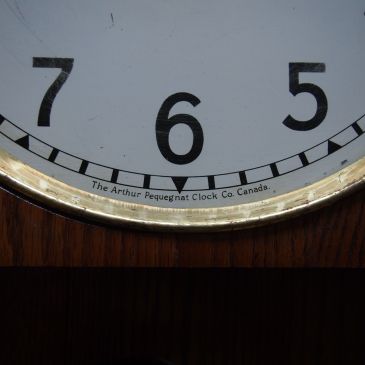
The Arthur Pequegnat Clock Co. made clocks in Kitchener, Ontario (Canada) from 1904 to 1941. Canadian clock collectors are very familiar with the name and associate Pequegnat clocks with solid construction, robust movements, conservative designs and nationalism since many clocks were named after towns and cities in Canada.

Pequegnat made mantel, shelf, hall clocks (Tall case) and wall clocks mostly of oak though some were mahogany veneered. The Kitchen clock or gingerbread clock as it is often called was very popular at the time and Pequegnat made an effort to keep up with current styles with a range called the Maple Leaf. There were six versions of the Maple Leaf clock made by the Arthur Pequegnat Clock Co. Though the dimensions are similar they share two unique characteristics; all Maple Leaf’s have the distinctive maple leaf tablet and Maple Leaf pendulum. It is Pequegnat’s interpretation of a truly Canadian clock styled after similar American ones.
I always make it a point to mark the time side wheel and mainspring so as not to confuse the two

It is a distinctive Arthur Pequegnat movement with nickel-plated steel plates (confirmed with a magnet) and brass bushings pressed into the plates. Unlike most Pequegnat movements this one is unmarked. Because of the shortage of brass after the First World War, Pequegnat used steel for their plates but with pressed brass bushing inserts. There must have been a cut-off date when Pequegnat switched from brass to steel plates so, this movement may have been made during the transition period at or around 1916.

Not surprisingly it had been worked on in the past. One escape wheel bushing on the front plate has ugly punch marks around it made while a past repairer attempted to close a pivot hole. In the process the pivot was bent. Upon closer inspections there are dients on the top of the pivot.

Otherwise there appears to be an average amount of wear for its age. I corrected one small issue right away; the half hour strike arm was loose in the arbour and had turned to one side. I oriented it to the correct position and secured it with Lock-Tite.
Disassembly and assessment
Ah, but I discovered another reason why the strike arm was loose. While the time side requires at least 5 or 6 bushings due to excessive wear, the strike side has almost no wear at all. I can only surmise that the strike side was seldom wound. It makes perfect sense that the half-hour strike arm was twisted out of the way so as not to make any sound at all.
Overall, less bushing work for me but as far as I am concerned both sides are meant to run and they will.

Though still usable the pressure washer on the count wheel is broken.
Bushing work
I thought I would tackle the worst bushing first, the escape wheel, back plate. First, to straighten the bent pivot. I put the wheel in the chuck of my mini lathe and gave the wheel a few spins. Yes, definitely bent.

Using a punch I inserted the hollow end into the pivot and determined where I had to bend it by giving it a few more slow spins on the lathe. It is soft steel and bends easily.It is important not to be too aggressive as the pivot can snap off. Installing a new pivot is not fun!

Once straightened I gave it a good polish.

It is worth mentioning that on this movement the time side mainspring is 17.2 mm high while the strike side is 15.6mm; not the first time I have seen a differential on movement such as this. I always make it a point to mark the time side wheel and mainspring so as not to confuse the two.
Now it is on to cleaning, pivot polishing, bushing work and testing which will be discussed in Part II.
It is time to service the movement on this mid-thirties German box clock. It was purchased at an antique mall in Peterborough, Ontario in May of 2017, and other than oiling, nothing has been done to it. While it has been running well since then, it is due for servicing. Plus, this little project is one of the many clock tasks that has kept me busy during the period of pandemic isolation.
There is nothing anywhere on this clock that tells me it is a Mauthe, not on the clock face or on the movement. However, the gong marked by the name Divina tells me that Divina was a subsidiary of Mauthe. It was likely sold under the Forestville or Solar name in department stores across Canada in the 1940s. There is an applique of a maple leaf on the crown so, I assume that it was made for the Canadian market.

As mentioned, this spring-powered rack and snail movement has no makers mark though 25226 is stamped on the front plate as well as the numbers 42 and 105; 42 the pendulum length in centimeters and 105 as beats per minute.

CA 79/9 scratched in the lower right of the front plate is a clock-makers mark for servicing in September of 1979, presumably the last time it was taken apart for cleaning.

Both plates are 1.8 mm brass. The backplate is solid while the front plate is open. It is a robust movement that was designed to last.

An unusual feature is a spring-loaded weight on the governor. Manufacturers sometimes used a special fly that has a small spring-loaded weight attached to try to even the power curve of the strike side. The faster the fly spins, the further out the weight, providing more resistance.
Day I – dis-assembly and servicing mainsprings
Safety is paramount; first and foremost, let down the mainsprings.
The rack, snail, lifting levers, and other assorted parts are separated from the movement before the plates are opened up. The strike hammers stayed attached to retaining pins as they were just too difficult to take out. Additionally, despite my best efforts to pull the gathering pallet off the arbour, it would not budge. I did not want to risk any damage to either part.
The movement was dirty, as expected, but I have seen much worse.
Once everything was apart I reinstalled the time side to check bushing wear and found the only suspect bushing to be T2, front plate. After taking out the time side gears I reinstalled the strike side gears and found that side to be in very good condition. The pivots likewise on both sides are in excellent condition.
The movement is in very good condition for an 80-year-old clock.
In the normal course of clock servicing I install more than one or two bushings
Different sized mainsprings for time and strike
The time mainspring is slightly shorter in height and length and therefore less powerful than the strike mainspring. On many movements, both sides have the same mainspring power but this movement is clearly different. Is it by design? There is more resistance pushing the strike gears through the train in that it has to work a little harder so, one would expect a strong mainspring.
Note the difference in the size of the cut pinions below. Both are second wheels. The one on the right with the larger leaf pinion is the strike side, the left is the time side.
Each time I work on German or English movements I make it a point to scratch a small “T” on both the time barrel and mainspring so as not to interchange them. Even if both sides have identical mainsprings I note the difference as a matter of practice. If the springs are different and they are switched, the increased power of the incorrect, more powerful strike spring might result in premature failure of the time side.

The other possibility is that during a repair in September of 1979, the time side mainspring was replaced by a smaller, and more than adequate, mainspring.
I took the springs out of their barrels and gave each a cleaning in the ultrasonic. Once dry I applied Keystone mainspring oil to each mainspring and returned the springs to their barrels. That’s it for day one.
Day 2 – bushing work
In the normal course of clock servicing, I install at least one or two bushings. On this movement, one bushing was required, T2F. The hole was marginally oblong and I am sure the clock would have functioned fine without it but as a precaution, a new bushing was installed.


I generally spread my clock cleaning and servicing over several days but the bushing work went so quickly that I decided to proceed with assembling the movement.
The only critical adjustment prior to assembling the plates is the stop wheel. The stop wheel requires about half a rotation to arrest the train during warning otherwise, all the other adjustments are made outside the front plate. During dis-assembly I made a note of the location of the wheel, at 12 o’clock, saving time and frustration and it worked just fine.
Rather than use a test stand I returned the movement to its case for further testing.
You must be logged in to post a comment.