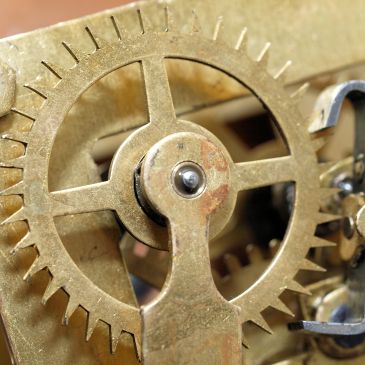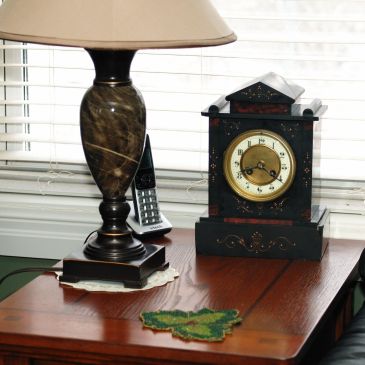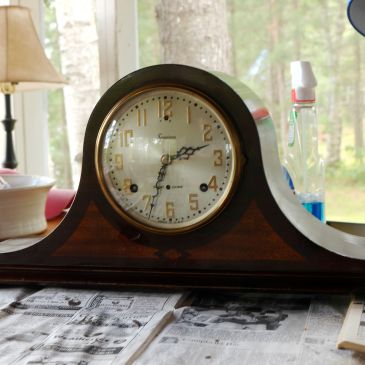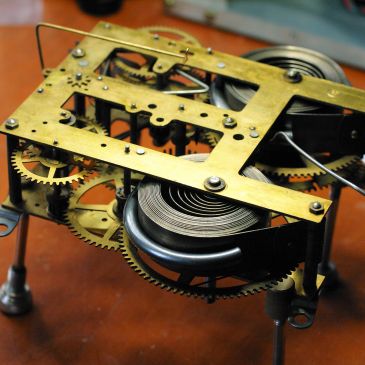

Saint Patrick’s Day – it is only fitting to feature a Smiths Enfield mantel clock that came all the way from Ireland
Starting Tuesday, March 21st I will feature a regular blog called Tick-Talk Tuesday.
The purpose of the blog is twofold, the first, to talk about letters and comments I have received from you, the reader, concerning your clocks, issues you might have had and challenges you face as well as my responses to your questions and my advice on your clock issues and concerns. The second purpose is a place for you, the reader, to profile your favorite clock or a clock that has presented a particular challenge for you.
The focus will be on you, the reader
So, the focus will be on you, the reader and contributor. Most of the comments and questions are ones that I have received privately but to preserve anonymity I will not mention names. To profile your clock, simply send me photos and a description (my contact email is ronjoiner@gmail.com) and I would be more than happy to present your prized clock to the many readers of this blog. Although privacy is important, let me know if you do not mind having your name published.
I am looking forward to this feature and between us it should be very informative.
Jaeger LeCoultre clocks are a favorite among collectors
Jaeger LeCoultre alarm clock
Jaeger LeCoultre clocks are a favorite among collectors of high-end luxury timepieces, often bringing in hundreds of thousands of dollars at auction. Jaeger LeCoultre to this day produces high quality desk clocks and watches in addition to their famous line of Atmos clocks.
I was in an antique shop in Victoria, BC recently and I must confess that I have never seen so many antique and vintage clocks in one place outside a museum. (I’ll cover those in a future blog article)
There were so many French and American mantel and wall clocks that I went by this diminutive clock twice before stopping to take a more careful look. On the clock face it says LeCoultre and underneath the base there is a label that says Faust Waltz, the musical tone of this alarm clock.
It is small but substantial in weight. It is an authentic 8-day gilt or lacquered bronze Swiss made clock from about the 1960s to 1970s though it may be earlier. There are no obvious dents or scratches on the case and no marks on the glazing although I did not have enough time to examine it more closely. I have no idea whether or not it is in complete working order but the fact that music box functions is encouraging.
Rear of clock showing winding key for the music box on the lower left
Unfortunately I was taking shots with low light and using a flash would have attracted too much attention from the owner. The quality is not up to my usual standards.
I am in the process of deciding whether or not to make the decision to buy this clock. In the meantime I have several questions:
The seller is asking CDN199; a fair price?
Is it collectible?
I would like to narrow the vintage, the year it was made, thoughts?
There are plenty of different styles of LeCoultre alarm clocks on the net but I could only find one photo of this particular clock. Either it is rare and desirable or uncommon and not worth considering. I hope it is the former.
It is a French mantel or shelf clock. I have no idea of the maker but it is an antique (over 100 years old), possibly 1890 to 1900. It has “Marque Deposse” stamped on the back plate but that simply means “trademark” in French. It is not a maker’s name. The clock is 11 inches high by 8 inches wide by 5 inches deep.
Rear access door
It is a time and strike movement on a coil gong. Unfortunately, the strike side does not work though the seller disclosed that to me before I bought the clock. I can feel the tension of the spring when I turn the key in the arbor but the spring does not engage the click, so, a broken or disconnected click I presume. The previous owner described it as having a melodious sounding gong. I would love to hear it. I wondered if the spring barrels could be taken out without separating the plates but further research has revealed that the movement must be dis-assembled.
Clock face
The clock dial face is in two sections. The brass inner pan is surrounded by a porcelain dial with painted numbers. The dial door is flat glazing in a brass bezel with a high quality “hidden” hinge. A taper pin holds the delicately crafted hands. There is a smaller arbor, a speed regulator above the 12, which allows more precise tuning in concert with a speed adjustment on the pendulum.
Pendulum back showing stamped numbers
Aside from numbers on the back plate, an identical batch number on the pendulum and the Marque Deposee stamping, there is no makers mark. There may be a mark on the gong block but I won’t know until I release the nut on the base panel to take it out from underneath the clock. The numbers on the back plate are 3851-55. The number 5 5 is the pendulum length as in 5 and 5/12 French inches.
Front side of pendulumTime and Strike movement
The movement appears to be of superior quality though common in a number of higher end French clocks. From what I can determine, the movement can be taken out of the case by undoing the two screws that go through the back bezel into the brass straps that protrude through the case from the front bezel. The movement should come out through the front once the two screws are released. The movement looks clean and there is sufficient oil in the pivots (no black or green gunk). I have other projects on the go so it might take me some time to take the movement out for inspection but for the time being I will let it run to regulate it.
The Corinthian style case is very heavy and is quite possibly Dinant Belgian Black Marble. Aside from the non-functioning strike side there are other issues. One is a very noticeable chip on the bottom right corner of the base which you can see in the photo below and the other is a small chip in the top left corner which is less visible. Close-up that larger chunk out of the corner looks ugly; from a distance it is hardly visible.
The worst of two chips, bottom right corner
Despite the slight damage the overall look is impressive. Most of what I see is well preserved. Indeed, it is a very attractive and stately antique French mantel clock that now occupies a prominent place in our family room.
Who made it? Unless there is a maker’s mark on the gong block or somewhere else on the movement, I may never know.
“Life is a box of chocolates….you never know what you are going to get”, Forest Gump
Buying a clock without actually touching and inspecting it is always a gamble and making a judgement based on images, many of which are poor quality, complicates the decision-making even further. There are stories of people buying clocks online only to find that the clock they thought had a antique mechanical movement arrived with a quartz one.
There are many challenges facing the clock shopper in today’s online world. Once your interest is piqued you may ask yourself these questions:
Did I get my money’s worth? Will I be “ripped off”?
Will it work when I get it home?
What do I have to do to fix whatever might be wrong?
What did the seller not disclose?
There are accepted rules about buying clocks on online for-sale sites. Online for-sale sites are ubiquitous and in many countries in the world. Here is an example of rules that are found on a particular site that I frequent.
All transactions should take place in person with cash. Do not ship items and do not accept other payment methods.
Never click links in an email that ask you to sign in to xxxx. All “Your xxxx account has expired” emails are fakes.
xxxx, eBay and PayPal do not offer buyer or seller protection for xxxx items. Such emails are fakes.
But for more specific rules on how to buy that special clock you were always looking for, see Ron’s Rules at the end of this post.
Follow this exchange between myself and the seller and consider my thoughts on this and other online clock purchases later in the article.
The clock
Unknown mantel or shelf clock.
Actual Ad photo
The exact words of the ad
Wind up alabaster clock. Very heavy. $80.00
The email exchange between myself and the seller
NOTE: This particular online for-sale site has an encrypted email service, therefore in my exchange I do not know the seller’s actual email address. This is a necessary protection for both parties.
Me
Do you know the company that made the clock and how old it is? Thanks
From the wording of the ad I am assuming at this point that the seller knows very little about the clock
Seller
Sorry I don’t know who made or how old it is. I bought it in an auction a few years back. Thanks xxxx
Me
Since you do not know the maker and I would have to drive from xxxxx, would you accept $60 for the clock.
Seller
Before you decide to drive from xxxxxx I would like you to know that the chimes do not work. I know that the clock would be worth more but 60.00 is fine if you would like to have it. Thanks xxxx. Let me know .
Me
If the chimes don’t work it is not a huge problem. Does it look like all the parts are there or is anything missing? I am still interested if the parts are there.
Seller
Everything is in tact. It was last serviced a few years back and worked great, but went to wind the chimes and they seemed to slip on the spring… However the clock still works just had it put away for a couple of years.
Me
For $60 I will buy it. How does 2pm today sound?
Seller
Yes we will make sure we are at home. Will you find the place OK? If not we could meet you part ways.
Later
I provided the seller with my telephone number. He subsequently calls to give me his address. The call is important because I suspect he wants to get a feel for who he is dealing with and that is the correct way to approach sales such as this.
Thoughts
It is important to be ready to pick the item up ASAP. You do not want to allow too much time for the seller to have second thoughts or to have someone else move in ahead of you. I often suggest meeting that same day, in a neutral place or at their home but most suggest meeting at their home. A neutral place is an option and I had to do this only once in over 2 dozen purchases.
My preliminary analysis based on the limited information that I have is that it is an French or English made time and strike shelf clock and judging from the problem on the “chime” side it might just be a bad click although it is possible that parts of the movement have been damaged. It is impossible to know until I see it and bring it home.
You might suggest I ask more questions about the clock or have the seller send additional photos of the movement or even a closeup of the clock face. It is only a $60.00 clock! In my experience once you attempt to have the seller take extra steps to sell their clock especially a clock at this price, the chances of a loss of sale increases. Were I to shell out hundreds of dollars I would definitely ask for more information and detailed, higher resolution photos.
Ron’s Rules
Locate the clock you are looking for online and try to avoid Chinese or Korean clocks often advertised as “31 day” clocks. (For some reason people think they are worth a lot of money and they are garbage – usually!)
Communicate by email and ask questions but not too many as to scare the seller off. Suggested questions might be:
Does the clock run?
Who is the maker (manufacturer)?
If it does not run, are all the pieces intact?
How old is it?
How long have you had it?
Would you accept a lower price because…….(justify reason(s))?
Arrange final meeting details by phone.
Meet the same day if possible.
Meet the seller in person.
Meeting at their home is preferred but a neutral location such as in front of a public building or in a mall is an option
Pay in cash.
Thank him/her for the sale.
Final thoughts
Check the dates on the listings. The longer they are listed the more the seller is inclined to sell for a better price.
Once, I gave the seller a day or two to think about my offer. I took a chance but got the clock for a decent price. (see first image)
Meeting the same day is crucial; you don’t want the seller to get cold feet and you don’t want someone coming behind you to buy the clock.
Only once did the seller accept a cheque from me because of past dealings with him. Cash is the rule.
If you cannot negotiate a final price by email suggest talking it over on the phone
Be courteous and polite at all stages of the deal
My wife and I are in the mood for a road trip. Now, with cash in hand, let’s get into the car and go for a drive.
This is Part II of a multi part series on the Sessions Westminster A chiming mantel clock.
Side view of Sessions Westminster A
Inside the plates they are a conventional Sessions clock. Outside the plates is an entirely different story
Sessions Westminster A clocks are true chiming clocks that play the Westminster chime sequences on the quarter hours and strike the hour count on the hour. The unique design combines the chiming and striking functions in one train powered by a single main spring. Between the movement plates these movements are very similar to other Sessions non-chime (strike only) movements. The going (time) train is controlled by a basic recoil escapement with the strip pallets or verge located between the plates. Inside the plates they are a conventional Sessions clock.
Outside the plates is an entirely different story. At the front of the movement one will notice that this is a rack and snail strike train but it has TWO racks and TWO snails. A look at the back of the movement reveals a small cam in the middle of the plate and a large “player drum” or pin drum. The two racks working together with the little cam and the player drum, which can shift outward to play chimes or inward to strike the hour, is what makes it all work. The chime sequence is self‐synchronizing and with so few working parts, once setup correctly this can be a relatively trouble free movement. (Source R. Croswell’sTaming the Sessions Two Train Clock)
This clock requires servicing for two reasons;
It runs for several minutes or an hour or so and then stops
The striking and chiming is very erratic. It might strike 4 o’clock one hour and 9 o’clock the next and the hammers “hang up” during the quarter hour chime.
There are a number of “exterior” parts that must be removed before separating the plates
Dis-assembly of the Westminster A is conventional however there are a number of “exterior” parts that must be removed before separating the plates. The regulator gearing, verge, drum assembly, hammers and racks as well as other parts are removed one after another. The additional parts add considerable complication to the movement and can lead to issues when servicing. I will describe two particular issues I have encountered in the process of working with this movement. I believe these issues, which I will describe later, are likely what frustrate most clock repair persons when working on the Westminster A.
Rear plate showing regulator, verge and chime drum. Clamp on mainspring
I chose to leave the mainsprings in while taking the movement apart though I contained the power using C-clamps. On this clock the mainsprings can be removed without dis-assembly. This allows the repair person to easily service the mainsprings or the clicks (which are notoriously bad on Sessions clocks generally).
Unfastening the drum and hammer assembly went without issue since there are only two bolts securing it to the plate.
The 2 racks, a unique feature, work together to produce the strike. They are located one on top of the other and are secured to a post.
Two racks stacked on top of each other. The post on the right accommodates two springs
Taking them off requires releasing a pressure washer on the top of the post. They came out easily. However, one rack is missing a return spring which might partly explain the erratic striking of the clock. Such a simple thing that may make a big difference. I may have to buy or fashion a spring.
Rack with spring
Rack without spring. The spring clips into the hole on the rack arm
Specialized tools are needed to remove some parts. Those I don’t have
Two issues.
One, I could not remove the hub supporting the gathering pallet pins seen here. It’s unfortunate because there is more lateral movement of the arbour that I am comfortable with which tells me that a bushing is required. I did not want to risk damaging the arbour and I don’t have specialized tools to do the job. I may have to live with it. However, it may not be so bad once the other bushing work is completed.
Gathering pallet pins
Two, I could not remove the centre cam despite pulling and gently prying.
Centre shaft cam
Again, I did not want to risk damaging the arbour. Specialized tools, such as a puller in this case, are required to remove it. That, I don’t have.
This clock has a unfortunate reputation for soft pivots
I will have to work around these two issues. Pressure fitted parts on any movement are very frustrating when said parts cannot be removed without special tools and this one is a challenge indeed. Re–assembly might be a little frustrating particularly with the centre arbour still attached to the rear plate which may effectively be “in the way” of positioning other wheels in place.
I inspected the pivots on the wheels and they all look good (no tapering) with expected wear for a clock of this period. I was worried because this clock has a reputation for soft pivots and perhaps because this is a later model, Sessions might have been introduced harder steel for the pivots. There is plenty of bushing work that needs to be done, however.
On to cleaning, bushing work, re-assembly and testing in Part III.
This is Part I of a multi-part blog wherein I explore the challenges of repairing a Sessions Westminster A tambour style time, strike and chime mantel clock. This part is the introduction.
Th Vintage Sessions Westminster A mantel clock
In August 2015 I wrote, “This a good project clock that is not for the inexperienced. As I gain more knowledge I will tackle this most interesting clock.” Well the time is now.
Well, it’s been two years and I have looked at this clock often enough and wondered what it would be like to finally get it running. Time to take the plunge.
The Sessions Westminster A mantel clock was made in Forestville Connecticut, USA. The first year of production for this model was 1927. Between 1903 and 1933 Sessions produced 52 models of mechanical clocks, ranging from advertisers, large and small clocks with logos of various businesses, to wall, or “Regulator” clocks, and shelf or mantel clocks, designed for the home.
Some Sessions clocks from this period are prized by collectors. The Westminster A is particularly sought after though collectors prefer it to be serviced and in running condition.
Raised Roman numerals and faux inlay
The case is in exceptional condition
The clock is tricky to repair and most horologists prefer to stay clear of it
This clock is 21 inches long and 10 inches high, has a mahogany finish with faux wood inlay and raised metal gold-coloured numerals on the dial face. It is a quarter-hour 8-day Westminster chime clock operating on two trains, the going train (time) with the strike and chime train combined. It also has small arbour just below the hour cannon to turn off the chimes/strike and is called “Silent Chime”. Sessions was not alone in producing two-train clocks and other makers incorporated this design later in the 1930’s and 1940’s. However, Sessions was probably the best known for this feature. This clock was sold in 1931 (inscription on label, back of access door). The sale price was $29.95 which would have been substantial considering a working man’s salary in those days.
Sessions Westminster chime drum
The clock is tricky to repair and horologists will generally try to stay away from it. I will be going through a step-by-step process and relying heavily on Robert Croswell’s excellent instructional manual called Taming the Sessions Two Train MovementFebruary 2016 edition.
In August 2015 I wrote, “This a good project clock that is not for the inexperienced. As I gain more knowledge I will tackle this most interesting clock.”
I have done some bushing work and from what I can see there is certainly bushing work to be done. I have removed the movement once before to replace a bad click which as easy fix since the mainsprings can be removed without dis-assembly. The click holds the tension or power of the mainspring and is identified by a clicking sound when the key is turned. But the real challenge will begin as I attempt to understand how the chime mechanism works and if I can re-assemble it successfully.
Follow me as I dis-assemble, clean and repair the movement in Part II.
I recently purchased a vintage Canadian made New Haven 8-day short drop octagon time and strike clock. It is in the familiar style of a schoolhouse clock.
The New Haven Clock Company lasted just over 100 years.
Sadly, The New Haven Clock Company lasted just over 100 years. Much of the history of the New Haven Clock Company comes from this informative site.
In 1853 the Haven Clock Company was founded in New Haven, Connecticut by Hiram Camp (1811‑1892) and other clock-makers. The company’s mission was to mass produce inexpensive brass clock movements for use in clocks. In April, 1856 The New Haven Clock Company buys out a competitor’s company, the Jerome Clock Company. They move their production to the former Jerome factory and New Haven begins making clocks under their own trademark. In 1870 some of New Haven’s clocks are marketed under the Jerome & Co. brand.
In 1885 the company stopped selling clocks other than their own New Haven brand. In 1890 the company developed serious financial problems and efforts were made to keep it solvent until 1897 at which time the company emerges from reorganization. In 1902 Walter Chauncey Camp (1859-1925) began to turn the company around. In 1923 Walter Camp steps down as head of the company and is succeeded by Edwin P. Root.
In 1929 Richard H. Whitehead replaces Root as president of the company but by this time New Haven is again facing financial difficulties which is compounded when the Great Depression hits in November, 1929. Whitehead is able to keep the company afloat during these troubled times and the firm becomes profitable once again. From 1943 to 1945 the company uses its manufacturing plant to aid in the war effort, producing products almost exclusively for military use. In March of 1946 The New Haven Clock and Watch Company becomes the new name of the firm after it reorganizes once again. It returns to what it did best before the War, once again making clocks and watches.
The 1946 reorganization eventually leaves the company vulnerable to foreign investors and it loses control to a consortium of Swiss watchmakers. The man who had successfully shepherded the company through the hard times of the Depression years, resigns as president. In 1956 the New Haven Clock and Watch Company files Chapter 10 bankruptcy in a U.S. court. Its fortunes have declined precipitously since Whitehead’s departure and it never recovers. In 1960 the company goes out of business and the production lines are closed. The facilities are sold through a combination of public auction and private negotiation in March of 1960.
The New Haven Clock Co. of Canada was established at Brantford, Ontario (Canada) in 1906. The New Haven Clock Company of Canada was a subsidiary of the New Haven Clock Company of America. Both mantel and wall clocks were made in the Brantford plant with Canadian wood cases, but the spring-driven pendulum movements were brought in from the U.S. The Canadian arm of the New Haven Clock Company closed in 1956.
This clock was made in the 1930s and taken out of a decommissioned one-room schoolhouse in 1963.
New Haven schoolhouse clock
I am always fascinated by a clock’s history and I always ask a seller how much they know about it
I am always fascinated by a clock’s history and I always ask a seller how much they know about it. I believe a clock’s provenance is almost as important as the clock itself. The seller, a man in this seventies, related in great detail how he acquired the clock from the Lone Spruce School in Invermay Saskatchewan in 1963 when the municipality was selling off school assets. Saskatchewan is a western province of Canada. Invermay Sask is a village in the east-central region of Saskatchewan, Canada with a population of 247 in 2011. Invermay is about 75 km west of Canora or about 50 km east of Wadena on Highway 5.
New Haven clock instructions
Lone Spruce school was built between 1913 to 1915 on the west side of section 1 township 34 range 8 west of the second meridian, and it is noted by local historian Caroline McDonald, that the school was 1/2 mile north from each of the north and south corners of the section of land. Classes opened under Mr. Oliver, during World War 1. A new school was needed around 1950-1951, and the new school yard chosen was section 8 township 34 range 7 west of the second meridian, the old school yard having been two miles to the west of the new school. The old school house sat empty for 10 years and was removed in 1959-60. When the new school closed for classes, the Lone Spruce school house was re-located into Hazel Dell around 1959-1960 and decommissioned in 1963 at which time its assets were sold.
Why a school board would order time and strike clocks is an interesting question.
#331 appears on the inside access door. The number 331 was likely an inventory number that referred to one of a lot purchased by the municipality in the 1930s. Why a school board would order time and strike clocks is an interesting question. My other schoolhouse clocks are time-only. Why the access door is a solid sash rather than glazed is another curious question. The combination of the solid sash and time & strike movement must have hit a particular price point for the school board at that time. The teachers were likely instructed not to wind the strike side.
Time zone clocks
The New Haven clock is now one of three “time zone” clocks on our kitchen wall. I have a daughter in Victoria BC, and a daughter in Calgary, Alberta and at a glance I can see the time in those two regions of Canada. The New Haven clock is our local time; the Victoria clock is a Waterbury and the Calgary clock is a Sessions.
This clock is on my calendar for servicing which I will cover in an upcoming article.
This is an antique German Junghans time and strike spring driven clock made in the style of a Vienna Regulator. It came to me as a box of parts. To some a box of clock parts and pieces is discouraging but to me it is a challenge.
Part II of a three part series on my newly acquired Junghans Crispi wall clock.
This is Part II of a three part series on my newly acquired Junghans Crispi wall clock. In Part I described the circumstances by which I came across this clock and it’s incredible story as a survivor of the Halifax Explosion of Dec 6, 1917.
This is a German count-wheel strike typically found in the lower lines of Mauthe, HAC and similar clocks. It is an open plate “bread and butter” movement, not of the highest of quality but well built and reliable. The count wheel is located to the rear between the plates and the mainsprings are enclosed in open barrels. There are no helper springs to worry about and all of the wheels are located in the centre and the upper side of the movement.
As you can see in the next two photos the movement was very dirty and I accepted the risk of running it for a day to see what issues might arise. I gave the pivots holes plenty of oil to mitigate any additional wear. What I found was a sticky hammer assembly that would malfunction intermittently which I attributed to dirt and grime buildup, otherwise the movement ran very well after not having run for 100 years. Imagine all that kinetic energy stored in the springs since 1917.
The movement is relatively easy to re-assemble but I had to install the lower centre wheel, the spring barrels and the centre cannon together with the top plate and then slide the gears in between the plates. Fortunately this process is not as difficult as it sounds but very different than laying the top plate right over the gears as you would in an American movement.
Very dirty movement
Mainspring barrel with years of dirt showing
I gave the pivots holes plenty of oil in the testing phase to mitigate any additional wear
Plates cleaned up well
All the wheels between the plates
I found everything within acceptable limits and decided that bushing work was not required
The accumulated grime of 100+ years came off following the ultrasonic cleaning. In fact I have never seen the ultrasonic solution so dirty. The plates cleaned up very well and I gave them an additional polishing with Brasso. After the parts came out of the ultrasonic I tested the movement for any evidence of excessive play and found everything within acceptable limits and decided that bushing work was not required. The pivot holes were pegged and the pivots were polished.
Springs were inspected, cleaned and oiled
There were no cracks or unusual issues with the mainsprings though I found it curious that they were very clean with no rust. There was also very little lubricant remaining. The springs are somewhat tired as you might expect but I think there is enough power remaining for a full cycle so I decided not to replace them at this point. I applied Keystone mainspring oil to the springs once I returned them to their barrels.
With the movement back together, it is time to adjust the strike side. The strike wheels must be set up correctly with respect to each other ensuring that the third (hammer lifting star wheel) and fourth wheels (the strike cam) align with he count wheel. The warning pin on the last wheel (which actually protrudes from the plate) has to be high enough for sufficient rotation. In order to count the strikes properly this relationship must be right. Unfortunately, I can never get this correct the first time.
The servicing of the movement is not without headaches, however.
The servicing of the movement is not without headaches, however. I bent a pivot on the warning wheel which I managed to successfully straighten out. The hammer arbor paddle was barely touching the star wheel and while trying to adjust it, I accidentally snapped it off along with the retaining spring. Although the clock will go though the strike sequence the gong will obviously not sound. I don’t have the tools to put in a new paddle so I will have to get that attended to somehow. I managed to correctly adjust the strike side but the clock mysteriously stops after about an hour or so. Something is definitely amiss and more investigation is required.
I have had more success with the case restoration that you will read about in Part III. In the meantime I have to constantly remind myself that this movement has not been running in 100 years!
What most people visualize as the Schoolhouse clock
My recent acquisition of another schoolhouse clock stimulated my curiosity and prompted me to do some research on the origin of the name. In this article I will describe my thoughts on how the schoolhouse clock came to be and my most recent Sessions wall clock purchase.
During my research I found it very interesting that little can be found regarding the history of the schoolhouse clock. I realize that many older readers growing up in the rural areas of Canada and elsewhere in North American have fond memories of the one-room schoolhouse with a large clock in either the front or the back of a classroom. I did not live that experience rather, when I was young and attending a large urban school the Simplex master / slave clock is the one I remember best.
The schoolhouse clock that I bought recently adds to my modest collection of three schoolhouse clocks. Given that I spent many years as an educator, it seems only fitting that I would have an interest in schoolhouse clocks. My schoolhouse clocks are all a similar style; short drop octagon, constructed of oak, brass dial bezel, bottom glazed access sash, 12 inch dial or 9 inches as in this case of this clock and the Waterbury pictured below. Although 9 inch clocks were used in schoolhouses they were also found in office or workplace settings.
They were not called a schoolhouse clock when they were made
Schoolhouse clocks were the standard design for early North American school houses because of their larger, easy to read dials. These distinctive clocks were hung in many schools rooms across Canada. The majority had simple but tough time-only movements and some even came with a calendar function. Occasionally they were ordered with time and strike movements but the cheapest and most popular versions were time-only. This type of clock had a very utilitarian look and function.
They were not always called schoolhouse clocks. None of the labels on my clocks have the word “schoolhouse” written on them and are either described as a”drop Octagon” in the case of this Sessions or have a specific model name. The term schoolhouse clock was not applied to them when they were made but came to be known as a particular style of clock found in school settings by later collectors. If a particular style was ordered by a school authority makers might have informally described them as clocks for schools or “school clocks”. In any event, the term has become a permanent part of the clock collector language.
Label on back of Sessions clock
With a swinging pendulum visible from a distance the clock can easily be seen running and the open-door bottom access sash allowed for restarting and adjusting the rate. In some clock collecting circles it is said that schoolhouse clocks are a derivative of the English drop dial fusee clock, an example of which can be seen here. Drop dials were produced in the late 18th through to the 19th century and closely resembled the schoolhouse clock. Unlike spring-driven schoolhouse clocks, fusee clocks have conical construction from which a chain or gut-line is pulled by the mainspring barrel allowing the power of the mainspring to be released evenly thus assuring better accuracy.
When I am in the process of buying a clock I always ask the seller this question. “How much do you know about this clock?”
When I am in the process of buying a clock I always ask the question. “How much do you know about this clock?”. I always ask this question because I am interested in a clock’s provenance and some of the stories are quite intriguing. The seller, a man in his late fifties, thought about it for a moment and said, “Well, I’ve had it since I was 14”. The clock came out of a decommissioned one-room schoolhouse in a small town called Springhill, Nova Scotia (Canada). However, when I first saw the clock I said to him, “It looks like a nice office clock”. The seller quickly corrected me and said, “It’s a schoolhouse clock”. “It runs for a little bit and then stops, maybe you can do something with it”, he added.
It is a 1920’s vintage Sessions Drop Octagon wall clock. It has a solid medium dark oak case with original hands, ornate pressed brass pendulum bob, solid brass bezel, 80% of an intact label on backboard, tin dial pan and stenciled lower glazing on the sash. The paper dial is original but it is heavily “foxed”. The movement is 8-day time only. The dimensions of the clock are a 9″ diameter dial, 19″ high, 13 1/2″ wide by 4″ deep. It is in reasonably good condition given it’s age and for $20 it was quite a bargain. It is also intact; there are no missing or broken pieces.
Sessions time-only movement
I don’t think this clock has been run in quite some time.
I took it home, hung it on the wall and true to what the seller said it would run less than a minute and stop. I noticed a rubbing sound around the pendulum area as it was running. The pendulum bob was hitting against the inside front of the case. I took the movement out and observed a bent crutch rod, corrected it, put it on a test stand and it ran immediately. As expected the movement had quite a bit of grime and required attention but it ran for a day before I took it apart for a thorough servicing. I don’t think this clock has been run in quite some time.
I found it curious that the suspension spring was soldered where the spring hooks into the top block. It likely kept slipping off and solder was used to keep it in place. In any event, the spring cannot be taken out without first removing the solder! The clock is in very good overall condition for it’s age and the movement was not as dirty as I first thought. The pivots are in decent condition for the most part and there is minimal wear overall. The movement was disassembled, cleaned and in the process I decided to install two bushings for added insurance, one on the escape wheel (front plate) and the other on an intermediate wheel (front plate). The movement was tested, put in beat and reinstalled back into it’s case.
I may replace the paper dial but I am going to see if I can live with it for the time being.
The dial has many brownish spots as you can see in the next photo. The clock had to have been in a moist environment for a long period for the paper to discolour. My two options are, one, leave as is or, two, replace with a paper dial. I may replace the paper dial but I am going to see if I can live with it for the time being. The brass bezel cleaned up well but the exposed tin surrounding the paper dial has blackish areas which I managed to reduce with CLR but could not totally eliminate. Of course, I later learned that CLR is really not appropriate for this purpose as it is an acid.
Dial showing rust staining
The case has years of grime which was easily remedied with Murphy’s soap and water. It cleaned up very nicely. Following the cleaning I gave the case a light coat of shellac to restore the luster of the oak. It looks good and it runs well.
My other drop octagon clocks are a Waterbury Arion, an unknown Ansonia and an Arthur Pequegnat Brandon II.
This Waterbury Arion is 19 inches long
Ansonia short drop octagon, model unknown, 12 inch dial
Arthur Pequegnat Brandon II, 12 inch dial
Time-only movements are the easiest to work on and a very good movement to learn on.
Repaired Sessions Drop Octagon clock
Time-only movements are the easiest to work on and a very good movement to learn on. If you are a beginner in clock collecting and repair clocks such as this are satisfying clocks to work on and presents few challenges. I am happy that I managed to bring this particular clock back to it’s former schoolhouse glory.
The term schoolhouse clock is a term that was not applied when they were made but came to be known as a particular style of clock found in school settings by later collectors. The schoolhouse clock is such an endearing name that when one thinks of a schoolhouse clock the memory of these specific styles of clock immediately comes to mind.
I am a retired college professor based in Nova Scotia Canada, live in a little village just outside Truro and collect vintage and antique clocks that I repair and maintain. I also write about horological areas of interest and of interesting clocks and clock stories that I encounter on my travels.
In the spring of 2015 I decided to write a blog about clocks. The first few months were a struggle to decide what material would be of interest to those who not only collect antique and vintage clocks but those few with just a passing interest. As the months went by I began to realize that the world of clock collecting and repair is incredibly vast and I discovered that there is a lot for me to learn. As I expand my knowledge of clock and collecting and repair I am also realizing that there is a lot I do not know.
This blog has given me an opportunity to profile my own clock collection, walk the reader through the challenges of restoring and repairing my clocks and the learning I have gained from the experience as well as talking about horological areas of interest.
My office showing tools and my work area
Let’s review 2016.
Some statistics. As I write this article my blog has exceeded 17,000 views, 33% of which are from United States, 17% are from Canada and the remainder are from around the world including the United Kingdom, Australia, Romania, Germany, India, The Netherlands, South Africa, Malaysia and 80 other countries, even 5 visitors from Cuba (and I thought they did not have access to the internet). I receive between 40-50 comments per month on average. The top 5 articles this year were:
Mauthe Mantel Clock
Daniel Dakota Wall Clock
Sessions Westminster A Mantel Clock
Forestville Mantel Clock
U.M. Muller Box Clock
As most bloggers know the key to building a successful blog is not only attracting new visitors but keeping existing ones interested enough to come back.
As most bloggers know the key to building a successful blog is not only attracting new visitors but keeping existing ones interested enough to come back. My visitors view an average of 1.8 articles per visit and I have 50-60 views on a typical day. I am now receiving as many views per month as I did in the first 8 months of the blog. My goal is to to provide enough stimulating content so that visitors want to return. I post 8 articles a month, usually spaced 4-5 days apart, on various topics of interest. I also attempt to appeal to all facets of clock collecting and repair from profiling my own acquisitions and experiences restoring and repairing my clocks to articles of general interest usually with some historical horological context.
Servicing an American clock, removing the time mainspring
Bushing a movement using a centering tool
I have welcomed all comments and inquiries. I have received a number of fascinating comments from people who typically ask me how much their clock is worth, particular problems they have with their clock, information about the history of their clock and suggestions for improving my workflow. I answer all questions to the best of my ability but I make no pretense that I am a trained professional though my general knowledge of clock collecting and repair is growing exponentially. I have also received comments from those who more knowledgeable than I am and I welcome their expertise and perspective. I especially welcome the wisdom and insights from popular commenters such as JC and Catalin at Blog Timbrofil.
Regulator weights
If you are a regular reader you will continue to see a number of what I hope are interesting clock articles in the months to come
Now it is time to look to 2017. My intent is to write interesting articles about clocks in general as well as continuing to profile my modest but expanding collection of antique and vintage clocks. I also intend to explore special areas of interest particularly my growing fascination with lantern clocks and crystal regulators. If you are a regular reader you will continue to see a number of what I hope are interesting clock articles in the months to come.
Stay tuned and if there is an area of interest you would like to see me to explore, drop me a quick note.
In Maritime Canada, this weekend marks the time to turn the clocks back. We have a saying, “Spring forward, fall behind,” which refers to the switch from Atlantic Daylight Savings Time (DST) to Standard Time on November 6th, moving the clocks back by one hour. As a result, we gain “an extra hour of daylight” in the morning, which is beneficial for farmers, I suppose. In the spring, the clocks are moved ahead again. However, not all regions in Canada observe DST.
Kienzle World Time clock
Not many people realize that Sir Sandford Fleming, a Canadian engineer and inventor, proposed Standard time and world wide time zones. Although he was born in Scotland he immigrated to Canada at the age of 14. In his later years he was employed by the Grand Trunk Railway which led him on the path to standardized time zones for the railway.
I decided to dedicate this blog to Standard Time and the many idioms and expressions with the word “clock” in them.
The clock is ticking
Beat the clock
Turn the clock back
Wind back the clock
Run out (or down) the clock
A stopped clock is correct twice a day
Clean (someone’s) clock
On the clock
Biological clock is ticking
Watch the clock
He’s (she’s) a clock watcher
Punch the clock
Around the clock
Stop the clock!
Race against the clock
As regular as clockwork (or, running like clockwork)
Face that could stop a clock
Five o’clock shadow
Hickory dickory dock the mouse went up the clock
One, two, three o’clock four o’clock rock
Rock around the clock
Let me know if I missed anything, and I’ll be happy to make adjustments.
I am going to take you, the reader, through the process I follow when servicing a clock. There will be several posts in this series. I am not a trained expert in clock repair, nor do I do this for profit and have learned most of what I know through trial and error, careful study and of course, listening to the advice of many experts and newfound friends on the forum site at NAWCC.
If you into clock collecting you’ve probably seen one of these mantel clocks at one time or another in your travels. Literally thousands were made. This attractive little mission styled oak-cased time and strike mantel clock is a Sessions “American No. 2” dating from 1921 according to Trans Sessions book, page 121.
When I opened the back access panel to service the movement I discovered an inscription which reads, “Jim A. Kennedy, Nov 3/63, a clear, cold nite”. One can only imagine that on that particular clear, cold night, Jim A. Kennedy was doing some work on this lovely clock. It does not say where Jim lived but Jim, wherever you are and if you are still with us, your clock lives on.
Although this clock has been running steadily since I acquired it about two years ago, the time is right to put it on the workbench. American made clocks like this tend to run on and on despite requiring much needed bushing work and this one is no exception, but now it needs some loving.
I took the movement out of it’s case and examined it closely. Fortunately it has not been botched by poor repairs over the years that one sees from time to time. Things looked good, no surprises. Although no bushings have been installed on the top (back) plate there were five bushings that were installed on the bottom (front) plate at some point in this clock’s life, perhaps on that cold, clear evening in November. My initial inspection reveals that there is wear in some pivot holes and that six bushings must be installed on the back plate and of the five previously installed bushings on the front plate, two need to be replaced and at least one new bushing is required on the pallet arbor.
Although the movement appears clean at first glance it really is very dirty. This is an example of the sludge (indicated by the arrow) that has built up in this particular pivot over the years. There are other such examples on this movement.
Top plate showing a build-up of dirt around a pivot hole
Once I tear it down completely I will be able to determine the condition of the pivots and other moving parts. I intend to clean the entire clock and clean/oil the springs as well as replace/install the aforementioned bushings. My first impression is that the mainsprings are in good condition. The clock easily ran eight days on a wind. The clicks are another matter. At least one looks like it needs replacement. Sessions clocks are notorious for their bad clicks but to put things in perspective the clicks have been in this clock likely since it was made (or perhaps 1961).
Time and strike movement with single hammer strike on a coiled gong
The escape wheel teeth may need to be filed but I will determine if filing is required once I inspect it more thoroughly.
Escape wheel tooth tips
Safety first. The first task other than taking the suspension spring/rod/bob off the movement is to secure the mainsprings using mainspring clamps that are available at any clock supply store. Mainsprings can be very dangerous and it is important to contain their power when working on a clock. I always wear eye protection and leather work gloves before I let the mainsprings down with a let down key. Once you’ve released the clock from the ratchet by moving the retaining spring out of the way, the power of the spring is transferred to the let down key which allows one to gently release it until it is contained in the C-clamp. After the springs are restrained you can safely disassemble the clock.
Let down key and C-clamp
.
Movement on stands
The clock is now ready to be disassembled. Tune into Part II where I will post photos of the complete disassembly stage and report on what further work needs to be done.
Researching clocks at the Canadian Clock Museum in Deep River, Ontario, Canada.
Taking a little time off seems like an amusing title for a clock blog. It just struck me (there I go again).
In the next few weeks you will see fewer posts as I am spending some quality time with friends and family at our summer get-away in central Canada. While in that area I intend to make my third visit to the Canadian Clock Museum in Deep River, Ontario. It is always exciting to see the newly added pieces to the museum collection and to chat with it’s knowledgeable curator.
Regular readers have no doubt observed that my usual practice in the past year is to post at least one article per week in an effort to keep readers interested and of course help me, the writer, offer the kind of content that appeals to a broad spectrum of clock enthusiasts. I typically profile my own clock collection and the trials and tribulations of maintaining and repairing my clocks plus some articles of interest based on observations in my travels and general interest clock subjects as I navigate through the fascinating world of horology.
From time to time (pun unintended) you will also find special interest articles that I write to give a broader perspective of the world of horology and I hope you enjoy reading them as much as I enjoy the research side of the equation. Even though I will be away I will try to maintain a presence on my blog by posting every two weeks or so which means you can still come back regularly. I also invite you to browse through my archive, there’s bound to something that will interest you if you are clock lover like myself.
In the weeks to come I am planning articles on Bracket clocks, how to oil and maintain your clock between servicings, a historical piece on a most interesting 17th century French cabinet maker and his contribution to horology and thoughts on the pros and cons of converting a clock from a mechanical movement to quartz.
Converted from a mechanical clock
If you have a comment on any of my posts please feel free to leave one though it may take some additional time for me to respond, so, a little patience would be appreciated.
In September I will resume my weekly posting schedule. As they say in the show business world – stay tuned!
Should every clock collector have a Grandfather (tall case or long case) clock? No, but it was something I had always wanted.
Ridgeway tall case clock
In 2012 I was perusing a local for-sale site and came upon this particular Ridgeway grandfather clock. The ad said that the clock was in excellent condition. When I called the seller and asked what he meant by “excellent” he said, “You have to see it to believe it”. He was right. The brass was bright and shiny and the only indication of its age (1996) is slight tarnishing of the column capitals.
Unfortunately, this type of clock takes a real hit on the used market. The smaller homes that many folks prefer today simply means there there is no room for a clock this size.
Clock face showing moon dial and raised Arabic numerals
The clock has a graceful, regal look. It stands 83 inches tall, has a scalloped bonnet crown, functional blue moon dial with constellation, 5-rod Westminster chime with shut-off, stately columns with brass base and caps, raised Arabic numerals, oak solids and veneers, brass lyre pendulum with 10 5/8 polished bob and access panels on each side. It was made by the Pulsaski Furniture Company. The Pulaski company struggled financially in later years and was eventually bought out by the Howard Miller Clock Company in 2004. Howard Miller continues to offer the Ridgeway line.
Moon phase with constellation
And it came with the original cabinet key.
Original Ridgeway cabinet key
The seller advertised that it had a quality Keininger movement. Later ones did; this has a Hermle movement. In the 1990s the German clock company Hermle was the principle supplier.
Hermle movement
In this case the ubiquitous 451-033, with 114 cm pendulum and 60 bps.
Sussex model
The clock is very similar to the Sussex model as shown in this advertising brochure.
I have also seen the clock referred to as the Hamilton Country model. Nonetheless, it is impossible to verify since very little information about the original company exists to this day.
Lyre pendulum with brass bob
The clock runs very well and to within a minute a week. When it fails it is more cost effective to replace the movement rather than bring someone in to repair it. I will simply swap the movement out with an identical one since Hermle continues to make this movement to this day.
I acquired this beautiful Mauthe Horse Crown Vienna style wall clock in the fall. I inspected it carefully enough before the purchase but it was not until I got it home that I discovered a finial or perhaps a trim piece missing from the base area on the bottom.
Missing trim or finial
Once hung the clock did not look as balanced as it should. It did not look quite right and there was clear evidence of a piece missing when I inspected the bottom more closely.
I went to the usual clock parts sites to look for a finial or piece that would best fit the design of this turn of the century wall clock. There were a number of choices but I decided to get the base piece finial you see here. It is flat on one side and comes without a peg. It complements the style of the clock without making it look awkward and I think I struck the right balance. It may not be exactly like the original but it looks good enough to fool the casual observer or even an expert.
The trim piece came unfinished. I determined that the clock had an original walnut finish so proceeded to apply enough coats of stain on the trim piece to match the rest of the clock.
Here is the result.
Trim piece added to base of clock
Here is a shot of the clock from a couple of meters away. You can see that it is more “balanced” than before. it might even be period-correct judging from what I have seen on other Vienna style clocks.
A small detail makes a difference
From Perrin Canada
This cost me $6.70 for the trim piece / finial I purchased from Perrin Canada, $4.99 for the dark walnut stain and $.79 for a length of 5/16 dowel. This small detail makes a huge difference.
It is time to buy the tools I need for clock repair. I already have a number of basic tools to get me started; pliers, letdown chucks, screwdrivers, etc.
However, my first significant tool is an Ollie Baker Mainspring Winder which arrived from the USA today. It is pictured below. The Ollie Baker comes with an assortment of collars for every size of mainspring.
Olie Baker spring winder
The spring winder will enable me to inspect, clean, and re-install barreled or open springs on all the clocks I will be servicing. My first impression is that it is a robust and well-machined tool that will give years of service. Indeed, one of the most important tools for clock repair enthusiasts is the spring-winder.
I also ordered bushing kit #5488 from Perrinstoday which will enable me to have the bushings I need in order to use the Bergeon Bushing Machinethat I will purchase later on this year.
The Bergeon Bushing tool is “Swiss made” and exudes quality. In every clock, due to considerable wear, the plates have to be bushed from time to time. This tool allows the bushing of plates of various sizes. The kit includes driving punches, centering bit, stakes, and reamers. I can bush by hand which some folks do by using appropriate reamers and files but I know that a bushing machine is a must-have. The first photo shows a clock movement that I had professionally bushed. It required 5 bushings in all in addition to cleaning and oiling and it runs very well.
With these tools, I can progress more seriously into this most interesting hobby.
Another wall clock has joined my collection, so let’s take a closer look at what I’ve acquired and whether it was worth the price I paid.
Time and strike movement, 116 BPM
The clock was advertised locally in the Truro, Nova Scotia area. The seller knew little about it beyond its provenance, but what he did share was an interesting, albeit brief, story.
In the early 1980s, his wife brought the clock over from Holland, where it had been in her family for several generations. Sadly, his wife passed away three years ago. Had she been alive, I’m sure I would have learned much more about the clock’s history. The seller was understandably hesitant to part with it, as it served as a happy reminder of his past life. However, he was entering a new phase of his life with a new partner, which meant letting go of furniture and other possessions. Like him, I also view life as a series of phases. The clock was priced at $100, firm and non-negotiable.
This two-train (time and strike) spring-wound clock could be described as being in the style of a Vienna Regulator. As expected, the movement is quite dirty—a common issue for clocks like this that have often never been serviced. However, there are signs that adjustments were made at some point, evidenced by marks on several screws in the movement.
The clock is largely intact, except for a missing finial at the center of the bottom base. Why this particular part? According to the seller, the clock was brought over in a suitcase, and to make it fit, the bottom finial was snapped off and lost forever.
Movement showing FMS Mauthe trademark
The clock is over 100 years old, with my research indicating it was made between 1895 and 1914, though the exact year of manufacture remains uncertain. The trademark—a Friedrich Mauthe of Schwenningen (FMS) emblem featuring three spokes with an eagle on top—is distinctive, as Mauthe trademarks are known to reflect the specific period during which the clock was produced.
Despite some benign neglect, the case is in good condition, and everything appears to be original, including the winding key.
The crown
The crown fits into a slot at the top of the clock and can be easily removed if the clock needs to be relocated. The crown is made of wood, while the horse appears to be crafted from a casting material of some kind.
The face
The dial is made of celluloid and has darkened with age. Inside the dial surround, there is a leaf-like emblem, a common design feature from this period.
The base and bottom finials
The base is fairly plain, though the bottom center finial is missing. I plan to replace it.
The coil gong
The coil gong and block with attached movement rails are characteristic of the period.
History of FMS Mauthe
Mauthe clocks have a long and distinguished history in Germany. In 1844, Friedrich Mauthe and his wife Marie founded the company in Schwenningen to produce watch parts. By the late 1860s, Mauthe began manufacturing its own wall clocks and movements. In 1876, Friedrich’s sons Christian (1845-1909) and James (1847-1915) took over the company. In 1886, Mauthe began producing its own springs. Around 1900, the company expanded its offerings to include alarm clocks, pendulum wall clocks, grandfather clocks, office clocks, and the so-called “Buffet Uhren” or “Buffet clocks.” In 1904, the third generation took charge: Eugene Schreiber (1877-1939), son of Christian Mauthe; Dr. Fritz Mauthe (1875-1951), son of Jacob Mauthe; and Alfred Mauthe (1879-1911), son of Jacob Mauthe, helped build upon the foundation of the company.
In 1925, Mauthe introduced a new trademark featuring a right-facing eagle with outstretched wings, clutching a three-part round plate inscribed with the letters F, M, and S. By the 1930s, the company was producing around 45,000 clocks per week, with approximately 60% destined for export markets like England. In the mid-1930s, Mauthe began manufacturing its first wristwatches, some of which were supplied to the German Army (“Wehrmacht”). After 1946, Mauthe resumed wristwatch production, but the company eventually entered a period of decline.
Was it worth $100? I would say yes, but it’s on the higher end of what I would typically pay for a clock like this.
Now, it’s time to clean the clock, install a new bottom middle finial, and add it to the queue for servicing.
In November 2015, I added an Arthur Pequegnat Maple Leaf “fan top” to my collection. The clock was advertised as non-running, and the seller’s description was accurate—it had its share of challenges. While gingerbread-style kitchen clocks don’t typically appeal to me, I felt that, as a Canadian, if I were to own one, it should be a Pequegnat.
This clock dates back to the Berlin era (before 1917, when Berlin was renamed Kitchener, Ontario) and features the signature nickel-plated steel plates with brass bushings, characteristic of most time-and-strike Pequegnat clocks.
Arthur Pequegnat Maple Leaf Kitchen Clock
The clock is complete with its Maple Leaf bob, an original untouched dial, most of its label, and a remarkably well-preserved maple leaf decal on the front glass.
Berlin Ontario label, mostly intactMaple Leaf bobMaple Leaf decal
I managed to get the clock in beat by adjusting the verge, but the minute arbor is quite loose, causing the minute and hour hands to stay stationary. Instead of attempting a full repair on my own, I’m considering having the clock professionally serviced. In the meantime, I plan to remove the movement from the case to examine the issue further. It could be a simple fix—or something more complex.
The mottled finish on the entire case
The case poses another challenge. While it has no chips, cracks, or missing pieces, the seller believed the mottled finish added character. I strongly disagree—it’s far from appealing.
To gather restoration ideas, I shared this clock on theNAWCC forum site. Although the finish might be original, it appears the clock was stored in a hot environment, causing the finish to degrade. As one forum member explained, “The case was likely subjected to heat (stored in the attic), and the shellac finish has melted into the alligatored appearance you see now.” When shellac softens, it attracts airborne dirt, further compromising the surface.
Although I’m capable of refinishing the case, the movement also requires repair. After inspecting it, I’ve realized the cost of professional repairs is currently beyond my budget. However, I plan to educate myself on servicing antique clocks and intend to handle the repairs myself.
I acquired my Sessions Raven clock about a year ago. It had been serviced by someone knowledgeable about clocks and arrived in excellent condition. The movement had clearly been disassembled, oiled, tested, and the case carefully reconditioned. Interestingly, it also came with a set of instructions from the person who had worked on it.
Ebony in colour and very attractive Detailed operating instructions
I imagine he wanted to ensure the clock found a good home—and it certainly did! The only drawback was the absence of a label, which is always a consideration when purchasing antique clocks. Otherwise, everything appeared to be in order. According to Tran’s book, the leading authority on American clocks, the Sessions Raven dates to the 1920s. It is a time-and-strike clock, featuring a bell for the half-hour and strike rods on the hour. I suspect it was named the Raven because of its deep ebony color—quite striking, in fact.
Time and strike movement showing the bell
The Sessions Clock Company emerged from the E.N. Welch Clock Company in the early 1900s and was once one of the most recognized American clock manufacturers. However, like many others, it struggled to compete with the rise of electric clocks. Despite its efforts to adapt, the company persisted until the late 1960s before ultimately being forced into liquidation in 1969—a bittersweet end to a once-prominent name in horology.
My clock holds a prominent place in my family room. Its simple design reflects the style of its era and blends seamlessly into any space.
You must be logged in to post a comment.