Delft clock by Forestville – Let’s take it apart and see what we have

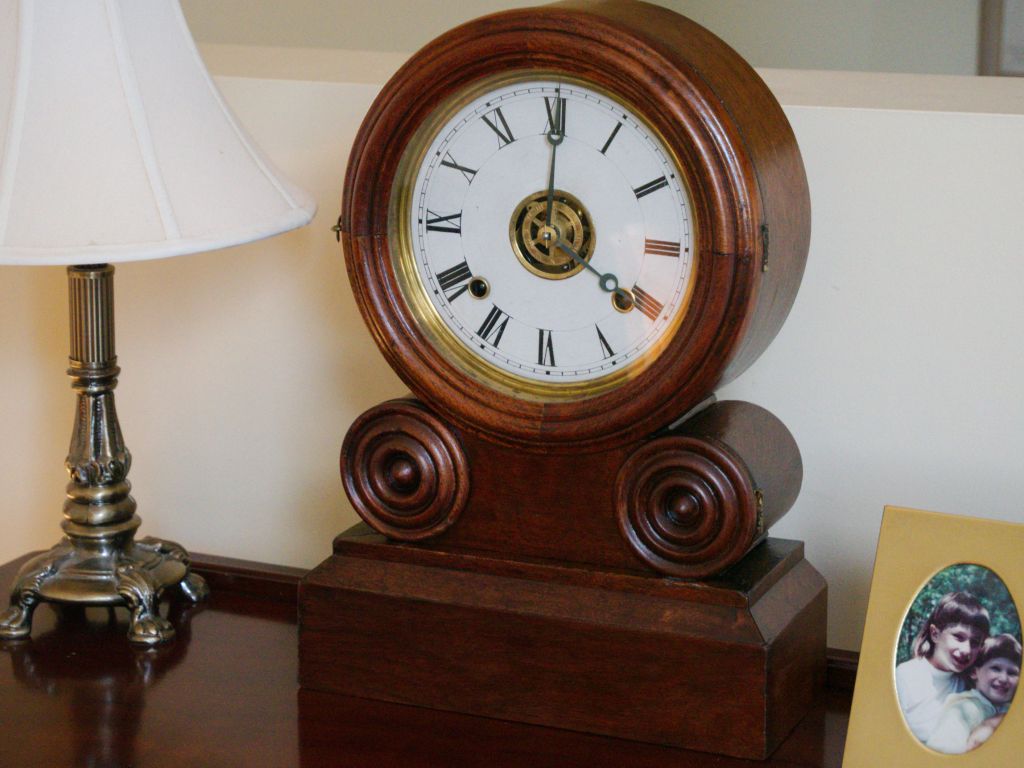
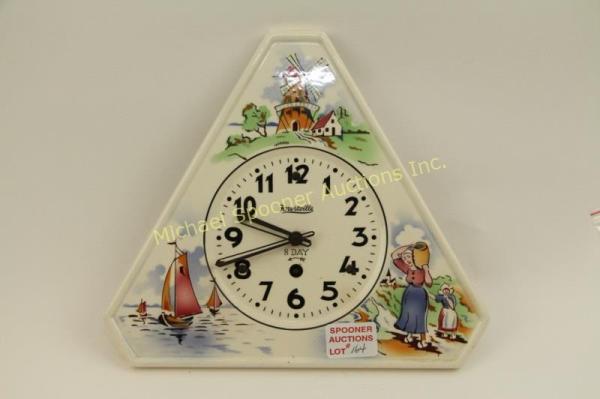
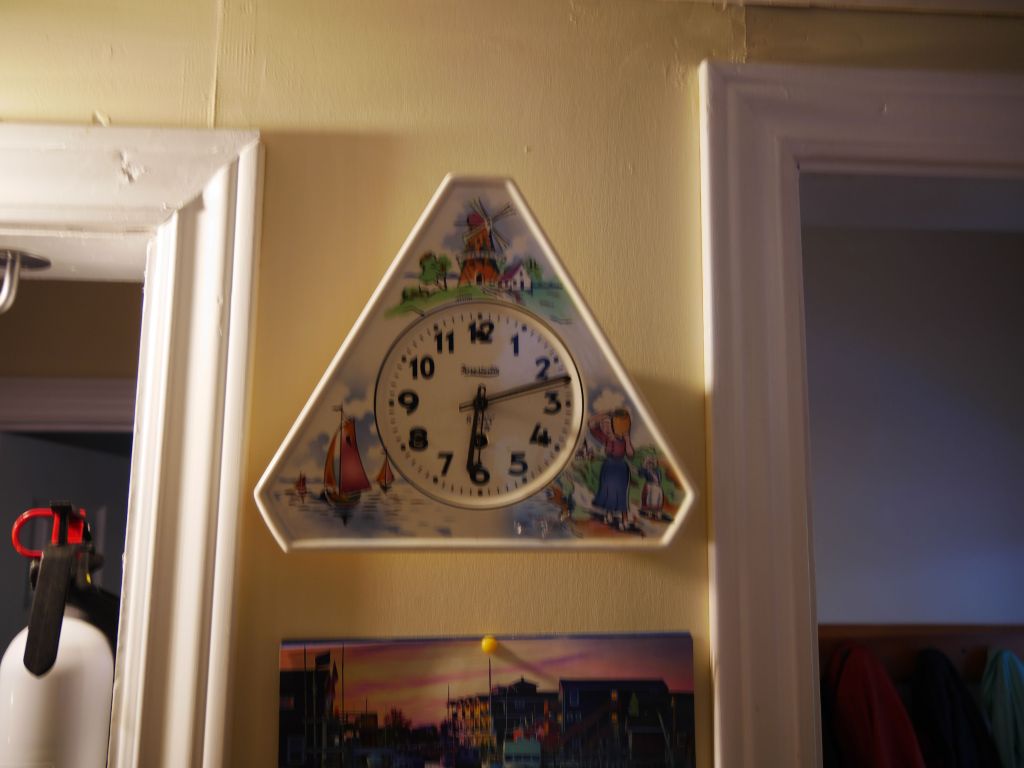
Delft Clock from Forestville

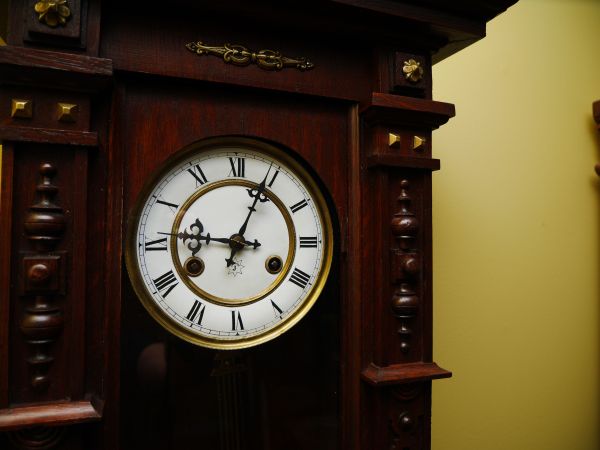
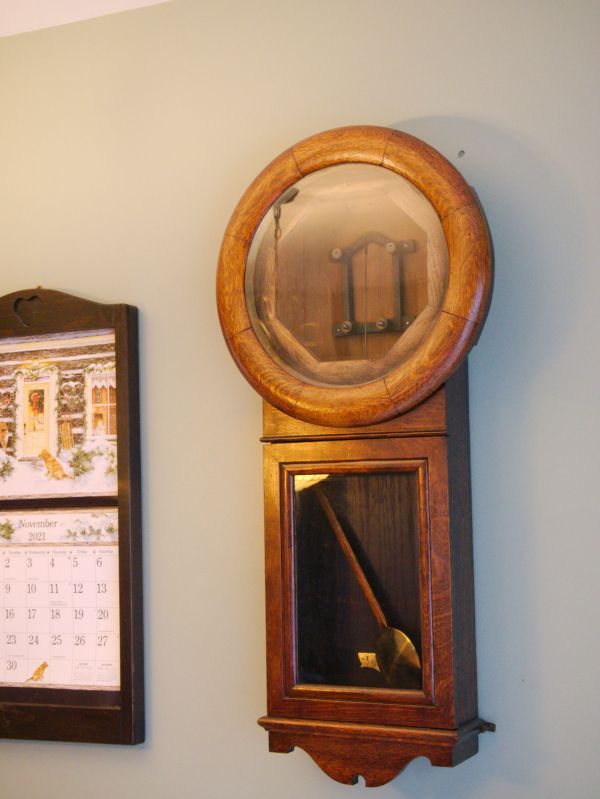
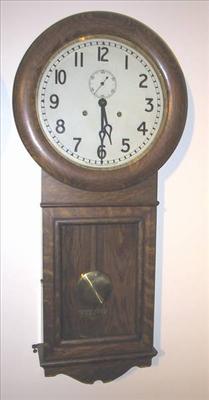
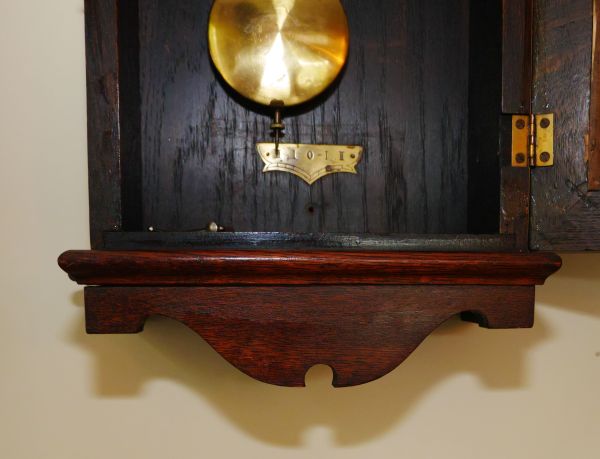
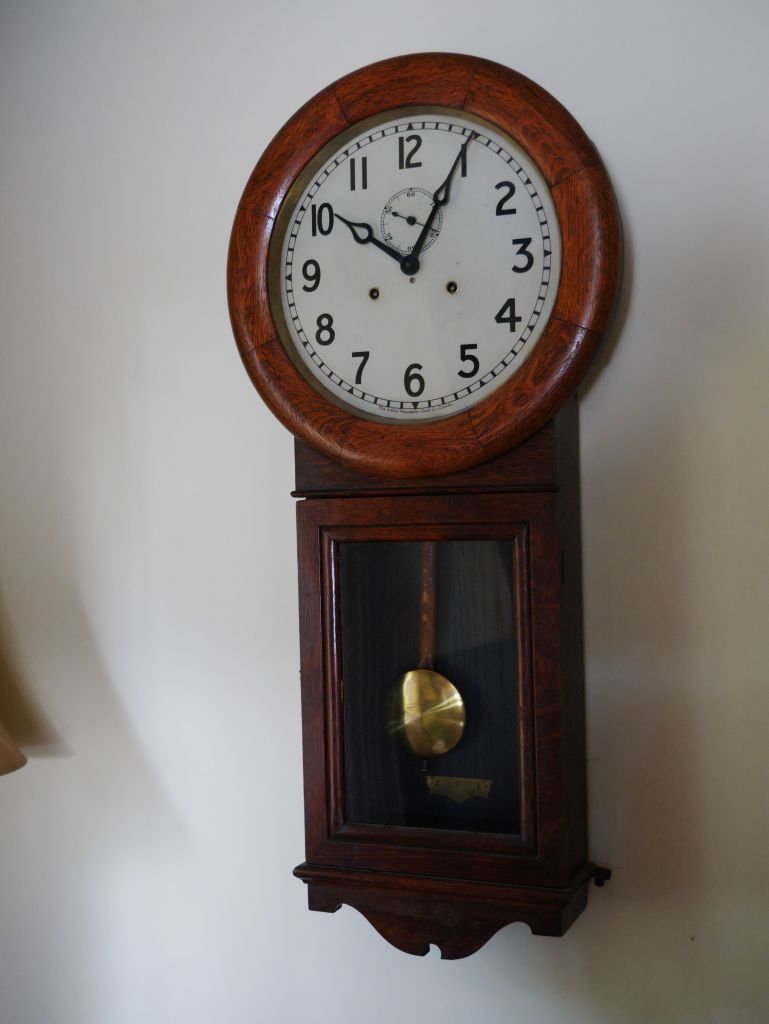
This clock was bought at auction in Ottawa, Ontario, and hung on the wall of the kitchen at our cottage in Quebec for 4 years. The clock was imported from Germany and sold by the Forestville Clock Co. of Toronto, Canada.

It was never a great timekeeper probably because it had never been properly cleaned. I brought it home to Nova Scotia to give it the attention in now deserves.

The word Delft is not a model name but refers to the design and composition of the dial face and surround. According to one source, Delft is “tin-glazed Dutch earthenware with blue and white or polychrome decoration”. Delft also refers to a place in the Netherlands, famous for the manufacture of pottery.

Delft clocks typically had a nondescript Dutch scene as one would expect but since this is not a delft clock by strict definition, it is, instead produced in a German factory (made in Germany stamped on the back) in the Delft style.

Mother and child

Many of these clocks were produced and were quite popular as kitchen clocks in Canada in the 1950s and 1960s perhaps a salute to Canada’s close association with Holland during the war years. There is a number stamped on the back (1054) which may refer to its year of make, 1954.

This clock is only required to run two months a year so, I am not concerned about future wear but a cleaning now will keep the clock running for several more years

Although this clock is from the Forestville Clock Co. other manufacturers produced similar styles. Most if not all of the movements are German-made and called, appropriately enough, “plate clock” movements.

A common Dutch scene

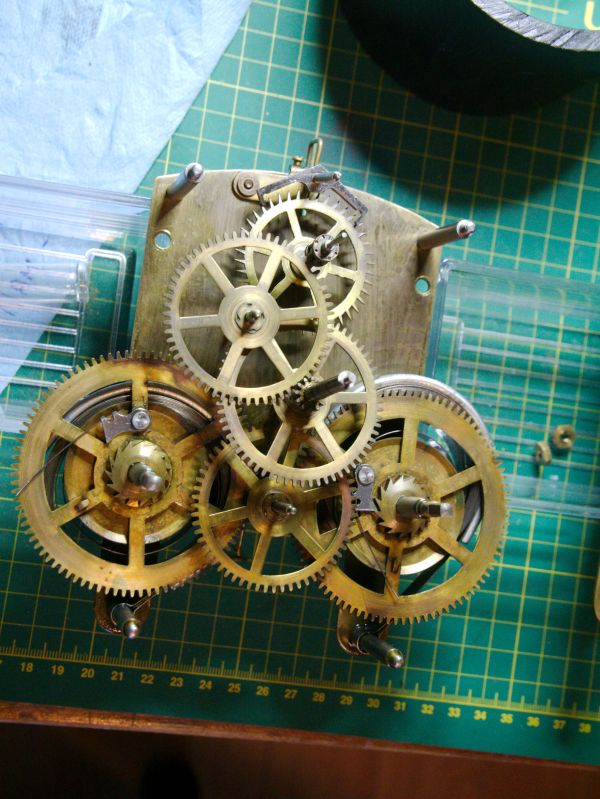
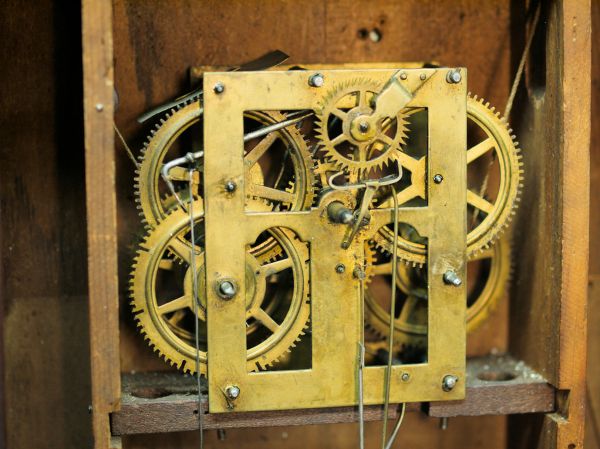
It is a small and simple time-only movement with a hairspring balance similar to what might be found on an alarm clock movement.

With tin dust cover removed

Some Delft clocks are pendulum driven and must be level on the wall to operate correctly whereas a hairspring escapement is more tolerant of placement.
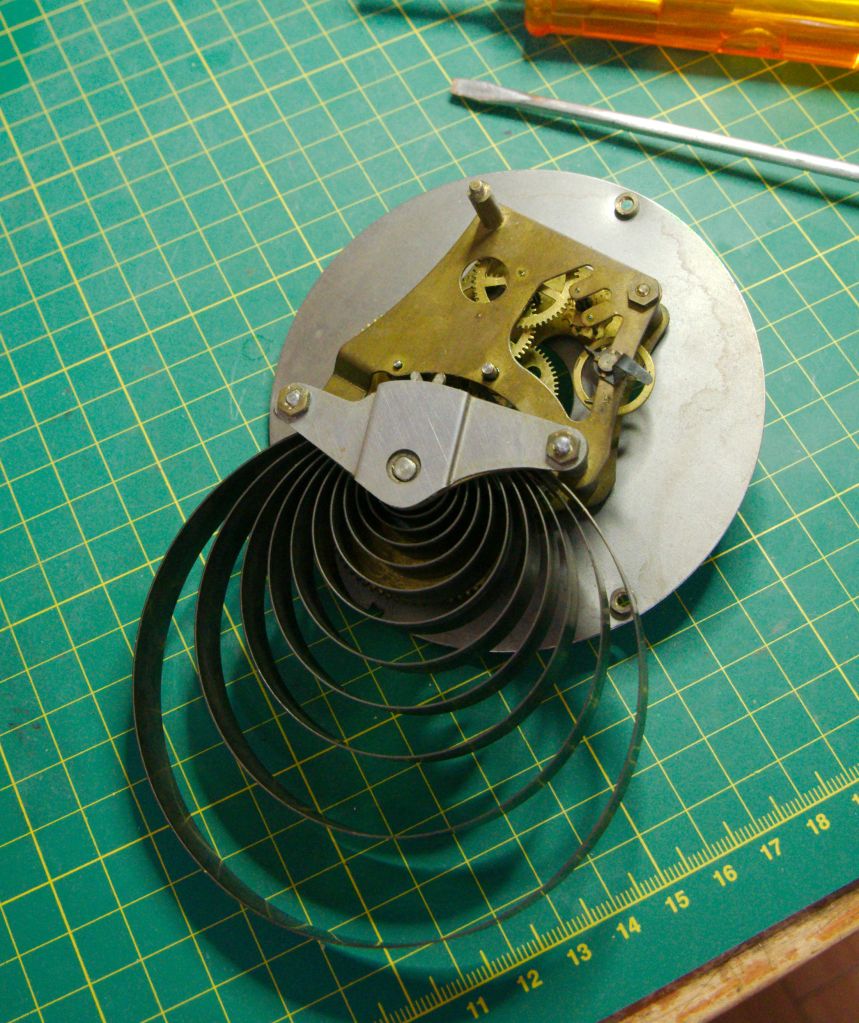
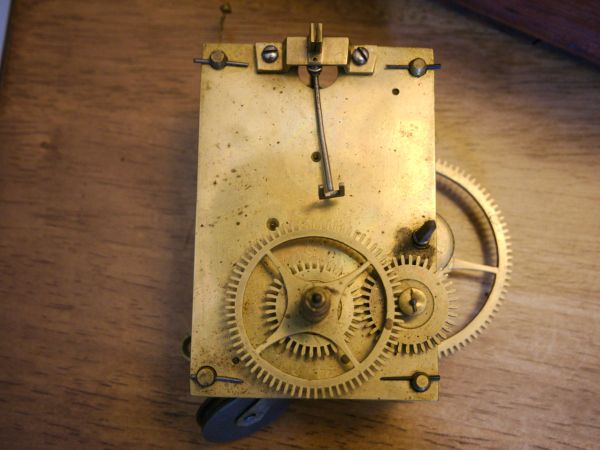
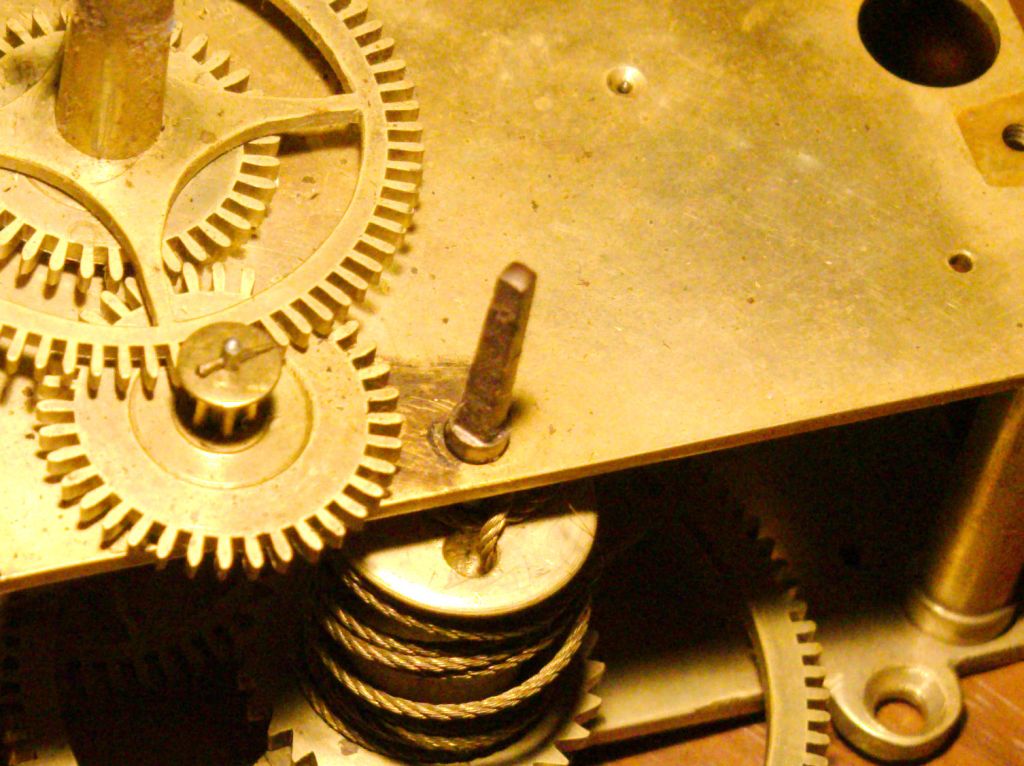
Movement removed showing the mainspring

The mainspring may appear tiny by mechanical clock standards but it is as powerful as it needs to be in a movement this small and designed to run for 8 days.

Disassembly and cleaning

The front plate is affixed to a tin plate and the two cannot be separated unless the rivets are broken. This is a serious issue if bushing work is required on the front plate. To expose the bushing holes one must break the rivets with no guarantee that the tin plate and movement plate would be successfully pressed back together again.

There is some wear in the pivot holes but not enough to warrant concern at this point in time. There is also some pivot hole wear in the back plate but, again, not enough to require bushing work.
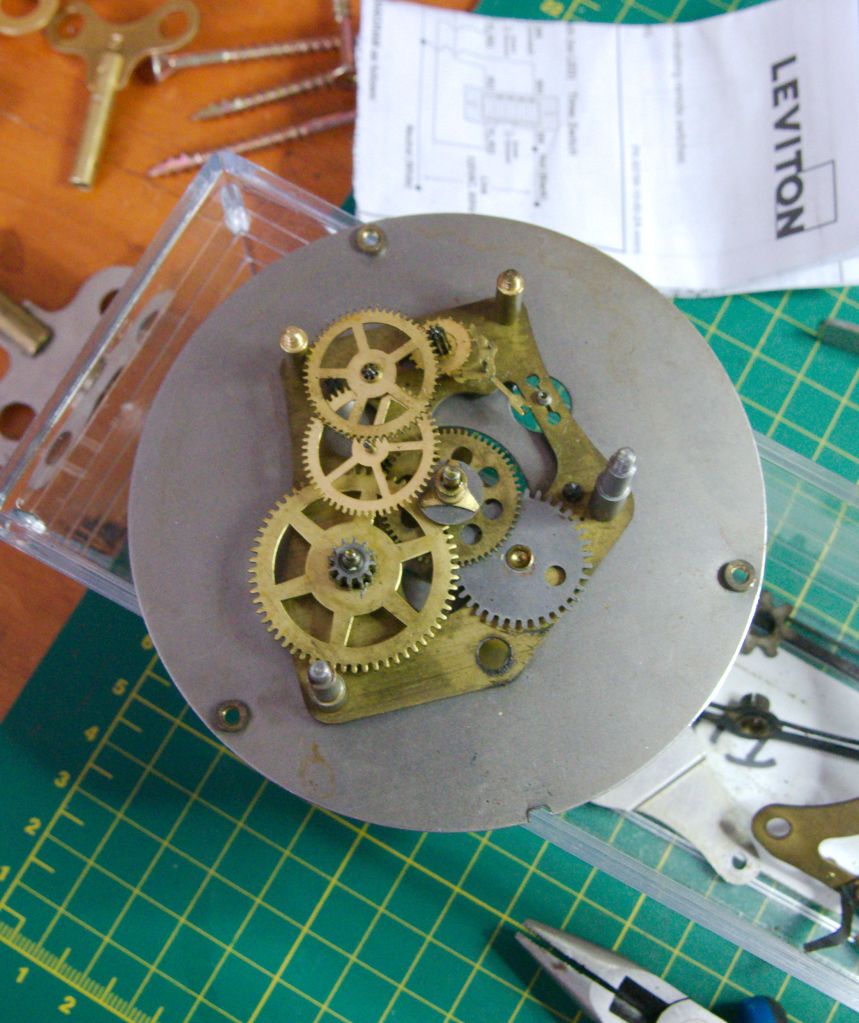
Back plate and mainspring removed

At some future point bushing work will have to be done and that would be a challenge for two reasons. One, the back-plate is difficult to access (as described above) and two, any bushings installed would be very tiny. I don’t have anything that small and they would have to be hand made. The designers may not have had servicing in mind when they made the clock and sadly, we are witnessing the beginnings of the throw-away generation.

All the parts, including the mainspring, are cleaned in the ultrasonic, dried thoroughly, inspected and pivots polished. Just a good cleaning and oiling this time around.

Since I decided not to do any bushing work, the movement was put back together. The wheels are installed plus the pallets leaving the escape wheel the last to position. There is an adjustment screw on the bottom plate for the escape wheel which can be Loosened allowing the escape wheel to be installed separately.

On the test stand

Feeding a very minuscule hairspring into its post is always a little tricky and quite often it takes several attempts. Manipulating small clock parts can be frustrating if you are used to working on American clocks with large wheels and pivots.

It is on the test stand and I will run it for about two weeks. If everything is satisfactory the remaining parts will be attached and the clock will be stored until the summer.

This clock is only required to run two months a year so, I am not concerned about future wear but a cleaning now will keep the clock running for several more years.
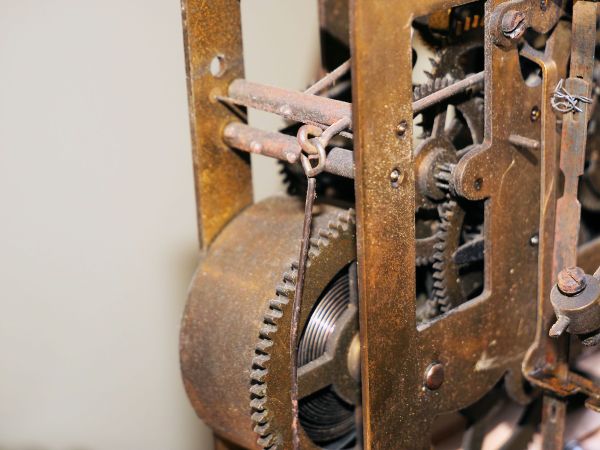
Should mainsprings be routinely replaced on an antique clock when servicing?

A mainspring’s purpose is to provide motive power for the wheels to move in a clock train. All mechanical clocks require a power source and the power source may be by weight or spring. Mechanical clocks that have mainsprings will have one, two, or three winding points which, once wound provide power for a clock’s designed cycle.

Each winding point or arbour is located on the dial face and requires a key (one key fits all arbours) to wind the clock. The mainspring is rated to provide power for a clock’s designed cycle, whether it be 1-day, 8-days, 15-days, and so on.

Sessions mainsprings cleaned and ready to be re-installed in the movement

Mechanical clocks are machines and over time machines wear out. When a clock will not wind up, it is time for a service. The service can be done if you have the skills and equipment otherwise you must depend on a professional clock repairer.

Should mainsprings be replaced during routine servicing?

Though not in the clock repair business I am aware that some repairers routinely replace mainsprings and, of course, the cost is passed on to the customer. Should they be replaced on a routinely or only when necessary?

As a general rule, I do not replace mainsprings when servicing a mechanical clock unless there is something fundamentally wrong with the spring(s). Obviously, there are situations where a mainspring must be replaced when it has failed in some catastrophic manner.

Broken mainspring for barrel
Broken mainspring which is not saveable

There may be occasions when there is too much surface rust or stress cracks on the mainsprings which will make them susceptible to failure and/or seizing and the prudent course of action is to replace them.

Ansonia time-only movement – Too rusted to save?

However, repairers reason that new mainspring(s) will extend the period between servicing and provide additional insurance for the repairer so that if the clock stops soon after servicing, issues other than the mainsprings are suspect.

Mainspring servicing

New quality mainsprings (American or German) also provide more power than the springs they replace and more power means they will continue to provide sufficient power for the clock through its rated cycle even if very worn.

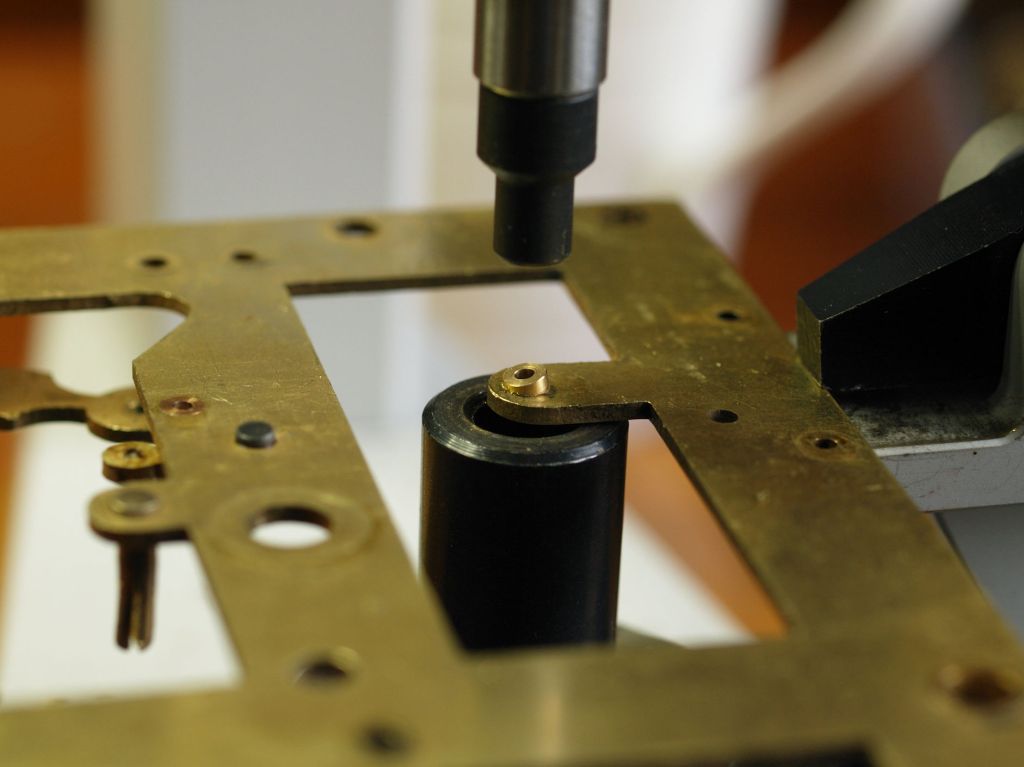
Installing or punching a bushing
Addressing wear by punching in a new bushing

The original mainsprings are often of better quality than a new spring. They may not have as much power as a new mainspring but many clocks, despite the fact that they are over 100 years old have springs that have more than sufficient power.

Once the movement is thoroughly cleaned, the pivots are polished and pivot wear is addressed there is less friction on the moving parts and therefore less power is required to drive the movement through it rated cycle.

Mainspring that is not salvageable

What if there are minor issues with the mainspring?

There are certain situations where a broken mainspring may be salvaged if the break is at the hook or loop end but not if it is broken in the middle. The mainspring can be shortened by two or three inches and after the repair, the spring will continue to provide sufficient power for the clock to run through its cycle.

What to do if your clock requires servicing by a professional

Should you bring your clock in to be professionally serviced ask plenty of questions. If it is recommended that the mainsprings be replaced, ask why, specifically. Once you receive a satisfactory explanation proceed with the repair.

New mainsprings, when the cost is upwards of $25 for each mainspring, will add substantially to the repair cost, something to be considered if the clock has little value. Of course, if it is to be repaired for sentimental reasons the cost is immaterial.

Mainsprings need not be replaced simply because they are old and “tired” and it does not require a lot of power to run a mechanical clock if serviced correctly.

Your choice!

Tick Talk Tuesday #37 – Gustav Becker clock

Tick-Talk Tuesday

Tick-Talk Tuesday is about the letters and comments I have received from readers concerning clock issues, challenges faced, a clock you would profiled or advice on your particular clock concern. For those comments and questions that stump even me, I consult within my clock circles for the best possible answer

J writes:

Thank you for your interesting and knowledgeable articles. Funnily enough I purchased a Gustav Becker wall clock when I lived in Halifax before moving to Vancouver. As you say they are beautiful clocks –  mine graces my hallway. However, being retired and gradually downsizing, I am faced with selling many of my European clocks, so your advice is very pertinent.

Gustav Becker clock

My reply:

I am way past retirement and still collect clocks. Be that as it may we all  have to let go of things at some point in our lives.

You have essentially four options.

You can gift your clocks. I have probably gifted a dozen clocks over the past couple of years to friends, family and acquaintances. If I gift one to a family member, visit them and see the clock on display it warms my heart even if the clock is not running.

You can sell your clocks. It’s free (generally) but takes a bit of effort to photograph a clock and craft some sort of description. Facebook Marketplace and Kijiji are great for selling clocks but do your research, have a price in mind because you are going to get a lot of low-ballers.

You can consign. If you know somebody in the antique business you can sell through them. They do the work selling the clock and would, of course, require a commission.

Pack them up and store them in a safe and dry place. Perhaps someone in the future may appreciate and enjoy an antique clock.

I would keep the Gustav Becker although I would probably do something about the missing bottom finials.

Hope this helps.

J writes back;

Many thanks for your kind input! Very kind of you

How does a mechanical clock work?

A mechanical clock is more than just a sum of its parts; it is a remarkable machine designed to measure, verify, keep, and indicate time. These devices allow us to measure intervals shorter than the natural units of the day, the lunar month, or the year.

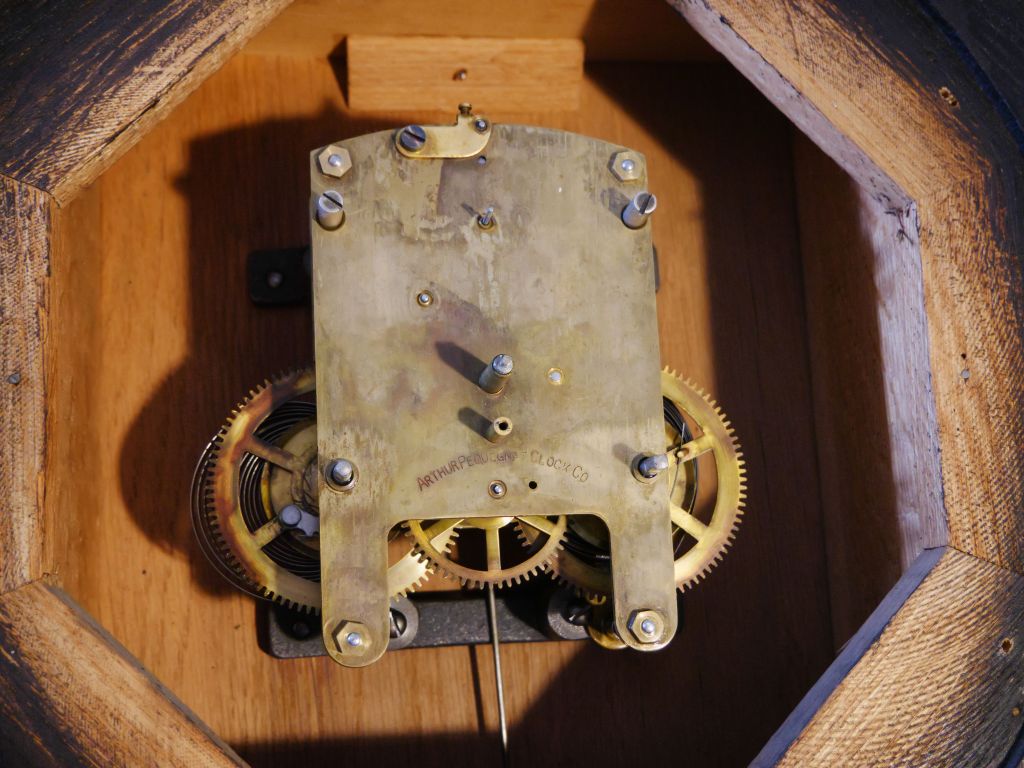
Pequegnat double spring time-only movement

How many machines can you name that run almost as well as they did the day they were built over 100 years ago and still operate exactly as designed? Not many! This enduring functionality is a testament to the ingenuity and vision of their inventors. Mechanical clocks are truly a marvel of engineering!

Clock mainsprings, one for the time side and one for the strike side

A True Story

Let me begin with a sad but true story. A few years ago, a friend of my son was visiting our home. He showed an interest in my clock collection, and I was more than happy to answer his questions.

At one point, he asked me how a clock worked. I picked up an American time-and-strike spring-driven movement and explained how the spring provides power, how the wheels transmit energy, and how that energy is released to keep time. He took the movement in his hands, examined it closely, and then, with a puzzled expression, asked, “Where do the batteries go?”

How A Clock Works

But how does this centuries-old invention actually work? Let’s take a closer look at the fascinating inner workings of mechanical clocks and discover how they keep time with such precision and elegance.

Photo by Brett Jordan on Pexels.com

Let’s keep it simple by focusing on the Five elements that are required. They are Power, Gears, Escapement, Regulator, and Indicator. Let’s discuss each one.

Power

Double spring time-only movement with top plate removed revealing the gears

The power is in your hands. The energy from you is transferred to the mechanical clock when winding it. As you insert the key into a winding point, energy is converted from your hand to the spring or weight.

The spring when fully wound or the weight pulled to its highest point provides the motive power or releases energy through the gears and allows the clock to run for a fixed period of time. Without a source of power, a mechanical clock will not run and a mechanical clock will stop when power is spent.

Gears or Wheels

Gears are also called wheels. The wheels have teeth. Each gear or wheel meshes or interacts with the next gear by way of pinions.

Energy is transferred to each wheel through what is called the train and in the process, the subsequent wheels turn faster. The time side gear train, for example, through a series of wheels leads to a wheel or gear called the escape wheel which turns much faster than the main wheel with the spring or weight. But the power that is released through the train must be controlled.

Escapement or Controlled Release Mechanism

The escapement is the last wheel in the time train. It is designed to release the power from the mainspring or weight in a controlled manner.

Bushing installed on escape wheel arbour
Escape wheel and verge

This is the tick and tock you hear when you are close to a mechanical clock. It is the sound of the verge catching and releasing the teeth of the escape wheel. The tick and tocks transmit an impulse to the pendulum to keep it swinging.

Similarly, the mainspring releases the energy through the gears or wheels on the strike side of a clock by means of a series of levers and pins.

The Regulator

Bracket clock
Bracket clock showing pendulum leader and bob

A regulator controls the speed of the clock. An example of a regulator is a pendulum. Generally speaking, a pendulum with a longer rod will oscillate more slowly than one with a shorter rod.

Regulating or adjusting the length of a pendulum will speed or slow down a clock. On the same clock, lengthening the pendulum slows the clock, and shortening the pendulum makes the clock go faster.

Clocks without a pendulum have lever escapements, floating balances, and balance wheels that rely on a coiled spring and are regulated by means of an adjustment dial or lever on the escapement arbour.

Vienna Regulator clock face
Clock face showing the hour and minute hand

Indicator

The indicator is the hands on the dial face. Regardless of the size of the dial, the style of the hands, how numbers are displayed, they all do one thing, tell the time.

The indicator also points to the sound a clock makes at a certain part in the hour whether it is quarterly, the half-hour, or the hour on a bell(s) or chime rod(s).

Synergy

The five elements come together to create synergy—a harmonious interaction of parts that produces a result greater than the sum of their individual contributions. This controlled harnessing of energy is ingeniously designed to make the machine perform one task: tell the time.

I think my son’s friend still wondered where the batteries go.

Traditional shellac may provide the ideal finish for your antique clock

Traditional shellac may provide the ideal finish you are looking for when deciding whether or not to finish that newly acquired antique clock.

A modern polyurethane finish is not a substitute for traditional shellac. Polyurethane is tough and easy to work with but not reversible. Unfortunately, many people resort to using modern finishes on antique and vintage clocks because they are easily available, simple to apply, and cost-effective. However, in order to preserve the authenticity of a clock when the finish must be addressed, traditional methods are the best course of action.

Modern vintage clocks will often have a lacquer finish but for much older clocks shellac is the finish that would have been used at the time it was made. It is the best finish for most antique clocks. Shellac has been around for ages, began to be used extensively in the early 19th century, and remains a preferred wood finish to this day.

What is traditional shellac and how is it made?

What is it, exactly? Shellac is a resin secreted by the female lac bug on trees in the forests of India and Thailand. It is processed and sold as dry flakes and dissolved in alcohol to make liquid shellac, which is used as a wood finish.

Shellac flakes

Traditional shellac is preferred over canned shellac. Canned Shellac does not produce the same results and has a limited shelf life. Traditional shellac also has a limited shelf life but you need only prepare a little at a time. If you have no access to shellac flakes, check the expiry date on the liquid shellac can before using it.

Instructions for making shellac

Advantages

Shellac is non-toxic with no fumes, and it’s safe for surfaces children and pets will be exposed to. It is easy to work with because it dries very quickly and can be applied by spraying or brushing. Intervals between coats can be a little as 15 minutes or less depending on the cut. Shellac also provides a hard finish and doesn’t yellow like varnish. If you must make repairs on shellac, you can simply apply a new topcoat of shellac over the old finish to get rid of scratches or blemishes. It comes in a variety of colors and can be stripped off wood surfaces with alcohol. Shellac does start to deteriorate after it sits in the alcohol mixture for a period of time.

Disadvantages

Heat softens the shellac, so it is best if you avoid putting anything hot on or near the surface. If someone sets a glass down, the condensation may leave a white ring especially if the finish has a higher wax content. Having said that I don’t think many would put anything hot on a clock case although it is best to avoid heat sources, radiators, space heaters, etc.

Preparation and application

I use a 1 lb cut which is an 8 to 1 mixture, that is, 1 oz of flakes to 8 oz of denatured alcohol or commercially sold Shellac/Lacquer thinner. The instructions on the photo above describe the different cuts. The shellac dries very quickly and many coats can be applied in a relatively short period of time. I generally allow about an hour between coats, again depending on the cut.

Shellac comes in a number of shades but amber shellac, which I prefer, employs a warm glow to the finish. I will use either a broad artist’s brush or a French polish to apply the shellac. Each has its advantages. A ball fashioned out of terry cloth is the most effective method of applying shellac. French polishing consists of building up layers of shellac. Moisten the pad in shellac, wipe off the excess and apply in long strokes. A brush, on the other hand, is better when getting into tight spaces and wood cases with a lot of detail. Either way results in a glossy surface, with a deep colour.

Shellac thinner from Lee Valley

400 grit sandpaper is used for rougher sections prior to the first application of shellac. A damp cloth is then used to clean off the residue from sanding. Allow drying. After the first and subsequent application of shellac, 0000 steel wool is all that is required to rub out any imperfections.  Repeat the process two times and allow for drying time between coats.

Three coats are more than enough. More coats will produce a darker finish if that is your objective. If the finished result is too glossy and unnatural, dull it down with 0000 steel wool until you have the effect you want. However, there may be some situations where one coat is sufficient.

How long does it last?

Shellac in its liquid form has a limited shelf life of about 6 months much like canned shellac. In flake form, and stored properly in a cool dark place, shellac has a shelf life of about 3 to 5 years. I store leftover liquid shellac in a sealed glass container. I would advise against a metal container as the alcohol will react to the metal.

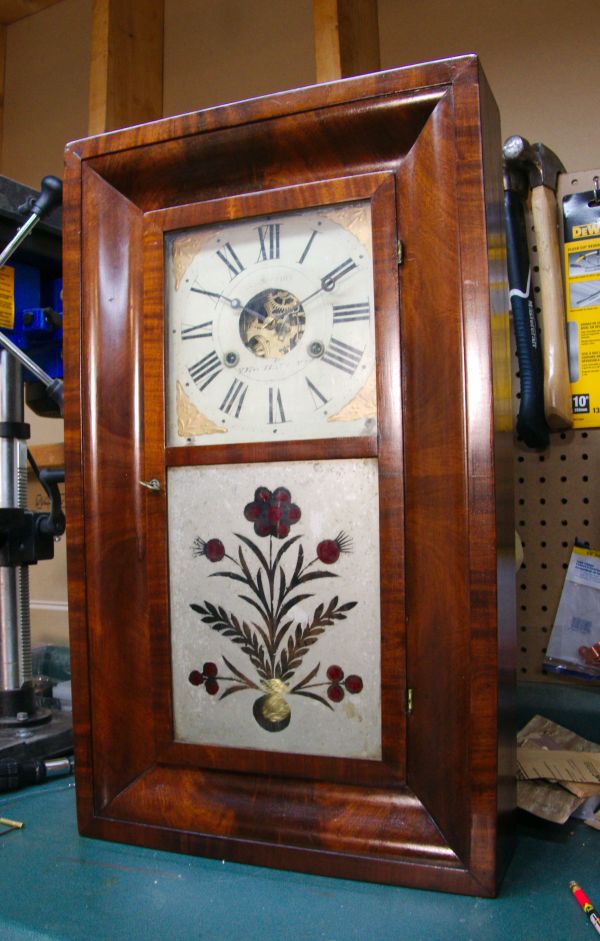
Let’s use my ogee clock as an example

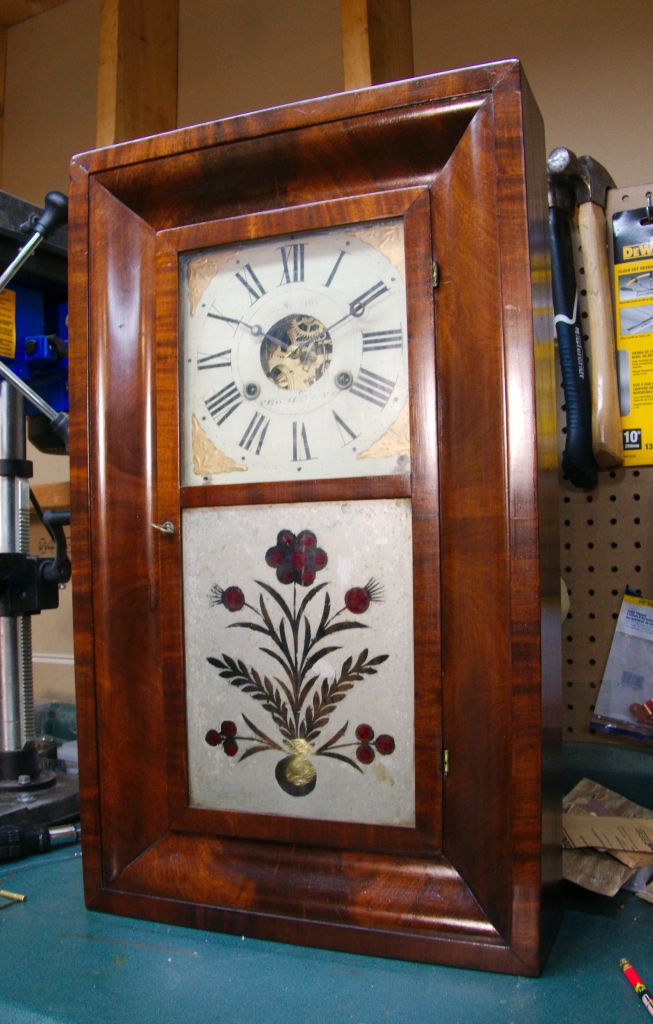
This ogee clock is a fairly recent acquisition. The veneer is in remarkably good shape although the finish was dirty, dull, and lifeless. Many 150+-year-old clocks have missing veneer usually on four corners of the case and the door frame as a result of years of wear and tear but this clock is a rare exception. Veneer repairs must be completed before the finish coat is applied.

Ogee clock as found

Once the movement is out of the case I lay the case on its back to begin the process of cleaning.

After cleaning the case and one application of shellac

Murphy’s Soap is an excellent cleaner. Some may react to Murphy’s soap and a suitable alternative is Dawn or similar dish detergent. I use a light coloured cloth so that I can visualize how much dirt is being removed. Quite often the old shellac finish has worn off but if there is old shellac left there is a good chance it will be removed during the cleaning process. This is unavoidable particularly if the objective is deep cleaning.

Following the cleaning, 400 grit sandpaper is used for rougher sections. Clean off any residue with a damp cloth and wait for the finish to dry. Sandpaper is optional as I find it unnecessary in some situations.

Shellac is applied to the clock case while on its back using long broad strokes from an artist’s brush or a French polish pad. To avoid an overly glossy finish and maintain the light tone of the case one coat is all that is required as in the case of this ogee. Finally, 0000 steel wool is used to lightly “sand” out any imperfections.

To complete the effect Minwax Finishing Paste Wax is applied. It is a quality furniture paste wax that will protect the finish.

Dating a Hamburg Amerikanische Uhrenfabrik (HAU) shelf clock

During the Christmas season, we split our time between Calgary, Alberta, and Ottawa, Ontario to see our 2 daughters. While in Calgary my wife spotted an interesting item on an Ottawa Facebook Marketplace, an English time and strike clock.

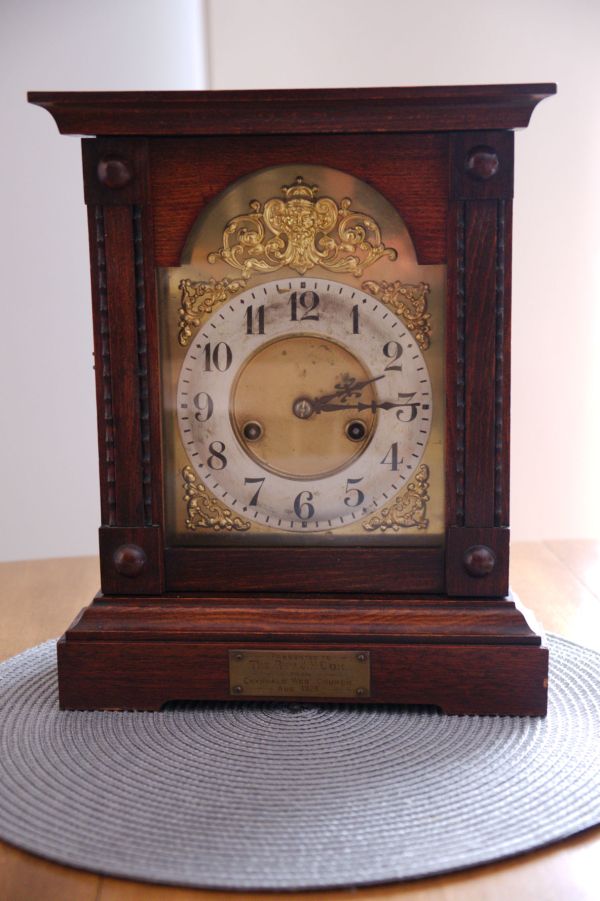
HAU shelf clock

She showed me the photo and I said, “that does not look like any English clock I am familiar with. The style is definitely German”. There is a commemorative plaque on the front base section which references an English church so, I am assuming the seller thought it was English.

When we picked it up from his home outside Ottawa I was surprised to learn that the seller is a clock collector and had no idea the clock he was selling was German. Occasionally I sell clocks to manage my collection and when advertising one for sale I make it a point to know the maker.

But, no matter, it was in very good condition and in working order.

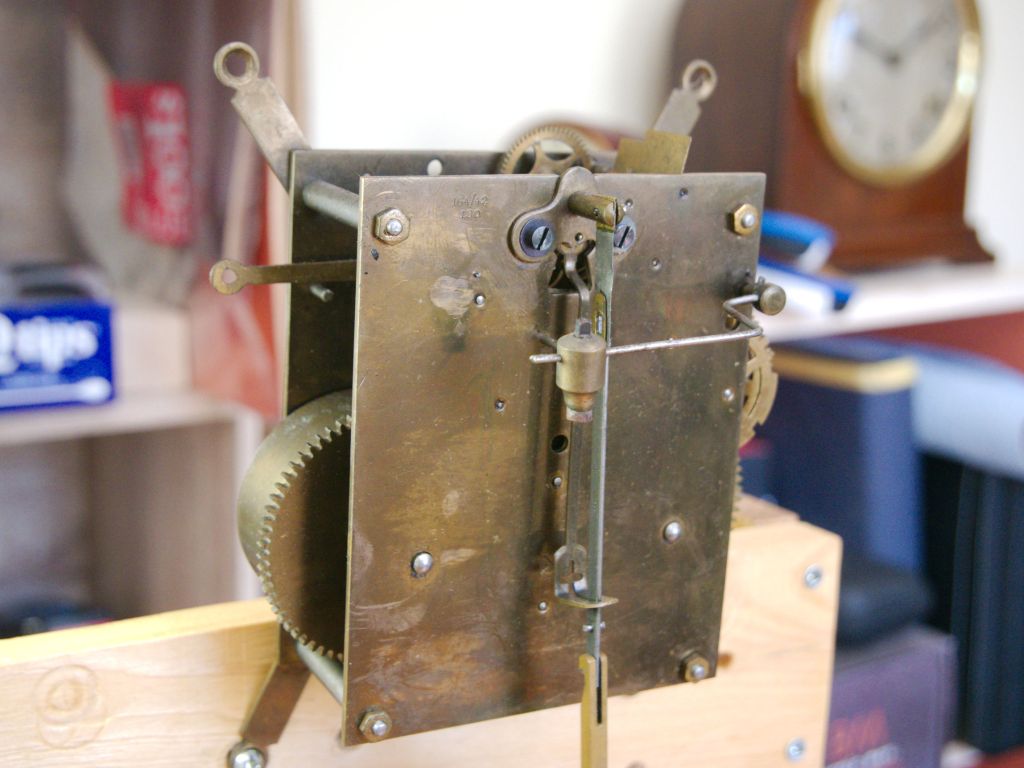
The movement showing the single strike rod and pendulum bob

The maker is HAU or HAC. The familiar cross arrows trademark of the maker is stamped on the movement, in the middle of the backplate.

HAC was formed in Germany in 1873 by Paul Landenberger and Phillipp Lang and was originally called Landenberger & Lang Uhrenfabrik. The company changed its name to Hamburg Amerikanische Uhrenfabrik (HAU)/Hamburg American Clock Company (HAC) in 1883. The famous crossed-arrows

Crossed arrows trademark

became their trademark in 1892. In 1926 the company went into a cooperative with Junghans and in 1930 they finally merged with Junghans.

The date on the plaque says 1926. However, HAC/HAU clocks are difficult to date prior to Junghans acquisition of HAC/HAU in 1930. Once Junghans and HAC began their collaboration in 1926 some of the movements were date coded.

Plaques are a good but not foolproof method of dating a clock. A clock purchased as a gift in 1926 could very well have been sitting on the retailer’s shelf for two or more years.

Catalogs are another good but hardly foolproof method of dating a clock. A catalog confirms that a model was made in a particular year, but that same model was probably offered 5 years +/- from the year of the catalog.

I will probably not determine a more reliable date for my new clock than circa 1926. The movement, compared to an earlier model (below), also has many cutouts and additional holes that indicate that it was a late production model and confirms that is closer to the 1926 date.

HAC clock movement
Solid plates of an early HAC clock movement CA. 1895

The clock runs for a while and stops. It is in need of a service but I expected to clean it as many of these old clocks have rarely seen the inside of a clockmakers’ shop.

Fleet Time replacement movement needed – calling all clock parts collectors

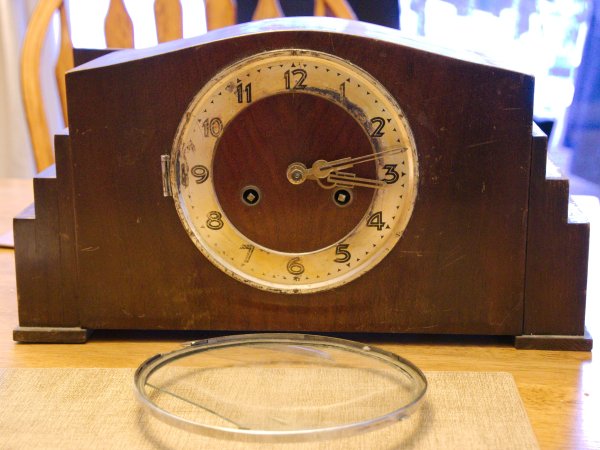
This Fleet Time mantel clock is a generic mantel clock with a walnut finish, flat front, a slightly domed top, and step-side features. Simple but attractive. Fleet assembled clocks sourced from German parts in the Montreal area for 4 years prior to WWII.

While the case looks great after refinishing, I was oh so close to having a fully functioning clock when disaster struck.

This is a call-out for anyone who can sell me or donate a replacement movement or otherwise direct me to where I can locate one. I am in need of a mainspring barrel and second wheel on the time side. As much as possible I would like it to be exactly the style of movement that came with the clock.

Fleet Time case
Fleet Time case, refinished

My clock passion is collecting clocks made or assembled in Canada and I would love to see this clock in working order

Fleet second time wheel
Fleet second wheel, a bent leaf cannot be unbent

Here is my story

The movement looked to be in reasonably good condition but needed a good cleaning.

Fleet time barrel
Fleet time barrel
Fleet time movement
Fleet time movement

The mainsprings can be removed without disassembling the movement, handy for such things as replacing a broken mainspring.

The movement was completely serviced with several new bushings installed. The mainsprings were removed, cleaned, and returned to their barrels.

Through the testing phase, the mainsprings were partially wound. Once I was satisfied that the movement was running well I installed it back into its case. I then wound the strike side fully and then wound the time side. Just as I was feeling resistance, CLUNK, and then the arbour turned freely.

Hoping it was only a broken mainspring I was not prepared for what I discovered when I opened up the movement. There were three broken/bent teeth on the mainspring barrel, a broken mainspring, and a damaged leaf pinion on the second wheel.

Broken mainspring

When a mainspring breaks at the teeth end of the barrel it tries to unwind but the loose end provides sufficient resistance, that is, a slower release of the energy, and is less likely to cause major damage. A broken mainspring results. A break at the winding arbour end or close to it as in this case results in the sudden release of energy and the result is damage not only to the mainspring but clock parts up the train; this is known as collateral damage.

A clock colleague advised me that although the barrel teeth and leaf pinion can be fixed it is usually not cost-effective because the process is so time-consuming. His solution is to collect movements that are used as donors for times such as this.

The plan, at this point, is to source a donor movement and harvest parts for what I hope would result in a successful repair.

So, here I am asking if anyone has a spare movement they can part with.

My clock passion is collecting clocks made or assembled in Canada and I would love to see this clock in working order.

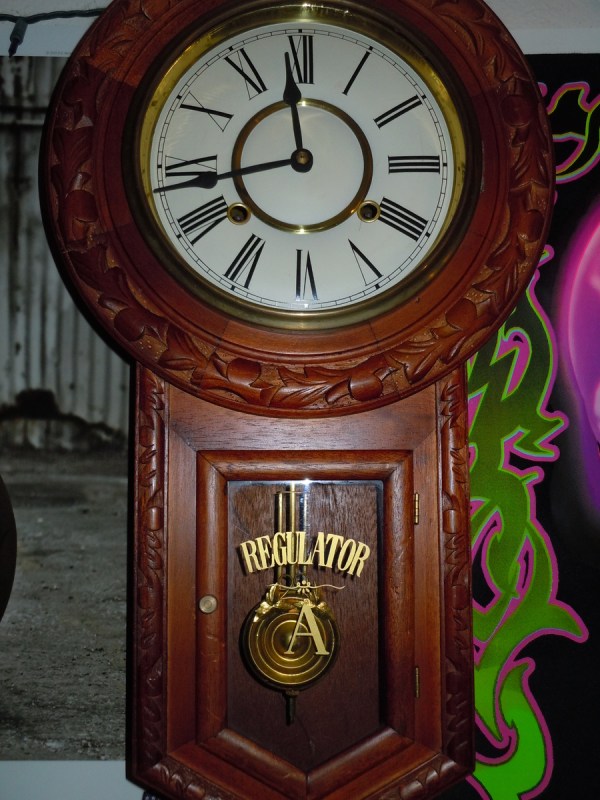
If it says Regulator on your clock it is likely NOT a Regulator?

A century ago, clock manufacturers understood the power of marketing, and the word “Regulator” became a key tool in their strategy to boost sales. By simply labeling a clock with “Regulator,” they could make it appear more precise and desirable, even if it wasn’t a true regulator. But did this marketing gimmick work? Let’s take a closer look.

Seth Thomas #2
Seth Thomas #2, typically used as a railroad time clock

By definition, a regulator clock was, and still is, a clock used as a standard for setting other clocks. Regulators were commonly found in businesses, railroad stations, public buildings, even churches and tower clocks, where townsfolk would adjust their personal clocks based on a clock that was trusted to be accurate. Early regulator clocks played an essential role in keeping communities synchronized in their daily routines.

Take, for example, the Gilbert calendar clock shown below. Advertised as a “Regulator,” it does not fit the true definition. With a spring-driven, time-only movement, it is accurate to within a minute or two per week, which is typical for spring-powered clocks. While the calendar feature is useful and the clock is attractive, it lacks the precision of a true regulator and would not be relied upon for setting other clocks. Still, it had the appearance of an accurate clock.

This Gilbert calendar clock is not a Regulator

Are there exceptions to this rule? As always, there are exceptions. The Welch Spring and Company produced a clock from 1874 to the mid-1880s certified for use in train stations. This double-weight, time-only clock, reminiscent of the well-regarded Seth Thomas Regulator #2, was stenciled with “Regulator” on its access door.

Given its constant weight-driven power and deadbeat escapement, it was likely a very accurate timekeeper and well-suited to any environment where accuracy was critical, such as a train station, business office, or public square.

Double-weight time-only Welch clock – is it a regulator?

This particular Welch clock, now a museum piece at the American Watch and Clock Museum in Bristol, Connecticut, has been meticulously restored. When it was received, the lower tablet was missing, leading to questions about whether it originally came with the word “Regulator” on the access door. The answer is yes, some did, and some didn’t—there was a tick box on the order form for this feature.

So, while the use of “Regulator” on a clock often served as a marketing tactic to imply precision, there are instances where it genuinely signified accuracy. As a general rule, though, it’s safe to assume that many clocks labeled “Regulator” were more about selling an image than offering precise timekeeping.

In the world of clocks, the term “Regulator” was often used as a clever marketing strategy to sell more timepieces by suggesting greater accuracy. While some clocks with this label were indeed precise, many were simply designed to look the part.

As a buyer, it’s important to look beyond the label and evaluate the clock’s true functionality and history before assuming it lives up to its name.

Related Articles

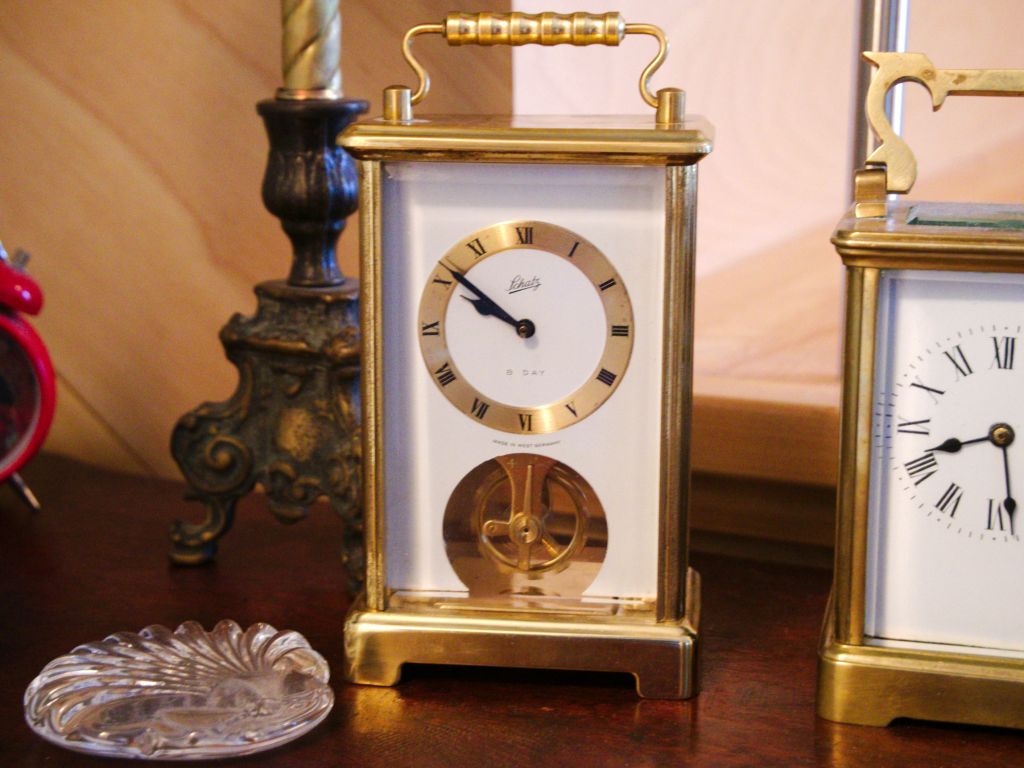
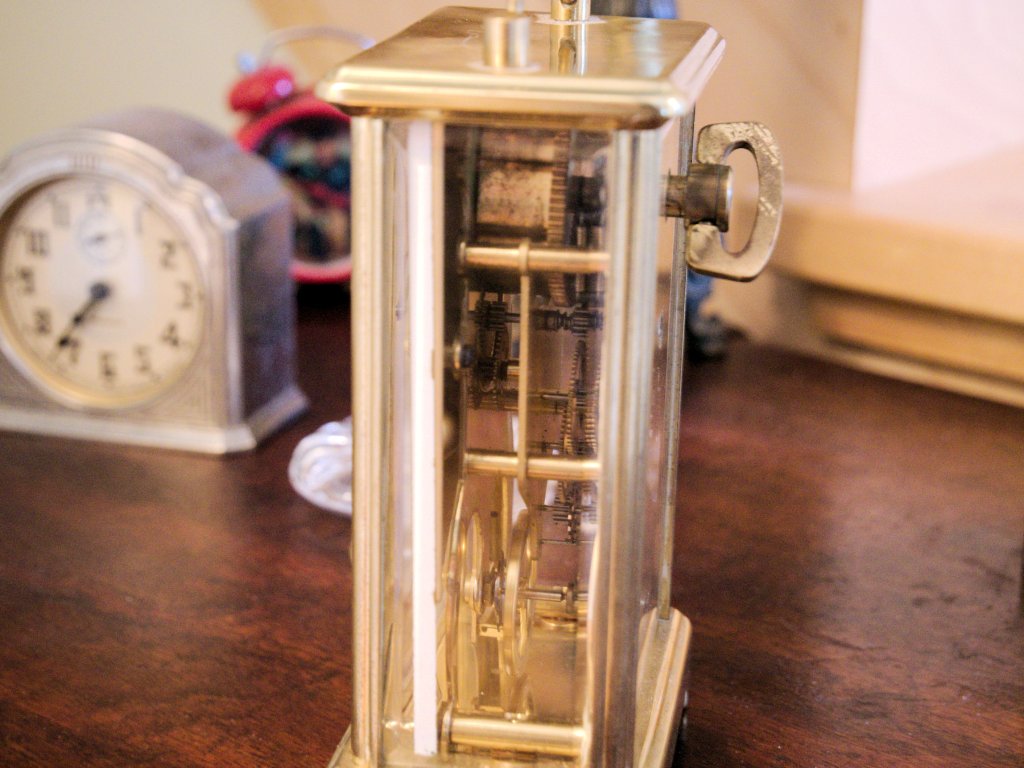
Schatz carriage clock with an interesting visible escapement

My wife found this 8-day Schatz carriage clock while she was browsing for antiques on Facebook marketplace for what we both felt was an attractive price. I had dealt with the seller in the past and he is known for his honesty and selling clocks at a reasonable price. I do not believe his intention is to make a lot of money.

Schatz carriage clock

My wife likes it and when we picked it up we were not disappointed, it has a quality look. It was made in the 1970s and probably many thousands were given as gifts.

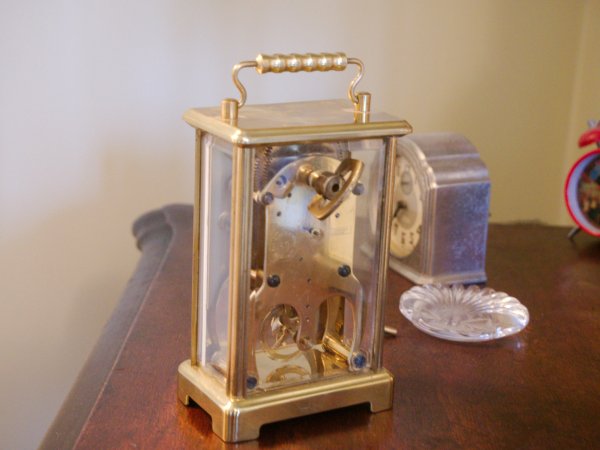
It is lighter than it looks and does not have the heft of a traditional antique carriage clock. The plates are thin, the brass casing is thin, the glass is not very thick although it is beveled and that accounts for the light weight. The winding key protrudes through the back glass panel, another nice touch.

View of the back panel

Schatz was likely looking for a certain price point and it was necessary to keep the costs down. Pretty, but not designed for long life. But after 40 years it is still running, to a point!

Side view

The seller said it runs for about four days and stops. It is not a big deal as far as I’m concerned but I am curious to take it apart to see if there are any issues beyond a good cleaning.

Will antique/vintage clock prices go up or down in 2022?

Will antique and vintage clock prices go up or down in 2022? Is this the time to buy or sell? Read further for my thoughts and observations.

First off, some definitions. According to the United States Government, the term “antique” is reserved for items that are over a century old. Webster’s dictionary defines an antique as a work of art, piece of furniture, or decorative object made at an earlier period and according to various customs laws at least 100 years ago. Wikipedia defines antiques as applying to objects at least 100 years old.

The word “vintage”, according to eBay and other sources, is a defined period that is less than 100 years but more than 30 years. You may find various definitions of vintage for example in the jewellery business vintage may be considered as anything 10 to 20 or more years.

Anyone, who regularly shops for antique or vintage clocks is well aware that the clock market has been depressed for quite some time but is this the time to sell or buy?

Pricing is as volatile as it was a year ago. There is no true “standard” pricing for any vintage or antique clock. As with most objects, there is a price range that most would consider reasonable.

How are clock prices set?

Sellers use a number of metrics to set prices;

  • A price more or less consistent with prices achieved at reputable auction houses and online for sale sites,
  • The condition of the clock, whether it runs or not and if it has been serviced,
  • A seller’s personal experience buying and/or selling online,
  • A seller prices higher than the value leaving room for a downward negotiated price,
  • A seller knows that most clocks are not sold to a serious collector and count on uneducated buyers who think they are worth more than they are.

Factors affecting the sale of clocks

Any object is ultimately worth what someone is willing to pay a higher price for it. High-end and truly rare clocks have managed to retain their value althrugh sales are largely based on market conditions and demand.

But what conditions influence the sale of run-of-the-mill antique and vintage mechanical clocks and those of slightly better quality?

Antique and vintage clocks have flooded the market in the past several years driving prices steadily downwards. The new generation of millennials have little interest in antiques and find it pointless to collect antique and vintage clocks.

Modern homes do not have the room for clocks as floor and wall space is limited. In an age when families are living in 800 square foot apartments space is at a premium though that could change as people migrant from dense cities to smaller communities. And when space is at a premium grandfather clocks and jeweller’s regulator clocks though finely crafted and cost thousands when new are not items many would consider as wants for the modern family home. Sentimental reasons aside, the cost of servicing far exceeds the value if the desire is to have a working clock.

I don’t have a crystal ball but judging from prices in the past few years I can comfortably predict that things will be much the same. I do not expect a significant change in 2022 or beyond. It is a buyer’s market and there are some terrific bargains out there. Knowledge is power and no doubt there are some great clocks to be found but shop carefully and do your homework.

A custom test stand for weight driven ogee style clocks

A few weeks back I published an article on clock testing stands. While a single clock stand would be ideal for all movement testing purposes there are so many different types and styles of movements that one size does not fit all.

The one stand I was missing was for testing weight-driven ogee style clocks whether they be 30-hour or 8-day or select clocks that would require a pulley system for the weights.

Aside from an easy setup and quick mounting of a movement for testing it allows me to inspect the movement from all sides

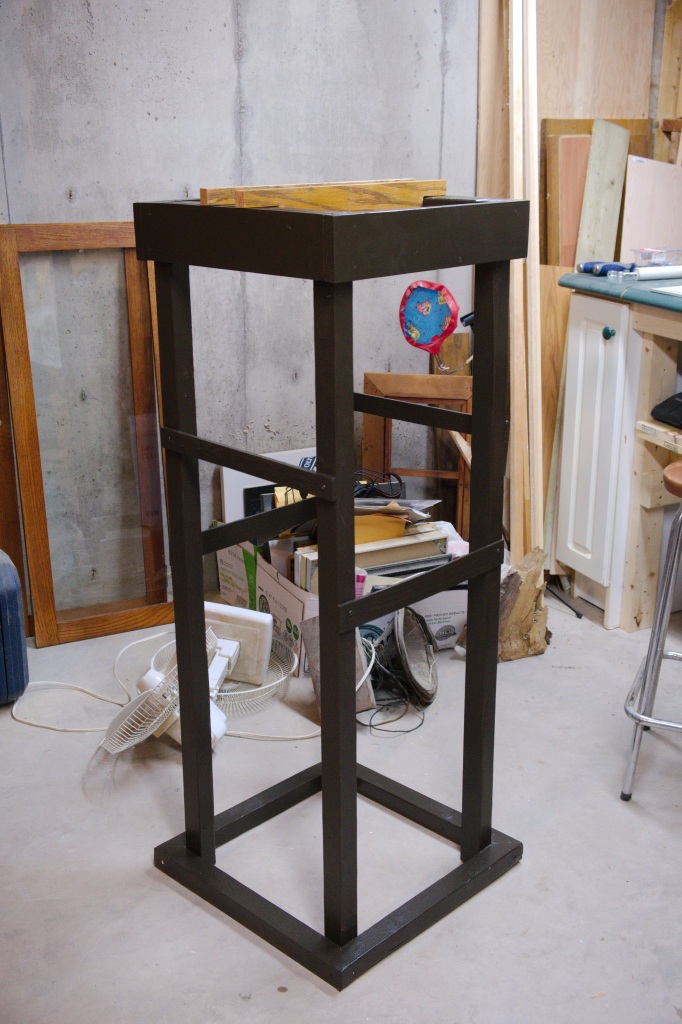
Tall case clock stand

Rather than construct a stand-alone ogee test stand I decided to make it a companion to my tall-case clock stand. Mounting atop the tall-case stand means that it is at the optimum height for making adjustments.

I also wanted something I could easily remove if I needed the long-case stand for testing and it is simple to set up.

Salvaging case parts from an old ogee simplifies the construction of the stand. It can be done without ogee case parts but it means devising a pulley system and making rails with slots for the movement seat board.

The ogee clock was purchased along with three others for $20 but the ogee clock case was in such poor condition it could not be restored.

A movement came with the case which I use for spare parts. The veneer has been harvested and used for other projects. The remaining wood pieces are stored and ready for use in future projects.

The tall-case stand is 48 inches high and will accommodate more than one movement although I generally work on one movement at a time. It is square-shaped and very stable though when used to test grandfather clock movements it is anchored to a wall to eliminate or reduce sympathetic vibration.

The tall-case stand is braced on all sides and the framing around the 4 legs adds additional stability and strength.

Clock stand two rails off
Taking the rails out

The rails, made of yellow oak, a hardwood, chosen for their strength.

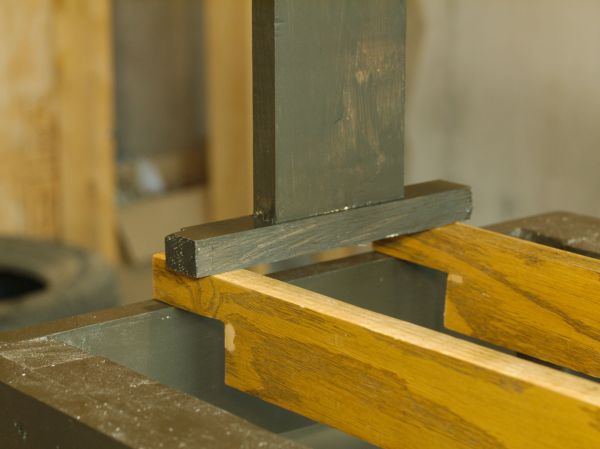
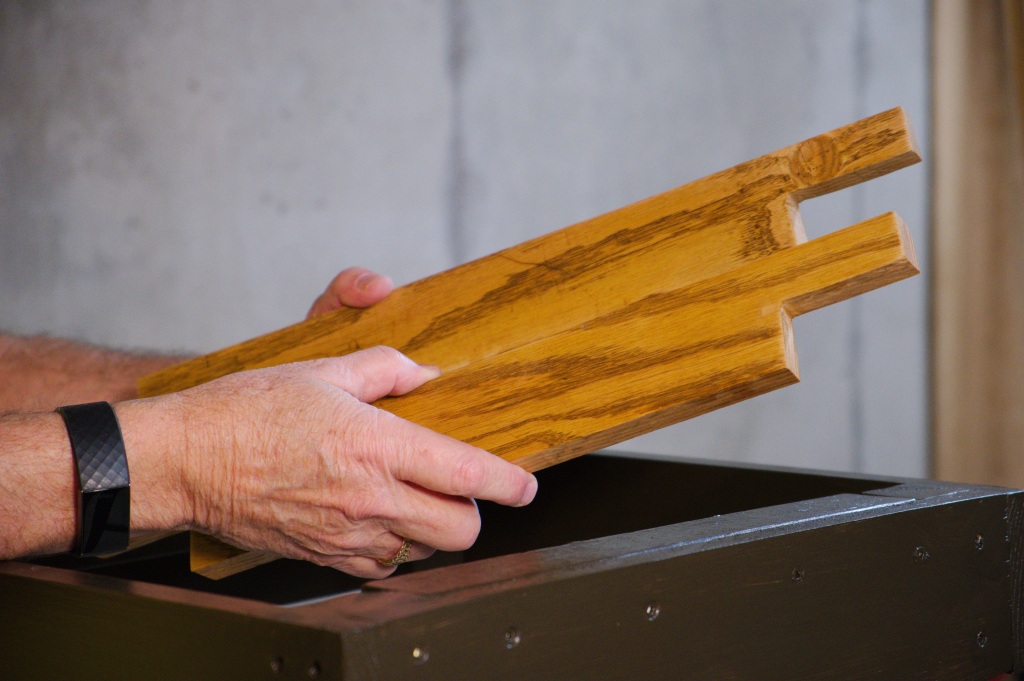
The two pieces I am holding are the oak rails that are designed to fit into the top of the stand and are fully adjustable width-wise depending on the size of the movement.

Close-up of the top

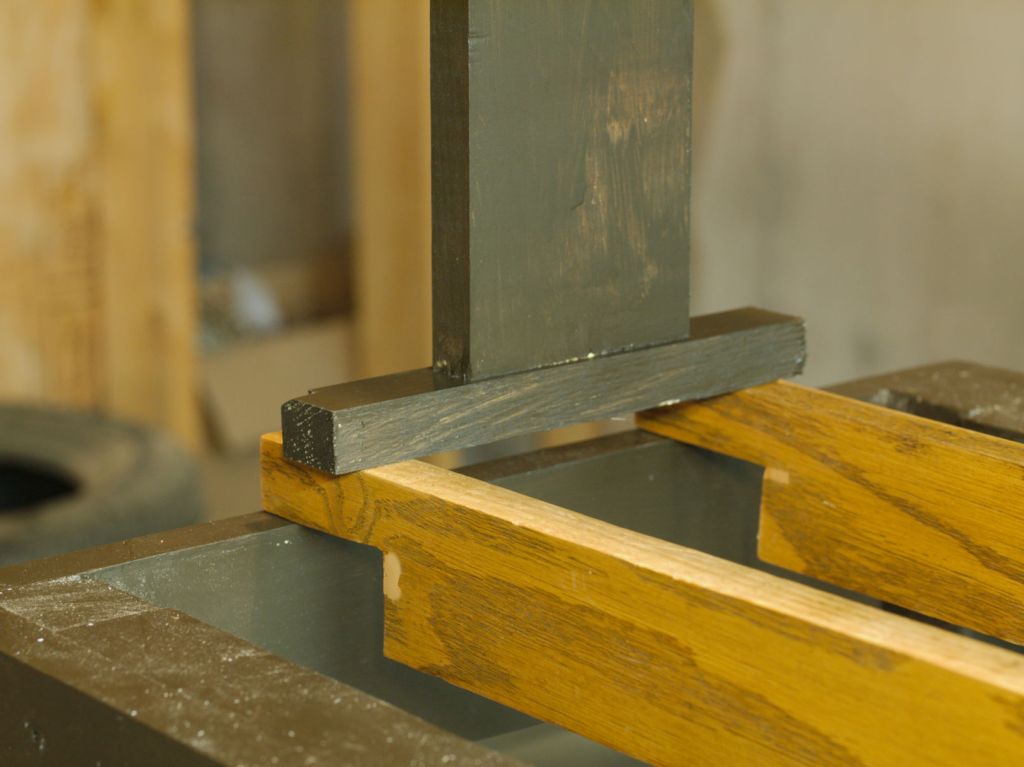
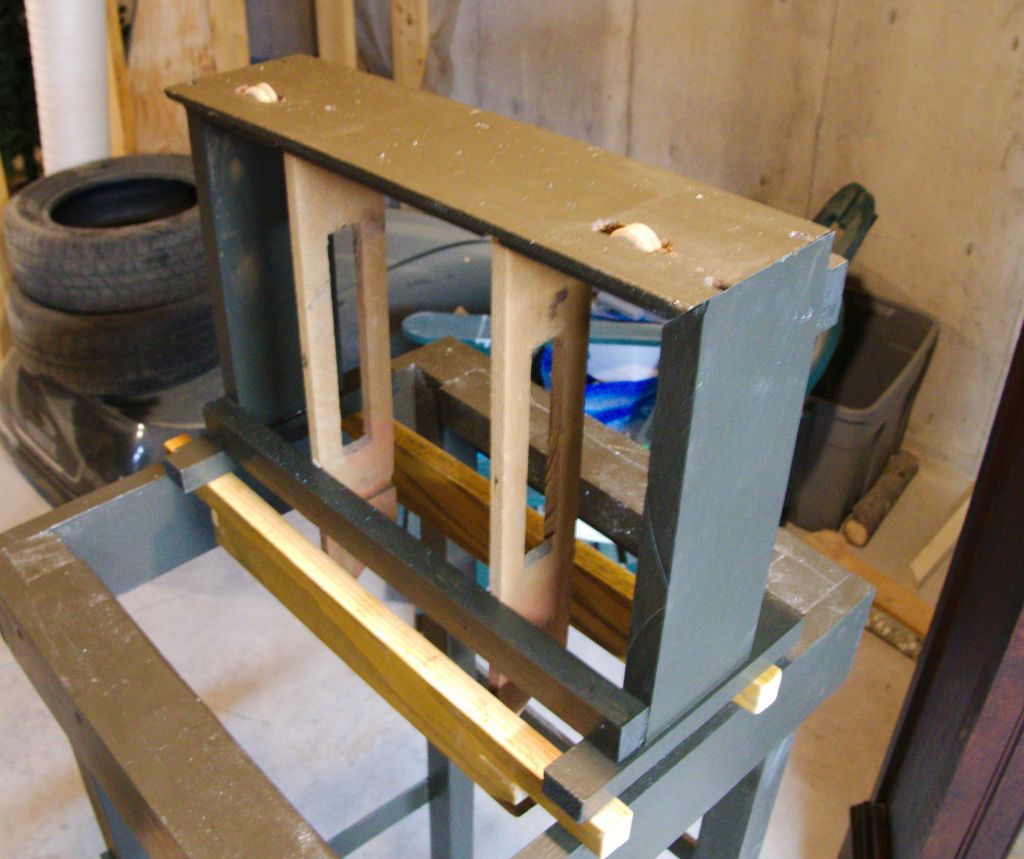
The ogee stand is 10 inches high and has stabilizing rails under each side that rest on the oak rails. There is a cross brace in the front and back to give it strength and lateral stability. The top from an old ogee case is ideal because the pulleys are in the correct position for the weights.

The rails easily take the weight of a 30-hour movement which is about 7 1/2 lbs total. Will it take the 13 lb+ weight of an 8-day ogee? Yes. There is no need to screw or nail the ogee stand to the oak rails as the combined weight of the movement plus weights are enough to anchor the stand in place.

Test stand rest on the two rails

I painted the stand to match the tall-case stand.

I chose Espresso latex paint because it does a great job of hiding my carpentry errors.

Testing the time side of a Waterbury ogee movement

Aside from an easy setup and quick mounting of a movement for testing purposes it allows me to inspect the movement from all sides.

It works as expected and now I can use the stand instead of the case for testing.

I know there is another ogee clock in my future!

Where do our readers come from?

Ingraham Grecian 8-day time and strike shelf clock

WordPress comes with an interesting dashboard. The dashboard provides me as author and developer with a back-end tool that provides a wealth of statistical information. The information allows me to track viewership and tailor my articles according to interest as shown by the number of clicks which is a measure of the level of interest.

In 2021 there were 68,095 visitors with 124,708 views at 1.83 views per visitor. Visitors came from 162 countries but let’s look at the top ten.

The top ten countries in 2021 are:

  1. USA
  2. Canada
  3. United Kingdom
  4. Australia
  5. New Zealand
  6. India
  7. South Africa
  8. Ireland
  9. Netherlands
  10. Italy

Since antiquevintageclock.com originates from the beautiful province of Nova Scotia, Canada it is not surprising that most of its visitors are from English-speaking countries.

All visitors are encouraged to explore the world of antique and vintage clocks and to that end, there is a handy applet on the front page for those of you who wish to translate in the language of your choice.

Readers pick for the best clock of 2021

The results are in. By a small margin, your pick for the best clock of the year is the Sawin banjo clock.

Sawin banjo clock

A great choice and one I would have picked had I not been frustrated with it during the restoration process but at the end of the day, my favorite is the Gilbert Shawville clock.

The Gilbert is an excellent example of a non-descript mantel clock found in thousands of homes in Canada and the USA in the 1920s. Seth Thomas, Sessions, and others made similarly styled models to appeal to those who could not afford the fancier, optioned-out upper range clocks that were offered by most manufacturers, including Gilbert, at the time.

I did not actually see the clock until we got home

The clock was offered on Facebook Marketplace in Quebec, Canada for $40 and had no takers over a three-month period. When the price was reduced, I snagged it. It was described as a non-running clock but the key, pendulum bob, and the movement are intact and I suspected I could get it running in a few minutes.

As an interesting aside, I found the clock in a recycle container by the side of the road, all prearranged, and never actually met the seller. It was boxed, sealed and wrapped in plastic, such is the fear the pandemic has produced.

Normally I stay away from American mantel clocks of the 1920s and 30s as I have had so many but for some reason, I was attracted to this clock because it looked like it had not been messed with.

There are no exotic veneers, appliques, fancy trim pieces, or finials, just a plain two-column, square-boxed-shaped, tinted mahogany lacquer hardwood case measuring 10 inches high by 5 ½ inches deep by 10 ½ inches wide at the base.

Gilbert shelf clock

The enamelled 5-inch dial with spade hands has Arabic numerals. On the top of the dial, within the number 12 is a regulating arbour used to adjust the speed of the clock.

On the front plate of the movement is the Gilbert trademark, a capital G within a diamond, and Wm Gilbert Clock Co, Winstead Conn. stamped on the right. The number 17 is in the lower centre, 1917 when the movement was made. The movement has steel plates with brass bushing inserts as brass was in short supply during the period of the First World War, 1914-1918.

A simple clock for the common folk and made by Gilbert is my pick for 2021.

Best clock acquisition of 2021

The time has come to determine the best clock acquisition of the past year. As a clock hobbyist, I have had little difficulty locating interesting clocks over the years, and despite the seemingly never-ending pandemic, I have scored a few in 2021 though the past year has been leaner than most.

In the early days of collecting, simple time and strike vintage mantel clocks were my principal focus so that I could take them apart, repair them if necessary, and generally advance my learning. Many of those clocks have been either sold or gifted. For the past three years, I have shifted my focus toward collecting interesting clocks, rare clocks, or clocks that have a special provenance that even includes the odd mantel clock.

My wife is my best clock finder. Our discussions often go something like this; “did you see that wall clock on Facebook?”. “Let me see. Yeah, it looks good, what do you think? Make an offer?” and off we go. Sometimes I will accept the offer from the seller without negotiating because I feel it is a fair price and other times there is some wheeling and dealing prior to firming the sale.

At the end of the post, you will have an opportunity to vote on what you think is the best in 2021.

In no particular order, here are my finds for 2021.

Sawin banjo clock

This is a garage sale find and even though it was purchased in the spring of 2021 it is still a work in progress. The clock is over 180 years old and in pretty decent shape.

Sawin weight driven banjo clock

It is a weight-driven banjo but it has no markings. An educated guess is that it was made by John Sawin of Boston or one of his associates on or close to 1840. I have completed minor veneer work on the case and have replaced the broken glass dial. The movement has been serviced but I am now looking at clock parts supply sources to replace a badly bent suspension spring. I want to avoid paying an outrageous price for the complete assembly; suspension spring, leader and spike.

Gilbert mantel or Shawville clock

I call this the Shawville clock because it spent most of its life in Shawville, Quebec (Canada).

It was a family clock for many years and following a death in the family, all possessions were either sold off or given away, a very common practice today. It has a time-and-strike Gilbert movement in a mahogany tinted case that has led a kind life since its manufacture in 1917. It is simple and unadorned and that’s what I love about it. I serviced the movement, cleaned the case, replaced a broken hour hand and now it is on prominent display in our home.

Gilbert time and strike

New Haven tall-case clock

An interesting $90 acquisition is this New Haven tall-case clock with a secret. Wow, a tall-case clock for $90, you say. Despite the look of a weight-driven clock, it is, in fact, a spring-driven clock. I was unaware of this until I walked through the door of the seller. I bought it anyway.

New Haven tall case clock

The weight cans are empty shells and they are simply there for show. The movement is quite large, eight-day, of course, and looks to be very robust. Despite my best efforts to determine if it was originally weight driven it had to have been spring-driven from the start, in other words, no evidence of a seat board or any additional holes for mounting the movement to the case. This appears to be an early “kit clock”, i.e. movement, dial face, hands, pendulum, “weights”, and ladder chains bought from the New Haven Clock Company and fitted to a pre-made case.

The case was very dark from years of accumulated dirt and grime and vigorous scrubbing revealed a wonderful red oak finish.

Waterbury Wren mantel clock

Ansonia Syria

Another clock with a secret is actually a disappointment. I found it in an antique store and it reminded me of an Ansonia Syria I had worked on for a friend last year, so, I was drawn to it.

Waterbury Wren mantel clock

It has a Waterbury case and what I thought was a Waterbury movement, but no.

It is missing the brass bezel and glass which is easily replaced but what is most disappointing is the mismatched movement, a Seth Thomas time and strike, which obviously replaced the original movement presumably because it was worn out. The movement is well-made and runs well but at the end of the day, the clock is destined to be sold.

Schatz Schatz carriage clock

This is a Schatz carriage clock made by August Schatz and Sohne of Germany. Thousands of these were sold and given as gifts through the 60s and 70s. It has an interesting lower visible escapement and an exposed movement.

Schatz carriage clock

Although it is working and keeping time it runs for about 4 days and stops. A cleaning is called for (on my list). It has a wind-up key in the back much like a typical alarm clock. It says West Germany on the dial and made, I would say, in the 1970s. August Schatz and Sohne closed in 1985, a victim of slow sales and a shift to quartz clocks by other makers.

Chauncey Jerome ogee clock

This clock is original in many ways, with a nearly flawless case made of mahogany veneer over softwood, moon hands, a wood dial, and a movement that matches when the case was made. Even the pendulum bob looks original. It was missing the suspension spring and rod and a wooden movement block, all easily sourced.

Chauncey Jerome 30-hour ogee clock

It cleaned up nicely and was a good candidate for a fresh coat of traditionally prepared shellac. I have three other 30-hour ogee clocks and this one is the most original of the bunch.

E. Ingraham Grecian shelf clock

This is a very nice shelf clock from an estate auction. It is an Ingraham Grecian clock with an alarm feature. If you have ever used the alarm on an old antique clock your first impulse is to throw it through a window, it is so loud and it goes on and on till the spring winds down.

Ingraham Grecian
Ingraham Grecian 8-day shelf clock

It came with incorrect hands and I had the darnedest time sourcing them but searching various suppliers in Canada and the US paid off. The case has been cleaned and the movement serviced including the infuriating alarm.

Fleet Time Co. mantel clock

An inexpensive clock that had huge potential but left me frustrated. Fleet Time Co. of Montreal had a short life of 4 years before the Second World war when they lost their source of German movements.

Fleet Time case
Fleet Time clock

I stripped the case and re-glued some sections, applied a walnut stain and I was very pleased with the final result. I serviced the movement, wound the time side completely, and BAM, kerplunk! the sound of a mainspring exploding. Sometimes you can get away with just replacing a mainspring and other times, like this, it took out the barrel teeth and a leaf pinon on the second wheel. I placed it in a plastic bag and it is now on a shelf in the basement awaiting donor parts.

Hamburg American Clock Company. (HAC) mantel clock

This German-made mantel clock has an interesting 14-day movement, an early production type from HAC. HAC is short for the Hamburg American Clock Company, a German company which had a long history up to the time it was absorbed by Junghans in the late 1920s. This clock was made in or around 1895.

HAC mantel clock
HAC 14-day mantel clock

It was another estate sale find. The case is nondescript and nothing special, but quite elegant.

So…..

Tell me what you think and I will reveal what I believe is my best acquisition this year in the next post. Let’s see if we agree.

A Happy New Year to all

Ringing in the New Year is for reminiscing, reliving, looking back, and looking forward.

midnight

However, I’ll be honest; let’s hope that 2022 is a whole lot better. We got through 2021 but for many of us, the ongoing pandemic has left an indelible mark. Promises were made and broken, plans were made and altered, hopes and dreams were reshaped.

The antiquevintageclock.com family wishes to convey our sympathy and condolences to those deeply affected by the pandemic.

Now let’s begin the New Year in style.

As champagne corks pop, glasses are raised and fireworks explode into the sky, it is important to recognize the special symbolism this holiday brings with it.

Amid promises of new beginnings and fresh starts comes a time of reflection and resolutions that more often than not tend to be short-lived.

A broken clock

Take my advice; why burden yourself with resolutions that will go nowhere and disappoint you in the end.

For you clock lovers, where will your horological journey take you this year? Will it be finding that special clock, finally servicing mom’s prized mantel clock, building your clock repair skills, reading about wonderful clocks on blogs such as this, buying that unique clock repair tool, or reading that special clock book?

May the New Year bring you prosperity and happiness.

Happy New Year everyone!

Happy Holidays Everyone

The last two years have taught us to be very thankful for family, friends, and relationships. Of course, we all wish we could be celebrating the holidays in a very different way in 2021 but just when we thought we were seeing the end of the pandemic another wave is crashing over us.

Unfortunately, celebrations will be confined to immediate family and close friends. Who would have thought the pandemic would last as long as it did and through all of this we must press on and continue to be vigilant. Is there an end in sight? I certainly hope so.

Holiday in Lego Land

The pandemic has taught us to appreciate the simpler things in life and during this festive season of giving and receiving, let us take time to slow down and be thankful for what we have.

Christmas at home

May this wonderful time of the year touch your heart and the hearts of your loved ones in a special way.

If there is a clock under the tree consider it a timely gift to remind you of days gone by and of happy memories when families got together to celebrate love, togetherness, and a feast to remember.

I understand the sentiment but a sad end to a tambour style clock

The holiday season is not about getting what you want but appreciating what you have.

Wishing you much happiness not just today, but throughout the coming year.

I would also like to take this opportunity to thank all my visitors, viewers, and subscribers for making antiquevintageclock.com the best year yet.

The Moncton – double spring time only – Part II – servicing the movement

I love this clock. It is one of my favorites. Bought in the fall of 2018, it has been on the kitchen wall and running ever since. Arthur Pequegnat clocks have a solid construction, robust movements, conservative designs, are among the most dependable and reliable clocks in my collection. this model is called the Moncton.

The Moncton was a regular fixture in offices and was then considered a “high-end” office clock. Many also found their way to rail stations across Canada. There were two variations of the Moncton, a short and a long version.

Those made before 1917 were known as the First Issue and had a tapered bottom piece. The second issue had a rounded bottom with a middle cut-out.

They are attractive clocks inspired somewhat by the Seth Thomas #2 although the Moncton has a 15-day double spring driven movement instead of the single weight of the #2.

I knew it required servicing but with so many other clock projects in the way I never got around to it. In my last post I took the movement out of its case and discovered that there is not a lot wrong with it.

The time-only movement is stamped Arthur Pequegnat Clock Company

It was dirty as expected and long overdue for a cleaning.

The movement is pretty simple with 4 wheels and an escape wheel plus the motion works. The two springs apply power simultaneously but one side can be wound if the other spring fails though the clock will run but for a shorter period.

The mainsprings are not what I expected, They are half the width of a typical time-only American clock. There is a reason for this. The Graham deadbeat escapement requires between one fourth to one half the driving power than the same clock using a recoil escapement. Less drive power means less wear over time. Having very few gears and little friction in the gear train also improves efficiency and time-keeping.

The Movement

Seth Thomas Regulator #2

The movement is attached to a support frame bolted to the case.

There are two screws holding the movement on the bottom that must be loosened and two long screws that go through both plates that hold it on top, much like a Seth Thomas #2.

Once disassembled I inspected the movement for wear.

I discovered the lantern pinions and pivots to be in very good condition for the age of the clock.

Time-only movement

The movement might have been cleaned at one point but there is no evidence of past repairs. The bushing holes are a little worn but not enough to warrant bushing work at this time.

Consequently, cleaning parts in the ultrasonic, polishing the pivots, cleaning the mainsprings and pegging out the bushing holes was the extent of servicing.

The movement was assembled and mounted in the clock for testing.

Cleaned and returned to the case for testing; notice the two top mounting screws

It will run for a cycle or two before I re-attach the dial and hands.

A pretty simple servicing requiring less than half a day of my time.

The Moncton – double spring time only – Part 1 – assessing the movement prior to servicing

Canadian clock collectors are very familiar with the name Arthur Pequegnat and associate the maker’s clocks with a solid construction, robust movements, conservative designs, and nationalism since many clocks were named after towns and cities in Canada. The Moncton was named after the City of Moncton in New Brunswick, Canada.

The Moncton was often found in offices and train stations across Canada and was known for its accuracy. This clock is originally from the Toronto (Ontario, Canada) area but I have no idea where it spent most of its life.

Arthur Pequegnat Moncton

For an 80+-year-old clock, it is in exceptional condition. A double spring time-only movement with a Graham deadbeat escapement running at 80BPM means that it is very accurate despite being spring-driven.

It has a 12-inch Arabic dial with simple, bold numbers. The pierced spade hands are attractive and are a common feature on many Pequegnat wall clocks. It has a fumed quarter-sawn oak case, is 35 inches high with a hinged 16-inch oak bezel door that swings to the right to reveal the dial.

The pendulum access door is 14 ½ inches high by 10 ¾ inches wide and swings to the right. The clock is 5 inches deep with wall stabilizers on either side of the case. The pendulum bob is brass over iron with an oak pendulum rod. The dial glass is original and has the “waviness” you would expect with old glass.

Assessment of the movement

With solid plates, front and back, and a mounting system similar (but not quite the same) as the Seth Thomas #2 the movement looks solid. I was expecting past repairs and some wear and, of course, a dirty movement, all confirmed when I looked at the movement for the first time.

Heavy-duty time-only movement

I removed the dial first and the movement from the case. The first step is to let down the mainsprings.

The mainsprings are much smaller than and half the width of a typical American clock with a recoil escapement. Not surprising since a Graham deadbeat escapement requires between one-fourth to one-half the driving power than the same clock using a recoil escapement. Less drive power means less wear over time. Having very few gears and little friction in the gear train also improves efficiency and time-keeping.

Even in its unserviced state, it would easily run 16 or 17 days.

I am not seeing a lot of wear, an indication that the clock has had a good life. The verge arbours may need bushing work otherwise I cannot see any other wear that is problematic. The lantern pinions are also in very good condition.

Next is to inspect the movement more closely and look for anything out of the ordinary.

In Part II I will cover the servicing of the movement.

Traditional shellac improves the appearance of an ogee clock case

This Chauncey Jerome 30-hour or one-day clock from about 1844-1845 is the example that I am using to illustrate the advantages of using traditional shellac as a finish coat.

The mahogany veneer is in very good condition and it is evident that the clock was not subject to the abuse one would expect of a 180-year-old clock. There is a small dent in the upper left corner but it is hardly noticeable. There are a few scratches here and there consistent with age but all in all the veneer is in great shape.

As found, a dull and lifeless case

First, is cleaning the case. My go-to cleaner for clock cases is Murphy’s Soap. It does a great job of lifting years of grime and dirt from the veneer. The tradeoff is that once you remove the dirt it reveals shellac loss. It was my intention to apply a coat of shellac in the first place so, when I got through layers of dirt and discovered some of the finish gone, I was not too concerned.

Since there are no veneer repairs, refreshing the case was pretty easy. I am not a big believer in maintaining the patina of a clock. if pt is dirty it needs to be cleaned!

I use traditional shellac consisting of flakes mixed with shellac lacquer. I use a wide artist’s brush to apply the shellac and it always produces a superior finish.

One coat of amber shellac

I have decided to leave the lower tablet as-is and as for the dial, I haven’t yet decided on whether or not to address the faded chapter ring though I am also leaning towards leaving it as-is.

The movement has been serviced, the clock is running and striking as it should and I think it looks great after the case refresh.

Veneer repairs on an 8-day Seth Thomas column and cornice clock

This 8-day Seth Thomas column and cornice time and strike shelf clock with sleigh front needed a little love. It has a Plymouth Lyre movement with a Thomaston Conn. label. The clock was made in the 1870s. and purchased five years ago and has been running since.

I will take you through my early days of veneer repair. It is probably not my best work but it was a fun and challenging project plus, there was good learning.

The Seth Thomas clock as found

A previous owner had applied brown paint on areas of veneer loss, it looked ugly and when I saw that I decided the case could use a little tender loving care. Many of these clocks are in decent condition for their age but if you are shopping for column and cornice clock from this era take note of veneer losses. You may want to reconsider your decision to purchase if you feel it is not worth the time, effort and expense or if there us so much loss that it is unsightly.

Of course, there is always the school of thought that advocates leaving things as-is and that is perfectly fine. But, a little veneer work is minimally invasive, in my view.

Veneer issues

The most troublesome sections were the top and bottom of the case and the column base, not surprising since those are the prime targets of wear and tear over the years. Most of the cornice veneer is in good shape as are the door sections, door surrounds, and the sleighs just above the feet. Although there is work to be done, I have seen worse.
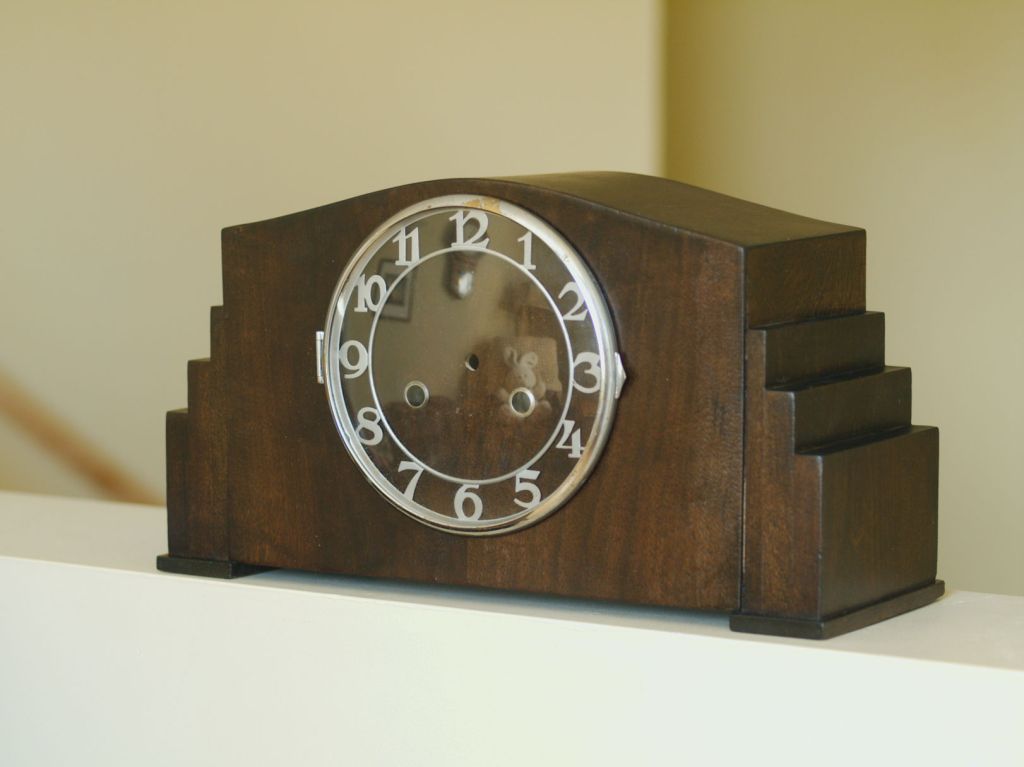
The veneer used at the time was Brazilian Rosewood, an exotic wood. Rosewood would have been used extensively by clock-makers of that era and replacement Rosewood veneer would be the correct choice. I have two 7 X 8 inch pieces of Rosewood veneer, more than enough for this project.

Veneer losses on the base

Prep-work and other case issues

The cornice on the left side was missing a section and that had to be attended to before the veneer work began.

Losses on the cornice and its base

Using scrap softwood I made a small piece and trimmed it roughly to fit. In this photo, I am testing the piece and making minor adjustments for a snug fit. The section is then glued in place and allowed to dry for 24 hours.

Cornice trim piece
Cornice trim piece

The top area of the front cornice is now ready to be faced with veneer.

The sections with brown paint had to be sanded down to the bare wood to improve adhesion before gluing the new veneer.

Repairs made to left cornice

In selected areas, small sections of old veneer were removed to make way for larger replacement pieces.

I have decided not to tackle the columns. There are some losses but from a reasonable distance, they are fine.

Hide glue and Bloom strength

The one true adhesive for antique clock case applications is hide glue. Hide glue would have been utilized at the time the clock was manufactured.

I chose pearl hide glue which is rated at 150g Bloom strength (500g Bloom strength, the maximum, is not necessary for this type of repair). 150g hide glue takes a little longer to gel and adhere but with the slightly longer working time moving pieces around for best fit is easy.

Home-made double boiler

To ready the adhesive place the container with the gelatinous glue in a bath of water in a pot specially designed for hide glue or a double boiler which worked equally well for me. Heat to approximately 140°F (60°C), using a candy thermometer and maintain the temperature throughout. Heating the wood surface with a hair dryer before applying the glue is an option. Full strength is reached when it’s dry, and that can take 24 hours.

An excellent article on hide glue and its strength properties can e found here.

It is best to start with a small batch. Put 2 tablespoons (30ml) of glue in a glass container and cover with 1 tablespoon (15ml) of cold water and let soak for about an hour or until the glue softens and becomes gelatinous. To make a larger batch simply follow the 2 to one rule. I recommend making small quantities, to begin with. If there is glue left over I find that it can be frozen and reused later with no ill effect.

Tools

Clamps, weights, tweezers, wax paper, a sharp knife, a metal straight-edge, painter’s tape, a micrometer, sandpaper, palm sander, and whatever you choose to use as a double boiler complete the list of tools.

Clamps used for veneer work

A micrometer is an indispensable tool for accurate measurements. Accurate measurements ensure a good fit, minimize the use of fillers and lessen waste.

Cutting, trimming & clamping

The cutting of veneer can be tricky. Veneer is brittle, and can easily tear. Veneer today is quite different than veneer used 100+ years ago as it is very thin. On some clocks you must double-up or layer the veneer to approach the height of the original veneer. Another alternative, and a better option, is to harvest veneer from old clock cases. Old veneer is thicker, is very close to the look and feel of the original finish but just as brittle.

If old veneer is hard to work with, softening it with water will have a small and short-lived effect on a veneer’s flexibility. Another option is a product called Super-Soft 2, said to be ideal for softening veneer. For the little veneer work that I do I cannot justify the cost of a commercial softener and water is satisfactory for my purposes.

Painters tape easily peels off

The next photo shows a veneer section glued and clamped into place. Wax paper is used to prevent the glue from sticking to the clamp. Clamps are essential for veneer repair but when clamps do not work other methods such as weights can be employed. Leave the clamp on for 24 hours for maximum adhesion.

Clamping cornice veneer

Cutting can be a challenge since you must follow the grain and narrow strips can break very easily. Painters tape prevents tearing and is easily removed from the veneer prior to or after the application.

The most challenging areas were the very top and very bottom of the case and the column bases but after many hours the veneer work is now complete. The next step is colour matching the new to the existing veneer.

Top of cornice veneer with new veneer

Rosewood Minwax Gel stain is a close match to the older veneer but I would recommend experimenting with a coat of shellac first before applying a stain, in fact, a stain should be a last resort.

The base section is finished

There is always good learning resulting from each project and in retrospect, I should have replaced the entire section under the left sleigh rather than cut two pieces of veneer to fit either side of the existing piece.

The completed case includes a repainted dial and replacement upper tablet

As with any other project, there will always be a slight colour variance between old and new veneer and the goal, as always, is to come as close as possible to the original finish.

The last photo shows the completed clock with a repainted dial and a new middle tablet.

Chauncey Jerome 30-hour movement – two unusual issues during servicing

I was not really looking for an ogee clock to add to my collection. But there it was sitting in a lonely corner of an antique shop calling me, “buy me”; and I did.

It is probably the oldest one in my collection of 4 other ogee clocks. It was made in or about 1845. Now, being old does not necessarily make it valuable. In fact, millions of these clocks were produced and many found their way to online auction sites in recent years contributing to a huge drop in value. You can find them online for a little more than I paid for mine but they are pretty cheap nonetheless. This one was $54.

As found

The case label located on the backboard inside the clock case was printed by John Benham in 1845. Comparing the movement in this case with one found on a popular Jerome database site tells me that it is a type 1.311 Jerome movement. Jerome movements were typically marked though some, like this one, were unmarked which is not unusual.

So, the case and the movement are near enough in time to tell me that the movement is very likely original to the case. That is always a good sign as many ogee cases had worn movements replaced over the years. In some cases, there was little intertest in matching the maker of the case to the movement especially if a customer’s only wish is to have a working clock and since the movements were interchangeable it made it that much easier. Many of these clocks are over 180 years old and one can expect some subtle and not-so-subtle changes over the years.
While very attractive and running well this clock (below), a “marriage”, is an EN Welch case with a Waterbury movement. When considering the purchase of an ogee clock, if it is important to you, check that the movement and case are from the same maker though that is not an absolute guarantee they started their lives together.

EN Welch and Waterbury marriage

What is original and what has been replaced?

Typically parts that have been lost/damaged or replaced over the years include the verge, suspension spring/leader, the pendulum bob, the weights, the hands, and case parts like pulley dust caps. In some cases, the lower tablets have been removed altogether because of breakage or severe paint loss, replaced by a clear glass panel, a mirror, a photograph, or a picture (often from a discarded calendar).

The leader and suspension spring are missing. The verge appears to be a replacement, the weights look original as do the hands and pendulum bob. There is a missing top movement block that secures the movement to the backboard and that is about it.

I am reserving judgment on the frosted glass tablet; it may or may not be original. It would be pretty exciting if it were a Fenn design but I doubt it. William Fenn was one of the more prolific tablet-makers of the mid-19th century. The dabs of red paint are certainly added later.

The clock dial, likely original, is signed C. Jerome below the twelve o’clock.

Assessment of the movement

This is a typical 30-hour or one-day time and strike movement.

I found some wear and I was expecting some past repairs. There is a repair date of 1863 on the inside of the access door but I can’t make out what was done at that time.

There are two bushings installed on the front plate, the second wheel, and the hour gear. On the back, there are four replacement bushings, evidence that it has had acceptable servicing. One seldom finds replacement bushings on an ogee clock. Most movements I have come across have punch marks around the bushing holes, a common practice by past clock repairers to close elongated holes.

Type 1.311 Jerome movement

Three of the replacement bushings will have to be redone and new bushings are required for the back-plate time side main wheel and the strike side back-plate main wheel for a total of five.

The pressure washer for the time side main wheel is completely worn out. Had I not separated the wheel and ratchet for cleaning I would not have discovered the problem but it tells me that it could fail at some future point.

To the right is the pressure washer with centre worn through

I have a donor New Haven 30-hour movement that will provide the replacement washer.

The lantern pinions have some wear but are quite acceptable. One trundle is loose on the escape wheel. Rather than take it apart and re-seat the troublesome trundle, a dab of Loctite Red should fix it in place.

These are two unusual issues but not insurmountable.

A lantern pinion with a loose trundle

Because the movement was so oily and dirty I pre-cleaned the parts prior to putting them in my ultrasonic. This helps extend the life of the solution. I used a medium bristle nylon brush to clean the stubborn areas.

After cleaning and drying the parts, the pivots are polished and I was pleased to find almost no wear on any of them.

Next is the bushing work. My only concern was pushing out what remained of the bushing material in the replacement bushings after drilling. I went slowly and did not apply pressure on the cutter, letting it do its work. As I suspected the Bergeon bushings are marginally smaller but each bushing fit snugly. Although I planned on five bushings, I installed six, adding a bushing for the second wheel on the time side front plate which was a little more worn than I thought. I left the escape wheel as-is, the wear is acceptable.

Next is restringing the weights, re-assembly, and testing. All went as expected.

I have worked on a few of these movements over the years but unique issues always seem to come up. Nonetheless, they are fun to work on.

Following the movement servicing, I will move on to refreshing the case.

Would you buy a “Cucuko” clock?

I frequently cruise the online for-sale sites for interesting clocks and I could not help but chuckle at this one.

Would you buy a Cucuko clock?

Online ad

If you are going to sell a cute Black Forest clock take a little time to find out how to spell the darn word. It is not choochoo or cucko, or CooCoo, or Coockoo, or Cucuko, it’s Cuckoo!

The word is Cuckoo and the Cuckoo is actually a bird found commonly in Europe. That little birdie that comes through the top hatch door the hour and half-hour on so-called clocks is a Cuckoo, plain and simple and they are a real thing.

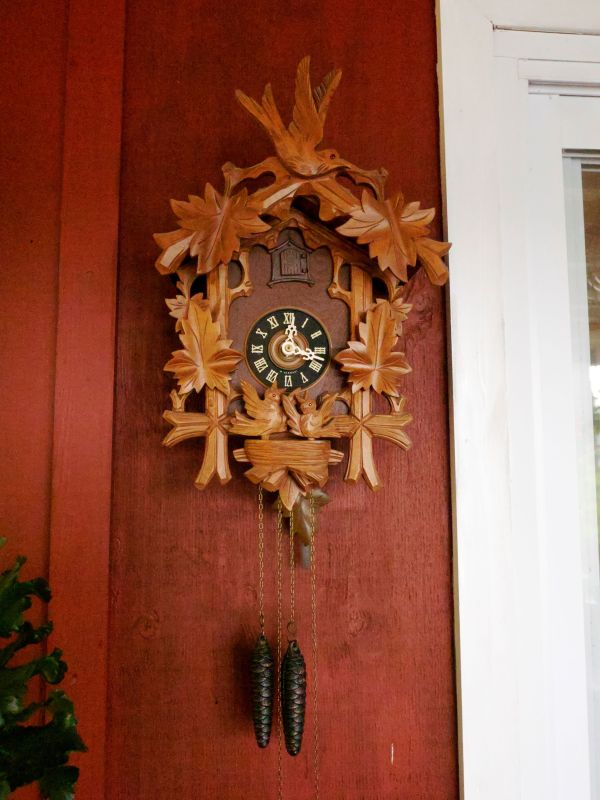
Dave's cuckoo clock
Dave’s cuckoo clock

I don’t know how many times I have seen the word misspelled. How much more would a seller know about the clock if they can’t even spell the name correctly?

The name is not the only thing to snicker at, look at the price.

I got mine for free. I call it Dave’s clock, the name of the previous owner. It is a lot nicer than the one offered for sale and I’d sell it for a whole lot less than $300…… if I sold it!

Sawin banjo clock movement servicing – two issues arose later

Weight-driven banjo clocks have simple time-only movements that are very reliable. They can be unadorned like the one I acquired or garish almost to excess like a presentation timepiece. Authenticity can be a challenge since some presentation timepieces started life as simple wooden cases and decorative tablets, finials, sidearms and other items were added later but I love the simplicity of this one.

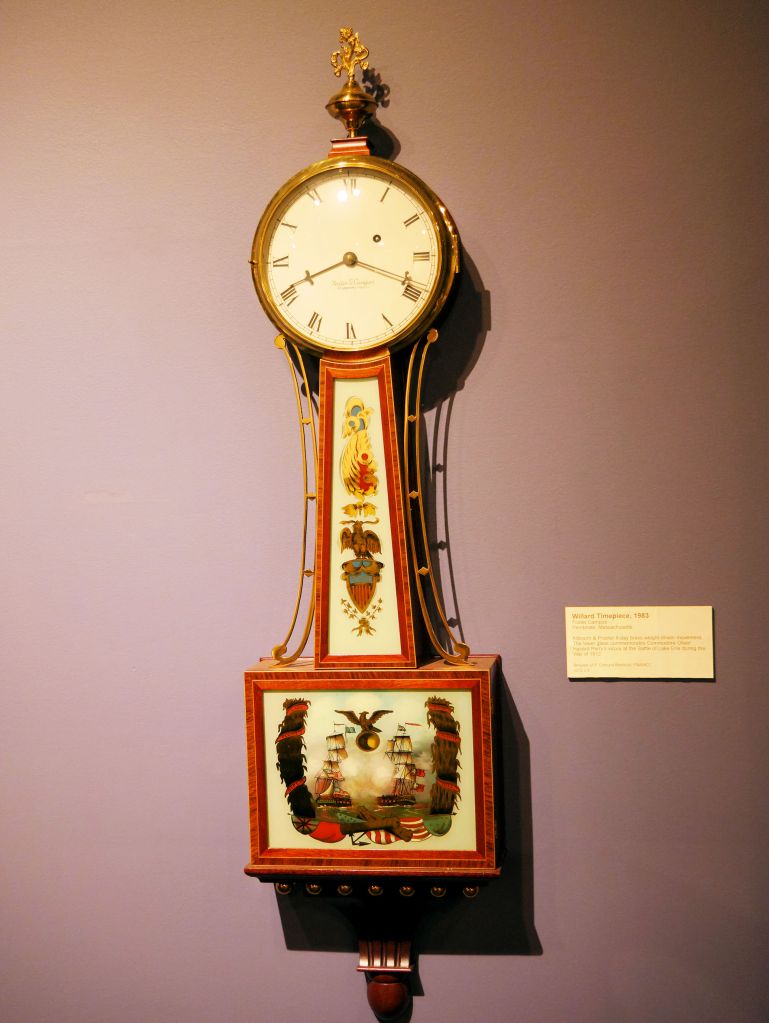
Presentation banjo clock by Foster Campos

Finding one for $75 is highly unusual but I am convinced the seller had no idea what it was worth. When I picked it up the seller asked me if I was interested in another clock he had for sale, a 30-hour mantel clock. He told me someone valued it at $300. Uh, no, not interested!

This federal-style banjo clock was made in the 1840s. I am reasonably certain it was made by John Sawin of Boston in 1840 or thereabout, by either himself or one of his apprentices or associates. The movement and case construction bares a strong resemblance to a Willard timepiece and there is a good reason for this.

John Sawin apprenticed under Simon Willard and was a journeyman under Aaron Willard, famous clockmakers of the day and makers of the original patent timepiece.

Unfortunately, there are no identifying markings on the movement or the case but there are key indicators, for example, the placement of the movement mounting “ears”, that tell me that this is a Sawin clock.

The case is complete and ready for the movement

Everything is original to the clock, weight, hands, movement, pendulum rod and bob. The dial glass was was broken at some point in the clock’s life. It had convex glass and a good many I have seen with wood bezels had flat glass. Brass bezel clocks, on the other hand, generally had convex glass, so, I have decided to replace it with flat glass.

The movement

The gear train is relatively simple and consists of 4 wheels; the main wheel, second wheel, third wheel, and escape wheel. The motion works are on the front plate.

The movement in its case

Assessment of the movement

As expected there is wear but consistent with the age of the clock. The movement looks good overall, the gear teeth and pinions are in very good condition but, there are punch marks around the pivot holes. It is never a good feeling to see punch marks around the pivot holes. Punching effectively closes the pivot holes but in a very crude way. This was an old practice and is not considered acceptable today.

Pivots are required for the main wheel front plate, second wheel back-plate, third wheel, and the escape wheel front plate. The verge may require front and back bushings but I will see how things look when the other bushing work is complete. Three are 2mm wide Bergeon bushings, the fourth is 2.5 and the main wheel bushing is larger. I don’t often work with bushings as small as 2mm and it simply means extra care must be taken to cut and ream as accurately as possible.

Bergeon Bushing Machine
Punch mark, left of winding arbour
New bushing for main wheel arbour

There was a good amount of movement in the main wheel arbour and installing a bushing was necessary to tighten things up. I have bushings that are 1.5 mm and 3mm thick but the plate is 2mm. A 3mm bushing was installed and using a file I reduced the height to 2 mm. Three other bushings were then installed with no issues.

I have decided to leave the verge bushings as-is for now.

The weight cable had no kinks or broken strands, I cleaned it in the ultrasonic and reused it. For brass cable, I generally knot each end and use solder to secure the knot to prevent it from slipping out of its knot.

Two weeks later and two issues

The weight cable is too short. The clock stops when the weight is several inches from the bottom of the case and it will only run six days instead of the usual eight. Why was the cable shortened? Who knows?

The Keystone

A second issue. The keystone is the piece between the suspension spring and the pendulum leader. It comes very close to hitting the large wheel of the motion works on the left side. Since the suspension spring is quite bent the right side of the keystone rubs against the back of the dial face stopping the clock. A bent spring is a consequence of leaving the pendulum assembly on the movement during transport.

Unfortunately, I cannot source a suspension spring alone and must purchase either the keystone and suspension spring together from an American supplier or the entire spring, leader and stake for about $55.00 from a Canadian supplier. In the meantime the movement runs until I put the dial on.

Sawin banjo clock c.1840

I am in no hurry for this one and will continue testing it until I come up with a solution for the bent suspension spring.

Over 108,000 views so far this year – thank you

Thank you, viewers and subscribers.

It is always a thrill to reach a milestone. Six years ago I attended a WordPress workshop and after the instructor assisted us in setting up a rudimentary site, I thought, I can do this. I can talk about clocks! WordPress 101 certainly made it sound so easy but it wasn’t as easy as I thought as I began my journey.

It has taken time to build a following, more than I ever imagined. It takes planning, commitment, an investment of energy, and, finally, perseverance but at the end of the day, it has been worth it.

My office about two years ago

I began by following other blogs and making notes on what made them successful and eventually found a natural style that was best for me. Unfortunately, I have seen a lot of blogs come and go in the past six years, bloggers that ran out of ideas, lost interest in their blog, or for whatever reason, life got in the way. And some of those blogs were pretty darned good. But I wasn’t going to let that affect me.

The first two years were frustrating, to say the least, and I don’t know how many times I thought of quitting, but I hung in even though the number of views was, well, disappointing. I knew my content was interesting, certainly to me and I knew there were people out there who had a yearning to read and learn about mechanical clocks, so, I stuck with it. And, I am glad I did.

Case repair and restoration work area

As I have said elsewhere if you regularly use a lathe to cut gear teeth, re-pivot arbours, bush mainspring barrels on a weekly basis, fashion new wheels from raw stock or make advanced repairs on complicated movements and cases, this is probably not the place for you but you are welcome to leave any comments or suggestions or simply read one of my blog articles over a cup of coffee in the morning.

Seth Thomas #2
Seth Thomas #2 c. 1922

After six years I still consider myself a clock repair generalist though there is no denying that I continue to build my repertoire of clock repair and restoration skill. Judging from my mail I seem to appeal to those who are like-minded. I appreciate those who have stumbled onto my site looking for advice and guidance on a particular clock or clock repair issue.

HAC mantel clock
Hamburg American Clock Co (HAC) mantel clock c.1908

But I especially appreciate comments and suggestions from regular viewers. And, yes, there is fan mail, most of it sent privately and I take great pleasure in responding to each and every query.

Ingraham Grecian
Ingraham Grecian c.1875

As I review articles that have the greatest number of views it seems clear to me that most of my visitors are looking for how-to and general information articles. That suits me just fine.

These have become the most popular.

After six years I have developed an understanding of my audience and have managed to produce blog articles that seem to appeal to a wide range of people with an interest in horology.

Will I continue? Darn right, and as they say, the best is yet to come.

Antique or Vintage Clocks: The Perfect Unique Gift Ideas

Ah, the holiday season is upon us, what to buy? Are you are looking for a unique gift for a friend or family member. An antique clock may not be anything you have considered but wouldn’t it make a terrific gift.

Mauthe time and strike wall clock from 1895

If you know a little about antique or vintage clocks or you know nothing at all, you may need some help finding the right clock for that special person. I will give you a few pointers plus an explanation of some of the terms you may come across.

Why buy an antique or vintage clock?

A year ago I sold a clock to a young woman who was looking for a unique gift for her father. She responded to my advertisement by saying that it was exactly the clock she was looking for because it reminded her of the family clock when she was young.

Sentimental reasons, satisfying the need to acquire anything antique, or the uniqueness of an old mechanical clock top the list for reasons to buy an old clock.

What is the difference between antique and vintage?

It is not easy to tell the age of a clock, or, for that matter, anything in an antique store and, ads for clocks seldom tell the year it was produced although it might hint at the period it was made, for example, “mid-century”. A quick trip through the world of Google will give you a general sense of how old something is give or take a few years.
Vintage Kienzle wall clock from the 1930s

An antique is anything over 100 years old and vintage is less than 100 years but more than 30 years old. Anything that is less than 30 years old may be considered vintage but more often called collectible.

Mechanical or something else

This article focuses on mechanical clocks but there are a lot of different types of clocks out there and online auction sites are filled with every type imaginable. It can be confusing to the shopper.

As a general rule quartz clocks have limited value and very few would be considered collectible.

Electro-mechanical clocks have a traditional mechanical movement, which keeps time with an oscillating pendulum or balance wheel powered through a gear train by a mainspring but uses electricity to rewind the mainspring with an electric motor or electromagnet. Something quite different is the electro-magnetic clock, popular in the 1950s. Both types can be highly desirable but leave that to the professional collector who knows specifically what they are looking for.

In the 1930s electric shelf, desk and wall clocks were introduced into homes everywhere. Some have value but most are not worth the trouble.

Sessions 3W electric table clock
Sessions 3W electric table clock 1927

They are great timekeepers but are often quite worn, dangerous to work on, and can be difficult to repair. I would not give one as a gift unless you know that it was serviced by a competent professional.

My advice is to stick to an antique or vintage mechanical clock.

One last note; beware of conversions, clocks where the mechanical movement was taken out for whatever reason and replaced by a quartz movement. They are worthless but some people fall for this sinful and deceptive practice.

Type of clock and placement

Space is the biggest consideration.

Seth Thomas alarm clock
Antique Seth Thomas alarm clock from around 1910

In the trend towards smaller homes, there is not always space for a clock. Mantel clocks require a shelf or table to put them on.

Simple time-only or time and strike clocks can be quite small but others may have more a complicated Westminster chime movement in a larger case. Alarm and desk clocks occupy the least space.

This 1917 Gustav Becker Vienna Regulator is 51 inches long

Wall clocks are easier to place. Wall clocks come in all shapes and sizes from the diminutive cuckoo clocks to large box clocks and Vienna regulators.
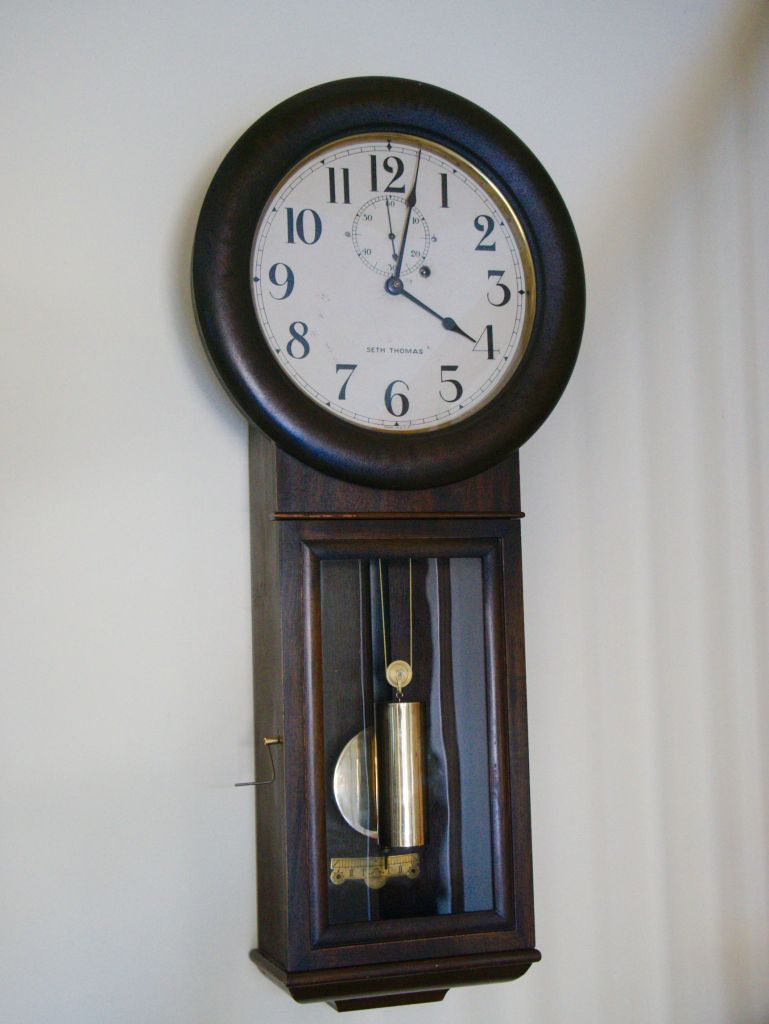
Floor clocks, otherwise called grandfather or grandmother clocks, tall case, long case or hall clocks are the most difficult to place. Unless the person in mind would appreciate one and has sufficient floor space I would not recommend one.

Working or non-working clock?

A working clock that has been recently serviced by a competent clock repairer is the most desirable. However, if the clock will be a decoration or part of the decor and a working clock is unimportant, you might find them less expensive to purchase. Perhaps one with a replacement quartz movement might be okay as long as you know that’s what you are getting.

Clock buying tips

1990s Ridgeway grandfather clock takes up space
  1. Look for a working clock over a non-working one. Chances are it has been better cared-for over its life span.
  2. Facebook Marketplace, eBay, your local online for-sale site (we have kijiji in Nova Scotia), reputable estate auction sites, antique stores and word of mouth are among the best sources.
  3. Most common clocks are priced reasonably. Clock prices have generally fallen over the last 5 years but expect to pay more for rare clocks or those with a special provenance.
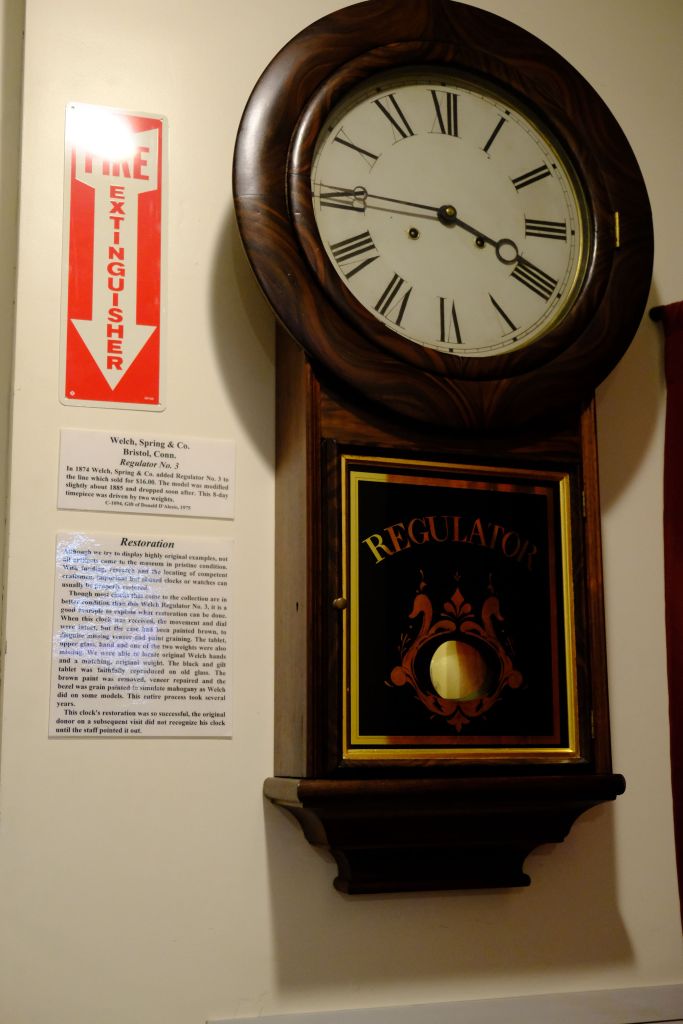
  4. Stay away from Chinese made or Korean clocks or most anything that has directional arrows around the winding points. They have very powerful mainsprings and will potentially harm the user if the springs break.
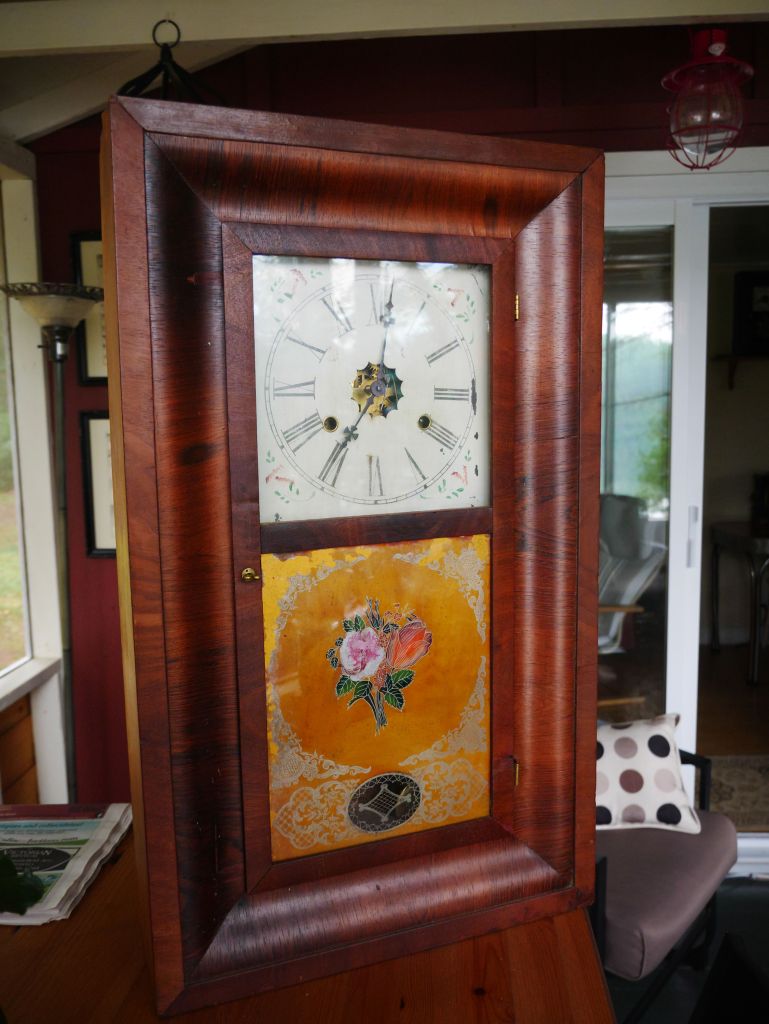
  5. The maker of the clock is largely unimportant. For example, all American clock producers made cheaper and more expensive lines of clocks.
  6. A little research is always helpful before you make the purchase. A little knowledge might be a dangerous thing but knowing nothing is worse.
  7. It may or may not be important to you if the clock has been altered in any way but it is nice to know. For example, many old ogee clocks are attractive but have had a replacement movement installed when the old one failed. In the clock world these are called marriages and it makes a difference to some people.
  8. Try to inspect the clock in person before you buy. Surprises are never nice when you discover something sent to you is not what you expected.

Well, if you are looking for a clock for that special person I hope I have given you something to think about before you put your money down.

I should say that I am not in the business of selling clocks but will sell the odd one locally to keep my collection manageable.

Website Powered by WordPress.com.

Up ↑

Antique and Vintage Mechanical Clocks

Collecting, Repairing and Restoring Antique/Vintage Clocks

Skip to content ↓