Clocks won at auction – at a fair price

I never actually went to this auction but participated online. It is not quite the same as the rush of bidding in a live auction hall but exciting in its own way.

This particular auction had quite a number of clocks but I would say that most were in rough or what I would call “hobby-ready” condition.

I was looking at one particular clock but three more grabbed my attention. A total of four clocks, two shelf clocks, and two wall clocks.

My budget was $300CDN and I stuck to it. I set the maximum I would pay for each item and placed all bids within the last minute of the auction and walked away from the computer. For two of the clocks, I was prepared to let them go if bidding got too high but at the end of the day I won all four. With fees and taxes, the final invoice was $379 (a little over $300US and 240BP).

Bidding online is always a gamble. What the photos reveal does not always tell you what you are getting and I have been surprised more than once. I have a number of other photos from the auction but these are a good representation.

Hamilton Clock Co.

30-hour Ogee clock

Clock number one is a 30-hour weight-driven ogee made by the Hamilton Clock Co. based in Hamilton, Ontario in the late 19th century. This was a clock I was anxious to have since I am in the process of building a small collection of Canadian-made clocks.

I have one other clock from The Hamilton Clock Co., a 30-hour time and strike steeple clock, and one from the Canada Clock Co., a 30-hour time and strike cottage clock.

I am grouping the two companies together because one essentially grew from the other and made clocks within the same factory and with the same machinery.

Those two have etched lower tablets as on this new acquisition.

Canada Clock Co. Hamilton Cottage Extra
Hamilton Clock Co Gothic steeple clock

The Hamilton Clock Co was formed in 1876 and went out of business in 1880, a very short run for a clock company, unfortunately. The exact year of manufacture is unknown but I may know more when I receive the clock.

This clock looks like every 30-hour ogee ever made and that was the original intent, a familiar clock style that appeals to the masses. The dimensions of this Canadian-made ogee are very similar to American-made ogees and the movements, though made in Canada, are essentially indistinguishable (minor differences aside) from 30-hour ogee time and strike movements made by a number of American manufacturers of the time.

The clock appears to be intact, has its own weights and the lower etched glass tablet seems to be in fine shape judging from the auction photos but the case will need a thorough cleaning and some veneer work.

Daniel Pratt Jr

Clock number two is a Daniel Pratt Jr which I’d like to call a reverse ogee with a splat top but the splat top is missing.

I have just one Daniel Pratt Jr clock in my collection and it has an early woodworks movement. The older Pratt clock shows what the splat should look like.

Daniel Pratt Jr with woodworks movement
Reverse ogee and “splat

According to the label on which the date 1843 is inscribed, one can assume that this is the date of manufacture, approximately.

In any event, it may have a woodworks movement. There were still a few companies who continued with the cost-effective woodworks movement but by that time the rolled brass plate movements were becoming more common.

The loss of the splat top certainly makes the clock less desirable but it was one of the cheaper clocks in this grouping and, who knows, I might have a splat made, we’ll see.

Label, weights and pendulum bob

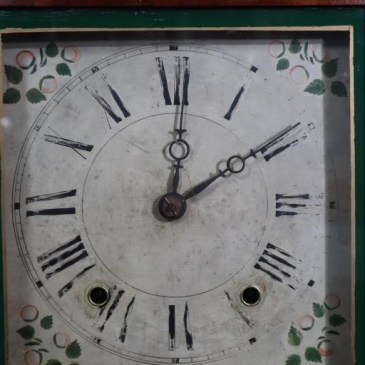
The green banding on the upper and lower glass sections looks somewhat suspicious and could have been added later. This clock also comes with weights and what looks to be an authentic-looking pendulum bob.

The lower tablet might just be a card-stock image, again, likely not original but old nonetheless. The dial has some losses but what there is of the case looks good.

Unknown gallery clock

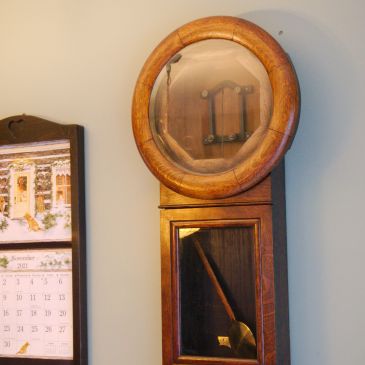
Clock number three is an unknown gallery clock. I have no idea of the maker and cannot even guess. I took a chance and I hope the gamble pays off.

Gallery clock

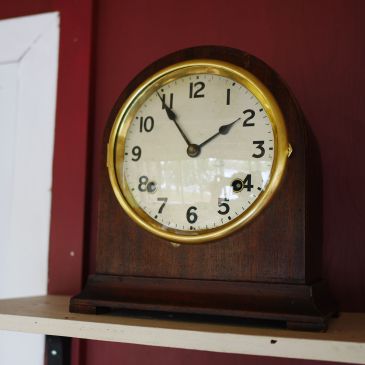
The auction information describes it as 14 inches in diameter so I am assuming the clock face is about 10 inches or so. The hands look very interesting, the case looks well-made (mahogany?) and the clock definitely has a mid to late 1800s English look.

The centrally located winding arbour tells me that it has a time-only mechanical movement.

Back of the clock

The dial looks to have been redone but I am more curious about the movement inside.

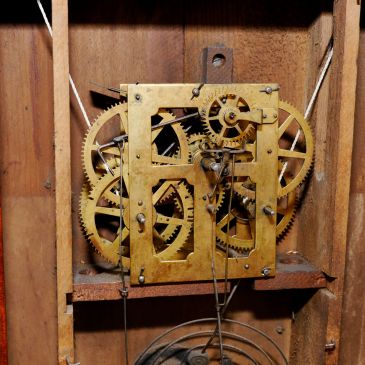
A shot of the movement from the bottom

I am not sure what I am seeing in the photo above. Certainly, a homemade door catch on the left and a large gear (perhaps a mainspring barrel), and cylinder-shaped pendulum bob. Fusee movement? I doubt it. I think it has a conventional spring-driven time-only movement but I will know in a few days.

Six-inch gallery or ships style clock

The last is a smaller gallery, ships, or marine-style clock which is spring-driven with a balance wheel. The speed adjsutment lever below the 12 is the give-away.

It is 8 1/2 inches in diameter (6-inch dial), key wound time-only 30-hour clock with a seconds bit. I cannot even guess who the maker is but could be a Waterbury, E N Welch, or some other American manufacturer.

The chunky oak case needs some attention but with a good cleaning and a coat or two of shellac, it should show nicely. Apparently, it is in working order.

Okay, so, two clock makers I am familiar with and two unknowns. I wonder what surprises await me when I open up the two unknown clocks.

In a day or so we shall see what we get. We are driving down to the auction house in the next couple of days but we will make something of our 3+ hour journey and enjoy the sites, have lunch in Annapolis Royal (Nova Scotia) and do some antiquing along the way.

Delft clock by Forestville – Let’s take it apart and see what we have

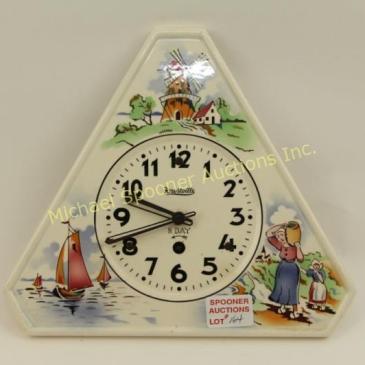
Delft Clock from Forestville

This clock was bought at auction in Ottawa, Ontario, and hung on the wall of the kitchen at our cottage in Quebec for 4 years. The clock was imported from Germany and sold by the Forestville Clock Co. of Toronto, Canada.

It was never a great timekeeper probably because it had never been properly cleaned. I brought it home to Nova Scotia to give it the attention in now deserves.

The word Delft is not a model name but refers to the design and composition of the dial face and surround. According to one source, Delft is “tin-glazed Dutch earthenware with blue and white or polychrome decoration”. Delft also refers to a place in the Netherlands, famous for the manufacture of pottery.

Delft clocks typically had a nondescript Dutch scene as one would expect but since this is not a delft clock by strict definition, it is, instead produced in a German factory (made in Germany stamped on the back) in the Delft style.

Mother and child

Many of these clocks were produced and were quite popular as kitchen clocks in Canada in the 1950s and 1960s perhaps a salute to Canada’s close association with Holland during the war years. There is a number stamped on the back (1054) which may refer to its year of make, 1954.

This clock is only required to run two months a year so, I am not concerned about future wear but a cleaning now will keep the clock running for several more years

Although this clock is from the Forestville Clock Co. other manufacturers produced similar styles. Most if not all of the movements are German-made and called, appropriately enough, “plate clock” movements.

A common Dutch scene

It is a small and simple time-only movement with a hairspring balance similar to what might be found on an alarm clock movement.

With tin dust cover removed

Some Delft clocks are pendulum driven and must be level on the wall to operate correctly whereas a hairspring escapement is more tolerant of placement.

Movement removed showing the mainspring

The mainspring may appear tiny by mechanical clock standards but it is as powerful as it needs to be in a movement this small and designed to run for 8 days.

Disassembly and cleaning

The front plate is affixed to a tin plate and the two cannot be separated unless the rivets are broken. This is a serious issue if bushing work is required on the front plate. To expose the bushing holes one must break the rivets with no guarantee that the tin plate and movement plate would be successfully pressed back together again.

There is some wear in the pivot holes but not enough to warrant concern at this point in time. There is also some pivot hole wear in the back plate but, again, not enough to require bushing work.

Back plate and mainspring removed

At some future point bushing work will have to be done and that would be a challenge for two reasons. One, the back-plate is difficult to access (as described above) and two, any bushings installed would be very tiny. I don’t have anything that small and they would have to be hand made. The designers may not have had servicing in mind when they made the clock and sadly, we are witnessing the beginnings of the throw-away generation.

All the parts, including the mainspring, are cleaned in the ultrasonic, dried thoroughly, inspected and pivots polished. Just a good cleaning and oiling this time around.

Since I decided not to do any bushing work, the movement was put back together. The wheels are installed plus the pallets leaving the escape wheel the last to position. There is an adjustment screw on the bottom plate for the escape wheel which can be Loosened allowing the escape wheel to be installed separately.

On the test stand

Feeding a very minuscule hairspring into its post is always a little tricky and quite often it takes several attempts. Manipulating small clock parts can be frustrating if you are used to working on American clocks with large wheels and pivots.

It is on the test stand and I will run it for about two weeks. If everything is satisfactory the remaining parts will be attached and the clock will be stored until the summer.

This clock is only required to run two months a year so, I am not concerned about future wear but a cleaning now will keep the clock running for several more years.

Fleet Time replacement movement needed – calling all clock parts collectors

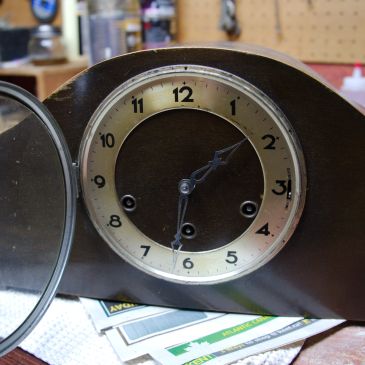
This Fleet Time mantel clock is a generic mantel clock with a walnut finish, flat front, a slightly domed top, and step-side features. Simple but attractive. Fleet assembled clocks sourced from German parts in the Montreal area for 4 years prior to WWII.

While the case looks great after refinishing, I was oh so close to having a fully functioning clock when disaster struck.

This is a call-out for anyone who can sell me or donate a replacement movement or otherwise direct me to where I can locate one. I am in need of a mainspring barrel and second wheel on the time side. As much as possible I would like it to be exactly the style of movement that came with the clock.

Fleet Time case
Fleet Time case, refinished

My clock passion is collecting clocks made or assembled in Canada and I would love to see this clock in working order

Fleet second time wheel
Fleet second wheel, a bent leaf cannot be unbent

Here is my story

The movement looked to be in reasonably good condition but needed a good cleaning.

Fleet time barrel
Fleet time barrel
Fleet time movement
Fleet time movement

The mainsprings can be removed without disassembling the movement, handy for such things as replacing a broken mainspring.

The movement was completely serviced with several new bushings installed. The mainsprings were removed, cleaned, and returned to their barrels.

Through the testing phase, the mainsprings were partially wound. Once I was satisfied that the movement was running well I installed it back into its case. I then wound the strike side fully and then wound the time side. Just as I was feeling resistance, CLUNK, and then the arbour turned freely.

Hoping it was only a broken mainspring I was not prepared for what I discovered when I opened up the movement. There were three broken/bent teeth on the mainspring barrel, a broken mainspring, and a damaged leaf pinion on the second wheel.

Broken mainspring

When a mainspring breaks at the teeth end of the barrel it tries to unwind but the loose end provides sufficient resistance, that is, a slower release of the energy, and is less likely to cause major damage. A broken mainspring results. A break at the winding arbour end or close to it as in this case results in the sudden release of energy and the result is damage not only to the mainspring but clock parts up the train; this is known as collateral damage.

A clock colleague advised me that although the barrel teeth and leaf pinion can be fixed it is usually not cost-effective because the process is so time-consuming. His solution is to collect movements that are used as donors for times such as this.

The plan, at this point, is to source a donor movement and harvest parts for what I hope would result in a successful repair.

So, here I am asking if anyone has a spare movement they can part with.

My clock passion is collecting clocks made or assembled in Canada and I would love to see this clock in working order.

Happy Holidays Everyone

The last two years have taught us to be very thankful for family, friends, and relationships. Of course, we all wish we could be celebrating the holidays in a very different way in 2021 but just when we thought we were seeing the end of the pandemic another wave is crashing over us.

Unfortunately, celebrations will be confined to immediate family and close friends. Who would have thought the pandemic would last as long as it did and through all of this we must press on and continue to be vigilant. Is there an end in sight? I certainly hope so.

Holiday in Lego Land

The pandemic has taught us to appreciate the simpler things in life and during this festive season of giving and receiving, let us take time to slow down and be thankful for what we have.

Christmas at home

May this wonderful time of the year touch your heart and the hearts of your loved ones in a special way.

If there is a clock under the tree consider it a timely gift to remind you of days gone by and of happy memories when families got together to celebrate love, togetherness, and a feast to remember.

I understand the sentiment but a sad end to a tambour style clock

The holiday season is not about getting what you want but appreciating what you have.

Wishing you much happiness not just today, but throughout the coming year.

I would also like to take this opportunity to thank all my visitors, viewers, and subscribers for making antiquevintageclock.com the best year yet.

The Moncton – double spring time only – Part II – servicing the movement

I love this clock. It is one of my favorites. Bought in the fall of 2018, it has been on the kitchen wall and running ever since. Arthur Pequegnat clocks have a solid construction, robust movements, conservative designs, are among the most dependable and reliable clocks in my collection. this model is called the Moncton.

The Moncton was a regular fixture in offices and was then considered a “high-end” office clock. Many also found their way to rail stations across Canada. There were two variations of the Moncton, a short and a long version.

Those made before 1917 were known as the First Issue and had a tapered bottom piece. The second issue had a rounded bottom with a middle cut-out.

They are attractive clocks inspired somewhat by the Seth Thomas #2 although the Moncton has a 15-day double spring driven movement instead of the single weight of the #2.

I knew it required servicing but with so many other clock projects in the way I never got around to it. In my last post I took the movement out of its case and discovered that there is not a lot wrong with it.

The time-only movement is stamped Arthur Pequegnat Clock Company

It was dirty as expected and long overdue for a cleaning.

The movement is pretty simple with 4 wheels and an escape wheel plus the motion works. The two springs apply power simultaneously but one side can be wound if the other spring fails though the clock will run but for a shorter period.

The mainsprings are not what I expected, They are half the width of a typical time-only American clock. There is a reason for this. The Graham deadbeat escapement requires between one fourth to one half the driving power than the same clock using a recoil escapement. Less drive power means less wear over time. Having very few gears and little friction in the gear train also improves efficiency and time-keeping.

The Movement

Seth Thomas Regulator #2

The movement is attached to a support frame bolted to the case.

There are two screws holding the movement on the bottom that must be loosened and two long screws that go through both plates that hold it on top, much like a Seth Thomas #2.

Once disassembled I inspected the movement for wear.

I discovered the lantern pinions and pivots to be in very good condition for the age of the clock.

Time-only movement

The movement might have been cleaned at one point but there is no evidence of past repairs. The bushing holes are a little worn but not enough to warrant bushing work at this time.

Consequently, cleaning parts in the ultrasonic, polishing the pivots, cleaning the mainsprings and pegging out the bushing holes was the extent of servicing.

The movement was assembled and mounted in the clock for testing.

Cleaned and returned to the case for testing; notice the two top mounting screws

It will run for a cycle or two before I re-attach the dial and hands.

A pretty simple servicing requiring less than half a day of my time.

The Moncton – double spring time only – Part 1 – assessing the movement prior to servicing

Canadian clock collectors are very familiar with the name Arthur Pequegnat and associate the maker’s clocks with a solid construction, robust movements, conservative designs, and nationalism since many clocks were named after towns and cities in Canada. The Moncton was named after the City of Moncton in New Brunswick, Canada.

The Moncton was often found in offices and train stations across Canada and was known for its accuracy. This clock is originally from the Toronto (Ontario, Canada) area but I have no idea where it spent most of its life.

Arthur Pequegnat Moncton

For an 80+-year-old clock, it is in exceptional condition. A double spring time-only movement with a Graham deadbeat escapement running at 80BPM means that it is very accurate despite being spring-driven.

It has a 12-inch Arabic dial with simple, bold numbers. The pierced spade hands are attractive and are a common feature on many Pequegnat wall clocks. It has a fumed quarter-sawn oak case, is 35 inches high with a hinged 16-inch oak bezel door that swings to the right to reveal the dial.

The pendulum access door is 14 ½ inches high by 10 ¾ inches wide and swings to the right. The clock is 5 inches deep with wall stabilizers on either side of the case. The pendulum bob is brass over iron with an oak pendulum rod. The dial glass is original and has the “waviness” you would expect with old glass.

Assessment of the movement

With solid plates, front and back, and a mounting system similar (but not quite the same) as the Seth Thomas #2 the movement looks solid. I was expecting past repairs and some wear and, of course, a dirty movement, all confirmed when I looked at the movement for the first time.

Heavy-duty time-only movement

I removed the dial first and the movement from the case. The first step is to let down the mainsprings.

The mainsprings are much smaller than and half the width of a typical American clock with a recoil escapement. Not surprising since a Graham deadbeat escapement requires between one-fourth to one-half the driving power than the same clock using a recoil escapement. Less drive power means less wear over time. Having very few gears and little friction in the gear train also improves efficiency and time-keeping.

Even in its unserviced state, it would easily run 16 or 17 days.

I am not seeing a lot of wear, an indication that the clock has had a good life. The verge arbours may need bushing work otherwise I cannot see any other wear that is problematic. The lantern pinions are also in very good condition.

Next is to inspect the movement more closely and look for anything out of the ordinary.

In Part II I will cover the servicing of the movement.

30-hour clocks in my collection – a complete list

While I have over 85 clocks in my collection twelve are 30-hour or one-day clocks. One of the twelve is a relatively modern clock.

The history of mass-produced clocks in America began in the 1820s and 1830s with 30-hour clocks that had woodworks movements. While the clock business was booming with many companies selling clocks to the masses, an economic recession in the late 1830s brought clock production to a halt.

Pioneer clockmaker Chauncey Jerome, who was in the clock business at the time, considered his “business troubles and disappointments” and he along with his brother Noble formulated the idea that movements could be made from brass. Noble Jerome received patent number 1200 for his brass clock movement, issued June 27, 1839. Woodworks movements began to be phased out and replaced by brass movements which were made in the hundreds of thousands. 30-hour brass movements were made well into the 1860s and were eventually replaced by the 8-day brass movement.

Because 30-hour clocks were produced in the thousands many examples have survived to this day. Most clock aficionados today have at least one ogee clock in their collection.

Of the 12 in my collection 5 are running continuously. Yes, winding a clock everyday is a hassle but we often forget that at one time the thirty hour clock in the form of the bedside alarm clock was a fixture in every home but for this post I am excluding the dozen alarm clocks in my collection.

Half are weight driven, so let’s begin with those.

Sperry and Shaw

Sperry & Shaw 4 column clock

This, a four-column shelf clock designed in the “New York” style was made between 1841 and 1851. Sperry and Shaw were assemblers and distributors and sourced parts from various producers. The movements and cases could have been made by Silas Hoadley or Chauncey Jerome or both.

I bought the clock from student in Halifax, Nova Scotia in the fall of 2018 and he would not budge on the price. My only question to him prior to making the deal was whether or not the clock had the original wafer weights which would be almost impossible to source if missing.

Daniel Pratt and Son

This is the only clock I have with a woodworks movement. Daniel Pratt worked with others but eventually went out on this own in the 1830s. I would date this clock to around 1837. This clock was won at an estate auction for the price of $30 during a time when clock prices were hitting rock bottom. The clock has a wood dial and a mirrored lower tablet (may or may not be original) and the case is in very good condition for its age.

Daniel Pratt and Sons

Chauncey Jerome

Chauncey Jerome 30 hoir Ogee clock
Chauncey Jerome 30 hour Ogee clock

This clock is from around 1855, made just before Chauncey Jerome’s company went into bankruptcy. This was also bought at auction a few years ago. It came with an extra mirrored lower tablet and a “spare” dial. I am not sure if either the mirrored tablet or the JC Brown picture are original. The veneer, however, is in perfect condition.

George H. Clark

George H Clark 30 hour Ogee shelf clock

This is an ogee from around 1857. There is no makers mark on the works but it is a Waterbury type 2.411 movement. The case is well-preserved and in excellent condition, obviously well-cared for by a previous owner. The beehive tablet looks to be original.

Waterbury Clock Co.

This an ogee style clock from 1865. It was bought at an antique store in Halifax. There was no price on the clock. I asked the owner what he would sell it for. He said, name a price, I said $40 and he said, sold! Evidently it been in his shop for a while. It is the first clock on which I learned how to replace very worn trundles.

Cuckoo clock

Dave's cuckoo clock
Dave’s cuckoo clock

This is a 30-hour cuckoo clock with a Regula movement, made about 1976. A cheap German made mass-produced “tourist” clock that was given to me by a relation. It still works but it is on its 3rd movement.

And now for the spring driven clocks.

Ansonia Cottage clock

This cottage clock is from about 1895. This another clock that was given to me. These were probably dollar clocks at the time. They had cheap movements but were solid and reliable. Surprisingly, these command good prices on the auction sites since so few remain.

OLYMPUS DIGITAL CAMERA

Canada Clock Company

The Hamilton Cottage Extra is from about 1880. These are now very difficult to find since so few have survived. It is Canadian made and collectors will happily pay hundreds of dollars for one. It has a very cheap case made of softwood with no veneers. The acid etched lower tablet is quite unique. It was bought in a local junk store for $40. I could not believe my find.

Hamilton Cottage Extra

Elisha Manross

Elisha Manross gothic steeple

The Manross is a thirty hour time and strike and called a steeple clock. One interesting feature is that the Rosewood veneer is in a vertical orientation on the side columns unlike most that have a horizontal orientation. It is also the only clock in my collection that has brass mainsprings which were phased out in the early 1840s making the clock historically significant. Needless to say that in order to preserve the mainsprings I run this clock infrequently.

Hamilton Clock Company

The style is known as gothic steeple. The clock is from about 1876 and features a religious expression on the acid etched lower tablet, “Cling to the Cross”. There are some veneer losses but the clock is in decent shape. The steeple tips never seem to survive on these clocks.

Hamilton Clock Co. 30 hour time and strike

New Haven

This is a spring driven time and strike ogee from around 1875. Unfortunately the veneer has been stripped from the case and the softwood re-stained but it is an attractive little clock nonetheless. The dial is a replacement and the lower tablet has some losses.

Ogee New Haven clock

New Haven

This a called a Sharp Gothic according to the label. It is an American-made clock sold by a jeweler by the name of Thomas B. Spike in Halifax, Nova Scotia (Canada) in the 1880s. The lower tablet features a seaside Parthenon scene which might suggest it was one of many produced for foreign markets. There are some veneer losses but the clock is in running order and keeps reasonably good time. It has replacement mainsprings because it will run for 3 days on a wind. Not bad for a 30-hour clock!

New haven Gothic Steeple clock

I hope you enjoyed this little tour of a part of my collection of 30-hour or one-day clocks and please leave a comment. As for expanding my collection of one-day clocks I am not sure that I would continue acquiring them unless I came across something quite unique or if one were given to me.

Pequegnat clock purchase may not happen and that’s too bad

I am writing this post during what we all hope are the final stages of the pandemic. As of this writing there are many rules in place because of the large number of active cases. One rule is that we are not permitted to leave our municipal areas (May 2021).

As a clock collector it makes it very difficult to acquire clocks especially if the clock that one wishes to purchase is outside ones permissible locale.

For example, I was looking at an Arthur Pequegnat “maple leaf” kitchen clock that was offered for sale on Facebook Marketplace in Bathurst, New Brunswick. Bathurst is about 4 hours drive from my home and in another province which simply means that I cannot pick it up from the prospective seller nor can the seller deliver it to me at this particular time.

I communicated with the seller and I agreed that the price was reasonable. She indicated to me that if she cannot sell it locally she will put it aside for me and when she travels to Nova Scotia, we can connect.

As a Pequegnat collector this clock would be a nice addition to the three other kitchen clocks in my collection.

In early May I floated the idea that it could be shipped to me and I would pay the costs. She replied that she had “googled” it and found the process too complicated and risky. I did not argue with her.

As we are driving through New Brunswick in late June I suggested we could meet at a neutral location near where she lives.

June contact

I contacted the seller this week Late (June) and suggested a rendezvous to make the deal. “I have to speak to my husband” said the seller.

In a modern relationship where each has equal decision-making power, clearing a purchase with the husband is, well, very archaic.

Three other Pequegnat kitchen clocks in my collection are the Canuck and two in the Maple Leaf series, the “pointed top” and the “fan top”

Arthur Pequegnat Canuck kitchen clock
Arthur Pequegnat kichen clock
Arthur Pequegnat fan top kitchen clock
Arthur Pequegnat Maple Leaf Pointed Top

I suggested that we meet along the Trans Canada Highway (TCH) in New Brunswick and the seller replied that she was close to the highway. Well, she thought the TCH ran through Bathurst which is 2 1/2 hours away from the TCH. So, that will not happen. Too bad!

I like the clock and it would be a very nice addition to my collection but I will look elsewhere.

Fleet Time mantel clock – Mainspring damage

The Fleet Time Co. was a short-lived Canadian clock company that operated between the years 1936 and 1940 producing a range of two and three-train mantel clocks with movements sourced from Germany. All clocks had pendulums and were spring-driven. According to the Canadian Clock Museum in Deep River, Ontario, the company was listed as an importer of clocks and watches. The locations were 440 McGill and then 303 St. Paul West, Montreal (Canada).

The Second World War took a heavy toll on this company as the source of movements dried up and so the future prospects of this small company.  Why they did not source movements from France and Germany like the Forestville Clock Co. of Toronto and others during the war years and beyond is anyone’s guess. Perhaps the margins were slim or alternate suppliers could not be found. That and the increasingly popular electric clock doomed the company.

Wood cases were made in Canada for some models while other cabinets were imported from Germany.

Of the two Fleet clocks in my collection one is this two-train clock with an unknown German movement and the other a Westminster chime mantel clock with a German Gufa movement. For more on the Gufa clock go here.

This clock is in much the same condition as my first Fleet clock, dents, gouges and scratches everywhere. Unfortunately, the tinted lacquer finishes on these old clocks do not survive well over time. It is one reason they attract little attention and sell for almost nothing despite having movements that are relatively strong runners.

Fleet Time clock
Fleet Time time and strike mantel clock, broken glass

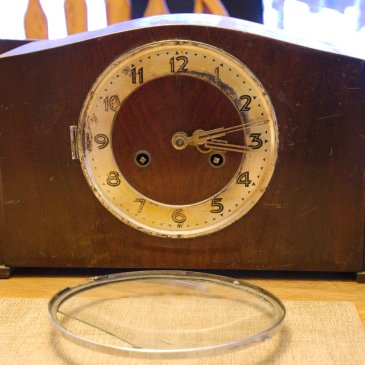
It is a plain, generic mantel clock with a walnut finish, flat front, a slightly domed top, and step-side features on outboard feet. The dial is heavily tarnished and the glass bezel that should be soldered to the chapter ring has detached. These bezels often go missing. At least it came with the clock.

Fleet time movement
Fleet time movement

The clock strikes on 3-rods producing a bim-bam sound, just loud enough so as not to be too intrusive.

The location of the star striking wheel on the movement is somewhat unusual. Commonly found between the plates, the star wheel is on the outside of the rear plate.

Fleet time barrel
Damaged Fleet Time barrel

As I have said in a previous article the barrel and second wheel on the time side were damaged during servicing. I don’t know who the maker is and I would appreciate any information to aid me in my search for a donor movement. The case has been reconditioned, with the addition of a dial and bezel from an old Blackforest Clock Co. clock.

Fleet Time case
Fleet Time case ready for repaired or replaced movement

It is a nice piece of Canadian horological history that I would like to see running.

Fleet Time mantel clock with Gufa movement – servicing the movement

Fleet clock with a new finish

About a year ago I picked up two clocks. I had my eye on one, an Arthur Pequegnat Canuck shelf clock, and the other was “thrown in” as part of the deal. We completed the transaction on the Pequegnat clock and the seller asked me if I wouldn’t mind looking at a mantel clock stored on a shelf in his garage. He said, “for $10 more you can have this”. I did not know the make at the time but for $10, why not! It was in sad condition as you can see in the next photo.

Fleet clock with a worn finish

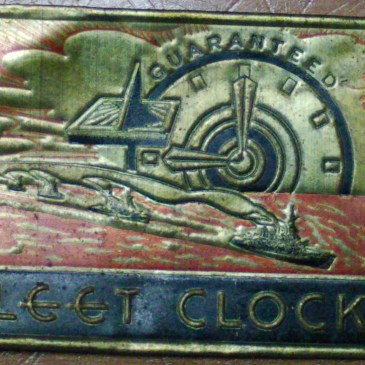
A tin plate affixed on the back of the clock told me what it was made by the Fleet Time Company of Montreal (Canada).

Many of these clocks were sold at department stores across Canada during the pre-war (WWII) era. However, this little-known Canadian clock company had a brief life span. Between 1936 and 1940 the company produced a range of two and three-train mantel clocks with movements sourced from Germany but were forced to end their operations when the war began.

Fleet label
Fleet Time Co. label

The Second World War took a heavy toll on this company as the source of movements dried up and so did the company’s fortunes.

Wood cases were made in Canada for some models while other cabinets were imported from Germany.

Servicing the movement

I had completed work on the case a few months ago and now it is time to service the movement.

3 train Fleet movement by Gufa

The clock has a Gufa Westminster chime movement. Gufa is the Guetenbacher Uhrenfabrik, located in Gütenbach, Germany. They manufactured 400-day clocks, cuckoo-clocks and later they became the “Jahresuhrenfabrik” (August Schatz & Sons in Triberg, Germany). Gufa is not a name horologists come across very often in North American. There is a chime gear patent date number ending in 34 which likely refers to the year 1934 indicating manufacture between 1935 and 1939. It is a solid, well-built movement.

Assessment of the movement

I had replaced the time mainspring shortly after I bought the clock but I knew that I would eventually have the movement on the workbench. As is typical of German clocks of this period in that the mainspring barrels can be removed without dismantling the movement, so, replacing the time mainspring was an easy fix.

The clock was running, though not well. On the fourth or fifth day, the chimes (and strike) would stop though the time train would soldier on a few days more. Wear issues on the strike and chime train had to be addressed.

I disassembled the movement, put the parts into the ultrasonic cleaner, and discovered afterwards that the plates had been lacquered. With the ultrasonic heat setting on, the lacquer stripped off but not uniformly. As it is a $10 clock I am not concerned about aesthetics.

Fleet wheels
Fleet movement wheels tied together according to location

To eliminate the chance that I would mix up the wheels for the 3 trains, I tied each set together. Once out of the ultrasonic cleaner I untied them and placed them in their respective trays. Westminster chime movements have similar-looking gears in the three trains and it is best to separate them to avoid frustration during re-assembly.

After inspecting the movement I determined that new bushings were required on the second wheels plus the motion works arbour. Three of the second wheels on the backplate, one bushing for the strike side second wheel front plate, and one for the motion works for a total of 5 new bushings; not bad for a 3-train movement. These are the typical wear points on three-train movements as the second wheels handle the greatest load.

Bushing work

Once the pivot holes were pegged out and the wheels rechecked in their locations, the bushing begins. Aside from the second wheels, most other pivot holes were in good shape. I don’t often use bushings with an outside diameter of 4.50mm but this movement required 4 in total. All bushings had to be reamed out with a cutting broach followed by a smoothing broach. All wheels were test fit with the plates together and things looked good.

Reassembly

Next is reassembly. With so many wheels it is a bit trickier than a two-train movement but it is important to work slowly and carefully to avoid a bent pivot. Once the wheels are positioned, test each train to check that everything is in place. After the nuts are tightened, the remaining parts such as the locking plate, chime locking lever, warning lever, rack snail, mainspring barrels and so on are installed/attached.

Testing

Of all movements, three trains are the most difficult to set up correctly. Although all three trains spin independently they are interconnected by levers. In order for everything to function in unison, careful attention must be paid to the job of each lever, what it does and how it performs its function every 15 minutes.

Gufa movement
Gufa movement, front plate showing rack, snail, levers, and so on

Everything went fairly smoothly. Both the strike side and chime side go into warning as they should, the locking plate stops the chime at each quarter-hour including the hour, which is a good sign the locking hook on the chime train is in the correct position.

Gufa movement
Gufa movement on the test stand

The chime strike lever is, however, sticking on the strike warning pin. Without taking the movement apart I used 1600 grit memory paper to smooth the hook end surface where it meets the strike warning wheel pin. The polishing allowed it to function a little better but continued testing revealed that that solution did not work. I finally had to remove the chime strike lever and polish the hook. the polishing was successful.

The next issue is the strike paddle which is ending the strike sequence hanging off one of the star points. The plates on the strike side must be opened up and the paddle repositioned. For safety reasons and to preserve the mechanism should things go awry, the power is let down on all mainsprings. Adjustments such as these come with the territory as nothing should be expected to work perfectly the first time.

Gufa movement
Gufa movement, the upper wheel is the main chime wheel

After the aforementioned adjustments are made, next is the chime sequence and that means loosening the set screw for the main chime wheel and rotating the drum till the quarter strike is at the 1-2-3-4, the beginning of the sequence.

Once the adjustments have been made it is back to the test stand.

Okay, my strike paddle adjustment did not work but in the meantime, the testing of the movement proceeded and everything looks very good at this point. I will give it a few days and return to re-adjusting that paddle.

Everything is working now.

I’ll be honest, 3 train movements are not my favorite type to work on for 4 reasons. One, they often need major work only after a few years. Secondly, it is often not enough to install new bushings for worn pivot holes lower in the trains but to address other worn holes up the trains, as well. Thirdly, they are labour intensive and finally, except for modern movements, parts are almost impossible to find.

In many cases, certainly as far as a modern Hermle is concerned, it is often more cost-effective to simply replace the movement rather than repair it.

Time for a short break

The past year has been like nothing we have ever experienced in our lifetime. Routines, relationships and plans were upset and with them major adjustments have had to be made. The situation is improving day by day, folks are re-establishing their routines, the country is opening up and things will no doubt return to normal in the months to come and with it a new definition of normal.

How will future generations define this dark period of our lives?

The lake our Shangri-La

It is time to relax, slow down and for my wife and I that means a change of scenery as we travel to our cottage in central Canada to spend the summer season with friends and family. Our get-away plan for the summer is to relax with a few good books, do a little fishing, swimming, hiking and exchange stories with friends and neighbours over a glass (or more) of wine.

Since many of my articles have been written well in advance of the summer months there will be NO interruption in blog posts through the summer months. I will continue to maintain a steady output of 7 to 9 clock blog articles per month.

Taking a look at this Ansonia cotteg clockwith the dial off
An Ansonia cottage clock with the dial removed for testing and spaghetti for lunch

Keep those cards letters coming as 1960s TV variety host Dean Martin used to say. There may be a slight delay returning your email inquiry or responding to blog post comments but rest assured that question(s) about your clock or comments regarding any of my posts are important to me and will be answered.

Roasting marshmallows

This blog profiles my own clock collection, the challenges of maintaining and repairing clocks, the joys of finding new and interesting vintage and antique clocks plus many articles of horological interest.

As we explore central Canada I will no doubt find interesting clocks as we scour antique stores, flea markets and junk shops. New clock stories, new repair challenges and perhaps the next major restoration project will also be part of my journey this summer.

Canadian Clock Museum
Canadian Clock Museum, Deep River Ontario

Included will be a trip to The Canadian Clock Museum in Deep River, Ontario to discover new and interesting clocks added to their collection and chat with curator Allan Symons.

Use the search box to browse past articles and/or click “follow” to have clock articles brought to your mailbox every three to four days. I hope you enjoy reading them as much as I enjoy researching each and every article.

Happy Canada Day!

Arthur Pequegnat clocks in my collection

Eight years ago I acquired my first Arthur Pequegnat clock. In the years following, I have added to my collection and now have a total of 8. Although my collection of Pequegnat clocks is very modest by comparison to a dedicated Pequegant collector it is a good start and I would certainly like to add to that number in the future.

The Arthur Pequegnat Clock Company (1904–1941) is notable as the longest-lasting Canadian-based clock manufacturer. They made a wide variety of different styled clocks from 1904 through to 1941 from shelf and mantel clocks to wall clocks and floor models.

The time and strike with signature nickle-plated steel plates
Nickle-plated steel or brass plates

Unfortunately, it is very difficult to date a Pequegnat clock, except for what is termed pre and post-Berlin, the location of the company’s manufacturing plant. Clocks made before 1917 were inscribed “Berlin, Canada” on the dial face. Kitchener, Ontario was known as Berlin prior to and during the first World War. It was the town of Berlin from 1854 until 1912 then the City of Berlin from 1912 until 1916.

Because the name Berlin was associated with the war against Germany the town fathers decided the name Kitchener was less offensive and the change was made midway through the First World War. Kitchener is the present seat of the Regional Municipality of Waterloo, Ontario, Canada.

Most Arthur Pequegant clock movements are stamped with the company name but there are no date marks on movements indicating when it was made. Clocks made after the First War wore the company name plus Canada under the number 6 on the dial face. For example, clocks such at the Canadian Time were made from 1904 to 1941 and are separated in age by the Berlin label consequently, my Canadian Time wall clock with the Canada label could be as old as 104 or as “new” as 80 years old.

One distinctive feature on many movements is the use of nickel plating for both brass and steel plates.

Clock face Arthur Pequegnat Canadian Time clock
Arthur Pequegnat Company name

Many models continued in production right up to 1941. By 1941, the demands of World War II armament makers for brass, the essential ingredient in clock movements as well as the growing popularity of the electric clock, forced the Arthur Pequegnat company to cease production.

And now, beginning with the first clock acquired in 2013.

The Canadian Time

My first Pequegant, purchased in September 2013 hung in the Intercolonial Rail Station waiting room in Pictou, Nova Scotia.

Canadian time clock
Canadian Time

The seller arranged the purchase of the clock just prior to the station’s decommissioning in 1993. It is in very good condition, missing its door clasp but otherwise intact. There are a few scratches and nicks consistent with its age but nothing objectionable.

The Brandon (2nd edititon)

I found this clock in an antique shop just outside Truro, Nova Scotia in 2014.

Arthur Pequegant Brandon II

The case is in excellent condition but the movement was quite worn. Had I known more about servicing clocks at the time of purchase I would not have sent it to a clock repair specialist. It is one of two in my Pequegant collection serviced by someone other than myself. This is the Brandon II. The Brandon 1, the first edition, was made prior to 1918, and had an ornate pressed wood bezel. This one is simpler in design.

The Maple Leaf “Fan-top”

Next came my first Maple Leaf kitchen clock, known for its unique lower tablet of scattered maple leaves and a distinctive maple leaf pendulum.

Arthur Pequegnat Maple Leaf kitchen clock

This clock, bought in 2015, was also serviced by a clock professional. The case was in very poor condition. Stripping a case is an absolute last resort as far as I’m concerned but the finish on this clock was pretty bad. I could not leave it as it was.

The finish on a Pequegnat fan-top clock

To Pequegnat collectors, it is known as the fan-top.

The Simcoe

Three years later, the Simcoe followed me home. It was bought at an antique shop in Victoria, British Columbia in  2018.

Arthur Pequegnat Simcoe mantel clock

It is not particularly attractive. It is the only mantel clock in my Pequegnat collection and it is from the “Berlin” period.

The Bedford

2018 was a good year because I acquired 4 Pequegnat clocks. This was number two of that year.

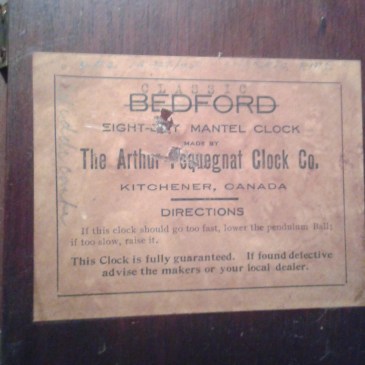
Restored Athur Pequegnat Bedford mantel clock
Bedford shelf clock

This clock was gifted to me by a reader. He asked if I wanted the clock but I had to pick it up in Quebec which was on our way to a summer cottage in central Canada. The movement was in very good condition but the case was damaged having taken a plunge off a high shelf.

The movement was serviced without issue but the case required extensive intervention.

The third purchase that year and the fifth in my collection is the Maple Leaf Pointed Top

The Maple Leaf “Pointed Top”

There are 4 Maple Leaf clocks made by Pequegnat. Any version of the Maple Leaf is sought after by Canadian collectors but this one has distinctive pointed side columns, hence the nickname.

Arthur Pequegnat Maple Leaf Pointed Top

Although termed a kitchen clock it could easily have been placed in a living room or parlour.

The Moncton 

The last 2018 acquisition was a clock that I had in the back of my mind for quite some time and I was waiting for the right price. This is an excellent copy that is very presentable and looks great on our kitchen wall.

Arthur Pequegnat Moncton

It is a post-Berlin double spring time-only 15-day clock. Many were used in rail stations despite the fact that they were spring-driven. Weight-driven clocks were preferred for their accuracy but the Moncton was up to the task as a timekeeper.

And the last.

The Canuck 

This is the only true Pequegant “gingerbread” clock in my view.

Arthur Pequegnat Canuck kitchen clock
Canuck kitchen clock

The case was refreshed and the dial was redone. The movement was also serviced without issue.

Cleaned up more presentable

These are all keepers. Most Pequegants have kept their value over the years and in Canada, they are regarded as quality clocks for the masses. They were well built, well-designed movements with a distinctive Canadian charm as many were named after cities in Canada.

A hall clock would complete my modest collection.

First blog post – 6 years ago

Clock collecting from a beginner’s perspective. That was the subject of my first blog post six years ago. Since then I have seen a lot of excellent and not-so-good blogs come and go but I wanted to give it my best shot and after 6 years, well, I am still here.

I started with a free WordPress plan, moved to a personal plan and then, this year, to a Premium plan. I now permit advertising on my site but my only goal is to recoup costs for server space and domain name. Anything extra is gravy.

In the early days I would stop blogging in the summer and resume in the fall. That did not work so well as my viewership fell off and I had to rebuild after the holidays. Now I schedule all my articles in advance. In fact, I typically have about 15-18 articles “in the can” at any given time. Having an inventory of articles means there is no need to scramble with something new every 3-4 days, my typical interval between articles. Some of you bloggers must know how hard it is to put words together when inspiration is lacking.

I am not sure what I was expecting 6 years ago but now have a dedicated following, receive many interesting letters each week, have met people through my blog and it seems people appreciate my content. This is reflected in statistics which are the lifeblood of any blog and it’s those daily figures that keep a blogger motivated. For instance, I have more views in a typical day than I had in the first 3 months of my blog.

Not once do I claim to be a professional horologist but after 10+ years in clock repair as a hobbyist I think I know something by now.

Welcome to my first blog post written May 15, 2015 which I will present word for word.

wall clock
OK, so it’s a Chinese clock but it works

I regard myself as a clock collector and tinkerer. I am not a trained horologist nor do I have a unique talent for clock repair or even getting a simple clock back to working order, but I find the world of horology to be quite fascinating.

It is a relatively new hobby for me which began with the purchase of a Daniel Dakota time and strike wall clock. Why start with a Chinese-made clock which most would consider inferior to almost any other clock in the world. It was cheap, it piqued my interest in collecting and repair and it was something to practice on. I then moved on to a Ridgeway grandfather clock and to my current collection of Mauthe, Seth Thomas, Hermle, Forestville, Sessions, Smiths Enfield, Muller and Pequegnat clocks.

Arthur Pequegnat kitchen clock, known as the “Fan-top”

My blog will profile clocks in my collection both vintage and antique as well as describe my attempts at repair. Along the way I will seek advice from you, the reader, from clock forum sites and whatever information I can find online.

Seth Thomas Adamantine mantel clock

Clock collecting is a great conversation starter and it allows me to combine my other passions, photography and traveling (and now, writing). Locating good clocks means traveling around the province of Nova Scotia and Canada, meeting interesting people along the way and is some cases getting that one-of-a-kind deal.

Most photos on this site are my own. Photos from other sources will be given full credit. I will try to capture the beauty of these old mechanical wonders and anything about their provenance will included as well.

Forestville Westminster chime
Forestville Westminster chime mantel clock

Stay tuned. It is all a learning experience and as I bravely go further into the hobby I hope to share my frustrations and my successes.

As Winston Churchill once said, “Success is walking from failure to failure with no loss of enthusiasm”.

I have stayed true to form since then and continue to publish 7 to 9 articles per month. Since then I have acquired dozens of antique and vintage clocks from all over Canada and probably have upwards of 80 clocks in my collection at this point. I have also said goodbye to an additional 20 clocks through local sales and as gifts. It remains a hobby that I thoroughly enjoy although occasionally I have done some paid and pro bono work.

If you have stayed with me since the beginning, thank you, but if you are new to my blog or following for the first time, welcome!

Anyway as I said 6 years ago, “Stay tuned”.

The Snider Clock Company of Canada

Canadian clock collectors familiar with companies such as Arthur Pequegnat, the Canada Clock Company, the Hamilton Clock Company, Forestville, and Fleet seldom consider the Snider Clock company clocks for their collections yet for a quarter of a century this home-grown Canadian company made mantel and wall clocks designed and manufactured in Toronto, Ontario.

Starburst clock in a boutique hotel, Quebec City

Harry Snider began making clocks in 1950 under the name Snider Clock Corporation. The name then changed to the Snider Clock Manufacturing Company Limited in 1957. Throughout its history it continued as a family venture until the last clock was made in 1976.

A master clock surrounded by Snider clocks, Canadian Clock Museum, Deep River Canada

Some say they only made fashion and novelty clocks and to some extent that is true. The Snider Clock company’s response to the trends and fashions encapsulated a healthy design philosophy that kept pace with the times. Innovation, quirkiness with fanciful designs are the hallmarks of their approach to clock manufacture.

Snider Clock Company
Former Snider Clock Company location in Toronto as it appeared in 2007

The company began by making mantel clocks with mechanical versions supplied by Ingraham, and later, mantel clocks with electric motors imported unassembled from the Lanshire company in Chicago. In 1960 Snider shifted focus to wall clocks which were in great demand at the time, a demand likely brought on by the Sputnik satellite, the interest in space adventure and the dawn of the “Atomic age”. Models with starburst and molecular patterns attracted new buyers.

Most models were corded electric clocks but in order to do away with the cord Snider offered an upgrade to electromechanical models with battery movements. The advantage of a battery movement was the flexibly in placement anywhere in the home.

The longest running style of clock was the starburst clock. When I think of a Snider clock the first image that comes to mind is an electric kitchen wall clock in a starburst or sunburst pattern. These were very popular and Snider sold thousands.

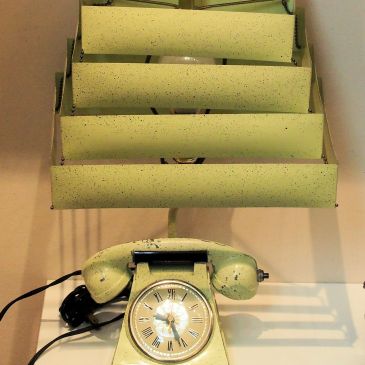
Telephone clock

However, Snider made unusual and fanciful lamp clocks, telephone clocks, in china, metal cast, brass-plated metal and many colours such as in brown, pink, turquoise and black.

Snider Novelty clocks, Canadian Clock Museum

In the peak years, the company made 50,000 clocks, had 20 employees, and used mainly Canadian components. Throughout its history, it strove to constantly adjust to a constantly changing market.

In 1976 when Caravelle clocks (a subsidiary of Bulova) arranged licensing agreements with retailers in Canada, Snider could not compete and ended its business after 26 profitable years. A sad end to a company ultimately pushed aside by an American competitor.

Fleet Time Clock – servicing the movement and then disaster

Fleet Time clock
Fleet Time Co. mantel clock

This Fleet Time, time and strike mantel clock is essentially a plain, garden variety clock with a walnut finish, flat front, a slightly domed top, and step-side features on corner feet. The dial is heavily tarnished and the glass bezel that should be soldered to the chapter ring is detached. These bezels often go missing and at least this one came with the clock.

The clock has some issues, none of which are insurmountable. The plan is to refinish the case, attach the bezel, clean-up the dial or replace it, install new glass, and service the movement.

In this post servicing the movement is the focus.

The movement looked reasonably good when I received it and it may have had some bushing work done in the past but once apart it was clear to me that it might never have been worked on beyond a cleaning. It ran when I got it and one is tempted to leave it as is but it was dirty, had some wear and long overdue for a good cleaning.

Servicing the movement

Fleet time movement
Fleet time movement

Disassembly and testing for wear

I discovered two troubling issues when I had it apart. I put the wheels together to check for wear and I noticed the escape wheel was a fair distance along the arbour from its correct position adjacent to the leaf pinion (no photos, sorry). The pallets were contacting the very edge of the wheel. My staking set comes in handy from time to time and it was needed to close the gap between the wheel and the pinion.

staking set
staking set

Using light taps from a hammer and an appropriately sized punch I drove the wheel closer to the pinion. The pallets now contact the middle of the wheel as they should. Odd!

Fleet time movement
Fleet time movement, dirty and in need of a good cleaning

The second was an erratic beat during the testing phase of the time side. With a beat amplifier connected, I could hear the movement go ever so slightly in and out of beat, yet the movement continued to run. There are a number of possibilities but one is a bent escape wheel arbour which, in this case, was the culprit. Bent arbours are not difficult to straighten but care must be taken to bent them carefully so as to prevent a break. A broken arbour can be a very frustrating clock problem.

Once the 2 issues were out of the way it is on to cleaning the parts, inspecting and polishing the pivots, pegging the pivot holes, followed by bushing work. Most of the bushings that were installed were on the strike side. In fact, 4 of six, 3 on the backplate and one on the front plate, strike side, and the two on the time side were on the second wheel. Two were 2.5 OD bushings. I work on a lot of American and European clocks and cannot recall using bushings that small.

Testing

After cleaning and bushing work is completed the rack, snail, levers, and strike hammers/levers are attached.

Since the star wheel is on the outside of the plate I thought attaching the strike hammers would be simple. Not so much!

Fleet Time movement
Fleet Time movement, star wheel paddles

Again as in all movements with star wheels, the strike paddles must sit between the star points. One was fine, the other hung on the tip of a point. Rather than attempt to force the star into position, the strike side was partially disassembled and the star wheel was re-positioned. Yes, it meant removing wheels on the strike side to change the orientation of the star wheel but it is best to do it correctly rather than risk damage to the gear.

On this movement, the mainsprings can be removed without disassembling the movement. Handy for such things as replacing a broken mainspring and making the above adjustment.

Fleet time movement
Fleet time movement

The movement was on the test stand for two eight-day cycles and now it is time to return it to its case.

Just when everything seemed to go well – disaster 

I polished the 3-rod gong and mounted it and the movement within the case. I wound the strike side fully and then wound the time side. Just as I was feeling resistance, CLUNK, and then the arbour turned freely. Did the mainspring slip off the winding arbour or, did the mainspring break?

Sourcing a mainspring is not a problem but when I removed the barrel I discovered two broken and one bent tooth on the mainspring barrel plus a broken mainspring. Make that three broken teeth since a bent tooth cannot be straightened.

Broken and bent teeth

I do not have the specialized equipment to make and install new teeth and sourcing a 60 tooth barrel that is the exact height and depth would be a challenge. Worse, the catastrophic shock of the broken mainspring took out one leaf of the second wheel pinion. 

When the mainspring breaks on the arbour end, which occurred in this case, the power is released uncontrolled, and causes damage to the barrel, the second wheel or both. When the mainspring breaks at the other end it tries to unwind and the loose end provides sufficient resistance, that is, a much slower release of the energy, and is less likely to cause major damage. In the latter case the mainspring is the only thing that is damaged and it can be easily replaced. In the former, both the barrel and second wheel need to be repaired or replaced.

This is an unusual situation, but it happens.

Fleet second time wheel
Fleet second time wheel with bent pinion leaf which cannot be straightened

The movement was aside to consider next steps. In the meantime, the plan is to locate a donor movement. The power was let down on the strike side, and everything was placed in a sealed plastic bag and marked for storage.

I’ll be honest, this situation bummed me out and it took a week to return to servicing another movement.

The clock case

The plan, after servicing the movement, was to devote a separate post on the case but since the movement is non-functional there is not much point. While the movement was on the test stand, I spent hours on the case, stripping, finishing, and polishing including swapping out the dial and broken glass with one from a Blackforest clock from the same period (both companies used the same suppliers). The case came out better than expected but now there is no movement to put in it.

Fleet Time case
Fleet Time refinished case and replacement bezel and dial

The most disappointing part? I was at the very end of the project. The movement and rod gong were installed in the beautifully reconditioned case and I was preparing it for its first run after having tested it for two weeks. I did not expect it to go out with such a destructive bang.

Broken time-side mainspring

I asked a clock friend for some advice. He says that although the barrel teeth and leaf pinion can be fixed it is usually not worth it because the process is so time consuming. “What do you do?”, I said. “I collect movements that are used as donors for times such as this”, he replied.

A sad end to an otherwise satisfying servicing.

Tick Talk Tuesday #30 – a Forestville clock

Tick-Talk Tuesday is about the letters and comments I have received from you, the reader, concerning your clock, issues you might have had, challenges you face or a clock you would like me to profile or my responses to your questions with advice on your particular clock concern. For those comments and questions that stump even me, I consult within my clock circles for the best possible answer

JS writes;

“I found your blog online. I wasn’t sure if you were able to help. But I’m trying to find some information on a mantle clock I purchased.

Blackforest clock Co.
Blackforest Clock Co.

It is made by Black Forest Clock Company, which I know is Canadian. Just curious if you recognized the clock and a possible year.

My reply;

“Hi and thanks for your email, Joe. The company was first called the Blackforest Clock Company when formed in 1928 and changed its name to the Forestville Clock Co. In 1941. The same company just a change in the name. It was based in Toronto through its life right up to the late 1970s. If it is a Blackforest clock it was made prior to 1941. Is it a pendulum clock or does it have a floating balance escapement? If you are not sure, send me a photo of the movement.”

Which JS promptly sent:

Blackforest Clock Co.

Just purchased it at an auction. I look forward to picking it up and putting it on the mantle. Be safe and well and thank you again.

My reply:

“Looks like a nice pendulum clock.”

Ten active clock companies in Canada during the 1950s

Canadian clock collectors are most familiar with the Arthur Pequegnat Clock Company that closed its doors in 1941 but 7 years later a number of clock companies were alive and flourishing in Canada, predominantly in areas in and around Toronto.

It is difficult to imagine that seventy years ago there were ten active clock companies in Canada. Unfortunately, none of these companies survived beyond the late 1970s.

Could any of these companies survive today?

Here are the ten Canadian clock manufacturers in no particular order:

BRESLIN INDUSTRIES: of Toronto: Clocks were a sideline for this company run by the Breslin family, whose products were focused on lamps, lampshades, and novelties. The only clocks in existence have horses as the typical 1950s theme. The wind-up movements are the same Ingraham type used by Snider, another company on this list.

INGRAHAM CANADIAN CLOCK COMPANY of Toronto. Ingraham clocks were being made by the original American company in Bristol, Connecticut from the mid-1800s. The Canadian factory was located in Toronto from the late 1940s until at least 1980. Wall and alarm models, the latter with wind-up or electric movements, were made for the Canadian market. Representative examples of typical alarm, kitchen, and starburst wall clocks with Ingraham Canadian, Ingraham Canadian Clock Co. Ltd, or Ingraham plus Made in Canada on the dial. The novelty windup alarm clocks, The Westerner and The Mountie are popular with collectors of animated models.

WESTCLOX CANADA of Peterborough, Ontario: The parent company started making alarm clocks in LaSalle, Illinois, near Chicago, before 1900. The Canadian factory operations began in Peterborough in 1920. The new building was ready in 1923. Business was so good that additions were put on several times up to the 1950s.

Westclox peterborough plant
Westclox Peterborough plant

However, by the mid-1980s the North American Westclox factories were closing down in favour of lower labour costs from China. Westclox is best known for its millions of Big Ben and Baby Ben windup and electric alarm clocks made in various styles between 1920 and the early 1980s in Canada. The company also make wall clocks for kitchens, dining, and recreation rooms starting in the 1930s. If collecting, avoid Westclox alarm clocks made in China.

Westclox LaSalle alarm clock
Westclox LaSalle alarm clock, assembled in Peterborough, Ontario

SETH THOMAS CLOCKS of Peterborough, Ontario: This old company was founded by Seth Thomas in the early 1800s in Plymouth, Connecticut (now Thomaston). In 1931 it became part of General Time Corporation, which owned Westclox. Seth Thomas brand mantel, alarm, and wall clocks were produced for the Canadian market in the Westclox factory from 1931 to the mid-1980s. However, inferior clocks produced under the Talley Industries brand are avoided by serious collectors.

NEW HAVEN CLOCK COMPANY of Brantford, Ontario: The parent company was based in New Haven, Connecticut originating in1900. Some mantel and wall clocks were made in Brantford with Canadian wood cases, but the spring-driven pendulum movements were brought in from the U.S. factory. Most clocks were made for schools and offices.

New Haven schoolhouse clock
New Haven schoolhouse clock, made in the USA but assembled in Brantford, Ontario

FORESTVILLE CLOCK COMPANY of Toronto: Set up by Leopold and Sarah Stossel as the Blackforest Clock Company in Toronto in 1928 the name changed to the Forestville Clock Company in 1941 because of World War II, and continued in business until the late 1970s. Forestville sourced movements from England, France and Germany.

Forestville Westminster chime
1970s Forestville Westminster chime, Canadian case(?) with German movement

Blackforest shelf clock
Blackforest shelf clock circa 1939

CANADIAN NEON-RAY CLOCK COMPANY: The main product was “Bulb Illuminated” advertising clocks. this business was in operation from about 1942 to the mid-1960s In Montreal. Many companies purchased these clocks to advertise their products such as soft drinks, beer, service station items like motor oil and spark plugs, ice cream, paints, meats, and mattresses.  French-language, as well as English advertising clocks, are commonly found in Canada.

CANADIAN GENERAL ELECTRIC of Barrie, Ontario. In addition to large industrial electrical components, CGE produced electric alarm, table, and kitchen wall clocks for the Canadian market from the 1930s into at least the 50s. CGE kitchen wall and alarm clocks were produced in large numbers.

SNIDER CLOCK MANUFACTURING COMPANY LIMITED of Toronto. The Snider Clock Corporation and its successor, the Snider Clock Mfg Company, flourished for over twenty-five years (1950 to 1976). Their success is a tribute to Harry Snider and his family for the many unique clock designs that were created, to the effective construction methods developed by Harry and then Michael Snider for them, and to their business skills in promoting and selling their clocks through hundreds of stores across Canada.

Snider Clock Company
Former location of the Snider Clock Company

WALTER CLOCKS of Toronto. The main product was mantel clocks. All of the cases were made in Toronto.  At least a dozen different models were produced in the mid to the late 1930s before WWII.  During that time, both time & strike and Westminster chimes spring-driven movements were imported from Britain and Germany. The war meant that overseas movements were not available and clock production stopped.  But many more models were made after WWII, from the late 1940s through to the late 1950s. The prewar models had walnut veneer cases and hinged back doors.  The removable round door on the back of the postwar models mostly made with less expensive, stained birch wood, was unique. Production continued up to the late 1950s when the last of the Walter Clocks mantel clocks were made.

Gone forever. It is a shame. Gone is the knowledge, expertise, and entrepreneurship. Could any of these companies survive today? No, they were important in their day, thrived on innovation and some were ahead of their time but the world is a different place today.

Solar time and strike mantel clock by Eatons – first look

In the 1960s, T. Eaton & Co., one of Canada’s most iconic department stores, offered a variety of home goods to suit the tastes of the era. Among their diverse range of products was a charming collection of clocks, including the small but striking mantel clock that continues to capture the attention of collectors today. Its distinctive style and craftsmanship represented a unique intersection of mass-market appeal and decorative elegance.

In this article, we take a closer look at this somewhat ordinary-looking clock, exploring its design, history, and place within the broader context of mid-century Canadian home décor.

Solar mantel clock
Solar mantel clock

A changing economic and retail environment in the late 1990s, along with mismanagement, culminated in the chain’s dissolution in 1999. As a young child, I remember pouring through the Eatons “Christmas Wish Book” trying to decide on that perfect gift….for me!

Eatons catalog
1975 Eaton’s catalogue, page 184, clocks (Online image: Fair Use; for information purposes only)

Eaton’s catalogue, as well as department stores spread across Canada, sold a variety of clocks including this mantel clock with a German-made Hermle movement under their house brand, Solar. Many of the Solar clocks sold from the 1950s through to the 1980s survive in Canadian homes to this day more as decorations rather than functional pieces.

This particular example is a time and strike mantel clock featuring a 6″ dial and a dark walnut case. Priced at approximately $50 or $60 when it was first sold, it measures around 13″ wide, 7″ high, and 4″ deep. Its compact size makes it an ideal choice for homes where space is limited, fitting comfortably in nearly any room without overwhelming the space.

Equipped with a Type 141 German movement from Hermle, this clock features a recoil escapement, an 11cm pendulum, and operates at a rate of 200.8 beats per minute. It strikes on the half-hour with a bell, though its chime isn’t particularly melodious. As a testament to its design and durability, the type 141 is still being produced by Hermle GmbH & Co. KG today.

It also came with instructions and a product card from Eatons.

Solar Hermle movement
Solar with type 141 Hermle movement (trademark FHS)

When I purchased the clock, it wasn’t running, and I hoped that a thorough cleaning would restore its function. The scratches and gouges on the backplate of the movement suggest that it has been serviced before. However, I won’t know the full extent of any previous repairs until I remove the movement from its case for a closer inspection. My main concern is the possibility of plated pivots, which were a common issue with Hermle clocks from the late 1970s to the late 1980s. Fortunately, I have a strong feeling that this clock predates that troublesome period.

The case, on the other hand, is in near-perfect condition.

It will be serviced and put up for sale. I am not normally in the business of selling clocks but will sell the odd one locally to trim my collection and cover clock supplies.

Look for an upcoming blog article on the servicing of the Hermle movement.

Mauthe box clock – In clock repair, fine-tune adjustments are part of the experience

Do you ever run into those situations working with clock movements when one little thing is so annoying? I recently serviced one of my box clocks, a Mauthe with a bim-bam strike. Everything went according to plan except for one small issue; the strike side was misbehaving. I’ll explain a little later but first something about the clock.

German "box" clock by Mauthe
German “box” clock by Mauthe

Nowhere on this clock German “box” clock by Mauthe does it have the Mauthe trademark or name, not on the clock face or any markings on the movement. However, an excellent clue is the two-rod gong, which was made by Divina, a subsidiary of Mauthe.

Divina rod gong
Divina rod gong

The clock was likely sold under the Forestville or Solar name in department stores across Canada in the 1940s. There is an applique of a maple leaf on the crown so, I would like to think it was made for the Canadian market. These are very good movements, are designed for long life and the sound of the gong is impressive.

So, what’s the problem?

The movement was taken out, cleaned, and one bushing installed. The movement is in very good overall condition despite having last seen a servicing in 1979 according to a date scratched on the front plate.

Mauthe movement front plate

Putting these German movements back together is not that difficult but one always must be mindful of the small pivots and the risk of bending or breaking one. How do I know that? Well, I might have bent or broken one or two along my journey through clock repair but not on this movement.

Mauthe movement back plate
Mauthe movement backplate

Two critical adjustments prior to assembling the plates are the placement of both the stop or warning wheel and the star wheel.

Mauthe movement and the star wheel

The stop or warning wheel requires about half a rotation to arrest the train during the warning phase by means of a stop pin. During dis-assembly I made a note of the location pin, at approximately the 12 o’clock position which saved time and frustration and it worked just fine once assembled.

What I missed was the correct positioning of the star wheel relative to the two hammer arbours. Because there are two actuators and two paddles, they must be placed between two star points on the wheel. Otherwise, one of the paddles will become hung up on a star point at the end of the strike.

For example, during the end of the strike, you might hear the bim part of the “bim-bam” strike and the bam part at the beginning of the next strike. Of course, there is always the risk that the hung up paddle will stop the train entirely.

It is a simple adjustment but the mainsprings must be let down for safety reasons and the plates pulled apart enough to relocate the paddle lever arbours so that both paddles are between the star points. In the process of repositioning the levers, one or two other wheels may or may not pop out. Once all the wheels are relocated, screw down the corner of the plate and test the strike side action.

After the adjustment, the strike side ran as it should. It is a little thing but pretty annoying especially when it is discovered after the movement is put together.

In clock repair, fine-tune adjustments are part of the experience.

Antiquevintageclock.com find of the year

What is my best clock find of 2020?

2020 was a very trying year for us all and I suppose that applies to clock collectors generally when it comes to acquisitions. Despite the pandemic, I managed to purchase a few clocks though obviously, not as many as in other years.

The contenders for the year are clocks from Solar, Junghans, Sessions, Arthur Pequegnat, and Fleet, leading up to the big winner of the year, a Scottish tall case clock.

Solar

First on the list is an attractive German-made Solar time and strike mantel clock, sold by the Eatons Department store chain in Canada during the 1960s and 70s.

Solar mantel clock
Solar mantel clock, 1965

It has a Hermle type 141 movement and strikes the half-hour on a bell. It was a non-working clock when I bought it for $20 but it was simple enough to service and now runs like a charm. I will likely sell it locally for a few dollars more.

Junghans bracket clock

For $40 I could not possibly go wrong with this bracket clock even though it was a non-working clock and need some serious TLC. I serviced the movement, refreshed the case, polished the brass, added new feet and the clock now occupies a prominent location in my family room.

Junghans Corner feet finished
Junghans time and strike bracket clock, 1911

Sessions 3W electric clock

The diminutive Sessions desk clock has a Synchron motor (60 cycles per second) and the only repair is to replace the plug. I like the simplicity and style. It has some issues consistent with an 87-year-old electric clock but it is in pretty good shape for its age.

Sessions desk clock, 1934

Arthur Pequegnat

Next is an Arthur Pequegnat Canuck time and strike gingerbread or kitchen clock as it is otherwise known. This was another inexpensive find, $50 on an online for-sale site, and for $10 more, another clock completed the deal.

Arthur Pequegnat canuck, inset shows the dial before restoration, 1918

I spent a considerable amount of time on this clock, refreshing the case, inpainting the dial, and refurbishing the movement. I was very satisfied with the results and this clock will join my collection of 7 other Arthur Pequegnat clocks. A nice find for a very good price.

Fleet Time Company

Next is a Fleet Westminster chime mantel clock from the late 1930s, made by the Fleet Time Company of Montreal. Fleet assembled clocks for 4 short years before World War II sourcing movements from Germany with locally made cases. It is the $10 clock that was combined with the deal above.

Fleet Westminster time mantel clock, 1937

The clock as received

I refurbished the case and replaced the time side mainspring but did nothing to the movement except re-oil it. The case was completely stripped down to the bare wood followed by the application of a medium oak stain and a clear satin topcoat. This is a lovely mantel clock with a rich Westminster chime and I will probably keep this one in my collection since it was assembled in Montreal and represents a small but important piece of Canadian horological history.

McLachlan tall case clock

Finally, let’s come to my prize for the year, bought at a live auction in February 2020, a Scottish tall case clock assembled by William McLachlan of Newton, Steward in 1848. Completely restored were the dial, movement, and the case, which required extensive structural repairs.

Scottish tall case clock
Scottish tall case clock, 1848

With an English bell strike movement, tall, stately mahogany case, beautiful hand-painted dial and heavy 13 lb weights, this clock has a commanding presence in my home. If you have ever heard the sound of an antique bell strike clock you will understand that is it as loud as it is because it was designed to echo through a stately Scottish manor. It is a conversation piece and those who have seen it marvel at its condition and age.

Despite a difficult year, I was pleased with my purchases. I am confident that 2021 will be a better year for me as a clock collector and a better year for us all.

The essential clock repair library according to Antiquevintageclock.com

Whether you are working on your first clock movement or have repaired dozens, instructional resources, I believe, are essential. There is only so much information gained from a YouTube video (sadly some information is plain wrong) or how-to instructions online and there comes a point in time when you simply must have more detailed information.

An example of a Canadian made gingerbread-style clock

Opinions vary as to what constitutes an essential clock repair library but in this post, I will present those resources for the novice in the clock repair world and for those of you who have taken further steps in your journey.

Most of my work is with American and Canadian clocks, though some are German, some French, and of course, some British. Here are my go-to books starting with the Steven G. Conover series.

My Four Conover books (or manuals) are:

  • Clock Repair Basics
  • Striking Clock Repair Guide
  • Chime Clock Repair
  • Clock Repair Skills

Conover is very hands-on with plenty of diagrams and detailed step-by-step instructions. He will walk you through the repair of a broad range of clocks while discussing trouble areas, repair how-tos and challenges.

I am always on the lookout for clock repair books but sadly most of what I have has gone out of publication years ago although some can be found in the sections of used books on Amazon


Next are my Laurie Penman books.

They are;

  • The Clock Repairer’s Handbook
  • Common Clock Escapement

While some of his descriptions are quite technical and more targeted towards advanced clock repair he explores the basics as well.

Working with Anniversary or 400-day clocks requires the Horolvar 400-day Clock Repair Guide. 400-day clocks can be quite finicky and you are asking for trouble if you do not have this resource. The perfect companion is Mervyn Passmore’s book entitled Anniversary Clock Adjusting. It is a little short on depth but simple and to the point.

Horolovar 400 Day Clock Repair Guide

Next are three books by Philip E. Balcome

  • The Clock Repair First Reader – Second Steps for the Beginner
  • The Clock Book – An Overview of Heirloom and Contemporary Clocks in the American Home (not a repair book per se but a guide to identifying clock parts, types, styles, and trends)
  • The Clock Repair Primer – The Beginners Handbook

Balcome books are easy reads and are targeted for beginners and more advanced repairers as well.

Canadian John Plewes’s Repairing and Restoring Pendulum Clocks is an excellent resource for Canadian homegrown clocks. He explores specific clocks, describes repair challenges as well as provide tips and tricks on a number of clocks from not only Canada but all over the world.

Extreme Restoration By T. E. Temple should be in everyone’s library. Temple explores everything from evaluating a project, clock case refinishing, restoring glass, and tablet renewal. His how-to step-by-step instructions are easy to follow. Although the photos in his book are black and white to reduce cost, a companion website provides colour photos.

Though not directly related to clock repair the Home Machinist’s Handbook by Doug Briney explores bench tools, home lathes, Milling machines, treating and finishing the final product.

Temple and Briney books

I am always on the lookout for clock repair books but sadly most of what I have has gone out of publication years ago although some can be found in the sections of used books on Amazon. I  scour used book stores and flea markets to grab pretty much anything I can find.

Although I do not have any of Tran Duy Ly’s excellent reference books I am always on the lookout for them. Of course, they are not about clock repair specifically but they are great resources for identifying the many models and types of clocks from dozens of makers over the years.

A typical reference in Tran Duy ly’s Ansonia clock book

Well, there it is, my essential library of clock repair resources. Of course, there are many other resources and if there is anything else you feel should be on this list, let me know.

Pequegnat kitchen clock servicing – Part II – cleaning, pivot polishing, bushing work and testing

On the bench is an Arthur Pequegnat time and strike kitchen clock which is part of the popular Maple Leaf series produced up to 1941 when the company closed its doors for good. In Part I of this two-part series I discussed disassembly and assessment of the work to be done.

In this Part II I continue with cleaning, pivot polishing, bushing work assembly and testing.

Nickel-plated steel plates

Parts cleaning

All parts are cleaned in the ultrasonic and dried immediately afterwards. The mainsprings were cleaned, oiled and placed back in their spring retainers.

Bushing work

One of the pivots had small amount of scoring but otherwise all other pivots were in good shape, polished and made ready for bushing. Here I have the wheels ready for polishing. An emery board is perfect for pivot polishing. A steady-rest (top right) also comes in handy for those pivot ends that are difficult to secure in the 3-jaw chuck.

Getting ready to polish the pivots
Getting ready to polish the pivots, steady-rest is in the upper right of the photo

As mentioned in Part I, I wanted to begin with the most problematic bushing wear, the escape wheel, but first it meant straightening out one of the pivots. A straight pivot will allow the arbour to align better.

Bent pivot
Bent pivot, escape wheel

Here (below) is the hatchet job of a past repairer. Normally I have sympathy for folks who had few tools to work with in the old days but attempting to close a pivot hole so aggressively and bending a pivot in the process is terrible workmanship. It is a wonder the clock ran at all.

Punch marks around a pivot hole

The new bushing is certainly an improvement. My one concern was cutting into the steel as the pressed brass inserts for the bushings are not quite on-center. It is a quick way to ruin a Bergeon reamer and this time, it was close! This was the toughest one, the other 4 on the time side were standard installs. As mentioned in the last post, the strike side pivot holes were in great condition which happens when the strike side is not wound.

New escape wheel bushing

Reassembly and testing

Now, on to reassembly. The last 2 movements I worked on had steel plates with a similar problem; bent plates. If they are bent in any way it is a struggle to align the top and bottom pillars. Moreover, if the plates are bent especially in the middle they may impede the running of the movement as there may be insufficient end-shake for the wheels to run. There needs to be a little end-shake or the gear’s arbour will bind. I am not a big fan of steel plates.

Generally, I do not replace helper springs but if they are broken, replacement is essential. Many Canadian time and strike clocks have helper springs to maintain tension on lifting and locking levers including the lever for the strike action. The hammer spring looked good when I disassembled the movement but during reassembly, the spring promptly snapped. The .35mm brass spring was replaced with one the same size.

Having worked on two other similar Pequegnat movement recently, I knew exactly where to position the stop wheel for the strike side. Everything went together smoothly, the movement is now on the test stand and destined to run for years to come.

The case is in great shape but the dial was beginning to flake. I found the right combination of colours and inpainted where needed.

As received with some flaking of the dial

Maple Leaf kitchen clock

While there was little wrong with the clock before servicing it is nice to know it will continue along for many years to come.

Pequegnat kitchen clock servicing – Part I – disassembly and assessment

On the bench is an Arthur Pequegnat time and strike kitchen clock which is part of the popular Maple Leaf series produced up to 1941. Among collectors it is know as the “Pointed Top”. This Canadian made clock was bought at an antique store in Bloomfield, Ontario the summer of 2018 and presumably spent its life in or around the Toronto area.

The Arthur Pequegnat Clock Co. made clocks in Kitchener, Ontario (Canada) from 1904 to 1941. Canadian clock collectors are very familiar with the name and associate Pequegnat clocks with solid construction, robust movements, conservative designs and nationalism since many clocks were named after towns and cities in Canada.

Pequegnat made mantel, shelf, hall clocks (Tall case) and wall clocks mostly of oak though some were mahogany veneered. The Kitchen clock or gingerbread clock as it is often called was very popular at the time and Pequegnat made an effort to keep up with current styles with a range called the Maple Leaf. There were six versions of the Maple Leaf clock made by the Arthur Pequegnat Clock Co. Though the dimensions are similar they share two unique characteristics; all Maple Leaf’s have the distinctive maple leaf tablet and Maple Leaf pendulum. It is Pequegnat’s interpretation of a truly Canadian clock styled after similar American ones.

I always make it a point to mark the time side wheel and mainspring so as not to confuse the two

It is a distinctive Arthur Pequegnat movement with nickel-plated steel plates (confirmed with a magnet) and brass bushings pressed into the plates. Unlike most Pequegnat movements this one is unmarked. Because of the shortage of brass after the First World War, Pequegnat used steel for their plates but with pressed brass bushing inserts. There must have been a cut-off date when Pequegnat switched from brass to steel plates so, this movement may have been made during the transition period at or around 1916.

Nickel-plated steel plates

Not surprisingly it had been worked on in the past. One escape wheel bushing on the front plate has ugly punch marks around it made while a past repairer attempted to close a pivot hole. In the process the pivot was bent. Upon closer inspections there are dients on the top of the pivot.

Punch marks around a pivot hole
Ugly punch marks around escape wheel pivot hole

Otherwise there appears to be an average amount of wear for its age. I corrected one small issue right away; the half hour strike arm was loose in the arbour and had turned to one side. I oriented it to the correct position and secured it with Lock-Tite.

Disassembly and assessment

Ah, but I discovered another reason why the strike arm was loose. While the time side requires at least 5 or 6 bushings due to excessive wear, the strike side has almost no wear at all. I can only surmise that the strike side was seldom wound. It makes perfect sense that the half-hour strike arm was twisted out of the way so as not to make any sound at all.

Overall, less bushing work for me but as far as I am concerned both sides are meant to run and they will.

Broken pressure washer on the count wheel

Though still usable the pressure washer on the count wheel is broken.

Bushing work

I thought I would tackle the worst bushing first, the escape wheel, back plate. First, to straighten the bent pivot. I put the wheel in the chuck of my mini lathe and gave the wheel a few spins. Yes, definitely bent.

Bent pivot
Bent pivot

Using a punch I inserted the hollow end into the pivot and determined where I had to bend it by giving it a few more slow spins on the lathe. It is soft steel and bends easily.It is important not to be too aggressive as the pivot can snap off. Installing a new pivot is not fun!

Using a hollow end punch to straighten a pivot

Once straightened I gave it a good polish.

Polishing the pivot
Polishing the pivot with an emery board

It is worth mentioning that on this movement the time side mainspring is 17.2 mm high while the strike side is 15.6mm; not the first time I have seen a differential on movement such as this. I always make it a point to mark the time side wheel and mainspring so as not to confuse the two.

Now it is on to cleaning, pivot polishing, bushing work and testing which will be discussed in Part II.

Pequegnat Bedford – servicing the movement

Restored Athur Pequegnat Bedford mantel clock
Restored Arthur Pequegnat Bedford mantel clock

To Canadian clock collectors, Arthur Pequegnat are clocks highly regarded. Irrespective of model names they are generally classified as either “Berlin” or “Kitchener”. The Arthur Pequegnat Bedford is a Kitchener clock. Let me explain.

Although it is impossible to date Pequegnat clocks to the exact year of production, the name Berlin distinguishes clocks made before 1917 and those made after and up to 1941 when the factory finally shut its doors for good. Those made after 1917 are referred to as Kitchener clocks. Prior to 1917 “Berlin”, Ontario (Canada) was inscribed on the dial face and after the war, simply “Canada”.

Later Pequegnat movements, such as this one, have steel plates with brass bushing inserts while older Pequegnat movement plates were nickle plated brass

Kitchener is the present seat of the Regional Municipality of Waterloo, Ontario (Canada).

This clock was given to me by a gentleman from Quebec City in May 2018. He wrote to me and asked if I wanted it, at no cost. It was his father’s clock and he felt it should go to a home where it would be appreciated. All I had to do was pick it up. While on our annual journey to our cottage in central Canada we stopped by, spent the morning chatting about clocks and other things, and have become friends ever since.

Bedford with a 6-inch dial, Canadian Clock Museum

This clock might possibly be a variant. Most Bedfords have the smaller 6-inch dial as opposed to the larger 7-inch dial on this clock.

The dial bezel and glass might also have been added as part of a later repair. The past owner told me that the clock fell and the damage was extensive. I spend part of the summer of 2018 reconstructing and refinishing the case but did nothing with the movement.

Gluing and clamping the case

Now, two years later, the movement must be serviced.

Later Pequegnat movements, such as this one, have steel plates with brass bushing inserts while older Pequegnat movement plates were nickel-plated brass. The change to steel was made during World War I when brass was in short supply. Most Pequegnat movements are stamped with the company name; this movement is unmarked.

Standard Pequegnat movement with steel plates

It was a running clock when I received it, had been running since 2018 and I did not expect too many issues while performing the service nonetheless there were problem areas. In a past repair, someone attempted to close pivot holes by punching into the steel plate. That did not work well. There is some bushing wear and from my initial assessment, at least 5 or 6 new bushings are required. On the other hand, the pivots look to be in very good condition.

Servicing the mainsprings

The strike side’s main wheel assembly fell apart when I removed the mainspring. Using a punch I staked it back together. The mainsprings are in very good condition with no rust or cracks and will be re-used. They were cleaned, oiled with Keystone mainspring oil and reinstalled on their wheels.

Servicing the mainsprings

Bushing work

As mentioned above, a past repairer attempted to unsuccessfully close at least 4 existing bushings by punching into the steel plate, so, this movement has never been bushed.

This movement was certainly more worn than I thought. After assessing the movement a second time I determined that 9 bushings were required, 6 for the time side and 3 for the strike side. With brass inserts punched into a steel plate, one is always fearful of an insert becoming dislodged or falling out. Not this time, everything went smoothly.

The 4th wheel on the strike side is unlike every other wheel with a thinner shaft just below the pivot area. The shaft was turned in order to access the lantern pinions from that end. Why not come in from the other side?

Odd repair on 4th wheel, strike side

I have seen many interesting repairs over the years so I am not especially surprised.

Parts laid out after cleaning in the ultrasonic

Once the repairs are made, the parts are cleaned, the pivots polished and new bushings installed, it is on to reassembly.

Everything but the verge is ready for the top plate

Once the wheels and levers are in position it is ready for the top plate. The escapement verge is installed once the plates are together.

During the course of reassembly I discovered a bent steel front plate which meant lining holes to the pillars was frustrating. Brass bends easily but steel also bends with enough force. I suppose if one attempts to punch a plate to close pivot holes while the movement is assembled, the plates might just get bent.

On the test stand. Beat amp microphone attached to set and monitor the beat

Then, it is on the adjustments and testing. The movement is running and striking as it should but a testing period of a couple of 8-day cycles should tell me if any further adjustments are required.

After two weeks all is good and the movement is returned it its case. It should be good for years to come.

What defines a successful clock day?

What defines a successful clock day? When everything goes according to plan, I’d say.

I ordered a number of parts from a clock supplier that finally arrived recently. Among the supplies was a good quality pivot oiler, a mainspring for the time side of a mantel clock, a set of better quality broaches and movement parts for my English bell strike.

I have a number of oilers but they are cheap and dispense far too much oil. A high quaility German made oiler is the right choice.

The broaches are made by Grobet and they are of excellent quality. The inexpensive broaches that I bought when I began my journey into clock repair will be put aside.

Success #1

In the fall of 2019 I picked up a clock made by the Fleet Time Company a short-lived Montreal-based company that lasted 4 years before World War II.

Fleet clock without the movement

The case had to be refinished but when I finally returned the movement to its case I discovered a broken time side mainspring. Some movements are designed such that the mainspring barrels can be removed without dis-assembly. I removed the barrel to take measurements for the replacement mainspring. Using needle-nosed pliers I pulled the mainspring out, measured the width, thickness, length and ordered one from my supplier. I had to put this project aside until the mainspring arrived.

Using my Ollie Baker spring winder I coiled the spring into a retention collar and inserted it into the spring barrel and once inside the barrel, it was capped and returned to the movement.

Broken time side mainspring, not reusable

It is finally nice to hear it chime.

Success #2

I recently serviced an Arthur Pequegnat Canuck time and strike kitchen clock. After installing 5 bushings and reassembling the movement I was not able to make the strike side run correctly. Today, I pulled the plates apart slightly to make an adjustment to re-locate the stop wheel.

The movement just before servicing

That was enough to allow the movement to go into warning. The clock is happily ticking and striking.

Success #3

I recently serviced a Waterbury York time and strike parlour clock. The strike side did not work when I bought it. I took the movement apart, cleaned it, installed several bushings and installed two missing helper springs. The movement ran well on the test stand but not when I returned it to its case.

In the case with the dial attached and the clock stopped. Today, I discovered that the crutch, a later replacement, is rubbing against the back of the dial, but just to be sure, I removed the dial and the clock ran without a problem. The solution; push the crutch loop further back into the movement.

Thoughts

These might seems like small victories but I’ll take them when they come. In the clock world some days are filled with challenges and frustrations but there are days like today where everything seems to go perfectly and that makes up for everything.

Website Powered by WordPress.com.

Up ↑