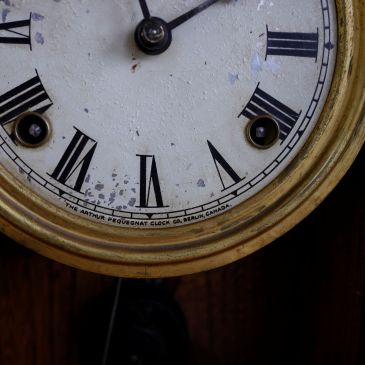
Pequegnat was in the business of making clocks in Kitchener, Canada for over 35 years, 1903 to 1941. Unfortunately the shortage of brass during World War II was the death knell for this company. Pequegnat clocks are sought after by Canadian clock collectors and command higher than average prices, in Canada at least. The best collection of Pequegnat clocks can be found at the Canadian Clock Museum in Deep River, Ontario.
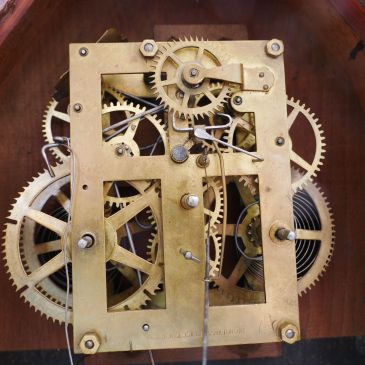
This article concerns the servicing of a typical Pequegnat time and strike movement. By typical I mean that most time and strike movements have steel plates with brass bushing inserts pressed into the plates. This was a working clock when I got it but I knew that there had to be wear issues that needed to be addressed.
This movement comes out of a Canuck.
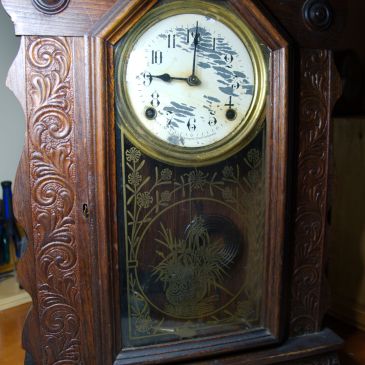
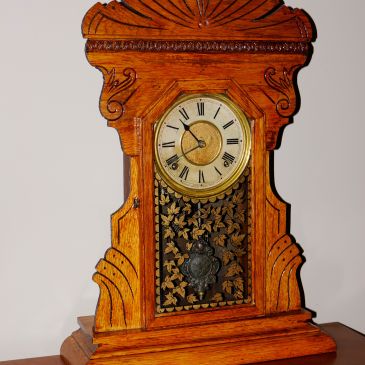
Arthur Pequegnat Canuck gingerbread clock
The Canuck is a gingerbread style clock, not particularly sought after by collectors but an attractive clock for the kitchen or the dining area.
Time and strike movement
I began with revitalizing the case which meant giving all the oak surfaces a good cleaning followed by two coats of shellac. The dial was in poor condition and I considered an aftermarket dial but in the end decided to try a little inpainting with good results.
Before (inset) and after clock dial
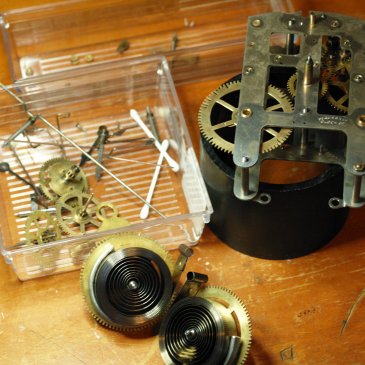
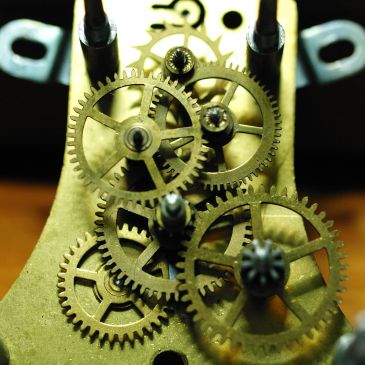
Pequegnat movements with steel plates are nickle plated. Most of the plating has worn off on this movement so while it make look dirty after cleaning it is simply tarnished. The movement is well constructed with 4 cut pinions and 6 lantern pinions. I am going out on a limb here but I have worked on a lot of similar American movements and this movement, in my view, is better designed in many ways.
Dirty and tarnished but in good shape otherwise
I do not not believe this movement has ever been worked on. I see no evidence of past repairs and/or adjustments which is a good thing because undoing previous bad work can be very frustrating. There is some bushing wear as expected, but the pivots, cut pinions and lantern pinions are all in excellent condition.
All wheels minus the hammer and lever
The time side required 4 new bushings, T2F, T3F, T4F and T4R. The strike side required one bushing, T3F. There is plenty of power left in the mainsprings which were cleaned and oiled. Otherwise, the movement was dirty, though I have seen far worse. My ultrasonic took care of most of the dirt and grime but the wheels benefited from additional hand cleaning.
Getting everything working nicely when all is back together is more luck than skill. The strike side did not lock as it should but I decided to test the time side for a few days before opening up the plates to move the stop wheel into its correct position. Everything is working now.
On the test stand
A nice little project and while I would not say it was brought back to life it is completely serviced and will run for many years to come.
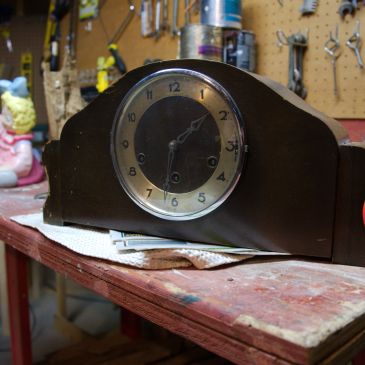
While refreshing the case of this relatively nondescript mantel clock assembled by a short-lived Canadain clock company I ran into two interesting surprises.
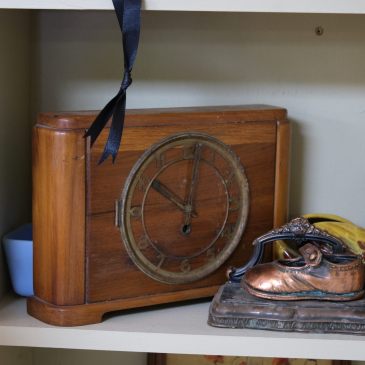
Here is a garden-variety vintage Westminster chime mantel clock from the Fleet Time Company of Montreal (Canada). Many of these clocks were sold at department stores across Canada during the pre-war (WWII) era. However, this little known Canadian clock company had a brief life. Between 1936 and 1940 the company produced a range of two and three-train mantel clocks with movements sourced from Germany but were forced to end their operations.
The Second World War took a heavy toll on this company as the source of movements dried up and so did the company’s fortunes.
Wood cases were made in Canada for some models while other cabinets were imported from Germany.
This particular clock has a Gufa Westminster chime movement and I assume most of their 3-train clocks had a similar if not the very same movement. Gufa is the Guetenbacher Uhrenfabrik, located in Gütenbach, Germany. They manufactured 400-day clocks, cuckoo-clocks and later they became the “Jahresuhrenfabrik” (August Schatz & Sons in Triberg, Germany).
Rather than advertise the maker, many Fleet Time clocks simply had the word “Foreign” stamped on the movements.
This is a clock that could easily have been thrown in the garbage and I am fairly sure that is where it was headed. While I was in the city of Halifax (Nova Scotia, Canada) to pick up an Arthur Pequegnat Canuk kitchen clock the seller took me into his garage, pointed to a clock sitting on a shelf, and said. “for $10 more you can have this one”. “Why not”, I said!
Refinishing the case
I thought I would tackle the case first. While the front of the clock looks okay, the finish on the side sections were down to the bare wood plus scratches on top really detracted from the general appearance of the clock. It was a real mess. On top of that, the left side shoulder section was completely detached and had to be re-glued. Hot hide glue was used for this repair.
The finish was badly worn on both sides
Surprise #1
Rather than reproduce the dark lacquer finish I chose to sand the case down to the bare wood to see what lay beneath. To my surprise, I discovered a nicely grained, and beautifully textured grain. Enhancing the veneer with a light walnut stain is the way I chose to go because I did not want to go as dark as the original finish. Special Walnut, which has a light tone is perfect for the case and if I did not like it I could apply a darker walnut stain over it later.
Choosing the right stain; part of the case is still drying off from a wipe down with a damp cloth
The special walnut is very pleasing to the eye.
Special walnut stain
And the top of the clock.
Top of clock
After two coats of stain (above), here is the result.
After two coats of stain and two coats of shellac
The Special Walnut stain produced a very pleasing result. I applied one more coat of shellac, let it dry, and topped it off with Minwax Polishing Wax to produce a satin finish. Not the finish that came from the factory but it wlooks good.
Surprise #2
After cleaning the chapter ring, polishing the chrome bezel I was ready to return the movement to its case but what I should have done was test the movement beforehand.
When I received the clock I confirmed that the strike and chime functioned as they should and I assumed the time side was fine.
Broken mainspring which is not reparable
I inserted the winding key into the centre arbour and found no resistance. Hmm!
On these movements the barrels can be pulled out without disassembling the movement which certainly simplifies repairs. I pulled out the barrel, popped the back cap off, and discovered a broken mainspring. Using needle-nose pliers and heavy gloves, I pulled the mainspring out with for closer examination. No part of this mainspring is reusable and a new one must be ordered.
Occasionally when a mainspring breaks it takes a few other components with it like broken teeth, broken leaf pinions or bent arbours referred to as collateral damage. I inspected the gear teeth, pinions and arbours on the time train, gave the wheels a few spins and found everything moved smoothly, so, no damage this time. The broken mainspring is the only issue keeping this vintage mantel clock from striking and chiming again.
Mainsprings care easily sourced from a clock supplier. I waited until I built up a list of supplies for other projects then submitted the order online. German and American mainsprings are best and avoid those made anywhere else particularly India.
The movement was placed in a plastic bag along with nuts, hands, screws etc. and stored safely away until the mainspring arrived.
Two weeks later
Two weeks later, out come all the parts from storage.
Using my Olie Baker spring winder and mainspring retention collar I installed the mainspring into its barrel.
Fitting the barrel back into the movement involves moving the strike rods out of the way which is a bit of a pain, then, the barrel slides into a channel on the plate. The movement was returned to its case and the hands attached.
Fleet Time Westminster chime
The strike hammers were re-positioned for the best possible sound and my guess is that the clock is running and chiming for the first time in many years. As of this writing, it has completed a number of 8-day cycles. And to top it off, it looks great!
Let’s see, $10 for the clock $19.50 for the mainspring and less than a few dollars for stain, glue, etc. A satisfying project combined with a piece of Canadian clock history.
Older readers growing up in the rural areas of Canada and American have fond memories of the one-room schoolhouse clock located in the front or rear of the classroom. Just how did the schoolhouse clock get its name?
As the teacher instructed the students to work quietly on their own students would look up furtively at the clock anticipating the next recess. Students learned about time, how it regimented the day, how it seemed to move slowly and yet so quickly. Can you imagine the privileged child selected to wind the clock once per week.
Killarney, Ireland pub. The drop fusee wall clock is to the right
With a swinging pendulum visible from a distance, the clock can easily be seen running. The open-door bottom access sash allowed for restarting and adjusting the rate. The vast majority were American clocks though Canada produced its fair share of schoolhouse clocks. Time-only movements were very popular because they had fewer moving parts, noiseless except for the ticking sound, were simpler to maintain and would run well for years even if very worn.
The schoolhouse clock came to be known as a particular style of clock found in school settings. If a particular style was ordered by a school authority manufacturers might have informally described them as clocks for schools or “school clocks”. In any event, the term, “schoolhouse clock” has become part of the lexicon of the clock collector.
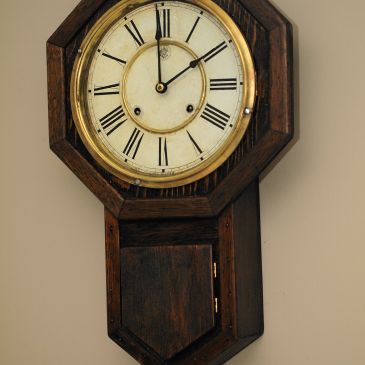
Today, the distinctive schoolhouse clock is known as a drop octagon by clock collectors.
Most schoolhouse clocks are 8-day running, constructed of oak, have a brass dial bezel, bottom glazed access sash, 9 or 12-inch dial with the majority being time-only. A time-only clock provides less distraction in the classroom environment than those clocks making a striking sound.
None of the labels on my clocks have the word “schoolhouse” written on them. They are either described as a “drop octagon” or have a specific model name
In some clock circles it is said that schoolhouse clocks are a derivative of the English drop dial fusee clock such as the one seen in an Irish pub in Killarney (above photo).
None of the labels on my clocks have the word “schoolhouse” written on them. They are either described as a “drop octagon” or have a specific model name.
Here are a few schoolhouse clocks from my collection. Enjoy!
Sessions Drop Octagon from a school in Springhill, Nova Scotia (Canada)Gilbert Admiral with 31-day calendar function, Colchester County, Nova ScotiaAnsonia schoolhouse clock, Berwick, Nova ScotiaGerman-made Jauch wall clock, 1970s era
“Special edition” clocks inspired by the classic schoolhouse wall clock are still sold today though you will find a quartz movement inside
Brandon II by Arthur Pequegnat, Great Village, Nova ScotiaWaterbury short drop wall clock, Halifax, Nova ScotiaA trio of clocks representing 3 time zones, From the left, a Waterbury, New Haven and Sessions
“Special edition” clocks inspired by the classic schoolhouse wall clock are still sold today though you will find a quartz movement inside.
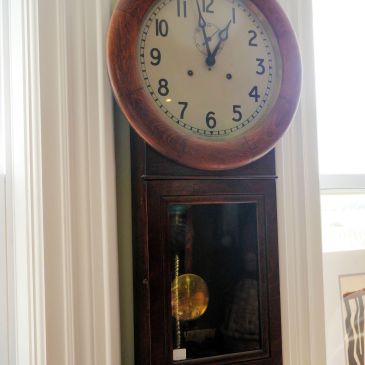
The classroom was not only place for the schoolhouse clock. Many found their way into homes across Canada and the US. My grandparents had a Waterbury time and strike schoolhouse clock in their kitchen that I remember well as a young boy (the preview clock for this post).
Schoolhouse clocks evoke fond memories for the older generation today and fortunately many have been preserved for generations to come.
In light of current world events the antiquevintageclock.com family wish to convey our sympathy and condolences to those effected by Covid 19
German-made time-only plate clock movement
Small shelf clocks of the 1930s from BlackForest Clock Co. of Toronto shared a simple German-made time-only movement across the line. The movement has tiny wheels and pivots plus a clever twisting pendulum rate adjuster.
In light of current world events the antiquevintageclock.com family wish to convey our sympathy and condolences to those effected by Covid 19
Here we have a nondescript mantel clock from the Fleet time Company of Montreal. This little known Canadian clock company had a short life between the years 1936 and 1940 producing a range of two and three-train mantel clocks with movements sourced from Germany. All clocks had pendulums and were spring-driven. According to business records, the company was listed as an importer of clocks and watches. The locations were 440 McGill and then 303 St. Paul West, Montreal (Canada).
The Second World War took a heavy toll on this company as the source of movements dried up and so the future prospects of this small company (information obtained from the Canadian Clock Museum, Deep River Ontario). One wonders why they did not diversify and source movements from France and Germany like the Forestville Clock Co. of Toronto during the war years.
Wood cases were made in Canada for some models while other cabinets were imported from Germany.
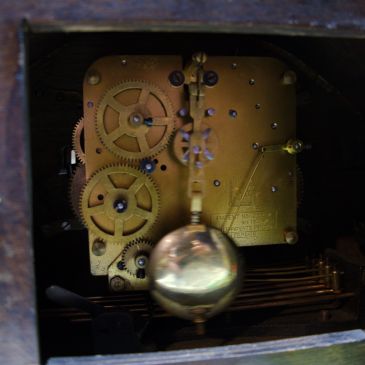
Gufa chime movement
This clock has a Gufa movement and one can assume most of their 3-train clocks had this movement although some movements are marked “Foreign”. Gufa is the Guetenbacher Uhrenfabrik, located in Gütenbach, Germany. They manufactured 400-day clocks and cuckoo-clocks and later they became the “Jahresuhrenfabrik” (August Schatz & Sons in Triberg, Germany).
Battered company plate, simply says “Fleet Clocks”Close-up of foil plaque
The movement does not work because the time side mainspring is broken. The case is in bad shape and I am not sure how I will proceed but it is beyond simply cleaning, touching up and polishing. At this point, the only option is stripping. I am always reluctant to strip the finish from an old clock unless it is the only option. In any event, the case will be a late spring (2020) project.
The case needs a lot of work
This is another Canadian clock added to my clock collection although the fact that it was assembled and sold on Canadian soil is its only real qualification.
Hi readers, in light of current world events the antiquevintageclock.com family wish to convey our sympathy and condolences to those effected by Covid 19
I have a total of eight Arthur Pequegnat clocks in my collection. The newest, an Arthur Pequegnat Canuck is not exactly my favorite though it is not unattractive for a gingerbread clock. The company made a range of kitchen clocks but I have seen very few in the true gingerbread style, such as this one.
The clock runs well though it will certainly need servicing
Few are offered on online for-sale sites so it is quite possible that not many of them have survived over the years. Collectors would often pass them up as most other Pequegnat clocks are considered more desirable and valuable.
Servicing this clock from the Canada Clock Company was a real challenge as I encountered many issues that conspired to slow my progress.
I found this clock in an antique shop in downtown Truro, Nova Scotia at basically a give-away price. The seller knew nothing about the Canada Clock Co. and that was fine with me.
So, what happens when amateurs and backyard mechanics get their hands on a movement. Read on.
But first, a little about the short-lived Canada Clock Co.
Canada Clock Co Hamilton Cottage Extra
The Canada Clock Company in its three iterations made clocks in Ontario, Canada between 1872 and 1884. The Canada Clock Co, the Hamilton Clock Co. and then Canada Clock Co. (redux) struggled over a 12 year period to put Canada on the clock-making map. Ultimately their efforts failed. Nonetheless, there are a number of fine examples that have survived to this day
Description
The clock is a 30-hour time and strike movement on a bell. It is the “Hamilton Cottage Extra”, one of the least expensive in their line of cottage clocks.
The label is in fair condition but identifies the model name and yes I paid far less than the sticker price
The case, which is in fair condition, reflects the age of the clock, grimy with numerous chips and scuff marks. Constructed of pine with a walnut stain finish the case has a minimum of decorative features and reflects the muted Victorian style of the times. The label is in fair condition and there is a stamp on the top of the label which says, “…A Hill &Co.”.
The lower part of the tablet has an etched glass floral design common on Canada Clock Company clocks. The dial face is flaked in places, has been “touched up” and will need attention.
The Maltese hands are original.
Original time and strike 30-hour movement
I tested the movement while in the case. The time side runs with a little encouragement while the strike side has the typical run-on strike when things fall out of adjustment.
Assessment of the Movement
When I disassembled the movement there were a few unexpected surprises. I now have answers for a movement that is running poorly.
Strike side mainspring riveted together
Both mainsprings had been modified, a very old repair. I try not to be judgemental when I see this and respect the folks that made every effort to keep their clocks running as best they could often with limited means. However, these look dangerous and must be replaced.
Time side mainspring with a nail holding parts of the mainspring together
Now on to other issues.
Levers bent in all directions
This is the strike side. What are the correct positions for the levers? Bent so many times it will take trial and error to find precisely where the levers should go.
The “hammer”
The hammer is actually a copper wire wound around 2 nuts and it is loose in the arbour.
Helper “string” or helper spring
There is enough helper spring to wrap around the pillar but someone thought the string was necessary. It will be replaced with a new spring.
Nuts for a hammer and the bell has been repositioned
While the bell may be original, Judging from the number of holes, it has been relocated and raised to work with the home-made hammer.
The movement is a disappointing mess but not unfixable. In the clock business, you must expect the unexpected. In the meantime, I can clean the parts and perform pivot polishing and bushing work while I await parts.
I am determined to get this clock running so, stay tuned for the movement servicing and dial painting!
When people living in the Yukon Territory, Canada switch their clocks forward to Daylight Saving Time Sunday March 8th, it will be for the last time. The government announced March 4th, that the territory will keep the time change permanent, after hearing an overwhelming majority of residents said they would rather remain an hour ahead than switch back in November.
Your first thought might be the Blackforest region of Germany and there is, indeed, a close relationship to that region to a small clock company that operated many years ago in Toronto, Ontario (Canada).
Blackforest is (or was) a well-known Canadian clock company. The Blackforest Clock Company of Toronto, Ontario was founded by Leopold and Sara Stossel in 1928. Both clock movements and complete clocks were imported from Germany and sold through department and jewelry stores across Canada.
Blackforest shelf clock from 1937, the year of the Royal Tour
Their son Ed Stossel started working part time with his parents’ company in the 1930s, and later became a full-time employee in the late 1940s.
My first Blackforest shelf clock
Some assembly work was carried out in their Wellington Street East factory (Toronto). Initially, imported mantel clock and grandfather clock movements were installed in cases made in Kitchener, but later the complete mantel clocks were imported from Germany.
It is a one train time-only movement with tiny wheels and a unique twisting pendulum rate adjustment
The arrangement with suppliers was interrupted by the Second World War, which also led to a name change to theForestville Clock Company in 1941. During the war years this company imported its clock movements from England, the United States, and even France. However, beginning in the 1950s German factories again became the source of movements, with Mauthe being a major supplier. Sadly, the company did not survive much past the late 1970s.
This is a 3-train Westminster chime mantel clock with Girod movement from France in a Canadian made Art Deco case.
Girod was a clockmaker based in the Morbier-Jura region of France and produced clocks from the 1930’s into the 1960’s. The firm of Girod was founded by brothers Leon and Auguste Girod.
The clock was manufactured after the war years, presumably the late 1940s. It has a pendulum movement which predates mantel clocks with balance wheel escapements that arrived in the 1950s.
The frustrating part was not making directional marks on some of the parts prior to disassembly
I have very little experience with 3-train movements and this movement was part adventure and part learning.
The movement has five hammers, four of the five carry the Westminster chime and three of the five for the top-of-the-hour strike. There are two levers on the left side of the movement looking through the access door. The uppermost is a repeater and the one below it is a chime/strike silencer.
The movement is a conventional design and once assembled all adjustments are made externally. Girod used the split back plate design for their 3-train movements which makes servicing simpler than the classical one plate design.
It is a conventional 3-train movement with a dedicated gear train for each function. Looking at the back, the centre train is the time, the left train is the strike while the right is the chime.
After having attended a NAWCC (National Association of Watch and Clock Collectors) May 2019 chapter meeting in Ottawa and the 2019 NAWCC National Convention in June of this year I began to wonder why there is no NAWCC representation in the Maritime provinces of Canada (Nova Scotia, New Brunswick and Prince Edward Island) or even an informal clock and watch club.
The closest NAWCC chapter is Montreal, Canada and there are at least 3 active chapters in Ontario alone. There has never been an active NAWCC chapter in the maritime provinces.
I believe there are a fair number of clock enthusiasts (horologists) in my region who would love to meet in order to share experiences and expertise.
This blog reaches clock lovers all over the world and I encourage any of you who have an interest in mechanical clocks to seek out those with similar interests in your local community but if you are living in the Maritime provinces of Canada; Nova Scotia, New Brunswick and Prince Edward Island, contact me directly at ronjoiner@gmail.com if you are interested in getting together to talk about clocks and watches, share experiences, share repair techniques or boast about your collection.
If the numbers grow and there is sufficient interest we can form a club, and later on we might even be able to explore charter membership with NAWCC.
I frequently take photos of clocks in antique stores. If asked I say that I have a friend who is looking for that exact clock and I usually get away with it. In Ladysmith, British Columbia I came across a Canadian clock that I have never seen before. On the bottom of the dial it says “Mfg Par Aro Inc Canada”.
Who or what is Aro? I could find very little information. They were evidently based in the province of Quebec and likely the city of Montreal. My research tells me that they made two styles of clocks in the 1960s. This one, a kitchen clock and a schoolhouse clock.
Clock with inscription “Mfg Par Aro”
Both have 8 day Japanese trapezoid open plate time-only movements.
One of the few clocks that I have had professionally serviced is an Arthur Pequegnat kitchen clock (Fan Top). In the early days of clock collecting and repair I had not acquired the necessary skills and experience to perform my own work and had some of my special clocks serviced by a skilled clock-maker. I consider this Arthur Pequegnat “fan-top” kitchen clock, a special clock.
The following comments are not a reflection of the work done by a professional clock repair shop. I consider the clock-maker who performed the service on this clock to be highly competent and I would recommend them to anyone but mechanical clocks can be very temperamental at times.
Arthur Pequegnat kitchen clock commonly known as a “Fan Top”
Two years after the clock was serviced, it stopped. It shouldn’t have! I considered all of the possibilities including weak mainsprings, bushing issues, bent, twisted or torn suspension spring and bent wheels to name a few.
On March 10th Daylight Savings Time began at 3:00am in Canada. Over 100 years ago on July 1, 1908, the residents of Port Arthur, Ontario, today’s Thunder Bay, turned their clocks forward by 1 hour to start the world’s first DST period.
Spring ahead, Fall behind
In Canada we refer to it as Daylight Saving Time (DST); the British call it “British Summer Time” and “summertime” in other areas. It is the practice of advancing clocks during summer months so that evening daylight lasts longer while sacrificing normal sunrise times. Typically, regions that use daylight saving time adjust clocks forward one hour close to the start of spring and adjust them backward in the autumn to standard time. We have a little expression, “Spring ahead, Fall behind” to make it easy to remember what to do twice a year. In Canada, it is the second Sunday in March and the first Sunday in November.
Junghans Crispi time and strike wall clock
There is a constant dispute about the benefits and drawbacks. Proponents say that it conserves energy and has a psychological benefit of extending the daylight hours. Opponents say that the energy arguments are inconclusive.
Regardless, people must remember to change their clocks. It is a time-consuming exercise, particularly for those owners of antique and vintage mechanical clocks that cannot be moved backward safely though obviously moving 1-hour forward is much simpler.
Arthur Pequegnat Moncton wall clock
But why go through this nonsense; let’s just get rid of DST! I advocate a move to “permanent daylight saving time” that is, staying on summer hours all year with no time shifts. My mechanical clocks will appreciate it and yours will too!
The Classic, made by the Arthur Pequegnat Clock Co.
Tick-Talk Tuesday is about the letters and comments I have received from you, the reader, concerning your clock, issues you might have had, challenges you face or a clock you would like me to profile and my responses to your questions with advice on your particular clock concern. For those comments and questions that stump even me, I consult within my clock circles for the best possible answer
DSfrom New Brunswick, Canada writes, “Good day Mr. Joiner, I have purchased my first Pequegnat clock by accident. It was just a parts buy but I was quite surprised to see it was an Arthur Pequegnat Bedford Classic. Now I’m looking at resurrecting this old girl. My concern is the dial. I’ve found a few few Bedford clock online but they have porcelain dials with a proper side hinged bezel but mine is a metal dial soldered into bezel so it opens upwards? I removed the bezel to try to rotate it but the only screw holes will only mount it as you see it. Would the brushed(?) metal dial have been an option or is this clearly a poor replacement. Any thoughts or opinions would be appreciated. I live just outside of Buctouch and could make the trip if you would like to see it for a closer inspection.
Thanks”
A reused label
My reply,”
Hi and thanks for your email.
Nice find. First of all it is called the Classic. The Bedford label was used and crossed out. Though not common I have seen this before.
I have attached a link to the Classic which is part of Skip Kerr’s extensive Pequegnat collection. You will see that his clock has a smaller (original) dial which is in keeping with the size and style of the case.
It is a Pequegnat dial though not normally for that particular clock and yes, Pequegnat made brushed metal/painted metal dials. I have never seen a Pequegnat clock with the hinge in that location but you never know, it might be a variant.
It might also be a replacement. If so, I would think that the “newer” dial’s hinge would not fit if hinged on either side. Are there any screw holes at all on the left or the right? The dial is soldered to the bezel? That is unusual. I don’t see any glass?
The next is a link to an article I wrote concerning a Bedford clock. You will notice that the case is quite different and yes, the dial on mine is a replacement and larger than the original, just like yours.
Arthur Pequegnat Bedford model, mantel clock
Rather than change it out I would keep it the way it is, after all, it is part of the clock’s provenance.
DS replies,”Thank you sir, it was a $6 online auction purchase. I was fond of the case style and thought I could strip it and update it for our guest room, maybe even paint it (I know I used the “P” word). Once I received and inspected it couldn’t believe it was a Pequegnat. Thinking it was another mass produced import I expected missing parts and poor veneer but other than the missing glass and hands it is complete and in working order. I’m honored to have the opportunity to save this piece and will enjoy it for many years to come. The body has only one set of screw holes for the bezel, I tried to reposition the bezel then I would re-solder the face in the proper position but nothing lines up except the current position so I welcome your idea to leave it as found.
Thanks again for your advice and link I will definitely take a look. I enjoy researching and learning with each new piece I collect.
Happy hunting, DS”
Later DS wrote, “Well sir I’ve cleaned up the original case, installed new hands and replaced the glass. I believe the bezel and face may be original. There are only one set of screw holes in the case and the bezel and when I correct the bezel the wood trim on the case interferes with opening the bezel. So there it is my first Pequegnat. Thanks for the information on my clock. Now on to the next.”
It has taken me 6 years to assemble my collection of antique and vintage clocks. Although I have many clocks, wall clocks are my particular favorites. Check out my collection of antique and vintage wall clocks in this YouTube video I made in January 2019.
Happy Birthday Sir Sanford Fleming, the inventor of Standard Time.
Sir Sanford Fleming (January 7, 1827 – July 22, 1915) was Canada’s foremost railway surveyor and construction engineer of the 19th century and a distinguished inventor and scientist.
CPR steam engine
Sir Sanford Fleming played a crucial role in developing a global system for setting time. Fleming advocated the adoption of a standard or mean time and hourly variations from that according to established time zones. He was instrumental in convening the 1884 International Prime Meridian Conference in Washington, at which the system of international standard time – still in use today – was adopted.
Pinwheel regulator designed for railroads, NAWCC museum
Many regions of Canada and the US observed local time and when coast to coast rail systems were constructed a unified time system was identified as a necessity. In the United States, the problems were severe, with one table showing over 100 local times in one region varying by more than 3 hours.
The first proposal for a consistent treatment of time worldwide was a memoir entitled “Terrestrial Time” by Fleming. Fleming was, at the time, the chief engineer of the Canadian Pacific Railroad, presented a proposal to the Canadian Institute in 1876. He produced modified proposals using the Greenwich meridian. Fleming’s two papers were considered so important that in June 1879 the British Government forwarded copies to eighteen foreign countries and to various scientific bodies in England.
Seth Thomas Regulator #2, a common railway clock
On 11 October 1883, two years after the invention of the toilet paper roll,
S. Wheeler and the toilet paper roll
a convention of railroad executives met in Chicago and agreed to the implementation of five time zones in North America, using as a basis, Greenwich Mean Time. Standard time was introduced at noon on 18 November 1883 across the nation though it was not legally established until 1918.
As we celebrate Sir Sanford Fleming’s birthday it is important to reflect on his contribution to the construct of organizing time; something all of us take for granted in our daily lives.
My kids stress every year over what to get dad for Christmas. They know that I am an avid antique clock collector and they know that I love to restore and repair antique and vintage clocks. They always ask, “Is there anything he needs”. I have all the tools I need and certainly all the clocks that I want. The fact that they think about it pleases me.
However, it is the little things I always appreciate in my Christmas stocking. Kids, if you want to give me something put a new pair of cloth gloves, a box of toothpicks, cotton swabs, or a paintbrush in my Christmas stocking so I know that you are thinking of me.
Sure, I would love to have that elusive Martin Cheney wall clock or the pride of the Arthur Pequegnat Clock Company, the Regulator #1 but even if they find that special clock for me it would spoil my personal journey to find that special clock.
Christmas is a time of joy, not of giving, unless the giving is in the form of love and appreciation for friends, family and colleagues.
So, if you are looking for that special gift for the clock lover in your family remember the simple things.
I discovered this Arthur Pequegnat Moncton in an antique store in Bloomfield, Ontario. I had my eye on it during a visit to the antique shop this past summer (2018), thought about it before taking the plunge later in the fall to buy it. These clocks do not come up very often and the price was right.
The Arthur Pequegnat Clock Co. made clocks in Kitchener, Ontario (Canada) from 1904 until the company closed its doors in 1941. The clock firm was originally founded in 1903 by Saas & Ford but was purchased by Arthur Pequegnat the following year.
Canadian clock collectors are very familiar with the name and associate Arthur Pequegnat clocks with solid construction, robust movements, conservative designs and nationalism since many clocks were named after towns and cities in Canada. However, the use of city names began to decline in the late 1920s when models such as the Eclipse and Swan were introduced. Arthur Pequegnat also showed his patriotism to the Royal family and to Canada and therefore named a number of models, the Monarch, the King Edward, the Maple Leaf, the Dominion, the Canadian Time and so on.
Pendulum, beat plate & centre cut rounded bottom
Pequegnat made mantel, parlour clocks, as well as Mission, kitchen, gingerbread, tambour, wall, and floor models (hall clocks). In most households of the period, a clock was a decorative status symbol, not just a timepiece, and was displayed in a prominent place in the home—usually the parlour.
Prices increased over the period the Pequegnats were in business but ranged from four dollars for the Midget to seven dollars for the simple round Toronto model, to $112 for the Alberta floor model in mahogany. The wide variety of designs and relatively low prices appealed to many Canadians. Today, the appeal of these timepieces remains as Pequegnat clocks are sought after by Canadian collectors.
This, the Moncton, is the seventh Arthur Pequegnat clock in my collection. This clock is named after a city in the province of New Brunswick (Canada). It is only fitting that Pequegnat supplied clocks to the railway as Moncton was once a rail hub for the Canadian National Railway.
This clock is in good condition overall. It has a 12 inch Arabic dial with simple, bold numbers. The pierced spade hands are attractive and are a feature on many Pequegnat wall clocks. It has a fumed quarter-sawn oak case, is 35 inches high with a hinged 16 inch oak bezel door that swings to the right to reveal the dial. The drop door is 14 ½ inches high by 10 ¾ inches wide and also swings to the right. The clock is 5 inches deep with wall stabilizers on either side of the case. The pendulum bob is brass over iron with an oak pendulum rod. The dial glass appears to be original and has the “waviness” you would expect with glass that is over 80 years old.
View of lower case
Although the lower glass has the same waviness it appears to have been changed out early in the clocks life as the retaining rails look to be replacements. Unfortunately, it is missing the label. Other minor issues are a small scratch on the dial face that is visible when the light is right and a screw hole on the back panel just below the beat plate to secure the clock to the wall. Evidently the stabilizers were not used.
This clock was made after 1916. Those made prior to that date were inscribed “Berlin” (Ontario) on the dial. On 1 January 1917, anti-German sentiments in Canada during the First World War spurred residents of Berlin, Ontario to change the city’s name to Kitchener. This is the only definitive way of dating a Pequegnat clock so, this clock would be between 80 and 100 years old. The Moncton wall clock was manufactured almost as long as the company was in existence.
The Moncton is a 15-day time-only clock with two winding arbours on the dial face. This is achieved by means of two mainsprings both of which are wound at the beginning of the running cycle releasing their power together. Two other wall clocks, the Regina and the King Edward (variant) were also available with a 15-day double spring movement. However, unlike most spring driven clocks that have recoil escapements this movement has a Graham deadbeat escapement which contributes to its accuracy. The seconds hand is not a true second hand and runs off the escapement taking 80 beats to complete the “minute”. As a testament to its accuracy and dependability many of these clocks were ordered as train station clocks across Canada.
Two winding arbours for double spring time-only movement
The “Moncton” came in two basic styles. One was made for Canadian National Railways and was five centimeters (two inches) shorter than the regular model. Some such as this one, were fitted with a seconds hand on a separate dial above the main hands. This feature is also found on the Regulator I which was Pequegnat’s most accurate model. The 1st Issue was 33 1/4 inches high by 15 1/2 inches wide with the triangular bottom. The 2nd issue of the clock has a height of 33 1/4 inches and a width of 16 inches with a centre cut rounded bottom. The 2nd issue clock is also found with cases that measure 35 inches in height such as this one.
Moncton first issue, Roman Numeral dial
The “Moncton” was first featured in the 1913 catalogue and the again in the 1918, 1920 to 1925 Wall Clock catalogues and Pequegnat’s final catalogue put out in 1928.
The Moncton closely resembles the Seth Thomas #2 in size and shape down to the seconds hand, 80BPM and beat plate but unlike the #2, the Moncton is spring driven. The Moncton was an alternative to the #2 which was a well made American regulator but costlier and with a shorter running cycle.
Seth Thomas Regulator #2
The seller tells me that the clock came from the north of Toronto (Ontario) and apologized for not knowing more about its history. He has had it for about 1 ½ years.
I removed the dial to inspect the movement. As expected it is large and heavy with solid plates mounted to an iron frame. It is not difficult to see that it was designed to be rugged and dependable. I did not check the back plate but judging from what I see on the front plate there appears to be little wear. The first wheel on the right side is the only one that has a newer bushing. Given its condition it was well cared for and did not have a hard life.
Large and heavy time-only movement
This clock has been on my wish list for some time.”Monctons” are up for sale from time to time, but they are getting harder to find. I have seen examples come and go but this one is in great shape and the time was right to add it to my collection.
In Flanders Fields, the poppies blow Between the crosses, row on row, That mark our place; and in the sky The larks, still bravely singing, fly Scarce heard amid the guns below.
Today is a day of remembrance. Exactly 100 years after the end of World War, at the 11th hour on the 11th day of the 11th month on Sunday, Canadians will observe two minutes of silence — as they do every year on this date — to remember soldiers (and other military personnel) who lost their lives in this war and other conflicts.
People wear artificial poppies on their clothes in the weeks leading up to Remembrance Day. Red poppies symbolize the memory of those who died. On November 11, special church services are organized. These often include the playing of “The Last Post”, a reading of the fourth verse of the ‘Ode of Remembrance’ and two minutes silence at 11:00am. After the service, wreaths are laid at local war memorials.
National War Memorial, Ottawa, Ontario, Canada
The official Canadian national ceremonies are held at the National War Memorial in Ottawa. A service is held and wreaths are laid by armed services representatives. In May 2000 the remains of a Canadian soldier who died in France in World War I, but was never been identified, were laid in the Tomb of the Unknown Soldier at the National War Memorial.
Peace Tower, Parliament Buildings, Ottawa
Take a moment to remember those who made the ultimate sacrifice to protect our freedoms.
At 2:00am Sunday morning, the 4th of November, set your clock one hour behind. That is, if you live in Canada. Your time change date may vary according to the country you live in. Consider yourself lucky if your your country does not observe this archaic convention.
If your country uses Daylight Saving Time (DST), you must change your clocks twice a year.
Seth Thomas Regulator #2 wall clock
“Spring Forward – Fall Back” is a phrase most often heard in the USA and Canada. In North America the word “fall” is used to denote the season, while other English-speaking countries call it autumn. Set your clocks forward 1 hour in the spring at the start of DST (Daylight Saving Time), and 1 hour back in the fall when DST ends.
Records show that the phrase “spring forward, fall back” has been in use at least as far back as the early 20th century. It is the practice of advancing clocks during summer months so that evening daylight lasts longer, while sacrificing normal sunrise times.
If one were to ask those with a keen interest in Canadian antique clocks, the word Pequegnat would immediately come to mind. Pequegnat produced clocks for close to 40 years and left an indelible mark on Canadian culture.
Predating Arthur Pequegnat is a lesser known clock maker (or clock-makers) that made clocks between 1872 and 1884. The Canada Clock Co, and the Hamilton Clock Co. struggled over a 12 year period to put Canada on the clock-making map. In 1872 the Canada Clock Co. established itself in Whitby, Ontario (Canada) but lasted just 4 years before failing, though largely due to a devastating factory fire.
Canada Clock Company cottage clock
Out of the ashes came another attempt in 1876 and key principles including manager John Collins moved to Hamilton and set up the Hamilton Clock Company. After 4 years this new company also failed and production halted in 1880. In late 1880 one more attempt was made to establish a new company called the Canada Clock Company resurrecting the old name. It is still based in Hamilton at the old Hamilton Clock Co. factory. Success was short-lived as the company declared bankruptcy in 1884 ending a dozen years producing clocks for the Canadian market.
Although both movements and cases were made in Canada they were copies American styles
Canada Clock Company, Prince of Wales parlour clock
Canada Clock Company, City of Hamilton parlour clock
I have grouped the clocks from the three companies and these are their characteristics. The most common clocks found today are the weight-driven, thirty-hour “Ogee” style, with colourful birds or flowers surrounded by a black background on the glass tablet. At least five different labels are known, four have a beaver on them. The large printed paper label was located inside the case on the lower back. Spring-driven mantel clocks with plain cases were also made with thirty-hour movements. Although both movements and cases were made in Canada they were obvious copies of American styles.
Hamilton Clock Co Gothic steeple clock with etched glass tablet
Clock label showing the Hamilton Clock Company factory
Also produced was a spring-driven “school house” wall clock.
At least sixty models of spring-driven mantel clocks are known, with both thirty-hour and eight-day movements. Most of the door tablets (Canada Clock Co.) have acid etched glass designs, unique to the two Hamilton-based companies and done in association with a local glass factory. Wall clocks are also found with the Canada Clock Company, Hamilton label.
The most desirable clocks are the ornate time and strike parlour clocks such as the City of Hamilton and Prince of Wales pictured above.
Unfortunately, a valiant attempt to grow a home-bred clock company failed miserably. However, the clocks of all three companies are highly sought after by Canadian collectors today.
This is a Canadian made clock I bought at an antique store on Bloomfield, Ontario this past summer (2018).
Arthur Pequegnat kitchen clock
This clock is affectionately known as the “Pointed Top”
The Arthur Pequegnat Clock Co. made clocks in Kitchener, Ontario (Canada) from 1904 to 1941. Canadian clock collectors are very familiar with the name and associate Pequegnat clocks with solid construction, robust movements, conservative designs and nationalism since many clocks were named after towns and cities in Canada.
Pequegnat made mantel, shelf, hall clocks (Tall case) and wall clocks mostly of oak but some were mahogany veneered. The Kitchen clock or gingerbread clock as it is often called was very popular at the time and Pequegnat made an effort to keep up with current styles with a range called the Maple Leaf. There were six versions of the Maple Leaf clock made by the Arthur Pequegnat Clock Co. Though the dimensions are similar they share two unique characteristics; all Maple Leaf’s have the distinctive maple leaf tablet and Maple Leaf pendulum. It is Pequegnat’s interpretation of a truly Canadian clock styled after American clocks.
Label found underneath the base
This clock is affectionately known as the “Pointed Top”. Maple Leaf clocks are easily found on auction & for-sale sites and can be had for a mere fraction of the cost of the more desirable hall and wall clocks.
Hammer and coil gong
I have several Pequegnat clocks in my collection, two of which are Maple Leaf’s, a “fan top” and now this, the “pointed top”. In my view, the pointed top is the best design of the series.
Made of quarter sawn golden oak, it is reminiscent of a Gothic steeple clock, with squared columns on either side and a pointed centre with stylistic applique above the 5 inch dial. The base is a simple angled pedestal sitting on a box frame.
Pendulum bob with Canadian Maple Leaf
Some clocks have something peculiar about them and this one is no exception. Most Pequegnat labels are found on the back board. The label on this clock is underneath the base which is an odd location for a Pequegnat. If this was a standard practice it looks original and has the usual amount of loss one would expect from a 100 year old clock label. While the name Berlin is on the dial, the label indicates that the clock was made in Kitchener, Ontario. There are two possible explanations; either the dial face is a replacement from a older clock or the clock was made during the transition period (1916) when the name of the city was changed from Berlin to Kitchener during the First World War.
The movement is a distinctive Arthur Pequegnat movement with nickel-plated steel plates and brass bushings pressed into the plates
The glass tablet is in excellent condition. It is not uncommon to find some loss especially a few missing maple leaves here and there but this is the best I have seen. The dial face has some flaking but is otherwise in good condition; the Roman Numerals are vivid and unfaded. The spade hands are correct for the clock and look original. The oak case is in great shape with no missing or split pieces. The finish is in excellent condition and the oak grain enhances the simple lines, in fact, this clock has aged very well.
Tablet is in excellent condition
I took the movement out of its case to inspect it. It is a distinctive Arthur Pequegnat movement with nickel-plated steel plates and brass bushings pressed into the plates. Not surprisingly it had been worked on in the past. One bushing on the front plate has punch marks around it otherwise the movement was tight and there appears to be little evidence of wear. There is one small issue however; the lever that activates the passing strike on the half hour is loose in the arbour and has turned to one side. Turning it to the correct position does little to fix the problem. At some point I will get in there with Lock-Tite to secure it.
The fact that it does not strike reliably on the half hour does not particularly bother me. I oiled the movement, reinstalled the movement into its case, set the beat, wound it and it maintains a full eight day cycle.
I am very pleased with this acquisition but I my search goes on for the more desirable 15-day Pequegnat Moncton wall clock and of course the Regulator #1.
Need a quick primer on developments and inventions in horology. You have come to the right place.
18th Century shelf clock Porto, Portugal
Though by no means a definitive guide the following are some important dates in the history of the clock as gathered through a number of sources. The difficultly in affixing some dates with precision results from discrepancies among sources.
Horological developments during the centuries before the mechanical clock are left out altogether. Water (Clepsydra) and sun clocks of the middle ages and astronomical clocks of ancient China deserve special mention but are the subject of a separate discourse and are not included here.
Important dates in Horological Development
CA. 1300 – First mechanical verge clock, Europe
1364 – Astronomical clock conceived by Giovanni de Dondi, Italy
1386 – Tower (turret) clock Salisbury Cathedral, England
Salisbury cathedral clock, photo by Dr. Meghan Joiner
CA. 1400 – Fusee invented by Jacobs, Czechoslovakia
CA. 1450 – Table clock with spring and fusee, Phillip the Good of Burgundy, France
CA. 1500 – Mainspring invented, Germany
CA. 1510 – Watch invented by Peter Henlein, Germany
CA. 1560 – Spring driven portable clock, Germany
CA. 1570 – Oldest known clock with a second hand, Orpheus clock, Germany
1637 – Galileo, swinging temple lamp, pendulum control conceived, Italy
CA. 1650 – First tower clock appears in Colonies, America
1656 – Pendulum clock devised by Huygens, Holland
1657 – Verge and foliot gives way to pendulum control, Huygens, Holland
1658 – Long-case prototype made by Fromanteel adapted from lantern clock, England
1660 – Balance wheel conceived by Hooke, England
CA. 1675 – Richard Towneley invents the dead-beat escapement, England
1675 – Balance wheel with spiral spring invented by Huygens, Holland
CA. 1675 – Recoil escapement and crutch invented by Hooke in collaboration with Clement, England
1676 – Rack striking developed by Barlow, England
1680 – 1700 – famous horologists of this era were Arnold, Earnshaw, East, Graham, Knibb, Compion and Windmills of England; Berthoud, Breguet and LeRoy of France
1701 – St Sulpice seminary tower clock (imported from France), Montreal, Canada
1713 – Harrison invents marine chronometer, England
CA. 1715 – Break-arch dial introduced
1715 – Graham perfects deadbeat escapement, regarded as the “father” of the dead-beat escapement
1717 – First tower clock of America, Benjamin Bagnall, Boston
1726 – Mercurial pendulum invented (temperature compensating pendulum), Graham, England
1726 – Wall clock by Thomas Bennett, 8 day brass, weight driven, America
1736 – Harrison’s marine chronometer tested at sea (accurately ascertaining longitude), England
1770 – White dials appear in English longcase clocks
1776 – Independent seconds train invented for watch, Pouzait, Switzerland
1790 – Vienna regulator style case emerges in Austria
1790 – American woodworks clocks begin to be appear
1802 – Willard patents his banjo clock, America
1806 – Terry introduces Pillar and Scroll clock, America
1809 – Martin Cheney leaves America to set up a clock-making shop in Montreal, Canada
1810 – Carriage clock (Pendule De Voyage) introduced by Breguet of France
1818 – Heman Clark makes wrought brass movement for Pillar and Scroll case, America
1825 – Rolled brass production begins in America
1837 – Noble Jerome 30-hour brass movement patent approved, America
1840 – American brass movements in mass production
1842 – American brass movement clocks exported to England by Chauncey Jerome
1845 – Wood-works movement production ends, America
1850 – Westminster tower clock designed by Lord Grimthorpe and made by Dent, England
CA. 1850 – Brocot (pin-wheel) escapement and pendulum suspension introduced, France
CA. 1850 – American mass production of watches begins
1860 – Junghans (Germany) sent to America to study American mass production techniques
1870 – Decline in English long-case clocks
1874 – Mass production of mantel and wall clocks begin in Whitby, Canada,
1900 – American clock production is at its height; makers are Ansonia, Ingraham, Gilbert, Howard, New Haven, Seth Thomas, Waterbury, and Welch
1904 – Arthur Pequegnat begins clock production in Berlin, Canada
1906 – Eureka electric clock introduced, America
CA. 1910 – Torsion pendulum clock (400-day) introduced, Germany
1920-40 – Decline in American mechanical clock production
1941 – Arthur Pequegnat ceases production, Canada
CA. 1960-70 – End of mass produced mechanical clocks, America (though cheaper Japanese, Korean & Chinese mechanical clocks flood North America)
Present day – Some movement and clockmakers remain; Howard Miller (Ridgeway), Keininger, Hermle, Chelsea, Jaeger LaCoultre among others
The clock is one of mans greatest achievements. The development of instruments to tell time is the unwavering toil of brilliant minds from many disciplines who, over 800 years, worked tirelessly to create, innovate and improve methods for telling the time.
Horology is not only the study of time but the synergy of art, joinery, fashion, design, décor, physics, engineering, metallurgy and mathematics. Indeed, the study of the mechanical clock is a microcosm of our society.
We call it Daylight Saving Time (DST), the British call it “British Summer Time” and “summertime” in other areas. It is the practice of advancing clocks during summer months so that evening daylight lasts longer while sacrificing normal sunrise times. Typically, regions that use daylight saving time adjust clocks forward one hour close to the start of spring and adjust them backward in the autumn to standard time. We have a little expression, “Spring ahead, Fall behind” to make it easy to remember what to do twice a year. In Canada, it is the second Sunday in March and the first Sunday in November.
Mauthe buffet clock
The idea was proposed by George Hudson in 1885 and first implemented by the Austrian Empire in 1916. Some countries do not recognize it in all regions. In Canada, for example, most of Saskatchewan does not change clocks spring and fall, it technically observes DST year round. Parts of Nunavut remain on Eastern Standard Time throughout the year. In the USA (which has 11 time zones) most areas observe DST with the exception of Arizona and Hawaii. Florida has recently applied to get rid of DST.
I advocate a move to “permanent daylight saving time” that is, staying on summer hours all year with no time shifts
DST clock shifts sometimes complicate timekeeping and can disrupt travel, billing, record keeping, medical devices, heavy equipment, and sleep patterns. Computer software often adjusts clocks. Radio controlled clocks adjust the time automatically which is very convenient. We have two modern Sony clocks in our home which do exactly that.
My only tall-case clock, Ridgeway, Hamilton Country
But for the 35 clocks that I have running at any given time, that means making a manual adjustment twice a year which is time-consuming and an unnecessary hassle.
There is a constant dispute about the benefits and drawbacks. Proponents say that it conserves energy and has a psychological benefit of extending the daylight hours. Opponents say that the energy arguments are inconclusive. People must remember to change their clocks which is a time-consuming exercise, particularly for antique and vintage mechanical clocks that cannot be moved backward safely.
For most of my clocks I either simply let them complete their cycle, stop them and when the correct time shows on the clock, I start them up. There is less wear and tear on the movement and I think my clocks are happier for it.
But why go through this nonsense; let’s just get rid of DST! I advocate a move to “permanent daylight saving time” that is, staying on summer hours all year with no time shifts. My clocks will appreciate it and yours will too!
You must be logged in to post a comment.