I absolutely love Art Deco clocks. They are understated, elegant, have great collector value and are timeless, of course (!).
Although we tend to throw the term around loosely Art Deco is actually derived from the phrase Arts Décoratifs which was a dominant decorative art style of the 1920s and 1930s, it’s heyday. This unique form is characterized by precise, bold geometric shapes and strong contrasting colors, used most notably in household objects, and, of course, in clock design as we see here. Style Moderne (as Art Deco was otherwise known) originated in France and was centered in Paris, just before World War I and became very popular after the Great War (World War I). Perhaps the most visible example of Art Deco architecture is the Chrysler Building in New York City in this photo taken from the Empire State Building in 2014.
Chrysler Tower, New York City
The Art Deco style had a far reaching influence and permanency that went far beyond the 20s and 30s through to articles, objects, architecture, furniture and yes, even clocks to this very day.
This is a Smiths Enfield Art Deco style clock. The Enfield Clock company was started by two German brothers in Enfield, North London, in the early twentieth century. During the Second World War (1939-1945) they were the major UK supplier for essential aircraft clocks and instruments. After the war the company vigorously resumed clock and watch production. No doubt most homes in Britain at that time had a Smiths clock. The Smiths Clock Co. became Smiths Enfield in 1949 and the Smiths Enfield name first appeared in catalogs from 1950 onward.
Smiths Enfield clockSmiths Enfield clock on a shelf
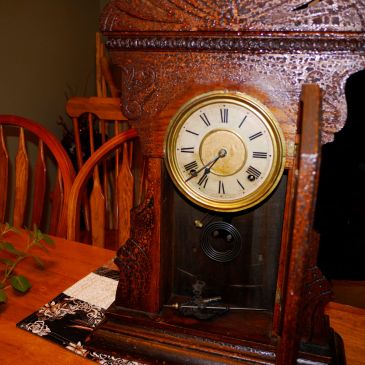
This elegant Smiths Enfield oak case time and strike shelf clock was made somewhere between 1949 and 1955. I know little of the provenance of this particular clock suffice to say that it came from overseas where it likely spent it’s life in someone’s home prior to coming to Canada about a year or two ago. The clerk at the antique shop located in Halliburton, Ontario this past summer (2016) told me that the owner of the shop purchases the bulk of his antiques from Ireland and judging from the store contents he imports a quite a lot of antiques and a lot of clocks.
The oak cabinet is made up of veneers and solids and is well constructed. The case is in excellent condition with nary a nick or scratch; required a soap and water cleaning and a little lemon-based furniture polish to bring the shine up. The clock runs well and keeps relatively good time although it certainly requires a thorough cleaning.
Floating balances were introduced by Smiths Enfield in 1956. Since this clock has a pendulum it was manufactured during the period I mentioned above (1949 to 1955). The inverted numbers on the lower clock face, which at first look strange, are actually very common on clocks with Roman Numerals.
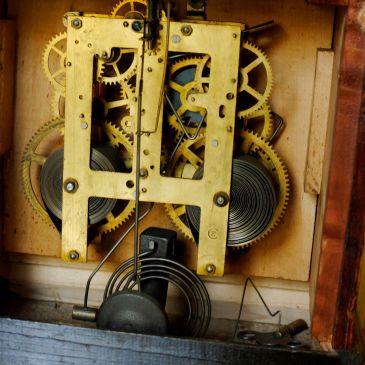
Movement showing coiled gong
It has a coiled gong and a nice pleasant strike if I can get the hammer to strike the gong as it should. A trial and error approach ensuring that the hammer is above but not quite touching the gong or replacement of the hammer leather are two possible solutions.
This is one of two cottage clocks I have. By that I mean they are literally at my summer cottage, and since it remains at my cottage a cleaning will have to wait until next summer.
The movement is disassembled and now it is time for further inspection, cleaning, servicing the mainsprings, pegging the pivot holes, polishing the pivots and installing bushings where needed. In this, Part III we will cover cleaning and mainspring servicing.
Ultrasonic cleaner
I have a small ultrasonic cleaner so I tend to clean parts in batches since this one does not have a large capacity. An ultrasonic cleaner is not an absolute must as you can easily clean by hand but having one certainly helps.
Front and back plates
Old toothbrushes are great for getting into the crevices and I use one especially for the lantern pinions as a lot of dirt and old oil tend to accumulate in those particular areas.
indicating where bushings will be installed
This photo shows a couple of bushings that I will install. I realize that some prefer to install bushings by hand and I applaud them as it does take considerable skill but I use a Bergeon Bushing Machine which I believe simplifies the task (for me, at least). More on bushing in the next part of this series.
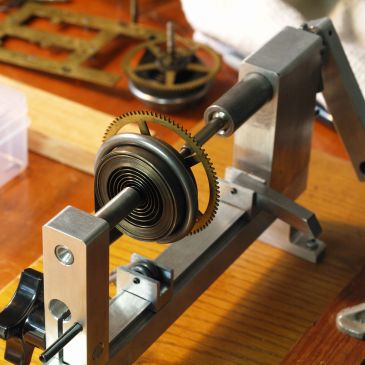
Olie Baker spring winder
An Olie Baker spring winder is an indispensable tool. You can easily make one of your own to save a little money if you are handy with building things. A spring winder permits you to inspect for cracks or breaks, clean and oil the springs before reinstalling them. The photo shows a C-clamp securing the mainspring prior to cleaning.
leather gloves are used to secure the spring on the winder
I have never lost an eye or a finger but I believe in safety first especially when working with mainsprings. Always wear leather gloves and eye protection. You never know when a 100 year old spring will break and fly across the room.
Click replaced
I discovered that one click had to be replaced as it was almost slipping off the ratchet. As some clock repair folks know, Sessions clocks have a reputation for bad clicks. I had a Sessions click in my supply box, fortunately. It is an easy job; just take the old one out with pliers, secure the new click and bang the rivet (supplied) into the existing hole with a ball peen hammer.
Serviced springs
The springs have been cleaned and oiled with Keystone Mainspring Oil and are completely serviced including the installation of one new click. Now comes the bushing work, re-assembly and testing. Stay tuned to Part IV of this series.
I acquired this mechanical Kienzle World Time clock recently from an antique shop in Quebec.
No matter where you are in the world this clock will tell you the local time. Quite ingenious! This is accomplished through a rotating hour indicator in the lower half of the clock. As the time advances the indicator moves along with it thus enabling the user to line up the distant hour according to where you are in the world. This is one of many clocks conceived by renounced German designer Heinrich Moeller. Moeller, who was trained as a cabinet maker, began working with Kienzle in 1931 and presumably through to the mid century. This vintage clock probably originates from the early 1950s.
This clock is in excellent condition as the brass seems well preserved. I would imagine it as a stunning clock in any environment. I would assume that it might have been sold as a promotional item or could have found it way into many executive office milieus. One can just imagine an import/export dealer 60 years ago who would need to know the time in many parts of the world.
I found an excellent description from this site. The clock is described as “circular, brushed brass, moulded and rectangular base, convex glass. Brushed silvered with applied gilt brass radial Roman numerals, outer minute track, the center with world planisphere and the names of 42 world cities and countries, aperture for the 24-hour day and night indication, scale above to calculate the world time. Gilt brass tapered baton hands. Lever escapement, three-arm balance, index regulator. Diam. 26 cm.” Curiously, the number 4 is expressed as IV rather than IIII found typically on Roman Numeral clocks.
Regular readers have followed my progress on this 1927 Sessions tambour style clock.
Better news this time. After installing 10 bushings, repairing the strike click, replacing the pendulum bob and suspension spring and reassembling and oiling the clock and the springs I am having excellent success regulating this fine old clock. On a full wind I am getting upwards of 9 days and typically eight days through the summer. Though it sits inside our cottage in Quebec it has suffered through all manner of outside weather including high humidity and cool nights and despite these conditions it has performed admirably.
Although originally intended as a cottage clock I will be taking this clock back with me and placing it in a prominent place in my home.
All in all a great learning experience and a satisfying result.
Oiling your mechanical clock is an essential part of its maintenance, ensuring smooth operation and longevity. Proper lubrication reduces friction between moving parts, preventing wear and tear while keeping the movement running smoothly over time.
During the summer of 2016, my wife and I were traveling through the Muskoka area of the province of Ontario and stopped at a quaint village called Halliburton where we happened upon the only antique shop in town. There were a large number of clocks in the store that the proprietor had brought over from Ireland and each one was interesting.
Though there were plenty to choose from we settled on a Smiths Enfield Art Deco style oak cased mantel clock pictured below.
Smiths Enfield time and strike
It was sold as-is and non-working, with the clerk noting that the pendulum bob was missing, which explained a lower price. However, when I got the clock home, I discovered the bob wrapped in brown paper along with the key, tucked inside the clock. After attaching the pendulum bob to the rod and a bit of adjustment, I found the correct beat, and the clock started running.
At my summer place, I do not have the necessary tools to service clocks but decided to take the movement out to oil it.
Once out of the case, I discovered that someone had oiled the movement by spraying it with an unknown lubricant. Spraying a clock with any lubricant is a bad practice. Indiscriminate oiling attracts dust and grime that will accelerate wear and eventually lead to stoppage.
Given the indiscriminate use of oil, there was no sense in operating the clock so I decided to put it aside until I got home where I could disassemble, clean, and properly service the movement.
Oiling Your Mechanical Clock
Lubrication is essential to the good running of any clock movement. Oiling a movement without first dissembling and cleaning it is normally a bad practice. The addition of new lubricant to old will mix with the dirt and grime to form a paste which acts as an abrasive that will hasten pivot and pivot hole wear.
The purpose of lubrication is to reduce wear, and applying the correct amount of oil is crucial. The only exception to this is when the oil sinks are dry— in such cases, oiling the movement without disassembling it is acceptable.
Apply only as much oil as required, a tiny drop goes a long way. Clock oil should occupy about one-half the capacity of the oil reservoir. Use an approved clock oil and a pin-type oiler to apply the oil.
Clock pivot oil
Key Points Regarding Oiling
Lubricant:clock oil has the correct viscosity and has a low tendency to evaporate, spread or react adversely to various metals. Pivot oil is for pivots and spring oil is for springs; there is a difference! Clock suppliers such as Timesavers or Perrin will shave the correct oil for your clock. Do not uses household lubricants and especially WD 40 which is not a lubricant but a water dispersing agent. Synthetic oil is preferred since it retains its properties for a longer period but I work with mineral oil which is cheaper and just as effective.
When to oil:Some say that one should apply oil only after disassembling and cleaning. Others say that a clock’s service cycle might be an average of 5 years or more and oiling every two or three years without a thorough cleaning is acceptable. If there is a visible build-up of black, contaminated oily sludge in the pivot holes, a disassembly and thorough cleaning is necessary prior to oiling. A clock’s the environment will play a significant role since dusty, smoky environments contribute to accelerated wear. A sealed case will also keep out dust and lengthen the cycles between oiling.
How much oil:After oiling there should be a visible presence of oil in the oil sinks around the pivot holes. Oil running down the plates is to be avoided and is a indication that too much oil has been applied. I use a clock oiler with dispenser. Oil cup reservoirs are also very helpful as they prevent any foreign material from getting into the oil bottle when dipping with a pin type applicator. Long case clocks with larger pivot holes will require more oil than a small carriage clock.
clock oiler with dispenser
What to oil:While looking at a clock plate (front or back) work from the top to the bottom. First and foremost are the pivot holes in the plate, then the points of contact between the pendulum and the crutch, escapement pallets faces and centre and motion works arbours. I generally do not apply lubricant to the mainsprings unless I have unwound them. Once out of the clock and assessed as to their condition and cleaned, I apply Keystone mainspring oil prior to re-installation. Do not oil the gear teeth.
Mainspring winder
This short primer on oiling your clock is not meant to be a definitive guide but will give you enough information to get you started if you have just found that mechanical clock you have always wanted.
In conclusion, a properly oiled clock, combined with regular servicing, is key to maintaining its functionality and extending its lifespan. Regular lubrication helps reduce friction between the moving parts, ensuring smooth operation and minimizing wear and tear. By performing periodic maintenance, such as cleaning and oiling, you can keep the clock running efficiently for many years, preserving both its accuracy and its value.
Regular readers might have followed my progress on this 1927 Sessions tambour style clock.
After installing 10 bushings, replacing the pendulum bob and suspension spring and reassembling and oiling the clock and the springs I am now in the process of regulating this old clock. I am finding that despite all the work I have put into this clock, it will run for only 6 days and it does not seem to want to run the full eight day cycle. Perhaps there is other wear that I am not detecting or the springs are weak.
I wound the clock again this morning and we will see how long this cycle will go before stopping. Everything is synchronized thanks to Steven Conover’s helpful book on striking clocks. Is it a success since it was a non-running clock when I acquired it last fall.
Let me take you on a brief journey as we explore the history of the bracket clock. If you’re already familiar with them, perhaps I can offer some additional insights into what exactly defines a bracket clock.
Hermle Bracket clock, circa 1990
So, what exactly is a bracket clock? A bracket clock is a type of shelf or mantel clock.
Bracket clocks date back to the 1600s, with the earliest examples being weight-driven clocks crafted by skilled artisans. These clocks were designed to hang on wall brackets, allowing the weights to descend freely. The movement was typically plated, meaning it consisted of plates with bearing or pivot holes, connected by horizontal pillars. Early bracket clocks used verge escapements, a mechanism dating back to the 13th century, which remained in use until the late 17th century, when the recoil anchor escapement was introduced.
As time progressed, bracket clocks transitioned to spring-driven movements, making them portable and easier for homeowners to move from room to room. Given their high cost, their portability was highly valued, as most owners could not afford to have multiple clocks in their homes.
These clocks were often striking clocks, with many featuring silencers that allowed the owner to turn off the striking mechanism at night, especially in the bedroom. Additionally, bracket clocks were commonly repeaters, meaning they could repeat the last hour with the pull of a chord or lever. As spring-driven movements became more common in the 1700s, the term “bracket” continued to be associated with this style of clock.
Bracket clock with ornate dial face, cast feet, and carrying handle
Bracket clocks were a reflection of the design trends of their time, often featuring intricate and ornate details. These clocks typically had wood cases, with finishes like oak or mahogany burl and walnut, adorned with floral decorations. The dials were often engraved, cast, or silvered, and many featured subsidiary dials, spandrels around the main dial, molded bases, and sculpted brass feet, adding to their visual appeal.
Antique bracket clocks are among the most elegant timepieces you can find for a home. The first two photographs showcase a modern Hermle bracket clock with Westminster chimes and a moon phase feature. Although this clock is 20 years old, a similar model from Hermle, called the Debden, is still available for purchase. The Debden includes side windows (which mine does not) and offers additional details, all for under $800.00.
Bracket clocks are timeless pieces that blend functionality with exquisite craftsmanship, reflecting the design styles of their eras. Whether antique or modern, these clocks remain a beautiful and elegant addition to any home, offering both aesthetic appeal and the charm of fine clockmaking.
Have you ever stayed at an inn or B&B? If you have you might have noticed those that have some sort of historical significance with furniture dating back a 100 years or more, have the odd antique or vintage clock. However, it frustrates me to no end to see them not running.
In the summer of 2014 my wife and I stayed at a beautiful century-old inn in Ganonoque, Ontario, Canada. There were at least 8 clocks in various locations within the inn. They were quite nice and appeared to be in good shape but none were running. A shame! Perhaps there are a number of reasons; clock(s) need(s) servicing / does not run, broken for whatever reason, laziness; staff cannot be bothered to keep them running, unsure how they work or fear of breaking the clock if staff attempt to wind or regulate it (them). I did not inquire.
I’m going to tell you about a pleasant exception we found on our travels. My wife and I were in Bar Harbor, Maine, USA in early June (2016) and I am delighted to say that I discovered that at the Bar Harbor Inn which is, I might add, a beautiful and stately inn prominently located on the village harbor(!), antique and vintage clocks inside the front room of the inn that were actually running.
Bar Harbor Inn, Bar Harbor, Maine
I was so amazed that I stopped to examine the clocks without touching them, of course, and while doing so was approached by an elderly gentleman who identified himself as the bell captain. At the time (pun unintended) I was looking at what might be a German Mauthe long case round top, time and strike clock (please tell me if you know otherwise). He mentioned that it was brought over at the end of the Second World War by an American serviceman. Despite working at the inn for over 30 years and maintaining the clock on a weekly basis, he could not tell me the maker. He was no doubt enamored with the clock and obviously not concerned who made it.
Possibly Mauthe tall case
He showed me another clock, a Seth Thomas time and strike which for some strange reason he was not permitted to wind or even touch for that matter. That duty was obviously left to a specially designated person since the clock must have had some particular relevance. Now, it doesn’t take much to wind a clock but some familiarity with how these old clocks work certainly goes a long way to preserving them.
American Seth Thomas time and strike tambour style shelf clock
If you are, like myself, a clock person, the next time you are in an inn or B&B praise the owner / staff if the antique and vintage clocks are running or politely question why they are not. They deserve to be running.
Last summer (2015) I bought a Blackforest time-only shelf clock for $10 at a small antique store in Kazabazua, Quebec which you see pictured below. To be fair it did not look like this when I bought it. It was quite beaten up and a case refresh was sorely needed which included stripping and re-staining.
Blackforest shelf clock #1
It’s a relatively simple 8-day time-only movement commonly known as a “plate clock” movement. To avoid any confusion let me say this shelf clock is Canadian made by the Blackforest Clock Company of Toronto (known as the Forestville Clock Company after the second war). The movement is likely German; the clock was made in the mid 1930’s when Canadian companies imported German movements for a variety of mantel and long case clocks.
Despite my best efforts I could not get Blackforest shelf clock #1 to run reliably. It would typically run 5-10 minutes and stop. The movement had a couple of bad teeth on the escape wheel; not an easy fix and I assume the source of the stoppage. I decided that I would wait until I found a donor movement to scavenge any parts I needed so I put #1 aside.
I scoured the net looking for an identical movement. I found one from a clock parts company in Ontario but sadly the company, despite having an online presence, was no longer in business. My numerous emails were not answered. I was getting a little discouraged until February 2016 when my wife and I were making our regular pilgrimage to a popular antique store in Great Village, Nova Scotia. I came upon Blackforest shelf clock #2, a clock not much different from the one I found in 2015 but more importantly it had an identical movement. I particularly like this one because it commemorates King George VI and Queen Elizabeth’s Royal Visit in 1939 (the coronation was in May 1937) making this vintage clock almost 78 years old.
Royal Visit to Canada1937
Blackforest shelf clock #2 circa 1938-39
No problem I thought. Between the two of them I should get one clock running reliably. I paid $20.00 for the newer one with a total of $30.00 for two clocks; a minimal outlay for the total project.
Blackforest shelf clock #2 ran for a while but I could not get it to run much past two days without it stopping. The sudden stop seemed like a power issue or perhaps it was just plain gummed up and dirty. A thorough cleaning was one solution to the stoppage. This was also a good opportunity to decide which clock was worth salvaging. In the end the newer one won out. However, two parts had to come from the older movement, the pendulum bob (the newer one had a cracked bob) and the spring / click / ratchet assembly which I will now discuss further.
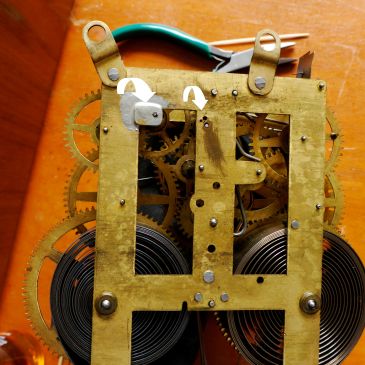
Blackforest shelf clock #2 had a partially stripped ratchet (see photo with white arrow) which I thought was rather unusual; not very surprising since brass is a very soft metal and does not stand up to much abuse, a product of rough treatment in the past I suspect. While winding it I could feel the click slipping on the ratchet and feared that it would let go if I was not careful enough. This critical issue could have led to a unpleasant outcome at some point in the future so I determined that it was only prudent to replace the spring / click / ratchet assembly.
White arrow is pointing to a stripped ratchet
Pendulum assembly with rotating bob adjustment
Open spring barrel, ratchet and click assembly
Gears assembled on the front plate
The two replacement parts fit perfectly. Now for a thorough cleaning. All the parts were put into an ultrasonic cleaner, dried, inspected and polished. The pivots were inspected and polished. The pivot holes which were in very good condition were pegged out and once re-assembled the movement was oiled and briefly tested. As any clock enthusiast who has had experience with time-only movements, they are certainly the easiest to work on.
The final step is the long-term testing phase to see how it runs on a full wind.
Postscript: five days later there is no stoppage. It will take a little longer to regulate the clock but so far so good.
Blackforest shelf clock #2 now has a replacement spring, click and ratchet as well as a new pendulum bob. Does it make it original? Considering that it has parts from a clock that was likely made at the same time it is original enough as far as I am concerned.
Every clock owner wants to know what their clock is worth and every clock seller wants to know what price they can ask for. This article will provide a guide to buying or selling an antique or vintage clock.
I will attempt to answer the following questions beginning with comments about the unpredictable clock market.
What factors are considered when assessing the value of a clock?
Is it original?
What type or style of clock is it?
Does the clock have a label, trademark, or prominent name?
Is it from the correct period or is it a “knock-off” or “re-issue”?
Does the clock have provenance?
What is the age and condition?
Is the clock collectible?
What is the mechanism type?
It all comes down to research
The unpredictable clock market
Unfortunately, in this unpredictable market, it is almost impossible to determine the value of a clock. What you think your clock may be worth today may not align with what the experts say and what others are willing to pay. What has value today may not have value tomorrow. Many factors influence the buying and selling of clocks and the clock market can be a battlefield with many casualties.
Recently, I saw a mid-1990s Howard Miller grandfather clock listed for sale on a Facebook site. I tracked the ad over the course of several days. The owner originally wanted $3000 but later stated they would take “no less than $1500” when it became obvious to them that the ad was not attracting attention. Personal value tends to be subjective and while the owner might have paid $3000 or more for a beautifully carved oak grandfather clock, its present value is not anywhere near what he thinks it is worth. I stopped following the ad but the seller likely withdrew it from sale.
Even an appraised value is the subjective opinion of an expert assessment based on condition and collectibility which is always subject to shifts in the market. My Ridgeway grandfather clock is in excellent condition, runs well, and has a command presence in my home but it is not worth much in today’s market.
Ridgeway Grandfather clock, Hamilton Country
What factors are considered when assessing the value of a clock?
Is it original? Original clocks attract buyers. The value of a clock decreases if some or many parts have been changed out. Determining whether or not a clock is original can often be difficult to determine unless viewed by an expert. The many “Vienna Regulator” clocks found on eBay and other online for-sale sites are missing parts, have had parts added such as crowns, finials, dial faces, hands, and even movements, and have weights that are not original to the clock. Back in the 1960s, many Vienna Regulators came to America in wooden crates consisting of loose movements and cases which were then married, assembled, and sold.
Would you expect a 100% original clock when the seller suggests that it is complete and original while at the same time admitting that they know nothing about clocks? Reputable auction houses have more accurate descriptions of the clocks they offer for sale when they describe condition and state if parts are missing or questionable. Moreover, they do not exaggerate the condition of a clock if they value their reputation.
Gustav Becker 2 weight regulator clock. It looks good but many parts have been replaced over the years.
What type or style of clock is it? Many mantel clocks in my collection are worth almost nothing since thousands were made and few good ones have survived. That said, some American mantel clocks are desirable and command high prices such as the Patti line of clocks from E N Welch or Sonora clocks from Seth Thomas. An 18th-century English bracket clock, an ornate French Cartel clock, or an American jeweler’s regulator are styles and types that are sought after by collectors and have retained their value over the years. On the other hand, tall-case or grandfather clocks, some as old as 200 years, can be had for a fraction of their value. Wall clocks tend to command higher prices than mantel clocks.
Does the clock have a label, trademark, or prominent name? Clocks that have an identifying label or trademark are more desirable than those that do not. Collectors often ask if the label is intact or if the movement is marked. Replacement labels are frowned upon by collectors and unmarked movements are less desirable as they may be replacements. Clocks made by prominent clock-makers add value. Old English bracket clocks with subsidiary dials, made by prominent clockmakers come to mind. A marked E. Howard or an authentic Willard banjo clock has more value than an un-named/unmarked clock similar in style and age.
The rear panel of an Arthur Pequegnat kitchen clock showing the label
Is it from the correct period or a “knock-off”? Is it original or a reproduction? There are excellent examples of reproduction wall clocks that look very much like period clocks from the early 1900s that are no more than 30-40 years old. Seth Thomas made a reissue of the iconic Regulator #2 in the 1970s which is not as desirable as the original #2. Often the differences are very obvious and sometimes quite subtle.
Does the clock have provenance? Does the clock have a story or does it have historical significance or can it be placed within a historical context? This Arthur Pequegnat Canadian Time clock spent most of it’s life in a train station waiting room not 30 minutes drive from my home. In the early nineties when the station was decommissioned it was purchased by a collector and was in his hands until I bought it from him about a few years ago. This is a key selling point and may add value. The history of the clock may be an important element in a sale.
Canadian Time clock by Pequgnat C.1929
The Ingraham Huron shelf clock (below) had been with a Bridgewater, Nova Scotia family since the 1890s. Balloon clocks, as they are called, seldom come up for auction and are valued by collectors because of their interesting design and limited production. In the case of this clock, This model was made between 1878 to 1880.
Ingraham Huron shelf clock C.1878
What is the age and condition? Many people think their clock is worth a lot of money when they see a similar clock by the same maker sell for a high price at auction. If their clock is missing case pieces, large sections of veneer, the hands are broken and so on, the value will be adversely affected. If the dial has been badly repainted or there have been poor repairs, the clock is not considered as valuable.
The age of a clock does not always mean that it has more value. A clock may be a style, or by a maker, who, regardless of age is not popular with collectors. Sperry and Shaw 4-column New York-style 30-hour clocks, while attractive, and over 125 years old, are not sought after by collectors as Sperry and Shaw, retailers rather than clock-makers, were clock merchants who used questionable assembling methods and dishonest selling practices.
172-year-old Sperry & Shaw 4 column clock
Thousands of gingerbread or kitchen clocks were made during the period 1885 to 1915. Despite their age, few have any value.
Is the clock collectible? Rare clocks are rare because few exist or rare because few owners want to sell them. OG (Ogee) clocks are clearly antiques, some more than 150 years old, but because thousands were made they are not as collectible as a one-of-a-kind 17th century English lantern clock. 30-hour Ogee clocks are also tough to sell because of the hassle of winding them every day.
Desirability is also region-specific. Of the many parlour clocks made in Canada, those made by the Hamilton Clock Company in the 1880s (Hamilton, Ontario, Canada) are very desirable by Canadian collectors. Arthur Pequegnat clocks, wall clocks, hall clocks, mantel clocks, or kitchen clocks fetch higher prices than similarly styled clocks because they are actively sought after by collectors in Canada. Outside of Canada, they are worth far less.
Martin Cheney clocks (1810) made in Montreal (Canada) are highly collectible, of exceptional quality, and are very rare. True Vienna Regulator clocks such as those from the Biedermeier period made prior to 1850 and authenticated as original are very desirable, reflect high asking prices, and are valued more than contemporary versions.
The key is research. Check eBay, reputable auction houses, local buy-and-sell sites, clock shops, antique stores and online message boards to get a feel for the range of prices and bear in mind that markets are very volatile
Cartel clocks are exceptional 18th-century French clocks and those fabricated by clock-makers such as Joseph de Saint-Germain or Duponchel à Paris command prices in the many thousands of dollars.
What is the mechanism type? Generally, three train clocks (time, strike, and chime) are mechanically more complex and are normally valued higher than two trains (time and strike) clocks. Three-weight Vienna Regulator Grande Sonnerie clocks generally command higher prices than a single or two-weight Vienna Regulator.
American clock company Sessions sold inexpensive clocks for the masses and produced many thousands. The Sessions Westminster-A tambour style clock has an unusual 2-train chime movement (chiming clocks generally have three trains) and fetch higher prices on auction sites than other Sessions mantel clocks.
Weight-driven clocks generally command higher prices than spring-driven varieties.
Sessions Westminster A mantel clock, C.1927
It all comes down to research
Do your research: Check eBay, reputable auction houses, your local buy-and-sell sites, clock shops, antique stores, and online message boards to get a feel for prices. Keep in mind that markets are extremely volatile. Do your homework prior to making any purchase. What may have sold for several hundred dollars years ago (30-hour Ogee clocks) are worth much less today.
Ask questions before you purchase your next clock and if you are a seller, provide an honest description of your clock and disclosures (new pendulum, new mainsprings, etc.). Chinese, Korean, and most Japanese clocks are not particularly collectible or desirable. If you firmly believe your prized Chinese-made Daniel Dakota family heirloom is worth over $150, potential buyers may not be beating down your door but a fair price of $40-50 might result in a quick sale.
This 1960s vintage Daniel Dakota wall clock is worth almost nothing
Clock prices are all over the map and we will not see a stabilization of prices any time soon. With the advent of the internet, many clocks thought to be rare have flooded the market depressing prices. The law of supply and demand applies. As demand increases, supply decreases, and prices rise. As supply increases and demand decreases, prices drop. The only constant is high-end clocks, sought after by serious collectors that have managed to retain their value. But how many of us can afford them?
Now is a good time for that special clock. There are certainly bargains to be had if you search carefully, learn as much as you can along the way, and tread lightly into the buyers arena or if you are placing a value on your clock to prepare it for sale.
My wife and I were at a little antique shop just outside Truro, Nova Scotia on a typical Sunday drive. I found a lovely Black Forest time-only shelf clock that was reasonably priced and bought it because it had a simple plate movement I was looking for. My wife on the other hand wandered through the same antique store and noticed a Kundo anniversary clock. Kundo was a well known German clock make and is otherwise known as Kieninger & Obergfell. Although we were not really in the market for an anniversary clock the price was right.
I noted at the time that it was not functioning but all it took when I got it home was a winding to get it running again and two weeks to regulate the time. Compared to those I have seen on EBay this one is in excellent condition and cleaned up well. The photos were taken prior to cleaning.
Kundo anniversary clock
A 400 day anniversary clock is otherwise known as a torsion pendulum clock. The torsion clock is a mechanical clock which keeps time with a mechanism called a torsion pendulum. This is a weighted disk or wheel, often a decorative wheel with 3 or 4 chrome balls on ornate spokes, suspended by a thin wire or ribbon called a torsion spring (also known as suspension spring).
Without glass dome
The torsion pendulum rotates about the vertical axis of the wire, twisting it, instead of swinging like an ordinary pendulum. The force of the twisting torsion spring reverses the direction of rotation, so the torsion pendulum oscillates slowly, clockwise and counterclockwise. The rotation is generally 270 to 360 degrees and takes about 7-9 seconds. Mine has a little bit of over-swing which is not problematic.
The clock’s gears apply a pulse of torque (provided by a winding spring) to the top of the torsion spring with each rotation to keep the wheel going. Because they are running so slowly and require little energy, they are capable of running for long periods but are not as accurate as weight driven or other spring driven clocks due to the fact that they are subject to temperature and humidity changes and the long run periods between windings augment any inaccuracy. Mine runs within 2-3 minutes a month and most would consider that to be acceptable.
Movement and pendulum with speed adjustment dial on top of 4 spokes
An adjustment allows the balls to move in and out of its axis thereby controlling the rate of the clock. The closer the balls are to the centre of the axis the faster they will spin and further from the axis results in a slower rotation. Torsion clocks were popular gifts because they would run a year between windings thus marking an important occasion or anniversary.
Torsion clocks are usually delicate, ornamental, spring wound shelf clocks which typically stand between 9 and 12 inches in height. The polished clock mechanism is usually exposed under a plastic or glass case or dome (need not be, however), to allow one to watch the torsion pendulum turn.
Movement showing spring barrel
This particular torsion clock was made in the 1970s. Shortly thereafter production of torsion clocks began to decline. There was a minor resurgence of electronically switched electro-mechanical (battery) torsion clocks but otherwise the age of the torsion clock was coming to an end.
Torsion clocks have a long history which I will explore in a future article.
What is a shelf clock? If you have a number of clocks as I do it can be quite confusing to describe each specific type to the average person but it is really quite simple. Let me explain how you can identify the clock you might be looking at. The term shelf clock is a broad category but I believe it can be classified in the following ways.
Some 180 years ago the first shelf clocks were OG (Ogee) clocks. These were the first mass-produced American clocks, were inexpensive, and were made up to about the late 1870s. They represented the early years of American clock-making and the transition from more expensively produced wood movements to cheaper brass movement clocks. OG clocks are so named because of the double-curved molding on the front of the clock. The curved molding was designed to hide the weights. Many of these clocks were weight driven with 30-hour or 8-day movements and had mirrored or painted tablets. OG clocks were usually 25 inches in height and 15 inches wide and had hardwood veneers covering a softwood frame. They were surprisingly accurate and reliable.
Spring-driven and weight driven 30 hour OG (Ogee) clocks, made by the Canada Clock Company, circa 1872-76 (Canadian Clock Museum)
Later, more stylish clocks could be found. These are called Column clocks because they would either have a half-column or full column on the left and right or even stacked half or full columns such as the one pictured below. Moldings on the top and bottom would be brought together by columns on each side of the clock with mirrored or painted tablets. Column clocks were almost exclusively weight driven with 30-hour or 8-day movements.
Stacked Column clock, circa 1870 (Canadian Clock Museum)
At around 1840 Steeple clocks were introduced. They had a peaked centre section bordered by columns topped with finials and a peaked sash with a decorated (often hand-painted) lower tablet. They were spring driven with 8-day movements. Steeple clocks are very distinctive, stood about 15 inches high with veneered hardwood over softwood, often with reverse-painted scenes and are made by a number of well-known companies.
Arthur Pequegnat Maple Leaf “fan top” Kitchen clock, circa 1905
Kitchen clocks (Gingerbread) were simple or ornate with carved or steam-pressed patterns made by quick-saws and heavy steel presses, stood 22-24 inches in height and about 15 inches wide, and had a decorated sash which could be a very simple design as you see here or a much fancier reverse-painted glass scene. These inexpensive, visually pleasing timepieces sat in the kitchens of lower and middle-class homes and were produced by the thousands. They were so named because of their likeness to the design of gingerbread houses at the time (early 1900s). They are usually made of oak, walnut or even walnut trimmings on oak with a metal clock face and many had a simple alarm mechanism. The Gingerbread clock you see here is the Maple Leaf “fan top” by Arthur Pequegnat. The Maple Leaf came in 4 unique styles all characterized by the maple leaf decal on the glass door.
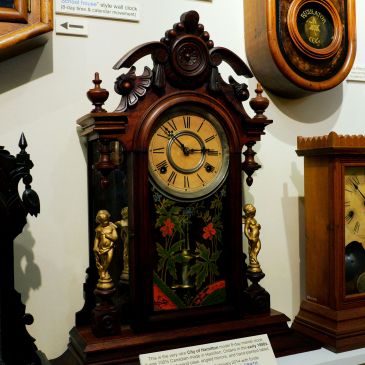
Some kitchen clocks had beautifully carved features and figurines such as this stunning clock made by the Hamilton Clock Company (Canada), though a clock such as this might be found elsewhere in the home and considered a parlor clock.
City of Hamilton, made by the Hamilton Clock Company, circa 1880 (Canadian Clock Museum)
When spring-driven clocks were introduced the Parlor clocks like this Hamilton Clock Company model became popular. They tended to be narrower than column clocks because they had spring-driven movements. These clocks mirrored the furniture styles of the time. This one reflected the Victorian era with its bold figurines, carved finials, elaborate patterns etched into its wooden frame, and the hand-painted floral design of the sash.
Seth Thomas round top cottage clock, circa 1930
Cottage clocks are less than 15 inches high and typically 8 inches wide are small, simple in design, and take up very little space. Many have basic alarm mechanisms but have one feature that distinguishes them from other pendulum clocks. They have a clip or a clasp that secures the pendulum rod for travel. The “round top” you see here was sold by Henry Birks and Sons an upscale Canadian jeweler. Others had “beehive” tops, flat tops, or octagon tops.
Pendulum rod clip for Seth Thomas round top
Smaller clocks are often referred to as desk clocks. They are usually mainspring driven with a flat dial. This Kundo 400-day anniversary German clock is an example of a desk clock but it might also be described more specifically as a torsion clock. This one stands less than ten inches tall and has a glass dome, a weighted wheel with 4 balls suspended by a ribbon called a torsion spring, and an exposed movement. It was typically given as a wedding gift.
Kundo 400 day anniversary clock, circa 1970
Finally, the mantel clock.
Mantel clocks can be ornate, larger, and the centerpiece in a room. This particular clock, a Mauthe pendulum mantel clock offers a precision-built sophisticated German Westminster chime movement in a relatively non-descript but attractive and well-built cabinet that is simple yet elegant.
Mauthe time. strike and chime, circa 1970
ASIDE: Is it mantel or mantle? I have always considered a mantle as something you wear, a garment or a part of the earth’s crust. A mantel on the other hand is a shelf above, say, a fireplace. I see this word interchanged so often when clocks are advertised or described that either word is universally accepted. I prefer the word “mantel”.
Ingraham Huron shelf clock, circa 1878
Mantel clocks were inexpensive to make, occupied very little space, and were part decoration and part practical timepieces. Mantel clocks were made with brass, wood, porcelain, slate, Bakelite, and metal though for the most part they were designed to be lightweight (slate clocks and cast iron clocks would be the exception), simple in basic design, and very practical. Mantel clocks have lasted so long, over two centuries, because they are dependable, versatile, and work so well in many domestic situations.
The categories of shelf clocks also include carriage clocks and lantern clocks. One of the first clocks whose movement and external structure was made predominantly from brass instead of iron or wood was the lantern clock. Although the shape of the clock looks somewhat like a lantern, the derivation of the name probably stems from the French word “laiton”, meaning brass. The earliest lantern clocks had striking mechanisms; later in the 17th-century alarms were sometimes added. Some lantern clocks had pendulums and could be hung on the wall.
Carriage clocks were spring-driven clocks developed in 19th century France and are made of plain or gilt brass. They are often no more than 8 inches tall, designed to be portable, and are characterized by a rectangular shape, glass or porcelain panels, and a carrying handle on the top. If you have a Breguet carriage clock as part of your collection you are very lucky indeed!
This is by no means an exhaustive description of the types of shelf clocks. There are others such as swinging clocks, tambour clocks, pillar and scroll, and so on. Whether you are shopping for a clock as a gift or adding one to your collection or even describing what you have seen to a friend, it is important to understand the distinctions between one type and another.
Black Forest Clock Company of Toronto, clock in as found condition
Shelf clocks such as the one pictured have always been hard to find though I did stumble upon this one very recently (April 2016) at an antique store in Great Village, Nova Scotia. Why, because of their cheap construction and inexpensive movements, not many of these clocks have survived over the years.
This one might have had a special meaning to someone at one time because it is a memento of the King George VI coronation of 1937 which nicely dates the clock. He became King George VI of England in December 1936 following the death of his father George V and the abdication of his brother. He had been a heavy smoker and in 1951 had his left lung removed then died suddenly in the winter of 1952. Elizabeth became queen later that year.
Black Forest shelf clock after case restoration
Another view of refinished case
This Blackforest shelf clock is only slightly larger than the first Blackforest clock I picked up last summer (2015) and like the other, is time-only.
Company plate on rear of clock
The time-only movement is very simple in design. The pendulum rod, bob and pallets are one piece.
One piece pendulum assembly
To adjust the beat rate you either rotate the bob left for slower rate or right to make the clock run faster or slower. Outside the back plate sits the mainspring which is housed in an open barrel and there are 5 gear wheels plus the escape wheel between two solid plates. This is an identical movement as found in my other Blackforest shelf clock but unlike this clock it was in very poor condition. The movement is German and could have been made by a number of companies at the time; Keinzle, Mauthe, Hermle or Junghans. There are no stamps or markings on this so-called “plate” movement to give any indication of the maker. Typically many Canadian companies such as the Blackforest Clock Company of Toronto (the Forestville Clock Company after the war) imported German movements before the Second World War and installed them in Canadian made cases.
Plate clock movement
Commemorative Edition – 1937 Coronation of King George VI
To refinish the case I cleaned it thoroughly using Murphy’s Soap, applied three coats of dark walnut stain taking care to wipe the stain with a cotton cloth 5-10 minutes after each application. My intent was to fill in the scratches and abrasions rather than radically alter the colour. I then rubbed the cabinet with 0000 steel wool between coats and applied two top coats of clear polyurethane satin finish. I cleaned the numerals but decided against repainting rather preserving the original patina, though I applied Brasso to bring back the finish on the key wind bushing. In the end the case is a little darker but likely closer to its original finish.
Original winding key
I haven’t quite figured this out yet but I think the winding key has a “bottle opener” design to allow the pendulum to be locked during travel. Ideas?
This clock would make a great addition to a any bedroom. It is small enough for a dresser or even a side table, quiet enough (for a mechanical clock) and is still attractive in design after all these years. Heck, you can even wind the clock in the 6 o’clock position.
Restoring the case was relatively simple. After a thorough cleaning to lift the accumulated grime, a wax overcoat, touch-ups in discrete areas with yellow shellac, the case is very presentable for a 138 year old clock. I cleaned up the brass bezel but left the paper dial untouched. The hands are original and left those alone. The lacquer on the pendulum is still intact; no work needed on it.
And now to a further investigation of the movement.
After taking the dial pan off a couple of days ago my first impression was that the movement appeared to be in good condition. There are a number of newer bushings on the front which would have been expected for a clock of this vintage. The servicing of the front plate looked like a capable repair. I oiled the front pivots and gave the pendulum a push, adjusted the verge and found a good beat. It ran continuously through the night. The next day I decided that if I were to keep this clock running until I can do some work on it, the movement should come out to oil the back pivots. It must have been years since this movement last saw pivot oil.
No problem. Four screws and out it came.
The secrets of this clock were now being revealed. Here you can see the back plate. I immediately observed several distressing issues with the movement. The first two problem areas are indicated by the white arrows. The left one shows a piece soldered onto the plate to address a pivot issue. The second shows a new bushing where one should not ordinarily be.
Back plate showing two problem areas
The addition of a new bushing in that location must have been done for a reason. At this point I cannot speculate why it had to be done this way but it looks like shoddy workmanship. Otherwise, I do not see any other conventional bushing work.
You can see that the escape wheel arbor is clearly misaligned in the following photo. It works though theoretically it should not. Despite the fact that the clock is happily ticking away it is a poor fix for an unknown (to me) problem.
Arrow showing a misaligned escape wheel arbor
The next issue is a soldered lantern pinion seen here just off the main gear (see arrow).
Soldered lantern pinion
It is not a problem now unless one had to work on the pinions on that gear at some later date.
The fan was also repaired with solder. It looks ugly but it does not effect the running of the clock.
So what to do? A simple bushing job I can do but serious bushing work is obviously required from someone with the experience and knowledge of Ingraham movements and I don’t have that level of expertise – yet. I may put this aside until I gain more experience or have it professionally repaired.
I did discover one unusual feature. Although it has a wonderful gong tone on the hour it does not strike on the half hour.
For the moment is is ticking away and keeping good time.
December 18th marks the day that my Arthur Pequegnat Maple Leaf fan-top is off to repair.
Sadly this is a repair that I cannot perform myself at this stage of my learning. The problem is essentially a clutch plate off the centre arbor that is not engaging the gear for the strike side. The result is that the hour and minute hand do not move at all thus the centre arbor is quite loose. In the meantime I might as well have some bushing work and a thorough cleaning done.
Typically gingerbread clocks go for almost nothing on the for-sale sites. The fact that this is a Pequegnat means something special however and in my view it is worth preserving for years to come.
Here is the problem area.
Clutch cup is loose
Although it is difficult to visualize from this photo, the cup clutch plate is very loose and needs to be reattached to allow a firm connection to the gear beneath. As such I am prepared to put a little money into this clock and keep it in my collection.
In November 2015, I added an Arthur Pequegnat Maple Leaf “fan top” to my collection. The clock was advertised as non-running, and the seller’s description was accurate—it had its share of challenges. While gingerbread-style kitchen clocks don’t typically appeal to me, I felt that, as a Canadian, if I were to own one, it should be a Pequegnat.
This clock dates back to the Berlin era (before 1917, when Berlin was renamed Kitchener, Ontario) and features the signature nickel-plated steel plates with brass bushings, characteristic of most time-and-strike Pequegnat clocks.
Arthur Pequegnat Maple Leaf Kitchen Clock
The clock is complete with its Maple Leaf bob, an original untouched dial, most of its label, and a remarkably well-preserved maple leaf decal on the front glass.
Berlin Ontario label, mostly intactMaple Leaf bobMaple Leaf decal
I managed to get the clock in beat by adjusting the verge, but the minute arbor is quite loose, causing the minute and hour hands to stay stationary. Instead of attempting a full repair on my own, I’m considering having the clock professionally serviced. In the meantime, I plan to remove the movement from the case to examine the issue further. It could be a simple fix—or something more complex.
The mottled finish on the entire case
The case poses another challenge. While it has no chips, cracks, or missing pieces, the seller believed the mottled finish added character. I strongly disagree—it’s far from appealing.
To gather restoration ideas, I shared this clock on theNAWCC forum site. Although the finish might be original, it appears the clock was stored in a hot environment, causing the finish to degrade. As one forum member explained, “The case was likely subjected to heat (stored in the attic), and the shellac finish has melted into the alligatored appearance you see now.” When shellac softens, it attracts airborne dirt, further compromising the surface.
Although I’m capable of refinishing the case, the movement also requires repair. After inspecting it, I’ve realized the cost of professional repairs is currently beyond my budget. However, I plan to educate myself on servicing antique clocks and intend to handle the repairs myself.
This is a Sessions Tambour style clock that, according to the label on the inside back access door is a Beveled Number 2. Seems like an odd name for a clock. It is a fairly attractive mantel clock featuring a mahogany finish with faux inlay just below the dial. It is a time and strike clock, two hammers striking on rods. I would put the date of manufacture at the late 1930s or early 1940s. I have 2 other Sessions clocks with a very similar movement so it looks very familiar. This one came without a pendulum bob so I will have to order one from Timesavers. I am not sure at this point whether the bob is a 2.3 oz or 3 oz so I will order both.
The clock has a few issues aside from the missing pendulum bob. I noticed right away that the time side arbor turned freely and therefore it was impossible to wind the time arbor as the click was not engaging the time spring teeth properly. Once the movement was out I inspected the click on the time side and sure enough it had slipped off the teeth.
The time side click is barely engaged
This is a common problem with this type of movement and a repair is definitely in order. The movement itself is very oily and dirty having been sprayed with some sort of lubricant at one point in its life. There was back gunk (old caked oil) on some of the pivots but there was not as much play in the bushing holes than I would have expected. The spring issue probably arose early in its life. One thing which I first thought was an issue turns out not to be. As the photo shows there are helper wires between the escapement and the fly.
Helper wires
They keep the strike levers from bouncing and assure better operation of the striking mechanism. They are in factory installed condition.
Very dirty movement, time side on left
The case was a little banged up. I did a little sanding with 0000 steel wool, removed dozens upon dozens of white paint drops, filled gouges in the veneer with a red chestnut stain and applied the same stain over the entire finish and it seems to pass for mahogany.
Case refresh
A little Brasso metal polish was applied to bring the shine up on the bezel and I Windexed the dial glass inside and out. The results, I think, are impressive. As a final stage I will apply a clear coat on the case.
Can I get this clock to work? I am convinced that if I can fix the time side click, give it a thorough cleaning, this clock will run fine for a long time.
I acquired my Sessions Raven clock about a year ago. It had been serviced by someone knowledgeable about clocks and arrived in excellent condition. The movement had clearly been disassembled, oiled, tested, and the case carefully reconditioned. Interestingly, it also came with a set of instructions from the person who had worked on it.
Ebony in colour and very attractive Detailed operating instructions
I imagine he wanted to ensure the clock found a good home—and it certainly did! The only drawback was the absence of a label, which is always a consideration when purchasing antique clocks. Otherwise, everything appeared to be in order. According to Tran’s book, the leading authority on American clocks, the Sessions Raven dates to the 1920s. It is a time-and-strike clock, featuring a bell for the half-hour and strike rods on the hour. I suspect it was named the Raven because of its deep ebony color—quite striking, in fact.
Time and strike movement showing the bell
The Sessions Clock Company emerged from the E.N. Welch Clock Company in the early 1900s and was once one of the most recognized American clock manufacturers. However, like many others, it struggled to compete with the rise of electric clocks. Despite its efforts to adapt, the company persisted until the late 1960s before ultimately being forced into liquidation in 1969—a bittersweet end to a once-prominent name in horology.
My clock holds a prominent place in my family room. Its simple design reflects the style of its era and blends seamlessly into any space.
This is a Blackforest shelf or kitchen clock made before the Second Word War. Blackforest is a Canadian clock company. The Blackforest Clock Company of Toronto, Ontario was founded by Leopold and Sara Stossel in 1928. Both clock movements and complete clocks were imported from Germany and sold through department and jewelry stores across Canada. Their son Ed Stossel started working part time with his parents’ company in the 1930s, and later became a full-time employee in the late 1940s.
Some assembly work was carried out in their Wellington Street East factory. Initially, imported mantel clock and grandfather clock movements were installed in cases made in Kitchener, but later the complete mantel clocks were imported from Germany. This arrangement was interrupted by the Second World War, which also led to a name change to the Forestville Clock Company in 1941. During the war years this company imported its clock movements from England, the United States, and even France. However, starting in the mid nineteen fifties German factories again became the source of most Forestville clocks, with Mauthe being a major supplier. The company did not survive much past the late 1970s.
I found this in a antique shop in Kazabazua Quebec and it was in sad shape. This particular clock would have been the least expensive in the Blackforest catalog. I had an opportunity to go through the Blackforest catalog during my visit to the Canadian Clock Museum in Deep River this past summer and could not find a listing. I have no idea of the model name or number as there is no label on the clock. The only feature it shares with other Blackforest mantel clocks is the metal bezel, numerals and hands. Otherwise it is a one train time-only movement with a minimum number of gears and a unique twisting pendulum adjustment. The movement is as simple as it gets so it is easy to work on.
The photo shows the movement out of the clock and as you can see, it is quite dirty. I am in the midst of dis-assembly, cleaning (in my new Ultrasonic cleaner) and oiling. My initial observation is that the pivot holes, pivots and lantern gears are in good shape and the mainspring seems strong. Not a lot of wear for a 75+ year old clock.
Single train time-only movement
The next photos show the condition of the case when I bought it and the second is the first phase of stripping. You will notice that I did not disturb the decal; it would have been impossible to find a replacement. It was in terrible condition, likely sitting in a attic or garage for quite a few years. The spring was wound very tight and I am assuming at this point that dirt and grime caused it to cease. Although I paid $15 for it at the time it seemed too much after I got it home. Nonetheless, I went to work on it and if I can get it to function it might be worth more than I paid for it. As far as restoring this clock I used a latex dark walnut wood satin and a polyurethane top coat, not what would have been done at the time which likely would have been a dark lacquer finish. This method will be more durable. The first photo shows the case is in a restored condition and as you can seeing it is a striking little clock.
You must be logged in to post a comment.