Crazy Clock Ads – anniversary clocks – you decide, sadly illiterate or cleverly deliberate

400 Dayz, Heirloom Aniversry Clocks

Yoo may chooz clock 3 for ohnly 135$ or 2 for ohnly $185 or 3 for ohnly 235$ or all for jist 350$. Theze 400-day Clocs are in ecselent condishn and reecwire NOH electrisitee and thus NOH batreez, , jist wiinding wunts each year, for constant, dependable time-keeping, noh mater how oftn thu hydro wahz off. Doo note that this kind uv cloc haz at leest a 250 yeerz, air-loom liif-span and sellz for hundredz uv dollarz noo; thu numbr-3 cloc wahz $495 noo; thu numbr-2 wahz $695 and thu fanseer, numbr-1 wahz $795, back when quarts clocs wer beeing introdoosd. I don’t recahl thee exact aje uv them but I can ashoor yoo that thay ahl hav been in mii pohzseshn for les than fiftee yearz, and nun hav any vizible signz uv wear in thair gearz, becuz uv thoze geerz mooving a fraction uv an inch ohnlee 4-timez eech minit, insted uv 60 timez az iz comon with ahl uthr kindz. Ahl-soh, ahl 3 uv theez are thu real thing, NOT thu =FAKE= kind that require batereez and ohnly APEAR too bee authentic, with an electric motor driving thu pendulum and a quartz movement that’s noh mohr reliable than any uthr batery-driven clock. Yoo’re welcum too make uh vyooiing apt. for any time uv any day, sunday throo thurzday.

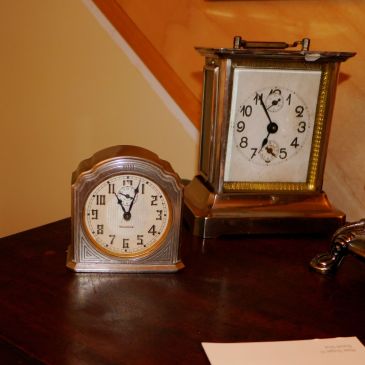
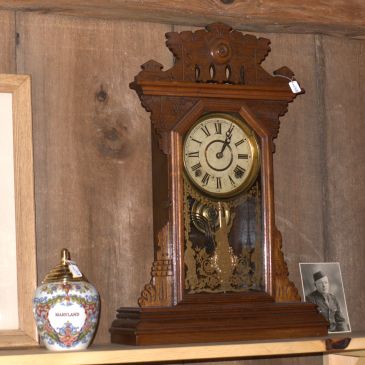
The clock described in the ad are similar to these in my collection. The prices he or she is quoting are much too high.

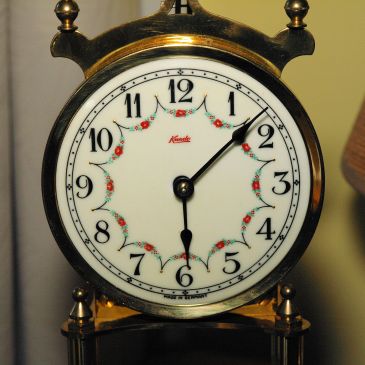
Kundo miniature
Kundo miniature
Kern 400 day clock
Kern 400 day clock

Is the seller cleverly deliberate or sadly illiterate? You decide!


Kundo 400 day clock and why I love anniversary clocks | Part I

The 400-day anniversary clock, also known as long-duration clocks, is a fascinating category of clock known for its ability to run continuously for a full year without needing to be wound. These clocks, often featuring intricate designs and beautifully crafted mechanisms, were first introduced in the late 19th century and have since become a beloved collectible.

Kundo standard size 400 day clock

In this article, we’ll explore the history, mechanics, and appeal of these interesting clocks. This is a two-part series. The first part describes my most recent purchase, a 400-day Kundo anniversary clock. Part II involves the installation of the suspension spring, cleaning, testing, and post adjustments.

400-day clocks are known for their inaccuracy, although they are undeniably beautiful and fascinating to observe. A minute lost each day adds up over the course of a year, potentially totaling many minutes—or even hours—by the end. Despite this, I still find great joy in owning and appreciating them.

A brief history

400 day clocks have been with us since about 1900. There were torsion clocks produced before 1900 but in limited numbers from about 1894 onward but the real push was after 1900. The Kundo model you see here was made in the late 1950s or early 1960s, probably the peak and subsequent decline of the anniversary clock era.

Dial face Kundo Clock

Once quartz clocks were introduced mechanical versions declined precipitously. Kundo is one of many companies making anniversary clocks in the 1950s and 60s. Kundo is a combined form of Kieninger and Obergfell. The company exists to this day as Kieninger, a subsidiary of Howard Miller which is part of a larger company.

This particular clock is a good example of a typical anniversary clock of the period. There are signs of wear as one might expect, dents on the base where an unrestrained pendulum did its damage and a snapped suspension spring but all the parts are there, complete with its dome.

Dents from weights bouncing around during transit

The clock was purchased at a local antique store. It is not in running condition. These clocks typically sell for around $50 to $100 or more on online marketplaces. Domes are often chipped or missing entirely. The glass dome on this one is free of chips.

I have ordered a Horolovar spring  (.0032″) and will report on the installation, cleaning, and testing of this 400-day clock. Look for the second part of this series.

Canada Clock Co. – a cottage clock from the early 1880s

Case is in fair condition, dial face has some flaking
Case is in fair condition, dial face has some flaking, piece broken on left side of base

We have a couple of antique stores in our small town. Calling them antique stores is a bit of a stretch because there is usually more junk inside than actual antiques. We were shopping in the area of one of those “antique” stores and my wife turned to me and said, “Let’s go in”. I replied, “You know, all they have is junk”.

I thought, I might have found something important

I acquiesced. While she continued her shopping I went on ahead to look around the store and in the very back I saw a very sad looking clock that at I took for an old Sessions or a Waterbury.  As I neared the clock it piqued my interest and I began to see that it was quite old. I picked it up, looked for any markings on the dial face, found none then checked the back of the clock and discovered most of an intact label revealing a what I consider to be a significant find.

Back label in good condition for the age of the clock

It is a clock from the Canada Clock Company. The Hamilton Cottage Extra was one of a range of clocks in their Metropolitan line.

This is an important discovery. The owner of the store knew nothing about clocks. He was asking $99 but after a bit of haggling, we settled on $40. I knew that it was worth much more.

Here is an excerpt on the Canada Clock Co. found at the Canadian Clock Museum in Deep River Ontario (Canada).

This company was the last of three sequential attempts to produce clocks by factory methods in Canada during the 1872 – 1884 period.  The original effort by the Canada Clock Company in Whitby, Ontario was basically unsuccessful and only limited production was achieved.
 
In 1876, the equipment was relocated to Hamilton, Ontario to begin a second attempt as the Hamilton Clock Company, with new investors.  This attempt was more successful and a fairly wide range of clocks was produced.  However, sales were not very large and some of the investors left the company by 1879.  At that point the president, James Simpson, ended production and proceeded with a major reorganization.
The company subsequently became the Canada Clock Company using the old Hamilton Clock Company factory and resumed production in 1880 but as a result of poor sales closed its doors in 1884.
For more go to this page at the museum site.
Clocks from the Canada Clock Co.are sought after by collectors. For international readers this represents a rare find because the 1870s to the mid 1880s was a very important period for clock production in Canada. Apart from several independent clock-makers in Quebec and eastern Canada two notable companies made wholly Canadian clocks, The Arthur Pequegnat Clock Co. of Kitchener Ontario made clocks up to 1941 and Martin Cheney of Montreal made finely crafted clocks in the early 1820s. This clock was made at the Hamilton, Ontario factory which produced clocks from 1880 to 1884.

Original time and strike 30 hour movement
Original count wheel time and strike 30 hour movement

The 30-hour time and (bell) strike movement is in remarkably good condition and fairly clean. The back label in good condition for the age of the clock and there is a stamp on the top of the label which says, “…A Hill &Co.”. If any Hamiltonians are reading this I would be grateful if you could make inquires about this small retailer.
My preliminary examination reveals that this clock has had very few repairs over the years. I have not taken the movement out of its case to check bushing/gear wear and other issues but I am initially encouraged. The case reflects the age of the clock but I would judge the clock to be in just fair condition. There is a wooden piece that needs to be re-attached on the right side of the base. Fortunately that piece was tucked inside the clock case.

Right side needs work

Left side looks good

100+ years of grime came off easily
100+ years of grime came off easily; etched glass on the bottom part of the tablet is distinctive

The crudely made case is not overly decorative and reflects a muted Victorian style of the times. The lower part of the tablet has an etched glass floral design typically found in Canada Clock Company clocks. The door clasp is original. The dial face is flaked in places and not in the best of condition though the 2 floral designs on each bottom corner are nicely preserved. The hands are original. The case is not heavy and made of pine with a deep walnut stained finish. It was grimy and dirty as expected. It cleaned it up nicely with Murphy’s soap and a sharp hobby knife was used to remove the numerous paint drops on the clock. Why folks do not put something over the clock when painting a room amazes me.

I will put the clock aside until I can determine my next steps. Do I pursue a full restoration including renewing the dial face or leave the clock largely in as-found condition? In the meantime I will re-attach the wood piece on the left side of the base.

What would you do?


Tick Talk Tuesday #12 – Arthur Pequegnat Nelson hall clock

Tick-Talk Tuesday is about the letters and comments I have received from you, the reader, concerning your clock, issues you might have had and challenges you face and my responses to your questions with advice on your  particular clock concern and of course, my general comments. For those comments and questions that stump even me, I consult within my clock circle for the best possible answer.

NV writes about her Arthur Pequegnat Nelson hall (tall-case) clock.

“I have an antique, oak ‘hall’ clock that’s been handed down in my family. I read in an article you wrote that you collect them.

This clock was in my home growing up and my grandmother, now 96, reminds me of its history and knows whose home it was originally from in our family.(my grandfather’s grandparents, I believe). I’ve started to look into the history of these clocks.  I’m interested to know what your thoughts are if you are interested in sharing them.

I can tell you that it’s in beautiful condition, however although it had always worked and sounded well (still sounds beautiful) when it was shipped here to BC in the 90s, it was never restarted and the finial became dislodged, but it is not cracked or broken.  So it’d since been stored at my grandmother’s but she never got it going after it arrived and needs to ‘be started’ as the weights are still off (or possibly a repair?)  Also the key was lost.

I’ve just recently brought it to my apartment (Gramma wanted the space!) And she supports me in whether I decide to keep it or not.Please contact me if you are interested as I am considering selling but regardless I will need to determine value/appraisal if I do keep it, at least for insurance. ”

My reply.

“You have a real Canadian treasure. Though it is called a hall clock it’s actual name is the “Nelson”. There is one on display at the Canadian Clock Museum in Deep River Ontario. Unlike many tall case clocks that decline in value yours is actually increasing since it is continually sought after by collectors.  If it says Berlin on the lower part of the dial it was made before 1917. Clocks made after that simply said, “The Arthur Pequegnat Clock Company of Canada”. The Arthur Pequegnat Clock Company closed its doors in 1941.

The Nelson is in the middle

You can easily find a replacement key. Perrins would have the key although off hand I do not know the correct size. The finial on top is a friction fit.

It would be in the neighbourhood of $2000. You should keep it not only because it has strong sentimental value but it is an important part of Canadian history. It would also be worth repairing.

NV cannot keep the clock and has plans to sell it.

E. N. Welch Whittier model parlor clock Part II – a description

E. N. Welsh Whittier model

The Whittier Model

This is the Whittier model from Welch’s Authors series. Tran’s 2d ed. shows it from the 1893 catalogue. It is a half-hour strike clock. Though an alarm could be ordered this clock came without one.

It is solid walnut in construction, deep brown in colour and darkened by age.  It stands 22 inches tall by 14 ½ inches wide and 5 inches deep. The crown is an ornate machine-cut design with a single bulls-eye. The Roman numeral dial face with inner brass ring is original but has been covered with a clear varnish.

Clock face in good condition

The spade hands with circular cut-outs also appear to be original. The tablet is in remarkable condition and features an embossed gold colored scene of two female child warriors on each side presumably guarding an older female warrior (laurel and spear), reminiscent of Greek or Roman mythology.

Barely readable label

Bottom label with running instructions

There are two labels on the back panel, the top designates the model name which is barely readable; the bottom label has generic operating instructions for several types of clock models. Both labels appear to have been varnished over at some point. The upper area of the back panel has a hook for hanging the clock, added by a previous owner. However, this is a shelf or mantel clock, not meant to be hung on a wall. I doubt that the pendulum bob was this colour originally.

Though incorrectly termed a kitchen or gingerbread clock it is commonly referred to as a parlor or hall clock. Since the company last produced clocks in 1902 I would comfortably date this clock at between 1893-96 or perhaps a little later, 1901-02. The E. N. Welch Clock Company has a fascinating history (detailed in Part I of this series) and unfortunately not many of these well-made American clocks are still around.

Time and strike movement

In Part III I will describe the challenges of servicing the clock movement.


The Cuckoo clock – A brief history

This weeks profile is about the cuckoo clock. I do not have one in my collection but I am always open to new additions. I  know almost nothing about them so I have to rely on knowledgeable people like Megan to fill in the blanks. Earlier this summer (2017) I received an email from Megan. Megan runs a site that specializes in Cuckoo clock products for sale. She asked me to profile her site and I said I would be happy to do so.

“I came across your clock blog and have really been enjoying it. I myself run a Black Forest cuckoo clock blog and I have an article about the history of the cuckoo clock that I think your audience might find useful. I have posted it below and should you find it useful, I would love to have it featured on your blog. If you want to check out my site, visit www.designedintime.com

Perhaps one of the greatest contributions to the Black Forest’s fame is the cuckoo clock. While it is easy to appreciate their charismatic beauty and charm, few realize how deeply rooted these clocks are in Black Forest history. It has been a long journey that has involved several hundred years and thousands of people in one small town.

The story of these incredible clocks starts several hundred years ago in Germany’s royal family. The first description of a cuckoo clock was in 1629 and made by a German nobleman, Philipp Hainhofer. He described a curious little clock that belonged to Prince Elector August von Sachsen. It was said to contain a bird that resembled a cuckoo and it was therefore called a cuckoo clock. Though these clocks were very primitive they did not make any noise.

Enter Franz Anton Ketterer! Ketterer was a clock maker from the Black Forest and is often credited with the invention of the cuckoo clock. It was one day in the 1730s, after pondering the mechanism of a church organ’s bellows that he was inspired to recreate the mechanism inside a clock that contained a cuckoo bird. Thus, the first cuckoo-calling mechanism was born.

Word spread of these fascinating little clocks and it wasn’t long before the cuckoo clock was on the rise in the Black Forest. Most of the villagers in the Black Forest were farmers, but as the eldest sons of the family often inherited the farm, it left the others with a need for supplemental income. Cuckoo clock making was, therefore, a wonderful opportunity for villagers to support their families. During the deep snowy winters, the villagers would toil away at their clock making skills and when the snow melted in the spring they would take their clocks to display in the town. These people, the early cuckoo clock makers from the Black Forest were given the name “Häuslers”.

At the time, hourglasses were the most commonly used timekeepers and the clocks became not only a much more accurate replacement but were also much more artistic. Germany, always a leader in the arts, once again did not disappoint. It wasn’t long before the villagers would have contests to see who could make the most unique and artistic cuckoo clock. People far and wide caught wind of these incredible timekeepers and it wasn’t long before there was an international demand for cuckoo clocks.

Therefore, in 1850, the Duke of Baden founded a clock-making school that offered classes in standard subjects such as math and writing, but also advanced clock-making.

As clock-making flourished a grand contest was offered by Robert Gerwig, the director of a Clock-making School in Furtwangen. It was open to any clockmakers who would compete for the best contemporary clock design. The winner would be funded to complete their design and the winning design was created by Friedrich Eisenlohr. Eisenlohr was an architect whose then-current project was building a new railway through the Black Forest and it was no surprise that the winning design was a cuckoo clock. This clock, however, resembled the rail houses and the design soon became a popular idea that would take over the early designs of the shield clocks. The box and roof style of the rail house design was the precursor to the modern day chalet clock that we see all over the world. Ironically though, there was only one difference between Eisenlohr’s design and the final product. This change would be that Eisenlohr’s design included a cuckoo, however, when the design was put into action, there was not sufficient funding to complete the cuckoo mechanism. Despite this, other Black Forest clockmakers soon figured how to merge both the cuckoo mechanism and the rail house design. Therefore Eisenlohr is still credited with the modern style.

Today, the Black Forest cuckoo clock is a world renowned treasure that has made the small, but beautiful Black Forest villages famous. It comes in a variety of sizes and styles including chalet and carved. While a true Black Forest cuckoo clock is mechanically operated, there are also battery operated clocks called quartz clocks. These can be made in the Black Forest and are often more affordable as they are not authentic like mechanically operated cuckoo clocks.

While visiting the Black Forest I strongly recommend stopping by some of the world-renowned clock makers, such as Hones, Rombach and Haas and Schneider. There are also a number of museums that contain some of the original shield and rail road clocks that are definitely worth checking out. Perhaps my favorite is the German Clock Museum in Furtenwagon as they contain some of the oldest cuckoo clock histories to date.

Next time you see a cuckoo clock, you can appreciate not only the skilled craftsmanship but also the hundreds of years of history that stand behind it!

Photos reproduced with permission. For more information on cuckoo clocks, visit Designed in Time, www.designedintime.com


E. N. Welch Whittier model parlor clock Part I – E. N. Welch history

Among the most common parlor clocks, E.N. Welch clocks are relatively scarce. A key reason is that the company was absorbed by Sessions in 1903. The history of Welch is intriguing, as Welch, Spring & Co. initially focused on producing high-end clocks but eventually shifted to manufacturing cheaper, heavily discounted mass-market clocks—a move that likely contributed to its decline.

E. N. Welsh Whittier model

This time-and-trike American clock with a count wheel strike is an antique store find. I  found it at what I would call a higher-end antique store in a small village in Quebec during one of our day travels from our summer cottage. I liked it so much I bought it. Because the strike side did not function there was a slight reduction in price.

The clock ran for several days and kept good time, but it was in desperate need of a cleaning. I was unable to get the strike side to run, though I hoped to fix it eventually. All the strike-side parts appeared to be present, but someone had clearly tampered with the levers, bending them significantly. It’s impossible to fully assess the situation until I take the movement apart.

Barely readable label
Barely readable label and someone determined that this clock should be hung on a wall

History of E N Welch

The E. N. Welch Mfg. Co. was formed on July 6, 1864 to succeed an older private firm making clocks under the name of E. N. Welch. Elisha N. Welch (1809 to 1887) had been making clocks at a factory site on East Main Street at Forestville, Conn. since taking over the bankrupt business of J. C. Brown in about 1856.

A movement shop was established in 1869, adding to the two factories already in use by the firm. Between 1868 and 1884, a subsidiary firm called Welch, Spring & Company was formed to produce a more expensive line of clocks. The company was formed by three clock enthusiasts; Welch, Solomon Crosby Spring and Benjamin Bennet Lewis. The Welch firm was well known for its handsome rosewood cases, though in 1885, with changing styles in furniture, the surviving firm began to introduce new models with solid walnut cases and discontinued some of the older rosewood veneered cases.

Elisha Welch was enamored of a lovely (but very liberal-thinking) diva of the day from Spain by the name of Adelina Patti. He named his best quality movement after her, called the “Patti” movement. Clocks with this movement are highly sought after by serious collectors. However, Examples of “Patti” clocks at any of the international auction sites are rare.

After the death of Elisha Welch in 1887, the firm steadily declined, selling off some of its assets and issuing new stock to raise much needed capital. A new line of clocks was introduced for 1893, which were cheaper in quality than their already discounted line. In May of that year the factory was closed down and a receiver was appointed The receiver spent nearly two years selling off stock and settling the debts of the firm. It was not until 1896 that the firm resumed production.

In 1899, two fires, one in March and a second in December reduced most of the Welch manufacturing complex to ashes. Despite the completion of a new brick factory in 1900, the company could not meet its liabilities. Meanwhile, members of the wealthy Sessions family were buying out former stockholders and eventually took control of the firm in 1902. They changed the name to the Sessions Clock Company on January 9, 1903.

E. N. Welch clocks made before 1880 are considerably more desirable as these represent the height of the company’s clock-making. Clocks made before 1880 generally command higher auction prices. Compared to companies like Seth Thomas and Waterbury instances of E. N. Welsh clocks coming up on auction sites are becoming quite uncommon.

Stay tuned for more! In Part II, I will describe the Whittier and highlight some of its interesting features. In Part III, I will share my progress and discuss any challenges I encounter while servicing the movement.

A tale of two similar but very different carriage clocks

At first I thought they were identical

While at an antique store in Kazabazua, Quebec my wife made an offer on one of these two carriage clocks. The other clock was found at an antique barn just outside of Campbell’s Bay, Quebec, literally an hour’s drive apart and about a week between the two purchases.

I was surprised to find two seemingly identical clocks not far from each other. At first I thought they were identical.

 Italian made versus German made carriage clock
German versus Italian made carriage clocks

The one immediate difference is readily apparent. The dial on the left has Arabic numerals whereas the one on the right has Roman Numerals. They have similar dimensions but if you look closely the bases are not the same height. Both are alarm clocks. Both have a “second” hand at the top and a set-time indicator at the bottom section of the dial. Both have seemingly identical carriage style cases made of very similar materials. Both I believe, are 30 hour clocks. There is an access panel on the back of each clock for winding and adjusting. However, that is where their similarities end.

Musical alarm on the left and bell strike on the right

Musical versus bell strike

I would estimate that they were both made sometime after the First War

The one on the right is made by Junghans or Kienzle, both German clock companies with long and illustrious histories. I tried comparing the plate design and dimensions to a database found here and the closest I could find was Kienzle. However, it is also very similar to Junghans “Joker” style clocks that I have seen for sale on EBay. At one time (around 1905) Junghans had a branch in Venice (Italy) likely a delivery depot for clocks made in Germany. But it is also possible that some assembly may have been done there hence, no definitive markings. I would estimate that they were both made sometime after the First War.

Side views
Side views

Back access panels
Back access panels

The one on the right is made by an Italian maker, Fratelli Borletti. Fratelli Borletti was the only clock factory in Italy prior to WWI and produced only alarm clocks. Fratelli Borletti was later renamed “Veglia Borletti” and produced many car instruments for Fiat, Lancia, Daimler and so on. Today, Veglia Borletti belongs to Magneti Marelli.

The Junghans or Kienzle clock is a musical alarm clock while the Fratelli Borletti clock has a bell type alarm with a striker, though the striker on this particular clock is missing.

One (the musical alarm clock) is working and remarkably clean, the other needs a lot of work. Two very unusual clocks found not far from each other.

Visit to the National Association of Watch and Clock Collectors museum

Clock tower, NAWCC Museum

We were making our way to Missouri after beginning our journey in Maine in early May (2017). We only had one very important stop along the way because for the past 5 years I have always wanted to see the NAWCC clock museum in Columbia, Pennsylvania. Ever since I seriously wrapped my head around clock collecting and repair my dream was to visit this museum. Getting there was no problem but Interstate traffic is truly a disaster! Unfortunately, we budgeted too little time for a thorough tour in the hour and a half we had but we saw as much as we could in that short time.

Waiting in a hot parking lot for the museum to open was not much fun. Couldn’t you just open the front doors a little earlier than 10:00am? To kill time we walked around the town of Columbia. It might be neat and tidy place and one of the “top twenty small towns to visit in America”, so the sign says, but like all small towns in America the decline is evident in the number of vacant storefronts and absence of activity in the streets.

A sign in Columbia Penn.
Sign in Columbia Penn.

We finally got into the museum. We (my wife and I) were the first in and being a NAWCC member my wife and I got in free. During our time there we saw only one other couple. So, not a terribly busy time but there are likely peak periods in the summer.

I was wondering how I would describe my visit to the National Association of Watch and Clock Collectors Museum in Columbia Pennsylvania on that day in May. It was wonderful and more than I had imagined. There is simply not enough time to see everything and take it all in. The museum is very well laid out and there are displays to please everyone.

Vienna Regulator with Grande Sonnerie movement

For me the highlight has to be Engels Monument Clock (see Youtube video below). There was only ourselves and one other couple at the time so we were happy that the staff were able to put on a real show for us. The staffer walked us through the history of the clock and followed with a fascinating demonstration. AS he did so I imagined what it must have like to attend a local fair and see this wonderful clock in action. The clock was exhibited around the country for 74 years and last displayed in 1951 at the Ohio State Fall.

There is an emphasis on American clocks as you would expect but there are excellent examples of French, German, English and Japanese clocks. There is a broad selection of tall case clocks all the way back to the 1700s  The history of time was very interesting as are the interactive displays which I am sure would please any children visiting the museum.

In a later article I will post more photos.

Whether you are an avid collector or merely have a casual interest in clocks this is great place to visit.


A pretty little Delft clock by Forestville

Purchased earlier this year (2017) I thought it would make the perfect cottage clock. A relative attended an estate auction in Ottawa while I simultaneously bid online in Nova Scotia for the clock. She brought it to her home and it was months later before I actually got to see it. But for one low resolution auction photo, it was bought unseen and as-is.

Delft style clock, auction photo

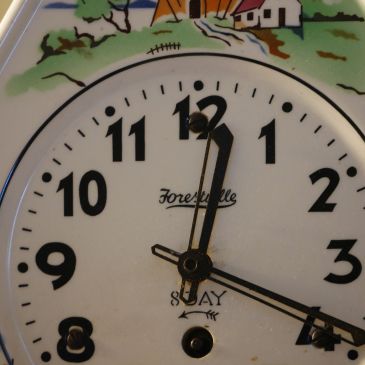
It is a Delft style, triangle shaped front-wind 8-day time-only porcelain clock with a lever escapement similar to those found in marine/alarm clock movements. It is marked Forestville. While Forestville is a Canadian company the clock is not Canadian made. The Forestville Clock Company is often confused with clocks made in Forestville, Connecticut. According to the following historical information they are not the same.

The Forestville Clock Company of Toronto began its life as the Blackforest Clock Co. of Toronto headed by its founders, Leopold and Sara Stossel in 1928. Both movements and complete clocks were imported from Germany and sold through department and jewelry stores across Canada. Their son, Ed Stossel started working part-time with his parents company in the 1930s and later became a full time employee in the 1940s.

Some assembly work was carried out in their Wellington Street factory but most clocks were imported fully assembled. At first, imported mantel and grandfather clock movements were installed in cases made in Kitchener, Ontario but later complete mantel clocks were imported from Germany. This arrangement was interrupted by the Second World War which also led to a change of the company name to Forestville Clock Company in 1941. During the war years the company imported their movements from England, the United States and even France. Starting in the early 1950s German companies resumed production with Mauthe being a major supplier.

Clocks with a Dutch motif reflected a popular trend in the 1950s and 60s perhaps in recognition of Canada’s close relationship with the Dutch people since the war years

The Forestville Clock company was quite successful during the middle decades of the 20th century and many Canadian homes proudly displayed time-only, time and strike and chiming clocks retailed by Forestville. When Ed Stossel retired in 1979 the company survived just a few years without his guidance and leadership.

Clocks with a Dutch motif reflected a popular trend in the 1950s and 1960s perhaps in recognition of Canada’s close relationship with the Dutch people since the war years. Canadian troops liberated Holland at the end of the Second World War, the Dutch holding a particular fondness with Canadians since that time.

It is an attractive but a simple design. There is one scene on each “point” of the “squared off” triangle; a woman in traditional dress carrying water and accompanied by a child on the right, three single-mast sail boats (one large and two small ones) on the left and a Dutch windmill beside a small house on top. The violin bow styled hour and minute hand design is shared with other Forestville clocks.

Mother and child
Mother and child

Windmill and house
Windmill and house

Sailboats
Sailboats

The clock ran slowly for the first day or so. On the back of the movement is a speed regulator that one would typically find on an alarm clock, an easy method of making small adjustments.

Speed adjustment
Speed adjustment

There are no chips, cracks or blemishes on the face. It appears to be in excellent condition and runs well.

It is a welcome addition to our cottage kitchen.

Clock key sizes – do you have the right one?

Understanding the role of the clock key is essential for proper clock maintenance and operation. The clock key not only winds your antique or vintage clock but also plays a crucial part in ensuring it runs smoothly and efficiently. However, using the correct size key is just as important as the key itself. Using the wrong size can lead to damage or improper winding, affecting the longevity and performance of your clock.

In this article, we’ll explore the purpose of the clock key, why choosing the right size is vital, and provide a helpful chart to guide you in selecting the correct key for your clock.

Winding Mechanical clocks

Mechanical clocks require periodic winding. Some clocks need to be wound daily, such as 30-hour clocks, while others are wound once a week (8-day clocks). Some clocks run for 14 days, and anniversary clocks can run for up to 400 days on a single winding.

Most mechanical clocks have a winding hole located on the dial face, where the clock key is inserted. The key should fit snugly—neither too tight nor too loose—ensuring smooth operation when winding.

Why Key Size Matters

Except for the smaller regulating arbour on some clock faces, most winding arbours or winding points are the same size on the clock. This means one key will fit all of them. However, over time, a clock’s original key may go missing. If this happens, you can often use a key from another mechanical clock, and one of them will usually fit.

A micrometre is a useful tool to measure the thickness of a winding arbour. However, measuring the arbour’s size often requires removing the clock movement from its case. Once you’ve measured, you can order the correct key online.

Using a micrometer to check pivot
Using a micrometre to check pivot diameter; this tool can be used to measure the thickness of a winding arbour

Different Types of Keys

In general, larger German movements use a #8 key, though some require a #7 key. Many 31-day clocks, or clocks made in Korea or China, use a #6 or #7 key. Many American mantel clocks require a #5 or #6 key.

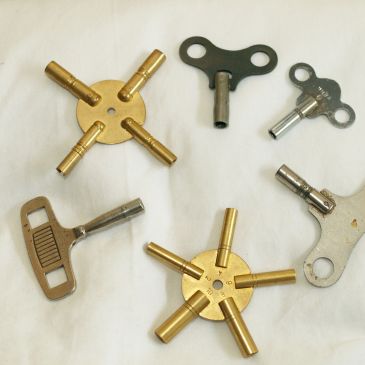
Keys come in all shapes and sizes. In the photo below are keys from German and American movements. The two-pronged keys (4 and 5 prongs) are available at any clock supply house such as Perrin or Timesavers and will fit many clock winding arbours. Many other sizes can also be ordered. eBay, online marketplaces and antique stores are other sources for clock keys.

4 and 5 prong keys and singles

In the photo below you can see two types of double-ended keys

Double-ended keys
Double-ended keys

The one on the left is used for winding a typical American clock. The large end fits into the winding arbour while the small end is for adjusting the speed of your clock. Many clocks have a smaller arbour used for adjusting the speed of your clock and will have “S” and “F” (Slow/Fast) inscribed on the dial generally near the 12 o’clock position.

The key on the right is for a time-only carriage clock. The small end is used to advance the minute hand and the large end fits onto the mainspring arbour.

Speed adjustment arbor
Speed adjustment arbour requires the small end of a two-ended key

Grandfather and Ogee Clocks

30-hour weight-driven Ogee clocks typically require a #4, #5, or #6 crank key. Many grandfather clocks use a #10 or #11 winding crank, and it’s important not to wind them with a conventional clock key. For clocks with weight cables, the winding crank is essential for raising the weights. Insert the crank into the arbour and carefully wind the weights up until they reach the top of the clock, ensuring they remain fully visible.

Some clock keys will also have a number stamped on them indicating their size.

Storing Your Clock Key

It’s important to keep your clock key in a safe, easily accessible place. Keys should be stored either beside the clock, within the front access door of a wall clock, or in a caddy inside the case. Mantel clocks with key caddies can be inconvenient, as you must move the clock to open the back door to access the key. However, for homes with small children, keeping the key in its caddy helps ensure it remains out of reach.

Key caddy behind access door
Key caddy behind the access door

Key Size Chart

Here is a chart that lists key sizes in millimetres for both American and Swiss movements, from small to large:

Key SizeAmerican (mm)Swiss (mm)
5/01.61.25
4/01.81.5
3/02.01.75
2/02.22.0
02.42.25
12.62.5
22.82.75
33.03.0
43.23.25
53.43.5
63.63.75
73.84.0
84.04.25
94.24.5
104.44.75
114.65.0
124.85.25
135.05.5
145.25.75
155.46.0
165.66.25
175.86.5
186.06.75
196.27.0
206.47.25
216.67.5
226.87.75
237.08.0


Winding crank
Winding crank in a miniature Vienna Regulator

There is no key required for weight-driven clocks that have weight chains. Winding involves pulling the weight(s) to the top of the clock once each week.

Check out this article on How to Wind A Mechanical Clock

Choosing the correct clock key is essential for the proper functioning and longevity of your mechanical clock. Whether you’re winding an antique mantel clock, a grandfather clock, or a time-only carriage clock, using the right key size ensures smooth operation and prevents damage to the movement.

With a variety of key sizes available, understanding your clock’s requirements and keeping the key in a safe, accessible location will help you maintain your timepiece in excellent working condition. By following the guidelines and chart provided, you can confidently select the correct key and enjoy the reliable performance of your clock for many years to come.

Low antique clock prices – are they here to stay

There is a peculiar phenomena happening in the clock world today and that is tumbling clock prices. French cartelle clocks, American jewelers regulators, original E. Howard and Willard banjo clocks to name a few have retained their value but clocks that would have sold for hundreds of dollars a few short years ago can be had for almost nothing today. It is not a great sellers market.

Rare Ingraham Huron found on a local online for-sale site
Rare Ingraham Huron shelf clock was once sought after by collectors

Prices will not rise any time soon as modern generations have been conditioned to discarding old for new irrespective of merit and in contradiction to the ideology that recycling saves the planet

Why are clock prices so low?

I have acquired some very nice clocks for ridiculously low prices. While it is part luck there is ample evidence that recent clock prices have never been lower.

There are so many clocks that no one seems to want. Gingerbreads, school house clocks, mantel clocks, Ogees (30 hour or one-day especially), calendar clocks and most garden variety clocks go for very low prices. Good for collectors, not so good for sellers. Prices will not rise any time soon as modern generations have been conditioned to discarding old for new irrespective of merit and in contradiction to the ideology that recycling saves the planet.

Millennials are also facing a very different world than I and my contemporaries faced. Factory work or clerical positions are now considered a good job and young people are staying with mom and dad living in their old rooms as they try to pay off mortgage size student loans. Under those circumstances you will not consider buying a tall case clock or an 18th century French clock.

Thanks but I have no place to put one

My generation (I am in my 60s) did not typically have mechanical clocks in their homes (aside from Grandfather and cuckoo clocks), so younger people today do not have those kind of memories to inspire nostalgia. In my day mechanical clocks were thrown in the trash when they wore out to make way for the electric clock. For young people today the old clocks we loved are not in their sights for purchase. An offer to gift a clock to a millennial is often met with the reply, “Thanks but I have no place to put one” and of course, winding it is always a hassle. A visit to any antique store or clock fair says it all when observations show the average age of visitors and traders are often in their “senior” years.

Junghans Crispi wall clock, not rare but a fascinating history

Prices of clocks really did not begin their rise in value (at least in North America) until the mid to late ’50’s. Since then and up until the late nineties many ordinary clocks commanded high prices. Since the year 2000, the economy has been spiraling downward. Paralleling the declining economy is the decline of prices for antiques of all types. The at-times spectacular and troubling declines in real estate values, increasing unemployment and fewer discretionary dollars have all had an deleterious effect on dropping clock values. With the up-tick in the economy perhaps things will change

I collect clocks and other antiques for interest and history alone

I collect clocks and other antiques for interest alone and only those I can afford which often means that I will try to buy a clock for as little as possible. Collecting in this way allows me the comfort in knowing that there is no worry about future rises or drops in value. I acquire clocks simply because I want them, and pay a price that is worth it to me. If I see something that I do not have, it is unique or has some historical value and it is a reasonable price (to me), I will buy it.

However, many of us collectors are aging and downsizing. Few are in buying mode and many want to sell. The result is a glut of often lesser quality clocks that were once bought at higher prices.

French mantel clock
French mantel clock, a very nice clock at a ridiculously low price

Unless you are prepared to learn how to repair or somehow care for an old mechanical clock you are faced with the prospect that the cost of repair far exceeds the value of the clock. Sentimental reasons always trump repair costs but the message from the clock repair person with integrity is clear, “keep it, it is not worth the cost of repairing”.

Will prices get better? Prices for antiques and collectibles is cyclical and chances are that they will go up again.

Aug Schatz & Sohne W3 – help me find a case for this fine movement

W3 refers to the 3 chimes, St Micheal, Whittington and Westminster

This W3 Aug Schatz & Sohne movement is local antique store find for under CAN$20 though it came without a case and chime rods. W3 refers to the three chimes, St Micheal, Whittington and Westminster. The Whittington chime is my favorite.

Aug. Schatz, a German company, are known today for two types of clocks: the Schatz 400-day clock (including the 1000-day clock) and the ships clocks. They are not typically known for shelf or mantel clocks.

The movement has a platform escapement though earlier versions of the W3 came with a pendulum. I believe that this platform escapement has 2 jewels. Later platform escapement had up to 7 jewels. The front and back plates are solid. It has higher quality leaf pinions rather than lantern pinions and there are 8 chiming hammers, three for the hourly strike.

Rear plate
Rear plate

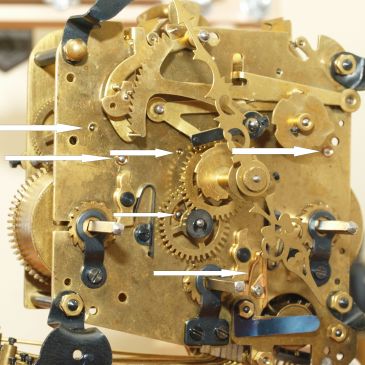
It has been worked on before, perhaps more than once, but it seems to be clean and in very good shape. There are at least 13 new bushings and a newer click spring.

Arrows show new bushings and a newer click spring
Arrows show new bushings and a newer click spring (bottom arrow)

Aug Schatz and Sohne trademark
Aug Schatz and Sohne German trademark showing W3 stamp

I oiled the movement and I wound all three arbors and it has been running happily for a week now, going through its quarter hour chime sequence flawlessly and hammer striking on the hour as it should. Well, at least the hammers moved.

Platform escapement
Platform escapement, jeweled or not

If you have a spare case lying around in your shop I’d be very happy to take it off your hands

If you have a spare case that would fit this movement lying around in your shop I’d be very happy to take it off your hands. It would have been a mantel, shelf or bracket styled clock. If a mantel clock it might look similar to this Juba Schatz bim-bam clock.

Juba Schatz time and strike clock

Having a movement without a case is like have a car engine without the body. If you have or know someone with a case that will fit this fine movement please drop me a line.

Doesn’t all that ticking drive you crazy?

No!

As a clock collector I have quite a few clocks in my home. Most are running daily. There are 34 clocks ticking away in my home as I write this blog article.

I have accepted them as normal sounds in my home

Some collectors have a dedicated clock room in their home but mine are scattered throughout the house. I try to arrange each one so that it fits more or less into the decor of the room. It is a big house and thankfully we have quite a few rooms in which I can display my clocks. I have all manner and styles of clocks including mantel, wall clocks, shelf clocks, carriage clocks, desk clocks, anniversary clocks but just one floor clock. My particular preference is wall clocks; I have 13 of them.

Kienzle clock on display with Ingraham Huron
Kienzle clock on display with Ingraham Huron balloon style shelf clock

Gustav Becker Vienna Regulator and Seth Thomas round top

Arthur Pequegnat Brandon in an upper hallway

Mauthe Westminster chime mantel clock atop a Stromberg Carlson radio

So how do I put up with the cacophony of clock noises in the house? One, I thoroughly enjoy the sound of a mechanical clock and two, I have accepted them as normal sounds in my house.

However, there are rules in our house.

  1. No striking or chiming clocks in or near the master bedroom.
  2. No clocks in the bathrooms.
  3. Clocks are stopped in those areas where guests are sleeping unless they do not object.

Are there clocks in the bedroom? Of course, three to be exact. Two are 400 day clocks like the one in the next photo and the third is a banjo clock.

9 inch 400 day Kundo clock
9 inch miniature 400 day Kundo clock

The Ingraham Nordic banjo clock has a front-wind lever escapement and I would challenge anyone to hear this clock across a room. Is is no louder than an old alarm clock. The 400 day clocks are, of course, virtually silent.

We have a Mauthe box clock in our family room that makes such a wonderful sound that I actually pause the TV to listen to it

Ingraham Nordic Banjo Clock

This is my advice to those of you who love mechanical clocks but are bothered by the “noise”:

  • Some clocks are loud tickers and some are not. As a general rule American clocks tend to be much louder tickers than German or French clocks. Loud clocks should be placed in noisy areas
  • Avoid clocks that have a striking or a chiming train. If you are not fond of the sound of an hourly or quarter hour strike clock, simply search for a time-only clock.
  • Most chiming clocks (Westminster chimes are the most common) have a shut-off feature located on the dial face.
  • For time and strike clocks simply wind the time side only. However, purists would say that this is not good for the clock.
  • Carriage clocks, clocks with lever escapements (like the Nordic above) and 400 day clocks are exceptionally quiet and do not normally strike or chime (however, some carriage clocks do strike).
  • Locate your clocks in an area where you will not be bothered by them, a dedicated room, for instance.
  • Stop your clock or never wind it. Perhaps you can appreciate your clock as a piece of art or furniture rather than as a timepiece.
  • For the nostalgic, run your clocks only at certain special times of the year.

Box clock
Mauthe Box clock

I rarely hear my clocks. Yes, I am aware of the ticking if I stop and listen. By and large I am not at all bothered by the sounds of my clocks. In fact, we have a Mauthe box clock in our family room that makes such a wonderful bim-bam sound that I actually pause the TV to listen to it.

Profile My Clock: Seth Thomas Column and Cornice clock

Carole Ann Bennett of Ottawa, Canada asked me to profile her latest clock acquisition which was bought at auction and advertised as a triple-decker clock. It is, in fact, a column and cornice clock.

Seth Thomas column and cornice

This lovely Seth Thomas time and strike eight-day weight-driven column and cornice clock with hour strike features a mahogany veneer case with cove molded crest, ¾ columns in painted gold and two reverse painted doors opening to the interior clock works which reveals a tin painted dial and the original printed and illustrated Seth Thomas clock makers label. It is 32″ tall, 18″ wide and 5“ deep.

The painted tin Roman Numeral dial has hand-decorated flower spandrels in all four corners with the centre portion of the brass lyre movement visible though the dial.

Brass lyre movment
Brass lyre movment

There is a small amount of chipping around the winding holes and face mounts. The hour and minute hands are in an Ogee style and original to the clock. The movement is clean and running well.

Painted tine dial face

The upper tablet has a hand-painted fruit bowl framed within a clear rectangular section with an onion top surround by a gold laurel design. The lower tablet shows a headless eagle framed in an clear oval centre with clustered gold berry spandrels in all 4 corners and encircling the oval section is a gold wreath made of berries and leaves. The headless eagle has clawed feet, one holding a sheaf of arrows while the other holds what appears to be a holly bush. There are 13 stars above the wings presumably representing the original 13 colonies. There is the expected amount of flaking consistent with the age of the clock which seems to disappear when the doors are closed. The missing paint areas blend into the remaining design and look good in spite of the minor issues.  A red banner runs through the centre. It appears to be a very loose interpretation of the eagle on the presidential seal.

Upper tablet
Upper tablet

Lower tablet

My first impression is that the top and bottom tablets are not a match because of the different themes on each panel however the blue paint is identical.

It has a very good interior label with the name J. M. Paterson, Hamilton, Canada West which appears to have been pasted over an original label.

Canada West, previously known as Upper Canada, formed one-half of the British colony of the Province of Canada. The region was governed jointly along with Canada East (formerly Lower Canada) from 1841 to 1867, when Canada West became the province of Ontario under Confederation. This would put the clock between 1841 and 1867.

More research is required. Below the added label are instructions for the operation of the clock. It has newer 6 ¾ lb cast iron replacement weights which are correct for an eight-day clock. The pendulum is a replacement as the original would have had a rate adjustment screw as per the last line of the instructions.

Clock instructions and label

Minor areas of paint around the main designs on the top and lower tablets are beginning to flake, however most of the original paintwork shows very well. The case has some scuffs and a little veneer chipping as one would expect. The deep grained mahogany veneer adds to the overall look of this big and beautiful shelf clock.

There are newer softwood strips attached by Robertson screws on the top and very bottom of the back of the case which appear to have been added either as a repair or to strengthen the case. There are 4 holes on the backboard just below the movement which may indicate the presence of an alarm mechanism at one time.

All in all it is a good looking clock that reflects the period and a fine acquisition.


Timezone clocks – keeping track of family across the country


Trio of clocks
Trio of clocks

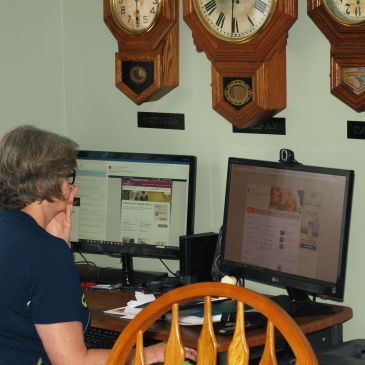
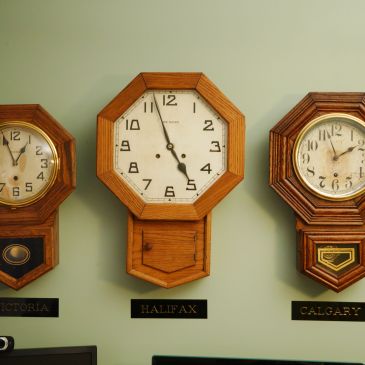
It this day and age it is very common to have family scattered to the four winds. What time is it is such and such? Why not create timezone clocks? I live in Canada and I have one daughter in Calgary, Alberta, one of our mid-western provinces and one in Victoria, BC, on the west coast of Canada. We keep in touch with Skype and telephone and as I am working on my computer in the kitchen area of my home all it takes is one glance upwards to see what time it is in Calgary or Victoria.

This is my trio of clocks. The two on either side are eight inch while the centre clock has a 12 inch dial. The centre clock is a New Haven time and strike from the 1930s taken out of a decommissioned school house in Saskatchewan in the 1950s. My aim is to have three 8 inch dial clocks. Once I find another 8 inch time-only clock the New Haven will be replaced.

New Haven time and strike clock

Waterbury Arion drop octagon

I later painted three numerals

The clock on the left is a Waterbury Arion. It came to me without glazing and bezel but ordering a replacement was easy enough through a clock supplier, Perrin in Canada. While writing this blog I decided to touch-up the 7, 8, and 9 numerals. It is the quietest of the three clocks.

The one on the right is Sessions Drop Octagon. The dial face is in rough shape but I decided to leave it as-is. The clock came from a decommissioned schoolhouse in Springhill, Nova Scotia in the 1960s.

Sessions Drop Octagon

It is by far the noisiest of the three but you get used to the sound. All three will be time-only clocks, preferred if you are looking for the dedicated function of simply telling the time. Of the three my favorite is the Waterbury. Even with the “messed-up” dial face, it is the most accurate of the three and will run for 12-15 days on a single wind.

Keeping track of family all over the country is part of being a normal modern family and timezone clocks certainly help.


Clocks at the summer cottage

We have a seasonal cottage that is used primarily in the summer and at times during Thanksgiving in October. While I have a number of clocks at my residence in Nova Scotia the cottage is a great place for displaying a small selection of my clocks.

Our first clock at the cottage was a Danial Dakota time and strike that we had converted to a quartz movement. The clock is from the 1960s and reflected Chinese design elements copied from American clocks at the time. It requires very little maintenance and is as accurate as one would expect. It requires a “C” cell battery to operate. It is a chiming clock with Westminster and Whittington chimes and my wife and I much prefer the Whittington chime. I still have the original mechanical movement and may someday use it in another case.

Converted from a mechanical clock

The clocks do not run during the winter but oiling once per year addresses the issue of dried pivot holes

Last summer (2016) we were travelling through an Ontario town of Halliburton and stopped by an antique shop. The owner brought in a number of clocks from Ireland, all British made. They were in very good condition though some were a bit on the pricey side. My eye was drawn to this simple but attractive Smiths Enfield time and strike Art Deco style clock. It has a chromed square bezel and Roman Numerals on a slivered background. The ornate brass coloured hands compliment the square dial face. The squared off dark oak case with half height side shoulders is in excellent condition. I placed this clock on a shelf between our kitchen and family room.

Smiths Enfield time and strike, circa, 1950

Our kitchen has  a Delft style, triangle shaped front-wind 8-day time-only porcelain clock with a lever escapement similar to those found in marine movements. It is an estate auction purchase. On the dial is the name Forestville. The Forestville Clock Company of Toronto operated from 1928 to the late 1970s. Though wholly Canadian owned the company had cases made in its early days (from Kitchener, Ontario) but later imported cases and movements from Germany then France and England during the War years and Germany again, after the Second World War. The clock has a Dutch motif which reflected a popular trend in the 1950s and 1960s but also recognized Canada’s close relationship with the Dutch people since the war years.

Delft Clock from Forestville

The clocks do not run during the winter but oiling once per year addresses the issue of dried pivot holes. We also take the battery out of the quartz clock.

There is nothing like the sound of mechanical clocks at the cottage particularly on a cold, quiet night when the only other sound is the melancholic cry of the whippoorwill.


Taking a little break

it is time to take a little break.

You will see fewer posts over the next 2 months as I spend quality time with friends and family and decompress at our summer get-away in central Canada. I intend to make my third visit to the Canadian Clock Museum in Deep River, Ontario while in the region.

Regular readers know that I typically profile my own clock collection, the challenges of maintaining and repairing clocks in my collection plus articles of interest based on observations in my travels including general interest clock subjects as I navigate through the fascinating world of horology.

I hope you enjoy reading them as much as I enjoy the researching each article. I will maintain a presence on my blog by posting regularly though it means that there might be some delay in answering letters. I invite you to browse through my archive; there is always something that will interest clock lovers at all levels.

Over the next 8 weeks you will find articles on a little Delft kitchen clock I discovered, my thoughts on a Aug Schatz movement I found, final detail improvements on my Junghans Crispi wall clock, some helpful information on clock keys, how to live with all the clocks in my house and notes on clock therapy. So, stay tuned as they say and if you like what you see let me know.

Tick Talk Tuesday #11 – clocks of Cuba

Tick-Talk Tuesday is about the letters and comments I have received from you, the reader, concerning your clocks, issues you might have had and challenges you face and my responses to your questions with advice on your  particular clock concern(s) and of course, general comments. For those comments and questions that stump even me, I consult within my clock circles for the best possible answer.

On my trip to Cuba in March of 2016 I happen to capture a number of interesting clocks. The two pictured below prompted a comment from JC.

wall clock
Wm Gilbert clock found in a restarant

Floor clock
Malaprade Floor clock

The first two clocks are the most interesting to me. The Gilbert looks fairly standard (often called a “Store Regulator”) but I think it’s been painted black. Normally these are in oak cases, occasionally (but rarely) in walnut. The colour would have matched the interior back.

The second clock looks like a fine and expensive Jeweler’s Pinwheel Regulator. I’m wondering if you’re wrong about it being spring driven. These are normally always weight driven. The weight normally hangs behind the pendulum. Is it possible you didn’t see the weight? The movements from these are almost always Swiss made (near the Jura region of France), with pinwheel escapements. They are VERY EXPENSIVE clocks. The movement alone would fetch around 1000$. I have no idea what that circle is on the dial. I’ve seen some with inlaid marble dials, but most have enameled dials like this one. Cases can range from plain to extremely elaborate, and from 5 feet to 9-10 feet.

The name and place on the dial is the retailer where the clock was sold. It is never the manufacturer (this is typical on all French and some Swiss clocks of this type/vintage – the same is true of Comtoise clocks and French mantle clocks).

The rest of the clocks (with the exception of the 2 figure 8 wall clocks) seem to be imported German clocks from 1930 and later. These include both tall clocks and all the 400 day clocks shown. The figure 8 clocks are either American or Asian made copies (likely from Japan) from the early 1900s.

Would you like to profile your antique or vintage clock?

Would you like to tell the world about your special clock?

Would you like to tell the world about your special clock? Is it a clock you have had for years or was it handed down to you or you did you win it an an auction or find it in a dark corner of an antique store?

Is it a favorite clock you would like to see profiled on this blog? It could be one of the clocks in my collection or it could be one of your own (or several that you own). If you would like to profile your own clock(s) send me as many photos as you can (1 meg each is fine) but include shots of the movement as well. If I use your photos I have your permission to post them. If you are using photos that someone else took  (Google or eBay for example) it becomes more problematic from a copyright perspective.

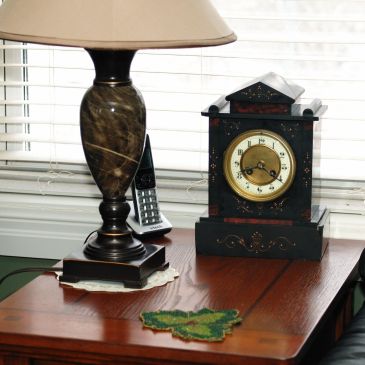
Circa 1890 French Black Marble mantel clock
Circa 1890 French Black Marble time and strike desk clock

I will keep your name and location private

Provide me with a history of the clock and/or some interesting details that I could include in the blog article and let me know if you want your name included. If not I can assign an identifier, the first and last letters of your name and of course I will keep your location private.

Send me an email with pictures.

ronjoiner@gmail.com


More fascinating terms – the language of clocks

Regular reader and contributor JC suggested a few more clock terms I thought readers and fellow horologists might find interesting.

My source for this article is the Watch and Clock Encyclopedia by Donald de Clarke, published by Bonanza Books (1984) which is still available on Amazon.

Gridiron pendulum: A pendulum consisting of alternating steels and brass rods coupled together to compensate for downward expansion so that the centre of oscillation of the pendulum remains consistent with changes in temperature, invented by John Harrison in 1725.

final look
Gridiron pendulum on a Junghans Crispi wall clock

Broaches: To broach is to open and enlarge a hole. A Broach is a steel cutting or smoothing tool with a tapered or parallel sided edge used to cut or “finish” holes in a clock plate. Used to enlarge and then finish (smooth) a newly installed bushing on a clock plate.

Swiss made smoothing broaches
A set of Swiss made smoothing (or finishing) broaches

Motion Works: The train or wheels of a clock directly connected with the hour and minute hand.

Great wheel: The teeth that form part of the barrel of the going barrel. It is also the wheel to which the mainspring is attached.

The motion works of a clock; the largest wheel on this movement is the great wheel (Pequegnat Clock Co.)

Maintaining Power: A method to maintain the driving power while the weight is being lifted or mainspring with fusee is being wound. In effect keeping the mechanism going while winding.

Weight driven movement with maintaining power
Weight driven movement with maintaining power, (unmarked Vienna Regulator)

Huygens Endless Rope Drive: It is a method of providing maintaining power to drive the clock while the weight was being raised. The endless cord passes over pulley A which is attached to the great wheel and supports the driving weight B, it then passes over pulley C which has a ratchet to support small weight D. As cord E is pulled down to wind the clock ratchet C turns under it’s click to raise weight B which continues to drive the clock as it supplies torque to wheel A. This ingenious system is found in some 18th century long-case clocks.

Huygens endless rope

Locking Wheel (or Count Wheel): A count wheel is the wheel that determines the number of blows to be struck in striking mechanisms.

The left wheel with notches is the count wheel

Ratchet wheel: A toothed wheel into which a click engages permitting the wheel to revolve in one direction only.

Click replaced
Toothed ratchet wheel and click

Cam: Usually a disk so that upon revolving it transmits movement to or exerts pressure upon a connecting unit.

Arrow showing location of a cam
Arrow showing location of a cam, the fly is located in the upper right

Fly: Often called the governor or controller of a chime or strike train. It is the last piece in a train of wheels.

The language of the clock world always amazes me. There are a plethora of other clock terms that I will be happy to explore in future blogs.

9 reasons why clock collecting and is a great hobby and why it might be a fit for you

Hobbies are a great way of finding comfort through stepping off the roller coaster of life

In this increasingly complex and chaotic world where many of us seek ways of exploring constructive activities & pastimes a hobby is one such escape. Hobbies are a great way of finding comfort, stepping off the roller coaster of life and rising to the surface after seeming to drown in life’s problems. A hobby allows one to disconnect briefly or longer from the social media universe that seems to consume us every day. Pursuing and maintaining a hobby, whether it is for casual leisure or serious pursuit, is a regular activity that should be done for pure enjoyment. It is healthy for mind, body and soul!

The more you know, the more you grow

There are 9 Reasons why clock collecting/repair hobby works for me and might even work for you.

  1. I meet people. This hobby requires that I come into contact with other people when I purchase clocks, have clocks repaired or ask for advice.

    rs-annapolis-royal-oct-16_21-42
    A clock repair shop in Nova Scotia
  2. Builds my self-esteem. Developing and maintaining a clock hobby is important because the small successes I have from day to day or week to week are enough to sustain me while other pressures are occurring in my life and it is the one solid thing to feel good about. It gives me renewed energy to tackle other challenges in life.
  3. Avoid boredom. I have zero scientific evidence of this but I really believe that boredom is responsible for a lot of society’s ills and destructive behaviours. How many people come home after a challenging work day to watch TV for hours on end when they could be doing something constructive and rewarding?
  4. My Hobby is a point of connection with other people. It gives me common ground with a small, select portion of the population, the people who collect, repair antique and vintage clocks, the people who share my passion. They are from all over the world. Every week I get inquiries from clock enthusiasts from all corners of the earth asking for advice on their particular clock.
  5. Clock collecting enriches my perspective. I remember an old adage: “The more you know, the more you grow”.  Any opportunity to learn something new, to be challenged anew, is great for character-building by seeing the world through refreshed eyes. Clock collecting and repair helps me differentiate myself from others and provides me with key examples of where I have overcome adversity or tackled a difficult situation and emerged on the other side.
  6. It keeps me stay youthful. Establishing and maintaining a hobby is a very healthy habit to form for later years. Hobbies are excellent for brain health especially if you are looking for something to stave off cognitive decline. The older you get the more trouble you will have struggling to fill your time with meaningful activities. Starting a hobby early in life pays dividends in the long run, much like an interest bearing investment.
  7. Clock collecting combines with other interests. Photography and traveling are two other interests in my life. Blog writing is another, of course. This hobby allows me to combine all of those interests and as a side benefit my wife, who is also my travel partner and clock locator, encourages me every day.
  8. My hobby makes me interesting. At a party, you can only talk about your occupation or your grandchild for so long before people’s eyes begin to glaze. But if I mention that I have a clock that fell off a wall during the Halifax Explosion, a clock that hung in a railway station near where I live, a rare clock I bought for almost nothing, their ears perk up.

    final look
    Halifax Explosion clock, Junghans Crispi wall clock

    OLYMPUS DIGITAL CAMERA
    Pictou rail station clock, Arthur Pequegnat, Canadian Time circa 1930
  9. A way to relieve stress. My hobby provides stress relief simply because it is an oasis from the rest of my life. You can immerse yourself in a totally different world when you are focused on getting that darned strike side to work correctly on a troublesome clock movement.
    Okay maybe clock collecting and repair is not a hobby for you but you can insert whatever hobby you wish to have or already have and I'll bet the 9 reasons above are pretty much on your list.

Ingraham Nordic Banjo Clock

Ingraham Nordic Banjo Clock

I did not have a banjo clock in my collection and my latest acquisition is certainly a banjo styled clock but not in the tradition of a true weight-driven American banjo clock which continues to allude me.

There is no scarcity of spring driven recoil escapement (lever escapement) banjo clocks. This particular clock has a balance wheel/hairspring escapement which Ingraham calls a “marine” movement.

Balance wheel/hairspring escapement
Balance wheel/hairspring movement

This is the Nordic, one of a series of small, hairspring banjos that Ingraham produced in the late 1920s and 1930s. The Nordic is one of three that Ingraham introduced during the aforementioned period, the others being the Norfolk and The Norway. In the mid 1920s it would have cost about $11.00.

Nordics come up occasionally on EBay and seem to be very desirable if in very good condition. Often the throat or bottom tablet is cracked or missing and the clock face is distressed in some fashion. This particular clock is in exceptional condition for its age and shows very well. It is both diminutive and attractive.

Marine movements were (and are) very accurate eight day lever movements which are key wound and key regulated. It is wound from the front unlike Gilberts and others that must be taken down from the wall to be wound. The movements are constructed with extra heavy brass plates, steel cut pinions, a double roller escapement and are made to last.

Reverse glass nautical scene

The case is described by Ingraham as having a “fine rubbed mahogany finish”. Fake done nicely!

These movements are not commonly found outside the confines of a case. They were also used in other Ingraham wall clocks. Tran Duy Ly’s book on Ingraham Banjo marine movement clocks shows them from the 1927 catalog.

Clock face showing silvered dial and press-fit hands

Handsome Banjo Clock
A Handsome Ingraham Banjo Clock

Both the hour and the minute hand are “pressed-on” friction fit. It has solid brass side arms, brassed eagle and a circular finish silver-plated dial with a non-tarnish-able gilt sash. Framed glass panels with coloured ship scene and floral throat complete the look. It is 26 inches in length. It lacks a label which would normally be affixed to the back of the clock.

As the most inexpensive of  banjo clocks many homes could have one to avoid the higher cost (though higher quality) of a weight driven banjo clock.


Tick-Talk Tuesday #7 – SP’s thoughts on dating a Kienzle Weltzeituhr clock

Hitler's clock
Kienzle Weltzeituhr clock presented to Adolf Hitler in 1939

Tick-Talk Tuesday is about the letters and comments I have received from you, the reader, concerning your clocks, issues you might have had and challenges you face and my responses to your questions with advice on your  particular clock concern(s). For those comments and questions that stump even me, I consult within my clock circles for the best possible answer.

On display in an antique store in Quebec Canada

Weltzeituhr is German for “World clock”.

The first Kienzle World Time clock was presented to Adolf Hitler on his 50th birthday in 1939 by the government of Würthemberg. The classical design with the world map in the “Mercator” style (cylindrical map projection presented by Gerardus Mercator in 1569) and the moving narrow scale with the time in the denoted cities came from the Heinrich Johannes Möller hired at age 27 and Kienzle’s principle designer from 1931 til about 1970.

The original clock had a bulky “foot” or base (first photo) and was decorated with swastika patterns on the edge. After the war, the decoration was necessarily altered, the base became smaller but the general layout of the dial was preserved through all permutations of the clock, from the early mechanical versions to the electro-mechanical versions and finally the quartz movements in the 80s. A unique feature of this clock is that it shows Germany to be the centre of the world.

Time sequencer
24 hour time sequencer

SP writes, “One way to narrow down date of one of these clocks is to look at the names of the cities. For example, mine has Jakarta, Indonesia as ‘Batavia’ which was the name given by the Dutch who ruled until the Japanese took over in WWII. The name was officially changed Dec. 27, 1949.”

Side view of World Time Clock showing substantial brass surround

Your clock says ‘Germany’ and has ‘Djakarta’. It could have been made between 1942 and 1949

SP wrote further, “I got to thinking and I suspect that further sleuthing may be in order. If you go to the Wikipedia article on ‘Batavia’, you’ll see that the name was changed when the Japanese took over in 1942. It also says that the name change from ‘Batavia’ to ‘Djakarta’ was ‘internationally recognized’ on Dec. 27, 1949 so that there was a seven year period when it was called ‘Djakarta’ by part of the world and ‘Batavia’ by another (Keep in mind that the Germans, allies with Japan, would have been partial to seeing things the Japanese way). Then, at the ‘West Germany’ Wikipedia, I see that ‘West Germany’ was declared on May 23, 1949. Your clock says ‘Germany’ and has ‘Djakarta’. It could have been made between 1942 and 1949 if the names on the dial were determined by Kienzle in strict conformity with official names. Of course, whether or not they were strict in that way would be hard to pin down but it seems to me that an earlier date for your clock’s manufacture seems just as plausible as a later one. It does seem to me, however, that, if it was made in 1950 or later, it would very likely say ‘West Germany’ given the 7-month lead time and the earth-shaking importance of the name change at the time.

Is it a clock or a work of art? Both it would seem

I replied that the clock was likely not produced during the war years when many German plants turned their attention to the war effort. My clock was either made in 1942 or close to 1949.

Kienzle World Time clock
Kienzle World Time clock, circa 1942-49

SP wrote back some time later and shared this with me, “I was also thinking that the war years are unlikely for the same reason. I was just doing a little exercise in marking rough parameters. Another rough parameter: mine has no country of origin as in ‘Made in Germany’ or ‘Made in West Germany’ — perhaps an indicator that it was made for the domestic market. I came here originally to learn how to calibrate the ‘world time zone’ scale. Then I took the clock to my local clock maker to have it serviced and he explained that, on my model at least, you have to take the back cover off and manipulate the metal disk inside with your finger. I see that some clocks, including yours, have a little button or knob on the back half-way down from the center knob that controls the hands and I assume that it controls the time zone scale. Anyway, if you are a visitor to this site looking for the same information, now you have my report.”

Winding crank
Winding crank

On my clock the tiny knob controls both the hands and the zone scale. As I rotate the knob the zone advances incrementally.

I am certainly on the lookout for more Art Deco styled Heinrich Johannes Möller clocks to add to my collection and when I come across another I will be sure to write about it.

Thank you, SP, for sharing your knowledge and experiences concerning this wonderful clock.

So, it seems that my Kienzle was made between 1942 and 1949.

Is it a clock or a work of art? The latter I would submit. Thanks to Heinrich Johannes Möller and his ability to turn a timepiece into a true work of art.

Unsigned French mantel clock – pretty but I wish I knew more about it

I acquired this elegant antique French mantel/shelf clock online in March of 2017 and it is the only French clock in my collection. Not many come up on Nova Scotia online for-sale sites.

French mantel clock
French time and strike mantel clock

I felt somewhat guilty leaving the home of the man I bought it from because he told me that he was selling off his possessions to provide for his wife after his passing as he was in the final stages of a terminal illness.

Clock face showing the two winding arbours

The elderly gentleman said that the low price reflected the fact that the strike side was not functioning and it had been like that since shortly after the last servicing. When inserting the key in the strike side arbour I immediately noticed that the spring had tension but it would not click. It could be a simple fix.

There was nothing on the inside of the case that would tell me anything about the maker

It is a time and strike clock of French origin from the turn of the 20th Century. The clock is 11 inches high by 8 1/4 inches wide by 5 1/4 inches deep, jet black, either slate or Belgian marble with lighter reddish brown rectangular accents and serpentine scrolling. It is quite heavy! The dial has a brass centre cup with enamel surround, delicate hands and painted Arabic numerals.

It is in the Grecian architectural style popular during the late 19th century both here and in France. But for a large chip on the bottom right of the case and a smaller chip on on the bottom left it is in very good condition. Unfortunately chips on the corners of these old French marble clocks are quite common. The movement is an exquisitely crafted French time and strike mechanism with a pleasant sounding but subdued coiled gong. It is unsigned.

The only markings are the word Brocot on the speed adjustment gear and another marking on the back plate. This patented Brocot speed adjustment was invented by French clock maker and inventor Louis-Gabriel Brocot in the 1800s.

Brocot patented speed adjsutment
Brocot patented speed adjustment

Stamped on the rear plate is Marque Deposee which means registered trademark in French. EBay sellers often mistakenly refer to it as the maker’s stamp. Careful examination of the movement revealed that there was nothing on the inside of the case or the movement that would give me a clue about the maker. A mystery, but not surprising as many French clocks are similarly unsigned.

Time and strike movement

The previous owner advised that the clock had been serviced but I decided to take the movement out of it’s case to inspect it more closely, re-oil if necessary and determine why the strike side was not functioning. The movement is relatively simple to remove. To extract it from it’s case undo the two slotted screws (rear) that hold the straps and pull the movement out from the front.

Side view of movement
Side view of movement showing brass straps

A very nice acquisition though I keep thinking about that old fellow

I discovered that for whatever reason the click screw was very loose, and not engaging the ratchet. After screwing it down tightly the click engaged the ratchet as it should. I can only assume that during it’s last servicing the click screw was not tightened securely.

The strike side click was loose
The strike side click screw was very loose

Numbers on bob correspond with the movement
Numbers on bob correspond with those on the movement

pendulum bob with adjuster
Pendulum bob with rate adjustment screw

I re-oiled the movement, returned it to its case and wound both sides. There are two speed adjustments on the clock, one on the bob and a finer speed adjustment arbour just above the number 12 on the dial. At the moment the clock is running a little slow and will take weeks to regulate. A one-ended key came with the clock, the original would have been double-ended.

It is a very quiet ticker with a pleasant strike and perhaps the perfect clock for those who might be bothered by the sound of a mechanical clock in any room.

A very nice acquisition though I keep thinking about that old fellow.


Website Powered by WordPress.com.

Up ↑