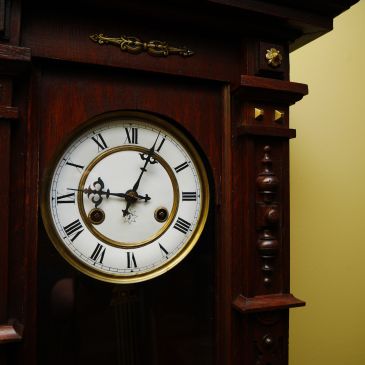
The Moncton – double spring time only – Part 1 – assessing the movement prior to servicing

Canadian clock collectors are very familiar with the name Arthur Pequegnat and associate the maker’s clocks with a solid construction, robust movements, conservative designs, and nationalism since many clocks were named after towns and cities in Canada. The Moncton was named after the City of Moncton in New Brunswick, Canada.

The Moncton was often found in offices and train stations across Canada and was known for its accuracy. This clock is originally from the Toronto (Ontario, Canada) area but I have no idea where it spent most of its life.

Arthur Pequegnat Moncton

For an 80+-year-old clock, it is in exceptional condition. A double spring time-only movement with a Graham deadbeat escapement running at 80BPM means that it is very accurate despite being spring-driven.

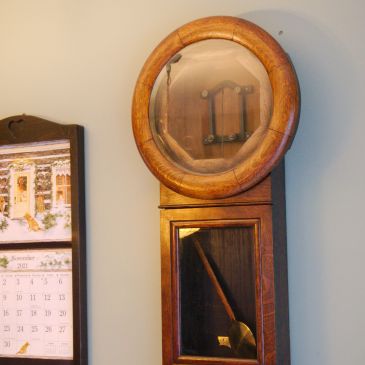
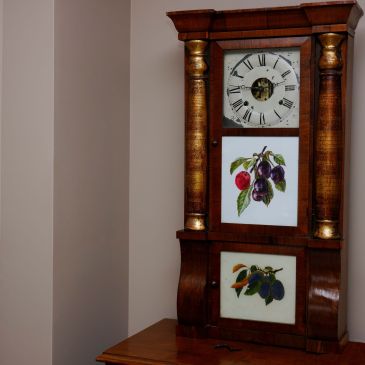
It has a 12-inch Arabic dial with simple, bold numbers. The pierced spade hands are attractive and are a common feature on many Pequegnat wall clocks. It has a fumed quarter-sawn oak case, is 35 inches high with a hinged 16-inch oak bezel door that swings to the right to reveal the dial.

The pendulum access door is 14 ½ inches high by 10 ¾ inches wide and swings to the right. The clock is 5 inches deep with wall stabilizers on either side of the case. The pendulum bob is brass over iron with an oak pendulum rod. The dial glass is original and has the “waviness” you would expect with old glass.

Assessment of the movement

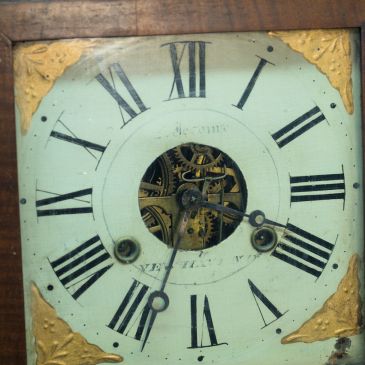
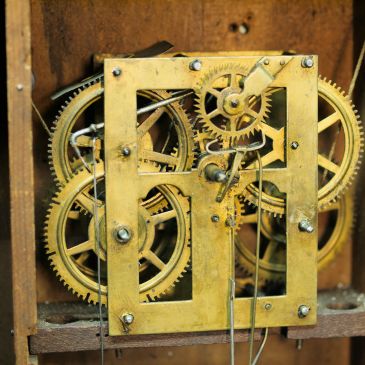
With solid plates, front and back, and a mounting system similar (but not quite the same) as the Seth Thomas #2 the movement looks solid. I was expecting past repairs and some wear and, of course, a dirty movement, all confirmed when I looked at the movement for the first time.

Heavy-duty time-only movement

I removed the dial first and the movement from the case. The first step is to let down the mainsprings.

The mainsprings are much smaller than and half the width of a typical American clock with a recoil escapement. Not surprising since a Graham deadbeat escapement requires between one-fourth to one-half the driving power than the same clock using a recoil escapement. Less drive power means less wear over time. Having very few gears and little friction in the gear train also improves efficiency and time-keeping.

Even in its unserviced state, it would easily run 16 or 17 days.

I am not seeing a lot of wear, an indication that the clock has had a good life. The verge arbours may need bushing work otherwise I cannot see any other wear that is problematic. The lantern pinions are also in very good condition.

Next is to inspect the movement more closely and look for anything out of the ordinary.

In Part II I will cover the servicing of the movement.

Traditional shellac improves the appearance of an ogee clock case

This Chauncey Jerome 30-hour or one-day clock from about 1844-1845 is the example that I am using to illustrate the advantages of using traditional shellac as a finish coat.

The mahogany veneer is in very good condition and it is evident that the clock was not subject to the abuse one would expect of a 180-year-old clock. There is a small dent in the upper left corner but it is hardly noticeable. There are a few scratches here and there consistent with age but all in all the veneer is in great shape.

As found, a dull and lifeless case

First, is cleaning the case. My go-to cleaner for clock cases is Murphy’s Soap. It does a great job of lifting years of grime and dirt from the veneer. The tradeoff is that once you remove the dirt it reveals shellac loss. It was my intention to apply a coat of shellac in the first place so, when I got through layers of dirt and discovered some of the finish gone, I was not too concerned.

Since there are no veneer repairs, refreshing the case was pretty easy. I am not a big believer in maintaining the patina of a clock. if pt is dirty it needs to be cleaned!

I use traditional shellac consisting of flakes mixed with shellac lacquer. I use a wide artist’s brush to apply the shellac and it always produces a superior finish.

One coat of amber shellac

I have decided to leave the lower tablet as-is and as for the dial, I haven’t yet decided on whether or not to address the faded chapter ring though I am also leaning towards leaving it as-is.

The movement has been serviced, the clock is running and striking as it should and I think it looks great after the case refresh.

Veneer repairs on an 8-day Seth Thomas column and cornice clock

This 8-day Seth Thomas column and cornice time and strike shelf clock with sleigh front needed a little love. It has a Plymouth Lyre movement with a Thomaston Conn. label. The clock was made in the 1870s. and purchased five years ago and has been running since.

I will take you through my early days of veneer repair. It is probably not my best work but it was a fun and challenging project plus, there was good learning.

The Seth Thomas clock as found

A previous owner had applied brown paint on areas of veneer loss, it looked ugly and when I saw that I decided the case could use a little tender loving care. Many of these clocks are in decent condition for their age but if you are shopping for column and cornice clock from this era take note of veneer losses. You may want to reconsider your decision to purchase if you feel it is not worth the time, effort and expense or if there us so much loss that it is unsightly.

Of course, there is always the school of thought that advocates leaving things as-is and that is perfectly fine. But, a little veneer work is minimally invasive, in my view.

Veneer issues

The most troublesome sections were the top and bottom of the case and the column base, not surprising since those are the prime targets of wear and tear over the years. Most of the cornice veneer is in good shape as are the door sections, door surrounds, and the sleighs just above the feet. Although there is work to be done, I have seen worse.

The veneer used at the time was Brazilian Rosewood, an exotic wood. Rosewood would have been used extensively by clock-makers of that era and replacement Rosewood veneer would be the correct choice. I have two 7 X 8 inch pieces of Rosewood veneer, more than enough for this project.

Veneer losses on the base

Prep-work and other case issues

The cornice on the left side was missing a section and that had to be attended to before the veneer work began.

Losses on the cornice and its base

Using scrap softwood I made a small piece and trimmed it roughly to fit. In this photo, I am testing the piece and making minor adjustments for a snug fit. The section is then glued in place and allowed to dry for 24 hours.

Cornice trim piece
Cornice trim piece

The top area of the front cornice is now ready to be faced with veneer.

The sections with brown paint had to be sanded down to the bare wood to improve adhesion before gluing the new veneer.

Repairs made to left cornice

In selected areas, small sections of old veneer were removed to make way for larger replacement pieces.

I have decided not to tackle the columns. There are some losses but from a reasonable distance, they are fine.

Hide glue and Bloom strength

The one true adhesive for antique clock case applications is hide glue. Hide glue would have been utilized at the time the clock was manufactured.

I chose pearl hide glue which is rated at 150g Bloom strength (500g Bloom strength, the maximum, is not necessary for this type of repair). 150g hide glue takes a little longer to gel and adhere but with the slightly longer working time moving pieces around for best fit is easy.

Home-made double boiler

To ready the adhesive place the container with the gelatinous glue in a bath of water in a pot specially designed for hide glue or a double boiler which worked equally well for me. Heat to approximately 140°F (60°C), using a candy thermometer and maintain the temperature throughout. Heating the wood surface with a hair dryer before applying the glue is an option. Full strength is reached when it’s dry, and that can take 24 hours.

An excellent article on hide glue and its strength properties can e found here.

It is best to start with a small batch. Put 2 tablespoons (30ml) of glue in a glass container and cover with 1 tablespoon (15ml) of cold water and let soak for about an hour or until the glue softens and becomes gelatinous. To make a larger batch simply follow the 2 to one rule. I recommend making small quantities, to begin with. If there is glue left over I find that it can be frozen and reused later with no ill effect.

Tools

Clamps, weights, tweezers, wax paper, a sharp knife, a metal straight-edge, painter’s tape, a micrometer, sandpaper, palm sander, and whatever you choose to use as a double boiler complete the list of tools.

Clamps used for veneer work

A micrometer is an indispensable tool for accurate measurements. Accurate measurements ensure a good fit, minimize the use of fillers and lessen waste.

Cutting, trimming & clamping

The cutting of veneer can be tricky. Veneer is brittle, and can easily tear. Veneer today is quite different than veneer used 100+ years ago as it is very thin. On some clocks you must double-up or layer the veneer to approach the height of the original veneer. Another alternative, and a better option, is to harvest veneer from old clock cases. Old veneer is thicker, is very close to the look and feel of the original finish but just as brittle.

If old veneer is hard to work with, softening it with water will have a small and short-lived effect on a veneer’s flexibility. Another option is a product called Super-Soft 2, said to be ideal for softening veneer. For the little veneer work that I do I cannot justify the cost of a commercial softener and water is satisfactory for my purposes.

Painters tape easily peels off

The next photo shows a veneer section glued and clamped into place. Wax paper is used to prevent the glue from sticking to the clamp. Clamps are essential for veneer repair but when clamps do not work other methods such as weights can be employed. Leave the clamp on for 24 hours for maximum adhesion.

Clamping cornice veneer

Cutting can be a challenge since you must follow the grain and narrow strips can break very easily. Painters tape prevents tearing and is easily removed from the veneer prior to or after the application.

The most challenging areas were the very top and very bottom of the case and the column bases but after many hours the veneer work is now complete. The next step is colour matching the new to the existing veneer.

Top of cornice veneer with new veneer

Rosewood Minwax Gel stain is a close match to the older veneer but I would recommend experimenting with a coat of shellac first before applying a stain, in fact, a stain should be a last resort.

The base section is finished

There is always good learning resulting from each project and in retrospect, I should have replaced the entire section under the left sleigh rather than cut two pieces of veneer to fit either side of the existing piece.

The completed case includes a repainted dial and replacement upper tablet

As with any other project, there will always be a slight colour variance between old and new veneer and the goal, as always, is to come as close as possible to the original finish.

The last photo shows the completed clock with a repainted dial and a new middle tablet.

Chauncey Jerome 30-hour movement – two unusual issues during servicing

I was not really looking for an ogee clock to add to my collection. But there it was sitting in a lonely corner of an antique shop calling me, “buy me”; and I did.

It is probably the oldest one in my collection of 4 other ogee clocks. It was made in or about 1845. Now, being old does not necessarily make it valuable. In fact, millions of these clocks were produced and many found their way to online auction sites in recent years contributing to a huge drop in value. You can find them online for a little more than I paid for mine but they are pretty cheap nonetheless. This one was $54.

As found

The case label located on the backboard inside the clock case was printed by John Benham in 1845. Comparing the movement in this case with one found on a popular Jerome database site tells me that it is a type 1.311 Jerome movement. Jerome movements were typically marked though some, like this one, were unmarked which is not unusual.

So, the case and the movement are near enough in time to tell me that the movement is very likely original to the case. That is always a good sign as many ogee cases had worn movements replaced over the years. In some cases, there was little intertest in matching the maker of the case to the movement especially if a customer’s only wish is to have a working clock and since the movements were interchangeable it made it that much easier. Many of these clocks are over 180 years old and one can expect some subtle and not-so-subtle changes over the years.

While very attractive and running well this clock (below), a “marriage”, is an EN Welch case with a Waterbury movement. When considering the purchase of an ogee clock, if it is important to you, check that the movement and case are from the same maker though that is not an absolute guarantee they started their lives together.

EN Welch and Waterbury marriage

What is original and what has been replaced?

Typically parts that have been lost/damaged or replaced over the years include the verge, suspension spring/leader, the pendulum bob, the weights, the hands, and case parts like pulley dust caps. In some cases, the lower tablets have been removed altogether because of breakage or severe paint loss, replaced by a clear glass panel, a mirror, a photograph, or a picture (often from a discarded calendar).

The leader and suspension spring are missing. The verge appears to be a replacement, the weights look original as do the hands and pendulum bob. There is a missing top movement block that secures the movement to the backboard and that is about it.

I am reserving judgment on the frosted glass tablet; it may or may not be original. It would be pretty exciting if it were a Fenn design but I doubt it. William Fenn was one of the more prolific tablet-makers of the mid-19th century. The dabs of red paint are certainly added later.

The clock dial, likely original, is signed C. Jerome below the twelve o’clock.

Assessment of the movement

This is a typical 30-hour or one-day time and strike movement.

I found some wear and I was expecting some past repairs. There is a repair date of 1863 on the inside of the access door but I can’t make out what was done at that time.

There are two bushings installed on the front plate, the second wheel, and the hour gear. On the back, there are four replacement bushings, evidence that it has had acceptable servicing. One seldom finds replacement bushings on an ogee clock. Most movements I have come across have punch marks around the bushing holes, a common practice by past clock repairers to close elongated holes.

Type 1.311 Jerome movement

Three of the replacement bushings will have to be redone and new bushings are required for the back-plate time side main wheel and the strike side back-plate main wheel for a total of five.

The pressure washer for the time side main wheel is completely worn out. Had I not separated the wheel and ratchet for cleaning I would not have discovered the problem but it tells me that it could fail at some future point.

To the right is the pressure washer with centre worn through

I have a donor New Haven 30-hour movement that will provide the replacement washer.

The lantern pinions have some wear but are quite acceptable. One trundle is loose on the escape wheel. Rather than take it apart and re-seat the troublesome trundle, a dab of Loctite Red should fix it in place.

These are two unusual issues but not insurmountable.

A lantern pinion with a loose trundle

Because the movement was so oily and dirty I pre-cleaned the parts prior to putting them in my ultrasonic. This helps extend the life of the solution. I used a medium bristle nylon brush to clean the stubborn areas.

After cleaning and drying the parts, the pivots are polished and I was pleased to find almost no wear on any of them.

Next is the bushing work. My only concern was pushing out what remained of the bushing material in the replacement bushings after drilling. I went slowly and did not apply pressure on the cutter, letting it do its work. As I suspected the Bergeon bushings are marginally smaller but each bushing fit snugly. Although I planned on five bushings, I installed six, adding a bushing for the second wheel on the time side front plate which was a little more worn than I thought. I left the escape wheel as-is, the wear is acceptable.

Next is restringing the weights, re-assembly, and testing. All went as expected.

I have worked on a few of these movements over the years but unique issues always seem to come up. Nonetheless, they are fun to work on.

Following the movement servicing, I will move on to refreshing the case.

Would you buy a “Cucuko” clock?

I frequently cruise the online for-sale sites for interesting clocks and I could not help but chuckle at this one.

Would you buy a Cucuko clock?

Online ad

If you are going to sell a cute Black Forest clock take a little time to find out how to spell the darn word. It is not choochoo or cucko, or CooCoo, or Coockoo, or Cucuko, it’s Cuckoo!

The word is Cuckoo and the Cuckoo is actually a bird found commonly in Europe. That little birdie that comes through the top hatch door the hour and half-hour on so-called clocks is a Cuckoo, plain and simple and they are a real thing.

Dave's cuckoo clock
Dave’s cuckoo clock

I don’t know how many times I have seen the word misspelled. How much more would a seller know about the clock if they can’t even spell the name correctly?

The name is not the only thing to snicker at, look at the price.

I got mine for free. I call it Dave’s clock, the name of the previous owner. It is a lot nicer than the one offered for sale and I’d sell it for a whole lot less than $300…… if I sold it!

Sawin banjo clock movement servicing – two issues arose later

Weight-driven banjo clocks have simple time-only movements that are very reliable. They can be unadorned like the one I acquired or garish almost to excess like a presentation timepiece. Authenticity can be a challenge since some presentation timepieces started life as simple wooden cases and decorative tablets, finials, sidearms and other items were added later but I love the simplicity of this one.

Presentation banjo clock by Foster Campos

Finding one for $75 is highly unusual but I am convinced the seller had no idea what it was worth. When I picked it up the seller asked me if I was interested in another clock he had for sale, a 30-hour mantel clock. He told me someone valued it at $300. Uh, no, not interested!

This federal-style banjo clock was made in the 1840s. I am reasonably certain it was made by John Sawin of Boston in 1840 or thereabout, by either himself or one of his apprentices or associates. The movement and case construction bares a strong resemblance to a Willard timepiece and there is a good reason for this.

John Sawin apprenticed under Simon Willard and was a journeyman under Aaron Willard, famous clockmakers of the day and makers of the original patent timepiece.

Unfortunately, there are no identifying markings on the movement or the case but there are key indicators, for example, the placement of the movement mounting “ears”, that tell me that this is a Sawin clock.

The case is complete and ready for the movement

Everything is original to the clock, weight, hands, movement, pendulum rod and bob. The dial glass was was broken at some point in the clock’s life. It had convex glass and a good many I have seen with wood bezels had flat glass. Brass bezel clocks, on the other hand, generally had convex glass, so, I have decided to replace it with flat glass.

The movement

The gear train is relatively simple and consists of 4 wheels; the main wheel, second wheel, third wheel, and escape wheel. The motion works are on the front plate.

The movement in its case

Assessment of the movement

As expected there is wear but consistent with the age of the clock. The movement looks good overall, the gear teeth and pinions are in very good condition but, there are punch marks around the pivot holes. It is never a good feeling to see punch marks around the pivot holes. Punching effectively closes the pivot holes but in a very crude way. This was an old practice and is not considered acceptable today.

Pivots are required for the main wheel front plate, second wheel back-plate, third wheel, and the escape wheel front plate. The verge may require front and back bushings but I will see how things look when the other bushing work is complete. Three are 2mm wide Bergeon bushings, the fourth is 2.5 and the main wheel bushing is larger. I don’t often work with bushings as small as 2mm and it simply means extra care must be taken to cut and ream as accurately as possible.

Bergeon Bushing Machine
Punch mark, left of winding arbour
New bushing for main wheel arbour

There was a good amount of movement in the main wheel arbour and installing a bushing was necessary to tighten things up. I have bushings that are 1.5 mm and 3mm thick but the plate is 2mm. A 3mm bushing was installed and using a file I reduced the height to 2 mm. Three other bushings were then installed with no issues.

I have decided to leave the verge bushings as-is for now.

The weight cable had no kinks or broken strands, I cleaned it in the ultrasonic and reused it. For brass cable, I generally knot each end and use solder to secure the knot to prevent it from slipping out of its knot.

Two weeks later and two issues

The weight cable is too short. The clock stops when the weight is several inches from the bottom of the case and it will only run six days instead of the usual eight. Why was the cable shortened? Who knows?

The Keystone

A second issue. The keystone is the piece between the suspension spring and the pendulum leader. It comes very close to hitting the large wheel of the motion works on the left side. Since the suspension spring is quite bent the right side of the keystone rubs against the back of the dial face stopping the clock. A bent spring is a consequence of leaving the pendulum assembly on the movement during transport.

Unfortunately, I cannot source a suspension spring alone and must purchase either the keystone and suspension spring together from an American supplier or the entire spring, leader and stake for about $55.00 from a Canadian supplier. In the meantime the movement runs until I put the dial on.

Sawin banjo clock c.1840

I am in no hurry for this one and will continue testing it until I come up with a solution for the bent suspension spring.

Over 108,000 views so far this year – thank you

Thank you, viewers and subscribers.

It is always a thrill to reach a milestone. Six years ago I attended a WordPress workshop and after the instructor assisted us in setting up a rudimentary site, I thought, I can do this. I can talk about clocks! WordPress 101 certainly made it sound so easy but it wasn’t as easy as I thought as I began my journey.

It has taken time to build a following, more than I ever imagined. It takes planning, commitment, an investment of energy, and, finally, perseverance but at the end of the day, it has been worth it.

My office about two years ago

I began by following other blogs and making notes on what made them successful and eventually found a natural style that was best for me. Unfortunately, I have seen a lot of blogs come and go in the past six years, bloggers that ran out of ideas, lost interest in their blog, or for whatever reason, life got in the way. And some of those blogs were pretty darned good. But I wasn’t going to let that affect me.

The first two years were frustrating, to say the least, and I don’t know how many times I thought of quitting, but I hung in even though the number of views was, well, disappointing. I knew my content was interesting, certainly to me and I knew there were people out there who had a yearning to read and learn about mechanical clocks, so, I stuck with it. And, I am glad I did.

Case repair and restoration work area

As I have said elsewhere if you regularly use a lathe to cut gear teeth, re-pivot arbours, bush mainspring barrels on a weekly basis, fashion new wheels from raw stock or make advanced repairs on complicated movements and cases, this is probably not the place for you but you are welcome to leave any comments or suggestions or simply read one of my blog articles over a cup of coffee in the morning.

Seth Thomas #2
Seth Thomas #2 c. 1922

After six years I still consider myself a clock repair generalist though there is no denying that I continue to build my repertoire of clock repair and restoration skill. Judging from my mail I seem to appeal to those who are like-minded. I appreciate those who have stumbled onto my site looking for advice and guidance on a particular clock or clock repair issue.

HAC mantel clock
Hamburg American Clock Co (HAC) mantel clock c.1908

But I especially appreciate comments and suggestions from regular viewers. And, yes, there is fan mail, most of it sent privately and I take great pleasure in responding to each and every query.

Ingraham Grecian
Ingraham Grecian c.1875

As I review articles that have the greatest number of views it seems clear to me that most of my visitors are looking for how-to and general information articles. That suits me just fine.

These have become the most popular.

After six years I have developed an understanding of my audience and have managed to produce blog articles that seem to appeal to a wide range of people with an interest in horology.

Will I continue? Darn right, and as they say, the best is yet to come.

Antique or Vintage Clocks: The Perfect Unique Gift Ideas

Ah, the holiday season is upon us, what to buy? Are you are looking for a unique gift for a friend or family member. An antique clock may not be anything you have considered but wouldn’t it make a terrific gift.

Mauthe time and strike wall clock from 1895

If you know a little about antique or vintage clocks or you know nothing at all, you may need some help finding the right clock for that special person. I will give you a few pointers plus an explanation of some of the terms you may come across.

Why buy an antique or vintage clock?

A year ago I sold a clock to a young woman who was looking for a unique gift for her father. She responded to my advertisement by saying that it was exactly the clock she was looking for because it reminded her of the family clock when she was young.

Sentimental reasons, satisfying the need to acquire anything antique, or the uniqueness of an old mechanical clock top the list for reasons to buy an old clock.

What is the difference between antique and vintage?

It is not easy to tell the age of a clock, or, for that matter, anything in an antique store and, ads for clocks seldom tell the year it was produced although it might hint at the period it was made, for example, “mid-century”. A quick trip through the world of Google will give you a general sense of how old something is give or take a few years.

Vintage Kienzle wall clock from the 1930s

An antique is anything over 100 years old and vintage is less than 100 years but more than 30 years old. Anything that is less than 30 years old may be considered vintage but more often called collectible.

Mechanical or something else

This article focuses on mechanical clocks but there are a lot of different types of clocks out there and online auction sites are filled with every type imaginable. It can be confusing to the shopper.

As a general rule quartz clocks have limited value and very few would be considered collectible.

Electro-mechanical clocks have a traditional mechanical movement, which keeps time with an oscillating pendulum or balance wheel powered through a gear train by a mainspring but uses electricity to rewind the mainspring with an electric motor or electromagnet. Something quite different is the electro-magnetic clock, popular in the 1950s. Both types can be highly desirable but leave that to the professional collector who knows specifically what they are looking for.

In the 1930s electric shelf, desk and wall clocks were introduced into homes everywhere. Some have value but most are not worth the trouble.

Sessions 3W electric table clock
Sessions 3W electric table clock 1927

They are great timekeepers but are often quite worn, dangerous to work on, and can be difficult to repair. I would not give one as a gift unless you know that it was serviced by a competent professional.

My advice is to stick to an antique or vintage mechanical clock.

One last note; beware of conversions, clocks where the mechanical movement was taken out for whatever reason and replaced by a quartz movement. They are worthless but some people fall for this sinful and deceptive practice.

Type of clock and placement

Space is the biggest consideration.

Seth Thomas alarm clock
Antique Seth Thomas alarm clock from around 1910

In the trend towards smaller homes, there is not always space for a clock. Mantel clocks require a shelf or table to put them on.

Simple time-only or time and strike clocks can be quite small but others may have more a complicated Westminster chime movement in a larger case. Alarm and desk clocks occupy the least space.

This 1917 Gustav Becker Vienna Regulator is 51 inches long

Wall clocks are easier to place. Wall clocks come in all shapes and sizes from the diminutive cuckoo clocks to large box clocks and Vienna regulators.

Floor clocks, otherwise called grandfather or grandmother clocks, tall case, long case or hall clocks are the most difficult to place. Unless the person in mind would appreciate one and has sufficient floor space I would not recommend one.

Working or non-working clock?

A working clock that has been recently serviced by a competent clock repairer is the most desirable. However, if the clock will be a decoration or part of the decor and a working clock is unimportant, you might find them less expensive to purchase. Perhaps one with a replacement quartz movement might be okay as long as you know that’s what you are getting.

Clock buying tips

1990s Ridgeway grandfather clock takes up space
  1. Look for a working clock over a non-working one. Chances are it has been better cared-for over its life span.
  2. Facebook Marketplace, eBay, your local online for-sale site (we have kijiji in Nova Scotia), reputable estate auction sites, antique stores and word of mouth are among the best sources.
  3. Most common clocks are priced reasonably. Clock prices have generally fallen over the last 5 years but expect to pay more for rare clocks or those with a special provenance.
  4. Stay away from Chinese made or Korean clocks or most anything that has directional arrows around the winding points. They have very powerful mainsprings and will potentially harm the user if the springs break.
  5. The maker of the clock is largely unimportant. For example, all American clock producers made cheaper and more expensive lines of clocks.
  6. A little research is always helpful before you make the purchase. A little knowledge might be a dangerous thing but knowing nothing is worse.
  7. It may or may not be important to you if the clock has been altered in any way but it is nice to know. For example, many old ogee clocks are attractive but have had a replacement movement installed when the old one failed. In the clock world these are called marriages and it makes a difference to some people.
  8. Try to inspect the clock in person before you buy. Surprises are never nice when you discover something sent to you is not what you expected.

Well, if you are looking for a clock for that special person I hope I have given you something to think about before you put your money down.

I should say that I am not in the business of selling clocks but will sell the odd one locally to keep my collection manageable.

Circa 1845 Chauncey Jerome Ogee Clock

An ogee clock is so-called because it is a 19th century U.S. shelf clock with a distinctive S-curve (convex above and concave below) molding.

30-hour ogee clocks were very popular from the early 1840s to as late as the 1890s, a good run for a distinctive style of clock. Before the days of the Internet, these clocks fetched hundreds of dollars at auctions houses and antique stores. Along came eBay and prospective buyers quickly learned that large numbers of these clocks were produced in their day and the supply of clocks flooded the net and prices dropped accordingly. I have 5 ogee clocks among my collection of over 100 clocks and have never paid more than $60 for any of them.

Of course, there are exceptions to the rule. The distinctive case has housed movements other than the 30-hour time and strike commonly found and some are quite desirable. Fusee, single weight 8-day time-only, calendar models, minis, Gesso fronts, 8-day time and strike clocks, and a few unusual ones have good value.

As found

30-hour clocks are worth collecting and if you a new to clock repair, they are a great clock to begin your journey.

This is a Chauncey Jerome 30-hour or one-day clock from about 1844-1845 and based on my research, the movement is from the same period. So, an excellent chance that the case and movement started life together. The pendulum bob looks very old and hard to say if original as pendulums often go missing during a clock’s life. But I’m not sure a modern pendulum bob would have similar detail.

Original (?) bob cleaned with Brasso

The dial is in good condition with attractive Gesso spandrels although the Jerome name under the twelve is barely readable and the chapter ring has faded. The moon hands also look original and the clock came with the correct weights. The mahogany veneer, while very dirty is almost flawless.

The name Jerome is just readable

Not original is the strike bell as the clock would have had a coil gong. The suspension spring and leader are missing. A top wooden block that attaches the movement to the case is also missing and the label, printed by John Benham, though readable, has some losses. The suspension spring and leader can be easily sourced, the block fashioned from old stock and I have a spare Jerome style coiled gong in my parts bin.

30-hour unmarked Jerome movement

The tablet design did not look original at first glance but after removing a piece of cardboard (first photo) and Christmas wrapping paper behind the glass I discovered a frosted tablet with thistles and flowers. The red paint might have been added and it is very possible that it was not painted originally.

Original tablet?

The plan is to service the movement, source missing parts, and refresh the case.

I am not a strong believer in maintaining the original patina which one reader opined is just another word for dirt. The case will be cleaned with Murphy’s Soap and a coat of shellac will be applied.

Original materials and techniques will be used when working on the case. This includes the use of traditional shellac (flakes mixed with shellac lacquer), and fasteners like old slot head screws, old wood, and square nails. The replacement coil gong is very similar to other Jeromes I have seen and will come out of a donor ogee case. There are a few stray pieces of label at the bottom of the case that will be glued back in place.

John Benham label is in rough shape

There is not a lot of demand for ogee clocks today as reflected in their asking price. Perhaps the 30-hour ones are considered a hassle for some as they must be wound once per day, nevertheless, I find them very appealing.

Coming soon will be an article on servicing the movement and later on, refreshing the case.

My Approach to Clock Restoration

Every clock enthusiast has their own way of doing things and each has a different approach to clock restoration. Am I different? Not really, but I have put some thoughts to paper that you might find interesting.

Like everyone I started out knowing virtually nothing about clock restoration but learned as I went. As I gained confidence and improved my skillset I took on greater challenges.

Not long ago I bought a nice 30-hour non-running Chauncey Jerome ogee. I would not consider this clock a huge challenge but it will help explain my approach to clock restoration.

The case is from the 1840s and based on my research, the movement is from the same period. There are a few things wrong with it and that is expected from a 176-year-old clock.

Four Options

The clock case and movement are very dirty and the clock certainly has some issues but I am happy to report that a lot is original. It is on my bench. Now, what do I do with it?

I have four options:

  1. Do nothing. Leave everything as-is, preserve the patina and display the clock without servicing the movement or cleaning the case.
  2. Service the movement so that it is in running order but do nothing to the case, again preserve the patina.
  3. Clean and refresh the case but leave the movement as-is.
  4. Service the movement and clean the case, making small repairs if necessary.

Option 1. There are very few clocks where I would do absolutely nothing. If the movement is beyond my capability or requires a complex repair and the case requires extensive repairs or any intervention on my part will potentially make it worse, I will leave it alone.

Option 2. Not a good option for me. There is no point in servicing a movement if is going back into a dirty case and risk the movement becoming contaminated with dirt and debris.

Option 3 If the movement is beyond my capability or requires a complex repair I will leave it alone and proceed with cleaning the case.

Option 4. This is my preference. My end goal is minimal invasive intervention which means that I will service a movement and address wear issues where necessary. I will refresh the case if it is grimy and requires a good cleaning. I am not a strong believer in patina which one reader opined is just another word for dirt. As much as possible, I use original materials and techniques when working on the case. This includes the use of hot hide glue, traditional shellac (flakes mixed with shellac lacquer), and fasteners like old slot head screws, and square nails.

In rare cases where I am met with a significant challenge, I will perform a complete restoration with the goal of bringing the clock back to its original condition. I call this extreme restoration.

Here are two examples. Both of these clocks are running daily.

Junghans wall clock before
Junghans wall clock – after
Mauthe wall clock – before
Mauthe wall clock – after

I believe that some amount of intervention is not only necessary but desired by collectors and I also believe that there are situations where a wholesale ground-up restoration is the only option.

In the case of this miniature Vienna Regulator cleaning and oiling the movement, and polishing the brass was the only intervention.

one-weight Vienna wall clock
Miniature one-weight Vienna wall clock

My position regarding changes to a clock

My end goal is a functional clock that presents well. As far as I’m concerned a non-working clock must become a working clock because that is the nature of its existence.

If a clock has important provenance and extensive repairs to the movement and/or case alter it in a negative way and I will leave it alone.

And what does the ogee clock i mentioned in the beginning of this article look like now?

Restored Jerome ogee

I am sure you will agree that it is not a dramatic change at all but it is now a working clock that presents well.

Gilbert mantel clock movement servicing

Let me say that I am not a huge fan of clocks with steel plates. Although most have brass bushing inserts punched into the steel, I am always fearful that there is not enough brass in the insert to prevent cutting into the steel plate and ruining a cutter. But in this case, my worries were unfounded and this clock presented no such headaches.

The mahogany tinted case shows well

The movement is stamped 17 which was Gilbert’s way of identifying the year the movement was made, which in this case is 1917. The case design is somewhat reminiscent of clocks made in the early 1920s but Gilbert no doubt made a run of these movements and put them into various clocks some years after the Great War.

Not a lot of dirt and grime

It is a time and strike with a passing strike on a bell on the half-hour.

I was not really looking for a mantel clock but I saw it online during the summer of 2021 and I thought it would be a good summer cottage project to keep me busy. I didn’t have the right tools for bushing work so I cleaned the case, replaced a broken hour hand, inspected it for wear, oiled it, and ran it through the summer.

It certainly needed cleaning but a month of running would do no appreciable harm. It was reliable and it kept reasonably good time, or as reasonable as one could expect of American clocks of this period.

Plenty of levers and helper springs

It looks like one of those clocks that had a few years of running, was disassembled and cleaned at least once but spent most of its life sitting prettily on a shelf.

There are a number of scratch marks on the movement which tells me that it has been worked on before. No bushing work was done but I see punch marks around the escape wheel bushing rear plate and that’s about it.

Pivots and lantern pinions are all in great shape

There is minimal wear; the lantern pinions are in very good shape as are all the pivots. As for bushing work, based on my initial assessment at least 4 bushings are required; second wheel strike-side backplate; third wheel time-side backplate; second, third, and fourth wheel strike-side rear plate. But, the wear is consistent with a clock that has reasonably good care during its life. There was plenty of brass material for the inserts and bushing went easily.

The movement has more than its fair share of helper springs, two in the upper part of the movement for the striking levers and two in the bottom, one for the half-hour strike on a bell and one for the hour strike. Getting all these helper springs to wrap around their respective posts is frustrating but doable although it is probably helpful attaching the lower springs while assembling the movement rather than wrestle with the springs after the movement is put together.

I have worked on a few Gilbert time and strike movements over the years and this one was no different. It is midway through the second 8-day test cycle and running well.

Other than some new bushings and a replacement hour hand, that is all there is to it.

I like this clock. It has simple lines, looks good and I think I will keep it.

Daylight savings time – a scourge on us all

One week before the time change in Canada there were many reports of people waking up late because their phone switched to Eastern time –  Quebec and Ontario, so if your phone told you it was 5am, it was really 6am. Bell Canada blamed this on a software glitch but it is a further reminder of how unnecessary the time change is to us all. What a frustrating experience to all those Bell customers who use their phones as an alarm clock.

Albertans were given a chance to decide in October 2021. The question posed to them was:

Do you want Alberta to adopt year-round Daylight Saving Time, which is summer hours, eliminating the need to change our clocks twice a year?

Electors could vote “yes” or “no” on the question.

The Chief Electoral Officer announced the following results for the referendum:

  • “Yes” – 531,782 votes, representing 49.8% of valid ballots cast
  • “No” – 536,874 votes, representing 50.2% of valid ballots cast

No change for Albertans! Most affected in Alberta would be those living in the far north. Sunrise could be as late as 10am. But, no matter, they said “no”!

Daylight Savings Time has no place in our modern world. Of 195 countries in the world, approximately 70 countries observe Daylight Saving Time in at least a portion of the country. Japan, India, and China are the only major industrialized countries that do not observe any form of daylight saving.

Top showing face and crown detail
Vienna Regulator clock C.1870

70 countries must live with it.

Clock face showing moon dial
Ridgeway grandfather clock C.1996

At 2:00am Sunday, set your clocks ahead one hour if you live in an area where the convention is still followed.

Regions that typically use daylight saving time adjust clocks forward one hour close to the start of spring and adjust them backward in the autumn to standard time.

In Canada, we have a little aide-memoire, “Spring ahead, Fall behind” to make it easy to remember what to do twice a year. In Canada, it is the second Sunday in March and the first Sunday in November.

Case is in fair condition, dial face has some flaking
Canada Clock Co. cottage clock C.1883

How to set your mechanical clock(s)

  • Stop the clock and wait for the correct time, then, restart.
  • Move the minute hand slowly clockwise to the correct time, stopping briefly for the quarter-hour on chiming clocks and the half-hour for striking clocks. If you have a movement with a rack and snail you can move the minute hand quickly through the hours.
  • Do not move the minute hand backward unless the instructions that come with the clock specifically say that it is safe to do so. Otherwise damage to the movement will result.

Time change is a scourge, it is very wasteful and unnecessary in our modern world.

Clock testing stands for most purposes.

What is ideal is one clock stand for servicing and testing all clock movements but unfortunately, there are so many different types and styles of movements that one size does not fit all.

I have written an article or two on test stands in the past but consolidating all my testing stands into one article might help the reader decide which one would work best for them.

Testing the Kienzle movement on a makeshift test stand

For the first one, I made a makeshift test stand out of scrap wood and what I like about this one is that if I require more holes to mount a movement, I could simply drill them where I need them. But I also like the idea of using it for those mantel clocks and small wall clock movements with seat boards.

HAC movement
HAC movement

This particular one has clamps so, mounting a movement is very easy since each clamp has a center horizontal groove. Once the height has been set, simply screw the clamps into the vertical rod. It takes seconds to mount a movement. The brackets are adjustable to about 10 inches.

Junghans B11 movement on the test stand

This test stand, called “Gene’s clock testing stand”, is very versatile. The movement can be mounted as I have done in the photo or bolts can be inserted through clock plates and into the cutouts as in the photo below.

Same as above with an extension

This is the same Gene’s stand as above but made for longer pendulum leaders. The home-made extension measures 18 1/4″ high by 9″ deep by 9 1/4″ wide. The bottom part is adjustable and fully detachable.

Clock stand painted
Clock stand for tall case movements

Finally, this is a 48″ stand for hall clocks or grandfather clock movements. It can accommodate two or three movements but I do not work on more than one tall case movement at a time. When used for testing purposes I anchor the stand to a wall to help eliminate sympathetic vibrations.

Clock stand one rail on
Clock stand rails

The stand is made of pine while the rails are constructed of yellow oak.

Every horologist should have at least one or more sturdy clock stands for testing clock movements.

Once you begin working on clock movements in earnest you will learn that a testing stand is indispensable and as you repair more movements one type will not be sufficient.

John Sawin banjo clock CA 1840

John Sawin was a prolific 1840s Boston clockmaker and many of his clocks have survived to this day.

The Key features of the Sawin timepiece share many of the attributes of the original Simon Willard Patented Timepiece. They are:

  • No striking parts reducing the number of wheels to a minimum for simplicity,
  • Making the distance between the plates wider allowing sufficient cord on the barrel allowing it run 8 days,
  • The push-pin catches on the bezel and lower access doors,
  • Placing the pendulum in front of the weight to ease repair and regulation,
  • The weight is reduced and made longer and wider,
  • The pendulum and guide are placed in front of the movement,
  • An oblong space in the pendulum so that it swings clear of the centre pinions and hour and minute collars,
  • The method of mounting the movement to the case. Works are fastened by two “ears”, the top right and bottom left backplate,
  • The calculation of the train in consequence of shortening the pendulum,
  • No method of securing the pendulum when transporting the clock,
  • Acorn top finial and wood dial bezel
  • The shape of the case,

The earliest timepieces from Roxbury had long screws from the front plate into the case in the upper right and lower left. Beginning about 1820 in Boston a single bolt from the back of the case into the movement was used as per Howard & Davis and E. Howard. North Attleboro movements had holes in the backplate in the upper right and lower left for screws into the case.

Upper right mounting “ear”

A John Sawin movement is distinguished by brass ears attached to the movement back plate in the upper right and lower left. Other Boston area clockmakers might have used the same casemakers so their cases probably would look similar to his.

As found

Cases came from one of several casemakers in the Boston area. Case construction is helpful in identifying where the clock was probably made and movement for the maker, however by the 1830’s movement construction had become so generic that was really difficult to identify the maker. It is probable that were many small workshops run by former apprentices and/or journeyman clockmakers that supplied movements to the trade as needed by the existing makers in the various cities so it makes things even more complicated.

The real differences were how the movement was attached to the case and that gives us information on where it was manufactured.

The John Sawin Banjo headpiece is carved out. With the dial off, the headpiece of the case looks like two crescent moons facing each other, thin at the top and bottom and thick in the middle. There is a piece of cloth glued to the inside top of the case to hold the 2 crescent moons together.

Two crescent moons make up the headpiece

Unfortunately this clock has no identifying markings which means that it is quite possible that while it may not have been made by John Sawin himself but one of his associates or one of his apprentices. Still in all, it is a nice-looking clock and looks great on any wall.

Gilbert shelf clock

I am always on the lookout for clocks to add to my collection, and one of the places where bargains can often be found is Facebook Marketplace. While browsing the listings, we came across an intriguing clock from a small village in Quebec. It was my wife who pointed it out, thinking it would make an interesting addition to our collection.

From our summer cottage in Quebec, we made the short trip—about half an hour—to a nearby town to see the clock. We learned it had spent its entire life in this quaint village. Due to the pandemic, we arranged the purchase in an unusual way: the agreed-upon amount was sent to the seller via eTransfer, and they left the clock in a recycling bin outside their home for us to pick up. The entire transaction took place without any in-person contact, making it one of the more unique methods I’ve used to acquire a clock.

The clock was wrapped in a plastic bag with a note attached that said, “Thank you.” As we drove away, I wondered if a clock purchased sight unseen would be what we expected.

A pleasant surprise

It is a very simple clock, but we were pleasantly surprised by its condition—it has clearly had a good life. This clock is an excellent example of a nondescript mantel clock that could be found in thousands of homes across Canada and the USA during the 1920s. Companies like Seth Thomas, Sessions, and others produced similar styles to appeal to those who could not afford the more elaborate, feature-rich upper-range mantel clocks offered by most manufacturers of the time.

The clock had been listed on Facebook Marketplace for $40 but had no takers for over three months. When the price was reduced, we decided to buy it.

It was described as a non-running clock, but the key, pendulum bob, and all parts of the movement were intact. The only flaw is the hour hand—the spade end has been snapped off. While the clock is nothing extraordinary, once cleaned up and put in running order, it should look presentable and run well for years to come.

Normally, I avoid American mantel clocks from the 1920s and ’30s, as I’ve owned several in the past. However, I found myself drawn to this clock, largely because it appeared to be untouched and well-preserved. I expect some wear consistent with its age, but at first glance, it looks promising.

This clock was made by Gilbert, a well-regarded American clock manufacturer with a long history of producing clocks from 1841 to 1957.

The clock features no exotic veneers, appliqués, fancy trim pieces, or finials—just a plain, two-column, square-shaped, tinted mahogany lacquer hardwood case measuring 10 inches high, 5 ½ inches deep, and 10 ½ inches wide at the base. The enameled 5-inch dial with spade hands displays Arabic numerals. At the top of the dial, within the number 12, is a regulating arbor for adjusting the clock’s speed.

There is no identifying stamp on the rear plate, and the seller was unaware of the maker. However, once the movement was removed from the case, the markings became visible. The front plate bears the Gilbert trademark—a capital “G” within a diamond—along with “Wm Gilbert Clock Co., Winsted, Conn.” stamped on the right. At the lower center is the number 17, indicating the year (1917) when the movement was designed. The movement features steel plates with brass bushing inserts, which is not surprising given the brass shortages during the First World War (1914–1918), prompting manufacturers to use steel for clock plates.

Gilbert movement

The case has an austere 1920s look. The movement date of 1917 suggests Gilbert might have used the same movement for a number of years following the war. The entire case, especially the molded base is free of gouges, dents, and other calamities associated with the rough handling and careless storage of old clocks. The case was cleaned with Murphy’s soap revealing a beautiful mahogany finish underneath layers of dirt.

If the movement is complete, I can usually get the clock running within a few minutes with a few adjustments here and there. However, despite oiling the movement, checking the gap in the crutch loop, releasing the tension on the mainsprings, and adjusting the beat, the clock would stop after just a few seconds. It wasn’t until I removed the suspension spring that I discovered a kink, which was enough to prevent the clock from running. The suspension spring will be replaced during servicing, but after I smoothed out the kink, the clock began to run. The strike side required no adjustments and works well.

While oiling and basic adjustments like these are no substitute for proper cleaning, they help me identify the issues I’m dealing with. Minor wear will be addressed by installing a few bushings. For now, the clock is running as well as can be expected.

Judging from cobwebs within and around the movement, a couple of dead houseflies plus dirt and grime on the movement itself, I doubt this clock has been running for many years though it likely gave years of reliable service before it stopped.

The previous owner says the clock has been in the family for a long time. It had been his grandmother’s clock passed on to his mother. It was dusted and cared for but, “she got tired of dusting it”, he said and it ended up stored in a barn for the last number of years.

I don’t mind dusting it!

New Haven hall clock – Restoring the case

I found the clock on an online for sale site in the spring of 2021 and contacted the seller the same day. When I saw the sellers photos my first thought was that it was pretty reasonably priced for a hall clock, known by many as a grandfather clock. I decided to take a chance, arranged a meeting with the seller and arrived to pick up the clock.

During our brief discussion I learned that the clock is inexpensive for a good reason – it is not quite what I thought it was.

Seller’s photo

Missing are the door handles, otherwise it is complete. It has a mechanical movement with a pendulum but what I was not expecting was a spring-driven movement. Almost all hall clocks are weight-driven.

Is it a conversion? Was the old movement worn out and a new movement installed in its place. I don’t think so. There was never a seat board in the case as seat boards are almost always present on a clock driven by weights. So it seems that from day one this was never intended to be a weight-driven clock.

The case was likely made by someone other than The New Haven Clock Company and the dial, hands, pendulum rod and bob, weight chains, weights, acorn chain pull knobs and the wood dial face were purchased together as a package from New Haven and installed in the case.

Fakes weight chains below the movement

Okay, that’s different!

Cleaning or stripping?

The decision to clean or strip is made easy by a good cleaning. After a good cleaning it is better to assess whether or not it requires stripping. What was revealed was a very nice red oak case.

All cleaned except the base

In the photo above the base, which was the last section to be cleaned, is almost black.

Base section

What is truly remarkable is the weight of the case and no wonder, the base sides are two inches thick. The top and base can be removed but the middle section alone cannot be lilted by one person, it is that heavy!

I left the cleaning aside to work on the hands and brass (fake) weights.

Clean weight on left
Brass hands and Brasso

The brass hands might looks flimsy but they are surprisingly heavy. Brasso was used on all brass pieces except the dial numbers. They appeared to have been lacquered either from the factory or sometime later.

A very light coat of red oak stain accentuated the grain. I considered shellac for the final finish but opted for Wipe-on Poly, an amber tinted polyurethane.

Finally complete

Yes, there are flaws, nicks and scratches that are consistent with age but given that it is over 100 years old some of the flaws add character. The fake weights went back into the clock to complete the look of a weight-driven clock.

I like it!

Yard sale find – a 181-year-old weight driven banjo clock for less than you think

Seller’s photo

Yes, a weight-driven banjo clock for a surprisingly low price!

There are essentially three types of mechanical banjo clocks. Those with lever escapements are usually in the $75 to $100 range, spring driven ones are $100 to around $200 and up but weight-driven banjo clocks occupy the higher end of the range and normally cost between $300-$500 in fair condition to upwards of thousands for Simon Willard or E. Howard clocks.

My wife discovered this particular clock on Facebook Marketplace for $100. I suggested she offer the seller $75 and the seller immediately accepted. I think they just wanted to get rid of it. However, it is always a risk buying a clock sight unseen but this looked like an excellent prospect and for $75, why not take a chance!

From the photos provided it is a weight-driven federal style mahogany-cased banjo clock from the 1800s. The movement is intact because the seller sent a video showing the pendulum bob moving from side to side.

Looks like the original dial and original hands

It has a top acorn finial which appears to be original to the clock. I thought it was missing the carved reverse scrolled side arms and the bottom base piece but not all of these clocks had bottoms or side arms. 

The original banjo styled steel hands and the painted face appear to be in good condition. The broken glass bezel can be easily replaced. The case is dirty and requires a small amount of veneer work. I also see the winding crank in the bottom of the case.

Could be a diamond in the rough

I picked it up in late June 2021.

The day of the pickup

We arrived at the garage sale and met the sellers. My wife was curious as to the provenance of the clock and we were told that it had been in the family for more than 60 years having spent most of its life in Wolfville, Nova Scotia.

The clock was heavy which meant the weight was inside the case. Had the weight been missing, sourcing one would have been a problem but it is best to have the original weight.

We had few errands to run in the city and did not return home till late in the evening. Minutes after coming through the door I had the clock on the kitchen table and a screwdriver in hand taking it apart.

A Boston made banjo clock

After studying it further and comparing the clock to others online and through my inquires with members of a clock forum site I learned that the clock was very likely made in 1840 in Boston by John Sawin who apprenticed under Simon Willard and was a journeyman under Aaron Willard, famous clockmakers of the day and inventors of the original patent timepiece.

Later, I will profile the clock with detailed images of the movement, dial face and aspects of the case and more information on clockmaker John Sawin.

Is this the find of the year? I certainly believe so!

Tick Talk Tuesday #36 – a tall case clock is transformed

Tick-Talk Tuesday is about the letters and comments I have received from you, the reader, concerning your clock, issues you might have had, challenges you face or a clock you would like me to profile or my responses to your questions with advice on your particular clock concern. For those comments and questions that stump even me, I consult within my clock circles for the best possible answer

Author

In the spring (2021) I found a tall case clock on an online for sale site at what seemed to be a bargain price. It is not what it appears to be. Although you can clearly see weights on the inside of the clock case it is not a weight-driven clock but a spring driven clock with fake weights.

I bought it anyway.

Seller’s photo

The New Haven movement was serviced and the case was cleaned almost down to the bare wood. It looks terrific and keeps good time. I don’t normally send photos back to the seller on a clock that I have rejuvenated but I thought, what the heck, the seller might be pleased that it went to a good home.

My email to TC:

“No need to reply but I just thought I’d send along a photo of the clock you sold me. The clock runs perfectly, everything has been polished, the movement taken apart and serviced and the case refinished.”

TCs reply;

“Wow…. Looks really good. Hard to believe it’s the same clock. Glad you got the clock all fixed up.”

Sometimes the time and effort is worth it.

Maintaining a hobby after the pandemic

The pandemic was certainly devastating and no doubt changed everyone and everything. Nothing will ever be quite the same.

As Dickens would say, it was the best of times and it was the worst of times. There are no hidden positives in a pandemic but if anything, this past year has given many of us the gift of reflection. It has also given us a chance to slow down and appreciate what is important in life. Part of that slowing down process has allowed us to pursue interests and hobbies that we not have otherwise had time for. Fortunately, my hobby was long established before the pandemic and it helped me get though some tough days.

HAC clock movement
HAC clock movement servicing

Once the pandemic is over, what happens to that newfound hobby? Hmm!

Let’s say your new hobby is clock collecting and repair old clocks but i could be just about anything. How do you maintain your new hobby beyond the pandemic.

Everybody loves lists so here we go!

Connect with like-minded people: In this age of social media, it is easier now than ever before. There are newsgroups, forums, and discussion groups for just about anything. I spend time on the NAWCC.org newsgroup where I find solutions to the challenges of clock repair. Input any hobby and you will find discussion groups aplenty and who knows, future friends. I connect with like-minded folks on Facebook.

Facebook
Facebook group

YouTube is your friend: There are literally millions of videos and if you select the right terms you can find information that might offer solutions to your hobby problem. There is a lot of good advice but not everyone is an expert. I subscribe to several reputable YouTube channels in clock repair and I find their advice helpful. But it is a truly a jungle out there.

Research your hobby: Your local library is an excellent resource. The staff will help you narrow your search for information. For those staying at home, there are some very good websites that are run by well-respected professionals in their field. Blogs and Youtube are other good sources for information. The NAWCC has a subscription-based online research site that I find excellent.

NAWCC website

Start simple and progress slowly:  if you have tackled something more that you are capable of in the beginning you will become easily discouraged. When I was starting out in clock repair I began disassembling and servicing time-only and 30-hour movements before progressing to more complicated clocks. Start simple, gain confidence, hone your skillset and work up to more difficult challenges.

Screw drivers, clock tools
Screwdrivers, an example of basic clock tools

Combine your hobby with other interests: My wife and I love to travel. Admittedly it has been difficult in the past year but small staycations have sustained us. We buy clocks online and travel to different parts of the province to pick them up.

My other interest is photography. Repairing clocks and photography go hand in hand. I take pictures at every step of the way when servicing my clocks.

Using depth of field to isolate the foreground image

Invest in the right tools at the right time: Invest in the right tools at each stage of your hobby; start with the most basic tools that you can find at a hardware or craft store. Spread your costs over time buying things as you need them.

Strategic purchasing means buying that expensive tool when you are absolutely sure you need it and have made a strong commitment to your hobby. For example, in clock repair, there are three essential tools that can be rather pricey. Over the course of four years, I bought a mainspring winder ($450), a bushing machine ($1550), and a mini lathe ($800). You can live without any of these tools and I know many clock repairers who manipulate mainsprings without a spring winder, who bush by hand, and who use a portable drill or drill press for clock repair. Buying used is an option but whatever the case, buy according to your means.

Olie Baker spring winder

Don’t be discouraged if things don’t go exactly as planned; A lot of us have high expectations when starting anything new. We have to realize that in any hobby there are hills and valleys, times when things are going well, and times when there are obstacles that seem impossible to overcome. For some hobbies, there is a steep learning curve.

Stick with it, Perseverance is the key. In time mountains become molehills.

Move out of your comfort zone; I work on many simpler one and two train clock movements but seldom work on 3 train movements which are much more complicated. However, I will buy the odd one to help me build confidence and broaden my skillset.

Despite my best efforts the strike side on this parlour clock refuses to run

Keep records: Records can be in most any form from handwritten notes to photographs, to an Excel spreadsheet (see below) or a written account of your successes and experiences such as a blog or website.

Keeping records reminds you of your successes when you are at a low point in your hobby and provides motivation to tackle new challenges.

Well, I hope that provides some ideas for maintaining your new hobby. A hobby can be a transitory thing or life-long pursuit but in tough times it is the one thing that sustains many of us.

Fleet Time mantel clock – Mainspring damage

The Fleet Time Co. was a short-lived Canadian clock company that operated between the years 1936 and 1940 producing a range of two and three-train mantel clocks with movements sourced from Germany. All clocks had pendulums and were spring-driven. According to the Canadian Clock Museum in Deep River, Ontario, the company was listed as an importer of clocks and watches. The locations were 440 McGill and then 303 St. Paul West, Montreal (Canada).

The Second World War took a heavy toll on this company as the source of movements dried up and so the future prospects of this small company.  Why they did not source movements from France and Germany like the Forestville Clock Co. of Toronto and others during the war years and beyond is anyone’s guess. Perhaps the margins were slim or alternate suppliers could not be found. That and the increasingly popular electric clock doomed the company.

Wood cases were made in Canada for some models while other cabinets were imported from Germany.

Of the two Fleet clocks in my collection one is this two-train clock with an unknown German movement and the other a Westminster chime mantel clock with a German Gufa movement. For more on the Gufa clock go here.

This clock is in much the same condition as my first Fleet clock, dents, gouges and scratches everywhere. Unfortunately, the tinted lacquer finishes on these old clocks do not survive well over time. It is one reason they attract little attention and sell for almost nothing despite having movements that are relatively strong runners.

Fleet Time clock
Fleet Time time and strike mantel clock, broken glass

It is a plain, generic mantel clock with a walnut finish, flat front, a slightly domed top, and step-side features on outboard feet. The dial is heavily tarnished and the glass bezel that should be soldered to the chapter ring has detached. These bezels often go missing. At least it came with the clock.

Fleet time movement
Fleet time movement

The clock strikes on 3-rods producing a bim-bam sound, just loud enough so as not to be too intrusive.

The location of the star striking wheel on the movement is somewhat unusual. Commonly found between the plates, the star wheel is on the outside of the rear plate.

Fleet time barrel
Damaged Fleet Time barrel

As I have said in a previous article the barrel and second wheel on the time side were damaged during servicing. I don’t know who the maker is and I would appreciate any information to aid me in my search for a donor movement. The case has been reconditioned, with the addition of a dial and bezel from an old Blackforest Clock Co. clock.

Fleet Time case
Fleet Time case ready for repaired or replaced movement

It is a nice piece of Canadian horological history that I would like to see running.

Fleet Time mantel clock with Gufa movement – servicing the movement

Fleet clock with a new finish

About a year ago I picked up two clocks. I had my eye on one, an Arthur Pequegnat Canuck shelf clock, and the other was “thrown in” as part of the deal. We completed the transaction on the Pequegnat clock and the seller asked me if I wouldn’t mind looking at a mantel clock stored on a shelf in his garage. He said, “for $10 more you can have this”. I did not know the make at the time but for $10, why not! It was in sad condition as you can see in the next photo.

Fleet clock with a worn finish

A tin plate affixed on the back of the clock told me what it was made by the Fleet Time Company of Montreal (Canada).

Many of these clocks were sold at department stores across Canada during the pre-war (WWII) era. However, this little-known Canadian clock company had a brief life span. Between 1936 and 1940 the company produced a range of two and three-train mantel clocks with movements sourced from Germany but were forced to end their operations when the war began.

Fleet label
Fleet Time Co. label

The Second World War took a heavy toll on this company as the source of movements dried up and so did the company’s fortunes.

Wood cases were made in Canada for some models while other cabinets were imported from Germany.

Servicing the movement

I had completed work on the case a few months ago and now it is time to service the movement.

3 train Fleet movement by Gufa

The clock has a Gufa Westminster chime movement. Gufa is the Guetenbacher Uhrenfabrik, located in Gütenbach, Germany. They manufactured 400-day clocks, cuckoo-clocks and later they became the “Jahresuhrenfabrik” (August Schatz & Sons in Triberg, Germany). Gufa is not a name horologists come across very often in North American. There is a chime gear patent date number ending in 34 which likely refers to the year 1934 indicating manufacture between 1935 and 1939. It is a solid, well-built movement.

Assessment of the movement

I had replaced the time mainspring shortly after I bought the clock but I knew that I would eventually have the movement on the workbench. As is typical of German clocks of this period in that the mainspring barrels can be removed without dismantling the movement, so, replacing the time mainspring was an easy fix.

The clock was running, though not well. On the fourth or fifth day, the chimes (and strike) would stop though the time train would soldier on a few days more. Wear issues on the strike and chime train had to be addressed.

I disassembled the movement, put the parts into the ultrasonic cleaner, and discovered afterwards that the plates had been lacquered. With the ultrasonic heat setting on, the lacquer stripped off but not uniformly. As it is a $10 clock I am not concerned about aesthetics.

Fleet wheels
Fleet movement wheels tied together according to location

To eliminate the chance that I would mix up the wheels for the 3 trains, I tied each set together. Once out of the ultrasonic cleaner I untied them and placed them in their respective trays. Westminster chime movements have similar-looking gears in the three trains and it is best to separate them to avoid frustration during re-assembly.

After inspecting the movement I determined that new bushings were required on the second wheels plus the motion works arbour. Three of the second wheels on the backplate, one bushing for the strike side second wheel front plate, and one for the motion works for a total of 5 new bushings; not bad for a 3-train movement. These are the typical wear points on three-train movements as the second wheels handle the greatest load.

Bushing work

Once the pivot holes were pegged out and the wheels rechecked in their locations, the bushing begins. Aside from the second wheels, most other pivot holes were in good shape. I don’t often use bushings with an outside diameter of 4.50mm but this movement required 4 in total. All bushings had to be reamed out with a cutting broach followed by a smoothing broach. All wheels were test fit with the plates together and things looked good.

Reassembly

Next is reassembly. With so many wheels it is a bit trickier than a two-train movement but it is important to work slowly and carefully to avoid a bent pivot. Once the wheels are positioned, test each train to check that everything is in place. After the nuts are tightened, the remaining parts such as the locking plate, chime locking lever, warning lever, rack snail, mainspring barrels and so on are installed/attached.

Testing

Of all movements, three trains are the most difficult to set up correctly. Although all three trains spin independently they are interconnected by levers. In order for everything to function in unison, careful attention must be paid to the job of each lever, what it does and how it performs its function every 15 minutes.

Gufa movement
Gufa movement, front plate showing rack, snail, levers, and so on

Everything went fairly smoothly. Both the strike side and chime side go into warning as they should, the locking plate stops the chime at each quarter-hour including the hour, which is a good sign the locking hook on the chime train is in the correct position.

Gufa movement
Gufa movement on the test stand

The chime strike lever is, however, sticking on the strike warning pin. Without taking the movement apart I used 1600 grit memory paper to smooth the hook end surface where it meets the strike warning wheel pin. The polishing allowed it to function a little better but continued testing revealed that that solution did not work. I finally had to remove the chime strike lever and polish the hook. the polishing was successful.

The next issue is the strike paddle which is ending the strike sequence hanging off one of the star points. The plates on the strike side must be opened up and the paddle repositioned. For safety reasons and to preserve the mechanism should things go awry, the power is let down on all mainsprings. Adjustments such as these come with the territory as nothing should be expected to work perfectly the first time.

Gufa movement
Gufa movement, the upper wheel is the main chime wheel

After the aforementioned adjustments are made, next is the chime sequence and that means loosening the set screw for the main chime wheel and rotating the drum till the quarter strike is at the 1-2-3-4, the beginning of the sequence.

Once the adjustments have been made it is back to the test stand.

Okay, my strike paddle adjustment did not work but in the meantime, the testing of the movement proceeded and everything looks very good at this point. I will give it a few days and return to re-adjusting that paddle.

Everything is working now.

I’ll be honest, 3 train movements are not my favorite type to work on for 4 reasons. One, they often need major work only after a few years. Secondly, it is often not enough to install new bushings for worn pivot holes lower in the trains but to address other worn holes up the trains, as well. Thirdly, they are labour intensive and finally, except for modern movements, parts are almost impossible to find.

In many cases, certainly as far as a modern Hermle is concerned, it is often more cost-effective to simply replace the movement rather than repair it.

Tips on selling (or buying) an antique or vintage clock

If you are a collector or simply have a general interest in mechanical clocks and wish to sell antique and/or vintage clocks then, read on. I am not a seller but I purchase clocks to build my collection.

I occasionally sell clocks locally as a way to manage my collection. Most of the clocks I’ve sold have been serviced by me, and my main goal is to recover the time spent on cleaning and repairs, rather than promoting sales on my blog.

Mauthe buffet clock C. 1950

The Difference between Antique and Vintage

Let’s begin with definitions. Antique is anything over 100 years old and vintage is less than 100 years but more than 30 years old. Anything that is less than 30 years old may be considered vintage but more often it is called collectible. Try to pass off a 30-year-old clock as an antique and you will turn off a lot of prospective buyers.

one-weight Vienna wall clock
Miniature one-weight Vienna wall clock C.1870

Clock Terms

When selling a mantel clock, it’s important to use ‘mantel,’ not ‘mantle.’ A mantel refers to a shelf or structure, while a mantle is something one wears. Using the correct terminology also signals that you have a deeper knowledge of clocks than the average person.

A clock with two winding points (with some exceptions) is typically referred to as a striking clock, which strikes but does not ‘chime.’ A chiming clock usually plays a quarter-hour melody, such as Westminster or Whittington, and often has three winding points (though there are exceptions). There is no such thing as a ‘Tempus Fugit’ clock; ‘Tempus Fugit’ simply means ‘time flies in Latin.

A grandfather clock is a clock that stands 6 feet or taller and is not a wall clock. A grandmother clock is a floor clock that measures less than 6 feet in height. Grandfather clocks are also known as tall-case clocks, longcase clocks, or hall clocks.

Gingerbread and parlour clocks are distinct in design, but both are typically classified as kitchen clocks.

There are many other styles but let’s leave it at that.

Honesty and Disclosure

In my view, the most important element in selling a clock is honesty.

Inform the prospective buyer by describing as much detail as possible about the clock without getting too wordy. A clock that is a marriage, a case with a similar but replacement movement, should be stated as such. Replacement glass, newer dial, replacement crowns and finials, case repairs, or full case restoration should also be disclosed, perhaps not immediately in your ad but as a follow-up.

If the clock is running and was recently serviced by a competent repair person, state such in your ad. If the clock is running but the movement requires cleaning it should be stated as such. If it is not running explain why and what issues it might have such as a broken mainspring, missing pendulum bob, missing winding key, and so on. If you don’t know why it is not running, say so but be honest about it.

If you’re selling a clock and don’t know much about it, be honest and say so. Similarly, if you’re selling clocks in general but lack knowledge about them, it’s better to be transparent about that as well.

If your clock is rare, indicate why it is rare and support your claim with credible documentation including its provenance.

E. Ingraham shelf clock C.1878, not rare but uncommon

Establishing a Value

Research auction prices to get a feel for the value of similar clocks that are offered for sale and the price realized. Sources are Kijiji, Facebook Marketplace, eBay, and any number of respectable auction houses.

There will be a range of prices and something in the middle of the range is a good guide though its condition will determine what people expect to pay.

Determining the condition of a clock is an important factor in evaluating its value. The clock’s overall appearance, functionality, and any repairs or restorations it has undergone will all impact its worth. A clock in poor condition generally has a lower value than one in excellent condition, as potential buyers may factor in the cost and effort required to restore it.

Know that a clock is only worth as much as someone will pay. If you price your clock too high you will know it soon enough.

Rare and desirable clocks, as well as clocks with an interesting provenance, will command higher prices.

Clocks also vary in price according to the geographic location where they are sold. Generally, clocks that are made in the same location as the clock is sold will command higher prices. English and German bracket clocks are not as popular in America as they are in Europe and are priced accordingly.

Preparations for Sale

A clock in running condition will fetch a higher price than one that is not. A professionally serviced clock in excellent running order will command an even higher price. A clock case cleaned of grime will present better than a dirty one. Missing hands or dial glass will adversely affect the price. Items such as these can be replaced and parts are available from clock suppliers but it becomes an extra cost for the buyer and for many, it is a deal-breaker.

If you are handy at clock repair, servicing the movement or any case repairs will enhance the value of the clock you are selling. If you have serviced a clock, always be clear about the work you’ve done. Describe in detail the specific repairs, cleaning, or adjustments you’ve made to the movement, as well as any parts that were replaced or restored.

This transparency not only helps potential buyers understand the value of the clock but also assures them that the clock is in good working condition. Whether it’s oiling, replacing worn parts, or correcting any mechanical issues, providing this information builds trust and demonstrates your expertise.

The term servicing has many definitions. Be wary as sellers may claim a clock has been serviced if the only thing done to it is oiling. Among reputable clock repairers, servicing is defined as, taking the movement out of its case, disassembling the movement, cleaning the parts, addressing wear issues/repairs/parts replacement, reassembly, oiling, and testing before reinstalling it back into the case.

Sessions Raven time and strike shelf clock

Visual Presentation

While few cell phones (though some are improving) can capture highly detailed images of a clock, they often suffice for many purposes. However, blurry or out-of-focus photos are unacceptable.

Smiths Enfield mantel clock
Smiths Enfield mantel clock serviced and ready for its new owner

Several images from different angles as well as a photo of the inside of the clock case are much more helpful than one photo. During the daylight, place the clock near a window and position yourself between the window and the clock to take a series of photos in natural light. If there is damage or wear take close-up photos of those areas.

In general, a dedicated camera with artificial light will produce better results than a cell phone camera.

Clock Description

Crafting an ad is an art in itself. You must be concise and accurate and not overly wordy. There is a balance between too little and too much information. Less information means fewer inquiries from prospective buyers. Too much information with technical terms will turn off prospective buyers. Try to anticipate the questions prospective buyers might have in order to limit the number of follow-up queries.

State the clock’s maker if known, the model if possible, the year it was made, the type, (time-only, time and strike, chiming clock), the style of clock (mantel, wall, shelf, parlour, Ogee, tall-case, etc.). as well as any interesting features, for example, a steeple clock with an alarm function or a clock with a second’s hand. Along with your description state the approximate age. If you do not know, a picture of the maker’s mark on the dial or the movement will assist prospective buyers.

While it’s not necessary to give a reason for selling, doing so can sometimes enhance the ad.

1860s era Seth Thomas column and cornice shelf clock

Where to Advertize

There are a number of ways to sell a clock. Facebook Marketplace is very popular. Other local online for-sale sites, eBay, flea markets, consignment shops, and auction houses are popular places to sell a clock. Setting up an account for most online sites is a pre-requisite but there is usually no cost.

Mauthe wall clock circa 1899

Example of a Poor Ad

Antique clock, comes with key, $250

Example of an Eye-catching Ad

Scaling down my collection. Antique German time and strike clock made by Friedrich Mauthe, circa 1899. Completely serviced in 2019 which includes disassembly and addressing worn parts. Original glass, mild refresh of the case, new wall stabilizers, and new arch piece. Ran for many years in a family home in Parsboro, Nova Scotia. Runs well and keeps good time, original key supplied. $250

Juba Schatz time and strike clock
Juba Schatz time and strike mantel clock

Final Remarks

While selling a clock can be a frustrating experience, it can also be quite satisfying. I choose to sell locally to avoid shipping costs and the risk of items arriving damaged. Meeting the buyer in person allows me to answer any questions they may have and provide a more personal experience.

Though this is not a definitive guide to selling, I hope these pointers and ideas will help when you decide to sell (or buy) your antique or vintage mechanical clock.

Tick Talk Tuesday #34 – what is a HHSN clock?

Tick-Talk Tuesday is about the letters and comments I have received from you, the reader, concerning your clock, issues you might have had, challenges you face, a clock you would like me to profile, my advice on your particular clock concern or a general clock question. For those comments and questions that stump even me, I consult within my clock circles for the best possible answer

CL writes:

“Hi Ron, 

I was hoping you could help me identify a clock I purchased at an estate sale this weekend for $10. The back of the wall pendulum clock has a intact paper label with a full size standing Ostrich and the letters H H S N. Stamped on the workings is 45/100 and 27583 It is a 4 chime clock. 

That is all of the identifying marks. 

Any information you have would be helpful. 

I did find one post on a site called Worth Point about a clock that had HHS N (Hermann Heinrich Straussj of Nurenberg)

STORAGE AUCTION FIND IN UNIT I WON IN AUCTION! If you search journeymagazine on eBay’s Discussion boards under Watches, Clocks & Timepieces I asked about this antique clock movement with the initials HHS N – and got 2 responses. First is a link that shows HHS N is a very rare clock movement that was part of the historical clock & watch exhibition in Nuremberg 1905 (Below)The 2nd is a link to a Mauthe that had HHS N clock movement in it.A VERY RARE CLOCK MOVEMENT FOR THE COLLECTOR OUT THERE!NOTE: I don’t have a key + I don’t know clock movements, so I don’t know if it works – Ask Any Questions or for more Photos – SOLD AS IS!FROM LINK GIVEN ME ON DISCUSSION BOARD: H.H.S.N. was a mark for the firm of Herm.[ann] Heinr.[ich] Strau [ =ss], of N rnberg. The only information in Abeler’s _Meister der Uhrmacherkunst_, the standard ref. for clockmakers in the German speaking tradions, is “erw. Hist. Uhrenauustell., N rnberg 1905.” In other words, they were mentioned in some connection with the historical clock & watch exhibition in N that year (in celebration of the 400th anniversary of the invention of the pocket watch (so they said) by Peter Henlein aka Petrus Hele. There were lots of firms represented, new and old clocks exhbited, etc. There’s a dozen or so small-print pages on this exhibition in several issues of the 1905 _ 

Thanks for your time.”

My reply:

“Hi CL

Thank you for coming to my blog.

This is a German “box” clock style from the late 1920s. The letters HHSN stand for Hermann-Heinrich Strauss, Nürnberg. Strauss in German means Ostrich. This company were clock dealers who are thought to have used Mauthe movements (and others) in their clocks. They went out of business in the late 1920s. Your clock could have been made by almost any of the big German firms at the time, Mauthe, Kienzle, Junghans etc. The movement looks like a Mauthe and that makes perfect sense.  45 refers to the length in centimetres of the pendulum (17.7 inches) while the number 100 refers to the beats per minute. 27583 is a production number and the first two digits are likely the year the clock was made.

4 -rods mean the movement will produce a very nice bim-bam strike if the hammers are aligned correctly on each of the strike rods.

It is a clock worth preserving and a steal for the price you paid.

Hope this helps

Ron”

CL replies:

“Ron,

Thank you for this knowledge!  I appreciate the quick reply.  I look forward to getting it cleaned and hung on our wall.”

Door catch repair on a Gilbert Model 2038 mantel clock

This is the model 2038 with a bim-bam strike or what Gilbert called a Normandy Chime in its sales catalog. The model number along with the words “Normandy Chime” are stamped on the bottom of the case. The “Normandy Chime” was reminiscent of the old bells of Normandy (Corneville) in France.

Gilbert tambour clock

In terms of nomenclature within clock circles, calling it a “Chime” certainly adds to the confusion as this would be considered a striking clock rather than a chiming one.

The movement has been serviced

Clocks such as this that have not seen servicing in many years fail because of a combination of bushing wear and old oil buildup.

The movement was cleaned, the mainsprings serviced, pivots polished, 5 bushings installed to address wear issues and tested prior to returning it to its case.

Gilbert movement
Gilbert movement with a date stamp of 1925

The door catch

Although serviced well over a year ago I never got around to repairing the door catch. I could not figure out a way to make an effective catch and I don’t think the solution I came up with is the best possible one.

Now, you might think, why is this such a big deal? It’s not, but without the catch the door pops open a little and will not stay closed, enough to annoy the heck out of me.

Brass tab fashioned into a catch

The solution, for now, is a brass tab with a hole drilled through it to accommodate one of the bezel screws. It is not perfect but allows the door to close securely.

Front glass and bezel of Gilbert clock

I have no idea what the original catch looked like but evidently it was a poor enough design that it broke at some point in the clock’s history.

The clock is promised as a gift and now I am now assured that everything works properly.

Preserve, Conserve or Restore, a clockmakers dilemma

How far do you go repairing, restoring or conserving a vintage or antique clock without changing it in a significant way?

My daughter. a civil engineer raised the philosophical argument that questions whether an object like a clock that has had all of its components replaced remains fundamentally the same object. This paradoxical thought exercise is called the Ship of Theseus. Plutarch, a Greek philosopher, asked whether a ship that had been restored by replacing every single wooden part remained the same ship.

The ship wherein Theseus and the youth of Athens returned from Crete had thirty oars, and was preserved by the Athenians down even to the time of Demetrius Phalereus, for they took away the old planks as they decayed, putting in new and stronger timber in their places, in so much that this ship became a standing example among the philosophers, for the logical question of things that grow; one side holding that the ship remained the same, and the other contending that it was not the same.  Plutarch, Theseus[2]

Think about it! If something is fundamentally changed is it the same object?

One of our proud provincial symbols in Nova Scotia is a sailing ship called the Bluenose II, our provincial ambassador. The original Bluenose was a fishing and racing schooner that ran aground and sank 90 years ago. To honour the original Bluenose, the Bluenose II was built in the 1960s and sailed for over 50 years until it was determined that she was not seaworthy.

Bluenose
Bluenose II, Peggy’s Cove (photo, NS government, used for educational purposes)

In 2018 the hull of the Bluenose II was rebuilt with new materials. Some items such as rigging, masts, sails, ironwork, deck structures, safety equipment, and electronics were reused. Part of the timeline for future repair involves replacing the masts, sails, rigging, and deck structures. Will the ship retain its identity? To purists, no! To Nova Scotians, yes!

Let’s go beyond the nautical example and apply our example to the lantern clock.

The lantern clock is a clock with a lantern-shaped brass case made for about a century after 1630 or so. Most had one hand, all were weight-driven with a bell on top and sat on a wall bracket. They were the first type of clock widely used in English private homes in the 17th century. Eventually, the lantern clock became obsolete when tall case clocks came into fashion.

Converted lantern clock

Lantern clocks are highly collectible today and those that are in “original” condition are the most desirable. But, almost all of them have been altered, even those considered “genuine”. Check out this quote from a seller of lantern clocks, D. and J. Benson, who are specialists in early English clocks.

We are strong believers that if a clock was converted to a different escapement many years ago, this should be retained, being part of the history of the clock, rather than reconverting clocks back to former guises. Only under compelling circumstances would a clock be returned to a former state. Only absolutely necessary restoration work is carried out in order that the original clock survives for future generations. We conserve rather than replace. D& J Benson

“Compelling circumstances”. Important provenance, perhaps?

Early conversions were from verge to anchor escapement. Later ones had the original movements removed and a fusee movement (single or double) installed. When converted, original movements including alarm mechanisms were taken out, a single-hand was replaced with two hands (or the minute hand added), broken finals and door handles might have replaced, chapter rings re-silvered, doors lost due to their nature of lifting out easily. Therefore, what is the nature of the clock after it has been changed, and how original is it? Does it retain its identity? To purists, no! To the casual collector, yes!

Let’s see how this philosophical argument plays out:

  • If too much is done to restore a clock is it fundamentally the same and is it considered original even though new parts were made from the same materials using the same methods when the clock was first made?
  • Do changes or alterations to the clock that bring it back to its original look and function including the making of new parts make it more “original”?
  • If one replaces one part at a time on a clock so that at some point all parts are replaced, at what point does a clock no longer become the same clock?
  • If you take all of those parts and make a “new” clock which of the two clocks is original? What is the nature of the clock’s identity since no two objects can occupy the same identity?

This is the dilemma of identity. One more example!

In 2016 I acquired my first weight-driven Vienna Regulator clock. As I worked on the clock I began to realize that many parts were replaced over the years such as the brass bezel, hands, glass panels, weights, and even the movement. Although the changes were part of the history of the clock I began to accept the notion that it is what it is and to a casual observer, it looks authentic.

Gustav Becker Vienna Regulator

Minimal Invasive Intervention

The term minimal invasive intervention means how far do you go to repair, restore or conserve a clock without changing it in a significant way? Some say that any work performed on an antique clock would diminish its value. Going too far to repair a clock and it begins to lose its attraction and value as a collectable object.

Is a “true collector” more interested in a movement that has never been worked on or one that has been repaired or restored? While it is always desirable to have a running clock most concede that to make a movement actually work, intervention must be accepted (bushing and pivot reconstruction, for example). The question remains; if I want the clock to function, what is the least I can do without changing it in a significant way?

Repair, Restoration, Conservation

Repair; to rectify the faults of a clock in a way that might alter it from its original form (gear replacement, pivot work, bushing work, replacement of some parts)

Restoration; the reconstruction of the movement and clock case to original condition.

Conservation; the protection of a clock using any methods that prove effective in keeping that article in as close to its original condition as possible for as long as possible.

Any amount of intervention is frowned upon by some collectors while some amount of intervention is not only necessary but desired by others and while collectors are always searching for a completely untouched clock, an antique clock in pristine condition that has never been meddled with is a rare find.

Questions, questions, questions…

  • Is undoing the “damage” caused by a previous poor repair an overly invasive procedure?
  • If the repair was done shortly after the clock was made and it was a proper repair, was clearly documented as markings inside the clock case, should it be left untouched? (example, a wheel that has a rough tooth repair but functions well). Is the poor repair part of the clock’s historical provenance and should it be left as-is?
  • Would bringing the movement back to its original state be considered a restoration or a repair?
  • Will a repair enhance or decrease the value of the clock?
  • Is a repair or restoration a form of conservation?

My position regarding changes to a clock

My goal is a functional clock that presents well. A non-working clock must become a working clock because that is the nature of its existence. If a clock has important provenance and extensive repairs to the movement and/or case alter it in a negative way and I will leave it alone. But I will always clean a clock case (unless otherwise directed) because as one clockmaker I know put it, “isn’t patina just another word for dirt!”.

When working on a customer’s clock I recommend presenting several options regarding the repair of the movement and addressing case issues. This past year I worked on a customer clock and asked what they wanted to be done. It had a beautifully designed case but a non-functioning movement. Make the clock run they said and replace the broken hands but don’t touch the case even though in my view the case could have used a good cleaning and a fresh coat of shellac. I did what was requested. Is the customer right? Yes!

I will leave you with two examples.

Ingraham Grecian
Ingraham Grecian
Ingraham Grecian
Ingraham Grecian

The bob wire that came with a clock appears to be a section of coat hanger wire. Replace it with a proper adjustable bob wire?

On a movement with pinned plates one of the pins is a finishing nail. Replace it with a brass taper pin?

Hell, yes on both counts!

In some circles, this trivial examples like these will provoke a heated argument. Is there a correct answer? Put twelve clockmakers in a room and you will have a thirteen opinions.

Website Powered by WordPress.com.

Up ↑