Restoring the case of an 1850s period Scottish tall case clock with an English bell strike is the subject of this blog. This is Part II of a two-part series. Check out Part I here.
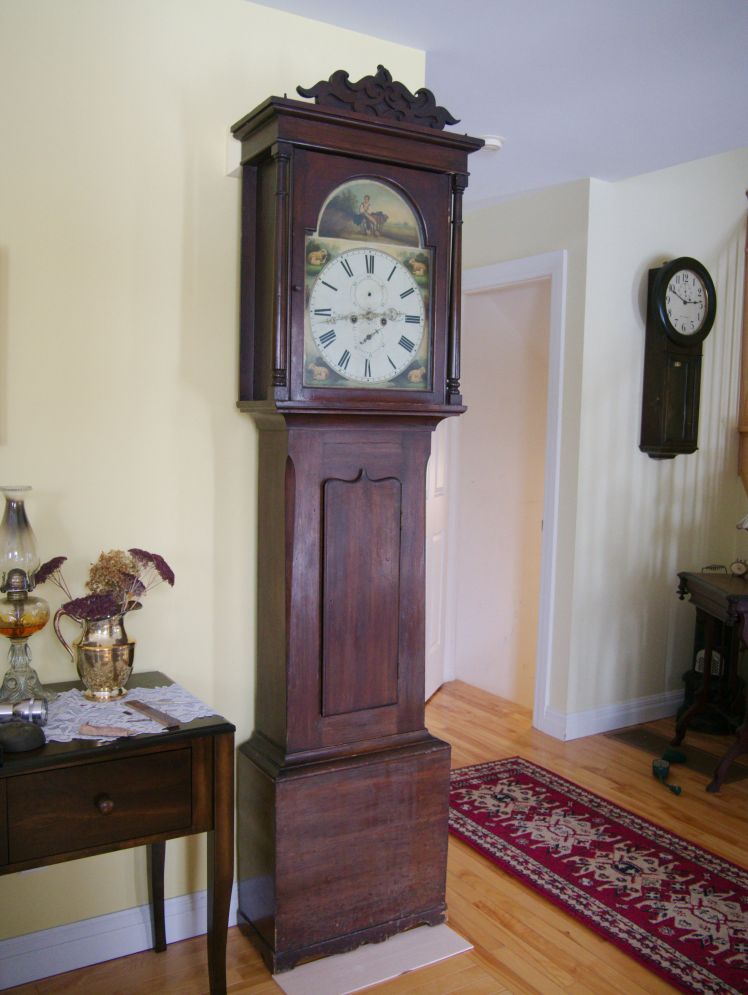
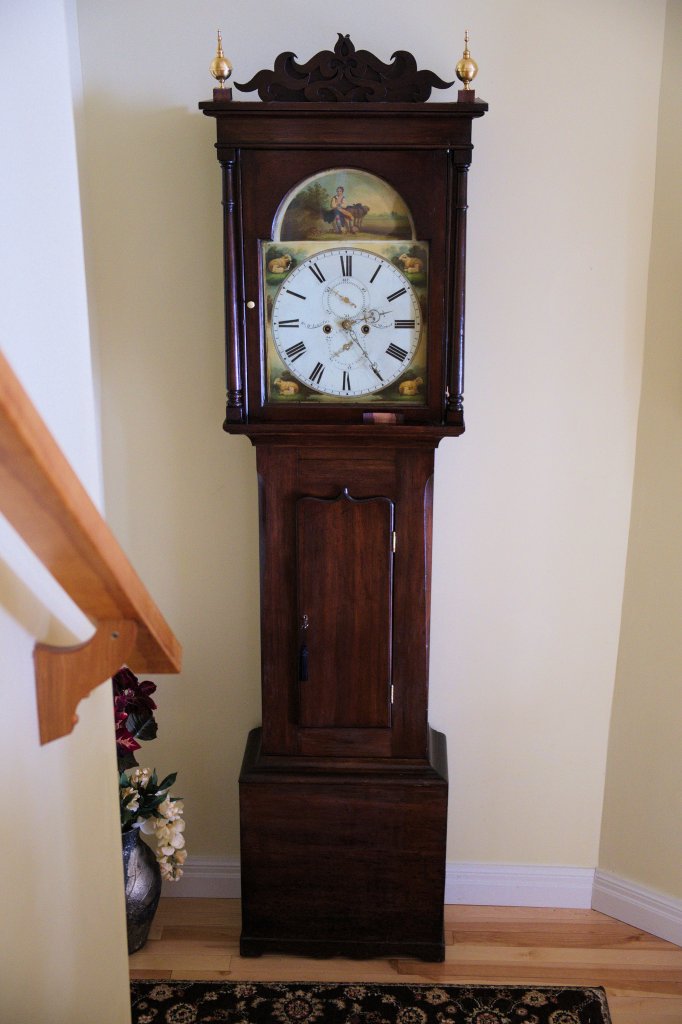
While the case was made in Scotland, the movement, dial and weights are all from Birmingham, England made at or before 1850. The clock was in fair condition when I bought it from an estate auction early in 2020, though I knew almost immediately that structural repairs and cosmetic fixes were necessary. My work was cut out for me.
It is rare to find a clock from this period that has not been subject to minor or even major repairs/changes over the years, some acceptable, others questionable
In Part I, I addressed age cracks, a cracked backboard and attaching a backboard to the waist section. In this, Part II, I will continue with installing new door pins, fashioning a missing right rear foot, cleaning the case and overall case refinishing.
New door pins
Both upper and lower door pins were missing. I considered what I would use as pins. Wood screws could work.
I cut the heads off two 3/4 inch steel wood screws and threaded each screw into the existing holes at the top and bottom of the frame. They are more than strong enough to hold the bonnet access door and appear authentic.
I learned that the poured cement on my basement floor is not level. It took me a 1/2 hour of crawling on the basement floor to find a perfectly level area
This is my first experience with a tall case clock from the 1850s and my first venture into English bell strike movement servicing.
Let me explain. Although the case was made in Scotland, the movement, dial and weights are all from Birmingham, England made at or before 1850. The clock was in fair condition when I bought it from an estate auction early in 2020, though I knew almost immediately that structural repairs and cosmetic fixes were necessary.
In this Part I, I will address case age cracks, a cracked backboard and attaching the backboard to the waist.
In Part II, I will continue with new door pins, replacing a missing right rear foot, cleaning the case, overall finishing & attending to various trim pieces.
Although modern adhesives were used for the main structural repairs, some trim pieces were attached using traditional hot hide glue
The first question is how to address present structural issues. Should I utilize materials and techniques that would have been available at the time or select a modern method that would ensure that the part(s) will continue to provide strength, rigidity and service for many years to come? I used both approaches and my apologies to the purists.
As found, standing in a corner of the auction hall
Older readers growing up in the rural areas of Canada and American have fond memories of the one-room schoolhouse clock located in the front or rear of the classroom. Just how did the schoolhouse clock get its name?
As the teacher instructed the students to work quietly on their own students would look up furtively at the clock anticipating the next recess. Students learned about time, how it regimented the day, how it seemed to move slowly and yet so quickly. Can you imagine the privileged child selected to wind the clock once per week.
Killarney, Ireland pub. The drop fusee wall clock is to the right
With a swinging pendulum visible from a distance, the clock can easily be seen running. The open-door bottom access sash allowed for restarting and adjusting the rate. The vast majority were American clocks though Canada produced its fair share of schoolhouse clocks. Time-only movements were very popular because they had fewer moving parts, noiseless except for the ticking sound, were simpler to maintain and would run well for years even if very worn.
The schoolhouse clock came to be known as a particular style of clock found in school settings. If a particular style was ordered by a school authority manufacturers might have informally described them as clocks for schools or “school clocks”. In any event, the term, “schoolhouse clock” has become part of the lexicon of the clock collector.
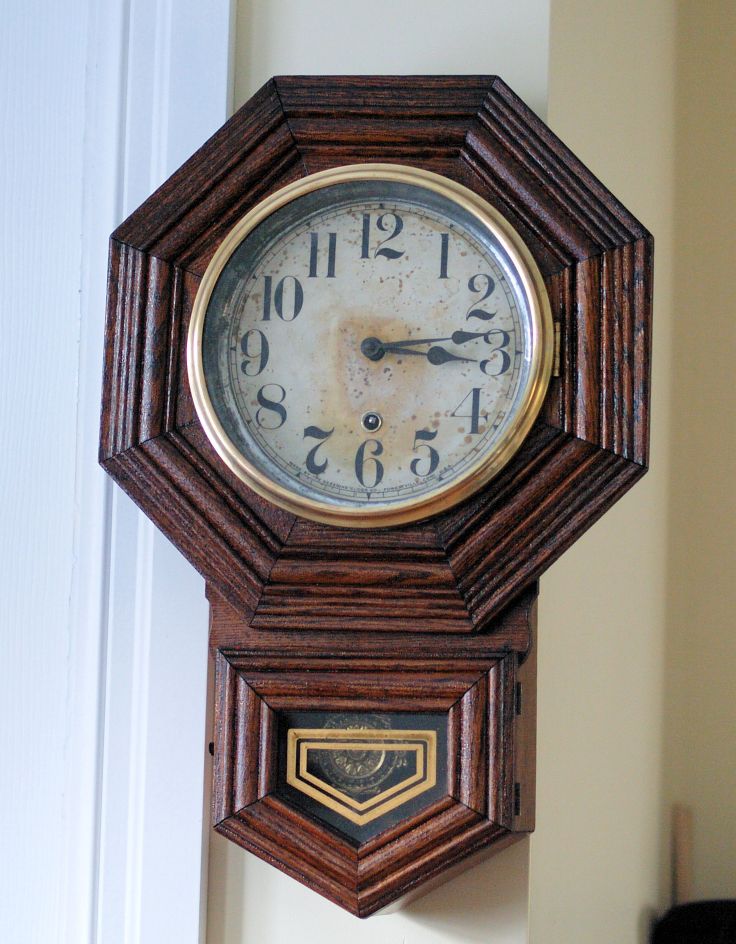
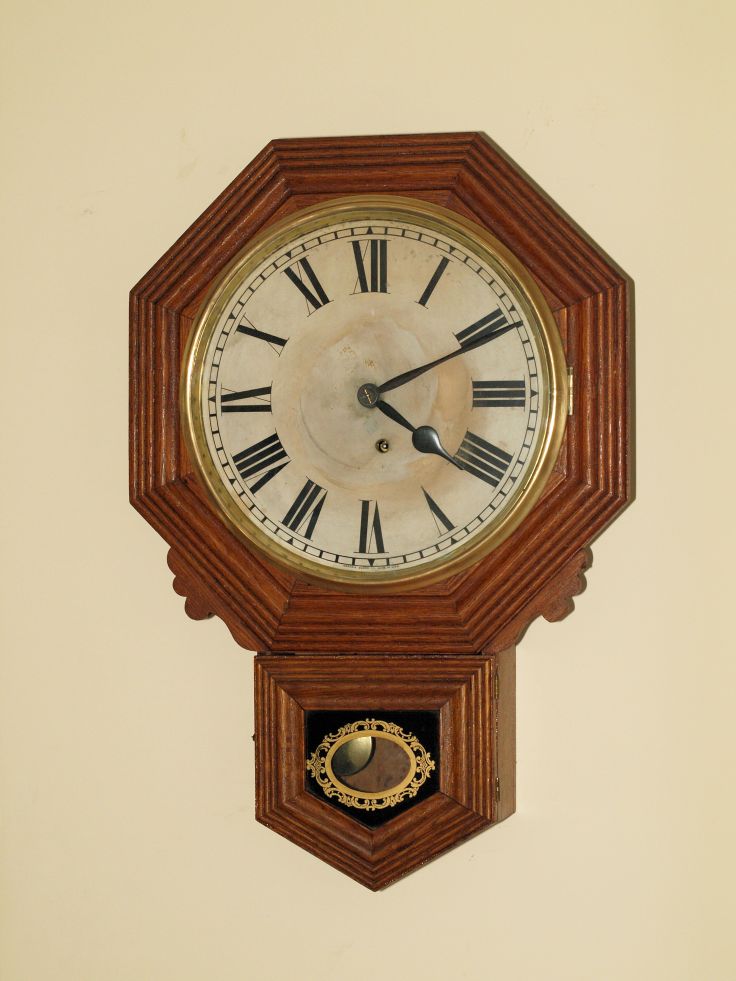
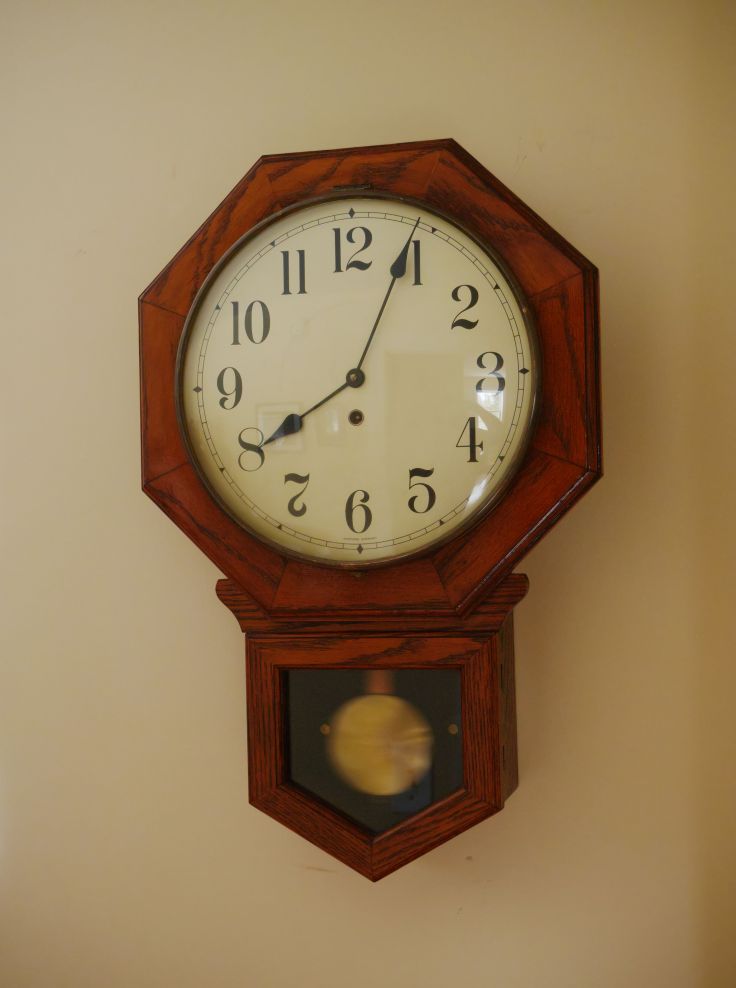
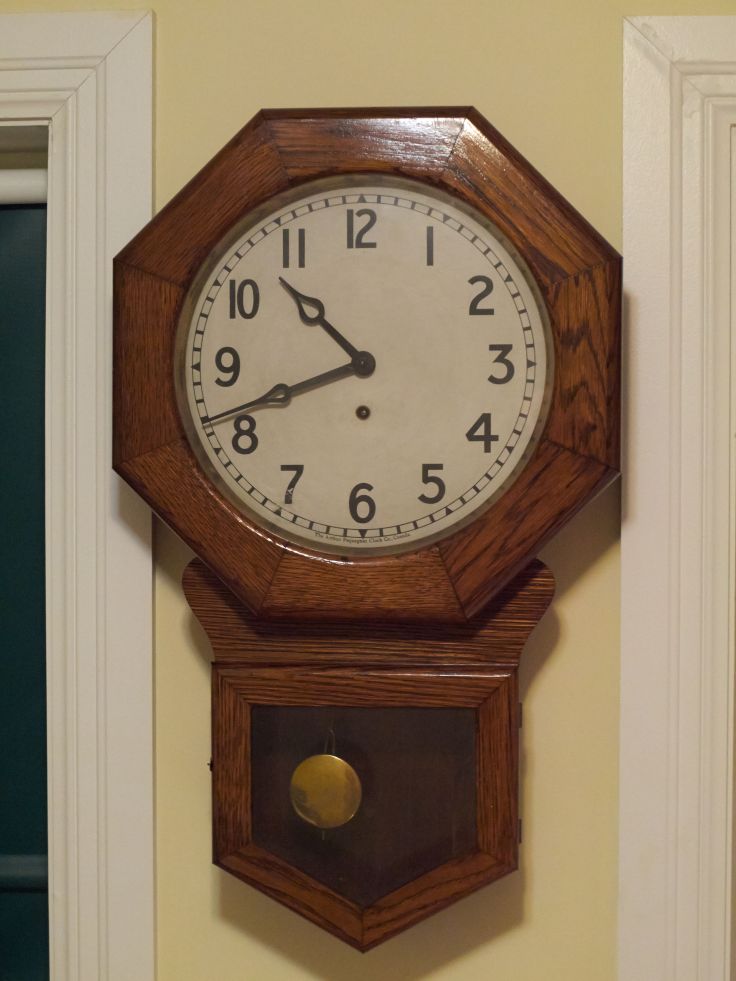
Today, the distinctive schoolhouse clock is known as a drop octagon by clock collectors.
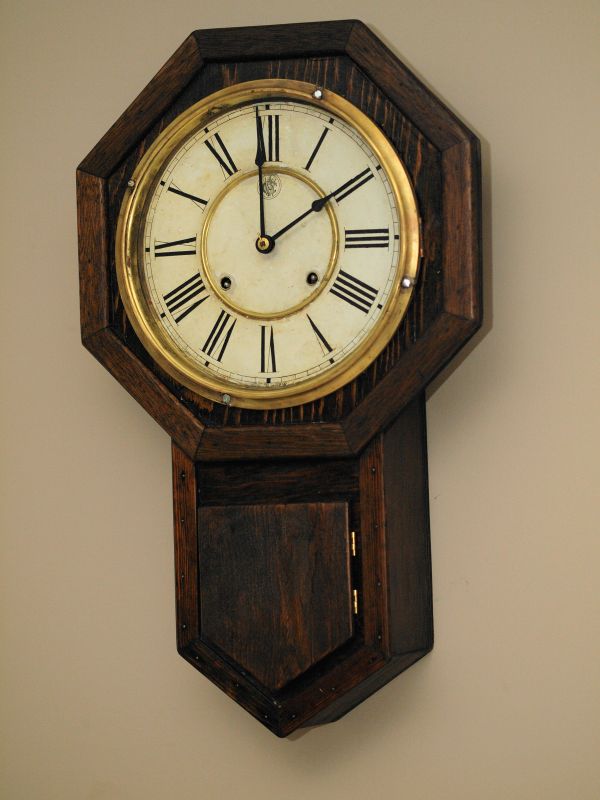
Most schoolhouse clocks are 8-day running, constructed of oak, have a brass dial bezel, bottom glazed access sash, 9 or 12-inch dial with the majority being time-only. A time-only clock provides less distraction in the classroom environment than those clocks making a striking sound.
None of the labels on my clocks have the word “schoolhouse” written on them. They are either described as a “drop octagon” or have a specific model name
In some clock circles it is said that schoolhouse clocks are a derivative of the English drop dial fusee clock such as the one seen in an Irish pub in Killarney (above photo).
None of the labels on my clocks have the word “schoolhouse” written on them. They are either described as a “drop octagon” or have a specific model name.
Here are a few schoolhouse clocks from my collection. Enjoy!
Sessions Drop Octagon from a school in Springhill, Nova Scotia (Canada)Gilbert Admiral with 31-day calendar function, Colchester County, Nova ScotiaAnsonia schoolhouse clock, Berwick, Nova ScotiaGerman-made Jauch wall clock, 1970s era
“Special edition” clocks inspired by the classic schoolhouse wall clock are still sold today though you will find a quartz movement inside
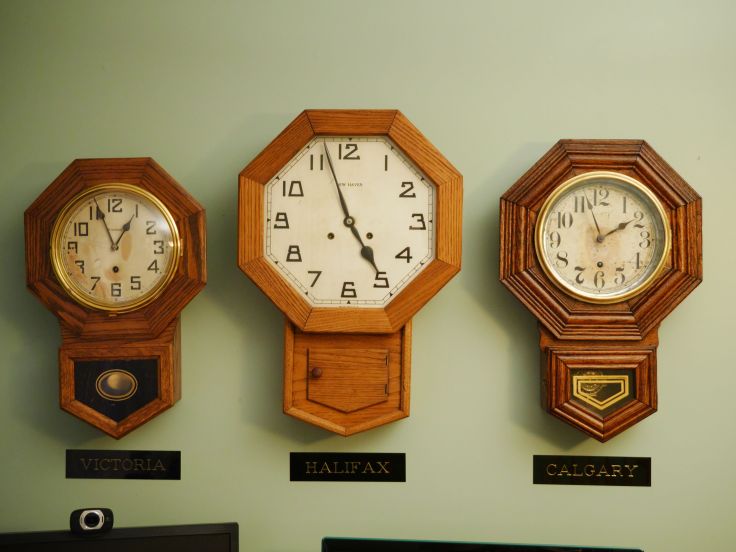
Brandon II by Arthur Pequegnat, Great Village, Nova ScotiaWaterbury short drop wall clock, Halifax, Nova ScotiaA trio of clocks representing 3 time zones, From the left, a Waterbury, New Haven and Sessions
“Special edition” clocks inspired by the classic schoolhouse wall clock are still sold today though you will find a quartz movement inside.
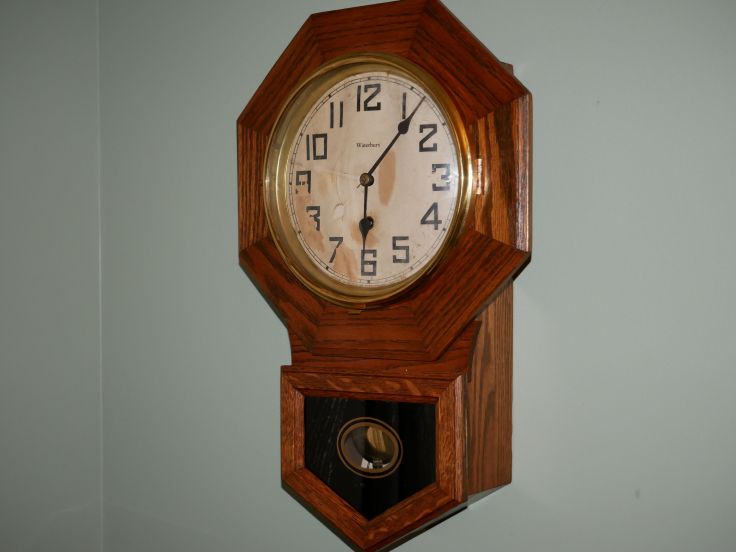
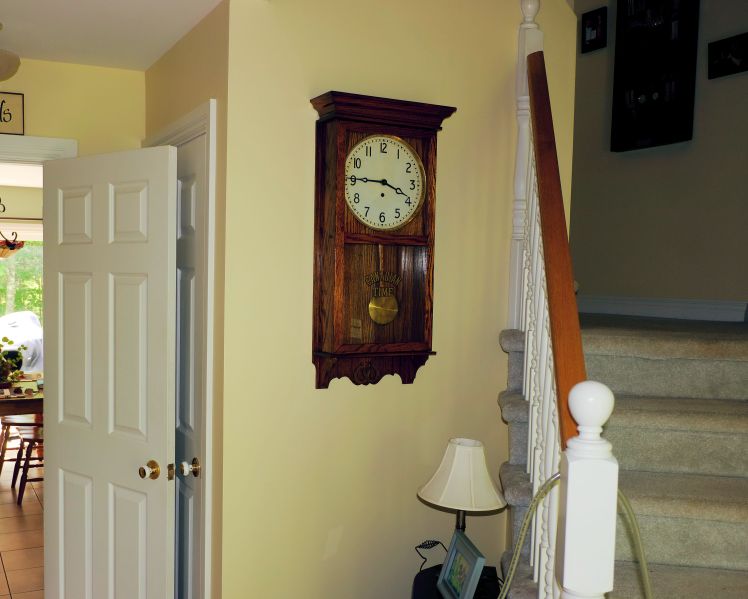
The classroom was not only place for the schoolhouse clock. Many found their way into homes across Canada and the US. My grandparents had a Waterbury time and strike schoolhouse clock in their kitchen that I remember well as a young boy (the preview clock for this post).
Schoolhouse clocks evoke fond memories for the older generation today and fortunately many have been preserved for generations to come.
Putting together a list of all the clocks I desire really appeals to me. The more I research the antique and vintage clock world the more discerning I have become as a collector.
Most clock collectors evolve as their tastes change and after collecting for more than 10 years I have changed my thinking on clocks I collect. I have also been focusing my collection on specific styles (wall clocks are preferred over mantel clocks) and makes of clocks (Arthur Pequegnat, for example).
A good portion of my wall and mantel clocks were acquired years ago when I was less discriminating as a collector (and some need to go) but in the past couple of years, I have been focusing on exceptional clocks that have historic significance and generally those made before 1900 in an age where better quality clocks were manufactured.
This is my current list including those clocks (indicated) I have acquired:
Arthur Pequegnat Regulator #1 wall clock
Arthur Pequegnat Moncton, time-only, double spring 15-day movement – ACQUIRED – summer 2018
American crystal regulator – ACQUIRED – summer 2018
Vedette wall clock – ACQUIRED June 2019
Vienna Regulator (mini) wall clock – one weight – ACQUIRED – Fall 2016
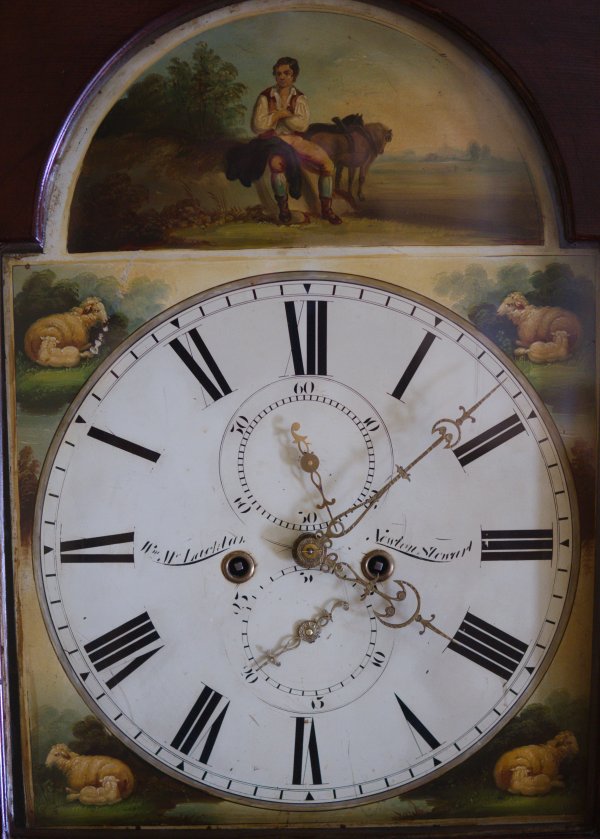
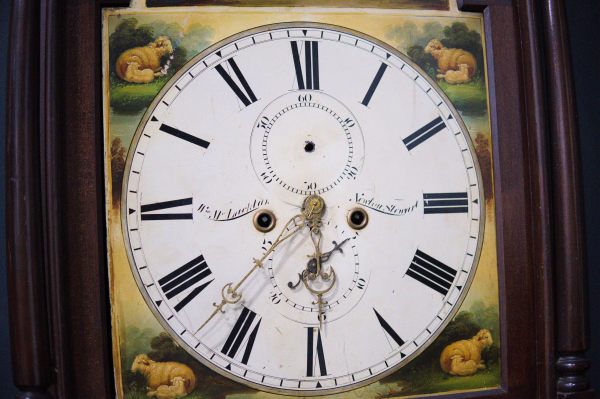
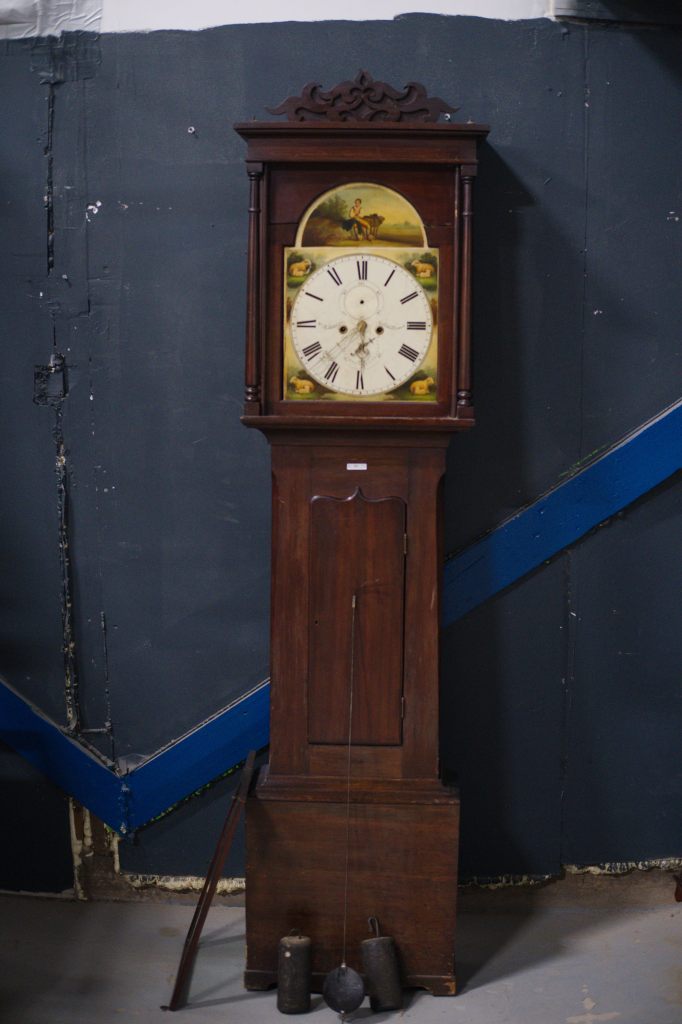
The latest is a tall case clock from Newton Stewart, Scotland, circa 1850. My son-in-law has a Scottish tall case clock that is even older than this one. It was brought over by his family in the early 1800s. I have always admired that clock and wished that one day I could add a similar one to my collection. Luckily I was able to pick one up at auction in February of 2020.
Tick-Talk Tuesday is about the letters and comments I have received from you, the reader, concerning your clock, issues you might have had, challenges you face or a clock you would like me to profile and my responses to your questions with advice on your particular clock concern. For those comments and questions that stump even me, I consult within my clock circles for the best possible answer
WE writes:
“I have the same Vedette Westminster chime box clock as the one I saw on your site. I am in need of the spring for the pendulum. Do you know where I can buy one? Thanks”
WE is referring to this clock, a 1930s vintage box clock made by Vedette of France.
Vedette Westminster chime box clock
My reply.
“Hi, WE,
If you are in the US, the biggest supplier is Timesavers. Another supplier is Merritt’s.In Canada, the main supplier is Perrin, located in Toronto.
The part you are looking for is called the “suspension spring”. If you have a broken one you will have to measure the total length, the length of the blocks and length of the steel band or bands between the blocks.
Broken suspension springSuspension spring mounted on the post
If the suspension spring is missing altogether, I can provide you with measurements to aid in your search. Let me know.
Back in December 2019, I wrote about the challenges of adjusting the strike side of this attractive parlour clock, a Waterbury York, circa 1900. Despite many attempts the strike side refused to work. Though I was close to a solution but I did not realize it at the time. I put it aside to think about it.
Attempt #2. Will I be successful? Read on.
A shot of the clock the day I brought it home.
The time side functioned perfectly but the strike side did not run at all when I first brought the clock home. Typically a good cleaning or a simple lever adjustment is all that is required though once I opened the movement up I saw it true colours. I detailed these surprises in my December post.
In light of current world events the antiquevintageclock.com family wish to convey our sympathy and condolences to those effected by Covid 19
I receive letters from all over the world asking my advice on a number of clock issues such as how a particular component of a mechanical clock should work, a clock repair challenge, how to address a particular repair or more basic things such as how to find a winding key that fits, how to wind a clock or set a clock in beat.
As comedian Dean Martin once said, “Keep those cards and letters coming”
In the past 4 years, I have authored over 400 articles that have covered a number of areas such as clock history, clock repair challenges and general clock articles but rather than direct questioners to use the search box (Search for clock articles using keywords), located to the right on the main page, I simply answer the question. It usually prompts a dialogue with more questions.
Veneering a cornice on a Seth Thomas shelf clock
Please drop me a line concerning your clock issue or give the search box a try; you might find what you need. One keyword should help in your search.
In-painting a clock dial
As American comedian and actor Dean Martin once said, “Keep those cards and letters coming”.
In light of current world events the antiquevintageclock.com family wish to convey our sympathy and condolences to those effected by Covid 19
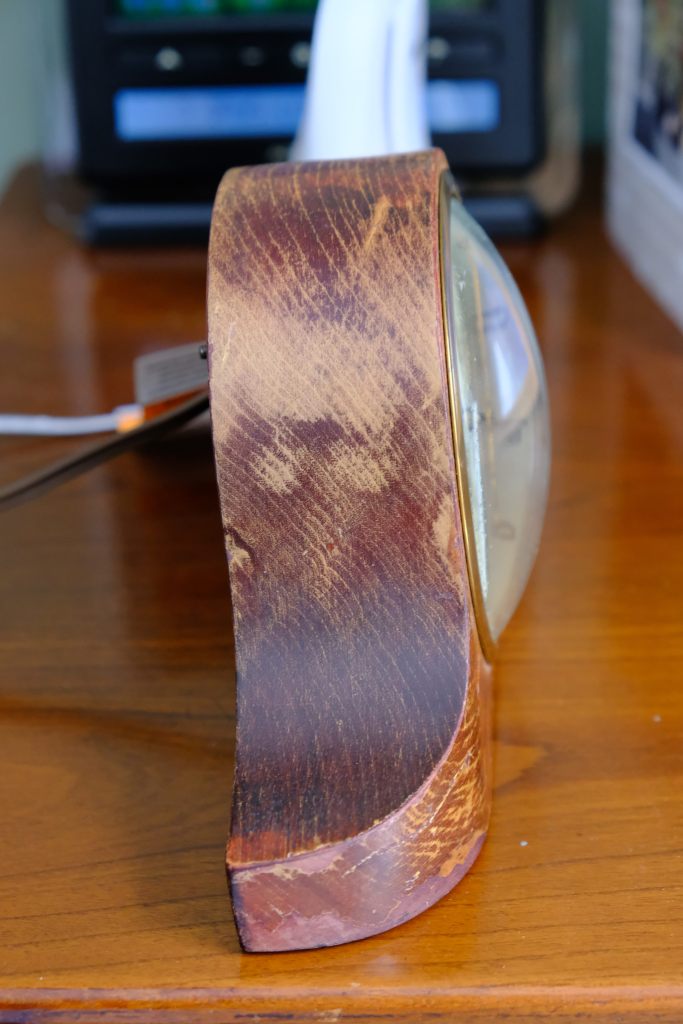
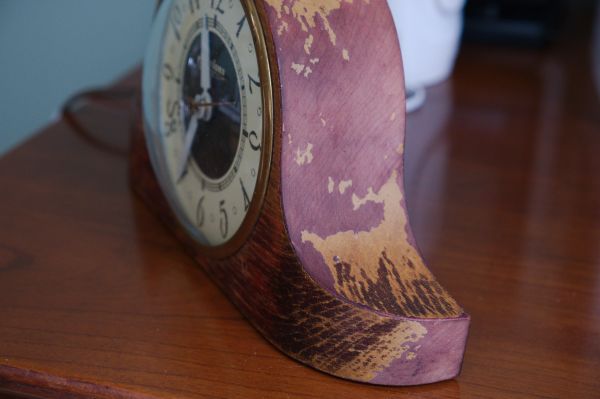
Finish almost completely gone, right side
My daughter found this vintage Sessions electric table clock, a model 3W and gave it to me as a Christmas gift. It is made, by the Sessions Clock Co. Forestville, Connecticut in 1936 and sold in Canada (a Canadian Standards Approval sticker is on the back).
Left side
On the back, it states that it consumes 2.5 watts, I guess they couldn’t call it model 2.5! It was probably a very affordable clock in its day and available almost anywhere.
At 4 1/2 inches tall and 8 1/4 inches wide, it would fit on any countertop, bookcase etc. but it lacks an alarm it would not be a suitable bedside table clock. There is only one control in the rear, a push-and-twist-in knob that sets the time. Pretty simple!
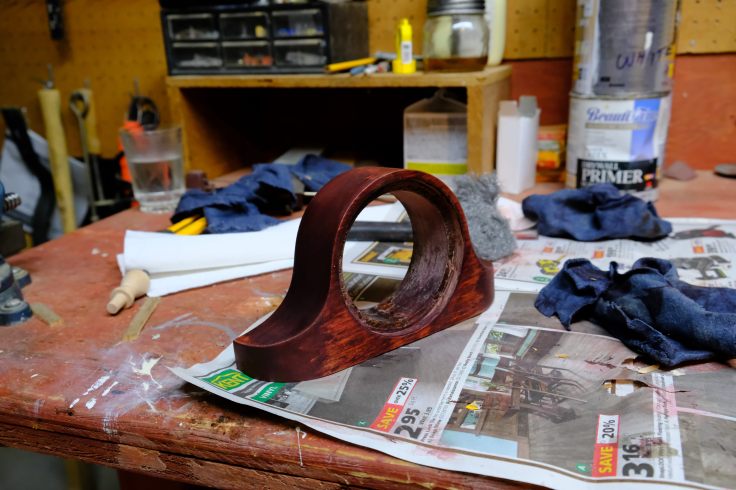
Stripping the finish
Everything else, the face, hands, brass bezel were in great shape but the finish on the case had almost completely worn off. It is one block of wood and likely pine and likely tinted lacquer.
My daughter and I chose to work on the finish together. We stripped the case down completely and applied a light walnut stain. Several coats of shellac followed by sanding with 0000 steel wool between coats and finishing with paste wax completed the project.
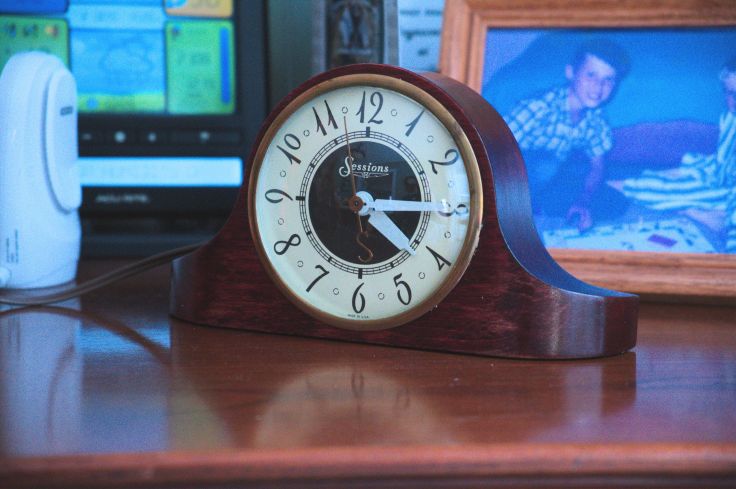
New and improved 3W
The result is a richer, darker finish, more in keeping with the original. Given that it runs so well a refinish is a complement to a very simple but stylish desk clock.
In light of current world events the antiquevintageclock.com family wish to convey our sympathy and condolences to those effected by Covid 19
Tick Talk Tuesday #24 – key required for family clock.
Tick-Talk Tuesday is about the letters and comments I have received from you, the reader, concerning your clock, issues you might have had, challenges you face or a clock you would like me to profile and my responses to your questions with advice on your particular clock concern. For those comments and questions that stump even me, I consult within my clock circles for the best possible answer
DM from Colorado writes.
“Dear Ron,
I hope you can help me. I have become in possession of our old family clock that my great grandfather brought for the old farmhouse. The clock is working but I do not have a key. I was hoping that you could sell me the right key to fit the clock. What I can read from the back sticker is ” Regulator H” and there may be another letter after that. “The sessions clock company of Forestville Connecticut.” Attached is the photo, any help would be great.
In light of current world events the antiquevintageclock.com family wish to convey our sympathy and condolences to those effected by Covid 19
Original time and strike 30 hour movement
The movement in this Canada Clock Co. time and (hour) strike cottage clock from the late 1880s is a mess but fixable. Some past repairs are acceptable while other leave a lot to be desired.
I’ll begin with the issues. “Repaired” mainsprings, nuts on a copper wire fashioned as a gong hammer and string “helping” the helper springs are things you really don’t want to see on a movement. The time side runs reasonably well but the strike side does not function, likely the result of fiddling with levers too many times.
clever, but dangerosu way of repairing the mainspringThe second mainspring, another “iffy” repairHome-made copper wire and two nuts serve as the gongString used to connect a broken helper spring
In the clock business you must always expect the unexpected. While I awaited parts, I went about cleaning the parts and bushing work .
This is perhaps the most frustrating 30-hour movement I have ever worked on
The parts arrived and included a new gong hammer, two new mainsprings and brass wire for new helper springs.
New 30 hour mainspringNew hammer gong and lever with helper springs installed
I began by installing the new hammer. Using my mini lathe I drilled a new access hole in the hammer arbour. I measured the diameter of the hammer rod and used a HSS bit to drill through the centre of the arbour. It was a reasonably good fit but to ensure a permanent hold I applied a drop of thread-locker.
The levers look like a twisting mess but there is a logic to the arrangement
This is the first 30-hour shelf clock I have worked on without a discernible warning action and it made for tricky lever positioning. Perhaps there is warning but I just could not see it. Though the levers look like a twisted mess there must be some logic to the arrangement.
The above photo shows the left side lifting lever that must be precisely adjusted and curved for the centre cam to push the drop lever over the count wheel cam to actuate the strike. The count lever blade must also line up exactly with the centre of the count wheel and precisely in the middle of the deep slot. As far as I can determine the lifting lever is the only one of the two levers that require a helper spring but I will know more after further testing.
All in all, this is one of the most frustrating 30-hour movements I have ever worked on. The movement was taken apart several times for various adjustments. I worked at for a while, left it, thought about the next steps but despite my best efforts, that strike side continues to elude me. The time side, however, works perfectly.
Some day I will have it working but for now it is on display.
In light of current world events the antiquevintageclock.com family wish to convey our sympathy and condolences to those effected by Covid 19
A different looking box clock
Is this a German box clock? It certainly appears to be a typical time and strike German box clock with the addition of finials. I discovered it behind a bar at a resort in Varadero, Cuba before Covid19 scared us all into our homes.
I have two box clocks in my collection, one is this Mauthe clock from the 1930s but most box clocks I have seen are relatively plain-looking and unadorned. Finding one with finials is a bit unusual.
German “box” clock by Mauthe
It might have been made by a number of German companies, Mauthe, Kienzle, Gustav Becker, or HAC but definitely German. I cannot see any markings on the dial or anywhere that might tell me what it might be. But those finials. Were they added later on? Who knows.
I am always on the lookout for interesting clocks during my travels and hopefully, in the months to come, my wife and I can resume our travelling once the current world health crisis subsides.
In light of current world events the antiquevintageclock.com family wish to convey our sympathy and condolences to those effected by Covid 19
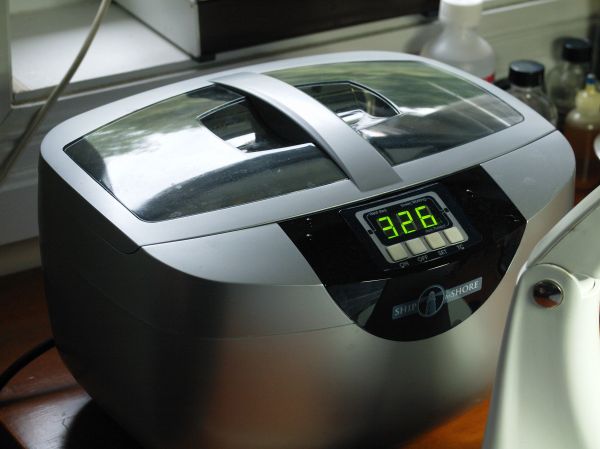
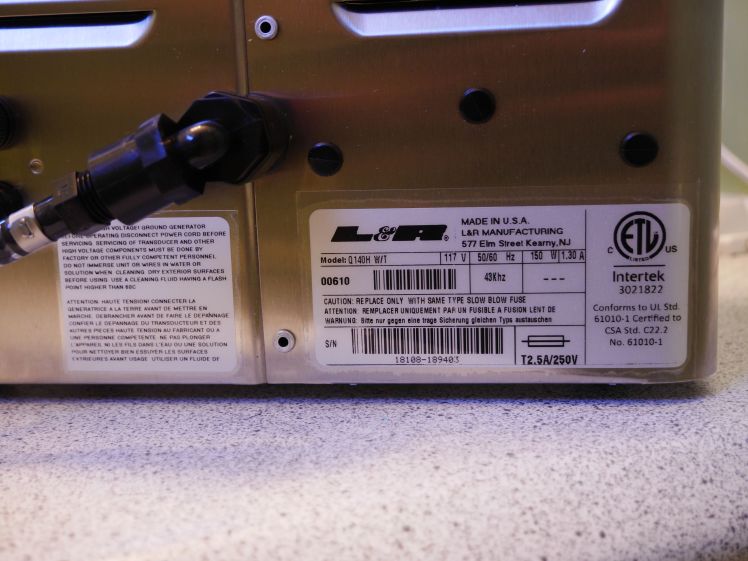
Ultrasonic cleaner by L&R, model 140
Is the ultrasonic cleaner indispensable for clock repair? The short answer is “no”. I know many in clock repair who hand clean clock movement parts, have had good success over the years and are not about to change their ways.
In my view, there are so many advantages to having an ultrasonic cleaner you will wonder why you did not have one in the first place. Indeed, these are many reasons why the ultrasonic cleaning system is widely used across many different industries.
Follow me as I explain why the ultrasonic cleaner can help you with the cleaning of most clock movements.
What is an ultrasonic cleaner?
An ultrasonic cleaner is a machine that comes in various sizes and used to clean many things. Ultrasonic cleaning uses cavitation bubbles induced by high-frequency pressure (sound) waves to agitate a liquid. The agitation produces high forces on contaminants adhering to substrates like metals, plastics, glass, rubber, and ceramics. This action also penetrates blind holes, cracks, and recesses.
The result is very fast and effective cleaning.
20 minutes is usually sufficient
What to clean and what cleaner to use
Most brass and steel clock parts can be cleaned. Leave out leather hammers and any specific items you do not want to be exposed to a liquid. Although plain water does work, whenever possible, it is best to use a water-based detergent in the ultrasonic cleaning process. Water-based solvents are nontoxic, nonflammable, and environmentally friendly. In the absence of commercial water-based detergents, a few drops of Dawn will do.
What not to put in an Ultrasonic cleaner
Never use any kind of flammable liquid in an ultrasonic cleaner; it is plainly dangerous. Liquids with relatively low vapour pressure (ie. lower boiling points) may nebulize or convert to a small spray when exposed to cavitation in an ultrasonic bath. This means tiny mist-like droplets will be dispersed into the air, somewhat akin to an ultrasonic humidifier. These droplets combine with air to create a perfect storm for combustion. This includes flammable liquids in sealed plastic or open bags or containers, glass etc..
As a general rule, there is no safe way to use flammable liquids in any stage of clock repair. Avoid flammable liquids altogether in an ultrasonic or even when cleaning by hand.
L & R is a reputable brand; this one has a drain and a heater
Ultrasonic cleaning works
I use an ultrasonic cleaner when I clean most clock movements because of the precision and thoroughness of the process. There is nothing I know of that cleans lantern pinions better than an ultrasonic cleaner.
In the main tank, I use hot water with Deox 007 mixed with water. Deox 007 is a biodegradable, non-toxic, mildly acidic, de-oxidizer and de-greaser which has a slightly slippery feel, meaning the surface tension is low and will transmit sound easily. Using hot water also speeds up the degassing process. If your ultrasonic cleaner has a heater, use it. Note that water/liquid which is too hot will strip lacquered parts.
If the movement is particularly dirty, a pre-cleaning with degreasing soap (dish detergent) and water is recommended.
Generally, a 15-20 minute time period is all that is required to thoroughly clean a dis-assembled movement. Machines have various output powers so timing may have to be a bit of an experiment for your particular machine.
Dial removed showing time and strike movement in as-found condition
Clock parts must be rinsed in a bath after a period of time in the ultrasonic, so the “dirt” in the solution is not a big concern. I wash dishes by hand and by the end of the task the water in the sink is sometimes pretty nasty, that’s why rinsing dishes is important. The bath can be simply warm water or a special rinsing solution. I use two bathes of warm water.
After cleaning in an ultrasonic cleaner; the difference is noteworthy
The drying phase is critically important. All parts must be dried immediately after the cleaning and rinsing process. Rust forms very quickly on steel parts. I use either a hairdryer or time my wife’s baking and leave the parts in the residual heat of the oven, usually for about half an hour or so.
Methods may differ but I take the liquid out of the ultrasonic cleaner after each use and store it in a plastic jug. I have a fairly small US so when the liquid gets too dirty I filter it through some coffee filters. And by dirty, I mean a very dark brown. When I perceive that it isn’t cleaning effectively I just dump the liquid and refill. Since the cleaning liquid is biodegradable I pitch it on the back lawn.
Exceptions to the rule
Aluminum parts with ammonia-based cleaners will turn brass dark. Personally, I feel ammonia can be harmful to both brass and humans and I would be very careful. The ammonia combined with the overcleaning of the ultrasonic and the wrong solvent will start by differentially dissolving the zinc from the surface of the brass leaving a washed-out pitted surface. However, having said that, if you research ammonia on clock forum sites it’s still not clear who is right on the issue.
I would also not put floating balance escapements or hairsprings in an ultrasonic cleaner.
Old hammered brass movements are much more fragile and sensitive to both chemicals (ammonia especially) and the impact of ultrasonic cleaning. Since old brass, which is very porous, does not take kindly to being placed in an ultrasonic cleaner this 175-year-old English bell strike, for example, was cleaned entirely by hand.
Scottish tall case clock with English bell strike movement
Final thoughts
Can you get by without an ultrasonic cleaner? Absolutely! However, unlike other tools in your clock repair arsenal, the ultrasonic cleaner is one that not only will save valuable time but may produce spectacular results.
Although an ultrasonic cleaner is a labour-saving device, it is not a panacea. It will make things clean, but it won’t make everything look like new. If the metal is very tarnished, nothing that I know of will remove that oxidation, aside from fine abrasives.
If your budget allows, It is worth spending money on an ultrasonic cleaner.
In light of current world events the antiquevintageclock.com family wish to convey our sympathy and condolences to those effected by Covid 19
German-made time-only plate clock movement
Small shelf clocks of the 1930s from BlackForest Clock Co. of Toronto shared a simple German-made time-only movement across the line. The movement has tiny wheels and pivots plus a clever twisting pendulum rate adjuster.
In light of current world events the antiquevintageclock.com family wish to convey our sympathy and condolences to those effected by Covid 19
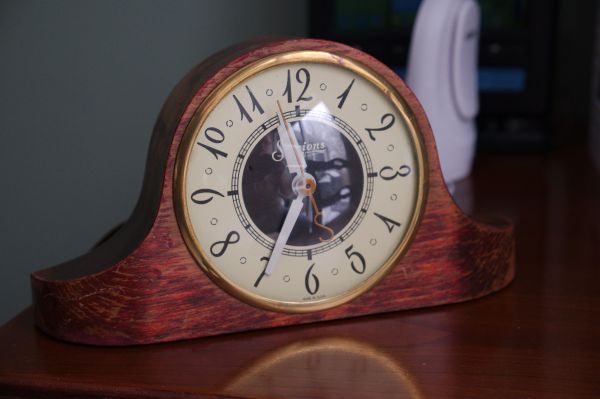
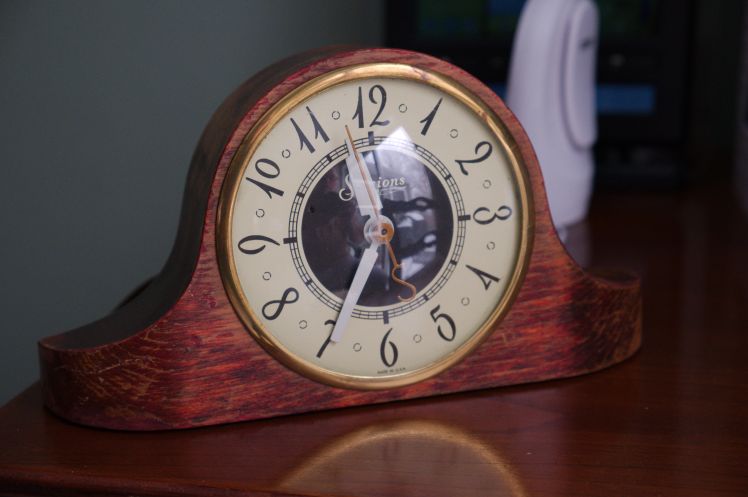
The only exception to my collection of mechanical clocks is this vintage Sessions electric auto-start table clock, model 3W, made by the Sessions Clock Co. Forestville, Connecticut in 1934 and sold throughout Canada (Canadian Standards Approval sticker on the back).
I wrote about this clock at the beginning of this year (2020) and have time to focus on the case.
Sessions 3W electric table or shelf clock
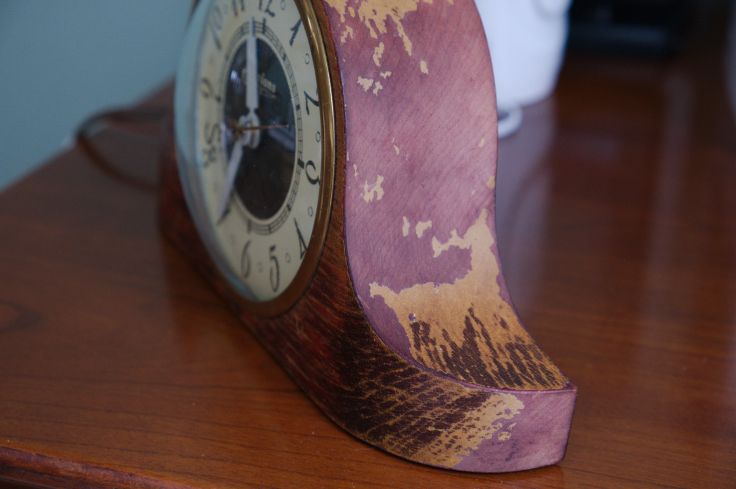
From the front, it doesn’t look too bad but the side view reveals much of the finish has worn off over the years
On the back, it states that it consumes 2.5 watts of electricity. I suppose the manufacturer could not call it model 2.5. it was a very affordable clock in its day and available almost anywhere.
At 4 1/2 inches tall and 8 1/4 inches wide it would fit on any countertop, bookcase, desk or bedside table though it does not have an alarm. It is time-only with an Arabic dial and a sweep second hand. Having a sweep second-hand means that at a glance you can see that the clock is running. There is only one control in the rear, a spring-loaded push-and-twist-in knob to adjust the time.
In light of current world events the antiquevintageclock.com family wish to convey our sympathy and condolences to those effected by Covid 19
In this article, I will describe the steps taken to inpaint and restore the dial of an Arthur Pequegnat time and strike gingerbread clock.
But first, what is inpainting? And what does it have to do with clock dials?
Inpainting is a dial restoration or conservation process where damaged, deteriorating, or missing parts of a dial are filled in to present a complete image.
And what does the term dial restoration mean?
Dial restoration includes adhering loose flakes, filling areas of loss, cleaning, colour matching, repairing graphics, inpainting of decorative artwork and sealing. Some dials are easier to work on than others but generally speaking American antique clocks dials are good candidates. Dial inpainting can be hit and miss, and the final results can range from fair to excellent.
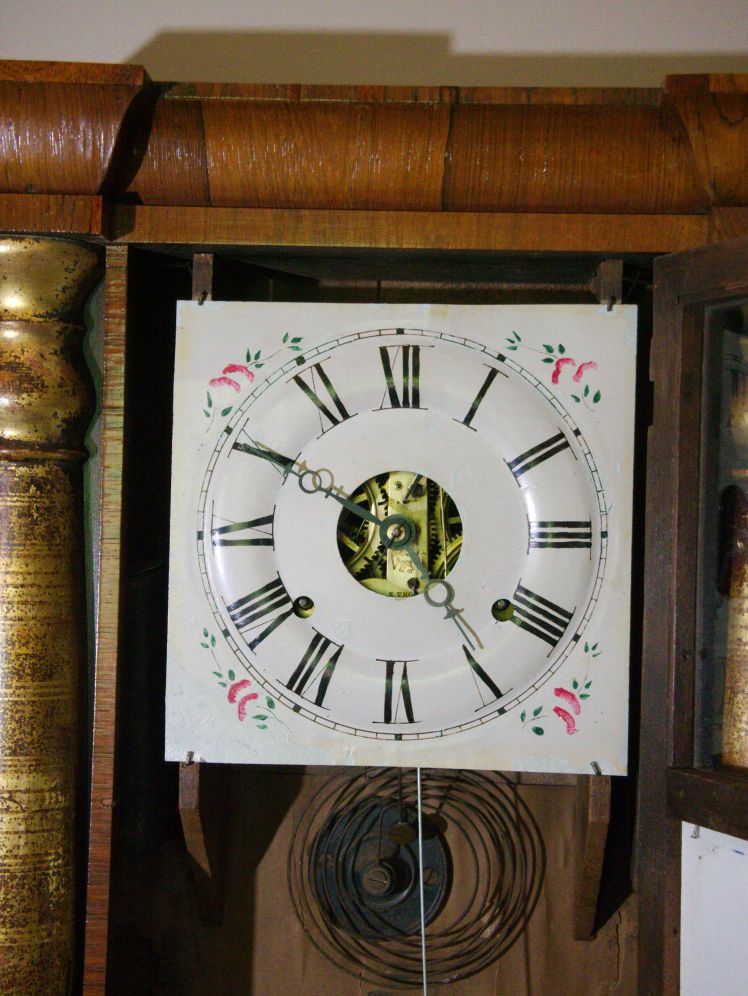
Here is an earlier project. The before photo shows the significant losses on the dial of an 1850s Seth Thomas column and cornice clock.
Before inpainting
And, after inpainting. In this example, restoring the floral spandrels and the chapter ring was the most challenging part of the project.
Working on a clock dial
I was pleased with the final result though these dials are among the easiest to work on.
After: Seth Thomas dial, column and cornice clock
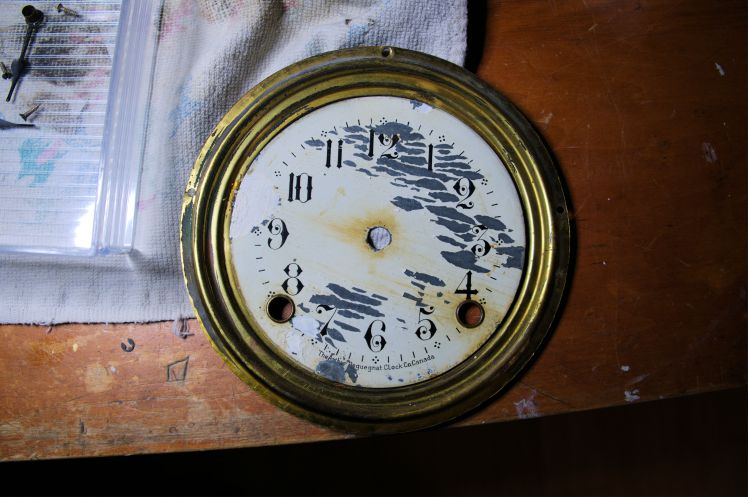
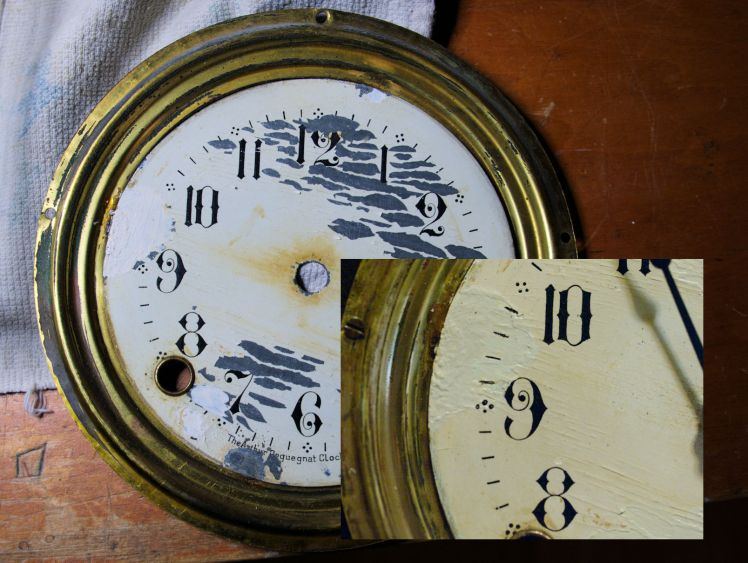
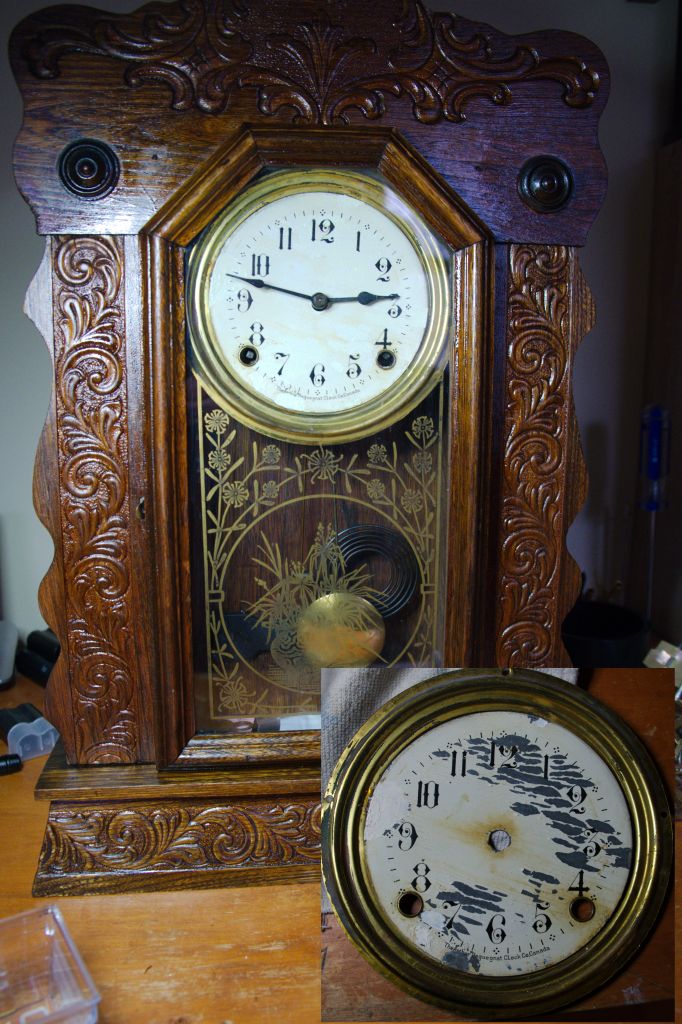
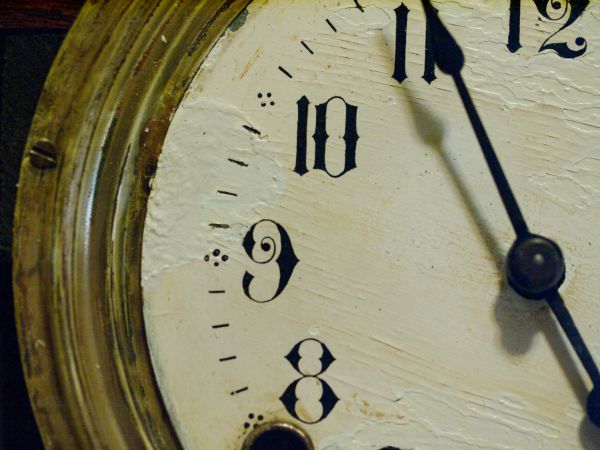
Now let’s turn to a circa 1918 Arthur Pequegnat Canuck time and strike gingerbread clock. There was considerable paint loss, numerals in a script that is a challenge to reproduce and a chapter ring consisting of small dashes with a 4-dot pattern every 5 minutes. To make matters worse, a previous owner had made an attempt to paint in larger sections of the dial.
Given its poor condition, I was initially tempted to buy a replacement dial; $50.00 for paper-on-tin and $4.00 for a paper dial plus tax and shipping. However, I decided to attempt inpainting.
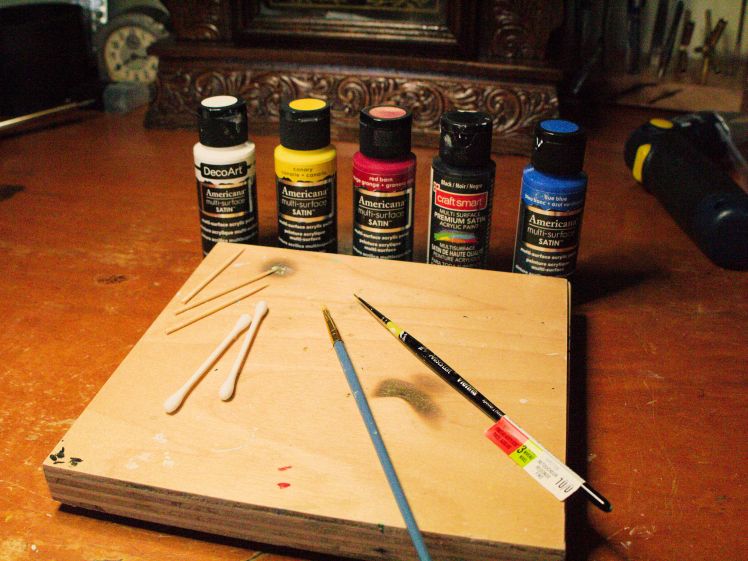
My supplies, which I have on-hand, consisted of:
Level 3 – 10/0 spotter artist’s paintbrush
#2 artist’s paintbrush
A selection of satin finish water-based acrylic paints; white, yellow, red, and blue
Black paint for numerals
Pitt artist’s pen, fine tip
Pencil eraser
Toothpicks for mixing paint
Q-Tips to remove over painted areas and polish brass bezel
Woodblock
Supplies
Occasionally I use a pencil eraser to remove dirt around the centre and winding arbour hole holes. It is very effective at removing years of dirt and grime.
White is the base paint. Others colours are mixed to replicate the aged finish. There is no magic to this. It takes trial and error to match the dial colour which had yellowed considerably over the years. An exact match is more luck than skill and there are a thousand shades of off-white. I suggest painting in warm light or natural light for best results. Arriving as close as possible to the aged finish was my objective.
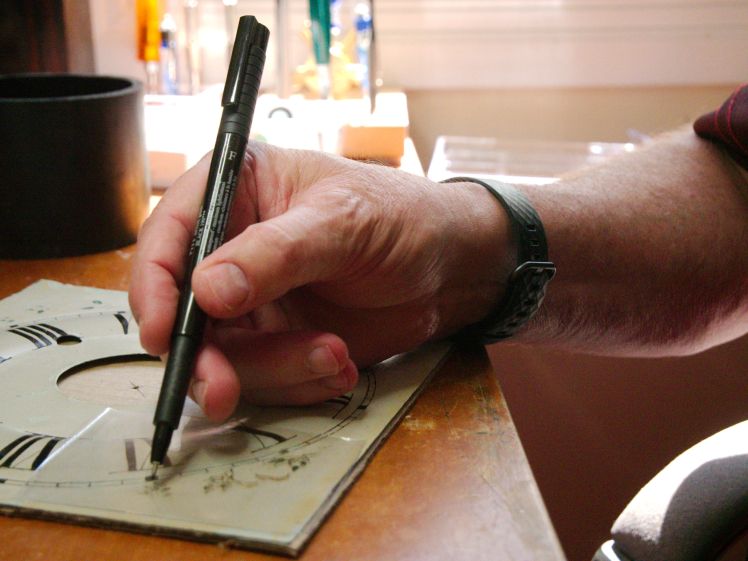
The numbers were in reasonably good shape and it takes a steady hand to fill in the missing sections especially the dashes on the chapter ring. For very thin lines, I use a black artist’s pen with a fine tip.
Before and after
Of course, upon close examination, you can see the infilled areas and the touched-up numbers but from average viewing distance, it is difficult to tell.
About 1/2 meter away (the case had been cleaned earlier).
While I was working in the dial I cleaned the brass bezel with Q-Tips and Brasso.
Before (inset) and after
There are some dials I leave as-is since the age and patina of the dial is an important part of the character of the clock but if it is too far gone, as in these examples, inpainting is certainly an option.
All in all a very satisfying project. Now on to servicing the movement.
In light of current world events the antiquevintageclock.com family wish to convey our sympathy and condolences to those effected by Covid 19
There are a fair number of Canadian clock enthusiasts that have various sized collections of Pequegnat clocks. Skip Kerr‘s extensive collection immediately comes to mind.
Although my collection is modest by comparison with just eight Arthur Pequegnat Canadian-made clocks they cover a range of models from kitchen to wall clocks.
The Arthur Pequegnat Clock Company was in business in Berlin, later renamed, Kitchener, Ontario (Canada) from 1904 to about 1941. Pequegnat clocks are well known among Canadian Clock collectors. Many are still running today and they can be easily found on local and national online for-sale sites and you might even find them on the northern border states of the US.
Here they are; I will let the captioned photos speak for themselves.
Arthur Pequegnat Maple Leaf kitchen clock, otherwise known as the “Fan top”
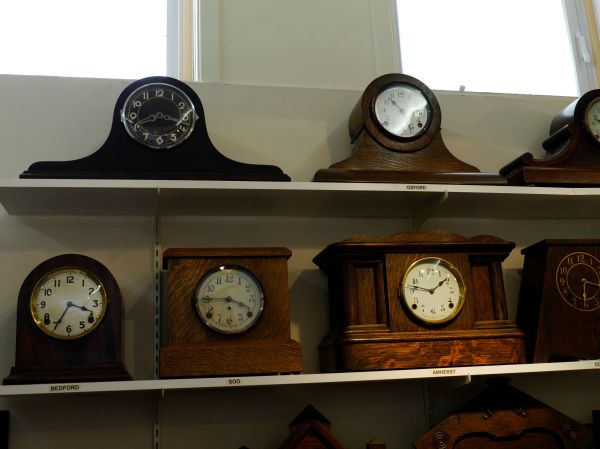
Arthur Pequegnat Bedford mantel clock (variant with larger dial)
Arthur Pequegnat Simcoe mantel clock, Berlin period
Arthur Pequegnat Canadian Time (time-only) wall clock
Arthur Pequegnat Brandon (second version)
Arthur Pequegnat Canuck kitchen clock (otherwise known as a gingerbread clock)
Arthur Pequegnat Kitchen clock, Maple Leaf, otherwise known among collectors as the “pointed top”
Arthur Pequegnat Moncton, double spring time-only 15-day clock, post-Berlin (after 1917)
My journey goes on as I continue to purchase Pequegnat clocks adding them to my collection. I have yet to secure a tambour style clock and a Regulator #1 is certainly on the top of my list.
In light of current world events the antiquevintageclock.com family wish to convey our sympathy and condolences to those effected by Covid 19
Here we have a nondescript mantel clock from the Fleet time Company of Montreal. This little known Canadian clock company had a short life between the years 1936 and 1940 producing a range of two and three-train mantel clocks with movements sourced from Germany. All clocks had pendulums and were spring-driven. According to business records, the company was listed as an importer of clocks and watches. The locations were 440 McGill and then 303 St. Paul West, Montreal (Canada).
The Second World War took a heavy toll on this company as the source of movements dried up and so the future prospects of this small company (information obtained from the Canadian Clock Museum, Deep River Ontario). One wonders why they did not diversify and source movements from France and Germany like the Forestville Clock Co. of Toronto during the war years.
Wood cases were made in Canada for some models while other cabinets were imported from Germany.
Gufa chime movement
This clock has a Gufa movement and one can assume most of their 3-train clocks had this movement although some movements are marked “Foreign”. Gufa is the Guetenbacher Uhrenfabrik, located in Gütenbach, Germany. They manufactured 400-day clocks and cuckoo-clocks and later they became the “Jahresuhrenfabrik” (August Schatz & Sons in Triberg, Germany).
Battered company plate, simply says “Fleet Clocks”
Close-up of foil plaque
The movement does not work because the time side mainspring is broken. The case is in bad shape and I am not sure how I will proceed but it is beyond simply cleaning, touching up and polishing. At this point, the only option is stripping. I am always reluctant to strip the finish from an old clock unless it is the only option. In any event, the case will be a late spring (2020) project.
The case needs a lot of work
This is another Canadian clock added to my clock collection although the fact that it was assembled and sold on Canadian soil is its only real qualification.
Hi readers, in light of current world events the antiquevintageclock.com family wish to convey our sympathy and condolences to those effected by Covid 19
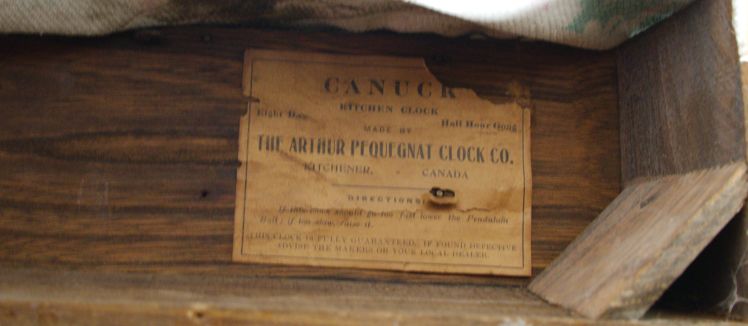
I have a total of eight Arthur Pequegnat clocks in my collection. The newest, an Arthur Pequegnat Canuck is not exactly my favorite though it is not unattractive for a gingerbread clock. The company made a range of kitchen clocks but I have seen very few in the true gingerbread style, such as this one.
The clock runs well though it will certainly need servicing
Few are offered on online for-sale sites so it is quite possible that not many of them have survived over the years. Collectors would often pass them up as most other Pequegnat clocks are considered more desirable and valuable.
Hi readers, in light of current world events the antiquevintageclock.com family wish to convey our sympathy and condolences to those effected by Covid 19
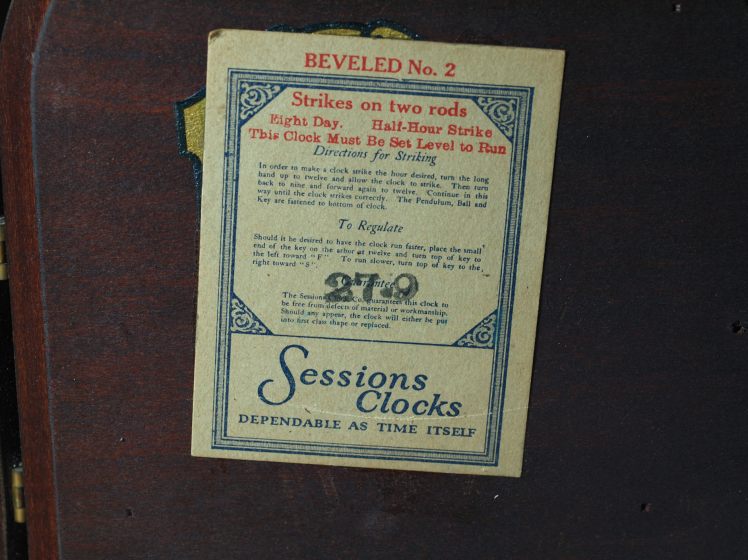
Dating a clock can be a challenge and often an estimate within a range of dates is the best that can be accomplished. Dating some clocks can be relatively easy as in the case of this Sessions Beveled Number 2 tambour style time and strike. Inside the back access door, it is stamped Sept 1927, the date of manufacture.
Further research about the clockmaker, the movement design and the label will reveal a date within a narrow range
Inside access door of Sessions tambour clock
Sessions Beveled No. 2
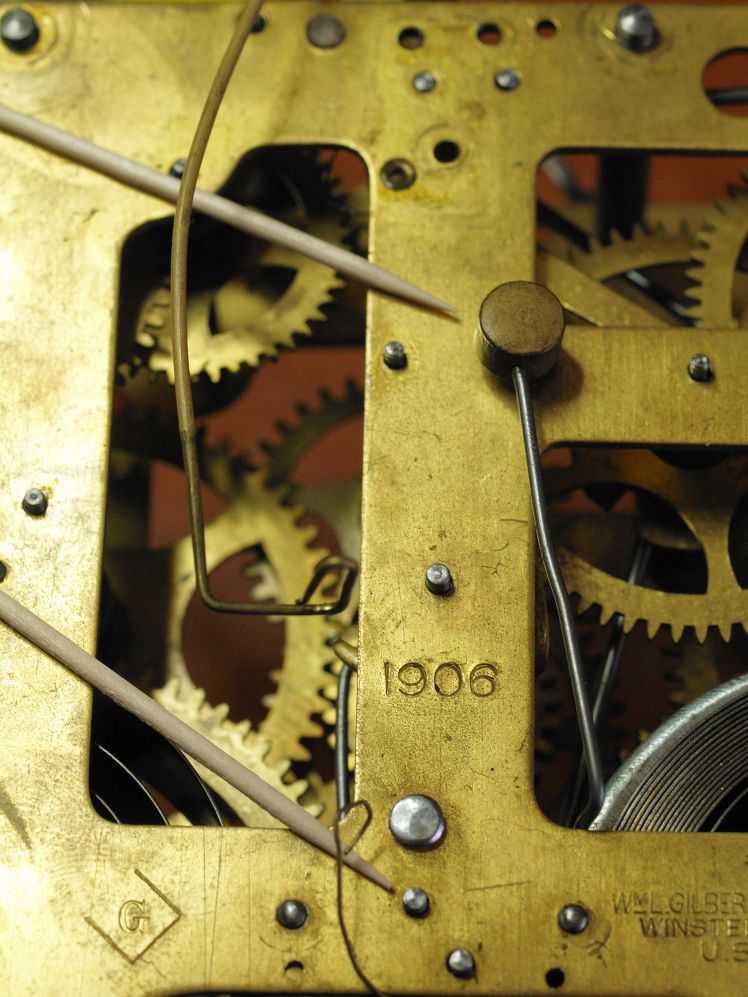
This Gilbert time and strike movement has a die-stamped year but the month of manufacture is unknown. Other markings in the case might narrow it down.
Gilbert movement made in 1906
Research concerning the maker, the clock design, the model name or number and the label may reveal the exact date or something within a narrow range of years. Books on the identification of American clocks such as those by Tran Duy Lycan be very helpful.
Let’s look at this Elisha Manross Gothic Steeple clock.
Elisha Manross (1792-1856) was an important pioneer of the Connecticut clock and made a variety of clock styles, one of which is the gothic steeple pictured below.
Elisha Manross Gothic Steeple clock. Hands are incorrect; it would have had spade hour and spear minute hands
Although Elisha Manross had been active in Bristol clock-making since 1812 and earlier he shows in the Bristol tax records as making clocks from 1842-1851. His business was dissolved in 1854 and the factory was purchased in 1855 by E.N. Welch.
Manross made two steeple clocks. One is 20″ high and 10″ wide, the other is 19 1/2 inches high by 9 1/2 inches wide. The larger case would have made for other labels but the smaller size such as this one was manufactured in the Manross factory.
A very dirty Elisha Manross 30 hour movement, just out of the case
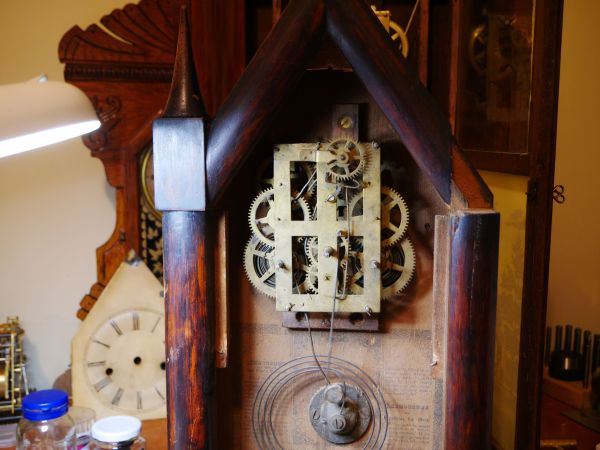
This 30-hour clock by Elisha Manross has some distinctive features that help in its dating. Let’s narrow down the date by looking at the design of the movement and case. Three features make this clock interesting. One, it has very rare brass mainsprings; two, the count-wheel is located in the middle on the backplate and three, the veneer on the front columns and door is in a vertical orientation.
Brass mainsprings
Brass mainsprings were invented, patented and first used in 1836 by Joseph Shaylor Ives. Brass was cheaper and more accessible than steel in the mid-1830s and 1840s. Silas B. Terry developed steel springs for clock use in the Bristol area circa 1847, and as steel improved and became cheaper, brass springs quickly disappeared.
In the history of the American clockmaking, brass mainsprings had a very short life, between 1836 and 1850. The brass mainsprings on this movement have survived for a very long time and most clocks of this age have had replacement steel mainsprings.
Count-wheel
Many American time and strike movements have the count wheel located on the left side of the front plate just above the mainspring (or winding arbour for a weight-driven clock). Placing the count wheel in the rear of this movement adds complexity to the lever arrangement. Also absent is a strike-side cam wheel typically found on later American time and strike movements.
Manross backplate showing location of count-wheel
Veneer and vertical orientation
Exotic woods were used to cover the pine case. Elisha Manross clocks were either clad in Rosewood veneer or Mahogany. Manross clocks were produced with the Mahogany veneer in a vertical orientation, such as this clock, and Rosewood veneer in a horizontal orientation. American clockmakers did not normally orient the veneer in this manner.
Left front column
Dating this clock – let’s see what the data tells us
Records also show that steeple cases were made by Manross between 1847 and 1853. The label on the clock is in remarkable condition for a 168-year-old clock and is extremely helpful in dating this clock. On the back of the door, the left side of the upper tablet is the inscription 8/43, not once but twice. Is this the date the case was made? The door is clearly original to the case since it has the same vertical orientation as the veneer.
Records also show the sale of 705 cases (unknown as to type) to “E. Manross” during the months July-November, 1843. It is very possible the case was constructed in 1843, stored until later when the movements were placed in the case and readied for sale.
The date of August 1843 is inconsistent with the label, located on the inside backboard, which was printed by Elihu Geer at his shop on 10 State Street, Hartford Conn on or about 1850. The label was likely added to the case just prior to the sale of the clock.
We can conclude that the clock was made no earlier than 1843 and no later than 1850 and we can safely date this clock within a 5-7 year period.
Dating aside, it is truly remarkable that a mechanical device that is 173 years old is still operating to this day.
The disassembly of an antique tall case clock need not be a daunting task. When I bought this clock at auction at the beginning of 2020 I put into practice some of the things I had learned when transporting a Ridgeway grandfather clock in 2013. My advice is to work slowly and methodically but think about what you are doing at each step of the process.
Why disassemble? A move across town, across the country, or even redecorating are three of many reasons. Even if you wish to move the clock from one area of your home to another disassembly is required. Yes, moving it a few inches requires disassembly.
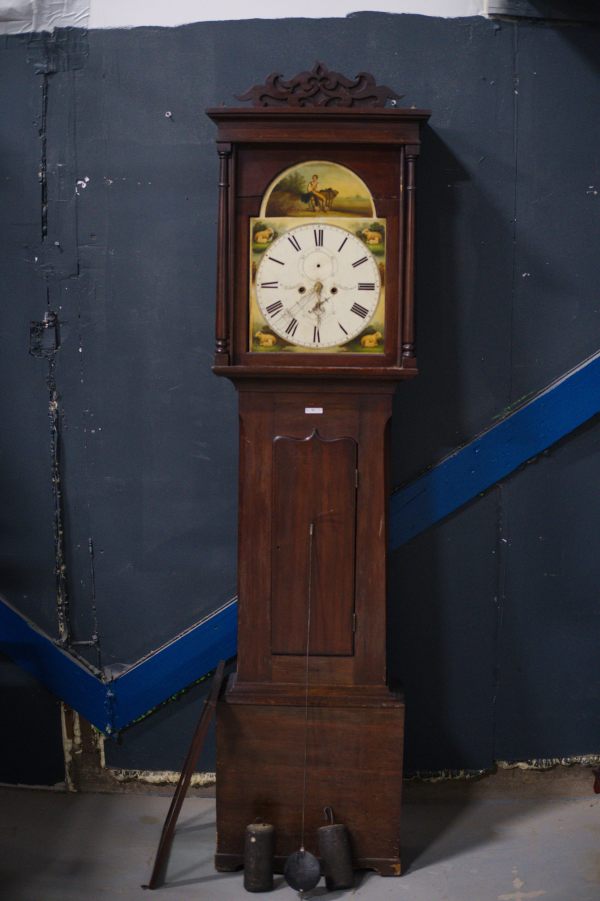
Scottish tall case clock from the 1850s
An antique tall case clock, such as this weight-driven Scottish tall case clock from the 1850s with an English brass bell strike, can be easily disassembled by one person. In this blog, I will walk you through the steps required to safely disassemble an antique tall case clock.
Similar American tall case clocks from the same period are disassembled in the same manner.
Amid the health crisis ensnaring the world today finding escape is good for the soul. Social distancing, self-isolation, and sheltered-in-place are terms representing new realities. However, we must all use our time at home constructively engaged in meaningful activities and mine is the repair and restoration of old clocks. Horology allows me to drift into a very different world and focus on something uplifting, challenging and positive.
If clocks are not your thing, insert whatever hobby you have below but bear with me as I give you seven reasons why a hobby is a great thing to have in times of high stress.
One of my more recent restorations, a Scottish tall case clock from the 1850s. Read more here.
So here are 7 reasons why a hobby (like clockmaking) gives you respite in today’s world.
Build self-esteem. Developing and maintaining a hobby is important because the small successes I have from day to day are enough to sustain me while other pressures are occurring in my life and it is the one solid thing to feel good about. It also gives me renewed energy to tackle other challenges in life.
Avoid boredom. I have zero scientific evidence of this but I really believe that boredom is responsible for a lot of society’s ills and destructive behaviours. How many people come home after a challenging workday to watch TV for hours on end (depressing news programs for example) when they could be doing something constructive and rewarding?
Enrich your perspective. There is an old adage: “The more you know, the more you grow”. Any opportunity to learn something new, to be challenged anew, is great for character-building by seeing the world through refreshed eyes. My hobby helps me differentiate myself from others and provides me with key examples of where I have overcome adversity or tackled a difficult situation and emerged on the other side.
Keep you youthful. Establishing and maintaining a hobby is a very healthy habit to form not just now but for your later years. Hobbies are excellent for brain health and stave off cognitive decline. The older you get the more trouble you will have struggling to fill your time with meaningful activities. Beginning a hobby early in life pays dividends in the long run, not unlike an interest-bearing investment.
Combine your hobby with other interests. Photography and travelling are two other interests in my life. Blog writing is another, of course. This hobby allows me to combine all of those interests and as a side benefit my wife, who is also my travel partner and clock locator, encourages me every day. Of course, lately, we have had to curtail some of our travelling because of world events.
It makes me interesting. You can only talk about your occupation or your grandchild for so long before people’s eyes begin to glaze, but if I mention that I have a clock that fell off a wall during the Halifax Explosion, a clock that hung in a railway station near where I live, a rare clock I bought for next to nothing, ears perk up.
A great way to relieve stress. My hobby provides stress relief simply because it is an oasis and we all need a place of refuge in trying times.
Complete restoration of German time and strike wall clock, Junghans Crispi circa 1899
In these trying times, I find comfort in knowing that my clocks work and look great because of the time and effort I devote to my hobby. My advice is simply this; it is never too late to find a hobby and once you have found something that is engaging and takes you away from the troubles in life, you have found your own oasis.
While waiting for movement parts I continued to work on the case of this antique Canadian cottage clock from the mid 1880s. The dial needs attention and in this article I will describe the procedures for in-painting the numerals and decorative elements.
Decorative hand-painted antique dials need attention from time to time. Through environment and use they become victims of wear and neglect. Stabilizing and restoring dials maintains the value of the clock. In-painting involves filling areas of loss, cleaning, colour matching, repairing graphics and decorative art work.
The Canada Clock Co.
The Canada Clock Company in its three iterations made clocks in Ontario, Canada between 1872 and 1884. The Canada Clock Co, the Hamilton Clock Co. and then Canada Clock Co. (redux) struggled over a 12 year period to put Canada on the clock-making map. Ultimately their efforts failed. Nonetheless, there are plenty of fine examples that have survived to this day.
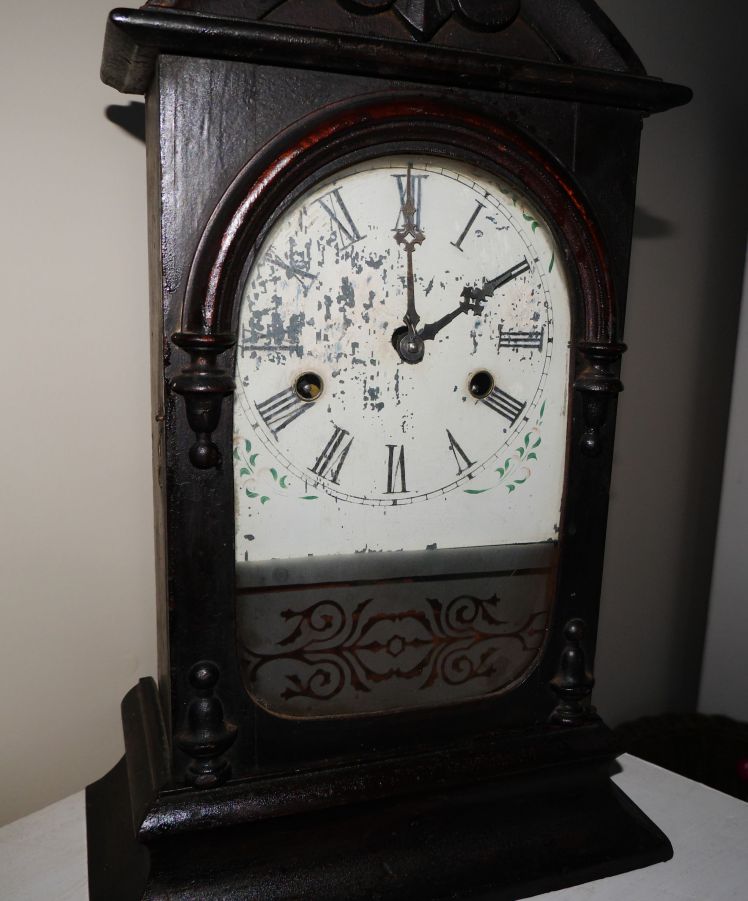
I found this interesting example in an antique shop in downtown Truro, Nova Scotia. The model is called Hamilton Cottage Extra.
First look
This is the dial when I first saw it. It is unsightly and distracting. Severe flaking over a good portion of the dial surface plus an attempt to repaint the numbers by a past owner presented a challenge for restoration.
For the past several years my wife and I have been searching for an authentic antique tall case clock. I finally found one at an estate auction an hour down the road from where I live and seized the opportunity to purchase a clock I knew practically nothing about. In this blog article, I will describe first impressions and the results of my preliminary research.
I have had only one tall clock in my collection, a Ridgeway Westminster chime clock from the mid-1990s. It is stately with handsome lines but it is a modern clock with a contemporary German-made movement and certainly not an antique.
Servicing this clock from the Canada Clock Company was a real challenge as I encountered many issues that conspired to slow my progress.
I found this clock in an antique shop in downtown Truro, Nova Scotia at basically a give-away price. The seller knew nothing about the Canada Clock Co. and that was fine with me.
So, what happens when amateurs and backyard mechanics get their hands on a movement. Read on.
But first, a little about the short-lived Canada Clock Co.
Canada Clock Co Hamilton Cottage Extra
The Canada Clock Company in its three iterations made clocks in Ontario, Canada between 1872 and 1884. The Canada Clock Co, the Hamilton Clock Co. and then Canada Clock Co. (redux) struggled over a 12 year period to put Canada on the clock-making map. Ultimately their efforts failed. Nonetheless, there are a number of fine examples that have survived to this day
Description
The clock is a 30-hour time and strike movement on a bell. It is the “Hamilton Cottage Extra”, one of the least expensive in their line of cottage clocks.
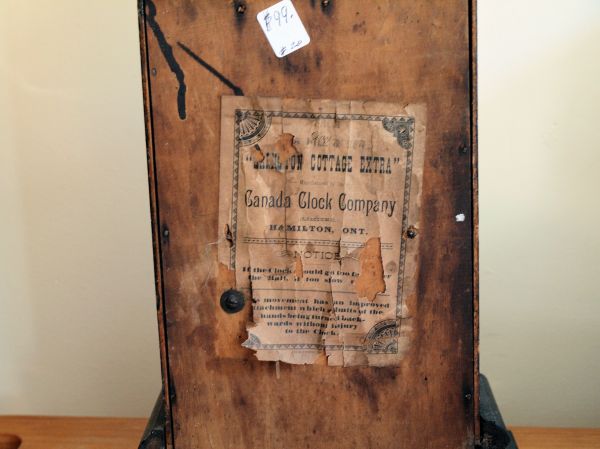
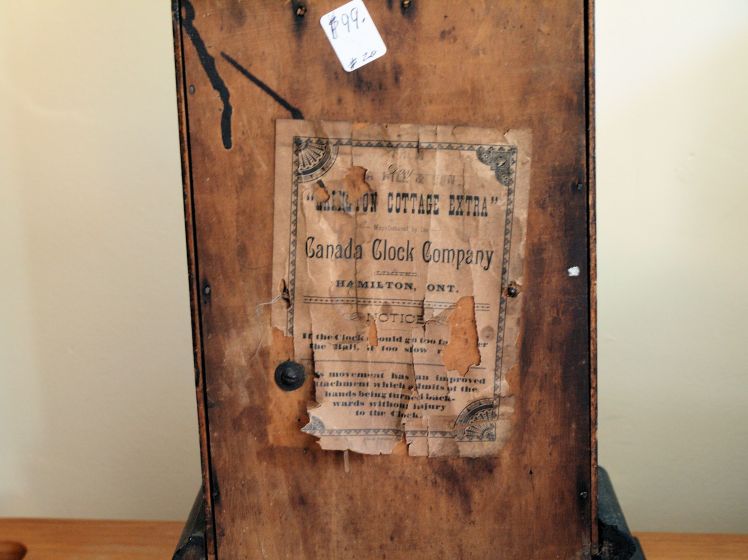
The label is in fair condition but identifies the model name and yes I paid far less than the sticker price
The case, which is in fair condition, reflects the age of the clock, grimy with numerous chips and scuff marks. Constructed of pine with a walnut stain finish the case has a minimum of decorative features and reflects the muted Victorian style of the times. The label is in fair condition and there is a stamp on the top of the label which says, “…A Hill &Co.”.
The lower part of the tablet has an etched glass floral design common on Canada Clock Company clocks. The dial face is flaked in places, has been “touched up” and will need attention.
The Maltese hands are original.
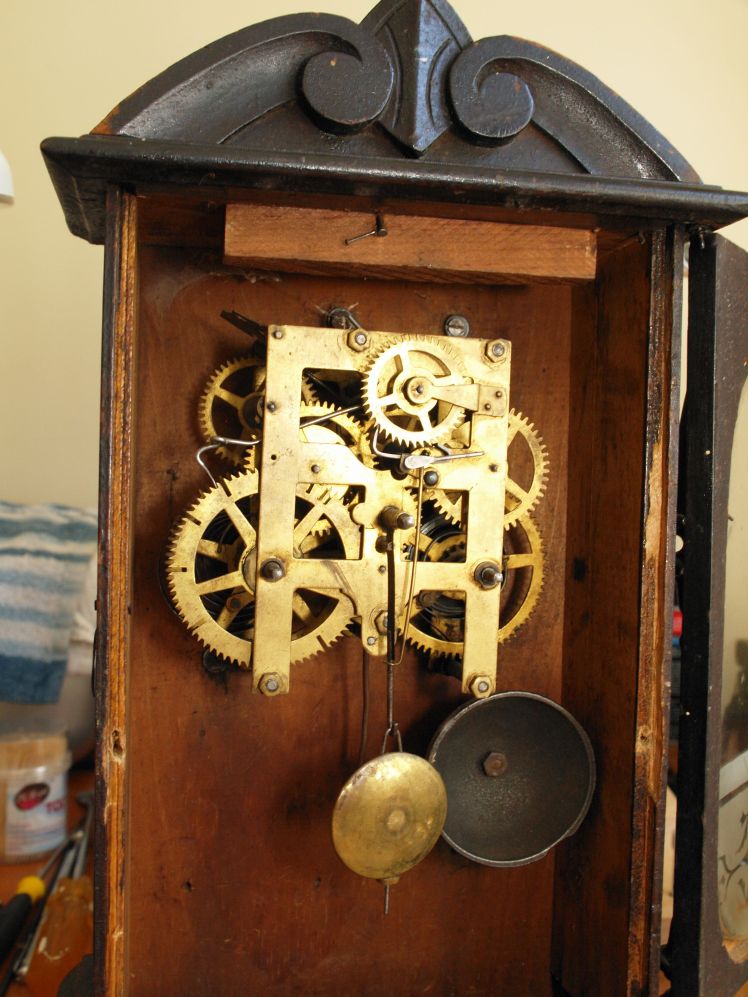
Original time and strike 30-hour movement
I tested the movement while in the case. The time side runs with a little encouragement while the strike side has the typical run-on strike when things fall out of adjustment.
Assessment of the Movement
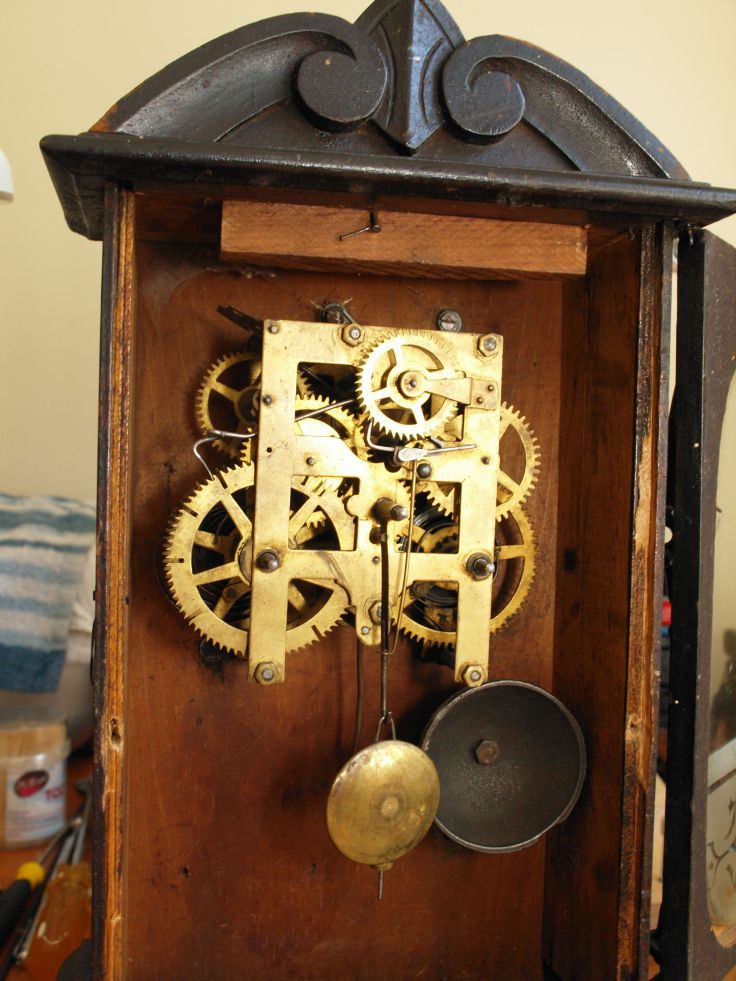
When I disassembled the movement there were a few unexpected surprises. I now have answers for a movement that is running poorly.
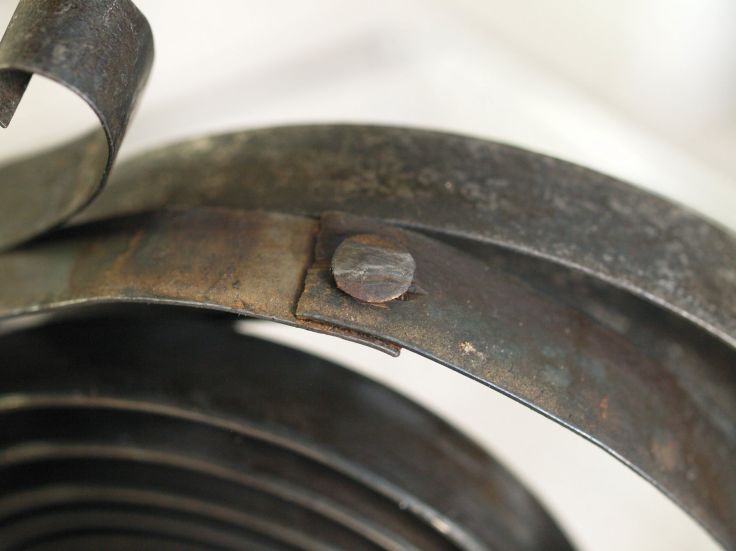
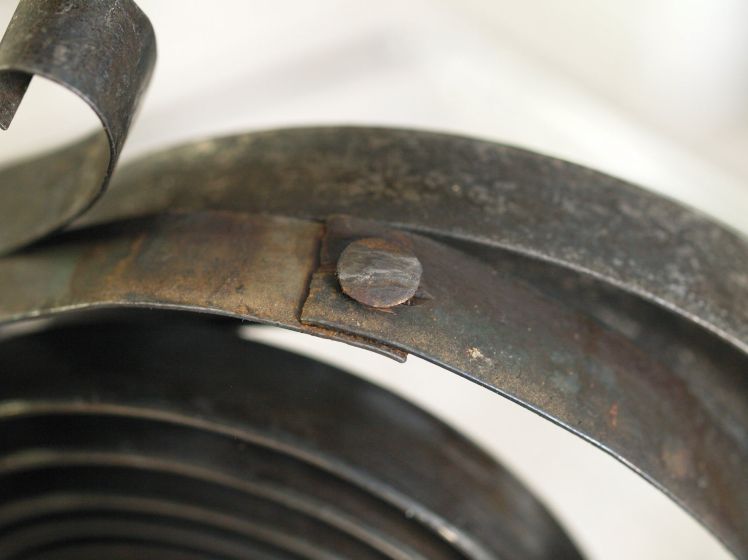
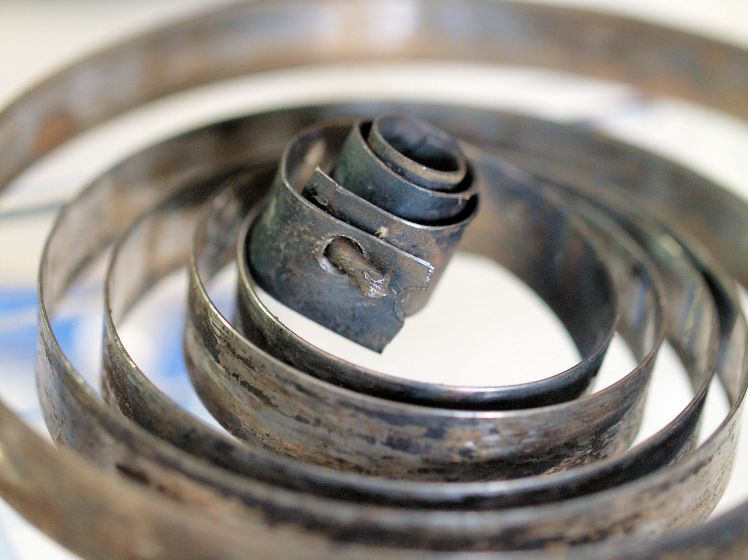
Strike side mainspring riveted together
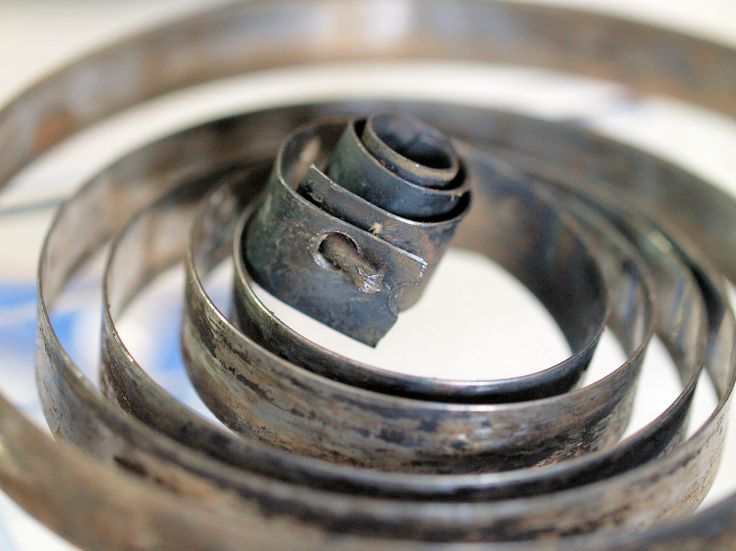
Both mainsprings had been modified, a very old repair. I try not to be judgemental when I see this and respect the folks that made every effort to keep their clocks running as best they could often with limited means. However, these look dangerous and must be replaced.
Time side mainspring with a nail holding parts of the mainspring together
Now on to other issues.
Levers bent in all directions
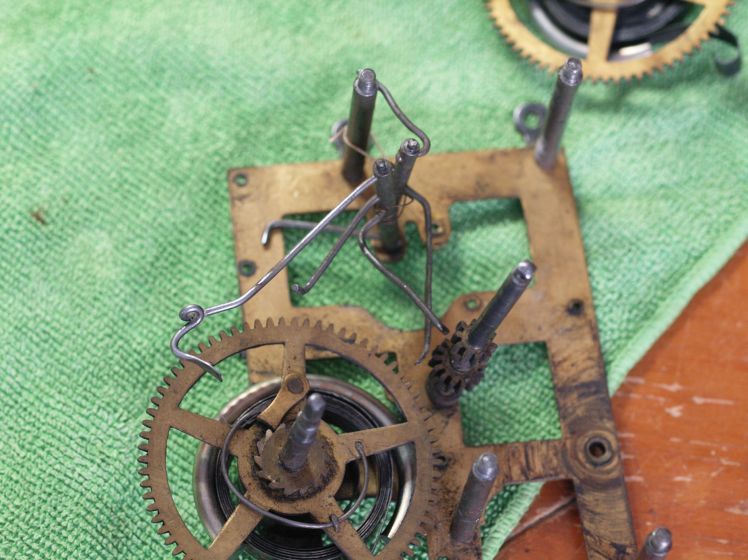
This is the strike side. What are the correct positions for the levers? Bent so many times it will take trial and error to find precisely where the levers should go.
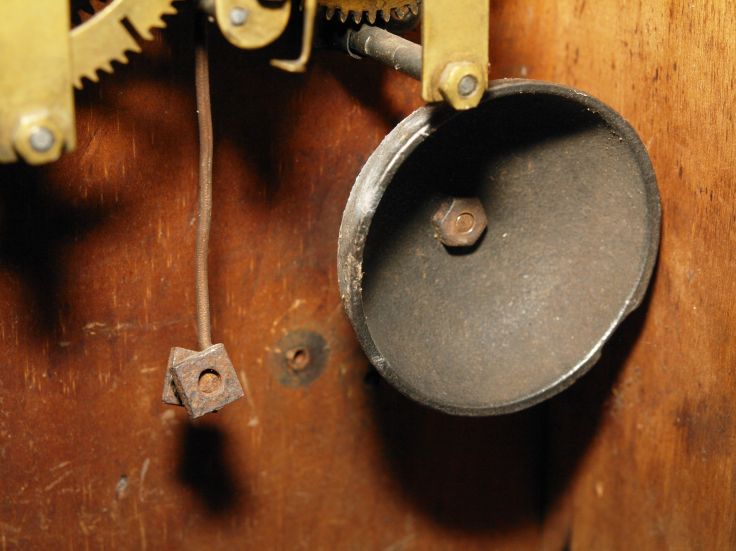
The “hammer”
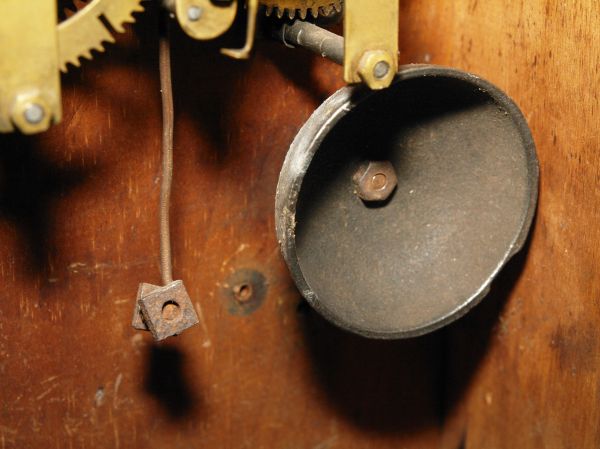
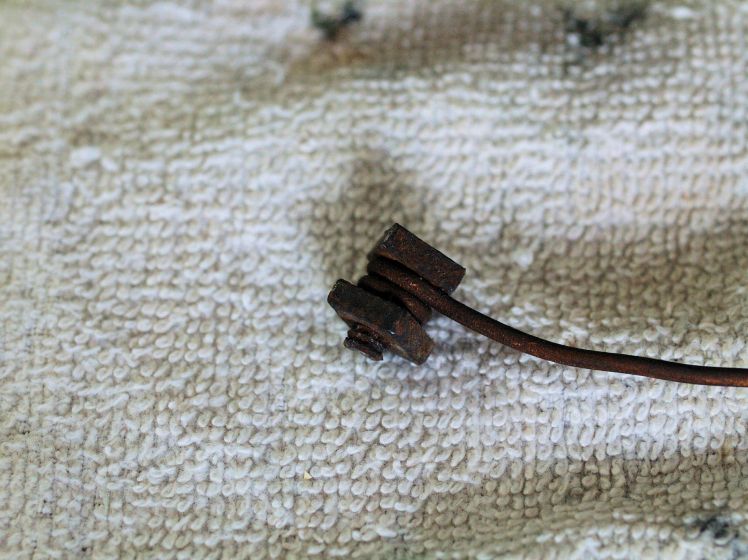
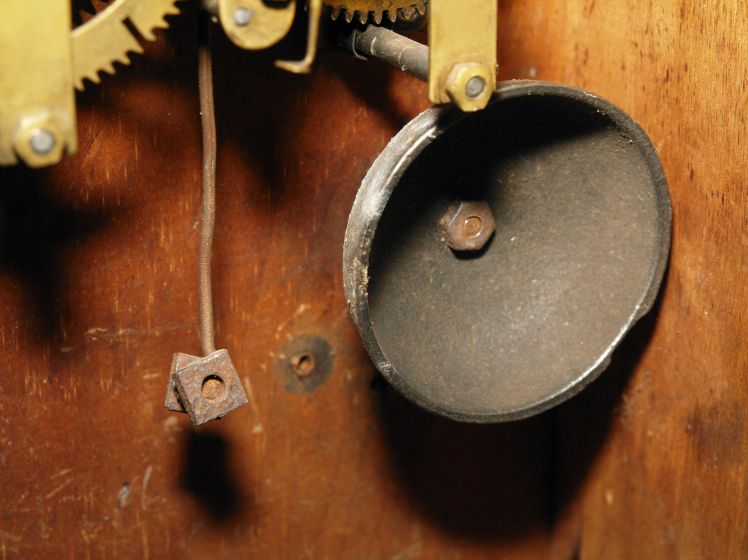
The hammer is actually a copper wire wound around 2 nuts and it is loose in the arbour.
Helper “string” or helper spring
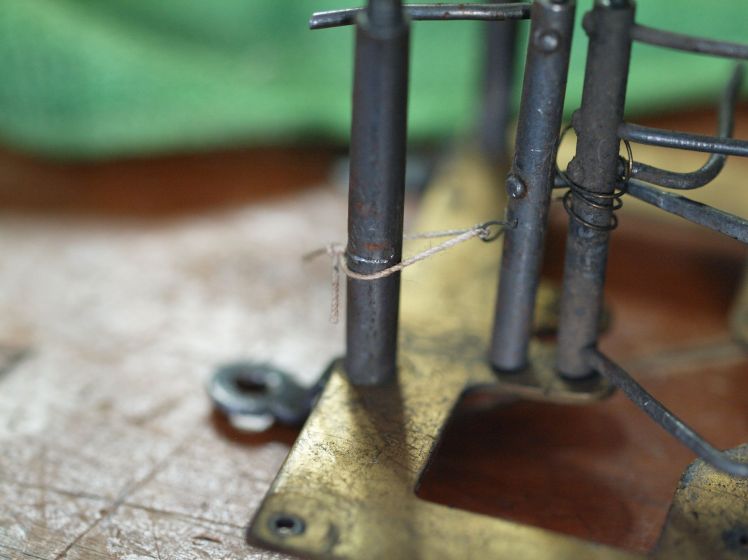
There is enough helper spring to wrap around the pillar but someone thought the string was necessary. It will be replaced with a new spring.
Nuts for a hammer and the bell has been repositioned
While the bell may be original, Judging from the number of holes, it has been relocated and raised to work with the home-made hammer.
The movement is a disappointing mess but not unfixable. In the clock business, you must expect the unexpected. In the meantime, I can clean the parts and perform pivot polishing and bushing work while I await parts.
I am determined to get this clock running so, stay tuned for the movement servicing and dial painting!
I want to talk about one of the most useful tools in clock repair, the pivot locator.
As an avid horology enthusiast for the past 9 years, I have been steadily building my knowledge of clock repair and with it a selection of essential clock tools.













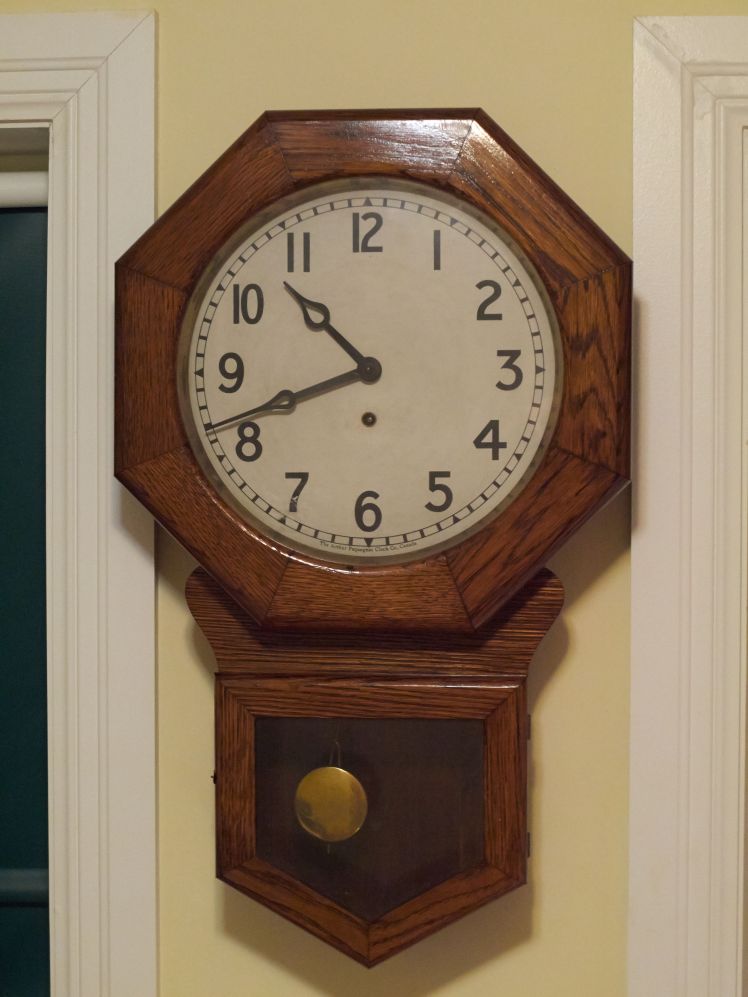
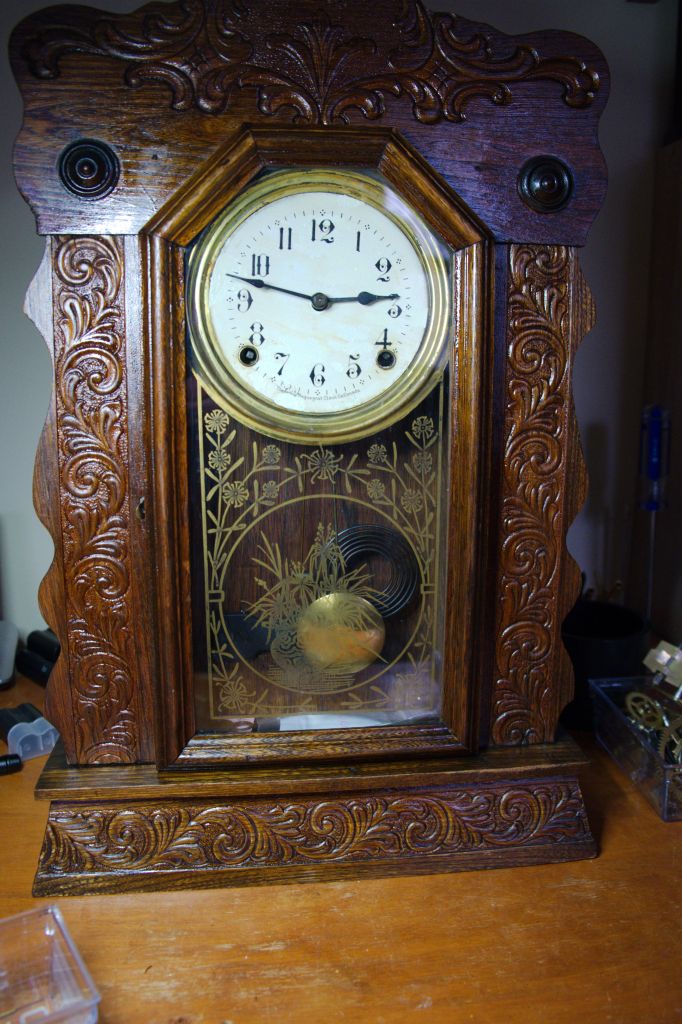
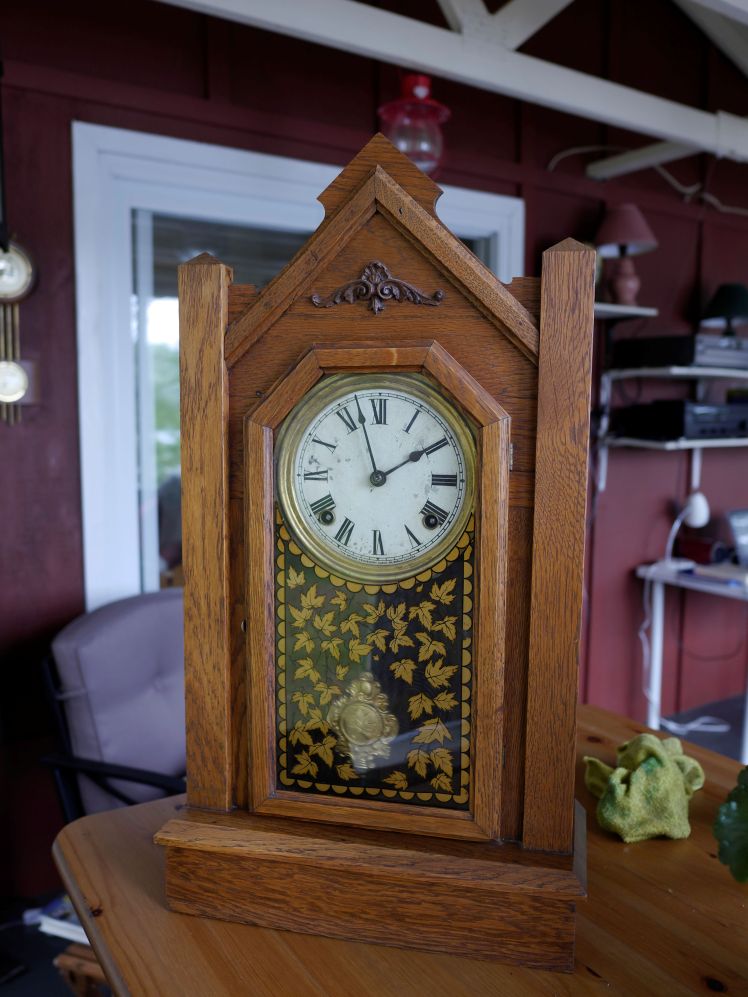

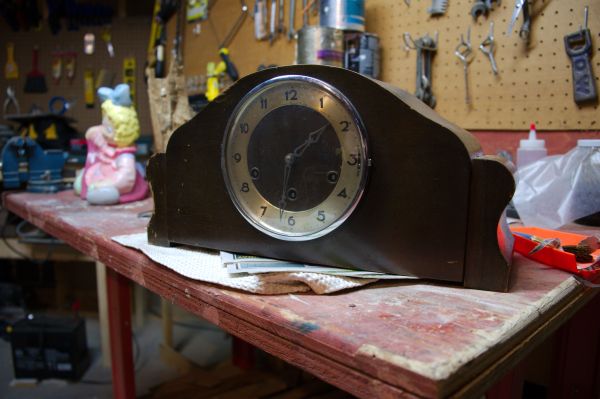





 Antique and Vintage Mechanical Clocks
You must be logged in to post a comment.