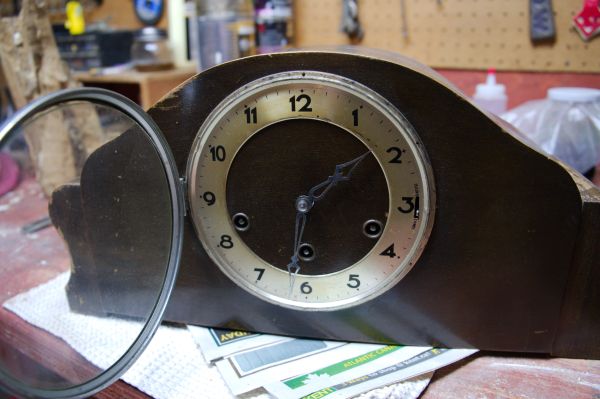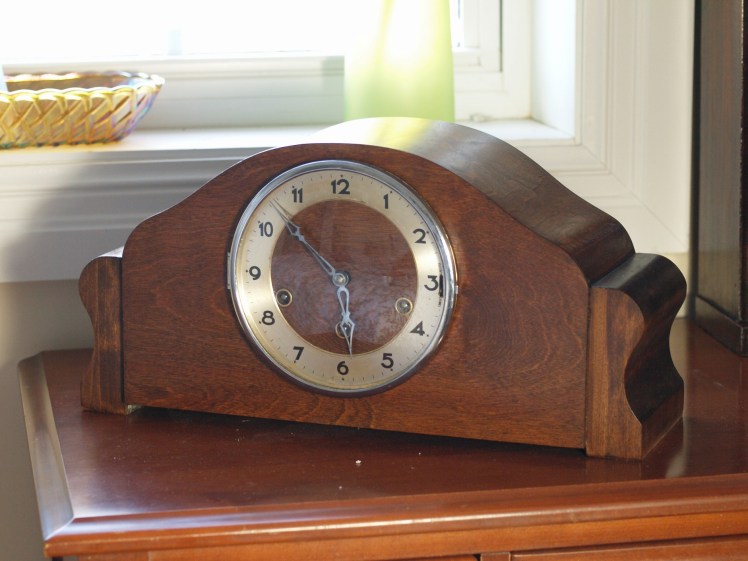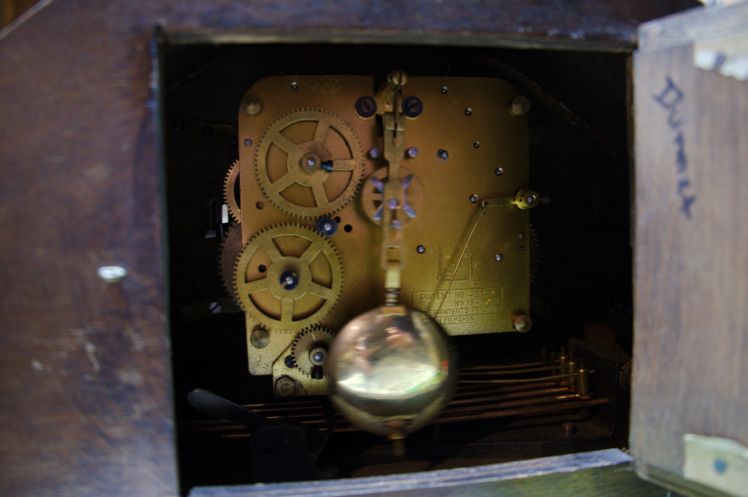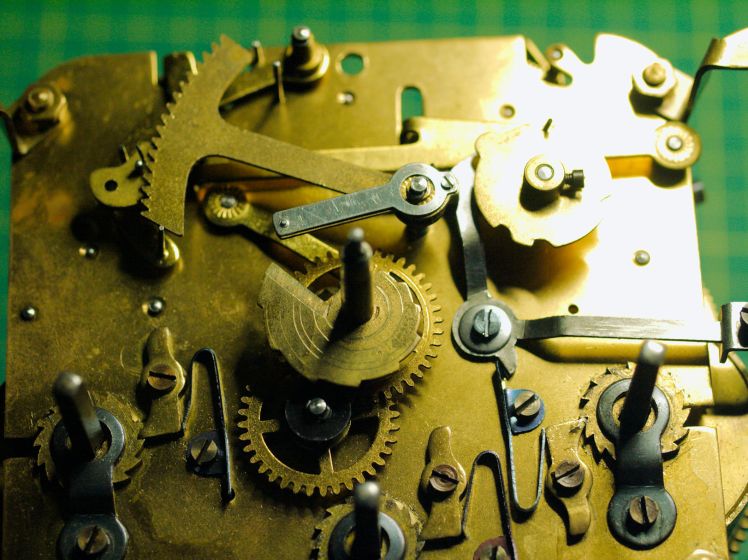
Are inexpensive carriage clocks worth fixing? Schatz and Sohne

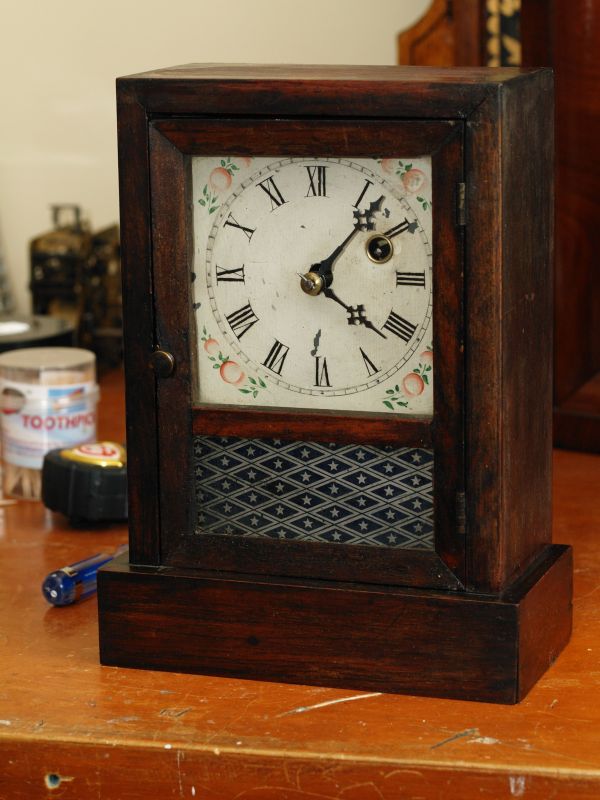
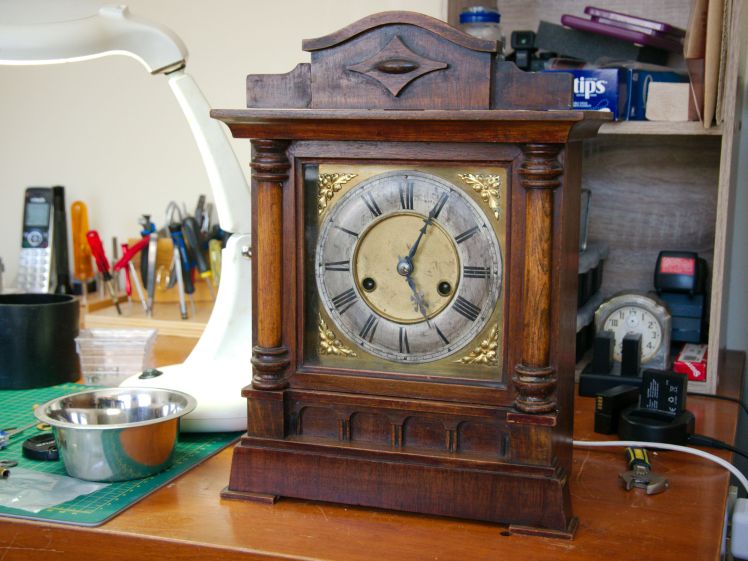
Schatz and Sohne, the maker of this attractive 8-day carriage clock may not have considered the fact one day their carriage clocks would require servicing. Did they make a throw-away clock? We’ll see.

Many were sold and gifted to family, friends, and business associates. Over the years they have either been tossed out, found their way to antique shops/flea markets, or sat on a shelf never to run again. They are pretty, however!
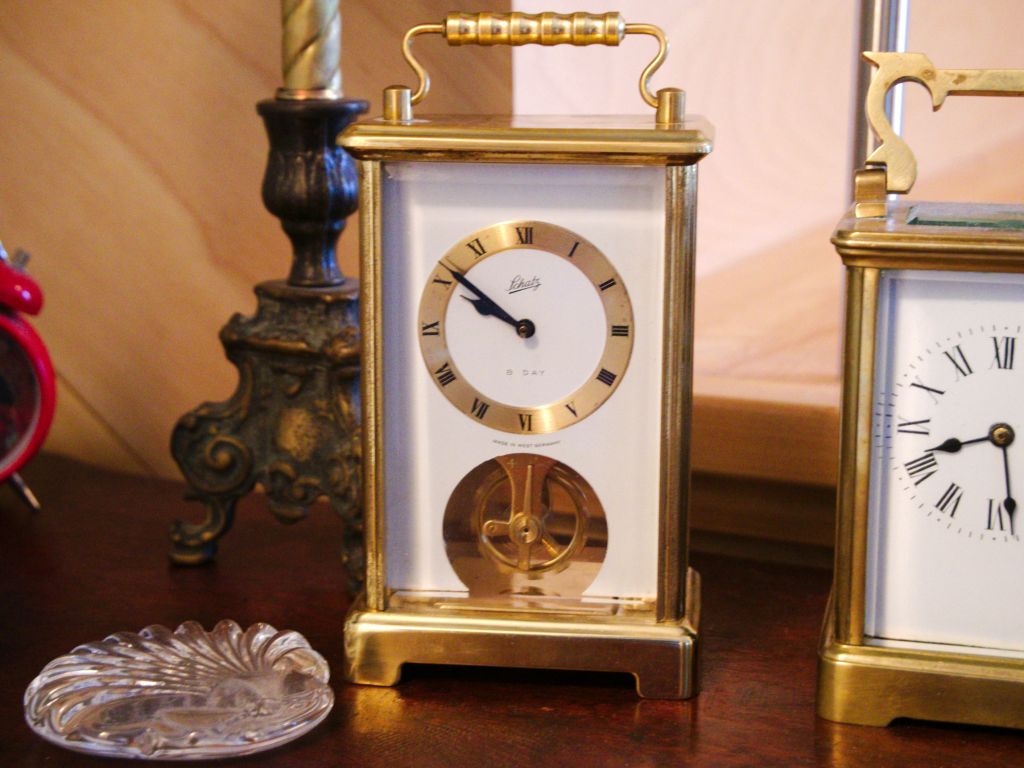
Schatz and Sohne carriage clock

Were they meant to be repaired and are they fixable? Perhaps.

Just about any clock can be fixed. However, the cost of a professional service would be far more than it is worth but may be justified for sentimental reasons. In the case of this clock a professional service would be out of the question.

I paid $40 for this clock. The seller said that it runs for 4 days and stops. He was quite correct. I wound it fully each time and over the course of a few weeks, it promptly stopped at about the 4-day point. I appreciate the seller’s honesty.

The loss of power that is consistent in this clock’s cycle tells me that there is serious wear at some point in the train. Some might immediately assume that the mainspring is weak but in my experience mainsprings are generally much more powerful than required.

So, let’s see what we have.

Rear showing winding key

Disassembly

A rubber band or two comes in quite handy when employed to hold the four glass sections in place while taking the clock apart. Next, unscrew the key and pull out the small knob used to change the time. Four screws hold the base to the glass sides and top of the clock.

Carriage clocks such as this example are more decorative than functional but are they worth fixing?

The first step in removal is to pull out the works from the base, then, pull off the hour and minute hands which are both friction fit. Next, the dial face and front section are removed by means of two screws that hold it in place. The base is removed from the movement, again, two screws hold it in place.

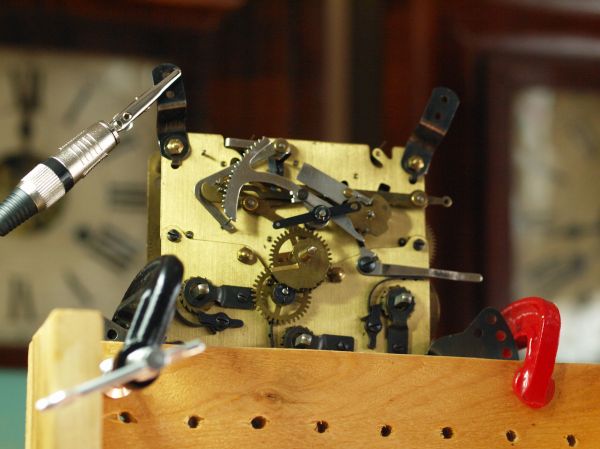
The movement showing the escape wheel

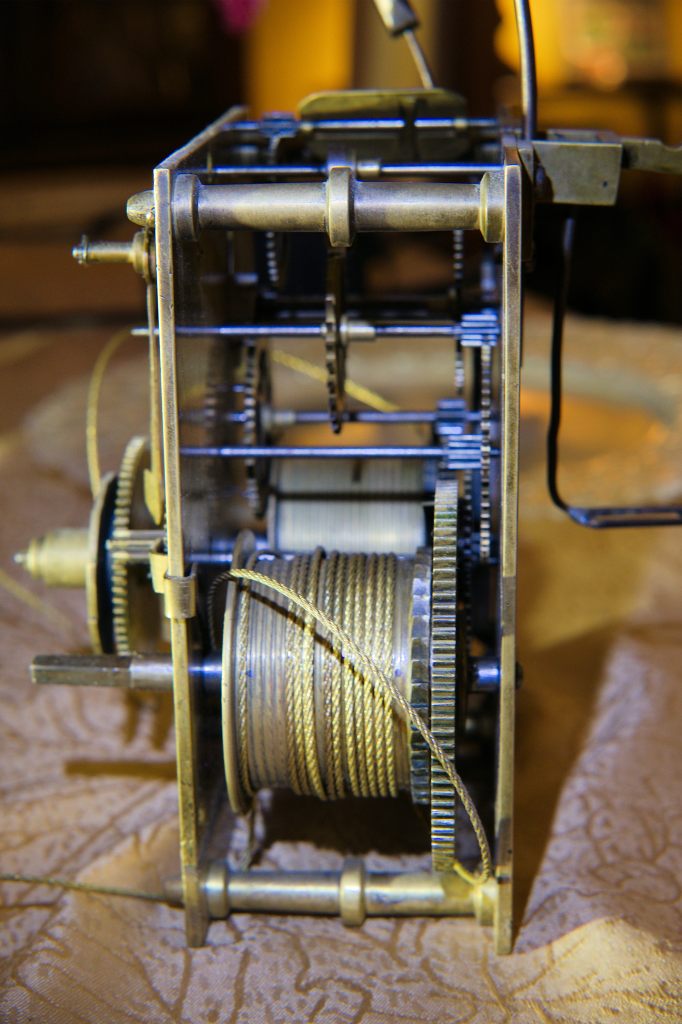
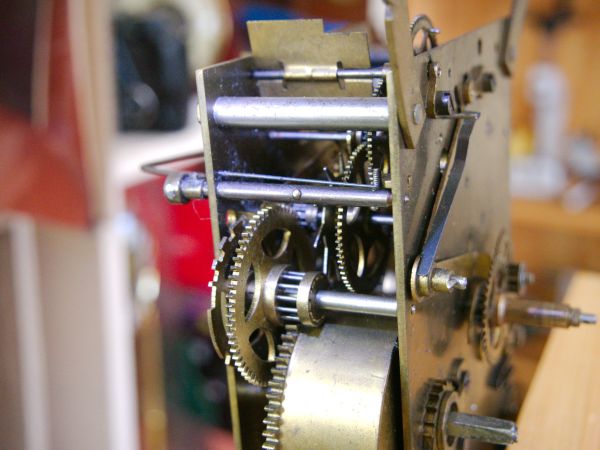
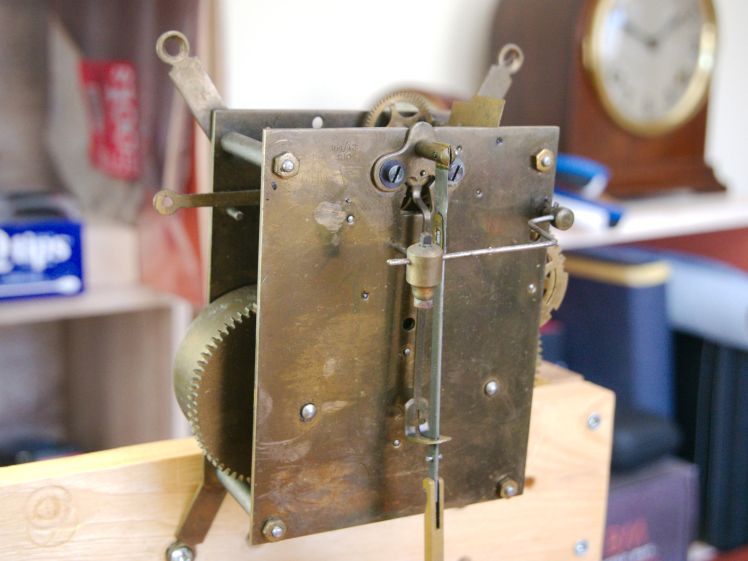
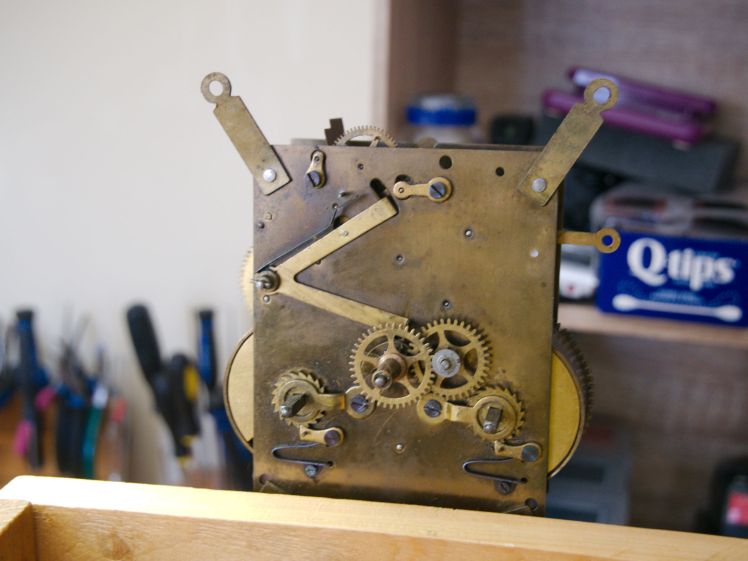
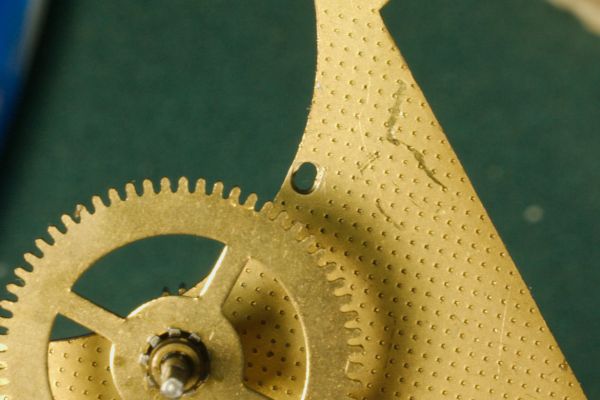
Once the movement is removed it becomes apparent that three plates are required for the gear train. The design is not far removed from a conventional time-only clock except for the upside-down configuration with an inverted escapement. The third plate is effectively used as mounting points for the dial, the mainspring barrel, and the escape wheel arbour.

Side view of the movement showing the three plates

Six screws hold the plates together. Once the rear plate is removed, the wheels are revealed.

The wheels are very small and the pivots are tiny and easily bent. Though I was careful, I can imagine anyone using brute force to bring the plates together upon re-assembly could easily risk bending or breaking a pivot. Therefore, extra caution is highly recommended.
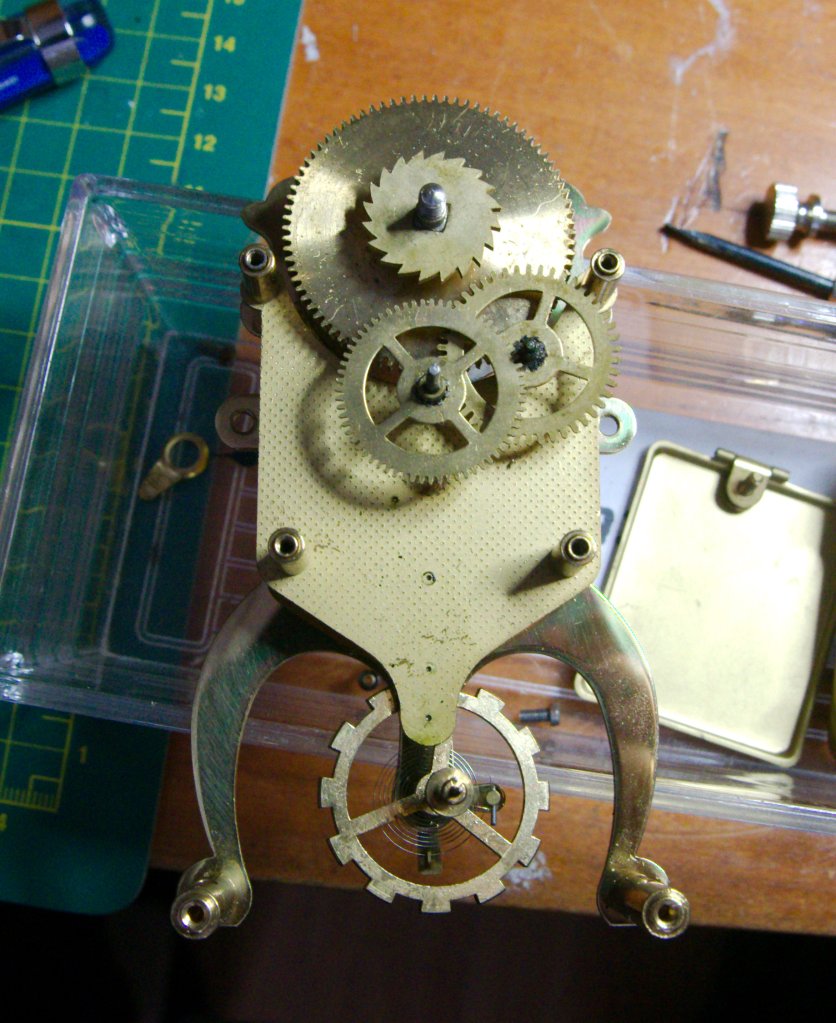
Some wheels removed

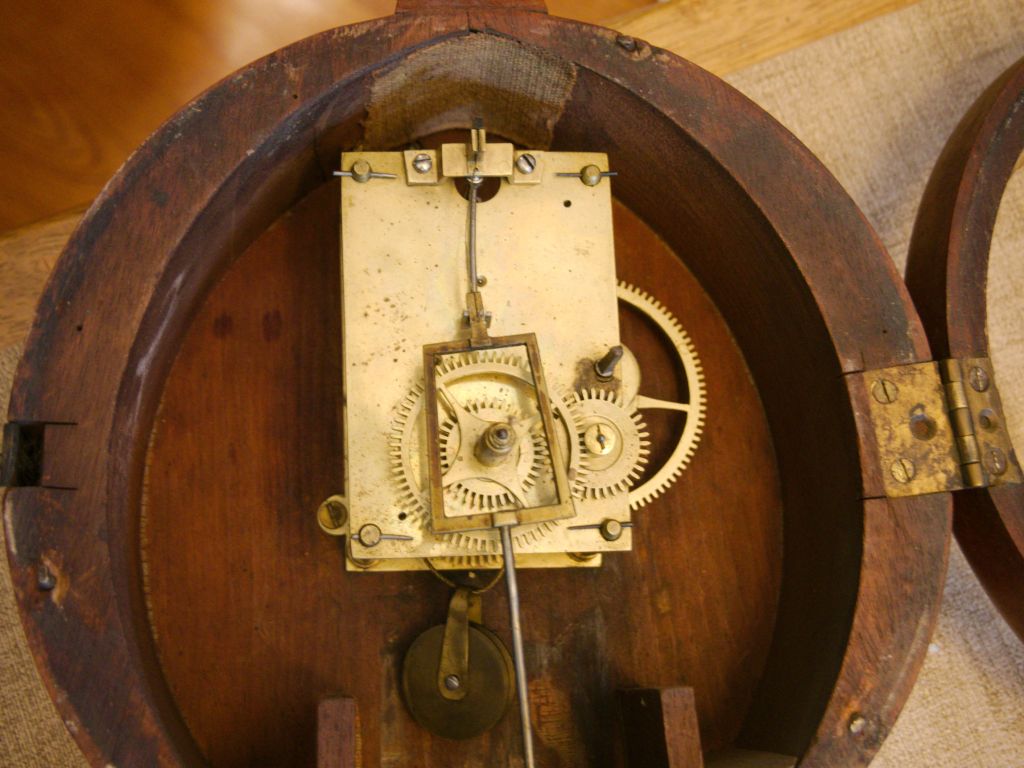
As for wear, everything looked very good except for the second wheel bushing hole which was badly worn, not surprising since the second wheel accepts the full force of the main wheel. Thin brass plates also exacerbate wear.

I believe I “might” have found the cause of the power issue. The bushing hole shown below is elongated enough to cause problems transmitting power up the train.

Elongated pivot hole

That one was the worst by a large margin. All the other pivot holes had acceptable wear and did not require new bushings.

All parts were cleaned in the ultrasonic, the pivots were polished and pivot holes pegged out.

Now for bushing work

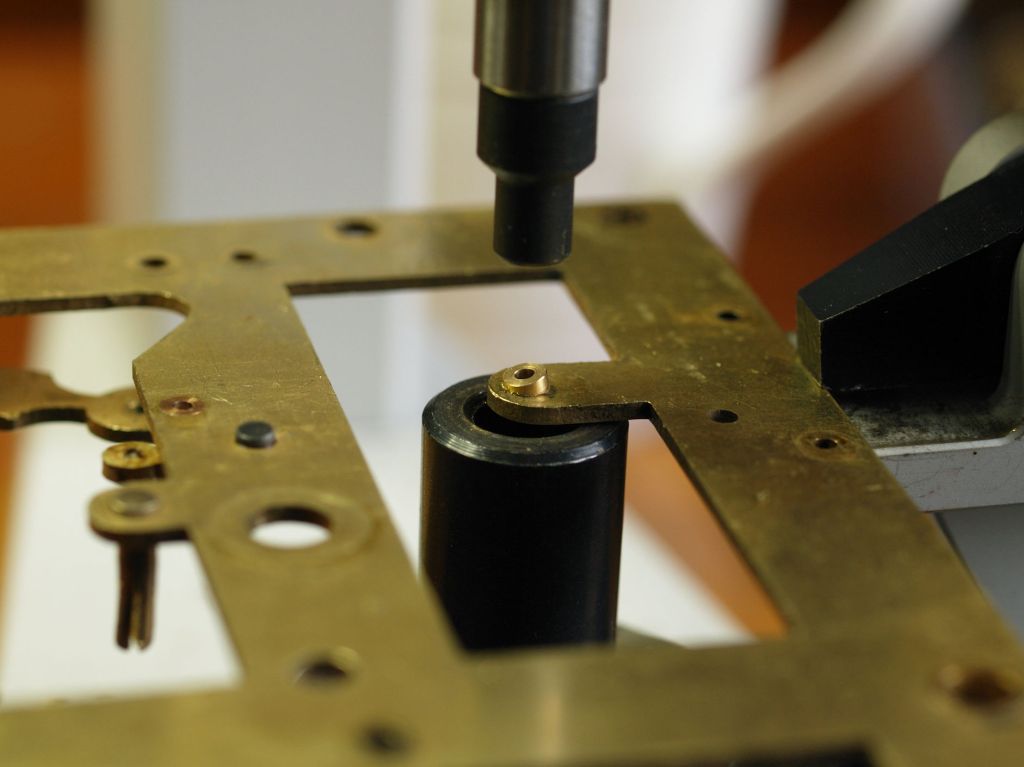
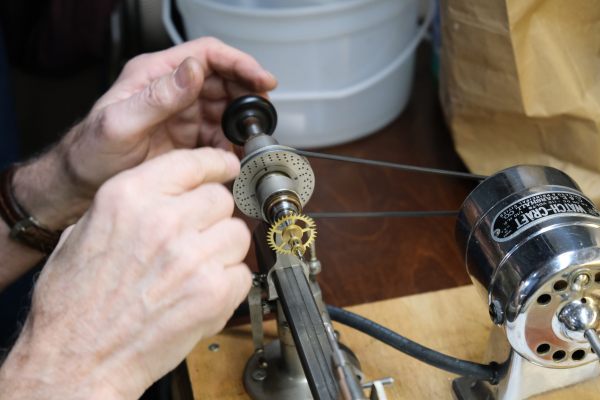
I have installed hundreds of bushings on clocks and this one was a real challenge. The pivot on the second wheel is 1.27 mm. The Bergeon bushing I chose has a 2mm diameter. Anything larger would have required removing too much brass making the new bushing potentially loose and unstable. As it stands there is a slight bulging of the brass plate where the bushing is installed.

Because the inside diameter of the bushing was .95mm a considerable amount of broaching out was required to enable it to fit the 1.27mm pivot. The result is a thin sidewall but sufficient to do the job. Using a pivot cutter I reduced the height of the bushing for a nice clean fit.

Just one bushing but a tough one.

New bushing for the second wheel

Reassembly

Reassembly went without issue though I had to refer to the photos I took during disassembly to determine when all those darned washers had to go. Photographing each step in the process always pays dividends in the long run.

Pivot locator

A pivot locator comes in very handy when putting it all together. Using the locator, the pivots are gently convinced to find their respective holes.

Once the escape wheel hairspring peg is pushed back into its post it is time to give the escape wheel a little spin and test the movement prior to returning it to its case.

And the final results

After disassembly, cleaning, addressing a serious wear issue, and testing, the final result is…….yep, it runs 4 days and stops.

I may remove the mainspring from its barrel (not something I did this time) and give it a good cleaning but I think that is it.

Will I go further and perhaps replace a weak mainspring? No! I am not going to put more money into a clock which, at the end of the day, is nothing more than a decoration. It is just not worth it.

Pretty to look at though!
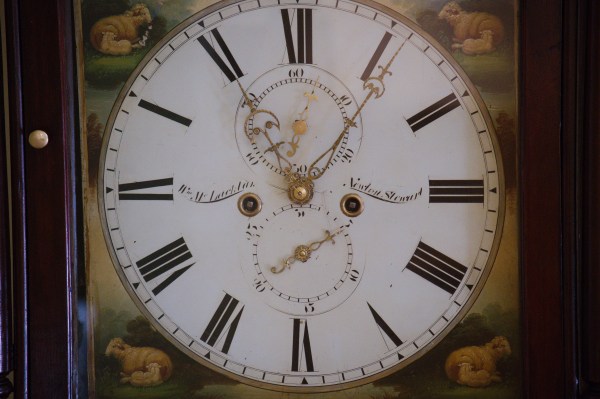
An 1848 Scottish clock – relearning sympathetic vibration

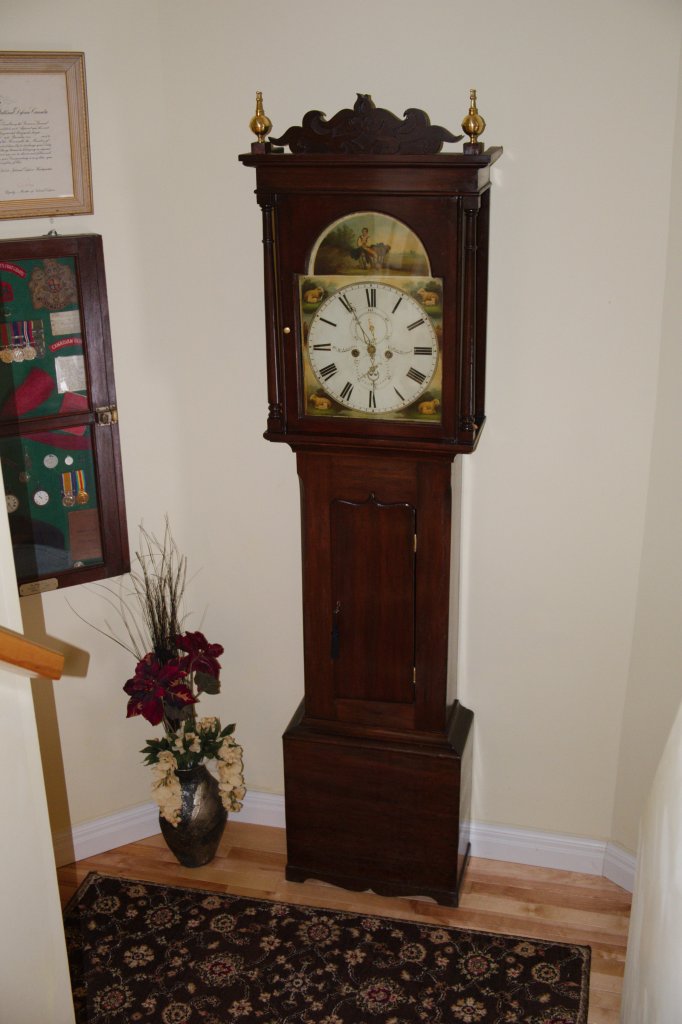
In 2020, my wife and I purchased a Scottish tall case clock at a live auction. It had been on our wish list for years, and it checked all the right boxes—tall, stately, attractive, with an easy-to-repair movement and very little missing. However, we later realized that not everything was as perfect as it seemed, and the clock required a bit of tender loving care.

Not a single person in the auction hall showed interest in the clock, and we managed to acquire it for $270 plus fees and taxes. While it’s unfortunate that it went for such a low price, tall-case clocks aren’t in particularly high demand at the moment, and with space constraints in smaller homes today, it’s understandable why they might not appeal to everyone.

It may not be apparent from the photo below, taken that day in the auction hall, but the clock had been neglected for a long time and required a significant amount of work.

At the auction house

The work included repairing the movement and refinishing and repairing a very tired case. However, it was a great learning experience and a true labour of love.

After the movement was repaired, testing continued for weeks, involving small adjustments and waiting for a new suspension spring, pendulum rod, and stake.

Sympathetic Vibration Definition

During testing, I encountered a consistent problem. On day six of the weekly cycle, the clock would stop. As the weights descended to the level of the pendulum a harmonic phenomenon occurred that is defined as “a formerly passive string or vibratory body responding to external vibrations to which it has a harmonic likeness”.

English bell strike movement

When the weights on a tall clock descend to the point where it’s at about the same height as the pendulum, the weights swing slightly. Since the power that drives the pendulum is now swinging the weights as well, the pendulum does not get its share of power and eventually stops.

I addressed the sympathetic vibration by anchoring the clock stand to a wall. What that enough?

Just after the movement was repaired and in its case, the pendulum had just enough over-swing to compensate for the moving weights and the clock would soldier on. But after two years and a little bit of wear, the clock stops at the point where the pendulum is at the same level as the weights.

Sympathetic vibration can often be addressed in a tall case clock by fastening the upper part of the case to the wall, or by mounting the case on a solid foundation avoiding anything soft such as a carpet.

But other measures can be taken if the problem persists.

Scottish tall case clock
Scottish tall-case clock

The Solution to the Stoppage

I had attached an anti-tipping wire between the wall and the clock case, thinking it would prevent sympathetic vibration. For a time, it worked, but eventually, the issue resurfaced.

Sponge block illuminated with a flashlight

The solution came in the form of protective packaging from an Amazon delivery—dense black foam blocks placed behind each side of the clock case, at the same height as the pendulum. Occasionally, I have to reposition the blocks, as the vibrating action of the strike causes them to slowly fall over time.

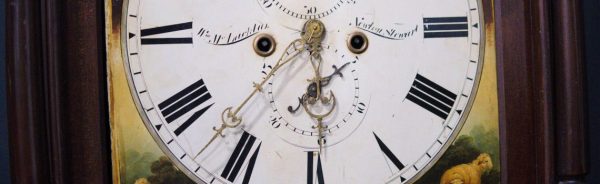
Everything is now put right and this beautiful tall-case clock assembled by William McLachlan from Newton Stewart, Scotland now runs its full cycle without that annoying stop at the six-day point.

Daylight savings – let’s get rid of it

Daylight saving time in Canada begins March 13th and ends on Nov. 6, 2022.

Do we need it! Daylight Savings Time has no place in our modern world. Of 195 countries in the world, approximately 70 countries observe Daylight Saving Time in at least a portion of the country. Japan, India, and China are the only major industrialized countries that do not observe any form of daylight saving.

At 2:00am Sunday, set your clocks ahead one hour if you live in an area where the convention is still followed.

Regions that typically use daylight saving time adjust clocks forward one hour close to the start of spring and adjust them backward in the autumn to standard time.

In Canada, we have a little aide-memoire, “Spring ahead, Fall behind” to make it easy to remember what to do twice a year. In Canada, it is the second Sunday in March and the first Sunday in November.

How to set your mechanical clock(s)

  • Stop the clock and wait for the correct time, then, restart or,
  • Move the minute hand slowly clockwise to the correct time, stopping briefly for the quarter-hour on chiming clocks and the half-hour for striking clocks. If you have a movement with a rack and snail you can move the minute hand quickly through the hours as a rack and snail movement is auto correcting.
  • Do not move the minute hand backward unless the instructions that come with the clock specifically say that it is safe to do so. Otherwise damage to the movement will result. As a general rule I always advocate moving the hands forward.

The time change is a scourge, it is very wasteful and unnecessary in our modern world.

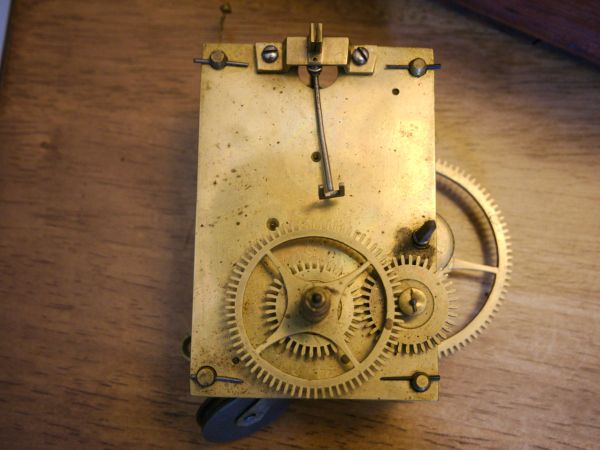
Sawin banjo clock – almost done, 3 more items to address

I have written about this clock several times in the past 10 months but I am making good progress which I will detail in this article.

This is how it arrived at my house last spring, dull and lifeless but with good bones and most everything original.

Dirty and dusty and ready for restoration

First, some background information about the clock.

This federal-style banjo clock was made in the 1840s perhaps as early as 1840. I am reasonably certain it was made by John Sawin of Boston, by either himself or one of his apprentices or associates.

The movement and case construction bears a strong resemblance to a Willard timepiece and there is a good reason for this as John Sawin apprenticed under Simon Willard and was a journeyman under Aaron Willard, famous clockmakers of the day and makers of the original patent timepiece.

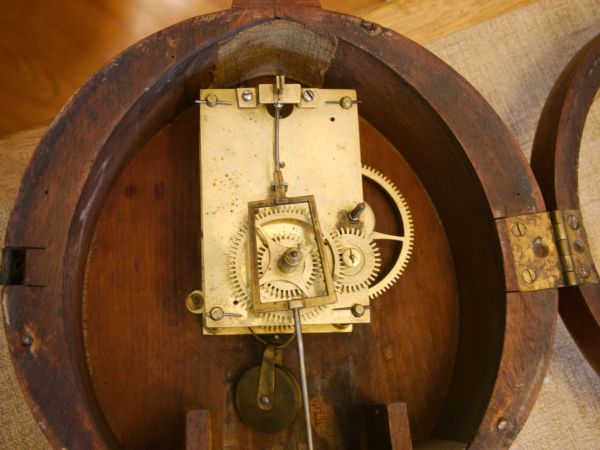
The movement which is based on the patent timepiece by S. Willard

Unfortunately, there are no identifying markings on the movement or the case but key indicators such as the placement of the movement mounting “ears” and the design of the door and bezel catches tell me that there is a very strong connection to John Sawin, enough to say that he is the clockmaker.

So far…

I have completed repairs on the case aside from the wood bezel mentioned later in this post. The repairs include new veneer pieces, harvested from an old mahogany ogee clock, a new post for the acorn finial, and two applications of traditionally prepared shellac.

The hands are attached to measure timekeeping

The movement has been cleaned, serviced and wear issues addressed.

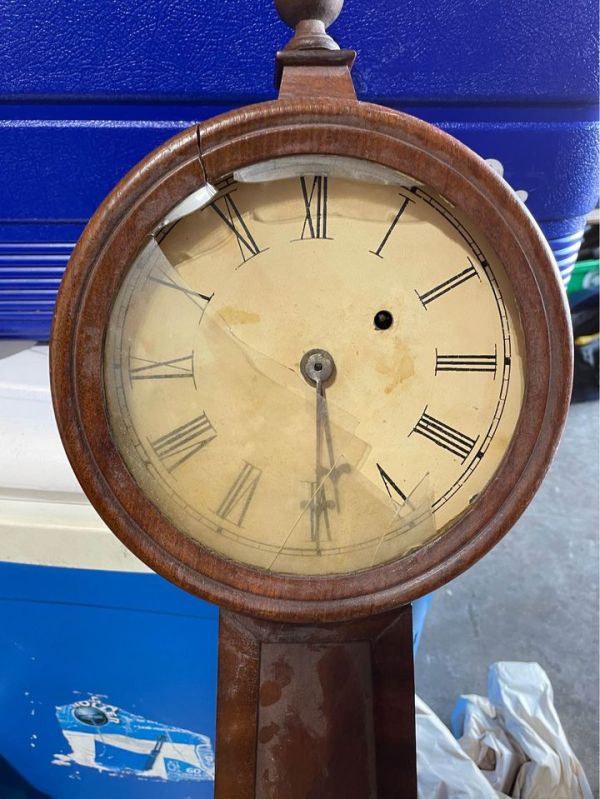
The glass dial was broken and new flat glass was ordered and installed. The old weight cable was replaced.

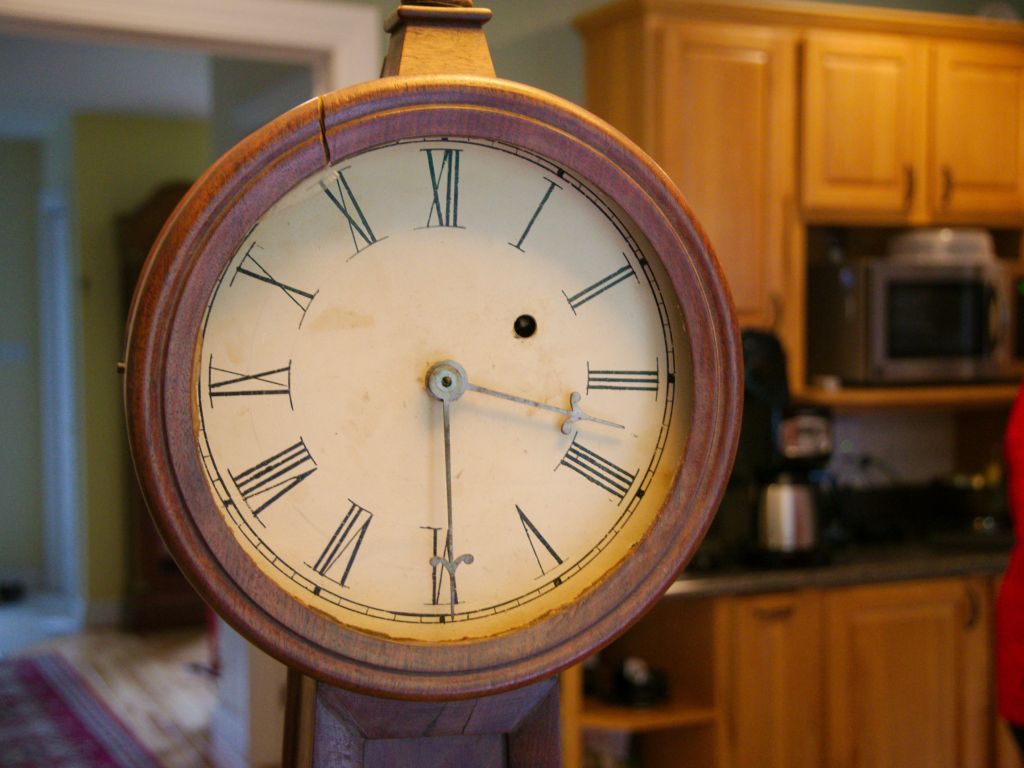
The dial, with some stains and discoloring, will be left as-is.

Three issues that have slowed me down

The three issues are a weight cable that is too short, a twisted suspension spring, and a cracked wood bezel.

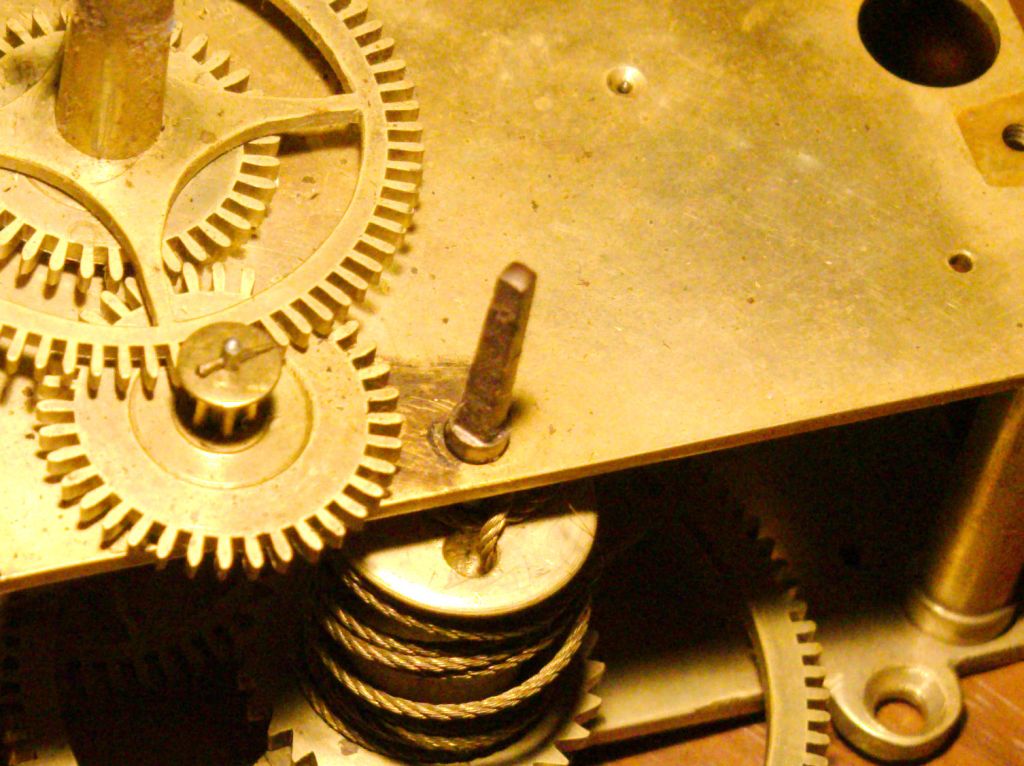
Weight cable that is too short: The clock stops when the weight is three inches from the bottom of the case and runs six days instead of the usual eight. I have run the clock several times and the clock consistently stops on the 6th day. I believe that the brass cable was frayed from wear and a previous owner shortened the cable rather than buy a new one. I have various sizes of cable and have chosen a slightly thicker brass cable with a nylon core. The nylon core prevents the cable from snarling and coiling plus the more robust cable is more than enough to carry the heavy iron weight.

However, a thicker cable results in a double layer. The cord will wind down from the top layer and the diameter of the drum has been increased due to the first layer. This means that with each turn more length of the cord will be removed from the top layer. Thus, the weight will reach the bottom of the case sooner than intended, reducing the runtime. A thicker cord makes it even worse. I believe I have struck the correct balance between thickness and length as the clock now runs its full 8-day cycle. Had the cable been any thicker the runtime would increase.

Since it had to be taken apart to install the new cable I cleaned the pivots, pegged out the pivot holes, and re-oiled the movement. Problem solved.

The Keystone

Twisted suspension spring: The keystone is the piece between the suspension spring and the pendulum leader. It very nearly hits the large wheel of the motion works on the left side as a result of a twist in the suspension spring. A bent spring is a consequence of leaving the pendulum assembly on the movement during transport.

A weight driven banjo clock must be partially disassembled when transporting and damage could result if the steps are ignored.

Unfortunately, I cannot source the suspension spring as a separate item and must purchase either the keystone and suspension spring together from an American supplier or the entire spring, leader, and stake for about $55.00 from a Canadian supplier. It does not make much sense but in the meantime, I have managed to straighten the suspension spring and it is functioning better than it was. Problem partially solved.

Cracked wood bezel: The crack is just above the number eleven on the dial. It was cracked initially and I used hide glue to close the gap. I now realize that hot hide glue I am using has a low bonding strength because it separated after a few weeks (a dry house in the winter does not help).

Cracked bezel

I have ordered a band clamp designed for furniture repair and will use stronger glue. However, I run the risk of the bezel splitting again and perhaps not in the same place. Another option is to fill it and simply live with a slightly larger bezel that may not fit the dial catch exactly. Problem not solved, yet.

There are three iron pin hooks that hold the dial in place. The hooks are twisted inward to secure the dial.

In the meantime, it is keeping perfect time.

Clock face is installed, missing is the wood door dial bezel

I am in no hurry for this clock. It is worth moving slowly with the repairs and ensuring that everything is completed correctly.

Having a professional service your clock

Is it worth the time and expense to have a clock professionally serviced?

That is the question of the day.

I receive many letters from people who ask whether a clock handed down to them is worth repairing/preserving. It is not an easy question to answer. Shared history and stories connected with the clock can be passed down from generation to generation and it is fond memories that keep it alive and consequently, there is a desire to have a clock in running condition. Sometimes it is better to do nothing and simply remember the stories associated with the clock.

If the decision is made to do something, the first consideration is whether or not the cost of preserving or restoring the clock is worth it. If the clock has deep sentimental value, the cost of repair cannot be compared to its resale value.

In the early days of clock collecting, I sent out clocks to be serviced and happily absorbed the cost. I knew then that some clocks cost more to repair than they are worth but I wanted to preserve some and have them operate daily, so, professional repairs were necessary.

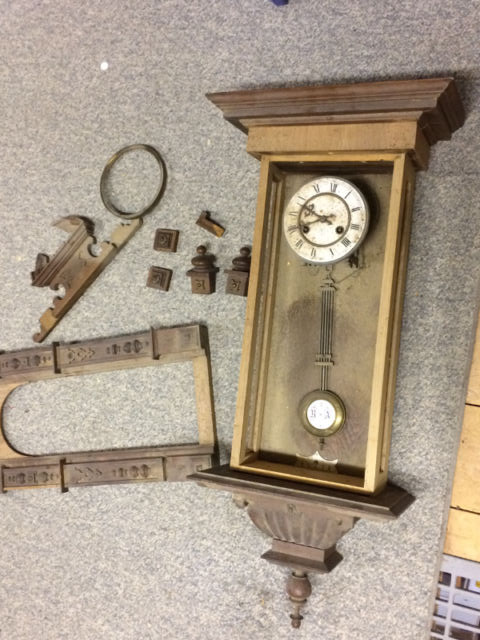
Junghans clock in pieces
Junghans clock before restoration

A case in point

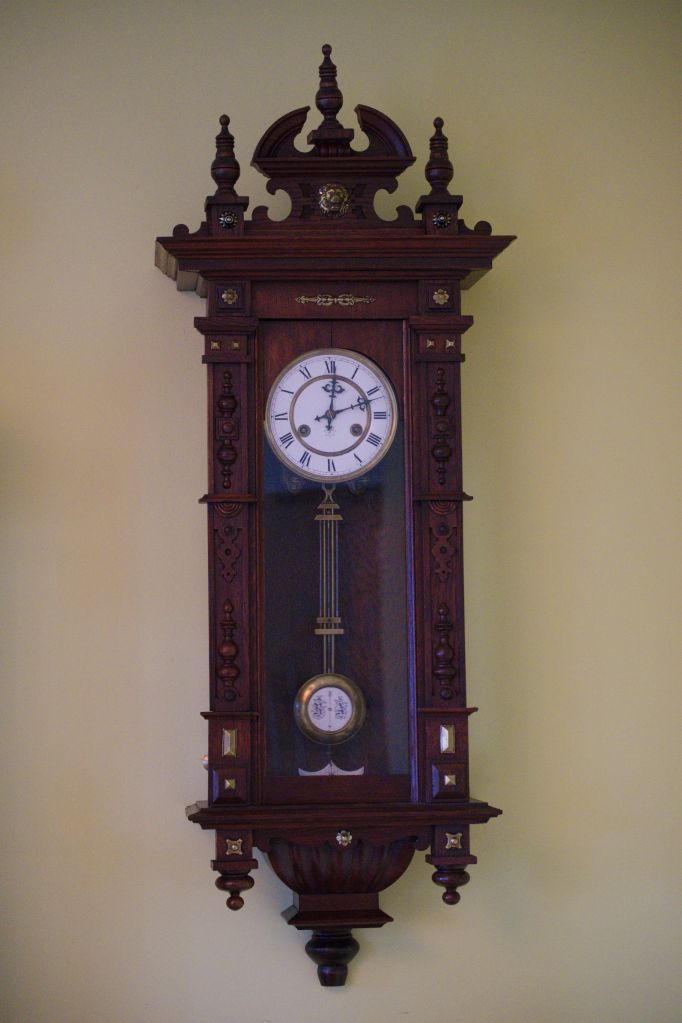
In January 2017 I bought a box of old clock parts (above photo). I was determined to make my German-made circa 1895 Junghans Crispi wall clock into what it is today. It was my first huge restoration challenge. It was a steep learning curve for me but in the end, I was pretty happy with the results.

During the course of restoration, I attempted to repair the movement, which hadn’t run in over a hundred years and made some rookie errors. I had no other course of action than to bring it to a professional in order to correct my mistakes. At the end of the day, the total cost was $475 for the initial purchase plus the servicing.

Last year, after 4 years of reliable running the clock developed an errant strike which required investigation and disassembly (and a good cleaning while I was at it) but I would not blame that on the professional repair. Perhaps it is the nature of that particular Junghans movement requiring the odd adjustment every now and then.

Junghans Crispi wall clock

In the years since then, I have acquired the skills and necessary equipment to perform my own repairs.

Twenty-three of the clocks in my collection are daily runners, all serviced from time to time by myself over the years. I am not a professionally trained clock-maker and some procedures are clearly beyond my capabilities, things such as teeth replacement and repair and fashioning new parts from stock brass. 95% of repairs I can comfortably handle on my own.

Rare Ingraham Huron found on a local online for-sale site
Rare E Ingraham Huron professionally repaired

Should you bring your clock to a professional? This is a decision you will have to make after weighing all factors. Know that by relying on a professional you can be assured that years of knowledge and experience go into the repair of your precious clock which becomes part of the cost.

Reputable repairers have the correct equipment to tackle just about any repair, offer a warranty period, and will correct any problems that arise after servicing, often without an additional fee.

Clocks are machines and machines do not last forever, parts will wear and from time to time they, like any machine, require attention. If, after some years, the clock that you had professionally repaired stops, I would have no hesitation suggesting that you return to the same repairer for servicing unless, of course, you had a negative experience.

Should mainsprings be routinely replaced on an antique clock when servicing?

A mainspring’s purpose is to provide motive power for the wheels to move in a clock train. All mechanical clocks require a power source and the power source may be by weight or spring. Mechanical clocks that have mainsprings will have one, two, or three winding points which, once wound provide power for a clock’s designed cycle.

Each winding point or arbour is located on the dial face and requires a key (one key fits all arbours) to wind the clock. The mainspring is rated to provide power for a clock’s designed cycle, whether it be 1-day, 8-days, 15-days, and so on.

Sessions mainsprings cleaned and ready to be re-installed in the movement

Mechanical clocks are machines and over time machines wear out. When a clock will not wind up, it is time for a service. The service can be done if you have the skills and equipment otherwise you must depend on a professional clock repairer.

Should mainsprings be replaced during routine servicing?

Though not in the clock repair business I am aware that some repairers routinely replace mainsprings and, of course, the cost is passed on to the customer. Should they be replaced on a routinely or only when necessary?

As a general rule, I do not replace mainsprings when servicing a mechanical clock unless there is something fundamentally wrong with the spring(s). Obviously, there are situations where a mainspring must be replaced when it has failed in some catastrophic manner.

Broken mainspring for barrel
Broken mainspring which is not saveable

There may be occasions when there is too much surface rust or stress cracks on the mainsprings which will make them susceptible to failure and/or seizing and the prudent course of action is to replace them.

Ansonia time-only movement – Too rusted to save?

However, repairers reason that new mainspring(s) will extend the period between servicing and provide additional insurance for the repairer so that if the clock stops soon after servicing, issues other than the mainsprings are suspect.

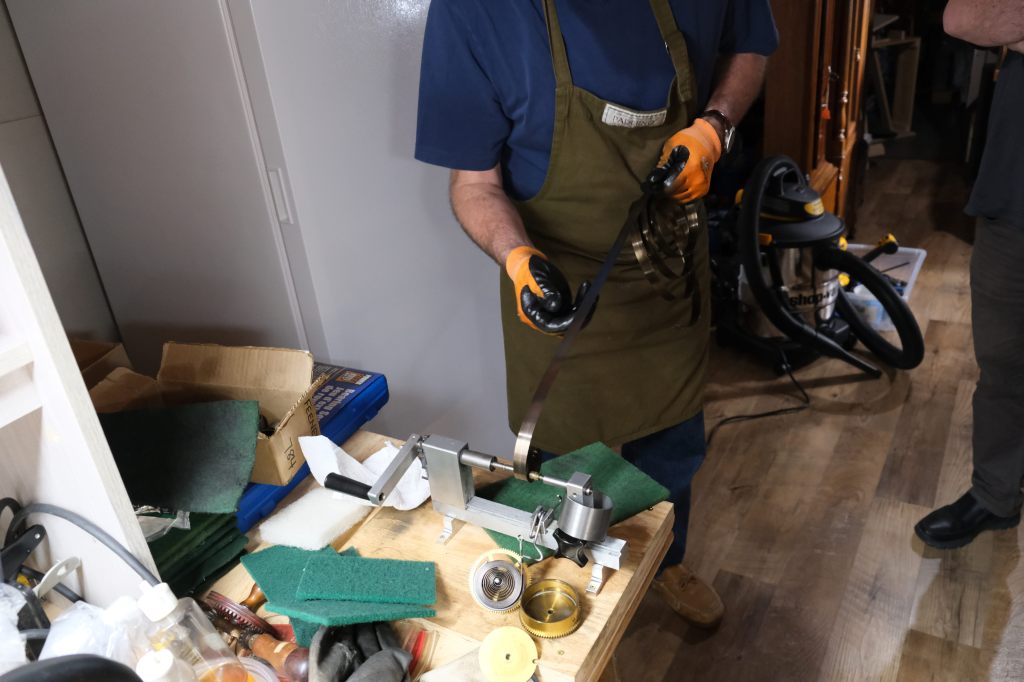
Mainspring servicing

New quality mainsprings (American or German) also provide more power than the springs they replace and more power means they will continue to provide sufficient power for the clock through its rated cycle even if very worn.

Installing or punching a bushing
Addressing wear by punching in a new bushing

The original mainsprings are often of better quality than a new spring. They may not have as much power as a new mainspring but many clocks, despite the fact that they are over 100 years old have springs that have more than sufficient power.

Once the movement is thoroughly cleaned, the pivots are polished and pivot wear is addressed there is less friction on the moving parts and therefore less power is required to drive the movement through it rated cycle.

Mainspring that is not salvageable

What if there are minor issues with the mainspring?

There are certain situations where a broken mainspring may be salvaged if the break is at the hook or loop end but not if it is broken in the middle. The mainspring can be shortened by two or three inches and after the repair, the spring will continue to provide sufficient power for the clock to run through its cycle.

What to do if your clock requires servicing by a professional

Should you bring your clock in to be professionally serviced ask plenty of questions. If it is recommended that the mainsprings be replaced, ask why, specifically. Once you receive a satisfactory explanation proceed with the repair.

New mainsprings, when the cost is upwards of $25 for each mainspring, will add substantially to the repair cost, something to be considered if the clock has little value. Of course, if it is to be repaired for sentimental reasons the cost is immaterial.

Mainsprings need not be replaced simply because they are old and “tired” and it does not require a lot of power to run a mechanical clock if serviced correctly.

Your choice!

How does a mechanical clock work?

A mechanical clock is more than just a sum of its parts; it is a remarkable machine designed to measure, verify, keep, and indicate time. These devices allow us to measure intervals shorter than the natural units of the day, the lunar month, or the year.

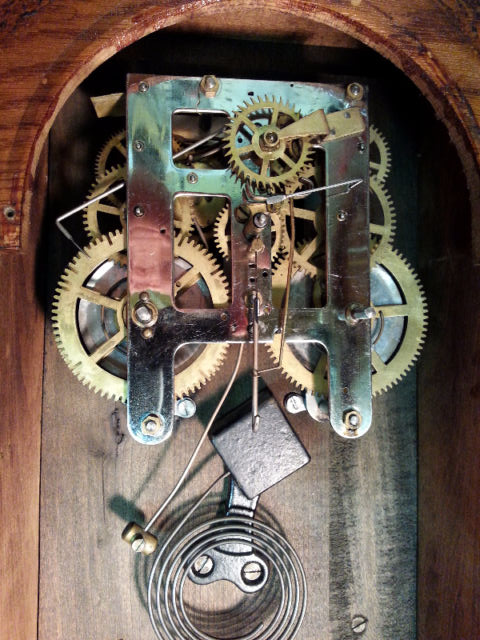
Pequegnat double spring time-only movement

How many machines can you name that run almost as well as they did the day they were built over 100 years ago and still operate exactly as designed? Not many! This enduring functionality is a testament to the ingenuity and vision of their inventors. Mechanical clocks are truly a marvel of engineering!

Clock mainsprings, one for the time side and one for the strike side

A True Story

Let me begin with a sad but true story. A few years ago, a friend of my son was visiting our home. He showed an interest in my clock collection, and I was more than happy to answer his questions.

At one point, he asked me how a clock worked. I picked up an American time-and-strike spring-driven movement and explained how the spring provides power, how the wheels transmit energy, and how that energy is released to keep time. He took the movement in his hands, examined it closely, and then, with a puzzled expression, asked, “Where do the batteries go?”

How A Clock Works

But how does this centuries-old invention actually work? Let’s take a closer look at the fascinating inner workings of mechanical clocks and discover how they keep time with such precision and elegance.

Photo by Brett Jordan on Pexels.com

Let’s keep it simple by focusing on the Five elements that are required. They are Power, Gears, Escapement, Regulator, and Indicator. Let’s discuss each one.

Power

Double spring time-only movement with top plate removed revealing the gears

The power is in your hands. The energy from you is transferred to the mechanical clock when winding it. As you insert the key into a winding point, energy is converted from your hand to the spring or weight.

The spring when fully wound or the weight pulled to its highest point provides the motive power or releases energy through the gears and allows the clock to run for a fixed period of time. Without a source of power, a mechanical clock will not run and a mechanical clock will stop when power is spent.

Gears or Wheels

Gears are also called wheels. The wheels have teeth. Each gear or wheel meshes or interacts with the next gear by way of pinions.

Energy is transferred to each wheel through what is called the train and in the process, the subsequent wheels turn faster. The time side gear train, for example, through a series of wheels leads to a wheel or gear called the escape wheel which turns much faster than the main wheel with the spring or weight. But the power that is released through the train must be controlled.

Escapement or Controlled Release Mechanism

The escapement is the last wheel in the time train. It is designed to release the power from the mainspring or weight in a controlled manner.

Bushing installed on escape wheel arbour
Escape wheel and verge

This is the tick and tock you hear when you are close to a mechanical clock. It is the sound of the verge catching and releasing the teeth of the escape wheel. The tick and tocks transmit an impulse to the pendulum to keep it swinging.

Similarly, the mainspring releases the energy through the gears or wheels on the strike side of a clock by means of a series of levers and pins.

The Regulator

Bracket clock
Bracket clock showing pendulum leader and bob

A regulator controls the speed of the clock. An example of a regulator is a pendulum. Generally speaking, a pendulum with a longer rod will oscillate more slowly than one with a shorter rod.

Regulating or adjusting the length of a pendulum will speed or slow down a clock. On the same clock, lengthening the pendulum slows the clock, and shortening the pendulum makes the clock go faster.

Clocks without a pendulum have lever escapements, floating balances, and balance wheels that rely on a coiled spring and are regulated by means of an adjustment dial or lever on the escapement arbour.

Vienna Regulator clock face
Clock face showing the hour and minute hand

Indicator

The indicator is the hands on the dial face. Regardless of the size of the dial, the style of the hands, how numbers are displayed, they all do one thing, tell the time.

The indicator also points to the sound a clock makes at a certain part in the hour whether it is quarterly, the half-hour, or the hour on a bell(s) or chime rod(s).

Synergy

The five elements come together to create synergy—a harmonious interaction of parts that produces a result greater than the sum of their individual contributions. This controlled harnessing of energy is ingeniously designed to make the machine perform one task: tell the time.

I think my son’s friend still wondered where the batteries go.

Fleet Time replacement movement needed – calling all clock parts collectors

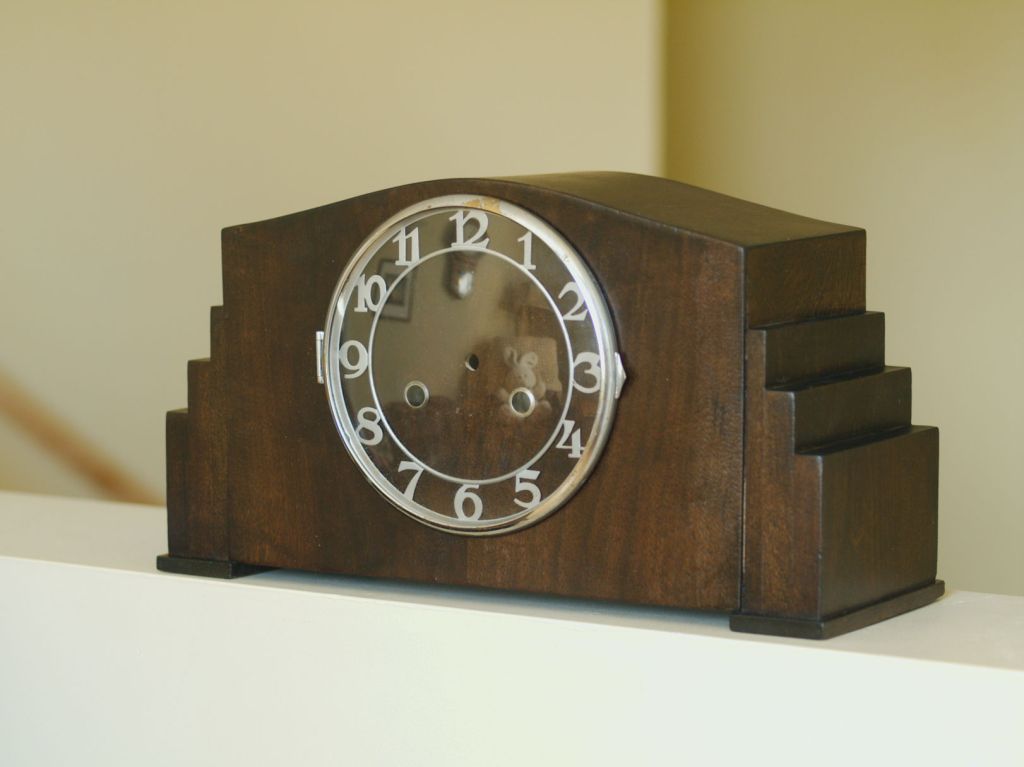
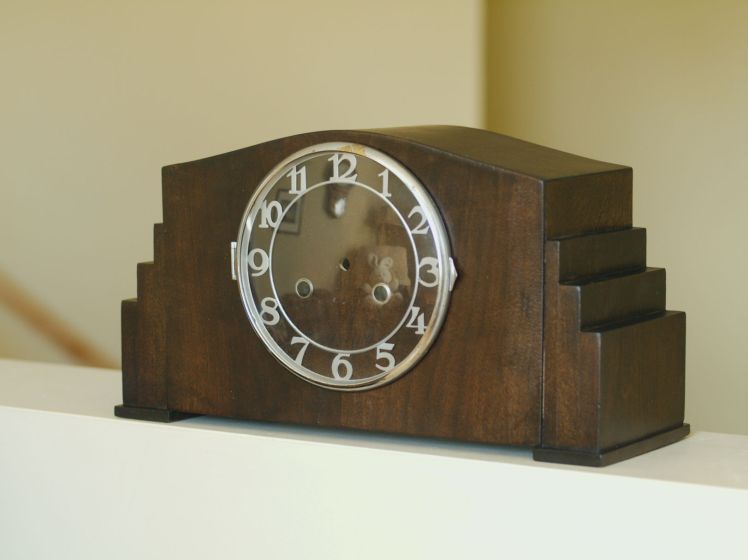
This Fleet Time mantel clock is a generic mantel clock with a walnut finish, flat front, a slightly domed top, and step-side features. Simple but attractive. Fleet assembled clocks sourced from German parts in the Montreal area for 4 years prior to WWII.

While the case looks great after refinishing, I was oh so close to having a fully functioning clock when disaster struck.

This is a call-out for anyone who can sell me or donate a replacement movement or otherwise direct me to where I can locate one. I am in need of a mainspring barrel and second wheel on the time side. As much as possible I would like it to be exactly the style of movement that came with the clock.

Fleet Time case
Fleet Time case, refinished

My clock passion is collecting clocks made or assembled in Canada and I would love to see this clock in working order

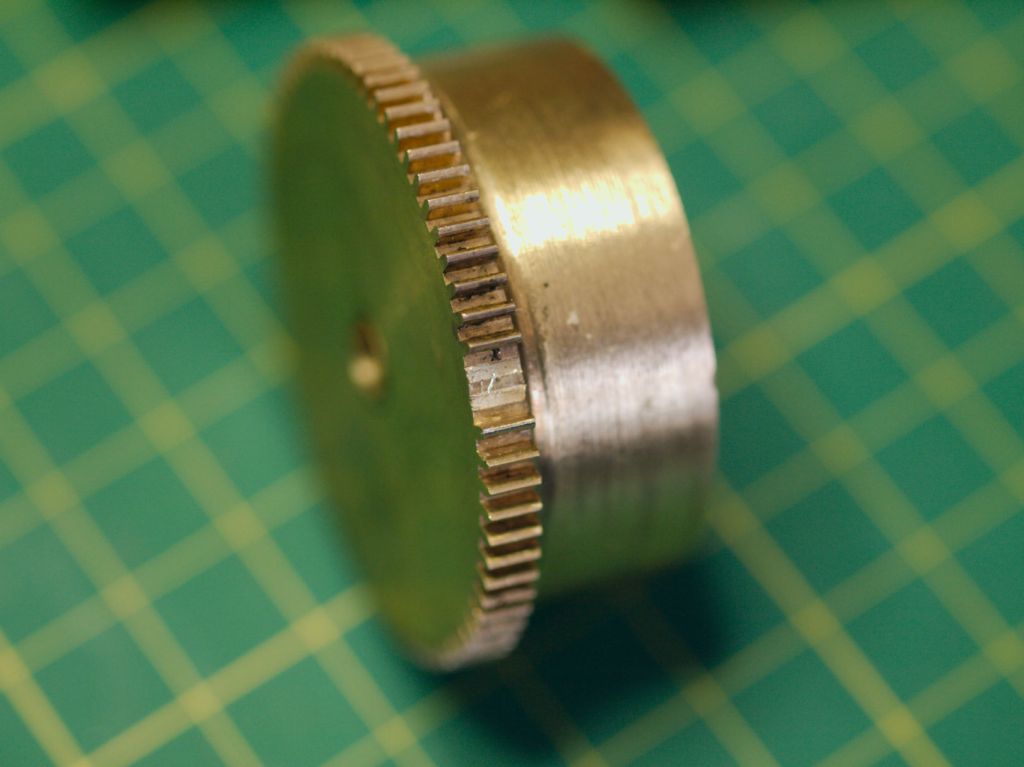
Fleet second time wheel
Fleet second wheel, a bent leaf cannot be unbent

Here is my story

The movement looked to be in reasonably good condition but needed a good cleaning.

Fleet time barrel
Fleet time barrel
Fleet time movement
Fleet time movement

The mainsprings can be removed without disassembling the movement, handy for such things as replacing a broken mainspring.

The movement was completely serviced with several new bushings installed. The mainsprings were removed, cleaned, and returned to their barrels.

Through the testing phase, the mainsprings were partially wound. Once I was satisfied that the movement was running well I installed it back into its case. I then wound the strike side fully and then wound the time side. Just as I was feeling resistance, CLUNK, and then the arbour turned freely.

Hoping it was only a broken mainspring I was not prepared for what I discovered when I opened up the movement. There were three broken/bent teeth on the mainspring barrel, a broken mainspring, and a damaged leaf pinion on the second wheel.

Broken mainspring

When a mainspring breaks at the teeth end of the barrel it tries to unwind but the loose end provides sufficient resistance, that is, a slower release of the energy, and is less likely to cause major damage. A broken mainspring results. A break at the winding arbour end or close to it as in this case results in the sudden release of energy and the result is damage not only to the mainspring but clock parts up the train; this is known as collateral damage.

A clock colleague advised me that although the barrel teeth and leaf pinion can be fixed it is usually not cost-effective because the process is so time-consuming. His solution is to collect movements that are used as donors for times such as this.

The plan, at this point, is to source a donor movement and harvest parts for what I hope would result in a successful repair.

So, here I am asking if anyone has a spare movement they can part with.

My clock passion is collecting clocks made or assembled in Canada and I would love to see this clock in working order.

Will antique/vintage clock prices go up or down in 2022?

Will antique and vintage clock prices go up or down in 2022? Is this the time to buy or sell? Read further for my thoughts and observations.

First off, some definitions. According to the United States Government, the term “antique” is reserved for items that are over a century old. Webster’s dictionary defines an antique as a work of art, piece of furniture, or decorative object made at an earlier period and according to various customs laws at least 100 years ago. Wikipedia defines antiques as applying to objects at least 100 years old.

The word “vintage”, according to eBay and other sources, is a defined period that is less than 100 years but more than 30 years. You may find various definitions of vintage for example in the jewellery business vintage may be considered as anything 10 to 20 or more years.

Anyone, who regularly shops for antique or vintage clocks is well aware that the clock market has been depressed for quite some time but is this the time to sell or buy?

Pricing is as volatile as it was a year ago. There is no true “standard” pricing for any vintage or antique clock. As with most objects, there is a price range that most would consider reasonable.

How are clock prices set?

Sellers use a number of metrics to set prices;

  • A price more or less consistent with prices achieved at reputable auction houses and online for sale sites,
  • The condition of the clock, whether it runs or not and if it has been serviced,
  • A seller’s personal experience buying and/or selling online,
  • A seller prices higher than the value leaving room for a downward negotiated price,
  • A seller knows that most clocks are not sold to a serious collector and count on uneducated buyers who think they are worth more than they are.

Factors affecting the sale of clocks

Any object is ultimately worth what someone is willing to pay a higher price for it. High-end and truly rare clocks have managed to retain their value althrugh sales are largely based on market conditions and demand.

But what conditions influence the sale of run-of-the-mill antique and vintage mechanical clocks and those of slightly better quality?

Antique and vintage clocks have flooded the market in the past several years driving prices steadily downwards. The new generation of millennials have little interest in antiques and find it pointless to collect antique and vintage clocks.

Modern homes do not have the room for clocks as floor and wall space is limited. In an age when families are living in 800 square foot apartments space is at a premium though that could change as people migrant from dense cities to smaller communities. And when space is at a premium grandfather clocks and jeweller’s regulator clocks though finely crafted and cost thousands when new are not items many would consider as wants for the modern family home. Sentimental reasons aside, the cost of servicing far exceeds the value if the desire is to have a working clock.

I don’t have a crystal ball but judging from prices in the past few years I can comfortably predict that things will be much the same. I do not expect a significant change in 2022 or beyond. It is a buyer’s market and there are some terrific bargains out there. Knowledge is power and no doubt there are some great clocks to be found but shop carefully and do your homework.

Where do our readers come from?

Ingraham Grecian 8-day time and strike shelf clock

WordPress comes with an interesting dashboard. The dashboard provides me as author and developer with a back-end tool that provides a wealth of statistical information. The information allows me to track viewership and tailor my articles according to interest as shown by the number of clicks which is a measure of the level of interest.

In 2021 there were 68,095 visitors with 124,708 views at 1.83 views per visitor. Visitors came from 162 countries but let’s look at the top ten.

The top ten countries in 2021 are:

  1. USA
  2. Canada
  3. United Kingdom
  4. Australia
  5. New Zealand
  6. India
  7. South Africa
  8. Ireland
  9. Netherlands
  10. Italy

Since antiquevintageclock.com originates from the beautiful province of Nova Scotia, Canada it is not surprising that most of its visitors are from English-speaking countries.

All visitors are encouraged to explore the world of antique and vintage clocks and to that end, there is a handy applet on the front page for those of you who wish to translate in the language of your choice.

Readers pick for the best clock of 2021

The results are in. By a small margin, your pick for the best clock of the year is the Sawin banjo clock.

Sawin banjo clock

A great choice and one I would have picked had I not been frustrated with it during the restoration process but at the end of the day, my favorite is the Gilbert Shawville clock.

The Gilbert is an excellent example of a non-descript mantel clock found in thousands of homes in Canada and the USA in the 1920s. Seth Thomas, Sessions, and others made similarly styled models to appeal to those who could not afford the fancier, optioned-out upper range clocks that were offered by most manufacturers, including Gilbert, at the time.

I did not actually see the clock until we got home

The clock was offered on Facebook Marketplace in Quebec, Canada for $40 and had no takers over a three-month period. When the price was reduced, I snagged it. It was described as a non-running clock but the key, pendulum bob, and the movement are intact and I suspected I could get it running in a few minutes.

As an interesting aside, I found the clock in a recycle container by the side of the road, all prearranged, and never actually met the seller. It was boxed, sealed and wrapped in plastic, such is the fear the pandemic has produced.

Normally I stay away from American mantel clocks of the 1920s and 30s as I have had so many but for some reason, I was attracted to this clock because it looked like it had not been messed with.

There are no exotic veneers, appliques, fancy trim pieces, or finials, just a plain two-column, square-boxed-shaped, tinted mahogany lacquer hardwood case measuring 10 inches high by 5 ½ inches deep by 10 ½ inches wide at the base.

Gilbert shelf clock

The enamelled 5-inch dial with spade hands has Arabic numerals. On the top of the dial, within the number 12 is a regulating arbour used to adjust the speed of the clock.

On the front plate of the movement is the Gilbert trademark, a capital G within a diamond, and Wm Gilbert Clock Co, Winstead Conn. stamped on the right. The number 17 is in the lower centre, 1917 when the movement was made. The movement has steel plates with brass bushing inserts as brass was in short supply during the period of the First World War, 1914-1918.

A simple clock for the common folk and made by Gilbert is my pick for 2021.

Sawin banjo clock movement servicing – two issues arose later

Weight-driven banjo clocks have simple time-only movements that are very reliable. They can be unadorned like the one I acquired or garish almost to excess like a presentation timepiece. Authenticity can be a challenge since some presentation timepieces started life as simple wooden cases and decorative tablets, finials, sidearms and other items were added later but I love the simplicity of this one.

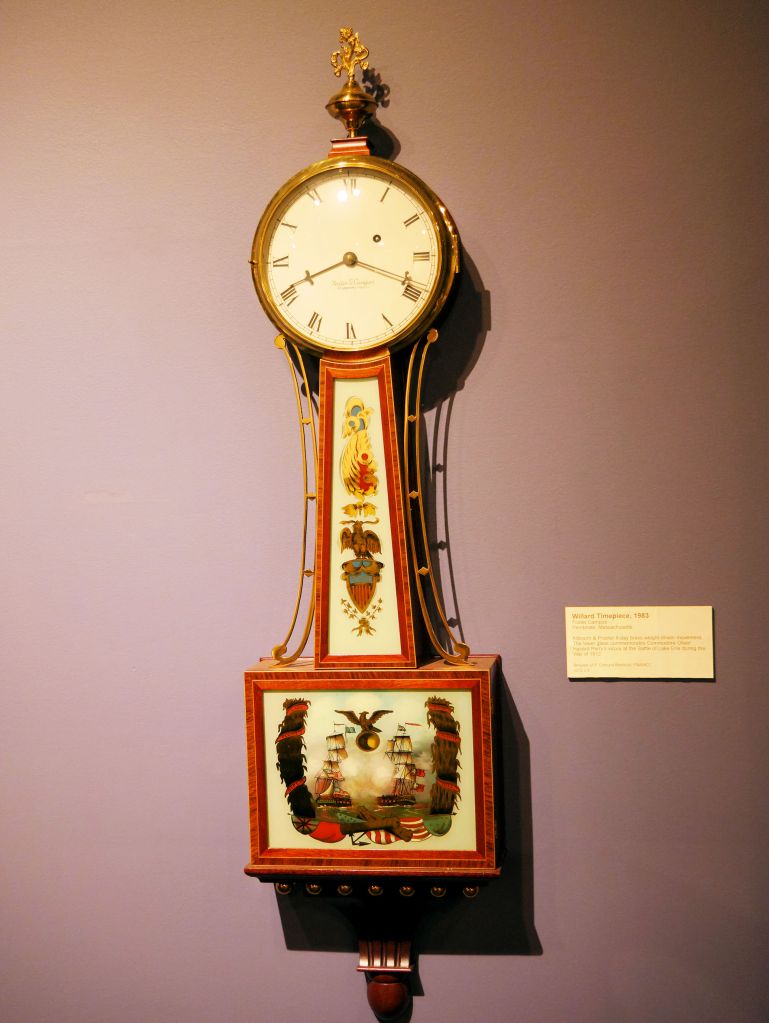
Presentation banjo clock by Foster Campos

Finding one for $75 is highly unusual but I am convinced the seller had no idea what it was worth. When I picked it up the seller asked me if I was interested in another clock he had for sale, a 30-hour mantel clock. He told me someone valued it at $300. Uh, no, not interested!

This federal-style banjo clock was made in the 1840s. I am reasonably certain it was made by John Sawin of Boston in 1840 or thereabout, by either himself or one of his apprentices or associates. The movement and case construction bares a strong resemblance to a Willard timepiece and there is a good reason for this.

John Sawin apprenticed under Simon Willard and was a journeyman under Aaron Willard, famous clockmakers of the day and makers of the original patent timepiece.

Unfortunately, there are no identifying markings on the movement or the case but there are key indicators, for example, the placement of the movement mounting “ears”, that tell me that this is a Sawin clock.

The case is complete and ready for the movement

Everything is original to the clock, weight, hands, movement, pendulum rod and bob. The dial glass was was broken at some point in the clock’s life. It had convex glass and a good many I have seen with wood bezels had flat glass. Brass bezel clocks, on the other hand, generally had convex glass, so, I have decided to replace it with flat glass.

The movement

The gear train is relatively simple and consists of 4 wheels; the main wheel, second wheel, third wheel, and escape wheel. The motion works are on the front plate.

The movement in its case

Assessment of the movement

As expected there is wear but consistent with the age of the clock. The movement looks good overall, the gear teeth and pinions are in very good condition but, there are punch marks around the pivot holes. It is never a good feeling to see punch marks around the pivot holes. Punching effectively closes the pivot holes but in a very crude way. This was an old practice and is not considered acceptable today.

Pivots are required for the main wheel front plate, second wheel back-plate, third wheel, and the escape wheel front plate. The verge may require front and back bushings but I will see how things look when the other bushing work is complete. Three are 2mm wide Bergeon bushings, the fourth is 2.5 and the main wheel bushing is larger. I don’t often work with bushings as small as 2mm and it simply means extra care must be taken to cut and ream as accurately as possible.

Bergeon Bushing Machine
Punch mark, left of winding arbour
New bushing for main wheel arbour

There was a good amount of movement in the main wheel arbour and installing a bushing was necessary to tighten things up. I have bushings that are 1.5 mm and 3mm thick but the plate is 2mm. A 3mm bushing was installed and using a file I reduced the height to 2 mm. Three other bushings were then installed with no issues.

I have decided to leave the verge bushings as-is for now.

The weight cable had no kinks or broken strands, I cleaned it in the ultrasonic and reused it. For brass cable, I generally knot each end and use solder to secure the knot to prevent it from slipping out of its knot.

Two weeks later and two issues

The weight cable is too short. The clock stops when the weight is several inches from the bottom of the case and it will only run six days instead of the usual eight. Why was the cable shortened? Who knows?

The Keystone

A second issue. The keystone is the piece between the suspension spring and the pendulum leader. It comes very close to hitting the large wheel of the motion works on the left side. Since the suspension spring is quite bent the right side of the keystone rubs against the back of the dial face stopping the clock. A bent spring is a consequence of leaving the pendulum assembly on the movement during transport.

Unfortunately, I cannot source a suspension spring alone and must purchase either the keystone and suspension spring together from an American supplier or the entire spring, leader and stake for about $55.00 from a Canadian supplier. In the meantime the movement runs until I put the dial on.

Sawin banjo clock c.1840

I am in no hurry for this one and will continue testing it until I come up with a solution for the bent suspension spring.

Over 108,000 views so far this year – thank you

Thank you, viewers and subscribers.

It is always a thrill to reach a milestone. Six years ago I attended a WordPress workshop and after the instructor assisted us in setting up a rudimentary site, I thought, I can do this. I can talk about clocks! WordPress 101 certainly made it sound so easy but it wasn’t as easy as I thought as I began my journey.

It has taken time to build a following, more than I ever imagined. It takes planning, commitment, an investment of energy, and, finally, perseverance but at the end of the day, it has been worth it.

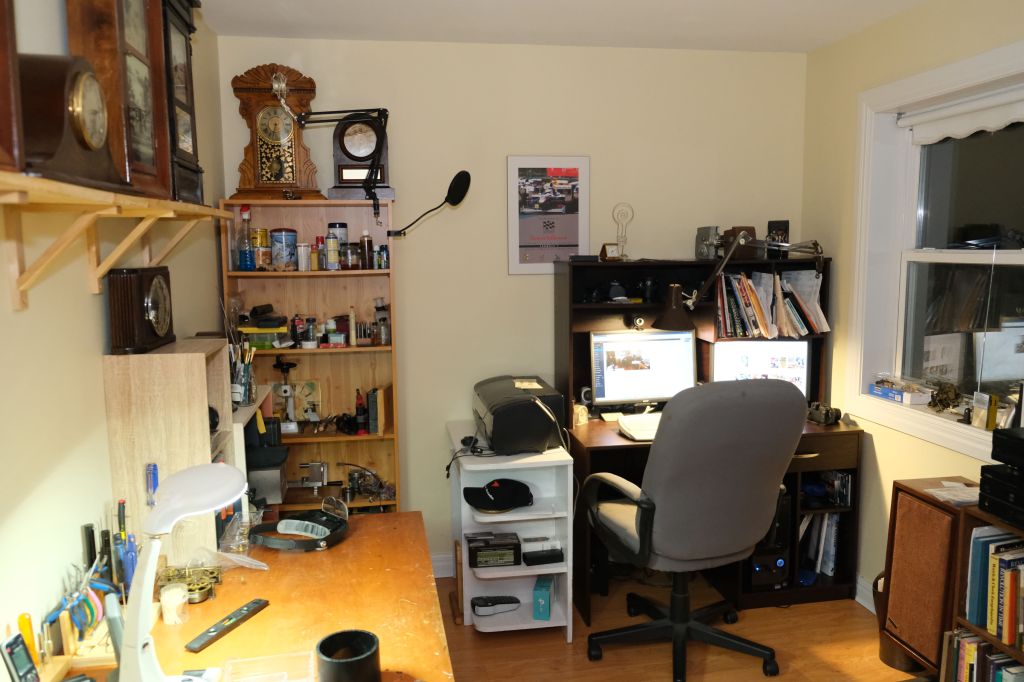
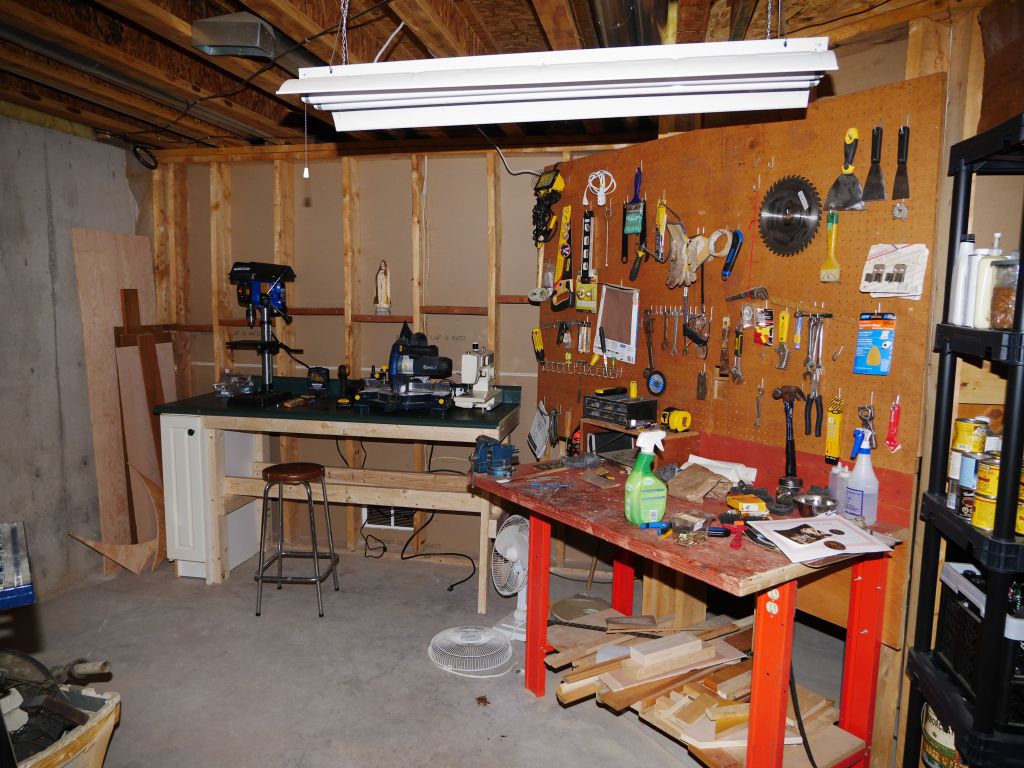
My office about two years ago

I began by following other blogs and making notes on what made them successful and eventually found a natural style that was best for me. Unfortunately, I have seen a lot of blogs come and go in the past six years, bloggers that ran out of ideas, lost interest in their blog, or for whatever reason, life got in the way. And some of those blogs were pretty darned good. But I wasn’t going to let that affect me.

The first two years were frustrating, to say the least, and I don’t know how many times I thought of quitting, but I hung in even though the number of views was, well, disappointing. I knew my content was interesting, certainly to me and I knew there were people out there who had a yearning to read and learn about mechanical clocks, so, I stuck with it. And, I am glad I did.

Case repair and restoration work area

As I have said elsewhere if you regularly use a lathe to cut gear teeth, re-pivot arbours, bush mainspring barrels on a weekly basis, fashion new wheels from raw stock or make advanced repairs on complicated movements and cases, this is probably not the place for you but you are welcome to leave any comments or suggestions or simply read one of my blog articles over a cup of coffee in the morning.

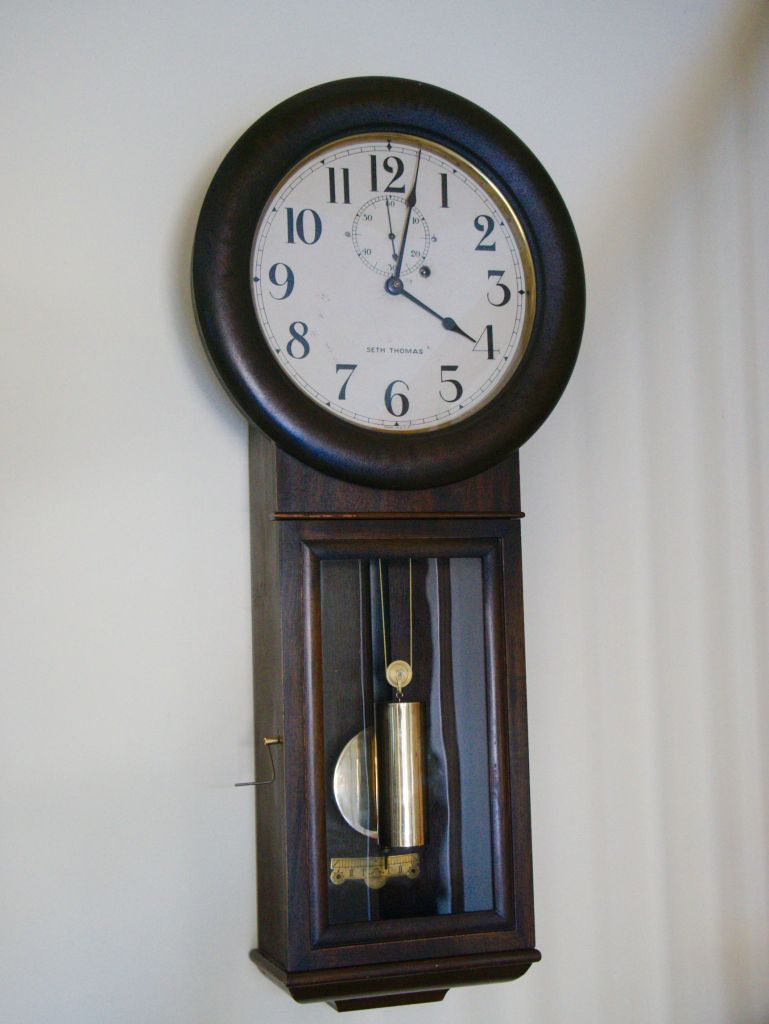
Seth Thomas #2
Seth Thomas #2 c. 1922

After six years I still consider myself a clock repair generalist though there is no denying that I continue to build my repertoire of clock repair and restoration skill. Judging from my mail I seem to appeal to those who are like-minded. I appreciate those who have stumbled onto my site looking for advice and guidance on a particular clock or clock repair issue.

HAC mantel clock
Hamburg American Clock Co (HAC) mantel clock c.1908

But I especially appreciate comments and suggestions from regular viewers. And, yes, there is fan mail, most of it sent privately and I take great pleasure in responding to each and every query.

Ingraham Grecian
Ingraham Grecian c.1875

As I review articles that have the greatest number of views it seems clear to me that most of my visitors are looking for how-to and general information articles. That suits me just fine.

These have become the most popular.

After six years I have developed an understanding of my audience and have managed to produce blog articles that seem to appeal to a wide range of people with an interest in horology.

Will I continue? Darn right, and as they say, the best is yet to come.

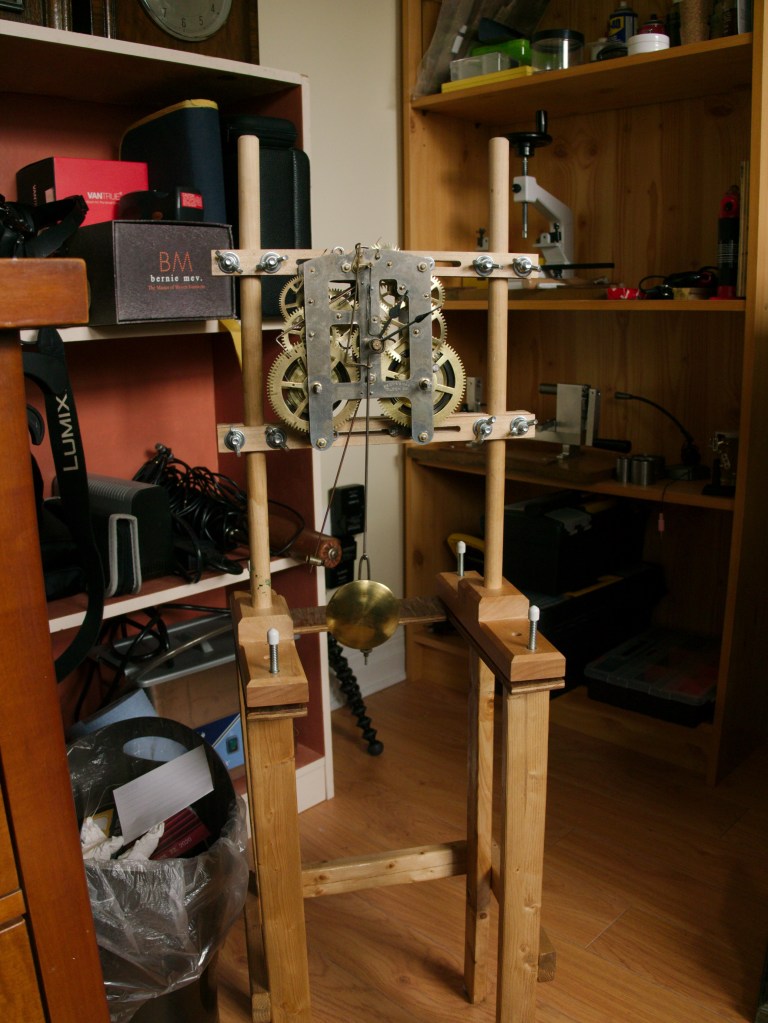
Clock testing stands for most purposes.

What is ideal is one clock stand for servicing and testing all clock movements but unfortunately, there are so many different types and styles of movements that one size does not fit all.

I have written an article or two on test stands in the past but consolidating all my testing stands into one article might help the reader decide which one would work best for them.

Testing the Kienzle movement on a makeshift test stand

For the first one, I made a makeshift test stand out of scrap wood and what I like about this one is that if I require more holes to mount a movement, I could simply drill them where I need them. But I also like the idea of using it for those mantel clocks and small wall clock movements with seat boards.

HAC movement
HAC movement

This particular one has clamps so, mounting a movement is very easy since each clamp has a center horizontal groove. Once the height has been set, simply screw the clamps into the vertical rod. It takes seconds to mount a movement. The brackets are adjustable to about 10 inches.

Junghans B11 movement on the test stand

This test stand, called “Gene’s clock testing stand”, is very versatile. The movement can be mounted as I have done in the photo or bolts can be inserted through clock plates and into the cutouts as in the photo below.

Same as above with an extension

This is the same Gene’s stand as above but made for longer pendulum leaders. The home-made extension measures 18 1/4″ high by 9″ deep by 9 1/4″ wide. The bottom part is adjustable and fully detachable.

Clock stand painted
Clock stand for tall case movements

Finally, this is a 48″ stand for hall clocks or grandfather clock movements. It can accommodate two or three movements but I do not work on more than one tall case movement at a time. When used for testing purposes I anchor the stand to a wall to help eliminate sympathetic vibrations.

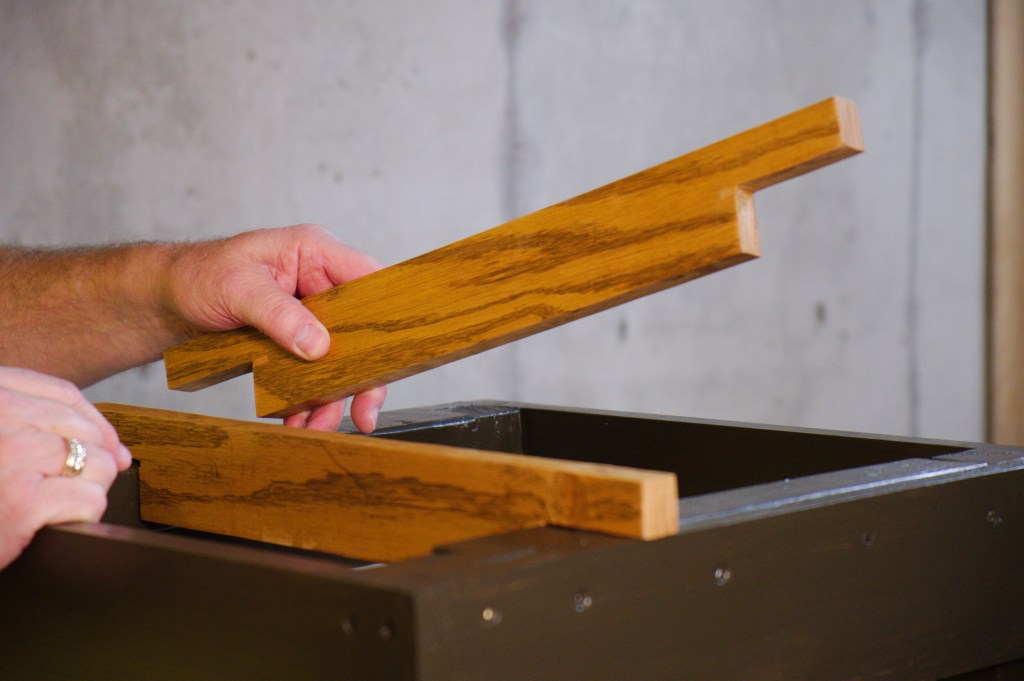
Clock stand one rail on
Clock stand rails

The stand is made of pine while the rails are constructed of yellow oak.

Every horologist should have at least one or more sturdy clock stands for testing clock movements.

Once you begin working on clock movements in earnest you will learn that a testing stand is indispensable and as you repair more movements one type will not be sufficient.

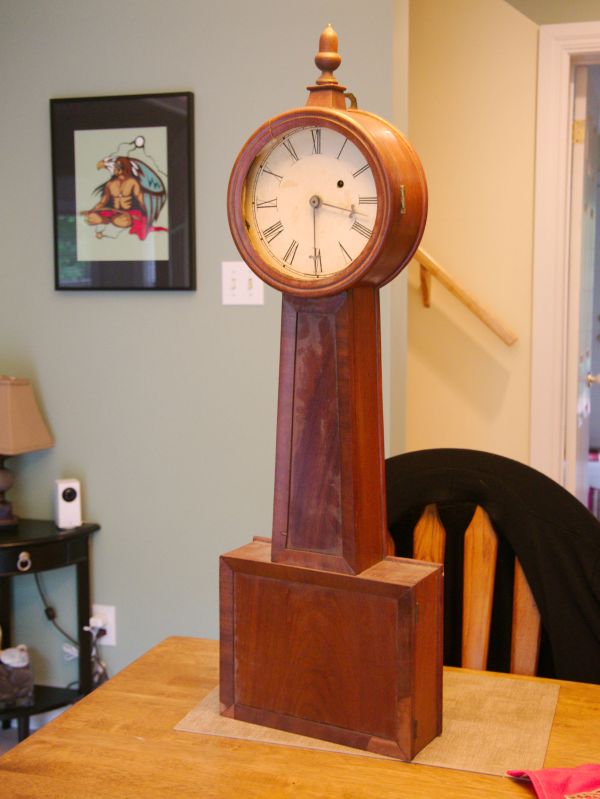
John Sawin banjo clock CA 1840

John Sawin was a prolific 1840s Boston clockmaker and many of his clocks have survived to this day.

The Key features of the Sawin timepiece share many of the attributes of the original Simon Willard Patented Timepiece. They are:

  • No striking parts reducing the number of wheels to a minimum for simplicity,
  • Making the distance between the plates wider allowing sufficient cord on the barrel allowing it run 8 days,
  • The push-pin catches on the bezel and lower access doors,
  • Placing the pendulum in front of the weight to ease repair and regulation,
  • The weight is reduced and made longer and wider,
  • The pendulum and guide are placed in front of the movement,
  • An oblong space in the pendulum so that it swings clear of the centre pinions and hour and minute collars,
  • The method of mounting the movement to the case. Works are fastened by two “ears”, the top right and bottom left backplate,
  • The calculation of the train in consequence of shortening the pendulum,
  • No method of securing the pendulum when transporting the clock,
  • Acorn top finial and wood dial bezel
  • The shape of the case,

The earliest timepieces from Roxbury had long screws from the front plate into the case in the upper right and lower left. Beginning about 1820 in Boston a single bolt from the back of the case into the movement was used as per Howard & Davis and E. Howard. North Attleboro movements had holes in the backplate in the upper right and lower left for screws into the case.

Upper right mounting “ear”

A John Sawin movement is distinguished by brass ears attached to the movement back plate in the upper right and lower left. Other Boston area clockmakers might have used the same casemakers so their cases probably would look similar to his.

As found

Cases came from one of several casemakers in the Boston area. Case construction is helpful in identifying where the clock was probably made and movement for the maker, however by the 1830’s movement construction had become so generic that was really difficult to identify the maker. It is probable that were many small workshops run by former apprentices and/or journeyman clockmakers that supplied movements to the trade as needed by the existing makers in the various cities so it makes things even more complicated.

The real differences were how the movement was attached to the case and that gives us information on where it was manufactured.

The John Sawin Banjo headpiece is carved out. With the dial off, the headpiece of the case looks like two crescent moons facing each other, thin at the top and bottom and thick in the middle. There is a piece of cloth glued to the inside top of the case to hold the 2 crescent moons together.

Two crescent moons make up the headpiece

Unfortunately this clock has no identifying markings which means that it is quite possible that while it may not have been made by John Sawin himself but one of his associates or one of his apprentices. Still in all, it is a nice-looking clock and looks great on any wall.

Yard sale find – a 181-year-old weight driven banjo clock for less than you think

Seller’s photo

Yes, a weight-driven banjo clock for a surprisingly low price!

There are essentially three types of mechanical banjo clocks. Those with lever escapements are usually in the $75 to $100 range, spring driven ones are $100 to around $200 and up but weight-driven banjo clocks occupy the higher end of the range and normally cost between $300-$500 in fair condition to upwards of thousands for Simon Willard or E. Howard clocks.

My wife discovered this particular clock on Facebook Marketplace for $100. I suggested she offer the seller $75 and the seller immediately accepted. I think they just wanted to get rid of it. However, it is always a risk buying a clock sight unseen but this looked like an excellent prospect and for $75, why not take a chance!

From the photos provided it is a weight-driven federal style mahogany-cased banjo clock from the 1800s. The movement is intact because the seller sent a video showing the pendulum bob moving from side to side.

Looks like the original dial and original hands

It has a top acorn finial which appears to be original to the clock. I thought it was missing the carved reverse scrolled side arms and the bottom base piece but not all of these clocks had bottoms or side arms. 

The original banjo styled steel hands and the painted face appear to be in good condition. The broken glass bezel can be easily replaced. The case is dirty and requires a small amount of veneer work. I also see the winding crank in the bottom of the case.

Could be a diamond in the rough

I picked it up in late June 2021.

The day of the pickup

We arrived at the garage sale and met the sellers. My wife was curious as to the provenance of the clock and we were told that it had been in the family for more than 60 years having spent most of its life in Wolfville, Nova Scotia.

The clock was heavy which meant the weight was inside the case. Had the weight been missing, sourcing one would have been a problem but it is best to have the original weight.

We had few errands to run in the city and did not return home till late in the evening. Minutes after coming through the door I had the clock on the kitchen table and a screwdriver in hand taking it apart.

A Boston made banjo clock

After studying it further and comparing the clock to others online and through my inquires with members of a clock forum site I learned that the clock was very likely made in 1840 in Boston by John Sawin who apprenticed under Simon Willard and was a journeyman under Aaron Willard, famous clockmakers of the day and inventors of the original patent timepiece.

Later, I will profile the clock with detailed images of the movement, dial face and aspects of the case and more information on clockmaker John Sawin.

Is this the find of the year? I certainly believe so!

Maritime Association of Watch and Clock Collectors

On November 2-3, 2019 the Maritime Association of Watch and Clock Collectors held its first meeting. Members came together from various parts of the Maritimes to meet in Prince Edward Island (Canada) to form a club of like-minded individuals.

A educational component of the meeting, a lesson in bushing

Unfortunately the pandemic scuttled all plans for a subsequent meeting but the climate is right for another face-to-face meeting shortly. In the meantime the group has stayed connected through email.

The goal of this group is to gather individuals of every skill level from across the Maritime provinces (PEI, New Brunswick and Nova Scotia) to share experiences, mentor each other, learn new techniques, provide opportunities to acquire clocks/watches and foster social interaction.

Inspecting an antique pocket watch

We chose the name MAWCC, the Maritime Association of Watch and Clock collectors. We agreed to no less than 2 meetings per year but that sub-groups would meet more frequently.

At this point in time we are not affiliated with the NAWCC (National Association of Watch and Clock Collectors) an American-based clock and watch group.

Demonstration of the cleaning of a mainspring

If you are from the Maritime region of Canada (Prince Edward Island, New Brunswick, Nova Scotia) and you have a keen interest in advancing your skills in horology or just beginning your journey into clock and watch repair and would like to connect with like-minded individuals, contact Wendell Feener at wcfeener@eastlink.ca

Fleet Time mantel clock with Gufa movement – servicing the movement

Fleet clock with a new finish

About a year ago I picked up two clocks. I had my eye on one, an Arthur Pequegnat Canuck shelf clock, and the other was “thrown in” as part of the deal. We completed the transaction on the Pequegnat clock and the seller asked me if I wouldn’t mind looking at a mantel clock stored on a shelf in his garage. He said, “for $10 more you can have this”. I did not know the make at the time but for $10, why not! It was in sad condition as you can see in the next photo.

Fleet clock with a worn finish

A tin plate affixed on the back of the clock told me what it was made by the Fleet Time Company of Montreal (Canada).

Many of these clocks were sold at department stores across Canada during the pre-war (WWII) era. However, this little-known Canadian clock company had a brief life span. Between 1936 and 1940 the company produced a range of two and three-train mantel clocks with movements sourced from Germany but were forced to end their operations when the war began.

Fleet label
Fleet Time Co. label

The Second World War took a heavy toll on this company as the source of movements dried up and so did the company’s fortunes.

Wood cases were made in Canada for some models while other cabinets were imported from Germany.

Servicing the movement

I had completed work on the case a few months ago and now it is time to service the movement.

3 train Fleet movement by Gufa

The clock has a Gufa Westminster chime movement. Gufa is the Guetenbacher Uhrenfabrik, located in Gütenbach, Germany. They manufactured 400-day clocks, cuckoo-clocks and later they became the “Jahresuhrenfabrik” (August Schatz & Sons in Triberg, Germany). Gufa is not a name horologists come across very often in North American. There is a chime gear patent date number ending in 34 which likely refers to the year 1934 indicating manufacture between 1935 and 1939. It is a solid, well-built movement.

Assessment of the movement

I had replaced the time mainspring shortly after I bought the clock but I knew that I would eventually have the movement on the workbench. As is typical of German clocks of this period in that the mainspring barrels can be removed without dismantling the movement, so, replacing the time mainspring was an easy fix.

The clock was running, though not well. On the fourth or fifth day, the chimes (and strike) would stop though the time train would soldier on a few days more. Wear issues on the strike and chime train had to be addressed.

I disassembled the movement, put the parts into the ultrasonic cleaner, and discovered afterwards that the plates had been lacquered. With the ultrasonic heat setting on, the lacquer stripped off but not uniformly. As it is a $10 clock I am not concerned about aesthetics.

Fleet wheels
Fleet movement wheels tied together according to location

To eliminate the chance that I would mix up the wheels for the 3 trains, I tied each set together. Once out of the ultrasonic cleaner I untied them and placed them in their respective trays. Westminster chime movements have similar-looking gears in the three trains and it is best to separate them to avoid frustration during re-assembly.

After inspecting the movement I determined that new bushings were required on the second wheels plus the motion works arbour. Three of the second wheels on the backplate, one bushing for the strike side second wheel front plate, and one for the motion works for a total of 5 new bushings; not bad for a 3-train movement. These are the typical wear points on three-train movements as the second wheels handle the greatest load.

Bushing work

Once the pivot holes were pegged out and the wheels rechecked in their locations, the bushing begins. Aside from the second wheels, most other pivot holes were in good shape. I don’t often use bushings with an outside diameter of 4.50mm but this movement required 4 in total. All bushings had to be reamed out with a cutting broach followed by a smoothing broach. All wheels were test fit with the plates together and things looked good.

Reassembly

Next is reassembly. With so many wheels it is a bit trickier than a two-train movement but it is important to work slowly and carefully to avoid a bent pivot. Once the wheels are positioned, test each train to check that everything is in place. After the nuts are tightened, the remaining parts such as the locking plate, chime locking lever, warning lever, rack snail, mainspring barrels and so on are installed/attached.

Testing

Of all movements, three trains are the most difficult to set up correctly. Although all three trains spin independently they are interconnected by levers. In order for everything to function in unison, careful attention must be paid to the job of each lever, what it does and how it performs its function every 15 minutes.

Gufa movement
Gufa movement, front plate showing rack, snail, levers, and so on

Everything went fairly smoothly. Both the strike side and chime side go into warning as they should, the locking plate stops the chime at each quarter-hour including the hour, which is a good sign the locking hook on the chime train is in the correct position.

Gufa movement
Gufa movement on the test stand

The chime strike lever is, however, sticking on the strike warning pin. Without taking the movement apart I used 1600 grit memory paper to smooth the hook end surface where it meets the strike warning wheel pin. The polishing allowed it to function a little better but continued testing revealed that that solution did not work. I finally had to remove the chime strike lever and polish the hook. the polishing was successful.

The next issue is the strike paddle which is ending the strike sequence hanging off one of the star points. The plates on the strike side must be opened up and the paddle repositioned. For safety reasons and to preserve the mechanism should things go awry, the power is let down on all mainsprings. Adjustments such as these come with the territory as nothing should be expected to work perfectly the first time.

Gufa movement
Gufa movement, the upper wheel is the main chime wheel

After the aforementioned adjustments are made, next is the chime sequence and that means loosening the set screw for the main chime wheel and rotating the drum till the quarter strike is at the 1-2-3-4, the beginning of the sequence.

Once the adjustments have been made it is back to the test stand.

Okay, my strike paddle adjustment did not work but in the meantime, the testing of the movement proceeded and everything looks very good at this point. I will give it a few days and return to re-adjusting that paddle.

Everything is working now.

I’ll be honest, 3 train movements are not my favorite type to work on for 4 reasons. One, they often need major work only after a few years. Secondly, it is often not enough to install new bushings for worn pivot holes lower in the trains but to address other worn holes up the trains, as well. Thirdly, they are labour intensive and finally, except for modern movements, parts are almost impossible to find.

In many cases, certainly as far as a modern Hermle is concerned, it is often more cost-effective to simply replace the movement rather than repair it.

Arthur Pequegnat clocks in my collection

Eight years ago I acquired my first Arthur Pequegnat clock. In the years following, I have added to my collection and now have a total of 8. Although my collection of Pequegnat clocks is very modest by comparison to a dedicated Pequegant collector it is a good start and I would certainly like to add to that number in the future.

The Arthur Pequegnat Clock Company (1904–1941) is notable as the longest-lasting Canadian-based clock manufacturer. They made a wide variety of different styled clocks from 1904 through to 1941 from shelf and mantel clocks to wall clocks and floor models.

The time and strike with signature nickle-plated steel plates
Nickle-plated steel or brass plates

Unfortunately, it is very difficult to date a Pequegnat clock, except for what is termed pre and post-Berlin, the location of the company’s manufacturing plant. Clocks made before 1917 were inscribed “Berlin, Canada” on the dial face. Kitchener, Ontario was known as Berlin prior to and during the first World War. It was the town of Berlin from 1854 until 1912 then the City of Berlin from 1912 until 1916.

Because the name Berlin was associated with the war against Germany the town fathers decided the name Kitchener was less offensive and the change was made midway through the First World War. Kitchener is the present seat of the Regional Municipality of Waterloo, Ontario, Canada.

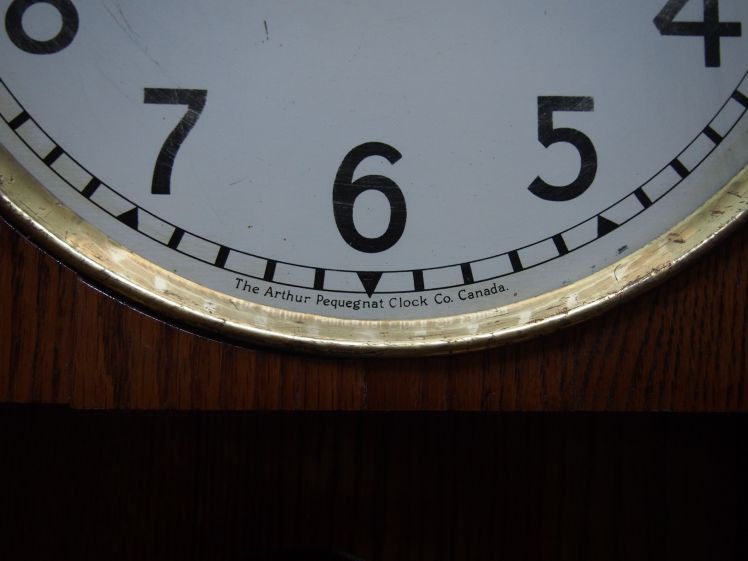
Most Arthur Pequegant clock movements are stamped with the company name but there are no date marks on movements indicating when it was made. Clocks made after the First War wore the company name plus Canada under the number 6 on the dial face. For example, clocks such at the Canadian Time were made from 1904 to 1941 and are separated in age by the Berlin label consequently, my Canadian Time wall clock with the Canada label could be as old as 104 or as “new” as 80 years old.

One distinctive feature on many movements is the use of nickel plating for both brass and steel plates.

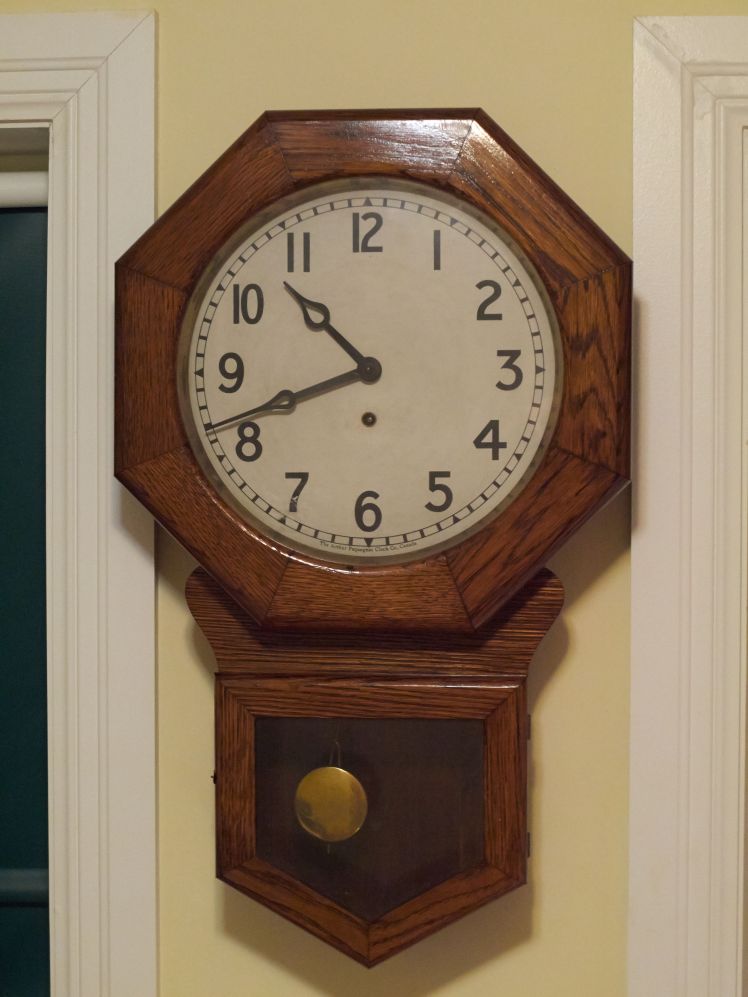
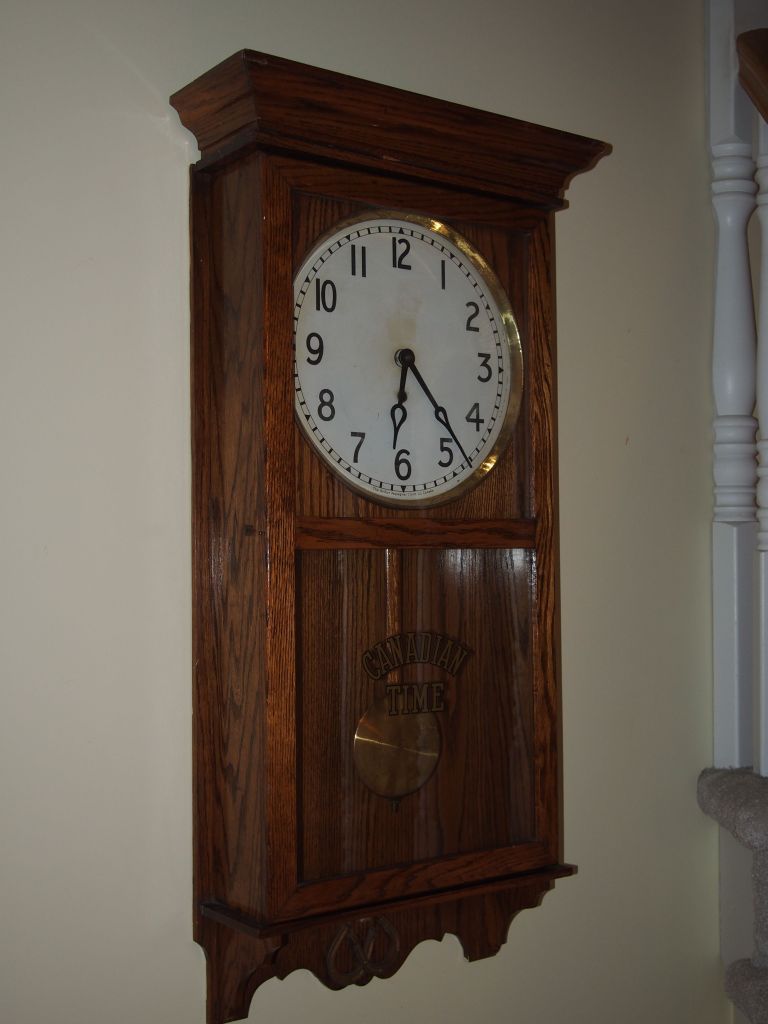
Clock face Arthur Pequegnat Canadian Time clock
Arthur Pequegnat Company name

Many models continued in production right up to 1941. By 1941, the demands of World War II armament makers for brass, the essential ingredient in clock movements as well as the growing popularity of the electric clock, forced the Arthur Pequegnat company to cease production.

And now, beginning with the first clock acquired in 2013.

The Canadian Time

My first Pequegant, purchased in September 2013 hung in the Intercolonial Rail Station waiting room in Pictou, Nova Scotia.

Canadian time clock
Canadian Time

The seller arranged the purchase of the clock just prior to the station’s decommissioning in 1993. It is in very good condition, missing its door clasp but otherwise intact. There are a few scratches and nicks consistent with its age but nothing objectionable.

The Brandon (2nd edititon)

I found this clock in an antique shop just outside Truro, Nova Scotia in 2014.

Arthur Pequegant Brandon II

The case is in excellent condition but the movement was quite worn. Had I known more about servicing clocks at the time of purchase I would not have sent it to a clock repair specialist. It is one of two in my Pequegant collection serviced by someone other than myself. This is the Brandon II. The Brandon 1, the first edition, was made prior to 1918, and had an ornate pressed wood bezel. This one is simpler in design.

The Maple Leaf “Fan-top”

Next came my first Maple Leaf kitchen clock, known for its unique lower tablet of scattered maple leaves and a distinctive maple leaf pendulum.

Arthur Pequegnat Maple Leaf kitchen clock

This clock, bought in 2015, was also serviced by a clock professional. The case was in very poor condition. Stripping a case is an absolute last resort as far as I’m concerned but the finish on this clock was pretty bad. I could not leave it as it was.

The finish on a Pequegnat fan-top clock

To Pequegnat collectors, it is known as the fan-top.

The Simcoe

Three years later, the Simcoe followed me home. It was bought at an antique shop in Victoria, British Columbia in  2018.

Arthur Pequegnat Simcoe mantel clock

It is not particularly attractive. It is the only mantel clock in my Pequegnat collection and it is from the “Berlin” period.

The Bedford

2018 was a good year because I acquired 4 Pequegnat clocks. This was number two of that year.

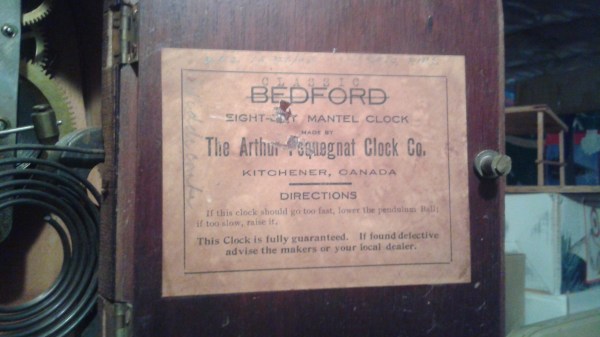
Restored Athur Pequegnat Bedford mantel clock
Bedford shelf clock

This clock was gifted to me by a reader. He asked if I wanted the clock but I had to pick it up in Quebec which was on our way to a summer cottage in central Canada. The movement was in very good condition but the case was damaged having taken a plunge off a high shelf.

The movement was serviced without issue but the case required extensive intervention.

The third purchase that year and the fifth in my collection is the Maple Leaf Pointed Top

The Maple Leaf “Pointed Top”

There are 4 Maple Leaf clocks made by Pequegnat. Any version of the Maple Leaf is sought after by Canadian collectors but this one has distinctive pointed side columns, hence the nickname.

Arthur Pequegnat Maple Leaf Pointed Top

Although termed a kitchen clock it could easily have been placed in a living room or parlour.

The Moncton 

The last 2018 acquisition was a clock that I had in the back of my mind for quite some time and I was waiting for the right price. This is an excellent copy that is very presentable and looks great on our kitchen wall.

Arthur Pequegnat Moncton

It is a post-Berlin double spring time-only 15-day clock. Many were used in rail stations despite the fact that they were spring-driven. Weight-driven clocks were preferred for their accuracy but the Moncton was up to the task as a timekeeper.

And the last.

The Canuck 

This is the only true Pequegant “gingerbread” clock in my view.

Arthur Pequegnat Canuck kitchen clock
Canuck kitchen clock

The case was refreshed and the dial was redone. The movement was also serviced without issue.

Cleaned up more presentable

These are all keepers. Most Pequegants have kept their value over the years and in Canada, they are regarded as quality clocks for the masses. They were well built, well-designed movements with a distinctive Canadian charm as many were named after cities in Canada.

A hall clock would complete my modest collection.

Servicing clocks and dealing with clock suppliers

I want to share my experiences dealing with clock suppliers and let me begin by saying that my experiences have been largely positive.

I have been repairing and restoring clocks for the past 10 years and since I live in Canada I generally deal with one mechanical clock parts supplier out of Toronto, Ontario, Perrin. They are excellent for most of my needs, but they do not have everything and from time to time I must locate special or unique parts through other suppliers such as Merritts, Timesavers, and Ronell from the USA and Meadows and Passmore in England.

For example, I recently completed the restoration of an Ingraham Grecian shelf clock, circa 1871, and it required a new set of hands. The hour hand that came with the clock was too short and the minute hand was the incorrect style. My goal in this case is a clock that is as authentic looking as possible and incorrect hands always takes away from a clocks appearance.

My Canadian supplier did not have the correct hands and eventually my search brought me to an out-of-country supplier, Timesavers.

Ingraham Grecian Harris and Sons auction photo
Ingraham
Ingraham Grecian with correct sized moon hands

Had I ordered just a set of hands the shipping cost would have been substantial.

In order to justify the purchase I added additional parts; 2 smoothing broaches, a Seth Thomas #2 maintaining spring, brass weight cable, a riffler set, and a bob wire set. The total came to $36US. The shipping and processing fee is $24US. Factoring in the rate of exchange the order cost me $82CDN.

If my Canadian supplier had everything I needed the cost would have been $20 less. It was not a significant difference in this case but it was worth it to find the correct hands.

What are the costs?

The sourcing of parts from various suppliers especially outside Canada can be expensive when administrative costs, shipping fees, exchange rates and import duty are included.

Some suppliers, however, require a minimum order. Others apply a credit card fee for international transactions, still others apply a processing fee and occasionally there is import duty. In almost every case the cost is higher and in some cases, it may not be worth it.

There are a number of choices for shipping but the cheapest method is not always “cheap”. Ground shipping in Canada is fairly inexpensive. Many out-of-country suppliers ship by air and the cost can be significantly higher.

That little $2.99 part can easily cost $20 or more after all costs.

Parts Availability

Seth Thomas Regulator #2

Not every supplier is going to have what you want. There are similarities from one supplier to another but there are also differences. For example, one is likely to find brass carriage clock feet from an English supplier because bracket and carriage clocks are much more common in that part of the world. English suppliers will also carry more tall case, and carriage clock parts and obviously, American suppliers will have many parts for clocks made in the USA.

The upside is that by knowing the various suppliers and their inventories I am able to satisfy most of my clock parts needs. If I only need one part I will always add additional items to justify the shipping and other costs.

My strategy for sourcing parts

If I were in the clock business and required one part, I would pass all costs on to the customer. I do not run a repair service and can afford to put a project aside if it needs parts and wait till I can justify an order.

I build a list of parts using an Excel spreadsheet, and when I feel there is enough to justify an order I pull the trigger. I can afford to wait.

As far as prices are concerned, companies such as Timesavers in the US have locked in their prices till 2022 while prices for some items at Perrin, a Canadian supplier, have increased marginally in the past year. Still, I buy Canadian when I can.

When ordering, if there is an offer of a free parts catalogue I always ask for one.

I also take advantage of every opportunity when I find pendulums, clock keys and other sundry items in flea markets and antique shops and snap them up, IF the price is less than I would buy from a supplier.

Clock parts are not cheap. If you are looking at clockmaking as a hobby factor in the cost of basic and more advanced tools but know that consumables can cost much more in the long run.

From my experience, most suppliers are excellent to deal with are and the service is speedy and professional. Just be mindful of all those other fees. It can really add up!

What’s the difference between an antique and a vintage clock?

There is enough confusion among clock collectors and owners of antique and vintage items that it prompts a discussion.

The terms vintage and antique are often used interchangeably, and often incorrectly.

Vintage or antique, Seth Thomas adamantine mantel clock C.1911

According to the United States Government, the term “antique” is reserved for valuables that are over a century old. Webster’s dictionary defines an antique as a work of art, piece of furniture, or decorative object made at an earlier period and according to various customs laws at least 100 years ago. Wikipedia defines antique as applying to objects at least 100 years old. Therefore, most sources define the term “antique” as items that are 100 years or more.

The word “vintage”, according to eBay, is a defined period that is less than 100 years but more than 30 years. To many, vintage often means anything that is not new, is dirty, worn, or looks like it might be old if nothing is know about its provenance.

Vintage Fleet Time mantel clock C. 1936

The word vintage is as overused, and misused, as the word “antique”. 

The use of the word vintage in auctions is becoming used moreMost often the seller who knows nothing about what they are offering for sale will use the term vintage or even “rare” and hope the buyer is convinced. 

Some items that were considered rare many years ago are common today. Take the 30-hour ogee clock which was once considered rare but with the advent of the internet thousands were offered for sale and prices dropped accordingly. “Rare” then became “antique”. What is truly rare today are one-of clocks that have an significant provenance.

The word “collectible” is another clever marketing term, and like the word vintage, has been misused. It presumes that the item offered must be added to what you already have and because it is the one piece you need the most, it will cost you more.

Jewelry is an interesting example. Anything over twenty years old is considered vintage. Some terms like “near” vintage and “true” vintage are often used. I assume any number of years can be assigned to “near” or “true” although “near” seems to mean “almost new” and sounds better than the word “used”.

George H Clark 30-hour ogee clock
Antique George H Clark 30-hour ogee clock

In my view no quartz clock has any value. However, in 1970, Junghans invented the Astor-Quartz wristwatch which entered series production in 1972. Watch collectors everywhere would consider the Junghans quartz watch to be a highly collectible vintage timepiece even though it is quartz.

Take the time to research your prospective purchase by consulting various sources which will inform you of the age of the clock you are shopping for.

Some clocks can be dated precisely by serial number, patent date or date stamps on the movements. Many clocks can be dated with some accuracy but often it is a challenge at times to determine the age of a particular clock unless you compare the style and movement type with others of the same period.

Canadian time clock
Vintage or antique Canadian time wall clock

In my collection is an Arthur Pequegnat Canadian Time clock which is quite old but I do not know it’s exact year of manufacture but I can place it within a range of dates. It was made by the company between 1917 and 1941. There is nothing noteworthy about the movement or style of the case that determines the year it was made.

Whether antique, vintage or collectible, if you enjoy your clock nothing else truly matters.

But, if you are selling a clock it is important to inform your prospective buyer and give them the best information possible to help them make a decision.

Fleet Time Clock – servicing the movement and then disaster

Fleet Time clock
Fleet Time Co. mantel clock

This Fleet Time, time and strike mantel clock is essentially a plain, garden variety clock with a walnut finish, flat front, a slightly domed top, and step-side features on corner feet. The dial is heavily tarnished and the glass bezel that should be soldered to the chapter ring is detached. These bezels often go missing and at least this one came with the clock.

The clock has some issues, none of which are insurmountable. The plan is to refinish the case, attach the bezel, clean-up the dial or replace it, install new glass, and service the movement.

In this post servicing the movement is the focus.

The movement looked reasonably good when I received it and it may have had some bushing work done in the past but once apart it was clear to me that it might never have been worked on beyond a cleaning. It ran when I got it and one is tempted to leave it as is but it was dirty, had some wear and long overdue for a good cleaning.

Servicing the movement

Fleet time movement
Fleet time movement

Disassembly and testing for wear

I discovered two troubling issues when I had it apart. I put the wheels together to check for wear and I noticed the escape wheel was a fair distance along the arbour from its correct position adjacent to the leaf pinion (no photos, sorry). The pallets were contacting the very edge of the wheel. My staking set comes in handy from time to time and it was needed to close the gap between the wheel and the pinion.

staking set
staking set

Using light taps from a hammer and an appropriately sized punch I drove the wheel closer to the pinion. The pallets now contact the middle of the wheel as they should. Odd!

Fleet time movement
Fleet time movement, dirty and in need of a good cleaning

The second was an erratic beat during the testing phase of the time side. With a beat amplifier connected, I could hear the movement go ever so slightly in and out of beat, yet the movement continued to run. There are a number of possibilities but one is a bent escape wheel arbour which, in this case, was the culprit. Bent arbours are not difficult to straighten but care must be taken to bent them carefully so as to prevent a break. A broken arbour can be a very frustrating clock problem.

Once the 2 issues were out of the way it is on to cleaning the parts, inspecting and polishing the pivots, pegging the pivot holes, followed by bushing work. Most of the bushings that were installed were on the strike side. In fact, 4 of six, 3 on the backplate and one on the front plate, strike side, and the two on the time side were on the second wheel. Two were 2.5 OD bushings. I work on a lot of American and European clocks and cannot recall using bushings that small.

Testing

After cleaning and bushing work is completed the rack, snail, levers, and strike hammers/levers are attached.

Since the star wheel is on the outside of the plate I thought attaching the strike hammers would be simple. Not so much!
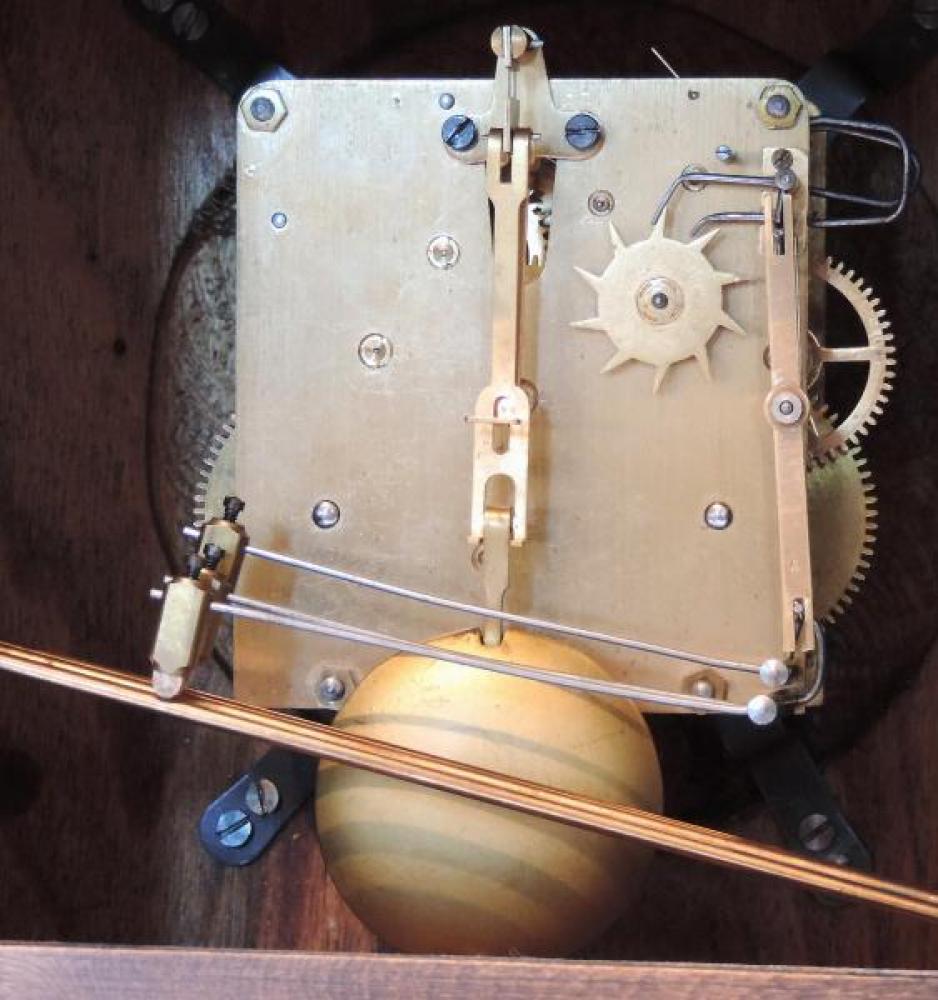
Fleet Time movement
Fleet Time movement, star wheel paddles

Again as in all movements with star wheels, the strike paddles must sit between the star points. One was fine, the other hung on the tip of a point. Rather than attempt to force the star into position, the strike side was partially disassembled and the star wheel was re-positioned. Yes, it meant removing wheels on the strike side to change the orientation of the star wheel but it is best to do it correctly rather than risk damage to the gear.

On this movement, the mainsprings can be removed without disassembling the movement. Handy for such things as replacing a broken mainspring and making the above adjustment.

Fleet time movement
Fleet time movement

The movement was on the test stand for two eight-day cycles and now it is time to return it to its case.

Just when everything seemed to go well – disaster 

I polished the 3-rod gong and mounted it and the movement within the case. I wound the strike side fully and then wound the time side. Just as I was feeling resistance, CLUNK, and then the arbour turned freely. Did the mainspring slip off the winding arbour or, did the mainspring break?

Sourcing a mainspring is not a problem but when I removed the barrel I discovered two broken and one bent tooth on the mainspring barrel plus a broken mainspring. Make that three broken teeth since a bent tooth cannot be straightened.

Broken and bent teeth

I do not have the specialized equipment to make and install new teeth and sourcing a 60 tooth barrel that is the exact height and depth would be a challenge. Worse, the catastrophic shock of the broken mainspring took out one leaf of the second wheel pinion. 

When the mainspring breaks on the arbour end, which occurred in this case, the power is released uncontrolled, and causes damage to the barrel, the second wheel or both. When the mainspring breaks at the other end it tries to unwind and the loose end provides sufficient resistance, that is, a much slower release of the energy, and is less likely to cause major damage. In the latter case the mainspring is the only thing that is damaged and it can be easily replaced. In the former, both the barrel and second wheel need to be repaired or replaced.

This is an unusual situation, but it happens.

Fleet second time wheel
Fleet second time wheel with bent pinion leaf which cannot be straightened

The movement was aside to consider next steps. In the meantime, the plan is to locate a donor movement. The power was let down on the strike side, and everything was placed in a sealed plastic bag and marked for storage.

I’ll be honest, this situation bummed me out and it took a week to return to servicing another movement.

The clock case

The plan, after servicing the movement, was to devote a separate post on the case but since the movement is non-functional there is not much point. While the movement was on the test stand, I spent hours on the case, stripping, finishing, and polishing including swapping out the dial and broken glass with one from a Blackforest clock from the same period (both companies used the same suppliers). The case came out better than expected but now there is no movement to put in it.

Fleet Time case
Fleet Time refinished case and replacement bezel and dial

The most disappointing part? I was at the very end of the project. The movement and rod gong were installed in the beautifully reconditioned case and I was preparing it for its first run after having tested it for two weeks. I did not expect it to go out with such a destructive bang.

Broken time-side mainspring

I asked a clock friend for some advice. He says that although the barrel teeth and leaf pinion can be fixed it is usually not worth it because the process is so time consuming. “What do you do?”, I said. “I collect movements that are used as donors for times such as this”, he replied.

A sad end to an otherwise satisfying servicing.

E. Ingraham Grecian – restoration of the case and dial

Ingraham Grecian Harris and Sons auction photo
Ingraham Grecian Harris and Sons auction photo (with permission)

This attractive shelf clock was bought on an online auction in early January 2021. From the auction photos, I expected a clock that required attention and now, having received it, I am pleasantly surprised that it is in better condition than I thought.

Under the auction studio light (first photo), the case might appear to look reasonably good. Closeup, there is a lot of oily dirt and grime. Servicing the movement will wait for another day. Restoring the case and dial is first.

Ingraham Grecian shelf clock
The vibrant grain of rosewood is there, underneath the grime

Restoration of the case and dial pan 

The design of the E. Ingraham Grecian 8-day time and strike shelf clock is neoclassical. It is not only aesthetically pleasing to patrons of the nineteenth century but remains so today. it is timeless.

The age-old debate about what to do with a clock case often arises. Some say, “leave it”, the finish, however grimy is part of a clock’s history. I am not of that camp. If I found the perfect classic car in an old barn I would not leave the dirt and grime on the finish to preserve its patina? Rather, I would polish it to show it off to the world.

This clock is not a candidate for stripping the finish. Stripping is a last resort. Good old fashioned soap and water work is perfect for a project such as this. 

Old clocks especially those that are over 100 years old are generally very dirty and the grime is layered. The home environment was a very different place a century ago. Smoking in the home was common, many homes had wood and coal fires for heat, humidity varied because of poor insulation and anything in suspension landed on the furniture. This Ingraham clock is no exception. The rosewood veneer deserves to be shown off and that can only be achieved by peeling off the dirt to reveal the texture of the grain underneath. 

Ingraham Grecian Harris and Sons auction photo
Ingraham Grecian Harris and Sons auction photo (with permission)

For cleaning, I prefer a light coloured microfiber cloth so that I can visualize how much dirt I am removing as I proceed with the cleaning. I use several during the course of the project. Diluted Murphy’s soap is used for the case and full strength for the stubborn areas.

Rubbing is required but I don’t want to get too carried away as the cloth might snag a piece of the veneer on a corner. I start with a discreet area first to see what effect the cleaning is having. Working one section at a time, I clean down to the veneer. Any shellac that remains will be removed during the cleaning.

The case looks bleached after the cleaning but a damp cloth will show the grain, the effect shellac will have once the cleaning stage is complete.

I let the case dry thoroughly before applying the first coat of shellac. Shellac is prepared in the traditional manner, flakes and lacquer thinner and mixed to a one pound cut allowing fast drying.

For this project, I applied 2 coats of shellac. Between coats, I used 4X0 steel wool to smooth out any imperfections.  After the second coat, I use steel wool to take away the glossy look of the shellac.

Next is the dial.

Ingraham Grecian shelf clock
Ingraham Grecian clock
Ingraham Grecian clock, the dial is detached from the bezel

Above is a photo of the dial when I received the clock. It is off-center because nothing is securing the dial face to the brass bezel.

Ingraham Grecian dial tabs
The rear of the dial, 2 new dial tabs

Two of the four tabs securing the dial face on the rear of the brass bezel were broken. The arrows show the two new tabs. I am not a whiz with a soldering iron and did the best I could but the results, to me, are acceptable. The thin brass tabs were sourced from a supplier. The tabs, once secured, are bent to secure the dial in place.

Ingraham Grecian
Ingraham Grecian

The numerals were in-painted. The dial was in generally good condition though there were losses outside the chapter ring. I mixed and matched paint to touch up the areas of paint loss, and installed a new grommet to replace the missing time-side one. The brass bezel, inner brass ring, and strike side grommet were polished with Brasso as the last step.

Ingraham
E. Ingraham Grecian shelf clock

The case and dial part of the project is complete and in a future post I will address servicing the movement.

Hamburg American Clock Co. – shelf clock, first look

This clock was an estate auction buy in early 2021. Since my wife and I were unable to bid in person we placed an online bid. So many estate auction houses are taking this very route that the days of people packing an auction house and bidding feverishly may be behind us. It was described as an unknown clock but I’d seen enough photos online to know that I had likely won a Hamburg American Clock Co. shelf clock. And, for a small shipping fee the clock was delivered to us a few days later by courier.

HAC was a well-known German company that was founded in 1883 and made clocks for a number of years before they were acquired by Gebr Junghans Uhrenfabrik or Junghans for short, in the late 1920s. I have a number of German clocks but this is the first HAC clock in my collection.

Bracket clock
Bracket clock, auction photo (with permission)

When I opened the box I inspected the clock for damage (there was none) and proceeded to look for the familiar cross arrows trademark on the backplate of the movement. I could see how it would have been easily missed by the auction house since the trademark was “hidden” behind the pendulum leader. Many HAC clocks have a trademark on the gong block, this one does not.

HAC trademark
HAC trademark

The case is a little tired and worn, especially the dial, but there is nothing amiss, no parts missing. The movement works but I am not sure what to do with a very tired looking dial face.

I pulled the movement out of the case to examine it more closely, inspect for any immediate issues, and proceeded to photograph it from different angles.

HAC clock
HAC clock, tired but working

HAC clock movement
HAC clock movement, backplate

HAC clock movement
HAC clock movement, front plate

Like other German movements, it is robust, well-engineered and has a certain industrialized look, even crude in some respects. The front and backplates are solid indicating that it was probably an early version of this movement. There are no “extra” holes in the plates that are often found in many other German movements, holes that are made for various functions for other styles of cases. Compared this to the #36 movement (below right) from HAC. At 8.7 cms by 10.9 cms this one is almost the exact size.

HAC clock movement
HAC #36 clock movement

The plates are almost 2 mm thick, suggesting a well engineered movement.

Movements on German mantel and shelf clocks from other manufacturers are typically bolted to a seat-board. On this clock, brackets on all 4 corners attach the movement to the inside front panel which is very American!
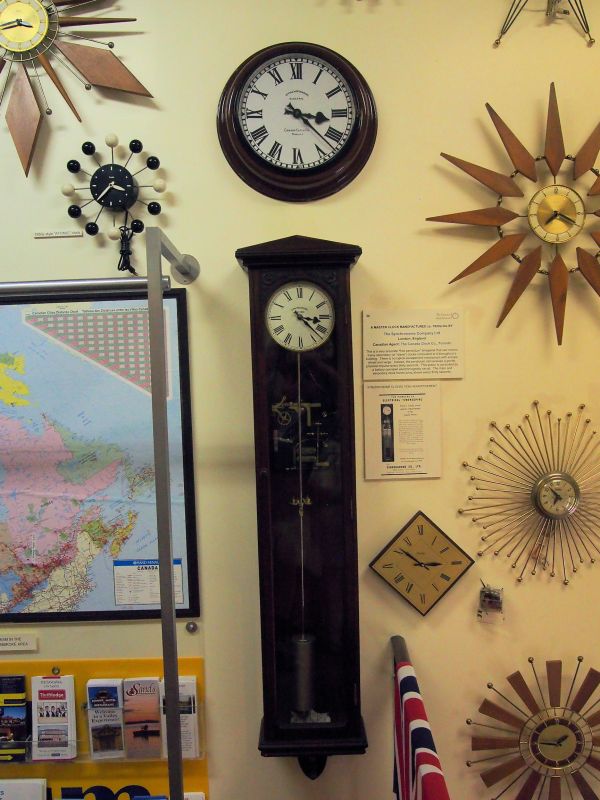
Numbers in the top left corner of the backplate,164, 42, and 130 tell the beats per minute, the number of escape wheel teeth, and pendulum length.

I am anxious to take the movement apart and look at ways to revitalize the case and dial.

This is an excellent winter project.

Daylight Savings – it is time to end it!

Daylight Savings Time has no place in our modern world. Of 195 countries in the world, approximately 70 countries observe Daylight Saving Time in at least a portion of the country. Japan, India, and China are the only major industrialized countries that do not observe some form of daylight saving.

Top showing face and crown detail
Face of a Vienna Regulator clock C.1870

70 countries must live with it.

Clock face showing moon dial
Face of a Ridgeway grandfather clock C.1996

At 2:00am Sunday, set your clocks ahead one hour if you live in an area where the convention is still followed.

Typically, regions that use daylight saving time adjust clocks forward one hour close to the start of spring and adjust them backward in the autumn to standard time. In Canada, we have a little expression, “Spring ahead, Fall behind” to make it easy to remember what to do twice a year. In Canada, it is the second Sunday in March and the first Sunday in November.

Case is in fair condition, dial face has some flaking
Canada Clock Co. cottage clock C.1883

How to set your mechanical clock(s)

  • Move the minute hand slowly clockwise to the correct time, stopping briefly for the quarter-hour on chiming clocks and the half-hour for striking clocks.
  • Do not move the minute hand backward as it risks damage to the movement. This should be regarded as a general rule, exceptions are some clocks where it is safe to do so (read your owner’s manual).

There has been a push to scrap the time-switch in Canada.

It is stupid, needless, senseless, and confusing.

Website Powered by WordPress.com.

Up ↑