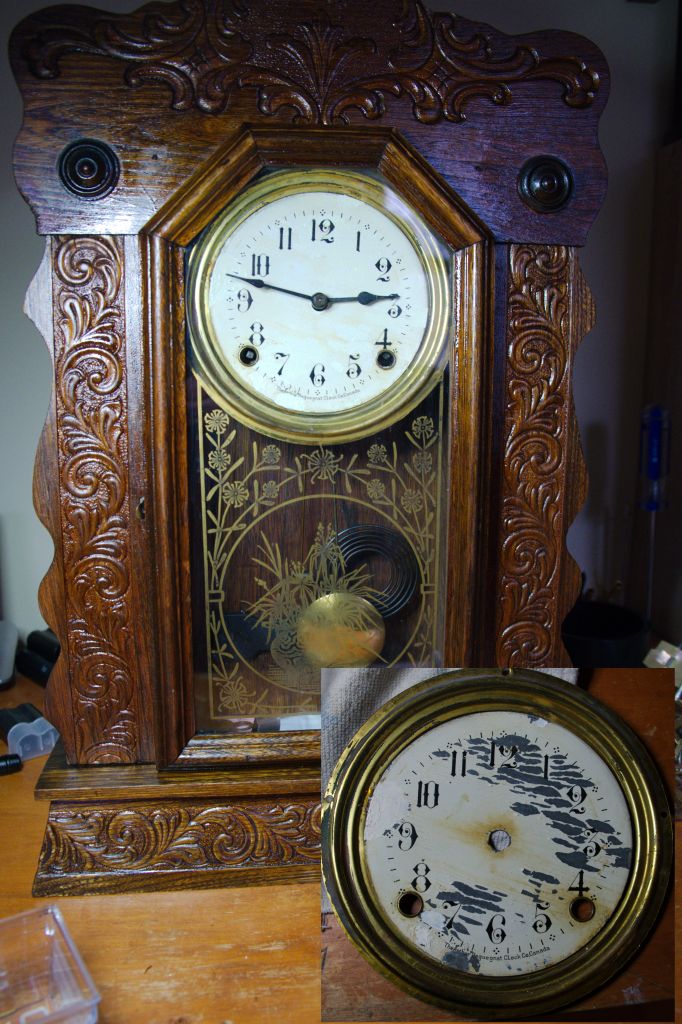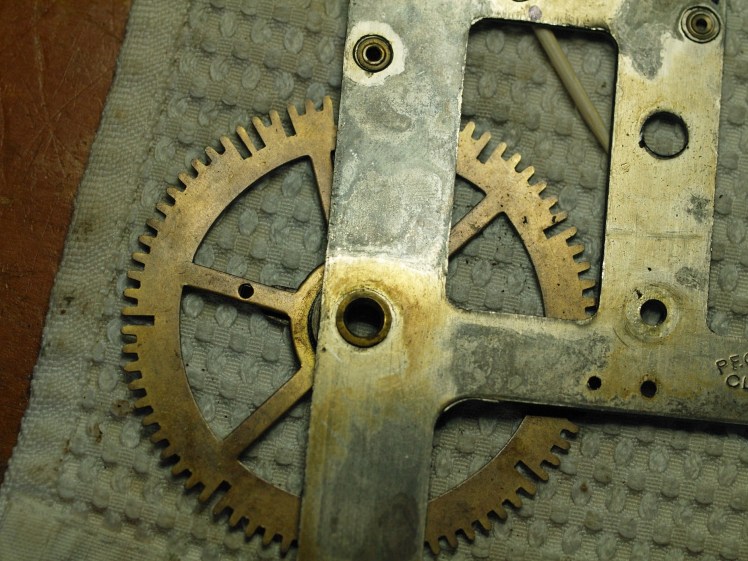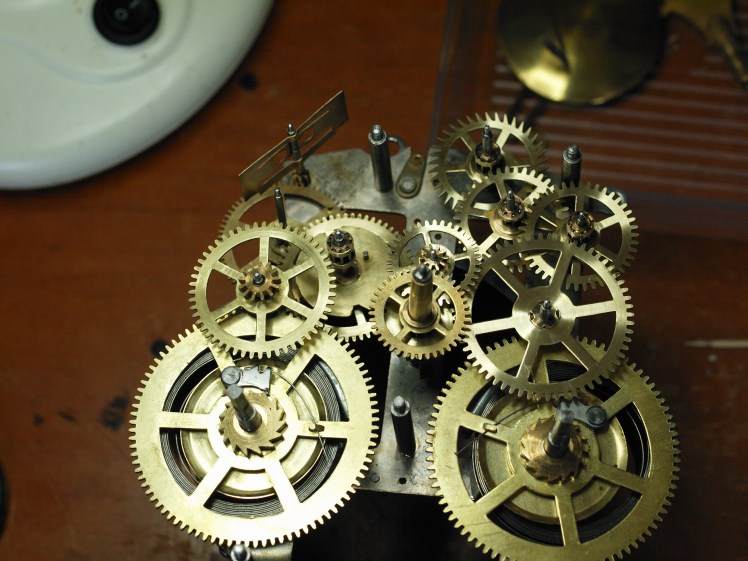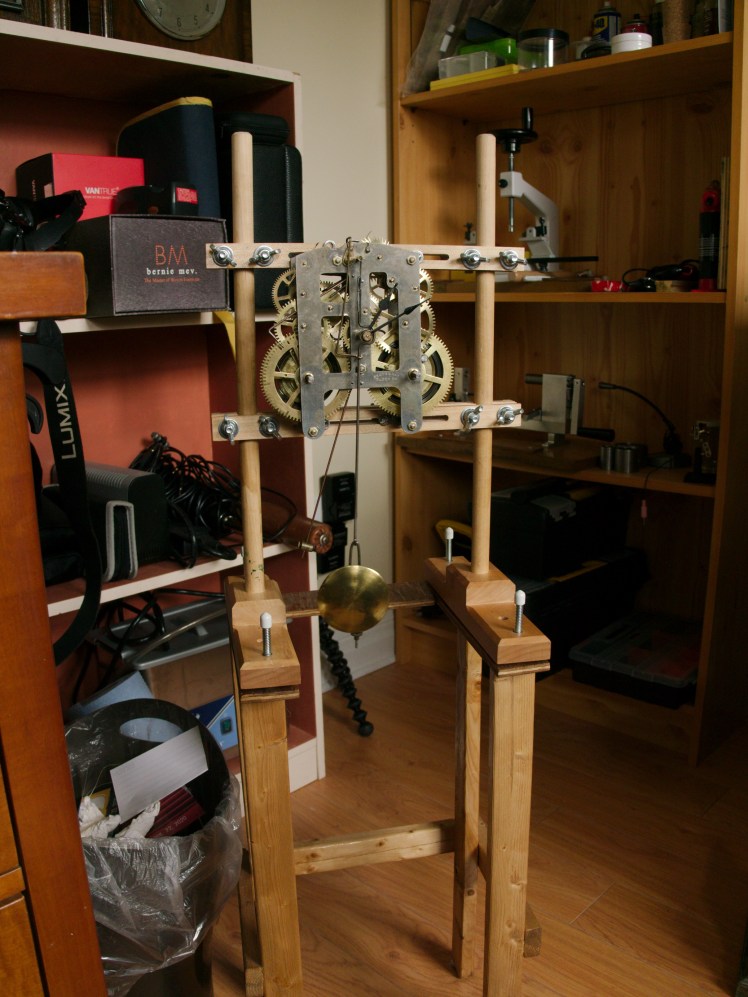
Daniel Dakota wall clock has stopped – why fix it?

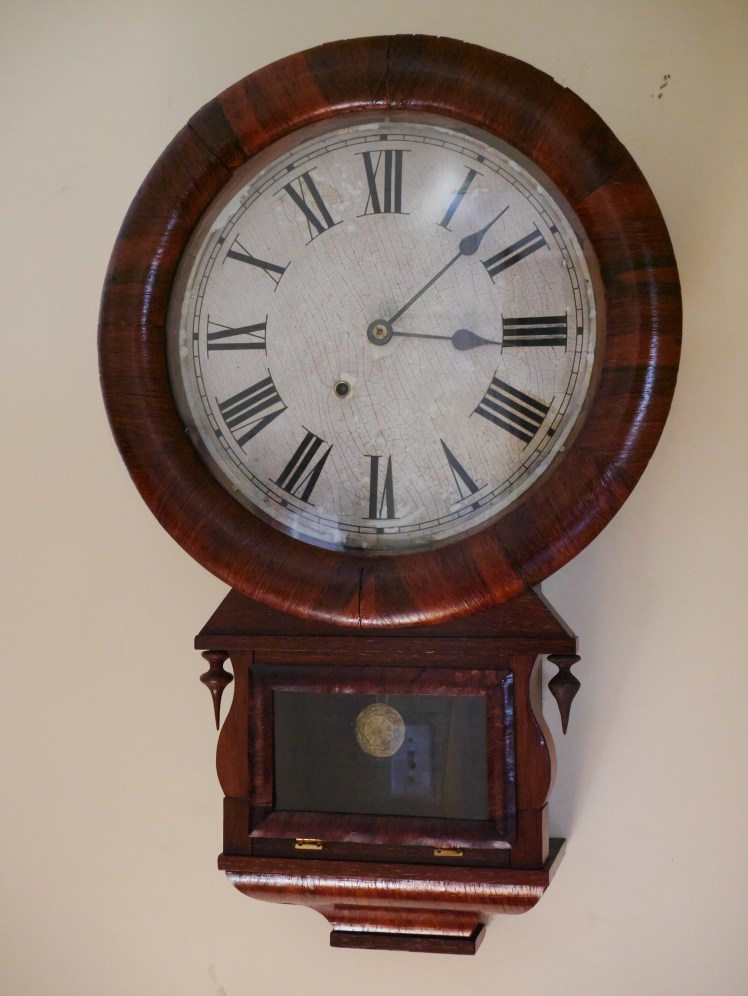
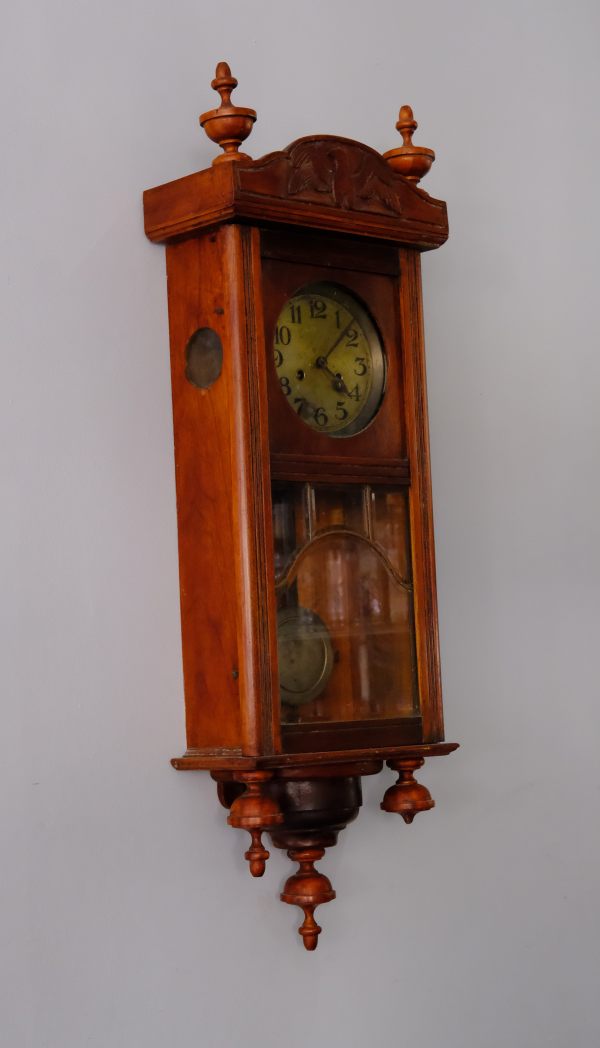
A Chinese-made vintage Daniel Dakota time and strike 31-day wall clock purchase will not set you back a lot of money. These clocks are everywhere and they were made in the many thousands. I would bet that 99% of them have never seen the inside of a clock repair shop. They have cheap movements which seem to defy death, they last forever or end up unceremoniously thrown in the trash bin.
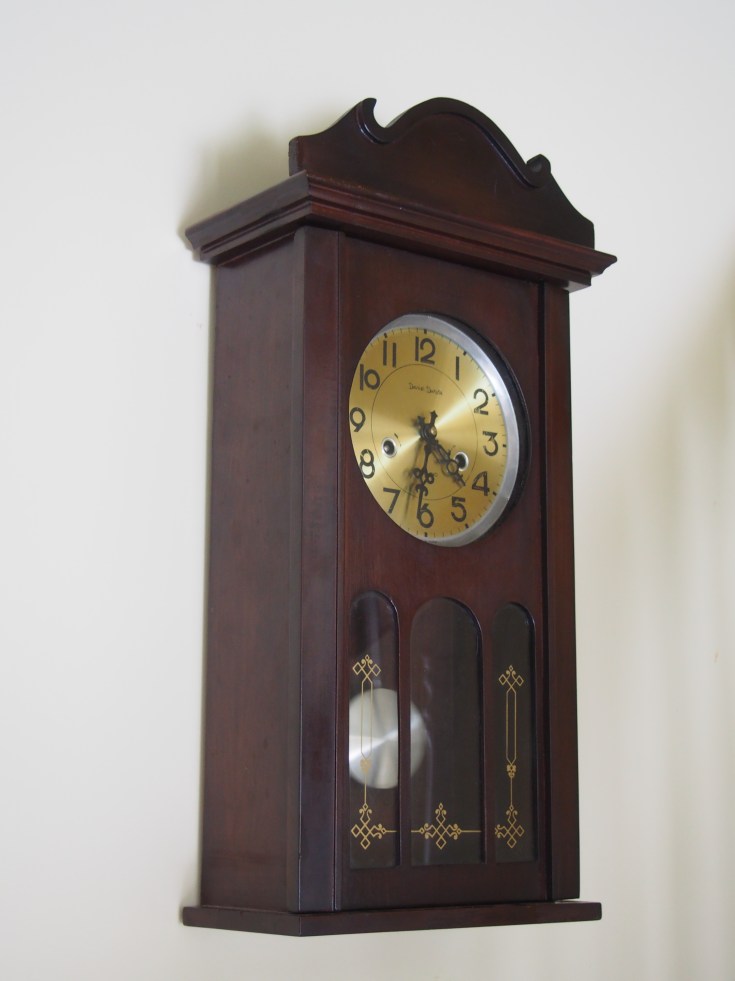
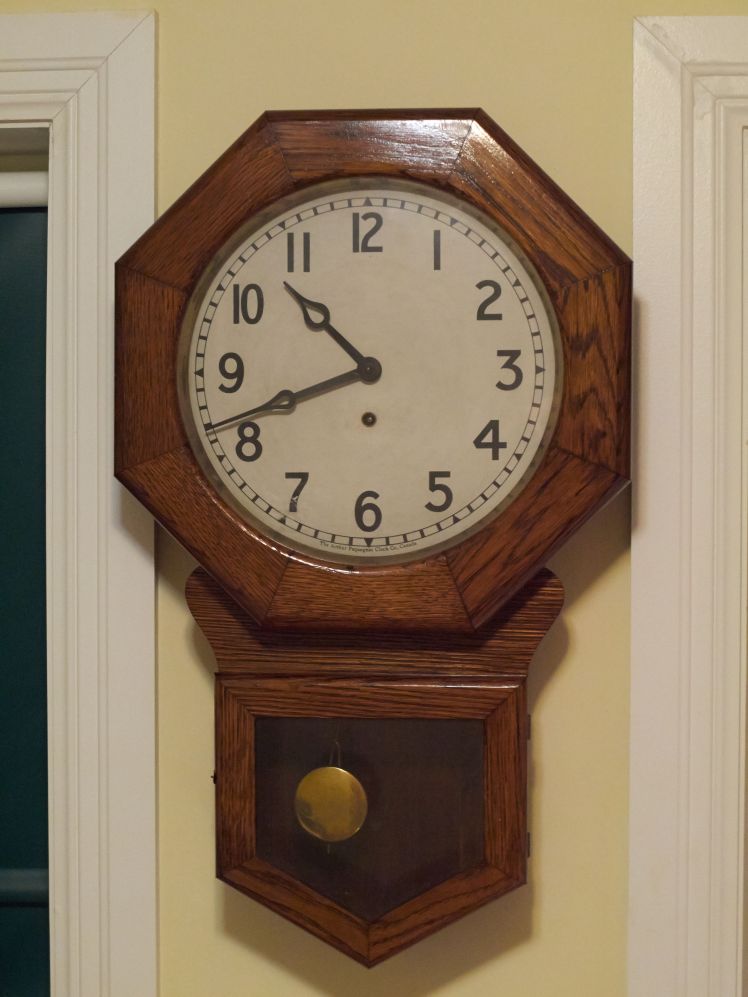
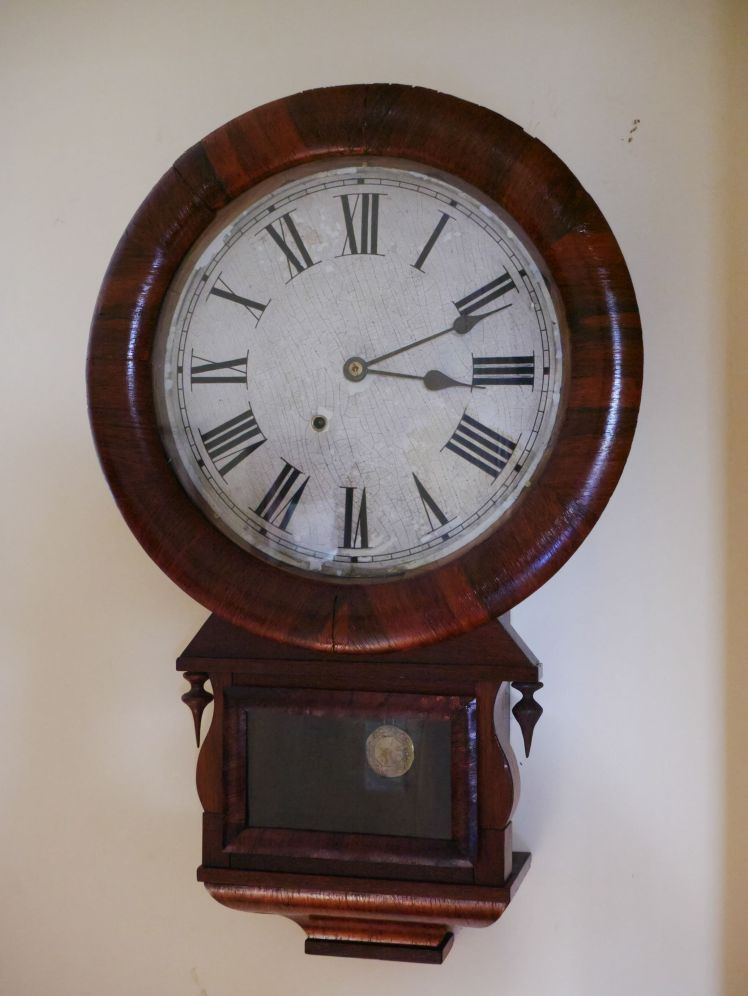
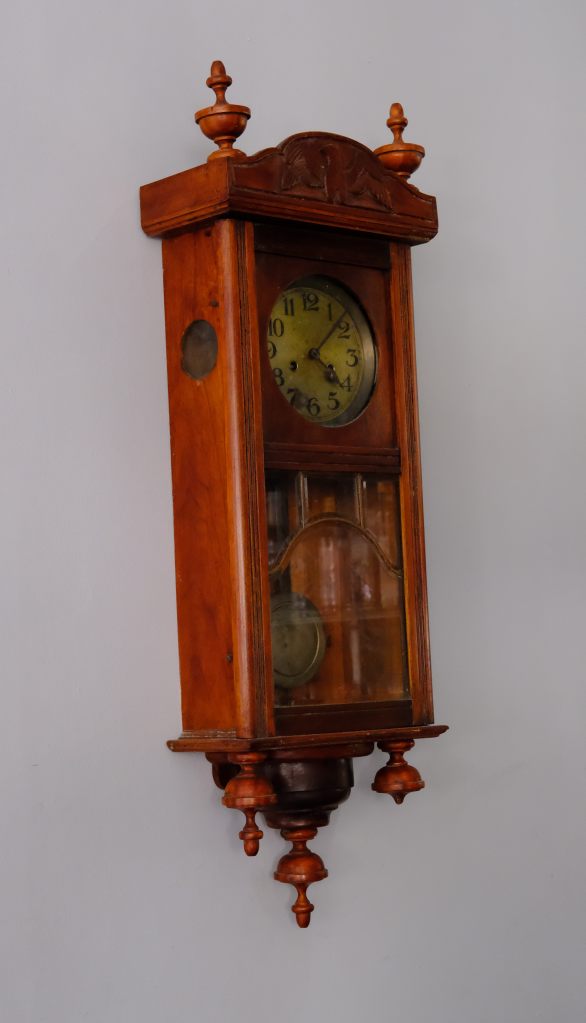
Daniel Dakota wall clock, one of Tempus Fugits more popular models
Daniel Dakota wall clock

The clock, which I bought in a junk shop some years ago, was gifted to a family member but it has been returned to me, not working; the boomerang effect. The family member has no desire to have it returned to them and I do not have a problem with that. Instead, I gifted them a much more refined German Schatz chiming bracket clock.

Chinese-made clocks have a design lifespan of about 20-25 years. They were never intended to be passed down as family heirlooms
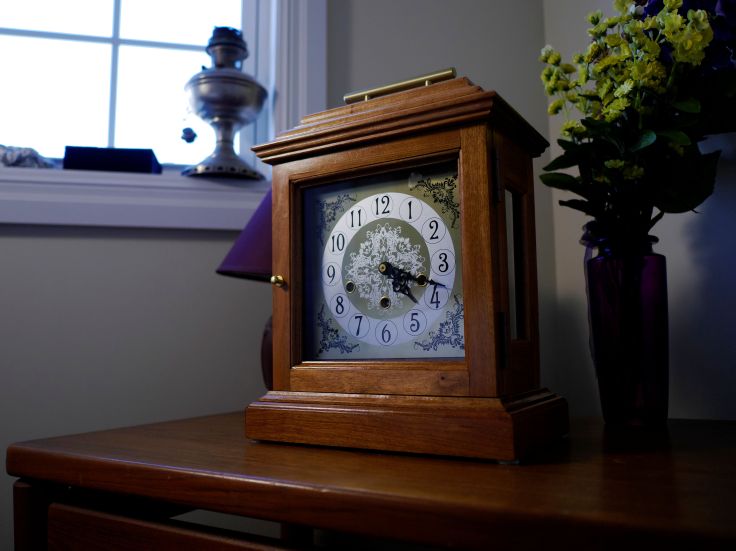
Schatz W3 in a custom made case
Schatz W3

On online for-sale sites, these things are ubiquitous. Sellers believe these vintage clocks are worth something judging by the silly asking prices on online for-sale sites. On any given day, you will find dozens on eBay ranging in price from $30 to $160 and they will find new homes for the unsuspecting. Most are quartz but there is the odd mechanical one.

This is a Chinese-made clock. Most Chinese (or Korean) clocks of the 1960s have inexpensively manufactured movements with thin plates, thin stamped wheels, plenty of clips and washers, long dangerous mainsprings, and have every component made with cost-saving in mind. During the 1960s and 70s, there was a strong demand for mechanical clocks and Chinese manufacturers stepped in to fill it. These are clocks made for the masses and were good sellers in their day but have a design lifespan of about 20-25 years. They are tough but were never intended to be passed down as family heirlooms.

The 31-day run times mean that the mainsprings are very powerful and if they let go they are sure to do some damage not only to the moving parts inside but to anyone handling them. It is one reason why many in the clock repair business stay away from them.

However, they are surprisingly strong runners and will provide service for years while quite worn. If they stop, the cost of repair is far more than they are worth. When they stop, quartz movements often replace mechanical movements or the clock is simply thrown out.
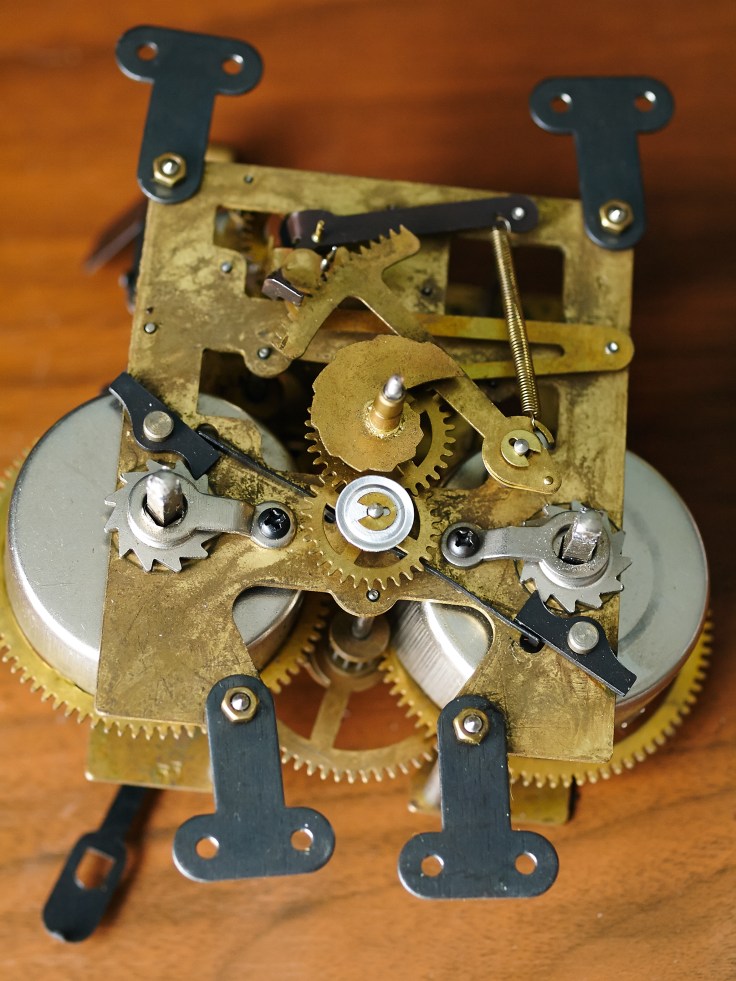
Daniel Dakota time and strike
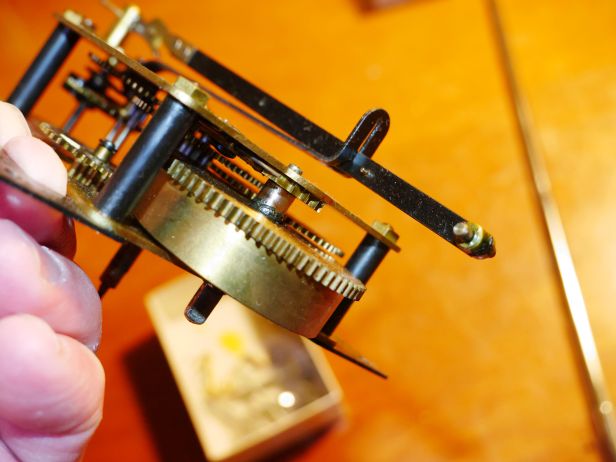
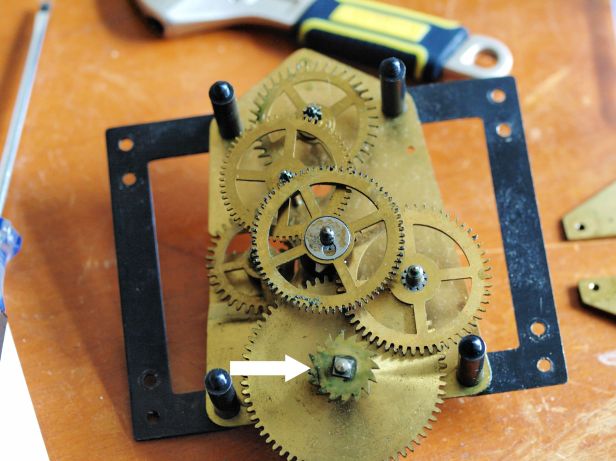
Daniel Dakota time and strike movement

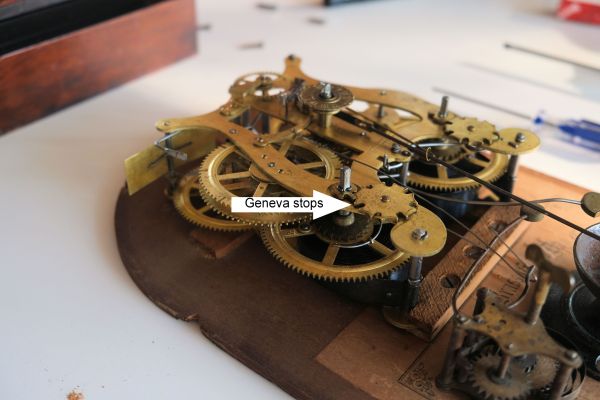
If you have worked on an English or German time and strike movement most everything will be familiar to you in terms of wheel placement since the Chinese copied existing designs. Some components like the fly and the star wheel are designed differently but their function is the same, of course.
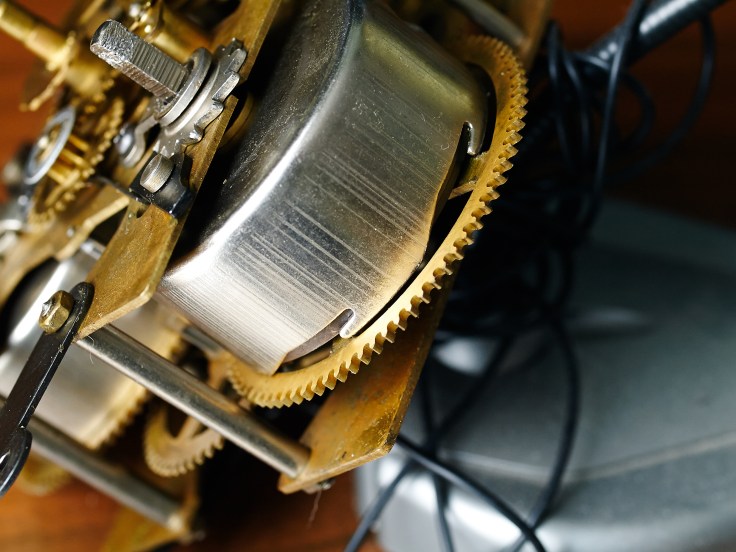
Daniel Dakota time and strike
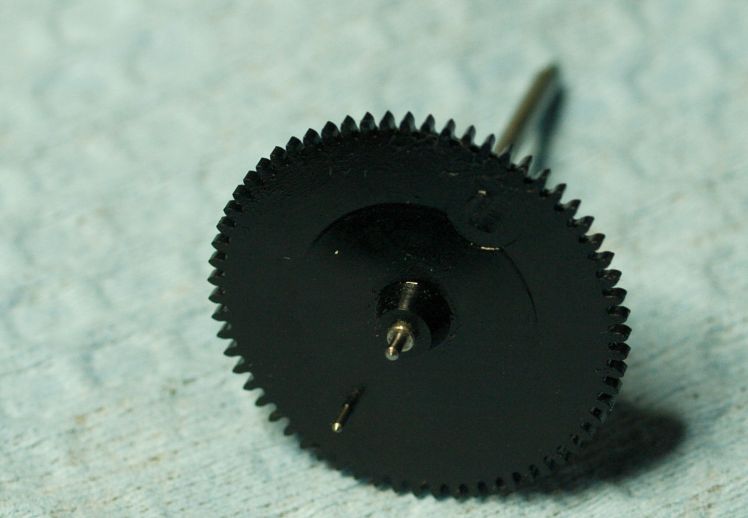
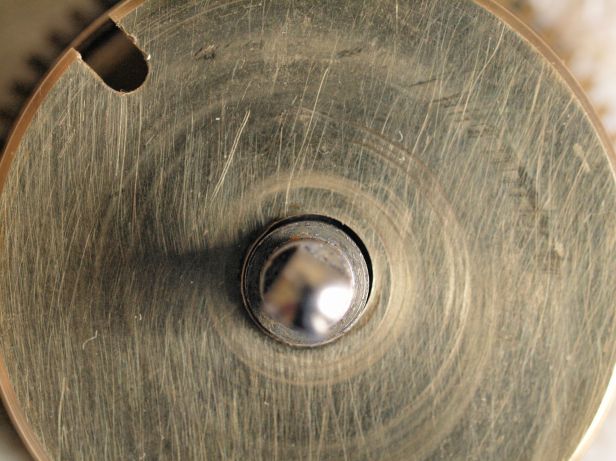
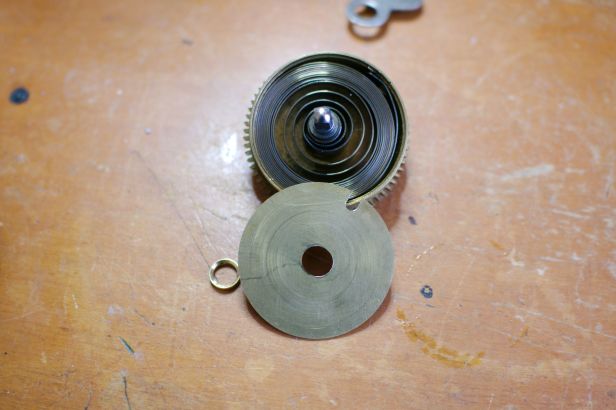
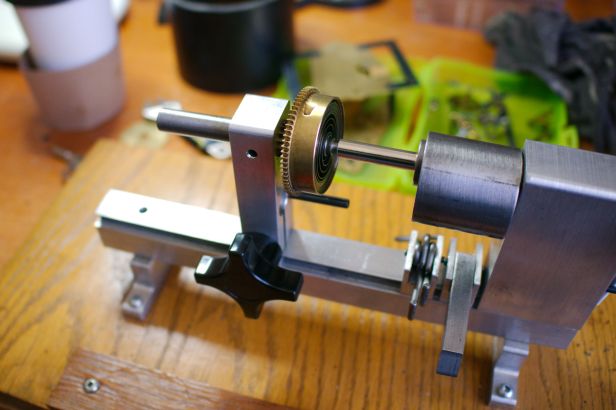
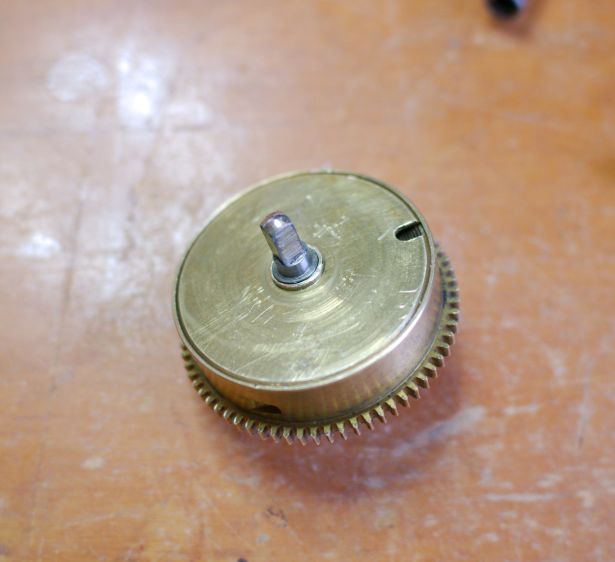
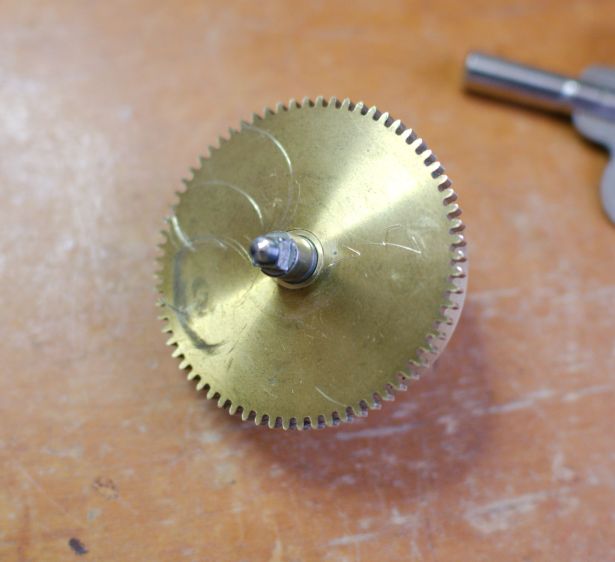
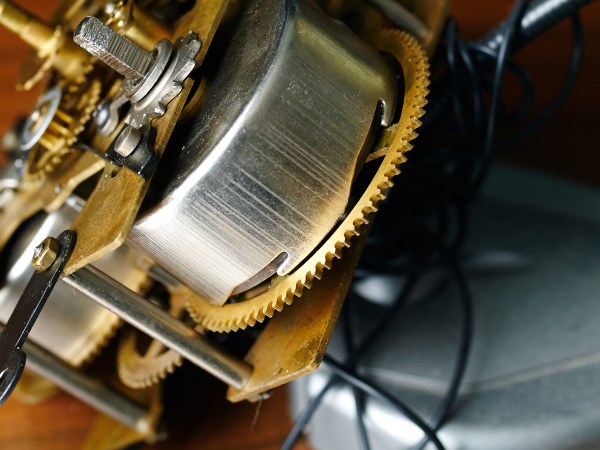
Daniel Dakota mainspring barrel where the barrel has decoupled from the wheel

What is very different are the dangerous twist-on mainspring barrels housing long, powerful mainsprings which are not fun to work on.
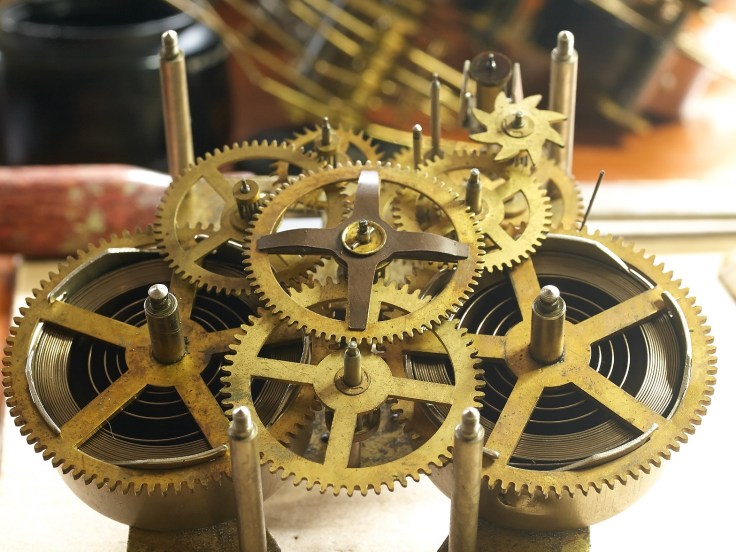
Daniel Dakota movement
Daniel Dakota movement; look familiar?

Why service the movement

Not surprisingly, these clocks can easily be brought back to life if there are no serious issues.

During the course of disassembling a typical Daniel Dakota movement, if I discovered something seriously amiss such as broken teeth, seriously bent arbours/broken pivots or broken mainsprings, I would stop immediately. There is no point in expending time, energy and expense on a throw-away movement. There is no source of parts for these things and if the type of repair offsets its value, there is no point. If everything looks relatively good, servicing makes sense and the only cost would be time and perhaps a bushing or two.

Let’s look at this movement

This came to me as a non-working movement. The movement is very dirty, the plates are tarnished, but the wheels run relatively free, the gear teeth have little wear, the pivot holes look good, the mainsprings are strong and none of the components appear to be damaged.

A deeper dive revealed some interesting issues. Once I took the movement apart I discovered two key trouble spots, a bent escape wheel pivot, and a bent flywheel pivot. It is a wonder that it even ran but no surprise that it finally stopped.

Bent pivots can be repaired. All the lantern pinions are in excellent condition, with no worn wheel teeth and the mainsprings are strong. There were punch marks around several pivot holes, likely done while the movement was assembled.

Repairing a bent pivot and cleaning the movement

Care must be taken when addressing bent pivots. If the pivots break while attempting to straighten them there is not much point in going any further on a cheap clock unless practice in repivoting is the goal.

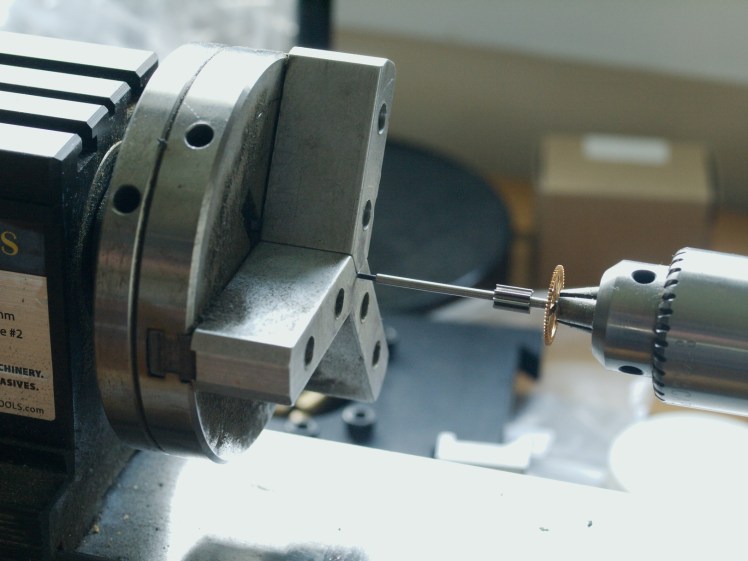
A lathe comes in handy but a portable electric drill will do. Place the wheel into the jaws and hand spin it to check the direction to bend it. Using a staking tool rather than a hammer means you can apply very little pressure, checking progress with each gentle bit of persuasion. It is soft steel and will take a little bending but don’t get carried away.
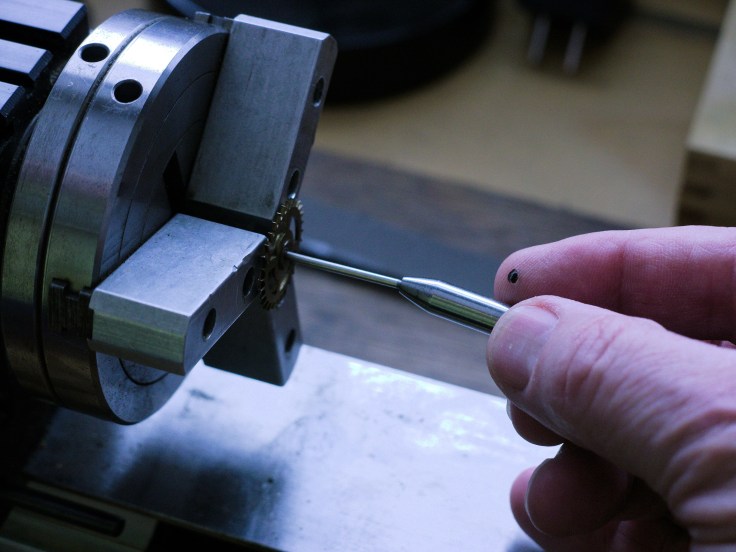
Daniel Dakota movement

Both the escape wheel and the fly pivots were straightened. All other pivots were inspected and everything looked good. Now on to cleaning the movement in the ultrasonic machine.

The parts were dried and cleaned but the ultrasonic machine did little to reduce the tarnish on the plates. The movement will function quite well without shiny plates, purely a matter of aesthetics.

Once the plates were cleaned and pegged out I could see very little wear. The only enlarged pivot hole is the second wheel time-side, backplate which is not surprising since there is a heavy load on this wheel from the mainspring. This required a 1.50mm bushing with an OD of 3.50mm.

Reassembly

Seeing no other bushings holes requiring remediation, the movement is re-assembled.

Once the bottom nuts for the barrels and second wheel and cannon wheel are put on and tightened, the time side wheels are secured and the corner nut is next. Once that section of the movement is in place, the strike side wheels are coaxed into position. This is where a pivot locator is your best friend. The pivots are thicker than those found on a typical German movement but can still be bent through rough handling.
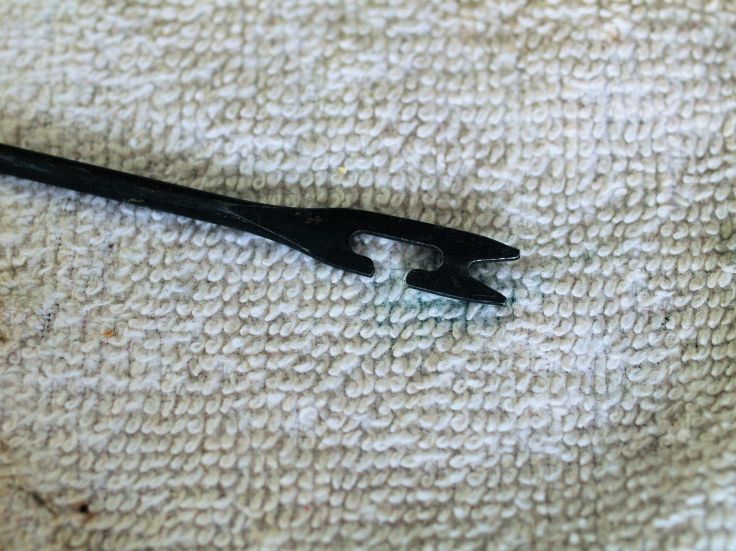
Pivot locator

Last, are the levers, snail, rack, and hour wheel on the outside of the front plate.

Final thoughts

Was the exercise worth it? Of course! I have worked on dozens of similar (English, German) types of time and strike movements I always find something that adds to my learning. These movements are easy to work on, are surprisingly strong runners when in good order and presented no issues during servicing.

In total, it cost me my time plus one bushing. Would I send this off to a shop for repair? Of course not! Why pay $250 or more to repair a clock that is worth almost nothing on a good day but for sentimental reasons it may be important for some.

Why fix it? To sell it, of course! I’ve had it a few years and enjoyed it, a family member has had it for a while and enjoyed it and now it is time to pass it on.
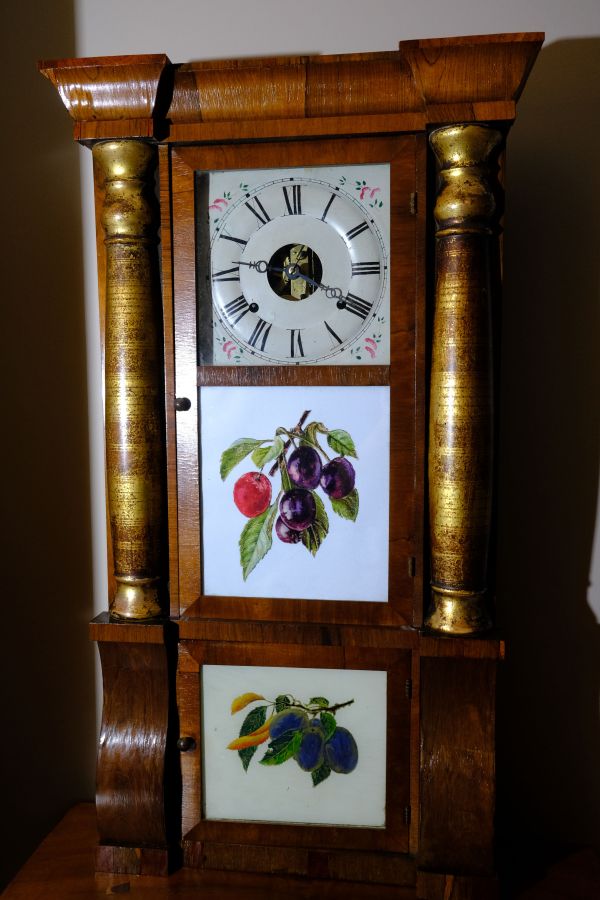
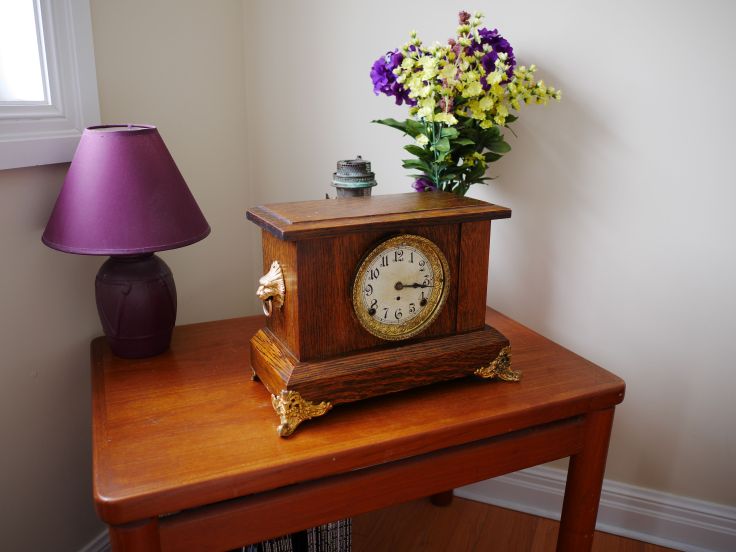
Variables that affect antique and vintage clock prices?


Arthur Pequegnat Simcoe
Canadian made Arthur Pequegnat Simcoe mantel clock, circa 1916, $300 (in Canada)

There are many types and styles of clocks and dozens of manufacturers. If you are a collector you know exactly what you are looking for and have a good idea of its approximate value. If you are not an “expert”, selecting an antique clock can be a daunting task. But this article is not about helping you find that special clock. It is about the variables that affect clock prices in 2021.

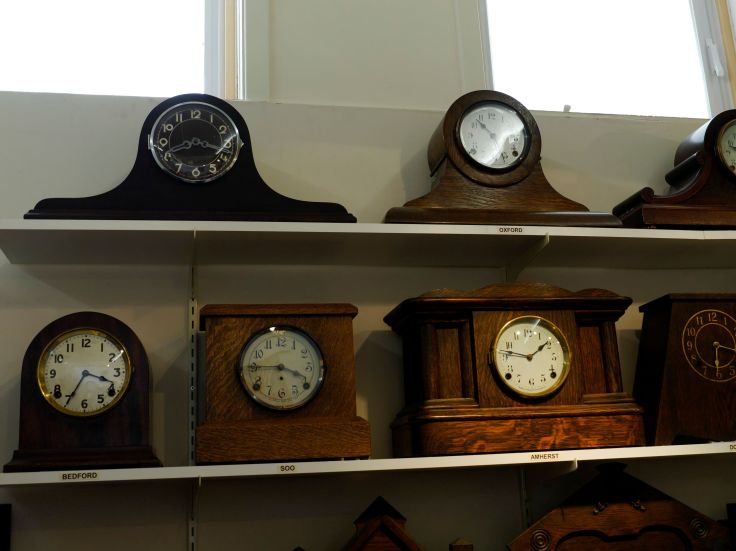
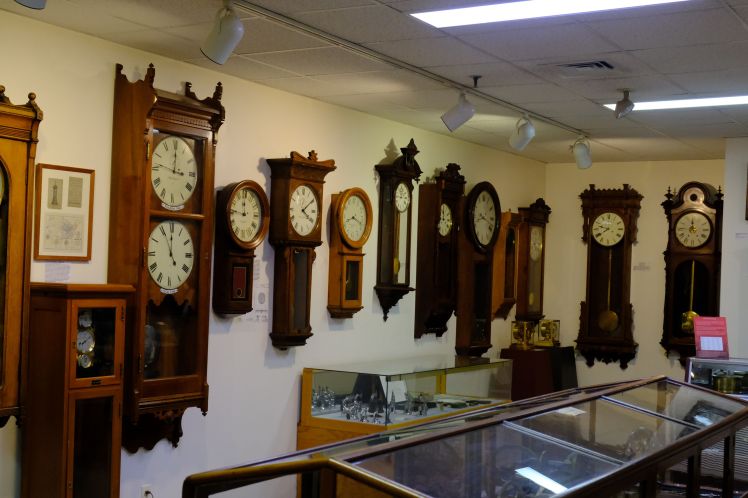
Mantel clocks on display in a museum

Over the years I have learned the value of many antique and vintage clocks. When I come across an interesting clock on an online for sale site or in an antique store I have several questions in mind. Is there anything special about it? When was it made? Is it rare? Is it historically significant? Is the price too high or too low and why? How much work must I put into it if it clearly needs TLC and will the seller accept a lower price? That said, I am prepared to walk away at any point.

For example, E. Ingraham clocks are common and can be had for very little money but the more desirable Ingrahams of the 1860s and 70s are those that Elias Ingraham had a hand in designing. The Ingraham Grecian is an attractive example of a clock that was designed in a period of American clock manufacturing where dappearance and uniqueness mattered.

E. Ingraham Grecian shelf clock C. 1870

Condition is important. One look at the case will tell me how well it was cared for. In my experience, it is pretty rare to find a clock that has been professionally serviced and many where a previous owner applied their limited skills to get it running. However, if you have the skills to service the movement and are handy at restoration, there are certainly bargains to be found.

If acquiring antique and vintage clocks is something you enjoy but have no knowledge of clock repair, the cost of servicing must be factored into the price particularly if you want it to run reliably.

Let’s assume that you are looking for an authentic antique or vintage clock that has not been altered in any way save for minor cosmetic touch-ups. What factors influence the price you pay for a clock today?

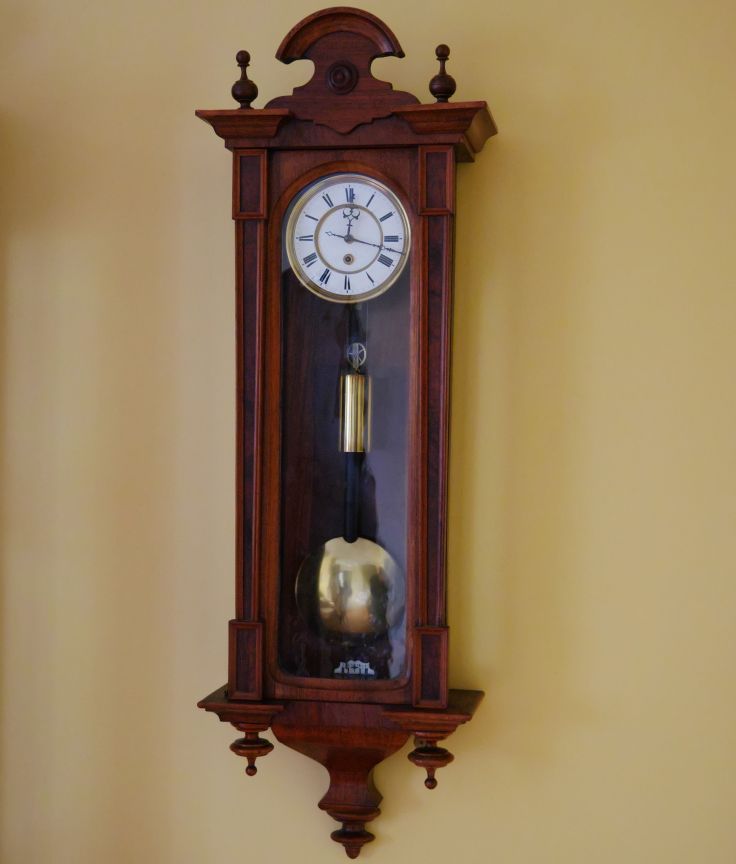
one-weight Vienna wall clock
Miniature one-weight Vienna regulator wall clock, unsigned, circa 1870, in the $400 range

Here is a list of factors I would consider in making your next purchase and why you would pay more for some clocks and less for others.

Variables that affect clock prices today

  • Wall clocks generally command higher prices than mantel clocks, the exceptions are Asian wall clocks and the like that have little value.
  • Most mantel clocks less than 100 years old have little value.
  • Clocks that come from a prominent collection that are well cared for and in excellent condition are more desirable.
  • Demand in your local area affects price; Canadian-made clocks are sought after in Canada whereas the same clocks are almost worthless in the US.
  • Weight-driven clocks are more desirable than spring-driven clocks. The exception is the modern weight-driven grandfather clock whose value has plummeted in recent years.
  • Condition is key, a clock in excellent condition is worth more than one in poor condition or with parts missing.
  • Running clocks are worth (generally) more than non-running clocks.
  • A recently serviced clock is worth more than one that has either not been serviced in a long time or never serviced.
  • The same clock may be worth more than others that are the same or similar if it has special provenance i.e. a well-documented tall case clock that came from Grover Cleveland’s home.
  • A clock with a replacement movement is termed a marriage by collectors. Marriages are worth far less than an authentic clock but acceptable by some collectors.
  • Any clock that has had its mechanical movement replaced with a quartz one is worthless.
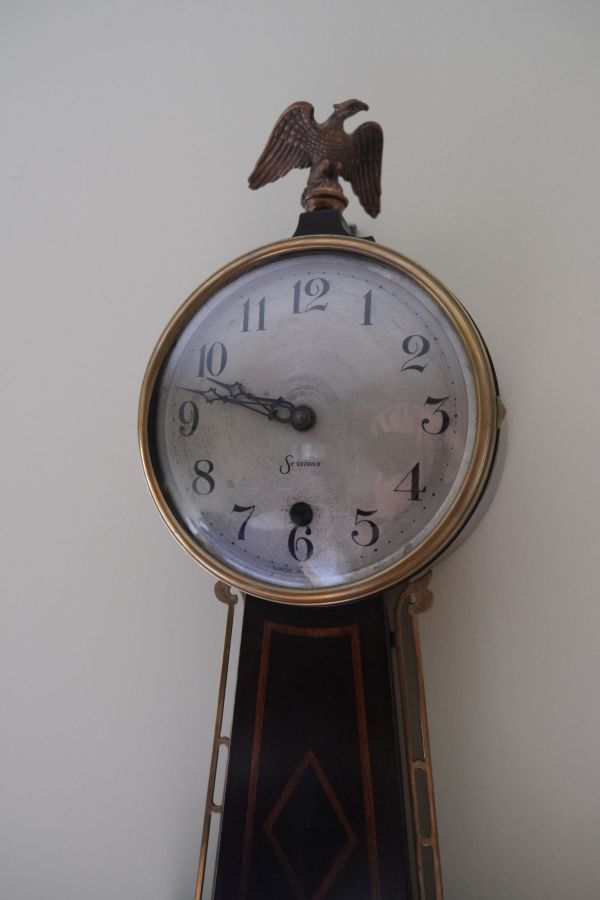
  • One of the largest factors in a clock’s value is the manufacturer. Many from Sessions Clock Co. are rather ordinary and relatively inexpensive but some Seth Thomas Sonora Chime clocks, for example, have good value.
  • Age does not always equate to a higher price. A clock that is 170 years old is not necessarily worth more than one that is 50 years old.
  • Mechanism type; double and triple fusee clocks and pinwheel regulators are worth more than open-spring-driven mantel clocks or modern tall-case weight-driven clocks.
  • Some clockmakers are more desirable than others; generally speaking a German-made Winterhalder and Hofmeier mantel clock is worth more than a similar American-made Gilbert mantel clock. Assuming both are in the same condition, an unsigned four-glass French clock has a greater value than a branded American crystal regulator.
Scottish tall case clock
Scottish tall case clock, circa 1848 for under $300

The Law of Supply and demand and the 30-hour ogee

The law of supply and demand is the theory that explains the interaction between the sellers of a resource and the buyers for that same resource. Generally, as price increases, people are willing to supply more and demand less and vice versa when the price falls. At the end of the day, the clock market is very unpredictable. Clocks on eBay that go for $400 one month are $100 the next.

An interesting example is a 30-hour ogee clock. Prior to the popularity of online auction sites 30-hour ogee clocks (below) were commanding prices in the hundreds of dollars. Antique stores had them in the $250-400 range and when the internet came along supply increased and prices dropped.

George H. Clark 30 hour Ogee
George H. Clark 30 hour Ogee, circa 1860

I have paid low prices for some of my clocks but higher for what I call special clocks that are not necessarily rare but are made with some level of precision or unique in design.

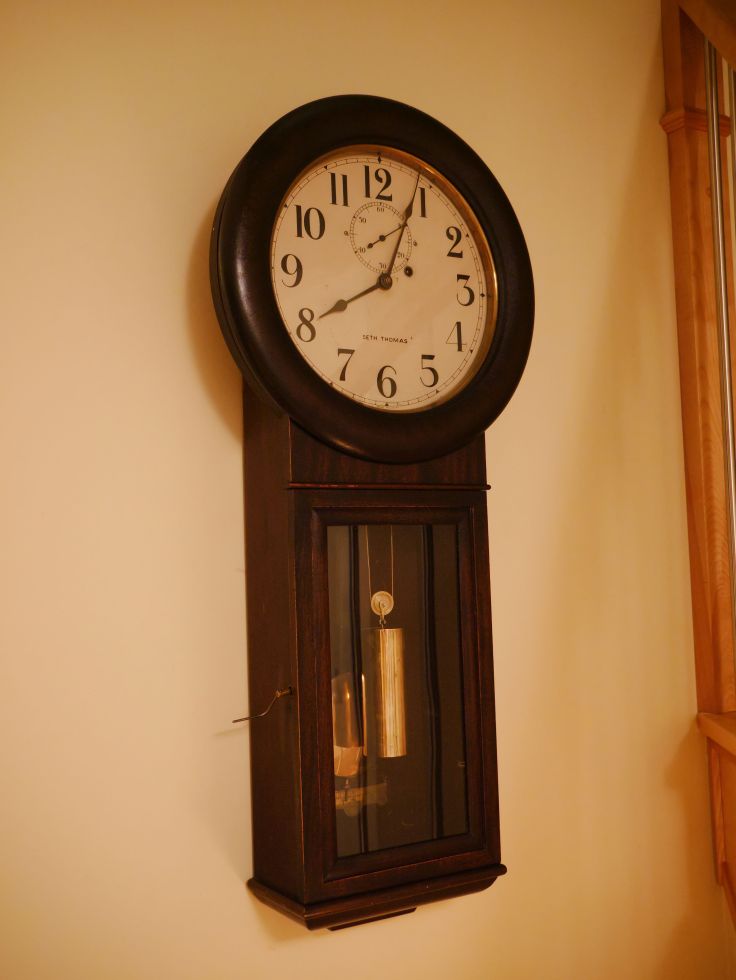
Seth Thomas Regulator #2
Seth Thomas Regulator #2, circa 1925, $800-1000 range

Closing thoughts

In commercial transactions, the principle that the buyer purchases at his own risk in the absence of an express warranty is termed Caveat Emptor, or let the buyer beware. In the clock world, buyers have little or no recourse if those goods turn out to be defective, misrepresented, or broken. The best of luck trying to get your money back if you are a successful bidder on an online auction site and your package arrives in pieces.

Selecting and purchasing an authentic antique mechanical clock can be a daunting task but it can also be a very rewarding experience.

Adjustments to a Smiths Enfield mantel clock

This is a Smiths Enfield Art Deco-style clock that reflects the clean lines and geometric design of the 1930s. It needs a few adjustments to ensure smooth operation before being listed for sale. Perfect for collectors or anyone who appreciates vintage clocks of this era.

Smiths Enfield mantel clock

The Smiths Clock Co. became Smiths Enfield in 1949 and the Smiths Enfield name first appeared in catalogs from 1950 onward. This oak-cased time and strike shelf clock was made somewhere between 1949 and 1955, vintage, but not antique. More information on this company can be found here. The latter part of the 1970s saw the decline of this and many other companies who fought hard to compete with inexpensive clock offerings from the Far East.

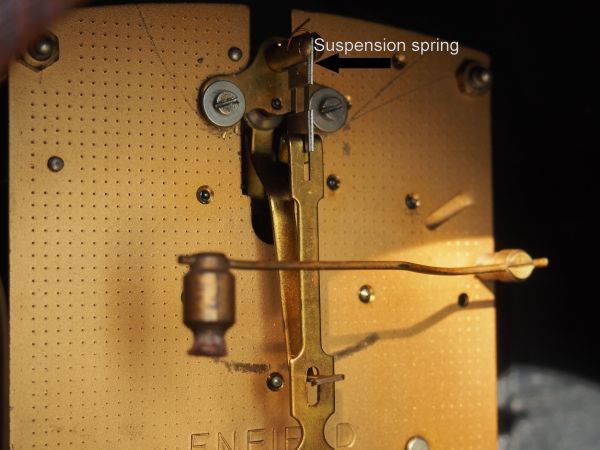
The clock keeps good time, but there’s an issue with the strike side. While the strike has a pleasant sound, it operates erratically. This may be an adjustment issue that will require removing the movement from the case for further inspection.

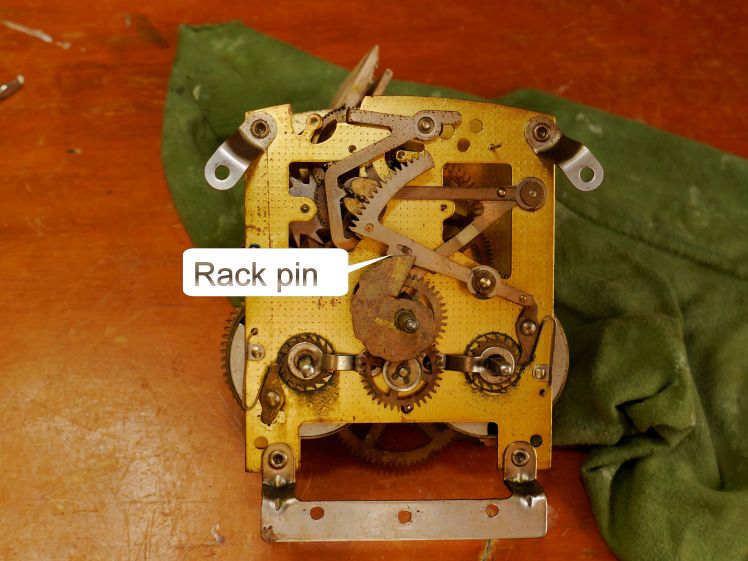
Once out of its case, I ran the strike side going through each hour observing the action of the levers and the snail. The setup is conventional but there is no rat tail per se on this movement just a pin or striker point midway along the rack arm. The rack pin was hitting the sloping edge of the plateau part of the snail, and the pin was not connecting with the flat section of the snail.

Smiths Enfield
Smiths Enfield movement

The Adjustment

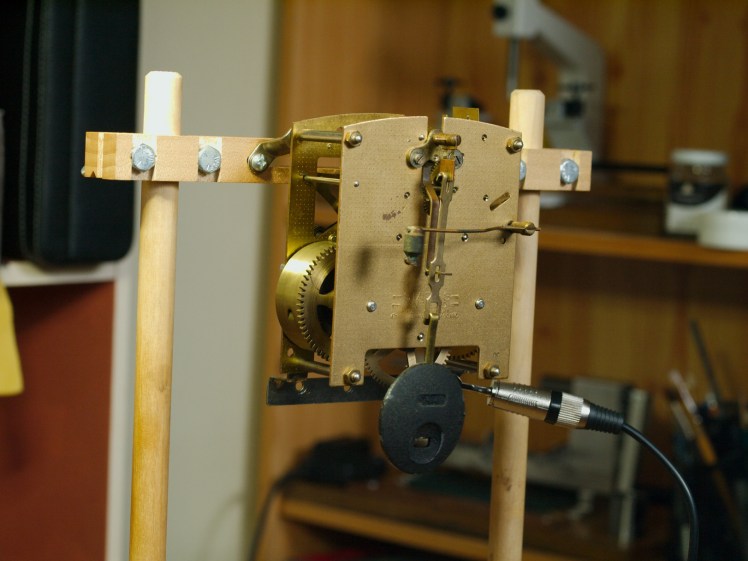
To make the adjustment, I removed the clip and washer to release the snail. I advanced the snail to the one o’clock position and removed the snail and reinserted it so that it was placed approximately where the rack pin hits midway along the plateau of the snail. This will permit the snail to fall at the midpoint throughout the 12-hour cycle. On the test stand, I monitored the strike sequence.

Determining the sweet spot in similar movements that have a rack and snail arrangement will take some experimentation.

As expected, I found that when advancing the strike, the paddle was catching on one of the points of the star wheel. This could either stall the strike train or cause an extra strike on the hour.

Although it is a simple adjustment the mainsprings must be let down and the plates pulled apart enough to relocate the paddle arbour so that the paddle is positioned between two tips of the star wheel. In the process of manipulating the levers, one or two other wheels may pop out. After repositioning all the wheels, secure one corner of the plate with a screw and proceed with testing the strike-side action.

Smiths Enfield movement
Smiths Enfield movement, testing

The clock had clearly been out of sorts for quite some time. Now that everything is properly adjusted and functioning as it should, it can be confidently sold without the dreaded disclaimer, “might need some adjustment.”

Ten active clock companies in Canada during the 1950s

Canadian clock collectors are most familiar with the Arthur Pequegnat Clock Company that closed its doors in 1941 but 7 years later a number of clock companies were alive and flourishing in Canada, predominantly in areas in and around Toronto.

It is difficult to imagine that seventy years ago there were ten active clock companies in Canada. Unfortunately, none of these companies survived beyond the late 1970s.

Could any of these companies survive today?

Here are the ten Canadian clock manufacturers in no particular order:

BRESLIN INDUSTRIES: of Toronto: Clocks were a sideline for this company run by the Breslin family, whose products were focused on lamps, lampshades, and novelties. The only clocks in existence have horses as the typical 1950s theme. The wind-up movements are the same Ingraham type used by Snider, another company on this list.

INGRAHAM CANADIAN CLOCK COMPANY of Toronto. Ingraham clocks were being made by the original American company in Bristol, Connecticut from the mid-1800s. The Canadian factory was located in Toronto from the late 1940s until at least 1980. Wall and alarm models, the latter with wind-up or electric movements, were made for the Canadian market. Representative examples of typical alarm, kitchen, and starburst wall clocks with Ingraham Canadian, Ingraham Canadian Clock Co. Ltd, or Ingraham plus Made in Canada on the dial. The novelty windup alarm clocks, The Westerner and The Mountie are popular with collectors of animated models.

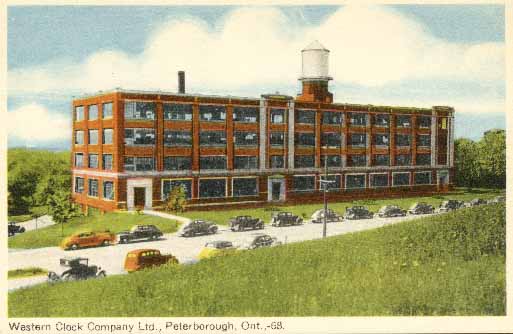
WESTCLOX CANADA of Peterborough, Ontario: The parent company started making alarm clocks in LaSalle, Illinois, near Chicago, before 1900. The Canadian factory operations began in Peterborough in 1920. The new building was ready in 1923. Business was so good that additions were put on several times up to the 1950s.

Westclox peterborough plant
Westclox Peterborough plant

However, by the mid-1980s the North American Westclox factories were closing down in favour of lower labour costs from China. Westclox is best known for its millions of Big Ben and Baby Ben windup and electric alarm clocks made in various styles between 1920 and the early 1980s in Canada. The company also make wall clocks for kitchens, dining, and recreation rooms starting in the 1930s. If collecting, avoid Westclox alarm clocks made in China.

Westclox LaSalle alarm clock
Westclox LaSalle alarm clock, assembled in Peterborough, Ontario

SETH THOMAS CLOCKS of Peterborough, Ontario: This old company was founded by Seth Thomas in the early 1800s in Plymouth, Connecticut (now Thomaston). In 1931 it became part of General Time Corporation, which owned Westclox. Seth Thomas brand mantel, alarm, and wall clocks were produced for the Canadian market in the Westclox factory from 1931 to the mid-1980s. However, inferior clocks produced under the Talley Industries brand are avoided by serious collectors.

NEW HAVEN CLOCK COMPANY of Brantford, Ontario: The parent company was based in New Haven, Connecticut originating in1900. Some mantel and wall clocks were made in Brantford with Canadian wood cases, but the spring-driven pendulum movements were brought in from the U.S. factory. Most clocks were made for schools and offices.

New Haven schoolhouse clock
New Haven schoolhouse clock, made in the USA but assembled in Brantford, Ontario

FORESTVILLE CLOCK COMPANY of Toronto: Set up by Leopold and Sarah Stossel as the Blackforest Clock Company in Toronto in 1928 the name changed to the Forestville Clock Company in 1941 because of World War II, and continued in business until the late 1970s. Forestville sourced movements from England, France and Germany.

Forestville Westminster chime
1970s Forestville Westminster chime, Canadian case(?) with German movement

Blackforest shelf clock
Blackforest shelf clock circa 1939

CANADIAN NEON-RAY CLOCK COMPANY: The main product was “Bulb Illuminated” advertising clocks. this business was in operation from about 1942 to the mid-1960s In Montreal. Many companies purchased these clocks to advertise their products such as soft drinks, beer, service station items like motor oil and spark plugs, ice cream, paints, meats, and mattresses.  French-language, as well as English advertising clocks, are commonly found in Canada.

CANADIAN GENERAL ELECTRIC of Barrie, Ontario. In addition to large industrial electrical components, CGE produced electric alarm, table, and kitchen wall clocks for the Canadian market from the 1930s into at least the 50s. CGE kitchen wall and alarm clocks were produced in large numbers.

SNIDER CLOCK MANUFACTURING COMPANY LIMITED of Toronto. The Snider Clock Corporation and its successor, the Snider Clock Mfg Company, flourished for over twenty-five years (1950 to 1976). Their success is a tribute to Harry Snider and his family for the many unique clock designs that were created, to the effective construction methods developed by Harry and then Michael Snider for them, and to their business skills in promoting and selling their clocks through hundreds of stores across Canada.

Snider Clock Company
Former location of the Snider Clock Company

WALTER CLOCKS of Toronto. The main product was mantel clocks. All of the cases were made in Toronto.  At least a dozen different models were produced in the mid to the late 1930s before WWII.  During that time, both time & strike and Westminster chimes spring-driven movements were imported from Britain and Germany. The war meant that overseas movements were not available and clock production stopped.  But many more models were made after WWII, from the late 1940s through to the late 1950s. The prewar models had walnut veneer cases and hinged back doors.  The removable round door on the back of the postwar models mostly made with less expensive, stained birch wood, was unique. Production continued up to the late 1950s when the last of the Walter Clocks mantel clocks were made.

Gone forever. It is a shame. Gone is the knowledge, expertise, and entrepreneurship. Could any of these companies survive today? No, they were important in their day, thrived on innovation and some were ahead of their time but the world is a different place today.

Tick Talk Tuesday #29 – A bob for a Pequegnat wall clock

DBs friend’s clock is similar to this one, an Arthur Pequegnat Brandon (2nd edition)

Tick-Talk Tuesday is about the letters and comments I have received from you, the reader, concerning your clock, issues you might have had, challenges you face or a clock you would like me to profile or my responses to your questions with advice on your particular clock concern. For those comments and questions that stump even me, I consult within my clock circles for the best possible answer

DB wrtes,

“Good morning, I stumbled across your site this morning while looking around for parts for what I think is a Pequegnat Brandon. It belongs to a friend and is missing the pendulum bob and key, but she thinks it works otherwise. I found parts that seem to be appropriate, but I’d like to find originals (or close to it) if I could.

Any advice?”

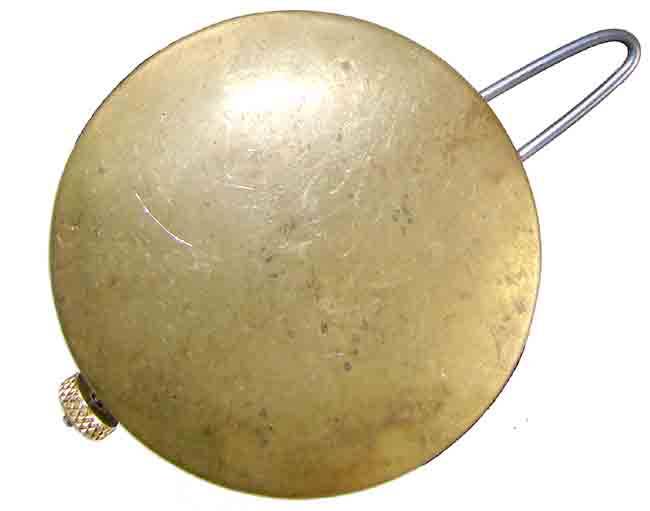
Pendulum bob
Pendulum bob

My reply,

Hi DB,

Thanks for your email. There is no known source for original Pequegnat parts although you might get lucky on eBay when clocks are parted out. It must be as close to 4.3 oz. or 125 grams, 62mm or 2.5 inches as possible, and it must be adjustable. I don’t see anything at Perrins, a Canadian supplier and the closest I could find is this one at Timesavers in the US. This one at Ronell looks to be the same but cheaper.

https://www.ronellclock.com/Adjustable-Pendulum-225-Bob-PM-63.htm?categoryId=-1

Ron

DB reply,

“Wow Ron, that’s very helpful, thank you very much.”

Solar mantel clock servicing – just one hiccup, well, a couple actually

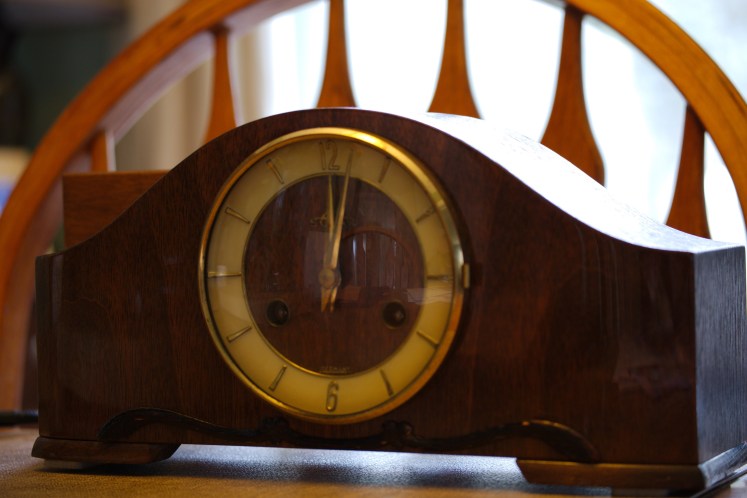
Solar mantel clock
Solar mantel clock

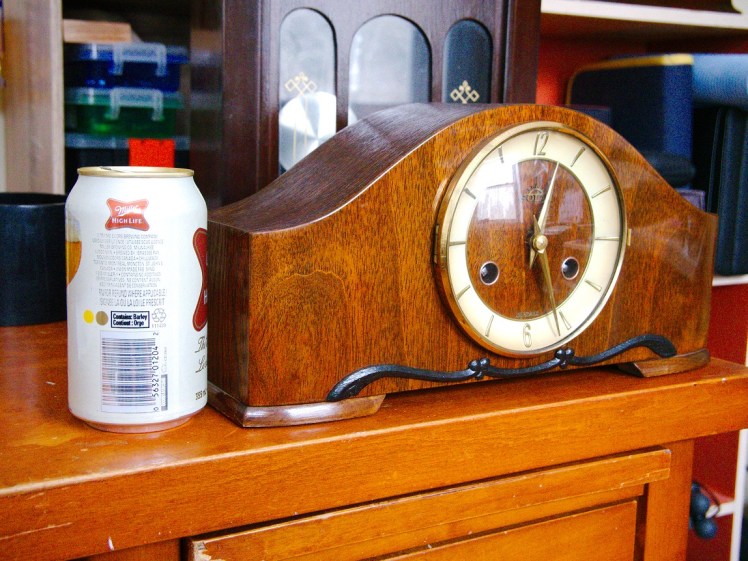
For today’s post, we are looking at a German time and strike mantel clock with a Hermle movement and sold in Canada under the Solar name. It has a 6″ dial and dark walnut case that would have been around $50 or $60 when new in the 1960s. At about 13” wide by 7” high by and 4” deep it is small by mantel clock standards and would fit just about anywhere in a home or office.

Solar clock
Solar clock, just a little taller than a beer can

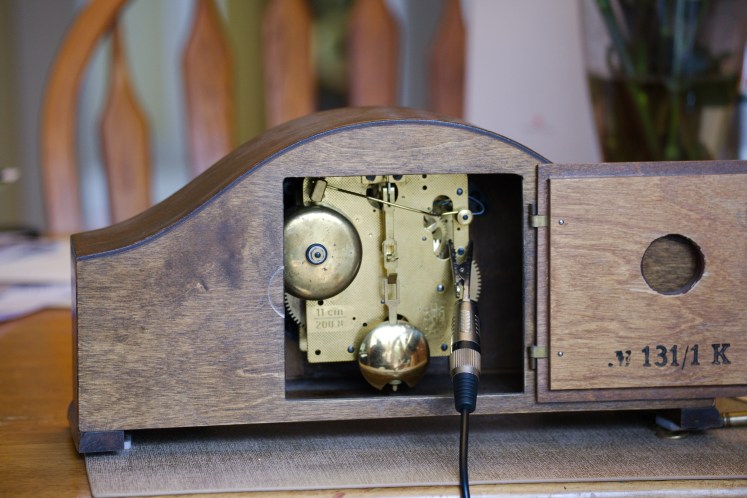
It has a type 141 German movement from Hermle with a recoil escapement and 11cm pendulum (200.8 bpm). The half-hour strike on a bell is pretty sound for a mantel clock but is loud enough to be heard across the house. As a testament to its design and durability, this movement is still being produced by Hermle today.

Solar Hermle movement

This was not a running clock when I bought it but I thought a good cleaning was all it required. Judging from mars and scratches on the backplate of the movement it has been worked on in the past.

I took the movement out of its case to examine it more closely and I was relieved when I saw that the pivots were not plated, the bane of Hermle movements from the 1970s to the late 1980s. In those days Hermle used soft steel pivots for their movements and plated them for hardness. The plating has been known to peel off and this requires repivoting which is a time-consuming process. When there is too much pivot work to be done the movement is simply tossed out. This movement predates the plated pivot period.

I did not see any evidence of bushing work on the movement but one or both mainsprings were replaced as the barrels had numerous scratch marks on them. As is typical of clocks of this period the mainspring barrels can be removed without disassembling the movement. The winding arbours simply pull out once the rachet is removed. Mainsprings on some German clocks are a known weakness.

Hermle movement
Hermle movement, you can see the S on the strike barrel

The movement was in very good condition with minimal wear.

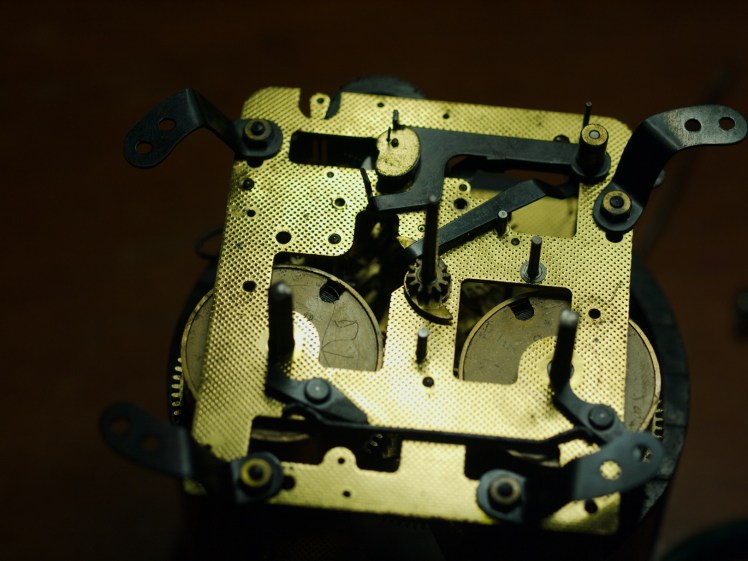
Hermle movement, front plate removed

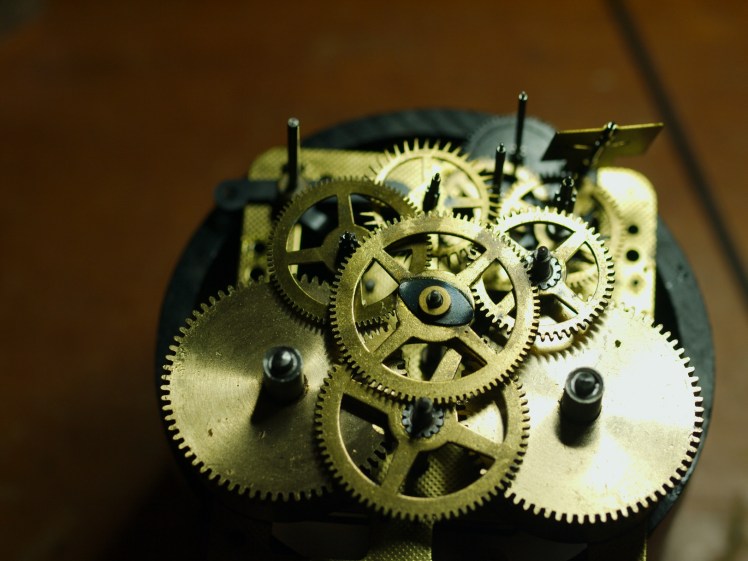
The movement was disassembled, parts cleaned in an ultrasonic cleaner, the pivot holes pegged, and the pivots polished. The warning wheel is plastic and did not go into the ultrasonic machine, a cost-savings measure by Hermle no doubt on a part that has almost no load.

Hermle stop wheel
Hermle plastic stop wheel

I assembled the parts to check for wear and found that the movement required two bushings, the star wheel, backplate, and the lower drive wheel rear plate, both quite worn. All other pivot holes were within acceptable tolerances.

Installing two bushings

The starwheel bushing installation was simple enough. The center cannon wheel had to be removed so that the backplate bushing hole could be accessed. Bushing work went without a hitch.

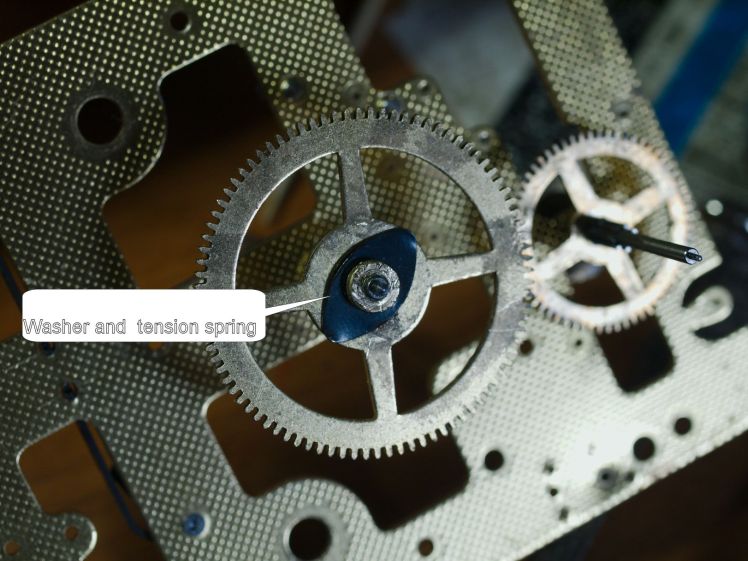
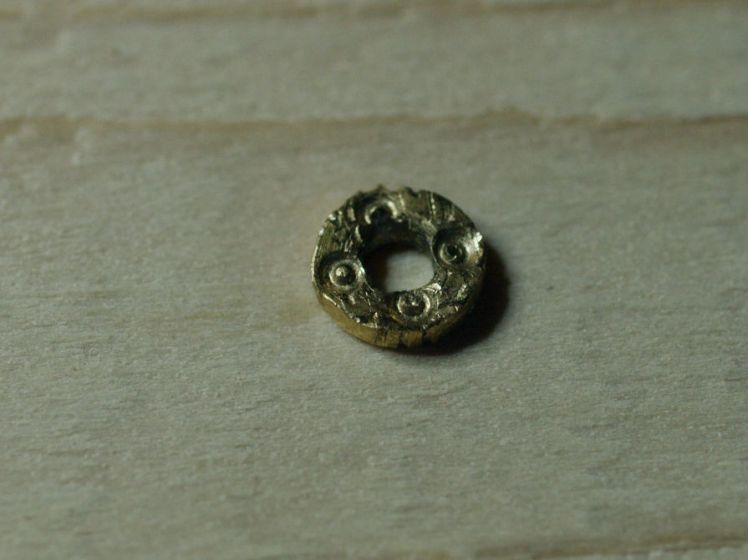
Now for putting that centre wheel back on. An oval tension spring just below it must be tight enough but allow the arbour to move. Attempting to reinstall the brass washer was frustrating and as you can see I made some nasty marks trying to get it back into place (below photo). After several tries, I just could not get it tight enough.
Hermle movement, washer and tension spring
Hermle movement, washer, and tension spring

I attempted to stake the washer but that did not work. None of my stock of brass tubes had the correct inside diameter and I was reluctant to put a lot of work into making a friction washer with my mini-lathe.

Solar washer
Solar center wheel friction washer, not reusable

However, I discovered a simpler solution, a brass Bergeon bushing.

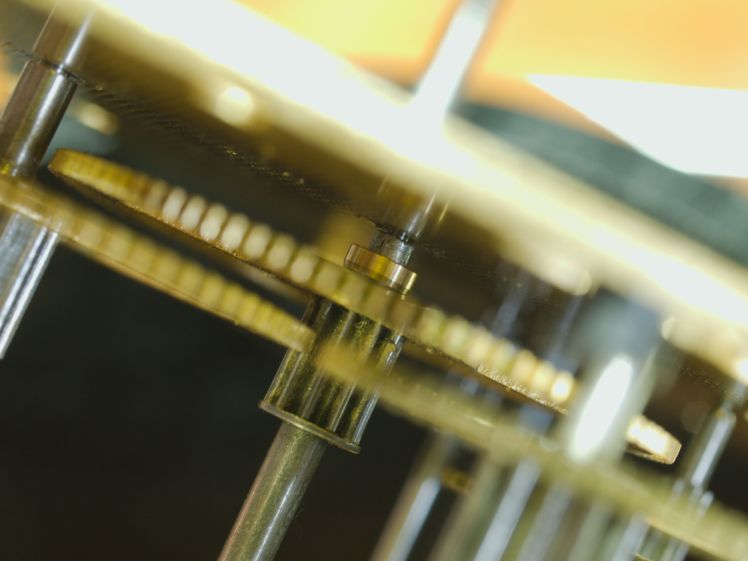
Hermle movement new washer
Hermle movement’s new friction washer is a brass bushing

The arbour is roughly 2.6mm and a bushing with an inside diameter of 2.5mm provided a good friction fit. The bushing is also large enough to cover the tension spring underneath. Perhaps not the intended purpose of a brass bushing but it works! In many other German clocks, there is a pin through the arbour and it can be easily taken off but not on this one.

Reassembly and testing

After test fitting all the parts it is off to the next stage, resembling the movement. When reassembling a rack and snail movement there a number of things to consider but in my view, the three most important steps are ensuring the warning wheel pin is in the roughly 12 o’clock position to permit a half-turn to set up the strike, that the strike paddle is between two star points and not resting on the point of star wheel (a strike train that starts up under load may stall) and that the gathering pallet pin is well clear of the rack teeth. On a typical rack and snail movement, all other adjustments are done outside the plates.

Then comes the testing phase which generally lasts a couple of weeks or more depending on what issues may arise.

In the meantime, I took the opportunity to clean the case and touch up some small chips on the decorator piece under the dial.

Junghans bracket clock – a small detail makes a big difference

A small change makes a big difference on a Junghans mantel clock from 1911. Let me explain.

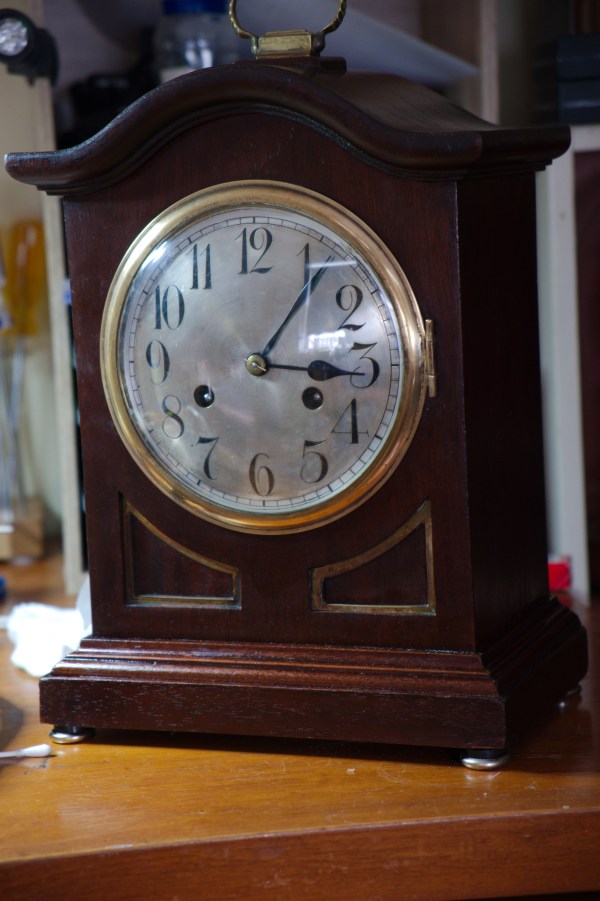
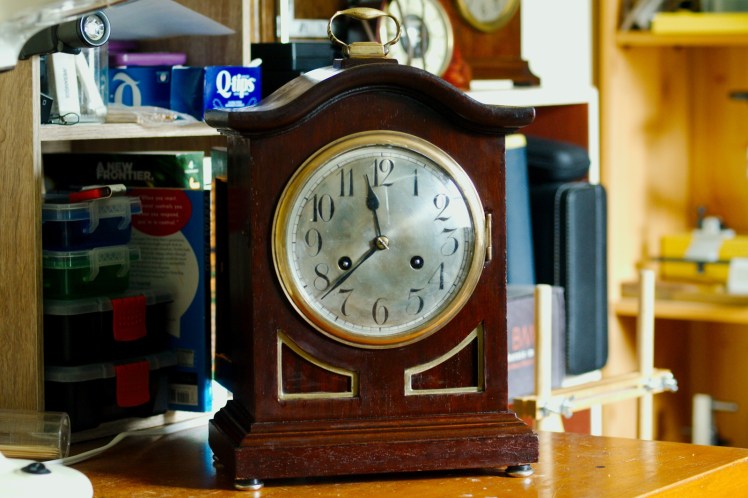
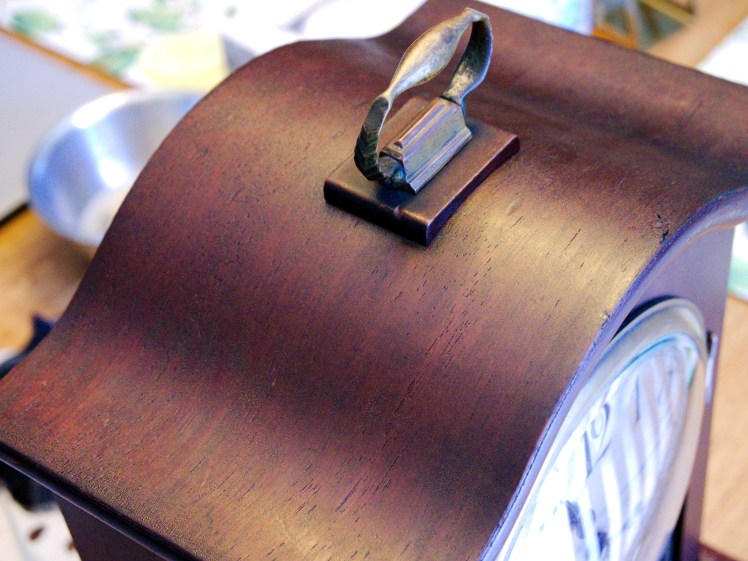
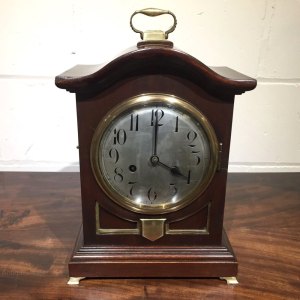
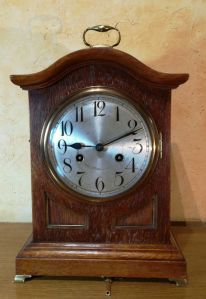
Back in September 2020, I bought a German-made Junghans bracket style clock. It is 14 inches high by 10 inches wide by 6 inches deep, mahogany veneered, attractive brass accents, and a carrying handle on a curved domed top.

Junghans clock
Junghans bracket clock

I just love the way it looks.

Junghans bracket clock handle

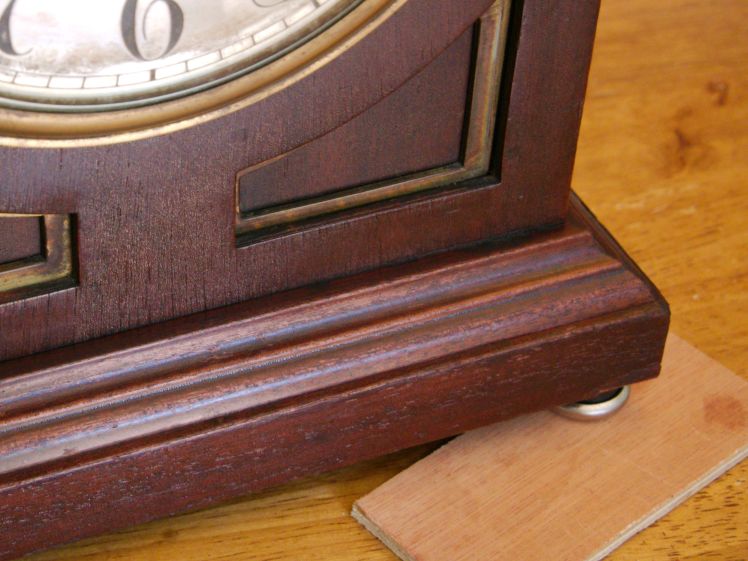
What about those chrome feet

The clock is original in almost every way; the quality time and strike movement is original to the clock, the spiral gong is correct; latches, bezels, and so on look good and work perfectly but for some strange reason it has replacement chrome feet and they bug the heck out of me.

Why should a small detail mar the classic lines of this clock!

Junghans bracket clock
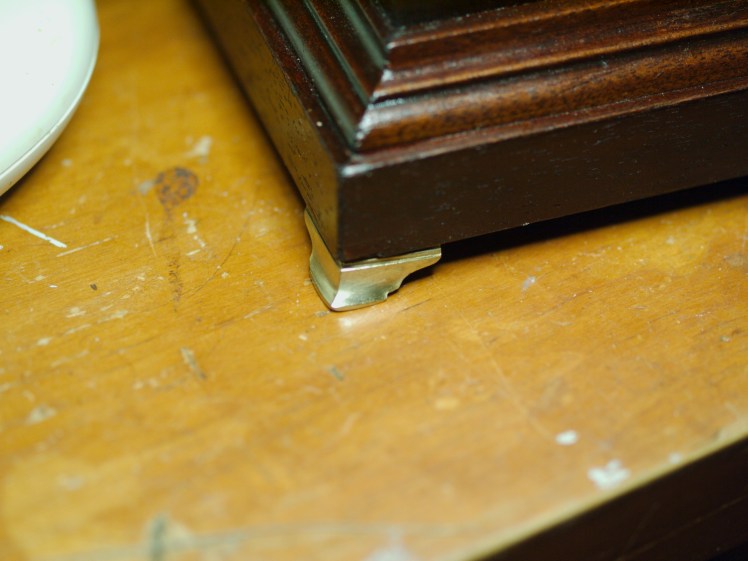
Junghans bracket clock, chrome foot

After searching various online auction sites, I discovered that the original corner feet would have looked like the ones in the below photographs. I can only surmise that many years ago one fell off, got lost and the repairer simply found what would work and tossed the other three feet out.

Junghans bracket clock online
Clock feet (Online photo, Fair Use: used informatively for the public good)

Bracket clock feet
Clock feet (Online photo, Fair Use: used informatively for the public good)

So, where to find corner feet. There are a number of suppliers worldwide but my usual go-to supplier here in Canada, Perrins who are otherwise excellent, has a very limited selection of clock case corner feet and not in the style or size I was looking for.

US suppliers similarly have a limited supply as bracket clocks are not as popular there as overseas. England is the logical place to look since it is the land of the bracket clock.

Interestingly, the term bracket clock first appeared in 19th century England and is commonly referred to as a spring-driven pendulum table clock with a carrying handle (and often with subsidiary dials) so that it could be moved from room to room in the owner’s home. Of course, true bracket clocks had a strike silencer so as not to disturb the owner’s beauty sleep.

Using the search term “brass bracket feet” I searched the two largest suppliers in England, Cousins and Meadows and Passmore.

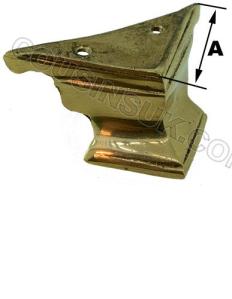
I found exactly what I was looking for at Cousins UK. Cousins calls the part a ridged carriage clock corner foot made of polished brass, sourced from Spain or India. They come in three sizes and for this clock, I chose the smallest one.

It took two weeks from the order date to arrival on my doorstep. I am very impressed!

Bracket clock feet Cousins
Bracket clock feet from CousinsUK (Online photo, Fair Use: used informatively for the public good)

The feet are made of brass and look to be of decent quality.

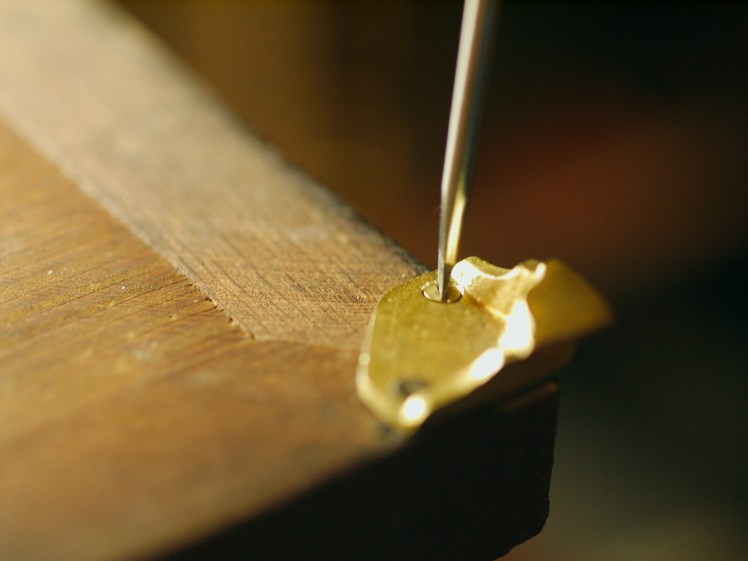
Installation was simple. Rather than risk splitting the base so near to the edge I pre-drilled the holes. Using a mini electric drill I first marked the holes with each foot in place and drilled a deep enough hole.

Two slotted brass screws are required per foot. As I screwed one screw of each foot I checked for correct orientation and made a small adjustment as necessary.

Perfect!


Corner foot for Junghans bracket clock
Corner foot for Junghans bracket clock, the screw holes are pre-drilled

Corner foot for Junghans bracket clock
Left front corner foot

The feet are very sturdy and look exactly what the manufacturer would have used at the time.

Junghans Corner feet finished
Junghans bracket clock with new corner feet

Compare this last photo with the first to see the difference the new feet make on this clock.

This is an example of a subtle but important change that is very inexpensive (less than $24) and I am sure you will agree that it makes a dramatic difference.

Junghans Sydney
Junghans Sydney

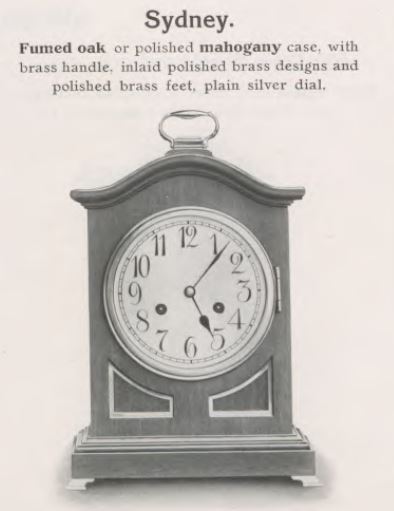
While I was working on this clock I visited the Junghans site and discovered a 1912 Catalogue which informs me that this clock was called the Sydney.

It was available in fumed oak or mahogany, 14 1/2 inches tall “with brass handle, inlaid polished brass designs, polished brass feet, and plain silver dial”. Both finishes were available with an 8 day or 14-day movement. The quarter strike 8-day clock had 2 gongs while the 14-day movement had 1 gong.

This then is a 14-day movement with a mahogany case and is referred to as model 7020. Judging by the name and the style, this clock was made for the English market.

It seems my research concerning the new polished brass feet paid off very nicely.

Approaching 200,000 views and 58,000+views so far this year

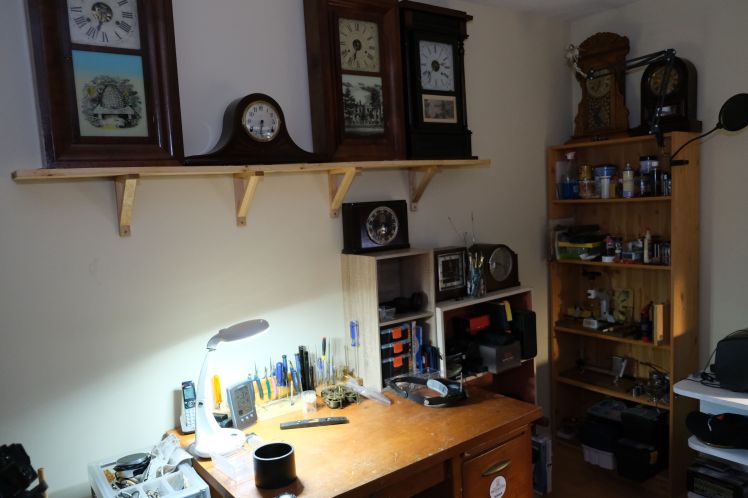
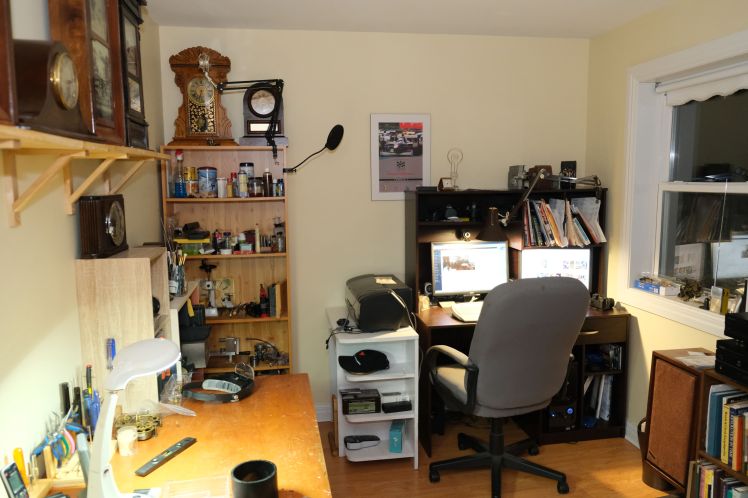
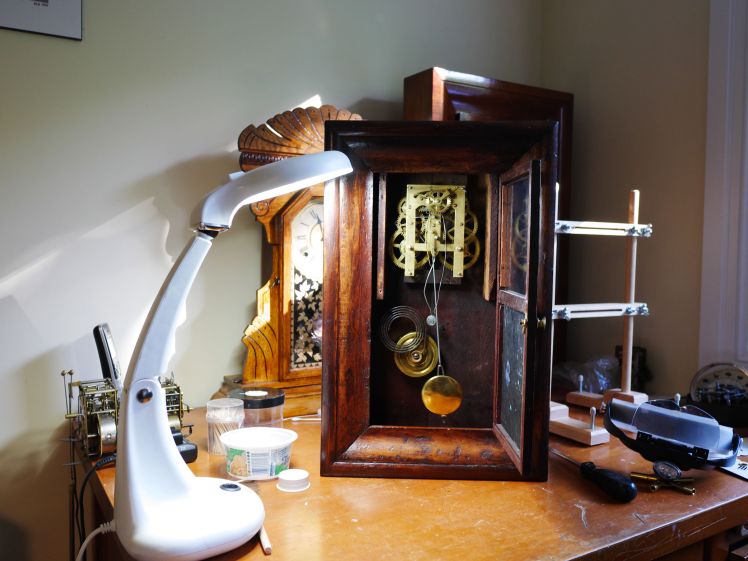
In my home, I have a dedicated room to work on my clocks

Five years ago I attended a workshop on WordPress at our local community college. It taught me more about blogging than I ever knew. The idea of a clock blog intrigued me but it is a lot of work, there is much learning and it was not something I wanted to design from the ground up but WordPress came to the rescue. It has an easy-to-do template approach and the only task was providing the content. So, I began the journey of documenting my horological interests and experiences.

The first few months were discouraging. I had very few views and likes which seem to be the lifeblood of many blogs. There is a strong blogger community out there and once connected to that community you get a feel for those sites that are quite successful and offer terrific content and those that quickly run out of steam.

A computer is not only essential for clockwork but it is the tool I use to compose my blogs

It takes time and patience to build a strong audience. It is also a healthy practice in blogging to follow other blogs and support their content and I am seeing a lot of excellent content.

Clock collecting and repair is a passion but I struggle with my writing and try to envision what my audience would like to see in my posts. Writing is not my forte but years working in academia had taught me to convey my thoughts on paper for my students in an effective way. I took notes on what other bloggers were doing, what made their sites engaging so as to improve my writing.

Contentwise, my intention was never to satisfy expert horologists and those in the clock repair business though I certainly don’t mind if they drop by from time to time, make comments, and offer their perspective. I consider myself a clock repair generalist and judging from my mail I seem to appeal to those who are amateurs like myself and those who have stumbled onto my site looking for advice and guidance on clock collecting and repair.

As a self-taught horologist and over the last 11 years, I have gained knowledge and experience working on a wide variety of mechanical clocks. Cabinet or case restoration is also an interest. I do not operate a clockmaking business and I am not a clock vendor though I will sell the odd clock locally to manage my collection.
I have received many comments. Some offer suggestions and advice on projects I am working on while others are looking for direction on their particular clock problem. I provide whatever assistance I can and within my scope of expertise.

Testing in the clock case rather than on a stand
Testing an ogee movement

Stats – the lifeblood of a blog

Like it or not, statistics are the lifeblood of a blog. I receive over 200+ views per day. The top 6 viewers are in the USA, Canada, United Kingdom, Australia, South Africa, and Germany.

Writing articles well in advance and scheduling publication dates help with blog planning particularity when I am vacationing and cannot find the time to write.

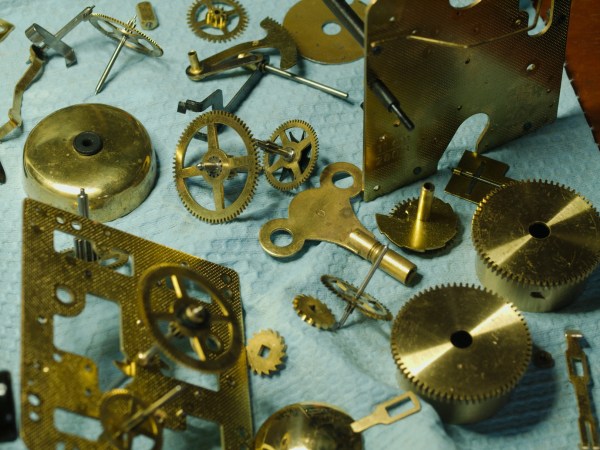
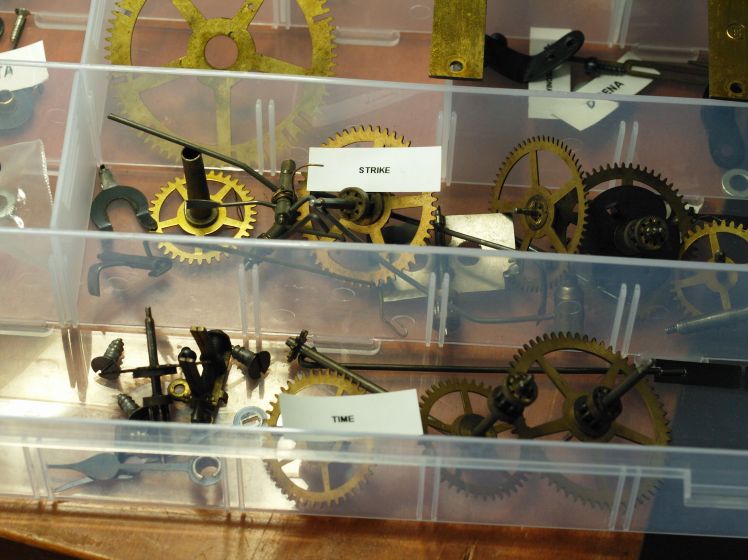
Time and strike parts
Time and strike parts separated

My regular features, Tick Talk TuesdayCrazy Clock Ads, and What Is This Thing For look at the lighter side of clock collecting and repair.

If you are new to my blog, welcome, there is plenty to read. If you are a regular viewer, thank you for supporting me and if you have any ideas for future articles let me know.

Forestville mantel clock servicing – not fun when things go wrong! Part I

Forestville mantel clock

This post is about a mantel clock made by the Forestville Clock Company of Canada and some challenges servicing the movement.

In 2013 we were on a visit to the Thousand Islands and stopped at an antique store in Gananoque, Ontario. As my wife and I were strolling through the store and she noticed this mantel clock made by the Forestville Clock Company of Toronto. Somewhat plain in style it seemed to be in great shape and it was exactly what we were looking for at the time.

History of the Blackforest Clock Co. and Forestville Clock Co. of Toronto

The Blackforest Clock Company of Toronto, Ontario was founded by Leopold and Sara Stossel in 1928.  Both clock movements and complete clocks were imported from Germany and sold through department and jewelry stores across Canada. Their son Ed Stossel started working part-time with his parents’ company in the 1930s and later became a full-time employee in the late 1940s.

Some assembly work was carried out in their Wellington Street East factory. Initially imported mantel clock and grandfather clock movements were installed in cases made in Kitchener (home of the Arthur Pequegnat Clock Company), but later the complete mantel clocks were imported from Germany. This arrangement was interrupted by the Second World War, which also led to a name change to the Forestville Clock Company in 1941.  During the war years, the company imported its clock movements from England, the United States, and France. However, starting in the mid-1950s German factories again became the source of most Forestville clocks, with Mauthe being a major supplier.

The Forestville Clock Company was very successful during the middle decades of the twentieth century. Its grandfather clock cases and some of the wall clock cases were made in Canada. Ed Stossel retired in 1979 and unfortunately, the company survived just a few more years without his leadership.

Most Blackforest and Forestville mantel clocks still have their paper labels tacked inside the back door. This one does not.

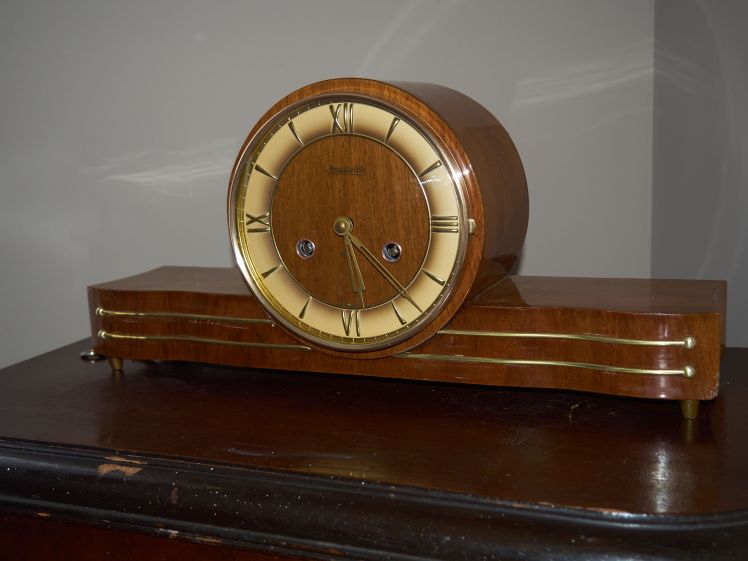
My Forestville mantel clock

This clock movement and case are imported from Germany in the 1960s. There is a serial number on the backplate but no database exists online to date this clock. I am thinking that the  movement is made by Mauthe

The pivots and bushings appear to be in good condition at first inspection. The clock keeps good time and there is a simple speed adjustment on the hairspring escapement to regulate the clock. This mantel clock is handsome, has good lines and reflects the style of the period.
Servicing the movement

After 7 years I have put off servicing the movement far too long. The rack and snail movement is relatively simple to work on with all the adjustment wheels, save the warning pin, on the outside. The mainspring barrels can be removed separately for servicing, common for movements of the 60s,

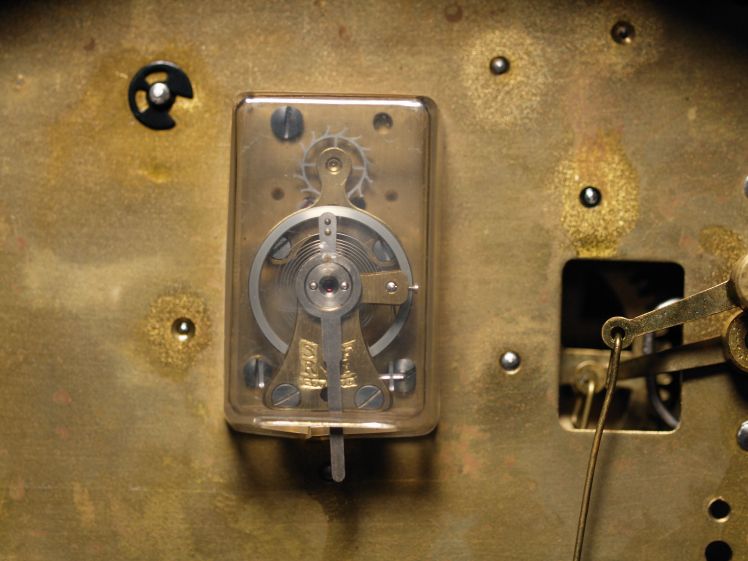
The hairspring escapement is something I will not attempt to clean. They can be finicky to work on and if the movement has been running beforehand, like this one, there is no pressing need to fool with it. It is well protected by a plastic shroud. Three screws unhook it from the movement.

While there is some wear on the time side I see at least 3 new bushings required, two on the front plate and one on the back.

Hairspring escapement

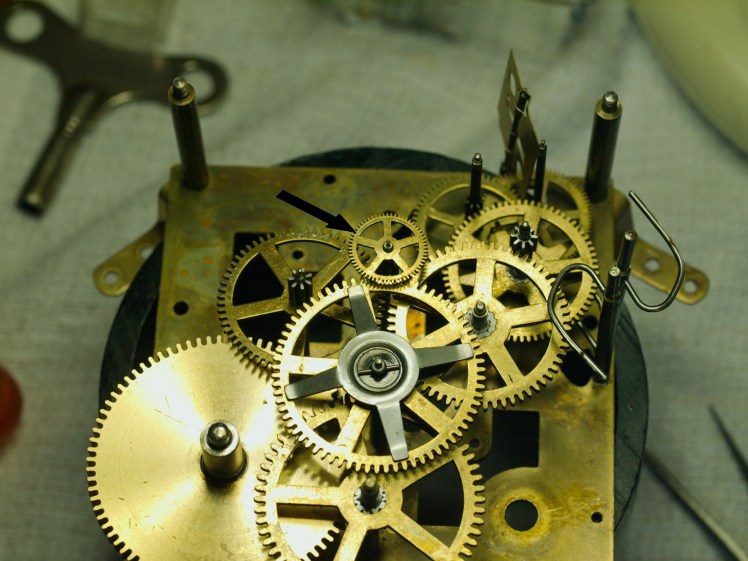
When working with German and French movements one must always be very careful of the delicate pivots. Normally when I work on these clocks I am aware of how easy it is to bend or break a pivot and this clock was no exception. However, I had the movement apart and was reinstalling the gears to determine bushing wear and went about repositioning the center gear when I noticed its centre cannon front plate pivot had sheared off.

Arrow indicates center wheel with broken pivot (strike barrel removed)

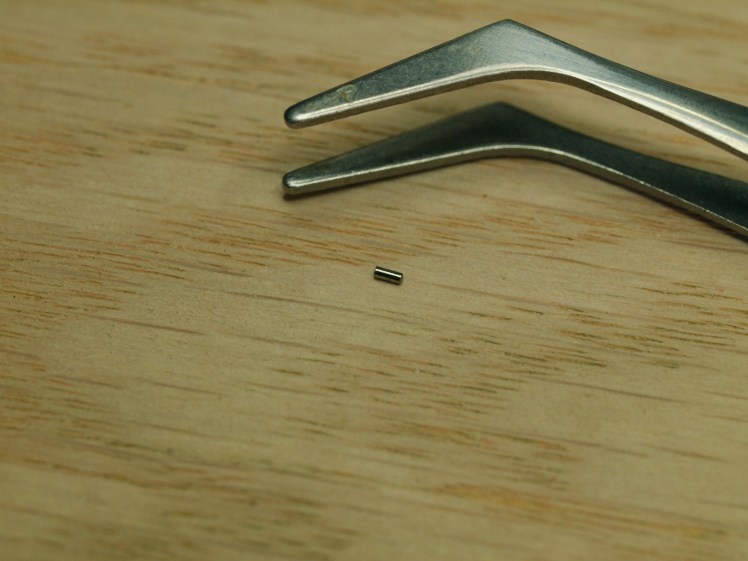
I was not even aware that I was putting undue pressure on the pivot as I was carefully guiding each pivot in place with a pivot locator. However, either I applied too much pressure or it was ready to go because I broke a pivot. To give a sense of how small it is, here it is beside a pair of tweezers.

Broken pivot

My experience with pivot repair is very limited. This is not like a broken or worn pivot on an American clock which is less challenging to repair because they are simply much bigger. This pivot is small, perhaps 0.5mm or so. Although I have bushings that size I do not have pivot wire that small and had to make do with a piece from my assortment of 0.85mm to 1.10mm wire.

Repairing a broken pivot, pivot wire is glued in place and left on the lathe overnight

I centred the arbour with a centring bit and then using a high-speed bit, drilled to about 4 or 5mm into the shaft, enough to anchor the pivot wire. Once the wire was inserted, I used high-strength Permatex Thread Locker Red to secure the wire which takes 24 hours to cure. The next day I installed a bushing in the front plate and put the gears back together to check the action of the new pivot. It is working okay. I was not convinced the repair would work but I will reserve judgment until the other 3 bushings on the time side are installed.

Can’t wait to find out if the repairs are successful? It’s a long wait but on November 25th, I will present the results.

The antique clock and the dilemma of identity

The antique clock and the dilemma of identity. Some may feel this is much ado about nothing but discussion on identity and antique clocks tends to prompt a lot of debate. Let me explain.

Let’s say you are looking for that particular antique clock and you think you have finally found it. The photos look great and the description hits all of the boxes on your list. Let’s assume you found it locally and are meeting the seller soon to close the deal. You arrive, they present the clock and you notice things that are not quite right with the clock. The clock you thought was an authentic antique has been changed over the years and the seller may or may not even be aware of the changes. If the clock has been changed is it an antique in the truest sense of the word. You walk away feeling that too much has been done to the clock and continue your search.

A clock collector might have the opinion that if too much is done to restore a clock it is not fundamentally the same and cannot be considered original even though the new parts were made from the same materials using similar methods when the clock was first made. An antique shopper who knows little about clocks might not be bothered by the changes if the clock “looks” original.

Another might have the opinion that changes or alterations to the clock that bring it back to its original look and function including the making of new parts make it more “original” and therefore more desirable. But has the clock changed its identity during the change process and is it less original if it has undergone restoration?

Here are some examples.

From This.

Ansonia Extra short drop wall clock
Ansonia Extra Drop wall clock that some would have thrown out

To this.

Not perfect but saved from the trash heap

From this.

Junghans clock in pieces
Junghans Crispi wall clock in a parts box

To this.

Junghans Crispi wall clcok with compensating pendulum
Junghans Crispi wall clock resurrected from the grave

If one replaces one part at a time on a clock so that at some point all parts are replaced, at what point does a clock no longer become the same clock? It follows that if you take all of those parts and make a “new” clock which of the two clocks is original? What is the nature of the clock’s identity since no two objects can occupy the same identity? This is an example of a thought argument that raises the question of whether an object that has had all of its components replaced remains fundamentally the same object.

I was working on a clock recently that was said by its owner to be an antique. At first glance, it looked original. The case was a little tired, the movement looked like it was cared for or at least properly serviced at some point in its life. As I began to examine it more closely I discovered several anomalies. Although the movement was the “correct” maker as the case, the movement was taken from a kitchen clock and slightly modified to fit the case. Is this clock still an antique or has it strayed too far away from the definition of an antique because it is a “marriage”

People pay for originality. For my money, I prefer a well-cared-for clock in original condition. I will take a second look if it has been tastefully restored or repaired and know that it is better than having it trashed or perhaps parted out. However, I would not expect to pay as much for a “changed” clock”

If a clock is overly restored how should it be valued? I am not against conservation or restoration but if a clock was two steps away from a garbage can is it less valuable if restored?

There are no clear answers. There will always be buyers who demand originality and those who overlook certain changes. Is this much ado about nothing?

Tick Talk Tuesday #27 – Feet for my Gilbert mantel clock

Tick-Talk Tuesday is about the letters and comments I have received from you, the reader, concerning your clock, issues you might have had, challenges you face or a clock you would like me to profile and my responses to your questions with advice on your particular clock concern. For those comments and questions that stump even me, I consult within my clock circles for the best possible answer

Gilbert mantel clock

DG writes

“Hello again Ron,

Firstly, many thanks for your advice. It was extremely helpful. The clock is running, striking the right number of times and back in its case, adjusted for beat and now just getting it to keep reasonable time. I made up two pivot locators (a good suggestion) from wire, one heavy-duty to get the centre pillar in place (it always seemed out of alignment!) and another to adjust the pivots. I had trouble in getting some of the pivots to stay in place long enough to close the front and back plates as I went along so resorted to some Blu Tack on the bottom bush to hold them – not very professional but I couldn’t think of anything else. Getting the strike to work as it should was a total challenge and took me a long time but I got there in the end (probably the most satisfying part of the whole business). I am afraid it wasn’t a very professional restoration but I learnt a lot about Gilbert clocks in the process!

The date stamped on the movement is 1914. I’ve attached a photo of the front of the clock. It looks to me as though it had something attached to the bottom, front corners (there are two pin holes each side) which I am guessing were feet. Have you any idea what these might have looked like? Looking at pictures on the Internet there seem to have been slightly different styles as well as gold and a dark antique look, on Gilbert clocks. Any idea where I might find some – eBay?

Once again, many thanks.”

My reply

“It is certainly a  good feeling putting a mechanical clock back together and have it in working order. If you can manage a Gilbert clock you can handle just about any American time and strike movement.

It is probably very similar to this clock https://www.duetimeblog.com/gilbert-mantel-clock/

which has a piecrust dial instead of the plain dial on your clock. You are correct. It would have had feet at one time. If one went missing I suspect they were all discarded.

Finding feet exactly like them will be a challenge. eBay is one source. Though not quite the same style something like these might work for you. https://timesavers.com/i-9882301-mantel-clock-cast-feet-4-pieces.html

Ron”

Servicing a Pequegnat time and strike movement

Pequegnat was in the business of making clocks in Kitchener, Canada for over 35 years, 1903 to 1941. Unfortunately the shortage of brass during World War II was the death knell for this company. Pequegnat clocks are sought after by Canadian clock collectors and command higher than average prices, in Canada at least. The best collection of Pequegnat clocks can be found at the Canadian Clock Museum in Deep River, Ontario.

This article concerns the servicing of a typical Pequegnat time and strike movement. By typical I mean that most time and strike movements have steel plates with brass bushing inserts pressed into the plates. This was a working clock when I got it but I knew that there had to be wear issues that needed to be addressed.

This movement comes out of a Canuck.

Arthur Pequegnat Canuck gingerbread clock

The Canuck is a gingerbread style clock, not particularly sought after by collectors but an attractive clock for the kitchen or the dining area.

Time and strike movement

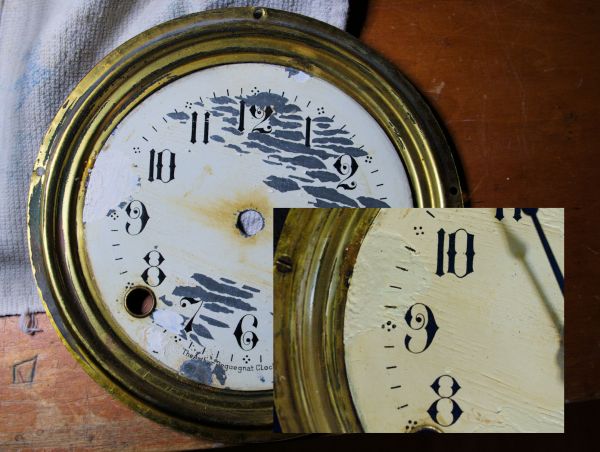
I began with revitalizing the case which meant giving all the oak surfaces a good cleaning followed by two coats of shellac. The dial was in poor condition and I considered an aftermarket dial but in the end decided to try a little inpainting with good results.

Before (inset) and after clock dial

Pequegnat movements with steel plates are nickle plated. Most of the plating has worn off on this movement so while it make look dirty after cleaning it is simply tarnished. The movement is well constructed with 4 cut pinions and 6 lantern pinions. I am going out on a limb here but I have worked on a lot of similar American movements and this movement, in my view, is better designed in many ways.

Dirty and tarnished but in good shape otherwise

I do not not believe this movement has ever been worked on. I see no evidence of past repairs and/or adjustments which is a good thing because undoing previous bad work can be very frustrating. There is some bushing wear as expected, but the pivots, cut pinions and lantern pinions are all in excellent condition.

All wheels minus the hammer and lever

The time side required 4 new bushings, T2F, T3F, T4F and T4R. The strike side required one bushing, T3F. There is plenty of power left in the mainsprings which were cleaned and oiled. Otherwise, the movement was dirty, though I have seen far worse. My ultrasonic took care of most of the dirt and grime but the wheels benefited from additional hand cleaning.

Getting everything working nicely when all is back together is more luck than skill. The strike side did not lock as it should but I decided to test the time side for a few days before opening up the plates to move the stop wheel into its correct position. Everything is working now.
On the test stand

A nice little project and while I would not say it was brought back to life it is completely serviced and will run for many years to come.

Don’t throw those old clock parts away

Don’t throw that old clock case or movement away. In this article, I will describe how I repurpose/reuse an old ogee clock case and how saving those old clock parts will come in handy someday.

Some time ago I responded to an ad on our local online for-sale site from an individual who had four clocks for sale, all for $20. I had no idea of the condition of the clocks but for the price I couldn’t lose but I knew it would be interesting. So, off my wife and set off for a 30-minute drive north of our home in Nova Scotia. The seller had them spread out on a table in an old barn. They had been stored in an attic for many years and were filthy.

None of them were in great shape but three came with mechanical movements which was worth the price alone.

They are:

  • E N Welch 30-hour Ogee movement and case,
  • Elisha Manross time and strike steeple clock, with 30-hour movement,
  • Ansonia Extra Drop time-only, 8-day wall clock with movement,
  • Waterbury mantel clock, replacement quartz movement.

That ogee case on the left was missing half of its veneer and would never be whole again

I managed to salvage two clocks from this bunch.

The Ansonia Extra Drop is hanging in my office and runs daily. The Elisha Manross steeple clock from 1843 has been cleaned up, serviced, and is now on display. The Manross clock has the distinction of being the only one in my collection with rare brass mainsprings.

A couple of missing pieces but looks good and runs well (reflection between 6 & 7)

Both clocks look great

Elisha Manross 30-hour steeple with brass mainsprings and new right finial & base

The Welch ogee and the Waterbury mantel clock were well beyond the due date they still had use as donor or parts clocks. I removed the brass bezel, strike rod block, dial face, rear door, and hinges from the Waterbury clock and tossed out the case which was not salvageable. Even the veneer could not be reused.

There was quite a bit to salvage from the Welch clock. I took out the movement, cleaned it, and put it aside to be used as a spare Ogee movement. I removed the pulleys, glass, hinges, iron nails, door catch and stripped the case entirely of its Rosewood veneer.

A new door made from the back panel of the ogee

Waterbury shot drop with new/old door

Talk to any clockmaker. Many save parts from clocks beyond repair for future use

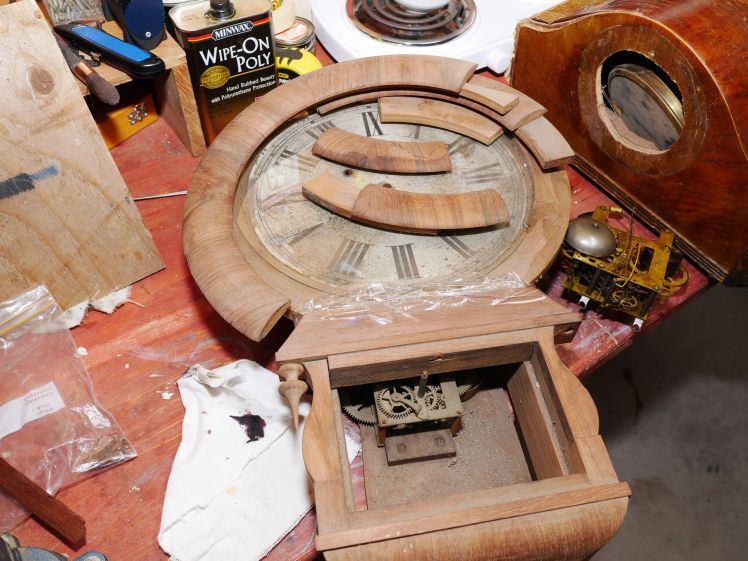
Veneer from the ogee was used to make a new finial base for the Elisha Manross steeple clock

A section of old wood is glued to a missing section of the backboard for the Ansonia Extra Drop wall clock

Veneer from the ogee clock was used to cover the finial bases for an old Scottish tall case clock.

Talk to any clockmaker and you will find many that save parts from clocks beyond repair. Conserve, do not throw anything out, it may have a future use as a hard-to-find part for a repair.

My antique and vintage clock wish list

Putting together a list of all the clocks I desire really appeals to me. The more I research the antique and vintage clock world the more discerning I have become as a collector.

Most clock collectors evolve as their tastes change and after collecting for more than 10 years I have changed my thinking on clocks I collect. I have also been focusing my collection on specific styles (wall clocks are preferred over mantel clocks) and makes of clocks (Arthur Pequegnat, for example).

A good portion of my wall and mantel clocks were acquired years ago when I was less discriminating as a collector (and some need to go) but in the past couple of years, I have been focusing on exceptional clocks that have historic significance and generally those made before 1900 in an age where better quality clocks were manufactured.

This is my current list including those clocks (indicated) I have acquired:

  • Arthur Pequegnat Regulator #1 wall clock 
  • Arthur Pequegnat Moncton, time-only, double spring 15-day movement ACQUIRED – summer 2018
  • Seth Thomas regulator #2 ACQUIRED – summer 2018
  • English 8-day Fusee gallery clock
  • Ithaca, double dial calendar clock
  • Antique tall case clock, McLachlan clock – ACQUIRED – winter 2020
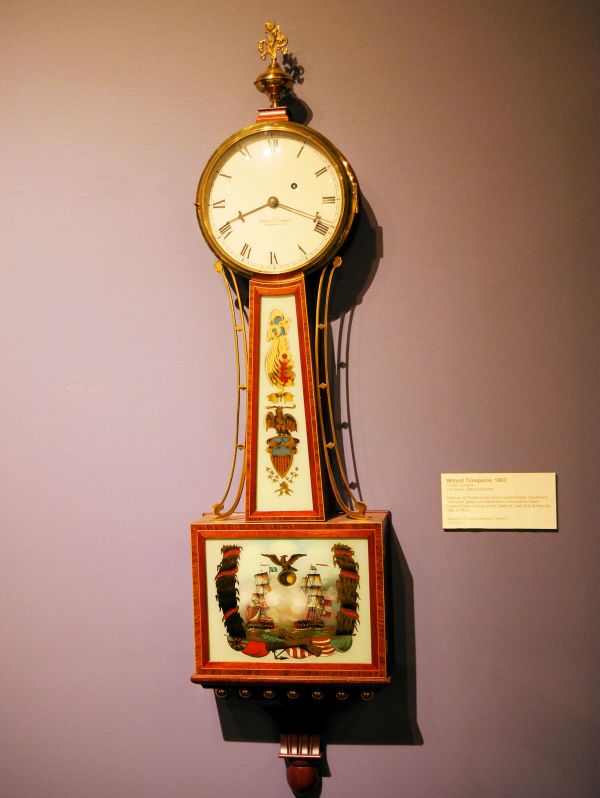
  • Banjo timepiece, weight driven
  • English lantern clock
  • Jeweller’s regulator with pinwheel escapement
  • Martin Cheney wall or tall case clock
  • English bracket clock
  • American crystal regulatorACQUIRED – summer 2018
  • Vedette wall clock – ACQUIRED June 2019
  • Vienna Regulator (mini) wall clock – one weight ACQUIRED – Fall 2016

The latest is a tall case clock from Newton Stewart, Scotland, circa 1850. My son-in-law has a Scottish tall case clock that is even older than this one. It was brought over by his family in the early 1800s. I have always admired that clock and wished that one day I could add a similar one to my collection. Luckily I was able to pick one up at auction in February of 2020.

Photo of McLachlan clock at an auction house

And, the search goes on for others on my list.

Search for my past clock articles using keywords

In light of current world events the antiquevintageclock.com family wish to convey our sympathy and condolences to those effected by Covid 19

I receive letters from all over the world asking my advice on a number of clock issues such as how a particular component of a mechanical clock should work, a clock repair challenge, how to address a particular repair or more basic things such as how to find a winding key that fits, how to wind a clock or set a clock in beat.

As comedian Dean Martin once said, “Keep those cards and letters coming”

In the past 4 years, I have authored over 400 articles that have covered a number of areas such as clock history, clock repair challenges and general clock articles but rather than direct questioners to use the search box (Search for clock articles using keywords), located to the right on the main page, I simply answer the question. It usually prompts a dialogue with more questions.

Veneering a cornice on a Seth Thomas shelf clock

Please drop me a line concerning your clock issue or give the search box a try; you might find what you need. One keyword should help in your search.

In-painting a clock dial

As American comedian and actor Dean Martin once said, “Keep those cards and letters coming”.

Is this a German box clock?

In light of current world events the antiquevintageclock.com family wish to convey our sympathy and condolences to those effected by Covid 19

A different looking box clock

Is this a German box clock? It certainly appears to be a typical time and strike German box clock with the addition of finials. I discovered it behind a bar at a resort in Varadero, Cuba before Covid19 scared us all into our homes.

I have two box clocks in my collection, one is this Mauthe clock from the 1930s but most box clocks I have seen are relatively plain-looking and unadorned. Finding one with finials is a bit unusual.

German "box" clock by Mauthe
German “box” clock by Mauthe

It might have been made by a number of German companies, Mauthe, Kienzle, Gustav Becker, or HAC but definitely German. I cannot see any markings on the dial or anywhere that might tell me what it might be. But those finials. Were they added later on? Who knows.

I am always on the lookout for interesting clocks during my travels and hopefully, in the months to come, my wife and I can resume our travelling once the current world health crisis subsides.

Plate clock movement – simple but finicky

In light of current world events the antiquevintageclock.com family wish to convey our sympathy and condolences to those effected by Covid 19

German-made time-only plate clock movement

Small shelf clocks of the 1930s from BlackForest Clock Co. of Toronto shared a simple German-made time-only movement across the line. The movement has tiny wheels and pivots plus a clever twisting pendulum rate adjuster.

Continue reading “Plate clock movement – simple but finicky”

Re-organizing my office/shop

My clock hobby has evolved to the point that I am constantly looking for ways to increase efficiency and adapt space to suit my needs. What began as an upstairs bedroom has become my office/shop for the past 6 years.

The acquisition of new tools and equipment means more space and, of course, more room for clocks.

This is how my office looked in 2014.

Continue reading “Re-organizing my office/shop”

The Maritime Association of Watch and Clock Collectors – Join Today

If you live in the Maritimes provinces of Canada and are keenly interested in vintage and antique clock and watch collecting and repair this will be of interest to you.

On November 2-3, 2019 the Maritime Association of Watch and Clock Collectors held its inaugural meeting. Five members came together from various parts of the Maritimes to meet in Prince Edward Island (Canada) to form a club of like-minded individuals.

After months of planning and discussions in preparation for the inaugural 2-day meeting the response from all present was very positive

Although the skill level varied among participants, all who attended have a keen interest in horology and are willing to share their knowledge and experiences with others.

A educational component of the meeting, a lesson in bushing

After months of planning and discussions in preparation for the inaugural 2-day meeting the response from all present was very positive.

Demonstration of the cleaning of a mainspring

The goal of this new group is to gather individuals from across the Maritime provinces (PEI, New Brunswick and Nova Scotia) to share experiences, mentor each other, learn new techniques, provide opportunities to acquire clocks and watches and foster social interaction.

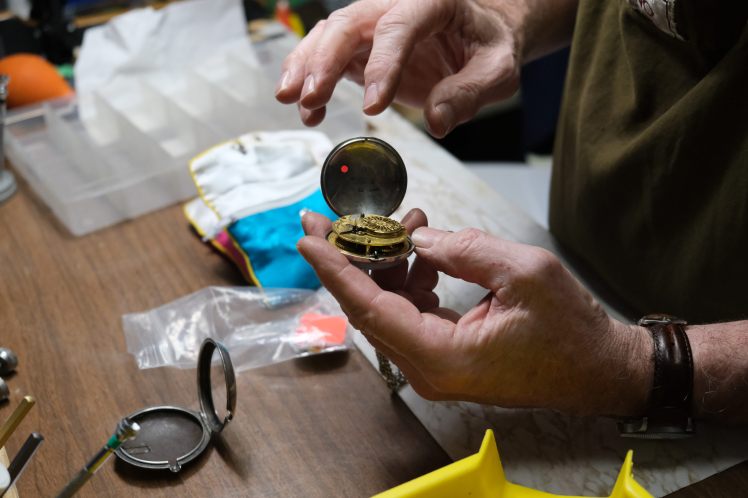
Inspecting an antique pocket watch

During our first meeting we discussed the name of the new association. We also discussed the format of our meetings, the venue, whether it be in one location or throughout the Maritimes, the frequency of meetings, outreach through social media, resource books, the training component within our meetings and what we can offer to each other both inside and outside our regular meetings.

A collection of clock movements in need of repair

We agreed that the new organization should be called MAWCC, the Maritime Association of Watch and Clock collectors. We agreed to no less than 2 meetings per year but that sub-groups would meet more frequently. At this point in time we are not affiliated with the NAWCC (National Association of Watch and Clock Collectors).

If you are from the Maritime region of Canada (Prince Edward Island, New Brunswick, Nova Scotia) and you have a keen interest or wish to advance your skills in horology and would like to  connect with like-minded individuals feel free to email me at ronjoiner@gmail.com.

Sessions Lexington Banjo Clock: 1928

Lexington banjo clock CA. 1927
Lexington banjo clock CA. 1927, as found

Once the Sessions Clock Co acquired E. N. Welch assets in 1902 (for the history of E. N. Welch go here) the company was well on its way to becoming one of the biggest clock producers in America. Production began in 1903 and between that time and 1933 Sessions produced 52 models of mechanical clocks, ranging from Advertisers, large and small clocks with logos of various businesses, to wall, or regulator clocks, and shelf or mantel clocks, designed for the home. Some Session clocks from this period are prized by collectors but most others are of the generic kind that have limited value today.

Continue reading “Sessions Lexington Banjo Clock: 1928”

American Clock and Watch Museum – a must-see for any clock enthusiast

Regulators and calendar clocks, lower level

During our stay in Springfield Ma. to attend a NAWCC annual clock convention in June 2019 we stopped in Bristol, Connecticut about 45 minutes drive south of Springfield. In Bristol, Connecticut is the American Clock and Watch Museum. The non-descript white clapboard New England styled salt-box is what first greets the visitor.

Although the museum is dedicated to American clock and watch makers it is a must see for any clock enthusiast

I admit I was a little disappointed after visiting the stately edifice of the NAWCC museum in Columbia, Pennsylvania but once I entered the side entrance door my disappointment evaporated. I was immediately impressed with the friendly and knowledgeable staff, the quality of the displays and the vast, well-organized collection of American clocks and watches. The following photos tell the story.

Continue reading “American Clock and Watch Museum – a must-see for any clock enthusiast”

Antique clock shopping experience

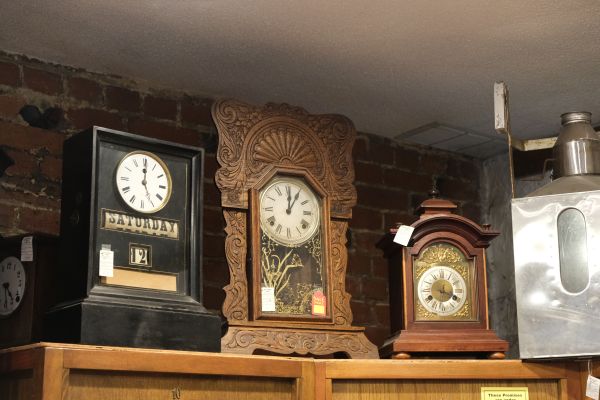
Although I did not buy any clocks during my trip to the west here are examples of what you might find in some of the better quality antique shops. The three shops these clocks are from are located on Vancouver Island, British Columbia, Canada.

Let the photos speak for themselves. captions identify some of the clocks.

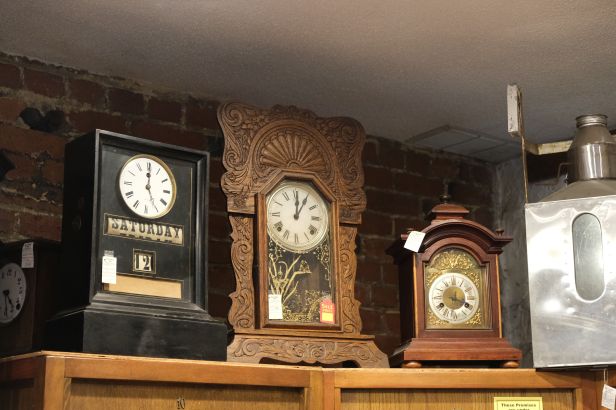
Trio of clocks, the middle one is a Grand Assortment by Sessions

Continue reading “Antique clock shopping experience”

The quest for an authentic banjo clock

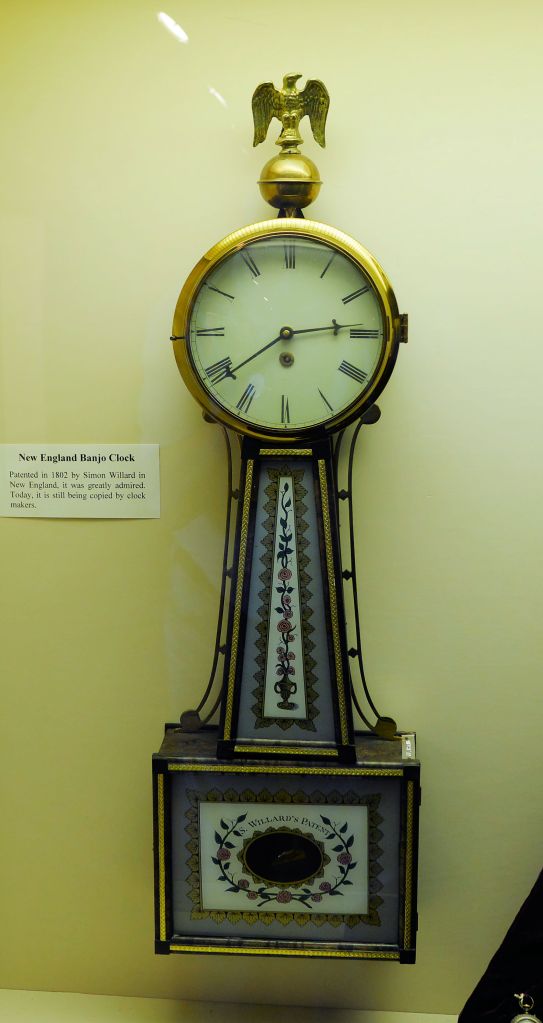
Searching for a weight driven time-only banjo clock can be a challenge and acquiring an authentic example would go a long way to completing my collection. Securing an authentic Willard would certainly be the icing on the cake.

The style was widely copied by other members of the Willard family of clock makers and many others clock-makers

I was fortunate to have seen several Willard banjo clocks during my visit to the Willard Museum in Grafton Mass. in June 2019.

Banjo clock, circa early 1800s, Macdonald Museum, Middleton, Nova Scotia. Notice the location of the winding arbour

Few American clock-makers at the beginning of the 18th century were innovative. One of the most notable achievements was the small 8-day, weight-driven clock developed by Simon Willard. The Willard clock is a uniquely American wall clock with a banjo-shaped case designed and constructed by Simon Willard. Willard was originally of Grafton, Massachusetts, later of Roxbury, Massachusetts, and patented his unique clock in 1802.

The Willard banjo clock has no striking mechanism and indicates time only by its hands and dial. It is correctly defined as a timepiece.

Continue reading “The quest for an authentic banjo clock”

Bushing a Jauch clock movement barrel


Over the past seven years, I’ve installed a number of bushings in clock movements, but I had never attempted to bush a clock spring barrel until now. While some clockmakers regularly bush barrels, this is the first time I’ve encountered a barrel mainspring in such poor condition. Despite being my first attempt at bushing a barrel, the process was largely successful.

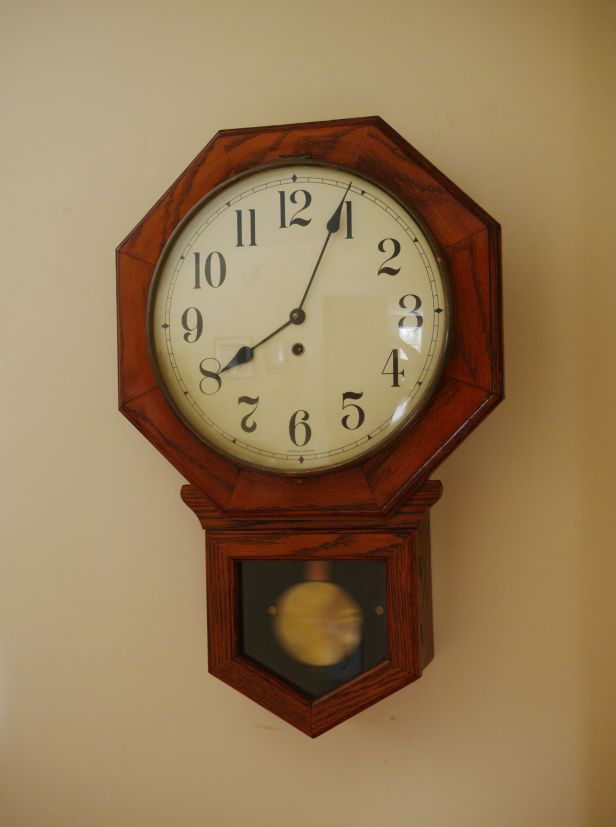
Jauch wall clock
Jauch wall clock

Two years ago, I purchased a Jauch schoolhouse clock at auction for $50. It features a straightforward, time-only movement, making it an excellent choice for anyone new to clock repair.

Jauch drop octagon wall clock
Jauch movement

German clock movements from the 1970s were not always built to the highest standards, often plagued by two key issues: plated pivots and soft brass. Softer steel pivots were used to prolong the life of cutting machines, with plating added to provide sufficient hardness. Unfortunately, this plating wears away over time, leaving the pivot significantly worn.

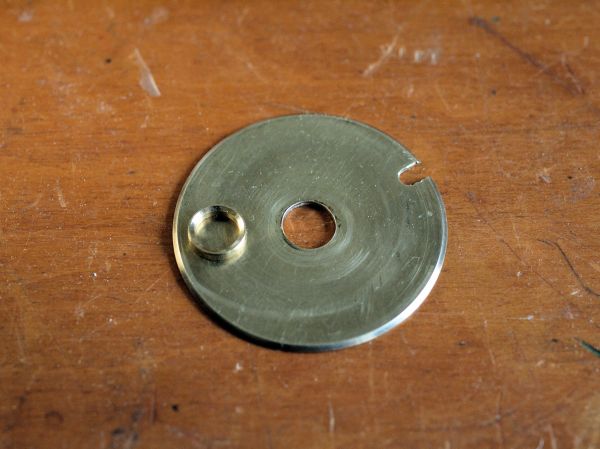
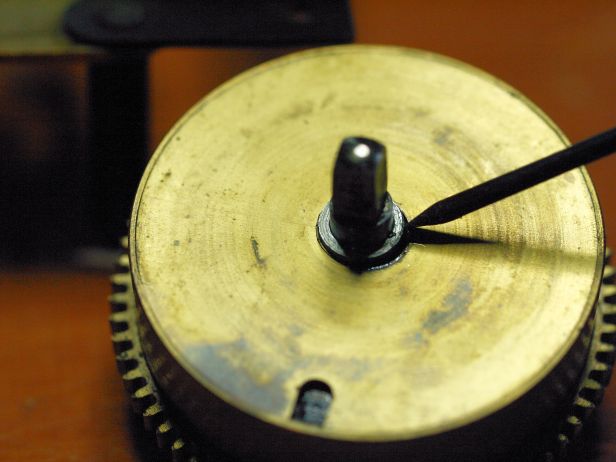
This particular movement does not have plated pivots. However, the second issue—soft brass—is evident. In this case, the steel arbor has caused significant wear to the brass cap and barrel.

Gap in barrel
Another shot of the enlarged hole on the cap

During a previous servicing, I installed three bushings but did not address the mainspring barrel.

Since I purchased the clock, it has consistently run 10 minutes fast at the start of the 8-day cycle and 10 minutes slow by the end. There’s likely some underlying physics related to barrel slop that affects this erratic behavior, though the exact cause eludes me. Clearly, something unusual is at play. Will bushing the barrel and its cap improve the running characteristics of this movement? Time will tell.

Assembled movement

A Challenging Repair

For the barrel repair, I chose a #60 Bergeon bushing to fit the reamed-out hole, as it was the largest size available in my bushing supply.

Largest Bergeon bushing with an outside diameter of 8.5mm
The ratchet gear must be removed to work on the barrel arbour

To remove the barrel arbor from the barrel, I first had to take off the ratchet gear. Lacking a gear puller, I placed the barrel in a vice, positioned two pieces of wood on either side beneath the ratchet, and gave the arbour a light tap with the nylon end of a brass hammer. The ratchet came off easily.

After popping off the barrel cap, I used my spring winder to remove the mainspring, allowing access to the barrel. I then restrained the spring with a collar. So far, everything was going smoothly.

Jauch mainspring barrel in Olie Baker spring winder, with capture collar on right

I positioned the barrel in my Bergeon bushing machine and used the centering bit to establish the center. Using an 8.47mm cutter, I created a hole and installed the bushing. To secure it, I peened the bushing in place, forming a lip on both ends to ensure it stayed firmly seated. With the barrel complete, I moved on to the cap.

This is where things didn’t go quite as smoothly. I centered the cap as accurately as possible on my bushing machine, drilled through it, and installed a bushing of the same size. However, the arbour’s diameter on the cap side was larger than on the barrel side, so I used another reamer to enlarge the inside of the bushing. As I worked, I noticed the bushing wall was becoming quite thin. To preserve a sufficiently thick wall, I decided to reduce the diameter of the arbour. Using my metal lathe and a cutter, I trimmed the arbour to achieve a proper fit. Once satisfied, I peened the bushing in place.

Cap bushing
Barrel bushing

When I reinstalled the barrel into the movement, I noticed that the cap could have been better centered. There is a slight tilt, which became apparent once the barrel was in place. I wondered whether the gear would properly mesh with the second wheel pinion as the barrel rotates or if it might rub against the second wheel. After a few days of observation, it seemed to function without issue.

Looking back, I realize it would have been better to bush the barrel side first, test it, and then move on to the cap side. It’s all part of the learning process!

Next time, taking extra care to pinpoint the exact center will undoubtedly lead to a better result. Given that this is a budget clock and not my finest work, I see it as a valuable experience.

Clock collecting and repair as a hobby – Part II

In Part I, I wrote why I collect, repair and restore clocks. In this, Part II are 9 reasons why clock collecting and repair is a great hobby for just about anyone.

9 Reasons why clock collecting and repair is a great hobby

Continue reading “Clock collecting and repair as a hobby – Part II”

Website Powered by WordPress.com.

Up ↑