A rare clock – the Ingraham Huron – Part I
RS Ingraham Huron1
Ingraham Huron shelf clock

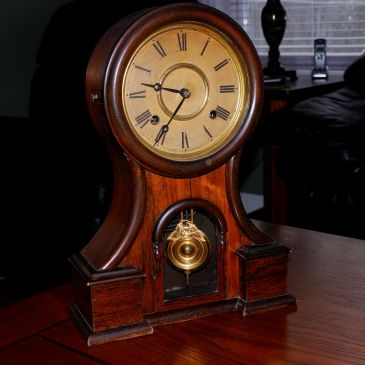
My most recent acquisition (April 2016) is an Ingraham Huron shelf clock. The Huron is one of the less commonly found Ingraham models, having been manufactured briefly between 1878-80.

The clock you see here is Rosewood Veneer “Huron” Shelf Clock, by E. Ingraham & Co., Bristol, Connecticut. It has paper on a zinc dial with a round glazed door and lower glass access panel. The maker’s label is inside the backboard. It is a brass eight-day spring-powered movement, with a height of just under 41 centimeters.

The case is in very good condition. The veneers are in excellent shape (no splitting or cracking), the clock face has a build-up of grime which I may leave as is, the base corner pieces have a little wear but the 2 door catches are sound, the glass is perfect, the door hinges are in very good condition and the doors, top and bottom, still fit with precision. The pendulum retains it’s original lacquer and presents well. I have not looked at the movement yet but a little push of the pendulum tells me that something is amiss. Could simply be wound down springs or something more involved. I will leave as is until I have the time to look at it further this coming week and I will post my findings later.

I asked the seller who is about 70 years old, “what do you know about this clock?”. He extended his hand palm down out to about a meter from the floor and said, “I was this tall when I can first remember it in my grandmother’s home”. There is a penciled marking just inside the case indicating that it had been serviced by a person by the name of Hebb in 1944. The seller recalls a Hebb family who at one time lived in the Bridgewater area of Nova Scotia near where I purchased the clock.

RS Ingraham Huron (21)
Base of the Huron

The company had a long and renowned history. Elias Ingraham was the founder of this 19th-century Connecticut company that bore his name.

Ingraham won 17 patents between 1853 and 1873, all protecting the unique design of his clocks, most of which were made to hang flat on a wall or sit on a shelf.  Ingraham was able to devote his attention to the physical look of his clocks because the technology inside them was rapidly becoming commonplace. By the middle of the 19th century, spring-driven clockworks were replacing weight-based ones, which allowed clocks to be smaller and lighter. These innovations permitted Ingraham to focus on the look of his clocks in order to differentiate himself from his competitors.

RS Ingraham Huron (18)
Dial door clasp

And that is precisely what he did.  In 1844, he and his brother Andrew joined with Elisha Curtis Brewster to form the Brewster & Ingrahams (plural) company. The firm would become E. and A. Ingrahams Company in 1852, Elias Ingraham and Company in 1857, E. Ingraham & Company in 1861, The E. Ingraham & Company in 1881, and The E. Ingraham Company in 1885. These subtle name changes might seem overly petty, but they provide the modern collector of antique Ingraham clocks with a accurate way to date clock styles that were produced during a span of years.

Ingraham shelf clocks ranged from painted timepieces richly decorated with mother-of-pearl to round Venetian and Grecian styles clad in rosewood veneer and adorned with gilt columns. Versions of these shelf clocks were also created for walls—the Ionic style was so popular that Ingraham made it from 1862 until 1924.

RS Ingraham Huron (10)
Clock face showing what I believe are original hands


RS Ingraham Huron (1)
Side of clock showing striking veneer

In 1885, Elias’s son Edward took over the company and continued its innovation in clock case design. Double-dial wall and shelf clocks produced during this period told the time of day, the day of the week, and the month. As the 19th century wore on, Ingraham made mantel clocks with Chinese motifs and carved dragon’s feet, as well as a number of patriotic clocks depicting American war heroes.

RS key
winding key looks home-made

The Ingraham Clock Company continued to produce clocks through the 1920s continuing with the tradition of unique clock cases with Oriental designs and patriotic themes. Throughout the war years the company diversified into pocket watches and wrist watches. During the post war period the Ingraham company continued to produce wall clocks, mantel clocks and wrist watches but by 1967 the company was acquired by McGraw-Edison who converted production into making more profitable fuses spelling the end of formal clock production and the end of the Ingraham tradition of producing uniquely designed clocks for the masses.

Much of the information for this post came from this site.

Floating balance no longer “floats”

Floating balance movements began appearing in mechanical clocks in the early 1950s. The floating balance has distinct advantages over pendulum clocks. It is robust, dependable and not susceptible to disturbance. It will tolerate being out of level unlike pendulum clocks which must be on a level surface.

clock movement
Hermle movement showing floating balance escapement

This Hermle movement was taken out of a Dugena 1960s vintage Mantel clock and is otherwise unmarked. The seller advised that it loses time and might just require a simple adjustment. This is code for, “it’s worn out”. The clock has been completely disassembled, cleaned, reassembled, oiled and tested. have I have eliminated friction loses in the trains. Not sure, but let’s see.

To function correctly the balance wheel rotates back and forth and maintains the steady beat of the clock through a pallet fork assembly. There is a speed adjustment and after adjusting it enough it becomes clear that the problem is within the balance wheel itself since it continues to run slowly.

The floating balance assembly consists of a balance wheel, 2 jeweled bearings on each end of a hollow tube riding on a pivot wire supported in a u-shaped frame.

mantel clock
Dugena time and strike mantel clock

The most common reasons for sluggish balance performance are dirt, rust/pitting/roughness of the wire, bent or weak wire or excess oil on the wire & jewels.

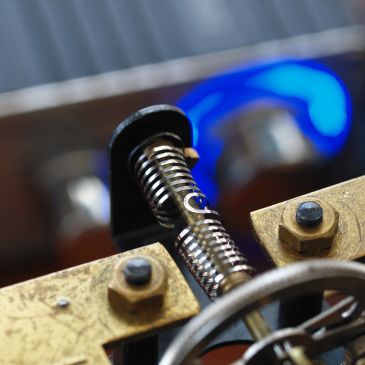
Removal is simple – take out two screws, tilt the balance to avoid bending the pallet fork and pull out. Here is the assembly removed from the movement. The bad news is that the helical hairspring appears to be distorted. Ideally it should enclose the balance shaft without bending.

clock part
Floating balance

The balance wheel should float on the wire that goes through the cylindrical shaft like the next photo. While in this position a push on the balance wheel should allow it to rotate freely for a minute or more. No more than a few seconds for this one, however.

clock part
Arrow shows a properly functioning floating balance

The thin wire is actually resting on the banking forks (or base). If the shaft rests on the base, additional friction slows the rotation of the balance wheel and will eventually slow the clock.

clock part
Cylindrical shaft is resting on the banking pins

In this case either the jewels are cracked or the spring has lost its strength. The solution is to either find a new helical torsion spring or find a replacement balance wheel assembly.

Given what I paid for it, it is probably not worth additional resources.

Call it a learning experience. Into the drawer it goes and perhaps someday it will provide parts for a better running movement.

Girod movement in Canadian made case

Mantel clock
Mantel clock

This fairly non-descript mantel clock is a puzzler. It has a nicely constructed case with curved wood relief features and a westminster chime, hence the three winding arbors. It is in very good condition and required a simple de-greasing of the cabinet to bring it back to it’s former glory.

The clock was presumably made after the war years, perhaps the late 1940s and has a pendulum movement. Most mantel clocks beginning in the 1950s had balance wheel escapements so I am putting this in the late 1940s perhaps even the early 1950s. This particular mantel clock has a French Girod westminster chime movement.

Girod was a clock maker based in the Morbier-Jura region of France and produced clocks from the 1930’s into the 1960’s. The firm of Girod was founded in 1865 by brothers Leon and Auguste Girod. The clocks were made almost exclusively in the Art Deco style. This clock has Art Deco features particularly the formation of the dial numerals but I would not say it was sold as a Girod clock.

RS Girod mantel clock (8)
Dial face

Girod clocks (both mantel and tall case) often came with Westminster chimes, and often a second chime named Cloche de Jura, using the same notes as the Westminster chime. A handful of clocks were built with Ave Maria de Lourdes, and  St. Etienne chimes. This clock is westminster chime only; no double chime feature unfortunately. Girod cases usually featured carved walnut appliques and were very ornate, almost garish. Mine is very plain and as I said non-descript.

So, what is it? Well, from my research I have discovered that despite the fact that the clock movement is stamped Girod, it might be a German Kienzle movement. Girod movements had the distinctive feature of split plates, this one has solid one-piece plates. Again my research reveals that as a result of the post-war German reparation effort, Kienzle clock movements were brought from Germany into the Girod factory in France, assembled and stamped as a Girod movements for, it is my guess, export to Canada and other countries.

Another clue. The case has a stamp on the back. It is a little faded but it says, “Quality Cabinet Made in Canada”. There are three letters in the middle that I cannot make out. PHS or FHS perhaps?

RS Girod mantel clock (11)
Upside down stamp on back

There is no trademark on the dial face which would normally indicate the retail seller or manufacturer but my guess is that it was likely sold as a Forestville mantle clock (the Forestville Clock Company was based in Toronto). The logo (??) punched into the hour hand makes me wonder though.

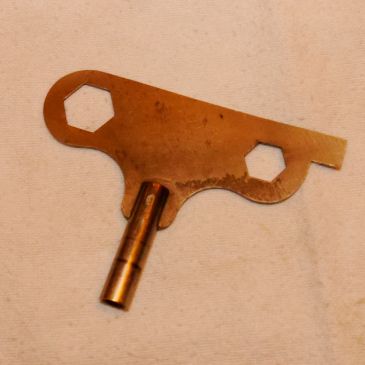
Look at the key. Why two wrench punch-outs and a screw driver end?

RS Girod mantel clock (1)
Key with screwdriver and wrench punch-outs
RS Girod mantel clock (4)
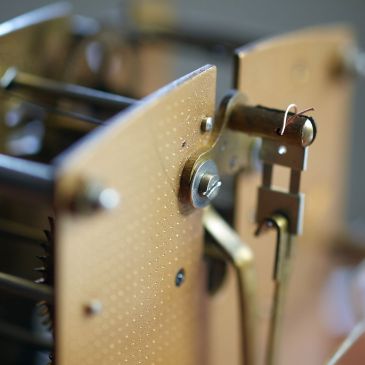
Girod movement showing chime rods and unusual pendulum

The above shot shows the movement. It has five strike hammers, 4 of which carry the Westminster chime and three hammers for the on-the-hour strike. The strike feature is quite loud. The rods appear to be differing lengths of copper and the pendulum has a relief of the Eiffel Tower that you can just make out. There is also a lever on the upper front of the movement which serves as a repeater. The movement appears to be very sturdily built and reflects German (??) quality.

Again my best guess is the Forestville Clock Company of Toronto but if you have other information or if you know more about the history of Girod clocks please drop a line.

Maple Leaf clock is sent off for repairs

RS Complete so far and on display (1)
The case is about 90% restored

December 18th marks the day that my Arthur Pequegnat Maple Leaf fan-top is off to repair.

Sadly this is a repair that I cannot perform myself at this stage of my learning. The problem is essentially a clutch plate off the centre arbor that is not engaging the gear for the strike side. The result is that the hour and minute hand do not move at all thus the centre arbor is quite loose. In the meantime I might as well have some bushing work and a thorough cleaning done.

Typically gingerbread clocks go for almost nothing on the for-sale sites. The fact that this is a Pequegnat means something special however and in my view it is worth preserving for years to come.

Here is the problem area.

view of the clutch cup on the centre arbour
Clutch cup is loose

Although it is difficult to visualize from this photo, the cup clutch plate is very loose and needs to be reattached to allow a firm connection to the gear beneath. As such I am prepared to put a little money into this clock and keep it in my collection.

Sessions Tambour Style clock

OLYMPUS DIGITAL CAMERA
Session Tambour clock, movement out of case

This is a Sessions Tambour style clock that, according to the label on the inside back access door is a Beveled Number 2. Seems like an odd name for a clock. It is a fairly attractive mantel clock featuring a mahogany finish with faux inlay just below the dial. It is a time and strike clock, two hammers striking on rods.  I would put the date of manufacture at the late 1930s or early 1940s. I have 2 other Sessions clocks with a very similar movement so it looks very familiar. This one came without a pendulum bob so I will have to order one from Timesavers. I am not sure at this point whether the bob is a 2.3 oz or 3 oz so I will order both.

The clock has a few issues aside from the missing pendulum bob. I noticed right away that the time side arbor turned freely and therefore it was impossible to wind the time arbor as the click was not engaging the time spring teeth properly. Once the movement was out I inspected the click on the time side and sure enough it had slipped off the teeth.

OLYMPUS DIGITAL CAMERA
The time side click is barely engaged

This is a common problem with this type of movement and a repair is definitely in order. The movement itself is very oily and dirty having been sprayed with some sort of lubricant at one point in its life. There was back gunk  (old caked oil) on some of the pivots but there was not as much play in the bushing holes than I would have expected. The spring issue probably arose early in its life. One thing which I first thought was an issue turns out not to be. As the photo shows there are helper wires between the escapement and the fly.

OLYMPUS DIGITAL CAMERA
Helper wires

They keep the strike levers from bouncing and assure better operation of the striking mechanism. They are in factory installed condition.

OLYMPUS DIGITAL CAMERA
Very dirty movement, time side on left

The case was a little banged up. I did a little sanding with 0000 steel wool, removed dozens upon dozens of white paint drops, filled gouges in the veneer with a red chestnut stain and applied the same stain over the entire finish and it seems to pass for mahogany.

OLYMPUS DIGITAL CAMERA
Case refresh

A little Brasso metal polish was applied to bring the shine up on the bezel and I Windexed the dial glass inside and out. The results, I think, are impressive. As a final stage I will apply a clear coat on the case.

Can I get this clock to work? I am convinced that if I can fix the time side click, give it a thorough cleaning, this clock will run fine for a long time.

Smiths Enfield Mantel Clock

Restoring and repairing antique clocks is a rewarding and sometimes challenging journey, and my latest project has been no exception. I recently acquired a time-and-strike mantel clock from the Enfield Clock Company, a British manufacturer known for its utilitarian designs, especially post-war.

Smiths Enfield time and strike mantel clock

In this article, I will share my experiences as I continue to restore this time-and-strike mantel clock, detailing the steps I’ve taken so far, the challenges I’ve faced, and what I’ve learned along the way.

The Enfield Clock Co. & Association with Smiths

The Enfield Clock Company’s history is as intriguing as the clocks they produced. Established in 1929, Enfield became known for its mass-produced timepieces, manufactured using modern assembly line techniques inspired by American factory systems.

By the early 1930s, Enfield was manufacturing clock movements that were sold wholesale, eventually leading to the formation of the Smiths Enfield brand after the company was sold to Smiths Industries in 1933. The clocks, particularly those produced in the 1950s, reflected the utilitarian, post-war aesthetic of the time.

Initial Observations

When I first examined the clock, I could tell that it had been worked on by someone with a tinkerer’s touch, rather than a skilled clockmaker. Although its striking mechanism sounded great and the clock was visually appealing, I knew it required a thorough service to restore its functionality.

This clock occasionally stopped for no apparent reason and was difficult to keep in beat, prompting me to learn more about clock repair. The movement was relatively simple, with two trains, so I set out to clean and service it. As I worked through the process, I encountered some challenges, including an unhooked mainspring and worn pivot holes, but I made progress nonetheless. Though I had to delay some repairs due to my limited experience, I gained valuable insights into the inner workings of this timepiece and look forward to continuing the restoration.

Two pivot holes on the back plate were a little worn but not enough to cause any issues at this time. However, since I know very little about bushing work at this point I think it wise to put off repairs until I know how to do the work. A bushing machine is on the horizon but limited funds do not permit me to tackle those more in-depth repairs just yet. Anyway, back to the movement.

Movement showing hammer, and pendulum leader and bob

While reassembling the strike side the mainspring unhooked. I am not sure why. I was prepared to disassemble the movement to reattach the mainspring but a little wiggling corrected the problem.  Once the parts were cleaned in an ultrasonic cleaner and the parts were dried, the movement was assembled and oiled. There are two adjusting two screws on either side of the verge that determine the correct height between the pallets and the escape wheel. Through trial and error, I was able to get a good pendulum swing and a steady beat.

Tricky clip

I decided not to re-attach the 2 clips just yet since it would not take much to break them. Only after the clock has been running reliably and striking correctly will I reattach the clips.

Two ratchets

Not a good design in my view and I wonder if these clocks were ever meant to be worked on after they left the factory.

In the next article, I will share my experiences as I continue to restore this time-and-strike mantel clock, detailing additional steps I’ve taken so, the challenges I’ve faced with this project, and what I’ve learned along the way.

Sessions Raven clock

I acquired my Sessions Raven clock about a year ago. It had been serviced by someone knowledgeable about clocks and arrived in excellent condition. The movement had clearly been disassembled, oiled, tested, and the case carefully reconditioned. Interestingly, it also came with a set of instructions from the person who had worked on it.

Sessions clock
Ebony in colour and very attractive
Sessions mantle clock (12)
Detailed operating instructions

I imagine he wanted to ensure the clock found a good home—and it certainly did! The only drawback was the absence of a label, which is always a consideration when purchasing antique clocks. Otherwise, everything appeared to be in order. According to Tran’s book, the leading authority on American clocks, the Sessions Raven dates to the 1920s. It is a time-and-strike clock, featuring a bell for the half-hour and strike rods on the hour. I suspect it was named the Raven because of its deep ebony color—quite striking, in fact.

Sessions mantle clock (17)
Time and strike movement showing the bell

The Sessions Clock Company emerged from the E.N. Welch Clock Company in the early 1900s and was once one of the most recognized American clock manufacturers. However, like many others, it struggled to compete with the rise of electric clocks. Despite its efforts to adapt, the company persisted until the late 1960s before ultimately being forced into liquidation in 1969—a bittersweet end to a once-prominent name in horology.

Sessions mantle clock (11)

My clock holds a prominent place in my family room. Its simple design reflects the style of its era and blends seamlessly into any space.

Blackforest Shelf Clock Progress

I have dis-assembled this clock twice. After the first dis-assembly I cleaned and oiled it, found everything to be in order but once I assembled it, bench-tested it to find everything seemingly correct and set the beat  it would not run more that 5 to 10 minutes at a time. When it stopped it seemed to catch on the escape wheel.

OLYMPUS DIGITAL CAMERA
Shown with back plate off

It is now stripped down again. No need to have as through a cleaning as the first go-around but now is the time to investigate other factors. It is a pretty simple clock as the photo shows.

OLYMPUS DIGITAL CAMERA
Escape wheel showing worn teeth

What I see right away is the escape wheel teeth and how some are hooked or misshapened. My temptation is to file it down but others are suggesting that I use pliers to press the hooks back into shape. I have’t decided what to do just yet.

Others have suggested that I put more weight on the pendulum which I am reluctant to do since this clock was likely designed to run on a light bob.

OLYMPUS DIGITAL CAMERA
The pendulum showing the twist adjustment for speed regulation

Now back to further investigation.

Late note: I finally got this clock to work after taking it apart twice. The second time I concentrated on the pivots discovering the at least 2 had enough rust that them that they may have slowed the clock down. I also took a burr off the escape wheel but in the process damaged the escape wheel a little, so that while the clock runs there is a little clunking sound once with each rotation, but it works and keeps time! Live and learn.

Sessions American No. 2 Mantel Clock

RS Sessions Mission Oak (3)
An attractive Sessions mantel clock

This is a recently acquired Sessions time and strike mission style mantel clock. Aside from cleaning up the case with diluted Murphy’s Soap, my standard cleaner for clock cases, I applied clock oil to the movement and reset the verge in order to get the proper beat. It is running well and keeps very good time. There is a  speed adjuster at the 12 o’clock position which is helpful in regulating the speed.

RS Sessions Mission Oak mantel clock (7)
Sessions time and strike movement

There are some issues, the glass clips are broken and the glass is loose in it’s bezel but putty will fix that. It came without a double-sided key but I have enough spares that I have one that fits and the clock needs a thorough cleaning.

RS Sessions Mission Oak mantel clock (3)
Before bezel is cleaned

After it is running for a week or so, I will tear it down and address any bushing issues.

This is an “American No. 2” Sessions  mantel clock from 1921 according to Tran Duy Ly’s book on Sessions clocks, page 121.

Website Powered by WordPress.com.

Up ↑