Clock collectors usually pride themselves in having at least one Gustav Becker (GB) clock in their collection. I have just one but I am always on the lookout for another.
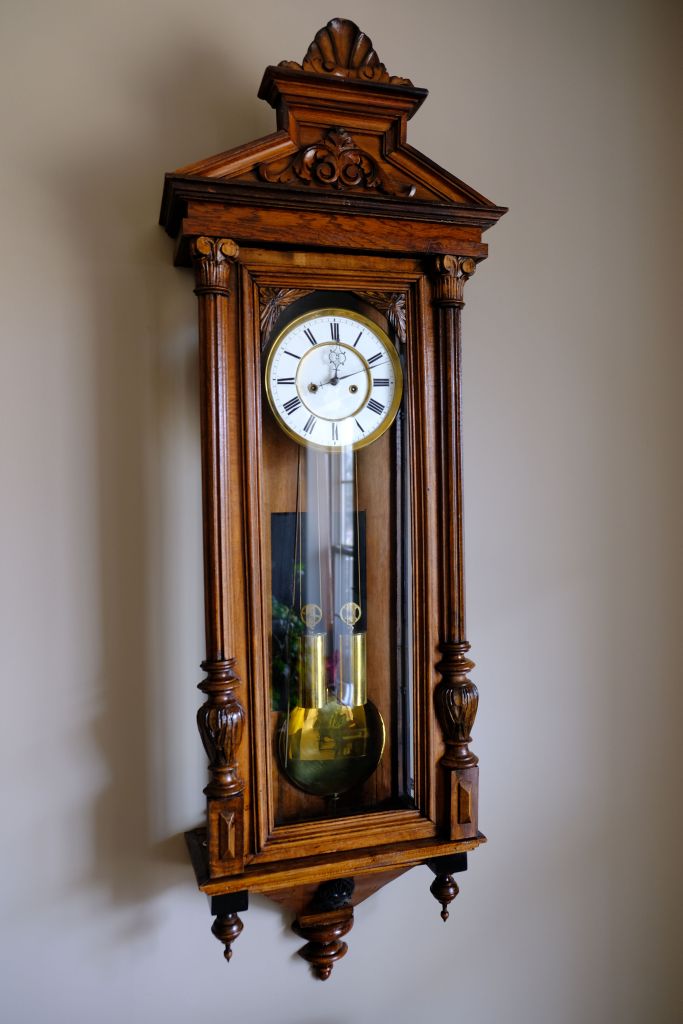
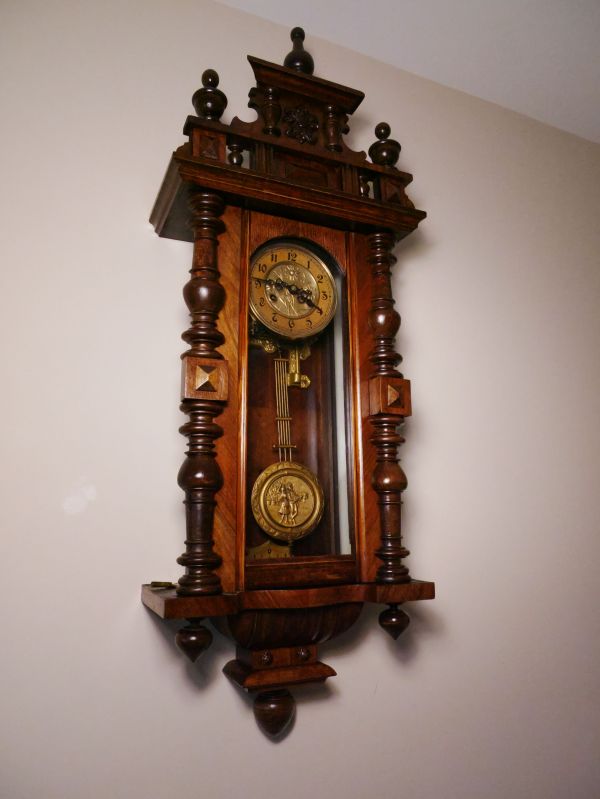
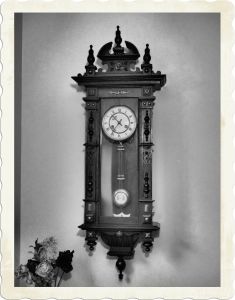
Gustav Becker wall clock
Becker clocks are not difficult to identify and date. Along with a maker’s stamp, serial numbers on the clock movements identify the year of manufacture. This clock was made in 1902 however, the original 1902 Braunau movement had too many missing parts and was replaced. It now has a “newer” Polish sourced Braunau movement from 1917.
Over the past seven years, I’ve installed a number of bushings in clock movements, but I had never attempted to bush a clock spring barrel until now. While some clockmakers regularly bush barrels, this is the first time I’ve encountered a barrel mainspring in such poor condition. Despite being my first attempt at bushing a barrel, the process was largely successful.
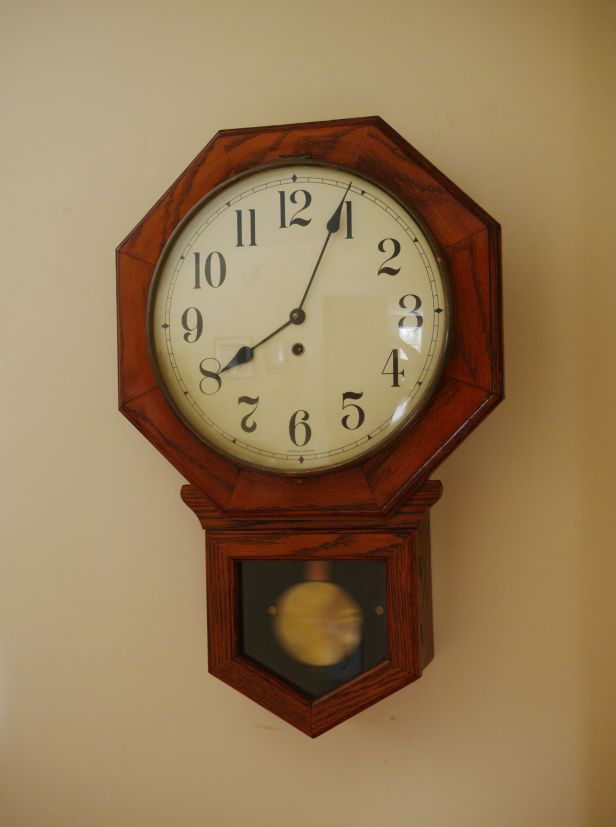
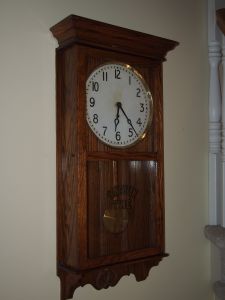
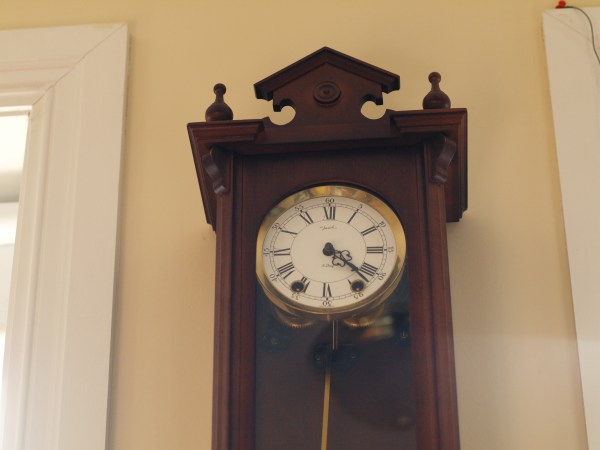
Jauch wall clock
Two years ago, I purchased a Jauch schoolhouse clock at auction for $50. It features a straightforward, time-only movement, making it an excellent choice for anyone new to clock repair.
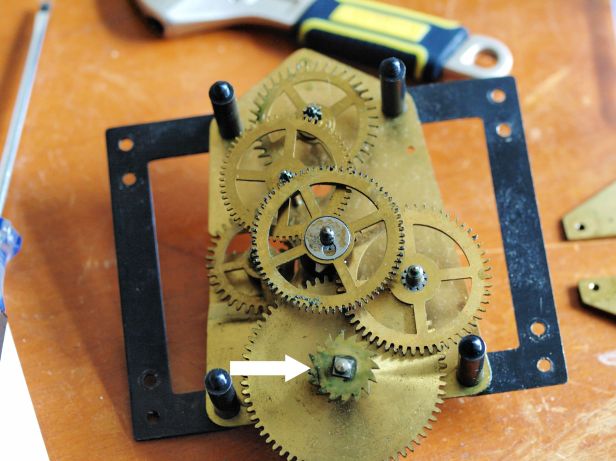
Jauch movement
German clock movements from the 1970s were not always built to the highest standards, often plagued by two key issues: plated pivots and soft brass. Softer steel pivots were used to prolong the life of cutting machines, with plating added to provide sufficient hardness. Unfortunately, this plating wears away over time, leaving the pivot significantly worn.
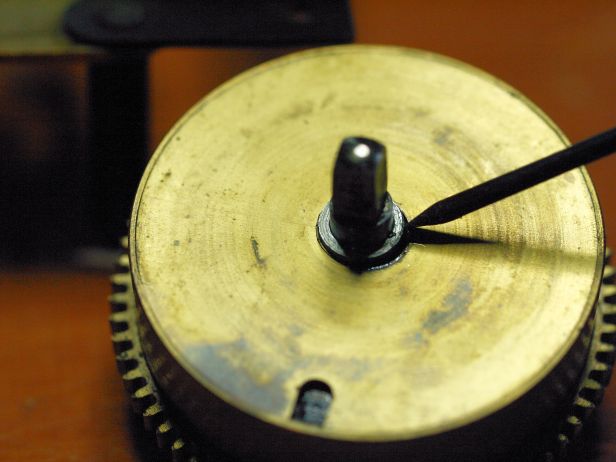
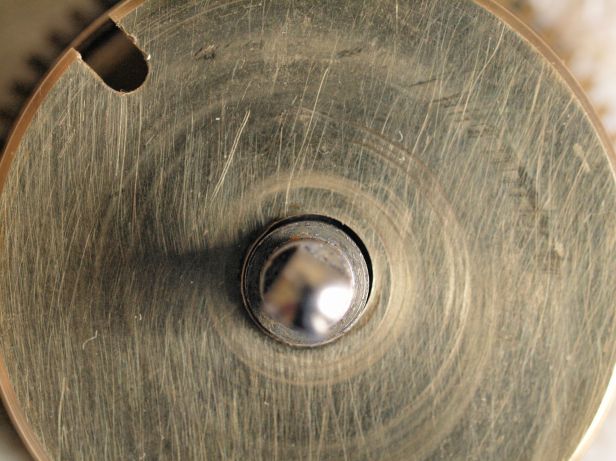
This particular movement does not have plated pivots. However, the second issue—soft brass—is evident. In this case, the steel arbor has caused significant wear to the brass cap and barrel.
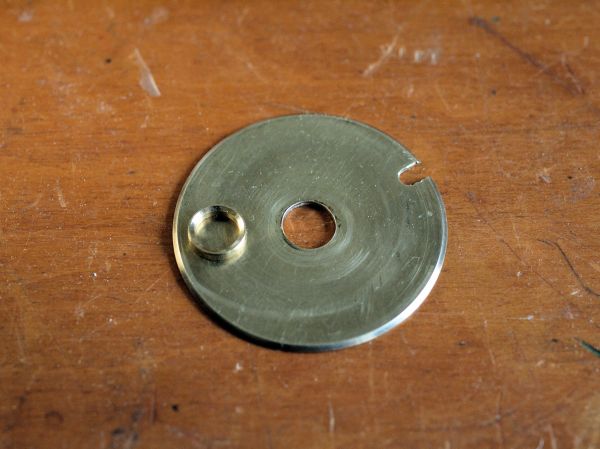
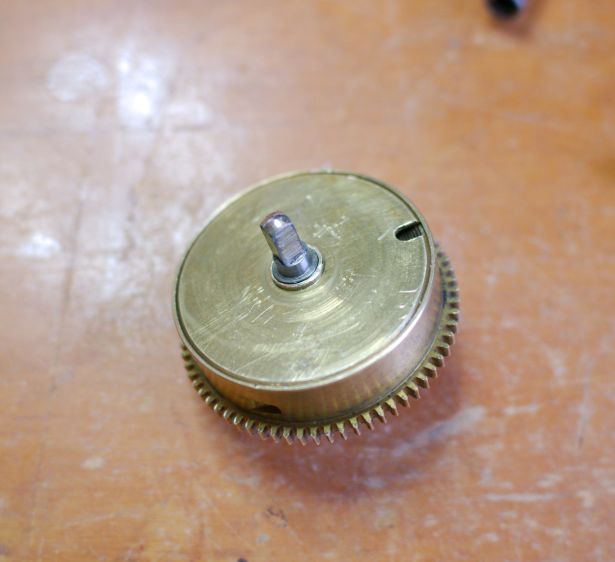
Gap in barrelAnother shot of the enlarged hole on the cap
During a previous servicing, I installed three bushings but did not address the mainspring barrel.
Since I purchased the clock, it has consistently run 10 minutes fast at the start of the 8-day cycle and 10 minutes slow by the end. There’s likely some underlying physics related to barrel slop that affects this erratic behavior, though the exact cause eludes me. Clearly, something unusual is at play. Will bushing the barrel and its cap improve the running characteristics of this movement? Time will tell.
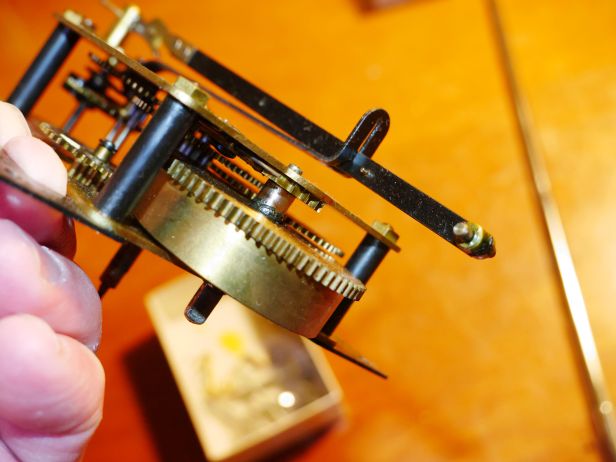
Assembled movement
A Challenging Repair
For the barrel repair, I chose a #60 Bergeon bushing to fit the reamed-out hole, as it was the largest size available in my bushing supply.
Largest Bergeon bushing with an outside diameter of 8.5mmThe ratchet gear must be removed to work on the barrel arbour
To remove the barrel arbor from the barrel, I first had to take off the ratchet gear. Lacking a gear puller, I placed the barrel in a vice, positioned two pieces of wood on either side beneath the ratchet, and gave the arbour a light tap with the nylon end of a brass hammer. The ratchet came off easily.
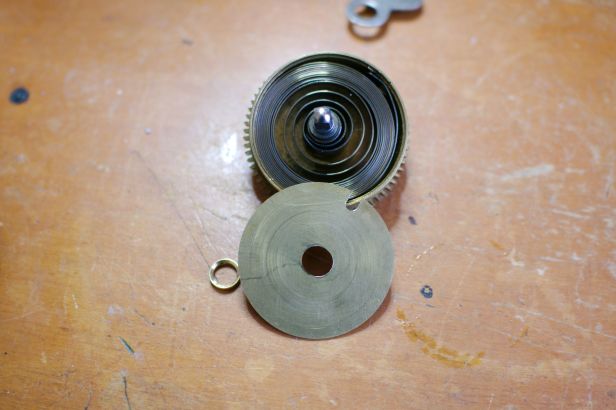
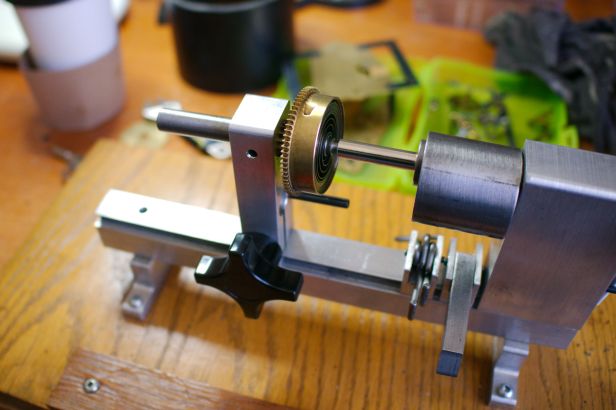
After popping off the barrel cap, I used my spring winder to remove the mainspring, allowing access to the barrel. I then restrained the spring with a collar. So far, everything was going smoothly.
Jauch mainspring barrel in Olie Baker spring winder, with capture collar on right
I positioned the barrel in my Bergeon bushing machine and used the centering bit to establish the center. Using an 8.47mm cutter, I created a hole and installed the bushing. To secure it, I peened the bushing in place, forming a lip on both ends to ensure it stayed firmly seated. With the barrel complete, I moved on to the cap.
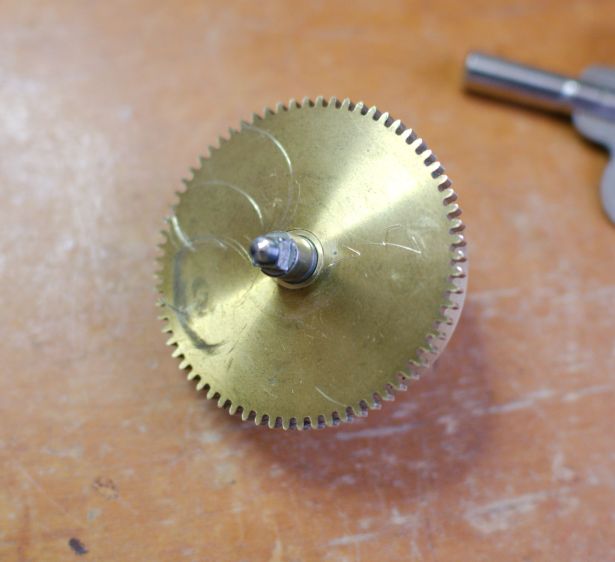
This is where things didn’t go quite as smoothly. I centered the cap as accurately as possible on my bushing machine, drilled through it, and installed a bushing of the same size. However, the arbour’s diameter on the cap side was larger than on the barrel side, so I used another reamer to enlarge the inside of the bushing. As I worked, I noticed the bushing wall was becoming quite thin. To preserve a sufficiently thick wall, I decided to reduce the diameter of the arbour. Using my metal lathe and a cutter, I trimmed the arbour to achieve a proper fit. Once satisfied, I peened the bushing in place.
Cap bushingBarrel bushing
When I reinstalled the barrel into the movement, I noticed that the cap could have been better centered. There is a slight tilt, which became apparent once the barrel was in place. I wondered whether the gear would properly mesh with the second wheel pinion as the barrel rotates or if it might rub against the second wheel. After a few days of observation, it seemed to function without issue.
Looking back, I realize it would have been better to bush the barrel side first, test it, and then move on to the cap side. It’s all part of the learning process!
Next time, taking extra care to pinpoint the exact center will undoubtedly lead to a better result. Given that this is a budget clock and not my finest work, I see it as a valuable experience.
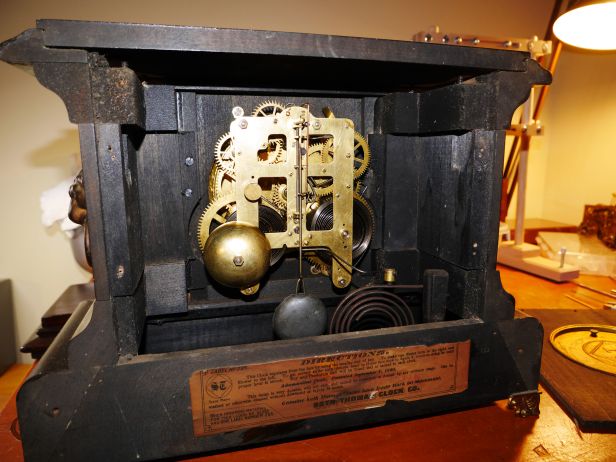
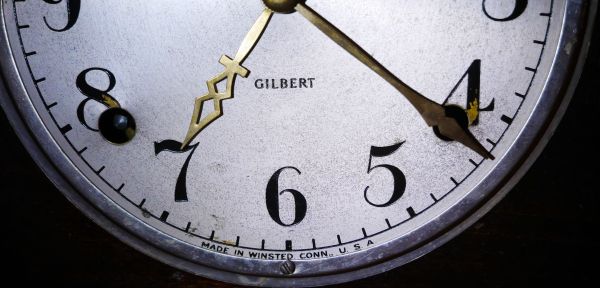
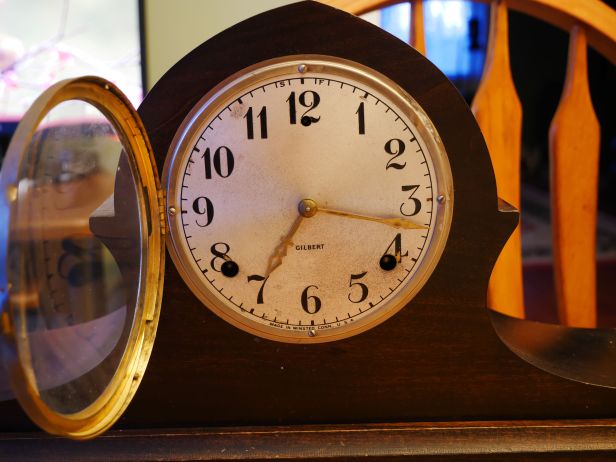
Has my 90 year old Gilbert clock been running continuously since it was first purchased? Not likely.
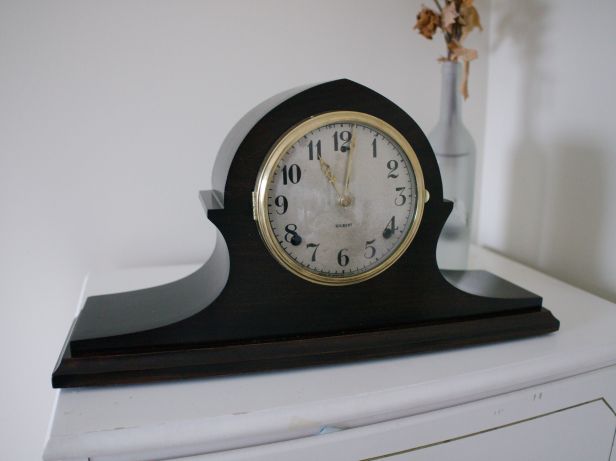
Gilbert time and strike mantel clock
Okay, you’ve made the plunge. For whatever reason you bought that mechanical clock you always wanted. Ask yourself; this is a 100 year old clock and it has been running all this time so what more do I need to do to take care of it. Why have it serviced or even oiled when it is running and striking as it should. The answer is complicated.
Time to relax with a few good books, clock books, of course
It is time to take a little break.
I typically maintain a steady output of 7 to 9 clock themed articles per month. A number of articles have been prepared in advance of the summer months which means that there will be NO interruption in blog activity.
July 1 is the national day of Canada the effective date of the Constitution Act of 1867 then called the British North American Act. This year we celebrate 152 years as a nation. Canada Day is often informally referred to as “Canada’s birthday”. Celebratory events take place on July 1.
Most communities across the country will host organized celebrations for Canada Day, typically outdoor public events, such as parades, carnivals, festivals, barbecues, air and maritime shows, fireworks, and free musical concerts.
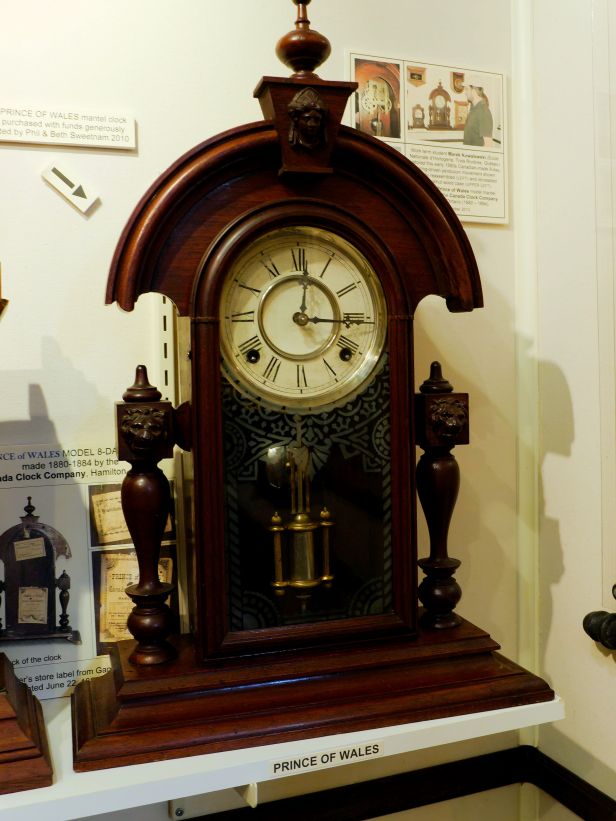
Prince of Wales parlour clock
Back when Canada was a young nation a small clock company known as the Canada Clock Company struggled to make its mark and produced some of the finest Canadian clocks that our country has ever seen. This is model called the Prince of Wales and it is a fitting tribute to this our nations birthday.
This post explores buying tips for novice antique clock buyers. Those looking for an antique clock in general rather than a specific type or model of an antique mechanical clock will find the following tips very useful.
Vintage versus antique
According to the United States Government publications, the term “antique” is reserved for valuables that are over a century old. Webster’s dictionary defines an antique as a work of art, piece of furniture, or decorative object made at an earlier period and according to various customs laws at least 100 years ago. Wikipedia defines the word antique as applying to objects at least 100 years old.
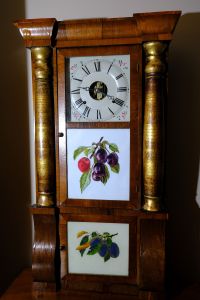
Restored Seth Thomas antique column and cornice “Empire” style time and strike weight driven shelf clock circa 1865
According to eBay, vintage is a defined period from 1920 to 1969. The use of the word vintage in online auctions and elsewhere is becoming more and more like the word “rare”. Some may define “vintage” as anything that was purchased less than 24 hours ago, is dirty and worn, or looks like it might be old if you know nothing about its history. Sellers often do not know anything about what they are selling and often describe the item as “vintage”.
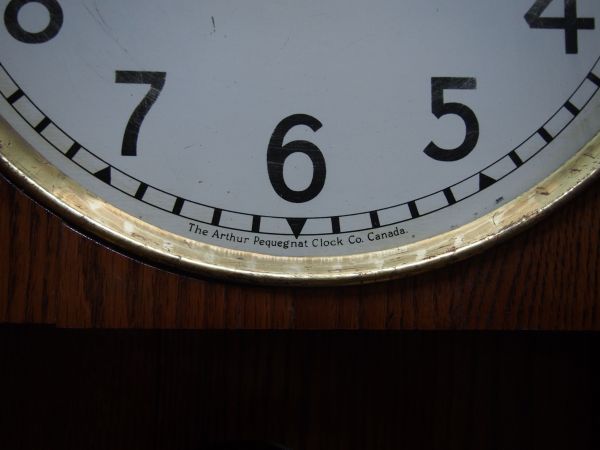
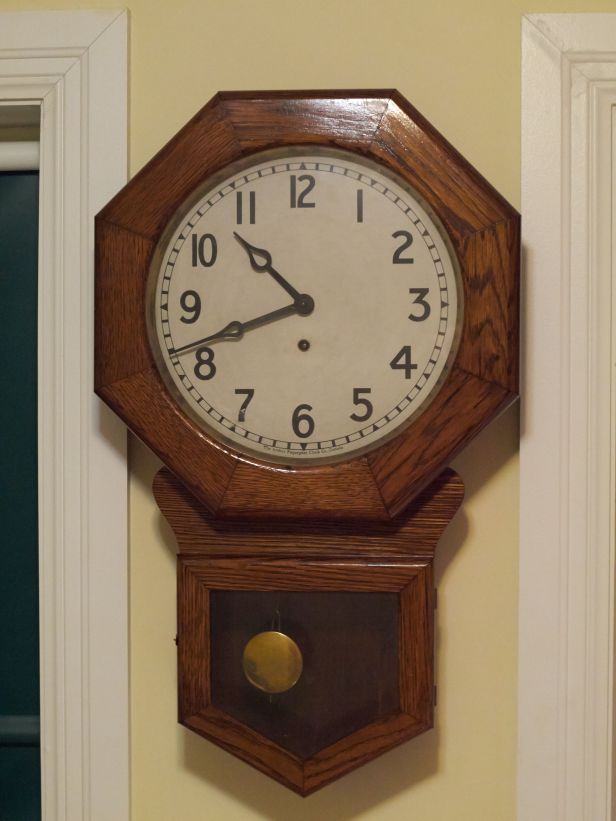
Arthur Pequegnat Canadian Time wall clock circa 1930
The word “collectible” is also used, just like the word vintage has been misused. Just about anything sold these days is marketed as a collectible if not vintage. Most serious buyers would agree that when it comes to clocks younger than 100 years old but older than 30 they are considered vintage and collectible is anything within 30 years.
Antique clock buying tips
Buying a clock without actually touching and inspecting it is always a gamble and making a judgment based on online images, most of which are of poor quality, complicates the decision-making even further. The sad stories of people who thought they bought an antique clock with a mechanical movement only to find a quartz one when the clock arrived at their door are not fiction. This and other examples are the many challenges facing the antique clock shopper in today’s online world.
I am not a firm believer in purchasing an antique clock online based on images unless one is very familiar with and respects the reputation of the seller. Although you may find that special clock online my advice is to see the clock in the flesh prior to making your final decision.
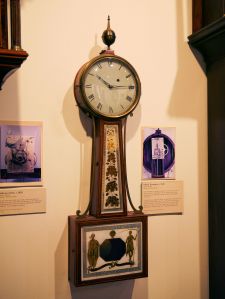
Simon Willard banjo clock circa 1810
Questions you might ask yourself prior to the purchase
Will I get my money’s worth? Will I be “ripped off”?
Will it work when I get it home?
What do I have to do to fix it if something is wrong and what could I pay to fix it?
What did the seller not disclose? What are the little surprises that await me when I get home?
“Life is a box of chocolates….you never know what you are going to get”, Forest Gump
3 Simple rules for antique clock buying
Here are 3 simple rules on how to buy that special antique clock you’ve always wanted.
1. Locate the antique clock
The style and type of antique clock is a personal preference. I prefer wall clocks over mantel clocks, parlour over gingerbreads, and Ogees over cottage clocks.
If it is a local online inquiry meet with the seller to finalize the sale. If the clock is found in an antique shop or antique mall you will not be dealing with the seller (there are exceptions) but an agent who may know absolutely nothing about the clock.
Avoid Chinese or Korean clocks often advertised as “31-day” clocks. Although they are normally reliable runners, clock-makers will tell you that they are not worth fixing. None are antiques.
2. Ask a lot of questions
Does the clock run?
A running clock has more value than a non-running example. Ask the seller to demonstrate a running clock.
Who is the maker (manufacturer)?
Manufacturers make both inexpensive and quality clocks (there are exceptions). Seth Thomas, a respectable American clock-maker manufactured inexpensive clocks that have little value and higher-end models that are very desirable by collectors. The name alone does not always equate to value.
Has the clock been altered in any way?
Newer case pieces, decorations, new glass, refinished case, a replacement movement, a replacement pendulum, etc. will reduce the value and sometimes significantly.
If it does not run, are all the parts intact?
If it has all the parts, can it be repaired either by you, the buyer, or a competent repair person? I know of a time and strike clock that was missing the strike side gears.
How old is it?
Again, vintage or antique. A clock made in 1919 is now an antique.
Does the clock have provenance, an interesting and verifiable history?
How long has the seller had it?
A cherished family heirloom has more value than an item recently acquired for a quick profit.
Would you accept a lower price?
Point out specifically why the price should be reduced, missing pieces, non-running, poor condition.
3. Deal directly with the seller
By dealing with the seller in person you will always have the opportunity to walk away if you are not satisfied.
Junghans Crispi time and strike wall clock Ca. 1899
Not every antique clock is rare or valuable and some clocks are more desirable than others. That 150-year-old 30-hour Ogee is not as valuable as you might think but a much younger vintage French figural style clock may be worth a lot more.
If you are looking for a very specific type or model of antique clock you will find that it takes time and research to find it but there will be a satisfying reward once found.
In Part I, I wrote why I collect, repair and restore clocks. In this, Part II are 9 reasons why clock collecting and repair is a great hobby for just about anyone.
9 Reasons why clock collecting and repair is a great hobby
This is Part I of a two part series. In Part I, I will discuss why I collect, repair and restore clocks. In Part II are 9 reasons why clock collecting and repair is a great hobby for just about anyone.
I have been using the Rowling theme from WordPress for the last two years and thought it was time for a change. The new look is the Gateway theme. Let me know if you like it or if I can improve upon it.
Arthur Pequegnat Regulator #1, an example of one of the clocks offered for sale
I do not normally promote auctions sales and derive no benefit from mentioning them however something special is happening on June 8th 2019. It is not often that so many clocks from one maker are on sale at one specific time. In New hamburg, Ontario (Canada) 200 Arthur Pequegnat clocks are on the auction block. All styles of clocks are being offered, wall, hall, mantel, shelf and so on including some variants.
At least three Monctons are offered for sale
This is a unique opportunity for Canadian collectors and anyone else interested in antique clocks. Were I closer I would certainly be there to enjoy the frenzy of an auction sale. Here are the clocks being offered.
I discovered this wall clock in an antique store in Victoria, British Columbia and the store shall remain nameless to protect the guilty. I have been on the lookout for a calendar clock and from a distance it looked like this was it. As I neared I realized that what I was looking at was some kind of interesting marriage.
The top dial and bezel is Pequegnat, Brandon II, the bottom is something else
This is the only true gingerbread clock I have in my collection, temporarily. By this summer (2019) it will be returned to a family relation.
Dial and movement has been removed; notice the 4-colour tablet design
Can you get this thing working, my sister said? Sure, I said. Grand Assortment is an odd name for a Sessions clock, I said. The name certainly lacks imagination, but this particular clock is one of three in a series and sold for $4.00 in 1915 and could be configured with alarm and/or cathedral bell. This particular clock is Grand #3.
Mechanical clocks do not last forever and every now and then a movement should be inspected for wear and to address any other issues if required. A cycle of 2-4 years is a good rule for checking on the health of your mechanical clock.
In the case of this clock perhaps 5 years is a little long but it has not been in a harsh environment. Although I had it professionally serviced I have built up my clock repair skill-sets in the last 4 years and can now do the work myself.
I was asked to take a look at this German made wall clock from the 1980s. The owner said it had not been running for 3 years. It is a German made Jauch wall clock from the late 1970s.
Sadly, the doors of the Jauch clock company closed many years ago. Jauch was not a notable supplier of whole clocks but Jauch did produce lots of clock movements after WWII to various assemblers. Many of these assemblers made clock cases or supplied kits with faces, hands and pendulum assemblies from other sources.
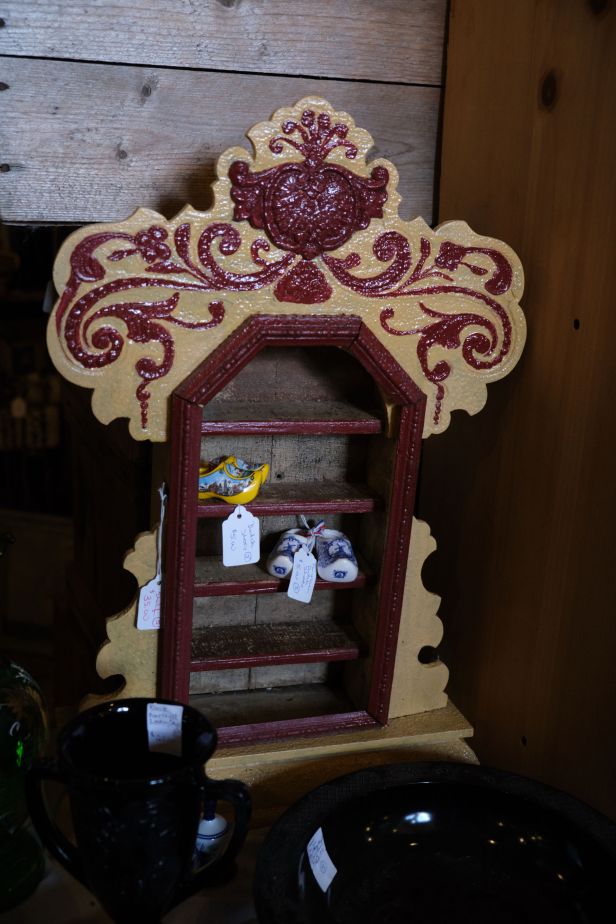
I discovered this sad case in an antique shop near my home. What was once a gingerbread clock is now a repainted case with shelves at the ridiculous price of $35. Just a few steps away was a similar parlour clock for only $20 more and it was largely intact. Some would argue that a repurposed clock case is not such a bad thing but as a clock collector I find this appalling.
Is it not better to have left the case alone and present it as an ornament rather that convert it into a hideous curio cabinet?
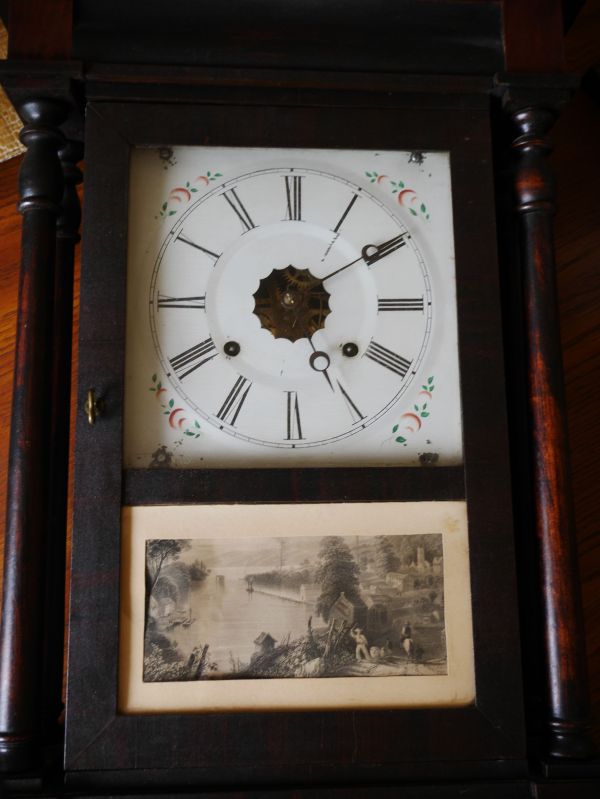
The four free-standing turned columns of the New York style Sperry and Shaw clock immediately drew my attention. The style reflects the decorative period of the Empire style popular in the mid 1850s. In a previous blog post I discussed servicing the movement. I thought long and hard about what to do with the case and decided that a refresh was what it needed.
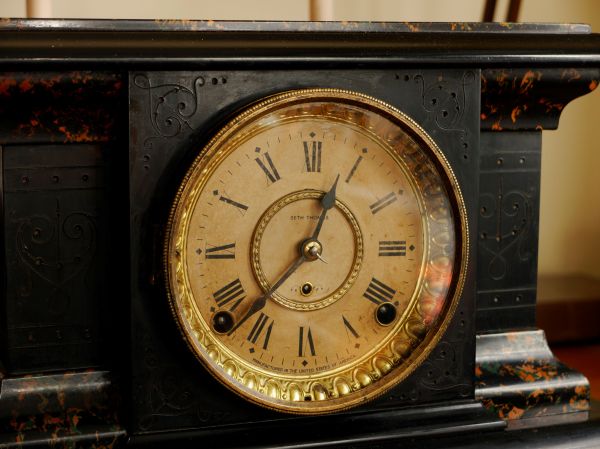
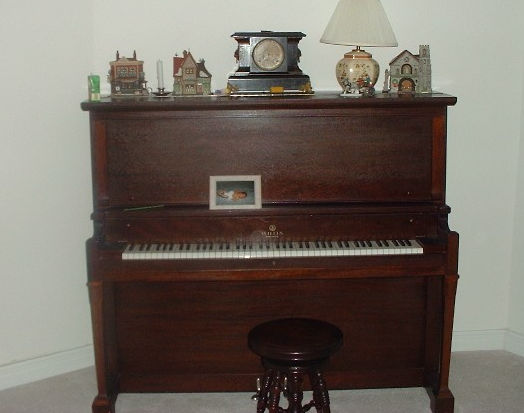
This Victorian period Seth Thomas mantel clock was in very good condition when I bought it close to 20 years ago. It sat on an upright piano until it was serviced in December 2017.
Image from October 2000, atop a Willis upright piano
During servicing 4 bushings were installed. The clock was then relocated to another room.
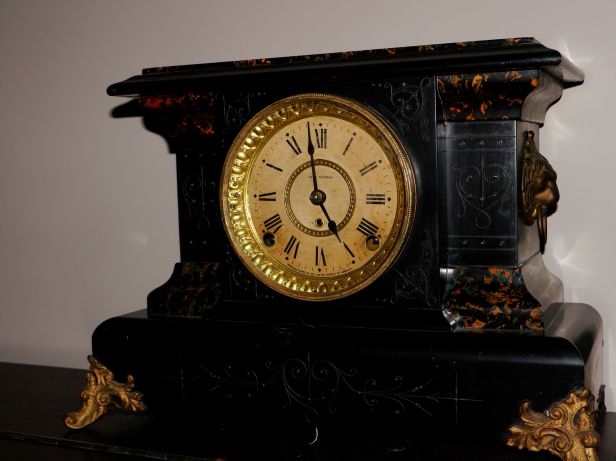
The clock would certainly benefit from detailing
The model is not actually called the Adamantine. Adamantine is a chemical process applied to the clock case and it was meant to be an inexpensive alternative to onyx or marble. An expensive looking clock for the masses! Adamantine veneer was developed by the Celluloid Manufacturing Company of New York City in 1880 and the Seth Thomas Clock Company purchased the rights to use Adamantine veneer in 1881.
Rear showing time and strike movement
I have seen many Adamantine clocks on online sites and antique shops and on some the scroll detailing is visible which leads me to think that the gold coloured paint that once filled the detail on this clock case and others has been long gone.
My wife was going through the online catalogue of an estate auction recently and found an attractive vintage Gilbert tambour style clock.
Gilbert mantel clock 1925
“Are you interested?” she said. “Sure”, I said, “put a maximum bid of $35”. We won the bid at $25 + tax and buyer’s premium, so, still under $35 CDN. Would I have paid more? Not likely. However, it is a handsome “Napoleon hat” styled clock but they were plentiful and cheap at the time and not particularly valuable or desirable today despite the fact that it is almost 100 years old.
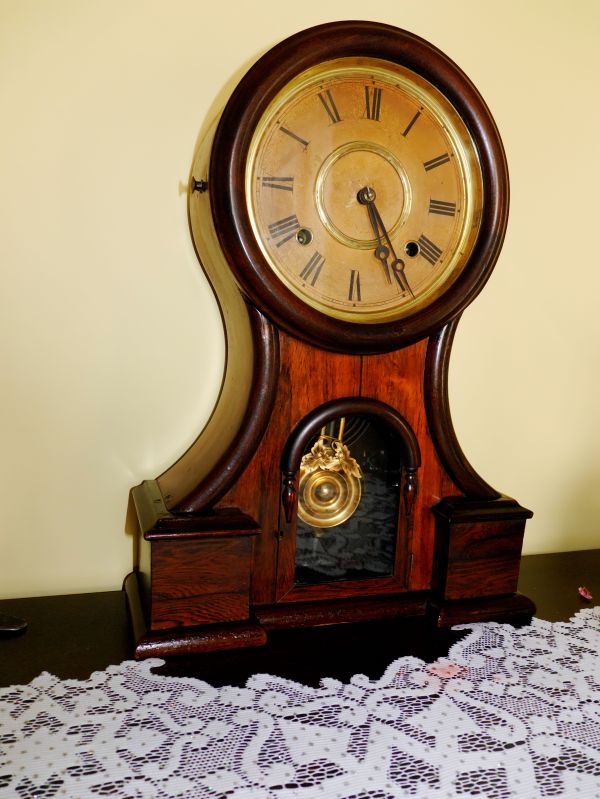
I do not come across many antique E Ingraham & Co. clocks and have just one other in my collection, the Huron from 1878, but I came across another recently that I found in a local antique shop. The price was right so, I snapped it up. The”S” shaped logo on the dial led me to assume it was a Sessions, but it was not – I’ll get to that later.
Rare Ingraham Huron balloon style clock in Rosewood
This is a parlour clock. It might have been described in company advertising as a kitchen clock. Some even refer to it as a gingerbread. There are a number of terms used when describing clocks of this style and the three names are used interchangeably by sellers on online for-sale sites and antique stores.
E Ingraham parlour clock circa 1897, sitting in an antique shop
I was on a Facebook clock collector page recently and I was intrigued by the work someone had done on a clock that was surely destined for the garbage bin. The transformation was given an apt phrase, “Trash to Treasure” and so I thought I would write about my own experiences resurrecting old clocks.
Preserving the original patina is always the principle goal and I do as much as I can to keep things as they are. However, when the finish has been adversely affected by environmental damage, heat, cold, humidity over the course of many years, as in a couple of examples below, the only course of action is refinishing.
There are times when the only course of action is complete restoration
One of the few clocks that I have had professionally serviced is an Arthur Pequegnat kitchen clock (Fan Top). In the early days of clock collecting and repair I had not acquired the necessary skills and experience to perform my own work and had some of my special clocks serviced by a skilled clock-maker. I consider this Arthur Pequegnat “fan-top” kitchen clock, a special clock.
The following comments are not a reflection of the work done by a professional clock repair shop. I consider the clock-maker who performed the service on this clock to be highly competent and I would recommend them to anyone but mechanical clocks can be very temperamental at times.
Arthur Pequegnat kitchen clock commonly known as a “Fan Top”
Two years after the clock was serviced, it stopped. It shouldn’t have! I considered all of the possibilities including weak mainsprings, bushing issues, bent, twisted or torn suspension spring and bent wheels to name a few.
This is Part III of a three (3) part series. In Part I I discuss disassembly and servicing the mainsprings. In Part II, the movement and in this, Part III we will look at restoring the brass case.
This is Part II of a three (3) part series. In Part I, I discuss disassembly and servicing the mainsprings. In this, Part II, the movement and in Part III we will look at restoring the brass case.
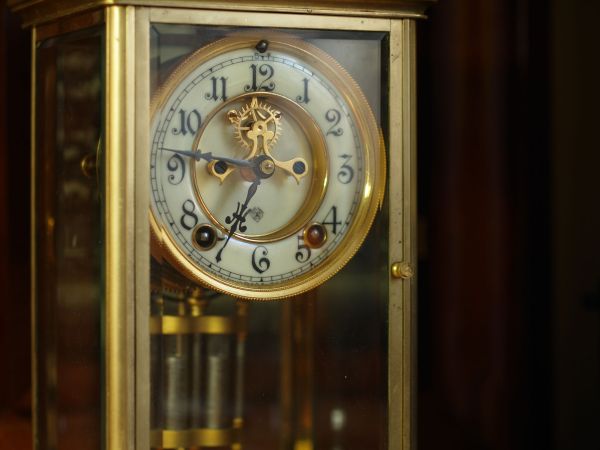
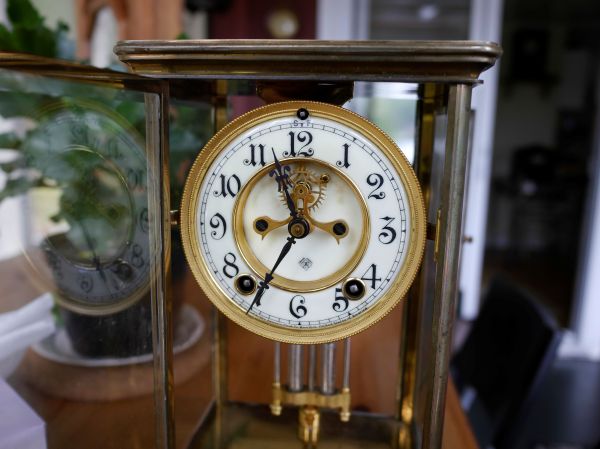
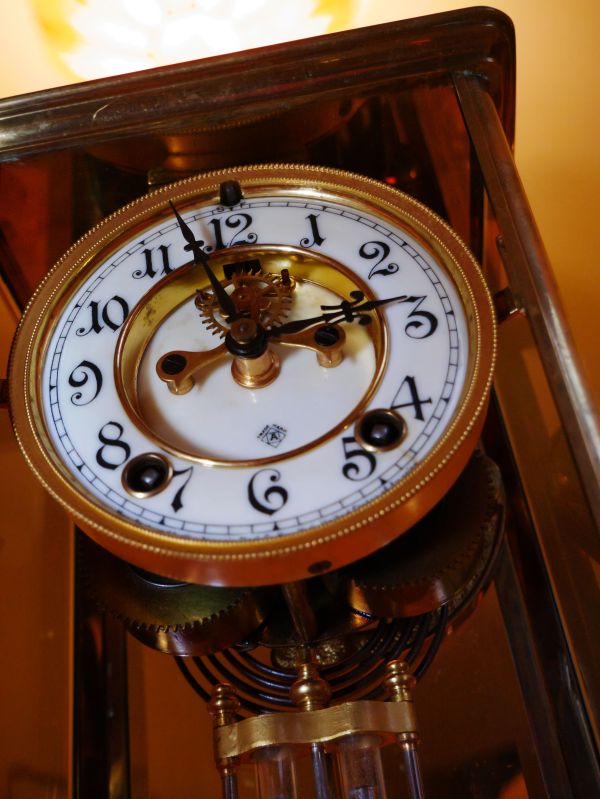
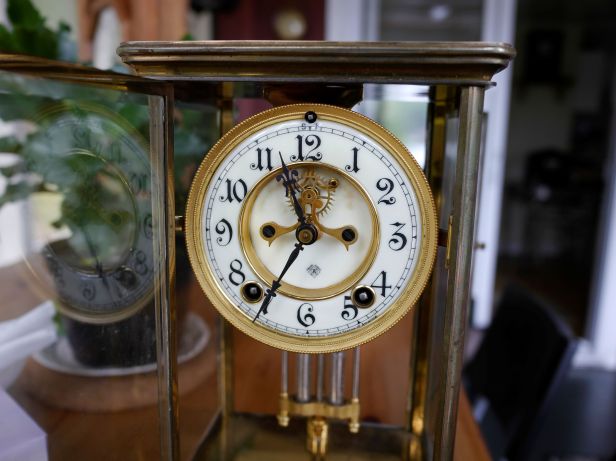
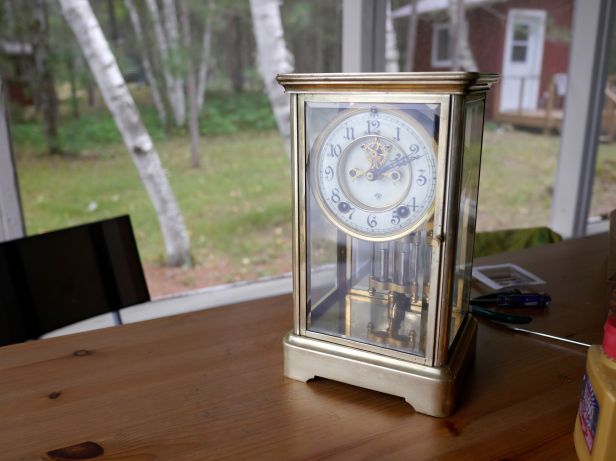
My wife found this 1910 Ansonia Crystal Regulator in the late summer 2018 while antique shopping. What a great choice! We were in a hurry and despite a price reduction we should have asked the proprietor to show us that it worked. We returned home and to our dismay, it was not running.
In Part I of this two part series I discuss disassembly and the big question; how to service the mainsprings.
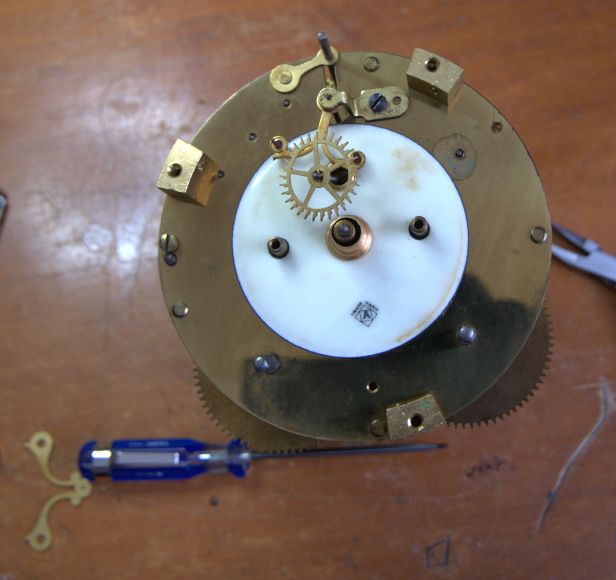
Front of movement showing visible escapement
The movement
There are 4 screws that release the plates. The 3 pin gathering pallet and hour gear must be removed to facilitate servicing. It is possible to re-assemble the movement without removing those two parts but it is very frustrating. To remove them assemble the plates. Using two small blades (small screwdrivers) positioned 180 degrees apart from one another will work. As these movements are visible, any scratches will show, so, placing masking tape on the plate will prevent scratches. Wedge both screwdrivers and the parts should pop off. The gathering pallet flew across the room (not ideal) but it worked.
Twisting the top regulator pivot bracket on the front plate upwards allows the pallets and crutch to come out from between the movement plates.
Clean parts in the usual way but do not put the pallet assembly in the ultrasonic if the pallets are jeweled. The ultrasonic machine will loosen the pallets.
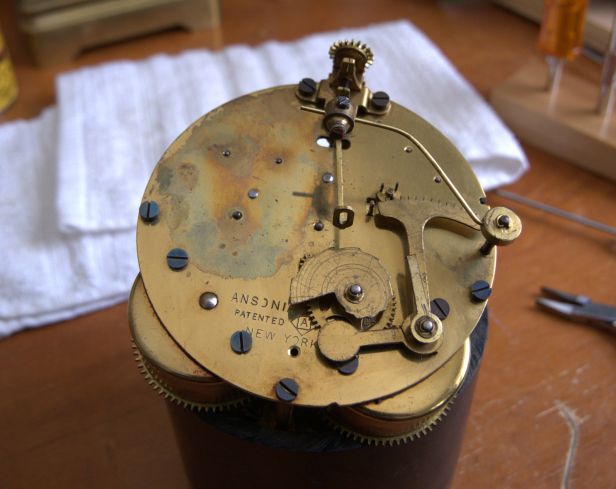
Rack and snail assembly on the back plate
The movement required 5 bushings and all on the front plate; S2, S3, T2, T3, and T4. Unusual but understandable given the placement of the gears.
Getting it all back together
Putting the plates together with gears in place is fairly straightforward. It takes a gentle twisting to get the pallet assembly in position however, there is no need to force anything.
Most of the strike assembly is on the outside but it is important to set up the warning correctly. There are two wheels with stop pins.
Thanks to reader Bob G. for explaining the following. The wheel with the stop pin closest to the outside of the plate is the stop wheel. That is held back by the tab coming through the plate from the back of the movement. The next wheel that has a stop pin is the warning. As the hour arbor lifts the lever to begin the strike sequence, the warning pin holds everything back until the correct moment. That second stop pin should be at about the four o’clock position when looking at the movement from the front.
If the stop pins are in the correct position, you must adjust the position of the pins on the gathering pallet. If you hold the wheel next to the fly, you can grip the pallet with a needle nose pliers and turn it until the pins clear the rack. Otherwise, the pins on the gathering pallet will lock the rack and the clock will only strike once on the hour and half hour.
All adjustments have been made and the movement has been fully assembled and now onto the movement test stand.
This is Part I of a three (3) part series. In Part I I discuss disassembly and servicing the mainsprings. In Part II, the movement and in Part II restoring the brass case.
My wife found this 1910 Ansonia Crystal Regulator in the late summer 2018 while antique shopping. In the 1905 Ansonia Crystal Regulator catalogue it is listed as the Prism at a price of $29.00 which would have been a hefty sum at that time. (Flash is required to open the catalogue)
What a great choice! We were in a hurry and should have asked the proprietor to show us that it worked. We returned home and to our dismay, it was not running. As I said in an article published in Dec 2018:
A gentle push of the pendulum produces a few ticks and then it stops. I am not familiar with Brocot escapements and before I do anything I will research the movement before I disassemble it and give it a thorough cleaning.
Brocot visible escapement; in this photo, the brass is very tarnished
Just days old but I thought I would polish the brass
This is a truly beautiful clock with a visible escapement. What I have learned is this; don’t mess with a Brocot escapement. The stone pallets, which are made of garnet are very delicate and breaking one or both is a huge issue. The pallets are held together by melted shellac and cleaning them in an ultrasonic will loosen them as they are position sensitive.
It is now April (2019) and I have put this project off long enough. So let’s begin.
This not a particularly easy clock to work on. The pivots are smaller than a typical American time and strike movement which means closer tolerances. The strike side is rack and snail, that is, there are no helper springs and only one combination lever between the plates. Most strike parts are located outside the plates and the final assembly for the Brocot escapement also occurs outside the plates. There are two wheels with stop pins for the strike side. Setting them up can be a challenge.
Dissembling the case
To disassemble the case I wrapped two strips of painters tape on all four sides. Doing so prevents the glass from falling out. Beveled glass panels are difficult to replace and exercising care when working with the case will prevent accidents. Each glass panel can be as much as $75 by the time shipping is included and turnaround time can be as much as 2 months.
The first to come out is the gong assembly. One large nut secures the gong to the case and is accessible from underneath the base.
I chose to disassemble the entire case though it is possible to remove the movement without doing do. There are three screws at the 1-2, 10-11 and 6 o’clock positions though a long skinning screwdriver is required to get at them.
There are 4 large screws on the bottom and 4 on top. Unscrew the bottom 4 screws first. Once the base is off you will quickly realize the importance of the painter’s tape. To access the top screws there is one small screw underneath the top plate that must be released to access the 4 top corner screws. Patience is key if you work slowly the chance of error is reduced. Put the brass pieces and the glass panels in a safe place while working on the movement.
Mainsprings
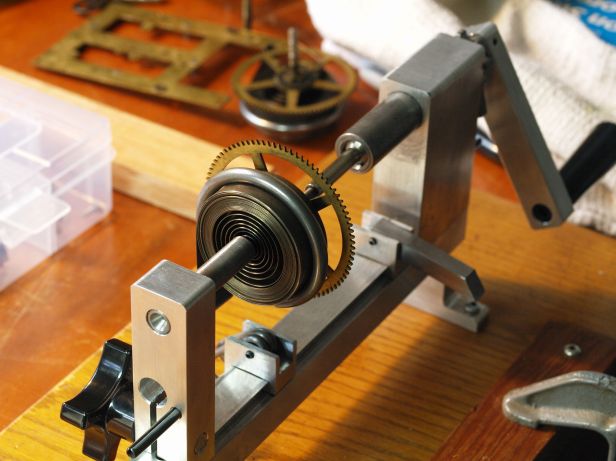
The mainsprings are in barrels. The barrels are secured to the movement plates with 4 screws. The great wheel and the arbour are one piece. With a twist, the arbour can be removed from the mainspring.
There are three ways to service the mainsprings.
1) Find a temporary winding arbor and use it to unwind the mainspring on a spring winder.
2) Hold the barrel in one hand and pull the spring out with the other being careful not to kink or bend the spring. Once the spring is released from the barrel, unhook it and you are free to clean the spring. To put it back together, use a thick leather glove to hold the barrel, hook the hole end, and carefully rewind the spring back into the barrel.
3) Partially disassemble the great wheel and use the arbour without the gear in place. Special tools are required to separate the arbour from the wheel.
Olie Baker spring winder
Front of movement showing visible escapement
Back of movement showing rack and snail, hammer and rate adjuster
In Part II I discuss servicing the movement and in Part III, restoring the brass case.








 Antique and Vintage Mechanical Clocks
You must be logged in to post a comment.