Daylight savings Time; let’s follow the province of British Columbia’s (BC) lead and get rid of DST.
In the meantime set your clocks back one hour if still you live in an area where the convention is still followed.
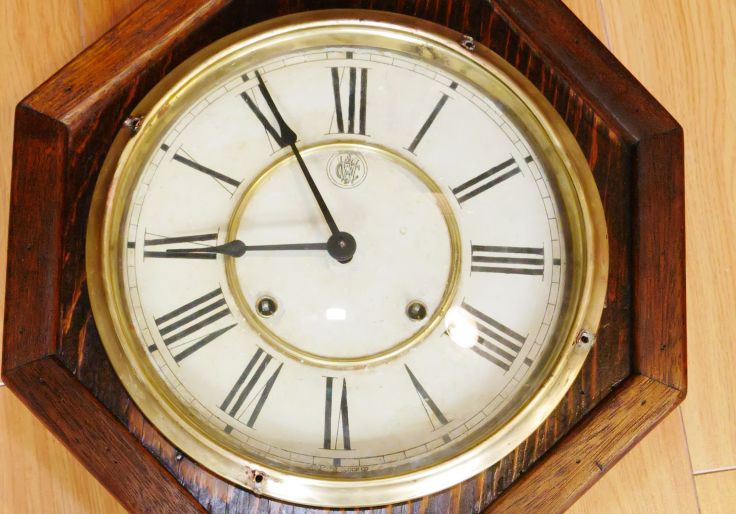
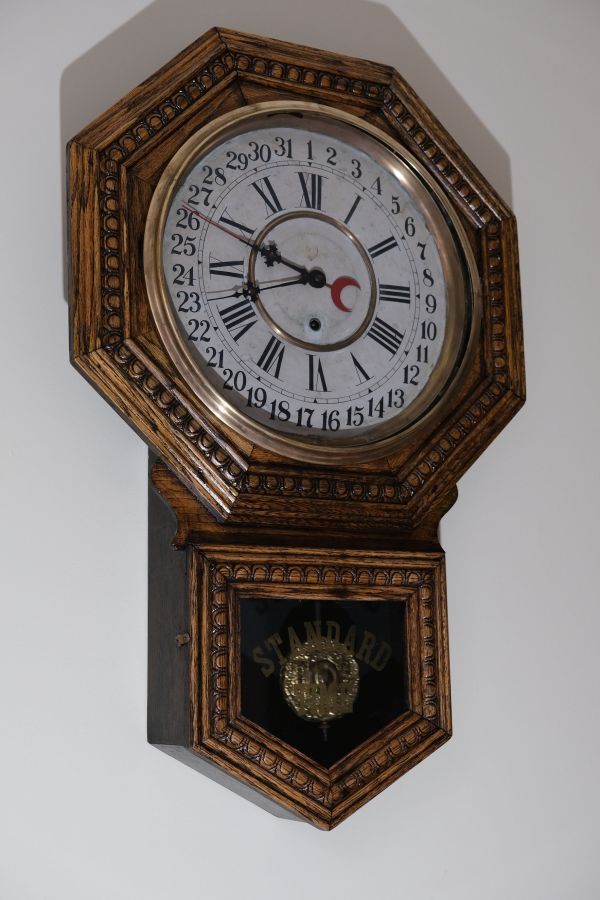
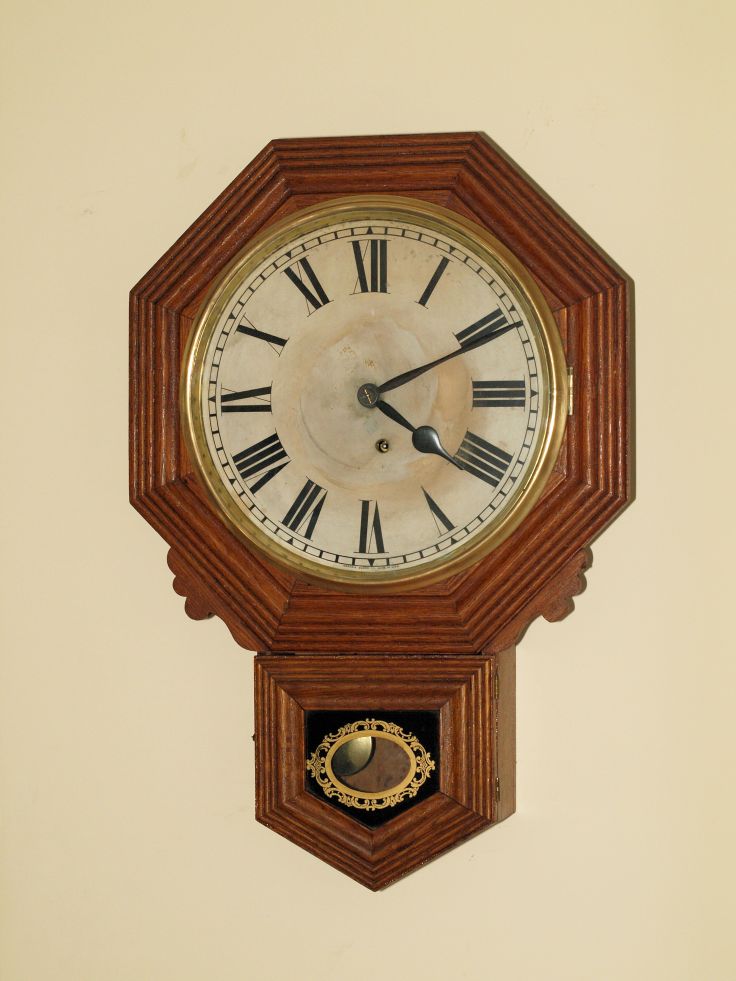
Waterbury drop octagon dial
Typically, regions that use daylight saving time adjust clocks forward one hour close to the start of spring and adjust them backward in the autumn to standard time. In Canada we have a little expression, “Spring ahead, Fall behind” to make it easy to remember what to do twice a year. In Canada, it is the second Sunday in March and the first Sunday in November.
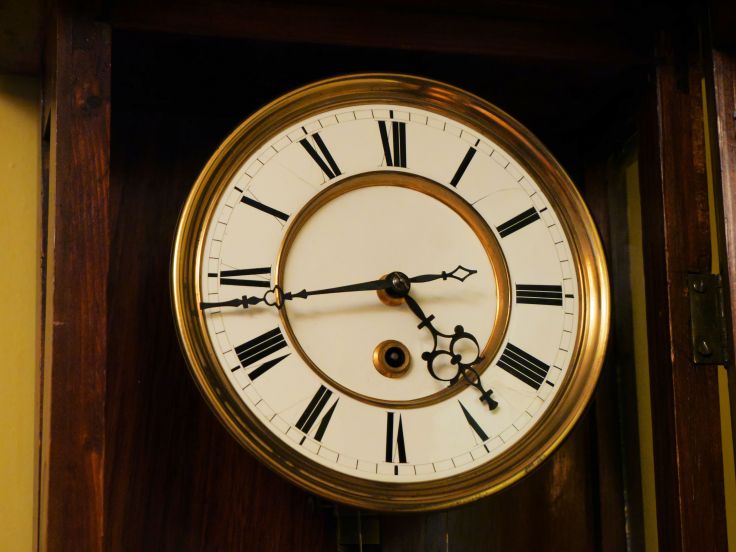
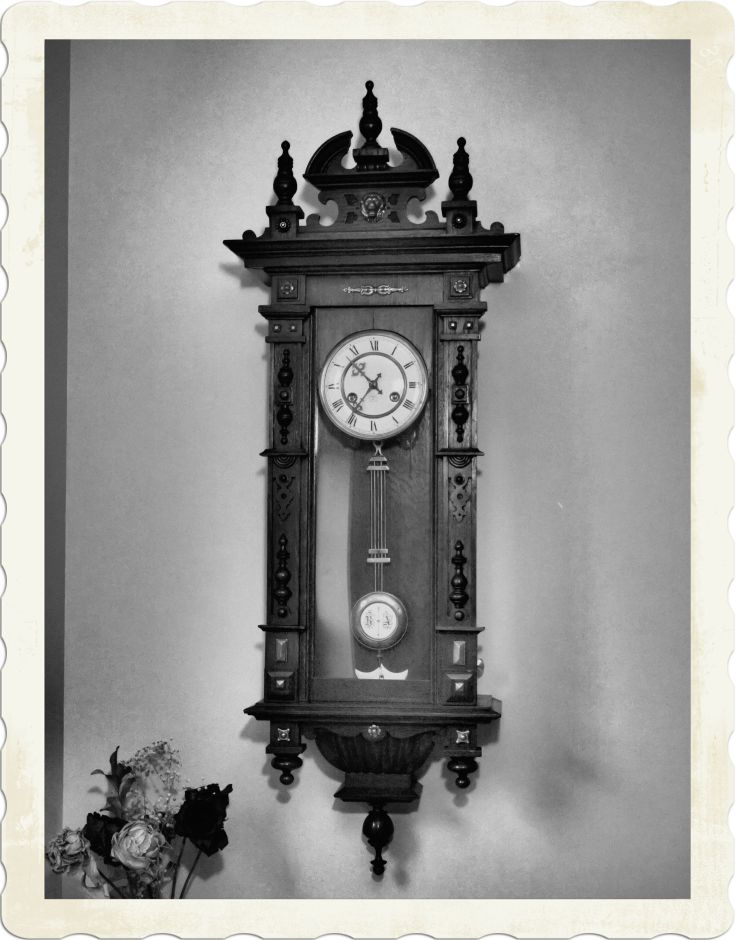
Vienna Regulator dial
As mentioned there has been a push to scrap the time-switch in Canada. British Columbia (western-most province of Canada) petitioned to end daylight saving time in the province back in 2015. Tens of thousands supported the move to end daylight-savings time.
My wife’s aunt lives in a quaint home near a small town in the south of Ireland. During our recent visit to Ireland we were invited to her home, had tea and cake and had a long talk about family history.
While there I was asked to take a look at the family clock which had not been running for a number of years. Aunt Theresa and her husband (now deceased) received the clock from his brother, an amateur antique collector, many years ago.
HAC’s are good quality movements with well-made cases
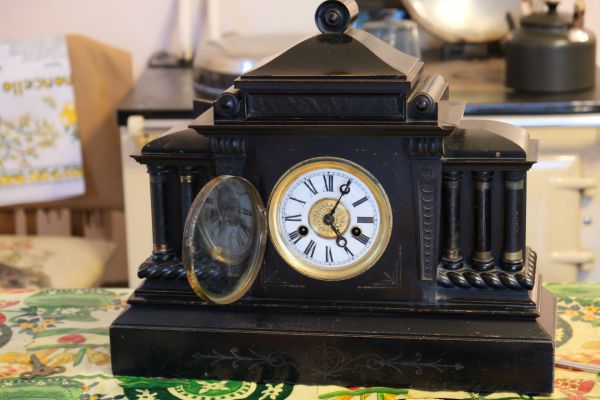
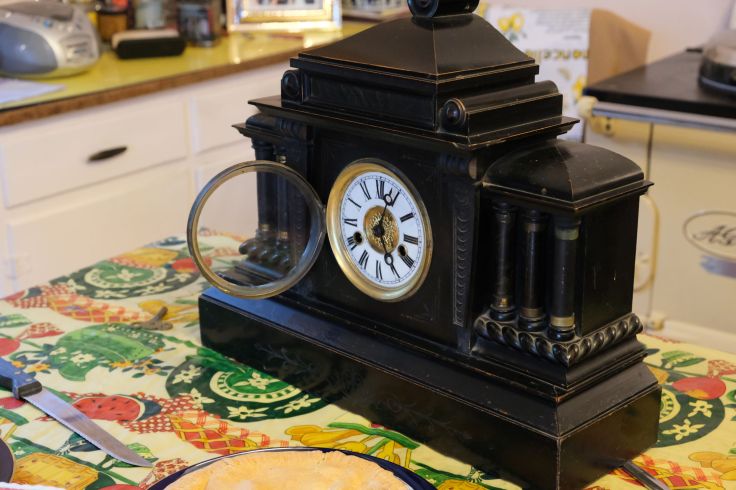
The clock is an attractive and somewhat large 6-column Victorian-style 14-day time and strike mantel clock with Roman Numeral dial made by the Hamburg American Clock Company. It is model #1902 probably made on or about that date. Hamburg American clocks are known for good quality movements with well-made cases.
I will take a look at it, I said, but without my tools, there is not much I could do. I wound both arbours and determined that the mainsprings had plenty of power. I gave the pendulum a push and immediately observed that there was power going to the escapement but there was an uneven tick-tock, so, the clock was out of beat. I propped up one side of the clock sufficiently to find the correct beat and it not only ran but dutifully struck on the half-hour. It works!
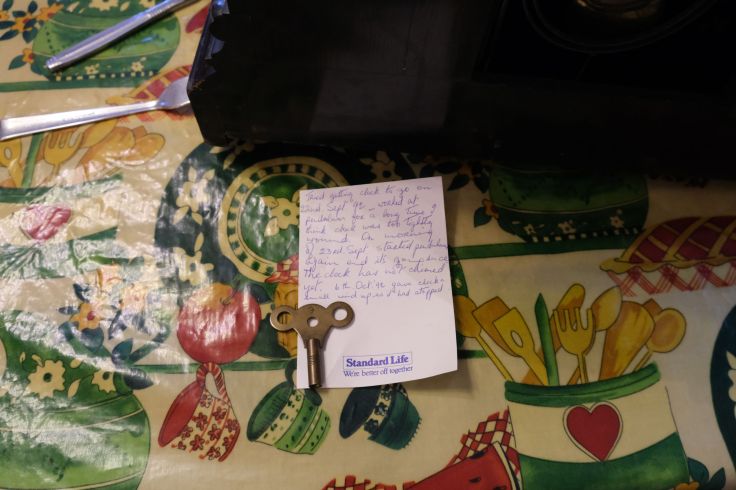
In the clock case was a note.
A note found inside the case
The note said,
Tried getting the clock to go on 22nd Sept ’92- worked at pendulum for a long time. I think the clock was too tightly wound. On morning of 23rd Sept, started pendulum again and it’s going since. The clock has not chimed yet. 6th Oct 92 gave the clock a small wind up as it had stopped
I admire aunt Theresa’s tenacity but the clock refused to run after the second winding way back in 1992, 27 years ago.
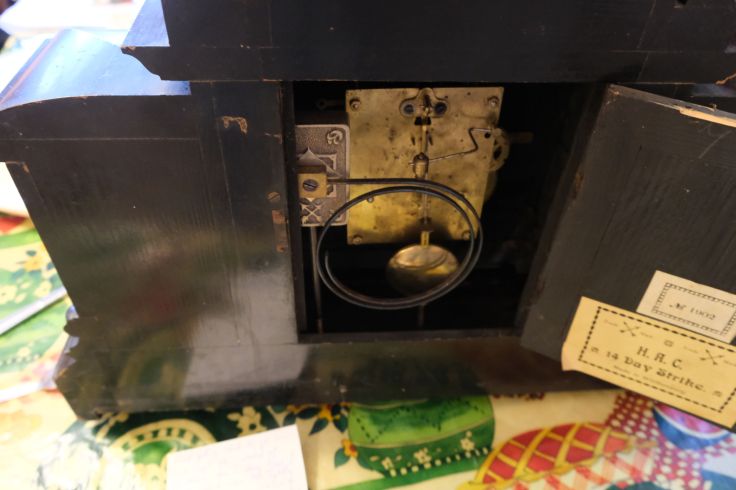
Time and strike movement with coiled gong
Here is what I discovered about the Hamburg American Clock Company.
In 1875, Paul Landenberger together with his partner, Philipp Lang, founded the Landenberger & Lang clock factory and although he had taken some know-how with him from Junghans (a noted German clockmaker), the company was bankrupt by 1882/1883. It was converted to a stockholding firm and with new investors, the company was re-named Hamburg-Amerikanische Uhrenfabrik (Hamburg-American clock factory).
The name might suggest that they had American made movements but that is far from the case. Hamburg is in the name because that is where the investors came from and “Amerikanische” referred to the movements which were made according to the “new” American mass-production methods.
Among clocks circles, the company is simply known as HAC.
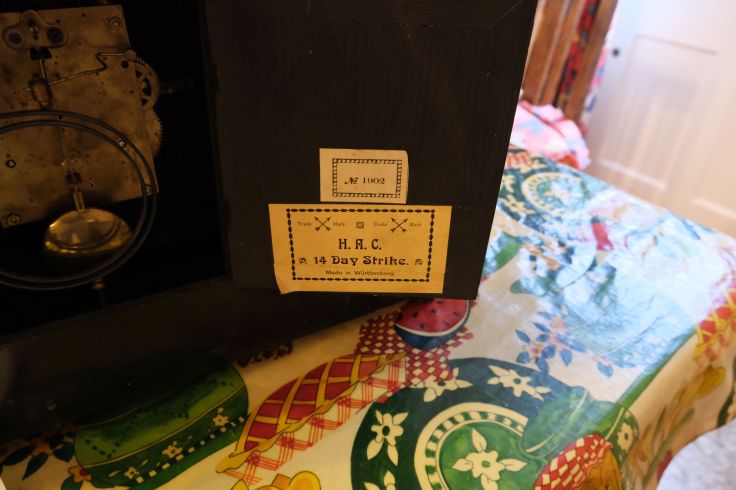
Nice label with model number above
The familiar crossed arrows trademark mark found on the coiled gong was registered in 1891. The “Lux” trademark, which this clock does not have, was added in 1905 so, it places this clock between those years. Model #1902 might even suggest the year it was made. Junghans eventually gained influence over the company and by 1930 was able to take over HAC completely.
The good news is that the clock runs and that there is nothing fundamentally wrong with it but after all these years it needs a good servicing and that means disassembly and cleaning by a qualified clock repair person.
Gilbert Admiral calendar clock ready for servicing
When I bought this clock I was not sure what I had. There is no label, no makers name on the dial and an unsigned movement. I thought, Gilbert or perhaps a Sessions? It did not take me long to find out that the clock is a No. 3027 Gilbert, otherwise known as the Admiral.
When I bought this clock I was not sure what I had. There is no label, no makers name on the dial and an unsigned movement. I thought, Gilbert, Sessions?
This clock was hanging on the wall of a local antique shop with no price. When I inquired the shop owner said that he just picked it up and had not decided on a price but he knew the clock had issues. The hands did not turn otherwise he said the clock ran fine. Something wrong in the motion works, I thought. It could be a simple fix or something more challenging. The brass dial bezel was secured with Robertson screws which told me that the clock had been messed with.
My wife said go for it, it’s about time for another clock project. I offered a price and he agreed but I walked away wondering what surprises awaited me.
Junghans Crispi time and strike wall clock; my oldest daughter has her name on this one
“I have a sterling silver collection”, she said, “that my son will melt down and sell for cash” once I am gone
My sister, who is a couple of years younger and “was” an avid antique collector, remarked the other day that she has stopped collecting antiques. Why, I asked. There is no one to leave them to and no one to appreciate them, she replied. “I have a sterling silver collection”, she said, “that my son will melt down and sell for cash once I am gone”.
Once the Sessions Clock Co acquired E. N. Welch assets in 1902 (for the history of E. N. Welch go here) the company was well on its way to becoming one of the biggest clock producers in America. Production began in 1903 and between that time and 1933 Sessions produced 52 models of mechanical clocks, ranging from Advertisers, large and small clocks with logos of various businesses, to wall, or regulator clocks, and shelf or mantel clocks, designed for the home. Some Session clocks from this period are prized by collectors but most others are of the generic kind that have limited value today.
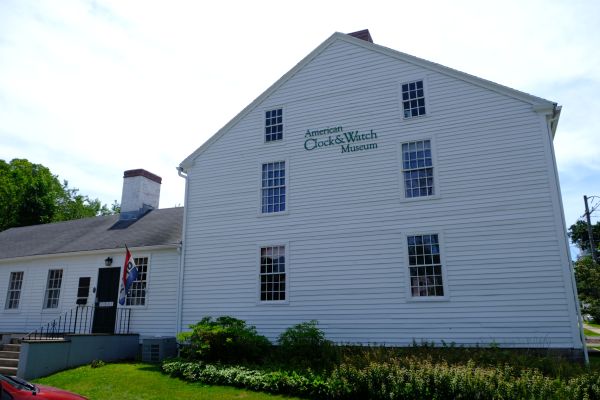
During our stay in Springfield Ma. to attend a NAWCC annual clock convention in June 2019 we stopped in Bristol, Connecticut about 45 minutes drive south of Springfield. In Bristol, Connecticut is the American Clock and Watch Museum. The non-descript white clapboard New England styled salt-box is what first greets the visitor.
Although the museum is dedicated to American clock and watch makers it is a must see for any clock enthusiast
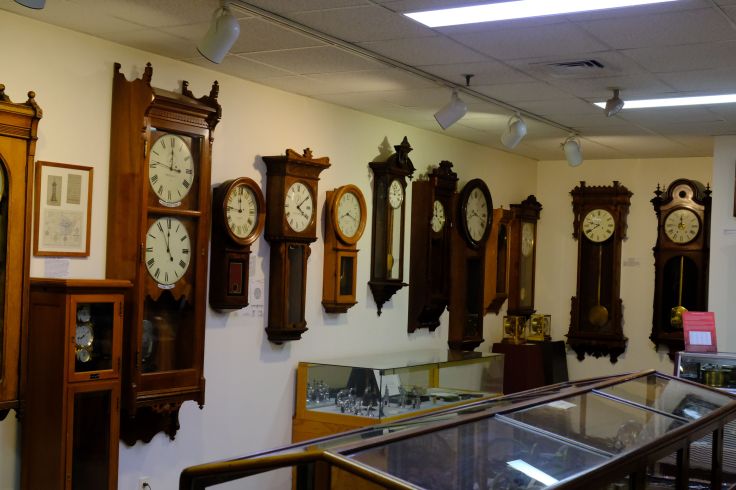
I admit I was a little disappointed after visiting the stately edifice of the NAWCC museum in Columbia, Pennsylvania but once I entered the side entrance door my disappointment evaporated. I was immediately impressed with the friendly and knowledgeable staff, the quality of the displays and the vast, well-organized collection of American clocks and watches. The following photos tell the story.
French clockmakers such as Vedette, like so many makers of 1930s Europe, made box clocks in several styles. Although I have always wanted a Vedette clock buying one so plain was not what I had in mind but there it was at a silent auction in a clock mart at the NAWCC National Convention in Springfield, Ma. in June 2019 at atake-me please price.
It could easily be mistaken for a typical German box clock of the period save for the attractive oval beveled lower window and lack of side windows. Vedette clocks are typically quite ornate – not this one! However, the sound of the chimes more than make up for its plain jane appearance.
There is nothing quite like the reverberating chime of a Vedette clock
When I attended the NAWCC Convention In June 2019 I bought this clock at the clock mart which is a unique opportunity to find that special clock among thousands offered for sale.
I have always equated E.N Welch with quality and this clock is no exception. I have one other Welch, the Whittier, a parlour clock, which is part of the “author” series, made in 1893. The seller knew nothing about this clock but it was attractive so I bought it.
8-day Welch movement with alarm
In 1902 the E. N. Welch Clock Co. was absorbed by the Sessions Clock Company. E N Welch had a long and glorious history and are best known for their “Patti” series of fine clocks since Patti clocks are named after famous opera stars of the time. This clock was made well before reorganization in the mid-1890s when it began producing clocks that were less expensive to manufacture, like the Whittier that had wider appeal. This clock is from about 1875.
Among the most respected American clockmakers is the Seth Thomas Clock Co. In my collection are 6 Seth Thomas clocks representing several styles all of which are unique representing the period between 1865 and 1930.
I acquired this clock at the National Association of Watch and Clock Collectors conference in Springfield Ma. in June of 2019.
Chauncey Jerome along with his brother Noble introduced the first mass-produced brass movement in 1839 two years after the depression of 1837 knocked out 90% of factories in the Northeast (New England States). The 30-hour brass movement was rugged, cheap to repair and not subject to swelling found in wood movement clocks. Despite business ups and downs Chauncey able was able to maintain a viable clock business until 1868 but later died penniless.
Visiting any clock museum is always an interesting and engaging experience.
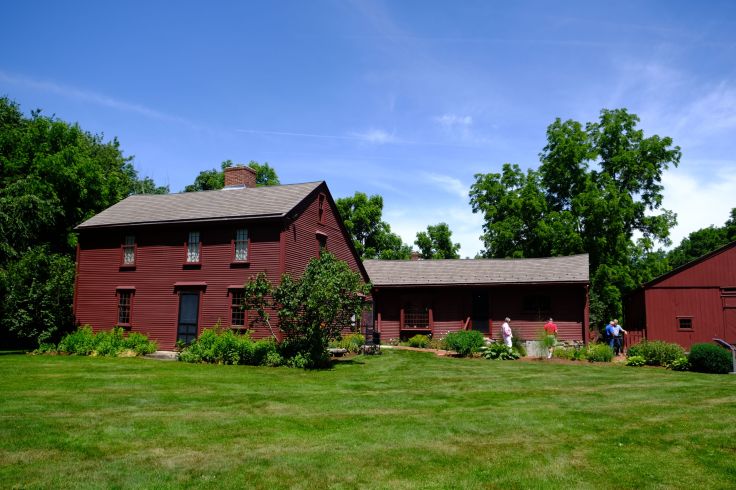
On our way from Boston to Springfield Ma. to attend the NAWCC (National Association of Watch and Clock Collectors) Convention 2019 we stopped in a small community called Grafton and in that community is the Willard House and Clock Museum one of the foremost museums of its kind in America. The unassuming location on a quiet country road in a pastoral setting of fields and forest was a pleasant surprise. The museum was the home of Benjamin and then, Simon Willard, celebrated clockmaker and inventor. Born in 1753 Simon Willard spent his formative years in Grafton, later moving to Boston.
The Willard name may not be immediately recognizable outside the United States but he is regarded as important source of innovative design in the American clock industry.
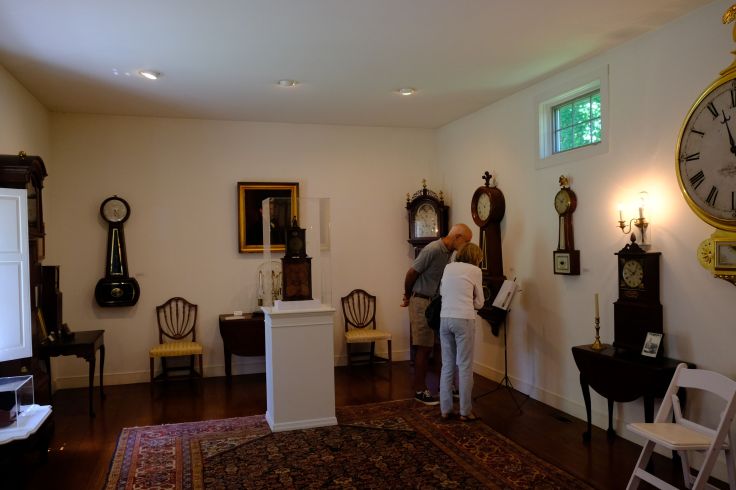
The vast collection of clocks housed inside is surprising for the size of the museum. The collection ranges from Massachusetts shelf clocks, to tall-case and Willard’s famous banjo clocks.
Tick-Talk Tuesday is about the letters and comments I have received from you, the reader, concerning your clock, issues you might have had, challenges you face or a clock you would like me to profile and my responses to your questions with advice on your particular clock concern. For those comments and questions that stump even me, I consult within my clock circles for the best possible answer
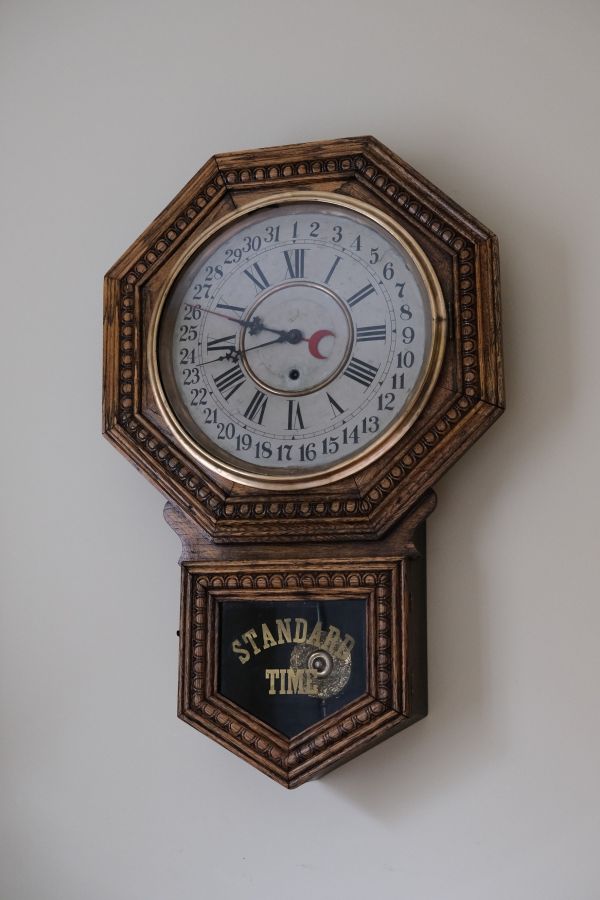
JM says, “I have an Ansonia Octagonal Schoolhouse clock dated 1878 exactly like the one featured here. I also have the pendulum and key. It’s in good working order, but I am looking to sell it. I don’t know its value. I paid $500 for it in 1975. It’s a darker wood, the face is in good condition, and the description label in the pendulum area is intact. What would you suggest for a sale price?”
My reply. “First of all, I am not an appraiser but I have several years experience buying and selling clocks.
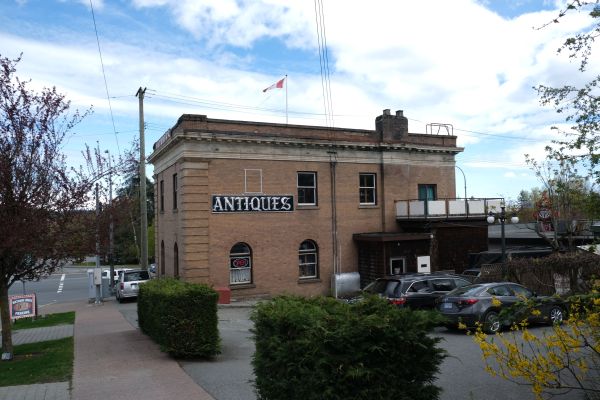
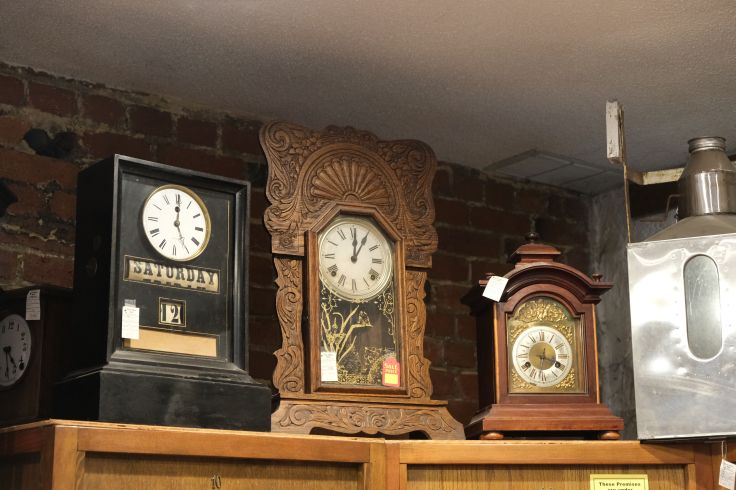
Although I did not buy any clocks during my trip to the west here are examples of what you might find in some of the better quality antique shops. The three shops these clocks are from are located on Vancouver Island, British Columbia, Canada.
Let the photos speak for themselves. captions identify some of the clocks.
Trio of clocks, the middle one is a Grand Assortment by Sessions
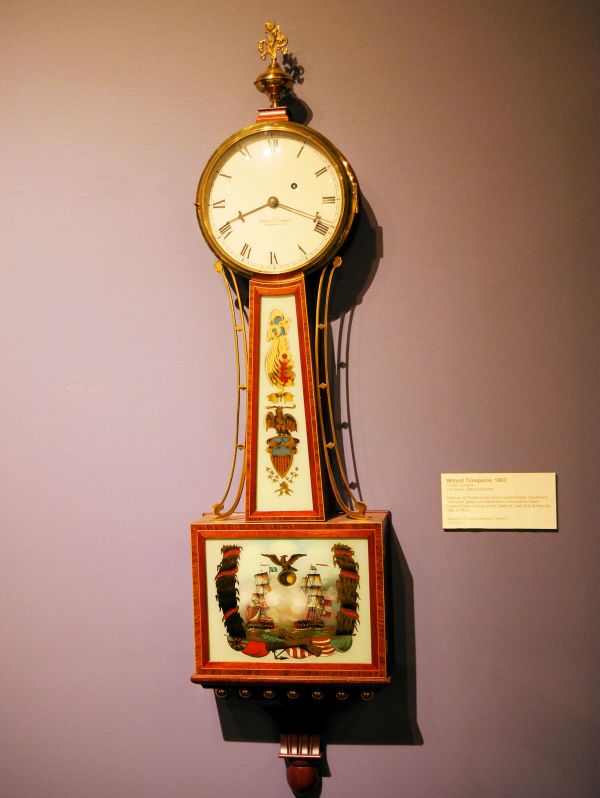
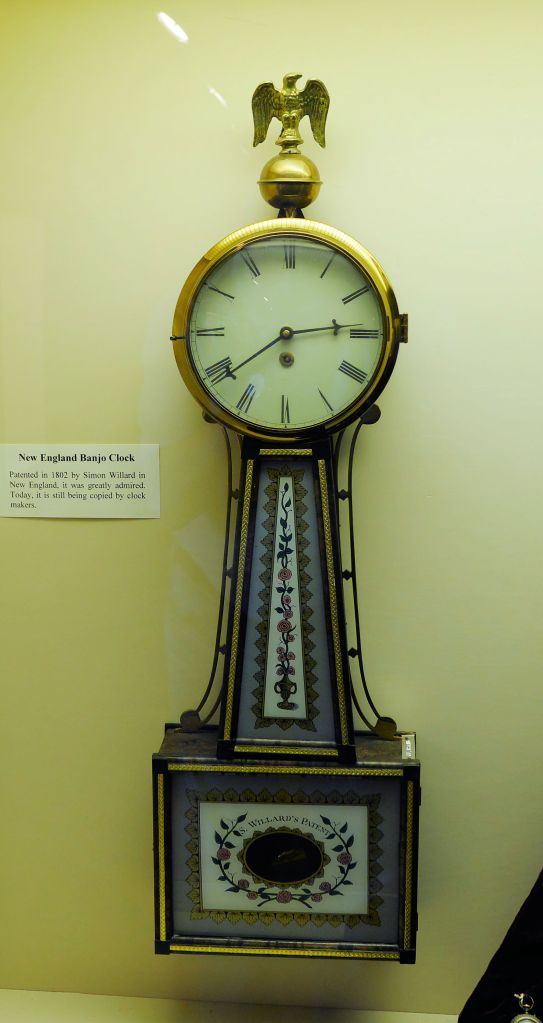
Searching for a weight driven time-only banjo clock can be a challenge and acquiring an authentic example would go a long way to completing my collection. Securing an authentic Willard would certainly be the icing on the cake.
The style was widely copied by other members of the Willard family of clock makers and many others clock-makers
I was fortunate to have seen several Willard banjo clocks during my visit to the Willard Museum in Grafton Mass. in June 2019.
Banjo clock, circa early 1800s, Macdonald Museum, Middleton, Nova Scotia. Notice the location of the winding arbour
Few American clock-makers at the beginning of the 18th century were innovative. One of the most notable achievements was the small 8-day, weight-driven clock developed by Simon Willard. The Willard clock is a uniquely American wall clock with a banjo-shaped case designed and constructed by Simon Willard. Willard was originally of Grafton, Massachusetts, later of Roxbury, Massachusetts, and patented his unique clock in 1802.
The Willard banjo clock has no striking mechanism and indicates time only by its hands and dial. It is correctly defined as a timepiece.
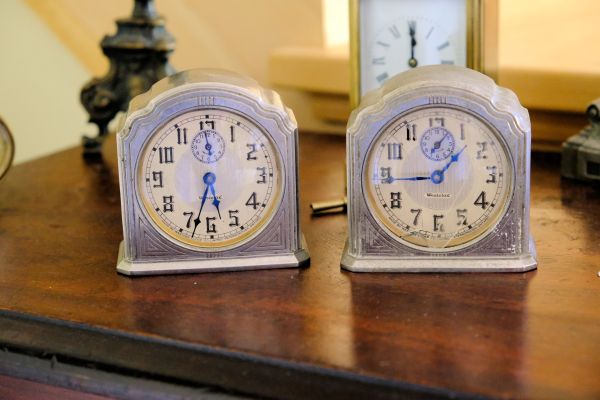
Reader EW asked me if I wanted a second Westclox LaSalle 61C alarm clock. Yes, I said, of course. I was advised of the condition of the clock beforehand so there was no surprise when it arrived in the mail.
The important distinction between my clock and the new arrival is that the new one actually works. My LaSalle may have run at one time but not now. I can hear it briefly ticking but once placed on a flat surface it stops. There is not a lot wrong with it but it definitely requires a good cleaning and perhaps some bushing work.
Gee, our old LaSalle ran great….those were the days
Archie Bunker
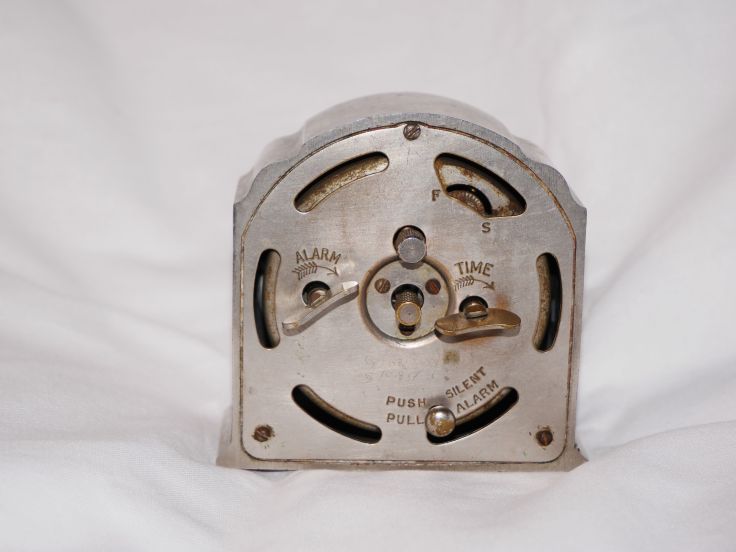
Westclox alarm clock; winding keys and adjustments
The Westclox Clock Company is better known for various versions of Big Ben and Baby Ben windup alarm clocks produced from 1900 to the mid 1980s. But there were other windup models one of which is the Art Deco styled LaSalle series. Both of these clocks are the model 61-C (401) otherwise known as a Dura clock because they have nickel-plated, die-cast zinc cases made by The Dura Casting Corporation in the United States. There are 6 models in the LaSalle series and all use the Westclox type 61 Baby Ben, one day movement.
After having attended a NAWCC (National Association of Watch and Clock Collectors) May 2019 chapter meeting in Ottawa and the 2019 NAWCC National Convention in June of this year I began to wonder why there is no NAWCC representation in the Maritime provinces of Canada (Nova Scotia, New Brunswick and Prince Edward Island) or even an informal clock and watch club.
The closest NAWCC chapter is Montreal, Canada and there are at least 3 active chapters in Ontario alone. There has never been an active NAWCC chapter in the maritime provinces.
I believe there are a fair number of clock enthusiasts (horologists) in my region who would love to meet in order to share experiences and expertise.
This blog reaches clock lovers all over the world and I encourage any of you who have an interest in mechanical clocks to seek out those with similar interests in your local community but if you are living in the Maritime provinces of Canada; Nova Scotia, New Brunswick and Prince Edward Island, contact me directly at ronjoiner@gmail.com if you are interested in getting together to talk about clocks and watches, share experiences, share repair techniques or boast about your collection.
If the numbers grow and there is sufficient interest we can form a club, and later on we might even be able to explore charter membership with NAWCC.
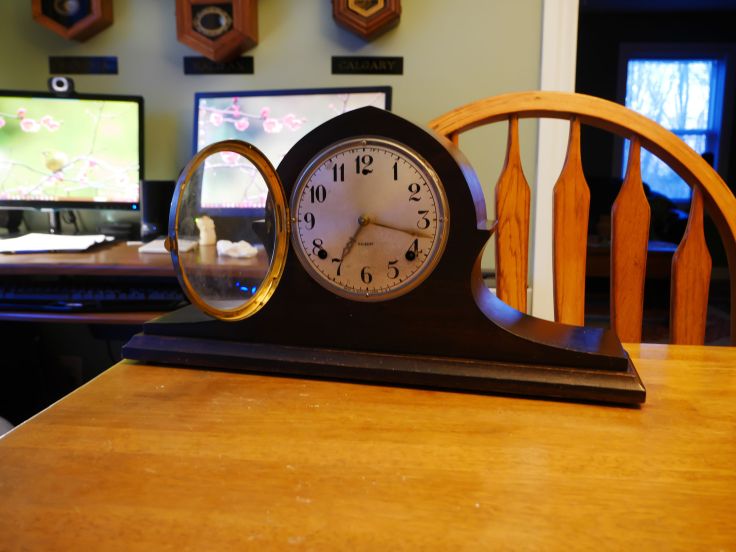
I have worked on several Gilbert clocks in the past few months which is unusual for me. Certain makes of clocks seem to come in bunches. This clock is a 6 column time and strike antique Gilbert mantel clock made in 1913, and reflects a period when every American maker had a similar style. Some parts of the case have an Adamantine finish but those particular areas are not in good shape.
A family relation asked me if I could get it running. Sure, I said.
Gilbert 6 column mantel clock,1913
History of the Gilbert Clock Company
The Gilbert Clock Company began making clocks in December of 1828 and produced clocks over a span of 130 years.
In 1837, John Birge joined the firm, and the name was changed to Birge, Gilbert, & Company. Shortly thereafter, Chauncey and Nobel Jerome and Zelotus Grant became partners with Gilbert, and in 1837 the company was know as Jerome, Grant, Gilbert, & Company. This company manufactured Jerome’s cheap brass-movement clocks.
This is Part II of a two Part series on a New Haven Sharp Gothic (Steeple) clock. This blog-post is about servicing the movement.
My recently acquired New Haven Gothic Steeple 30-hour clock is an online auction win.
New Haven Gothic Steeple clock
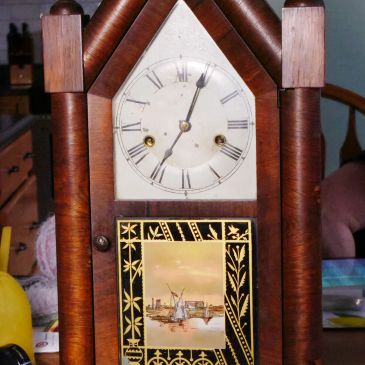
The case is in very good condition apart from minor veneer issues on the base and the columns. The clock is missing the tip of the right finial although it might be hard to tell from the photo. It measures 20 1/2 inches tall with a 5-inch dial. The movement appears to be original to the case.
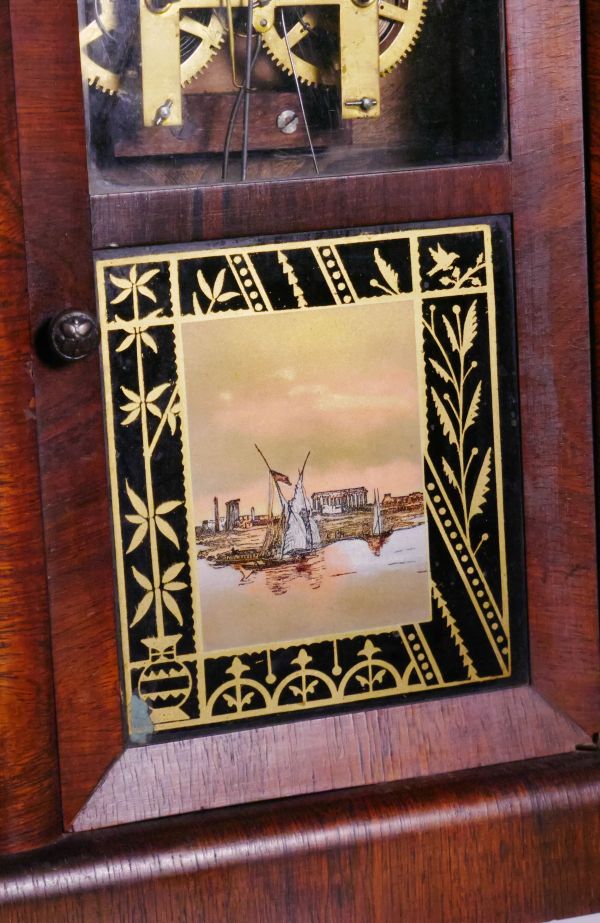
The dial is original and has some loss that would be expected in a 135-year-old clock. The tablet, likely original, features a sailboat against Greek (?) temples surrounded by gold foliage on a black background. The design of the tablet was used in other New Haven clocks of the time. Though intended for European export the clock found its way to Canada.
This is Part I entitled History Unearthed. It is the first part of a two part series. Part II concerns servicing the movement.
My recently acquired New Haven Gothic Steeple 30-hour clock is an online auction win.
The case is in very good condition apart from minor veneer issues on the base and the columns. The clock is missing the tip of the right finial although it might be hard to tell from the photo. It measures 20 1/2 inches tall with a 5-inch dial. The movement appears to be original to the case.
I have an upstairs office in my home where I work on most of my clocks. I also have a small workshop in my basement where I work on clock cases; gluing, painting, reconstruction and other odd jobs.
In the spring of this year (2019) my wife asked me how many clocks are running in my office at any given time. I said, “I’m not sure”.
I put together a video to show how busy my office can be. Someone (not my wife) asked me if the sounds of ticking clocks bothered me and my reply was, “I find the sounds very soothing”. Allow me to take you on a tour.
I hope you enjoyed the tour. Let me know if you have any general comments or ones you would like more information about.
This is Part II of a two part series. Part one covers the first three steps in renewing a Seth Thomas clock dial. In this, Part II, the decorative design is restored on the corners.
The Seth Thomas clock as found
Inpainting is the process of reconstructing lost or deteriorated parts of a clock dial. In the museum world, in the case of a valuable painting, this task would be carried out by a skilled art conservator or art restorer. Inpainting, as opposed to repainting and restoring the entire dial, addresses the degraded areas of the dial using a few simple techniques.
Inpainting is cost effective and can be done on the home work bench
Inpainting certainly does not meet the higher professional standards of a service such as The Dial House, which perform exemplary work but I will not have a dial professionally restored if the cost is twice what the clock is worth. There will always be occasions when a professional restoration is justifiable, however.
Inpainting is cost effective and can be done on the home work bench.
This is Part I of a two part series. Part one covers the first three steps in renewing a Seth Thomas clock dial. In Part II the decorative corner design is restored.
Seth Thomas column and cornice “Empire” style time and strike weight driven shelf clock, as found
Inpainting is the process of reconstructing lost or deteriorated parts of a clock dial. In the museum world, in the case of a valuable painting, this task would be carried out by a skilled art conservator or art restorer. Inpainting, as opposed to repainting and restoring the entire dial, renews the dial using a few simple techniques.
Some of the methods can be found in T. E. Temple’s excellent resource book entitled Extreme Restoration.
I have worked on Gilbert movements previously and each one has slight differences. This one has a rod gong with two striking hammers. Disassembly was routine but required the removal of some parts to separate the plates.
The Gilbert Clock Company began making clocks in December of 1828 and produced clocks over a span of 130 years.
Gilbert tambour style clock model 2038
This is the model 2038 with a bim-bam strike or what Gilbert in its marketing called a Normandy Chime. The model number along with the words “Normandy Chime” are stamped on the bottom of the case. The “Normandy Chime” was reminiscent of the old bells of Normandy (Corneville) in France.
In terms of nomenclature within clock circles, calling it a “Chime” certainly adds to the confusion as this would be considered a striking clock rather than a chiming one.
Among common parlour clocks you will find few EN Welch clocks. There is a good reason for this. The company was absorbed by the Sessions Clock Company in 1903 so any Welch clock is 115 years old and older.
E N Welch Parlour clock, The Whittier circa 1897
This E N Welch time and strike parlour clock is the Whittier model. The clock was made some years after Welch established its reputation as a quality clock manufacturer with the Patti series. The Whittier model represents a period from 1897 onward when Welch re-organized following a bankruptcy and produced well made but inexpensive clocks for the masses.
I located the clock in an antique store in Kazabazua, Quebec in 2016 while my wife and I were on a day trip from our summer cottage. The seller said the strike side did not work and we negotiated a lower price.
The clock ran for several days but despite adjustments I was unable to get the strike side to run correctly. The stop/warning lever and the count/lifting lever were intact, so, I was puzzled; it should run. Straightening the levers might solve the problem.







 Antique and Vintage Mechanical Clocks
You must be logged in to post a comment.