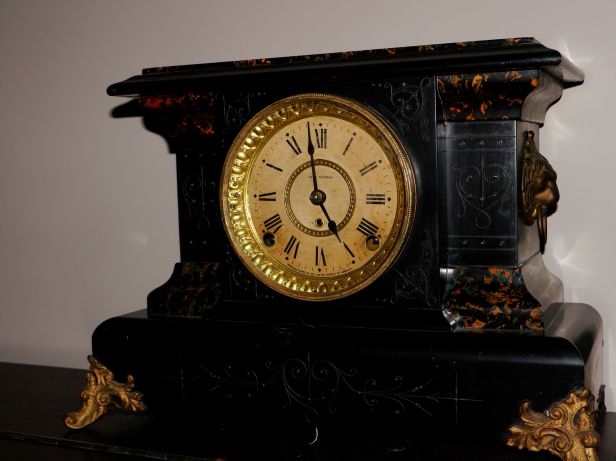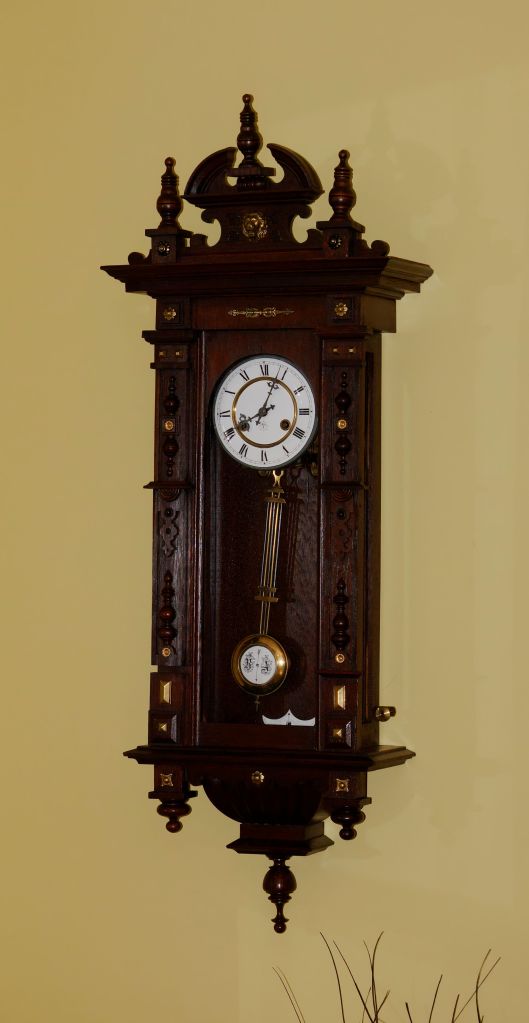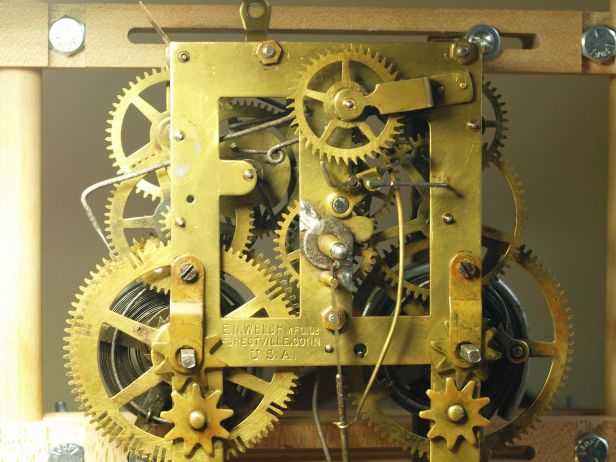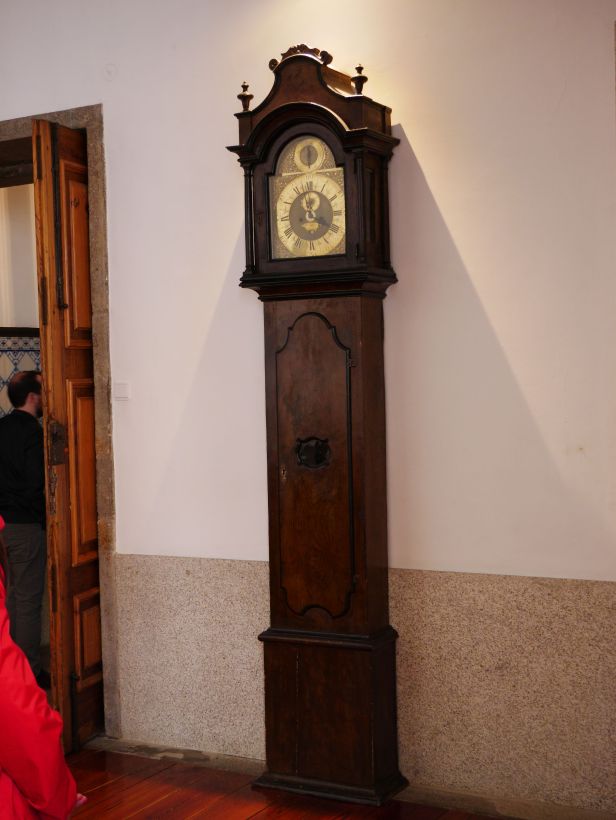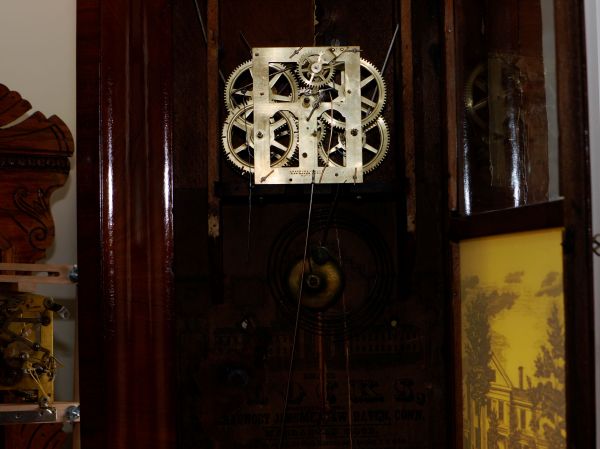
Gilbert time and strike – why I am putting the movement aside for now

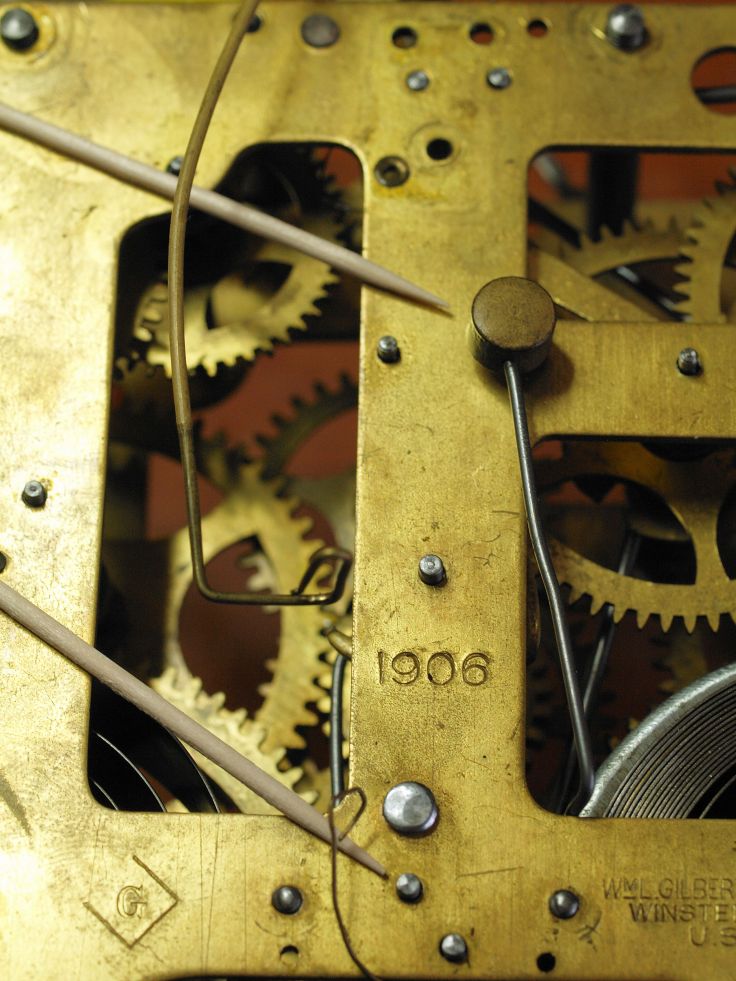
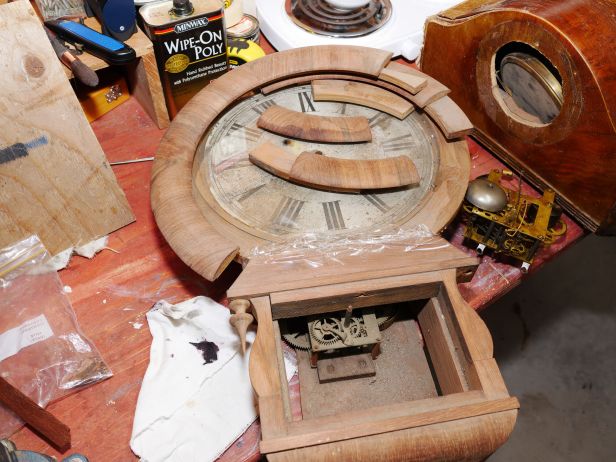
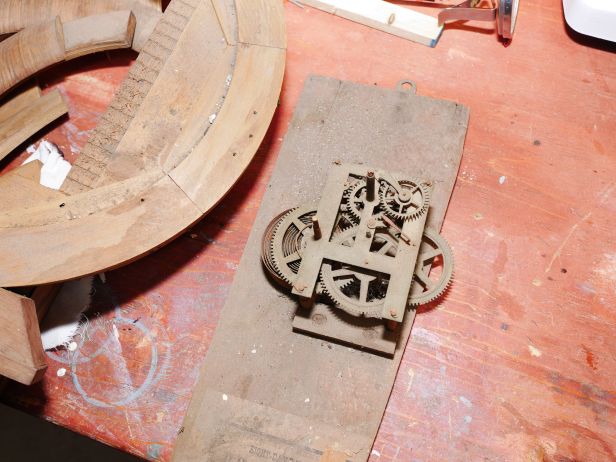
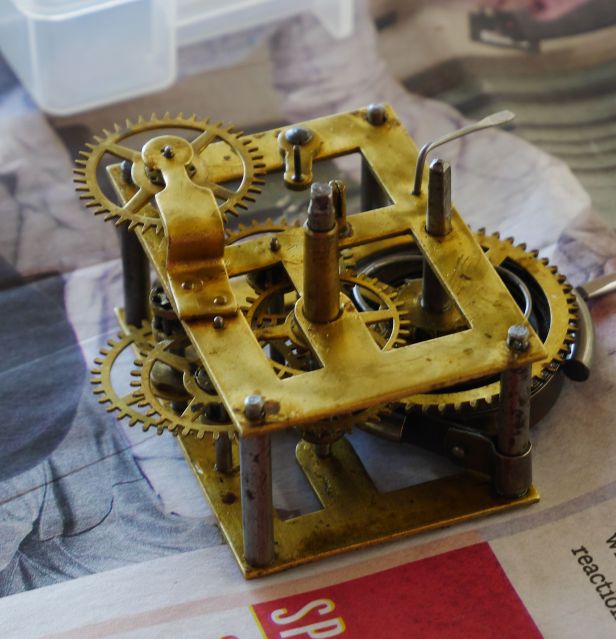
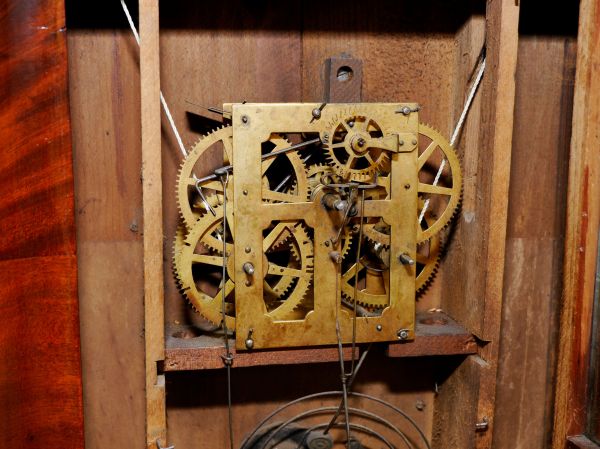
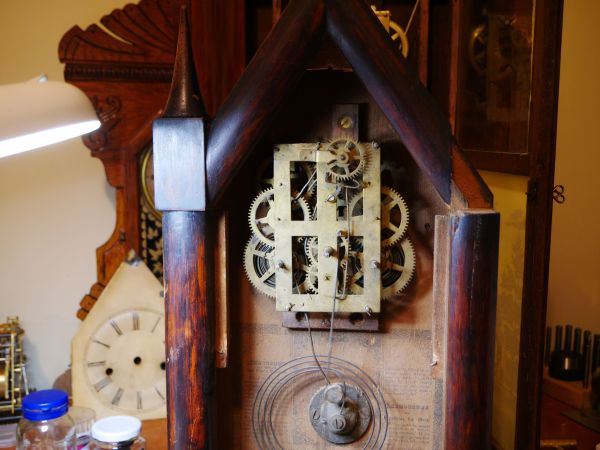
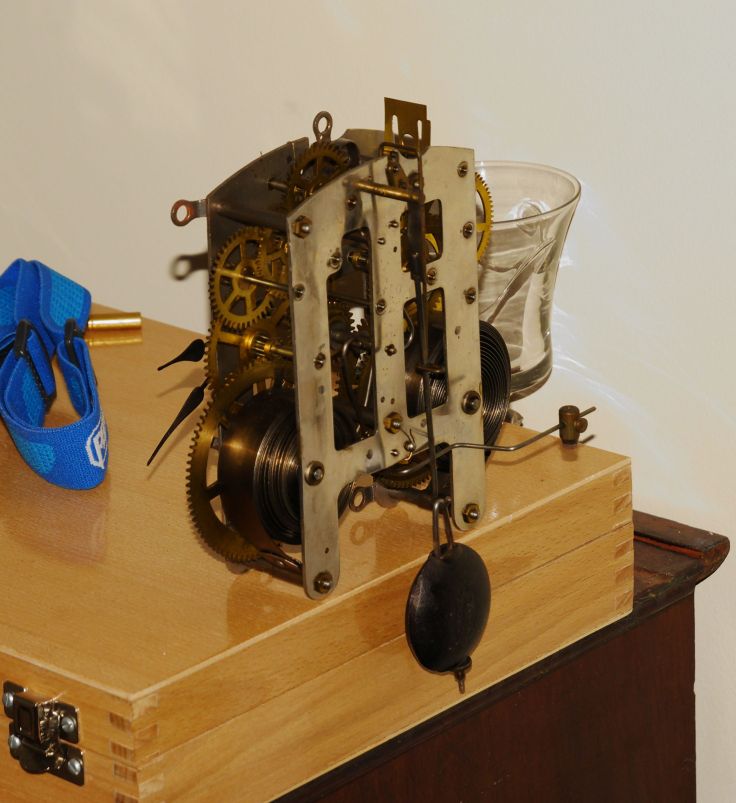
While antiquing some time ago I came across boxes of clock movements in a shop. Some were fairly new though I found a Gilbert time and strike date stamped 1906 which piqued my interest. In the box was the key, the coil gong, clock hands, pendulum and movement mounting screws. A movement without a case. Hmm, interesting! Here’s what I’m thinking.

You dig up an old clock from the basement. It was your mothers and you were immediately reminded of the soothing sound of the clock when you were a kid. Wouldn’t it be nice to get that old clock running again. You fiddle with it and despite your best efforts you just cannot get the thing going. Why not bring it to the local clock-maker? He takes a look at it and explains that it is worn out. It will cost much more than the clock is worth to repair it, he says. But there is a solution. Take the works out and replace the movement with a reliable quartz one and all for less than half the cost of a repair. It sure would be nice to get that old clock running again and who would know that a new quartz movement is inside. The clock-maker takes the movement out, asks the customer if they want it, puts it in a box on a shelf and uses it for parts on the next clock. I’ll bet I’m close.

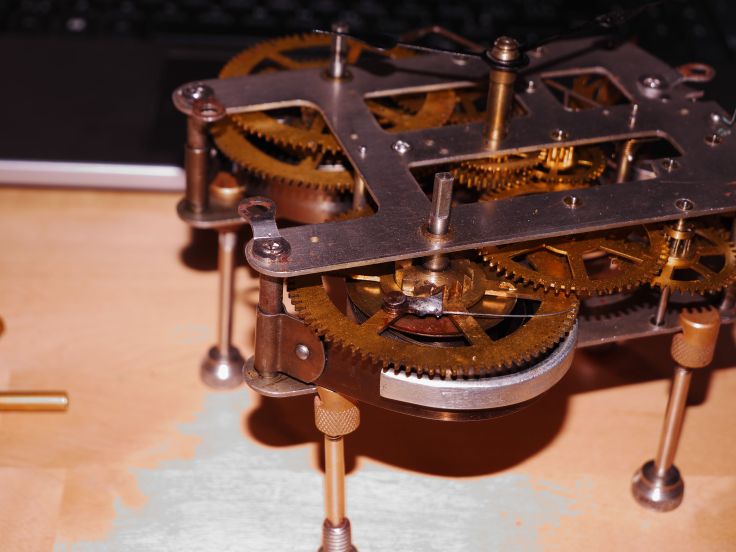
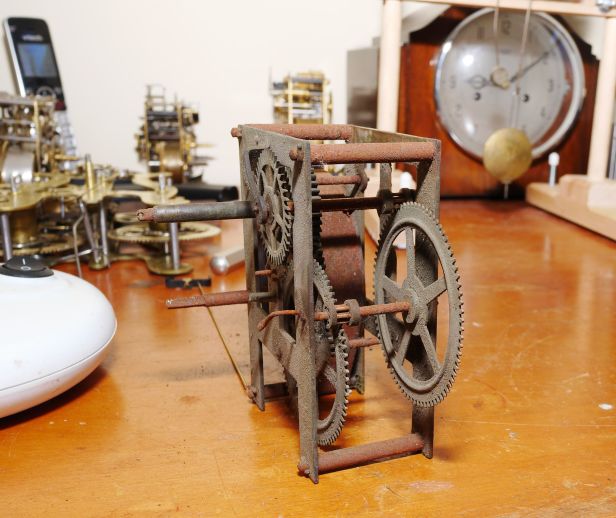
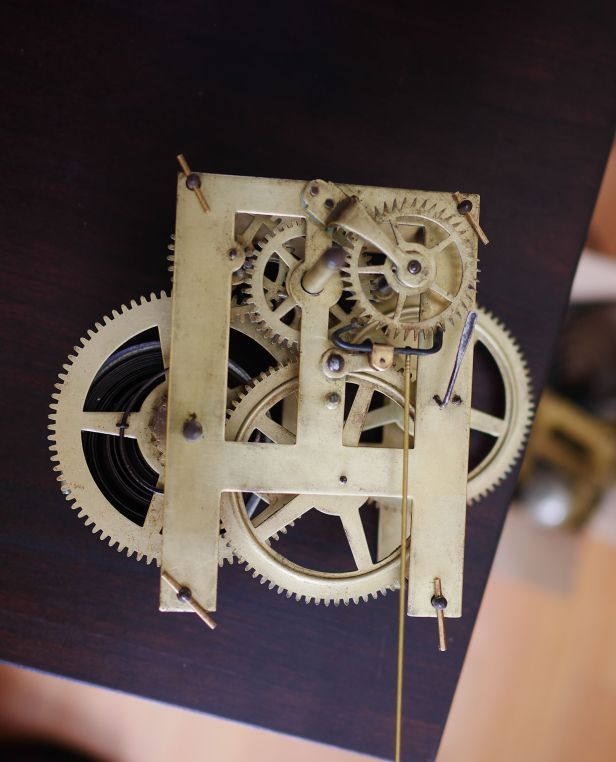
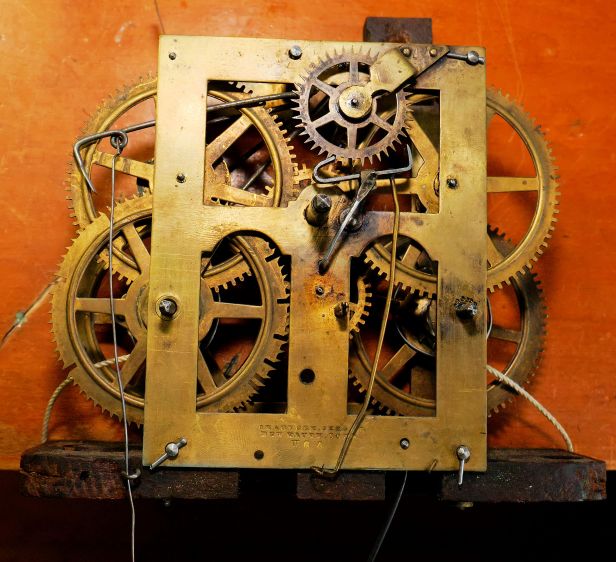
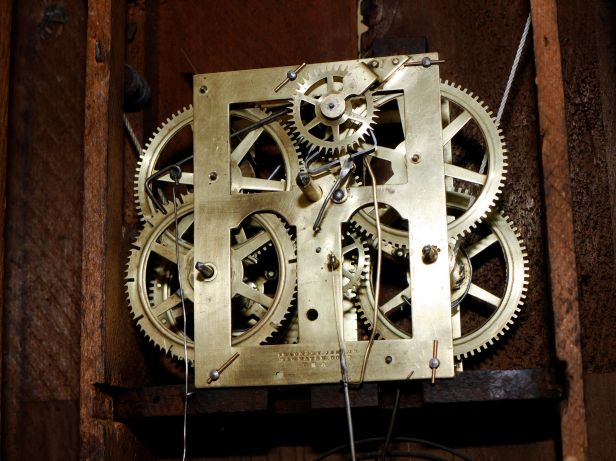
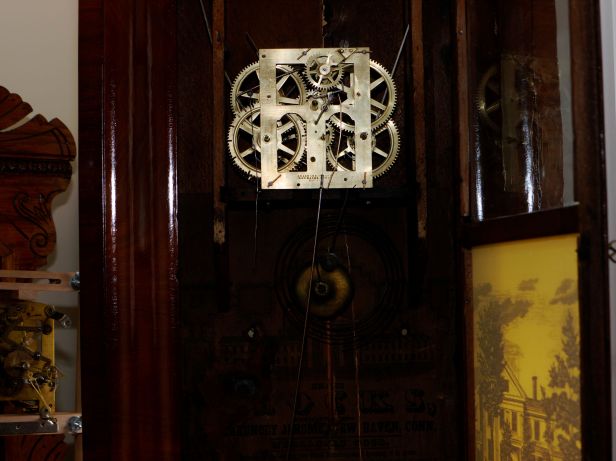
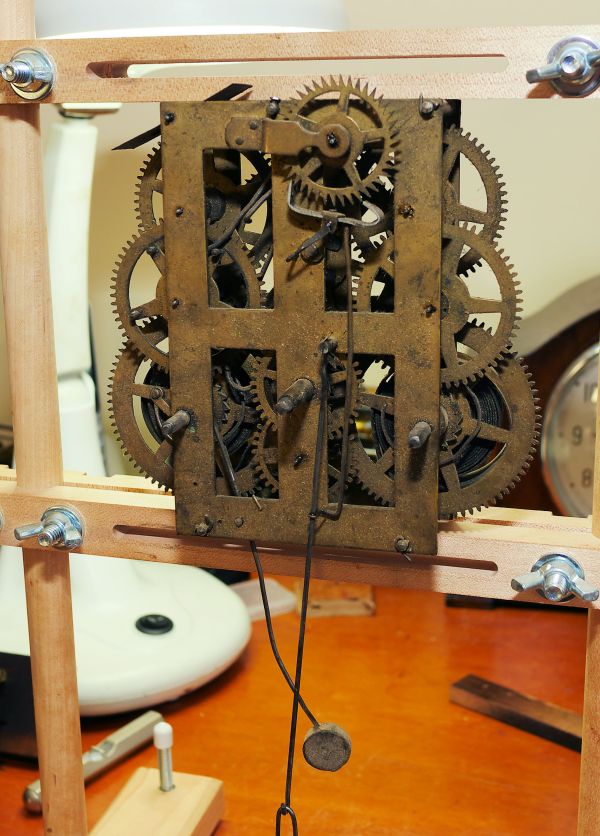
It is a Gilbert time and strike with a passing bell strike on the half hour. It has a distinctive 24 hour count wheel meaning that the count wheel rotates just once every 24 hours, each half with slots for 12 hours.

Gilbert time and strike date stamped 1906

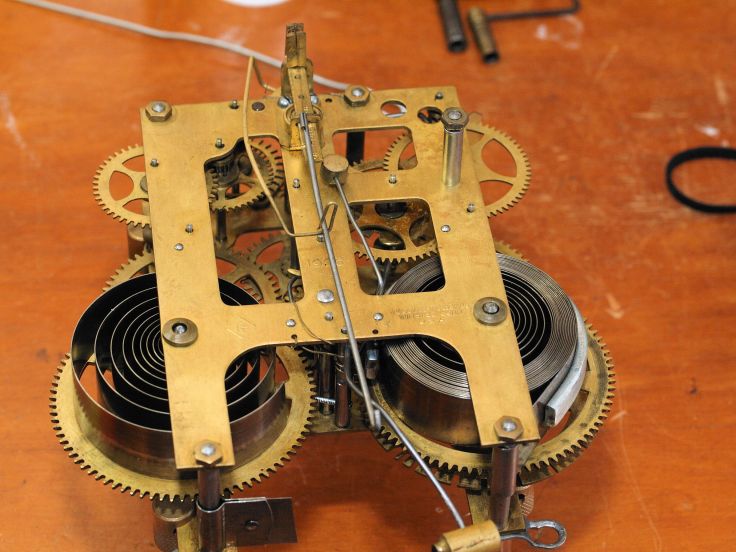
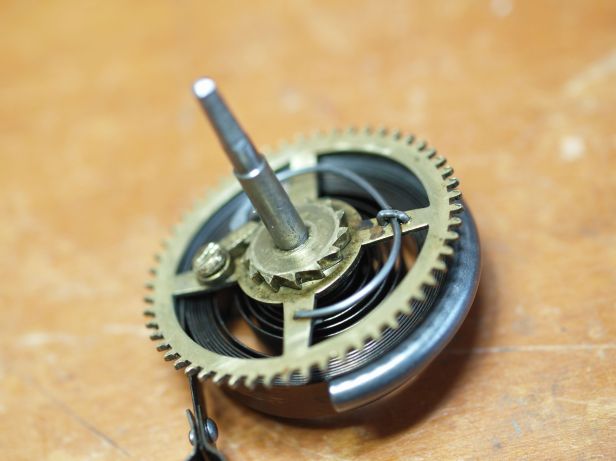
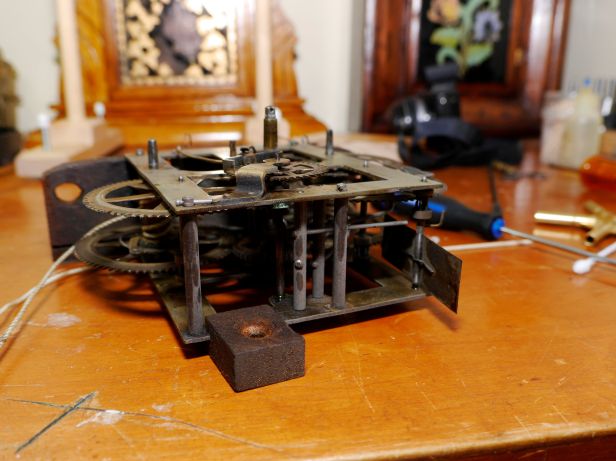
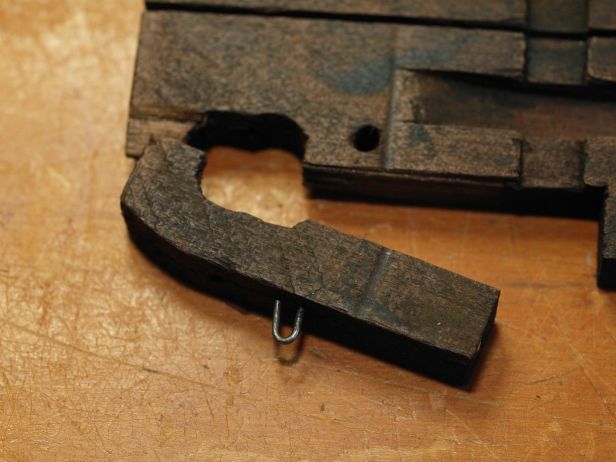
It sat in a box  in my office for several months. The other day I placed the movement on a test stand to determine its condition, wound the time side and BANG, the mainspring blew apart. A nice clean break! Luckily it did not take me or any other parts with it. The break was so far from the loop end that the mainspring was not salvageable. You can see the snapped section of the left mainspring in the photo above. Determined to see this movement in running condition I ordered a new spring from a clock supply house.

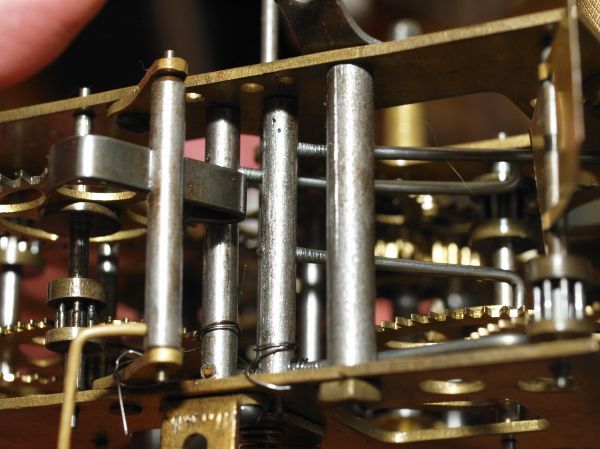
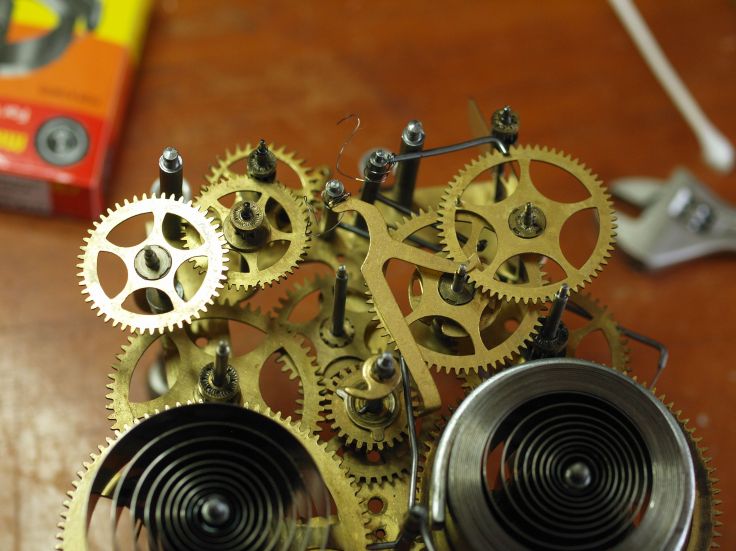
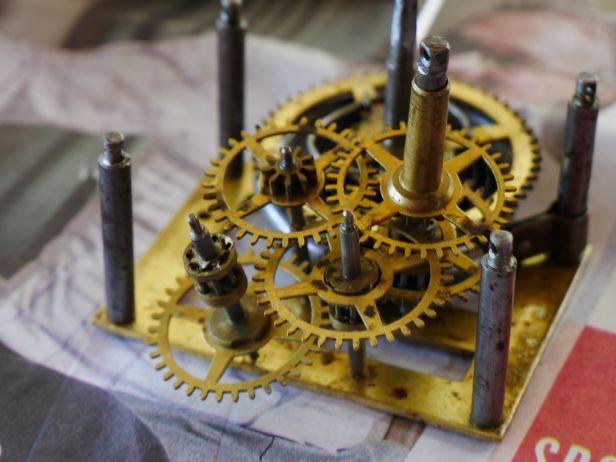
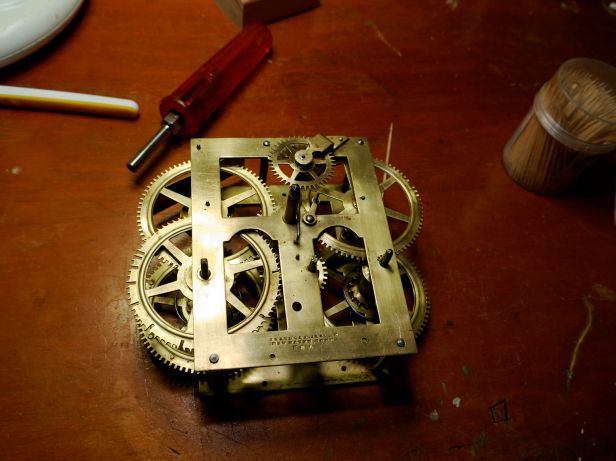
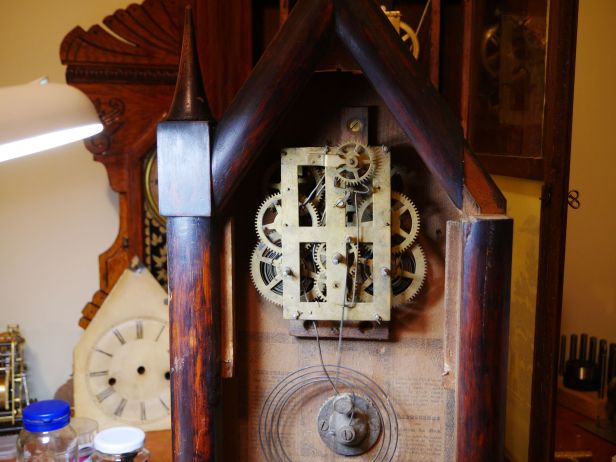
Top plate removed
Top plate removed

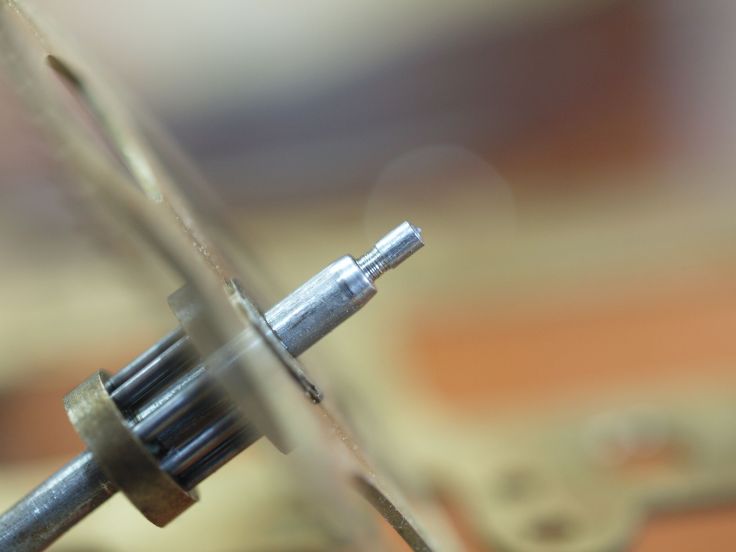
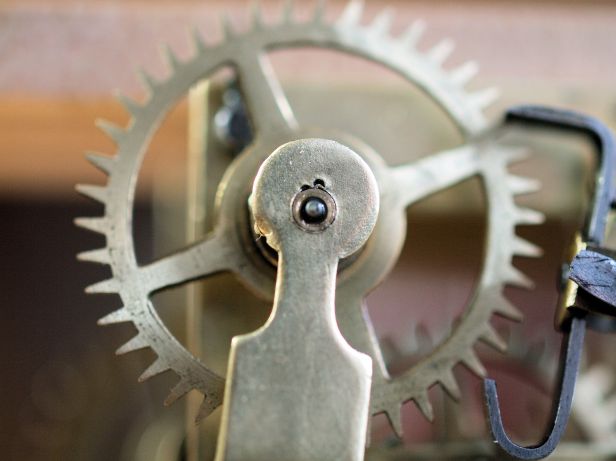
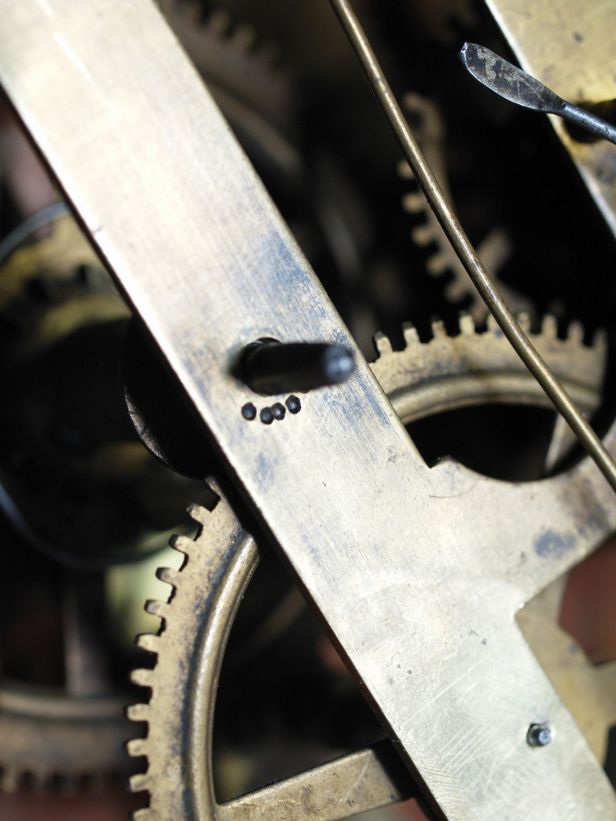
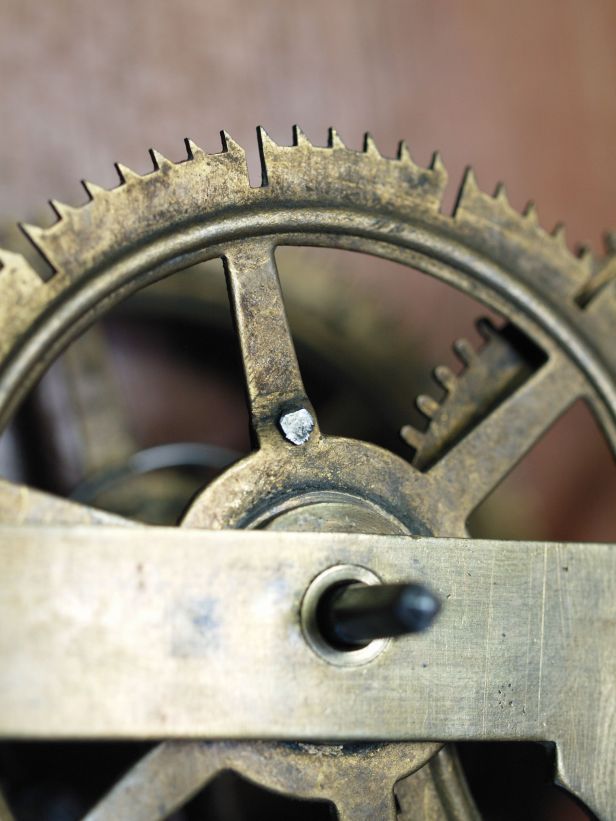
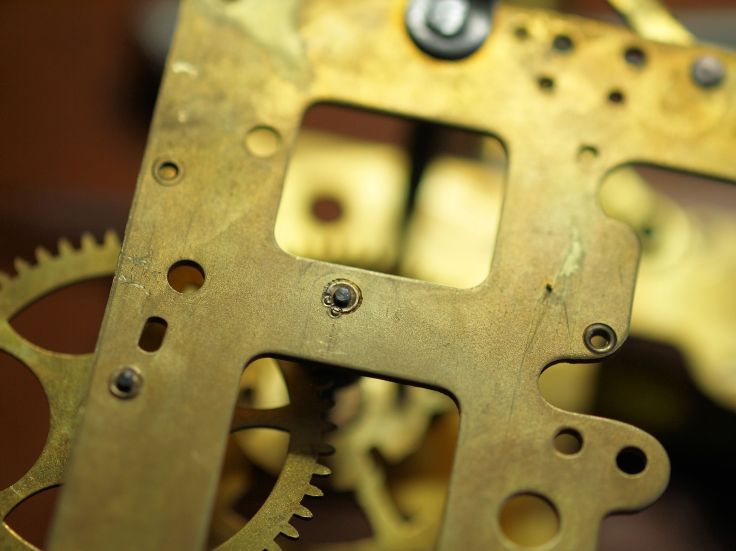
When I dis-assembled the movement it was worn but repairable. However, all pivots were in very good condition except one, the second wheel on the time side, front plate. It was worn at the shoulder as you can see in the next photo.

Unusual wear on second wheel, time side

Was this enough to stop the clock and why just one? Perhaps a combination of factors. It is the second wheel and under the most axial load or probably a contaminated pivot hole with enough embedded detritus that would have ground away at the pivot shoulder.

There are only two solutions, fashion a new pivot or turn down the pivot and polish it. Fashioning a new pivot is a lot of work. However, there is enough steel left after it is turned down to give me a strong pivot. I chose the second option and installed a new bushing to fit the new pivot size which is much easier than re-pivoting. I put the wheel on a lathe and ground the pivot down to the size I wanted and then gave it a polish.

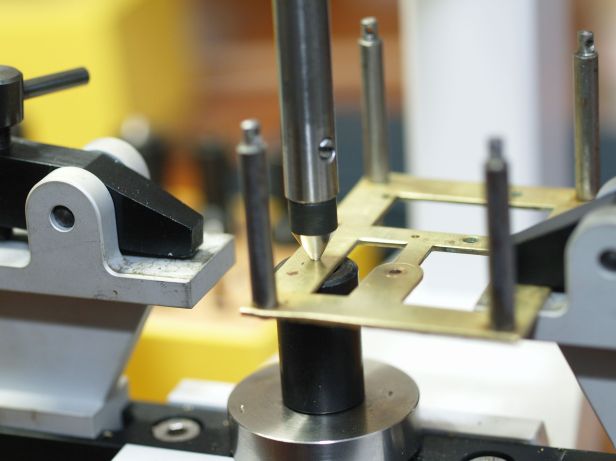
New bushing that had to be punched to stay in place
New bushing had to be punched to stay in place

The second issue was an old bushing that had been installed at some point in the clocks life. I drilled out the old bushing knowing that the replacement bushing would be loose. Alas, it slipped out too easily. The solution, two punches adjacent to the bushing to secure it in place. Punching a brass movement is rarely a good idea but this was a solution that was appropriate to the situation.

I installed two more bushings on the strike side second wheel back plate and third wheel front plate and one more on the time side, second wheel, back plate.

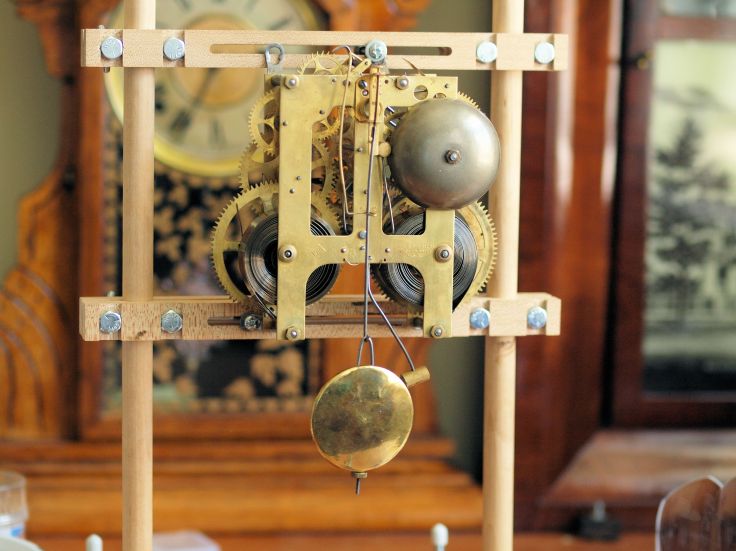
With the new mainspring installed and the repairs completed, it was time to assemble the clock and test it. I cannot count the number of times when I have re-assembled an American time and strike only to find that the strike setup was slightly out of adjustment. You know you have a problem when the clock strikes until the mainspring winds down. Placing the lever in the maintenance cam while the count lever is directly into the deep slot and hoping that the warning wheel pin locks at just the correct moment is always fun. I have cursed a few times when I cannot get it right. In this case it was first time lucky, the stop pin was in the right location on my first try.

On the test stand, bell is now fixed in place
Toothpicks reminding of the location of the bell lever
As an aid in re-assembly toothpicks remind me of the location of the bell lever

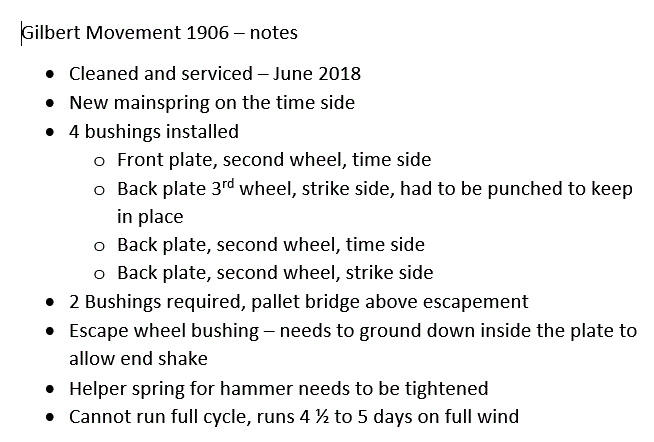
The clock has been running but does not seem to be able to get past 5 days of an 8-day cycle. I realize that there are some things I need to address before I get this clock running a full cycle but I have other projects on the go. Since this movement does not have a case I took it off the test stand, put it in a box on a shelf, included some notes, and will address it at a later date when and if I ever get a case.

Gilbert Notes
Notes about the movement reminding me what needs to be done

So, I’ll wait for that illusive case but in the meantime into storage it goes.

The Macdonald Museum – if you are a clock fan, or even if you are not, this small museum may surprise you

I have been to Middleton, Nova Scotia many times. I have even passed the Macdonald Consolidated School where the clock museum is located without realizing what treasures lay inside. The clock museum represents a small section of the museum, the remainder of which is dedicated to the history of the area.

In the Spring of 2018 my wife and I set off on one of our many mini staycations. On my agenda was a visit to this museum and I was not disappointed.

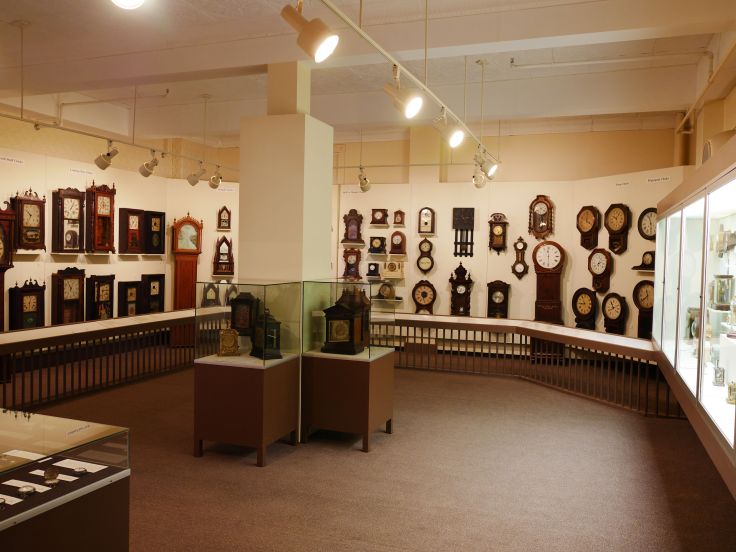
MacDonald Museum main exhibit area
Macdonald Museum main clock exhibit area
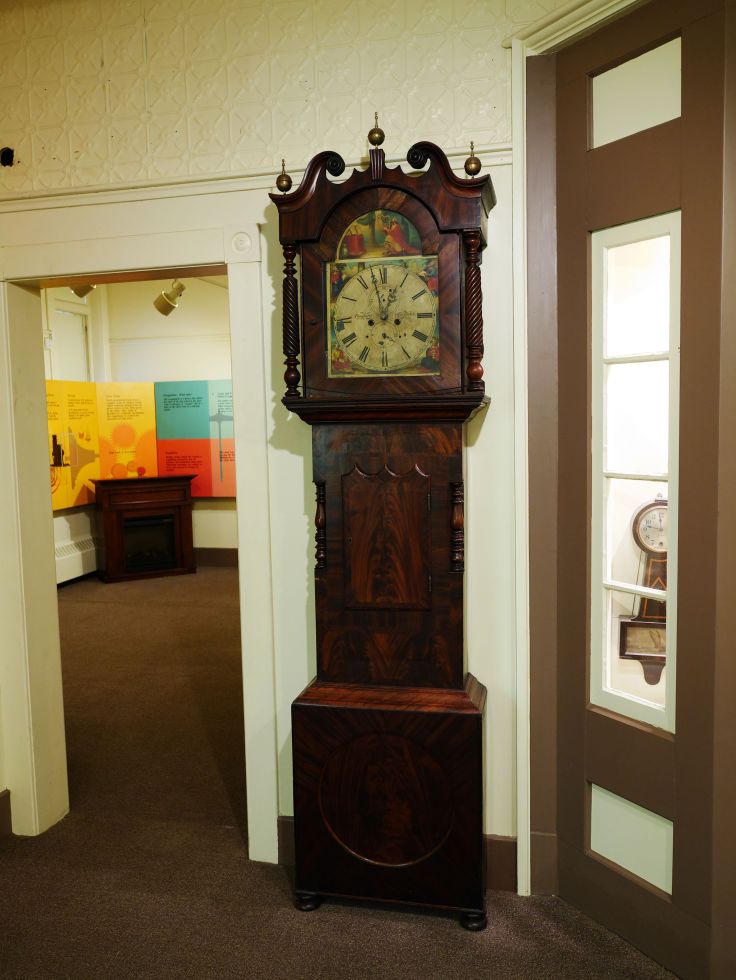
Tallcase clock
Holbeck made tall-case clock
It certainly ranks as the best exhibit in Atlantic Canada

Off highway 1 on School Street, Middleton, Nova Scotia stands the Macdonald museum. I had some expectations because I had been to two well respected clock museums, the NAWCC museum in Columbia PA. and the Canadian Clock Museum in Deep River, Ontario. Though not on the same scale as these two, it certainly ranks as the best exhibit in Atlantic Canada.

According to the web site

The Annapolis Valley Macdonald Museum is home to the Nova Scotia Museum’s collection of over 150 antique clocks and watches. This permanent exhibit showcases items collected by the late Norman Phinney and was one of the primary reasons for establishing the Macdonald Museum. Many of the clocks are in working condition. There are a wide variety of clocks and watches on display, with some dating back to the late 17th century. Anyone interested in clocks would do well to see this exhibit – one of the best in Eastern Canada.

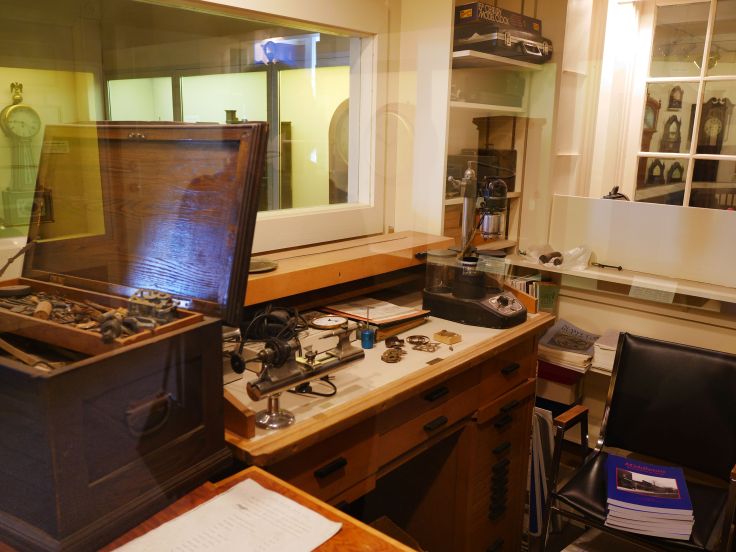
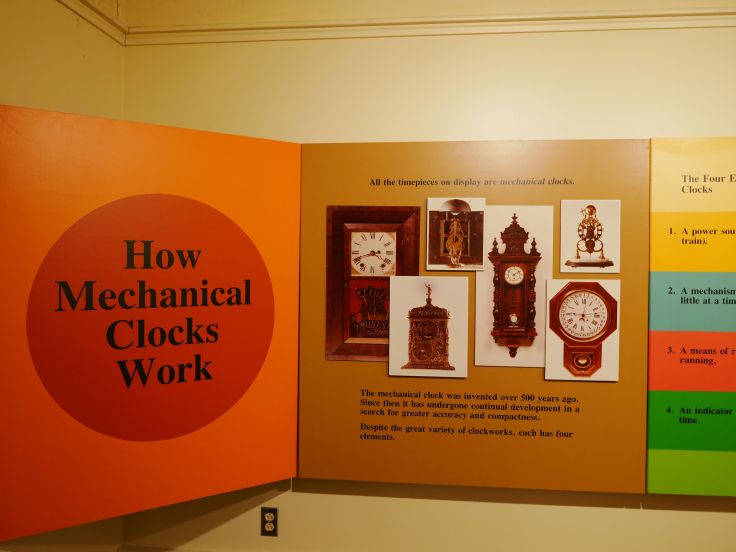
The museum is well laid out with enough information on each of the clocks on display to satisfy the general public and clock enthusiasts alike. Each display highlights its significance as an important development in horological history. We were alone as we walked though the main exhibit area and an adjacent room which contained a fascinating old clock-maker’s shop and a well laid out and informative interactive display on how mechanical clocks work.

Clockmaker's shop
Clock-maker’s shop
How mechanical clocks work

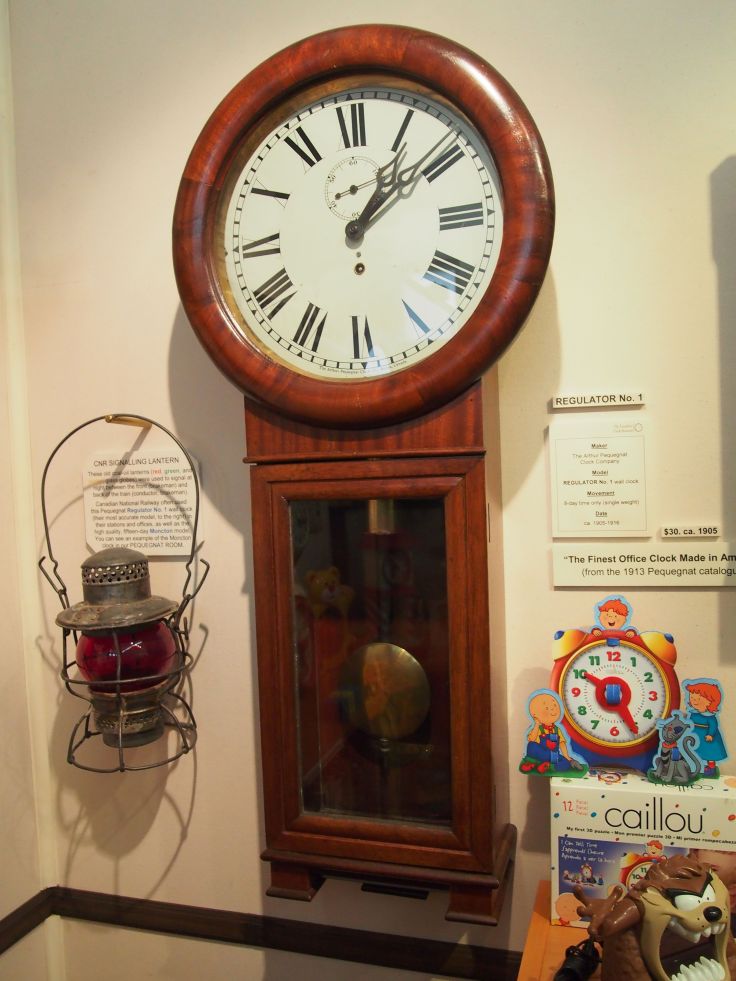
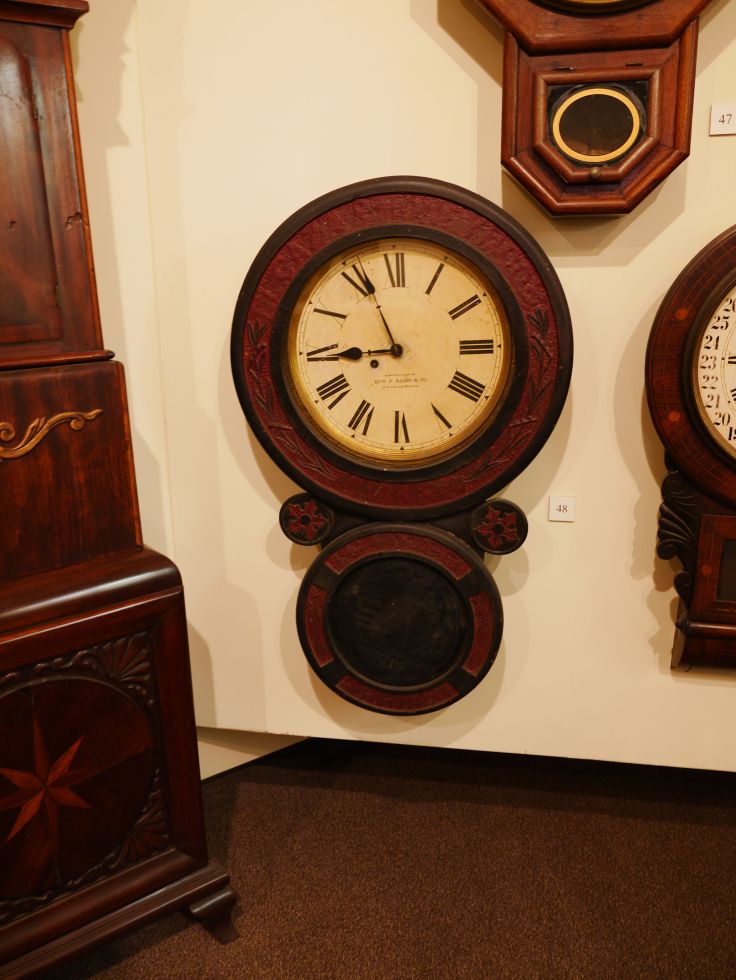
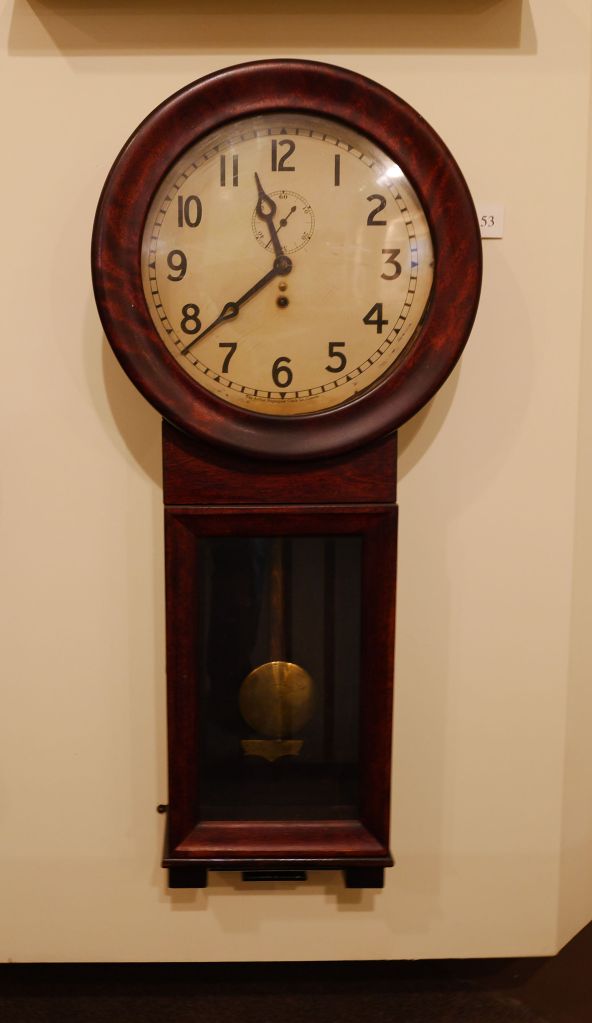
At least one example from the Baird Clock Co. of Montreal and five examples from the Arthur Pequegnat Clock Co. of Berlin (now Kitchener) Ontario were on display including the Arthur Pequegnat Regulator #1, that the company once advertised as “The finest clock made in America”.

Baird clock from Montreal
Arthur Pequegnat Regulator #1

None of the clocks were running, however. Though the clocks appeared to be in excellent condition, the sound of ticking clocks make for a more authentic experience. All other clock museums make a practice of running some clocks on a rotating basis at any given time.

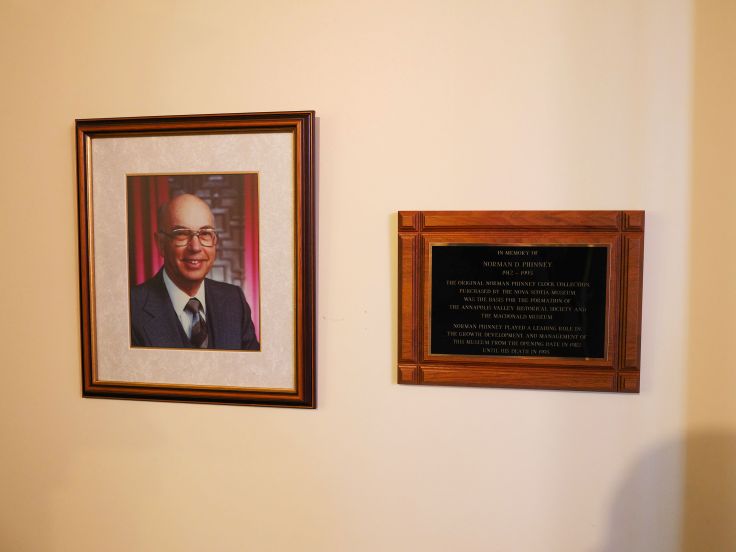
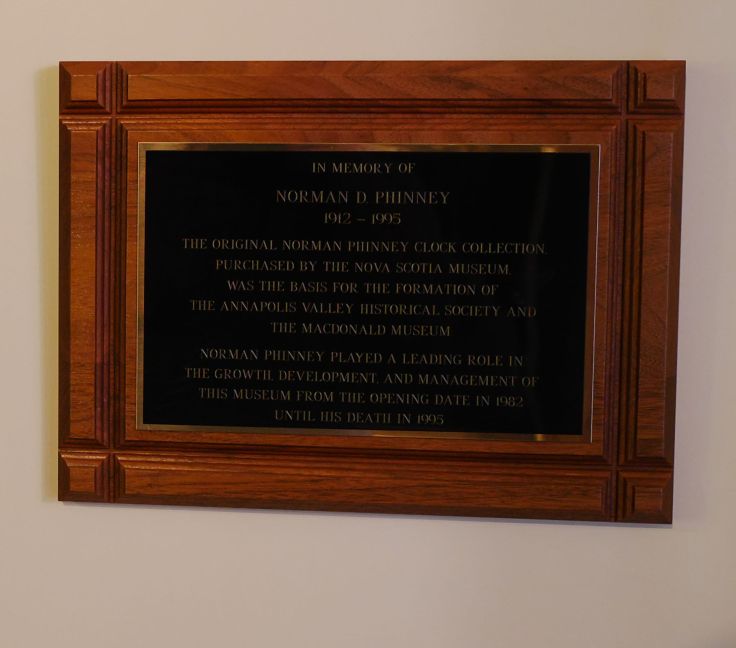
At the entrance to the clock collection there is a simple plaque dedicated to Norman D. Phinney. Learning more about Norman D. Phinney, his contribution to the Macdonald Museum and the story of how the museum received his clock collection would add to the experience.

Norman D Phinney
Norman D Phinney

If you are a clock fan or even if you only have a casual interest in the world of horology, this small clock museum may surprise you

Though perhaps not within the scope of Phinney’s original collection, examples from the Canada Clock Co. and the Hamilton Clock Co. or more peddlers clocks from Nova Scotia and New Brunswick would have provided an enhanced Canadian horological perspective.

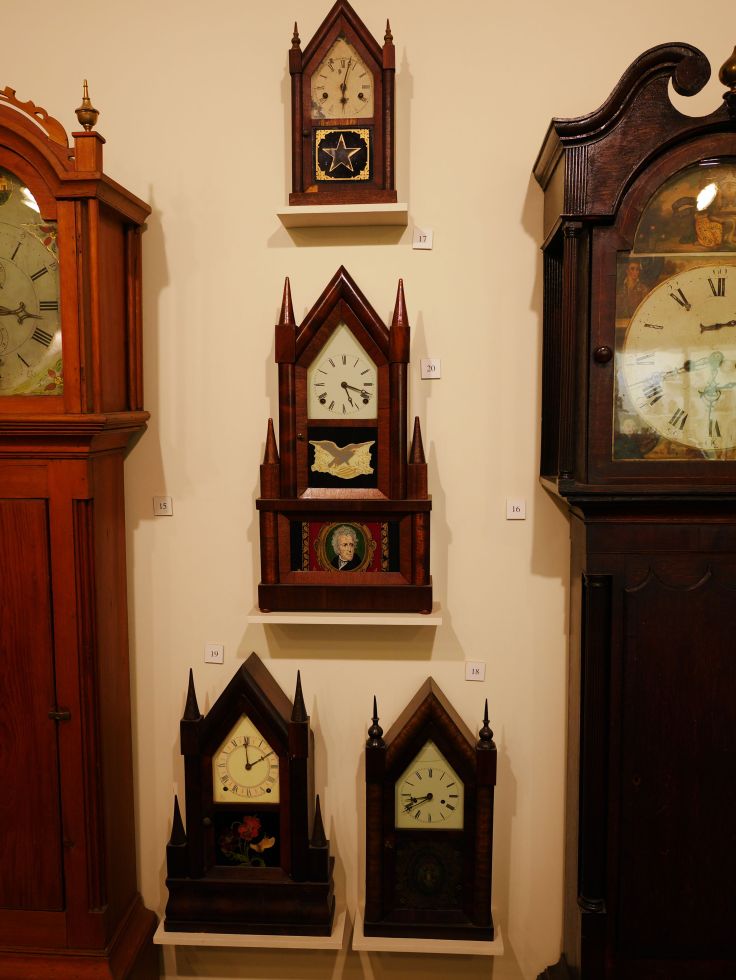
Steeple or sharp Gothic clocks

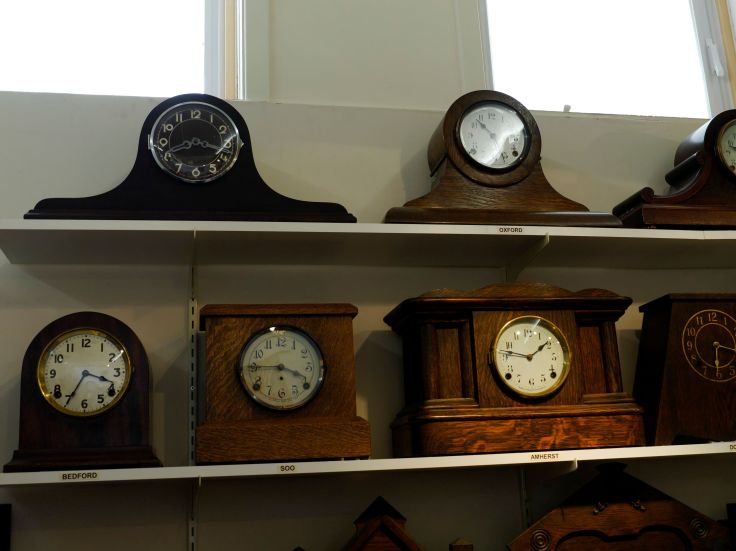
However, these are minor quibbles and should not detract you from appreciating the high quality of the exhibits which contained British, American, French and Canadian examples or the many styles that included Pillar and Scroll, tall-case, shelf, beehive, steeple, drop octagons, mantel, alarm clocks and Ogee clocks, all of which were well represented.

If you are a clock fan or even if you only have a casual interest in the world of horology, this small clock museum may surprise you.

Oh, and while there, visit the rest of this fascinating museum.

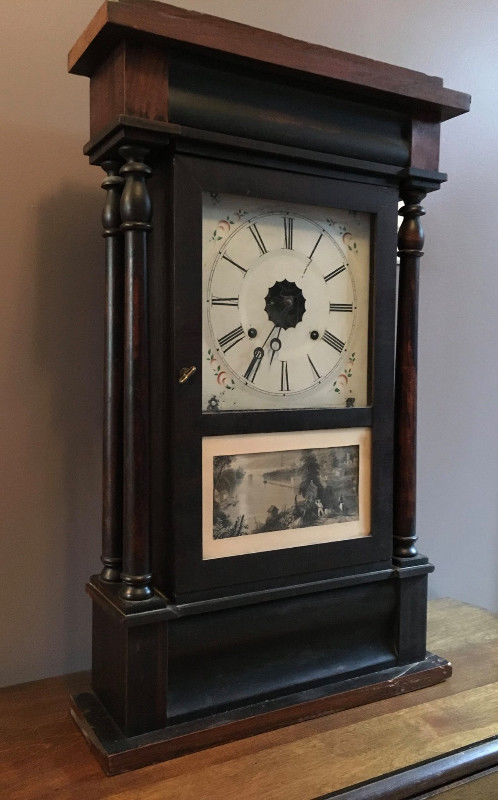
Sperry and Shaw 30 hour 4 column New York Style shelf clock circa 1846-47

4 column Sperry and Shaw 30 hour shelf clock

I have the 30-hour clock bug and my collection of them is steadily growing, but where to put them all? I have not decided where to put this one and for the moment it is on the floor of my work room.

Sperry and Shaw were not thought of as a high end clock company but some models like this 4 column New York style were quite attractive

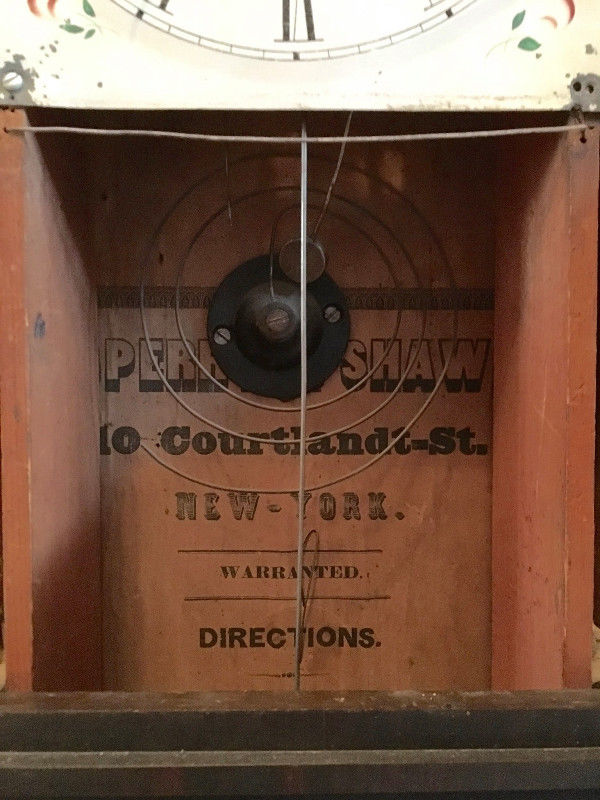
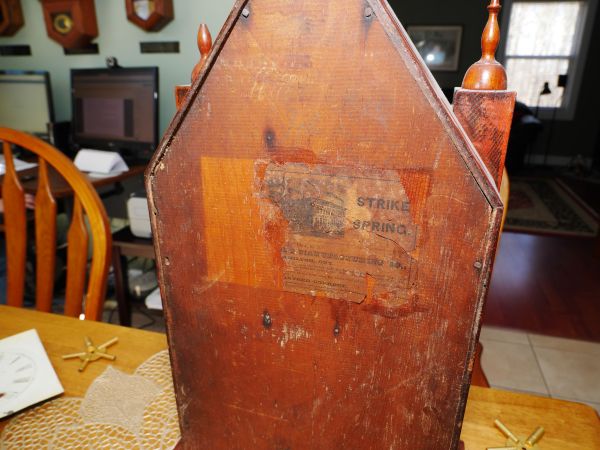
This is a New York-styled Sperry and Shaw 30 hour time and strike, 4 column shelf hour strike clock, measuring 25 1/2 inches in height by 14 inches in width. The 4 free-standing turned columns first drew my attention as I had never seen anything quite like it. While researching the NAWCC site I discovered that this clock was made in or about 1846-47. The label, of which 98% is intact inside the backboard says 10 Courtlandt (not a misspell, there is a second”t”) Street, the company headquarters during the aforementioned period. Sperry and Shaw were business partners and were regarded as distributors and assemblers rather than clock-makers.


Sperry and Shaw's label showing 10 Cortlandt St.
Sperry and Shaw’s label showing 10 Cortlandt St.

They sourced cases and movements, affixed their own stamp on the movement and placed their labels (sometimes over other makers labels) inside the case, a common practice at the time as clocks for the home and workplace both locally and abroad were in great demand.

Not everyone in the clock business was happy with Sperry and Shaw. Consider this excerpt from Chauncey Jerome’s book, History of the American Clock Business.

“These New York men would say that they were agents for Jerome and that they would have a plenty in a few days, and make a sale to these merchants of Jerome clocks. They would then go to the Printers and have a lot of labels struck off and put into their cheap clocks, and palm them off as mine. This fraud carried on for several years. I finally sued some of these blackleg parties, Samuels & Dunn and Sperry & Shaw, and found out to my satisfaction that they had used more than two hundred thousand of my labels. They had probably sent about one hundred thousand to Europe.”

Chauncey Jerome had a few clock-makers/assemblers on his hit list that included Sperry and Shaw and at least managed to sue some successfully.

Sperry and Shaw were not thought of as a high-end clock company but some models like this 4 column New York style were quite attractive, sold well at the time and are sought after today by collectors.

The movement is Jerome-like (Counterfeit perhaps?) and stamped Sperry and Shaw, New Jersey. I measured the plate thickness and compared it to a Jerome in my collection and the plates in this clock are a little thinner.

The narrow brick-shaped weights (4  3/4 inches X 1 inch) fit neatly into channels on the left and right. When I first communicated with the seller, he was not sure if the weights were in the clock. He later emailed to say that it did indeed have weights. I would have passed on the clock had it not come with the weights because the narrow bricks are the only type that will fit into the channels and they would have been almost impossible to source. The weight cords, clearly not original, are old and frayed and will be replaced with simulated gut. How old, well on the first night I raised the strike weight up about halfway and about 20 minutes later I heard a loud BANG. I knew exactly what happened; the cord had snapped and the weight had dropped. Luckily there was no damage.

The open moon steel hands are original.

The upper glass appears original and has the waviness you would expect from a clock over 172 years old.

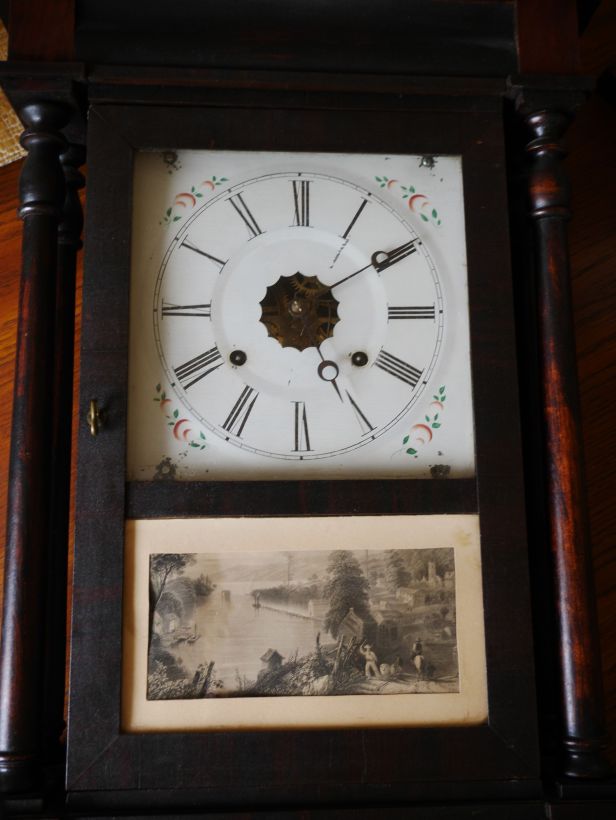
The lower tablet has a cropped image of the Bay of Quinte (Ontario, Canada) taped to the inside – not original but old. The original 18X12 cm steel engraving was drawn by W. H. Bartlett and engraved by J. C. Armytage in 1840; the image can be found here. Since the image is from 1840 and appropriate to the period of the clock, I might just leave it there. It also tells me that the clock likely spent most of its life in Ontario, Canada.

Sperry and Shaw clock showing dial and lower tablet
Sperry and Shaw clock showing dial and lower tablet print

The zinc dial is old though not as old as the clock itself since there is a patent stamp on the back of the dial dated Dec 1, 1863.

Dial patent date of 1863
Dial patent date of 1863, a later addition to the clock

There is also a clock-makers inscription that says, “cleaned by Felo Bros, March XX 1901”. Obviously this particular dial would not have been on the clock at the time it was made. A wood dial would have been appropriate for the period.

Clock-makers inscription in pencil

The case looks good…from a distance. The veneer looks like mahogany or walnut, I am really not sure. There are a few small pieces of veneer missing at various places and mostly on the corners, a common issue. It has a two-tone appearance though the case might have been all one colour when made (??). There is a lot of grime on the darker surfaces and I have to decide whether to leave as-is or take it down a little bit to see what’s there. Attending to the veneer issues should be a fairly straightforward process. The break in the right corner of the base is a crude repair and that will have to be redone.

One of several areas of minor veneer loss

The movement is dirty but should clean up nicely. There is not a lot of pivot wear on the front plate of the movement but I will learn more once it is out of its case.

There are a number of other clocks in the queue but I am eager to tackle this one.

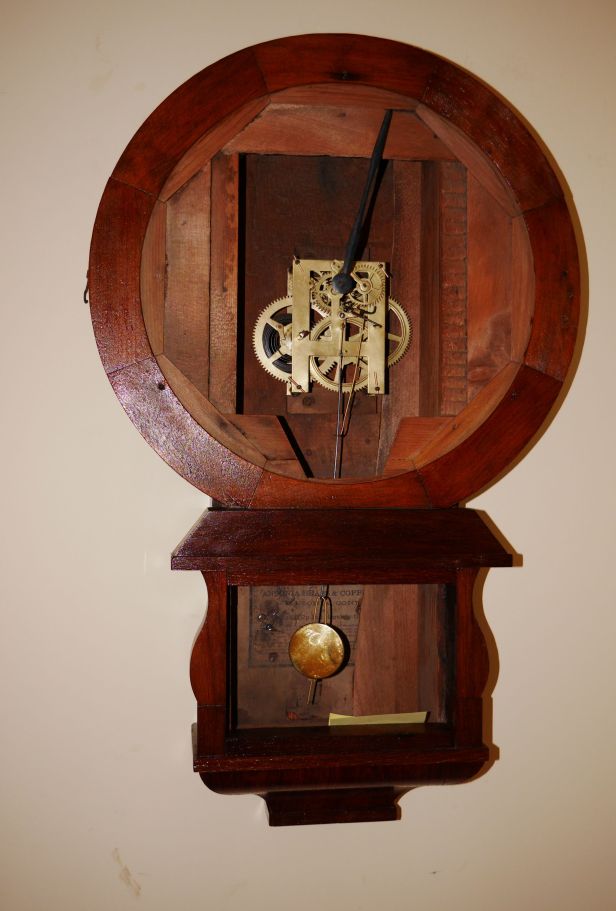
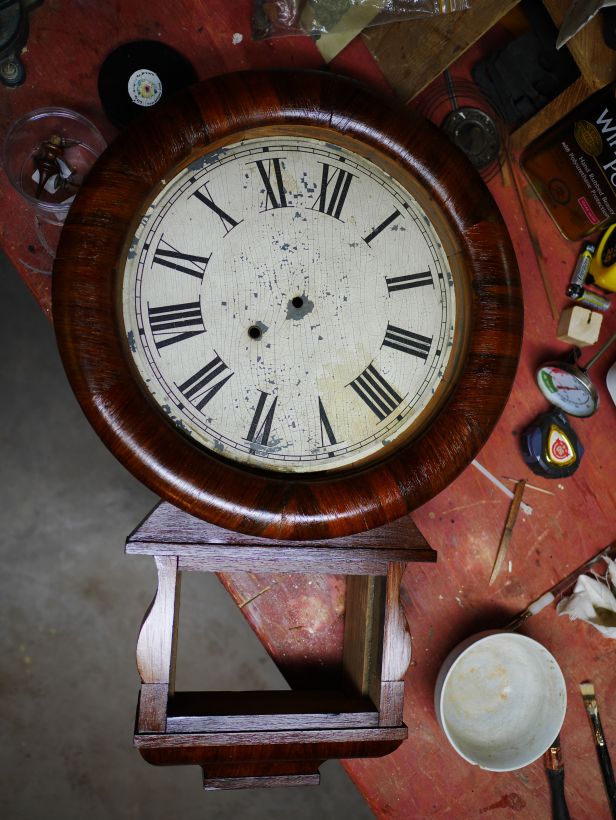
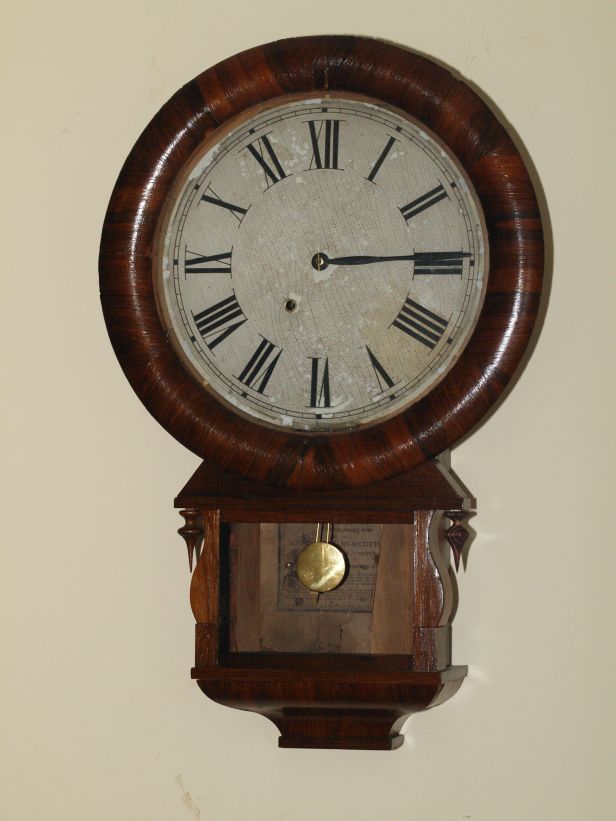
Ansonia Extra Drop wall clock – moving ahead with repairs

Ansonia Extra short drop wall clock
Ansonia Extra short drop wall clock in as-found condition

The photos tell the story

Some time ago I wrote an article on an Ansonia barn find. It is an Ansonia Extra Drop time-only Rosewood veneered wall clock, circa 1880. I thought I would update readers on how this little project is progressing. I was able to find most of the parts but there are still some missing. I will let the photos tell the story.

It did not look like it would ever run again

Siezed time-only movement
Before shot of the seized time-only movement

Cleaned up time only movement
Cleaned and serviced one-train time-only movement

Ansonia movement in case
Ansonia movement in the case and running an 8-day full cycle

The movement was cleaned up with 4 bushings installed and is now able to run a full 8-day cycle. The case received attention with glue repairs, a new backboard, new right finial and a re-lacquering of the veneer surface. The veneer was in good condition and required very minor repairs.

Dial with minor losses, At this point is test fit with the wood bezel
Dial with minor losses

Touched up dial, mounted in case
The dial has been touched up and mounted in the case

Addressing the paint loss on the dial was a challenge. I played with various shades and mixed colours that were a close match to the original. The result is better than it was. The glass fits into a slot on the wood bezel and the fit was surprisingly tight. Had I known I would have glued the bezel pieces with the glass in place. Lesson learned!

I am still missing the drop access door plus its reverse painted glass and the brass bezel that surrounds the dial face. I will make the door but will leave that project for another day. My search for the brass bezel continues.

As I progress with this restoration project I will keep the reader up to date with changes.

Ansonia cottage clock – a neglected clock brought back to life

Last summer (2017) my sister asked me to look at her newly acquired Ansonia time-only 1-day cottage clock (circa 1895). “How much did you pay for it”, I said. “Only $25 but it doesn’t work, something is wrong with it,” she said without being specific. And she was correct.

The clock would have not cost much at the time, perhaps a dollar or so but today people collect small clocks such as this and prices can be higher than the more common mantel clock. In those days for an extra 50 cents you could buy a time and strike cottage clock with an alarm feature but his one is pretty basic. They were cheaply built, somewhat disposable since very few made their way to the repair shop and not as many have survived.

Several months have gone by and I thought I should take a look at the clock, repair the movement, spruce up the case and dial face and return it to my sister in working condition. Having completed a number of other projects I decided I had time to tackle this one.

Time-only 30 hour movement

It was dirty as expected and the gears generally loose, particularly the winding arbour. It was clear something around the mainspring was amiss. The click was loose and would not engage every time.

Top plate is removed
The top plate is removed

Time-only movements are the simplest to work on and this is no exception. If you are starting out in the world of mechanical clocks this is the movement to begin with. The movement is very small in comparison to mantel or kitchen clocks and measures only 2 inches wide by 3 inches tall. Despite its diminutive size, it is easy to work on. The case itself is only 9 1/2 inches tall by 7 inches wide by 3 1/2 inches deep.

The movement had been worked on before. The click anchor screw was stripped and there were punch marks on the escape wheel bridge.

New bushing but 2 punch marks are still showing
New bushing but 2 punch marks are visible

The most troubling issue was the main wheel arbour which had detached from the gear. It took a few punches on the brass shroud to push it in back into place and secure the wheel to the arbour. Not the prettiest of repairs but very functional. The click was also loose and would barely engage the ratchet. It took a couple of hits with a hammer on the holding pin to secure it tightly in place.

The arbour is now secured to the wheel and the click has been repaired

Four bushings were installed, the centre arbour (rear), the rear of numbers 2 and 3 wheels and the escape wheel bridge.

Centering prior to drilling a hole for a bushing
Centering prior to drilling a hole for a bushing. You can also see how small the plate is

The clock was mounted on the test stand and run for several days without issue. Once testing was completed it was returned to its case.

The numbers on the dial were somewhat faded. I decided to address the numbers with a little paint.

Faded numerals on dial face
Faded numerals on the dial face

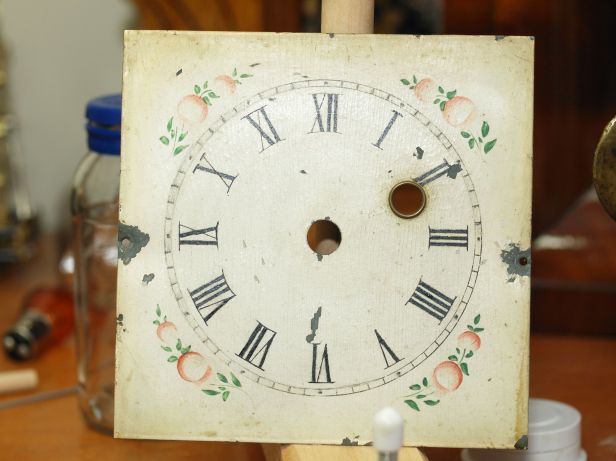
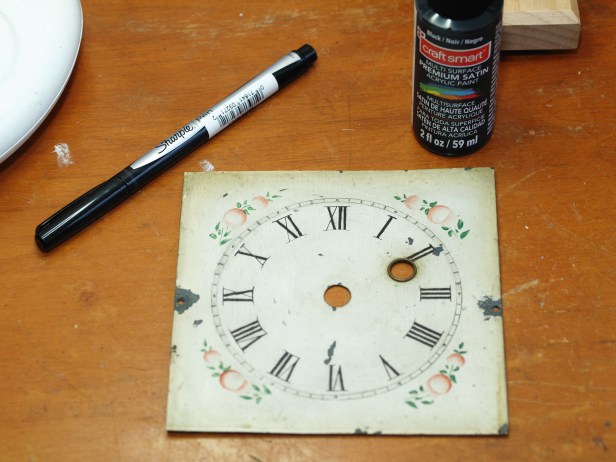
I was concerned about being too invasive when touching up the dial but I thought the numerals should stand out a little more. I used a number 2 paintbrush and touched them up using flat black acrylic metal paint and a Sharpie pen for the small lines. The effect is subtle without being over the top.

After touching up the numbers with paint and a Sharpie for the thin lines
After touching up the numbers with paint and using a Sharpie and straight-edge for the thin lines

The case was cleaned up with a toothbrush and Murphy’s Soap. There is some finish loss on top but I will leave that as-is.

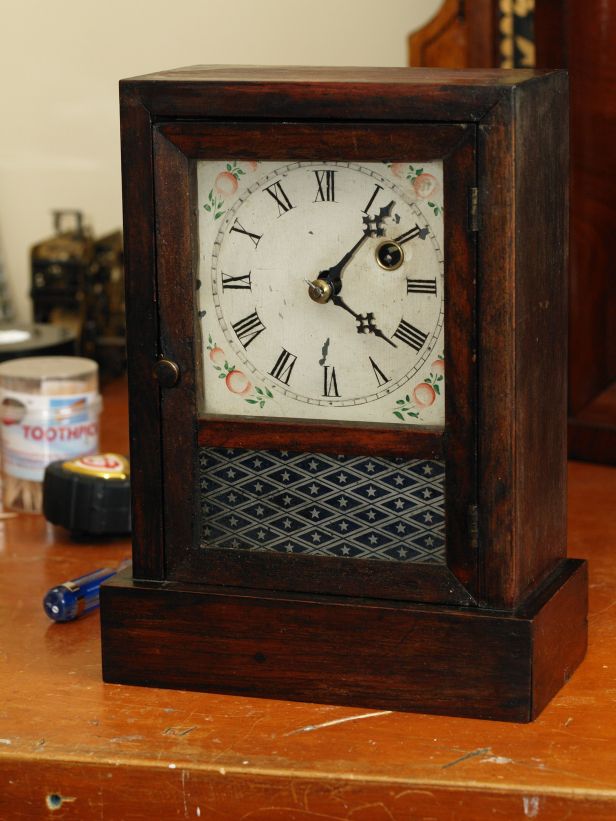
Here is the completed project. The movement is now back in its case.

Assembled, in beat and ticking away strongly

The hands, which appear original, are attached and the clock is running better than it has in years.

I am sure that my sister will be pleased when the clock is returned to her.

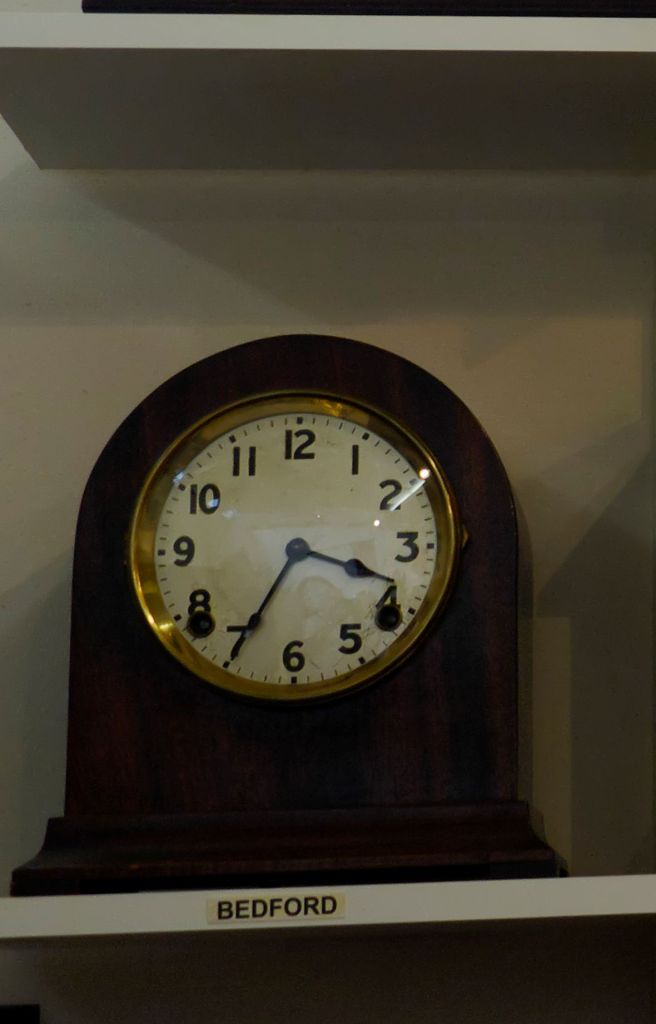
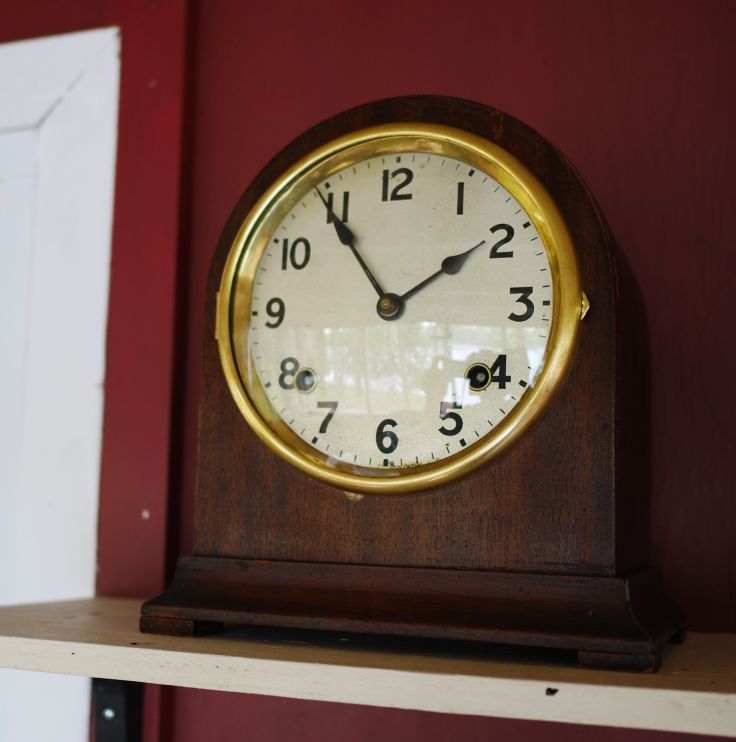
Arthur Pequegnat Bedford mantel clock – an interesting find

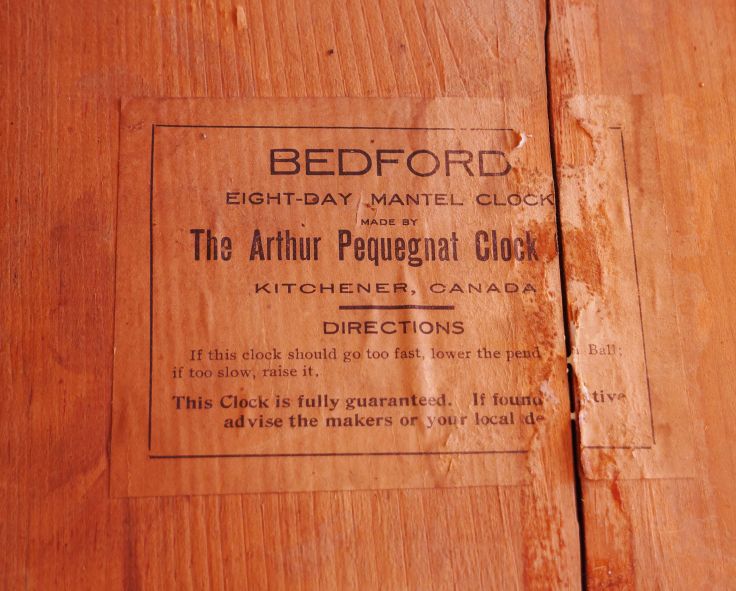
As regular readers know I am a fan of Arthur Pequegnat clocks not just because they were made in Kitchener, Ontario, Canada but they are attractive, well made and hold their value well (in Canada!).

Eddy's photo of the clock
Eddy’s photo of the clock

I have had clocks given to me in the past but this was a rather unusual situation. As readers know I publish at least seven or eight articles a month in order to provide interesting content on all aspects of mechanical clocks. I publish a regular feature called Tick Talk Tuesday in which I profile the mail I receive from readers. The mail is private email and not comments after a blog article. I receive many emails you will not find on my blog. Some people prefer writing to me privately and that is perfectly fine.

I received one such email some time ago from Eddy who lives in the Quebec City area (Province of Quebec, Canada). Eddy was researching my blog and discovered that I admired and collected Canadian-made Arthur Pequegnat clocks. He wondered if I would have an Arthur Pequegnat clock added to my collection.

Because it was an Arthur Pequegnat I was immediately interested but I did not expect a reply. To my surprise Eddy answered with five photos of the clock from various angles. It was a mantel clock in pretty rough shape and after seeing his photos I was still curious even though it likely required a lot of work to restore it.

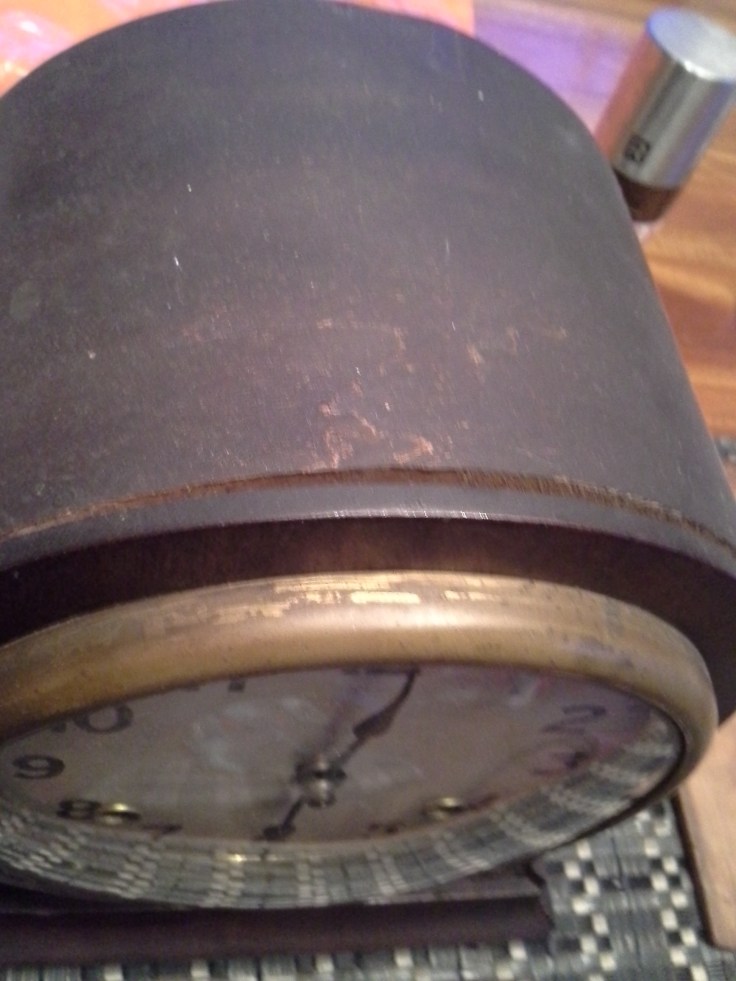
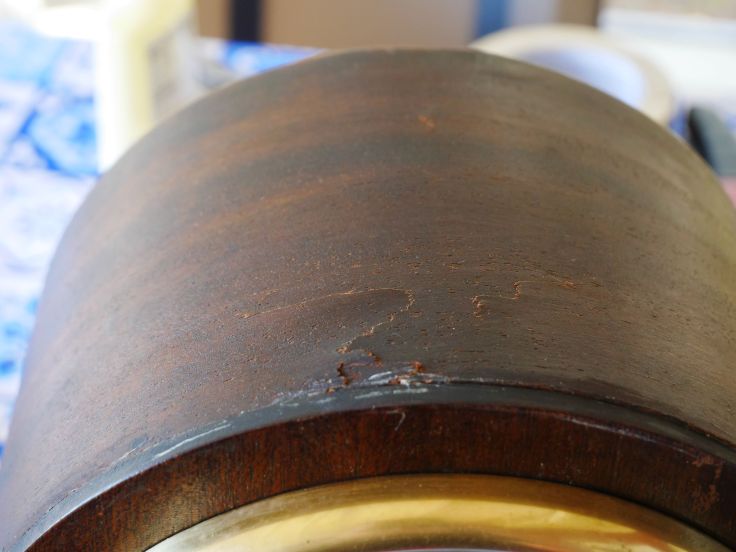
Top of the clock
Top of the clock

In his email Eddy explained that he was having serious health issues and was taking stock of his life. He had a number of antique and vintage items that his father and grandfather had left him and he felt they should be passed on to someone who would appreciate having them. As Eddy explained, “My father had that clock as a trade against work done for people he helps with their house and lawn chores. He gave it to me since he’s got too many, just like my grand-father did. He was okay with me parting with it.”

I wrote back and told him that a meeting was indeed possible. We would be passing through the Quebec City area in the next few days on our way to our cottage in Quebec to open it up for the summer. We (my wife and I) had even planned to stay in that area for the night. We could stop by to have a look at the clock. Eddy then provided me with his address and telephone number. A meeting day and time was set up.

After nine hours of driving we arrived at his door. He invited us in and we spent a very pleasant two hours getting to know each other, discussing my collection of clocks, talking about the clock in question, his fathers hobby of searching out old antiques and finally, matters related to his struggle with a serious illness.

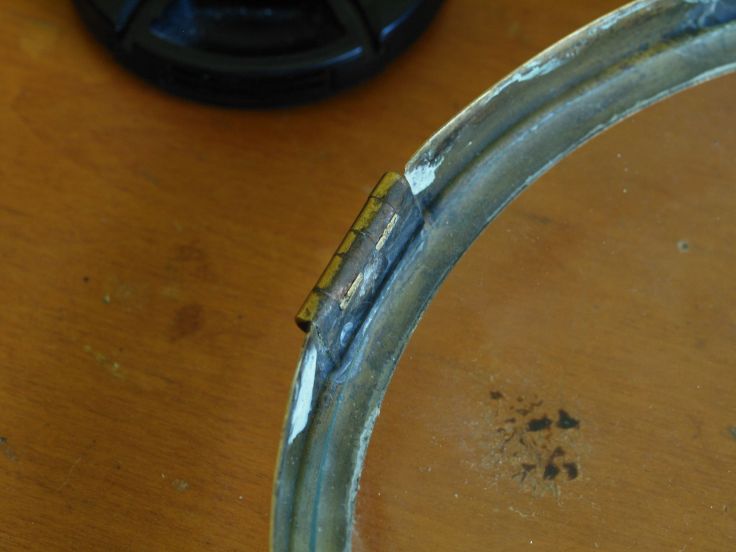
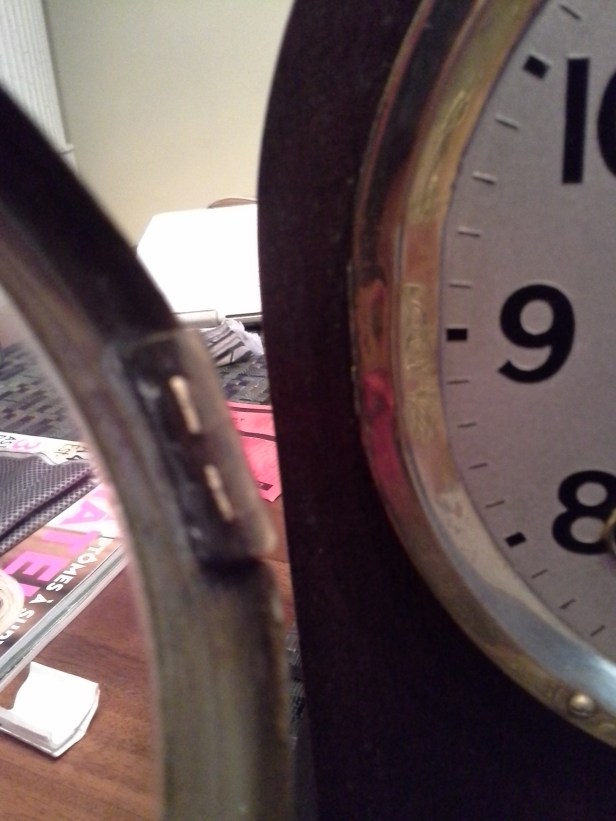
broken brass hinge
broken brass hinge

I was a little confused. Was he was actually giving me the clock or did he expect money in return so I decided to ask him straight out. No, he said, you can have it. he then brought out three other clocks to the kitchen table, a cottage clock, a steeple clock and a swinger. He asked me if I wanted those as well and I thanked him for the offer but declined. While they were very nice clocks I felt awkward taking all of them for nothing. So, we left with just one clock.

We walked out the door with clock in hand and for the next hour of our drive we talked about Eddy and his gift of an Arthur Pequegnat clock.

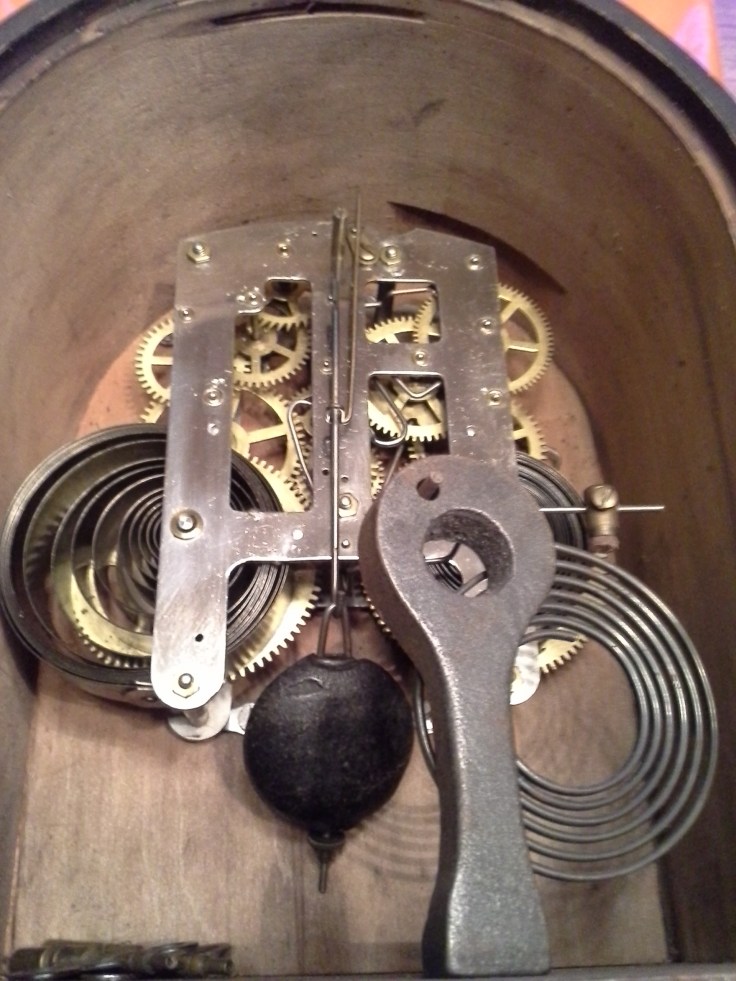
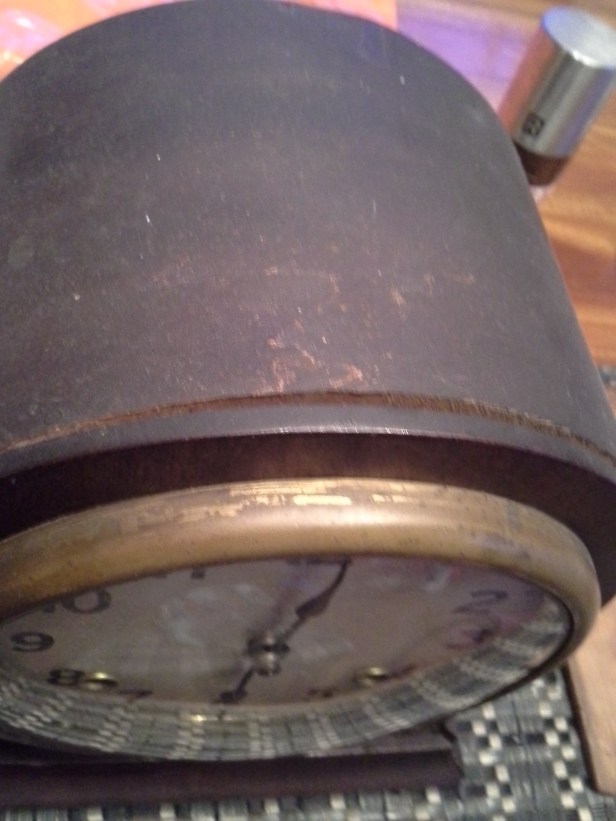
The clock was complete with original hands, pendulum bob, coil gong and of course, the signature Arthur Pequegnat movement with nickel-plated steel plates. The only visible sign of an issue with the movement was the time side mainspring which, as Eddy explained, could not be wound with a key. Damaged veneer, side trim pieces splitting open was clear evidence that at some point the clock had been dropped or fallen hard. The impact point was the very top of the  clock. Yes, it was in rough shape!
A challenge to repair? Yes, but I graciously accepted the clock knowing that I would have to spend several hours putting it right.

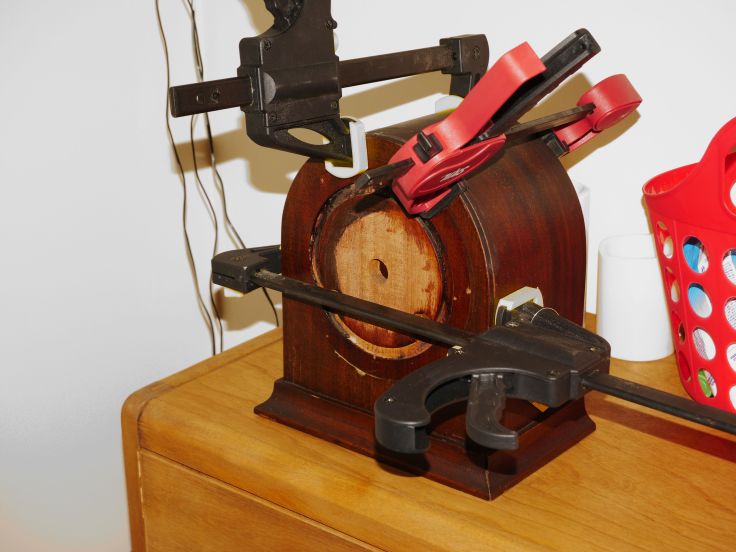
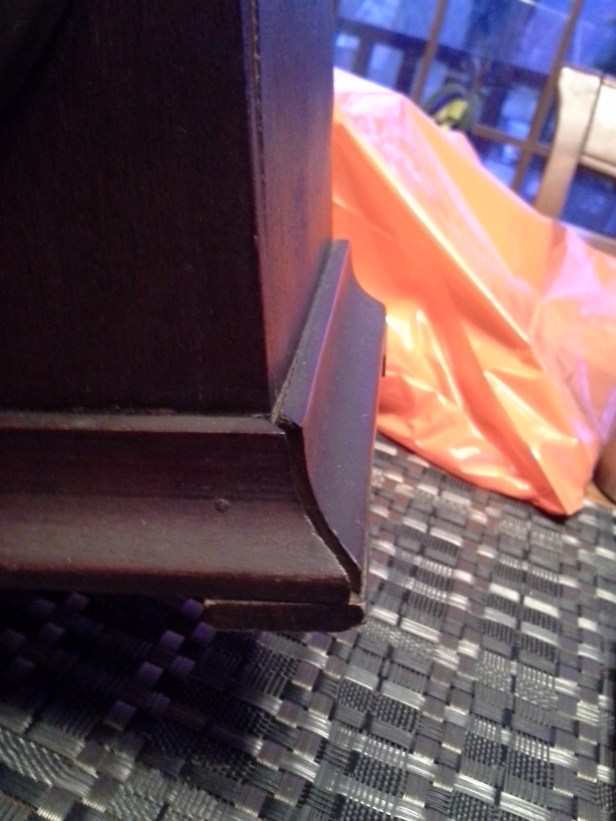
The sides and front were coming apart
Both sides and the trim front were coming apart

Thanks to Eddy I am now the new owner of an Arthur Pequegnat, Bedford model that I will add to my collection of four other Pequegnat clocks. In a later post I will detail the repairs to this fine Canadian made clock.

Eddy suggested that instead of offering him money that we donate to a charity and so a cheque went to the Canadian Cancer Society. I have never given names to my clocks but this one will always be called Eddy in honour of a individual who felt strongly that a family treasure should go to an appreciative owner.

Looking for an antique Ogee clock? Now is the best time to buy

Ogee clock prices seem to be at their lowest level in years. If you have your heart set on an Ogee clock, there is probably no better time to buy than now.

Ogee clockclock design that originated in the United States in the 1830s, distinguished by a case (usually pine) the front outer edges of which are curved into an S-shape (ogee). This shape is formed by the union of a convex and a concave line. A mass-produced variant of the shelf clock, the ogee clock stands about 30 inches (75 cm) high and is usually weight-driven. The movements were usually made of brass and were made to run for 30 hours or eight days. (Brittanica.com)

Earlier this year (2018) I bought three Ogee clocks at an estate auction. There were about a dozen clocks up for bid, some gingerbreads, a couple of mantel clocks and a few Ogee clocks. Fearing that the auction would bring out collectors I surmised that the clocks would fetch somewhat higher prices. Though there were many clocks there were few aficionados. I scored three clocks, all were in very good condition though they were running poorly.

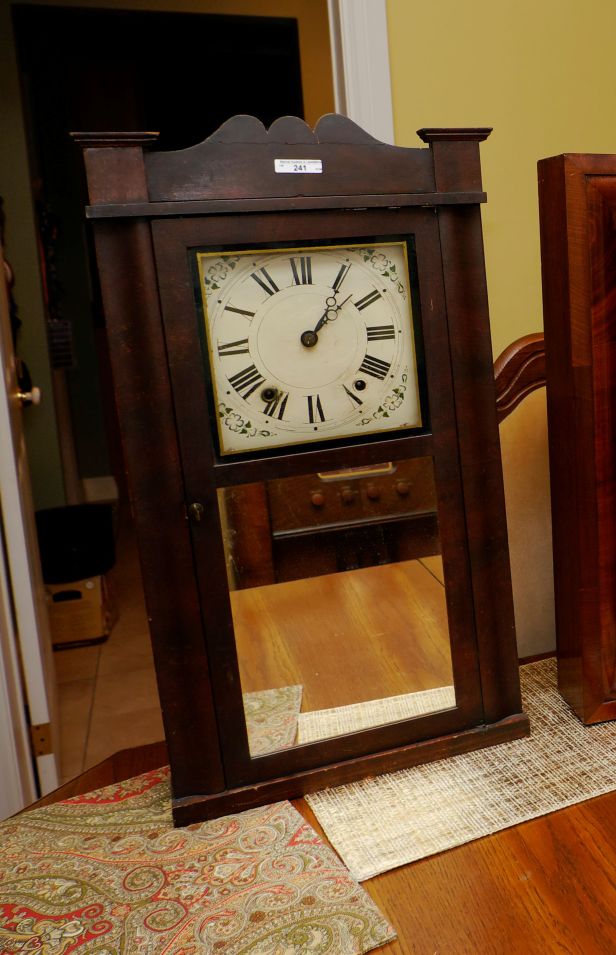
Daniel Pratt reverse ogee and splat clock

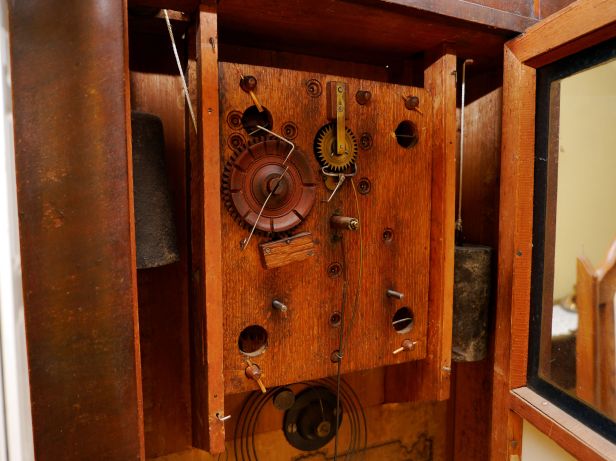
This Daniel Pratt Jr clock caught my eye. It is reverse ogee and splat, time and strike with wood movement made in the mid-1830s. My winning bid was a mere 30CDN. Ogee clocks with wood movements have sold for at least 200CDN in years past and eBay asking prices for Daniel Pratt Jr. clocks are typically between 60US and 200US. Although Ogee clocks have hit rock bottom in Canada the same may not be true elsewhere.

Wooden movement, time and strike

I have written about the decline in clock prices in a previous post. There is a legion of unwanted clocks out there. EBay and other online sites are flooded with ordinary antique clocks though special interest clocks still command higher prices. Many reasons are attributed to the decline though the poor economy in recent years is a major factor. Since 2008 clock prices have been dropping steadily and an upward direction in the near future looks dim. Prices are at or near the bottom. As the economy improves and antique buyers return to the marketplace we will see an uptick in values. In the meantime, now is certainly the time to buy.

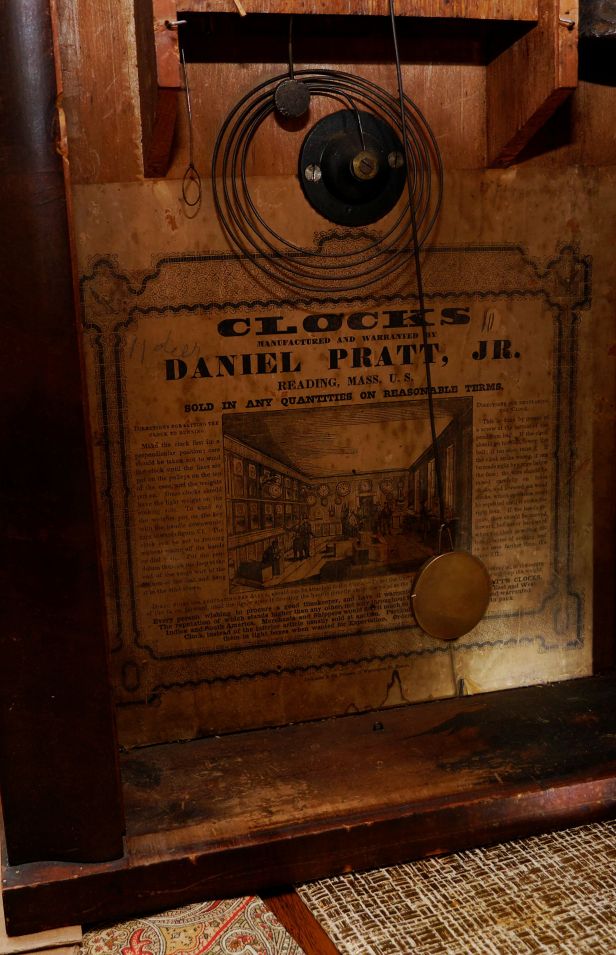
Clocks, manufactured and warranted by Daniel Pratt Jr

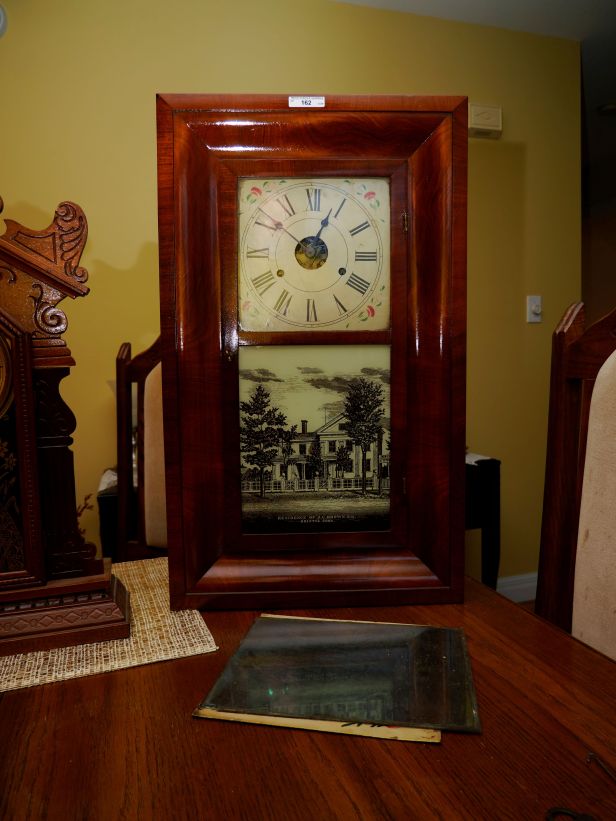
I paid 60CDN each for the other two Ogee clocks, one a Chauncey Jerome 30 hour time and strike, circa 1857, the other, a George H. Clark 30 hour time and strike, circa 1860.

Chauncey Jerome 30 hoir Ogee clock
Chauncey Jerome 30 hour Ogee clock

George H Clark Ogee clock
George H Clark 30 hour Ogee clock

Sellers are posting inflated prices but a clock is only worth what the buyer will pay. Do your research and learn to shop with a critical eye and you be rewarded.


240 clock posts later and still ticking away

The other day I decided to explore my humble beginnings and realized that 240 posts ago was post number one. Three years ago I had recently retired and I decided to look into blogging, something I always wanted to do. I never considered myself a great writer. I do not have that natural flair that some people seem to have for writing but I wanted to give it a try. I had some thoughts and ideas that I wanted to communicate with an audience that was looking for something a little different.

I attended a WordPress session at my local college and was very impressed with how easy it was to set up a blogging site. Anyone can do it said the facilitator and I wasted no time getting started. WordPress impressed me as a very intuitive package then and after 3 years I am still impressed with the power of the product.

This year as some of you know I decided to buy a domain name which I think is a great name and says everything it needs to,  antiquevintageclock.com and a 1-year automatically renewable subscription. I won’t go into the additional benefits of the new package suffice to say the time was right for a change. The result has been a slight uptick in hits and exposure to more powerful options within WordPress.

Just a note about hits. In the first week or so of my new domain name my hits dropped dramatically, something to do with Google’s ranking analytics and not unusual for a brand new domain name. Of course, after I hit the migrate button and saw my hits drop I found an article that spoke directly to making preparations beforehand to avoid low hits after migration but too late for me. It would have been nice for a WordPress warning box to pop that would have read, “Oh, before you do that you may want to read this”

So, here is what I said three years ago. It was a short article and I remember at the time what a real struggle it was to put those first few words together.

I am no more than a clock collector and tinkerer. I am not a trained horologist nor do I have a great talent for clock repair or even getting a simple clock back to working order, but I find the world of horology to be quite fascinating.

It is a relatively new hobby for me which began with the purchase of a Daniel Dakota 2-train wall clock about 3 years ago.

The clock that started my collection, a humble Chinese clock that still ticks today.

Now I know what you are thinking. Why start with a Chinese made clock which most would consider inferior to almost any other clock in the world. Well, it was pretty cheap and it piqued my interest in collecting. From there I moved on to a Ridgeway grandfather clock and to my current collection of Mauthe, Seth Thomas, Hermle, Forestville, Sessions, Smiths Enfield, Muller and Pequegnat clocks.

I intend to profile my clocks both old and newly acquired on this blog and describe my attempts to repair and maintain my modest collection. I might even solicit a little help from my fellow clock enthusiasts.

Some of the nicer things about clock collecting are that is a great conversation starter and it allows me to combine my other passions, photography and traveling. Finding good clocks means traveling around the province of Nova Scotia, meeting interesting people along the way and is some cases getting fabulous deals. All the photos on this site are my own. I will try to capture the beauty of these old mechanical clocks and talk about the pedigree if I can learn anything about the history of any of these clocks..

Stay tuned. It is all a learning experience and as I bravely go further into the hobby I will be able to share my many experiences.

Well, I am still doing what I set out to do, profile my modest collection and pass on the clock repair techniques I have learned to the novice and intermediate clock repairer. Do I know more than I knew then? Sure, isn’t that what learning is all about? I am still tuned in and I hope you are too.

The sundial – the earliest time telling object

On a recent trip to the Dominican Republic my wife and I spent the day in the capital city of Santo Domingo. It is the largest city in the Dominican Republic and the oldest city in the Americas.

Square in historic centre of Santo Domingo

Central cathedral, Santo Domingo

Although the city considers itself a European in style and architecture, in appearance it is not unlike any other city in the Caribbean. Most of the historic buildings are located in the Colonial Zone or Zona Colonial, a walled 16-square-block historic district with many firsts of the New World such as the first cathedral, university, and hospital. Most of our time was spent in this historic district where we saw museums, castles, churches, had a light lunch and this sundial.

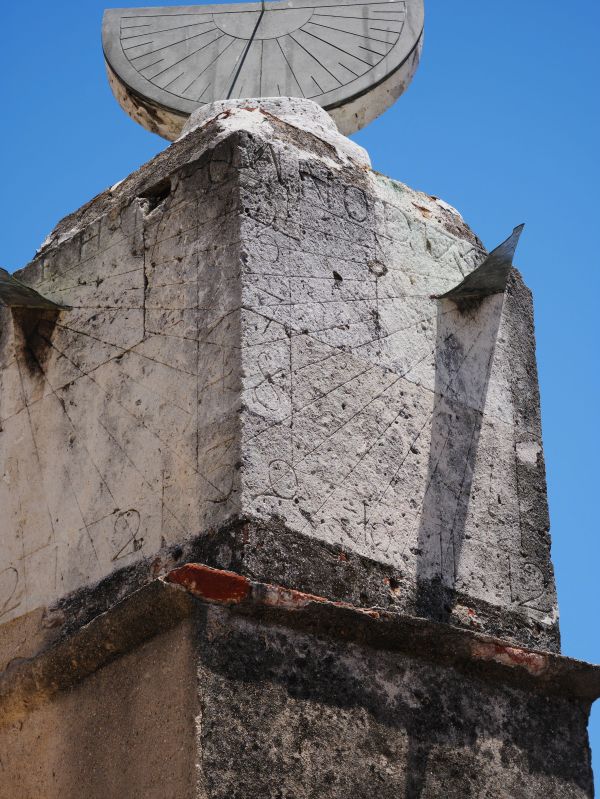
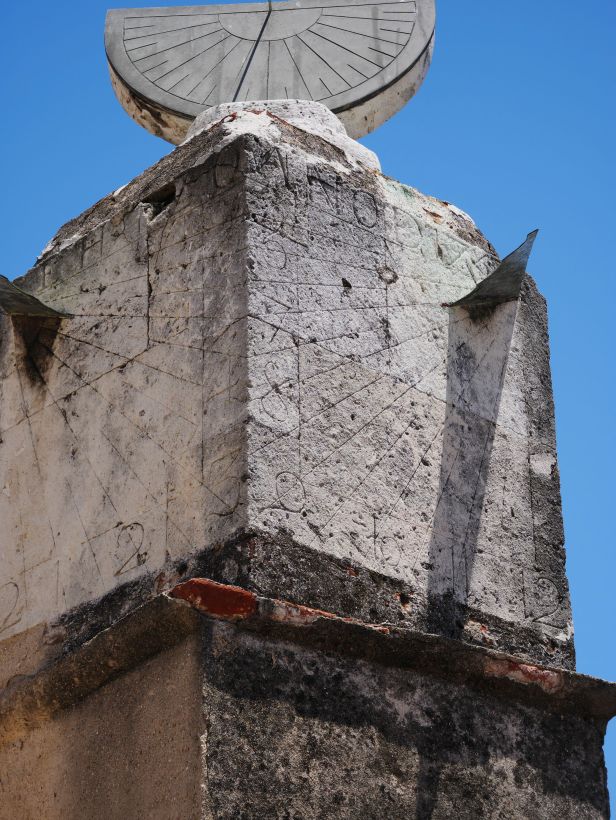
Sundial in historic district Santo Domingo
Sundial in historic district Santo Domingo, showing 11:30am

Jesuit church, Santo Domingo

A sundial is a device that tells the time when there is sunlight. It does so by casting a shadow according to the position of the sun in the sky. The part of it that casts the shadow is called the gnomon, a sort of shark-fin like object. As the earth turns on its polar axis, the sun appears to cross the sky from east to west, rising at sun-rise from beneath the horizon to a zenith at mid-day and falling again behind the horizon at sunset. Sundials indicate the local solar time only. Before the introduction of the mechanical clock, the sundial was the only source of time. Ironically, when the clcok was invented the sundial became more important as a way of regulating the clock as its accuracy was poor.

The Alcázar de Colón, or Columbus Alcazar is the oldest Viceregal residence in America

Torre del Reloj, clokc tower, Santo Domingo
Torre del Reloj, clock tower, Santo Domingo

Sundials have been invented independently in all major cultures and become more accurate and sophisticated as the culture developed. The earliest sundials go back to 1500BC from ancient Egyptian astronomy, however, humans were telling time from shadow-lengths at an even earlier date, but this is difficult to verify.

Indeed, we have come a long way from the sundial.

Unlike mechanical clock movements, they are easy to maintain. As they say, there are two clocks that should never be oiled, the Atmos and the sundial.


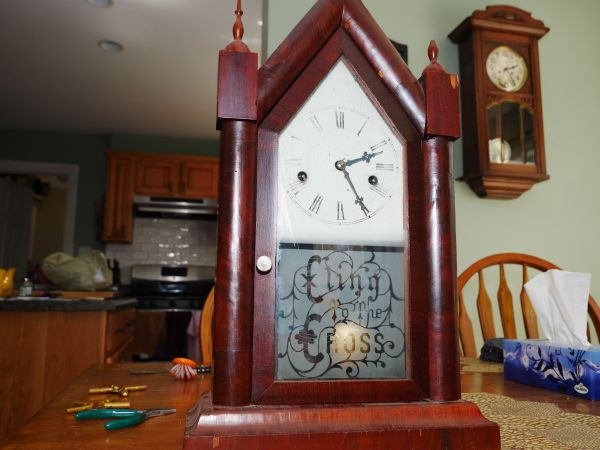
Interesting steeple clock from the short-lived Hamilton Clock Co. (Canada)

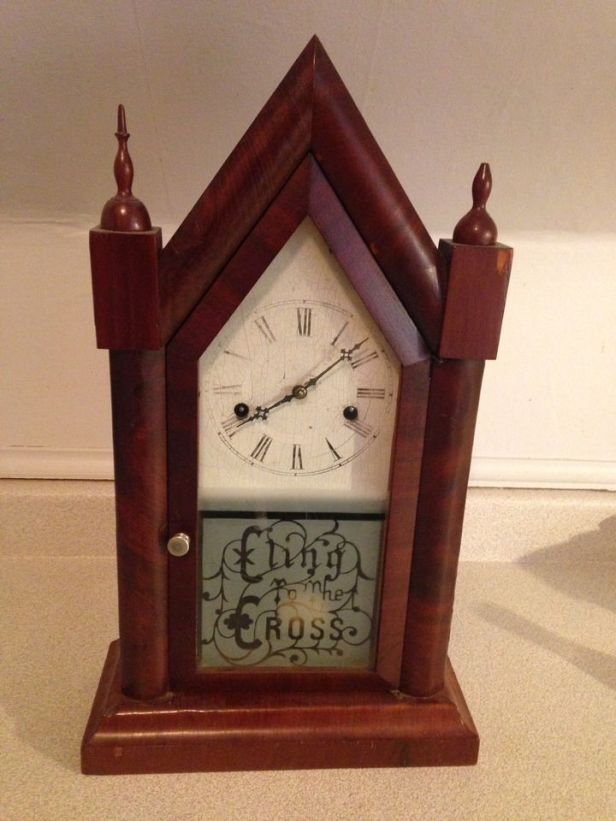
Hamilton Clock Co Gothic steeple clock

I wasn’t on the lookout for another steeple clock but when I discovered this on a local online for-sale site I just could not pass it up.
Let’s clear something up from the outset. The Hamilton Clock Co in the United States and the Hamilton Watch Co were probably associated with each other in some way but the Hamilton Clock Co. located in Hamilton Ontario, Canada which operated between 1876 and 1880 was not in any way affiliated with the American company.
I bought his Hamilton Clock Co. 30-hour time and strike steeple clock from a local seller. I am sure the seller thought he did well with the sale as he did not budge from the 100CDN he was asking. However, I consider this a win-win situation. We were both pleased because clocks from the Hamilton Clock Co. are sought after by Canadian collectors and this example would easily fetch much more than the price I paid. I was particularly intrigued by the etched tablet with, “Cling to the Cross” a religious phrase that was popular at the time. It is the larger of two versions at 19 ¼”. The Hamilton Clock company made the only true steeple clocks and very few survive.

The 30-hour time and strike movement is appropriately stamped HAMILTON CLOCK CO. HAMILTON ONT. The suspension spring is mounted higher up than a photo I saw on the Canadian Clock Museum site which shows the suspension spring mounted below the hour cannon. There is also a pin through what looks like the intermediate gear on this movement. There had to be some variations over the period the movement was made.

The clock is not without issues, after all, it was made between 1876 and 1880 and some wear and tear is expected for a 140-year-old clock. Everything seems to be there and it is in good shape including the “Cling to the Cross” inscription on the tablet. The etched glass tablet was the result of an association with glass factories in the Hamilton area and unlike anything offered by other companies. There were a whole series of clocks made with similar religious messages.

30-hour time and strike movement with clock company inscription on the bottom of the front plate

The original dial face is faded/worn, the hands are original and the 30-hour movement has the correct pendulum. There are minor veneer losses here and there consisting mostly of chips. The right steeple is also missing its tip.

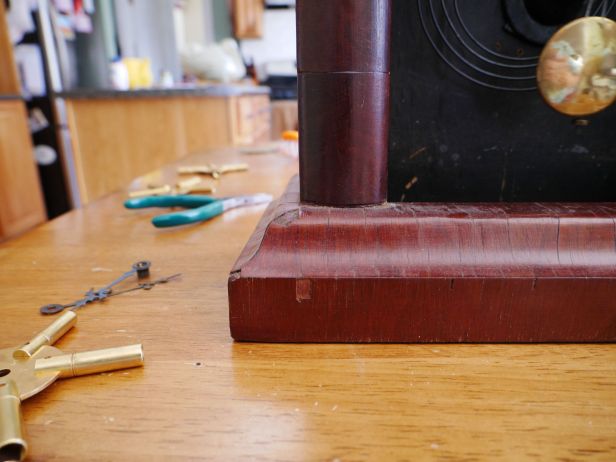
Veneer chips on left side of base
Veneer chips on the left side of the double-curved base

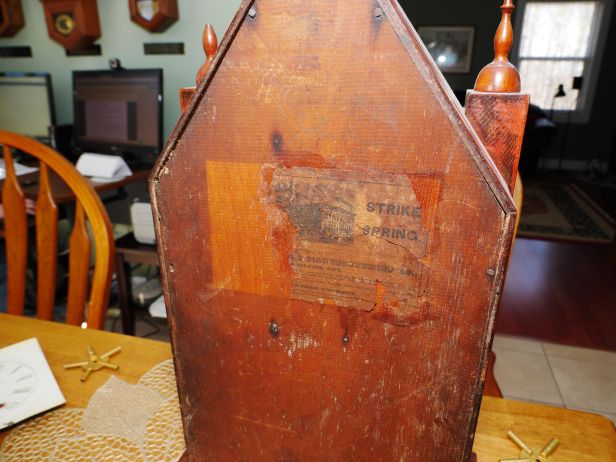
The label is not complete but is quite readable.

Loss on the clock label

Half the label is missing but enough to identify the clock.
Half the label is missing but enough to clearly identify the clock-maker

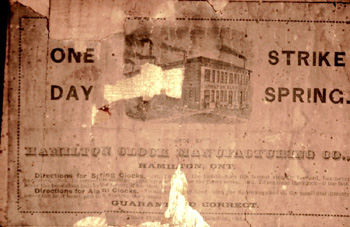
A complete label should look like this better example

The clock runs surprisingly well but requires a thorough cleaning and repair work on the time side ratchet click which slips when the arbour is wound. Generally, the clock appears to be in reasonably good shape.
I am always intrigued by clocks made entirely in Canada. The following information is taken from the Canadian Clock Museum located in Deep River Ontario (Canada). A must visit if you are in Canada, love clocks and are especially interested in Canadian makers.
“This company was established in 1876, after the failure of the Canada Clock Company in Whitby, Ontario.
The machinery and other tools and equipment were purchased and moved to Hamilton by two business men, James Simpson and George Lee.  Simpson, born in Scotland, had been active in Hamilton for years as a partner in a wholesale grocery business.  He assumed the title of President of the clock company.  Lee, born in Ireland, was also active in food wholesaling, and the operation of hotels, and restaurants.  He became the Business Manager.  Neither man had any prior experience with factory operations or clock making.
Technical expertise was provided by John F. Collins, who had previously acted as Manager of the Canada Clock Company in Whitby and had been instrumental in equipping and operating that enterprise.  He was brought from Whitby along with the equipment and given the title of Mechanical Superintendent.
Collins utilized tools, dies and designs he had created at Whitby, so the Hamilton company was really a continuation of his previous efforts. He was able to broaden the range of movements and case styles, and hence to offer a more complete line of merchandise.  Unfortunately, after a few years, he appears to have fallen out with the new owners and left the company in 1879.
George Lee, in turn, suffered health problems and was obliged to leave around 1880.
This left James Simpson as sole proprietor.  He ended production under the name Hamilton Clock Company and proceeded to make major changes.  The factory and equipment were retained, but a completely updated product line was developed.  Simpson found new investors and incorporated the firm as a public company that was renamed The Canada Clock Company Limited.
The Hamilton Clock Company appears to have made a valiant effort to provide clocks for the Canadian market, in competition with the huge U.S. clock factories that already dominated the market.  Hamilton clocks matched competitive products in appearance and their quality was quite adequate.  The volume achieved, however, was never very large and the product line was simple and limited.  No catalogs or printed material have ever been found from the company and our opinions can only be based on an examination of surviving clocks.  Perhaps, like the attempt in Whitby, the available capital and ‘know-how’ were insufficient to ensure a major success.”
There is nothing novel or unusual about Hamilton Clock Co. clocks. They had movements and cases similar to American made clocks but since the production was limited to 4 years, fewer were made, they are rare and therefore more desirable for collectors.
Overall I am pleased with this acquisition.

Featured article on Chelsea Clock blog about my blog

The following is an article that was featured on the Chelsea Clock blog

I have always had a fascination with clocks. As a young boy I can remember the schoolhouse clock in my grandparents’ kitchen and the ticking sound it would make that echoed through the entire house.

Seth Thomas Adamantine time and strike mantel clock, circa 1913

We all have busy lives and despite my interest in clocks over the years it was not until the year 2000 that I started building my collection, first with a Seth Thomas Adamantine clock and later with more mantel clocks, wall clocks and finally a grandfather clock in 2012. My collection has expanded to include virtually every style of clock though my interest lies specifically with American and European wall and shelf clocks. As I write there are about 35 clocks ticking away in my home.

In my blog I stress that I am not a trained horologist but have accumulated enough knowledge over the years that I feel capable of addressing general clock issues

Clock repair came a little later. I began with general understanding of the cleaning and oiling of clock movements in order to keep my little collection running. As I acquired clock repair tools and equipment I progressed to servicing pinions, bushings, verge repairs, cleaning of mainsprings and case restoration.

In 2015 I decided to write a blog about collecting and servicing vintage and antique clocks. There are some excellent clock blogs but many are commercial sites or professional horologists selling their services. I decided to design a blog that would appeal to the amateur clock collector/repairer. In my blog I stress that I am not a trained horologist but have accumulated enough knowledge over the years that I feel capable of addressing general clock issues. Therefore, my blog is not aimed at the professional repairer or restoration expert but the individual looking for specific information about a certain clock, those who have a particular problem with their clock and finally those who have a general interest in clock collecting and repair.

Junghans Crispi wall clcok with compensating pendulum
Fully restored Junghans time and strike wall clock, circa 1899

Cleaned, bushings replaced and tested
Time and strike movement on a test stand after servicing

I publish an average of seven blog articles per month on a variety of clock topics. I appeal to a wide change of subjects; some articles have a philosophical perspective, some detail the challenges of working on a specific clock, some present simple repair techniques for the beginner, general maintenance tips as well as articles of general interest. As a history buff I try to include a background history or provenance of the specific clock I am profiling or information about its maker.

Using a micrometer to check pivot
A micrometer is used to size a bushing for an escape wheel pivot

Blogging has also allowed me to combine my other interests, that of photography and traveling. My wife and I have had many interesting adventures seeking out unique clocks for my collection.

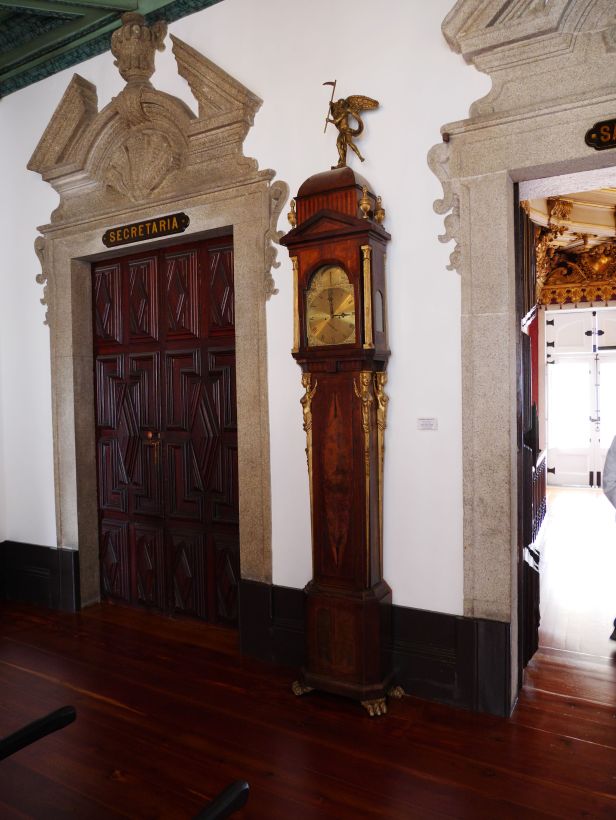
Clocks we saw while on a visit to Spain and Portugal

In the early spring, my wife and I travelled to Portugal and Spain. We attended our daughter’s destination wedding in Sintra, Portugal and we decided to expand our stay, visit Spain and see the sights in Barcelona and Montserrat. Spain has always been on our bucket list and it did not disappoint.

Being a clock enthusiast I did a little research beforehand to find out if there were any clock museums along our travel route. Alas, we travelled to places that were very distant from the well know clock museums. Clocks in Europe were made in specific regions and that is where you will find clock museums. Here are a few clocks that I found in various places in Spain (Barcelona) and Portugal. I will let the photos tell the story.

Tall case clock in a cathedral
Tall case clock in a Barcelona cathedral

Little card on the side simply said "High box clock, school clock"
Little card on the side simply said “High box clock, school clock”, Barcelona

Marriage of movement and case found in a shop in Porto.
A marriage of movement and case found in a shop in Sintra, Portugal

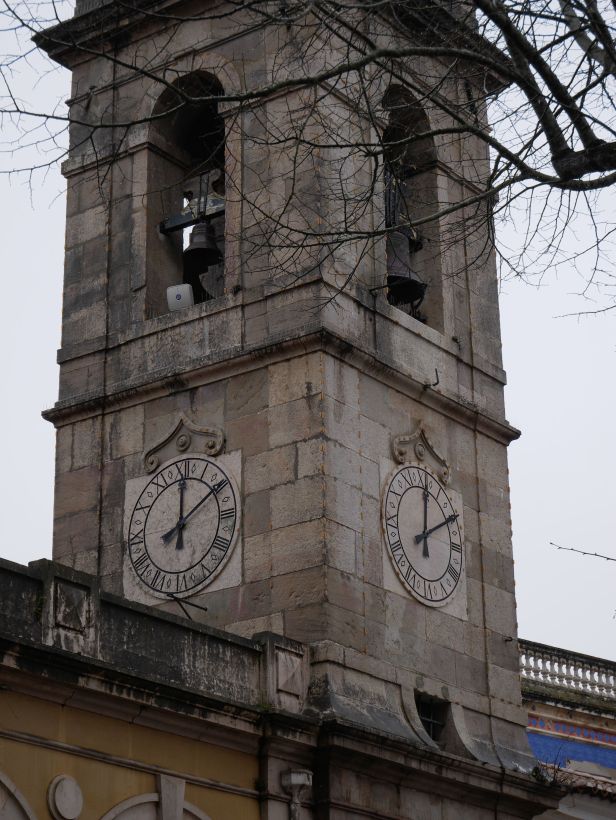
Town clock in downtown Sintra, Portugal

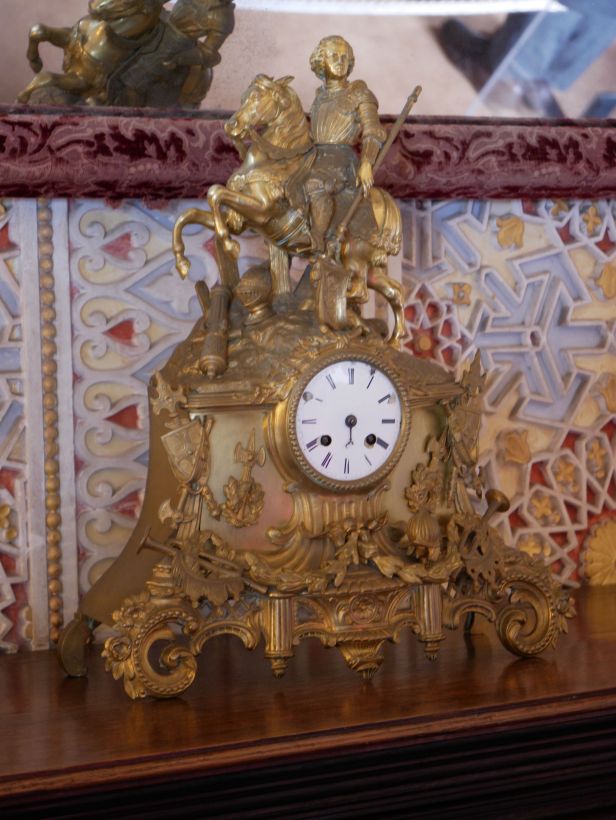
Very ornate clock in poor condition, Pena Palace, Sintra, Portugal
A very ornate clock in poor condition, Pena Palace, Sintra, Portugal

Pena Palace, Sintra, Portugal

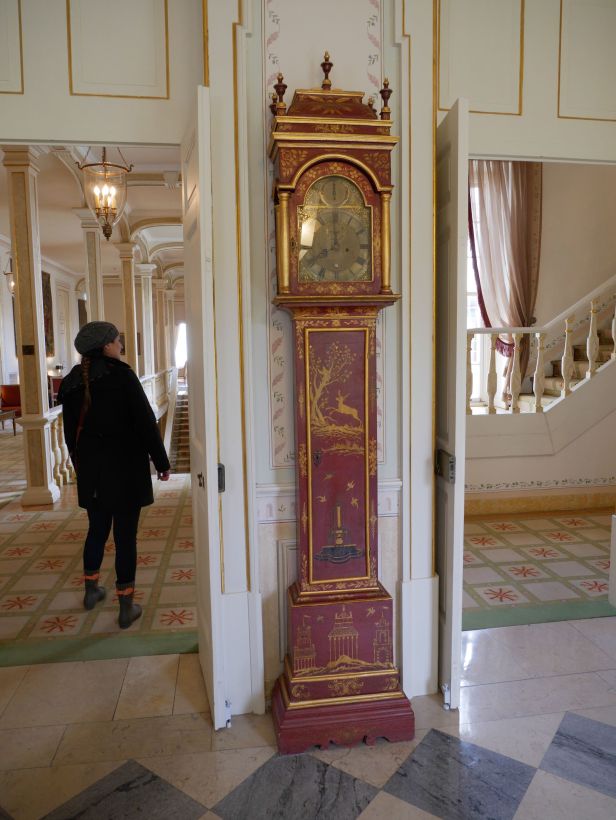
Tivoli Hotel, downtown Sintra. Unknown tall-case clock

The most ornate clcok is this working example at the Porto basilica
The most ornate clock I found is this working example at the Porto basilica

Unknown mantel clock, Tivoli Hotel, Sintra, Portugal

Unknown gallery clock. I could not find an opening on this clock. No arbor holes on the clock face.
Unknown gallery clock. I could not find an opening on this clock. No arbour holes on the clock face. Found on an estate in Sintra, Portugal

Flea market clock. Time and strike English or German clock, 1960s
Flea market clock. Time and strike English or German clock, the 1960s

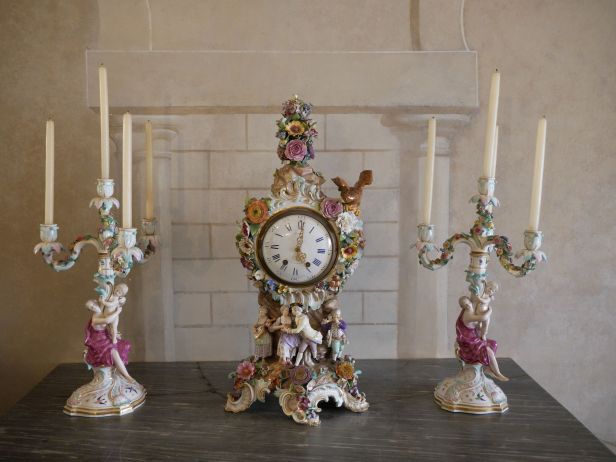
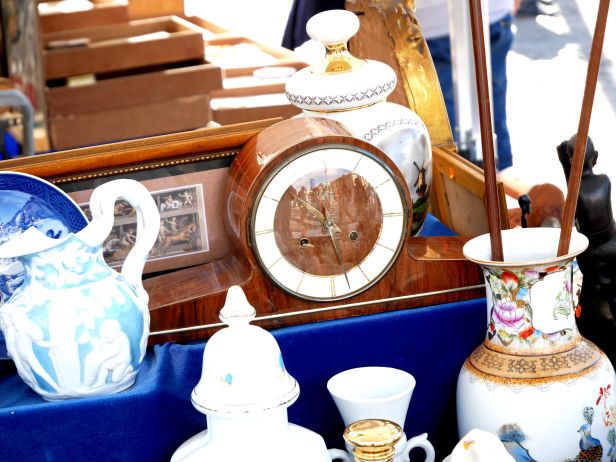
Flea market clock. Time and strike French clock with matching candelabra

Used goods store, time and strike wall clock, possibly French

I was not specifically looking for these clocks but as we visited churches, museums, shops and public places I photographed any I discovered in our travels.

Elisha Manross Steeple Clock – addressing spire issues and other things

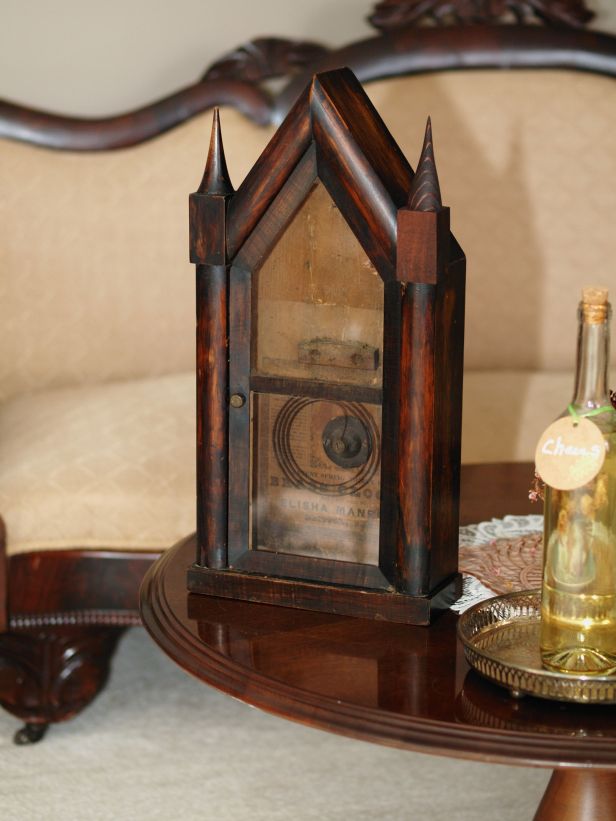
Elisha Manross 30 hour steeple clock
Elisha Manross 30 hour steeple clock, as found

I am not a huge collector of steeple clocks but I was intrigued by one I found in an old barn. I bought 4 clocks as part of a barn find this past winter (2018). Two including this one are salvageable. The two others are for case and works parts only.

$5 for a clock is a real bargain. This antique American Elisha Manross 30 hour time and strike steeple clock is an interesting variant of the sharp Gothic steeple clock. It looks fairly plain today but it was a striking style for its time. The early Steeple clocks of the 1840s influenced the design of later steeple clocks which were produced in large numbers up to the end of the 19th century.

A unique feature is the 30 hour brass movement with 2 brass mainsprings. Brass mainsprings were used in American clocks between 1836 and 1850. When affordable steel mainsprings arrived the brass mainspring disappeared into history. This clock was made in the Elisha Manross factory in Bristol, Connecticut (USA) August of 1843. 30 hour movements are immediately recognizable because of the proximity of the winding holes to the centre cannon. Eight day movements, which are taller, would have much lower winding arbours.

The dial faces is in good shape with some losses
The dial face is in reasonably good shape with some losses on the edges and corners

The good and the bad

The good: the movement, coil gong and dial face are original as is the pendulum bob. The label is in very good condition for the age of the clock. The upper glass tablet is original and shows the waviness you would expect with visible imperfections. The movement works but needs a thorough cleaning. The movement looks good though I will know more once I disassemble it for cleaning.

The bad: the mahogany veneered case is in poor condition with nicks, scratches and gouges on the entire surface. The very tip of the left steeple is broken off. There is a large piece of veneer missing on the right side on the clock base but that piece was found inside the clock and later glued in place. The most critical issue is the missing right steeple and base. The lower tablet is missing. There would have been a Fenn or similar design. Clear glass has been installed in its place. It is also missing the minute hand.

This side piece of veneer was found inside the case but there is still a small section that needs veneer
This side piece of veneer was found inside the case glued in place but there is still a small section that needs veneering

Work to be done

My first task is to clean the case and determine how I should approach finishing the clock case. I decided not to strip the case because there is a certain patina I would like to preserve.

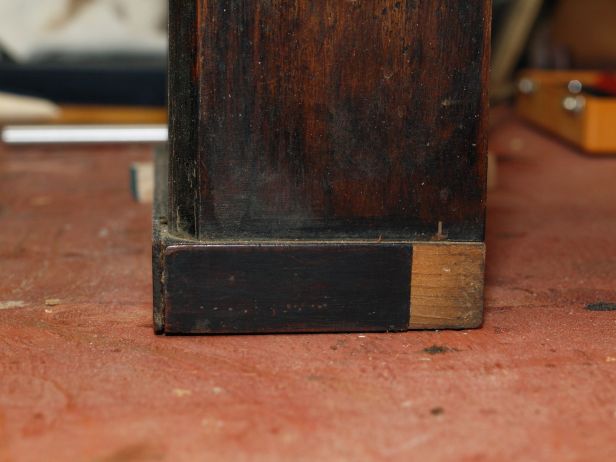
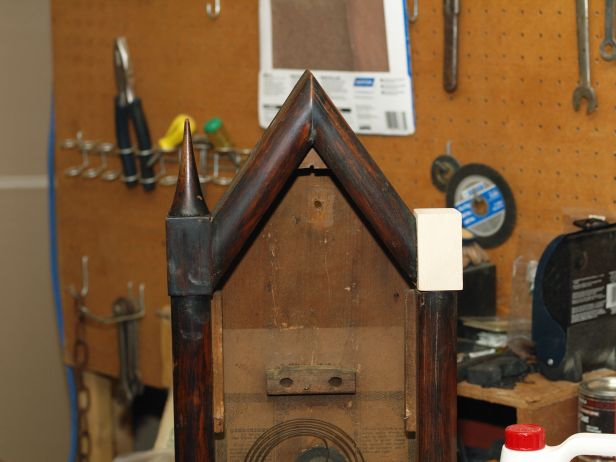
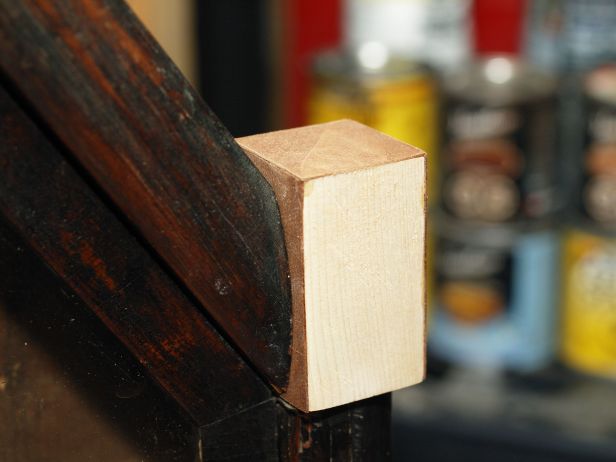
My goal is the have a running clock in presentable condition and that includes replacing the right steeple. Ordering the missing parts from a clock supply house would seem to be a simple solution but unfortunately these parts must be hand made. To address the steeple base and spire I had some decisions to make. I took careful measurements of the left steeple base, cut a piece of pine stock to the same dimensions and clad it in crotch mahogany.

Pine cut and test fit
Pine cut and test fit for right steeple base

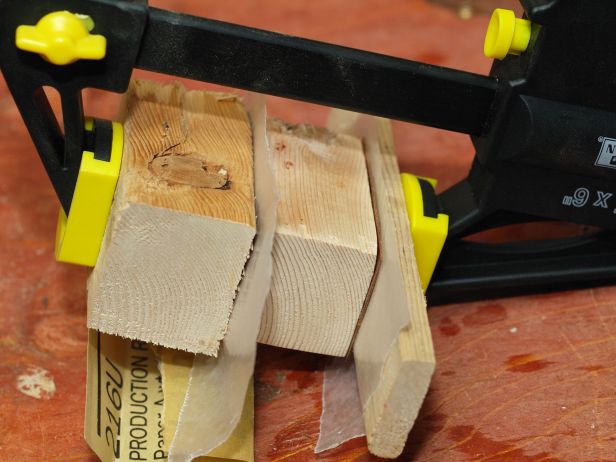
A relatively simple task of veneering took three days as I had to veneer each side, clamp, wait till it dried and trim off the excess before tackling the next side. Hide glue was used for this project. Hide glue is appropriate because it is an organic adhesive and it is the type of glue that would have used at the time.

The steeple base is the middle block of wood

Sides and top are done, now to do the front
Sides and top are veneered, now the front

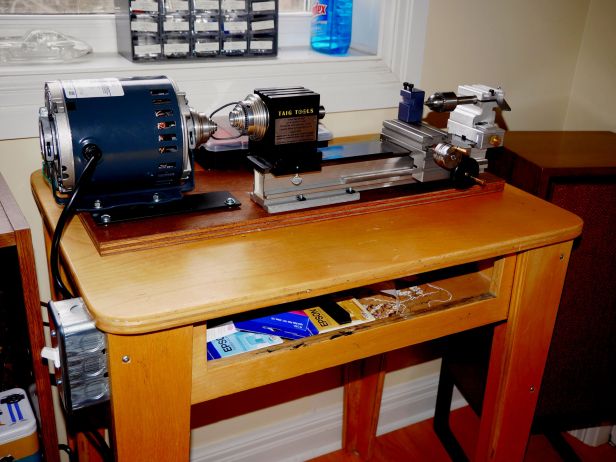
Once all sides were completed the spire was next. I have never made a finial before so this was a very interesting learning experience. The spire was somewhat more challenging since it involved patterning it off the left spire. As I discovered it is much harder than it looks. I do not have a wood lathe so my metal lathe had to do. I bought a set of wood lathe chisels at my local hardware store at a reasonable price though I discovered that they require sharpening prior to use.

Taig lathe with 1/4 hp motor

The result was something closer than I expected. Not perfect but until I improve my skills this will do for now. Working with softwood is relatively easy but working with hardwood would be a much greater challenge would think.

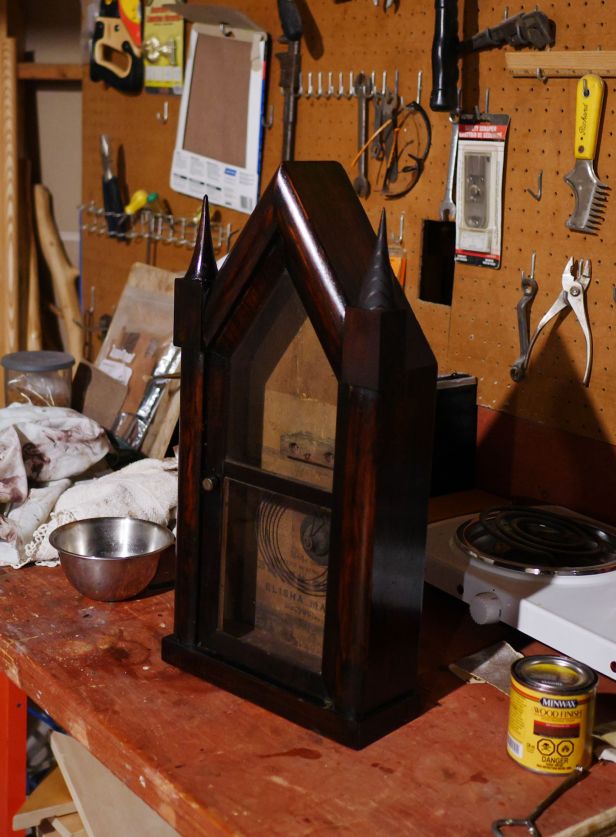
Steeple and base but how to get rid of the wood grain!
This is the first application of red mahogany stain on the steeple but how to get rid of the distracting wood grain!

The grain in the spire is certainly distracting and it is something I did not anticipate. One more application of stain concealed some of the grain but it is still visible at certain angles. Will a clear coat over the stain bring me the result I am looking for? Hmm!

Second application of red mahogany stain
Second application of red mahogany stain, grain is disappearing

After thoroughly cleaning the case with Murphy’s soap and Orange Oil I applied a very thin coat of red mahogany stain on the entire case, left it on for only one minute and wiped off all the excess residue. Again, my aim was to preserve the original patina as much as possible but hide numerous scratches. The stain filled in the scratches and I am satisfied with the end result. With the addition of the right final base and spire, the clock now looks complete.

Now to address the spire one more time. I decided that Minwax Poly Wipe was not working very well.  The clear coat absorbed into the wood after two applications and still left a dull finish. I then selected a clear spar varnish and it finally gave me the results I was looking for.

The screws holding the movement were so loose they had to be replaced with bolts. The coil gong and base were cleaned and stripped of years of rust. I then oiled the movement, put the clock in beat and attached the dial face. The moon hands look good but are not original to the clock. While I have the hour hand the original needle type minute hand is long gone.

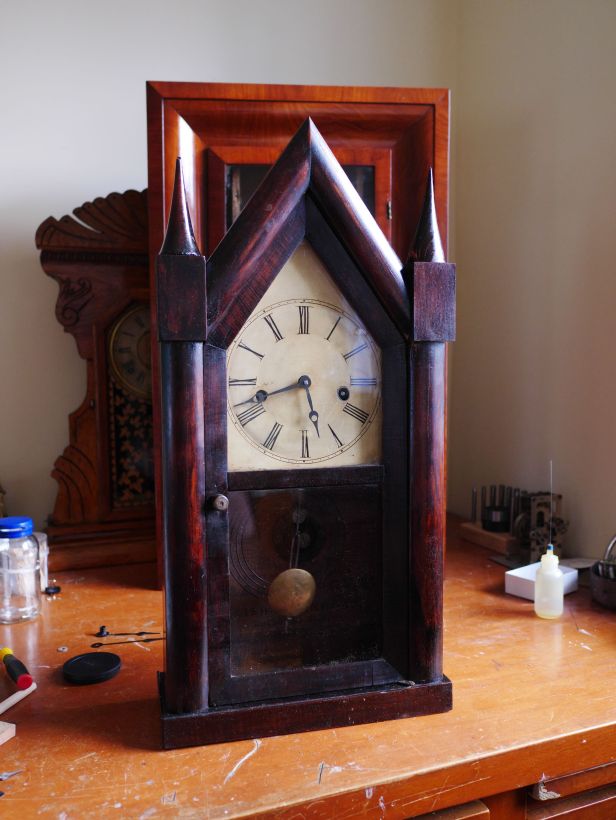
The clock is assembled and running

With the cased cleaned and with the addition of the right spire base and steeple the clock now looks presentable. Although I was able to make the spire on a metal lathe it it has certain limitations and I now see the value in using a wood lathe. I am also pleased that the movement is running but at some point it must be cleaned and properly serviced. At the moment there are just too many other projects standing in the way.

A great little project and a test of my veneering and woodworking skills.

I have good luck finding a great deal on a clock

I seem to be one of those people who manage to find a great clock deal. I don’t think it takes a special talent but patience, research, and timing are three key elements in finding a bargain.

I often cruise the online for-sale sites for interesting clocks. In Canada, we have something called Kijiji. In the States Craig’s List is quite popular and I am sure other countries have something very similar.

What makes Kijiji (and similar sites) interesting and fun is that you can connect with people locally or in my case our province of Nova Scotia. There are a wide variety of sellers. Some know what they are selling and price items accordingly. Some have really no idea and either price items clearly for much more than they are worth or conversely for far less than their actual value.

It is nice to be able to meet the seller, find out the history of the clock, learn something about the seller, and their motivation for selling, negotiate a price, and bring the item home. There is no post office or courier service to “screw” things up. No “oh crap” sigh when you open the package. With online auction sites, you often get a “pig in a poke” which means that something is sold or bought without the buyer knowing its true nature or value, especially when buying without inspecting the item beforehand. This does not happen with Kijiji. You find the item advertised, connect with the seller several times electronically or personally if necessary, see the item beforehand, ask questions about it, inspect it for any immediate issues or potential problems and you have the choice to walk away if you are not completely satisfied. All transactions are cash with no pesky sales tax.

Clocks are interesting items to collect and prices are all over the map as you would expect. However, I have found a few gems in the last few years. Let me tell you about my latest experience.

A few weeks ago I saw this clock advertised on Kijiji (photo below). Now, this looks like any ordinary Gothic steeple clock but what grabbed my attention was the unique tablet inscription. The acid-etched glass tablet says “Cling to the Cross”, a religious expression not often found on this style of clock. I knew immediately that this was a very special Canadian-made clock.

Seller's photo
Seller’s photo

Why, because several months ago I watched a video presentation by Jim Connell. Jim Connell is well known in Canadian clock circles. According to the introductory remarks found at the aforementioned site “He has amassed a large collection of clocks of all types with an emphasis on those with a Canadian origin. As his collection and knowledge grew, Jim prepared and presented numerous articles, talks, and displays on Canadian clocks and their history.  He is the respected author of the Charlton Standard Catalogue of Canadian Clocks and he co-authored Early Canadian Timekeepers and The Canada and Hamilton Clock Companies with Jane Varkaris.”

In his presentation, he described this exact clock and mentioned in his presentation that there were very few copies left, a very rare Canadian clock indeed.

I wanted to confirm that this was the clock I thought it was and asked the seller to photograph the label. He did so and sent this to me.

Seller's photo of the label affixed on the back of the clock
Seller’s photo of the label affixed on the back of the clock

I attempted to negotiate a price. The seller wanted 100CDN and I offered 80CDN. He replied that he would not accept anything less than 100CDN. In the meantime, I checked with the curator of The Canadian Clock Museum to confirm its authenticity. Upon discovering that this was a Hamilton Clock Co. clock made between 1876 and 1880 I decided that, yes, this was a good find and in my email reply to the seller I said, “100CDN it is”.

It is what I would consider one of those happy win-win situations. The seller got more than he thought the clock was worth and I got a clock that is worth much more than I paid for it. My motivation, however, was not to celebrate a great deal at a great price but to acquire a piece of significant Canadian horological history at an affordable price.

Hamilton Clock Co Gothic steeple clock
Hamilton Clock Co. Gothic steeple clock
30-hour time and strike movement with clock company inscription on the bottom of the front plate
30-hour time and strike movement with company inscription on the bottom of the front plate

We met and settled the deal. I am now the owner of a Canadian-made 30-hour time-and-strike Hamilton Clock Co. Gothic steeple clock.

In a later blog article, I will profile this clock and describe my strategy to address some of its issues.

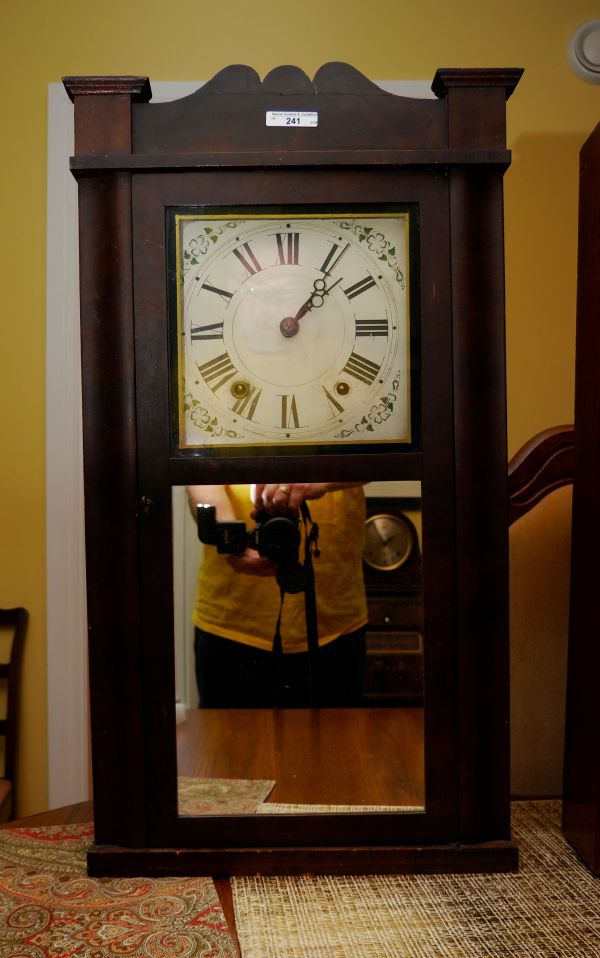
Daniel Pratt Jr. reverse ogee and splat clock with mirrored tablet

Daniel Pratt reverse ogee and splat clock
Daniel Pratt reverse ogee and splat clock with mirrored tablet

This Daniel Pratt Jr. reverse Ogee shelf clock was made in Reading, Massachusetts, c. 1832-38. It has a splat-top mahogany case with half (?) reverse Ogee moldings flanking the door, painted wooden Roman numeral dial and mirrored lower tablet.

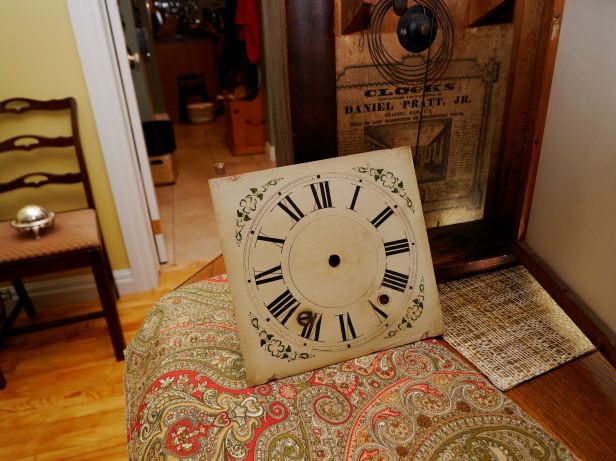
Clocks, manufactured and warranted by Daniel Pratt Jr

The label inside states in part.

Clocks manufactured and warranted by Daniel Pratt Jr. Reading Mass, U.S. Sold in any quantities on reasonable terms

The label is a ink drawing of a clock merchants shop and is printed by Dickinson and Co. 52 Washington St. Boston.

Wooden movement, time and strike

Wooden Roman numeral dial
Wooden Roman numeral dial with missing grommet on right arbor hole

Daniel Pratt (1797-1871), Jr., clock-maker, banker, town clerk, legislator, lived in the town of Reading, Massachusetts, in the 1800s. Reading is a suburb twelve miles north of Boston. Pratt did not contribute much to clock-making and was regarded as an entrepreneur rather than an innovator. He made wooden movements in his plant, as well as wooden cases. The clocks they sold during the 1832-35 period were typically wooden movement, weight driven, 30 hour, wood-cased, “looking glass” shelf clocks.

This Pratt clock measures 28 inches high, 14 3/4 inches wide, and has a depth of 5 inches. It is covered with mahogany veneer over pine. The square dial is of painted wood, 9 inches wide by 8 1/2 inches tall, with Roman numerals with floral spandrels. The dial is in good condition for the age of the clock. This clock was produced during the heyday of wood movements which were eventually phased out when cheaper but more reliable brass movements were introduced after 1839.

The memory of this successful man is continued by the quiet, even beat of his many clocks which have survived to this day — truly a great honour indeed.

Chauncey Jerome 30 hour ogee – servicing a #1.314 time and strike movement

Chauncey Jerome 30 hoir Ogee clock
Chauncey Jerome 30 hour Ogee clock

I bought four clocks at an estate auction several weeks ago, this and three other Ogee clocks plus a parlour clock. This clock is no less interesting than the others but I was lucky enough to research its maker and date it fairly accurately. I wish I knew its provenance but nevertheless it is an excellent example and has been well cared for over the years.

It is a Chauncey Jerome 30 hour Ogee weight driven time and strike clock. No-one can deny that Chauncey Jerome had made a historic contribution to the American clock industry in the 18th century when he substituted brass works for wooden works and was said to be “the greatest and most far-reaching contributor to the clock industry.” Although he made a fortune selling his clocks, and his business grew quickly his company failed in 1856.

Chauncey Jerome one-day movement type 1.314

The number 11 Ogee was the last of the Jerome clocks made in 1855. Mike Bailey, a Chauncey Jerome clock collector has an excellent blog in which he meticulously details and dates Jerome cases and movements. After researching his site I was able to determine that my clock is a number 11 Ogee made just before the Jerome bankruptcy, 1855. It has the Jerome patent 30 hour brass movement number 1.314 which is likely original to the case.

Type 1.314 movement, very dirty

There were some issues with the movement as you would expect from a 156 year old clock. There were a number of punch marks here and there, but specifically on the first wheel and the second wheel time side. The movement had years of dirt. The repairs over the years are typical for this type of clock. Punching to close pivot holes would have been the preferred approach to repairing a worn clock. With the advent of the modern bushing machine repairs are much simpler.

Eight bushings were installed. The first wheel strike side, the second wheel strike side plus the fly, the lower gear off the centre cannon, rear plate and 3 bushings on the time side.

Punch marks on first wheel
Punch marks on first wheel, strike side

A piece came off the wood support for the movement when I disassembled the movement. Dry-rot perhaps. I had leftover hide glue from a previous project, applied the glue and clamped it for 24 hours.

broken movement support
Broken movement support

The retainer clip for the count wheel was riveted in placed and prevented me from taking it apart.

Retainer clip for count wheel riveted in place
Retainer clip for count wheel riveted in place, not nice!

Some were punched very close to the pivot hole as you can see in this next photo. I left that as-is and decided to take a second look in a year or two.

Looks like a large pivot hole but actally punched close to the hole
Looks like a large pivot hole but actually punched very close to the hole

After eight bushings were installed (4 in the front and 2 in the rear) and an ultrasonic cleaning, the parts are test fit to check the smooth running of the gears. The rope for the weights looked re-usable, they were not replaced. The suspension spring also looked to be in good shape. The crutch wire has had bending and twisting over the years but it was also re-usable.

Test fitting parts
Test fitting parts after cleaning

 30 hour movement servicing
30 hour movement servicing, oiled, movement in the case

C Jerome 30 hour movement testingin the case
C Jerome 30 hour movement testing in the case

Now to regulate the movement. The clock is ticking away nicely and in beat. There are always challenges setting the strike side and this movement is no exception. However, through trial and error the strike side is functioning as it should.

These are very simple clocks to service and a great movement to hone your clock repair skills.

Addressing an upper tablet replacement on a Seth Thomas column and cornice clock

This is a fine example of a Seth Thomas column and cornice clock with sleigh front made prior to 1867 and sold by the R.W. Paterson Company of Canada West. Both the lower and upper tablets appear to be original and are in very good condition. Unfortunately this antique American column and cornice time and strike Seth Thomas clock is not mine and if it were I would proudly display it.

My clock, though similar is missing its upper tablet and a few other items that I wish to address in stages.

Missing upper tablet
Missing upper tablet on an American Seth Thomas clock

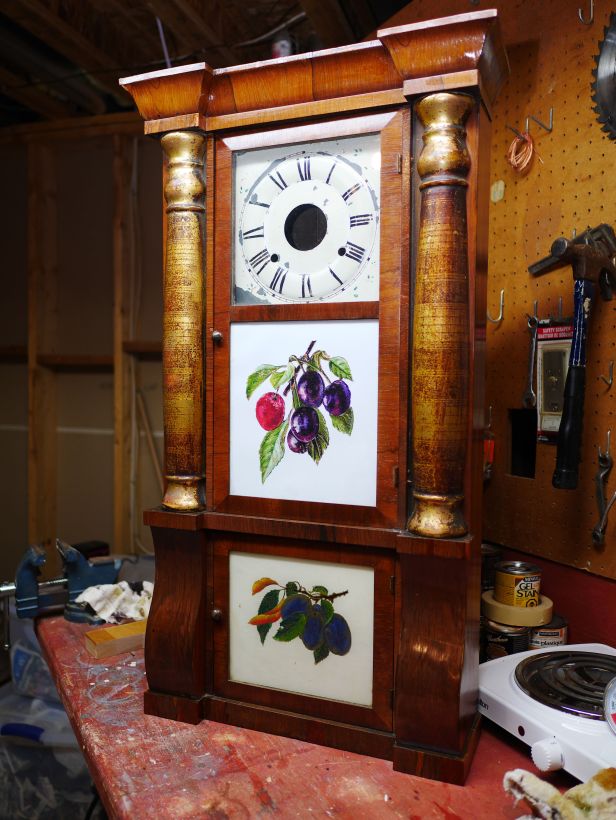
This blog article concerns one aspect of the clock, it upper and lower tablets. The lower tablet appears to be original and shows a cluster of fruit. Not as stately or ornate as the one in the first photo but quite appropriate for this style of clock. A quick online search shows that there were an endless number of reverse tablet painting designs ranging from birds, flowers, pastoral scenes, stately structures, eagles, parrots, berries, flags, drapery, crests and the list goes on.

Because there is a missing top tablet, the clock does not look complete. The clear glass is certainly not correct. As is typical for most clocks this age, things go missing over the years.

To address the missing upper tablet there are a number of options to consider;

  • Do nothing,
  • Attempt to find a decent quality reverse painted set from the same period,
  • Try my hand at painting a new tablet,
  • Buy a photo reproduction set online
  • Find a complimentary design and reproduce it on my home photo printer.

Finding a decent quality reverse painted set from that era is quite difficult and a search would take a long time. I am no artist, so, painting a tablet is out of the question. Buying a reproduction set online is a possibility but how much am I prepared to spend on something I could potentially do myself. After analyzing the options my first thought was to explore the possibility of buying a reproduction set online.

A search on EBay revealed sellers who make reproductions of the original tablets. They are essentially a “replacement picture set” of the clock tablets. They are as one ad put, “Exact copies of a set of Seth Thomas 8 day “Column” model sleigh front clock ca. 1880. They are printed on photo stock and mounted on mat-board that when put behind antique glass they are very hard to tell from the original and make a Seth Thomas column clock with plain or damaged pictures into a super looking clock.” I have seen them offered from 15USD to 45USD + shipping.

Hmm, I can do this myself!

Following a search of my photo collection I found a cluster of hanging fruit that complimented the lower tablet. Using PaintShopPro X6 by Corel I chose a water-colour effect, removed some fruit, changed the orientation of the image, adjusted the back lighting to match the tone of the lower tablet, cloned the deleted areas and darkened the stem and black-berries.

The first photo shows the source photo converted to a water-colour. The next shows the adjustments made to the “water-colour”. The third shows my first attempt without back-light darkening.

Using my wide carriage Epson Stylus 1400, here is my first attempt.

First attempt, a little lighter than what I was looking for
First attempt, a little brighter than what I was looking for but close

Colour-matching the lower tablet is a real challenge. More adjustments are required to get the right effect but I think I am on the right track.

If you have any suggestions on how I can improve my workflow I would love to hear from you.


The challenges of restoring an Ansonia Drop Extra wall clock when the clock is rare and parts are hard to come by

I acquired four old clocks in a barn find. Two, a 30 hour Ogee and a mantel clock were totally unsalvageable although I managed to take off some veneer, case parts, a movement, boards, case hardware and a few other items.

Elisha Manross 30 hour steeple clock

Two others were worth a second look. One is an Elisha Manross 30 hour Gothic steeple clock that is worth restoring and the other, an Ansonia Drop Extra wall clock, the subject of this article.

There are a number of variations of the Ansonia Drop Extras and the one most sought after is the time, strike and calendar version. This is merely a time-only version and would fetch a price in the lower end of the range.

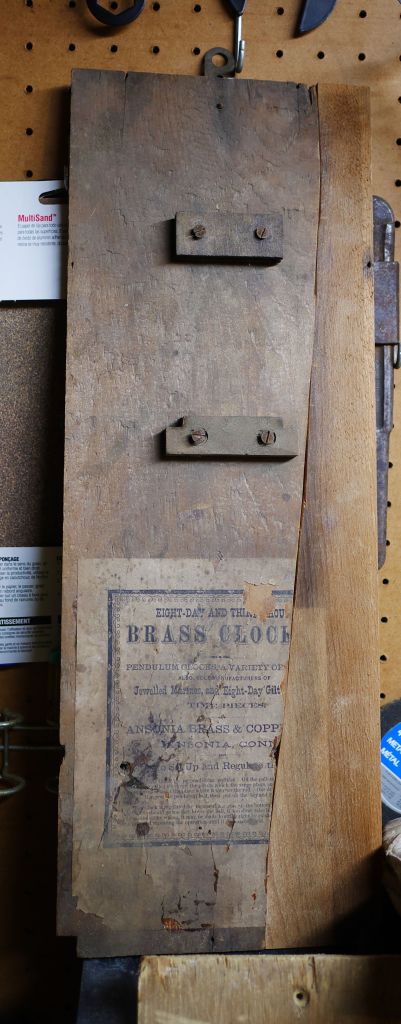
The largely intact label says,

Eight-day and thirty hour brass clocks, pendulum clocks, a variety of……., Also sole manufacturers of Jeweled Marines and eight-day gilt time pieces, Ansonia Brass and Copper….Ansonia Conn.

This clock was manufactured by the Ansonia Brass & Copper Co. around 1880. It is 26 inches high, 16 inches wide and 5 inches deep. It has a 16 inch round wood door bezel on a large 2 inch hinge. The drop section has serpentine sides and teardrop finials. The bottom access drop door opens downwards. Other Drop Extra access doors open to the side.

Much has been written about the Ansonia clock company. The company history can be found here. Formed in 1844, the Ansonia Clock Company went into receivership just before the stock market crash in 1929. The machinery and dies were sold to a Russian Company in 1931 thus ending the long reign of a glorious American clock manufacturer.

The Lima (Ohio) News gave this account in a March 12, 1931 news report:

“…there came an order to supply the Soviet union with men and machines to make watches and clocks, neither of which products ever had been manufactured there. Representatives of Amtorg went to the Ansonia Clock Company in Brooklyn and to the Duber Hampden Watch Company of Canton, Ohio, and bought them lock, stock and barrel. Then they hired most of the skilled employees of the plants to go to Russia and operate the familiar machines. These have been installed in a new, many-windowed building in Moscow, where Russian apprentices are beginning to master the trade.”

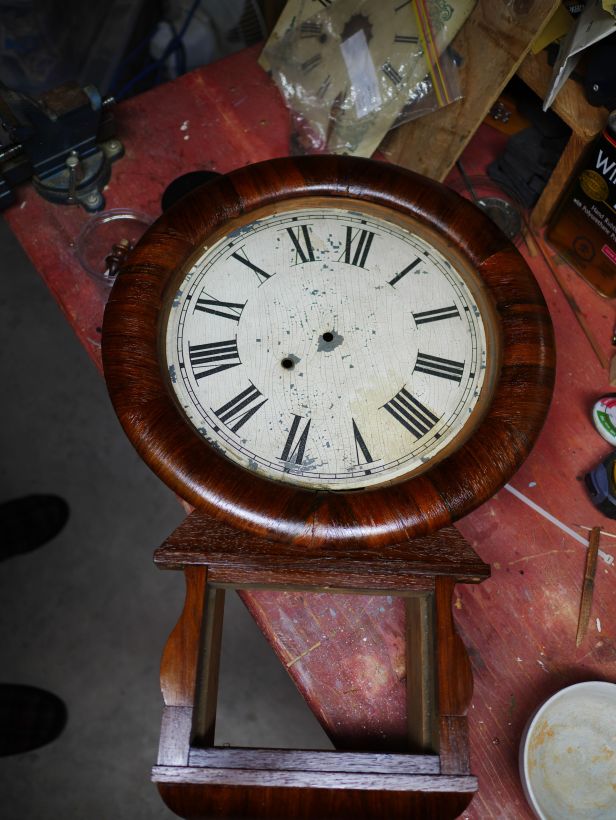
The time-only movement appears unusual because of the oversize 2nd and 3rd wheels. The dial glass is original as is the painted dial which is 11 1/2 inches wide.  The painted zinc dial has black Roman numerals, is flaked in some areas and requires stabilization. The flaking dial could use some work if only to arrest the deterioration of the finish. In the meantime the numerals have been touched up with black metal paint.

Ansonia Extra short drop wall clock

Siezed time-only movement
Seized time-only movement

The clock is in generally poor shape, what I would consider a diamond in the rough. A challenging project? Yes, because there are so many missing parts. Missing are the brass dial bezel, clock hands, pendulum bob, verge, drop access door with its hardware, right tear drop finial and 3 hinges. The finish is completely gone, down to the bare veneer. The veneer has some minor losses that are in hidden from view but for the most part the case is in good condition.

The movement was rusty and the wheels were seized. Obviously the clock had not been running in a number of years. After applying some WD-40 I managed to free the gears. In addition, two bent wheels (2nd and 3rd) had to be straightened. The rust was removed and the movement cleaned up surprisingly well. Only one bushing was required on the escape wheel bridge. The movement is presently installed in the clock and running well with the addition of a new verge, pendulum rod and bob.

There is nothing special about bringing the veneer back to life. After a thorough cleaning with Murphy’s soap I applied three coats of shellac lightly sanding after each coat. The photo shows the clock after the third application of shellac.
Ansonia backboard with partial label
Ansonia backboard with partial label & movement mount blocks

A section on the right side of the backboard was missing. I salvaged a piece of board from a donor Waterbury Ogee from about the same period and traced a pattern to fit the missing piece. Replacing the entire backboard might have been an option but I felt it necessary to preserve most of the label. Hide glue was used to bond the two boards which were then clamped for 24 hours. The gaps were filled with a combination of hide glue and sawdust one day later.

Ansonia movement in case
Ansonia movement running and installed in the case

Unfortunately, this is as far as I can go with this project. Unless the previous owner finds the missing pieces which is doubtful or I find another clock to marry the two together this clock will simply be a curiosity on a wall. In the meantime I have contacted some clock suppliers and have had no luck so far. My inquiries on clock oriented social media sites have also produced no results.

Rosewood veneered dial bezel in position

The movement has been running reliably for a full 8-day cycle and has run for the past 4 weeks. Despite not having the parts I require to complete the project there is a certain satisfaction in making a clock run that has not run in years.

Thoughts on where else to search?


Elisha Manross Steeple Clock – the early days of the American clock

I acquired four old clocks in a barn find. Two, a 30 hour ogee and a mantel clock were salvageable only that I was able to take veneer, case parts, one movement and a few pieces.

The two other clocks are worth preserving. Though it is missing some case parts one of them is an Ansonia Drop Extra wall clock. It is the subject of a future article.

Steeple clocks of the 1840s signaled the design of later steeple clocks

Ansonia Extra short drop wall clock
Ansonia Drop Extra wall clock

The fourth clock is an American Elisha Manross 30 hour steeple clock which is the subject of this article.

Elisha Manross 30 hour steeple clock
Elisha Manross 30 hour steeple clock on right

This is an interesting variant of the sharp Gothic steeple clock. These early Steeple clocks though simple in style, influenced the design of later steeple clocks.

Veneer could use some cleaning
Veneer could use some cleaning, right steeple is missing, door is off

The clock has accumulated years of dust and grime. The movement though dirty runs remarkably well. The case is scuffed, has a myriad of marks and scratches and one or two deeper gouges. This clock has seen its share of abuse and neglect over the years.

I took the access door off and found the bottom door pin to be original but the top pin has been replaced with a finishing nail. A piece of pinion wire was fashioned and glued in place. It is missing the right side steeple base and the spire. It is also missing the minute hand which appears to have been snapped off at some point and lost. Also missing is the bottom tablet with plain glass fixed in its place. The pendulum bob appears to be original as is the coil gong. The dial face has a nice patina and is in good condition with some losses. It has readable Roman numerals but covered with shellac or varnish at one point. The numerals have also been touched up.

Exotic woods were used to cover the pine case. Elisha Manross clocks were either clad in Rosewood veneer or Mahogany. The Mahogany veneer on this clock is much thicker than the veneers typically used today. Manross clocks are produced with the Mahogany veneer in a vertical orientation and Rosewood veneer in a horizontal orientation. Manross made two steeple clocks. One is 20″ high and 10″ wide, the other is 19 1/2 inches high by 9 1/2 inches wide. The larger case would have made for other labels but the smaller size (this is the smaller mahogany clock) was produced in the Manross factory.

Nice aged patine, numbers have been touched up

On the back of the door, left side of the upper tablet is the inscription 8/43, not once but twice. My first thought was an inventory or part number but if this is the month and date the clock was made it would be consistent with the brass mainsprings on the movement which makers used between 1836 and 1850. The label on the clock is in remarkable condition for a 175+ year old clock. However, the date (8/43) is inconsistent with the label which was printed by Elihu Geer at his shop on 10 State Street, Hartford Conn. According to one source Elihu Geer operated the print shop at this location after 1850. Perhaps but it seems reasonable that the clock was made in 1843.

8/43 inscribed on the back door

Although Elisha Manross had been active in Bristol clock-making since 1812 or earlier he shows in the Bristol tax records as making clocks from 1842-1851. His business was dissolved in 1854 and the factory was purchased in 1855 by E.N. Welch.

Well preserved label

Brass springs were invented and first used in 1836 by Joseph Shaylor Ives. Brass for mainsprings was evidently cheaper and more accessible than steel in the mid 1830s and 1840s. Silas B. Terry developed steel springs for clock use in the Bristol area circa 1847, and as steel improved and became cheaper brass springs quickly disappeared. In the history of the American clock brass springs had a very short life. The brass springs on the movement have survived a very long time which is unusual since most clocks of this age have had replacement steel springs.
The movement will be cleaned up and the case will be reconditioned including the replacement of the right steeple and base. I do not foresee the clock as being a daily runner.
Have you brought an old antique back to life be it a clock or a piece of furniture? Leave a comment about your own experiences.

If clocks could tock – the stories they could tell

I wish I knew the stories of all of my clocks.

Antique and vintage clocks evoke a time when life was simpler than the hectic times we live in today. Those nostalgic times when the things we bought and cherished were living memories of people and places that are gone but not forgotten. Antique clocks should be passed down from one generation to the next. Judging from the online marketplaces unfortunately many are not handed from father to son at all as so many have left their original owners. Is sentimentality lost on this generation?

Two such clocks have a story

Not including the the nine clocks I have in my home office there are 35 clocks displayed throughout our home. It saddens me to think that for many of my clocks I know absolutely nothing about them though I wish they all could talk. What stories they could tell.

Two such clocks have a story.

One of my clocks survived the Halifax Explosion in 1917. I know this because the people I bought it from had the clock in their family for over 100 years. It was certainly not in the condition you see here. It was a box of parts and I imagine they felt they had held onto it long enough and it was time to let it go. After I restored the clock I called back the previous owner and told him what I had done with the clock and would I kindly send him a photo of it restored to its former glory. I did and heard nothing afterwards. Sellers remorse, perhaps. I often look at the clock and try to imagine that fateful day when it fell of the wall in a modest home in North Halifax on December 6, 1917.

Junghans Crispi wall clock

Story number two. You have to feel something for some of the previous owners. This Ingraham Huron shelf clock (circa 1878) is a real gem and fairly rare, you just do not see it come up for sale very often. Some would call it a balloon clock. It was bought in a little village outside Bridgewater, Nova Scotia. My wife and I are about 2 hours away and we decided to make a trip out of getting the clock, having lunch nearby and doing a little shopping.

Do you know anyone who wants Jeff Gordon memorabilia?

Rare Ingraham Huron found on a local online for-sale site

We arrived at the sellers home, a modest nondescript bungalow. I was greeted at the door by an elderly couple. They had previously told me on the phone a day earlier that after consultation with their son they had decided on a fixed price for the clock and the price seemed very fair to us.

I asked how long they had the clock and the gentlemen who I would say was in his early seventies said that he could remember the clock in this grandmother’s home when he was quite young. He extended his hand palm down to about a meter from the floor and said, “I was this tall when I can first remember it in my grandmother’s home”. After a conversation with the couple I had discovered that they were parting ways, an amicable separation it seemed and the wife had decided to live in an apartment minutes away in Bridgewater. The husband was left with the home and his workshop in the back of the property. “He spends a lot of time out there anyway and besides, we need to get rid of stuff”. “Do you know anyone who wants Jeff Gordon memorabilia?” “No”, I said and left with the clock. It is sad that they had to part with such a memory but people change.

Seth Thomas column and cornice "Empire" style time and strike shelf clock
Seth Thomas column and cornice “Empire” style time and strike shelf clock

I guess sentimentality has a dollar value or people live with things so long that they eventually tire of having them. Deciding to get rid of things is about relieving yourself of all the stuff you’re hanging onto from past relationships and past memories. Secondly, our desire to hold onto piles and piles of old mementos can often be blamed on nostalgia. That’s because reminiscing about the past makes us feel good. It can lead to increased feelings of familial or social connectedness. If I have an old clock, looking at it can elicit positive emotions. Or, perhaps it was not an especially happy memory and getting rid of it expunges that memory.

I often wonder what will happen to my collection when I meet my fellow clock-makers in the sky. My wife knows that I have no real attachment to some of my clocks since I merely purchased them to learn how to repair them and to grow my hobby. Yes, you can have too many mantel clocks!

However, there are about ten clocks in my collection that I hope will be passed down to my kids. My four Arthur Pequegnats, two Vienna regulators, a Seth Thomas Empire style clock, my Sessions Beveled No. 2, my Ingraham Huron shelf clock and my Junghans Crispi wall clock. For some I appreciate their history and admire the folks who had them and for others they have become sentimental attachments because I spent so much time restoring them.

Pequegnat Canadian Time office clock

I think my kids will appreciate them.


Chauncey Jerome 30 hour Ogee – a 156 year old American clock that is a tribute to the man himself

I bought four wonderful clocks at an estate auction several weeks ago, this and three other Ogee clocks plus a parlour clock. This clock is no less interesting than the other three but I was lucky enough to research its maker and date the manufacture to within a year or two.

Noble Jerome’s invention showed that with the one-day brass movement, clocks could be mass produced economically and in great quantities

I wish I knew its provenance, how many hands it passed through, where it has been, what homes it has been in and even its last owner. All that is a mystery to me, nonetheless this clock is an excellent example of the classic Ogee weight driven shelf clock and a well-cared-for time-keeper.

Chauncey Jerome 30 hoir Ogee clock
Chauncey Jerome 30 hour Ogee clock with J.C. Brown house in lower tablet

Chauncey Jerome: The greatest and most far-reaching contributor to the clock industry

Chauncey Jerome 30 hour Ogee weight driven time and strike clocks are not a rarity. Thousands upon thousands were made. However, no-one can deny Chauncey Jerome’s historic contribution to the American clock industry in the 18th century when he substituted brass works for wooden works. He was “the greatest and most far-reaching contributor to the clock industry.” Although he made his fortune selling his clocks and his business grew quickly his company eventually failed in 1856.

Chauncey Jerome (1793–1868) was one of many pioneer American clock-makers. Jerome began his career in Waterbury, Connecticut (USA), making dials for long-case clocks. Jerome learned what he could about clocks, particularly clock cases, and went to New Jersey to make seven-foot cases for clocks. In 1816 he went to work for Eli Terry making “Patent Shelf Clocks,” and learned how to make previously handmade cases using machinery. His venture into business for himself eventually led to making cases and trading them to Terry for wooden movements.

In 1822 Jerome moved his business to Bristol, Connecticut opening a small shop with his brother Noble, producing 30-hour and eight-day wooden clocks. By 1837 Jerome’s company was selling more clocks than any of his competitors. A one-day wood-cased clock with wood movement sold for six dollars and had helped put the company on the map. A year later his company was selling that same clock for four dollars. As profits began falling combined with a general malaise in the manufacturing sector, it was not long before Noble Jerome’s patented clockwork innovation, the 30 hour brass weight driven movement introduced in 1839 changed clock making in America. The design was proposed by Chauncey in response to the 1837 nationwide depression that closed many clock factories. Noble’s invention showed that with the one-day brass movement, clocks could be mass produced economically and in great quantities.

Jerome also made clocks according to what he termed the “systematic approach” where selected workers made one part of a clock while other workers simultaneously constructed other parts in the same factory, a precursor to the assembly line method of manufacture.

Coil gong
Coil gong, polished, incorrect position in this photo

In 1842 Jerome moved his clock-case manufacturing operation to St. John Street in New Haven, Connecticut. Three years later, following a fire that destroyed the Bristol plant, Jerome relocated the entire operation to Elm City. Enlarging the plant, the company soon became the largest industrial employer in the city, producing 150,000 clocks annually. In 1850 Jerome formed the Jerome Manufacturing Co. as a joint-stock company with Benedict & Burnham, brass manufacturers of Waterbury. In 1853 the company became known as the New Haven Clock Co., producing 444,000 clocks and timepieces annually. Jerome’s future should have been secure but in 1855 he bought out a failed Bridgeport clock company controlled by P.T. Barnum, (a good read, it is a very tangled story) which wiped him out financially, leaving the Jerome Manufacturing Co. bankrupt in 1856. Jerome never recovered from the loss. By his own admission, he was a better innovator and inventor than a businessman.

In the years following he traveled from town to town and took jobs where he could, often working for clock companies that had learned the business of clock making using Jerome’s inventions. Returning to New Haven near the end of his life, he died, penniless, in 1868 at age 74.

The ticking of a clock is music to me, and although many of my experiences as a business man have been trying and bitter, I have satisfaction of knowing that I have lived the life of an honest man, and have been of some use to my fellow men
Chauncey Jerome 1860

This the number 11 Ogee was the last of the Jerome clocks made no later than the fall of 1855 when Jerome Manufacturing Co. failed. Mike Bailey, a Chauncey Jerome clock collector has an excellent blog in which he meticulously details and dates Jerome cases and movements. After researching his site I was able to determine that my clock is a number 11 Ogee made just before the Jerome bankruptcy in 1855. It is the Jerome patent 30 hour brass movement number 1.314. The movement appears to be original to the case.

Chauncey Jerome one-day movement type 1.314
Chauncey Jerome one-day movement type 1.314, yes, very dirty

The clock has a zinc dial and an image of JC Brown’s house in the lower tablet. Jerome was the first to introduce the zinc dial. It might have originally had a mirrored lower tablet. However it now features the JC Brown’s home. The J.C. Brown home in Forestville was featured on the tablet of many of his (Brown) Ogee clocks and it is unclear why it is on this clock. From 1847-1855 Brown conducted business without partners as the Forestville Manufacturing Company or the Forestville Clock Manufactory.

Rear of zinc dial
Rear of zinc dial

On the back of the zinc dial are inscriptions that I can barely make out. It says 1860 April 9???  on the top of the dial and 1866, Feb 2 and UPO 477 on the bottom. I tried to enhance it as best I could. Could this dial be a later replacement?

Overall the veneer is in excellent condition though it has been covered at some point with a clear coat of varnish. The weights appear original with the strike side having the slightly lighter weight as one would expect. The pendulum bob is consistent with the age of the clock and the label is largely intact. This was the last label Jerome used before his company went bankrupt.

Label showing Benham Printer, 56 Orange Street, New Haven
Label showing Benham Printer, 55 Orange Street, New Haven at bottom center

The movement is not running reliably. It is very dirty and long overdue for a cleaning, plus, the movement has had some poor repairs over the years.

Much of the information for this post is from Chauncey Jerome’s autobiography entitled History of the American Clock Business for the Past 60 Years, a free copy which you can find here.

Next up is servicing the movement which I will cover in a separate post.

The art of veneering – Part III – staining and finishing

This is Part III and the final part of a three part series on my first venture into veneer repair on an antique clock. Prior to beginning this project I spent many hours researching veneer repair, watching YouTube videos and seeking advice from my knowledgeable colleagues at NAWCC.

A recent acquisition, this is an 8-day Seth Thomas column and cornice time and strike shelf clock with sleigh front. It has a Plymouth (Hollow) lyre movement with a Thomaston Conn. label which means that the clock was made shortly before the incorporation of Thomaston in the early 1870s.

ST column and cornice , as found
ST column and cornice, as found

An example of veneer loss

I assessed this clock in Part I and described the steps in preparation for the veneer repair. In Part II I described the process of  applying veneer. Part III concerns the final finishing. Once the case work is complete I will focus my attention on servicing the movement, addressing the dial issues and replacing the clear glass with a floral pattern in the upper tablet.

The lighter coloured sections in the next photo are new veneer pieces. New veneer is found on the top of the cornice, the left cornice base, the right column support and sections of the bottom base.

Veneer repairs are complete
Veneer repairs (light areas) are complete

Finishing is the final phase of this project. In many respects this can be the most challenging phase of the project because once the hard work of applying veneer is complete the job means nothing if the new veneer does not match the old veneer. Although it can never be a perfect match the goal is to come as close as possible.

One finish seemed to stand out above the others

I conducted an experiment on leftover Brazilian Rosewood.

I selected three stains/finishes, Minwax Rosewood gel stain, Wipe-On Polyurethane satin clear coat and yellow shellac. I utilized various light sources to see the effect colour temperature had on the results and came to the conclusion that there was one finish that seemed to stand out above the others.

In the photo below there are three swatches on a piece of leftover veneer; Rosewood gel stain on the left, Wipe-On Polyurethane in the middle and on the right is yellow Shellac. Wipe-On Poly initially struck me as the best of the three; it is subtle while bringing out the character of the Brazilian Rosewood veneer while keeping that “aged” look but it is too muted. Rosewood gel is reddish and quite dark and looked very striking compared to the original Rosewood.

I concluded that yellow shellac was the best choice. Shellac darkens the veneer and accentuates the red tones nicely. Shellac would have been been the original finish when the clock was made and it is still the finish of choice today.

Comparing three stains
Comparing the three stains

Although veneering is a challenge, it is very rewarding work and I eagerly await my next project

New veneer above cornice, base of cornice is original though it looks like it was replaced
New veneer above cornice. The base of right cornice is original though it looks newer

Most of the base was replaced with new veneer
After two coats of shellac

After three coats of shellac, the case is complete

With dial and doors re-attached
With dial and doors re-attached, movement is out of the case at this stage

Although veneering is a challenge, it is very rewarding work and I eagerly awaiting my next veneering project.

Movement serviced and oiled
Lyre movement serviced and oiled

With the veneer repairs completed and the movement serviced there is still work to be done on this clock. I have decided that the gesso columns will stay as-is. Next is perfecting a tablet design for the access door to replace the clear glass, and finally, making a decision regarding the dial face; whether to leave as-is, find a suitable replacement or buy a new one from a clock supplier.

Seth Thomas column and cornice "Empire" style time and strike shelf clock
Seth Thomas column and cornice “Empire” style time and strike shelf clock

Lessons learned:

  • Allot a significant portion of time for the project, it is time-consuming and meticulous.
  • For an authentic repair hide glue must be used; avoid white or yellow carpenters glue though I would think there are rare times when it would be considered.
  • Hide glue:
    • must be a certain consistency to work properly. It should drip off the brush like honey. My hide glue was too thin at the start of the project.
    • will last a while in the fridge. Don’t cap the glue while it cools; condensation will hasten mold growth
  • Stay away from plastic based modern stains and finishes and go with shellac or any finish that would have been used at the time.
  • Some use filler to smooth the gaps between pieces of veneer, I did not use filler for this project; it is something I might consider next time.
  • A light sanding of the veneer is all you need, aggressive sanding will destroy the veneer (lesson learned).
  • Apply painters tape on the veneer before cutting; doing so eliminates ripping and tearing.
  • Use a sharp hobby knife
  • In future I would consider replacing larger sections rather than a patchwork of small pieces though that largely depends on how much veneer you have to work with.
  • Clamps are essential. Get various sizes of clamps and use wax paper between the clamp and the veneer, you will thank me!
  • Leave the area clamped for 24 hours. Although hide glue bonds quickly clamping for a day will ensure maximum adhesion.

This was a great project and I am confident that my next veneer project will be even better. Time, patience and perseverance are keys to a successful veneering project.

The art of veneering – Part II – veneer work

This is Part II of a three part series on my first venture into veneer repair on an antique clock. Prior to beginning this project I spent many hours researching veneer repair, watching YouTube videos and seeking advice from my knowledgeable colleagues at NAWCC.

This is an 8-day Seth Thomas column and cornice time and strike shelf clock with sleigh front. It has a Plymouth Lyre movement with a Thomaston Conn. label. The clock was made in the early 1870s.

Part I explores the steps in preparation for veneer repair.

The focus of this, Part II, is the selection of the correct veneer, working with hide glue, as well as cutting, applying and trimming the veneer.

Although one is tempted to use readily available yellow or white carpenters glue the only authentic product to use is hide glue

The veneer

I am not an expert in wood finishes and determining the type of veneer was my first major task. To do this I had to rely on expertise to tell me that I had Rosewood veneer. Once I discovered the type of veneer, I had to determine the quantity and the specific repairs that are required for this clock. My research revealed that the veneer used at the time was Brazilian Rosewood. An exotic wood, Rosewood would have been used extensively by clock-makers of that era and it is the correct veneer for this project. A clock friend (thanks JC) sent me two 7 X 8 inch pieces of Rosewood veneer, more than enough for the job.

The very worst sections were the top and bottom of the case and the column bases as one would expect given wear and tear over the years. Most of the cornice veneer is in good shape as are the door sections, door surrounds and the sleighs just above the feet.

Hide glue

One is tempted to use readily available yellow or white carpenters glue but the only authentic adhesive for clock case applications is hide glue. Hide glue is the glue of choice and it would have been utilized at the time the clock was manufactured. I chose pearl hide glue which is a type of hide glue rated at 150g Bloom strength. It takes takes a little longer to gel and with the longer working time it is better for applications like this when you need time to fit, but where high strength is not absolutely essential.

If you have never worked with hide glue, it is best to start with a small batch. My first batch was larger than I needed and too thin. Simply put 2 tablespoons (30ml) of glue in a heat-resistant glass container, cover with 1 tablespoons (15ml) of cold water and let soak for about an hour or until the glue softens and becomes gelatinous. Less is more and I recommend making small quantities. For about 20CDN you can buy a supply that will last a long time.

Place the container with the gelatinous glue in a bath of water in a pot especially designed for hide glue or a double boiler which I found worked just as well. Heat to approximately 140°F (60°C) and maintain the temperature. A candy thermometer is ideal to keep the glue at an even temperature.

Home-made double boiler with temperature maintained on a hot plate

Tools

Clamps, weights, tweezers, wax paper, a sharp knife, a metal straight-edge, painter’s tape, a micrometer, sand paper, palm sander and whatever you choose to use as a double boiler complete the list of tools.

A micrometer is an indispensable tool for accurate measurements. Accurate measurements ensure a good fit, minimize the use of fillers and lessen waste.

A micrometer ensures an accurate cut

Cutting, trimming & clamping

Cutting veneer can be tricky. Veneer is thin, brittle and can easily tear. Veneer today is different than veneer used 100+ years ago, it is very thin. On some clocks you may need to double-up, that is layer the veneer to approach the height of the original veneer.

Cutting can be a challenge since you must follow the grain and those narrow strips can break very easily. Painters tape is a true friend since it prevents tearing and it is easily removed from the veneer prior to application.

Painters tape ensure a rip free cut

Painters tape easily peels off

You will never have enough clamps

I chose to work one area at a time moving from the bottom of the case to the top. The next photos shows veneer sections glued and clamped into place. Clamps are essential for veneer repair but when clamps do not work other methods such as weights can be employed. You will never have enough clamps! Although a clamp need only be in place for a few hours, having it on for a 24 hours is best for maximum adhesion.

Clamping cornice veneer

Door piece and corner base piece is clamped

The upper left cornice presented a unique challenge. A section was missing just above the cornice. Fashioned out of softwood it was glued in place.

A piece of pine was cut to fit

strip of veneer applied
Strip of veneer glued in place;  prior to trimming and sanding

In this photo the piece for the curved part of the veneer is applied. The top area of the front cornice is now ready for staining and finishing.

Small angular cornice piece on left is glued in place

Top section almost complete and ready for staining
Top section is almost complete except for a left side cornice section (not visible in this shot)

As with any other project there will always be a slight colour variance as one would expect over the course of a century or more but the goal is to come as close to the original finish as possible

As mentioned the worst areas were the very top and very bottom of the case, expected after years of wear and tear. Another area which had veneer loss were the column bases. When possible I used old veneer to repair small areas but I found it very brittle and hard to work with. From my research I discovered that there are methods of softening old veneer but that can wait until the next project.

Right column base
Right column base, prior to sanding and trimming

After many hours the veneer work is now complete The next step is colour matching the new to the existing veneer. As you can see in the following photo the chip held by green tape shows that Rosewood Minwax Gel stain is a close match to the older veneer. My experimentation did not end. Part III explores other finishing options.

As with any other project such as this there will always be a slight colour variance as one would expect over the course of a century or more. The goal is to be as close as possible to the original finish.

Colour matching test: the green tape is holding a chip that has one coat of Rosewood stain

Now that the veneer work has been applied the next and final stage is finishing. Stay tuned for Part III in a few days time.

Kids cannot tell the time on an analogue clock

In my past life I was a community college instructor. My students ranged in age from age 20 and beyond but most were around the early 20s.

For years I had an analogue clock just above my office door. I often met with students but when I was pressed for time (not meaning to be rude) I would casually glance at the clock over the office door rather than look at my wristwatch. One day I asked a student what time we should meet again. They said, “well, what time is it now?” I said, the clock is right there, pointing to my office clock. They looked at it quizzically and said, “I can’t tell the time from that”, “I never learned”. What I heard hit me like a ton of bricks and this was a very bright student.

Baby Ben alarm clock with second hand
The big hand is on the left

The biggest difference between the Millennials and their predecessors is in how they view the world

We talked.

  • Me: Where is the small hand pointing?
  • Them: What do you mean, small hand?
  • Me: I pointed out the difference between the long and the short hand, the long indicating the minutes and the short, the hours.
  • Them: Between 3 and 4.
  • Me: So that means it is 3 something. Where is the long hand pointing?
  • Them: On the 6.
  • Me: What’s 5 times 6?
  • Them: 30.
  • Me: So it’s 3:30. Simple.
  • Them: Oh!

Are smart phones destroying our present generation? Is the digital age having a deleterious effect on our young people? Many scholarly articles and vigorous debate attempt to explore how the present generation thinks and as you would expect there are many theories.

It’s no wonder that analogue mechanical clocks are hitting their lowest price levels in years

As a community college instructor I should have been aware of generational differences and the impact that smart phones and the digital world have had on our present generation. I was making assumptions that how we learned way back when was very much like how young people learn today. Boy, was I wrong! The biggest difference between the Millennials and their immediate predecessors and even my generation is in how they view the world; young people today differ from previous generations not just in their views but in how they perceive the world around them as sound-bytes, fleeting images and instant messages. The experiences they have every day are radically different from my generation.

Winding arbor above the six
The little hand is between the twelve and the one

Time for them takes on a different dimension. Time is at the same time important yet unimportant. Time for young people is not measured in imprecise phrases like “about a quarter to”. It has a certain curious precision that is at odds with my generation (1950s and 1960s). What time is it? To them the time is precisely “seven thirteen”, not “half past” or ” a quarter past”. And don’t get me going on fractions!

In the following months all the clocks on the college campus were replaced with digital versions. One day I had a conversation with the facilities manager and he said, “we took them all down because the students can’t read them”. It brought me back to my conversation with the student and I completely understood.

I collect antique analogue clocks and it makes me sad there there is a generation, and perhaps future generations going forward who will not appreciate the beauty and utility of the that “old fashioned” analogue clock. Will these clocks be lost to a generation who feel that they are completely irrelevant? I hope not!

It’s no wonder that analogue mechanical clocks are hitting their lowest price levels in years. Case in point. I bought an circa 1835 Daniel Pratt Jr. reverse column and splat 30 hour clock at an auction recently and paid just 30CDN (24USD).

Daniel Pratt reverse ogee and splat clock
Daniel Pratt Jr. reverse ogee and splat 30-hour clock, bought at recent auction

To this generation analogue clocks (and antique clocks for that matter) are meaningless, unnecessary and pointless.

But to us old folks they continue to have a certain charm that cannot be explained, well, to young people, anyway!

New Haven Ogee clock – attractive but not without issues

Ogee New Haven clock
Mini Ogee by New Haven, the gaps in the door indicate that the front was once veneered and later stripped

This spring driven 30 hour New Haven Ogee clock is a loud ticker and rapid striker so distinctive that I can hear the ticking outside the room it is in like a mischievous puppy who wants to remind you where it is.

Judging from other New Haven clocks I have researched from this period, 1875 seems to be the approximate date of manufacture. The case measures 18 1/2 by 11 3/4 inches (47cm X 30cm) and the movement measures 3 1/2 by 5 inches (9cm X 12.7cm); a small ogee styled clock some would call a mini.

The clock is a mere reflection of its former self but not unattractive

The New Haven clock Co. has had a long and illustrious history. In 1853 the Haven Clock Company was founded in New Haven, Connecticut by Hiram Camp (1811‑1892) and other clock-makers. The company’s mission was to mass produce inexpensive brass clock movements for use in clocks. In April, 1856 The New Haven Clock Company bought out a competitor’s company, the Jerome Clock Company. They moved their production to the former Jerome factory and New Haven began making clocks under their own trademark. In 1870 some of New Haven’s clocks were marketed under the Jerome & Co. brand.

In 1885 the company stopped selling clocks other than their own New Haven brand. In 1890 the company developed serious financial problems and efforts were made to keep it solvent until 1897 at which time the company emerged after reorganization. In 1902 Walter Chauncey Camp (1859-1925) began to turn the company around. In 1923 Walter Camp stepped down as head of the company and is succeeded by Edwin P. Root.

In 1929 Richard H. Whitehead replaced Root as president of the company but New Haven again faced financial difficulties compounded by the Great Depression in November, 1929. Whitehead was able to keep the company afloat during these troubled times and the firm regained profitability. From 1943 to 1945 the company turned to the war effort, producing products almost exclusively for military use. In March of 1946 The New Haven Clock and Watch Company became the new name of the firm after it reorganized once again. It returns to what it did best before the War, making clocks and watches.

The 1946 reorganization eventually leaves the company vulnerable to foreign investors and it lost control to a consortium of Swiss watchmakers. The man who had successfully shepherded the company through the hard times of the Depression years, resigned as president. In 1956 the New Haven Clock and Watch Company filed Chapter 10 bankruptcy in a U.S. court. Its fortunes have declined precipitously since Whitehead’s departure and it never recovered. In 1960 the company went out of business and the production lines closed. The facilities were sold through a combination of public auction and private negotiation in March of 1960.

Coiled gong - a replacement?
Coiled gong – a replacement from an E. N. Welch or a Gilbert.

This 30 hour New Haven Ogee looks good from a distance but closer inspection reveals a number notable issues. The movement appears original to the case and the case is in fair condition having been reconditioned at one time. Although the sides of the clock are veneered, the veneer on the front has been stripped off presumably because there was too much loss/damage. There is also some veneer loss on the top right side. Crude chisel marks on the left front indicate that the veneer in that area might have been more difficult to strip off. Unfortunate, but I have no intention of re-veneering the front. From a distance it still looks good and the casual observer will hardly know the difference.

The coil gong is a replacement and is in a slightly different location than the original gong judging from screw holes to the right. I can only surmise that the original gong somehow broke. This gong is probably from an E. N. Welch or a Gilbert.

New Haven 30 hour movement
New Haven 30 hour movement, back plate

30 hour movement - front plate
30 hour movement – front plate showing factory installed oil cups

There are oil sinks on the front but not the back plate. The sinks on the front plate are stamped by the factory and were made to look like a more expensive clock since most would not see the rear plate. An odd decision by the manufacturer but a common practice.

Side view of 30 hour movement
Side view of 30 hour movement showing count wheel and cam wheel

The plates are pinned (rather than the newer bolts or screws) and there are two solid gear wheels suggesting that it is an earlier version of this particular 30 hour movement. The suspension spring and leader are a replacement as expected given the age of the clock. The pendulum bob is a replacement and so is the dial face.

I took the movement from its case, inspected it for wear and applied clock oil. The clock is running well and does not require immediate servicing.

The clock is a mere reflection of its former self but not unattractive.

Website Powered by WordPress.com.

Up ↑